➡️ PART 3 ➡️
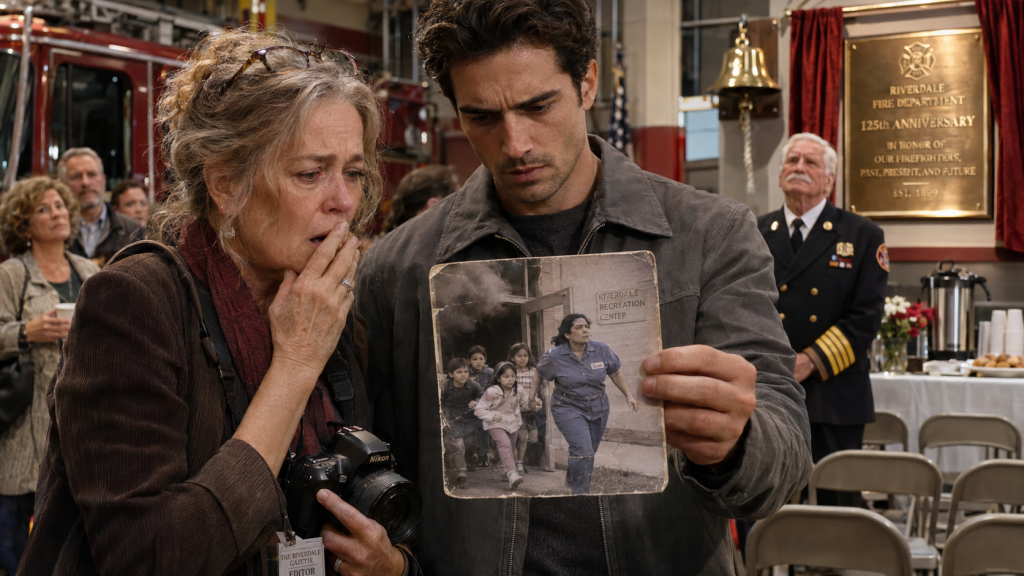
I took a photograph of the incident note before Theo folded it away.
Then I asked whether he’d be willing to come to my newspaper office the next morning.
He nodded.
Everett was still standing beside us.
For the first time in thirty-one years of reporting, I didn’t know how to look at a man I’d admired for decades.
He had responded to a dangerous fire.
He’d carried a frightened child to an ambulance.
Those things were true.
But another part of the story had been missing from every anniversary article I’d printed.
And the woman at the center of it had paid a price for that silence.
I turned toward Everett.
“I’d like to speak with you tomorrow too. On the record.”
He closed his eyes.
“Miriam, can we at least finish the ceremony?”
“Of course,” I said. “But the story isn’t finished.”
That evening, I went back to my office and pulled our old bound newspapers from the archive shelf.
The edition from twenty-five years earlier was easy to find.
There was Everett on the front page, holding Theo beneath a gray winter sky.
I remembered taking the photograph.
I remembered the noise of the generators and the smell of wet coats.
I had arrived after the children were safe.
Somebody from the fire department told me Everett had rescued them.
I’d repeated it in the caption without asking who had led them to the exit.
The following week’s paper hurt worse.
At the bottom of page six was a brief I had approved as the assistant editor.
Recreation center custodian relieved of duties following evacuation review.
The director was quoted saying staff had failed to remain at assigned posts.
The story never named any child who’d been harmed by that failure.
It never mentioned that all four children had already been outside when the first engine arrived.
And it never included a comment from Nita.
I sat alone in the newsroom, staring at eight lines of print.
At the time, I’d thought it was a routine personnel item.
Now I saw it differently.
Eight lines had helped an entire town decide what kind of employee Nita Flores was.
The next morning, Theo came to see me.
He brought the original photograph, the copied incident note, and a yellow envelope full of letters.
Some were from the other three children, all grown now.
One was from a former recreation center volunteer who remembered Nita calling for everyone to follow her toward the side door.
I asked whether Theo would let me contact the writers directly.
“Please,” he said. “I don’t want you to have to take my word for it.”
I respected that.
He told me his mother had taken the photograph while searching for him outside the building.
She’d kept it in a family album, too frightened by that night to look at it often.
When she died two years earlier, Theo found it among her things.
He started asking questions because the woman in the photograph wasn’t the one the town thanked every year.
“I don’t want to take anything away from the firefighters,” he told me. “They helped us. I remember being wrapped in a coat.”
“Then what do you want?”
He looked at the photograph.
“I want her to stop thinking she did something wrong.”
We found Nita living forty minutes away.
She was fifty-eight, working part-time in the kitchen of an assisted-living community.
When I called, she didn’t sound pleased.
“I already spoke to somebody from your newspaper once,” she said.
“I know,” I answered. “And we didn’t publish what you told us.”
There was a silence.
“You remember that?”
“I found the story. I was responsible for approving it.”
She sighed.
“What do you want from me now?”
“A chance to listen properly.”
Nita agreed to meet at a public library near her home.
She arrived wearing a plain green coat and carrying a cloth grocery bag.
She looked at the photograph before I asked a single question.
“That’s Theo,” she whispered.
Her finger rested on the small boy against her hip.
“He kept asking for his mother.”
I waited.
Nita described the night slowly.
She was cleaning the hallway outside the gym when she smelled smoke.
The main route to the front entrance was already becoming hard to see.
She pulled the alarm, called for help, and shouted for the children to follow her toward the side exit she’d used for deliveries.
Three children could walk.
Theo had frozen beside a bench.
She carried him because he wouldn’t let go of her shirt.
Once outside, she moved them away from the doorway and waited for the firefighters to arrive.
“I didn’t go back into the smoke,” she said. “I knew I’d only make another person somebody needed to rescue.”
Everett took Theo toward the ambulance.
Nita went to help a staff member count children on the lawn.
She hadn’t expected a medal.
“I expected to go back to work on Monday,” she said.
But the center director was upset that she’d left her assigned cleaning area and used a side exit rather than the posted main evacuation route.
Nita said she tried to explain that the main hallway was filling with smoke.
She wasn’t asked to provide a written statement for the initial public announcement.
Her shifts were suspended during a review, and her employment ended weeks later.
I asked whether she had challenged the decision.
“I tried,” she said. “But I had rent due and a little boy at home. I needed another job more than I needed a fight.”
She’d found work in another town.
She avoided the anniversaries.
When people praised Everett, she didn’t argue.
“I knew what happened,” she said. “Those children knew. I thought that would be enough.”
Then she opened her cloth bag.
Inside was a folded newspaper clipping from our old edition.
It had been read so many times the crease had nearly split.
“My son found this when he was thirteen,” she said. “He asked whether I’d really left children behind.”
Her voice broke.
“I could handle losing that job. I couldn’t handle my own child wondering if I was a coward.”
I looked down at the clipping.
My newspaper’s name was at the top.
I felt ashamed.
Not the kind of shame that makes you want to hide.
The kind that tells you something has to be repaired.
“Nita, I can’t give you back those years,” I said.
She nodded.
“I know.”
“But I can publish what the evidence supports. Including what we got wrong.”
She watched me carefully.
“Will it be another story where somebody else speaks for me?”
“No,” I said. “You can tell it in your own words. And I’ll verify every part I can.”
She agreed to an interview.
Before I left, she asked one question.
“Is Everett still saying he rescued all four?”
I thought about him standing beside that plaque.
“He admitted to me that you brought them outside,” I said.
Nita looked toward the library window.
“Then he’s had twenty-five years to say it where people could hear.”
I didn’t have an answer.
Because she was right.