➡️ PART 3 ➡️
For forty-two years, I had imagined that Arthur Pendelton walked out of our marriage and never gave me another thought. I imagined him building a happy life somewhere while I drove a yellow school bus through the back roads of Navarro County, carrying other people’s children because the doctors had told us I’d never carry one of my own.
I had made peace with that, or at least I thought I had. But now I stood in the American Legion hall in Waco, surrounded by the children I’d raised, staring at an envelope my former husband had written more than forty years earlier. The envelope was addressed to my mother. Not to me.
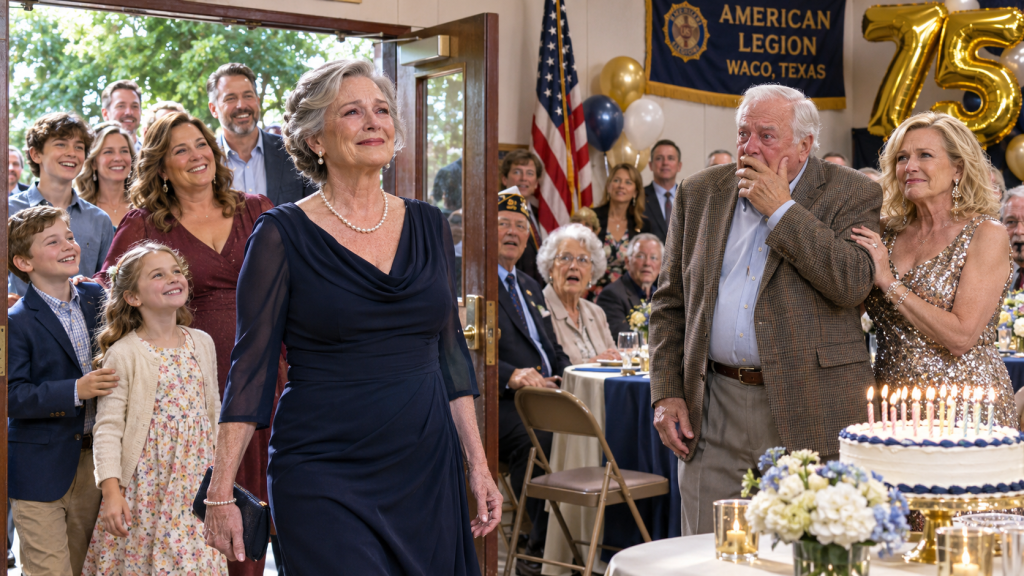
And that frightened me more than I wanted to admit. Michael held it carefully. “Mama, I think you should read this.” Arthur stood beside his birthday table, looking as though somebody had pulled the floor out from beneath him. “Where did you get that?” he whispered.
Michael glanced toward him. “Grandma Evelyn’s old sewing chest.” My heart tightened. Mama had died twelve years earlier. She’d kept every birthday card, every church bulletin, every school photograph. Apparently, she’d also kept a letter from the man who’d broken my heart.
I took the envelope.
The paper was yellowed.
The edges had softened with age.
Across the front, in Arthur’s handwriting, were the words:
Mrs. Evelyn Carter — Personal.
I swallowed.
Beatrice wasn’t inside the hall yet.
She’d said she wanted me to have my moment without her interfering.
But suddenly, I wished she’d come in.
I looked toward Arthur.
“Did you write this?”
He nodded slowly.
“Yes.”
“What does it say?”
His eyes filled.
“Martha, perhaps we should discuss it privately.”
I looked around at the eleven people standing behind me.
Daniel.
Ruth.
Michael.
Teresa.
Jonah.
And the others who had given my life its greatest meaning.
Then I looked back at Arthur.
“No, Arthur.”
My voice remained steady.
“You were perfectly comfortable telling me I couldn’t give you a real family.”
I lifted the envelope.
“Whatever you wrote afterward, I think I can bear to hear it.”
I unfolded the letter.
The first line was ordinary enough.
Dear Mrs. Carter,
I hope this finds you well.
Then came the sentence that made my fingers tighten.
I understand Martha has begun caring for a little boy through the county.
My heart stumbled.
November 1985.
Daniel had arrived that spring.
He was four years old, with a coat two sizes too big and a habit of hiding bread beneath his pillow.
I’d thought Arthur knew nothing about him.
I continued reading.
I am concerned that Martha may be making decisions out of loneliness rather than sound judgment.
My face grew warm.
The next line nearly stopped my breath.
I hope you will encourage her not to confuse raising another person’s child with having a family of her own.
The room went quiet.
Even Clara stopped whispering.
I read the sentence again.
Then again.
Forty-two years earlier, Arthur had told me I wasn’t enough because I couldn’t bear children.
A year later, when I’d opened my home to a frightened little boy, he’d apparently decided that wasn’t enough either.
I lowered the letter.
“Well,” I whispered.
Daniel stepped closer.
“Mama?”
I shook my head.
“I’m alright, baby.”
But I wasn’t entirely alright.
Because suddenly I remembered Daniel’s first Christmas.
He’d been afraid to ask whether Santa Claus would know where he’d moved.
I’d stayed up until two in the morning painting his name on a wooden toy box.
And all that time, Arthur had been writing letters suggesting the love I gave that child wasn’t real.
Arthur cleared his throat.
“Martha, I was young.”
I looked at him.
“You were thirty-five.”
He swallowed.
“I didn’t understand.”
I nodded slowly.
“No, you didn’t.”
Then I handed the letter back to Michael.
“But I did.”
Arthur frowned.
“What?”
“I understood that little boy needed somebody.”
I looked toward Daniel.
“And I understood I had room.”
Daniel’s eyes shone.
He was fifty years old now.
A fire chief.
A husband.
A father of three.
But in that moment, I could still see the little boy standing in my doorway, clutching a paper grocery bag containing everything he owned.
He’d looked at my living room and whispered, “Is this where I stay?”
I’d knelt beside him.
“For as long as you need, sweetheart.”
He’d studied me.
“Can I call you Miss Martha?”
“Of course.”
Six weeks later, he called me Mama.
He hadn’t asked permission.
And I hadn’t needed him to.
Clara gave a small, dismissive laugh.
“Well, Arthur couldn’t possibly have known how things would turn out.”
Ruth turned toward her.
“Ma’am, children aren’t investments.”
Clara blinked.
“Excuse me?”
Ruth’s voice remained gentle.
“Mama didn’t take us in because she thought we’d become successful adults.”
She looked toward me.
“She took us in because we needed someone to love us when we weren’t successful at anything except being scared.”
My throat tightened.
Ruth had been seven when she arrived.
Her mother was ill, and there was nobody available to care for her.
She barely spoke during her first month with me.
Then one afternoon, she brought home a drawing.
A little yellow school bus.
A blue house.
And two stick figures holding hands.
Above them, she’d written:
ME AND MY MAMA.
I’d kept that picture in my Bible for thirty-six years.
Arthur looked toward Ruth.
“You were adopted?”
She nodded.
“Eventually.”
He glanced at Daniel.
“And you?”
Daniel smiled faintly.
“Yes, sir.”
Michael stepped closer.
“Me too.”
Arthur stared at the three of them.
Then looked around at the others.
Teresa had come to me at twelve, after a difficult series of placements.
Jonah had lived with me from fourteen until graduation.
Others had stayed for shorter periods.
Some had reunited with relatives.
Some had gone on to build families of their own.
But most kept returning.
For Sunday dinners.
Christmas mornings.
Birthdays.
And the days when life became too heavy to carry alone.
That was why I still had so many stockings in the hall closet.
Not everyone who’d lived beneath my roof was legally my child.
But every one of them knew there was a place at my table.
One of Arthur’s sons approached us.
He was tall, with gray beginning at his temples.
“Excuse me,” he said quietly.
Arthur looked up.
“Peter, not now.”
But the man didn’t move.
He looked at me.
“Are you Martha?”
I nodded.
He held out his hand.
“I’m Peter Pendelton.”
We shook.
His grip was warm.
“I’ve heard about you.”
I smiled sadly.
“I imagine you have.”
He glanced toward his father.
“Not very much, actually.”
Arthur looked away.
Peter continued.
“Dad always said his first marriage ended because you didn’t want children.”
The words struck me so unexpectedly that I felt my knees weaken.
I stared at Arthur.
“What?”
Peter looked confused.
“That’s what he told us.”
For forty-two years, I’d carried the memory of Arthur telling me I couldn’t give him children.
Now I was hearing that he’d told his sons I hadn’t wanted any.
There is a particular kind of cruelty in being abandoned for something you desperately wished you could change, only to discover the person who left you rewrote the story afterward.
I looked toward Arthur.
“You told them that?”
His mouth opened.
Then closed.
Clara stepped forward.
“Arthur, you don’t have to explain your private life.”
I turned toward her.
“Actually, Clara, he doesn’t.”
She looked surprised.
I continued.
“I don’t need another explanation from Arthur.”
Then I looked at Peter.
“But I do want you to know something.”
My voice trembled.
“I wanted children very much.”
Peter’s face changed.
“I’m sorry.”
I nodded.
“Thank you.”
He looked toward his father.
For the first time that evening, I saw something in Arthur’s family that hadn’t been there when I arrived.
Questions.
Not about me.
About the stories they’d been told.
The birthday party continued awkwardly.
Some guests returned to their tables.
Others pretended to study the decorations.
The man holding the microphone quietly set it down.
Clara looked furious.
Arthur seemed twenty years older than he had when I entered.
I hadn’t come to ruin his birthday.
I certainly hadn’t expected a forty-year-old letter.
All I’d wanted was to stand beside the people who loved me and show that my life hadn’t ended when he left.
But sometimes the truth has a way of opening doors nobody intended to touch.
Daniel bent toward me.
“Mama, do you want to leave?”
I looked around.
Eleven people had driven from different cities to stand beside me.
Ruth had come from Austin.
Michael from Houston.
Teresa from San Antonio.
Jonah had rearranged a business trip.
They’d brought spouses, children, and photographs I hadn’t seen in years.
I smiled.
“No, baby.”
He nodded.
“What do you want to do?”
I looked toward the buffet.
“Well, I believe somebody promised barbecue.”
Daniel laughed.
The sound broke the tension.
And for the first time since entering that hall, I felt my shoulders relax.
We gathered around two tables near the windows.
Some of my children sat beside me.
Others stood nearby talking.
The younger ones laughed about childhood memories.
Michael reminded everybody about the time Daniel tried to build a bicycle ramp from my porch steps.
Daniel protested.
“It was a perfectly good ramp.”
“Until you landed in Mama’s tomato patch,” Ruth replied.
I laughed so hard I nearly spilled my sweet tea.
For a moment, I forgot Arthur was even in the room.
And that was when I realized something wonderful.
I hadn’t brought my family to prove anything.
I’d brought them because being with them felt like home.
Halfway through lunch, Peter approached our table.
“Mrs. Carter?”
I smiled.
“Martha is fine.”
He looked relieved.
“Could I sit?”
Daniel pulled out a chair.
“Sure.”
Peter glanced around the table.
“I hope I’m not intruding.”
Ruth smiled.
“At Mama’s table? There’s always room.”
My heart swelled.
Peter sat down.
For several minutes, he listened while the others talked.
Then he looked toward me.
“Can I ask you something?”
“Of course.”
“How did you become a foster parent?”
I thought about that spring afternoon in 1985.
The telephone call from the county.
The little boy with the oversized coat.
Then I smiled.
“Somebody asked if I had room.”
Peter nodded.
“And you did.”
I looked toward Daniel.
“Not nearly enough money.”
Everyone laughed.
“But plenty of room.”
Peter smiled sadly.
“My dad always talked about wanting a big family.”
I nodded.
“I remember.”
He hesitated.
“But he didn’t talk much about what happened before he married Mom.”
I looked toward Arthur.
He sat at the head table, staring at his untouched cake.
“Sometimes people find it easier to remember the version of a story that makes them feel comfortable.”
Peter lowered his eyes.
“I think I’m starting to understand that.”
Then something unexpected happened.
A woman in her sixties approached our table.
She wore a plain blue dress and carried a small handbag.
I recognized her immediately.
“Elaine?”
Her eyes filled.
“Martha?”
I stood.
Elaine Whitcomb.
Arthur’s younger sister.
I’d known her when she was a teenager.
She’d spent summer afternoons at our house, eating watermelon and complaining about school.
I hadn’t seen her in decades.
She hugged me tightly.
“Oh, Martha.”
I smiled.
“Look at you.”
She laughed through tears.
“Old as dirt.”
I squeezed her hand.
“Well, honey, that makes two of us.”
Elaine looked toward my family.
“Are these your children?”
I nodded proudly.
“Some of them.”
Her eyes widened.
“Good heavens.”
Then she whispered.
“I always wondered whether you found happiness.”
I smiled.
“I did.”
Her eyes filled.
“I’m glad.”
But when she looked toward Arthur, her expression changed.
There was something she wanted to say.
I could see it.
Finally, she leaned closer.
“Martha, can we talk?”
We stepped into the hallway.
The music from the ballroom floated through the closed doors.
Elaine clutched her handbag.
“I didn’t know Arthur invited you.”
I nodded.
“I was surprised myself.”
She looked ashamed.
“There’s something I should’ve told you years ago.”
My stomach tightened.
“Elaine, what?”
She swallowed.
“After the divorce, Mama found a letter from the clinic.”
I frowned.
“What clinic?”
“The doctors you and Arthur saw in Dallas.”
I stared at her.
Those appointments had nearly destroyed me.
Two doctors.
Two sets of tests.
And the same terrible conclusion Arthur had repeated until I believed it was my fault.
“What letter?” I whispered.
Elaine looked toward the floor.
“One addressed to Arthur.”
My hands began trembling.
“What did it say?”
She swallowed.
“That the medical findings weren’t as simple as he’d told you.”
For several seconds, I couldn’t speak.
The hallway seemed to grow colder.
“Elaine, explain.”
She took a shaky breath.
“I never saw the entire medical report.”
I nodded.
“Then what did you see?”
“A letter saying further testing was recommended for both of you.”
My heart tightened.
“And?”
“Arthur didn’t want to go back.”
I stared at her.
“Why?”
She hesitated.
“Because one of the doctors had raised concerns about his own fertility.”
I felt the blood drain from my face.
For forty-two years, I’d believed Arthur left because I couldn’t have children.
That belief had shaped my twenties.
My marriage.
My grief.
Even the way I’d looked at myself for years afterward.
And now Elaine was telling me that the medical story hadn’t been complete.
I leaned against the wall.
“Are you certain?”
She nodded.
“About the recommendation, yes.”
I swallowed.
“But you don’t know what the final results would’ve shown.”
“No.”
Elaine’s eyes filled.
“I don’t want to pretend I know more than I do.”
I appreciated that.
But my heart was pounding so hard I could barely hear her.
I remembered Arthur sitting beside me in the doctor’s office.
His hand resting on my knee.
The way he’d looked toward the physician and asked whether there was anything else to try.
Then the drive home.
His silence.
The way he’d begun sleeping farther away from me.
I had interpreted every change as disappointment.
What if some of it had been fear?
What if he’d been terrified that the problem wasn’t mine alone?
What if blaming me had been easier than facing uncertainty about himself?
Elaine reached for my hand.
“Martha, I’m sorry.”
I looked toward her.
“Why didn’t you tell me?”
Her face crumpled.
“I was young. Mama said it was none of our business.”
I nodded slowly.
She continued.
“By the time I understood what it might mean, you’d moved on.”
I looked toward the ballroom.
Forty-two years.
All those years spent carrying blame that might never have belonged entirely to me.
I took a long breath.
“Elaine, thank you for telling me.”
She wiped her cheeks.
“Are you angry?”
I thought about it.
Then answered honestly.
“A little.”
She nodded.
“But mostly?”
I swallowed.
“Mostly I’m sad for the young woman who believed she was broken.”
When we returned to the ballroom, Arthur was standing near the birthday cake.
He saw my face.
Then looked toward Elaine.
Something changed in his expression.
“Martha?”
I approached him.
“We need to talk.”
Clara stepped closer.
“Not again.”
I looked at her.
“This isn’t about you.”
She opened her mouth.
Then closed it.
Arthur glanced toward his sister.
“Elaine, what did you tell her?”
Elaine stood straighter.
“The truth about the clinic letter.”
Arthur’s face went white.
For several seconds, nobody moved.
Then Arthur whispered.
“You had no right.”
Elaine’s eyes filled.
“She had a right to know.”
I looked directly at him.
“Arthur, did the doctors recommend further testing for you?”
He stared at me.
His hands began shaking.
“Martha…”
“Yes or no?”
He lowered his head.
“Yes.”
My heart seemed to stop.
I stood motionless.
Not because the answer changed the family standing behind me.
But because it changed the story I’d told myself for forty-two years.
I swallowed.
“Did you know there were questions about your fertility?”
Arthur nodded.
“Yes.”
I closed my eyes.
“And you let me believe it was all my fault.”
He began crying.
“I was ashamed.”
For a moment, the room seemed to disappear.
I could see our little kitchen in Corsicana.
The duffel bag.
The pickup truck.
The young woman standing by the sink, wondering what she could have done differently.
Arthur whispered.
“I thought if I started over, things would be different.”
I opened my eyes.
“And were they?”
He looked toward his three sons.
His expression tightened.
“Yes.”
I nodded slowly.
Because that was the complicated part.
Arthur had gone on to have three children with Clara.
Whatever questions the doctors raised decades earlier, his later life had included the biological family he wanted.
But that didn’t change what he’d done to me.
He’d blamed me for uncertainty he hadn’t been willing to face.
And he’d allowed that blame to become the story everyone knew.
“Martha,” he whispered, “I was wrong.”
I looked at him.
“Yes.”
His eyes filled.
“I should’ve told you.”
“Yes.”
He reached toward me.
I stepped back gently.
Not because I hated him.
But because there are apologies that need to be heard without immediately turning into forgiveness.
Clara suddenly spoke.
“Arthur, you don’t have to stand here and let them humiliate you.”
Peter turned toward his mother.
“Mom.”
She looked at him.
“What?”
He swallowed.
“Please.”
Clara stared at her son.
Then at the people surrounding me.
Her face tightened.
“I don’t understand why everybody’s acting like Martha is some kind of saint.”
I took a breath.
“Nobody said I was.”
She folded her arms.
“You came here with an entire crowd.”
I nodded.
“Yes.”
“To embarrass us.”
I shook my head.
“No, Clara.”
Then I looked toward Daniel, Ruth, Michael, and the others.
“I came with my family.”
The room went silent again.
But this time, the silence felt different.
Not cruel.
Not tense.
Simply honest.
Then Jonah stepped forward.
He was forty-three now, a quiet man who owned a construction business outside Austin.
When he came to live with me at fourteen, he barely spoke.
He’d been passed between relatives so often that he didn’t unpack his suitcase for three weeks.
One evening, I’d found him sitting on the back steps.
“Why don’t you put your clothes away?” I’d asked.
He’d shrugged.
“Because I’ll probably be leaving.”
I’d sat beside him.
“Well, honey, if you do, we’ll pack them again. But while you’re here, there’s a drawer with your name on it.”
He’d cried that night.
The first time I’d ever seen him cry.
Now Jonah stood beside me.
“Mrs. Pendelton,” he said gently, “Mama didn’t bring us to embarrass anybody.”
Clara looked irritated.
“Then why?”
He smiled sadly.
“Because somebody told her to come see what a real family looks like.”
He gestured toward our table.
“So we came.”
My eyes filled.
Jonah continued.
“Some of us stayed with Mama for a few years. Some stayed forever.”
He looked toward me.
“But none of us ever wondered whether we mattered.”
Then he whispered.
“That’s what a real family looks like to me.”
I covered my mouth.
Daniel stepped beside him.
Ruth took my hand.
Michael stood behind my chair.
And for a moment, the crowded ballroom became something small and beautiful.
A circle of people who had chosen one another.
Arthur sank slowly into a chair.
He looked toward Daniel.
Then toward me.
Finally, he whispered.
“Martha, I never knew you built all this.”
I smiled through tears.
“Arthur, I didn’t build it alone.”
I looked toward the people surrounding me.
“They helped build it too.”
The birthday party eventually began winding down.
Guests gathered coats.
The cake was cut.
People spoke quietly near the doors.
I hadn’t planned to stay long.
But as I prepared to leave, Peter approached me again.
“Martha?”
I smiled.
“Yes?”
He looked uncomfortable.
“Can I ask you something personal?”
I nodded.
He swallowed.
“Do you hate my father?”
I looked toward Arthur.
The man I’d once loved.
The man who’d hurt me more deeply than anyone else.
The man whose approval I’d once believed determined my worth.
Then I looked back at Peter.
“No, sweetheart.”
His shoulders relaxed.
I continued.
“But I don’t excuse what he did.”
Peter nodded slowly.
“That makes sense.”
I smiled.
“Sometimes forgiveness and accountability have to stand beside each other.”
Then Peter said something that surprised me.
“My daughter works with foster families.”
I looked up.
“Really?”
He nodded.
“She’s a social worker in Dallas.”
My heart warmed.
“Well, isn’t that wonderful.”
He smiled.
“She’d love to meet you.”
I laughed softly.
“Tell her to come by sometime. I’ll feed her.”
Peter smiled.
“You’re serious?”
I nodded.
“Honey, I spent half my life feeding people who arrived at my door without warning.”
He laughed.
Then hugged me.
And in that moment, I realized Arthur’s children weren’t responsible for their father’s mistakes.
They had their own lives.
Their own hearts.
And perhaps their own understanding of what family could mean.
Outside, the evening air was cool.
Beatrice stood beside her car, pretending she hadn’t been watching through the window.
“Well?” she asked.
I smiled faintly.
“Well, what?”
She folded her arms.
“Did you show that man a real family?”
I looked behind me.
Daniel was helping Ruth gather the younger children’s coats.
Michael was carrying leftover cake.
Teresa was laughing at something Jonah said.
And several little voices were calling, “Grandma Martha!”
My eyes filled.
“Yes,” I whispered.
“I believe we did.”
Beatrice opened the passenger door.
Then she looked at me carefully.
“Something else happened.”
I nodded.
“A few things.”
She waited.
I told her about Arthur’s letter.
About the clinic.
About the years of blame.
When I finished, Beatrice stood motionless.
Then she whispered.
“That old fool.”
I laughed through tears.
“Beatrice.”
She shook her head.
“No, ma’am. I’ve been polite about Arthur for forty-two years. I’ve earned one.”
I laughed harder.
And suddenly, some of the heaviness inside me began to lift.
On the drive home, I watched the dark Texas highway stretch ahead.
The same highway I’d traveled countless times in a yellow school bus.
The same roads where I’d carried children to school before the sun came up.
And the same state where I’d once believed my life would always be defined by something I couldn’t do.
Now I thought about the children waiting for me at Christmas.
The grandchildren who filled my kitchen with noise.
The old photographs.
The mismatched stockings.
The telephone calls that came every Sunday.
I smiled.
For forty-two years, Arthur had believed he’d left a woman who couldn’t give him a family.
But the truth was far more beautiful.
He’d left a woman who hadn’t yet discovered how many people she would become a mother to.
Then, just as Beatrice turned onto the road toward Corsicana, my phone rang.
It was Michael.
“Mama?”
“Yes, baby?”
His voice sounded strange.
“There’s something else in Grandma Evelyn’s box.”
My stomach tightened.
“What?”
He hesitated.
“A second envelope.”
I closed my eyes.
“From Arthur?”
“No.”
My heart began pounding.
“Then who?”
Michael took a slow breath.
“From the clinic in Dallas.”
For several seconds, I couldn’t speak.
Then he whispered.
“Mama, I think Grandma kept the actual medical report.”
I stared through the windshield.
The road stretched dark before us.
Beatrice glanced toward me.
“What is it?”
I held the telephone tighter.
Michael continued.
“There’s a page here with your name on it.”
My heart pounded.
“And?”
He hesitated.
Then said something that made my breath catch.
“Mama, it says the doctors never confirmed you were unable to have children.”
For forty-two years, I’d carried a verdict that had shaped my entire life.
I’d believed my body had failed my marriage.
I’d believed Arthur left because I couldn’t give him what he wanted.
Now, sitting beside my sister on a dark Texas highway, I was hearing that the original medical records might tell a very different story.
I swallowed.
“Michael, don’t lose those papers.”
His voice softened.
“I won’t, Mama.”
I looked toward the stars.
Then whispered.
“Because I think it’s finally time I learned what those doctors actually said.”