My parents skipped my wedding because I would not reschedule it around my sister’s Bali getaway. My father said maybe this was the lesson I needed to learn respect and humility. I kept my head up,
walked down the aisle without them, and smiled through the reception like none of it hurt. Then my husband rose to his feet in front of 200 guests and said a single sentence that stopped every conversation in the room.
My name is Claire Bennett, and the day I got married should have been the happiest day of my life. Instead, it became the day I finally understood that my parents had never seen me as a daughter with equal worth. I was thirty-one years old, standing in a silk wedding gown in a vineyard venue outside Napa, staring at two empty front-row seats that had been reserved for my mother and father, and trying not to let two hundred guests watch my heart break in real time.
The fight had started three months earlier when my younger sister, Madison, announced that she had booked a luxury Bali wellness retreat with her friends during the same week as my wedding. My venue had been locked in for over a year. Deposits were paid. Flights were booked. Guests had arranged childcare, hotels, and time off work. But my parents still called and asked me to move the date.
Not asked. Expected.
My father, Robert Bennett, said family should come before pride. My mother said Madison had been planning her retreat for months and it would be selfish of me to make her choose. I reminded them that this was my wedding, not a brunch, not a birthday dinner, not something that could just slide to another weekend because my sister wanted ocean-view yoga and cocktail photos. That was when my father’s voice turned cold. He said maybe refusing to compromise was exactly why I needed to learn humility.
Then he said if I would not move the date, they would not come.
I waited for my mother to stop him. She did not.
I still went through with everything. I finalized the seating chart. I met with the florist. I smiled through my bridal shower even while relatives asked careful questions about whether my parents were “coming around.” On the morning of the wedding, my maid of honor helped zip me into my dress while my phone stayed silent. No message from my mother. No apology. No last-minute change of heart.
When I walked down the aisle, I did it alone.
My fiancé, Ethan Cole, was waiting for me at the end in a black tuxedo, his eyes locked on mine with the kind of steady love that kept me upright. We said our vows under bright California sunlight while people cried and smiled and took photos, but every now and then my eyes drifted toward those two empty chairs.
At the reception, I told myself I would hold it together until the night was over. I laughed when expected. I thanked guests. I cut the cake. I danced. I did not beg. I did not cry.
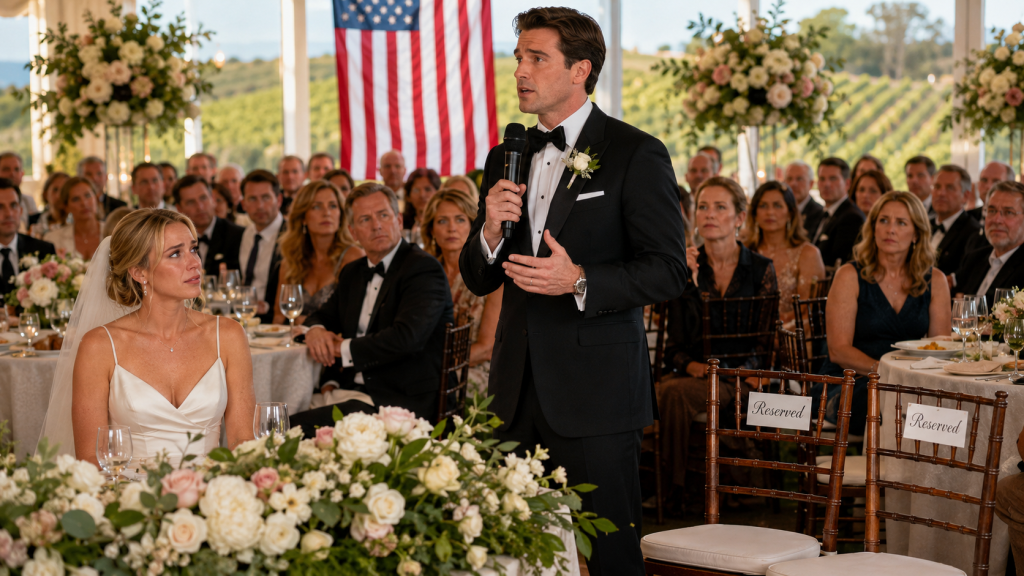
Then, halfway through dinner, Ethan stood up and tapped his glass.
The room went quiet.
He looked at all two hundred guests, then at the two empty seats in the front, and said, Since the people who should have stood by Claire chose not to come, there’s something everyone here deserves to know.
That was the moment my pulse stopped.
And the entire room leaned in..
PART 2: THE SENTENCE MY HUSBAND SAID IN FRONT OF TWO HUNDRED PEOPLE
Ethan stood beneath the warm string lights with one hand around his champagne glass and the other resting lightly against the back of his chair.
Two hundred people turned toward him.
Forks lowered.
Conversations stopped.
Even the servers near the kitchen doors slowed.
I sat beside him with my heart beating so hard that I could feel it in my throat.
He looked first at me.
Then at the two empty chairs near the front of the room.
And he said,
“Since the people who should have stood by Claire chose not to come, there’s something everyone here deserves to know.”
The room became completely still.
I stared at him.
“Ethan…”
He squeezed my shoulder.
Not to silence me.
To steady me.
Then he looked back at our guests.
“Claire’s parents did not miss this wedding because of a scheduling conflict.”
My stomach tightened.
“They did not miss it because of illness.”
“They did not miss it because of travel problems.”
He paused.
“They chose not to come because Claire refused to move her wedding around her sister’s vacation.”
A murmur moved through the room.
Not loud.
Just enough.
Shock has a sound.
So does disbelief.
My face grew hot.
I had spent three months protecting my parents from this exact moment.
Whenever relatives asked, I softened the story.
I said there had been a family disagreement.
I said travel plans were complicated.
I said maybe things would work themselves out.
I had carefully carried their embarrassment for them.
And suddenly Ethan had set it down in the middle of the room.
I whispered,
“You don’t have to do this.”
He looked at me.
“Yes, I do.”
His voice was soft.
Then he turned back toward everyone.
“Claire asked me not to say anything.”
My eyes filled.
“She told me tonight was supposed to be about joy.”
He smiled sadly.
“That is exactly why I’m saying it.”
My throat closed.
Ethan continued.
“For three months, I watched the woman I love apologize for having a wedding date.”
A few people lowered their eyes.
“She kept asking whether maybe she had been too stubborn.”
“Whether she should have tried harder.”
“Whether she had somehow caused this.”
His voice changed.
Not louder.
Stronger.
“So I need everyone here to understand something.”
“Claire did not cause two empty chairs.”
My breath caught.
“Two adults made a choice.”
The words landed hard.
Not cruel.
Clear.
That was almost worse.
My mother’s brother, Uncle David, slowly lowered his wine glass.
My cousin Rebecca covered her mouth.
Ethan continued.
“And there is something else.”
My heart stopped.
I turned toward him.
“What?”
He looked at me.
There was hesitation in his face now.
A question.
I realized he was asking permission without words.
I could have stopped him.
Maybe I should have.
Instead, I nodded.
Barely.
Ethan exhaled.
Then reached into the inside pocket of his tuxedo.
He removed a folded piece of paper.
My stomach dropped.
I recognized it immediately.
A printed email.
One I had seen two nights earlier.
One I had cried over in our apartment while Ethan sat beside me on the kitchen floor.
He unfolded it.
“This email was sent by Claire’s father six weeks ago.”
The room tightened around me.
He did not read everything.
Thank God.
Only one part.
“Robert wrote that if Claire refused to move the wedding, then maybe missing it would finally teach her that family decisions have consequences.”
My eyes closed.
Hearing the sentence aloud was different.
On a screen, words can still feel distant.
In a ballroom full of people who loved me, they became real.
Ethan continued.
“And then he wrote…”
He paused.
His jaw tightened.
“Madison has always been the one who needs us more. Claire is strong. She’ll get over it.”
That one broke me.
Not visibly.
Not at first.
I sat completely still.
But inside, something split.
Claire is strong.
I had heard versions of that sentence my entire life.
Claire is responsible.
Claire understands.
Claire can handle it.
Claire doesn’t need as much.
Words adults use when they want one child to carry what they would never ask another child to hold.
I had once thought being called strong was praise.
Maybe sometimes it was.
But in my family, strength had become an invoice.
Every compliment came with a cost.
Because Claire was strong, Madison got comfort.
Because Claire understood, Madison got exceptions.
Because Claire was mature, Madison got forgiveness.
And because Claire would “get over it,” my parents could skip my wedding.
I felt Ethan take my hand.
His thumb moved slowly across my knuckles.
Then he said,
“There is one thing Robert Bennett was right about.”
The room went silent again.
I looked at him.
Even I did not know what was coming.
Ethan turned toward me.
“Claire is strong.”
My eyes filled.
“But not because she can survive being hurt.”
His voice cracked.
“She is strong because after being hurt, she still knows how to love without becoming cruel.”
That did it.
My first tear fell.
I looked down.
Ethan continued.
“She is strong because she walked down that aisle alone without turning her wedding into a punishment for anybody.”
Another tear.
“She is strong because she spent three months defending people who did not show up to defend her.”
My shoulders started shaking.
“And she is strong because even tonight, she asked me not to embarrass them.”
He looked toward the empty chairs.
“I’m not saying this to embarrass anyone.”
His voice became quieter.
“I’m saying it because silence has been making Claire carry responsibility that never belonged to her.”
The room stayed still.
Then Ethan raised his glass.
“To my wife.”
His eyes found mine.
“To the woman who no longer has to earn love by being the easiest person in the room to disappoint.”
I broke.
Not dramatically.
No collapse.
No sob that silenced the ballroom.
I simply covered my mouth and cried.
The room rose.
All at once.
Two hundred people stood.
Glasses lifted.
Someone started clapping.
Then everyone did.
I had never felt more exposed in my life.
And somehow—
never more protected.
Ethan sat down.
I turned toward him.
“You told them.”
He looked worried.
“Are you angry?”
“Yes.”
His face fell.
I laughed through tears.
“And no.”
He smiled cautiously.
“Helpful.”
“I’m still deciding.”
“Fair.”
I leaned closer.
“You should have warned me.”
“I tried.”
“When?”
“Yesterday.”
“You asked whether public truth was still truth.”
He smiled.
“That was your warning?”
“I’m subtle.”
“You are not subtle.”
That made me laugh.
The room began breathing again.
People sat.
Conversations restarted.
Music returned.
But something had changed.
Not around me.
Inside me.
For the first time, everyone knew.
Not my edited version.
Not the polite version.
The truth.
And I was still sitting there.
The ceiling had not fallen.
My parents had not magically become more right because people learned what they did.
I had spent three months afraid that if people knew the whole story, they would judge me.
Instead, they looked at the empty chairs.
And understood.
That should have been the end of it.
It wasn’t.
Ten minutes later, my phone started vibrating inside my clutch.
Once.
Then again.
Then again.
I knew before I looked.
Mom.
Three missed calls.
Dad.
Two.
Madison.
Seven messages.
I stared at the screen.
Ethan noticed.
“Do you want me to take it?”
“No.”
“You sure?”
“Yes.”
I opened Madison’s messages.
The first said:
What did Ethan just do?
The second:
People are texting me.
Then:
Why are you telling everyone our private family business?
I almost laughed.
Not because it was funny.
Because even from Bali, Madison had managed to make my wedding about what people were saying to her.
Another message:
Dad is furious.
Then:
Mom is crying.
And finally:
Claire, call us NOW.
I locked the phone.
Set it face down.
Ethan looked at me.
“What did she say?”
“Apparently Mom is crying.”
His expression hardened.
I touched his hand.
“Don’t.”
“What?”
“Do the thing where you get angry enough for both of us.”
He exhaled.
“Fine.”
“You’re terrible at fine.”
“I know.”
I looked around the room.
My friends laughing.
Ethan’s parents dancing badly near the edge of the floor.
My maid of honor, Natalie, wiping tears while pretending she had allergies.
My cousin Rebecca pouring wine for Uncle David.
Two hundred people who had chosen to be there.
Chosen.
That word mattered.
I whispered,
“I don’t want to call them tonight.”
Ethan nodded immediately.
“Then don’t.”
No guilt.
No lecture.
No warning about consequences.
Just:
Then don’t.
I think that was when I began understanding how unfamiliar respect had become to me.
The reception continued.
And somehow, after Ethan’s speech, I stopped checking the empty chairs.
They were still there.
But they no longer looked like evidence that I had failed.
They looked like exactly what they were.
Seats my parents had chosen not to fill.
That difference changed the entire night.
I danced with Ethan.
I ate cake.
I laughed when one of his college friends split his pants trying to do a terrible spin.
I danced with Uncle David when he quietly asked if he could stand in for my father.
At first, I almost said no.
Then I said yes.
Halfway through the song, Uncle David whispered,
“I’m sorry.”
I looked up.
“For what?”
“For not calling Robert sooner.”
My throat tightened.
“Uncle David…”
“No.”
He shook his head.
“I heard a version of the argument.”
“I thought everyone was being dramatic.”
“I figured they’d show up.”
His eyes filled.
“I should have asked you what was actually happening.”
I swallowed.
“It wasn’t your responsibility.”
“No.”
He nodded.
“But you’re family.”
“And maybe all of us got too comfortable assuming you’d be okay.”
There it was again.
Strong Claire.
Reliable Claire.
Claire will get over it.
I rested my head briefly against his shoulder.
“Thank you for saying that.”
After the song, Rebecca hugged me.
Then my mother’s cousin.
Then two family friends.
No one made a scene.
No one insulted my parents.
That mattered.
They simply looked at me differently.
Or maybe I finally stopped looking at myself through my parents’ eyes.
At 11:48 p.m., the reception ended.
Ethan and I walked through a tunnel of sparklers.
For forty seconds, everything was light.
Pure light.
People cheering.
Ethan’s hand around mine.
My dress brushing the stone path.
The smell of smoke and lavender.
I remember thinking:
I will not let their absence become the most important thing I remember.
That felt like rebellion.
We reached our car.
I turned around once.
The vineyard glowed behind us.
Then my phone rang.
Dad.
I looked at Ethan.
He said nothing.
My decision.
That mattered too.
I answered.
“Hello.”
My father did not say congratulations.
He did not ask whether I was happy.
He said,
“What the hell was that?”
I closed my eyes.
“Hello to you too, Dad.”
“You humiliated us.”
Ethan’s jaw tightened.
I held up one finger.
Let me.
Dad continued.
“I have spent the last hour getting messages from relatives.”
“And?”
“And you allowed your husband to publicly attack your family.”
“No.”
“What would you call it?”
“The truth.”
Silence.
Then his voice turned cold.
“You always have to make everything dramatic.”
I stared out the car window.
For thirty-one years, that sentence would have made me panic.
Explain.
Apologize.
Tonight it only made me tired.
“I didn’t make you miss the wedding.”
“That was your choice.”
“You forced the situation.”
“How?”
“You knew Madison couldn’t make your date.”
“No.”
I laughed softly.
“Madison chose not to make my date.”
“She had already paid for Bali.”
“And I had already paid for a wedding.”
“That is not the same.”
“Why?”
He stopped.
Because there was no good answer.
I continued.
“Why did her vacation automatically matter more?”
“It wasn’t about more.”
“Yes.”
“It was.”
“Claire—”
“No.”
My voice remained calm.
“That is what I finally understand.”
“It was always more.”
“Her disappointment mattered more.”
“Her plans mattered more.”
“Her comfort mattered more.”
“And whenever I noticed, you called me selfish for keeping score.”
My father breathed heavily.
“You’re twisting your entire childhood over one wedding.”
My eyes filled.
“No.”
“The wedding just gave me a date I could point to.”
Silence.
I continued.
“Do you remember my college graduation?”
“What does that have to do with anything?”
“Madison had a dance competition.”
He said nothing.
“You and Mom left before my name was called.”
“She was fifteen.”
“I was twenty-two.”
“We were trying to support both of you.”
“No.”
“You supported her.”
“You told me I would understand.”
My father said nothing.
“What about my thirtieth birthday?”
“Madison had just broken up with someone.”
“Mom spent half my dinner on the phone with her.”
“That’s ridiculous.”
“It was her fiancé.”
“They had been dating four months.”
“Claire.”
“What about when I got promoted?”
I continued.
“You told me not to talk about it too much because Madison was struggling with work.”
My voice broke.
“Do you know what Mom said when I bought my first condo?”
Silence.
“She said not to mention the price because Madison was sensitive.”
I swallowed.
“Everything good in my life came with instructions about how to make it smaller.”
Dad went quiet.
For the first time.
Really quiet.
I whispered,
“And somehow, I still thought if I was easy enough, patient enough, understanding enough…”
My eyes filled.
“…eventually you would show up for something that belonged entirely to me.”
The silence on the other end felt enormous.
Then Dad said,
“We did our best.”
There it was.
The sentence parents use when the past becomes uncomfortable.
Maybe it was even true.
But best effort does not erase impact.
I answered softly.
“I believe you.”
He seemed surprised.
“You do?”
“Yes.”
“And your best still hurt me.”
He had no answer for that.
Then my mother’s voice appeared in the background.
“Give me the phone.”
A moment later:
“Claire?”
Her voice was already crying.
My body responded automatically.
Guilt.
Immediate.
Old.
Deep.
I hated that.
“Hi, Mom.”
“How could you let Ethan say those things?”
I almost laughed.
“Were they false?”
“That isn’t the point.”
“It is for me.”
“Family issues should remain private.”
“Why?”
“Because people don’t understand context.”
“Then explain the context.”
Silence.
“What context makes it reasonable to skip your daughter’s wedding because your other daughter booked a vacation?”
Mom started crying harder.
“That is not what happened.”
“Then tell me what happened.”
“We were trying not to abandon Madison.”
I stared out the window.
“By abandoning me.”
“No.”
Her answer came too fast.
I closed my eyes.
“Mom.”
Silence.
“Say it.”
“What?”
“Say what happened.”
“Claire…”
“Please.”
My voice cracked.
“Just once.”
“Don’t explain.”
“Don’t soften.”
“Say it accurately.”
I waited.
A long time.
Then my mother whispered,
“We chose not to attend your wedding because Madison could not attend.”
My eyes filled.
There.
Truth.
Plain.
No humility.
No respect.
No compromise.
Just choice.
I breathed.
“Thank you.”
She started crying.
“For what?”
“For finally saying it.”
Then she said something I did not expect.
“I’m ashamed.”
My stomach tightened.
Dad spoke somewhere behind her.
“Elaine.”
She ignored him.
“I’m ashamed.”
My mother repeated it.
“Mom…”
“No.”
She inhaled shakily.
“I kept telling myself you would forgive us.”
The sentence cut deeper than anger.
She continued.
“I thought because you always did…”
She stopped.
I waited.
“You counted on me getting over it.”
I whispered.
“Yes.”
Mom cried.
“I think we did.”
There it was again.
That pattern.
My reliability weaponized against me.
I closed my eyes.
“I need some space.”
My father’s voice sharpened in the background.
“Space? After what you did tonight?”
Mom said,
“Robert, stop.”
The car went silent.
Even Ethan looked surprised.
Dad said something I could not hear.
Then Mom returned.
“Okay.”
I opened my eyes.
“What?”
“If you need space.”
Her voice shook.
“We’ll give it to you.”
That was the first boundary my mother had ever accepted without arguing.
Maybe because she had finally seen two empty chairs through other people’s eyes.
Maybe because public embarrassment had done what my private pain could not.
I did not know.
And I did not want to build hope too quickly.
“Thank you.”
We ended the call.
I sat completely still.
Ethan reached for my hand.
“How do you feel?”
I thought.
“Sad.”
“That’s allowed.”
“Relieved.”
“Also allowed.”
“Angry.”
“Definitely allowed.”
I laughed through tears.
Then I looked at him.
“You really had to read the email?”
He winced.
“I may have overcommitted.”
“Yes.”
“I’m sorry.”
I stared.
He looked genuinely worried.
I squeezed his hand.
“I’m glad you did.”
His face softened.
“But if you ever surprise me with a public family intervention again…”
“I will consult counsel.”
“You are counsel.”
“Then we’re doomed.”
I laughed.
And for the first time that day, laughter did not feel like performance.
Two days later, while Ethan and I were still at the hotel before leaving for our honeymoon, Madison called.
I considered ignoring her.
Then answered.
“Hi.”
She did not greet me.
She said,
“You made everyone hate me.”
I closed my eyes.
There was my sister.
“People don’t hate you.”
“You don’t know that.”
“Aunt Rebecca sent me a paragraph about priorities.”
I almost smiled.
“That does sound like Rebecca.”
“This isn’t funny.”
“No.”
“It isn’t.”
Madison’s voice cracked.
“I didn’t ask Mom and Dad to skip.”
I froze.
That mattered.
“Okay.”
“I didn’t.”
She repeated it.
“I asked if you could move the wedding.”
“Yes.”
“You said no.”
“Yes.”
“Then Dad said they wouldn’t come.”
I sat straighter.
“And what did you say?”
Silence.
There it was.
The real question.
Madison whispered,
“Nothing.”
I looked down.
“Why?”
“Because I was angry.”
At least she was honest.
“I thought you were making a point.”
“What point?”
“That your wedding mattered more than me.”
My chest tightened.
“Madison.”
“I know.”
She started crying.
“I know how stupid that sounds now.”
I waited.
She continued.
“You always got things right.”
I frowned.
“What?”
“School.”
“Jobs.”
“Your apartment.”
“Ethan.”
“You always knew what you were doing.”
I almost laughed.
That was so far from how I had experienced my life.
Madison continued.
“And Mom and Dad always told me you didn’t need as much help.”
My throat tightened.
There it was.
The other side of the family system.
I had been told:
Claire is strong.
Madison had been told:
Claire doesn’t need us.
Those messages can damage both children in different ways.
She whispered,
“I think I started believing your needs were optional.”
I closed my eyes.
That sentence hurt because it was precise.
Not that Madison hated me.
Not that she wanted to destroy my wedding.
She had simply learned that my disappointment cost less.
I asked,
“Did you enjoy Bali?”
She sounded confused.
“What?”
“Did you?”
A pause.
“No.”
That surprised me.
“Why?”
“Because after the wedding pictures started coming in, I felt sick.”
My eyes filled.
“I saw the photo of you walking down the aisle.”
I swallowed.
“And?”
“You were alone.”
Her voice broke completely.
“I kept thinking Dad was supposed to be beside you.”
I said nothing.
Madison cried.
“I’m sorry.”
Not enough to fix everything.
Enough to start.
I asked,
“What are you sorry for?”
Silence.
Then she answered carefully.
“For asking you to move the wedding.”
“For treating my vacation like it was equal to your marriage.”
“For staying quiet when Dad said they wouldn’t come.”
“And for letting Mom and Dad make you the difficult one because that made things easier for me.”
My throat tightened.
Good apology.
Specific.
No “if.”
No “but.”
I wiped my eyes.
“Thank you.”
“Do you forgive me?”
I hated that question.
Not because she had no right to ask.
Because I did not know.
“I love you.”
She became quiet.
“That’s not what I asked.”
“I know.”
I took a breath.
“I’m not ready to decide what forgiveness looks like yet.”
She cried again.
But she said,
“Okay.”
That mattered.
No demand.
No accusation.
Just okay.
Then she whispered,
“I sent you something.”
“What?”
“Open your email.”
I did.
A flight confirmation.
Bali to San Francisco.
Arrival three days later.
I stared.
“What is this?”
“I’m coming home.”
“Why?”
“I need to talk to Mom and Dad.”
My stomach tightened.
“About what?”
“About all of it.”
“No.”
I sat straighter.
“Madison, don’t go home and fight for me.”
“I’m not.”
“Then what are you doing?”
She took a breath.
“I’m going to stop letting them tell the story like you caused this.”
That landed.
Hard.
I closed my eyes.
“Thank you.”
After we hung up, Ethan asked,
“What happened?”
“My sister is voluntarily leaving Bali early.”
He placed a hand against my forehead.
“Do you have a fever?”
I laughed.
Then cried.
Again.
Apparently marriage involved an unreasonable amount of crying.
We left for our honeymoon the next morning.
Five days in Maui.
Nothing dramatic.
Beach.
Food.
Sleep.
For the first twenty-four hours, I kept checking my phone.
Then Ethan confiscated it.
“You cannot spend our honeymoon emotionally monitoring your parents.”
“I’m not.”
“You refreshed your messages nine times during breakfast.”
“I was checking weather.”
“You have a window.”
Fair.
So I put the phone away.
And something strange happened.
I started enjoying being married.
Not recovering from the wedding.
Not processing my parents.
Married.
Ethan burned his shoulders on day two because apparently SPF 30 was “basically armor.”
I mocked him mercilessly.
We ate shrimp from a roadside truck.
I lost one sandal in the ocean.
He retrieved it heroically from water six inches deep.
We laughed.
And every ordinary hour slowly loosened the knot inside me.
I had spent so much of my wedding week thinking about who did not come that I almost missed who stayed.
That thought changed me.
When we returned home, there were flowers outside our apartment.
No card.
I assumed they were from my parents.
They weren’t.
They were from Madison.
The card said only:
I’m done asking you to be the strong one for everyone.
I sat on the floor and cried.
Then came Mom’s letter.
Handwritten.
Six pages.
I did not open it for three days.
When I finally did, Ethan sat beside me.
The first page contained no excuses.
That mattered.
My mother wrote:
I have spent most of your life congratulating you for needing less while giving Madison more because she needed more loudly.
I stopped reading.
My eyes filled.
Ethan took my hand.
I continued.
I called this fairness.
It was not.
It was convenience.
My chest tightened.
Then:
Your father and I confused your competence with an absence of need.
I covered my mouth.
That sentence.
There it was.
Everything.
She continued:
When you were eight and Madison cried over sharing a room, we moved you because you “handled change better.”
I remembered.
When you were fourteen and both of you wanted summer camp, we sent Madison because she “needed confidence,” and told you that you were already independent.
I remembered that too.
When you graduated college, we left early for Madison.
When you bought your condo, I asked you to make your joy smaller.
When you got engaged, I told you not to choose expensive things because I worried Madison would compare.
Each line was a door opening onto something I had convinced myself did not matter.
My mother ended with:
Missing your wedding was not one mistake.
It was the first mistake large enough that you could no longer pretend the others were small.
I cried so hard Ethan took the letter from my hands.
Not because it fixed anything.
Because she saw it.
Finally.
Then came the last paragraph.
I will not ask you to forgive me quickly.
I will not ask you to make me feel like a good mother.
If there is a relationship left for us, I want to earn it by learning how to show up without asking you to carry my guilt.
I read that paragraph three times.
Then I folded the letter.
Ethan asked,
“How do you feel?”
I looked at him.
“Like I’ve spent thirty-one years waiting for six pages.”
He hugged me.
Dad’s letter arrived a week later.
It was much shorter.
Two pages.
The first sentence irritated me immediately.
I never intended to hurt you.
I almost stopped.
Intent.
The favorite shield of people who do not like consequences.
But I continued.
Halfway down the page, his tone changed.
Madison came home and asked me whether I would have skipped her wedding if you had a trip.
I froze.
Then:
I told her no.
There.
The answer.
Everything else disappeared.
Dad wrote:
I heard myself answer before I understood what I had admitted.
My eyes filled.
He continued:
I would not have done it to her.
That means I should not have done it to you.
No explanation could make that sentence gentler.
And strangely, I did not want one.
Truth is sometimes kinder when it stops trying to be pretty.
Then Dad wrote:
When I called your refusal selfish, what I really meant was inconvenient.
I covered my mouth.
He continued.
You were refusing to continue a family pattern that benefited the rest of us.
I called it disrespect because admitting that would have required me to look at myself.
That was the first time my father had ever apologized without turning the apology into a lecture.
Near the end, he wrote:
I do not expect an invitation back into your life simply because I finally understand why you closed the door.
But I am sorry I was not there to walk you down the aisle.
That line broke me.
I wanted him there.
That was still true.
Boundaries do not erase grief.
You can know someone failed you and still mourn the moment you wanted with them.
I cried for the father who should have stood beside me.
I cried for the daughter who kept looking toward the door until the music started.
And I cried because apologies arrive in the present.
They cannot travel backward.
Three months passed before I saw my parents again.
Not at their house.
Not mine.
A quiet restaurant halfway between.
Ethan came with me but sat at another table.
My idea.
I wanted him close.
Not inside the conversation.
Mom arrived first.
She looked older.
Dad arrived five minutes later.
For once, he did not comment on my choice of restaurant.
Nobody hugged.
We sat.
For thirty seconds, no one knew what to do.
Then Dad said,
“I’m sorry.”
No preamble.
No defense.
I nodded.
Mom cried immediately.
I did not.
Not yet.
Dad continued.
“I thought being your father gave me the right to call punishment guidance.”
My eyes lifted.
That was good.
Painful.
Accurate.
He continued.
“I thought if I called it humility, I wouldn’t have to admit I was using absence to pressure you.”
My throat tightened.
Mom added,
“And I went along with it.”
Dad looked at her.
She continued.
“I kept telling myself I was caught in the middle.”
She shook her head.
“I wasn’t.”
“I chose.”
That mattered.
For an hour, we talked.
Not perfectly.
Dad became defensive twice.
Mom tried to explain too much once.
I interrupted.
They stopped.
Progress.
Then Dad asked the question I had been expecting.
“What happens now?”
I looked at both of them.
“I don’t know.”
Dad looked hurt.
Good answer.
I continued.
“You don’t get the old relationship back.”
Mom nodded through tears.
“I understand.”
“I’m not available for being the daughter who always understands.”
Another nod.
“If plans conflict, I’m not automatically the flexible one.”
Dad looked down.
“If Madison is upset, that does not become my responsibility.”
Mom whispered,
“Yes.”
“And if you disagree with me…”
I took a breath.
“You can disagree without threatening to leave my life.”
Dad’s face crumpled.
“Yes.”
I was not ready to forgive everything.
I told them that.
To my surprise, neither argued.
When lunch ended, Mom asked,
“Can I hug you?”
Asked.
That word nearly undid me.
“Can I?”
Not assumption.
Not entitlement.
I stood.
“Yes.”
She hugged me.
She cried against my shoulder.
I did not tell her it was okay.
Because it wasn’t.
Not yet.
Instead, I said,
“I love you.”
Those words were true.
That was enough.
Dad hugged me afterward.
He whispered,
“I should have been there.”
I closed my eyes.
“Yes.”
He nodded against my shoulder.
No excuse.
Just yes.
When I returned to Ethan’s table, he stood.
“Well?”
I exhaled.
“I survived lunch.”
“Five stars.”
“Possibly three.”
We laughed.
Then he kissed my forehead.
On the drive home, I looked out the window and realized something.
For years, I had imagined family repair as returning to normal.
Now I understood.
Normal was the problem.
We needed something new.
And new relationships are awkward at first.
You ask before hugging.
You stop making assumptions.
You let disappointment exist without treating it like betrayal.
You learn new muscle memory.
That is what we did.
Slowly.
Madison and I rebuilt differently.
She stopped calling me only when things went wrong.
I stopped solving everything automatically.
When she lost a job six months later, she called.
My old instinct rose instantly.
Offer money.
Call someone.
Fix.
Instead I asked,
“What do you need?”
She paused.
Then laughed softly.
“I don’t know.”
“Want advice?”
“Maybe tomorrow.”
“Want me to listen?”
“Yes.”
So I listened.
That was harder than sending money.
Better too.
My parents came to our first anniversary dinner.
Small.
Just six of us.
Mom brought dessert.
Dad brought wine.
At one point, Madison arrived twenty minutes late.
Everyone waited for the old pattern.
Dad looked at the clock.
Then at me.
For one terrifying second, I thought he might ask us to delay dinner.
Instead he said,
“Food’s getting cold.”
And began serving.
Madison laughed.
“Fair.”
Such a small moment.
No one else would have noticed.
I did.
Healing often hides inside moments too ordinary for photographs.
Two years later, Ethan and I had our first child.
A daughter.
Grace.
When my parents came to the hospital, Mom stood in the doorway and asked,
“Are you ready for visitors?”
Not:
We’re here.
Not:
Let us in.
Are you ready?
I smiled.
“Yes.”
Dad held Grace.
Cried immediately.
Pretended he had allergies.
No one believed him.
Then he looked at me.
“You’re doing okay?”
There was that question.
Not because I was strong.
Because I mattered.
“Yes.”
I smiled.
“Ask me again tomorrow.”
He laughed.
“I will.”
And he did.
Every day for a week.
Years later, people still asked about Ethan’s wedding speech.
It became family legend.
My cousin Rebecca called it “the toast that caused an international incident.”
Ethan insisted it was “measured.”
Nobody agreed.
Sometimes people told me how satisfying it must have been.
Watching everyone realize my parents had skipped the wedding over Bali.
Watching my parents receive angry messages.
Watching Madison cut her trip short.
But satisfaction is not the word I would use.
Vindication is warm for about five minutes.
Then grief returns.
Because proving someone hurt you does not magically produce the version of them you wanted.
My parents missed my wedding.
That cannot be repaired.
There is no future apology that can place my father beside me at the beginning of that aisle.
No letter can fill those chairs retroactively.
No therapy can change the photographs.
I had to grieve that.
Really grieve it.
Healing began when I stopped trying to use forgiveness as a time machine.
Forgiveness did not change the wedding.
It changed what happened after.
That was enough.
And one thing mattered even more.
I stopped believing their absence said something about my worth.
For months before the wedding, I thought:
Maybe I am difficult.
Maybe I am rigid.
Maybe I should compromise.
Maybe a better daughter would move the date.
I know now how dangerous that thinking was.
A wedding date did not determine whether I was humble.
And my parents attending would not have made me more worthy.
Their absence did not make me less loved.
It revealed their priorities at that moment.
That belongs to them.
Not me.
The happiest photograph from our wedding is not the one at the altar.
It was taken after Ethan’s speech.
I am sitting at the reception table.
Eyes red.
Makeup slightly ruined.
Laughing.
Ethan is beside me.
Maya—my best friend, not my future daughter from another story—wait, no. My maid of honor Natalie is leaning over my shoulder.
Uncle David is raising a glass behind us.
And in the background, if you look closely, you can see the two empty chairs.
I used to hate that.
Now I love it.
Because those chairs are not the center of the photograph.
I am.
My husband is.
The people who showed up are.
That became the final lesson.
For years, I measured love by the people I was waiting to choose me.
I do not anymore.
I measure it by who shows up.
Who listens.
Who apologizes without demanding immediate forgiveness.
Who asks before assuming.
Who can be disappointed without punishing you.
Who celebrates your joy without asking you to make it smaller.
My parents eventually learned some of that.
Madison did too.
So did I.
And Ethan?
He still insists his speech was tasteful.
It was not.
On our fifth anniversary, I found a printed copy hidden inside his desk.
Across the top he had written:
THE SPEECH CLAIRE ALMOST KILLED ME FOR.
I added underneath:
Worth it.
Then put it back.
Because he was right about one thing.
The people who should have stood beside me chose not to come.
But that was never the whole story.
The more important truth was that I walked down the aisle anyway.
Not because I did not need them.
I did.
Not because it did not hurt.
It did.
I walked because their choice was not allowed to become mine.
And when I reached the end of that aisle, Ethan took my hands.
He did not ask why I was crying.
He did not tell me to be strong.
He simply held on.
Years later, when Grace asked why Grandpa Robert was not in some of our wedding pictures, I told her the truth in a way a child could understand.
“Grandpa made a bad choice.”
She frowned.
“Did he say sorry?”
“Yes.”
“Did you forgive him?”
I thought for a moment.
“Eventually.”
She considered this.
Then asked,
“Did saying sorry make him come back to the wedding?”
My throat tightened.
“No.”
“Why?”
“Because some things can be forgiven without being undone.”
Grace nodded slowly.
Children often understand what adults spend decades avoiding.
Then she pointed at the photo.
“But Daddy was there.”
I smiled.
“Yes.”
“And Aunt Natalie.”
“Yes.”
“And Uncle David.”
“Yes.”
She grinned.
“That’s a lot of people.”
I looked at the photograph.
Two hundred guests.
Two empty chairs.
For years, I only saw the chairs.
My daughter saw the room.
Maybe that was the most beautiful correction of all.
“Yes.”
I kissed the top of her head.
“It was.”
And that is how I finally remember my wedding now.
Not as the day my parents chose my sister’s vacation over me.
Not as the day my father tried to teach me humility.
Not even as the day Ethan stood in front of two hundred people and told everyone the truth.
I remember it as the day I stopped making emptiness larger than love.
Two chairs were empty.
Two hundred others were not.
And once I finally learned to count the people who stayed instead of only the people who left—
my wedding stopped feeling like the day I was abandoned.
It became the day I discovered how deeply I was already surrounded.
PART 3: THE AISLE MY FATHER COULD NEVER WALK AGAIN
For a long time after my wedding, I believed forgiveness would arrive like a door opening.
One day I would wake up.
The anger would be gone.
The disappointment would feel distant.
My father’s empty chair would become an old photograph instead of an injury.
That is not what happened.
Forgiveness came in pieces.
Small ones.
Unimpressive ones.
A phone call answered without dread.
A birthday dinner where nobody compared me to Madison.
My mother asking before giving advice.
My father listening to the word no without treating it like an act of war.
Those were the pieces.
And slowly, over the years, we built something with them.
Not the family we had before.
Something more careful.
Something more honest.
Something that required everyone to knock before entering.
Then, almost six years after my wedding, Madison called me on a rainy Thursday evening.
She was crying.
For one terrifying second, I assumed something terrible had happened.
Then she screamed,
“I’M ENGAGED.”
I pulled the phone away from my ear.
Ethan looked up from the sofa.
I pointed toward the screen.
“Madison.”
He nodded knowingly.
“Volume confirms it.”
I laughed.
“Congratulations!”
Madison cried harder.
His name was Julian.
They had been together almost three years.
He was kind.
Patient.
The sort of man who could sit through a Bennett family dinner without trying to win anything.
I liked him.
More importantly, Madison seemed different beside him.
Quieter in the right ways.
Less interested in proving that she was loved.
More comfortable simply being loved.
She sent me pictures of the ring.
Then the proposal.
Then approximately thirty-seven messages about flowers before I went to bed.
I smiled through all of it.
And yet, sometime after midnight, when Ethan was asleep beside me, an old ache woke up.
Madison was getting married.
My parents would be there.
My father would walk her down the aisle.
My mother would sit in the front row.
There would be photographs.
Speeches.
A father-daughter dance.
All the ordinary things I had once expected so naturally that I never imagined losing them.
I hated myself for the jealousy.
Not because it existed.
Because six years of healing had taught me that feelings do not become immoral simply because they are inconvenient.
Still, I did not want Madison’s wedding to become the courtroom where my grief asked for another hearing.
So I said nothing.
For two weeks.
Then Madison called again.
“I want you to be my matron of honor.”
I went silent.
She noticed immediately.
“Claire?”
“I’m here.”
“You don’t have to.”
“No.”
I smiled through tears she could not see.
“I want to.”
“Really?”
“Yes.”
She exhaled.
Then she said something that made my throat tighten.
“And if anything about this is too hard, you tell me.”
I closed my eyes.
She continued.
“I mean it.”
“If dress shopping is weird, say it.”
“If Dad walking me down the aisle hurts, say it.”
“If Mom starts acting like my wedding is the second coming, I will personally remove her.”
I laughed through tears.
“Please don’t remove Mom.”
“No promises.”
I sat on the edge of our bed.
“Madison.”
“Yes?”
“Thank you.”
“For what?”
“For knowing there’s something to be careful with.”
She became quiet.
Then said,
“I helped create it.”
That hurt.
But in a clean way.
An honest way.
I whispered,
“We all did.”
“No.”
She interrupted.
“Don’t make it equal because equal feels nicer.”
That sounded like Ethan.
I smiled.
“You’ve been talking to my husband.”
“He has excellent material.”
We laughed.
And just like that, I said yes.
The wedding planning began.
And almost immediately, I noticed something strange.
My parents behaved differently.
Not perfectly.
Differently.
Mom asked Madison what she wanted instead of announcing what she thought weddings were supposed to look like.
Dad offered money, but with a fixed number attached.
When Madison exceeded it, he said,
“That’s your decision.”
No lecture.
No moral lesson.
No threat.
I nearly dropped my wine.
At one family dinner, Madison mentioned considering a destination bachelorette weekend.
Dad looked at me.
Then back at her.
And said,
“Make sure nobody else’s major life event gets rearranged around it.”
The table went silent.
Madison stared at him.
Then laughed.
“Subtle.”
Dad’s face reddened.
“I deserved that.”
I looked down at my plate because if I looked at him, I would cry.
Progress is sometimes embarrassing.
That does not make it less real.
Still, the deeper we moved into the wedding year, the more often I found myself remembering my own.
The invitations.
The dress fittings.
The seating chart.
The phone I kept checking.
The empty chairs.
There were moments I felt thirty-one again.
Not forty years old.
Not a wife.
Not a mother.
Just the daughter who had wanted her parents to show up.
One afternoon, Madison and I went to her final dress fitting.
She stepped onto the platform in a silk gown with long sleeves and a simple train.
For once, she did not look at herself immediately.
She looked at me.
“Well?”
I smiled.
“You look beautiful.”
She burst into tears.
The seamstress quietly disappeared.
Smart woman.
Madison reached for tissues.
“I hate hormones.”
“You’re not pregnant.”
“Wedding hormones.”
“Convenient diagnosis.”
She laughed.
Then her face softened.
“Claire?”
“Yes?”
“Do you ever wish I hadn’t gone to Bali?”
The question landed gently.
But it landed.
I sat in the chair beside the platform.
“Yes.”
She nodded.
No defense.
No flinch.
I continued.
“I wish you had come.”
“I wish Mom and Dad had come.”
“I wish Dad had walked me down the aisle.”
“I wish my wedding pictures didn’t have empty chairs in them.”
My eyes filled.
“And sometimes, when I imagine Dad walking you down the aisle, part of me still hurts.”
Madison started crying.
“I’m sorry.”
“I know.”
“No.”
She stepped carefully off the platform.
Wedding gown and all.
“I’m really sorry.”
She sat beside me.
“I used to think apologizing meant I needed you to stop hurting.”
I looked at her.
She continued.
“Like if you were still sad, maybe that meant I hadn’t apologized correctly.”
My throat tightened.
“But I think now…”
She swallowed.
“…some pain doesn’t mean the apology failed.”
I stared at my sister.
There are moments when you realize the person who hurt you has truly changed.
Not because they say the perfect words.
Because they stop demanding that your healing make them comfortable.
I took her hand.
“Exactly.”
She cried.
“So what do I do when Dad walks me down the aisle?”
I smiled sadly.
“You walk.”
“What about you?”
“I stand beside you.”
Her face crumpled.
I squeezed her fingers.
“And I will be happy for you.”
“Even if it hurts?”
“Yes.”
“Both things can exist.”
She nodded.
Then whispered,
“I wish I could give it back to you somehow.”
My eyes filled.
“You can’t.”
She looked down.
I continued softly.
“And that is okay.”
She looked up.
“Really?”
“No.”
I smiled through tears.
“Not okay.”
“Just true.”
That distinction mattered.
Some losses are not repaired.
They are integrated.
The wedding day arrived in October.
Northern California.
Not the same vineyard.
Madison had deliberately chosen somewhere different.
A garden estate beneath redwoods.
One hundred thirty guests.
Smaller than mine.
Warmer.
Less formal.
I arrived early.
Helped with her veil.
Held her bouquet while the photographer adjusted the light.
Fixed one stubborn button at the back of her dress.
Normal sister things.
Beautiful things.
Then, thirty minutes before the ceremony, my father knocked on the bridal-suite door.
Madison looked at me.
I opened it.
Dad stood outside in a dark suit.
He looked nervous.
My father had argued cases before corporate boards.
Negotiated contracts worth millions.
Given speeches to hundreds of people.
But standing in that hallway, he looked like a man asking permission to enter his own life.
“Can I talk to Claire?”
Madison glanced at me.
I nodded.
We stepped into a small library across the hall.
Dad closed the door.
For a moment, neither of us spoke.
Then he reached inside his jacket.
He pulled out something folded.
An old piece of paper.
I recognized it immediately.
My wedding program.
My chest tightened.
“Why do you have that?”
“David gave it to me.”
Uncle David.
Apparently he had kept one.
Dad unfolded it carefully.
My name.
Ethan’s.
The date.
The vineyard.
My eyes filled.
Dad looked down at the paper.
“I’ve carried this in my desk for almost six years.”
I said nothing.
He continued.
“At first, I kept it because I wanted to punish myself.”
“That sounds healthy.”
He almost laughed.
“I deserved that.”
Then his expression became serious.
“Eventually I kept it because I needed to remember that some decisions cannot be apologized back into existence.”
My throat tightened.
He looked at me.
“I’m about to walk Madison down the aisle.”
“Yes.”
“And I need you to know something before I do.”
I held my breath.
His eyes filled.
“There has not been one day since your wedding that I haven’t known which aisle mattered first.”
I closed my eyes.
“Dad.”
“No.”
He shook his head.
“Let me finish.”
His voice broke.
“I was supposed to walk beside you.”
“I was supposed to look at you before the doors opened.”
“I was supposed to tell you not to trip because you inherited your mother’s balance.”
I laughed through tears.
“And then you would have told me to stop joking.”
“Yes.”
He smiled.
“I had imagined that day since you were little.”
That hurt.
Maybe because I had assumed he had not.
He continued.
“And then, when the moment came, I let pride convince me that withholding myself was parenting.”
His mouth trembled.
“I thought if I did not attend, you would learn something.”
I stared at him.
He swallowed.
“You did.”
My eyes narrowed slightly.
He continued.
“You learned I was capable of failing you.”
My anger disappeared.
Not erased.
Softened.
“And I learned something too.”
“What?”
“That authority without humility becomes cruelty very easily.”
That sentence sounded like it had taken him six years to earn.
He looked down at the wedding program.
“I cannot walk your aisle now.”
“No.”
“I cannot give you that moment.”
“No.”
“I cannot make a speech that changes the photographs.”
“No.”
Every answer hurt him.
I let it.
Truth did not require cushioning.
Then he said,
“So I’m not going to ask you to pretend today fixes anything.”
My throat tightened.
“Thank you.”
He nodded.
“But I wanted to ask you one thing.”
“What?”
“When I walk Madison down the aisle…”
He stopped.
Tears filled his eyes.
“…would you stand where I can see you?”
I could not speak.
He continued.
“I know you’re the matron of honor.”
“You’ll be there anyway.”
“But I mean…”
His voice cracked.
“I don’t want to walk past you as if there isn’t another daughter whose hand I should have held once.”
That broke me.
I covered my mouth.
For six years, part of me had wanted something impossible.
Not revenge.
Recognition.
I wanted my father to understand that showing up for Madison did not erase failing me.
And now he did.
I stepped forward.
Hugged him.
He held me tightly.
I whispered,
“I’ll be there.”
He cried against my hair.
“I’m sorry.”
“I know.”
“I love you.”
“I know that too.”
That was new.
For years, his failure made me question whether he loved me.
Now I understood something more complicated.
People can love you and still fail you terribly.
Love is not proof of good behavior.
Behavior is how love becomes safe.
Dad had spent six years learning that.
So had I.
When we returned to the bridal suite, Madison saw our faces.
“Oh, great.”
She grabbed tissues.
“Everybody’s crying and I haven’t even ruined my mascara yet.”
We laughed.
Then the coordinator knocked.
Five minutes.
The ceremony began.
I took my place beneath an arch covered in white roses and eucalyptus.
Ethan sat in the second row with Grace beside him.
Grace was six by then.
She waved at me wildly.
I waved back more discreetly.
Then the music changed.
Everyone stood.
My father appeared at the end of the aisle.
Madison’s arm linked through his.
She was radiant.
Dad looked at her.
Then, just as he promised—
he looked at me.
Across the rows.
Across six years.
Across one vineyard and two empty chairs.
Our eyes met.
His face changed.
Not dramatically.
Just enough.
He nodded once.
I nodded back.
Then he walked.
With Madison.
Not with me.
And something inside me finally understood that letting him have this moment with her did not steal mine again.
My moment had already been lost.
This one belonged to my sister.
I could grieve mine without resenting hers.
That was freedom.
When they reached the front, Dad kissed Madison’s cheek.
Then he surprised everyone.
He turned toward me.
Not the guests.
Me.
And quietly said,
“I’m here.”
My eyes filled.
No speech.
No public confession.
Just two words.
I’m here.
Late.
Years late.
Still meaningful.
I whispered,
“I know.”
Then he sat beside Mom.
The ceremony was beautiful.
Julian cried through half his vows.
Madison laughed through hers.
At one point, a bird landed on the arch and nearly destroyed the floral arrangement.
Everyone thought it was charming.
The florist looked ready to commit murder.
When the officiant pronounced them married, I cheered louder than anyone.
And I meant it.
At the reception, Dad gave his toast.
I was nervous.
Apparently Ethan’s speech had ruined all parental wedding speeches for me.
Dad stood.
Raised his glass.
Looked at Madison and Julian.
Then said,
“I once believed parents teach humility by expecting their children to bend.”
The room became quiet.
I froze.
Madison looked at me.
Dad continued.
“I was wrong.”
My throat tightened.
“Children do not learn humility from being made smaller.”
“They learn it when the adults who raised them are willing to admit when they were wrong.”
Mom started crying.
Dad’s eyes moved toward me briefly.
Not long enough to hijack Madison’s wedding.
Just enough.
Then he smiled at the bride.
“Madison, one of the best things you have done as an adult is learn that being loved does not require winning.”
Madison’s face crumpled.
“And Julian, thank you for loving my daughter without asking her sister to lose.”
That sentence nearly brought me to my knees.
Nobody else in the room understood all of it.
They did not need to.
I did.
Madison did.
Mom did.
Ethan definitely did.
Dad raised his glass.
“To a marriage where nobody has to become smaller for somebody else to feel secure.”
Everyone drank.
I cried.
Of course.
Apparently weddings were determined to dehydrate me.
Later came the father-daughter dance.
I had wondered how that would feel.
When the music started, I stood near Ethan.
Dad led Madison onto the floor.
She rested her head against his shoulder.
He whispered something.
She laughed.
My chest hurt.
But it did not break.
Ethan slipped his hand into mine.
“You okay?”
“Yes.”
Then I smiled.
“And no.”
He kissed my temple.
“Better answer.”
I laughed.
Halfway through the song, Madison suddenly pulled away from Dad.
She walked toward me.
I panicked immediately.
“No.”
She held out her hand.
“Come here.”
“Madison.”
“Claire.”
“This is your dance.”
“I know.”
Dad stood behind her.
Eyes wet.
Madison said,
“I’m not trying to recreate your wedding.”
My throat tightened.
“I know I can’t.”
She held her hand out again.
“But I want my sister in this memory.”
I looked at Dad.
He did not move toward me.
He waited.
Permission.
Always permission now.
That mattered.
I took Madison’s hand.
She pulled me onto the dance floor.
Not between her and Dad.
Beside her.
Dad held one of her hands.
I held the other.
For maybe thirty seconds, the three of us stood there while the music played.
Not replacing anything.
Not pretending history had changed.
Just making a new photograph.
Then Madison hugged me.
Whispered,
“Thank you for not hating me.”
I pulled back.
“I did for about six minutes in 2020.”
She laughed through tears.
“Fair.”
Dad laughed too.
Then I stepped away.
The dance finished with just the two of them.
Exactly as it should have.
That photograph became one of my favorites.
Not because it fixed the missing picture from my own wedding.
Because it proved we no longer needed every new moment to repair an old one.
Sometimes a new moment gets to be new.
That became one of the hardest things I learned about healing.
Years passed again.
My parents got older.
So did we.
Madison had two children.
Ethan and I had Grace and, three years later, a son named Noah.
Family gatherings became loud.
Chaotic.
Someone was always spilling something.
Someone was always crying.
Usually a child.
Occasionally Dad when Grace brought him handmade cards.
He became softer with age.
Not harmless.
Not perfect.
Softer.
Then one autumn morning, Dad called me.
His voice sounded strange.
“Claire?”
“Yes?”
“I need a favor.”
Old reflex.
My body tightened.
“What kind?”
Then he laughed softly.
“I can hear you preparing boundaries.”
I smiled.
“Healthy trauma response.”
“Fair.”
He took a breath.
“I’m cleaning out the attic.”
“That sounds terrible.”
“It is.”
“I found something that belongs to you.”
My chest tightened.
“What?”
“Come by when you can.”
Not urgent.
Not manipulative.
When you can.
I went Saturday.
Dad was sitting at the dining-room table.
Mom made coffee.
On the table lay a long white box.
I frowned.
Dad pushed it toward me.
Inside was a folded piece of ivory fabric.
My breath caught.
“What is this?”
Mom whispered,
“Your veil.”
I stared.
I had forgotten I left it at their house months before my wedding.
My mother had stored it.
When they skipped the ceremony, the veil stayed there.
I ended up wearing a shorter one Natalie borrowed from a cousin.
I touched the fabric.
Six years.
No.
More than ten by then.
A wedding object from a life that had continued without it.
Mom said,
“I couldn’t throw it away.”
Dad looked down.
“Neither could I.”
I lifted the veil.
It smelled faintly of cedar.
My throat tightened.
“I thought you got rid of this.”
Mom shook her head.
“No.”
For a moment, no one spoke.
Then Dad said,
“I wondered if you wanted it for Grace someday.”
My daughter was eleven.
Marriage was a universe away.
I smiled sadly.
“Maybe.”
Then I thought about it.
“No.”
Dad looked surprised.
“No?”
I touched the veil.
“I don’t want to make it into an inheritance.”
Mom frowned.
“Why?”
“Because it’s attached to something unfinished.”
I looked at the fabric.
“Grace can choose her own veil.”
Dad nodded.
No disappointment.
“What do you want to do with it?”
I smiled.
“I don’t know yet.”
Good answer.
I took it home.
For months, it remained inside the box.
Then one December, Grace’s school announced a costume drive for a local theater program.
They needed fabric.
Formalwear.
Old wedding items.
I stared at the veil.
Ethan stared at me.
“You sure?”
I laughed.
“Apparently everyone in this family has learned that question.”
“Occupational hazard.”
I donated it.
Not because I wanted to destroy the past.
Because the veil had spent enough years waiting for a wedding that had already happened.
A month later, Grace came home carrying a photograph from the theater program.
Several children stood onstage in a production of A Midsummer Night’s Dream.
One little girl wore pieces of ivory tulle around her shoulders like fairy wings.
I recognized the fabric immediately.
My veil.
Cut.
Changed.
Useful.
Beautiful.
I cried at the kitchen table.
Grace panicked.
“Mom, what happened?”
“Nothing.”
“Then why are you crying?”
I laughed.
“Sometimes things become beautiful after they stop being what you originally planned.”
She looked at the photograph.
Then at me.
“That sounds like one of Dad’s speeches.”
“Unfortunately, marriage is contagious.”
Years later, when my father died, I was holding his hand.
He was eighty-one.
It was peaceful.
No dramatic final confession.
No hidden secret.
Just a tired man surrounded by his wife, his daughters, grandchildren, and the ordinary evidence of a life that had contained both damage and repair.
A few hours before he died, he woke briefly.
Madison stood on one side.
I stood on the other.
Dad looked at both of us.
Then whispered,
“My girls.”
My throat tightened.
Not:
My strong one.
Not:
The one who needs me.
My girls.
Equal.
Simple.
I leaned closer.
“I’m here.”
His eyes found mine.
And even then, I knew exactly what he was remembering.
Madison’s wedding.
Those two words.
I’m here.
His mouth trembled.
“I know.”
He smiled.
Then closed his eyes.
He died that evening.
At the funeral, people said wonderful things about him.
Some were true.
Some were the polished sentences we use when somebody dies.
I did not need to correct them.
My father had been loving.
Stubborn.
Generous.
Controlling.
Funny.
Wrong.
Sorry.
Human.
He was not the worst thing he ever did to me.
And I was not required to pretend the worst thing never happened in order to love him.
That became my final understanding of forgiveness.
It is not editing.
It is not erasing.
It is holding the whole person without lying about any of the pieces.
After the funeral, Madison and I sat alone in the old family kitchen.
Mom had gone upstairs.
The house felt impossibly quiet.
Madison found Dad’s copy of my wedding program inside his desk.
Still folded.
Still worn along the edges.
He had carried it all those years.
She handed it to me.
I stared at my own name.
Then at the date.
Madison whispered,
“He never stopped regretting it.”
“I know.”
“Does that make you feel better?”
I thought.
“No.”
She nodded.
“Me neither.”
I smiled sadly.
“But it makes me feel loved.”
Madison’s eyes filled.
“Even though he missed it?”
“Yes.”
I looked at her.
“Because eventually he stopped asking his love to excuse the failure.”
That was the difference.
We sat there for a long time.
Then Madison said,
“I still think about Bali.”
I laughed softly.
“I figured.”
“I barely remember the retreat.”
“Seriously?”
“I remember the flight.”
“The hotel.”
“One stupid waterfall.”
She wiped her eyes.
“But I remember your wedding pictures perfectly.”
My throat tightened.
She continued.
“I spent so long thinking I chose a vacation.”
“I didn’t.”
“I chose the version of our family where your disappointment was cheaper.”
I reached for her hand.
“You stopped choosing it.”
She nodded.
“So did Mom.”
“Yes.”
“Dad too.”
“Eventually.”
We smiled.
There was no more to prosecute.
No final judgment.
Life had already delivered the sentence.
Time.
Consequences.
Change.
Love.
Loss.
All mixed together.
My wedding happened more than twenty years ago now.
Grace is grown.
Noah is in college.
Ethan still tells terrible speeches.
Madison still calls me when she cannot choose shoes.
Mom is quieter since Dad died.
We see one another often.
Not because family must always remain close.
Because ours learned how to become safe enough that closeness stopped feeling like surrender.
The photograph from my wedding still hangs in our hallway.
The one after Ethan’s speech.
My makeup ruined.
My eyes red.
My smile real.
Two empty chairs in the background.
For years, I thought eventually I would crop them out.
I never did.
Grace once asked why.
I told her,
“Because healing doesn’t mean pretending the chairs were full.”
She looked at me.
“Then what does it mean?”
I smiled.
“It means they’re no longer the first thing I see.”
And they aren’t.
I see Ethan.
I see Natalie.
Uncle David.
Two hundred people.
I see myself.
Thirty-one.
Heartbroken.
Still standing.
Still marrying the man I loved.
Still choosing joy even when grief had been invited too.
And somewhere beyond that photograph, I see everything that came after.
My mother’s six-page letter.
Madison leaving Bali early.
My father’s apology.
A difficult lunch.
A baby named Grace.
Another wedding beneath redwoods.
My father looking at me before walking Madison down the aisle.
Three people dancing for thirty seconds.
A forgotten veil becoming fairy wings.
A dying man saying,
“My girls.”
None of those moments changed what happened.
They changed what it meant.
My father once told me missing my wedding might teach me humility.
In a strange way, humility did become part of the lesson.
Just not mine alone.
He learned that being a father did not make him infallible.
Mom learned that avoiding conflict was still a choice.
Madison learned that needing more loudly did not mean deserving more deeply.
And I learned that strength did not mean absorbing every wound without consequence.
The strongest thing I ever did was not walking down the aisle alone.
It was admitting afterward that I wished I hadn’t had to.
It was letting people apologize without rushing to comfort them.
It was forgiving without pretending.
It was loving my family without returning to the role that had hurt me.
And it was finally understanding that equality inside a family does not mean everyone receives the same thing.
It means everyone’s pain matters.
Everyone’s joy matters.
Everyone’s no matters.
Everyone gets a chair.
My parents left two chairs empty at my wedding.
That will always be true.
But they did not get to leave me empty forever.
I filled my life anyway.
With Ethan.
With children.
With friendship.
With boundaries.
With a sister who learned to stand beside me instead of ahead of me.
With parents who, imperfectly and too late in some ways, learned how to show up.
And with the quiet certainty that I no longer need anyone’s attendance, approval, or apology to prove that my life deserves celebration.
The aisle I walked alone ended years ago.
What came after was much longer.
And in the end, that was the part that mattered most.
THE END STORIES! THANK YOU FOR READING GOOD LUCK !❤️
Related Posts