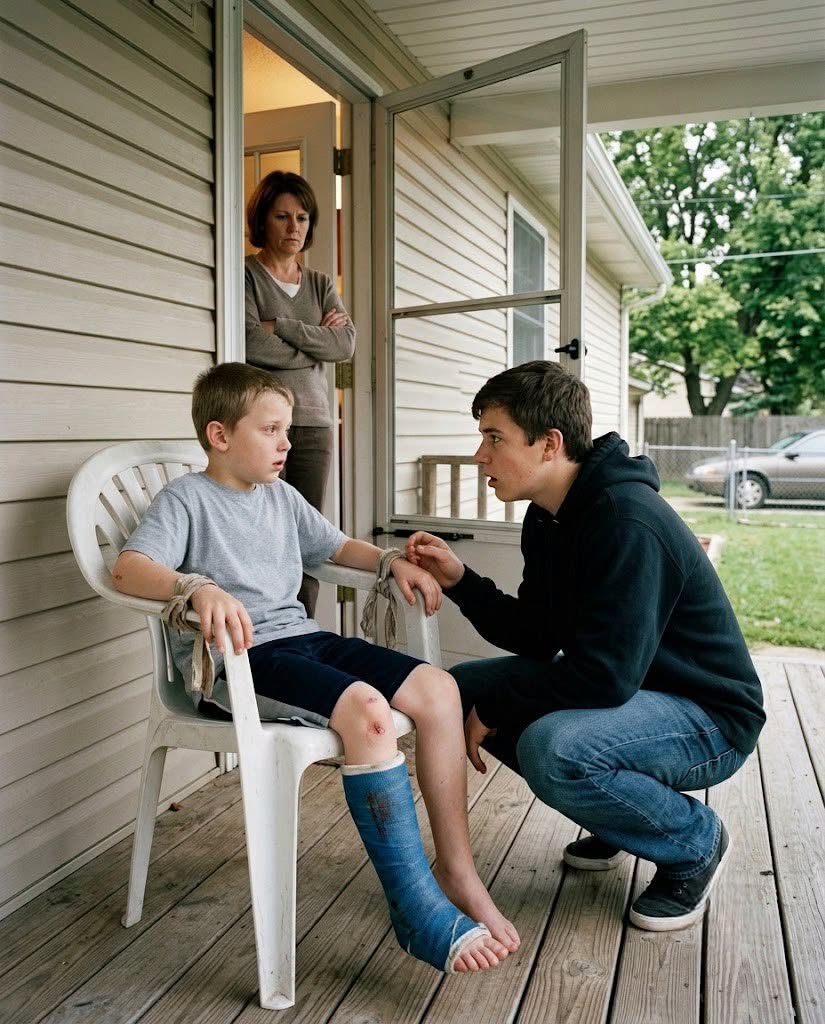
My little brother still had a cast on one leg when I found him tied to a chair on the back porch. Our aunt said he was “faking pain for attention,” but his hands were shaking and the cast was scraped where he’d tried to get free. Then he lifted his chin toward the window and whispered, “She put my crutches inside first.”

The porch boards were warm through my jeans when I crouched beside him, and the screen door tapped softly behind our aunt every time the breeze caught it. I looked at his wrists, then at the scraped edge of his cast. I stopped asking questions.
I loosened the knot. I checked that his injured leg stayed still. I asked him whether he could feel his toes. I kept my voice level because his breathing was already fast enough.
Our aunt folded her arms. “You’re making this worse,” she said. “He’s been carrying on all afternoon.”
“Why was he tied to a chair?”
“He wouldn’t stay put.”
My brother swallowed and stared at the floorboards. His fingers flexed slowly after I freed them, like he was making sure they still belonged to him.
“I tried to get my crutches,” he said.
Our aunt gave a sharp little sigh. “Exactly.”
I turned toward her. “Exactly what?”
She said he kept insisting the cast hurt. She said he kept asking for his crutches when she wanted him to sit still. She said if he really needed them as badly as he claimed, he could prove it.
My brother looked at me then.
“I tried,” he whispered. “I got up on the good leg. I made it to the door once. Then I fell back against the chair.”
The scrape on the cast suddenly made sense.
I looked through the window beside the screen door. Both crutches were inside, leaning against the wall only a few feet away.
Not lost. Not forgotten. Not accidentally left somewhere else. Put out of reach.
Our aunt stepped between me and the door.
“He needs to stop learning that every little ache gets him rescued,” she said. Her voice was calm now, almost reasonable. “You keep babying him, and he’ll never toughen up.”
I stood without raising my voice. “Move.”
She didn’t.
Behind me, my brother pushed both palms against the chair seat as if he thought he needed to prove something again. I immediately put a hand on his shoulder.
“Don’t,” I said. “You don’t have to show me anything.”
His shoulders dropped.
That tiny movement hurt worse than the argument.
Our aunt reached for the screen-door handle before I could. “You’re not taking him anywhere while he’s acting like this.”
“I’m not arguing about whether he hurts.” I nodded toward the crutches. “Give those back.”
“They’re mine until he settles down.”
“They’re not a privilege.”
For the first time, her expression tightened.
I kept one hand near my brother and pulled the screen door open with the other. She backed into the house, still blocking the narrow entrance.
I stepped forward. She stepped back. I reached toward the crutches. She reached them first.
Then our aunt snatched both crutches off the wall and carried them down the hallway.
PART 2: THE CRUTCHES SHE HID WERE ONLY THE FIRST THING SHE TOOK AWAY
Our aunt carried the crutches down the hallway as though she had won something.
For one second, I simply watched her.
Then I looked back at my brother.
Eli was eleven.
His left leg had been fractured badly enough that the orthopedic surgeon had warned us not to let him bear weight on it until the next follow-up.
The cast ran from below his knee almost to his toes.
And now the outer edge was scraped white where he had apparently dragged it against the porch boards trying to reach the door.
His hands were still shaking.
That decided everything.
I did not follow Aunt Denise down the hallway.
I took out my phone.
She heard the keypad tones and turned.
“What are you doing?”
“Calling his doctor.”
Her face changed.
Barely.
But enough.
“You don’t need to bother Dr. Keller because Eli had a tantrum.”
I looked at my brother.
He was not having a tantrum.
He was sitting too still.
Children who expect punishment often become very good at disappearing while remaining in the room.
I crouched again.
“Eli, does your leg hurt more than it did this morning?”
He nodded.
“Where?”
He pointed near the ankle.
“Inside?”
Another nod.
“Did you fall?”
He looked toward the hallway.
Denise answered for him.
“He slid.”
I kept my eyes on Eli.
“Did you fall?”
“Yes.”
“How?”
“I tried to hop.”
My stomach tightened.
“Because she took your crutches?”
He nodded.
Denise snapped,
“Stop feeding him answers.”
I stood.
“I asked him a question.”
“You’re teaching him exactly what I’ve been trying to stop.”
“What’s that?”
“That if he acts helpless long enough, somebody comes running.”
I stared at her.
Then I said,
“He has a fractured leg.”
“He has another leg.”
The sentence was so absurd I almost laughed.
Instead, I felt something cold settle behind my ribs.
Aunt Denise had always believed discomfort built character.
Cold showers after soccer.
No dessert if homework was late.
No sleeping past eight even during summer.
She called it discipline.
My mother had called it “Denise being Denise.”
Most of us had learned to roll our eyes.
But there is a difference between strictness and removing a child’s medical equipment to test whether he really needs it.
I pressed the call button beside Dr. Keller’s number.
Denise walked toward me.
“Hang up.”
“No.”
“Maya.”
“No.”
Her mouth tightened.
“You are not his parent.”
That one hit where she intended.
Our mother had died three years earlier.
Our father worked long-haul freight routes and had been away that week because another driver had gone on leave unexpectedly.
I was twenty-four, lived twenty minutes away, and had spent more nights at Dad’s house than my own since Eli broke his leg.
Denise was technically helping.
Family helping family.
The sentence adults use right before nobody can remember who agreed to what.
I looked at her.
“You’re right.”
She blinked.
“I’m his sister.”
“And right now I’m the adult standing here while he is injured and his crutches are being withheld.”
Her face reddened.
“You make everything dramatic.”
The orthopedic office answered.
I turned away from her.
The nurse asked what happened.
I told her.
Facts.
Not interpretation.
Eleven-year-old.
Recent leg fracture.
Non-weight-bearing instructions.
Crutches removed from reach.
Tied to chair.
Attempted hopping.
Fall against chair.
New pain near ankle.
Scraped cast.
The nurse became quiet.
Then:
“Do not let him put weight on that leg.”
“I won’t.”
“Can you get him to urgent orthopedic evaluation?”
“Yes.”
“Today?”
“Yes.”
Denise laughed from the hallway.
“He doesn’t need a hospital.”
The nurse heard.
Her voice sharpened.
“Is that the caregiver?”
“My aunt.”
“I want you to bring Eli in.”
“Okay.”
“And Maya?”
“Yes?”
“Bring the crutches.”
I looked toward the hallway.
“I’m working on that.”
Denise crossed her arms.
“You are not taking him anywhere.”
I stared at her.
Then said the sentence I should have said five minutes earlier.
“I’m calling Dad.”
That worked.
Her face went still.
Not frightened.
Angry.
Very angry.
“Your father put me in charge.”
“Then he deserves to know what being in charge looked like today.”
I dialed.
Dad answered on the second ring.
Road noise behind him.
“Maya?”
“Dad, I need you to listen before you say anything.”
Silence.
Then:
“Okay.”
I told him.
Not everything emotionally.
Just what I could see.
Eli tied to a chair.
Crutches inside.
Cast scraped.
New pain.
Doctor wanted him evaluated.
Dad did not interrupt once.
Then he asked,
“Where is Denise?”
“Here.”
“Put me on speaker.”
I did.
Dad’s voice came through the phone.
“Denise.”
She folded her arms tighter.
“Mark, she’s making this sound insane.”
“Did you tie Eli to the porch chair?”
Silence.
“Denise.”
“He wouldn’t sit still.”
Dad’s voice changed.
A quietness I knew.
The quiet right before anger stopped being negotiable.
“Did you tie him?”
“Yes.”
“Did you take his crutches?”
“He kept using them to get up.”
“That is what crutches are for.”
“He was supposed to rest.”
“Not be restrained.”
Denise rolled her eyes.
Dad continued.
“Give Maya the crutches.”
“No.”
I almost thought I had misheard.
Dad did too.
“What?”
“He needs consequences.”
Dad said nothing for two seconds.
Then:
“Denise, give my son his crutches.”
She picked them up from where she had leaned them near the end of the hallway.
For one second, I thought she would hand them to me.
Instead, she opened the hall closet.
Put them inside.
Locked it.
The click of the lock sounded louder than it should have.
Eli flinched behind me.
Dad had heard enough.
“I’m turning around.”
Denise laughed.
“You’re four hours away.”
“Yes.”
“And Maya is taking Eli to the doctor.”
“No, she isn’t.”
Dad’s voice hardened.
“She is.”
“She’s not his guardian.”
“She is his adult sister, I am his father, and I am telling her to take him.”
Denise stared at the phone.
Then at me.
Something in her face changed.
Not surrender.
Calculation.
Dad continued.
“Maya.”
“Yes.”
“Call the police if she prevents you from leaving.”
The room went silent.
Denise’s face became white.
“You’d call police on your own sister?”
Dad answered,
“If my son needs medical care and you stop him from getting it, yes.”
That was when she unlocked the closet.
She tossed the crutches onto the floor.
Not at Eli.
Near enough that the sound made him jump.
I picked them up.
Checked the rubber tips.
Then helped Eli stand.
The moment he put his hands on them, his whole body changed.
Not dramatically.
He simply breathed out.
A long breath.
Like he had been holding it all afternoon.
That hurt.
He moved carefully.
I stayed beside him.
Denise followed us to the front door.
“You’re teaching him fear.”
I turned.
“No.”
I looked at Eli.
Then back at her.
“I think he already learned that here.”
Her face twisted.
I walked out before she could answer.
In the car, Eli sat in the back seat with his leg supported across two pillows.
I drove slowly.
Halfway to the orthopedic urgent-care clinic, I looked into the mirror.
His eyes were closed.
“Eli?”
“Yeah?”
“Stay awake for me.”
“I’m tired.”
“I know.”
“Does your leg hurt?”
“Yes.”
“More?”
“A little.”
I swallowed.
Then asked,
“Were you tied there long?”
He opened his eyes.
I immediately regretted the question.
“Never mind.”
He looked confused.
“What?”
“You don’t have to explain everything right now.”
His shoulders relaxed.
Then he whispered,
“Since lunch.”
My hands tightened on the steering wheel.
It was almost four.
I forced myself not to react.
“What time did you eat?”
“I don’t know.”
“One?”
“Maybe.”
Three hours.
Maybe more.
I took a breath.
“Did Aunt Denise give you water?”
He shook his head.
“Food?”
“No.”
“Bathroom?”
His face turned red.
That told me enough.
I stopped asking.
The clinic was quiet when we arrived.
A nurse brought a wheelchair before I even finished signing him in.
Eli stared at it.
“I can use the crutches.”
“I know.”
The nurse smiled.
“But today you get upgraded.”
He looked at me.
“Do I have to?”
“No.”
The nurse answered before I could.
“You can choose.”
He thought.
Then picked the wheelchair.
That choice mattered more than it should have.
Nobody made him prove he could manage.
They simply offered the safer option.
Dr. Keller came in after new imaging.
He was in his fifties.
Soft-spoken.
The kind of doctor who always talked to Eli before talking to Dad.
He examined the cast.
Touched near the scraped area.
“Tell me if anything hurts.”
Eli pointed.
Dr. Keller stopped immediately.
“Right there?”
“Yes.”
He checked his toes.
Sensation.
Color.
Swelling.
Then reviewed the images.
The fracture had not dramatically shifted.
Thank God.
But there was enough concern about the fall and cast damage that he wanted the cast reinforced and movement limited for several days.
“No weight-bearing.”
He looked directly at Eli.
“That does not mean no moving.”
Eli frowned.
Dr. Keller continued.
“Crutches are part of how you move safely.”
Then he looked at me.
“Who took them away?”
I swallowed.
“Our aunt.”
Dr. Keller’s face did not change.
“Why?”
“She said he needed to prove he wasn’t exaggerating.”
He took off his glasses.
Set them down.
Then asked Eli,
“Did someone tie you to a chair?”
My brother looked at me.
I nodded once.
“You can tell him what you remember.”
Eli whispered,
“Yes.”
Dr. Keller asked no dramatic questions.
“Were you able to get up?”
“No.”
“Could you reach your crutches?”
“No.”
“Did you ask for them?”
“Yes.”
“What happened?”
Eli’s lip trembled.
“She said if I needed them, I’d figure it out.”
Dr. Keller sat back.
The room became very still.
Then he said,
“I want you to know something.”
Eli looked at him.
“Pain is information.”
“It is not bad behavior.”
My brother’s eyes filled.
Dr. Keller continued.
“If your cast hurts, you tell an adult.”
“If your leg hurts, you tell an adult.”
“If you need your crutches, you use them.”
“You never need to prove an injury by making it worse.”
Eli cried.
Quietly.
I looked away for a second because I was crying too.
The doctor gave him tissues.
Then turned to me.
“There’s more we need to do.”
I knew.
A mandated report.
I had expected it.
Still, hearing it made everything real in a new way.
He explained that because Eli had been deliberately restrained and denied prescribed mobility support, he was required to report the concern to child protective services.
I nodded.
“Please do.”
Eli looked frightened.
“Am I going somewhere?”
My heart broke.
Dr. Keller leaned forward.
“No one is punishing you.”
I added,
“You’re coming with me.”
His eyes went to mine.
“For tonight?”
“For as long as Dad and the people helping us decide is safe.”
He swallowed.
“Okay.”
The clinic social worker came in.
Her name was Tessa Green.
She had a soft green cardigan and a notebook covered in tiny gold stars.
Eli noticed the stars.
That seemed to help.
She spoke with me first.
Dad’s work schedule.
Where Eli usually lived.
Who provided care.
Why Denise had been with him.
Whether there were prior concerns.
I almost said no.
Then I stopped.
Because I had learned something in the last four hours.
“No prior concerns I understood as safety concerns.”
Tessa looked up.
“What does that mean?”
I thought.
“Denise has always called him dramatic.”
“How long?”
“Years.”
“She says he cries too easily.”
“She says Dad babies him.”
“She tells him to finish food even if he says he feels sick.”
I stopped.
Those things sounded different now.
Tessa did not tell me what they meant.
She just wrote them down.
“Anything since the fracture?”
I thought again.
Then remembered.
The second day after surgery, Eli called me.
He said Denise would not bring him the ice pack because he had already used it once.
She said he needed to wait.
I had driven over with one.
At the time, Denise called me ridiculous.
Another memory.
Eli saying he hated shower days.
Denise made him stand with one leg outside the tub instead of using the shower chair Dad rented.
I had assumed Eli simply disliked bathing with a cast.
My stomach turned.
“Tessa.”
“Yes?”
“I think there’s more.”
She waited.
I told her.
Not accusing.
Remembering.
She took notes.
Then she asked,
“Does Denise have access to his medical information?”
“Yes.”
“Appointment portal?”
“I don’t know.”
“Has she attended appointments?”
“One.”
“Which one?”
“The follow-up after the cast was put on.”
Tessa nodded.
Then she spoke with Eli.
Not a full forensic interview.
Just immediate safety.
“Do you feel safe going back to Aunt Denise’s house tonight?”
“No.”
Immediate.
Not whispered.
No.
I stared at him.
He stared at the gold stars on her notebook.
Tessa asked,
“Do you feel safe with Maya?”
“Yes.”
“Your dad?”
“Yes.”
“Anyone else?”
“Grandma.”
My throat tightened.
Good.
A list.
Safe adults.
That mattered.
When the clinic released us, Dad was still nearly two hours away.
I took Eli to my apartment.
He had been there dozens of times.
But that night, he stood inside the doorway like he was waiting for instructions.
“Couch or bed?”
I asked.
“What?”
“You get my room.”
“No.”
“You have a cast.”
“You have work.”
I stared at him.
“What does that have to do with a bed?”
He shrugged.
“Aunt Denise says people who help you get tired of it.”
My heart cracked.
I set down his bag.
“Eli.”
He looked at me.
“You are allowed to need help.”
His face changed.
“She says Dad already changed everything because of me.”
“What everything?”
“His routes.”
“The house.”
“Money.”
My stomach tightened.
Dad had taken shorter routes after Eli broke his leg.
Of course he had.
He was a parent.
But Denise had apparently translated that into debt.
Something Eli owed.
I crouched.
“Dad changed his schedule because you were injured.”
“That is what parents do.”
“He is not keeping a bill.”
Eli looked unconvinced.
I smiled sadly.
“If Dad ever sends you an invoice for parenting, I’ll fight him.”
That made him laugh.
Tiny.
Still a laugh.
Then he said,
“Can I have water?”
I froze.
“You never have to ask me for water.”
His face went red.
“Okay.”
I poured a glass anyway.
Set it beside him.
He drank half immediately.
Then asked,
“Can I eat?”
My anger rose so quickly I had to turn toward the kitchen.
Not at him.
Never at him.
I opened the refrigerator.
“Sandwich?”
He nodded.
“Chips?”
Another nod.
“Fruit?”
“Maybe.”
“Excellent risk management.”
He smiled.
While I made food, I noticed him watching me.
“What?”
He looked away.
“Nothing.”
“Eli.”
He whispered,
“She says if I keep asking for things people won’t want me around.”
I stopped.
Knife in hand.
Bread on the counter.
For one second, I wanted to drive back to Denise’s house and ask what kind of adult tells an injured eleven-year-old that care has a limit he can exhaust.
Instead, I finished the sandwich.
Sat beside him.
“Listen carefully.”
He looked at me.
“People can get tired.”
“Yes.”
“People can need breaks.”
“Yes.”
“Adults can ask other adults for help.”
He nodded.
“But none of that means a child earns less care by needing more of it.”
His eyes filled.
“Okay.”
“You understand?”
“I think.”
“That’s enough for tonight.”
Dad arrived at 8:17.
I know because Eli had asked me the time every seven minutes starting at seven thirty.
When Dad knocked, Eli tried to stand too fast.
I stopped him.
Dad came through the door.
Saw the wheelchair.
The reinforced cast.
Then his son.
He dropped his duffel bag.
“Hey, buddy.”
Eli started crying.
Dad crossed the room.
Then stopped before hugging him.
“Can I?”
Eli nodded.
Dad knelt.
Wrapped both arms around him.
Eli buried his face against Dad’s shoulder.
“I’m sorry.”
Dad froze.
“For what?”
“I made you come home.”
Dad’s face collapsed.
“No.”
He pulled back enough to see him.
“You did not make me do anything.”
“But your route.”
“My job has other drivers.”
“You are my son.”
“Those are not equal categories.”
Eli cried harder.
Dad looked at me.
I could see the question.
What has she been saying to him?
I shook my head.
Later.
Not now.
Dad stayed with Eli until he fell asleep.
Then we sat at my kitchen table.
I told him everything.
The porch.
The crutches.
The doctor.
The report.
The things Eli had said.
Dad looked gray by the time I finished.
Then he whispered,
“I left him with her.”
I knew that guilt.
It had already visited me.
“Dad.”
“I asked her to help.”
“You asked her to help.”
I repeated.
“You did not ask her to restrain him.”
“I should have known.”
“How?”
He looked at me.
“She said things.”
“What things?”
“That he was milking the injury.”
My stomach tightened.
“When?”
“After the fracture.”
“She kept saying he was more capable than I let him be.”
“And?”
“I told her to stop.”
“But I…”
He looked down.
“I thought she was just being hard on him.”
There.
The gap families fall through.
Just strict.
Just blunt.
Just old-fashioned.
Until one day an eleven-year-old is tied to a chair with his crutches locked inside.
Dad covered his face.
Then his phone rang.
Denise.
He stared at it.
I said,
“Don’t.”
He looked at me.
“Not tonight.”
He let it go.
A voicemail appeared.
Then another.
Dad did not listen immediately.
At midnight, after Eli was asleep, we played the first one.
Denise sounded angry.
Not worried.
“Mark, this has gotten completely out of hand. Maya dragged Eli to a doctor because he scratched his cast. Now some social worker is calling me like I’m a criminal. You need to tell them he exaggerates. You know he does.”
Dad stopped the recording.
Neither of us spoke.
Then he played the second.
Her voice had changed.
Softer.
More controlled.
“Look, I’m sorry I tied him down. That sounds worse than it was. I used one of the soft garden ties because he kept trying to stand. I was protecting him from himself.”
I closed my eyes.
Protecting him.
By removing the crutches designed to help him move safely.
Then:
“And I never denied him medical care. He had an appointment canceled this week anyway.”
Dad froze.
“What?”
I looked at him.
“What?”
He replayed it.
He had an appointment canceled this week anyway.
Dad opened his phone calendar.
His face changed.
“His orthopedic follow-up is tomorrow.”
“No.”
He stared at the screen.
“It was tomorrow.”
“What do you mean was?”
He opened the patient portal.
Then went still.
“Canceled.”
My stomach tightened.
“By who?”
He clicked.
The portal showed the appointment had been canceled three days earlier.
Reason:
Patient doing well. Family requests later follow-up.
Dad’s face drained.
“I didn’t cancel this.”
“Did Eli?”
“He’s eleven.”
“Could Denise?”
Dad looked at me.
“She has proxy access.”
There it was.
Another door opening.
I felt cold.
“Why?”
“Because she took him to the last appointment when I was working.”
Dad immediately called the after-hours number, even though we knew nobody in scheduling would answer until morning.
Then he opened the portal messages.
There were two.
One from Denise’s proxy account.
Sent four days earlier.
Eli continues to report pain but appears comfortable when distracted. I believe anxiety and attention-seeking are contributing. Is continued use of crutches necessary?
Dad stared.
I read it again.
Continued use of crutches necessary?
The physician assistant had responded:
Yes. Please continue non-weight-bearing restrictions and prescribed crutch use until reevaluation. Pain should be reported if worsening.
Denise had read the message.
The portal showed it.
Two days later, she canceled the follow-up.
My hands went cold.
Dad whispered,
“She knew.”
Not everything.
But this.
She knew the medical team had specifically said the crutches were still necessary.
She did not misunderstand.
She had asked.
She had received the answer.
Then taken them away anyway.
Dad scrolled farther.
Another message.
From Denise.
Sent yesterday.
He is becoming increasingly dependent on medical attention. I think fewer appointments may help him stop fixating on symptoms.
The clinic had replied that scheduled follow-up remained important.
No response from Denise afterward.
Dad sat back.
His eyes filled.
“This isn’t discipline.”
“No.”
We both knew that now.
The next morning, Dad contacted Dr. Keller’s office.
Proxy access was removed immediately.
The canceled appointment was restored.
The clinic documented the messages.
Child protective services received the information.
Denise’s explanation that she had been trying to prevent unnecessary dependence became harder to reconcile with written instructions she had deliberately ignored.
Still, nobody called it a crime in front of me.
Nobody made dramatic promises.
They reviewed.
Documented.
Asked questions.
That steadiness mattered.
Eli woke around nine.
Dad helped him to the bathroom.
Not carried.
Not babied.
Helped.
At breakfast, Eli asked,
“Do I still have to go to the appointment?”
Dad looked at me.
Then back at him.
“Yes.”
His face fell.
Dad continued.
“Not because you’re in trouble.”
“Oh.”
“Because your doctor wants to see how the leg is healing.”
Eli nodded.
Then whispered,
“Aunt Denise said doctors make you think you hurt more.”
Dad went completely still.
“What?”
“She said if I stopped talking about it, it would stop hurting.”
I closed my eyes.
Dad sat beside him.
“Pain doesn’t work like that.”
“I know now.”
That sentence hurt.
I know now.
What had he thought before?
Dad reached for his hand.
Stopped.
“Can I?”
Eli nodded.
Dad took it.
“I need to apologize.”
My brother frowned.
“For what?”
“I left you with someone who was not listening to what your doctor said.”
Eli looked frightened.
“Is Aunt Denise in trouble?”
Dad breathed.
“This is not your responsibility.”
“But she was helping us.”
“She was supposed to.”
Eli looked down.
Dad continued.
“You telling us what happened did not cause whatever happens next.”
“That belongs to the adults.”
Another lesson.
Another burden removed from a child.
At the orthopedic appointment, the fracture was still stable.
No new major injury.
The cast needed more reinforcement.
Rest.
Crutches.
Follow-up.
For the first time all day, I felt something close to relief.
Then Dr. Keller said,
“I reviewed the portal messages.”
Dad nodded.
His face tightened.
The doctor continued.
“I want all care communication going through Mark or Maya for now.”
“Done.”
Dad said.
“And I want Eli to know he can call the office if he is ever confused about what he is allowed to do.”
Eli looked surprised.
“Me?”
“Yes.”
“You can call?”
“You can ask an adult to call with you.”
Dr. Keller smiled.
“Your body belongs in the conversation.”
Eli looked down.
I saw the words land.
Afterward, the child-protection investigator met us at Dad’s house.
Her name was Kara Simmons.
She walked through the porch.
Looked at the chair.
The garden ties.
The window.
The hallway closet.
The crutches.
The distance between them.
Nothing dramatic.
Just measurements.
Photographs.
Context.
Then she noticed something on the kitchen counter.
A stack of printed medical instructions.
The page about non-weight-bearing restrictions was on top.
One sentence highlighted.
Crutches must be used for all transfers and ambulation.
Kara looked at Dad.
“Who highlighted this?”
“I don’t know.”
Then Eli said from the doorway,
“Aunt Denise.”
Everyone turned.
He looked nervous.
“She made me read it.”
My stomach dropped.
“When?”
Dad asked.
“The first day she stayed.”
Kara crouched slightly.
“What did she say?”
Eli swallowed.
“She said doctors write rules because they’re scared of getting sued.”
Dad closed his eyes.
Kara remained calm.
“And what did she tell you to do instead?”
Eli looked toward the porch.
Then whispered,
“She said by the end of the week I was going to prove I could manage without those.”
His eyes moved to the crutches.
No one spoke.
Because finally, the shape of it was becoming clear.
The chair had not been one impulsive mistake.
The crutches had not been forgotten.
The canceled appointment had not been scheduling confusion.
Denise had decided the medical plan itself was the problem.
And she had apparently spent days trying to replace it with her own.
Later that afternoon, Kara called Dad privately.
I only heard his side.
“Yes.”
“No.”
“I understand.”
Then:
“Absolutely not.”
His voice hardened.
When he hung up, I asked,
“What?”
He stared at the phone.
“Denise wants to come over.”
My body tightened.
“Why?”
“She says she needs to apologize to Eli in person.”
I looked toward the living room.
Eli was playing a video game with his leg propped on pillows.
“Does he want that?”
Dad stopped.
He had not asked.
Good.
That was the old pattern.
Adults arranging emotional closure because adults wanted it.
Dad walked into the living room.
Sat near Eli.
“Aunt Denise wants to apologize.”
Eli’s face went pale.
That answered enough for me.
Dad saw it too.
“You don’t have to see her.”
His shoulders relaxed.
“Really?”
“Yes.”
“Is she mad?”
“Maybe.”
Dad said.
“But that is not your job to fix.”
Eli looked at his game controller.
Then whispered,
“I don’t want her here.”
Dad nodded.
“Then she isn’t coming.”
Simple.
No family vote.
No guilt.
No lecture about forgiveness.
The child said no.
The adults listened.
That evening, Denise sent Dad one final text before her attorney apparently told her to stop contacting us directly.
Dad showed it to me.
You are teaching him that pain gives him power over the family.
I read it twice.
Then looked toward Eli.
He was asleep on the couch.
Crutches beside him.
Within reach.
Exactly where they should have been.
I handed the phone back.
“No.”
Dad frowned.
“No what?”
“She had it backward.”
“What?”
I looked at the crutches.
“Pain didn’t give Eli power.”
I thought about the porch.
The knots.
The closet.
The highlighted instructions.
The canceled appointment.
Then I said,
“His pain made him dependent on adults.”
“And she used that dependence as power over him.”
Dad’s eyes filled.
Neither of us spoke for a while.
The investigation continued.
No instant ending.
No dramatic arrest that afternoon.
Doctors documented.
The agency reviewed.
Dad gave statements.
Denise had counsel.
Eli was referred to a child therapist, not because anyone thought he was damaged beyond repair, but because being restrained by a trusted adult and taught to doubt his own pain had consequences worth addressing early.
The first thing the therapist asked him was:
“Do you want your crutches beside you or by the door?”
Eli stared at her.
Then said,
“Beside me.”
“Okay.”
That was all.
Choice.
Tiny.
Ordinary.
Necessary.
A week later, he slept at my apartment again.
I made grilled cheese.
He left crumbs everywhere.
I complained.
He grinned.
Normal.
Then, halfway through dinner, he said,
“My leg hurts.”
I froze.
Not because the pain scared me.
Because of what came next.
He looked at my face.
Waiting.
I put down my sandwich.
“Okay.”
He blinked.
“Okay?”
“Yes.”
“How much?”
“Like a five.”
“We’ll check the instructions and tell Dad.”
His shoulders relaxed.
No proof.
No hopping.
No testing.
No accusation.
Just information.
Pain is information.
I smiled.
“Anything else?”
He thought.
“Can I have another grilled cheese?”
“That sounds suspiciously attention-seeking.”
His face froze for half a second.
My stomach dropped.
Too soon.
I reached for his hand.
“Sorry.”
He looked at me.
Then, slowly, he smiled.
“I know you’re joking.”
“Still.”
“I’m sorry.”
He nodded.
“Okay.”
That was healing too.
Learning which jokes were not funny yet.
Learning to apologize without turning the apology into another burden for him to erase.
Two weeks after the porch, Kara called Dad with another update.
She had reviewed the canceled appointment.
The medical messages.
The restraint.
The crutch removal.
Then she asked about something none of us expected.
“Did Denise ever mention a second orthopedic opinion?”
Dad frowned.
“No.”
“Why?”
Kara paused.
“She contacted another clinic.”
My stomach tightened.
“When?”
“Five days before the porch incident.”
Dad put the call on speaker.
“What did she ask them?”
Kara answered carefully.
“She inquired whether an eleven-year-old with a healing leg fracture could transition away from crutches early if a caregiver believed the child had developed anxiety-related dependence.”
Dad stared at me.
I felt cold.
“What did they tell her?”
“They declined to advise without evaluating Eli and told her to follow the treating surgeon’s plan.”
Another warning.
Ignored.
Then Kara said,
“There’s more.”
Of course there was.
“A voicemail was left with that clinic the following day.”
My fingers tightened around the edge of the table.
“By Denise?”
“Yes.”
“What did she say?”
Kara did not play it.
She summarized.
Denise said the boy’s father was “too emotionally involved” to make objective medical decisions.
That his older sister “reinforced helplessness.”
That Eli needed a caregiver willing to “break the cycle.”
I stopped breathing.
Break the cycle.
Suddenly the porch looked different again.
Denise had not seen herself as punishing Eli.
She had seen herself as correcting all of us.
Dad.
Me.
The doctors.
Anyone who believed his pain.
Kara continued.
“And she asked whether temporary guardianship would allow her to consent to a different treatment approach without the father present.”
The room went completely still.
Dad whispered,
“What?”
Temporary guardianship.
Not just crutches.
Not just one afternoon.
Denise had been thinking beyond that porch.
About authority.
About becoming the adult whose interpretation of Eli mattered more than his father’s.
Kara added immediately,
“No guardianship filing occurred.”
Good.
Facts.
“She appears to have asked a general question.”
“Still…”
Dad’s voice broke.
“She wanted control of his medical decisions.”
Kara stayed precise.
“We know she asked what authority would be required to make them.”
That was enough.
After the call ended, Dad sat at the kitchen table.
Staring at nothing.
Then he whispered,
“I thought I needed help.”
I sat beside him.
“You did.”
He looked at me.
“I chose the wrong help.”
That was true too.
I did not tell him otherwise.
Then he asked,
“What do I tell Eli?”
I thought about it.
“The truth he needs.”
“Which is?”
“That Aunt Denise made choices that were not safe.”
“That adults are handling it.”
“That his doctors still decide his medical plan with you.”
“That he never has to prove pain by hurting himself.”
Dad nodded.
“And the guardianship question?”
“Not yet.”
He looked at me.
I continued.
“That is adult information until there is a reason he needs it.”
Not secrecy.
Proportion.
There is a difference.
That night, Eli slept at Dad’s house.
His crutches leaned beside the bed.
His water bottle sat on the nightstand.
His cast rested on a pillow.
Before Dad turned out the light, Eli asked,
“Can you leave the hallway light on?”
Dad nodded.
“Sure.”
Then Eli asked,
“Are you leaving tomorrow?”
Dad’s face tightened.
“No.”
“I changed my route.”
My brother’s expression became worried.
“For me?”
Dad sat beside him.
“Yes.”
Eli swallowed.
“I’m sorry.”
Dad shook his head.
“No.”
Then he smiled.
“You know what my job is?”
“Driving trucks.”
“Second job.”
Eli thought.
“Being annoying?”
“Correct.”
That made him laugh.
Dad continued.
“And being your father.”
“No invoice.”
“No score.”
“No debt.”
“You need me, I show up.”
Eli stared at him.
Then nodded.
When Dad closed the bedroom door halfway, he looked at me in the hall.
Both of us heard it.
Eli shifting.
Then settling.
No crying.
No calling us back.
Just rest.
I looked toward the crutches visible beside the bed.
Something ordinary.
Aluminum.
Rubber handles.
Medical equipment.
And yet those crutches had become the clearest symbol of everything Aunt Denise misunderstood.
She thought needing support made Eli weak.
She thought taking support away would reveal strength.
But strength had never been the ability to drag an injured body across a porch without help.
Strength was what came after.
An eleven-year-old saying:
My leg hurts.
I need my crutches.
I don’t want her here.
And slowly learning that each of those sentences could be spoken without punishment.
Denise had put his crutches inside because she wanted him to prove he could reach them.
Instead, all she proved was how dangerous it becomes when an adult decides a child must earn the tools he needs to stand.
Related Posts