
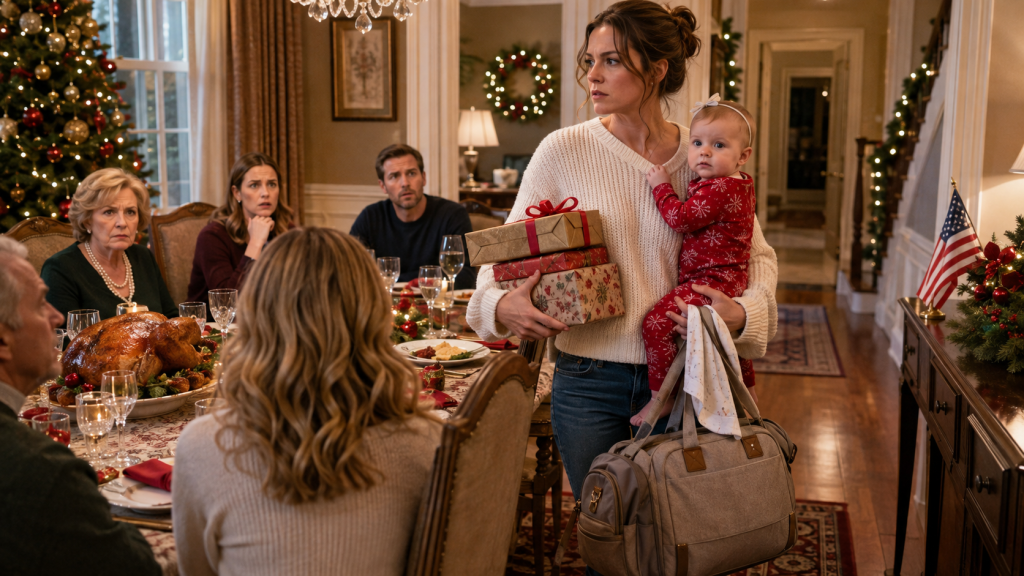
On Christmas, my mom humiliated my baby in front of the whole table—so I packed my daughter’s gifts and told her: “This is her last Christmas here.”

My daughter’s presents were the smallest pile under my mother’s tree, tucked so low the pine needles almost swallowed the ribbon. A soft book from my sister. A little bunny from my aunt. Two uneven boxes I wrapped after midnight while my eight-month-old finally slept in my apartment.
I carried her into that dining room hoping for one quiet holiday.
The table had everything my mother loved to show off: polished glasses, turkey steam, the good cranberry bowl, candles trying to make the room feel warm. My daughter sat against my chest in her red Christmas onesie, staring at the lights like they were the most beautiful thing she had ever seen.
Then my mother put down her fork.
“She looks… off,” she said loud enough for everyone to hear. “Are you sure that baby is even healthy?”
The room changed instantly. My cousin stopped chewing. My aunt looked down. My sister’s husband folded his napkin again and again, like he could hide from the moment.
My baby didn’t understand the insult. She only felt me become still.
I waited for my mother to laugh it off.
She didn’t.
She lifted her wineglass and said, “I’m just saying what everyone’s thinking. Some babies are not… normal.”
My sister whispered, “Mom, stop.”
But my mother kept that calm expression she always wore when she wanted cruelty to sound like concern.
For years, I let her speak to me that way. My clothes were wrong. My job wasn’t impressive enough. My apartment after my divorce was too small. The way I cared for my daughter was too nervous, too soft, too much.
She called it advice.
I called it keeping peace.
But peace should never come at the cost of a child’s dignity.
My daughter’s little hand curled into my sweater, trusting me completely.
So I stood up.
The chair scraped the floor. Everyone looked over. I grabbed the diaper bag beside the china cabinet, walked to the tree, and picked up the gifts one by one.
The book. The bunny. The two crooked boxes.
“What are you doing?” my mother asked.
Her voice changed. Just slightly.
Like she finally realized I wasn’t arguing anymore.
I zipped the diaper bag.
That small sound felt like a door closing.
“Don’t be dramatic,” she said. “I didn’t mean it like that.”
I turned with my daughter on my hip and her gifts under my arm.
“This is her last Christmas here.”
For the first time all day, my mother had no answer ready.
She looked around for someone to call me sensitive, emotional, difficult.
No one did.
I reached the hallway table, where Christmas cards sat beside a tiny American flag in a blue ceramic vase from my mother’s holiday decorations. My daughter pressed her cheek against my neck. My hand shook on the doorknob.
Then my sister whispered behind me.
“Mom… you didn’t tell her about the letter, did you?”
I turned slowly.
“What letter?”
My mother’s face changed.
Her hand moved toward the pocket of her cardigan, closing around a folded envelope she had hidden there.
PART 2: THE LETTER SHE NEVER WANTED ME TO READ
“What letter?”
The question left my mouth quietly.
Almost too quietly.
But everyone at that Christmas table heard it.
My mother’s fingers tightened around the pocket of her cardigan.
For one strange second, nobody moved.
The candles continued burning.
The turkey sat beneath the dining room light, cooling on the platter.
Somewhere in the living room, an old Christmas song played softly through the speakers.
It was the kind of song my mother always loved.
Warm.
Nostalgic.
Full of promises about home.
Yet standing there with my daughter against my chest, I had never felt less at home in my life.
My sister Rachel looked at our mother.
Then she looked at me.
The regret on her face told me everything I needed to know.
There really was a letter.
And Rachel knew about it.
“Rachel,” my mother said.
Just her name.
Nothing more.
But I recognized that tone.
I had heard it all my childhood.
It meant:
Be quiet.
Do not embarrass me.
Do not tell the truth if the truth makes me look bad.
Rachel swallowed.
“Mom, she deserves to know.”
My mother stood so quickly that her chair bumped against the wall.
“This is Christmas,” she snapped. “We are not doing this today.”
A laugh almost came out of me.
Not because anything was funny.
Because sometimes disbelief has nowhere else to go.
“You just called my baby abnormal in front of thirteen people.”
My voice trembled.
“And now you’re worried about ruining Christmas?”
My daughter Lily shifted against me.
Her tiny face turned toward mine.
Eight months old.
Soft cheeks.
Dark lashes.
A faint curl of brown hair above one ear.
She stared at me with complete trust.
That trust was becoming the only thing keeping me upright.
My mother looked toward the table.
She wanted an ally.
She always wanted an audience when she was powerful and privacy when she was guilty.
Nobody spoke.
My aunt stared into her lap.
My cousin suddenly became fascinated with the condensation on his water glass.
Rachel’s husband stopped folding his napkin.
Then Rachel stepped away from the table.
“Give it to her.”
My mother’s jaw tightened.
“No.”
One word.
Cold.
Final.
At least, she wanted it to be final.
I adjusted Lily higher on my hip.
“Give me the letter.”
My mother shook her head.
“It’s nothing.”
“If it’s nothing, give it to me.”
“It’s old.”
“Then give it to me.”
“It will only upset you.”
That sentence broke something inside me.
Not loudly.
Not dramatically.
It simply cracked.
For thirty-two years, my mother had decided which feelings I was allowed to have.
When I cried because girls bullied me in middle school, she told me I was too sensitive.
When I wanted to study art instead of business, she told me I would regret embarrassing myself.
When my marriage began falling apart, she told me good wives learned not to ask so many questions.
When I was pregnant, terrified, and sleeping alone in a half-empty apartment, she told me motherhood would make me stronger.
Every wound had somehow become another lesson she believed she was qualified to teach me.
And now she was standing between me and a letter addressed to my life.
Because she believed she had the right to decide what I could survive.
“No,” I whispered.
My mother blinked.
“No what?”
“No more deciding for me.”
The room became very still.
I stepped toward her.
“If that envelope has my name on it, you hand it to me now.”
Her expression changed.
Not much.
But enough.
For the first time, I saw something beneath the irritation.
Fear.
My mother was afraid.
Rachel saw it too.
“Mom.”
My mother turned toward her.
“Stay out of this.”
“I already stayed out of it.”
Rachel’s voice cracked.
“That was the mistake.”
My stomach dropped.
I looked at my sister.
“What do you mean?”
Rachel rubbed both hands over her face.
“I found the letter in September.”
September.
Three months ago.
Lily had been five months old.
I remembered September.
The sleepless nights.
The formula stains on my shirts.
The way I counted every dollar before grocery shopping.
The days when I would sit on the edge of my bed after Lily fell asleep and wonder how my life had collapsed so completely in less than a year.
My marriage gone.
My husband gone.
My confidence gone.
And apparently, during all of that, my mother had been hiding something.
“Where did you find it?”
“In Mom’s desk.”
My mother exploded.
“You had no business going through my things!”
Rachel spun toward her.
“I was looking for Dad’s insurance paperwork!”
The mention of our father created another strange silence.
Dad had died three years earlier.
A heart attack in the kitchen before sunrise.
He had been gentle in ways my mother never understood.
Quietly gentle.
The kind of man who cut apples into thin slices because he knew I liked them better that way.
The kind of man who filled my gas tank when I visited without mentioning it.
The kind of man who rarely challenged my mother directly.
For years, I had confused his silence with peace.
Only after he died did I begin wondering how much silence had cost him too.
Rachel continued.
“The envelope was behind the tax folder. I only saw it because it fell out.”
I looked at my mother’s pocket again.
“You kept it all this time?”
My mother said nothing.
“Who wrote it?”
Rachel’s eyes met mine.
That was when I knew.
Before she said the name.
Before the envelope came out.
Before I saw the handwriting.
Some part of my body recognized the truth first.
My knees weakened.
Rachel whispered, “Caleb.”
The whole room disappeared.
Not literally.
But suddenly the table, the people, the lights, the tree, the decorations—none of them seemed real.
There was only that name.
Caleb.
My ex-husband.
Lily’s father.
The man I had once believed I would grow old beside.
The man who packed a suitcase when I was six months pregnant and told me he could no longer live inside our marriage.
The man who had missed Lily’s birth.
The man whose name I had stopped saying aloud because it still hurt too much.
My mother slowly pulled the envelope from her cardigan.
I stared at it.
My name was written across the front.
Not “Mrs. Whitmore.”
Not “To whom it may concern.”
My first name.
Emma.
In Caleb’s handwriting.
I knew every curve of those letters.
I had watched him write my name on birthday cards for nine years.
I had seen it scribbled on grocery lists.
Written on the label of my lunch before long shifts.
Once, during our honeymoon, he had written it with his finger in the sand beside the Atlantic Ocean.
EMMA + CALEB.
Forever, he had added underneath.
The tide had erased it before sunset.
Back then, we had laughed.
Standing in my mother’s hallway on Christmas Day, I suddenly remembered that moment so clearly that my chest physically hurt.
“When did this come?”
My mother hesitated.
“August.”
August.
Four months.
She had hidden it for four months.
I reached for the envelope.
She pulled it back.
That tiny movement sent fury through me so fast that I stopped shaking.
“Give it to me.”
“Emma, you need to understand—”
“Give me my letter.”
Her fingers released it.
I took it.
The paper was creased.
Not from the mail.
From being opened.
My eyes lifted.
“You opened it?”
My mother immediately defended herself.
“I was concerned.”
“You opened my mail?”
“It came to my house.”
“It had my name on it.”
“I didn’t know what it contained.”
“That is generally why people put letters inside envelopes.”
“Emma.”
“No.”
My voice rose.
“No. You don’t get to say my name like I’m the one misbehaving.”
Lily startled.
I immediately lowered my voice.
“Sorry, sweetheart.”
I kissed the top of her head.
Her little fingers reached toward the envelope.
The movement nearly destroyed me.
Because whatever was inside that paper had something to do with her too.
I slid my finger beneath the flap.
The envelope had already been opened cleanly.
Inside were several folded pages.
And photographs.
The photographs slipped first.
They scattered across my mother’s hardwood floor.
Rachel gasped.
I crouched carefully, balancing Lily, and picked one up.
It was Caleb.
My breath caught.
He was standing outside a small gray house I didn’t recognize.
His hair was shorter.
He looked thinner.
Older somehow.
But it was him.
In his arms was a cardboard box filled with baby things.
A pink blanket.
Diapers.
A stuffed elephant.
Another photograph showed a small bedroom.
A white crib.
A wooden rocking chair.
Yellow curtains.
Above the crib, mounted in simple wooden letters, was one word.
LILY.
My daughter’s name.
I stared until the letters blurred.
“What is this?”
My mother pressed her lips together.
Rachel whispered, “Read the letter.”
So I did.
My hands shook so badly that the pages rattled.
Emma,
I don’t know whether this letter will reach you.
I don’t know whether you will read it.
I don’t even know whether I deserve an answer.
But I have tried calling.
My number is blocked.
My emails come back unanswered.
I went to the apartment twice and was told you moved.
I sent letters there.
They were returned.
I don’t know where you are now.
Your mother told me you want nothing to do with me.
I stopped reading.
Slowly, I looked up.
My mother looked away.
My voice came out hollow.
“You told him that?”
She folded her arms.
“You did want nothing to do with him.”
“I never said that.”
“You were divorcing him.”
“That is not the same thing.”
“He abandoned you.”
“I know what he did.”
“Then why does it matter?”
“Because you lied.”
My aunt finally spoke.
“Margaret…”
My mother turned sharply.
“Please do not involve yourself.”
But Aunt Carol didn’t look away this time.
“You should have given her the letter.”
Something flickered across my mother’s face.
Embarrassment.
Anger.
Perhaps even shame.
But I couldn’t care about her emotions anymore.
I looked back down.
I forced myself to continue.
I am writing because there are things you still don’t know.
Things I didn’t know either.
I need to begin with the night I left.
My fingers went cold.
That night.
I remembered every detail.
Rain against our apartment windows.
A half-assembled crib in the spare bedroom.
My wedding ring sitting beside the kitchen sink because pregnancy had made my fingers swell.
Caleb pacing beside the counter.
His face pale.
His hands trembling.
I had thought he was nervous about the baby.
Then he had said the sentence that ended our marriage.
I don’t think this child is mine.
I had stared at him.
He wouldn’t explain.
Wouldn’t tell me why he suddenly believed it.
I screamed.
He cried.
I threw a mug against the wall.
And before sunrise, he was gone.
The letter trembled in my hands.
Your mother called me three days before I left.
I stopped breathing.
She told me you had confessed something to her.
She said you had been seeing someone else around the time Lily was conceived.
She said you were afraid to tell me.
She said she believed the baby might not be mine.
For a moment, I heard nothing.
Not the music.
Not the breathing.
Not Lily’s tiny noises.
Nothing.
My eyes rose slowly toward my mother.
She looked pale.
Rachel began crying.
“You told him I cheated?”
My mother shook her head quickly.
“It wasn’t like that.”
“Did you tell my husband I cheated on him?”
“I told him there were questions.”
“What questions?”
“You and Caleb were fighting constantly.”
“All married couples fight!”
“You were unhappy.”
“That does not mean I was sleeping with someone!”
“You were spending time with that man from your office.”
I stared at her.
“David?”
“You talked about him constantly.”
“He was sixty-three years old!”
My cousin actually closed his eyes.
Rachel gave a sound between a sob and disbelief.
“Mom.”
My mother lifted her chin.
“I had concerns.”
“David was my supervisor.”
“You went to lunch with him.”
“With six other people!”
“You didn’t always mention that.”
“Because I didn’t know I was reporting to a parole officer!”
Lily began fussing.
My anger vanished instantly.
“Hey.”
I bounced her gently.
“You’re okay, baby. Mommy’s here.”
She rubbed her face against me.
I walked several steps away from everyone.
My heart was pounding violently.
Once Lily settled, I looked back at the letter.
Part of me didn’t want to read another sentence.
The other part knew that if I stopped, my mother would win again.
I continued.
I believed her.
That is my shame to carry.
I should have asked you.
I should have trusted you.
Instead, I confronted you already believing something terrible.
When you denied it, I convinced myself you were lying.
I was angry.
Terrified.
Cowardly.
And I left.
I will regret that for the rest of my life.
My eyes burned.
I blinked several times.
The words blurred anyway.
After Lily was born, I contacted your mother because I wanted to speak to you.
She told me you had moved on.
She told me you had said I was not Lily’s father.
She said you planned to raise Lily without me.
I looked at my mother again.
She had stopped defending herself.
Maybe even she knew there were too many lies to rearrange into something respectable.
I kept reading.
Then, in June, Rachel contacted me.
My head snapped up.
Rachel covered her mouth.
“You contacted him?”
She nodded.
Tears slipped down her cheeks.
“I’m sorry.”
“When?”
“June.”
“Why?”
“Because I heard Mom telling Aunt Denise that Caleb didn’t care enough to fight for Lily.”
Rachel wiped her face.
“And something about the way she said it bothered me. So I found his old number.”
I stared at her.
“Why didn’t you tell me?”
“Because when he answered, I panicked.”
She gave a broken laugh.
“I thought I was helping. Then I realized I had stepped into something huge.”
“What did he say?”
“That he thought Lily wasn’t his.”
My chest tightened.
Rachel continued.
“I told him you had never said that. Ever.”
The room seemed to tilt beneath me.
“And then?”
“He asked if there had been another man.”
“There wasn’t.”
“I know.”
Rachel cried harder.
“I told him that.”
I looked at the letter again.
Rachel told me the truth.
Or at least enough of it to make me finally question everything.
I demanded a paternity test.
I know how ugly that sounds.
I know what it says about me.
But I needed certainty before I walked back into your life and caused more damage.
Your lawyer still had my information because the divorce paperwork had not been fully finalized at that point.
The test was arranged legally.
I stared at that sentence.
The test.
Then I remembered.
A cheek swab.
When Lily was three months old.
My attorney had told me Caleb was requesting a paternity test before finalizing support arrangements.
I had cried for an entire night afterward.
Not because I feared the result.
Because I was insulted he still doubted me.
I had never known what had caused that doubt in the first place.
The test came back.
99.99 percent probability.
Lily was Caleb’s daughter.
Of course she was.
I had always known.
I turned the page.
The day I received the result, I sat in my truck for almost four hours.
I had destroyed my family because I believed someone else instead of my wife.
I don’t have a sentence big enough for that regret.
I wanted to come to you immediately.
Your mother told me not to.
A sound escaped my throat.
Half laugh.
Half sob.
Rachel whispered, “Emma…”
But I couldn’t look up.
I kept reading.
She said you were fragile.
She said seeing me would destabilize you.
She said you were finally becoming a good mother and that I should not interfere.
My entire body went numb.
Finally becoming a good mother.
I looked at Lily.
My beautiful daughter was trying to chew the zipper of my sweater.
Completely innocent.
Completely unaware that two adults had spent months deciding what her mother deserved to know.
I read the sentence again.
Finally becoming a good mother.
My mother saw my expression.
“I never said it exactly like that.”
I held up the page.
“He put it in writing.”
“You’re going to believe him over me?”
The question was so absurd that nobody answered.
I continued.
I listened again.
That is also my fault.
Then I realized something.
Every road between us seemed to pass through your mother.
Every time I asked about you, she answered for you.
Every time I tried to reach you, she said you did not want to hear from me.
So I am sending this letter to the only address I know.
Her address.
I hope she gives it to you.
A bitter laugh escaped me.
I covered my mouth.
There was more.
I have moved back to Ohio.
The room in the photographs is for Lily.
Not because I expect you to forgive me.
Not because I think I can walk back into your life and pretend the last year didn’t happen.
I only want the chance to be her father.
And if you never forgive me as your husband, I will understand.
But please do not let my cowardice become something Lily has to pay for.
I stared at those words for a long time.
Then came the final paragraph.
There is one more thing you need to know.
I almost didn’t include it because it sounds impossible.
But I have proof.
Your mother did not only tell me you had cheated.
She sent me messages from your phone.
I lowered the letter.
“What?”
My mother’s face went white.
Not pale.
White.
Rachel looked confused.
“What messages?”
My heartbeat climbed into my throat.
I turned the page.
Taped to the back were printed screenshots.
Messages.
Supposedly from me.
To Caleb.
I read the first.
I can’t do this anymore.
Then another.
Maybe the baby would be better off without you involved.
And another.
I need space. Please stop calling.
My hands began trembling again.
“I never sent these.”
My voice sounded distant.
My mother took one step toward me.
“Emma—”
“I never sent these.”
“No one is saying—”
“CALEB THINKS I SENT THESE!”
Lily started crying.
Instant guilt stabbed through me.
I held her close.
“I’m sorry. I’m sorry, baby.”
Rachel rushed forward.
“Do you want me to hold her?”
“No.”
The answer came too quickly.
Too protectively.
I softened my voice.
“No. I need her.”
I needed the weight of my daughter against me.
Needed the warmth of her body.
Needed something real.
Because the past year was suddenly rearranging itself inside my head.
Caleb’s silence.
His distance.
My mother insisting he had abandoned us completely.
My mother helping me change my number after I complained that Caleb’s attorney kept contacting me.
My mother encouraging me to block his email.
My mother telling me not to put his name on the hospital visitor list.
My mother saying:
If a man walks away once, make sure the door locks behind him.
At the time, I thought she was protecting me.
Now I understood.
She had been building walls.
And convincing both of us the other person had chosen them.
I looked at the screenshots.
“They came from my phone?”
My mother didn’t answer.
Rachel whispered, “Mom?”
I remembered something.
A tiny memory.
Almost meaningless.
When I was five months pregnant, I stayed at my mother’s house for a weekend because Caleb and I had been arguing.
One night, I fell asleep on the sofa.
My phone was charging in the kitchen.
My mother knew my passcode.
She knew because she used to help me answer texts when I was driving.
I looked at her.
“You took my phone.”
“No.”
“You took my phone.”
“I was trying to protect you.”
My knees nearly gave out.
My aunt whispered, “Oh my God.”
Rachel stared at our mother like she was seeing a stranger.
“You actually did it?”
My mother’s eyes filled with tears.
And somehow that made me angrier.
Because the tears arrived only after she was caught.
Not when I was pregnant and alone.
Not when I cried through my baby shower because Caleb wasn’t there.
Not when Lily was born and I kept looking toward the hospital door.
Not when I signed divorce papers with one hand while holding a newborn with the other.
Now she cried.
“I saw what that marriage was doing to you.”
Her voice cracked.
“You were miserable.”
“So you destroyed it?”
“I tried to save you.”
“You lied to my husband.”
“He was weak enough to believe it!”
“That was his mistake!”
I shouted.
Then I forced myself quieter.
“That was his mistake to answer for. Not yours to manufacture.”
My mother wiped her cheeks.
“You don’t understand what I watched.”
“Then explain it.”
“You were disappearing in that marriage.”
“I was pregnant!”
“You stopped painting.”
“I was exhausted.”
“You stopped seeing your friends.”
“They had children too!”
“You cried every time you came here.”
“Because every time I came here, you told me my marriage was failing!”
She flinched.
For the first time, I understood how deeply she had shaped the story I told myself.
Not created every problem.
Caleb and I had real problems.
We fought about money.
His work consumed him.
I felt lonely.
He felt criticized.
Pregnancy magnified every crack.
But cracks were not the same as collapse.
My mother had found those cracks and pushed until the walls came down.
“Why?”
I whispered.
That was the question beneath all the others.
“Why would you do this?”
My mother looked at me.
For several seconds, she said nothing.
Then she glanced toward the small framed photograph on the mantel.
My father.
Smiling beside a lake.
And something changed in her face.
Not guilt.
Grief.
Old grief.
“I stayed,” she said.
I frowned.
“What?”
“With your father.”
Her voice became strangely quiet.
“I stayed through things you knew nothing about.”
Aunt Carol stood abruptly.
“Margaret, don’t.”
My mother looked at her.
“It’s already ruined.”
Then she turned back to me.
“Your father left me once.”
The sentence hit differently than everything else.
I stared at her.
“No, he didn’t.”
“Yes.”
“When?”
“You were three.”
Rachel stopped crying.
“What?”
“He was gone for almost four months.”
“That’s impossible,” I said.
“You were too young to remember.”
My mother looked toward Dad’s photograph.
“He fell in love with someone else.”
Aunt Carol closed her eyes.
Rachel whispered, “Dad?”
“Yes.”
My mother gave a small, wounded smile.
“Saint David.”
The bitterness in her voice made me recoil.
“He came back. We repaired things. We built a life. And everyone remembers him as the sweet man who sliced apples and fixed bicycles.”
Her eyes filled again.
“But I remembered what it felt like to beg someone to choose me.”
For one heartbeat, I saw her differently.
Not as the woman who had just destroyed my marriage.
As a twenty-something mother holding two little girls, terrified that her husband would not come home.
It explained something.
But it excused nothing.
“So when Caleb and I started having problems…”
“I saw history repeating.”
My mother whispered the words.
“I saw you becoming me.”
“And instead of helping me, you decided to make my decisions for me.”
“I wanted you to leave before he could destroy you.”
“So you destroyed me first?”
Her mouth opened.
No answer came.
That silence hurt more than anything she could have said.
I looked down at Lily.
Her crying had stopped.
She rested against me, exhausted by emotions she could not understand.
My mother stared at her too.
Then she whispered, “I never meant to hurt the baby.”
I looked up.
“But you did.”
“I love Lily.”
“Love is not what you say after humiliating someone.”
My mother flinched.
“It is how safe they are around you.”
I glanced toward the tree.
Toward the little gap beneath the branches where Lily’s gifts had been.
Then I looked back at my mother.
“You know what scares me most?”
She said nothing.
“I almost stayed.”
My voice broke.
“I almost sat back down after you called my daughter abnormal.”
Tears finally spilled over my cheeks.
“Do you understand that?”
Rachel began crying again.
“I was so trained to keep you comfortable that I almost taught my daughter the same thing.”
My mother shook her head.
“No, Emma.”
“Yes.”
I kissed Lily’s temple.
“If I had stayed at that table, someday she would have learned that family is allowed to hurt you as long as they call it concern.”
The room was silent.
“She would have learned to smile when she wanted to cry.”
I swallowed.
“To forgive before anyone apologized.”
Another breath.
“To call fear respect.”
My mother looked shattered.
But I had spent too many years protecting her from the consequences of her own behavior.
So I didn’t stop.
“I will not raise her that way.”
I folded Caleb’s letter.
Placed the screenshots back inside.
Picked up the photographs.
Then I tucked everything into the diaper bag.
My mother stepped forward.
“Where are you going?”
“Home.”
“Emma, please.”
“No.”
“We need to talk.”
“We have talked.”
“Not about Caleb.”
I froze.
My mother looked terrified again.
And suddenly I knew.
There was more.
“What now?”
She shook her head.
“Nothing.”
Rachel stared at her.
“Mom.”
My mother closed her eyes.
Rachel’s expression slowly changed.
“Oh God.”
I looked between them.
“What?”
Rachel whispered, “The second envelope.”
My heart stopped.
“What second envelope?”
My mother’s face collapsed.
Rachel covered her mouth.
“Emma, when I found Caleb’s letter in September…”
She inhaled shakily.
“There was another one underneath it.”
My mother whispered, “Rachel, please.”
But my sister was finished protecting her.
“It wasn’t from Caleb.”
“Who was it from?”
Rachel looked toward the photograph of our father.
Then back at me.
“It was written by Dad.”
I stared at her.
“Dad has been dead for three years.”
“I know.”
The Christmas music changed songs in the next room.
A bright chorus filled the silence.
My mother lowered herself into her chair.
She suddenly looked much older than she had that morning.
I clutched Lily closer.
“What did Dad write?”
Rachel’s eyes filled with fresh tears.
“I only read the first page.”
“Why?”
“Because when I saw who it was addressed to, I put it back.”
My stomach twisted.
“Who was it addressed to?”
Rachel looked directly at me.
“You.”
The room tilted again.
I turned toward my mother.
“Where is it?”
She shook her head.
“Emma…”
“Where is my father’s letter?”
“I wanted to tell you.”
“When?”
No answer.
“Next Christmas?”
Her face crumpled.
“It would change the way you remember him.”
My throat tightened.
“He was my father.”
“Yes.”
“Then whatever he had to tell me belonged to me.”
My mother looked down.
I stepped closer.
“Where is the letter?”
She whispered, “Upstairs.”
I turned toward the staircase.
My mother stood.
“Emma, wait.”
I kept walking.
“Please.”
I reached the first step.
Then she said something that stopped me completely.
“Your father didn’t write that letter before he died.”
I turned.
Everyone stared at her.
My mother’s hands were shaking.
My voice barely worked.
“What does that mean?”
She looked at me with red, frightened eyes.
“I mean the date on the letter is from last February.”
Nobody breathed.
My father had died three years ago.
February had been ten months ago.
I stared at her.
Then at Rachel.
Then at the photograph on the mantel.
My father smiling beside the lake.
Young.
Alive.
Frozen forever behind glass.
“That’s impossible.”
My mother closed her eyes.
And whispered the sentence that made every betrayal before it feel suddenly small.
“Your father isn’t dead, Emma.”
My arms tightened around my daughter.
The hallway seemed to disappear beneath my feet.
My mother looked at me and began to cry.
“He never was.”
PART 3: THE MAN WE BURIED
“He never was.”
For several seconds, I did not understand the words.
They entered the room.
They reached my ears.
But my mind rejected them.
My father had been dead for three years.
I had stood beside his grave.
I had watched a polished wooden casket disappear beneath white roses.
I had held Rachel’s hand while my mother trembled beneath a black umbrella.
I had gone home afterward and slept in one of Dad’s old flannel shirts because it still smelled faintly like cedar and laundry soap.
You could not simply undo something like that with one sentence.
You could not resurrect a dead man between Christmas dinner and dessert.
I stared at my mother.
“What did you say?”
Her lips trembled.
My daughter Lily shifted against my chest.
The little movement pulled me back into my body.
I tightened my arms around her.
My mother’s voice came out thin.
“Your father is alive.”
Rachel made a small sound behind me.
Not surprise.
Pain.
That told me she had not known this part either.
I looked toward her.
Her face had gone completely colorless.
“You knew about the letter,” I said.
“Not this.”
She shook her head quickly.
“I swear, Emma. I thought maybe Dad had written it years ago and Mom had dated the envelope or something. I didn’t know.”
I looked back at our mother.
“Upstairs.”
She swallowed.
“What?”
“The letter.”
I pointed toward the staircase.
“Get it.”
“Emma—”
“Get it.”
The words were quiet.
I did not shout.
I did not need to.
Something in my voice made everyone in the room understand that the woman standing there was not the same daughter who had arrived carrying a diaper bag and hoping to survive one peaceful Christmas dinner.
My mother stared at me for a long moment.
Then she turned.
She walked upstairs slowly.
Every step creaked.
I remained near the bottom of the staircase with Lily against me.
Nobody at the table moved.
No one touched their food.
The turkey steam was gone now.
The candles had burned low enough for wax to gather around their bases.
The room that had looked so beautiful when I arrived suddenly looked staged.
Like a photograph of a family instead of a family itself.
Rachel came closer.
“Emma.”
I looked at her.
“I’m sorry.”
“For what?”
“For not telling you about Caleb’s letter when I found it.”
Her eyes filled again.
“I was scared.”
I almost laughed.
Not because it was funny.
Because I was beginning to understand how fear had become the family language.
My father had been afraid.
My mother had been afraid.
Rachel had been afraid.
Caleb had been afraid.
And somehow I had spent my entire life believing I was the sensitive one.
“What were you scared of?”
Rachel looked upstairs.
“Her.”
One word.
That was all.
And maybe it was the most honest thing anyone had said all day.
My anger softened for a second.
Not disappeared.
Just changed shape.
Rachel and I had grown up under the same roof.
We had simply learned different survival skills.
I became obedient.
She became quiet.
Neither of us had learned how to tell the truth without trembling.
My mother returned several minutes later.
She carried a white envelope.
Nothing special.
Nothing dramatic.
An ordinary envelope.
I hated that.
I hated that something capable of destroying three years of grief could look so harmless.
She stopped halfway down the stairs.
Her hand shook as she held it.
“I wanted to protect you.”
I closed my eyes.
That sentence again.
“I don’t want to hear those words anymore.”
She came down the rest of the stairs.
When she reached me, she held out the envelope.
My name was written across the front.
Emma.
My father’s handwriting.
I knew it immediately.
My chest caved inward.
I remembered birthday cards.
Checks tucked inside college textbooks.
Little notes he left on my windshield.
Drive safe, kiddo.
Love, Dad.
I took the envelope.
There was a postmark.
February 14.
Ten months ago.
I stared at the date until it blurred.
Valentine’s Day.
A dead man had mailed me a letter on Valentine’s Day.
I tore it open.
Inside were six pages.
My father had always written small.
Neat.
Patient.
Nothing like the chaos he had apparently left behind.
I began reading.
Emma,
If this reaches you, it means your mother has finally decided that protecting herself is no longer more important than telling you the truth.
I stopped.
The first sentence struck like a slap.
My mother lowered her eyes.
I kept reading.
If she has not given it to you willingly, then I suppose some truths are still being dragged into daylight.
I am sorry for that.
And I am sorry for what I allowed you and Rachel to believe.
I want you to understand one thing before anything else.
I did not die three years ago.
I left.
My vision blurred.
I lowered the page.
“You left?”
My mother covered her face.
I looked at her.
“You let us bury an empty coffin?”
Her shoulders shook.
Rachel whispered, “Mom.”
My mother lowered her hands.
“He was sick.”
“Sick?”
“He was drowning.”
“What does that even mean?”
She looked toward Dad’s photograph.
“He had been depressed for years.”
I stared at her.
My father?
The man who grilled hamburgers in the rain?
The man who sang badly while washing dishes?
The man who called every Sunday morning just to ask whether I had enough gas in my car?
Depressed?
I had never known.
And immediately I hated myself for not knowing.
Then I caught the thought.
No.
Not everything hidden from me was mine to feel guilty about.
I looked back at the letter.
For many years, I lived two lives.
One was the life you knew.
Your father.
Your mother’s husband.
The man who went to work, fixed things around the house, made pancakes on Sundays, and tried to be dependable.
The other life existed only inside me.
It was full of regret.
Shame.
And the belief that I had become someone I could no longer recognize.
I told myself I was staying for the family.
The truth is uglier.
I stayed because I was afraid to leave honestly.
My throat tightened.
The letter continued.
Your mother told you I died of a heart attack.
There was no heart attack.
There was no hospital.
There was no body.
The funeral home belonged to an old friend of mine.
By then, your mother knew I intended to disappear.
She helped me.
The page trembled.
I looked at her.
“You helped him fake his death?”
She whispered, “Yes.”
Rachel stepped backward as if the word had physical force.
“Oh my God.”
My mother began crying again.
“He said he couldn’t live here anymore.”
“So he died instead?”
“No.”
Her voice broke.
“He wanted to vanish.”
“And you thought that was normal?”
“I thought if he disappeared without an explanation, you girls would spend your whole lives searching for him.”
I stared at her.
“So you gave us a grave?”
She flinched.
“I thought grief was kinder than rejection.”
That sentence almost knocked the breath from me.
Grief was kinder than rejection.
Was that how my mother had lived?
Replacing painful truths with lies because she believed she had the right to choose which wound everyone else should carry?
“You buried our father because you thought it was easier for us?”
“I was wrong.”
My laugh came out broken.
“You think?”
Lily stirred again.
I pressed my lips to her hair.
She smelled like baby lotion and mashed sweet potato.
Something simple.
Something real.
I looked back at the pages.
Your mother was not the only person responsible.
I asked her to do it.
I signed papers I should never have signed.
I walked away knowing you would mourn me.
There is no excuse for that.
I was a coward.
I believed disappearing would be less painful than admitting the truth.
And the truth was that I could no longer be your mother’s husband.
I could barely be myself.
I sat down on the bottom stair.
My legs could no longer hold me.
Rachel sat beside me.
Our shoulders touched.
For the first time all day, we were not two grown women surviving separately.
We were sisters again.
Two daughters reading a letter from the father we had mourned.
I turned the page.
After I left, I moved to Maine.
A small town near Rockland.
I rented a room above a bait shop for six months.
It was ugly.
Cold.
Perfect.
Nobody knew me.
Nobody expected me to smile.
I started therapy.
I stopped drinking.
I learned that disappearing does not erase pain.
It simply gives the pain to everyone who loved you.
I stopped reading.
My father had been drinking?
I remembered the glass of bourbon he poured after dinner.
Always one.
Sometimes two.
Had there been more?
How many things had existed just beyond the edges of my childhood?
I continued.
Two years ago, I wanted to contact you.
Your mother refused.
She said enough damage had been done.
I agreed because guilt makes cowardice sound reasonable.
Then last year, I found out you were pregnant.
My heart stopped.
I looked at my mother.
“How did he know?”
She whispered, “I told him.”
Of course she had.
The hypocrisy was almost unbearable.
She had controlled every door in the house.
Every message.
Every truth.
She decided who knew what and when.
I kept reading.
I saw a photograph of you holding your belly.
Your mother sent it to me.
You looked tired.
Beautiful.
Terrified.
I had this sudden, unbearable thought.
My daughter is about to become a parent believing hers is dead.
I cried that night harder than I have cried in my entire life.
My vision blurred.
A tear fell onto the paper.
It darkened the word daughter.
I wiped it quickly.
Then I read the next lines.
When Lily was born, your mother sent me a photograph.
I printed it.
It is beside my bed.
I know that makes me sound selfish.
I have never earned the right to call myself her grandfather.
But she has your eyes.
My hand flew to my mouth.
Lily looked up at me.
Her blue-gray eyes blinked slowly.
Dad’s eyes.
My eyes.
Her eyes.
Three generations connected inside a lie.
I sobbed once.
Quietly.
Rachel wrapped one arm around my shoulders.
I kept reading.
I am writing because I can no longer ask your mother to carry my cowardice.
And I can no longer accept the version of love that protects people by lying to them.
Those words made my mother close her eyes.
I wonder now whether that sentence had frightened her most.
Not the fact that Dad was alive.
Not the explanation.
That sentence.
Because it named her.
It named everything she had done.
I read on.
You may hate me.
You have every right.
You may never want to see me.
I will respect that.
But if there is even a small part of you that wants answers, my address and phone number are at the bottom.
I will answer every question.
No excuses.
No blame.
No hiding.
If you want nothing from me, I will understand.
But I am done pretending the truth is more dangerous than the lie.
Love,
Dad.
I sat there.
The paper rested in my lap.
For a long time, nobody spoke.
Then Rachel asked the question I could not.
“Have you talked to him?”
My mother nodded.
“How often?”
“A few times a month.”
Rachel stood so abruptly that I nearly dropped the letter.
“For three years?”
“Rachel—”
“For three years, you listened to us cry at his grave while you called him?”
My mother stood too.
“It wasn’t like that.”
“STOP SAYING THAT!”
Rachel screamed.
The sound shocked the room.
I had never heard my sister scream at our mother before.
Rachel pointed toward the framed picture on the mantel.
“I brought flowers to that cemetery every Father’s Day!”
Her whole body shook.
“I took my children there!”
My mother cried harder.
“I know.”
“You watched me tell my son that Grandpa was in heaven!”
“I know.”
“You knew he was in Maine!”
“I know!”
The words collapsed out of my mother.
She covered her face.
“I know.”
Rachel began sobbing.
Her husband finally stood and wrapped his arms around her.
She resisted for half a second.
Then she fell against him.
I looked at my mother.
Something inside me had become strangely calm.
Not forgiving.
Not peaceful.
Just clear.
“You need help.”
She looked at me.
“What?”
“You need real help.”
Her face hardened slightly.
“I am not crazy.”
“I didn’t say that.”
“Then what are you saying?”
“I’m saying you have spent decades controlling people because uncertainty terrifies you.”
She stared at me.
“You decided Dad should die instead of leave.”
Her lips parted.
“You decided Caleb should believe I cheated because you were afraid he might hurt me.”
I stood slowly.
“You decided I shouldn’t get his letters.”
A breath.
“You decided I wasn’t allowed to know my father was alive.”
Another.
“And today you decided it was acceptable to insult my daughter because something about her made you uncomfortable.”
My mother looked toward Lily.
“I love that baby.”
“I believe you.”
She seemed startled.
I continued.
“But love without respect is not enough.”
She began shaking her head.
“It has to be.”
“No.”
My voice softened.
“It doesn’t.”
I had spent my whole life believing love was automatically sacred.
If someone loved you, you endured them.
Forgave them.
Made excuses for them.
Stayed at the table.
But standing there with my daughter in my arms, I finally understood something.
Love could be real and still be unsafe.
Love could exist and still require distance.
Love could be sincere and still not deserve access.
My mother whispered, “What are you saying?”
“I’m saying what I said before.”
I looked toward Lily’s gifts.
“This was her last Christmas here.”
My mother’s face collapsed.
“Emma.”
“For now, you are not going to see Lily.”
She reached for the edge of the table.
“You can’t do that.”
“I can.”
“I’m her grandmother.”
“And I’m her mother.”
The sentence changed the room.
My mother had spent my entire life being the highest authority.
Suddenly she wasn’t.
Not over my child.
Not over my home.
Not over my future.
“You will not speak about her body.”
My voice stayed steady.
“You will not question whether she is normal.”
“You will not criticize my parenting.”
“You will not contact Caleb for me.”
“You will not contact Dad for me.”
“You will not hide another letter.”
My mother cried silently.
“And before you see Lily again, you need therapy.”
Her expression tightened.
“You’re punishing me.”
“No.”
I shook my head.
“I’m protecting her.”
The difference mattered.
More than anything.
I zipped the letter into the diaper bag.
Then I picked up Lily’s gifts.
Rachel stepped forward.
“Emma.”
I looked at her.
“I’m coming with you.”
I shook my head.
“Stay.”
“But—”
“You need your answers too.”
Her eyes filled.
I hugged her.
Awkwardly.
Lily between us.
A diaper bag against my hip.
Christmas presents under one arm.
But somehow it was the most honest hug we had shared in years.
“I’m not angry with you,” I whispered.
Rachel cried harder.
“You should be.”
“I’m hurt.”
I squeezed her.
“But you told the truth when it mattered.”
Then I looked at my mother.
She stood beside the Christmas tree.
Small.
Older.
No longer powerful.
Just human.
And painfully flawed.
“I hope you get help.”
Her chin trembled.
“Will you ever forgive me?”
I looked at her for a long time.
“I don’t know.”
That was the truth.
Not yes.
Not never.
Just truth.
And for once, truth was enough.
I walked out.
The cold hit my face the moment I opened the door.
Snow had started falling.
Soft flakes drifted beneath the porch light.
Lily immediately looked up.
Her mouth opened.
She stared at the snow like the sky had decided to send her something magical.
I laughed through my tears.
“There you go, baby.”
I kissed her cheek.
“Your first Christmas snow.”
I strapped her into the car seat.
Placed her gifts beside her.
Then I sat behind the steering wheel.
And cried.
Not gracefully.
Not quietly.
I cried until my chest hurt.
For Caleb.
For Dad.
For the grave I had visited.
For the marriage I had mourned.
For the childhood I had misunderstood.
For the version of my mother I wanted to believe existed.
And for myself.
Mostly for myself.
Because I had spent so many years being proud of how much I could tolerate.
I had confused endurance with strength.
That night, I learned they were not the same thing.
Sometimes strength was leaving.
Sometimes strength was closing the door.
Sometimes strength was letting people be angry with you because you finally refused to abandon yourself.
When I got home, Lily fell asleep before I even removed her coat.
I carried her upstairs.
Changed her.
Fed her.
Rocked her beneath the small lamp beside my bed.
Our apartment was tiny.
My mother hated it.
She always said the kitchen was cramped.
The neighborhood was too noisy.
The carpet needed replacing.
But that night, holding my daughter in the quiet glow of one lamp, it felt safer than any house I had ever lived in.
After Lily fell asleep, I placed her in the crib.
Then I sat at my kitchen table.
The two letters lay in front of me.
Caleb’s.
Dad’s.
Two men.
Two disappearances.
Two betrayals.
Two chances to decide what came next.
I picked up my phone.
Caleb’s number was at the bottom of his letter.
I stared at it for nearly ten minutes.
Then I dialed.
It rang once.
Twice.
Three times.
“Hello?”
His voice.
One word.
And suddenly nine years of love stood in my kitchen.
I couldn’t speak.
“Hello?”
He sounded older.
Tired.
Then something changed in his breathing.
“Emma?”
I closed my eyes.
“Yes.”
Silence.
Then I heard him begin to cry.
Quietly.
Like he was trying not to let me hear.
“I got your letter.”
He inhaled shakily.
“I’m sorry.”
“I know.”
“No.”
His voice broke.
“You don’t know how sorry.”
I stared toward Lily’s room.
“You believed her.”
“I did.”
“You believed my mother instead of me.”
“I did.”
“You left me pregnant.”
He started crying harder.
“I did.”
I waited.
No excuses came.
That mattered.
I asked, “Why?”
“Because I was scared.”
His answer came immediately.
“And because when she told me you were cheating, it confirmed every insecurity I already had.”
He swallowed.
“I thought I was losing you.”
“So you left first.”
“Yes.”
I laughed bitterly.
“Everybody in my life seems to do that.”
“I know.”
“No, Caleb.”
I wiped my face.
“You don’t get to say you know.”
A pause.
“You’re right.”
Another thing that mattered.
We talked for almost two hours.
Not about getting back together.
Not about forgiveness.
About facts.
Dates.
Messages.
Mistakes.
Lily.
He had never held her.
That realization broke something open in both of us.
Finally he asked, “Can I meet her?”
I looked toward the bedroom.
My daughter slept safely on the other side of the wall.
“I don’t know.”
“I understand.”
“But maybe.”
He began crying again.
“Maybe is more than I deserve.”
“Don’t make me comfort you.”
“You’re right.”
I almost smiled.
There was still too much hurt between us.
But for the first time, the hurt belonged to the people who had caused it.
Not to the lies surrounding it.
Three days later, I met Caleb at a coffee shop.
Rachel came with me.
Not because I was afraid of Caleb.
Because I no longer wanted important moments to happen in isolation.
He looked exactly like the photograph.
Thinner.
Short hair.
Nervous hands.
The moment he saw Lily, he stopped walking.
He simply stood there.
His face folded.
“Oh.”
That was all he could say.
Oh.
Lily stared at him from my arms.
Caleb covered his mouth.
“She’s beautiful.”
“She is.”
He looked at me.
“Can I…”
He didn’t finish.
I understood.
I looked at Lily.
Then back at him.
“Sit down.”
He sat.
I placed Lily carefully in his arms.
Caleb began crying before she even settled against his chest.
He whispered her name.
“Hi, Lily.”
She stared at him.
Then grabbed his nose.
Rachel burst out laughing.
I laughed too.
And Caleb cried harder.
It was not reconciliation.
It was not forgiveness.
It was a beginning.
Sometimes beginnings were quieter than endings.
Over the next six months, Caleb showed up.
Every visit.
Every doctor appointment I invited him to.
Every scheduled afternoon.
He learned how Lily liked her bottle.
How she hated socks.
How she fell asleep faster if someone hummed.
He changed diapers.
Bought groceries.
Paid support.
Went to therapy.
Never once asked me to take him back.
That mattered more than apologies.
My father was harder.
I waited three weeks before calling.
When he answered, neither of us spoke at first.
Then he whispered, “Kiddo?”
That word destroyed me.
I cried for five minutes before I could respond.
When I finally did, I said, “I hate you.”
He answered, “I know.”
“I loved you.”
“I know.”
“I buried you.”
His voice broke.
“I know.”
“You let me.”
“Yes.”
There was no defense.
Only shame.
That mattered too.
I visited Maine that spring.
Alone.
Dad was waiting outside a small cottage near the water.
He looked older.
Much older.
But alive.
Painfully alive.
For a long time, I couldn’t walk toward him.
Then he began crying.
And I did.
I punched his chest once.
Not hard.
Then again.
Then I collapsed into his arms.
He held me.
“I’m sorry.”
I sobbed against the man I had grieved for three years.
“I hate you.”
“I know.”
“I missed you.”
“I know.”
We did not heal in one afternoon.
Some stories lie when they pretend reunion erases betrayal.
It doesn’t.
Love does not erase damage.
Time does not automatically turn cruelty into wisdom.
Forgiveness is not a switch.
It is a door.
Sometimes you open it an inch.
Sometimes you close it again.
My father and I rebuilt slowly.
Phone calls first.
Then visits.
Eventually, I brought Lily.
The first time he held her, he cried so hard he had to sit down.
My mother kept her distance.
For eight months, she did not see Lily.
She went to therapy.
At first, I knew because Rachel told me.
Later, Mom told me herself.
She stopped defending what she had done.
That was the beginning of her change.
Not apologies.
Accountability.
The next Christmas arrived quietly.
No giant family dinner.
No polished glasses.
No performance.
I hosted Christmas morning in my small apartment.
Rachel came with her family.
Caleb came for breakfast.
Dad joined by video call from Maine.
And my mother?
She came for one hour.
By invitation.
Nothing more.
She brought Lily one present.
A wooden music box.
No criticism.
No comments.
No advice.
She sat on the rug while Lily played with wrapping paper.
At one point, Lily crawled toward her.
My mother froze.
She looked at me before touching her.
That small gesture nearly made me cry.
Permission.
Something my mother had spent a lifetime forgetting existed.
I nodded.
She lifted Lily gently.
My daughter touched her grandmother’s cheek.
Mom closed her eyes.
Then whispered, “Merry Christmas, sweetheart.”
Nothing cruel.
Nothing disguised as concern.
Just love.
When the hour ended, Mom stood.
She did not ask to stay.
She put on her coat.
At the door, she turned to me.
“I’m glad you left last year.”
I stared at her.
She smiled sadly.
“I hated you for it at first.”
A pause.
“But I think it was the first honest thing anyone in this family had done in a very long time.”
My throat tightened.
She glanced at Lily.
“You protected her.”
Then she looked back at me.
“And maybe you protected all of us.”
After she left, I stood by the window.
Snow had begun falling again.
Lily toddled toward me in red pajamas.
Almost the same color as the Christmas onesie she had worn the year before.
She lifted both arms.
“Mommy.”
I picked her up.
She rested her head against my shoulder.
Behind me, Rachel laughed with her children.
Caleb poured coffee in the kitchen.
Dad’s face still glowed from the tablet on the counter.
Our family was not restored.
That word would have been too simple.
We were rebuilt.
Differently.
With boundaries.
With truth.
With people allowed to leave rooms.
With apologies that required change.
With love that was no longer permitted to hide behind cruelty.
I looked down at my daughter.
She would never remember the Christmas when her grandmother insulted her.
She would never remember the hidden letters.
The empty grave.
The lies.
The door closing behind us.
But I would.
Because that was the day I learned motherhood was not only about feeding a child.
Or rocking her to sleep.
Or buying presents.
Sometimes motherhood meant becoming the first woman in your family willing to say:
No more.
Sometimes the greatest gift you could give your child was not another package beneath the tree.
It was a different inheritance.
One without silence.
One without fear.
One without love that demanded suffering as proof.
I kissed Lily’s forehead.
Outside, snow gathered softly along the windowsill.
Inside, my daughter laughed.
And for the first time in my life, Christmas did not feel like something I had survived.
It felt like home.
THE END STORIES! THANK YOU FOR READING GOOD LUCK !❤️
Related Posts


