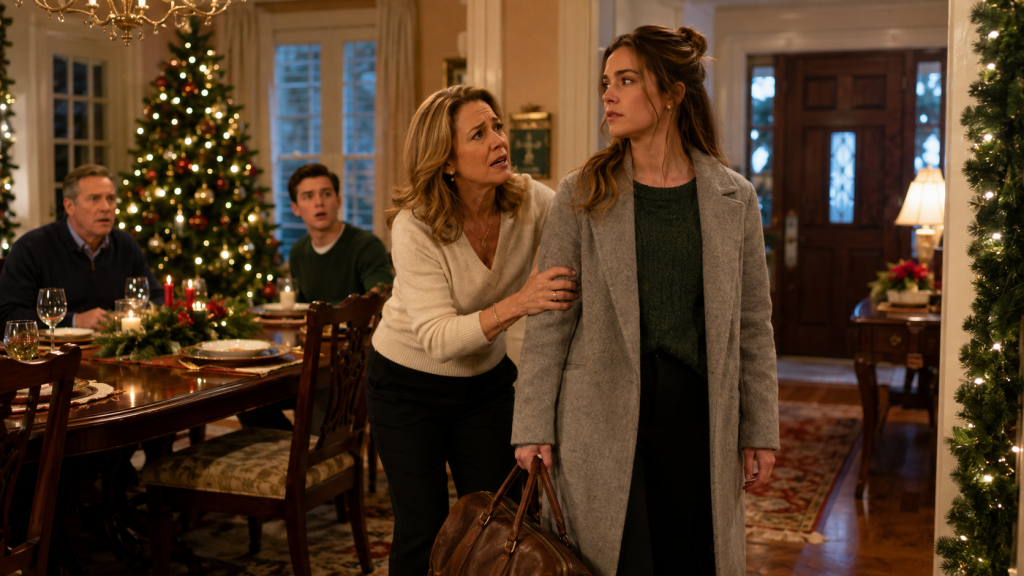
At Christmas Eve dinner, my parents told me to move out and start being independent while my brother laughed in my face. I quietly reached for my bag to leave—until my mom panicked and rushed over, asking if I’d still pay their bills.

“”You’re twenty-five years old, Harlow. It’s time to pack your bags and start being independent.””
My father’s voice cut through the warm, twinkling glow of the Christmas Eve tree, sharp and absolute. Across the mahogany dining table, my younger brother, Leo, snorted into his wine glass, hiding a smug laugh behind his napkin. My parents had spent the entire evening making pointed remarks about my quiet freelance work, assuming I was barely scraping by while living under their roof. They viewed me as their perpetual burden, the struggling daughter who couldn’t keep up with Leo’s manufactured corporate success.
The tipping point had arrived disguised as holiday tough love. They wanted me gone, convinced I would crawl back begging for financial scraps within a week.
I didn’t yell. I didn’t beg or argue. A cold, heavy calm washed over me. Without saying a word, I pushed my chair back from the table, stood up smoothly, and reached for my heavy leather duffel bag resting by the hallway coat rack. I had packed it the moment I walked into the house, sensing this exact confrontation was coming.
As I zipped the bag shut and turned toward the front door, the festive mood in the room abruptly shattered. Footsteps padded rapidly across the hardwood floor, and my mother rushed over, her face pale and twisted with sudden, frantic panic. She grabbed my arm, her fingers digging in desperately.
“”Harlow, wait! Before you go… you’ll still pay our monthly bills and mortgage, right?””
The entire room went dead silent.
Leo stopped laughing instantly, his fork freezing halfway to his mouth. My father sat upright, his brow furrowing in sudden confusion, staring at my mother as if she had lost her mind. My mother didn’t care about my independence; she cared about the fact that her luxury lifestyle, the country club dues, and the house payments were entirely dependent on the exact bank account she expected me to abandon.
I looked down at her grasping hand, then slowly lifted my eyes to meet hers, letting a quiet, dangerous smile touch my lips.
PART 2: THE DAUGHTER THEY THOUGHT THEY WERE SUPPORTING
I looked down at my mother’s hand wrapped tightly around my arm.
Her manicured fingers were trembling.
A minute earlier, she had been sitting beneath the chandelier with perfect posture, nodding while my father explained that throwing me out was necessary for my personal growth.
Now she looked terrified that I might actually leave.
I slowly lifted my eyes to hers.
“You want me to move out.”
My voice was calm.
Almost gentle.
Mom swallowed.
“Yes, but—”
“And become independent.”
“Yes, sweetheart, but that doesn’t mean—”
I carefully removed her hand from my arm.
“Then I think independence should work both ways.”
The silence that followed was beautiful.
Not comfortable.
Not peaceful.
Beautiful.
It was the kind of silence that appears when a lie has finally been dragged into the light and everyone realizes there is nowhere left to hide it.
My father pushed his chair back.
“What exactly does that mean?”
I turned toward him.
For twenty minutes, he had lectured me about adulthood while cutting slices from a prime rib I had paid for.
The wine beside his hand had been purchased with my credit card.
The electricity warming the house came from an account in my name.
Even the Christmas tree glittering behind him had been delivered by a company whose invoice had arrived in my email.
And he had looked directly at me and called me dependent.
I almost admired the confidence required.
“It means,” I said, “that starting January first, you’ll be paying your own expenses.”
Dad stared.
Leo lowered his fork.
Mom whispered, “Harlow.”
I continued.
“The mortgage.”
Her face changed.
“The utilities.”
Dad’s expression hardened.
“The property taxes.”
Leo slowly set his wineglass down.
“The homeowners’ insurance.”
Mom took a breath.
“The country club membership.”
Another breath.
“Your car lease.”
My father’s mouth opened.
“And the monthly transfer I’ve been sending into the household account.”
No one spoke.
I looked around the dining room.
White candles burned between arrangements of cedar and red berries.
Crystal glasses caught the lights from the tree.
My mother’s expensive Christmas china glowed beneath the chandelier.
Everything looked elegant.
Stable.
Successful.
That was what my parents valued most.
Appearance.
Our family had always been very good at appearing successful.
Apparently, I had been the one paying for the appearance.
Dad stood.
“What monthly transfer?”
Mom immediately looked away.
There it was.
The first crack.
I turned toward her.
“You never told him?”
Her face tightened.
“This is not something we should discuss at Christmas.”
I nearly smiled.
“You were comfortable discussing my eviction at Christmas.”
“That’s different.”
“How?”
“We were trying to help you.”
“No.”
I shook my head.
“You were trying to humiliate me.”
Leo leaned back in his chair.
“Oh, come on, Harlow.”
I looked at him.
He gave me the same little grin he had been wearing all evening.
“You’re making this way more dramatic than it needs to be.”
I stared at him for a second.
That grin had annoyed me for years.
Tonight, strangely, it didn’t.
Tonight I knew something he didn’t.
And ignorance looks very different once you stop envying the person wearing it.
“I’m not being dramatic.”
I lifted my bag.
“I’m leaving.”
Leo laughed.
“Where are you even going to go?”
Mom closed her eyes.
Dad looked irritated.
And I understood immediately that Leo knew even less than my father.
I tilted my head.
“My apartment.”
His smile faltered.
“What apartment?”
“The one I own.”
A tiny pause.
Then Leo laughed again.
“Right.”
I slipped my coat over my shoulders.
He looked toward Dad, expecting him to join in.
Dad didn’t.
Instead, he looked at Mom.
“What apartment?”
Mom whispered, “Richard…”
“What apartment?”
I answered for her.
“Lake Shore Drive.”
Leo stopped smiling.
Chicago has certain addresses that function almost like titles.
You do not need to explain them.
People hear the street and understand.
His eyebrows rose.
“You rent a place on Lake Shore?”
“No.”
I adjusted the strap of my bag.
“I own it.”
Dad stared at me.
Mom looked at the floor.
Leo gave a short laugh.
“You’re telling me you own a condo downtown?”
“Yes.”
“With your freelance money?”
There was such disbelief in his voice that something inside me finally loosened.
For years, those two words had been used like an insult.
Freelance work.
To my father, it meant inconsistent.
To my mother, embarrassing.
To Leo, unemployed with a laptop.
None of them had ever bothered asking what I actually did.
They had decided the answer before I could give it.
“Yes,” I said.
“With my freelance money.”
Leo shook his head.
“No way.”
My father’s eyes narrowed.
“How much did it cost?”
Mom stepped forward.
“Richard, this really isn’t necessary.”
I looked at her.
She knew.
Not everything.
But enough.
Dad noticed too.
His attention snapped toward her.
“What do you know?”
Mom’s lips pressed together.
“Nothing.”
“You clearly know something.”
“I said this isn’t the time.”
“Then when was the time, Margaret?”
His voice rose.
“When you apparently decided our daughter should secretly pay our mortgage?”
Mom flinched.
Leo turned toward her.
“She pays the mortgage?”
Finally.
There it was.
The question everyone had somehow managed not to ask.
Mom looked at me.
I refused to rescue her.
For once, she would answer her own questions.
“Yes,” she said quietly.
Dad’s face went blank.
Leo stared at her.
“For how long?”
She hesitated.
“Harlow…”
I folded my arms.
“Tell them.”
Mom’s face flushed.
“About four years.”
The room went completely still.
Dad actually sat down.
Not gracefully.
His knees seemed to give way beneath him.
“Four years?”
Mom hurried toward him.
“Richard, please.”
He held up one hand.
“How much?”
She said nothing.
“How much has she been paying?”
Mom’s eyes moved toward me.
I answered.
“Six thousand eight hundred a month.”
Leo choked.
Dad stared at me.
“That’s impossible.”
“No.”
I shrugged.
“It’s automatic.”
His voice became strangely quiet.
“Six thousand eight hundred dollars?”
“Yes.”
“Every month?”
“Yes.”
“For four years?”
“Yes.”
The math appeared to happen behind his eyes.
More than three hundred thousand dollars.
And that was only the mortgage.
His face changed.
“What about the utilities?”
“I cover them.”
“Insurance?”
“Yes.”
“Taxes?”
“Most years.”
“Your mother’s car?”
I looked at Mom.
She closed her eyes.
“Yes.”
Dad stood again.
“You told me your consulting work barely covered groceries.”
I frowned.
“No, I didn’t.”
He stopped.
“I never told you what my work earned.”
“You said you freelanced.”
“I do.”
“That means—”
“It means I work independently.”
My voice stayed level.
“It does not mean I’m broke.”
Leo gave an incredulous laugh.
“You expect us to believe you make enough freelancing to pay all this?”
I turned toward him.
“No.”
He blinked.
“What?”
“I don’t expect anything from you anymore.”
That wiped the smile away.
He leaned forward.
“So what do you even do?”
I almost laughed.
Twenty-five years.
I was twenty-five years old, and my brother was asking for the first time what I did for a living.
That fact hurt more than the question.
“I build brand strategy and digital launch systems for technology companies.”
Leo frowned.
“What does that even mean?”
“It means companies hire me when they need to reposition a product, launch into a new market, or recover from a failed campaign.”
“That’s marketing.”
“Sometimes.”
He rolled his eyes.
“And they pay you enough for a Lake Shore condo?”
“Yes.”
“How much?”
“Leo,” Mom whispered.
“No, I want to hear this.”
He looked at me with open disbelief.
“How much did you make last year?”
I stared at him.
“Why?”
“Because this sounds ridiculous.”
I nodded.
“All right.”
I unzipped my bag.
Mom immediately became nervous.
“Harlow, don’t.”
I pulled out my laptop.
Not because I needed to prove myself.
That version of me had died sometime between the prime rib and my mother grabbing my arm.
I opened the computer because I wanted the lies to end.
I logged into my business dashboard.
Then I rotated the screen toward them.
Leo leaned forward first.
My father moved behind him.
Mom stayed where she was.
Leo stared.
His face slowly changed.
“What is that?”
“My company revenue.”
He looked closer.
The number on the screen represented invoices paid during the previous twelve months.
$2,147,880.
Leo blinked.
Then blinked again.
Dad stepped closer.
“That’s two million dollars.”
“Approximately.”
Leo laughed.
But there was no humor in it.
“You’re lying.”
I closed the laptop.
“You asked.”
“No, seriously.”
His voice grew louder.
“You made two million dollars last year?”
“Gross revenue.”
“How?”
“The way most businesses make money.”
My eyes met his.
“Clients.”
Dad looked stunned.
“You own a company?”
“Yes.”
“Since when?”
“Five years.”
“Five—”
His voice broke off.
“You started a company at twenty?”
“Nineteen.”
Mom whispered, “Harlow started working with that software company during college.”
I looked at her.
She knew more than I thought.
Dad turned.
“You knew?”
“She told me parts of it.”
“Parts?”
Mom looked uncomfortable.
“She asked me not to talk about the money.”
That was true.
I had.
At twenty-one, one of my early clients had been acquired by a major technology group.
I negotiated part of my fee through performance bonuses.
The campaign succeeded beyond anything I expected.
Suddenly, I was earning more in a quarter than my father earned in a year.
I had been terrified to tell them.
Not because wealth embarrassed me.
Because I already knew what happened whenever someone in my family had money.
Need appeared.
Then expectation.
Then entitlement.
So I told Mom enough to explain why I could help when Dad’s business suffered.
At first, it was temporary.
Three mortgage payments.
Then six.
Then Dad’s company had another difficult quarter.
Mom cried on the phone.
I extended it.
When Mom needed surgery, I paid.
When the property taxes increased, I covered them.
When the country club threatened suspension because their account was overdue, Mom said losing the membership would humiliate Dad professionally.
I paid that too.
Temporary became normal.
Help became obligation.
And obligation eventually became invisible.
Until tonight.
Dad looked at Mom.
“You knew she had this kind of money and never told me?”
Mom’s face hardened.
“She was helping us.”
“That is not what I asked.”
“You would have treated her differently.”
He stared at her.
“What’s that supposed to mean?”
I laughed softly.
Everyone looked at me.
“It means exactly what happened tonight.”
Dad turned.
“Harlow.”
“If you knew I was paying for this house, you wouldn’t have told me I was a burden.”
His face tightened.
“I never called you a burden.”
“You didn’t need the word.”
I picked up my bag again.
“You spent dinner comparing me to Leo.”
Leo shifted.
“You praised his discipline.”
Another step toward the door.
“His career.”
Another.
“His independence.”
Leo’s expression became defensive.
“I have a career.”
“I know.”
“And I am independent.”
Mom suddenly looked at him.
That look told me something.
Something I hadn’t known.
I stopped.
Leo saw it too.
“What?”
Mom quickly looked away.
I stared at her.
“Mom.”
“Harlow, please.”
“What?”
She shook her head.
“Nothing.”
Leo became irritated.
“What are you all doing?”
I looked at Mom.
“Tell him.”
She went pale again.
Leo pushed his chair back.
“Tell me what?”
Mom whispered, “Your apartment.”
He frowned.
“What about my apartment?”
I stared at her.
I knew Leo lived in a luxury building near River North.
I knew his salary.
At least the salary he claimed.
I had always wondered how the numbers worked.
Apparently, I was about to learn.
Mom clasped her hands.
“When you got promoted last year…”
Leo nodded slowly.
“We helped with the apartment.”
His face relaxed.
“Yeah. Dad helped with the deposit.”
Dad frowned.
“I paid five thousand.”
Leo looked toward him.
“Right.”
Mom said nothing.
I suddenly understood.
“Oh my God.”
Mom looked at me.
I almost laughed.
“Is that where the extra transfer went?”
Her silence answered.
For eighteen months, Mom had asked me for an additional twenty-five hundred dollars every month.
She said Dad’s insurance premiums had increased.
I never checked.
I trusted her.
I had been too busy.
Too accustomed to solving problems with transfers.
I looked at Leo.
“Your rent is forty-five hundred?”
His eyes narrowed.
“How do you know?”
“I didn’t.”
I looked at Mom.
“Until now.”
Leo slowly turned toward her.
“What is she talking about?”
Mom whispered, “I help with your rent.”
“I know.”
“Not exactly.”
His expression changed.
“Mom.”
She closed her eyes.
“Harlow pays part of it.”
The sentence landed harder than anything else that evening.
Leo stared at me.
I stared at him.
The brother who had laughed while our parents threw me out.
The brother who had spent dinner explaining that success required discipline.
The brother whose luxury apartment I had apparently been subsidizing without knowing.
“No.”
He shook his head.
“No way.”
Mom rushed in.
“You were having trouble after the promotion and—”
“I pay my own rent.”
“You pay part of it.”
“How much?”
Mom hesitated.
“How much?”
“Twenty-five hundred.”
His mouth fell open.
Dad whispered something I couldn’t hear.
Leo looked at me.
“You’ve been paying half my rent?”
“Apparently.”
“I didn’t ask you to.”
“No.”
My eyes moved to Mom.
“You didn’t.”
That mattered.
Leo was arrogant.
Insensitive.
Often unbearable.
But in that moment, the humiliation on his face looked genuine.
Mom had deceived both of us.
She had made me believe the money was for insurance.
She had allowed Leo to believe he was fully independent.
Then tonight, she sat there silently while he laughed at me for supposedly depending on our parents.
Something colder than anger moved through me.
“Why?”
Mom began crying.
“Harlow.”
“Why would you do that?”
“I was trying to keep everyone stable.”
“By lying?”
“You wouldn’t have agreed.”
“You’re right.”
I stepped closer.
“I would not have agreed to secretly pay my brother’s luxury rent.”
Leo stood.
“Stop talking about me like I’m not here.”
I turned.
“I’m not blaming you.”
He looked startled.
“I’m blaming her.”
Mom wiped her eyes.
“I knew you could afford it.”
That sentence.
Simple.
Small.
Ugly.
I could afford it.
Somehow those four words had become permission.
Permission to take.
Permission to hide.
Permission to assume.
I stared at my mother.
“You think because I have money, it doesn’t count when you take it from me.”
“No.”
“That is exactly what you think.”
“I’m your mother.”
“And I’m your daughter.”
My voice cracked for the first time.
Not an ATM.
Not an emergency account.
Not the invisible person who made everyone else’s life easier while being mocked for having none of her own.
A daughter.
I swallowed.
“When Dad’s company nearly collapsed, I helped.”
My father looked down.
“When you needed surgery, I helped.”
Mom cried silently.
“When Leo needed tuition for his final semester, I helped.”
Leo’s head snapped up.
“What?”
Mom covered her mouth.
I froze.
That one I had known about.
Apparently Leo hadn’t.
“You told me Dad paid,” he whispered.
Mom said nothing.
Leo stared at her.
“You told me he took money from his retirement account.”
“I didn’t want you to feel guilty.”
“So you lied?”
She began crying harder.
“I was protecting your confidence.”
Leo laughed bitterly.
“My confidence?”
He pointed toward me.
“You let me sit here and make fun of her.”
Mom shook her head.
“I didn’t know you were going to—”
“You knew.”
His voice rose.
“You knew she paid my tuition?”
“Yes.”
“My apartment?”
“Yes.”
“And you let me call her dependent?”
Mom said nothing.
Leo turned away.
For the first time all night, he looked ashamed.
I should have enjoyed it.
A few hours earlier, maybe I would have.
But humiliation had stopped feeling satisfying.
I had been humiliated enough for all of us.
Dad lowered himself into his chair.
He stared at the table.
“How much?”
I looked at him.
“How much what?”
“How much have you spent on this family?”
I thought about the question.
Mortgage.
Taxes.
Insurance.
Medical expenses.
Tuition.
Cars.
Trips.
Repairs.
A new roof.
Leo’s education.
Apparently Leo’s rent.
Christmases.
Emergencies.
Quiet transfers no one remembered after the crisis passed.
“I don’t know.”
Dad looked up.
“You don’t know?”
“I stopped counting.”
His face crumpled slightly.
That affected me more than I expected.
My father had always been proud.
Sometimes painfully proud.
He hated borrowing money.
Hated admitting weakness.
Maybe that was why Mom hid so much from him.
But his pride had also made him cruel tonight.
He had needed someone beneath him.
Someone whose life made his own feel stable.
And he chose me.
“Harlow.”
His voice was different now.
Lower.
“Why didn’t you tell me?”
I almost smiled.
“You never asked.”
“That’s not fair.”
“No?”
“No.”
He stood.
“If you were doing all this, you should have said something.”
“I did.”
“When?”
“Four years ago.”
He frowned.
“I told you I could cover the mortgage while your company recovered.”
His face changed.
I continued.
“You told me not to worry about adult finances.”
Leo looked down.
“I offered to explain my business.”
My throat tightened.
“You said internet work wasn’t a real career.”
Dad’s face went pale.
“You remember that?”
I laughed softly.
“People usually remember the sentences that change how they see their parents.”
No one spoke.
I picked up my bag.
This time, Mom did not stop me.
At least not immediately.
I reached the door.
My hand touched the brass handle.
Then Dad spoke.
“If you stop paying…”
I turned.
He looked older.
Suddenly much older.
“What happens to the house?”
There it was.
Not accusation.
Fear.
I looked around.
The house had been my childhood home.
I had learned to ride a bicycle in the driveway.
Broken my wrist falling from the oak tree.
Cried in the upstairs bathroom after my first breakup.
Studied for exams at the kitchen island.
Decorated that same Christmas tree with Leo when we were children.
A house is strange that way.
Walls collect love even when the people inside them become difficult to love.
“The mortgage becomes your responsibility.”
Dad swallowed.
“I can’t carry it.”
Mom closed her eyes.
I knew.
Of course I knew.
His business had never fully recovered.
The country club conversations and expensive dinners disguised a company barely keeping its head above water.
“How long before the bank…”
He couldn’t finish.
“I don’t know.”
“That isn’t an answer.”
“It’s the only one I have tonight.”
Mom finally moved.
She stepped toward me.
“Harlow, please.”
I looked at her.
“Please what?”
“Don’t punish your father because I made mistakes.”
I stared.
“And there it is.”
“What?”
“You still think this is punishment.”
She looked confused.
“I’m not taking anything from you.”
I gestured around the room.
“I’m simply no longer giving it.”
The distinction seemed to stun her.
People become very comfortable calling generosity an obligation once they depend on it.
“You told me to become independent.”
My voice softened.
“I’m doing exactly what you asked.”
Mom cried.
“But not like this.”
“How, then?”
She had no answer.
Leo stepped forward.
“Harlow.”
I looked at him.
His earlier smugness was gone.
“I’m sorry.”
I waited.
He looked genuinely uncomfortable.
“I was an ass.”
A faint laugh escaped me.
“Yes.”
He almost smiled.
Then his expression became serious again.
“I didn’t know.”
“I know.”
“That doesn’t make what I said okay.”
“No.”
He nodded.
“I’ll handle my rent.”
For the first time that night, someone accepted a consequence without negotiating.
I appreciated that.
“You should.”
He swallowed.
“And the tuition…”
“That was years ago.”
“I can repay you.”
“You don’t have to.”
His eyebrows rose.
“I thought you were cutting everyone off.”
“I’m stopping ongoing support.”
I looked at him.
“I’m not rewriting every gift into a debt.”
Something in his face softened.
Maybe, for the first time, he understood that the money had never been the real problem.
It was the disrespect.
The assumption.
The way they had turned my generosity into evidence of my weakness.
Dad crossed his arms.
“So that’s it?”
I looked at him.
“You leave on Christmas Eve and let us lose everything?”
His tone brought the old anger back.
Not because he was afraid.
Because somehow, even now, he wanted me to be guilty.
I inhaled slowly.
“You told me to leave.”
“I was trying to motivate you.”
“You told me I had thirty days.”
“That doesn’t mean—”
“It meant exactly what you said until you learned I paid the bills.”
His jaw clenched.
“That is not fair.”
“No.”
I smiled sadly.
“It isn’t.”
That was the first thing we agreed on.
I opened the door.
Cold December air rushed inside.
Snow was falling lightly over the front lawn.
The Christmas lights my mother hired someone to install glowed along the roofline.
For years, I had thought leaving this house would feel like failure.
Instead, standing there with my bag over my shoulder, I felt something almost unfamiliar.
Space.
Mom called my name again.
I turned.
She hugged herself as though the cold had already reached her.
“You’ll come for Christmas morning?”
I looked at the dining room.
At the half-finished plates.
At Dad.
At Leo.
At the empty chair I had occupied.
“No.”
Her face fell.
“Harlow.”
“I need one Christmas where I’m not pretending.”
She began crying again.
I hated that it hurt.
Boundaries would have been easier if I had stopped loving them.
But love rarely disappears simply because respect does.
Sometimes you leave while still loving people.
That is what makes leaving difficult.
“I’ll call after New Year’s.”
Mom nodded weakly.
I stepped outside.
Then Dad said something behind me.
“Harlow.”
I looked back.
He stood in the doorway.
For once, he did not look like the family patriarch.
He looked like a man who had just discovered he understood far less about his daughter than he believed.
“I really thought you were struggling.”
I stared at him.
“I was.”
His forehead creased.
“What?”
“I was struggling.”
My voice shook.
“Just not financially.”
That silenced him.
I continued.
“I was struggling because no matter how much I accomplished, this family still treated me like the child who couldn’t get anything right.”
Dad looked away.
“I paid your mortgage and still listened to you lecture me about responsibility.”
My throat tightened.
“I paid for Mom’s car while she asked when I planned to get a real job.”
Mom covered her mouth.
“I helped Leo finish college and listened to him laugh because I supposedly couldn’t support myself.”
Leo’s eyes dropped.
“That was the struggle.”
A tear slid down my cheek.
I wiped it away before it reached my jaw.
“I kept thinking if I gave enough, eventually you would see me.”
Nobody moved.
“But the more I gave, the less visible I became.”
That was the truth I had never been brave enough to say.
Not to them.
Not even to myself.
I stepped backward onto the porch.
“So I’m done buying a place in this family.”
Mom sobbed.
I turned before guilt could stop me.
I walked down the snowy driveway.
My car waited beneath the streetlamp.
I placed my bag in the trunk.
Then I sat behind the wheel.
For several seconds, I did nothing.
My hands rested on the steering wheel.
My childhood home glowed in the rearview mirror.
I cried.
Quietly.
Not because I regretted leaving.
Because sometimes freedom still breaks your heart.
I drove downtown through softly falling snow.
Chicago shimmered beneath Christmas lights.
Storefronts glowed.
People hurried along sidewalks carrying packages.
Families crowded restaurants.
The city felt impossibly alive.
When I reached my building, the doorman smiled.
“Good evening, Ms. Bennett.”
“Merry Christmas, Thomas.”
“You too.”
I rode the elevator to the thirty-first floor.
When my front door opened, silence greeted me.
But it was not lonely silence.
It belonged to me.
My sofa.
My books.
My ridiculous collection of ceramic mugs.
The painting I bought in Lisbon.
The wide windows overlooking the lake.
Nothing needed to impress anyone.
Nothing needed to prove I was successful.
I set my bag down.
Then my phone began vibrating.
Mom.
Dad.
Mom again.
Leo.
I turned it facedown.
A minute later, another call came.
This one was different.
MELISSA GRANT — FIRST NATIONAL PRIVATE BANK
I frowned.
Melissa was my private banker.
She never called after hours.
Especially on Christmas Eve.
I answered.
“Melissa?”
“Harlow, I’m sorry to call tonight.”
Something in her voice changed my posture.
“What happened?”
“There was an attempted transfer from one of your business accounts about thirty minutes ago.”
My blood went cold.
“How much?”
She hesitated.
“Four hundred and eighty thousand dollars.”
I stood completely still.
“To where?”
“An account ending in 7712.”
I knew that number.
I had seen it before.
Not recently.
Years ago.
My father’s business account.
I closed my eyes.
“Was the transfer approved?”
“No. Your secondary authentication stopped it.”
Relief moved through me.
Then anger followed.
“Who initiated it?”
“That’s why I called.”
Melissa paused.
“The login credentials belonged to you.”
My fingers tightened around the phone.
“That’s impossible.”
“I thought so too.”
“Where was the login made?”
Another pause.
Then she gave me the IP location.
My parents’ house.
For a moment, all I could hear was my own breathing.
Someone inside that house had tried to transfer nearly half a million dollars from my company account less than an hour after I left.
“Freeze everything.”
“I already restricted outgoing transfers.”
“Change the access credentials.”
“We’ll need to verify—”
“I’ll verify anything you need.”
My voice became colder.
“Nothing moves tonight.”
“Understood.”
I ended the call.
Then I stood alone beside the windows.
Snow floated over Lake Michigan.
Thirty-one floors below, headlights moved like ribbons along the street.
My phone buzzed.
A text from Mom.
Please don’t be angry. Your father is panicking. Call me.
Then another.
We can explain.
My stomach dropped.
We.
Not he.
We.
I stared at the message.
Suddenly, the lies about Leo’s rent felt small.
The mortgage felt small.
Christmas dinner felt small.
Someone had accessed my business banking credentials.
And Mom already knew there was something to explain.
I called Leo.
He answered on the first ring.
“Harlow?”
“Where are you?”
“In my car.”
“Why?”
“I left.”
That surprised me.
“Why?”
He exhaled.
“Dad and Mom started fighting after you drove away.”
I walked toward my desk.
“Leo, I need you to listen carefully.”
His tone changed.
“What?”
“Did Dad go into my old bedroom after I left?”
Silence.
“Yes.”
My pulse accelerated.
“Why?”
“I don’t know.”
“Think.”
“He said he needed some paperwork.”
“What paperwork?”
“I don’t know, Harlow.”
His voice became nervous.
“What’s happening?”
I stared toward the lights outside.
“Someone tried to take four hundred and eighty thousand dollars from my company account.”
Silence.
Then:
“What?”
“The login came from Mom and Dad’s house.”
Leo swore.
“I’m turning around.”
“No.”
“Harlow—”
“Do not go back.”
“Why?”
“Because I don’t know what they’re doing.”
His breathing changed.
Then he said something that made every hair on my arms rise.
“Harlow…”
“What?”
“There’s something you should know.”
My grip tightened.
“What?”
“I heard Mom and Dad talking before dinner.”
“About me?”
“Yes.”
My heart began beating harder.
“What did they say?”
“I only caught part of it.”
“Leo.”
“They were arguing in Dad’s office.”
A pause.
“Dad said something about tomorrow being too late.”
Cold moved through my body.
“Too late for what?”
“I don’t know.”
“And Mom?”
“She told him you would never agree if you found out.”
My knees suddenly felt weak.
“Found out about what?”
“I swear, I don’t know.”
Then he inhaled sharply.
“Wait.”
“What?”
“There was a folder.”
“What folder?”
“Dad had this blue legal folder on his desk.”
I stopped breathing.
Blue.
My father used blue folders for one thing.
Corporate documents.
Leo continued.
“Your name was written on it.”
I closed my eyes.
“What exactly did it say?”
He was silent for several seconds.
Then he answered.
HARLOW BENNETT — OWNERSHIP TRANSFER.
My heart stopped.
Ownership transfer.
Not mortgage papers.
Not household bills.
Ownership.
I looked toward my laptop.
My company.
My father’s struggling company.
The attempted transfer.
Suddenly the entire Christmas Eve confrontation looked different.
They had not simply wanted me out of the house.
They had wanted me away from something inside it.
“Leo.”
“Yeah?”
“Do you still have the key to the side entrance?”
“Yes.”
“Don’t use it.”
“What are you going to do?”
I stared at my parents’ messages.
Please don’t be angry.
We can explain.
Then another appeared.
This time from Dad.
Come back to the house. We need to discuss your company before you do something reckless.
I read the sentence twice.
My company.
He knew.
He knew far more than he had pretended to know at dinner.
Maybe he had known for years.
My mother’s panic.
Dad’s sudden concern about the house.
The demand that I move out.
The secret folder.
The attempted bank transfer.
Pieces began falling into place.
Not enough to reveal the whole picture.
But enough to make me afraid.
Not of losing the house.
Not of losing Christmas.
Of discovering that the people I had spent years supporting had not merely taken my generosity for granted.
They might have been planning to take the one thing I built entirely without them.
My business.
I called Melissa back.
“Send me every login record from the last thirty days.”
Then I called my attorney.
He answered with Christmas music playing faintly in the background.
“Harlow?”
“Marcus, I’m sorry.”
“You sound upset.”
“I need you to pull every corporate filing connected to Bennett Strategic Group immediately.”
His voice became serious.
“Why?”
“Because someone tried to move four hundred and eighty thousand dollars out of my account.”
Silence.
“And I just learned there may be ownership-transfer documents with my name on them.”
The Christmas music disappeared.
Perhaps he moved into another room.
“Have you signed anything recently?”
“No.”
“Anything at your parents’ house?”
“No.”
“Have they ever had access to your electronic signature?”
My body went still.
My electronic signature.
I thought back.
Three months earlier, Mom had asked me to use Dad’s office computer to sign an insurance renewal because my laptop battery had died.
I had logged into my document-signing account.
Had I logged out?
I could not remember.
“Possibly.”
Marcus’s voice became very calm.
“Harlow, do not return to that house tonight.”
I stared into the dark glass of the window.
“Why?”
“Because if someone has attempted to transfer funds and there are unauthorized ownership documents involved, this has moved beyond a family disagreement.”
My throat tightened.
“What are you saying?”
“I’m saying we document everything first.”
He paused.
“And Harlow?”
“Yes?”
“Do not warn them about what you know.”
I looked down at Dad’s message again.
Come back to the house.
For twenty-five years, my parents had taught me that good daughters answered when called.
Good daughters helped.
Good daughters forgave.
Good daughters never embarrassed the family.
But that Christmas Eve, standing alone in the home they did not know I owned, I finally understood something.
Maybe being a good daughter had never required being an easy victim.
I typed one response to my father.
I’m already home.
Then I turned my phone off.
Outside, Christmas lights shimmered across Chicago.
Inside, my lawyer began searching records that my parents had apparently hoped I would never see.
And before midnight, he called me back.
His first sentence erased every remaining doubt.
“Harlow,” he said, his voice grim, “I found the ownership document.”
I gripped the phone.
“And?”
“It says you transferred forty-nine percent of Bennett Strategic Group.”
My stomach dropped.
“To whom?”
Marcus went silent.
Then he said:
“Your father.”
For a moment, I could not breathe.
“But I never signed that.”
“I know.”
“How do you know?”
“Because there are two witnesses listed.”
My pulse thundered.
“One is your mother.”
I closed my eyes.
“And the other?”
His answer came quietly.
“Leo.”
I stared into the darkness.
My brother.
The same brother who had just apologized.
The same brother who claimed he knew nothing.
His name was on the document that could have handed nearly half my company to my father.
I slowly lowered myself into the chair beside the window.
Christmas Eve had started with my family telling me I needed to learn independence.
Now, less than six hours later, I was staring at evidence that someone in that family may have been trying to steal the company that made me independent in the first place.
And for the first time that night, I was no longer sad.
I was furious.
Quietly.
Completely.
Dangerously furious.
Because paying their bills had been generosity.
Financing their lifestyle had been my mistake.
But trying to take my company?
That was different.
That was not family.
That was war.
And Christmas morning was only a few hours away.
PART 3: THE CHRISTMAS MORNING THEY LOST CONTROL
“Leo.”
His name came out of my mouth like a question.
Like an accusation.
Like a prayer I did not want answered.
I stared at the ownership-transfer document on my laptop screen.
Forty-nine percent of my company.
My father’s name beneath it.
My mother listed as one witness.
Leo listed as the other.
And my signature.
Almost perfect.
Almost.
Except it was not mine.
I knew every hesitation in my handwriting.
Every slope.
Every small habit.
Whoever had copied it had done an excellent job.
But they had copied a version of my signature from years ago.
Before I changed the way I crossed the final letter.
That tiny difference may have looked meaningless to anyone else.
To me, it looked like a fingerprint.
Marcus was still on the phone.
“Harlow?”
“I’m here.”
“Do not call anyone.”
I leaned back in the chair.
Snow drifted silently past the window.
Chicago looked peaceful from thirty-one floors up.
That almost offended me.
My entire family had apparently built a trap beneath my feet, and the city was still glowing as though nothing had happened.
“Do you think Leo knew?”
Marcus paused.
“I don’t know.”
His answer mattered.
He could have told me what I wanted to hear.
He didn’t.
“That signature beside his name may be genuine.”
My chest tightened.
“Or forged?”
“Possibly.”
I closed my eyes.
I wanted certainty.
I wanted someone to point toward the villain and say:
There.
That person.
Be angry at them.
But real betrayal rarely arrives with neat labels.
Marcus continued.
“I also found a filing attempt from six weeks ago.”
I sat straighter.
“What filing?”
“An ownership amendment.”
My mouth went dry.
“Was it processed?”
“No.”
“Why?”
“The electronic verification failed.”
I exhaled.
“Then why would Dad try to transfer the money tonight?”
“That is the question.”
I stared at the document.
Forty-nine percent.
Not fifty-one.
Just enough to make him powerful.
Not enough to make it obvious.
My father had always liked control disguised as reasonableness.
Even his theft had apparently been negotiated.
“Marcus.”
“Yes?”
“If I had not stopped the bank transfer tonight, what would have happened?”
He exhaled slowly.
“If the account accepted the transaction and if they later succeeded in legitimizing that ownership document, your father might have argued the transfer was authorized as a business distribution.”
My stomach turned.
“He was trying to create evidence.”
“Possibly.”
Evidence that the lie was real.
Evidence that I had treated him like an owner.
Evidence built with nearly half a million dollars of my own money.
I laughed once.
Quietly.
Marcus heard it.
“Harlow.”
“It’s almost elegant.”
“What is?”
“The audacity.”
He did not answer.
Maybe there was nothing to say.
I looked at the clock.
11:47 p.m.
Christmas Eve was nearly over.
Christmas morning was waiting on the other side of twelve.
The holiday my mother had spent weeks planning.
The matching napkins.
The elaborate breakfast.
The perfectly staged photographs.
Tomorrow was supposed to begin with cinnamon rolls and champagne.
Instead, my parents were going to wake up to consequences.
“Marcus.”
“Yes?”
“I want everything locked.”
“It already is.”
“Business accounts.”
“Restricted.”
“Corporate filings.”
“Flagged.”
“Electronic signature access.”
“Disabled.”
“My trust accounts.”
“Unchanged and secure.”
I inhaled slowly.
“And the house payments?”
He hesitated.
“That is up to you.”
“No.”
My voice softened.
“They stop.”
A pause.
“All of them?”
“Yes.”
The mortgage.
The country club.
The insurance.
Everything.
I had told them I was done.
Now I meant it.
“I’ll confirm the cancellations tomorrow.”
“Tonight.”
“Harlow—”
“Please.”
He was silent.
Then:
“All right.”
I closed my eyes.
“Thank you.”
“Get some sleep.”
I almost laughed.
“Apparently everyone thinks I sleep through disasters.”
He let out a tired breath.
“Then at least lie down.”
I promised nothing.
After we hung up, I sat alone for almost an hour.
My apartment was quiet.
Too quiet.
Every room seemed to hold a memory I had avoided.
Mom calling me from the grocery store because her card declined.
Dad asking casually if I could cover “a small gap” in the mortgage.
Leo laughing when I said I had a client call on a Saturday.
My parents telling guests that I “worked online.”
Mom sighing whenever someone asked whether I planned to get a real office.
Dad praising Leo’s promotion while barely understanding that one contract of mine was worth more than Leo’s yearly salary.
I had thought they did not understand me.
Now I wondered if the truth was worse.
Maybe they understood exactly enough.
Enough to use me.
Not enough to respect me.
At midnight, my phone lit up.
A message from Leo.
Can we talk?
I stared at it.
Then another.
I swear I didn’t know about the transfer.
I did not answer.
A third message arrived.
I think Mom used my signature.
My heart shifted.
Not softened.
Shifted.
There is a difference.
I typed:
How?
The reply came immediately.
She asked me to sign something two months ago. Said it was related to Dad’s insurance.
I stared.
Did you read it?
A long pause.
No.
I almost threw the phone.
Instead, I leaned back and closed my eyes.
Of course he had not read it.
Of course.
The brother who had spent Christmas Eve lecturing me about responsibility had signed something without reading it.
The irony was so clean it almost hurt.
I typed:
Call Marcus tomorrow. Tell him everything.
Leo replied:
Will you believe me?
My fingers hovered.
I thought about every smug joke.
Every comparison.
Every time he had treated my career like a phase.
Then I typed the only answer I could honestly give.
I’ll believe evidence.
Nothing more.
The next morning, I woke at six.
I had slept for less than three hours.
Christmas sunlight filtered weakly through the windows.
The lake below was gray-blue.
The city looked washed clean.
I made coffee.
Black.
No sugar.
Then I sat at the kitchen island and opened my laptop.
Three emails were already waiting.
One from Marcus.
One from Melissa at the bank.
One from my father.
Dad’s subject line read:
Family Emergency
I almost admired that too.
His emergency.
Created from my money.
I opened it.
Harlow,
Last night became unnecessarily emotional. Your mother and I made mistakes in how we handled dinner, but you are also reacting without understanding the full financial picture. Your company has benefited from this family in ways you refuse to acknowledge.
We need to sit down like adults.
There are documents you signed years ago that you may not remember.
The transfer last night was intended to protect family assets before you made rash decisions.
Please come home.
Dad.
I read it twice.
Then I smiled.
There are documents you signed years ago that you may not remember.
That sentence mattered.
Not because it frightened me.
Because it admitted too much.
I forwarded it to Marcus.
His reply came three minutes later.
Do not respond.
I didn’t.
Then the intercom buzzed.
My doorman.
“Ms. Bennett?”
“Yes?”
“There’s a Leo Bennett downstairs.”
I looked toward the elevator.
“Send him up.”
When the doors opened, Leo stepped out wearing the same clothes from last night.
No coat.
Wrinkled shirt.
Red eyes.
He looked nothing like the polished younger brother who had laughed over wine.
He looked twenty-two again.
Maybe younger.
“Harlow.”
I stepped aside.
He entered quietly.
For once, he did not make some comment about the view.
He just stood there.
Then he said:
“I’m sorry.”
I crossed my arms.
“For which part?”
He closed his eyes.
“Fair.”
I waited.
He sat on the edge of the sofa.
“I talked to Mom.”
“Why?”
“Because she called me twenty-seven times.”
That sounded like her.
“And?”
“She admitted she used the document I signed.”
My jaw tightened.
“What did she say you were signing?”
“Insurance paperwork.”
“And you didn’t read it.”
“No.”
I stared at him.
He looked ashamed.
“Say it.”
“What?”
“Say you didn’t read a document before signing.”
His face reddened.
“I didn’t read it.”
“After spending dinner telling me I needed to be more responsible.”
He nodded.
“I know.”
I looked away.
I did not want his shame.
Not anymore.
It felt too much like mine.
“What did Mom say?”
“She said Dad was panicking about the business.”
“Whose business?”
“His.”
I looked back.
Leo continued.
“It’s worse than we thought.”
That sentence made my stomach tighten.
“How?”
“Dad’s company is nearly insolvent.”
I frowned.
“How nearly?”
“Bad.”
“That isn’t a number.”
“He owes suppliers.”
“How much?”
“About one-point-three million.”
I stared at him.
“And taxes.”
“How much?”
“Nearly four hundred thousand.”
My chest went cold.
Leo looked miserable.
“He also used the house as collateral.”
I laughed.
Not because anything was funny.
“Of course he did.”
“Harlow.”
“What?”
“He didn’t just need the transfer last night.”
I stared.
“He needed your company.”
The words settled slowly.
Dad had not wanted money.
Not only money.
He wanted the machine that produced it.
My company.
My clients.
My contracts.
My reputation.
All the things he had dismissed as “internet work.”
Now he needed them to save himself.
“Why forty-nine percent?”
Leo swallowed.
“Dad said fifty-one would look suspicious.”
My laugh this time was colder.
“There it is.”
He looked down.
“Mom told me.”
“So she knew everything.”
“Not everything.”
I raised an eyebrow.
“Be careful with that sentence.”
He nodded.
“She says Dad told her you had agreed years ago to make him a silent partner.”
I stared.
“And she believed him?”
“At first.”
“At first?”
“She started questioning it when you told everyone how much you made.”
I laughed softly.
“So my success made the lie too obvious.”
Leo looked at me.
“She thought you were doing well.”
“She knew I was doing well.”
“No.”
He shook his head.
“She didn’t know you were doing that well.”
I sat across from him.
For a moment, neither of us spoke.
Then he said:
“She thought you made maybe two hundred thousand.”
I almost smiled.
Of course.
That explained the comfort.
Enough money to pay their bills.
Not enough to make them feel smaller.
Two million changed the emotional math.
Suddenly, the daughter they treated like a dependent was wealthier than everyone at the table.
Including Dad.
Especially Dad.
“What did Mom think the ownership document was for?”
“She said Dad told her it protected the family if you got sued.”
I stared.
“So she witnessed a fake transfer because she thought it protected me.”
Leo nodded.
“Apparently.”
I closed my eyes.
There it was again.
The family habit.
Control disguised as protection.
Taking disguised as helping.
Lying disguised as love.
“Do you believe her?”
Leo exhaled.
“I believe she knew it wasn’t clean.”
That was honest.
I appreciated honesty now, even ugly honesty.
“She knew I hadn’t agreed?”
“I think so.”
I nodded.
The pain was quieter than I expected.
Maybe because I had already cried for the family I thought I had.
Now I was just meeting the one that actually existed.
Leo leaned forward.
“Harlow.”
“Yes?”
“I want to help.”
“With what?”
“Anything.”
I studied him.
“Why?”
“Because I spent years being a jerk to you.”
“That is not the same as helping.”
“I know.”
He swallowed.
“But I also let Mom and Dad build this whole story about you.”
“What story?”
“That you were lost.”
He looked ashamed.
“That you were struggling.”
“That you stayed home because you couldn’t afford to leave.”
“That I was the successful one.”
My throat tightened.
“And you liked it.”
“Yes.”
The honesty hurt.
He continued.
“I liked being the one Dad bragged about.”
I said nothing.
“I liked feeling ahead of you.”
Another silence.
“And I never asked what your life actually looked like because I didn’t want the answer to threaten mine.”
I stared at him.
That was the first apology that reached me.
Not because he said sorry.
Because he understood the injury.
“I was jealous of you.”
I almost laughed.
“You thought I was broke.”
“I thought you were free.”
That stopped me.
He looked toward the windows.
“You worked when you wanted.”
“You traveled.”
“You didn’t seem terrified of your boss.”
His mouth twisted.
“I spent three years in a company I hate because Dad finally respected me.”
There it was.
The wound beneath his arrogance.
Different from mine.
But born from the same house.
“I’m not excusing anything.”
He looked back at me.
“I just want you to know I see it now.”
I nodded slowly.
“Good.”
He seemed surprised.
“That’s it?”
“What do you want?”
“I don’t know.”
“Punishment?”
He almost smiled.
“Maybe.”
“I’m not Dad.”
That wiped the smile away.
“I’m not building my relationships around punishment.”
He nodded.
“Then what happens?”
“I don’t know.”
“Can I earn back trust?”
“Yes.”
His eyes lifted.
“But not with speeches.”
He nodded.
“With time.”
“Yes.”
“And evidence.”
“Exactly.”
That morning, Leo met with Marcus.
He handed over texts.
Emails.
The insurance document Mom had sent him.
A photograph of the blue folder.
He even agreed to provide a formal statement.
By noon, Marcus had enough to begin a civil fraud case.
Then something happened I did not expect.
My mother came to my apartment.
She arrived alone.
No makeup.
No jewelry.
No perfect Christmas coat.
She looked exhausted.
I almost did not let her upstairs.
Then I decided I wanted to hear her without Dad beside her.
When she entered, she stopped near the door.
“Harlow.”
I waited.
She looked around.
The apartment she had criticized the idea of before ever seeing it.
The lake.
The art.
The life I built.
Her eyes filled.
“This is beautiful.”
I almost laughed.
“Now?”
She flinched.
“I deserve that.”
“Yes.”
She clasped her hands.
“I came to tell you the truth.”
I leaned against the counter.
“That would be new.”
She closed her eyes.
“I knew about the ownership papers.”
I said nothing.
She continued.
“Not everything.”
I raised a hand.
“Please don’t use that phrase to reduce your responsibility.”
Her face crumpled slightly.
“All right.”
Good.
“Start again.”
She took a breath.
“I knew your father was trying to get part of your company.”
There.
Clean.
Ugly.
True.
“Why?”
“Because he was desperate.”
“So?”
“He said the company could save us.”
“Us.”
“Yes.”
“You mean him.”
Her lips trembled.
“Yes.”
I folded my arms.
“And you helped.”
She began crying.
“Yes.”
“Why?”
“I was afraid.”
“Of what?”
“Losing the house.”
I stared.
“That house?”
She nodded.
I almost laughed.
All of it.
Four years of payments.
All the panic.
The lies.
The manipulation.
For a house.
“I raised you there.”
She whispered.
“I thought we would grow old there.”
“You were willing to steal from me for wallpaper and memories?”
“It wasn’t just a house.”
“No.”
My voice sharpened.
“It was status.”
She flinched.
“The neighborhood.”
“The country club.”
“The dinners.”
“The photographs.”
“Mom, you were terrified of looking poor.”
She began sobbing.
“Yes.”
That surprised me.
The admission.
No defense.
Just yes.
I stared at her.
She wiped her face.
“Your father’s business has been failing for years.”
“I know.”
“No.”
She shook her head.
“You know numbers.”
“You don’t know him.”
I almost laughed.
“I know him better now.”
She swallowed.
“He became someone I didn’t recognize.”
“He was ashamed.”
“He stopped sleeping.”
“He started borrowing.”
“He convinced himself one big deal would fix everything.”
“And when it didn’t?”
“He borrowed more.”
Her shoulders shook.
“Then he found out how much your company had grown.”
“How?”
She looked down.
“The tax return.”
My body went still.
“What tax return?”
“You printed documents in his office last year.”
I remembered.
I had printed an investment report.
Not a tax return.
Unless…
My stomach tightened.
“He went through my files.”
Mom nodded.
“After that, he became obsessed.”
I stared at her.
“He said you owed the family.”
There it was.
The sentence I had suspected.
“He said we supported you when you were starting.”
I laughed.
“I started with a secondhand laptop and scholarship money.”
“I know.”
“He said you built the company while living in our house.”
“I paid rent.”
“I know.”
“He said the family name helped you.”
“My clients don’t even know who Dad is.”
“I know.”
Her crying intensified.
Every I know was another confession.
“You knew he was wrong.”
“Yes.”
“And helped anyway.”
“Yes.”
I turned away.
That hurt more.
Not because she believed his lie.
Because she didn’t.
She knew.
And still chose comfort over me.
“I’m sorry.”
I faced her.
“I don’t need sorry today.”
“What do you need?”
“Distance.”
She closed her eyes.
“I understand.”
“No.”
My voice softened.
“You will.”
She looked up.
“I’m ending all household support.”
“I know.”
“The mortgage.”
She nodded.
“The country club.”
Another nod.
“Your car.”
Her face tightened.
“Yes.”
“The credit card.”
She swallowed.
“Yes.”
“And I will not cover Dad’s debts.”
Silence.
Then:
“I know.”
I studied her.
“Do you?”
She nodded.
“I came here because…”
She stopped.
“Because what?”
“I wanted to ask you not to destroy him.”
My jaw tightened.
“Mom.”
“I know what he did.”
“No.”
I shook my head.
“This is exactly the problem.”
“What?”
“You think consequences and destruction are the same thing.”
She stared.
“I am not destroying Dad.”
I spoke slowly.
“He forged my signature.”
“He tried to take half my company.”
“He attempted to move nearly half a million dollars.”
“He did those things.”
I pointed toward the door.
“He built the consequences.”
My mother cried silently.
“I am simply refusing to stand between him and them.”
She lowered her head.
For the first time in my life, she looked truly defeated.
Not because she lost an argument.
Because there was nothing left to negotiate.
“Will you ever forgive me?”
I thought about it.
Maybe.
Someday.
Not today.
“I don’t know.”
Her mouth trembled.
“I love you.”
I believed her.
That was the painful part.
“I love you too.”
Her eyes lifted.
“But love is not permission.”
She started crying harder.
Neither did I rescue her.
That was new.
I walked her to the door.
Before she left, she looked back.
“Leo told me he’s helping you.”
“Yes.”
“Are you angry with him?”
“Yes.”
“But you’re talking to him.”
“Yes.”
She looked confused.
“Why?”
“Because he told the truth before it benefited him.”
Mom flinched.
I did not mean it cruelly.
But truth does not become kind just because you lower your voice.
She left.
Dad did not come.
Instead, he hired an attorney.
That told me everything I needed to know.
The next three months were ugly.
Not dramatic in a satisfying way.
Ugly.
Paperwork.
Depositions.
Bank audits.
Corporate filings.
Lawyers.
Invoices.
My father denied forging my signature.
Then said he believed I had authorized it verbally.
Then claimed the family had an implied ownership interest.
Then argued I was emotionally unstable.
Marcus loved that last one.
Because Dad had spent years telling people I was too unserious to run a real business.
Now he was arguing that the company was valuable enough to belong partly to him.
Contradictions are expensive in court.
The attempted transfer left a trail.
So did the login.
So did the signature file.
So did the electronic document history from Dad’s office computer.
Mom eventually gave a sworn statement.
That was the moment their marriage broke.
Not because she betrayed him.
Because she stopped protecting the lie.
Dad blamed her.
Of course he did.
She moved into a small rental apartment three months later.
Not glamorous.
Not terrible.
Just ordinary.
She got a job at a local interior design showroom.
At fifty-six years old.
Her first real job in almost twenty-five years.
She hated it at first.
Then she became good at it.
That mattered to me more than I expected.
Leo moved into a smaller apartment.
He paid his own rent.
Completely.
He complained about it once.
Then caught himself.
We both laughed.
That was the first time we felt like siblings instead of competitors.
He changed jobs six months later.
Took a small pay cut.
Started working somewhere he actually liked.
Dad called him a fool.
Leo said:
“Maybe.”
Then did it anyway.
I was proud of him.
I did not tell him immediately.
Older sisters have traditions to preserve.
My father’s case settled eleven months after Christmas.
He admitted to unauthorized use of my electronic signature and attempted financial transfer.
There were civil penalties.
Restitution.
His company collapsed anyway.
Not because I refused to save it.
Because it had been collapsing for years.
The house was sold.
The country club membership disappeared.
The leased cars went back.
The mahogany dining table was auctioned.
I saw the listing online once.
For a few seconds, I stared at the photograph.
That table.
The place where I had been told to leave.
The place where Leo laughed.
The place where my mother panicked over the bills.
It looked smaller in the auction photograph.
Maybe everything does once you stop being afraid of it.
Dad moved into a modest townhouse outside the city.
He did not speak to me for almost a year.
Then one afternoon, I received a letter.
Real paper.
His handwriting.
Harlow,
I have spent most of my life confusing providing with being valuable.
When I stopped being able to provide, I became afraid there would be nothing left of me.
Then I looked at you.
You built something I could not understand.
Instead of learning to understand it, I belittled it.
That made it easier to feel bigger.
When I discovered how successful you were, I did not feel proud.
I felt ashamed.
Not of you.
Of myself.
What I did was wrong.
There is no explanation that makes it less wrong.
I tried to take something you built because I was too proud to admit I had failed at what I built.
I am sorry.
Dad.
I read it three times.
Then placed it in a drawer.
I did not call him.
Not yet.
Some apologies deserve to be heard.
That does not mean they erase the distance required to survive them.
Another Christmas came.
I did not host a grand dinner.
I did not want chandeliers.
Or country club friends.
Or photographs designed to prove anything.
I invited Elena.
My best friend Priya.
Leo.
Mom.
And, after a great deal of thought, Dad.
My apartment was crowded.
The turkey came out slightly dry.
Leo burned one tray of rolls.
Mom brought cranberry sauce in a plastic container instead of her antique bowl.
Nobody cared.
Dad arrived last.
He stood near the elevator holding a small wrapped box.
When the doors opened, no one spoke for a second.
He looked older.
Smaller.
But calmer.
“Harlow.”
“Dad.”
He held out the box.
“You didn’t have to bring anything.”
“I know.”
That answer made me smile faintly.
I opened it later.
Inside was an old photograph.
Me at nineteen.
Sitting on the floor of my childhood bedroom.
Laptop open.
Hair tied in a messy knot.
A cup of terrible coffee beside me.
I remembered that night.
My first major client.
My first launch.
My first real payment.
I turned the photograph over.
Dad had written:
You were building something before I knew how to see it.
I cried.
Quietly.
Not because everything was fixed.
It wasn’t.
Not because I forgot.
I didn’t.
Because healing does not always look like returning to what existed before.
Sometimes healing is building something entirely different.
Later that evening, Leo sat beside me near the window.
He handed me a glass of wine.
“Remember last Christmas?”
I looked at him.
“No.”
He laughed.
“Liar.”
I smiled.
“I remember enough.”
He stared toward the tree.
Then said:
“You know what’s weird?”
“What?”
“I really thought I was better than you.”
I raised an eyebrow.
“Bold confession.”
“I know.”
He laughed.
“Now I think I was just louder.”
That made me laugh harder than it should have.
He looked toward Mom.
She was helping Priya clear plates.
Dad was standing near the kitchen, arguing with Elena about the correct way to carve leftover turkey.
Our family was still awkward.
Still scarred.
Still unfinished.
But different.
No one was paying for everyone else’s love.
No one was pretending.
No one was allowed to hide behind “family” as an excuse for entitlement.
Leo nudged me.
“You happy?”
I thought about it.
Really thought.
“Yes.”
And I was.
My business had grown.
But that was not why.
I had money.
But that was not why.
The mortgage on my apartment was paid.
My investments were secure.
My company belonged entirely to me.
Still not why.
I was happy because my life finally matched the truth.
I no longer entered rooms trying to prove I deserved a chair.
I no longer gave money because I feared what would happen if I stopped.
I no longer made myself smaller so someone else could feel tall.
And I no longer confused being needed with being loved.
Near midnight, Mom found me alone beside the windows.
Snow had started falling.
Again.
Just like the year before.
“Harlow.”
I looked at her.
She held two mugs of tea.
She handed me one.
“Thank you.”
We stood quietly.
Then she whispered:
“I’m sorry I grabbed your arm.”
I smiled faintly.
“Of all the things that happened, that’s what you’re apologizing for?”
“I think about it.”
“Why?”
“Because I remember your face.”
Her eyes filled.
“You looked so calm.”
A tear slipped down her cheek.
“And I was only thinking about the mortgage.”
I said nothing.
“I didn’t ask where you would go.”
Her voice broke.
“I didn’t ask whether you were scared.”
“I asked whether you would keep paying.”
She looked down.
“That was the moment I realized what I had become.”
My throat tightened.
I touched her hand.
Not because everything was forgiven.
Because I loved her.
And love, when healthy, leaves room for truth.
“You changed.”
“I’m trying.”
“That matters.”
She looked at me.
“Do you trust me?”
I thought about it.
“More than last year.”
She laughed through her tears.
“I’ll take it.”
That was enough.
Not perfect.
Enough.
The party ended after midnight.
Leo hugged me before leaving.
Dad stood awkwardly near the elevator.
Then, after a long hesitation, he hugged me too.
Not tightly.
Not dramatically.
Just carefully.
As though he understood that access to me was no longer automatic.
“Thank you for inviting me.”
“You’re welcome.”
He nodded.
Then the elevator closed.
Mom left with Leo.
The apartment became quiet again.
I walked back toward the Christmas tree.
Underneath it sat several gifts.
Nothing extravagant.
Books.
Candles.
A scarf from Mom.
A ridiculous mug from Leo that said:
FREELANCER: APPARENTLY A REAL JOB.
I laughed when I saw it.
Then I sat on the floor.
The same way I had at nineteen.
Laptop nearby.
Coffee long gone cold.
Except this time I was not building a business.
I was looking at the life that business had given me the courage to protect.
A year earlier, my parents had told me to move out and become independent.
They thought independence meant rent.
Bills.
A mortgage.
A place of my own.
They were wrong.
Independence was learning that generosity without boundaries becomes self-abandonment.
It was understanding that helping people does not give them ownership over you.
It was realizing that being loved badly is not better than being alone peacefully.
And it was knowing that if someone only values your presence because of what you pay for, leaving is not cruelty.
It is clarity.
I picked up the old photograph Dad had given me.
Nineteen-year-old me stared back.
Messy hair.
Cheap laptop.
Tired eyes.
No idea what was coming.
I smiled at her.
She had worked so hard to become someone everyone would respect.
She did not know yet that the harder lesson would be respecting herself first.
I placed the photograph beside the tree.
Outside, snow covered the city in white.
Inside, my home was quiet.
Warm.
Mine.
And for the first time, Christmas did not feel like a test I had passed by making everyone else comfortable.
It felt like peace.
The kind you do not buy.
The kind you do not beg for.
The kind that arrives when you finally stop paying for a seat at someone else’s table—
and build your own.
THE END STORIES! THANK YOU FOR READING GOOD LUCK !❤️
Related Posts