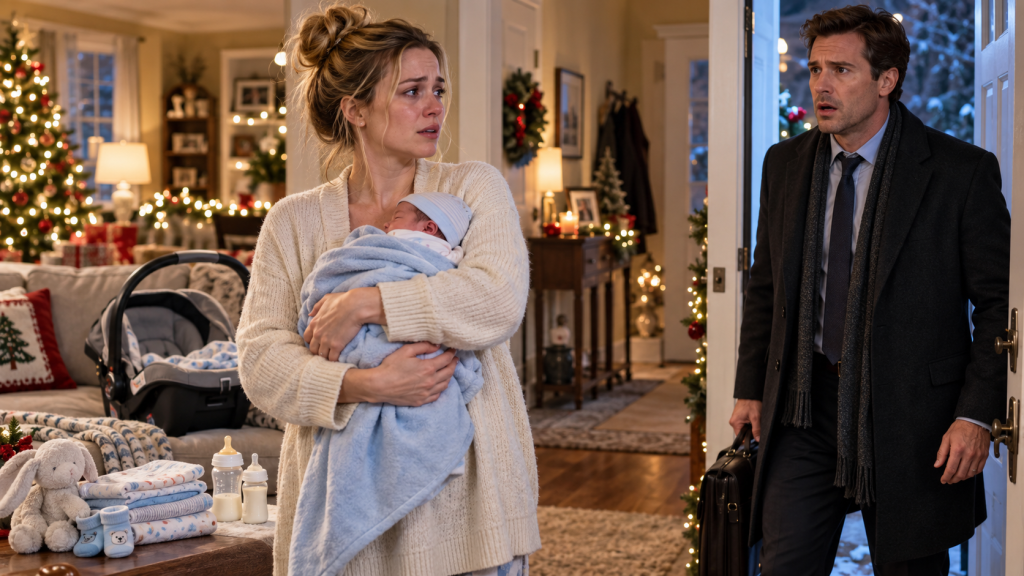
On Christmas Eve, I arrived at my ex-wife’s home ready to face the man I believed had taken my place. Instead of a new husband, I found a newborn baby. When I finally learned why she had hidden the truth from me, everything I thought I understood came crashing down.

Part 1: The Son I Didn’t Know Existed
I arrived at my ex-wife’s house on Christmas Eve expecting to confront another man. Instead, I discovered a newborn whose eyes matched mine.
Emily Carter and I had divorced five months earlier, barely speaking as lawyers finalized the paperwork. As CEO of Rowan Technologies, I negotiated billion-dollar deals, yet I couldn’t stop dwelling on the marriage I had destroyed.
Snow fell over Bellevue as I drove my Aston Martin toward her small blue house. Christmas lights brightened the windows, making my luxurious Seattle penthouse seem even lonelier by comparison.
I called the visit a search for closure. Really, I wanted to know whether she had replaced me.
Emily answered wearing a loose cream sweater, her hair gathered in a messy bun. She looked exhausted.
“Gavin? Why are you here?”
Rather than apologize for appearing unannounced, I asked whether she had company. Her expression hardened, and she told me to leave.
I took her refusal as proof. Stepping past her, I searched for a man’s belongings.
Instead, I noticed a baby carrier beside the sofa. Bottles, folded blankets, tiny socks, and diapers filled the room.
When I turned, Emily stood in the hallway cradling a newborn in a pale blue blanket. He looked only days old.
We had divorced five months ago. We had last been together nine months ago.
“Whose child is he?” I asked.
She held him closer. “Gavin, this is your son.”
Then he opened his green eyes, and I gripped a chair.
“Noah?”
She nodded. “Noah James Carter.”
James was my middle name. I had missed his birth, his first cry, and the moment Emily became his mother.
“Why didn’t you contact me?”
Her eyes filled. “I tried.”
Three firm knocks interrupted her. Emily stiffened and pulled Noah against her chest.
Another knock followed, then a woman called from outside, insisting she knew Emily was home.
“Please don’t answer,” Emily whispered.
Her fear changed everything. I had come looking for evidence that she had moved on; now I wondered whom she was trying to keep away.
The person outside already knew about our baby. As I approached the door, I understood there was much more Emily hadn’t told me..
PART 2 — THE CALLS SHE NEVER RECEIVED
The woman outside knocked again.
Harder this time.
“Emily, I know you’re in there.”
I froze.
I knew that voice.
My mother.
Margaret Rowan.
I turned toward Emily.
Every trace of color had left her face.
“You know her?”
I asked.
Emily gave me a look so wounded that the question suddenly felt stupid.
“She’s been here three times this week.”
My stomach dropped.
“My mother?”
Emily nodded.
“She knows about Noah?”
“She knew before you did.”
For a moment, I could hear nothing except the soft hum of the heater and Noah’s tiny breaths against Emily’s chest.
Then the knocking came again.
“Emily, open the door.”
I moved toward it.
Emily caught my sleeve.
“Please don’t.”
I looked at her hand.
She released me immediately.
“Why are you afraid of her?”
Emily stared at me.
Then she laughed once.
A broken, exhausted sound.
“You really don’t know.”
“No.”
Her eyes filled.
“I tried to tell you I was pregnant.”
The room seemed to tilt.
“What?”
“I called.”
“You never called me.”
“I called seven times.”
My chest tightened.
“I emailed you.”
“I sent messages through your office.”
“I mailed a letter.”
I shook my head.
“No.”
Emily’s voice sharpened.
“Yes, Gavin.”
“I spent three weeks trying to tell my husband that I was carrying his child.”
“Ex-husband.”
I whispered.
“At the time, technically still my husband.”
That hurt more.
She looked down at Noah.
“When you never answered, I thought you didn’t care.”
“I didn’t know.”
“I know that now.”
“Then what happened?”
Emily’s eyes moved toward the front door.
“Your mother happened.”
Another knock.
“Emily.”
Margaret’s voice softened.
“You’re making this unnecessarily difficult.”
Emily visibly flinched.
I had heard my mother use that tone my entire life.
Not loud.
Never vulgar.
Calm enough to make resistance sound irrational.
“What did she do?”
I asked.
Emily hesitated.
Then:
“She called me.”
“When?”
“About a month after I found out.”
“She said you knew.”
My body went cold.
“She said what?”
“She told me you knew about the baby.”
“And that you wanted nothing to do with us.”
I stared.
“No.”
Emily’s mouth trembled.
“She said you were relieved the divorce was almost finished.”
“That a child would complicate your life.”
“That your board was worried about publicity.”
“I never said any of that.”
“I know.”
“Now.”
The word landed between us.
Now.
Too late for the pregnancy.
Too late for every appointment.
Too late for Noah’s birth.
Emily continued.
“She told me that if I tried to involve you publicly, Rowan Technologies had lawyers who could make my life miserable.”
I felt physically sick.
“My mother threatened you?”
“She called it advice.”
Of course she did.
Margaret never threatened.
She explained consequences.
There was always enough politeness around the blade to make you wonder whether you had imagined being cut.
I pulled out my phone.
“I need to see something.”
Emily watched as I opened my messages.
Searched her name.
Nothing.
I searched archived threads.
Nothing.
Blocked contacts.
My hand stopped.
Emily Carter.
Blocked five months earlier.
I stared at the screen.
“I didn’t do this.”
Emily’s expression barely changed.
“I believe you.”
That somehow hurt worse.
I opened my email.
Searched her address.
Nothing in my inbox.
Then I checked filters.
There was one rule I had never created.
Messages containing Emily’s address were automatically forwarded into an administrative folder and marked as read.
My pulse pounded.
The rule had been created through an executive administrative login.
The same account my chief of staff, my assistant—
and my mother—
had been given access to during the divorce because I had been traveling constantly.
I looked at Emily.
“She got into my office systems.”
Emily said nothing.
She did not need to.
The knocking came again.
I walked toward the door.
Emily whispered:
“Gavin.”
I turned.
She looked terrified.
Not of me.
That distinction mattered.
“I’m not letting her in.”
I said.
“Then what are you doing?”
“Making sure she knows I’m here.”
I opened the door only far enough to step onto the porch, then pulled it nearly shut behind me.
Margaret stood beneath the Christmas lights wearing a camel-colored coat and leather gloves.
She smiled automatically.
Then saw my face.
The smile disappeared.
“Gavin.”
“Hello, Mother.”
For the first time in thirty-seven years, she looked genuinely frightened of me.
Not physically.
Of what I knew.
“What are you doing here?”
she asked.
I almost laughed.
“I was about to ask you the same thing.”
Her eyes moved toward the narrow opening behind me.
“She called you?”
“No.”
I said.
“She spent months trying.”
Margaret became still.
There it was.
Confirmation before confession.
“You blocked her.”
I said.
Margaret’s lips parted.
“You intercepted her emails.”
“Gavin—”
“You told her I knew about the pregnancy.”
She looked toward the street.
“Not here.”
“Why not?”
“The neighbors—”
I laughed.
Of course.
Image first.
Always.
“Did you tell Emily I wanted nothing to do with my son?”
Margaret closed her eyes.
Then:
“I was trying to protect you.”
The words hit harder than denial would have.
I stepped back.
“From my child?”
“From a disaster.”
Inside the house, Noah began crying.
My mother heard him.
Something flickered across her face.
Emotion.
Maybe love.
Maybe curiosity.
Maybe ownership.
I moved automatically, blocking her line of sight through the doorway.
She noticed.
Her expression hardened.
“Gavin, I am his grandmother.”
“And you made sure I didn’t know I was his father.”
Silence.
Emily appeared behind the door.
Not close.
Noah against her shoulder.
Her voice trembled, but the words did not.
“You told me he hated his own child before he even knew the child existed.”
Margaret looked at her.
“I told you what was necessary.”
My anger disappeared.
Not cooled.
Changed into something much more dangerous.
Clarity.
“What was necessary?”
I asked.
Margaret turned toward me.
“Your father nearly destroyed this family once.”
I frowned.
“What does Dad have to do with Noah?”
“Everything.”
She exhaled.
“When your father’s brother went through that custody scandal, the company nearly lost two major contracts.”
“That was Uncle Patrick.”
“It became a Rowan problem.”
“No.”
I stepped closer.
“It became a Patrick problem that you decided belonged to everybody.”
Margaret’s face tightened.
“You don’t understand what it takes to protect a family like ours.”
There it was.
The Rowan name.
The company.
The fortune.
The thing my mother had worshipped longer than she had loved any individual member of the family.
“She was pregnant during a divorce.”
Margaret continued.
“You were already distracted.”
“The board was uneasy.”
“Reporters had started asking questions.”
“So you decided my son was a liability?”
“I decided you needed time.”
“Five months?”
She said nothing.
“His entire pregnancy?”
Nothing.
“His birth?”
Her face finally cracked.
“I did not know she had delivered until two days ago.”
Emily laughed bitterly.
“You would have known if you hadn’t made me disappear.”
Margaret looked toward Noah.
“Let me see him.”
Emily held him closer.
“No.”
My mother stared.
People rarely told Margaret Rowan no.
Emily did.
Again.
“No.”
I stepped between them.
“You heard her.”
Margaret looked at me.
“You’re taking her side?”
That sentence revealed how little she understood.
“This is not a side.”
I said.
“This is the mother of my child telling you not to approach her baby.”
Her face changed.
“Our baby?”
I turned toward Emily.
The mistake struck immediately.
Not mine to claim yet.
Not like that.
I corrected myself.
“Her child.”
Then quieter:
“And my son, if Emily allows me the chance to become his father.”
Emily looked at me.
Something shifted in her face.
Not forgiveness.
Maybe recognition.
Margaret whispered:
“You’re humiliating me.”
I almost smiled.
“You hid my child from me.”
“And you’re worried about humiliation.”
She looked suddenly older.
“I did what I thought was best.”
“For whom?”
Silence.
Exactly.
Emily disappeared into the hallway and returned carrying an envelope.
Old.
Bent at the corners.
She handed it to me.
“I kept this.”
I looked down.
My name was printed across the front.
Gavin James Rowan
Rowan Technologies
Certified mail markings ran along the top.
Returned to sender.
Unopened.
My hands began to shake.
Then I saw handwriting across the envelope.
Black ink.
Four words.
A handwriting I had seen on birthday cards, contracts, school forms, Christmas tags, condolence letters.
My mother’s.
Do not contact him again.
I stopped breathing.
“When did you get this back?”
I asked.
Emily swallowed.
“Four months ago.”
“Why didn’t you show anyone?”
“Who?”
Her question destroyed me.
“My lawyer?”
“Your attorney was speaking to my attorney.”
“Your office?”
“Your mother controlled who reached you.”
“My friends?”
“Gavin, by then I believed you knew.”
Right.
My silence had become evidence.
Because I had built a life where silence from me was plausible.
I had ignored Emily for meetings.
Canceled dinners.
Missed anniversaries.
Allowed assistants to manage personal calls.
Allowed my mother to “help” with uncomfortable family matters because it saved time.
I had not hidden Noah.
But I had created enough distance that someone else could pretend to be my voice.
And Emily believed it.
Because my behavior had trained her to.
That realization hurt almost as badly as the envelope.
I looked at Margaret.
She was crying now.
Quietly.
Beautifully.
My mother even cried with restraint.
“Leave.”
I said.
“Gavin.”
“Go home.”
“We need to discuss—”
“No.”
She flinched.
“I will call you when I decide I want to speak to you.”
“I am your mother.”
“Yes.”
“And that is the only reason I am saying this once instead of having security remove you from Emily’s property.”
Margaret looked at Emily.
Then at the baby.
Then at me.
She walked away.
No final speech.
No victory.
Just snow gathering on the shoulders of her expensive coat as she reached her car.
I closed the door.
Locked it.
Then turned around.
Emily stood several feet away.
Noah had stopped crying.
The house was suddenly silent.
I looked at my son.
Then at the woman I had failed long before my mother interfered.
“I’m sorry.”
Emily closed her eyes.
“Don’t.”
My chest tightened.
“Emily—”
“Not tonight.”
I nodded.
She looked exhausted.
More tired than angry.
“I have spent months imagining you knew.”
“I know.”
“I hated you.”
“I understand.”
“I gave birth thinking you had chosen not to come.”
The words nearly brought me to my knees.
“I didn’t know.”
“I know.”
She looked at me.
“That doesn’t erase what it felt like.”
“No.”
It didn’t.
Nothing could.
Noah made a small sound.
I looked toward him.
Emily noticed.
“You can come closer.”
I moved slowly.
Stopped an arm’s length away.
He was impossibly small.
Red cheeks.
Dark hair.
Green eyes closed now.
My son.
Except I had not earned the word emotionally yet.
Biology had done the easy part.
I whispered:
“Can I hold him?”
Emily studied my face.
A long time.
Then:
“Sit down.”
I sat.
She placed Noah carefully into my arms.
Every executive decision I had ever made disappeared.
Every contract.
Every boardroom.
Every number.
None of it had prepared me for six pounds of sleeping human being settling against my chest.
I stared at him.
His fingers opened.
Closed around one of mine.
And I cried.
Not quietly.
Not elegantly.
I cried for the birth I missed.
For the pregnancy Emily survived believing she had been abandoned.
For every call I never received.
For the father I had not known I was.
Emily sat across from me.
She did not comfort me.
She shouldn’t have.
These tears were mine to carry.
After a while, she said:
“You cannot fix this with money.”
I looked up.
“I know.”
“You cannot send lawyers after your mother and call it fatherhood.”
“I know.”
“You cannot decide Noah belongs in your life because you discovered him tonight.”
“I know.”
Her eyes filled.
“And you cannot use what Margaret did to pretend you were a good husband.”
That one went straight through me.
I looked down at Noah.
“No.”
I whispered.
“I won’t.”
Because my mother had stolen something enormous.
But she had not destroyed our marriage by herself.
She had entered through doors I had left open.
Distance.
Neglect.
Silence.
Convenience.
All those years I thought providing everything meant I was giving Emily enough.
I had given her a house.
Security.
Vacations.
Whatever money could purchase.
And made her lonely inside all of it.
My mother’s deception succeeded because the lie sounded like a man I had already taught Emily to expect.
That truth would hurt for a long time.
It deserved to.
Outside, snow continued falling over Bellevue.
Inside, the Christmas tree lights reflected softly against the window.
Noah slept against my chest.
Emily watched me from across the room.
Nothing was repaired.
Nothing was forgiven.
I had not gotten my marriage back.
I had not earned my son.
But for the first time in months, nobody was speaking for me.
Not my mother.
Not an assistant.
Not a lawyer.
Just me.
So I looked at Emily and said the only promise I had any right to make.
“I’m not asking you to trust me tonight.”
Her expression softened slightly.
“I’m asking for the chance to become someone Noah can trust someday.”
Emily looked at our son.
Then back at me.
“You start by showing up tomorrow.”
I nodded.
“What time?”
Her eyes filled.
“Six.”
“In the morning?”
A faint smile touched her mouth.
“You wanted fatherhood.”
For the first time that night, I laughed.
“Yes.”
I looked down at Noah.
“I suppose I did.”
But as I held him, I understood something I should have learned years ago.
Wanting a family was easy.
Being present for one was the work.
And this time, nobody else was going to do that work for me.
PART 3 — THE FATHER WHO LEARNED TO STAY
At 5:42 the next morning, I parked two houses away from Emily’s home and turned off the engine.
Snow had stopped sometime before dawn.
Bellevue was almost unnaturally quiet, the lawns covered in white, Christmas lights still glowing against roofs and hedges while most of the neighborhood slept.
My phone read:
5:42 A.M.
Emily had told me six.
I had arrived eighteen minutes early because apparently discovering you had a newborn son transformed punctuality into panic.
I almost walked to the door.
Then stopped myself.
She had said six.
Not 5:42.
Not whenever my anxiety decided I deserved access.
Six.
So I stayed in the car.
For eighteen minutes, I did absolutely nothing.
It may have been the first meaningful act of fatherhood I performed.
I waited.
At exactly six, I knocked.
Not rang.
Not let myself in.
Knocked.
Emily opened the door wearing sweatpants and the same exhausted expression she had worn the night before.
Her hair was twisted loosely over one shoulder.
There was spit-up on her shirt.
I had never seen her look more beautiful.
Not because motherhood had transformed her into some glowing symbol.
She looked tired.
Sore.
Human.
And for years I had been married to that human being while noticing schedules more easily than exhaustion.
“Six.”
she said.
I held up the paper bag in my hand.
“Coffee?”
She looked suspiciously at it.
“For you.”
“And?”
“Nothing.”
“No peace offering?”
“No.”
“No breakfast from a five-star hotel?”
“No.”
“No diamond necklace hidden underneath?”
I almost smiled.
“Coffee.”
Emily took the bag.
“Good.”
Then she stepped aside.
“Come in.”
Noah was awake.
He lay in a bassinet beside the sofa, making tiny offended noises at the ceiling.
I stopped in the entryway.
It was ridiculous.
I had held him the night before.
Still, seeing him again made something inside my chest pull tight.
Emily noticed.
“He does that.”
“What?”
“Looks fake.”
I glanced at her.
She smiled faintly.
“Like someone made a very small person for a movie.”
I looked back at him.
“Yes.”
Then:
“Can I—”
Emily sighed.
“You don’t need permission to look at him.”
I nodded.
“Right.”
“But yes, ask before picking him up for now.”
“Okay.”
I approached the bassinet.
Noah’s green eyes moved vaguely in my direction.
There was no recognition.
Of course there wasn’t.
I had spent less than an hour of his life near him.
I reached one finger toward his hand.
Then stopped.
“Can I touch his hand?”
Emily stared at me.
“You are going to ask me that every time?”
“For as long as you need.”
Something changed in her face.
“Go ahead.”
His fingers closed around mine.
Instinct.
Not love.
Not recognition.
Biology performing a reflex.
I knew that.
It still almost destroyed me.
Emily sat on the sofa.
“He needs a bottle.”
I straightened.
“I can do it.”
She raised one eyebrow.
“Do you know how?”
“No.”
“Excellent beginning.”
She pointed toward the kitchen.
“Formula is already prepared.”
“Bottle warmer.”
“Not the microwave.”
“Check the temperature.”
“Support his head.”
“Burp him afterward.”
“And if he screams?”
“I panic internally.”
She nearly smiled.
“Good.”
“Externally?”
“Stay calm.”
“Right.”
I picked up the bottle as though it were a piece of laboratory equipment capable of detonating.
Emily watched me.
“Gavin.”
“Yes?”
“He is a baby.”
“I know.”
“Not a billion-dollar acquisition.”
“I’m significantly more comfortable with acquisitions.”
“I noticed during our marriage.”
The sentence hit.
Not cruelly.
Accurately.
I nodded.
Then warmed the bottle.
The first time Noah drank from my hands, I spilled formula down his neck.
He screamed.
I panicked externally despite instructions.
Emily reached for a cloth but did not take him.
“Lift his chin slightly.”
“Like this?”
“Less.”
“He’s not opening an account.”
I adjusted.
Noah latched onto the bottle again and immediately stopped crying.
I stared at him.
“That’s it?”
“For approximately fourteen seconds.”
Emily said.
Then yawned.
“When did you sleep?”
“I didn’t.”
My head snapped toward her.
“Emily.”
“Do not.”
“What?”
“Do not suddenly become the CEO of my postpartum recovery.”
I shut my mouth.
Good lesson.
She leaned her head against the sofa.
“Noah sleeps in short stretches.”
“I’m still figuring feeding out.”
“My body apparently believes milk production should be a full-time crisis.”
“I hurt everywhere.”
“And I am tired enough that yesterday I put my phone in the refrigerator.”
I almost laughed.
Then realized she was serious.
“Did you find it?”
“Eventually.”
I looked at her.
“Go sleep.”
Her eyes narrowed.
“That sounded like an order.”
“You’re right.”
I corrected myself.
“Would you like to sleep while I sit with him?”
She studied me.
“For how long?”
“As long as you want.”
“No.”
I felt something drop in my stomach.
Then she added:
“Forty-five minutes.”
Relief came so quickly it embarrassed me.
“Okay.”
“You stay in this room.”
“Yes.”
“If he cries and you can’t settle him, wake me.”
“Yes.”
“You do not call your mother.”
My face hardened.
“I won’t.”
“And you don’t post pictures.”
“I won’t.”
“And Gavin?”
“Yes?”
“If I wake up and you’ve called a photographer, a pediatric concierge, a baby nurse, a private chef, or anyone whose job title makes my house more expensive…”
Despite everything, I laughed.
“No one.”
She nodded.
Then walked toward the bedroom.
At the doorway, she stopped.
Looked back at Noah.
Then at me.
For one awful second, I saw how difficult it was for her to leave us together.
Not because she thought I would hurt him.
Because trust had been torn in too many places.
“I’m right here.”
I said.
She nodded.
Then closed the bedroom door.
Forty-five minutes became fifty-two.
I did not wake her.
Noah fell asleep against my chest after drinking three ounces.
I sat completely still.
My right arm went numb.
My neck began hurting.
I did not care.
Outside, dawn slowly turned the snow blue.
Inside, my son breathed against my shirt.
I thought about every meeting I had interrupted because my phone buzzed.
Every dinner with Emily I had canceled because “Singapore can only do this hour.”
Every vacation day I had spent answering email beside a pool while telling myself presence counted because my body was there.
I used to believe I had no choice.
The company needed me.
The board needed me.
Employees depended on me.
Thousands of people.
Billions in valuation.
Surely that made my absence from one dinner reasonable.
Then another.
Then an anniversary.
Then the marriage.
The truth was uglier.
Being needed at work had made me feel important.
Being needed at home made me feel vulnerable.
At work, problems had metrics.
At home, Emily sometimes needed me to sit beside her while she was sad.
I could not optimize sadness.
So I answered email instead.
I had called that ambition.
Sometimes it had simply been cowardice with a calendar.
At 6:57, Emily appeared.
She looked more awake.
Barely.
Then she saw Noah on my chest.
Stopped.
I almost apologized for holding him.
Instead I waited.
Her eyes softened.
“Did he eat?”
“Three ounces.”
“Burp?”
“Eventually.”
“Diaper?”
My face betrayed me.
Emily laughed.
Actually laughed.
The sound filled the room I had spent months believing another man might occupy.
“No.”
I said.
“I forgot diapers exist.”
“He will remind you.”
Right on cue, Noah made a tiny grunting sound.
Then an odor hit me.
I looked at Emily.
She folded her arms.
“Congratulations, Dad.”
I changed the first diaper of my life at 7:04 on Christmas morning.
I got it wrong twice.
Noah peed on my sleeve.
Emily sat on the edge of the sofa laughing until tears came.
I stared at my soaked shirt.
“Is this normal?”
“No.”
she said.
“It only happens to billionaires.”
For three seconds, we were us again.
Then the laughter faded.
The distance returned.
Not as harshly.
But there.
History had not disappeared because a newborn had weaponized urine.
Good.
It should not have.
At seven-thirty, I left.
Emily seemed surprised.
“You’re going?”
“You told me to show up at six.”
“You did.”
“I didn’t know how long you wanted me here.”
She looked down at Noah.
Then:
“Come back tomorrow.”
“What time?”
“Seven.”
I nodded.
“At seven.”
She looked at me.
“You have nowhere to be?”
It sounded almost accusatory.
I deserved that.
“I do.”
“Where?”
“Here.”
Her expression hardened slightly.
“Don’t say things like that yet.”
I took the correction.
“You’re right.”
Then:
“I cleared my schedule through New Year’s.”
Her eyebrows lifted.
“You never cleared a week when we were married.”
“I know.”
The silence hurt.
“See you tomorrow.”
I said.
Emily nodded.
“Seven.”
I did not go to my mother’s house.
Margaret called eleven times before noon.
I answered none.
Then came a message.
Gavin, please do not let one emotional evening destroy this family.
I stared at it.
One emotional evening.
She had blocked my former wife.
Intercepted mail.
Lied about my unborn son.
Threatened Emily with lawyers.
Then reframed my discovery as an emotional episode.
The technique was so familiar I wondered how I had never seen it.
Or perhaps I had.
And because it benefited me, I had called it efficiency.
I forwarded the message to my attorney.
Then opened another thread.
My chief operating officer.
Need to speak today. Executive access review. Immediate.
He called within thirty seconds.
“On Christmas?”
“Yes.”
“This sounds cheerful.”
“It won’t be.”
By Christmas afternoon, I had ordered an internal access audit.
Not an investigation designed to punish whoever had followed my mother’s directions.
I wanted facts first.
Who had access to my executive email?
Who created the filter blocking Emily?
Who instructed the mailroom to redirect personal certified mail?
What authority had Margaret been using inside Rowan Technologies?
The answers came faster than I expected.
That frightened me.
My mother did not hack anything.
No one forged a badge.
No sophisticated scheme.
She had used access I gave her.
Years earlier, after my father died, Margaret had retained an honorary advisory role with the company.
No formal operating authority.
But the Rowan name carried weight.
Mine most of all.
When the divorce began, I had told my executive assistant:
“If my mother can handle family-related things, let her.”
Five seconds.
One sentence.
I barely remembered saying it.
Apparently other people did.
My assistant had interpreted Margaret’s requests through that instruction.
Emily’s number was blocked on one work-issued phone after Margaret claimed repeated calls were disrupting negotiations.
The email rule had been created by an IT administrator after my assistant forwarded a request saying family-law correspondence should be separated from executive communications.
The certified letter reached the corporate mailroom.
Because it was personal and connected to Emily, it was routed to the family office.
Margaret received it.
Then returned it.
No conspiracy.
A system.
My system.
That was worse in a different way.
I had made myself so inaccessible that employees believed delegating my marriage was an acceptable workflow.
The board chair, Thomas Bell, called me Christmas night.
“Gavin, what the hell happened?”
I sat in my penthouse staring at a tree my housekeeper had decorated because I had been too busy.
“I found out yesterday that I have a son.”
Long silence.
“What?”
“Five days old.”
Another silence.
Then:
“Congratulations?”
“I also found out my mother intercepted the pregnancy.”
Thomas swore.
I explained.
Not all the personal details.
Enough.
When I finished, he said:
“Was the board involved?”
“No.”
“Did anyone discuss reputational risk from Emily’s pregnancy?”
“Not that I know of.”
“I can answer that.”
His voice hardened.
“No.”
“We did not.”
Margaret had lied about that too.
“The board did not care that your former wife might have a baby.”
“Your divorce was not a corporate strategy.”
I closed my eyes.
“I know.”
“No.”
Thomas said.
“I’m not sure you do.”
That made me open my eyes.
“What does that mean?”
“It means your mother has been wandering through this company under the authority of being your mother for years.”
“And you let it happen because dealing with her yourself was inconvenient.”
I almost argued.
Did not.
Thomas continued.
“You don’t get to act shocked that a boundary nobody enforced got crossed.”
There are people you pay to flatter you.
A good board chair is not one.
The audit expanded.
Margaret’s advisory credentials were suspended.
Her building access was removed.
Her family-office privileges were separated completely from corporate systems.
We implemented a rule that personal relationships could not create administrative authority without explicit written scope.
It should have existed already.
The fact that our governance needed to learn from my divorce embarrassed me deeply.
Good.
Some embarrassment is educational.
My executive assistant offered to resign.
I refused.
“Did my mother tell you Emily was harassing me?”
“Yes.”
“Did you believe her?”
“Yes.”
“Why?”
“You had told us you didn’t want personal distractions during the separation.”
That sentence cut.
My own instruction.
Again.
“Did Emily ever threaten anyone?”
“No.”
“Was she abusive?”
“No.”
“Then why block her?”
My assistant looked stricken.
“Because I thought I was doing what you wanted.”
And there it was.
Responsibility arrived home.
I did not fire her.
I changed the system.
Then changed myself.
On December twenty-sixth, I took formal parental leave.
The board initially expected two weeks.
I requested eight.
Thomas laughed over the phone.
“You are aware CEOs technically have children all the time?”
“Apparently.”
“And companies continue?”
“Let’s test it.”
He paused.
Then:
“Approved.”
I had built Rowan Technologies around the mythology that my presence was irreplaceable.
Maybe every founder does that eventually.
Fatherhood began by discovering I was replaceable where I wanted not to be.
At work.
And absent where I had wanted to believe money could substitute.
At home.
Emily did not care about the leave.
When I arrived at seven the next morning, I told her.
She was feeding Noah.
“Eight weeks.”
she said.
“Yes.”
“Why are you telling me?”
I stopped.
Good question.
“Because I thought you should know I’m available.”
“That sounds like pressure.”
I felt myself getting defensive.
Then caught it.
“You’re right.”
I took off my coat.
“I’m telling you because it changes my schedule.”
“You do not have to use any of that time for me.”
Her shoulders loosened slightly.
“Okay.”
Then:
“Wash your hands.”
I did.
Fatherhood continued.
The next six weeks were profoundly unglamorous.
That may be why they changed me.
I learned how Noah liked to be held when gas made him scream.
Upright.
Chest to chest.
Slow bouncing.
I learned he hated cold wipes.
I learned his right sock disappeared more often than his left.
I learned newborn fingernails are apparently designed for facial violence.
I learned six in the morning feels different when someone tiny needs you than when markets in London open.
I learned Emily drank coffee only after eating something now because pregnancy had apparently rewritten her stomach.
I learned she cried every Sunday evening for no reason she could name.
I learned not to ask her to explain every tear.
Sometimes I just brought water.
Sometimes I left.
Depending on what she wanted.
I attended Noah’s first pediatric appointment.
I sat in a chair.
Not the doctor’s chair.
Not beside the computer.
Not controlling questions.
Emily had a list.
I had one too.
Before asking mine, I said:
“Do you want me to?”
She looked almost amused.
“You’re allowed to ask the pediatrician questions.”
Right.
There is such a thing as overcorrecting.
I was learning that too.
The doctor asked whether both parents lived together.
Emily said:
“No.”
Then looked at me.
Something in my chest tightened.
Not shame.
Reality.
The doctor nodded.
“Who has primary care right now?”
“Me.”
Emily said.
“Gavin visits.”
Visits.
I hated the word.
It was accurate.
The doctor moved on.
No drama.
No judgment.
Just facts.
A DNA test happened in January.
Not because either of us doubted Noah biologically.
Because legal paternity deserved clarity, especially with a divorce already final and a birth certificate that listed no father.
Emily suggested it.
I agreed immediately.
No offense.
No:
How can you question me?
Facts.
The result came back essentially conclusive.
I was Noah’s biological father.
I printed the page.
Then felt stupid for printing it.
Biology confirmed what his face already made me feel.
Still, paper mattered legally.
My attorney coordinated acknowledgment of paternity.
Child support.
Parenting rights.
No courtroom fight.
No emergency custody filing.
Emily expected one.
I saw that the day my lawyer sent her lawyer the proposed documents.
She called me for the first time since Christmas Eve.
“What are you doing?”
I sat up in my office chair.
“What do you mean?”
“The parenting proposal.”
“Yes.”
“It says I have final medical decision-making temporarily.”
“For now.”
“And you get scheduled visits.”
“Yes.”
“Why?”
I frowned.
“Because that’s what you wanted.”
Silence.
Then:
“You’re not asking for fifty-fifty?”
“Not immediately.”
“No.”
“Why?”
I looked out the office window.
“Because Noah doesn’t know me.”
“You’re recovering.”
“We have not co-parented.”
“And I am not going to use a lawyer to turn biology into overnight access before either of you is ready.”
Emily was silent.
Then:
“Your attorney wrote that?”
“No.”
“I told him to.”
Another pause.
Finally:
“Okay.”
One word.
Still, I understood.
Trust sometimes returns first as surprise when you do not misuse power.
The child-support calculation was absurd because of my income.
My attorney explained statutory formulas, deviations, private-school provisions, healthcare, trust planning.
I stopped him.
“What does Noah actually need?”
He laughed.
“That is not how high-income support discussions usually begin.”
“It is now.”
We created a structure.
Monthly support to Emily.
Healthcare.
Childcare.
A separate education account later, with transparent controls.
No giant transfer that could look like leverage.
No property purchase she did not request.
When I offered to pay the mortgage on her house, Emily said no.
I accepted it.
That was harder than writing the check would have been.
Margaret’s first letter came in mid-January.
To me.
Not Emily.
Three pages.
I read the first.
Then stopped.
The opening paragraph said:
Everything I did was done because I believed you were too emotionally compromised by the divorce to make rational choices.
There it was.
Her central belief.
My autonomy vanished when she disagreed with how I might use it.
I wrote back one sentence.
Do not contact Emily or attempt to meet Noah.
Margaret replied through her attorney.
Not directly.
That was progress, technically.
She wanted to know when she could see her grandson.
I answered:
There is no timeline.
She hated that.
I knew because her attorney wrote:
Mrs. Rowan hopes emotions will settle.
I almost framed it.
Emotions.
Again.
As though the problem were temperature.
Not conduct.
Emily received a letter too.
Margaret sent it through counsel after asking whether Emily would accept correspondence.
Emily said yes.
Then left the envelope unopened for two weeks.
One morning I found her staring at it on the kitchen counter.
“Do you want me to take it?”
“No.”
“Do you want me to stay?”
She looked at me.
“Yes.”
I sat.
She opened it.
Read silently.
Her face changed.
Then she handed it to me.
Margaret had written:
Emily, I told myself I was protecting Gavin. That sentence allowed me to behave as though your pregnancy belonged to me to manage.
Good start.
Then:
I believed a public conflict involving a child could damage him, his company, and the Rowan family. I also believed you would eventually seek financial leverage through the baby.
Emily laughed bitterly.
I kept reading.
There was no evidence for that belief beyond my own fear and my experience of what happened to this family years ago.
Better.
Then:
I blocked communication because I thought if Gavin had time to complete the divorce without knowing about the pregnancy, he would later be able to approach the situation rationally.
My hands shook.
She had designed my ignorance as a strategy.
Not permanent.
Temporary, in her mind.
As if missing pregnancy could be repaired later.
The letter continued.
Margaret admitted the returned certified envelope.
The email filtering.
Her conversation with Emily.
The threat involving lawyers.
Then she wrote something that made me stop.
I expected Gavin to be angry when he eventually learned the truth. I believed he would also understand why I did it.
I stared.
Emily whispered:
“That’s the worst part.”
“Yes.”
Because Margaret had known me.
Or believed she did.
She thought the son she raised would be furious at the method but accept the principle.
Protect the company.
Control the problem.
Deal with feelings later.
Why wouldn’t she?
That was how I had lived.
The final paragraph said:
I understand now that I did not protect my son. I took away his chance to decide what kind of man he would be when told he was becoming a father. I took away Emily’s right to tell him herself. And I took away months of Noah’s life from both of them. I cannot return those months.
Emily folded the letter.
“What do you think?”
I asked.
She looked at me.
“I think she understands some of it.”
“Do you want to answer?”
“No.”
“Okay.”
Then she said:
“You?”
I looked at the letter.
“No.”
Not yet.
My relationship with Margaret became something I had never experienced before.
Distant.
She had always been present.
Board dinners.
Holidays.
My apartment.
Company events.
My childhood had been organized around her competence.
After my father died, she became even more central.
I trusted her with everything except the things I considered too personal.
Then, during my divorce, I let her into those too.
Convenience again.
When I finally cut off access, I felt guilt.
That surprised me.
She had done something unforgivable in the colloquial sense.
Still, at 2:00 a.m. one night, I almost called.
Noah was sleeping.
I was alone in my penthouse after leaving Emily’s house.
I wanted my mother.
Not the woman who intercepted the letter.
The mother who sat beside me after my first major business failure.
The mother who ironed my high-school graduation shirt at midnight.
The mother who knew my father was dying before I did and stayed awake with me for three days.
People do not become strangers just because they betray you.
That would be easier.
I called my therapist instead.
Yes.
Therapist.
Thomas recommended one after I nearly fell asleep during a board call.
“Your problem is not sleep.”
he said.
“You just discovered your entire personal governance model is garbage.”
Board chairs are nurturing that way.
My therapist was Dr. Leah Morgan.
At our third session, she asked:
“What does your mother’s usefulness have to do with your attachment to her?”
I nearly left.
Then remembered I was paying four hundred dollars an hour.
Might as well suffer.
I told her Margaret had always solved things.
School admissions.
My father’s schedule.
Family disputes.
Later, introductions.
Business dinners.
Political fundraisers.
Charity events.
When she solved something, I felt loved.
When Emily asked me to sit with a problem instead of solving it, I often felt helpless.
Interesting.
Unpleasant.
Dr. Morgan asked:
“Did you marry someone very different from your mother?”
“Yes.”
“Why?”
I laughed.
“Apparently to avoid therapy.”
She did not laugh.
Therapists are selfish with humor.
Emily and I started co-parenting counseling in February.
Not couples therapy.
She insisted on the distinction.
So did I.
Our counselor wrote it on the intake form:
CO-PARENTING ONLY
Emily circled it.
Twice.
Message received.
The first session was brutal.
Emily said:
“I do not trust him to remain present when work gets difficult.”
I wanted to defend myself.
Didn’t.
The counselor asked:
“What would change that?”
Emily answered:
“Time.”
Of course.
No grand gesture.
No check.
No speech.
Time.
The one thing wealthy men cannot accelerate without ruining the meaning.
So I gave time.
Not theatrically.
Consistently.
Wednesday mornings.
Friday evenings.
Sunday afternoons.
Then more as Noah grew.
I learned to arrive five minutes early and wait until the agreed time.
I learned not to stay past the end because Noah had fallen asleep on me.
The first time I said:
“I should go.”
while he slept against my chest, Emily looked genuinely startled.
“You can stay until he wakes.”
she said.
That meant more than any expanded legal schedule.
Because she offered.
At three months, Noah smiled at me.
Not gas.
I confirmed with three adults.
A real smile.
I was changing him on Emily’s dining table because the changing pad had been moved and newborn life apparently turned every flat surface into infrastructure.
I made some ridiculous noise.
He smiled.
Wide.
Toothless.
My entire brain stopped.
“Emily.”
She was in the kitchen.
“What?”
“Come here.”
“Is he okay?”
“He smiled.”
She appeared immediately.
Noah stared solemnly at her.
I sounded insane.
“He did.”
“I believe you.”
“No.”
“You need to understand.”
“He smiled at me.”
Emily laughed.
“Congratulations.”
Then Noah smiled at her.
Bigger.
I pointed.
“That one was excessive.”
“Jealous of a three-month-old?”
“Of you.”
The word came naturally.
Too naturally.
Silence followed.
I looked down.
“Sorry.”
Emily’s expression softened.
“No.”
She said.
“It’s okay.”
First time she had said that about something between us.
Small.
I kept it small.
When my parental leave ended, I changed my work schedule permanently.
The board hated part of it.
Then discovered the company did not collapse.
I stopped taking standing meetings before eight on mornings I had Noah.
Blocked pediatric appointments as nonmovable.
Delegated Asia calls more often.
Promoted two executives who should have had more authority years ago.
Profit did not fall.
The company did not become less serious because its CEO had a baby.
A radical discovery.
I had used work as an excuse long after work stopped requiring the sacrifice.
That was mine to own.
One evening in April, Emily asked:
“Why didn’t you do this when we were married?”
There was no safe answer.
We were standing in her kitchen.
Noah asleep upstairs.
Rain against the windows.
I considered lying kindly.
Instead:
“Because losing you was theoretical then.”
Her face hardened.
I continued before fear stopped me.
“And work rewarded me immediately.”
“When I stayed late, people thanked me.”
“When I closed a deal, numbers moved.”
“When I came home to you exhausted, there was no metric telling me I had failed.”
She stared.
“So I had to leave.”
“Yes.”
“For you to care.”
“No.”
I shook my head.
“I cared.”
“That’s what makes it worse.”
I looked down.
“I cared and still behaved like I didn’t.”
Emily’s eyes filled.
“That was the marriage.”
“Yes.”
The truth sat between us.
Heavy.
Necessary.
She wiped her cheek.
“I begged you to come to counseling.”
“I know.”
“You said we didn’t have time.”
“I know.”
“You missed my thirty-fourth birthday.”
“I know.”
“You came home at two in the morning and sent jewelry the next day.”
“I know.”
“Do you know where that necklace is?”
“No.”
“I sold it.”
That surprised me.
“When?”
“After I left.”
“What did you do with the money?”
“Paid six months of rent in advance.”
I almost laughed from the poetic justice.
My luxury apology had financed her escape.
Good.
It deserved to.
“I’m not telling you this to punish you.”
she said.
“I know.”
“I need you to understand that your mother did not break our marriage.”
“I know.”
“She manipulated the ending.”
“Yes.”
“She stole Noah’s pregnancy from you.”
“Yes.”
“But if I had believed you would answer…”
She stopped.
I finished quietly.
“You would have kept trying.”
Emily nodded.
“That is what I have to live with.”
“No.”
she said.
“You have to learn from it.”
I looked at her.
“Living with guilt is easier.”
she said.
“Guilt lets you stare at yourself.”
“Change requires you to keep looking outward.”
I never forgot that.
Margaret experienced consequences inside the company too.
Her honorary advisory title was removed by mutual agreement that was not especially mutual.
She stepped away from the family foundation board after other directors learned she had used family-office resources to intercept my personal correspondence.
No criminal case.
Emily chose not to pursue one.
Some actions may have created legal exposure.
Her attorneys argued otherwise.
I respected Emily’s decision not to turn the next year into another legal war.
That did not mean nothing happened.
Margaret lost access.
Influence.
Proximity.
The things she valued most.
Not because I punished her.
Because authority without trust becomes a risk.
Even when the person holding it is your mother.
Especially then.
She requested one meeting with me in May.
I agreed.
Public.
My therapist suggested neutral ground.
I chose an old restaurant where Margaret and I had eaten after board meetings for years.
She arrived exactly on time.
Of course.
Camel coat gone.
Spring jacket.
She looked smaller.
I hated noticing.
“Gavin.”
“Mother.”
We sat.
She did not order wine.
That told me she was terrified.
“I am sorry.”
she said.
I waited.
She understood.
“For what?”
Her eyes filled.
“For interfering between you and Emily.”
“Too broad.”
She flinched.
Then tried again.
“For blocking Emily’s phone number.”
“For having her emails filtered.”
“For keeping the letter.”
“For telling her you knew about Noah when you did not.”
“For threatening her with legal consequences.”
“For deciding your unborn child was a corporate risk I had authority to manage.”
Better.
Then:
“For believing I knew what you would choose and taking the choice away.”
There.
I asked:
“Why did you think I would forgive you?”
Margaret looked down.
“Because you had always let me handle uncomfortable things.”
That hurt.
She continued.
“You called me when lawyers upset you.”
“When investors became personal.”
“When your father was sick, I shielded you from details until decisions had already been made.”
“You liked that.”
“I did.”
“I learned that you wanted difficult information filtered.”
She looked up.
“I did not understand there was a point at which filtering became lying.”
I sat back.
“No.”
“You understood.”
She went still.
“You just believed the result justified it.”
Silence.
Then:
“Yes.”
Good.
“Did you hate Emily?”
“No.”
Immediate.
“Did you think she was using me?”
“I thought she could.”
“Based on what?”
“Nothing she had done.”
“Then?”
Margaret’s mouth tightened.
“Fear.”
“Of scandal?”
“Yes.”
“Of losing the company?”
“Of watching you become your uncle.”
I almost laughed.
“My uncle did not become what he became because he had a child.”
“I know that now.”
“You knew it then.”
She looked away.
Again, stories we tell ourselves because they justify control.
My father’s brother Patrick had gone through a vicious divorce decades earlier.
Custody disputes.
Public allegations.
Company distraction.
Tabloid coverage.
Margaret had lived through it as though it were war.
Then my father got sick.
Then died.
She became obsessed with stability.
Predictability.
The Rowan name.
She believed if she controlled variables, catastrophe could not return.
Emily’s pregnancy during a divorce was a variable.
So Margaret removed it from my view.
That explained her.
It did not excuse her.
“Do you want to meet Noah?”
I asked.
Her face changed.
“Yes.”
Too quickly.
I almost shut down.
Then she caught herself.
“But I know that is not my decision.”
Good.
“Whose is it?”
“You and Emily.”
“Mostly Emily right now.”
She nodded.
“Yes.”
“Do not contact her.”
“I won’t.”
“No gifts.”
Her mouth tightened.
“Gavin—”
“No.”
She stopped.
“Not even—”
“No.”
She breathed.
Then:
“Okay.”
The first real test.
A grandmother with money who believed giving was love being told not to give.
She survived.
I did not hug her when we left.
She did not ask.
That was new.
By summer, my parenting time expanded.
Two evenings.
One full weekend day.
Then occasional overnight stays when Noah was eight months old.
The first overnight almost killed me.
Not Noah.
Me.
I bought everything twice.
Crib.
Bottles.
Diapers.
Monitor.
Clothes.
Emily walked into my penthouse, looked at the professionally organized nursery, and said:
“You know babies don’t care if storage bins match.”
I stared at the beige linen labels.
“I panicked.”
“Clearly.”
Then she inspected the crib.
The blackout curtains.
The formula.
The medicine cabinet.
Not because she distrusted me maliciously.
Because Noah was her baby.
I let her inspect.
No wounded ego.
That evening, after she left, Noah cried for forty minutes.
Nothing worked.
Bottle.
Diaper.
Rocking.
Singing.
My singing may have worsened things.
I almost called Emily.
Then stopped.
Not because I wanted to prove something.
Because crying was normal.
I checked everything.
He was safe.
Fed.
Dry.
Tired.
So I held him.
He screamed into my shoulder.
I whispered:
“I know.”
Again.
Again.
Finally he slept.
At 1:17 in the morning, I took a picture.
Then did not send it.
Emily had asked me not to flood her with updates unless needed.
So I stared at the picture alone.
That was surprisingly difficult.
I had spent years broadcasting success.
Apparently some joy could remain private.
At 6:12, Emily texted:
How is he?
I replied:
Alive. Furious. Slept eventually.
Three dots.
Then:
Welcome.
I smiled for an embarrassing amount of time.
Noah’s first birthday approached.
That brought Margaret back into the edges of everything.
She asked through me whether she could send a card.
I asked Emily.
Emily said no.
I told Margaret no.
That was it.
She did not argue.
Progress.
We held Noah’s birthday at Emily’s house.
Small.
Family friends.
My sister came.
Thomas Bell came for twenty minutes because apparently board chairs are invited to baby parties when they threaten CEOs into therapy.
No Margaret.
That hurt me.
I let it.
My sadness did not create her right to attend.
Important distinction.
After the guests left, Noah fell asleep in my arms.
Emily sat beside me on the sofa.
We were both exhausted.
She looked around at the destroyed living room.
Wrapping paper.
Blocks.
Half a cake.
“Do you remember last Christmas?”
she asked.
“Yes.”
“You walked into my house looking for another man.”
I winced.
“I was extremely mature.”
“You walked into rooms without permission.”
“I know.”
“I almost hit you with a bottle warmer.”
“I deserved it.”
She laughed.
Then became quiet.
“You really thought I’d replaced you?”
“Yes.”
“Why?”
“Because the alternative was admitting I had lost you because of me.”
Emily looked at me.
That was the kind of sentence that once would have felt like performance.
Now I could say it without expecting reward.
She nodded.
Then rested her head against the sofa.
Not my shoulder.
Close.
That was enough.
Our divorce remained final.
For more than a year, that fact mattered.
People assumed a baby meant we would reunite.
Friends hinted.
My sister asked once.
I shut it down.
Emily hated the question.
Because it turned Noah into a romantic plot device.
He was a child.
Not glue.
We built a co-parenting relationship that existed whether romance returned or not.
That foundation became the only reason anything else eventually had a chance.
The first time Emily kissed me again was not dramatic.
No snow.
No Christmas lights.
No orchestra.
Noah was eighteen months old.
He had a stomach virus.
We had both been awake most of the night at Emily’s house.
At 4:00 a.m., after changing sheets for the third time, I sat on the laundry-room floor with my back against the dryer.
Emily came in carrying towels.
She looked at me.
“You look terrible.”
“Thank you.”
“Your hair is doing something illegal.”
“I’m calling counsel.”
She laughed.
Then sat beside me.
For several minutes, neither of us spoke.
The dryer turned.
Noah slept upstairs.
Then Emily said:
“You stayed.”
I looked at her.
“Of course.”
She flinched slightly.
I corrected immediately.
“No.”
“Not of course.”
She nodded.
“Thank you.”
Something about that hurt.
Being thanked for basic fatherhood.
“I should have stayed years ago.”
“Yes.”
She looked at me.
Then kissed me.
One second.
Maybe two.
Then pulled away.
My heart was beating like I was twenty.
Emily closed her eyes.
“That may have been a mistake.”
“Okay.”
“You’re not going to argue?”
“No.”
She opened one eye.
“I hate improved Gavin.”
“That makes two of us.”
She laughed.
Then rested her head on my shoulder.
This time, voluntarily.
I did not move.
We did not call ourselves together.
Not then.
We went back to counseling.
Different intake form.
The counselor looked at us.
“Co-parenting?”
Emily glanced at me.
Then:
“Maybe more.”
The counselor crossed something out.
Therapy: glamorous.
Dating your ex-wife is humiliating.
You already know each other’s worst restaurant habits.
There is no mystery about finances.
She has seen you with food poisoning.
You cannot pretend to be emotionally available because she owns six years of contradictory evidence.
Excellent accountability.
Our first official date happened at a small Italian restaurant.
No private room.
No driver waiting.
No flowers taller than Emily.
I arrived first.
She noticed.
“Who are you?”
“I’ve been practicing.”
We ate.
Talked about Noah only for the first twenty minutes.
Then stopped.
That was harder than expected.
Who were we without the marriage autopsy or the baby?
We had to find out again.
Emily had changed.
Of course.
So had I.
She no longer wanted the life we once built.
She liked her blue house.
Her neighborhood.
The bakery two blocks away.
Her work as an illustrator, which had expanded during our separation.
I had barely understood her professional ambitions while married.
That confession still embarrasses me.
She illustrated children’s books.
Beautifully.
I had once referred to it at a dinner as “Emily’s little design work.”
She reminded me during our third date.
I wanted the earth to open.
“That was awful.”
“Yes.”
“I’m sorry.”
“I know.”
Then:
“My last book hit the bestseller list.”
I stared.
“You didn’t tell me.”
“You didn’t ask.”
Fair.
I asked.
She told me.
For an hour.
I listened.
The company survived.
We rebuilt without merging immediately.
I kept the penthouse.
Emily kept her house.
Noah moved between us according to schedule.
When Emily and I spent nights together, we planned them rather than assuming.
It felt almost absurdly formal.
Also safe.
We had once mistaken marriage for automatic access.
Now we practiced invitation.
Margaret met Noah for the first time when he was almost two.
Emily decided.
Not me.
Margaret had spent nearly twenty months respecting every boundary.
No surprise gifts.
No contact.
No attempts through friends.
She remained in therapy.
She sent one annual letter to me, nothing to Emily.
Finally Emily said:
“I think I could handle thirty minutes.”
I asked:
“Are you sure?”
“No.”
Fair.
We arranged it at a family therapist’s office.
Margaret arrived empty-handed.
That detail made Emily exhale.
Noah had no idea who Margaret was.
He was busy with a wooden train.
Margaret sat several feet away.
Her hands shook.
Emily remained beside him.
I sat between worlds.
My mother.
My son.
The woman I had married and divorced and was maybe learning to love properly.
Noah looked up at Margaret.
“Who you?”
Margaret’s face collapsed.
She looked at Emily before answering.
Good.
Emily nodded.
Margaret said:
“My name is Margaret.”
Not Grandma.
Margaret.
Noah considered.
Then handed her a train.
Apparently this was sufficient background checking.
Margaret took it.
“Thank you.”
They played for twenty-three minutes.
No declarations.
No tears aimed at Noah.
At the end, Margaret asked Emily:
“May I say goodbye?”
Emily nodded.
Margaret knelt.
“Goodbye, Noah.”
He waved.
That was all.
In the parking lot, my mother cried so hard she could not drive for ten minutes.
I sat in her car.
Did not tell her everything was okay.
It wasn’t.
I simply stayed until she could see clearly.
Compassion without erasure.
Another skill I had not possessed before.
Contact grew slowly.
Months.
Then years.
Margaret never regained unfettered access to corporate systems.
Never resumed her advisory position.
Never became the grandmother who picked Noah up whenever she pleased.
She became a grandmother with boundaries.
Visits by invitation.
No posting photographs.
No undermining Emily.
No discussing the divorce with Noah.
No extravagant gifts beyond agreed limits.
She struggled most with the last one.
At Noah’s third birthday, she asked if she could buy him a ride-on electric car.
Emily said:
“No.”
Margaret inhaled.
Then:
“What’s the limit?”
“Fifty dollars.”
My mother looked physically injured.
But complied.
She bought wooden dinosaurs.
Noah loved them.
The world continued.
My relationship with Margaret never returned to what it had been.
Good.
The old relationship required me to remain a son who allowed competence to replace boundaries.
We built something narrower.
More honest.
She once told me:
“I miss knowing everything.”
I answered:
“I know.”
She waited for reassurance.
I gave none.
Then she smiled sadly.
“Progress, I suppose.”
“Yes.”
When Noah was three, Emily and I moved in together.
Not into my penthouse.
Not immediately into her house.
We bought a different home together.
That mattered to Emily.
It mattered to me too.
No inherited emotional territory.
No place where one person was guest.
A house east of Seattle with a yard, an office for Emily, and a smaller office for me because, as she explained:
“You already have a skyscraper.”
Fair.
We put both names on the deed.
Every room chosen together.
Even the terrible wallpaper in the downstairs bathroom.
Marriage had taught me that consent can die in a thousand minor assumptions.
So we practiced it absurdly.
Curtains.
Furniture.
Holiday plans.
Guests.
Money.
Especially money.
We did not remarry when we moved in.
That surprised everyone.
Our relationship was not waiting for paperwork to become legitimate.
We wanted time.
Noah knew us as Mom and Dad.
He did not know there had once been lawyers between us.
Not yet.
That truth would come with age.
We did not lie.
We simply gave him what he could carry.
One night, after Noah fell asleep, Emily and I sat on the back steps.
She said:
“Do you ever think about what would have happened if you hadn’t come over Christmas Eve?”
Constantly.
“Yes.”
“I hate that.”
“Me too.”
“I could have gone months.”
“I know.”
“Years?”
“Maybe.”
My stomach turned.
Emily looked at me.
“Your mother would have had to tell you eventually.”
“Maybe.”
“That is not comforting.”
“No.”
We sat quietly.
Then she said:
“I’m glad you came for the wrong reason.”
I looked at her.
“Jealousy?”
“Extremely unattractive jealousy.”
“Thank you.”
“You’re welcome.”
Then:
“Sometimes the wrong reason still puts you at the right door.”
I kissed her forehead.
Carefully.
Even years later, some tenderness still asked.
The question of remarriage came when Noah was four.
Not from me.
From him.
We were reading a picture book.
The parents in it got married.
Noah pointed.
“Were you married?”
Emily and I looked at each other.
Children have incredible timing.
“Yes.”
I said.
“Then why you not married?”
Emily answered:
“Because we stopped being good partners.”
Noah frowned.
“But now you partners.”
Brutal.
“Yes.”
she said.
“What happens if you be good again?”
I almost laughed.
Emily stared at our four-year-old family therapist.
Then:
“Maybe people can choose again.”
Noah accepted that.
“Okay.”
Then asked for crackers.
Two months later, Emily and I talked.
Really talked.
No ring.
No proposal.
Not yet.
We asked why we wanted marriage again.
Not for Noah.
Not for reputation.
Not because the old marriage somehow needed redemption.
Emily said:
“I want the legal partnership.”
“I want the family protections.”
“And I want to choose you with what I know now.”
That was the most romantic sentence anyone had ever said to me.
Not:
I cannot live without you.
She could.
She had.
Choice after independence meant more.
I proposed six months later.
At home.
After Noah went to bed.
No restaurant.
No photographer.
No audience.
I held the ring.
Then laughed.
Emily narrowed her eyes.
“What?”
“I’m about to ask you a question I was apparently incapable of asking people for most of my adult life.”
She understood.
Her eyes filled.
I knelt.
“Emily Carter, would you choose to marry me again?”
Not come back.
Not restore.
Choose.
She cried.
Then:
“Yes.”
I remained kneeling.
She laughed.
“You can get up.”
“I’m processing.”
“Gavin.”
I stood.
Then kissed her.
No company announcement.
No magazine coverage.
No exclusive photos.
Our son found out in the morning and asked whether there would be cake.
Priorities.
We married in Emily’s backyard.
Twenty-two people.
No press.
Thomas Bell.
My sister.
A few friends.
Margaret attended.
She sat in the second row.
Not front.
Her choice.
That surprised me.
Later she said:
“The front was not mine to assume.”
I almost cried.
People can learn.
Sometimes too late for the first version of a relationship.
Still in time for another.
Noah carried the rings.
Dropped one.
Found it.
Declared himself a hero.
Emily wore a simple dress.
I had no speech prepared.
For once.
When it was time for vows, I looked at her.
Then said:
“The first time I married you, I promised to provide for you.”
Emily’s eyes filled.
“I thought that was love.”
“I know now that providing can become a way to avoid being present.”
“I cannot promise I will never fail you.”
“I already have.”
“I can promise that I will not hide behind work, money, my mother, or my intentions when I do.”
“I will answer.”
“I will show up.”
“And when you tell me no, I will remember that love does not turn no into a negotiation.”
Emily cried.
So did Margaret.
Thomas pretended something was in his eye.
Liar.
Emily’s vow was shorter.
Of course.
“I loved you when I left you.”
That nearly ended me.
“I left because loving you was no longer enough to live beside you.”
She took my hands.
“I love the man you have become.”
“Not because Noah changed you.”
“Because you chose to let fatherhood expose what needed changing.”
“And I choose you again.”
No one applauded until the officiant finished.
Good guests.
The second marriage was not magically easier.
We had more skills.
Also a child.
Children find unhealed places efficiently.
I missed one school event when Noah was six because a crisis erupted in Tokyo.
Emily was furious.
So was I.
Old shame arrived.
I wanted to buy something.
Fix.
Compensate.
Instead, I came home.
Sat with Noah.
Said:
“I told you I would be there.”
“And I wasn’t.”
“I’m sorry.”
He shrugged.
Children can be cruelly casual about the guilt that destroys adults.
Then:
“Come next time.”
“I will.”
I did.
Repair.
Not perfection.
When Noah was seven, he asked why his last name was Carter while mine was Rowan.
We had kept it.
Emily never changed his name when we remarried.
Neither did I.
His birth name belonged to him.
I answered:
“Because your mom named you before I knew you were born.”
He frowned.
“Why didn’t you know?”
There it was.
The story beginning to open.
Emily and I had prepared.
I said:
“Because adults made some bad choices.”
“Me?”
“No.”
Immediate.
“Never you.”
He looked at Emily.
She sat beside us.
“Your grandmother Margaret kept information from your dad.”
Noah frowned.
“Why?”
“She thought she was protecting him.”
“Was she?”
“No.”
I said.
“She was wrong.”
He thought.
“Were you mad?”
“Yes.”
“Are you still?”
“Sometimes.”
“Then why does she come to Christmas?”
Good question.
“Because she apologized.”
Emily said.
“And because over a long time she showed us she could respect our rules.”
I added:
“Forgiving someone does not mean pretending what they did was okay.”
“And seeing someone again is a choice.”
“Not a requirement.”
Noah nodded.
Then asked:
“Did Grandma steal me?”
My entire body stopped.
“No.”
I said.
Absolutely.
“No.”
“She did not take you.”
“She prevented me from learning about you before you were born.”
“That was wrong enough.”
We did not turn Margaret into something she had not been.
Truth did not need upgrading to remain serious.
“Did Mom hide me?”
“No.”
Emily answered.
“I tried to tell him.”
Noah looked at me.
“And you didn’t answer?”
I swallowed.
“I didn’t receive the messages.”
Then:
“But before that, I had been absent enough in our marriage that your mom believed I might be ignoring her.”
Emily looked at me.
That was more detail than required.
Still true.
Noah stared.
“You were bad at husband?”
I laughed.
“Spectacularly.”
Emily nodded.
“Historically.”
“Thanks.”
Noah giggled.
Then became serious.
“Are you good now?”
Emily and I looked at each other.
She answered:
“Better.”
Perfect.
At eight, Noah became obsessed with the company.
Not business.
The elevators.
He loved visiting Rowan Technologies because the executive elevator moved faster than the one in his pediatrician’s building.
Perspective.
One afternoon, I brought him to my office.
He sat in my chair.
Spun around.
Then asked:
“Do you own all this?”
“No.”
“Some?”
“I own part.”
“Do you boss everybody?”
“Not if the board is doing its job.”
He had no idea what that meant.
Good.
Then he pointed at a framed photograph on my desk.
Emily.
Noah.
Me.
Taken at our second wedding.
“Was Grandma Margaret boss here?”
“Not anymore.”
“Why?”
Children remember stories.
“Because she crossed boundaries.”
“What’s boundaries?”
I thought.
Then:
“Rules about where another person ends and you begin.”
He stared.
“That’s weird.”
“Very.”
“Can I have a snack?”
“Yes.”
Management lesson over.
As Noah grew, Margaret became a normal grandmother in deliberately limited ways.
She attended school plays when invited.
Did not demand private time.
Did not introduce herself to teachers as though she held authority.
Once, when Noah was ten, she offered to take him to London during spring break.
Emily and I said no.
Margaret looked disappointed.
Then:
“Another year?”
“Maybe.”
No guilt.
No:
I’m getting older.
No:
You never let me do anything.
Just maybe.
That mattered.
Two years later, we said yes to a four-day trip with clear arrangements.
Trust was not restored by pretending risk had vanished.
It grew through evidence.
Margaret once told me something I never expected.
We were having lunch.
She said:
“I think I spent most of my life believing love meant preventing people from making choices that might hurt them.”
I looked at her.
“And?”
“I did not notice that taking away choice is also a way of hurting them.”
I leaned back.
“Therapy?”
She looked offended.
“I am capable of independent insight.”
“Therapy?”
She sighed.
“Yes.”
I laughed.
She did too.
There were years when laughing with her felt impossible.
Now it felt cautious.
Real.
Enough.
Rowan Technologies changed because I did.
Not sentimentally.
Structurally.
Executive access.
Family-office separation.
Conflict protocols.
Parental leave expanded after I realized ours was embarrassingly weak for a company that bragged about talent retention.
Thomas called me a hypocrite.
Correctly.
We fixed it.
I began speaking differently to young executives.
When someone said:
“I can’t miss this meeting.”
I asked:
“Why?”
Sometimes the answer was real.
Often it was ego wearing urgency.
I recognized the costume.
One of my vice presidents apologized for leaving a meeting early because her son had a fever.
I said:
“Go.”
She blinked.
“Are you sure?”
The question hurt.
“Your son is sick.”
“The slides will survive.”
She left.
The company survived again.
Remarkable pattern.
I thought about Emily giving birth while my phone contained no message.
I thought about the machinery I had built around being unreachable.
Success is useful.
It is not innocent if the person achieving it never asks what everyone else is carrying.
I stepped down as CEO when Noah was thirteen.
Not because of family crisis.
Not because the company failed.
Because I wanted to.
That distinction mattered.
I became executive chair.
Less travel.
More strategy.
Thomas retired and sent me a bottle of wine with a note:
Finally learned delegation. Took you two marriages to the same woman.
I framed it.
Emily hates that I framed it.
I maintain it is historical documentation.
Noah entered adolescence with absolutely no respect for the emotional significance of any of this.
As is correct.
He slammed doors.
Forgot homework.
Declared us unfair because we limited gaming.
Rolled his eyes when Margaret told stories about my childhood.
Once, during an argument, he yelled:
“I wish I had different parents!”
Emily looked at me.
I looked at her.
Then we both started laughing.
Noah became furious.
“This isn’t funny!”
“No.”
Emily said.
“I’m sorry.”
But she was still laughing.
Later, when he calmed down, I sat beside him.
“You’re allowed to be mad at us.”
He frowned.
“I didn’t mean it.”
“That’s okay too.”
No loyalty test.
No reminding him how lucky he was.
No demand that love sound grateful.
We were trying.
At fifteen, he asked to read the letters Margaret sent during the years she had no contact.
We said not yet.
He argued.
Hard.
He had a point.
They concerned him.
But they also contained adult material about the divorce and company.
We negotiated.
Another skill.
We gave him the portions relevant to his history.
Later, at eighteen, all of it.
He read quietly.
Then said:
“Grandma was kind of terrifying.”
Emily laughed.
“She was.”
Margaret, when Noah told her, answered:
“I was.”
That was perhaps the greatest evidence of change.
No defense.
When Noah was twenty, he asked me the question I had always feared.
“Do you wish you knew Mom was pregnant?”
We were walking near Lake Washington.
Cold afternoon.
I laughed sadly.
“Every day.”
He looked at me.
“Still?”
“Yes.”
“Isn’t that exhausting?”
Interesting.
“No.”
I thought.
“It used to be.”
“Now it’s just true.”
He kicked a stone.
“Do you think things would have worked out differently?”
“Your mom and me?”
“Yes.”
“I don’t know.”
Honest.
“We might have stayed married and remained unhappy.”
“We might have gone to counseling.”
“We might have divorced anyway.”
“But I would have been there when you were born.”
He nodded.
“That’s the part.”
“Yes.”
Then he asked:
“Do you hate Grandma for it?”
“No.”
I answered.
“But I did.”
“How’d you stop?”
I considered.
“By realizing hating her was another way of keeping the moment permanently active.”
He frowned.
“That sounds like therapist stuff.”
“It is.”
“Gross.”
“Extremely.”
Then:
“Forgiveness?”
I shrugged.
“Maybe.”
“I stopped needing her punishment to prove what she did mattered.”
Noah looked at the water.
“That’s better.”
“Write it down.”
“I’m not giving you credit.”
Fair.
Emily and I grew old enough for the story to lose some sharpness.
Not importance.
Sharpness.
Christmas Eve became Christmas Eve again.
For years, the date carried a strange electricity.
Then one year I forgot the anniversary until bedtime.
I told Emily.
She smiled.
“That’s good.”
I felt guilty.
“Is it?”
“Yes.”
“Memories don’t need ceremonies forever.”
Another lesson.
Margaret died when Noah was twenty-six.
Peacefully.
At home.
She had been ill for months.
No dramatic confession at the end.
Thank God.
We already had the conversations.
No deathbed repair.
No pressure.
Noah visited her the week before.
Emily did too.
Margaret held Emily’s hand and said:
“Thank you for allowing me to know him.”
Emily replied:
“You earned some of that.”
Some.
The correct word.
Margaret smiled.
“I know.”
After she died, I found the returned certified letter in her safe.
The original.
Do not contact him again.
Still across the front in black ink.
My hands shook.
I had not seen it in years.
I sat in her study.
Could smell the perfume she always wore.
For a moment I was thirty-seven again.
Christmas Eve.
Snow.
A newborn.
Rage.
I expected the old anger to return fully.
It did not.
Sadness did.
That seemed appropriate.
I brought the envelope home.
Emily looked at it.
“Why did she keep it?”
“I don’t know.”
Maybe punishment.
Maybe reminder.
Maybe evidence of the worst choice of her life.
We could have guessed forever.
Instead, Emily asked:
“What do you want to do with it?”
I thought.
Then:
“Nothing yet.”
We put it in a drawer.
Years later, Noah asked to see it.
We gave it to him.
He held the envelope.
Touched his grandmother’s handwriting.
Then handed it back.
“Do you want it?”
I asked.
“No.”
“Why?”
“It belongs to your story more than mine.”
Wise.
Maybe therapy is genetic after all.
When Emily and I celebrated our twentieth anniversary—the second marriage’s twentieth, because our timeline requires legal notation—we returned to the small Italian restaurant where we had gone on our first post-divorce date.
No press.
No company.
Noah was overseas working.
Emily wore a blue dress.
I told her she looked beautiful.
She said:
“I know.”
Still her.
After dinner, we walked slowly because both of us had reached the age where knees began making policy.
Snow had started.
Very light.
Emily looked at me.
“Christmas Eve weather.”
I groaned.
“Absolutely not.”
She laughed.
Then took my hand.
“Do you remember what you said that first night?”
she asked.
“What?”
“You asked for the chance to become someone Noah could trust.”
I had forgotten the exact words.
“Did I?”
“Yes.”
“Very dramatic.”
“You were crying on my sofa holding a six-pound baby.”
“Fair.”
She squeezed my hand.
“He trusts you.”
My throat tightened.
“Most days.”
“He calls you when something goes wrong.”
That was true.
At thirty-one, Noah still called me when his car broke, his heart broke, or he needed someone to tell him whether leaving a job was cowardice or wisdom.
Sometimes he called Emily first.
Healthy.
No competition.
Emily stopped walking.
“So do I.”
I looked at her.
The street seemed to quiet around us.
“What?”
“I trust you.”
Twenty years after remarrying.
Almost thirty since the first.
And that sentence felt newer than any vow.
I swallowed.
“Thank you.”
She smiled.
“Don’t make it weird.”
Too late.
I kissed her.
Snow melted against her hair.
No cinematic music.
Just traffic.
Cold.
Two old idiots outside an Italian restaurant.
Perfect.
People sometimes ask what I did when I discovered my mother had hidden my son from me.
Usually they want a dramatic answer.
They imagine lawsuits.
Boardroom destruction.
A billionaire’s revenge.
The powerful mother brought down by the more powerful son.
That is not what mattered.
Yes, I removed her access.
Yes, governance changed.
Yes, lawyers became involved.
Yes, consequences followed.
But none of that made me Noah’s father.
The only thing that did was Tuesday after Tuesday.
Bottle after bottle.
School mornings.
Fevers.
Apologies.
Showing up after the story stopped being dramatic.
That is what I had misunderstood about family when Emily first married me.
I thought love was proven in scale.
The larger house.
The larger gift.
The bigger sacrifice.
The bigger rescue.
My mother believed something similar.
Big decisions.
Big protection.
Big control.
Emily taught me the opposite.
Love often lives in repetition.
Six in the morning.
Warm bottle.
Clean diaper.
Answer the phone.
Keep the promise.
Ask before entering.
Listen when someone says no.
Come back tomorrow.
Then again.
Then again.
Until presence stops being an event and becomes the shape of your life.
Noah never cared that I missed his first cry once he was old enough to understand the story.
I cared.
I probably always will.
There are moments you do not get back.
That is not pessimism.
It is respect for time.
I missed the pregnancy.
The birth.
The first days.
No amount of money changed that.
No second marriage.
No forgiveness.
No perfect later memory.
Some losses remain losses.
But a missing beginning does not require a missing life.
That is what saved me.
The last Christmas Eve before Noah moved permanently to London, he came to our house late.
Emily was asleep upstairs.
I was in the kitchen.
He walked in carrying two grocery bags.
“You have keys.”
I said.
He looked offended.
“I knocked.”
True.
Old family habit.
Good one.
“What’s in the bags?”
“Breakfast.”
“At eleven at night?”
“For tomorrow.”
He unpacked eggs.
Bread.
Coffee.
Then a ridiculous amount of bacon.
I watched him.
“What?”
he asked.
“Nothing.”
“You’re doing the dad face.”
“What face?”
“The emotional one where you pretend you’re not thinking about my birth.”
Damn child knew too much.
I laughed.
“You were discovered on Christmas Eve.”
“That’s very different from being born on Christmas Eve.”
“Details.”
He shook his head.
Then:
“Mom told me you showed up at six the next morning.”
I stared.
“She did?”
“Yes.”
“Why?”
“I asked when you started being my dad.”
My throat tightened.
“What did she say?”
Noah smiled.
“She said, ‘Six o’clock Christmas morning, when he waited until I told him to come in.’”
I had forgotten that part.
The car.
5:42.
Eighteen minutes.
Waiting.
Noah leaned against the counter.
“She said that mattered.”
“It did.”
“Why?”
I thought.
“Because I had spent years believing wanting access was enough to justify taking it.”
He nodded.
“Grandma too.”
“Yes.”
He was quiet.
Then:
“So you learned to knock.”
I smiled.
“Eventually.”
Noah walked over.
Hugged me.
Adult son.
Taller than me now.
He whispered:
“Good job.”
I laughed into his shoulder.
“Patronizing.”
“Very.”
I held him tighter.
Then let go.
Always let go.
The next morning, Emily came downstairs to find Noah cooking breakfast badly.
Smoke alarm went off.
I opened windows.
Emily yelled.
Noah argued that burned bacon was “artisan.”
Chaos.
Ordinary.
Family.
At some point, I stood beside the Christmas tree watching them.
My wife.
My son.
The two people I had nearly lost before I knew one of them existed.
Margaret’s old letter flashed through my mind.
Do not contact him again.
Four words meant to close a door.
They failed.
Not because I smashed the door down.
Because years later, we built another one.
And learned to knock.
Emily looked across the kitchen.
“What are you staring at?”
“You.”
“Why?”
“I’m being sentimental.”
“Stop.”
Noah pointed a spatula at me.
“Absolutely stop.”
I laughed.
Then went to help with breakfast.
Because that was the answer.
Not staring.
Not mourning.
Not narrating my redemption inside my own head.
Help with breakfast.
Set the table.
Make coffee.
Be there.
I used to believe the greatest tragedy of that Christmas was discovering what had been taken from me.
The pregnancy.
The birth.
The knowledge that I had a son.
Years later, I understood something else.
The greater danger would have been using that loss as permission to take from Emily in return.
Demand custody.
Demand forgiveness.
Demand a marriage.
Demand that Noah fill the hole left by what I missed.
I could have turned grief into entitlement.
It would have looked understandable.
Maybe even loving.
It would still have been wrong.
The first thing fatherhood taught me was not how to hold my son.
It was how not to grab.
Emily had hidden nothing from me.
She had tried.
My mother had interfered.
But the final truth was more complicated than innocence and blame.
Margaret created the deception.
I created the conditions in which deception sounded plausible.
Emily survived the result.
Noah was born into the middle of it.
Then all of us had choices afterward.
Those choices became the family.
Not the mistake.
That is the part I want Noah to remember.
You are not doomed by how your story begins.
You are responsible for what you build from what you learn.
Your mother can betray you and still be someone you eventually love with boundaries.
Your marriage can fail and still contain enough truth for two people to choose each other again.
You can miss the first chapter of your son’s life and still be present for the book.
But none of that happens because you deserve another chance.
It happens because someone offers one.
And then you honor it.
Daily.
Quietly.
Without assuming tomorrow belongs to you.
Every Christmas Eve now, just before bed, I check the front door.
Old habit.
Emily says I am obsessed with locks.
Maybe.
But sometimes, with my hand on the deadbolt, I remember the blue house in Bellevue.
The snow.
The baby carrier.
Emily in the hallway.
My mother outside.
The man I was standing between all of them, still thinking the important question was whether my ex-wife had replaced me.
I almost feel sorry for him.
Almost.
He had no idea what he was about to lose.
Or find.
Then I turn off the lights.
Walk upstairs.
Past photographs of Noah at every age.
First birthday.
First day of school.
Missing front teeth.
Graduation.
Wedding.
Life.
Hundreds of moments.
Most of them ordinary.
That is the miracle.
Not that I discovered my son.
That I remained long enough for discovering him to become the least interesting thing about being his father.
And sometimes, before sleep, Emily reaches for my hand.
No words.
No need.
I think about the morning after Christmas all those years ago.
5:42.
Sitting alone in my car.
Watching the minutes change.
Waiting until six because she had said six.
At the time, it felt like nothing.
Now I know better.
That was the first moment I truly understood that loving someone does not mean entering because you want to.
It means standing outside until they open the door.
Emily eventually did.
Noah did too.
I have spent the rest of my life trying to deserve the sound of both.
THE END STORIES! THANK YOU FOR READING GOOD LUCK !❤️
Related Posts