I picked up my 19-year-old daughter after her summer job at a resort—and she was carrying a newborn baby. Before I could even ask whose baby it was, she looked at me and said, “Mom… she’s mine now.”

My name is Karen, and Sophie is my only child.
After her father died five years ago, it was just the two of us. We became incredibly close. Even as a teenager, Sophie told me everything, and we rarely went a day without talking. So when she got a summer job at a lakeside resort three hours away, I worried.
“You’ll call me, right?”
“Every night, Mom.”
And she almost did. All summer, Sophie told me about work, her roommates, difficult guests, and new friends. She sounded happier and more independent every week.
By the end of August, I couldn’t wait to have her home. That Saturday, I drove to the resort to pick her up.
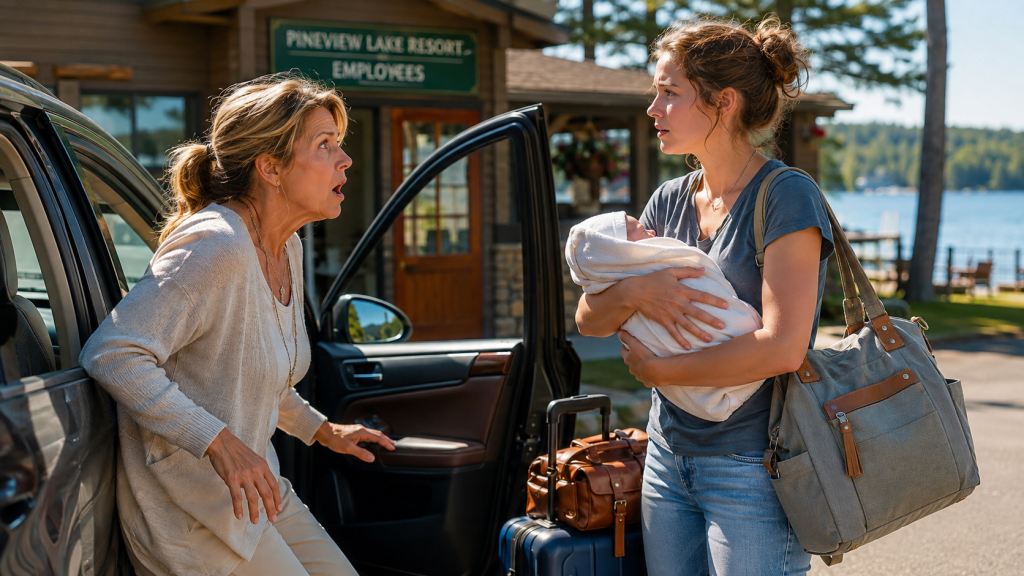
Sophie texted me to wait outside the employee building. A few minutes later, the door opened. I saw her walking toward me. Then I noticed what she was carrying.
A newborn baby.
I got out of the car.
“Sophie?”
She gave me a nervous little smile.
“Hi, Mom.”
I barely heard her. The baby couldn’t have been more than a few weeks old.
“Whose baby is that?”
Sophie looked down at the tiny face.
“Can we get in the car first?”
“Where is her mother?”
She didn’t answer. Then I noticed a diaper bag hanging from Sophie’s shoulder.
“Sophie, what’s going on? Are we taking this baby somewhere?”
She shook her head.
“Then why are you holding her?”
Sophie pulled the baby closer. I stared at her.
“Sweetheart, whose baby is this?”
She finally looked me in the eyes.
“Mom… she’s mine now.
PART 2: THE BABY SHE REFUSED TO LEAVE BEHIND
“Mom… she’s mine now.”
For a moment, the parking lot disappeared.
The employee building.
The lake.
The cars.
The gulls circling above the resort.
Everything blurred around that sentence.
I stared at my daughter.
Then at the newborn in her arms.
Then back at Sophie.
“What do you mean, she’s yours?”
My voice sounded strange.
Too quiet.
Too controlled.
The kind of voice you use when your brain has not yet caught up with your fear.
Sophie looked around nervously.
“Can we please get in the car?”
“No.”
She flinched.
I softened immediately.
“Sophie, I’m not trying to scare you.”
My eyes dropped to the baby.
“She looks like she was born yesterday.”
“Three weeks ago.”
My stomach turned.
Three weeks.
Three weeks ago, Sophie had called me from the resort and complained about a guest who yelled because housekeeping forgot extra towels.
She had laughed.
I had laughed.
Nothing in her voice had suggested that somewhere near her, a child was being born.
I looked at her again.
“Whose baby is she?”
Sophie’s jaw tightened.
“I told you.”
“No.”
I shook my head.
“You said she’s yours now. That is not the same as telling me whose child she is.”
The baby stirred.
A tiny sound escaped from beneath the blanket.
Sophie instinctively rocked her.
Not awkwardly.
Not like a teenager handed someone else’s baby.
Naturally.
That frightened me more.
I had raised Sophie alone for five years.
I knew every version of her.
The stubborn child.
The moody thirteen-year-old.
The sixteen-year-old who cried in the pantry after her first breakup because she did not want me to hear.
The eighteen-year-old who pretended college applications did not terrify her.
But I had never seen this Sophie.
The one holding a newborn as though she had been doing it every hour for weeks.
“Get in the car,” I whispered.
This time she obeyed.
I opened the back door.
Sophie stopped.
“Mom.”
“What?”
“The car seat.”
I froze.
She pointed toward the employee entrance.
“I have one.”
Of course she did.
A diaper bag.
A car seat.
Formula tucked into the side pocket.
This was not spontaneous.
This was planned.
My chest tightened.
“You bought a car seat?”
“No.”
“Then where did it come from?”
Sophie looked toward the building.
“Please. Just give me five minutes.”
She carried the baby back inside while I stood beside the car, trying not to lose my mind.
Five minutes later, she returned carrying an infant seat in one hand.
Behind her walked a woman I had never seen before.
She looked to be in her early thirties.
Tall.
Tired.
Wearing a resort manager’s badge.
She carried two grocery bags full of baby supplies.
When she reached us, she looked at Sophie first.
“You sure?”
Sophie nodded.
“I’m sure.”
The woman’s eyes shifted toward me.
“You’re Karen?”
“Yes.”
“I’m Maya.”
I stared.
“How do you know my name?”
Maya looked at Sophie.
That answer told me enough.
My daughter had discussed me with this stranger.
Enough for the stranger to recognize me immediately.
I suddenly felt like the only person who had not been invited into my daughter’s life.
Maya gently placed the bags near my trunk.
“There’s formula, bottles, newborn diapers, wipes, two blankets, and the medication.”
My head snapped up.
“Medication?”
Sophie quickly said, “It’s nothing serious.”
I looked at her.
“Do not say that sentence to me while holding a three-week-old child.”
The sharpness in my voice made Maya step back.
Sophie’s eyes filled.
“Mom.”
I closed my eyes.
“Okay.”
I exhaled slowly.
“Okay.”
The baby made another small noise.
Not crying.
Almost sighing.
My heart twisted.
None of this was her fault.
Whatever mess had happened around her, she was innocent.
I reached into the car.
“Put the seat in.”
Sophie installed it.
Correctly.
Too correctly.
Another detail I stored away.
She clicked the baby into the harness with practiced hands.
Checked the straps.
Adjusted the blanket.
Then climbed into the back seat beside her.
I looked at Maya.
“Are you going to tell me what’s happening?”
Maya hesitated.
“It’s Sophie’s story.”
That irritated me.
“She is nineteen.”
“And an adult.”
“She is my daughter.”
Maya’s expression softened.
“I know.”
Something in that answer stopped me.
Not defensive.
Almost sympathetic.
Then she leaned toward the window and told Sophie:
“Text me when you get home.”
“I will.”
“And if anything changes…”
“I’ll call.”
Maya squeezed Sophie’s shoulder.
Then she walked away.
I stood outside the car for several seconds.
My hands were shaking.
Finally, I got behind the wheel.
For the first ten minutes, we drove in silence.
The resort disappeared behind us.
Pine trees stretched along both sides of the highway.
The lake flashed silver between them.
In the rearview mirror, I watched Sophie.
She watched the baby.
Never looked at me.
I gripped the steering wheel.
“Start talking.”
She swallowed.
“Her name is Lily.”
I almost laughed from disbelief.
“That’s where you’re starting?”
“I don’t know where else to start.”
“How about her mother?”
Sophie’s eyes lowered.
“Her mother is named Emma.”
“Where is Emma?”
No answer.
A sick feeling formed in my stomach.
“Sophie.”
“She died.”
My hands tightened on the steering wheel.
The car drifted slightly.
I corrected immediately.
“What?”
Sophie’s voice cracked.
“She died nine days ago.”
I pulled onto the shoulder.
Too fast.
Gravel sprayed beneath the tires.
The baby startled.
Sophie immediately leaned over the car seat.
“It’s okay, Lily.”
I turned around.
“What happened?”
Sophie looked at me.
Tears finally spilled down her face.
“She had an infection.”
“What kind?”
“After the birth.”
My chest tightened.
“A postpartum infection?”
Sophie nodded.
“She didn’t realize how bad it was.”
“Where was she?”
“At the employee housing.”
I stared at her.
“A woman gave birth and then went back to employee housing?”
“No.”
Sophie wiped her face.
“She gave birth at the hospital. She was discharged. She said she was fine.”
“Where was the father?”
Sophie looked away.
There.
Another secret.
“Who is the father?”
“I don’t know.”
I stared.
“You don’t know?”
“She wouldn’t tell me.”
“Wouldn’t?”
Sophie shook her head.
“Emma never wanted him involved.”
My mind raced.
“Was he dangerous?”
“I don’t know.”
“You keep saying that.”
“Because I really don’t.”
I leaned back in my seat.
The highway rushed past us.
Cars.
Families.
People heading home.
Normal lives.
I looked at the tiny infant sleeping behind me.
“How did you know Emma?”
“She worked in the kitchen.”
“At the resort?”
“Yes.”
“How old was she?”
“Twenty-three.”
My chest hurt.
Twenty-three.
A child raising a child.
Almost Sophie’s age.
Sophie continued.
“She started there in May.”
“Did she know she was pregnant?”
“Yes.”
“Did management?”
“Eventually.”
I frowned.
“What does that mean?”
“She hid it for a while.”
“Why?”
“She needed the money.”
Of course.
That sentence had buried more young women than bad luck ever could.
I looked toward the road again.
“So you became friends.”
Sophie nodded.
“She didn’t have anyone.”
“Family?”
“Her mom died when she was little. Her dad lives somewhere in Arizona, but she hadn’t spoken to him in years.”
“Siblings?”
“No.”
I felt the story tightening around me.
A young woman.
Pregnant.
Alone.
Working at a resort.
My daughter befriending her.
Then the baby.
Then death.
I whispered:
“And you helped her.”
“Yes.”
“How much?”
Sophie began crying again.
“Everything.”
She looked down at Lily.
“When she got too tired to finish shifts, I covered for her.”
“When her feet swelled, I brought her food.”
“When she went into labor, Maya drove us to the hospital.”
I turned slowly.
“You were there?”
Sophie nodded.
“I stayed.”
“At the birth?”
“Yes.”
I stared.
My daughter had watched a child come into the world.
And she had not called me.
That hurt in a way I did not expect.
Not because I needed to be part of everything.
But because for nineteen years, we had been each other’s person.
At least I thought we had.
“Why didn’t you tell me?”
Her face crumpled.
“Because Emma made me promise.”
I looked away.
There it was again.
Another person whose needs had apparently outranked mine.
I hated myself for feeling jealous of a dead young woman.
Immediately.
Completely.
But grief and fear are ugly before they become reasonable.
“What did she make you promise?”
“That I wouldn’t tell anyone at home.”
“Why?”
Sophie hesitated.
“She was scared.”
“Of what?”
“The baby being taken.”
I frowned.
“Taken by whom?”
“She wouldn’t explain.”
A cold feeling moved through me.
“Sophie.”
“I swear, Mom.”
“She kept saying that if certain people found out where she was, Lily wouldn’t be safe.”
I looked at the infant again.
The blanket was pale yellow.
Tiny pink fingers curled near her chin.
“What people?”
“I don’t know.”
“Did she mention the father?”
“Sometimes.”
“How?”
Sophie rubbed her eyes.
“She said he was powerful.”
My stomach tightened.
“Powerful how?”
“She wouldn’t say.”
“Rich?”
“Maybe.”
“Married?”
“I don’t know.”
“Older?”
Sophie went silent.
That was the first answer.
I turned.
“How old?”
“I don’t know exactly.”
“Sophie.”
“She said he was older.”
“How much older?”
“She never said.”
My jaw clenched.
A twenty-three-year-old resort employee.
A secret baby.
An older man she feared.
This was no longer simply tragic.
It was dangerous.
“Did Emma ever contact police?”
“No.”
“Why not?”
“She said they wouldn’t help.”
“That doesn’t make sense.”
“I know.”
“Did she have proof?”
Sophie hesitated again.
I hated that hesitation.
“What aren’t you telling me?”
She looked at Lily.
“Emma thought someone was watching her.”
My skin prickled.
“What?”
“After Lily was born.”
“Who?”
“I don’t know.”
“Stop saying that.”
“I don’t know!”
The baby stirred again.
Sophie immediately lowered her voice.
“I’m sorry.”
I pressed both hands to my face.
Then forced myself to breathe.
“When Emma got sick, what happened?”
Sophie swallowed.
“She had a fever.”
“When?”
“About two weeks after the birth.”
“Did you take her to the hospital?”
“We tried.”
“Tried?”
“She refused at first.”
I closed my eyes.
Of course.
Fear makes people refuse the very help that might save them.
Sophie continued.
“She kept saying she couldn’t leave Lily.”
“So you stayed with the baby.”
“Yes.”
“Maya finally called an ambulance.”
I opened my eyes.
“And Emma?”
“They took her.”
Sophie’s voice became smaller.
“I went with her.”
“What happened?”
“She got worse really fast.”
My chest tightened.
“She had sepsis.”
I whispered, “Oh, God.”
Sophie nodded.
“She was in intensive care.”
“For how long?”
“Three days.”
“And during those three days, you had Lily.”
“With Maya.”
I looked toward the resort in the distance behind us.
A nineteen-year-old.
A manager.
A newborn.
Trying to hold together a life that was already breaking.
“Did social services know?”
Sophie nodded.
“They came to the hospital.”
That brought some relief.
At least someone official had been involved.
“What did they say?”
“They were looking for family.”
“And?”
“Nothing.”
“No one?”
“No one they could find.”
I stared at the dashboard.
“So how exactly does a newborn go from a hospital caseworker to my daughter’s back seat?”
Sophie’s lips trembled.
“Emma named me.”
I turned.
“What?”
“She filled out temporary guardianship paperwork.”
My heart stopped.
“What paperwork?”
“She signed forms before she got too sick.”
“Sophie, temporary guardianship is not adoption.”
“I know.”
“So when you said she’s yours now…”
“I didn’t mean legally forever.”
I stared at her.
That sentence brought a strange combination of relief and fear.
“Then what did you mean?”
Sophie looked down at Lily.
“I mean I’m not abandoning her.”
There was something in her voice.
Steady.
Absolute.
I had heard that tone only a few times.
When she was eleven and refused to leave her father’s hospital room.
When she was fourteen and told a teacher she would not apologize for defending a bullied classmate.
When she was seventeen and informed me she had decided where she wanted to go to college.
Sophie could bend.
But when she planted her feet emotionally, mountains had a better chance of moving.
I stared at her.
“You can’t just bring home a newborn.”
“I know.”
“Do you?”
“Yes.”
“You’re nineteen.”
“I know how old I am.”
“You start classes in three weeks.”
“I deferred the semester.”
My mouth fell open.
“You what?”
“I deferred.”
“When?”
“Yesterday.”
I stared.
“You changed your college enrollment without telling me?”
“Yes.”
“Why?”
“Because I can’t go right now.”
“Sophie—”
“Emma died holding my hand.”
The words silenced me.
My anger vanished instantly.
Sophie’s face collapsed.
“She knew she was dying.”
My chest tightened.
“She asked where Lily was.”
“I told her Maya had her.”
“She made me promise that no matter what happened, Lily wouldn’t be alone.”
Sophie covered her mouth.
“She was so scared, Mom.”
I turned in my seat.
My daughter was crying like a child again.
Not nineteen.
Not independent.
Just my baby.
“She kept saying, ‘Don’t let them take her.’”
Sophie wiped her cheeks.
“I promised.”
I reached toward her.
My hand stopped halfway.
She took it.
I squeezed.
“Oh, sweetheart.”
“I didn’t know she was going to die.”
“I know.”
“I thought she was scared because she was sick.”
“I know.”
“She squeezed my hand.”
Sophie’s whole body shook.
“And then she stopped.”
I climbed awkwardly between the front seats as far as the center console allowed and wrapped my arm around her.
She leaned into me.
For several minutes, we cried together.
The baby slept through it.
Tiny.
Unaware.
The center of a storm she had not created.
When Sophie finally pulled away, her face was blotchy.
“I’m sorry I didn’t tell you.”
I wiped her cheek.
“I wish you had.”
“I know.”
“I’m not angry because you cared about Emma.”
“I know.”
“I’m scared because you have been carrying something enormous without me.”
Sophie looked down.
“I thought I could handle it.”
“That is usually when people need help the most.”
She almost smiled.
“That sounds like something you’d put on a coffee mug.”
“I’m your mother. It is my legal right to become annoying and wise.”
A weak laugh escaped her.
For one second, the girl I knew came back.
Then I looked at Lily again.
“What happens now?”
Sophie took a breath.
“A caseworker is supposed to contact us Monday.”
“Us?”
“I gave her your information.”
I stared.
“You gave a social worker my information before telling me?”
She winced.
“Yes.”
I closed my eyes.
“One crisis at a time.”
“Sorry.”
“Who is the caseworker?”
“Dana Brooks.”
“What agency?”
She told me.
I wrote it down immediately.
“Did Dana authorize you to take Lily?”
“Yes.”
“Do you have documentation?”
Sophie reached into the diaper bag.
She handed me a folder.
There were hospital forms.
Emergency guardianship documents.
Contact information.
Pediatric instructions.
Everything looked official.
For the first time, I relaxed by half an inch.
Then I found a sealed envelope inside.
My name was written on it.
Karen.
Not Sophie.
Me.
I frowned.
“What is this?”
Sophie’s face changed.
“I forgot that was in there.”
“Who wrote it?”
“Emma.”
My heart tightened.
“For me?”
“She wrote letters before she died.”
“How many?”
“Three.”
“One for Lily.”
“One for me.”
“And one for you.”
I stared at the envelope.
“Why me?”
“She said you were going to hate her.”
I looked at Sophie.
“What?”
“She thought you’d be angry that she put this on me.”
I looked down at the envelope again.
“She said if she died, you deserved to know the whole story.”
My stomach turned.
“What whole story?”
Sophie looked afraid now.
Not sad.
Afraid.
“I didn’t read your letter.”
“Did you read yours?”
“Yes.”
“And?”
She looked toward the road.
“Sophie.”
She swallowed.
“Emma told me who Lily’s father is.”
Everything inside me became still.
“Who?”
“I don’t think I should say until you read the letter.”
I stared.
“You’re telling me the identity of this child’s father is sitting inside that envelope?”
“Yes.”
“Is he dangerous?”
Sophie didn’t answer.
That was enough.
I turned back toward the steering wheel.
“We’re going home.”
She nodded.
“And after that, I’m calling the caseworker.”
“Okay.”
“And a lawyer.”
Sophie looked startled.
“A lawyer?”
“Yes.”
“Why?”
“Because if a dying mother believed her child needed protection from the father, we are not handling this with good intentions and Google.”
Sophie stared at me.
Then nodded slowly.
“Okay.”
I pulled back onto the highway.
For the next hour, neither of us spoke much.
Lily woke once.
She cried.
A small, desperate newborn cry that pierced directly into my chest.
Sophie fed her a bottle while I drove.
She burped her.
Changed her at a rest stop.
Wrapped her again.
I watched.
And somewhere beneath my fear, I felt pride.
My daughter was terrified.
Grieving.
In over her head.
But she was gentle.
Patient.
Present.
Her father would have been proud too.
That thought hurt.
Daniel had died when Sophie was fourteen.
A heart attack.
Sudden.
One morning, he was complaining about the lawn mower.
That evening, I was telling our daughter he was gone.
Loss made Sophie and me close because it frightened both of us.
We learned to tell each other where we were.
When we would be home.
How we felt.
I thought transparency could protect us from losing anyone else.
Life had just reminded me it could not.
By the time we reached home, evening light had turned the neighborhood gold.
I parked in the driveway.
Sophie stared at the house.
“You okay?”
She nodded.
Then whispered:
“It feels weird.”
“What does?”
“Bringing her here.”
“Why?”
Sophie looked at Lily.
“Because this was my safe place.”
My throat tightened.
“And now?”
“I want it to be hers too.”
That sentence changed something in me.
Not completely.
I was still terrified.
Still confused.
Still angry that Sophie had hidden so much.
But the baby was here.
And Sophie was right.
Whatever happened next, this little girl needed somewhere safe to sleep tonight.
We carried everything inside.
I found the old bassinet from Sophie’s infancy in the attic.
I had kept it for sentimental reasons.
Never imagining I would use it again.
We cleaned it.
Checked every hinge.
Looked up current safety recommendations.
Then decided the bassinet was too old.
At nine at night, I drove to a twenty-four-hour superstore and bought a new one.
Along with diapers.
Burp cloths.
Formula.
More bottles.
Baby soap.
A thermometer.
Things I had not purchased in nineteen years.
When I returned, Sophie was asleep on the couch.
Lily rested against her chest.
One of Sophie’s hands lay protectively across the baby’s back.
I stood in the doorway.
My daughter and a newborn.
For one impossible second, I saw myself nineteen years earlier.
Sophie on my chest.
Daniel asleep beside us.
The living room lamp glowing.
I had been exhausted then.
Terrified.
In love.
I understood suddenly why Sophie had said:
She’s mine now.
Sometimes the heart makes claims before the law knows what to call them.
I gently woke Sophie.
We settled Lily in the bassinet.
Then Sophie went upstairs to shower.
I sat alone at the kitchen table.
Emma’s letter rested in front of me.
I stared at my name.
I almost did not open it.
Part of me wanted one quiet night before another truth arrived.
But mothers do not always get to choose the timing of truth.
I tore the envelope carefully.
Inside were four handwritten pages.
The writing was uneven.
Probably written from the hospital.
I began.
Dear Karen,
You don’t know me, but I know a lot about you.
Sophie talks about you constantly.
She says you make too much soup when you’re worried.
I stopped.
That was true.
I looked toward the stove.
A pot of chicken soup sat there.
I almost laughed.
Then continued.
She says you still keep her father’s coffee mug in the cabinet even though no one is allowed to use it.
Also true.
My eyes burned.
She says you are the safest person she knows.
That is why I am writing to you.
I swallowed.
If you are reading this, I may not have made it.
I am sorry.
Not just because your daughter is hurting.
Because I asked something of her that a nineteen-year-old should never have had to carry.
Tears blurred the page.
I do not expect Sophie to raise Lily alone.
I never wanted that.
I only needed someone I trusted to keep Lily safe long enough for you to know the truth.
My heartbeat quickened.
I turned the page.
Lily’s father is named Adrian Vale.
I frowned.
The name meant nothing to me.
Then I read the next sentence.
You may know him better as Adrian Vale III, owner of Vale Resorts.
My breath stopped.
Vale Resorts.
I looked toward the hallway.
The lakeside resort.
Sophie’s summer job.
I grabbed my phone.
Searched the name.
A photograph appeared immediately.
Adrian Vale III.
Fifty-one years old.
Married.
Two adult sons.
Owner of fourteen luxury resorts across the Midwest.
Including the one where Sophie had worked.
My stomach turned.
Emma had been twenty-three.
He was more than twice her age.
I kept reading.
I met Adrian two years ago when I worked at another Vale property.
He was kind at first.
At least, that is what I believed.
He helped me when I was struggling with rent.
Then he started expecting things in return.
I closed my eyes.
I did not want to keep reading.
But I did.
When I became pregnant, he told me to terminate it.
I refused.
After that, everything changed.
He said if I ever named him as the father, he would destroy me.
My hands began shaking.
He told me no court would believe someone like me over someone like him.
He said he would call me unstable.
He said he would take the baby if necessary and make sure I never saw her again.
I looked toward the bassinet in the other room.
Lily slept beneath a soft white blanket.
My skin turned cold.
Emma continued.
I moved to the lake resort because I thought it was far enough from his headquarters that no one would notice me.
I was wrong.
Someone recognized me when I was seven months pregnant.
After Lily was born, Adrian called me.
He knew.
My heart pounded.
He said I had one week to sign papers giving up any claim against him and agreeing never to identify him publicly.
I did not sign.
Three days later, someone broke into my employee room.
Nothing valuable was taken.
Only Lily’s birth records.
I stopped.
“Sophie.”
My voice came out too loudly.
She hurried downstairs.
“What?”
I held up the letter.
“Did you know about a break-in?”
Her face went pale.
“Yes.”
I stood.
“Why didn’t you tell me?”
“I didn’t know if it was connected.”
“Emma did.”
Sophie looked at the floor.
“She told me Adrian knew.”
“Do you understand who this man is?”
“Yes.”
“You worked at his resort.”
“I know.”
“You stayed there after Emma died.”
Her eyes filled.
“I couldn’t leave Lily.”
My anger collapsed into fear.
“Oh, God.”
I walked toward her.
“You should have called me.”
“I know.”
“You should have called me immediately.”
“I know.”
I grabbed her shoulders.
“You do not protect me by letting me think you’re safe when you aren’t.”
She began crying.
“I’m sorry.”
I pulled her into my arms.
For a long moment, I simply held her.
Then I returned to the letter.
There was one final page.
Karen,
There is something else.
I did a DNA test before Lily was born.
Not a home kit.
A legal prenatal test.
I have proof that Adrian is her father.
The original report is not with me.
I hid it.
My pulse quickened.
I told Sophie where to find it only if something happened to me.
I looked at my daughter.
She nodded.
“You know?”
“Yes.”
“Where?”
Sophie swallowed.
“Here.”
I stared.
“What?”
“I brought it.”
She walked toward the diaper bag.
From the bottom, beneath the spare clothes, she pulled out a small plastic pouch.
Inside was a flash drive.
And a key.
Not a house key.
A bank deposit key.
My heart started pounding.
“What is this?”
Sophie whispered:
“Emma said it opens a box at a bank near the resort.”
“What’s inside?”
“The DNA report.”
“What else?”
Sophie looked terrified.
“I don’t know.”
I returned to the letter.
The final lines were written more shakily.
Adrian is dangerous when he thinks he can control the story.
Do not confront him.
Do not trust anyone from the resort without checking them yourself.
And please, Karen—
if something happens to me, do not assume it was only because I got sick.
I froze.
Read it again.
Then again.
My blood turned cold.
Sophie stepped closer.
“What?”
I looked at her.
She saw my face.
“What does it say?”
I could barely speak.
“She doesn’t think her death was an accident.”
Sophie’s face went white.
“What?”
“She says not to assume she died only because she got sick.”
The kitchen became unbearably quiet.
Then my phone rang.
Unknown number.
Neither of us moved.
It rang again.
Sophie stared at me.
“Mom.”
I answered.
“Hello?”
A man spoke.
Smooth voice.
Older.
Calm.
“Mrs. Bennett?”
My stomach dropped.
“Yes?”
“My name is Adrian Vale.”
Every hair on my arms rose.
Across the kitchen, Sophie covered her mouth.
Adrian continued as though he were calling about a reservation.
“I understand my daughter is currently in your home.”
My grip tightened around the phone.
I said nothing.
His voice remained polite.
“That child belongs with her father.”
I looked toward the bassinet.
Lily made a tiny sleeping sound.
My fear transformed.
Not disappeared.
Changed.
Became sharper.
Protective.
“You’re calling very late.”
“I thought this was urgent.”
“I agree.”
A pause.
Then he said:
“I’ll have someone come for her in the morning.”
My entire body went still.
“No.”
Silence.
“What did you say?”
“I said no.”
His tone changed.
Barely.
But enough.
“Mrs. Bennett, you may not understand the legal situation.”
“I understand enough not to hand a three-week-old baby to a stranger because he calls after bedtime.”
“You’re making this unnecessarily difficult.”
“No.”
I looked at Sophie.
She was crying silently.
“I think difficult started long before you called.”
Another pause.
Then Adrian said something that chilled me.
“Emma was emotional too.”
My hand tightened.
“And look how that ended.”
The room went silent.
I could hear my own heartbeat.
Sophie stared at me.
Adrian had said it casually.
Too casually.
Like a warning wrapped in sympathy.
I lowered my voice.
“Do not call this number again.”
He laughed softly.
“Karen.”
The fact that he used my first name made my stomach twist.
“You’re protecting a child you have no legal claim to.”
I looked down at Emma’s letter.
At the flash drive.
At the key.
Then I thought of the caseworker.
The temporary guardianship papers.
And my daughter.
“No.”
My voice became steady.
“I’m protecting a child until people with actual legal authority decide what happens.”
His warmth vanished.
“You have no idea who you’re dealing with.”
I looked toward the sleeping newborn.
Then at Sophie.
And for the first time since I saw her walk out of that resort, I knew exactly what my role was.
Not to panic.
Not to judge.
Not to ask why my daughter had brought home somebody else’s tragedy.
To stand between that tragedy and whatever came next.
“You’re right,” I said.
“I don’t.”
Then I hung up.
Sophie stared at me.
“Mom.”
I locked the back door.
Then the front.
Pulled every curtain closed.
And called the police.
Not because I knew what Adrian had done.
Because I knew one thing with absolute certainty.
Emma had been afraid of him.
And dead women do not get to change their testimony.
So I would protect the only things she left behind.
Her letter.
Her evidence.
And the little girl sleeping in my living room.
But before the police arrived, another message appeared on my phone.
A photograph.
No text.
Just an image.
Our house.
Taken from across the street.
Tonight.
I stared at it.
Then slowly looked toward the darkened front window.
Sophie whispered:
“What is it?”
I turned the phone toward her.
Her face drained of color.
Outside, somewhere beyond the curtains, someone was watching us.
And suddenly I understood something Emma had been trying to tell me from the beginning.
Sophie had not brought home only a baby.
She had brought home a secret powerful people were willing to follow.
PART 3: THE CHILD WHO CHANGED OUR HOME
The photograph had been taken from across the street.
Our house.
Our porch light.
My car in the driveway.
The curtains I had closed less than two minutes earlier.
And in the lower corner of the image, the timestamp showed that it had been taken that night.
I stared at the phone.
For one terrible second, I could hear nothing.
Not Sophie breathing.
Not the baby monitor.
Not even the refrigerator humming behind me.
Only the blood pounding in my ears.
Sophie whispered:
“Mom?”
I looked at her.
Her face had gone pale.
I turned the screen toward her.
She covered her mouth.
“Oh my God.”
I moved quickly.
Not wildly.
Not screaming.
Fear had suddenly become useful.
I checked the locks again.
Front door.
Back door.
Garage.
Windows.
Then I turned off the porch light.
“Stay away from the windows.”
Sophie immediately crossed to the bassinet.
She lifted Lily.
The baby stirred against her chest.
Tiny.
Warm.
Completely unaware that adults had already filled the first weeks of her life with secrets.
I called the police.
Then I called Dana Brooks, the caseworker.
It was late.
I expected voicemail.
She answered on the third ring.
“Karen?”
“Yes.”
My voice came out too fast.
“Someone is outside my house.”
Silence.
“What?”
I told her everything.
Adrian’s call.
The warning.
The photograph.
The bank key.
Emma’s letter.
Dana interrupted only once.
“Do not leave the house.”
“I wasn’t planning to.”
“And do not meet Adrian.”
“I wasn’t planning that either.”
“Good.”
Her voice became sharper.
“I’m notifying my supervisor and legal counsel.”
I looked at Sophie.
“Dana, I need to ask you something.”
“What?”
“Can he just take Lily?”
“No.”
The word came immediately.
That helped.
“Even if he proves he is the biological father?”
“No.”
She continued.
“Biology does not allow someone to arrive at a private home and remove an infant without legal process, especially where there are active safety concerns.”
My knees weakened with relief.
“Okay.”
“But, Karen…”
“Yes?”
“If the DNA evidence is real, we need it.”
I looked toward the flash drive and key on the kitchen table.
“We’ll get it.”
“Not tonight.”
“No.”
“Police first.”
“Yes.”
“And one more thing.”
“What?”
“Do not delete the photograph.”
“I won’t.”
“Screenshot the call log.”
“I will.”
“Save everything.”
Her voice softened.
“Emma may have left you more protection than she realized.”
The police arrived twelve minutes later.
It felt like an hour.
Two patrol cars pulled up without sirens.
A male officer approached the front door.
A female officer circled the property.
When I opened the door, cold night air rushed inside.
The male officer introduced himself.
“Officer Ramirez.”
I stepped aside.
“There’s a baby.”
My voice shook.
“I know.”
He had probably received the note from dispatch.
He looked toward Sophie.
Then toward Lily.
His expression changed.
People become softer around newborns.
Even frightened policemen.
Officer Ramirez took my statement.
Then Sophie’s.
We showed him the photograph.
The call log.
Emma’s letter.
He read only the parts necessary.
When he reached the line—
And look how that ended.
His jaw tightened.
“Did Mr. Vale say that exactly?”
“Yes.”
“Word for word?”
“Yes.”
He wrote something down.
The female officer returned.
“There’s nobody outside now.”
“Car?”
“None nearby that matches anything suspicious.”
She looked at me.
“But we found footprints in the snow near the neighbor’s hedge.”
My stomach turned.
Someone had been there.
Not an old photograph.
Not a bluff.
Someone had stood across the street.
Watching.
Sophie pressed Lily closer.
Officer Ramirez noticed.
“Do you have somewhere else you can stay tonight?”
I shook my head.
“Not somewhere Adrian doesn’t know about.”
He thought for a moment.
Then looked at his partner.
“We can keep an extra patrol through the neighborhood.”
She nodded.
“That would help.”
It did.
Not enough.
But some.
That night, nobody slept.
I made coffee at two in the morning.
Then soup at three.
Sophie looked at the pot and almost laughed.
“Emma was right.”
I glanced at her.
“What?”
“You really do make soup when you’re scared.”
I looked at the enormous pot.
Carrots.
Noodles.
Enough chicken to feed twelve people.
I started laughing.
Then Sophie did.
And somehow, in a kitchen full of terror, with a newborn asleep in the living room and police lights occasionally flashing past our curtains, we laughed until tears ran down our faces.
It was not because anything was funny.
Sometimes laughter is just the body’s way of begging fear to loosen its grip.
When we stopped, Sophie looked at me.
“Mom?”
“Yes?”
“I’m sorry.”
“For what?”
“For all of this.”
I crossed the kitchen.
“No.”
She looked down.
“I brought this into the house.”
“You brought a baby into the house.”
“And a dangerous man.”
“No.”
I shook my head.
“Adrian brought himself.”
Her eyes filled.
“You didn’t invite him into our lives.”
“You protected someone who needed you.”
“That does not make everything happening now your fault.”
She looked at me.
“I should have called.”
“Yes.”
Her face fell.
I touched her cheek.
“But making one mistake does not turn you into the cause of someone else’s cruelty.”
That mattered.
I wanted her to hear it.
Really hear it.
Because guilt grows fast in good people.
Especially young ones.
At seven the next morning, Dana arrived.
She brought another woman.
Laura Chen.
An attorney representing the county’s child welfare unit.
Laura was small.
Calm.
Precise.
The kind of woman who carried two phones and never seemed surprised by anything.
She spread documents across my kitchen table.
“What we have right now is temporary placement.”
She looked at Sophie.
“Emma named you as emergency caregiver before she died.”
Sophie nodded.
“That gave the hospital and agency enough authority to release Lily temporarily under supervision.”
“And now?”
I asked.
“Now we determine the longer-term arrangement.”
She looked toward the bassinet.
“If Adrian establishes paternity, he will have legal standing.”
My stomach tightened.
“But?”
Laura looked at me.
“But standing is not custody.”
Relief moved through me.
She continued.
“Courts consider safety.”
“History.”
“Conduct.”
“The child’s best interests.”
“And if he threatened Emma?”
“That matters.”
“If he threatened us?”
“That matters too.”
I looked at the bank key.
“What about the DNA test?”
Laura’s eyes followed mine.
“We need it.”
“Can we go today?”
“Yes.”
“But not alone.”
Dana nodded.
“I’m coming.”
The bank was ninety minutes away.
Not three hours.
Emma had apparently rented the box at a small branch outside the resort town.
We drove in two cars.
Dana with Sophie and Lily.
Laura with me.
I did not like being separated from Sophie.
Even for an hour and a half.
But Laura said it was safer not to travel together.
Adrian knew my vehicle.
We switched cars halfway.
It felt ridiculous.
Like something out of a bad crime drama.
Except when fear is real, ridiculous precautions stop feeling ridiculous.
At the bank, the manager took us into a private room.
Sophie handed over the key.
Then the documents Emma had left.
There was a delay.
Verification.
Calls.
More signatures.
And finally, the manager returned with a narrow gray box.
Sophie’s hands shook.
“You want me to open it?”
I asked.
She nodded.
I lifted the lid.
Inside were four things.
A sealed DNA report.
A flash drive.
A notebook.
And an envelope.
My name was not on that one.
Sophie’s was.
She picked it up.
Then froze.
“What?”
I asked.
“She dated it.”
“When?”
“The day before she died.”
My chest tightened.
Sophie opened the envelope.
Her hands trembled too much to unfold the paper.
I took her hand.
“Do you want me to read it?”
She shook her head.
“No.”
She took a breath.
Then began.
Sophie,
If you are reading this, I am sorry.
Her voice broke immediately.
She stopped.
Pressed her lips together.
Then continued.
You were the first person in a long time who looked at me without asking what I could give you.
You brought me food when I was tired.
You covered my shift without making me feel weak.
You talked to Lily when she was still inside me as though she already mattered.
Sophie started crying.
I put one arm around her.
She kept reading.
I know asking you to protect her is unfair.
You are nineteen.
You should be worrying about school and friends and who you want to become.
Not bottles and legal documents.
But I am asking anyway because I trust your heart more than I trust any system I have known.
Dana quietly wiped her eyes.
Laura looked down at the table.
The letter continued.
Do not raise Lily because you promised me.
Sophie stopped.
Her forehead creased.
She read the line again.
Then kept going.
Promises made beside hospital beds can become chains.
I do not want to become one around your life.
My throat tightened.
What wisdom.
From a woman only twenty-three.
Keep her safe long enough for adults who love you to help decide what comes next.
Let your mother help.
Sophie laughed through tears.
I covered my mouth.
Emma had known us better than I realized.
Then Sophie reached the last paragraph.
If Lily grows up with you in her life, tell her I wanted her.
Tell her she was never a mistake.
Tell her fear was mine.
Not hers.
And tell her that the first person who ever protected her after me was a nineteen-year-old girl who had no idea how brave she was.
Sophie lowered the page.
She sobbed.
Not quietly.
Not gracefully.
The kind of sobbing that comes from somewhere below language.
I held her.
Dana held her too.
For several minutes, the bank room became something other than a bank.
Not an office.
Not a legal meeting.
A place where a dead mother was saying goodbye.
Eventually, Laura opened the DNA report.
The result was clear.
Adrian Vale III.
Probability of paternity:
99.99%.
There it was.
Evidence.
Not a rumor.
Not Emma’s fear.
A name attached to a child.
Then we opened the notebook.
Page after page.
Dates.
Phone calls.
Meetings.
Payments.
Threats.
Emma had documented everything.
Not perfectly.
Not like a lawyer.
Like a frightened young woman trying to leave a trail.
One entry was circled.
A.V. said if I don’t sign, he will make sure no hospital, hotel, or employer in this state takes me seriously.
Another:
He said his lawyers can make me look unstable.
Another:
He knows where I’m staying.
Then the final entry.
Two days before Emma went to the hospital.
Someone tampered with my medication bottle. The seal was broken. I threw it away. I am scared.
My skin turned cold.
Laura read it twice.
Dana whispered:
“Oh, God.”
Sophie stared.
“What medication?”
We did not know.
But we knew enough.
This was no longer only a custody matter.
Laura immediately made calls.
The hospital.
The police department near the resort.
The county prosecutor’s office.
A detective was assigned before we left the bank.
That afternoon, everything moved quickly.
Not because wealthy people are always punished quickly.
Usually they are not.
But because Adrian made another mistake.
He assumed fear had already done the work for him.
So he became careless.
He called again.
This time, Laura answered from my phone with my permission.
Adrian immediately said:
“Karen, you need to stop turning this into something dramatic.”
Laura remained silent.
He continued.
“I’ve already spoken to people who can resolve it.”
More silence.
“The baby will be collected tomorrow.”
Laura finally spoke.
“Mr. Vale, this is attorney Laura Chen.”
Silence.
A long one.
Then:
“I called Karen.”
“Yes.”
“And she is represented.”
His voice hardened.
“By whom?”
“For this conversation, by me.”
He hung up.
That was the last direct call I ever received from Adrian.
But it was not the end.
The police searched Emma’s room at the resort.
Then hospital records were reviewed.
The infection that killed her had been real.
Severe.
There was no evidence anyone had intentionally caused it.
That mattered.
For days, I had imagined worse.
So had Sophie.
But investigators found something else.
The broken medication seal in Emma’s notebook led them to a former resort security employee.
He had been paid by a private investigator working for one of Adrian’s companies.
His job had been to watch Emma.
Track her movements.
Photograph visitors.
Learn whether she contacted lawyers.
He claimed he never touched her medication.
No evidence proved otherwise.
But the surveillance was real.
So were the payments.
So were the threats.
And so was the break-in.
One security employee admitted he had entered Emma’s room after receiving instructions to “retrieve documents related to paternity.”
He insisted he believed the papers belonged to the company.
Maybe that was true.
Maybe it wasn’t.
Either way, Adrian’s story began collapsing.
Not dramatically.
Legally.
Slowly.
With records.
Emails.
Phone logs.
Payments.
People who had been loyal while the money was flowing suddenly remembered things once lawyers began asking questions under oath.
Within six weeks, Adrian stepped down from day-to-day operations of Vale Resorts.
Three months later, several civil lawsuits were filed.
Emma was not the only young employee who came forward.
That broke my heart in a different way.
There had been others.
Women who said Adrian used promotions, housing, money, and intimidation to control them.
Women who stayed silent because they believed nobody would listen.
Emma had been right about one thing.
Power often survives by convincing isolated people they are alone.
She had been wrong about another.
Once people stood together, his name was not enough.
The custody case was harder.
Because Lily was not evidence.
She was a baby.
A person.
A child who deserved more than becoming the final prize in an ugly legal battle.
Adrian petitioned for custody after paternity was confirmed.
His attorneys argued he had never been given a fair opportunity to parent.
Laura expected that.
So did Dana.
Sophie did not.
The first time she heard, she almost broke.
“He wants her?”
She stood in our kitchen with Lily against her shoulder.
“After everything?”
I took the baby gently.
“He wants control.”
Sophie’s face twisted.
“How do you know?”
“I don’t.”
I paused.
“But wanting custody and wanting to parent are not always the same thing.”
That hurt her.
Because Sophie already loved Lily.
Love had arrived before paperwork.
Before courts.
Before anyone knew what to call their relationship.
The judge ordered supervised contact.
Three visits.
Adrian attended the first.
He arrived twenty minutes late.
Left early.
The second, he canceled.
The third, he sent an assistant to say he had a business emergency.
That did not help his case.
Meanwhile, Sophie showed up for everything.
Pediatric appointments.
Home visits.
Court evaluations.
Night feedings.
Colic.
Diaper blowouts.
The first smile that probably was gas but we celebrated anyway.
Still, I watched my daughter carefully.
Emma’s letter had said something I refused to forget.
Do not raise Lily because you promised me.
So one night, after Lily finally fell asleep, I sat beside Sophie on the sofa.
She looked exhausted.
Hair tangled.
T-shirt stained with formula.
Nineteen years old.
Too young and too old at the same time.
“Sophie.”
“Hmm?”
“We need to talk.”
Her eyes immediately filled with fear.
“What happened?”
“Nothing.”
“Then why are you doing that mom voice?”
“Because I am your mother.”
She groaned.
I almost smiled.
Then I took her hand.
“You don’t have to become Lily’s mother.”
She stared.
“What?”
“You heard me.”
Her expression hardened.
“I’m not giving her up.”
“I didn’t say that.”
“It sounds like it.”
“No.”
I leaned closer.
“I am asking whether you want this life.”
She looked toward the bassinet.
“She needs me.”
“That is not what I asked.”
Sophie turned back.
I continued.
“You deferred college.”
“You changed your plans.”
“You barely sleep.”
“You are nineteen.”
Her eyes filled.
“Emma trusted me.”
“I know.”
“I promised.”
“I know.”
“She died.”
“I know.”
Her voice rose.
“Then what am I supposed to do?”
“Choose.”
She froze.
I touched her face.
“Not from guilt.”
“Not from fear.”
“Not from a promise made while someone you loved was dying.”
“Choose because you understand what this means.”
Her chin trembled.
“Do you want me to say I don’t want her?”
“No.”
“Because I do.”
She began crying.
“I love her.”
“I know.”
“I love her so much.”
“I know.”
“But…”
There it was.
The word I had been waiting for.
Sophie covered her face.
“I’m scared I’m going to lose myself.”
My heart broke.
Not because she admitted it.
Because she had been afraid to.
I wrapped my arms around her.
“Then we do this differently.”
She cried against my shoulder.
“What does that mean?”
“It means you do not have to become a nineteen-year-old single mother overnight.”
She pulled back.
“Then who takes care of Lily?”
I smiled through tears.
“We do.”
She stared.
I continued.
“We build something that does not destroy one person to save another.”
Her eyes filled again.
That sentence became our plan.
When the court asked about long-term placement, I applied for legal guardianship too.
Not to take Lily from Sophie.
To take some weight off her.
Sophie remained deeply involved.
More than involved.
She became family in every practical sense.
But I became the primary legal guardian.
The adult with stable income.
A house.
Health insurance.
A schedule that could bend.
Sophie returned to school the following semester.
Local university.
Part-time at first.
She came home every afternoon.
Lily lit up when she heard her voice.
The first time the baby smiled unmistakably at Sophie, my daughter cried for twenty minutes.
So did I.
We never forced labels.
That became important.
To Lily, I was Grandma Karen.
Sophie was Sophie.
Sometimes Sofie.
Sometimes “Soso” once Lily started talking.
We kept Emma’s photograph in the nursery.
Not hidden.
Not made sacred.
Present.
When Lily was old enough, she would know.
All of it.
Age appropriately.
Carefully.
Truth was the one thing we refused to repeat badly.
A year after Emma died, Adrian withdrew his custody petition.
Not because he became noble.
Because his legal situation had deteriorated.
His companies were under investigation.
Civil settlements were mounting.
His wife had filed for divorce.
His older sons had publicly distanced themselves.
And supervised parenting had apparently required more effort than the idea of ownership.
He signed an agreement relinquishing pursuit of custody while remaining financially responsible under court order.
I thought I would feel triumphant.
I did not.
I felt sad.
For Lily.
For Emma.
Even, strangely, for Adrian.
Not because I forgave him.
Because there is something deeply pathetic about a man powerful enough to own resorts and yet too small to sit for one hour beside his own daughter.
Money gives people many things.
Character is not one of them.
Sophie changed too.
Not in the dramatic way people expect after trauma.
She became quieter.
More thoughtful.
She stopped believing independence meant doing everything alone.
That was perhaps the greatest lesson of her summer.
She studied social work.
Originally, she had planned to study communications.
After Emma, she changed her major.
I worried she was choosing out of grief.
She told me:
“Maybe.”
Then she smiled.
“But grief showed me something I care about.”
That was enough.
Three years passed.
Lily grew into a loud, fearless little girl with curly brown hair and a laugh that filled the whole house.
She loved strawberries.
Hated peas.
Collected rocks.
Called every dog she saw “Henry” for reasons none of us understood.
She had Emma’s eyes.
We knew because of the photographs.
That hurt beautifully.
Some mornings, I would see Lily standing in sunlight and feel grief for a woman I had known only through pages, warnings, and the child she left behind.
Emma never got to see first steps.
First words.
First birthday candles.
She never saw Lily shove both hands into a cake.
Never heard her say “Soso.”
Never saw Sophie graduate.
We carried those moments for her.
Not instead of her.
For her.
On Lily’s fourth birthday, we took her to the lake.
Not the resort.
Never there.
A different lake.
Quiet.
Public.
Safe.
Sophie spread a blanket beneath a tree.
I unpacked sandwiches.
Lily ran toward the water carrying a yellow bucket.
“Not too close!”
I shouted.
She ignored me.
Of course.
Four-year-olds consider survival advice optional.
Sophie laughed.
“She gets that from you.”
“Absolutely not.”
“She definitely does.”
I looked at my daughter.
Twenty-three now.
Older than Emma had been.
That realization still startled me.
Sophie looked different from the girl I had picked up at the resort.
Not harder.
Stronger.
There is a difference.
She had learned that love did not mean rescue at any cost.
That promises could be honored without sacrificing yourself.
That grief did not have to become identity.
She sat beside me.
“Mom?”
“Yes?”
“Do you ever think about that day?”
“What day?”
She gave me a look.
“The parking lot.”
I smiled.
“Every August.”
She looked toward Lily.
“I thought you were going to kill me.”
“I considered it.”
She laughed.
“I knew it.”
“I drove three hours expecting dirty laundry.”
“You got both.”
“Fair.”
We sat quietly.
Lily crouched near the shoreline, carefully placing stones into her bucket.
Then Sophie said:
“I really meant it.”
“What?”
“When I said she was mine.”
My throat tightened.
“I know.”
“I didn’t mean like ownership.”
“I know.”
“I meant…”
She struggled for the words.
“I meant I couldn’t walk away.”
I took her hand.
“You didn’t.”
She looked at me.
“Neither did you.”
That was true.
At first, I thought Sophie had brought home a problem.
Then a secret.
Then danger.
But eventually I understood.
She had brought home a person.
A tiny human being.
Everything else came after.
The court documents.
The DNA.
The threats.
Adrian.
The fear.
Those things mattered.
But they were never the center.
Lily was.
Emma had understood that.
That was why her final request was not revenge.
Not exposure.
Not punishment.
Protection.
A chance for her daughter to grow up without inheriting her fear.
We gave her that.
Not perfectly.
No family gives anything perfectly.
But honestly.
That mattered more.
Two months after Lily’s fourth birthday, a package arrived.
No return address.
Inside was a letter from Adrian.
I almost threw it away.
Then I read it.
He wrote that he was living outside the country.
That he had lost most of his business interests.
That the lawsuits had been settled.
That he had completed counseling.
I did not know whether any of that was sincere.
Then came the only paragraph that mattered.
I have no right to ask Lily for anything.
I thought being her father meant I had the right to possess the story.
I understand now that I behaved like someone protecting a reputation, not a child.
If she ever asks about me, tell her the truth.
Do not protect me from it.
I read that line twice.
Do not protect me from it.
Maybe people can change.
Maybe some do.
Maybe some only become better at describing their damage.
I did not know.
I still don’t.
I placed the letter in a sealed folder with the rest of Lily’s records.
Someday, it would be hers.
Not mine to destroy.
Not mine to rewrite.
Her story.
Her choice.
That became another lesson Emma left us.
Children deserve truth.
But they also deserve the right to meet that truth when they are strong enough to carry it.
Years passed.
Sophie graduated.
I cried so loudly at the ceremony that the woman beside me handed me tissues.
Lily, now six, screamed:
“THAT’S MY SOSO!”
Half the auditorium laughed.
Sophie looked toward us.
Her face crumpled.
Mine did too.
Afterward, we stood outside taking photographs.
Sophie in her graduation gown.
Lily wearing Sophie’s cap crookedly.
Me trying unsuccessfully not to cry.
At one point, Lily looked toward the sky.
Then asked:
“Is my first mommy watching?”
The question stopped us.
We had already begun telling her about Emma.
Simple things.
She grew in Emma’s belly.
Emma loved her.
Emma died when Lily was very little.
Nothing more yet.
Sophie crouched beside her.
“I think she would be very proud of you.”
Lily frowned.
“Why?”
“Because you ate two vegetables yesterday.”
Lily laughed.
“No.”
Sophie smiled.
“Because you’re kind.”
Then Lily looked at me.
“And proud of you?”
My throat tightened.
“I hope so.”
She thought about that.
Then wrapped one arm around my waist and one around Sophie.
Children have a remarkable ability to solve emotional complexity with physical closeness.
We stood there.
Three generations.
Not exactly what anyone planned.
But family rarely follows architecture.
Sometimes it arrives sideways.
Through loss.
Through choice.
Through a terrified nineteen-year-old stepping out of a resort carrying a newborn.
That night, after Lily fell asleep, Sophie sat with me on the back porch.
The summer air smelled like cut grass.
Fireflies moved across the yard.
She handed me a glass of iced tea.
“Mom?”
“Yes?”
“Thank you.”
“For what?”
She smiled.
“For not making me choose between my life and Lily.”
I looked at her.
“You would have chosen Lily.”
She nodded.
“I know.”
“And someday you might have resented her for it.”
Her smile disappeared.
“Maybe.”
“That would have been unfair to both of you.”
She leaned her head against my shoulder.
“Emma was right.”
“About what?”
“Promises can become chains.”
I thought about the letter.
“Only if we refuse to unlock them.”
We sat in silence.
Then she said:
“You know what the weirdest part is?”
“What?”
“That summer job was supposed to teach me independence.”
I laughed.
“Did it?”
She smiled.
“Not the way I thought.”
“No.”
She looked through the window.
Lily slept upstairs.
Our house was quiet.
Safe.
Full.
Sophie continued.
“I thought independence meant proving I didn’t need you.”
My chest tightened.
“And now?”
“I think growing up is knowing who you can trust enough to need.”
That sentence stayed with me.
Because maybe I had needed to learn it too.
After Daniel died, I had become obsessed with being enough.
Enough mother.
Enough income.
Enough strength.
Enough everything.
I thought if I carried all the weight, Sophie would never feel unsafe again.
Then my daughter came home carrying a newborn, and suddenly I understood how foolish that was.
Safety is not one person holding everything.
It is people holding one another.
Emma trusted Sophie.
Sophie trusted me.
I trusted Dana.
Laura.
The police.
The court.
Slowly, the weight spread out.
And none of us broke beneath it.
Years later, when Lily was old enough to read Emma’s letter herself, we gave it to her.
She was thirteen.
Almost the age Sophie had been when her father died.
We sat with her at the kitchen table.
She read every page.
Slowly.
Then cried.
Sophie cried too.
So did I.
Lily pressed the letter to her chest.
“She really wanted me?”
Sophie moved around the table and knelt beside her.
“More than anything.”
“Was she scared?”
“Yes.”
“Of my dad?”
“Yes.”
Lily looked at me.
“Did he hurt her?”
I answered carefully.
“He frightened her.”
“He tried to control her.”
“He did things that were wrong.”
“But the infection that killed her was an illness.”
I would not give Adrian crimes the evidence never proved.
Truth mattered too much for that.
Lily nodded.
Then whispered:
“I’m glad she had you.”
She looked at Sophie.
Sophie started crying harder.
Then Lily looked at me.
“And you.”
I reached across the table.
She placed her hand in mine.
That was enough.
More than enough.
Sometimes I still think about the parking lot.
Sophie walking toward me.
That yellow blanket.
The diaper bag.
Her nervous smile.
My fear.
I remember asking:
“Whose baby is that?”
I thought I was asking a simple question.
I was not.
I was asking who Lily belonged to.
Life gave me a better answer.
She belonged first to herself.
She was Emma’s daughter.
Adrian’s biological child.
Sophie’s promise.
My responsibility.
Our family.
None of those truths canceled the others.
Love did not require us to erase anyone.
Only to make room.
So when people later asked me how I became a grandmother so suddenly, I stopped giving the complicated version.
I simply said:
“One summer, my daughter came home with someone who needed us.”
That was the whole truth.
Everything else was paperwork.
And every August, on the anniversary of the day I picked Sophie up from that resort, we take Lily to the lake.
Not because we want to remember the fear.
Because we want to remember the beginning.
The day Sophie walked toward me carrying a three-week-old baby and said:
“Mom… she’s mine now.”
She had been wrong.
Lily was never only hers.
And she had been right.
Because from that day forward, none of us ever let Lily face the world alone.
Not Sophie.
Not me.
Not the people who loved her.
And somewhere, I like to believe Emma knew that.
Her daughter was safe.
Her daughter was wanted.
Her daughter grew up surrounded by truth.
And in the end, that was the only promise we ever needed to keep.
THE END STORIES! THANK YOU FOR READING GOOD LUCK !❤️
Related Posts