After my husband passed away, my father grabbed me by the hair and dragged me out of my own house while I was eight months pregnant. My water broke as my twenty-four-year-old stepmother laughed right in my face. I didn’t scream.

I made one phone call, and only minutes later, they realized they had just thrown away everything they thought they were about to take.
Three weeks after my husband, Lucas Gallagher, was killed in a highway accident outside Syracuse, New York, I was still sleeping with one of his T-shirts folded beneath my pillow.
I was eight months pregnant, and grief had blurred whole days together. But one fact was clear: that house belonged to me too.
Lucas had bought it before we married. After our second anniversary, he added my name to the deed. We had lived there together for six years.
Apparently, my father had never bothered to find that out.
Charles Baldwin arrived on a gray Tuesday morning with his new wife, Courtney. She was twenty-four, two years younger than my youngest cousin and thirty-two years younger than my father.
They didn’t knock.
Charles used the emergency key I had stupidly never taken back and walked straight into my kitchen like he still had every right to be there.
“You can’t live here anymore,” he said.
I looked up from the kitchen table. “What?”
He dropped a folder in front of me.
“Lucas left debts. The house needs to be sold. I’m taking care of it.”
“You’re not taking care of anything.”
Courtney leaned against the counter with a small smile, watching me as if she had been waiting for me to challenge him.
I pushed myself carefully out of the chair, one hand supporting my stomach. “Get out.”
My father had never handled being challenged well.
His face hardened. He grabbed my arm.
I pulled away.
Then his other hand caught in my hair.
He dragged me.
Pain tore across my scalp as my bare feet slipped against the kitchen floor. I fought to stay upright, one arm wrapped around my stomach while Charles pulled me toward the front door.
Behind us, Courtney laughed.
“Dad, stop!”
He didn’t.
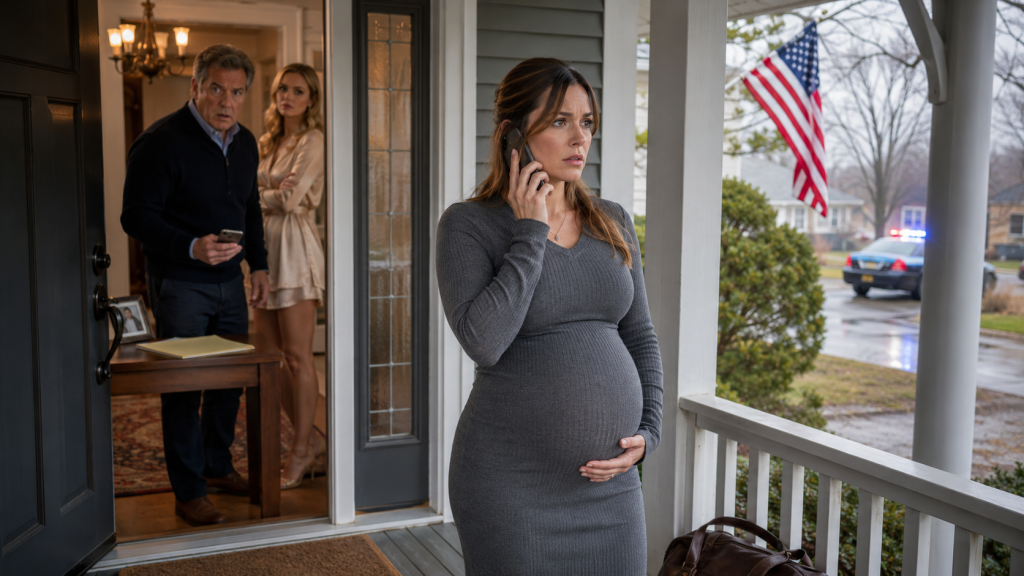
Charles yanked the door open and shoved me onto the porch. I came down hard on one knee and caught myself just before my stomach could hit the boards.
Then warmth ran down my legs.
I stared beneath me.
“My water broke,” I whispered.
Courtney covered her mouth. For one second, I thought she finally understood what they had done.
She was still laughing.
Charles tossed my handbag onto the porch beside me. “Call whoever you want.”
So I did.
Not 911. Not yet.
I pulled out my phone and called Samantha Vance, Lucas’s attorney. She answered on the second ring.
“Victoria?”
“My father is inside my house,” I said. “He attacked me. My water broke. And I think he’s trying to take the property.”
Her voice changed instantly.
“Do not leave that porch. Call 911 right now. I’m sending someone to the county recorder’s office, and I’m contacting the bank.”
“What bank?”
“The one holding the trust account Lucas established for you.”
I froze.
Through the open doorway, Charles was already searching Lucas’s desk.
Samantha kept talking. “Victoria, your father called my office yesterday. He claimed you had given him permission to liquidate the estate.”
My fingers tightened around the phone.
“Lucas expected someone might interfere,” she said. “The house, the investment accounts, and the controlling shares in Baldwin-Gallagher Logistics are all protected. If Charles forged your signature, he may have activated the fraud clause.”
A siren sounded in the distance.
Inside the house, Charles’s phone suddenly began ringing.
He reached for it.
PART 2: THE CALL THAT CHANGED EVERYTHING
Inside the house, Charles’s phone began ringing.
Once.
Twice.
Three times.
He looked irritated, as if the sound itself had offended him.
Then he glanced at the screen.
And something in his face changed.
It was small.
Barely there.
But I saw it.
The confidence vanished first.
Then the color.
Courtney leaned toward him.
“Who is it?”
Charles did not answer.
He stared at the screen for another second before finally lifting the phone.
“Hello?”
I sat on the porch with one hand braced against the railing and the other wrapped beneath my stomach.
Another contraction rolled through me.
Not sharp yet.
Not unbearable.
But deep.
Heavy.
A warning.
My daughter was coming.
Three weeks after losing her father, she had chosen the morning my own father dragged me through my house to enter the world.
I almost laughed at the cruelty of the timing.
Instead, I breathed.
In.
Out.
Lucas had taught me that during childbirth classes.
He had taken them far more seriously than I did.
He sat in the front row every Thursday evening with a notebook balanced on his knee.
The instructor once asked for volunteers to demonstrate breathing techniques.
Lucas raised his hand so quickly I wanted to disappear.
He spent ten minutes breathing like a determined steam engine while the entire room laughed.
Later in the car, I told him he was ridiculous.
He kissed my hand.
“If looking ridiculous helps you for even five seconds, I’m doing it.”
That memory hit me so suddenly I had to close my eyes.
Lucas should have been here.
He should have been kneeling beside me on that porch.
He should have been panicking.
Calling the hospital.
Carrying three bags we absolutely did not need because he had packed like we were moving into the maternity ward permanently.
Instead, I had his attorney in one ear.
Sirens in the distance.
And my father standing inside our home.
My home.
The home Lucas and I had painted room by room.
The home where he had assembled the nursery crib backward, cursed quietly for twenty minutes, then insisted the instructions were wrong.
The home where he had once stood in the kitchen at midnight holding my pregnancy test with tears running down his face.
Charles had dragged me out of that house as though I were a trespasser.
And now someone on the phone was clearly telling him he had made a mistake.
A large one.
“What do you mean frozen?” Charles snapped.
Courtney straightened.
I opened my eyes.
Frozen.
Samantha heard it too.
She was still on the line with me.
“Victoria,” she said quietly, “the bank has acted.”
“What did they freeze?”
“Anything tied to the emergency transfer request.”
I stared through the open doorway.
Charles turned away from us and lowered his voice.
“No. Listen to me. I am authorized.”
A pause.
“I have paperwork.”
Another pause.
His jaw tightened.
Courtney whispered, “What’s happening?”
Charles waved her away.
Samantha continued in my ear.
“Your father submitted documents yesterday claiming you were incapacitated by grief and had appointed him to manage Lucas’s estate.”
My heart stopped.
“What?”
“He sent copies of what appears to be a power of attorney.”
“I never signed one.”
“I know.”
I looked at my father.
He had always controlled things.
Money.
Schedules.
Family decisions.
Who was allowed to be angry.
Who was allowed to speak.
Even when I was a child, Charles Baldwin treated every room like a meeting where only one vote counted.
His.
But forgery?
That was different.
That was not arrogance.
That was planning.
“How long has he been doing this?”
“We don’t know yet.”
Another contraction tightened across my abdomen.
I bent forward.
My fingers dug into the porch boards.
“Victoria?”
“I’m okay.”
“No, you are not.”
“I know.”
The first police cruiser turned onto the street.
Red and blue lights washed across the wet pavement.
Samantha’s voice became firmer.
“Stay where the officers can see you. Tell them everything. The assault. The forced removal. The suspected fraud.”
I looked at the dark stain spreading across my dress.
“And the labor.”
“Yes. Especially the labor.”
The cruiser stopped hard at the curb.
Two officers got out.
One of them saw me immediately.
“Ma’am!”
He ran toward the porch.
Behind him, an ambulance rounded the corner.
The sound of the siren filled the street.
Neighbors began appearing at windows.
Of course they did.
Mrs. Landry from next door stepped onto her porch in slippers and a robe.
Across the street, Mr. Jennings stood beneath an umbrella.
The quiet neighborhood Lucas loved had suddenly become a stage.
Three weeks ago, black cars had lined this same curb for his funeral.
Now an ambulance was pulling into the same driveway.
I felt something inside me crack.
The officer crouched beside me.
“Are you Victoria Gallagher?”
“Yes.”
“What happened?”
“My father dragged me out of my house.”
He looked at the wet fabric beneath me.
“And you’re pregnant?”
“Thirty-five weeks.”
His eyes widened slightly.
“My water broke when I fell.”
He immediately signaled the paramedics.
Another officer moved toward the front door.
Charles stepped outside.
“Officer, this is a family misunderstanding.”
I looked at him.
Even then.
Even with my hair pulled loose around my face.
Even with marks already rising along my arm.
Even with amniotic fluid running down my legs.
He called it a misunderstanding.
The officer beside me stood.
“Sir, step away from the doorway.”
Charles lifted both hands.
“I’m her father.”
“That does not change what I said.”
Courtney appeared behind him.
She had stopped laughing.
Completely.
Her face was pale now.
Good.
One paramedic knelt beside me.
“Victoria, I’m Melissa. We need to get you to the hospital.”
I nodded.
“My phone.”
“You can keep it.”
“Samantha?”
“I’m here,” the attorney said through the speaker.
The paramedic glanced at me.
I covered the microphone.
“She’s my husband’s attorney.”
Melissa nodded as if she had seen stranger things.
Behind us, Charles raised his voice.
“That is my daughter’s house.”
I looked at him.
Even the contractions could not distract me from that sentence.
“No,” I said.
He ignored me.
The second officer asked, “Do you reside here?”
Charles hesitated.
Courtney answered too quickly.
“We were moving in.”
Everyone went silent.
Even Charles turned toward her.
I stared.
“What?”
Courtney realized immediately that she had said too much.
Her lips parted.
Charles hissed, “Stop talking.”
The officer noticed.
“So you were moving into this residence today?”
“No,” Charles said sharply.
Courtney blinked.
“I thought—”
“Courtney.”
She shut her mouth.
The officer looked between them.
“Do either of you have identification showing this as your address?”
“No,” Charles said.
“Do you own the property?”
Charles lifted his chin.
“My daughter’s husband died.”
“That wasn’t my question.”
Charles hated being corrected.
I knew the look.
The tightening around the mouth.
The cold eyes.
The subtle shift in posture that said everyone else had become inconvenient.
But police officers were not daughters.
They did not flinch when Charles Baldwin decided he was the most important man in the room.
“I am handling the estate,” he said.
“Are you the executor?”
Charles hesitated.
“No.”
“Administrator?”
“No.”
“On the deed?”
Silence.
The officer waited.
Charles finally said, “Not technically.”
I almost smiled.
Not technically.
That was Charles’s language for absolutely not.
Samantha heard everything through the phone.
“Victoria,” she said.
“Yes?”
“Do not discuss ownership with him. We have the deed.”
I lowered my voice.
“He thinks he can take the house.”
“He cannot.”
A paramedic helped me stand.
The moment I shifted my weight, pain tore through my abdomen.
I gasped.
The porch tilted.
For one terrifying second, all I could think was:
Not the baby.
Please.
Not her too.
I had already buried one person I loved.
I could not lose another.
Melissa caught me.
“Easy.”
“My baby.”
“We’re going to take care of both of you.”
Another paramedic brought the stretcher closer.
I let them guide me onto it.
Charles stepped forward.
“Victoria, don’t make this bigger than it is.”
I looked at him.
The audacity was almost breathtaking.
“You pulled me by my hair.”
“You were hysterical.”
“I told you to leave.”
“You’re grieving.”
“So that gave you the right to drag me through my own house?”
His jaw tightened.
“I was trying to help.”
That sentence.
My father’s favorite absolution.
If Charles hurt someone while claiming to help them, then in his mind the pain became irrelevant.
Intent was everything.
Consequences belonged to other people.
“You made my water break.”
His eyes flicked toward the stretcher.
For the first time, fear appeared.
Not for me.
For himself.
“I didn’t know that would happen.”
“No.”
I looked at him steadily.
“You just didn’t care if I fell.”
Courtney crossed her arms.
“This is getting ridiculous.”
Every head turned toward her.
She immediately regretted speaking.
I stared at the woman who had laughed while my father dragged me by the hair.
“You laughed.”
She rolled her eyes.
“Oh my God.”
“You laughed when I said my water broke.”
“I thought you were being dramatic.”
Something inside me became very quiet.
Lucas used to say that was the moment people should fear me most.
Not when I yelled.
When I went still.
I looked at Courtney.
“Remember that.”
Her face changed.
“What?”
“You’ll understand later.”
The paramedics began moving me toward the ambulance.
As we reached the bottom of the porch steps, Charles’s phone rang again.
This time he answered immediately.
“What now?”
A voice spoke loudly enough that I heard fragments.
“…Baldwin-Gallagher Logistics…”
“…control restriction…”
“…pending investigation…”
Charles stopped walking.
“What?”
He listened.
Then his face collapsed.
Not completely.
But enough.
Samantha heard the company name.
“Victoria.”
“Yes?”
“Did Lucas ever explain the structure of Baldwin-Gallagher Logistics to you?”
“No.”
I frowned.
“Dad started the company years ago. Lucas helped expand it.”
“That is the simplified version.”
“What do you mean?”
The ambulance doors opened behind me.
Samantha lowered her voice.
“Lucas did not just help expand it.”
I waited.
“He rescued it.”
My mind went blank.
“What?”
“Seven years ago, Baldwin Logistics was close to insolvency. Lucas invested through a holding company and restructured the debt.”
I stared at Charles.
My father was still on the phone, shouting now.
“But I founded the company!”
Samantha continued.
“After the restructuring, Lucas became majority beneficial owner through multiple entities.”
My mouth went dry.
“I didn’t know.”
“Apparently Charles assumed Lucas would eventually transfer control back.”
“Did he?”
“No.”
I closed my eyes.
Of course Lucas never told me.
Not because he hid things cruelly.
Because he never cared about using money as power.
He came home from meetings, threw his tie over a chair, and asked what I wanted for dinner.
He never introduced himself by net worth.
Never talked about control.
Never mentioned that my father’s company survived because he had saved it.
“Why didn’t Lucas tell me?”
“I can’t answer that.”
I could.
Because he knew my father.
Lucas understood that Charles measured masculinity in ownership.
Influence.
Dominance.
If Lucas had openly admitted he controlled the company, my father would have turned every family dinner into a battlefield.
So Lucas stayed quiet.
He let Charles keep the title.
The office.
The illusion.
I felt tears sting my eyes.
Even dead, my husband was protecting me from my father.
I hated that thought.
Not because it wasn’t beautiful.
Because Lucas should have been alive to do something other than protect me from people who claimed to love me.
Samantha continued.
“Lucas’s controlling interest passed into a trust.”
My heart began pounding.
“What trust?”
“The trust established for you and your child.”
I gripped the edge of the stretcher.
“Me?”
“Yes.”
“Does Dad know?”
“He does now.”
I looked toward the porch.
Charles had lowered his phone.
He was staring at me.
Not like a daughter.
Like a person holding something he wanted.
Suddenly the morning made sense.
The folders.
The house.
The forged authorization.
The urgency.
He had not come because he was worried about me.
He had come because he wanted control before I understood what Lucas had left behind.
The ambulance suddenly felt very cold.
“Did he know before today?”
“We are determining that.”
Courtney walked toward him.
“What happened?”
Charles said nothing.
She touched his arm.
“Charles.”
“The accounts are frozen.”
Her face changed.
“What accounts?”
He looked at her with naked irritation.
“All of them.”
“What does that mean?”
“It means stop talking.”
She stepped back as if slapped.
The first officer approached Charles.
“Sir, I need you to remain here.”
Charles looked toward the ambulance.
“I need to speak with my daughter.”
“No.”
“I’m her father.”
“Not right now.”
Charles’s face twisted.
“Victoria!”
I looked at him.
“Tell them this is a misunderstanding.”
My pulse thudded.
He still thought I would rescue him.
Even now.
After everything.
Some habits are difficult to kill.
He had spent my whole life teaching me that his anger was my emergency.
He got upset.
I fixed it.
He crossed a line.
I softened the consequence.
He insulted someone.
I explained what he “really meant.”
He demanded loyalty.
I supplied it.
But I was lying on a stretcher because of him.
My husband was dead.
My daughter was coming too early.
And for once, Charles Baldwin would have to survive his own actions without me standing between him and the result.
I met his eyes.
“No.”
That single word traveled across the driveway.
His face hardened.
“Victoria.”
“No.”
I repeated it.
Stronger.
“You attacked me.”
“I’m your father.”
“You attacked me.”
“You’re emotional.”
“You forged my signature.”
He froze.
Courtney looked at him.
“What?”
Charles’s eyes narrowed.
“Who told you that?”
The officer immediately turned toward him.
“Forged what signature?”
Charles realized the mistake.
Too late.
I almost admired how quickly his face changed.
“You’re confused.”
“No.”
I lifted the phone slightly.
“My attorney isn’t.”
Samantha spoke through the speaker.
“Charles Baldwin, this is Samantha Vance.”
Every line in my father’s body went rigid.
“Do not speak to me.”
“I’m not advising you.”
Her voice was calm.
“I’m informing my client that any documents purporting to transfer her authority are being challenged as fraudulent.”
Courtney stared at Charles.
“You said she signed.”
He turned on her.
“Be quiet.”
Her face went white.
“You told me the house was going to be ours.”
There it was.
Again.
Another truth accidentally spoken aloud.
The officer looked at Courtney.
“You believed you were taking possession of this property?”
She swallowed.
Charles snapped, “She doesn’t know what she’s talking about.”
Courtney looked at him.
Something ugly moved across her face.
Not guilt.
Self-preservation.
I recognized it immediately.
She was beginning to understand that loving Charles was not worth being arrested beside him.
“We packed last night,” she said.
Charles stared at her.
“What are you doing?”
“You told me Victoria would be moving to a smaller place.”
My stomach turned.
A smaller place.
They had planned my displacement.
Not theoretically.
Not someday.
They had packed.
They came prepared to move into the home where my husband’s shoes were still beside the bedroom closet.
Where his toothbrush was still in the bathroom because I had not found the courage to throw it away.
Where his jacket still hung by the garage door.
They wanted to live there.
Sleep in our bedroom.
Eat at our table.
Maybe repaint the nursery.
The thought made me physically sick.
The paramedic noticed.
“Victoria?”
“I’m okay.”
“Don’t say that automatically.”
That sentence nearly made me laugh.
Lucas used to say the same thing.
I stared at her.
“I’m scared.”
“That I believe.”
Another contraction tightened.
Stronger this time.
My breath caught.
Melissa looked at her watch.
“How long since the last one?”
“Maybe six minutes.”
The paramedics exchanged a look.
“We’re going.”
The doors began closing.
Charles lunged forward.
“Wait!”
The officer blocked him.
“Step back.”
“Victoria!”
I looked through the narrowing gap.
He was standing in my driveway.
My father.
The man I had spent decades trying to impress.
Trying to soften.
Trying to love in the correct way.
And suddenly he looked terribly ordinary.
Not powerful.
Not frightening.
Just a man who had mistaken obedience for permanent control.
The doors shut.
His voice disappeared.
The ambulance started moving.
For the first time all morning, I was away from him.
I began crying.
I turned my face toward the wall.
“I’m sorry,” I whispered.
Melissa sat beside me.
“For what?”
I could not answer.
Because grief has strange directions.
I was not crying for Charles.
I was crying for Lucas.
For our kitchen.
For the nursery.
For the fact that the last person who should have had to protect our home was me alone.
I pressed my hand against my stomach.
“Your dad should be here.”
Melissa looked away respectfully.
I continued speaking to the baby.
“He would have been so scared.”
A laugh broke through my tears.
“He would have pretended he wasn’t.”
My daughter moved beneath my hand.
Just once.
A small roll.
I cried harder.
Samantha was still on the phone.
“Victoria?”
“Yes.”
“There is something else you need to know.”
I closed my eyes.
“Please tell me there isn’t.”
“I wish I could.”
The ambulance turned.
My body swayed slightly with it.
“What now?”
“When Lucas revised the trust last year, he added a misconduct provision.”
I frowned.
“What does that mean?”
“If any officer or beneficiary of Baldwin-Gallagher Logistics attempted to seize trust assets, forge authorization, or remove you from protected property…”
She paused.
I opened my eyes.
“What happens?”
“Their company interests become subject to immediate suspension pending review.”
I stared at the ceiling.
“My father’s interests?”
“Yes.”
That explained the phone call.
The frozen accounts.
The panic.
Charles had walked into my home believing Lucas’s death had created weakness.
Instead, Lucas had built a trap around greed.
The moment someone tried to exploit me, the protections tightened.
“What can Dad lose?”
“A lot.”
The answer was quiet.
“Possibly his voting authority.”
I almost stopped breathing.
“His job?”
“Potentially.”
“The company?”
“Control of it.”
I stared at nothing.
My father had spent thirty years introducing himself as founder and chairman of Baldwin-Gallagher Logistics.
The company was his identity.
His pride.
His proof that he mattered.
He had told everyone Lucas merely married into success.
The truth had apparently been the opposite.
Lucas had saved the company.
Then protected it.
And now Charles’s own behavior might remove him from it entirely.
“He did this to himself,” I whispered.
“Yes.”
I thought I would feel satisfaction.
Instead, I felt tired.
Deeply tired.
Revenge looks satisfying from a distance.
Up close, sometimes it just looks like another piece of your family collapsing.
We reached the hospital eleven minutes later.
Nurses surrounded me.
Questions came quickly.
“How many weeks?”
“Thirty-five.”
“First pregnancy?”
“Yes.”
“Any complications?”
“No.”
“Bleeding?”
“No.”
“Contractions?”
“Yes.”
“Pain level?”
I wanted to say:
My husband died three weeks ago.
My father pulled me through my house by the hair.
My stepmother laughed.
My water broke on the porch.
My father may have forged my signature.
My husband apparently owned most of the company my father thinks belongs to him.
And my baby is arriving before I have figured out how to breathe without her father.
What number covers that?
Instead I said, “Seven.”
They moved me into labor and delivery.
A nurse helped me change.
Another attached monitors.
The sound of my daughter’s heartbeat filled the room.
Fast.
Steady.
Alive.
I started sobbing.
The nurse turned.
“What’s wrong?”
“Nothing.”
Then I remembered Melissa’s words.
Don’t say that automatically.
I tried again.
“My husband died.”
The nurse’s face softened.
“Three weeks ago.”
She touched my shoulder.
“And he was supposed to be here.”
“Yes.”
That was the sentence.
The truest one.
He was supposed to be here.
Not as a memory.
Not in a photograph.
Not as a signature on trust documents.
Here.
Holding my hand.
Complaining about the hospital coffee.
Asking the nurse too many questions.
Telling me I was beautiful even when I threatened to throw something at him.
I covered my face.
“I don’t know how to do this without him.”
The nurse sat beside me.
“You don’t have to know the whole thing.”
I looked at her.
“Just the next breath.”
So I took it.
One breath.
Then another.
My phone vibrated.
Samantha.
I answered.
“What’s happening?”
“Your father has been taken to the station for questioning.”
I closed my eyes.
“And Courtney?”
“She is giving a statement.”
Of course she was.
“Did they arrest him?”
“Not yet, as far as I know.”
I nodded.
Samantha continued.
“The bank confirmed attempted transfers.”
My heartbeat seemed to match the monitor.
“Transfers where?”
“To a new holding account controlled by Charles.”
“How much?”
She hesitated.
“Samantha.”
“Nearly two million dollars.”
I stared at the wall.
Two million.
My father had not only tried to take the house.
He tried to move money.
“Was that mine?”
“It belonged to the trust.”
“My daughter’s too?”
“Yes.”
Something changed in me.
Until that moment, a small part of me had still been thinking like a daughter.
A hurt daughter.
A betrayed daughter.
A daughter asking why her father would do this.
But the moment Samantha said my unborn child’s money was involved, I stopped thinking like Charles Baldwin’s daughter.
I became her mother.
And mothers understand danger differently.
“You stop everything.”
My voice changed.
Samantha noticed.
“We are.”
“No access.”
“Already underway.”
“No authority.”
“Yes.”
“No contact with the house.”
“We can seek an emergency protective order.”
“Do it.”
“Victoria—”
“Do everything Lucas put in place.”
Silence.
Then Samantha said softly, “He would be proud of you.”
I broke.
A sound escaped me before I could stop it.
I turned my face away.
“No.”
“He would.”
“He should be here.”
“I know.”
“Everyone keeps telling me what Lucas would want.”
Tears ran into my hair.
“I don’t want what he would want.”
My voice cracked.
“I want Lucas.”
The room became still.
Samantha did not answer immediately.
When she did, her voice was gentler.
“I know.”
That was all.
No lesson.
No silver lining.
Just acknowledgment.
Sometimes kindness is knowing when not to repair the unbearable.
The contractions became closer.
Four minutes.
Then three.
The doctor arrived.
“We’re going to try to slow labor if we can, but given the ruptured membranes and your contraction pattern, your daughter may have other plans.”
I laughed weakly.
“She gets that from her father.”
“What?”
“Bad timing.”
The doctor smiled.
“Maybe determination.”
That sounded more like Lucas.
Hours blurred.
Pain.
Breathing.
Monitors.
Calls.
Forms.
At some point, I asked Samantha to come.
She arrived before sunset.
Not in a dramatic lawyer’s suit.
In jeans, a sweater, and rain-damp hair.
She walked into the room holding a folder.
Then immediately put it aside.
“No business.”
I stared at her.
“You brought a folder.”
“Habit.”
A laugh escaped me.
She sat beside the bed.
Lucas had trusted Samantha for years.
She handled business matters.
Estate plans.
Contracts.
I had always thought of her as his serious friend with perfect handwriting.
Now she looked exhausted.
Sad.
Human.
“Why didn’t he tell me?”
I asked.
She knew exactly what I meant.
“The company?”
“Yes.”
“The trust?”
“Yes.”
“All of it.”
Samantha looked down.
“Lucas worried you would think he was trying to control your relationship with your father.”
I stared at her.
“He knew Charles resented him.”
“I know.”
“He also knew you still wanted your father’s approval.”
That hurt.
Because it was true.
“So he stayed quiet.”
“Yes.”
“He let Dad think the company was still his.”
“Yes.”
I closed my eyes.
“Idiot.”
Samantha smiled sadly.
“I called him worse.”
Another contraction hit.
I gripped her hand.
She nearly lost circulation.
When it passed, I whispered, “Sorry.”
“Do that again and I’m billing the estate.”
I laughed.
Lucas would have loved that.
The laugh turned into tears.
Everything did.
Near midnight, labor stopped being negotiable.
The doctor checked me.
Then looked up.
“Victoria, we’re having a baby.”
Fear came immediately.
Cold.
Primitive.
“I can’t.”
The nurse looked at me.
“Yes, you can.”
“No.”
I shook my head.
“Lucas isn’t here.”
The room blurred.
“He was supposed to be here.”
Samantha stood beside me.
“He is part of why she’s here.”
“No.”
I began crying harder.
“I mean here.”
I pressed my fist against my chest.
“I need him here.”
Another contraction hit.
There was no time to argue with grief.
Birth does not wait for fairness.
It comes anyway.
I screamed.
For the first time that day, I screamed.
Not when Charles pulled my hair.
Not when my knee struck the porch.
Not when Courtney laughed.
Now.
Because pain finally found a place where it was allowed to have a voice.
I screamed for my daughter.
For Lucas.
For myself.
For every moment I had stayed quiet because silence made everyone else comfortable.
The nurse held my shoulder.
“Push.”
So I did.
Again.
Again.
Again.
At 12:41 in the morning, my daughter entered the world.
Small.
Early.
Furious.
Her cry filled the room.
And I broke completely.
“Oh my God.”
They lifted her.
For one second I saw Lucas.
Not literally.
But something in her face.
The line of the nose.
The tiny crease between her eyebrows.
That same offended expression Lucas made whenever someone woke him too early.
I laughed and sobbed at once.
“My baby.”
They placed her against me.
She was warm.
So unbelievably small.
I held her against my chest.
“Hi.”
My voice shook.
“Hi, sweetheart.”
Her tiny hand opened against my skin.
I kissed her forehead.
“You’re here.”
The room disappeared.
Charles disappeared.
Courtney disappeared.
The company.
The house.
The forged signatures.
The frozen accounts.
Everything became distant.
There was only my daughter.
Lucas’s daughter.
My daughter.
Alive.
She cried again.
“I know.”
I kissed her cheek.
“I know.”
Samantha stood near the wall crying openly.
The nurse asked, “Does she have a name?”
I had known for months.
Lucas chose it.
I pretended I hated it for almost a week.
Then he caught me writing it in the margin of a grocery list.
“Eleanor.”
The nurse smiled.
“Eleanor Gallagher.”
I looked at my daughter.
“No.”
Everyone paused.
I took a breath.
“Eleanor Lucas Gallagher.”
The nurse’s eyes softened.
I knew Lucas was usually a surname.
I didn’t care.
Her father would exist somewhere in her name.
Not because names replace people.
They never can.
But because I needed one small piece of him to travel with her through every classroom roll call.
Every certificate.
Every ordinary day he would never see.
“Eleanor Lucas Gallagher,” the nurse repeated.
I cried again.
Later, after they took Eleanor for additional monitoring because she was premature, I lay awake in the dim hospital room.
Everything hurt.
My body.
My heart.
My scalp.
My family.
Samantha had gone to find coffee.
At 3:17 in the morning, my phone vibrated.
Unknown number.
I almost ignored it.
Then I answered.
“Hello?”
A man spoke.
“Mrs. Gallagher?”
“Yes.”
“This is Detective Paulson with the Onondaga County Sheriff’s Office.”
I sat up slightly.
“What happened?”
“We completed an initial review of the documents seized from your residence and from your father’s vehicle.”
My stomach tightened.
“Okay.”
“There’s something you should be aware of.”
I waited.
“We found a signed sale agreement.”
“For the house?”
“Yes.”
My blood went cold.
“I never agreed to sell.”
“We understand that.”
I gripped the blanket.
“Who was buying it?”
There was a pause.
Then the detective said something I did not expect.
“Your father.”
I stared into the darkness.
“What?”
“Through a company registered eleven days ago.”
My heartbeat accelerated.
Eleven days.
He created a company before Lucas had been dead two weeks.
He had planned this.
I whispered, “For how much?”
“According to the document…”
The detective paused again.
“…one dollar.”
I stopped breathing.
One dollar.
My father planned to transfer my house to himself for one dollar.
The room felt suddenly enormous.
“He thought I would let him?”
“We don’t believe the signature on the agreement is yours.”
My fingers tightened.
“What else did you find?”
The detective hesitated.
That hesitation terrified me.
“Mrs. Gallagher, there was another document.”
“What document?”
“A petition drafted but not yet filed.”
“For what?”
“Temporary guardianship.”
I stared at the wall.
“Guardianship of who?”
Silence.
Then:
“Your child.”
Every part of me went cold.
“My baby?”
“Yes.”
I could barely speak.
“Why?”
“The petition alleged that after your husband’s death, you had become emotionally unstable and incapable of managing your finances or caring safely for a newborn.”
My vision blurred.
He planned everything.
The house.
The money.
The company.
And Eleanor.
My father had not come to help a grieving daughter.
He had come to build a version of me that could be removed.
Weak.
Unstable.
Incompetent.
Then my hair.
The porch.
The fall.
My water breaking.
What if I had screamed hysterically?
What if police arrived and found me panicking while Charles stood calm in the doorway?
What if he had told them grief had made me irrational?
What if that had been part of the plan?
I whispered, “He wanted people to think I was unstable.”
“We are investigating that possibility.”
My hand moved protectively over my stomach even though Eleanor was down the hall.
Something ancient rose inside me.
Fear transformed into fury.
Quiet fury.
The kind Lucas always recognized.
The kind that did not burn fast.
It settled.
Focused.
Stayed.
“Detective?”
“Yes?”
“Do not let him near my daughter.”
“We won’t.”
“No.”
My voice sharpened.
“I need that in writing.”
“We can help you with protective procedures.”
“Good.”
I stared toward the hallway leading to the nursery.
“And tomorrow, I want every document.”
“As soon as we’re legally able.”
“Every signature.”
“Yes.”
“Every account.”
“Yes.”
“Every person who helped him.”
The detective paused.
Then said, “There may be one more person.”
I froze.
“Who?”
“We found correspondence between your father and someone inside Baldwin-Gallagher Logistics.”
My heart began pounding.
“Who?”
“I can’t identify them until we verify the evidence.”
My voice became quiet.
“Was it Courtney?”
“No.”
That frightened me more.
“Then who?”
“We’re working on it.”
The call ended minutes later.
I sat in the darkness alone.
Somewhere down the hall, my daughter slept beneath hospital lights.
Somewhere else, my father was likely sitting in a police interview room trying to explain why every terrible thing he did had been for my own good.
I looked at the empty chair beside my bed.
For one second, I imagined Lucas there.
Tie crooked.
Hair messy.
Holding terrible hospital coffee.
He would have looked at me and said exactly what he always said when I was scared.
You don’t have to be fearless, Vic.
You just have to know what matters more than the fear.
I closed my eyes.
I knew what mattered now.
Eleanor.
Our home.
The life Lucas had protected.
The company he had quietly saved.
And the truth.
I had spent years trying not to make my father angry.
Now I finally understood that anger was the only tool he had ever needed because everyone around him kept handing him power to avoid it.
I was done.
I reached for my phone.
Opened Samantha’s contact.
Then stopped.
It was four in the morning.
No.
This could wait until sunrise.
For once, I did not need to solve everything tonight.
I lay back against the pillow.
Then the door opened.
Samantha walked in carrying coffee.
She looked at my face.
“What happened?”
I handed her the phone.
“Dad drafted papers to take Eleanor.”
Samantha went completely still.
“What?”
“And apparently someone inside the company was helping him.”
Her eyes changed.
Not shock.
Recognition.
I noticed.
“Samantha.”
She looked away.
“You know something.”
“No.”
“That was not a surprised face.”
She set the coffee down.
“Victoria—”
“Who?”
She closed her eyes.
For the first time since I had known her, Samantha Vance looked afraid to tell me the truth.
When she finally opened them, her voice was barely above a whisper.
“Lucas suspected someone inside Baldwin-Gallagher Logistics was feeding your father information.”
My throat tightened.
“Who?”
“He never proved it.”
“Who did he suspect?”
She stared at me.
Then said a name that made every remaining piece of my old life begin to collapse.
“Your mother.”
I stopped breathing.
My mother.
The woman I had not spoken to in nine years.
The woman who supposedly moved to Florida after divorcing Charles.
The woman who had sent flowers to Lucas’s funeral but never called me.
I stared at Samantha.
“That’s impossible.”
“I hope it is.”
“But you don’t think it is.”
She said nothing.
I looked toward the nursery.
My daughter was less than four hours old.
My husband had been dead three weeks.
My father had tried to take my house.
My money.
My authority.
Maybe even my child.
And now, for the first time, I realized Charles might never have been planning alone.
Outside the hospital windows, dawn began turning the sky pale gray.
A new day.
A new life.
And somewhere beyond those walls, someone in my family still believed I was too broken to fight back.
They were about to discover something Lucas had known long before any of them did.
Grief had not made me weak.
It had simply burned away everything I was still willing to lose.
PART 3: WHAT GRIEF LEFT STANDING
“Your mother.”
For several seconds, I thought I had misunderstood Samantha.
The hospital room was too quiet.
Too white.
Too clean for a sentence like that.
My daughter was four hours old.
My husband had been dead for three weeks.
And suddenly the woman I had spent nine years trying not to think about had stepped back into my life without ever entering the room.
“My mother lives in Florida.”
“That’s what Charles told you.”
I stared at Samantha.
“What does that mean?”
She sat down slowly.
“Victoria, I need you to understand that Lucas never had proof.”
“You already said that.”
“He had suspicions.”
“About what?”
Samantha folded her hands.
“About information leaking from inside the company.”
My throat tightened.
“What information?”
“Trust structures. Voting rights. Account restrictions. Internal debt schedules.”
I shook my head.
“My mother barely knew anything about business.”
“That may not have been true.”
I stared at her.
Samantha continued carefully.
“Before your parents divorced, your mother held an administrative position at Baldwin Logistics.”
I remembered that vaguely.
My mother, Diane Baldwin, had always described herself as someone who “helped out at the office.”
I pictured her in photographs from when I was young.
Perfect hair.
Pearl earrings.
A legal pad in front of her.
Always sitting two chairs away from my father at company dinners.
“She was Dad’s assistant.”
“Officially.”
“What does that mean?”
“She had access.”
The word landed heavily.
“To everything?”
“A great deal.”
I looked away.
Nine years.
I had not spoken to Diane in nine years.
Our relationship had not ended with one dramatic explosion.
It died slowly.
Phone calls became arguments.
Arguments became silence.
Silence became years.
After my parents divorced, Mom blamed me for refusing to take her side.
Dad blamed me for refusing to take his.
I was twenty-three and already exhausted from being treated like evidence in someone else’s marriage.
So eventually, I stopped answering both of them for a while.
Charles fought his way back into my life.
Birthdays.
Holiday calls.
Grand gestures.
Money.
Pressure.
Diane did not.
She simply disappeared.
Then Lucas came.
And for the first time, family did not feel like a courtroom.
I built a life.
I married.
I stopped waiting for either parent to become someone they had never been.
Now Samantha was telling me my mother might have been standing behind the curtain all along.
“Why would she help Dad?”
“I don’t know.”
“They hate each other.”
“People can hate each other and still share interests.”
I let out a tired laugh.
“That sounds like something a lawyer would say.”
“It probably is.”
Another silence.
Then I asked, “Did Lucas know where she was?”
Samantha looked at me.
“Yes.”
My stomach dropped.
“What?”
“He located her two years ago.”
“Why?”
“Because he was reviewing company history.”
“You mean he investigated my mother without telling me?”
The grief in my chest changed shape.
Not anger exactly.
Something more complicated.
Samantha nodded.
“He didn’t want to upset you until he knew whether it mattered.”
I laughed once.
Sharp.
Bitter.
“Apparently everyone loved protecting me with secrets.”
She flinched.
“That’s fair.”
I looked at her.
“No. It isn’t.”
The anger disappeared almost immediately.
“I’m sorry.”
“You don’t need to apologize.”
“I do.”
I rubbed my face.
“I’m just so tired of discovering that everyone knew pieces of my life before I did.”
Samantha looked toward the bassinet area beyond the hall.
“Then we change that now.”
I followed her gaze.
Eleanor.
My daughter.
My tiny, furious little girl.
She would not grow up around whispers.
Not if I could help it.
I looked back at Samantha.
“Tell me everything Lucas knew.”
So she did.
My mother had not been in Florida for years.
She had moved back to New York state quietly almost three years earlier.
Not Syracuse.
Albany.
She was living under her maiden name.
Working as a consultant for a regional freight brokerage.
One that had done business with Baldwin-Gallagher.
My stomach turned.
“How did Lucas find out?”
“An invoice.”
Samantha opened the folder she had brought.
For once, I was glad she never arrived anywhere without paperwork.
She removed a copy of an old consulting agreement.
The name on it was not Diane Baldwin.
It was Diane Mercer.
Her maiden name.
I stared at the signature.
I had not seen my mother’s handwriting in nearly a decade.
I recognized it instantly.
“Lucas found this eighteen months ago?”
“Yes.”
“And he never told me?”
“He asked me not to.”
“Why?”
Samantha’s face softened.
“Because that week was your first ultrasound.”
My hand moved to my stomach automatically.
Empty now.
Eleanor was down the hall.
I remembered that week.
Lucas had cried when he heard the heartbeat.
Then denied it.
There had been tears on his face, but apparently those were “allergies.”
I laughed despite myself.
Then started crying.
“God, I miss him.”
“I know.”
“No, I mean physically.”
My voice broke.
“I keep thinking he’s going to walk into a room.”
Samantha looked down.
“And every time he doesn’t…”
The rest would not come.
She finished softly.
“You lose him again.”
I nodded.
That was exactly it.
Grief was not one death.
It was a thousand little deaths afterward.
Every door that opened without him.
Every joke he never heard.
Every cup of coffee you almost made for two.
Every emergency where your body still expected him to appear.
I wiped my face.
“What did Lucas think my mother was doing?”
“Feeding Charles information.”
“Why?”
“He didn’t know.”
“Money?”
“Possibly.”
“Revenge?”
“Possibly.”
I laughed bitterly.
“That narrows it down.”
Samantha almost smiled.
Then her expression became serious again.
“There’s one more thing.”
Of course there was.
“What?”
“Lucas believed Diane knew how the misconduct clause worked.”
My heartbeat changed.
“Meaning?”
“If Charles moved against the trust in a way that triggered the clause, she may have known he could lose control.”
I stared at her.
“Then why would she help him?”
Samantha did not answer.
The possibility came to me slowly.
Coldly.
“Unless she wanted him to.”
Samantha’s eyes met mine.
Exactly.
My mother may not have been helping Charles win.
She may have been helping him destroy himself.
The idea was so viciously elegant I almost admired it.
Then I hated myself for that.
“What kind of parents do this?”
My voice sounded small.
Samantha did not pretend to have an answer.
I looked toward the window.
Sunrise had finally reached the glass.
The sky was pale gold.
Somewhere inside this same hospital, Eleanor was beginning her first morning.
And somewhere else, my parents were still fighting a war that had begun before she existed.
Enough.
I had thought that word before.
But this time, it felt final.
“Find my mother.”
Samantha nodded.
“I already have someone confirming her current address.”
“Good.”
“And Victoria?”
“Yes?”
“Do not meet her alone.”
I looked at her.
“I wasn’t planning to.”
Three days later, I went home.
Not alone.
Eleanor remained in neonatal care for observation.
Leaving the hospital without her felt unnatural.
My arms felt empty.
My body kept searching for weight that wasn’t there.
But I needed clothes.
Documents.
And I needed to see the house.
The police had changed the lock after Charles was removed.
Samantha drove.
Two officers met us there.
When I stepped onto the porch, my knees almost gave out.
The stain from where my water broke was gone.
Rain had washed it away.
For some reason, that hurt.
I had expected evidence.
A mark.
Something.
But houses do not remember what happens to us.
People do.
I walked inside.
The kitchen looked almost normal.
A chair pushed back.
A mug on the counter.
Lucas’s handwriting still on a grocery list attached to the refrigerator.
Milk.
Coffee.
Apples.
Batteries.
Do not let Victoria buy the expensive olives.
I laughed.
Then I pressed my forehead against the refrigerator and cried.
Samantha stood quietly behind me.
“I hated those olives.”
“No, you didn’t.”
“No.”
I smiled through tears.
“He did.”
I left the list where it was.
Upstairs was worse.
Our bedroom.
His side of the bed.
His watch on the dresser.
His shoes.
I touched one sleeve of a shirt hanging in the closet.
Then stopped.
Grief had made everything sacred.
Laundry.
Shoes.
Receipts.
Things I would once have thrown away without thought now felt like fragments of a country that no longer existed.
I sat on the edge of the bed.
Samantha waited in the hall.
For ten minutes, I let myself be Lucas’s widow.
Not Charles’s daughter.
Not a trust beneficiary.
Not a mother fighting for control of a company.
Just a woman who wanted her husband back.
Then I stood.
Because Eleanor still needed me.
In Lucas’s office, police tape had already been removed from the desk.
The drawers were open.
The folder Charles had brought was gone into evidence.
I walked behind the desk and sat in Lucas’s chair.
For the first time.
It felt wrong.
Then I noticed something.
A key taped beneath the center drawer.
Small.
Brass.
I stared at it.
“Samantha?”
She came in.
“What?”
I pointed.
“Did police see this?”
She frowned.
“No.”
We photographed it before touching anything.
Then one of the officers checked the area.
The key belonged to a lockbox built into the bottom cabinet.
Inside were six folders.
One had my name.
Another said Eleanor.
Another:
Charles.
Another:
Diane.
My heart stopped.
Samantha looked at me.
“Lucas knew.”
I reached for the folder marked Diane.
My hands trembled.
Inside were emails.
Invoices.
Copies of wire transfers.
And a handwritten page.
Lucas’s handwriting.
I sat down.
Samantha stood beside me.
The note began with two words.
For Vic.
I could not breathe.
I touched the paper.
It was him.
Not memory.
Not legal language.
Him.
I read.
If you are reading this, something went wrong before I could explain it properly.
My vision blurred.
I kept going.
I’m sorry.
I had to stop.
Samantha put one hand on my shoulder.
I continued.
I believe your father is trying to reposition company assets in a way that could eventually harm you. I also believe your mother knows more than she has told either of us.
Tears dropped onto the page.
I moved them away quickly, terrified of damaging his words.
I didn’t tell you because you were pregnant, happy, and finally sleeping through the night. Maybe that was cowardly. Maybe I wanted one season of our life where your parents did not get to enter the room.
I covered my mouth.
That was Lucas.
Exactly Lucas.
Protective.
Imperfect.
Trying too hard.
If I am wrong, I will apologize for being paranoid.
I laughed through tears.
If I am right, Samantha has instructions.
Of course she did.
I glanced at her.
She was crying too.
The final paragraph destroyed me.
Whatever happens with the company, the house, or the money, none of it matters as much as you and the baby. Do not let anyone turn assets into a substitute for safety. Sell everything if you need to. Walk away if you need to. I built protections because I know Charles. But I married you because I know you. You will know what to keep.
Below it:
Love you more than all of it.
Lucas.
I pressed the paper to my chest.
For a while, I could not move.
Then I whispered, “He knew.”
Samantha nodded.
“He knew enough.”
“He knew I might have to choose.”
“Yes.”
I looked at the folders.
The house.
The company.
The money.
All of it suddenly looked smaller.
Lucas was right.
Assets could become another kind of prison.
Charles had built his entire identity around ownership.
What he owned.
What he controlled.
What carried his name.
Maybe my mother had too.
Maybe that was why they destroyed everything between them.
I looked at Samantha.
“I want the company stabilized.”
She nodded.
“But I don’t want to run it.”
“Okay.”
“I don’t want Dad’s chair.”
“Good.”
“And I don’t want Eleanor growing up thinking this company is some kind of family throne.”
Samantha smiled slightly.
“That sounds very healthy.”
“I’m serious.”
“I know.”
I looked at Lucas’s note again.
“I want professional management.”
“We can arrange that.”
“Independent board review.”
“Yes.”
“And if Charles loses voting authority permanently…”
“He may.”
“Then he loses it.”
Samantha nodded.
No hesitation.
No revenge in me now.
Just consequence.
There is a difference.
A week later, the investigation became uglier.
Courtney cooperated completely.
She handed over text messages.
Voice notes.
Photographs.
She claimed Charles told her Victoria was “too unstable” to manage anything after Lucas died.
He told her the house would be theirs by summer.
He promised her a controlling interest in company investments.
He even told her the baby might eventually live with them “until Victoria got herself together.”
When Samantha read that part aloud, I went cold.
Not angry.
Cold.
He had already imagined Eleanor in his house.
My daughter.
My child.
Without me.
I looked at Eleanor sleeping in the bassinet beside my hospital chair.
Her tiny chest rose and fell.
I whispered, “Never.”
Courtney was not innocent.
She had laughed.
She had helped pack.
She had known Charles intended to remove me.
But she had not known about the forged documents.
At least, that was what investigators believed.
She agreed to testify.
Three months later, she filed for divorce.
That did not make me forgive her.
But I learned something useful.
Cruel people often stop laughing the moment cruelty reaches them.
My mother contacted me first.
Not the other way around.
A message arrived through Samantha.
I will meet if Victoria wants the truth.
I stared at the sentence.
Not I’m sorry.
Not I miss her.
The truth.
Part of me wanted to ignore it.
Another part had been waiting nine years.
So we met.
Public place.
Attorney present.
Samantha beside me.
A quiet conference room.
My mother walked in wearing gray.
Her hair was shorter than I remembered.
More silver.
She stopped when she saw me.
For one second, we were not enemies.
We were a mother and daughter who had missed nearly a decade.
Then the moment disappeared.
“Victoria.”
“Diane.”
Her face tightened.
“You used to call me Mom.”
“You used to answer.”
She looked down.
Fair.
She sat.
Nobody spoke for almost a minute.
Then I asked, “Did you help Charles?”
“No.”
“Did you give him company information?”
“Yes.”
My jaw tightened.
“That sounds like helping.”
“I gave him information I knew he would misuse.”
Samantha shifted beside me.
I stared at my mother.
“So you set him up.”
Diane looked me directly in the eyes.
“Yes.”
I felt sick.
“Why?”
“Because he ruined my life.”
There it was.
Not me.
Not Eleanor.
Not Lucas.
Her war.
“He took the company.”
“He founded it.”
“And used me to build it.”
Her voice sharpened.
“I worked beside him for nineteen years. I negotiated contracts. I fixed payroll crises. I handled lenders.”
She laughed bitterly.
“And when we divorced, suddenly I had been ‘just his wife.’”
I watched her.
“Why didn’t you fight him legally?”
“I did.”
“And?”
“I lost more than I won.”
She looked tired.
“Charles was very good at making sure his name was on everything that mattered.”
I thought of my house.
My trust.
My signature.
Apparently that had always been his favorite strategy.
“So you waited.”
“Yes.”
“For years.”
“Yes.”
“Then used Lucas’s death.”
Her face changed.
“No.”
I leaned forward.
“You fed Dad enough information to trigger the fraud clause after my husband died.”
“I did not know Lucas would die.”
“Obviously.”
My voice shook.
“But after he did, you could have called me.”
She said nothing.
“You could have warned me.”
Silence.
“You could have said, ‘Victoria, your father is planning something.’”
Her eyes filled.
“I thought Charles would go after the company.”
“He came after me.”
She flinched.
“My house.”
I continued.
“My money.”
Her face crumpled.
“My daughter.”
Diane whispered, “I didn’t know.”
“And that is supposed to matter?”
“No.”
The answer surprised me.
She looked at her hands.
“No.”
I stared at her.
“I thought I understood him.”
A tear slid down her cheek.
“I thought he would try to move company shares.”
She swallowed.
“I did not think he would touch you.”
I laughed once.
“Then you never understood him at all.”
She looked up.
“You think I don’t know your father?”
“I think you only knew what he did to you.”
The sentence landed.
Hard.
Diane went still.
I continued.
“You were so focused on punishing the man who hurt you that you forgot he was still capable of hurting someone else.”
Her tears came faster.
“You used me as collateral.”
“No.”
“Yes.”
I stood.
“Maybe you didn’t intend it.”
I gathered my bag.
“But that is what happened.”
She stood too.
“Victoria, please.”
I looked at her.
For the first time, I saw something I had wanted since I was a child.
Regret.
Real regret.
It did not heal me.
It simply existed.
“I sent flowers to Lucas’s funeral.”
I stared at her.
“I know.”
“I wanted to come.”
“You didn’t.”
“I thought you wouldn’t want me there.”
“You could have asked.”
Her face broke.
“You stopped answering me.”
“Nine years ago.”
“I didn’t know how to come back.”
I felt something inside me ache.
That was the tragedy.
Not that she had no way back.
That she had spent years waiting for the way back to become easy.
It never does.
“You come back by knocking,” I whispered.
She started crying.
“So knock now.”
Her face lifted.
Hope.
I held up one hand.
“Not for me.”
She went still.
“For yourself.”
I took a breath.
“Tell investigators everything.”
Her expression changed.
“Everything?”
“Every email.”
I looked at her.
“Every document.”
“Victoria—”
“Every time you gave Dad information intending to make him act.”
Her lips parted.
“That could implicate me.”
“Yes.”
She stared.
And for one second, I saw Charles in her.
The instinct to calculate consequence before truth.
Then something softened.
She nodded.
“All right.”
I did not hug her.
Not that day.
But she told the truth.
All of it.
Months passed.
Charles was indicted on multiple charges connected to attempted fraud, forgery, coercive financial conduct, and the assault.
The exact legal language became exhausting.
I stopped memorizing it.
I cared about one thing.
He could not come near us.
The court granted protective orders.
The company removed him from all operational authority pending final resolution.
Eventually, the board made the separation permanent.
Baldwin-Gallagher Logistics kept his name.
For a while.
Then something unexpected happened.
The employees petitioned for change.
Not because of the scandal.
Because everyone knew Lucas had been the person who actually rebuilt the company.
The board approved a new name.
Gallagher Meridian Logistics.
I cried when Samantha told me.
Then I said, “That sounds too fancy.”
She laughed.
“Lucas would hate it.”
“He absolutely would.”
The company created an employee emergency fund in his name.
That mattered more to me than the building.
More than the shares.
Lucas had believed businesses should protect the people whose lives made them possible.
So I used a portion of the trust income to endow the fund permanently.
Medical emergencies.
Bereavement.
Unexpected family crises.
The first grant went to a warehouse supervisor whose wife was undergoing cancer treatment.
I read the approval anonymously.
Then closed my laptop and cried in the kitchen.
That felt like keeping something Lucas would have wanted.
Not control.
Care.
Eleanor came home after twelve days.
She was five pounds, three ounces.
I carried her through the front door in a yellow blanket.
The same door Charles had dragged me through.
I stopped on the threshold.
Samantha stood behind me carrying flowers.
A nurse had told me moments like that could feel strange.
She was right.
My body remembered everything.
The hair pulling.
The porch.
The fall.
The warmth down my legs.
The laughter.
I looked down at Eleanor.
Her eyes were closed.
Tiny lips moving in sleep.
Then I stepped inside.
One step.
That was all.
But sometimes one step can reclaim an entire house.
The nursery was untouched.
Lucas’s terrible backward crib had been fixed months before the accident.
He had painted one wall himself.
Soft green.
The edges were uneven because he refused painter’s tape.
I had teased him mercilessly.
Now I would have paid anything to watch him ruin another wall.
I placed Eleanor in the crib.
Then sat on the floor.
Her first night home, she woke six times.
I cried four.
At three in the morning, I sat in the rocking chair feeding her.
Moonlight fell across the nursery.
I stared at the empty doorway.
For just a second, I imagined Lucas leaning there.
Arms crossed.
Smiling.
Then the image faded.
I did not chase it.
I kissed Eleanor’s head.
“Your dad loved you before he ever saw you.”
She kept drinking.
“He talked to you every night.”
My voice shook.
“He thought you could hear him.”
I smiled.
“He read you baseball scores.”
I laughed softly.
“You had no chance.”
Her fingers curled against mine.
I looked toward the doorway again.
“I’ll tell you everything.”
That became my promise.
Not everything at once.
Not every ugly detail.
But truth.
Age appropriate.
Kind.
Honest.
No family myths.
No pretending cruelty was love because the cruel person shared blood.
A year later, Charles accepted a plea agreement.
There was prison time.
Not as much as part of me thought he deserved.
More than the daughter in me ever imagined seeing.
At sentencing, I gave a statement.
I nearly did not.
Then I thought about the porch.
And Eleanor.
So I stood.
Charles sat across the courtroom.
Older.
Thinner.
For the first time in my life, he could not interrupt me.
I looked directly at him.
“You spent my entire childhood teaching me that family meant loyalty.”
My voice shook.
“But what you meant was obedience.”
Charles stared at the table.
“You taught me that if I challenged you, I was disrespectful.”
I took a breath.
“If I cried, I was dramatic.”
Another.
“If I resisted, I was ungrateful.”
The courtroom was silent.
“Then my husband died.”
My throat closed.
I waited until I could speak again.
“And you looked at my grief and saw opportunity.”
Charles lifted his eyes.
Tears were there.
I kept going.
“You came into the home Lucas and I built.”
“You put your hands on me.”
“You dragged me by my hair while I was carrying his child.”
My voice cracked.
“And when my water broke, you still asked me to protect you from consequences.”
I looked at him.
“That was the last thing you ever asked me for as my father.”
He began crying.
I did too.
Not because I forgave him.
Because somewhere inside me was still a six-year-old girl who once stood at a window waiting for Charles Baldwin to come home from work.
People are complicated.
Love does not disappear simply because someone becomes unsafe.
Sometimes you carry both.
Love.
And distance.
Memory.
And boundary.
I finished with one sentence.
“You did not lose me because of a house, money, or a company.”
I looked directly at him.
“You lost me when you decided I was something you could own.”
Then I sat down.
I never visited him in prison.
I received letters.
The first few blamed Courtney.
Then Diane.
Then Lucas.
I did not answer.
Months later, a different letter came.
Short.
No accusations.
No excuses.
Only:
I remember the porch.
I stared at it for a long time.
Then put it away.
Maybe that was the closest Charles could come to understanding.
Maybe not.
I stopped needing to know.
Courtney disappeared from our lives.
Last I heard, she moved west.
I hope she became someone who stopped laughing when other people fell.
That is as generous as I can be.
My mother was harder.
Diane cooperated fully with investigators.
She faced consequences too.
Financial penalties.
Reputational damage.
A brutal public admission that she had intentionally manipulated information to provoke Charles.
But because she had not participated in the forgery or assault, her legal outcome was different.
Our personal outcome was slower.
For almost two years, we exchanged letters.
Real letters.
Paper.
Stamps.
No sudden phone calls.
No emotional ambushes.
She told me things I had never known.
I told her things she had refused to see.
Sometimes I hated her after reading a page.
Sometimes I cried.
Sometimes I wrote back immediately.
Sometimes I waited a month.
Then one spring afternoon, she asked if she could meet Eleanor.
I stared at the letter for three days.
Finally, I said yes.
One hour.
Public park.
I brought Samantha.
Diane brought no one.
When she saw Eleanor running toward a line of ducks, my mother stopped walking.
She covered her mouth.
Eleanor was almost two.
Dark hair.
Lucas’s nose.
My stubborn chin.
Diane whispered, “She looks like him.”
“Yes.”
My voice came softer than expected.
Eleanor ran back toward me.
“Mommy!”
I lifted her.
Then looked at Diane.
“This is your grandmother.”
Diane cried.
She did not reach for Eleanor.
That mattered.
She waited.
Eleanor stared at her.
Then offered her half a cracker.
My mother laughed through tears.
“Thank you.”
That was how they met.
No dramatic forgiveness.
No embrace.
Half a cracker.
Sometimes healing begins in ridiculous ways.
Diane is in our lives now.
Carefully.
Slowly.
She has never been alone with Eleanor.
Not because I think she would hurt her.
Because trust is not inherited.
It is built.
Brick by brick.
She understands.
That may be the greatest proof that she has changed.
She stopped demanding more than I was ready to give.
Four years have passed since the porch.
Eleanor is four.
She talks constantly.
Lucas would have adored her.
She asks questions from the moment her eyes open.
Why is the moon following us?
Why do dogs have eyebrows?
Why can’t she wear rain boots to bed?
Why does Mommy sometimes cry when a song comes on?
That last one is harder.
I tell her:
“Because your daddy loved that song.”
She knows Lucas through stories.
Photographs.
Videos.
His old baseball cap.
The ridiculous voice messages he left me.
There is one where he sings badly for almost forty seconds because I refused to answer his call during a meeting.
Eleanor plays it constantly.
“That’s Daddy?”
“Yes.”
“He’s terrible.”
“Yes.”
She laughs.
And every time she does, the grief hurts differently.
Softer.
Not gone.
Grief did not leave.
It grew around us.
Like a tree swallowing an old fence.
Still there.
But no longer the only shape in the landscape.
I sold none of Lucas’s controlling shares.
I transferred most of my voting power to an independent trust with strict governance rules.
The company continued.
I attended board meetings twice a year.
That was enough.
I kept the house.
Not because it was valuable.
Because it was ours.
Eventually, I changed some things.
I repainted the kitchen.
That took me three years.
For a long time, touching anything felt like erasing Lucas.
Then I realized he would have hated living in a museum.
I replaced the sofa.
Moved furniture.
Turned his office into a library and study.
But I kept the crooked green nursery wall.
That stays.
Eleanor knows why.
“Daddy painted badly.”
“Yes.”
“Very badly?”
“Historically badly.”
She laughs every time.
On the anniversary of Lucas’s death, we do not visit the cemetery in the morning.
We make pancakes.
His favorite.
Blueberry.
Too much syrup.
Then we go.
Not because I want death to be the center of how Eleanor knows him.
I want love to be.
Last year, while we stood beside his grave, Eleanor placed a tiny toy truck near the stone.
I asked why.
She shrugged.
“Daddy works with trucks.”
I almost laughed.
Then cried.
She grabbed my hand.
“Mommy?”
“I’m okay.”
She frowned.
I corrected myself.
“I’m sad.”
That was something I learned after the ambulance.
Stop saying I’m okay automatically.
Eleanor nodded.
“Because you miss Daddy?”
“Yes.”
She squeezed my hand.
“Me too.”
She had never met him.
And somehow, she missed him.
Love travels strangely.
On the way home, we passed the house where Charles used to live with Courtney.
Sold now.
Different family.
Children’s bikes in the driveway.
I felt nothing.
That surprised me.
There had been a time when seeing anything connected to Charles made my stomach twist.
Now it was just a house.
I understood something then.
Freedom does not always feel like triumph.
Sometimes it feels like indifference.
The thing that once controlled your whole body becomes scenery.
That is enough.
A month ago, Samantha came over for dinner.
She still brings folders everywhere.
Even to dinner.
I told her this was a character flaw.
She said it was billable organization.
Eleanor climbed onto her lap and asked whether lawyers fight dragons.
Samantha said yes.
Mostly in conference rooms.
After Eleanor went to sleep, we sat on the porch.
The porch.
For years, I avoided sitting there.
Then one summer I bought two chairs.
I refused to let Charles own the boards beneath my feet.
Samantha held a glass of wine.
“Lucas would be insufferably proud of you.”
I smiled.
“He was insufferable in general.”
“True.”
We sat quietly.
Then she asked, “Do you ever wish you had sold everything?”
I looked at the yard.
“No.”
“Why?”
“Because I kept what mattered.”
Lucas’s words.
I smiled.
“What mattered?”
I thought about it.
Not the company.
Not the house.
Not the trust.
Those were useful.
Protected.
Helpful.
But not the answer.
I looked through the window.
Eleanor’s drawing was taped to the refrigerator.
Three stick figures.
Me.
Her.
And a tall figure with wings because she had decided Daddy probably needed them.
I answered.
“Choice.”
Samantha looked at me.
“I kept the ability to choose.”
That was what Charles tried to take.
Not money.
Not property.
Choice.
Where I lived.
Who controlled my life.
Who decided whether I was capable.
Who raised my daughter.
Lucas’s protections mattered because they gave the choice back to me.
But in the end, I was the one who had to use it.
That night after Samantha left, I sat alone on the porch.
Rain began softly.
The same kind of gray rain that had fallen the morning Charles came.
I remembered myself on those boards.
Eight months pregnant.
Barefoot.
Hair tangled.
Terrified.
My water running down my legs.
Courtney laughing.
Charles standing over me believing he had won.
If I could go back to that woman, I would kneel beside her.
I would tell her:
You are about to lose almost everything you thought was permanent.
Your father.
Your old idea of your mother.
Your belief that family automatically means safety.
Your illusion that grief is the worst thing that can happen after someone dies.
But you are also about to find things.
A daughter.
A voice.
The truth about your husband.
The truth about yourself.
And a life nobody gets to manage for you.
Charles thought he was throwing me out of my own house.
He was wrong.
He threw himself out of my life.
He thought he was taking Lucas’s estate.
Instead, he triggered every protection Lucas had built.
He thought my grief had made me weak.
Instead, grief had already stripped me down to the one thing he could not manipulate anymore.
I knew what losing someone truly felt like.
And once you survive real loss, threats of disapproval become much smaller.
That was what Charles never understood.
He spent my whole life making me afraid he would leave.
Then Lucas died.
Not by choice.
Not in anger.
He was simply gone.
And I survived the thing I thought would destroy me.
After that, my father’s silence was no longer terrifying.
His anger was no longer a storm.
It was weather.
Temporary.
Outside me.
No longer mine to control.
I still sleep with one of Lucas’s T-shirts beneath my pillow sometimes.
Not every night.
Only when the house feels too quiet.
The fabric no longer smells like him.
That disappeared years ago.
I cried the day I noticed.
Then I kept the shirt anyway.
Love does not become meaningless when scent fades.
Memories do not need proof to remain true.
Eleanor sometimes finds it.
“This Daddy’s?”
“Yes.”
“Can I wear it?”
“When you’re older.”
“How old?”
“Forty.”
She groans.
I laugh.
Then we move on.
That is life now.
Missing.
Laughing.
Remembering.
Moving on without abandoning what mattered.
My mother once asked me whether I regretted not letting Charles back into my life before sentencing.
I told her no.
She asked whether that made me sad.
I said yes.
Both things can be true.
You can mourn a relationship and still refuse to return to it.
You can love someone and keep the door locked.
You can wish the story had ended differently without reopening the chapter that hurt you.
That took me years to understand.
There is one thing I changed immediately after coming home from the hospital.
The emergency key.
I took every spare key back.
Every one.
Then I installed a new lock.
Samantha joked that I was becoming paranoid.
I said no.
I was becoming selective.
The new key hangs beside the front door.
One for me.
One day, one for Eleanor.
Nobody else gets one automatically.
Not because I am afraid.
Because access is a privilege.
That lesson cost too much to forget.
Last Tuesday, exactly four years after the morning Charles dragged me outside, Eleanor and I planted a tree near the porch.
A maple.
She dug one tiny scoop of dirt, declared herself exhausted, and made me finish.
When we were done, she asked why we were planting it there.
I looked at the porch.
Then at her.
“Because something new should grow here.”
She accepted that.
Children often understand truth without needing every detail.
We watered it.
Then she ran inside for cookies.
I stayed behind.
The wind moved through the tiny leaves.
For a second, I thought about Lucas.
Then Charles.
Then Diane.
Then the woman I had been.
I touched the trunk.
Still thin.
Still vulnerable.
But rooted.
Maybe that was me too.
Not unbroken.
Rooted.
There is a difference.
People sometimes think strength means nothing can knock you down.
It doesn’t.
Strength is knowing where to grow after.
My father dragged me out by my hair.
My stepmother laughed.
My water broke.
My husband was gone.
And I sat on those porch boards believing my life had finally become too heavy to carry.
Then I made one call.
Not because I was fearless.
Because I had finally reached the point where fear was no longer the most important thing in the room.
My daughter was.
My safety was.
The truth was.
Years later, when I look back, I do not remember Charles’s face most clearly.
I remember the siren.
Samantha’s voice.
The sound of Eleanor’s first cry.
I remember carrying her back through the doorway.
I remember choosing not to sell the house.
Choosing not to run the company.
Choosing not to forgive before I was ready.
Choosing to let my mother return slowly.
Choosing to keep Lucas present without turning our home into a grave.
Choice after choice after choice.
That became my life.
Not what Charles tried to take.
What I decided to keep.
And if Lucas were here, I know exactly what he would say.
He would lean against the kitchen counter.
Cross his arms.
Look unbearably pleased with himself.
Then say:
“Told you you’d know.”
And I would roll my eyes.
Because he would be right.
Again.
I hate when he was right.
I still talk to him sometimes.
Not because I think he answers.
Because love creates habits stronger than logic.
So on quiet nights, I stand in the kitchen and tell him things.
Eleanor lost her first tooth.
The company had its best year.
Diane sent a birthday card.
The maple tree is growing.
I finally threw out your horrible running shoes.
Then I wait.
Silence.
Always silence.
But not empty silence anymore.
There is a difference.
Our life continued.
Not the way I wanted.
Not the way we planned.
But it continued.
And maybe that is what surviving really is.
Not replacing what was lost.
Not pretending it did not matter.
Simply building something honest around the absence.
I lost my husband.
I lost my father in a different way.
I almost lost my house.
I almost lost control of the future Lucas built for our daughter.
But in the end, the thing Charles thought he could take most easily was the one thing he never understood.
Me.
He thought I was still the daughter who would apologize when he raised his voice.
Still the girl who confused obedience with love.
Still the woman who would rather be hurt than make trouble.
That woman was already disappearing before he ever grabbed my hair.
Lucas had loved her out of me slowly.
Grief finished the job.
So when Charles threw me onto the porch and said,
“Call whoever you want,”
he thought he was mocking me.
He did not know he had just handed me permission.
Permission to stop protecting him.
Permission to call for help.
Permission to let consequences arrive.
I made the call.
And everything he thought he was about to take began slipping out of his hands.
Not because I destroyed him.
Because he finally met a version of me who would no longer save him from himself.
That is how the story ends.
Not with revenge.
Not with a courtroom.
Not with money.
With a porch.
A little maple tree.
A four-year-old girl inside asking whether cookies count as dinner.
And me standing exactly where I once believed my life had ended.
It did not end there.
Something else did.
Fear.
Not all of it.
But enough.
Enough for me to open the door.
Enough for me to step back inside.
Enough for me to finally understand that nobody gets to throw you out of a life you have learned to claim as your own.
I touched the new lock.
Then looked once at the tree.
“Come on, Mommy!” Eleanor shouted from the kitchen.
I smiled.
“Coming.”
And I went inside.
Home.
Not because Lucas bought it.
Not because my name was on the deed.
Not because the courts protected it.
It was home because the people inside it were safe.
Because nobody laughed when someone fell.
Because nobody confused control with love.
Because my daughter would grow up knowing that her voice mattered before it ever had to become a scream.
I closed the door behind me.
Turned the lock.
And this time, the key was mine.
THE END STORIES! THANK YOU FOR READING GOOD LUCK !❤️
Related Posts