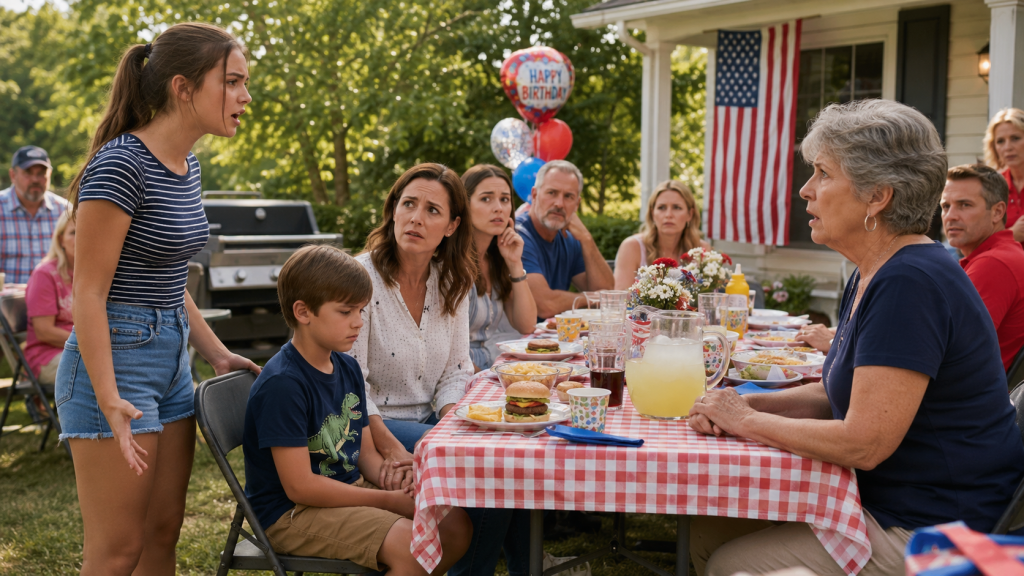
At my dad’s seventy-first birthday picnic, my mother looked straight at my eight-year-old son and said, “Next time, leave him at home.”
She didn’t lower her voice.
She didn’t wait until he was out of earshot.
Everyone at the table heard her.
And no one said a word.
Then my seventeen-year-old daughter suddenly pushed back her chair, stood up, stared directly at her grandmother, and said,
“Say that again.”
The entire picnic went silent.
Up until that moment, everything had been completely ordinary.
Burgers were cooking on the grill.
Pitchers of lemonade sat on folding tables covered with paper plates and napkins.
Children were running through the yard while the adults talked and laughed.
Then Mom turned toward Noah.
“Next time, don’t bring the kid.”
My brothers heard it.
My aunts heard it.
My cousins heard it.
My father heard it.
And worst of all, Noah heard every single word.
My son froze with his plastic fork halfway to his mouth.
He was wearing his favorite navy dinosaur shirt, the one with a Triceratops on the front.
He had chosen to sit on the bench instead of the grass because he had noticed ants crawling nearby.
From the moment we arrived, Noah had been doing everything he could not to bother anyone.
Earlier, my brother’s dog had run into him and knocked over his lemonade.
Noah apologized immediately.
Twice.
Even though the accident hadn’t been his fault.
Then he grabbed paper towels and cleaned the entire spill while everyone else laughed and continued eating.
That was how hard he was trying to belong.
I stared at my mother.
“What did you just say?”
She calmly wiped her mouth with a napkin.
“I said what everyone else is thinking, Marissa. He changes the atmosphere whenever he comes.”
The words hurt, but they didn’t completely surprise me.
This wasn’t the first time Mom had made comments about Noah.
For years, they had come disguised as smaller things.
Little jokes.
Little complaints.
Little remarks everyone pretended not to notice because she was Grandma.
People excused her because she hosted holidays.
Because she remembered birthdays.
Because she could be charming and warm whenever she wanted to be.
But adults sometimes forget something important.
Children remember every cruel comment the adults dismiss.
Noah’s face went pale.
His shoulders folded inward.
Then he slowly placed his fork on his plate so carefully that it barely made a sound.
As though even making too much noise might give someone another reason not to want him there.
I looked around the table.
My sister suddenly became fascinated by her phone.
My brother turned toward the grill.
My father cleared his throat and looked away.
Nobody defended Noah.
Not one person told my mother she was wrong.
I opened my mouth to speak.
Before I could, the chair beside me scraped loudly against the pavement.
Lily stood up.
My seventeen-year-old daughter hated confrontation.
She hated attention.
She usually rehearsed difficult conversations in her head long before saying anything.
So seeing her stand there with both hands planted firmly on the table shocked everyone.
She stared straight at her grandmother.
“Say it again.”
Mom blinked.
“Excuse me?”
Lily didn’t move.
“Say it again. Look Noah in the face and tell him he shouldn’t come to family gatherings because having him here makes you uncomfortable.”
One of my aunts spoke quietly.
“Lily…”
“No.”
Her voice shook slightly.
But her eyes never left Grandma.
“Everyone keeps acting like Grandma doesn’t mean these things. Noah knows she means them. He always knows.”
Beside me, Noah stared down at the dinosaur on his shirt.
I reached under the table and took his hand.
His fingers immediately tightened around mine.
My mother leaned back in her chair.
“You’re seventeen. Stay out of conversations between adults.”
Lily’s expression stayed firm.
“This stopped being an adult conversation the second you decided to humiliate an eight-year-old in front of the entire family.”
No one moved.
The only sound came from the grill crackling behind us.
Somewhere near the driveway, someone slammed the lid of a cooler.
Then Lily reached toward the backpack hanging from the back of her chair.
For the first time, something changed in my mother’s face.
It wasn’t quite fear.
It looked more like recognition.
That was when I realized Lily hadn’t simply snapped.
She had been expecting this.
She pulled out her phone.
Unlocked it.
Then placed it in the center of the table.
An audio recording appeared on the screen.
The date showed it had been made three nights earlier.
My mother stared at it.
Lily rested her finger just above the play button.
“You told me I was old enough to understand why Noah shouldn’t be invited anymore.”
Mom’s napkin slipped from her fingers.
Everyone looked at Lily.
Then at my mother.
Because whatever had happened three nights earlier had clearly taken place without any of us knowing.
And Lily had recorded it.
She had proof of what Grandma really said when she believed no one else would ever hear.
Within seconds, everyone sitting at that table was about to discover that her feelings toward Noah went much deeper—and had lasted much longer—than any of us had realized.
PART 2: THE RECORDING
Lily rested her finger above the play button.
For several seconds, nobody moved.
My mother stared at the phone as though it were something dangerous.
Maybe it was.
Not because a phone could hurt her.
Because for the first time in years, her own words were about to exist in a form she could not soften, deny, or explain away.
My father lowered the spatula he had been holding.
“Lily,” he said carefully, “what is on that recording?”
My daughter looked at him.
“The truth.”
My mother laughed.
Too quickly.
Too loudly.
“Oh, for heaven’s sake.”
She reached toward the phone.
Lily pulled it back.
“Don’t.”
Mom froze.
I had never heard Lily speak to her that way.
Neither had anyone else.
My aunt Susan shifted uncomfortably.
“Maybe everybody should calm down.”
Lily turned toward her.
“No.”
Her voice shook.
But she did not sit.
“No one needs to calm down before hearing what she said.”
My mother folded her arms.
“This is ridiculous.”
Lily looked at her.
“If it’s ridiculous, then you shouldn’t be worried about us hearing it.”
That silenced Mom.
Beside me, Noah’s hand tightened around mine.
I looked down.
His eyes were still fixed on the dinosaur printed across his shirt.
He was tracing the outline of one of the horns with his thumb.
A nervous habit.
He did it whenever too many people were watching him.
I leaned closer.
“You want to go inside?”
He shook his head.
“No.”
His voice was so quiet I almost missed it.
“Are you sure?”
Another tiny nod.
Then he whispered:
“I want to know.”
My heart cracked.
Of course he did.
Children always want to understand why someone does not love them.
Adults spend years pretending they do not.
Lily looked at me.
“Mom?”
I knew what she was asking.
Permission.
Not because she needed it.
Because she was still seventeen.
Because despite everything, part of her was terrified she might be destroying the family by exposing what had already been destroying her brother.
I nodded.
“Play it.”
My mother’s face hardened.
“Marissa.”
I looked at her.
“What?”
“You are seriously going to allow your daughter to secretly record her grandmother?”
That almost made me laugh.
Not because it was funny.
Because she had found the smaller offense immediately.
Not what she said.
Not why Lily felt the need to record it.
The recording itself.
Classic Mom.
“I’m going to listen to what you told my daughter about my son.”
She shook her head.
“You have always encouraged disrespect.”
There it was.
I felt something inside me go cold.
“You humiliated an eight-year-old five minutes ago.”
“I told the truth.”
“No.”
My voice sharpened.
“You expressed cruelty.”
She rolled her eyes.
“Everything is cruelty with you now.”
Lily pressed play.
My mother stopped talking.
Static came first.
Then the sound of a television playing softly somewhere in the background.
And then Mom’s voice.
Clear.
Calm.
Unmistakable.
“Lily, you’re old enough now that I can talk to you like an adult.”
The entire picnic went still.
My daughter’s recorded voice answered.
“About what?”
Then Mom.
“About Noah.”
The boy beside me stiffened.
I wrapped my arm around his shoulders.
On the recording, Lily asked:
“What about him?”
There was a pause.
Then my mother said:
“I think your mother needs to stop bringing him to every family event.”
My stomach dropped.
Even though I had known something ugly was coming, hearing it in her voice was different.
There was no irritation.
No momentary anger.
She sounded thoughtful.
Deliberate.
Like she had spent time deciding this.
Recorded Lily said:
“Why?”
Mom sighed.
“Because everything changes when he comes.”
My brother looked down.
My sister stopped pretending to check her phone.
Everyone listened.
“He doesn’t play like the other children. He won’t eat half the food. He gets upset when things are too loud. Everyone has to watch what they say because Marissa is always hovering over him.”
My jaw clenched.
Noah had never asked anyone to change an entire gathering for him.
Sometimes he went inside when the fireworks started.
Sometimes he sat somewhere quiet when the adults became loud.
Sometimes he refused foods he did not like.
That was apparently enough to make him a problem.
On the recording, Lily said:
“He’s eight.”
Mom answered:
“So?”
Lily’s voice became firmer.
“So maybe stop expecting an eight-year-old to make grown adults comfortable.”
I looked at my daughter.
She stared at the phone.
Her face was pale.
My mother’s voice continued.
“You don’t understand because you love him.”
“I do love him.”
“I know.”
Then Mom laughed softly.
That laugh turned my stomach.
“But you’re not his mother. You can admit things she can’t.”
Lily asked:
“Like what?”
My mother lowered her voice.
And even though she had been speaking privately three nights earlier, it felt as if she leaned across that picnic table and said the words directly into Noah’s face.
“That something is off about him.”
My son flinched.
My blood went hot.
My father whispered:
“Linda.”
Mom snapped:
“Don’t.”
I turned toward her.
“Don’t what?”
She stared at Dad.
“Don’t pretend you’ve never said he was difficult.”
Dad’s face changed.
That landed too.
I looked at him.
“Dad?”
He said nothing.
My chest tightened.
The recording continued.
Lily’s voice:
“What do you mean ‘off’?”
Mom replied:
“You know what I mean.”
“No. I don’t.”
“He’s odd.”
The word was casual.
Almost bored.
“He sits by himself. He watches people. He apologizes constantly. He acts like everything frightens him.”
My eyes filled.
Noah buried his face against my side.
I pulled him close.
He apologized constantly because adults like my mother had taught him that simply existing differently might inconvenience someone.
And she had used the evidence of that fear as another reason to reject him.
Lily’s recorded voice shook now.
“Maybe he acts nervous around you because you treat him like you don’t want him here.”
Silence on the recording.
Then Mom:
“That’s dramatic.”
Lily responded:
“No, Grandma. It isn’t.”
My mother shifted in her chair.
“I don’t need to listen to this.”
She stood.
My father spoke sharply.
“Sit down.”
Everybody looked at him.
Mom stared.
“What did you say?”
Dad’s voice was quiet.
But it had changed.
“Sit.”
For once, she did.
Lily kept the recording playing.
My recorded mother said:
“You’re seventeen, Lily. You’ll understand eventually that families have different kinds of people.”
“What does that mean?”
“Some people make gatherings easier.”
“And some people don’t?”
“Exactly.”
I felt sick.
The next sentence was worse.
“You’ve always been easy.”
Lily closed her eyes.
I knew that phrase.
God, did I know it.
Easy child.
Good child.
Mature child.
Words adults often use when they mean:
You have learned not to ask us for too much.
On the recording, Lily said:
“So because Noah isn’t easy, he shouldn’t come?”
Mom sighed.
“I didn’t say never.”
“Yes, you did.”
“I said not every time.”
“Which times should he miss?”
“Christmas would be calmer.”
Someone at the picnic table gasped.
My aunt Susan covered her mouth.
Mom’s voice kept going.
“Your grandfather’s birthday too. He deserves to enjoy himself without everything revolving around Noah.”
My father looked as if someone had struck him.
“What?”
Mom turned toward him.
“Robert—”
“You said my birthday would be better without him?”
She looked irritated.
“That isn’t what I meant.”
The recording made the lie ridiculous.
Dad stared at her.
Then he looked toward Noah.
My son would not lift his head.
Dad’s expression collapsed.
The audio continued.
Lily asked:
“Does Grandpa know you think this?”
Mom answered:
“He agrees that Noah can be exhausting.”
My father shot to his feet.
“I never said that.”
My mother snapped:
“You said he was a handful.”
“Once!”
Dad’s face flushed.
“When he was four and dumped cereal all over my carpet!”
Noah looked up.
Grandpa seemed almost desperate now.
“I never said I didn’t want you here, buddy.”
Noah stared at him.
But he did not answer.
The pain on Dad’s face was immediate.
Adults forget.
Children keep receipts.
The recording continued.
Lily said:
“So you’ve been talking about Noah with other people?”
My mother paused.
“Yes.”
Something went cold in my stomach.
Lily asked:
“Who?”
“A few people.”
“Who?”
“Your Aunt Susan understands.”
Every face turned.
Aunt Susan went white.
“I do not.”
Mom looked furious.
“You agreed he changes the atmosphere.”
Susan shook her head.
“I said Marissa looked tired.”
“That’s what I meant.”
“No.”
Susan’s voice trembled.
“That is not the same thing.”
Interesting.
How quickly everyone discovered nuance once a recording existed.
My mother’s recorded voice continued:
“Your uncle Mark has noticed too.”
My brother Mark stared down at his plate.
My heart sank.
“Mark?”
He rubbed one hand over his face.
“I said he gets quiet at parties.”
I waited.
“And?”
“That’s all.”
“Did Mom say he shouldn’t come?”
Mark did not answer immediately.
That was enough.
“Mark.”
“Yes.”
The word came out ashamed.
“She said something after Christmas.”
I stared at him.
“And you said nothing?”
His eyes filled.
“I told her she was being harsh.”
“Did you tell me?”
“No.”
“Why?”
He looked away.
“I didn’t want to start something.”
There it was.
The sentence that had protected my mother for years.
Nobody wanted to start something.
Meanwhile, Noah had been quietly absorbing everything.
I looked around the table.
“All of you were so afraid of starting something that you let an eight-year-old stand inside it alone.”
Nobody spoke.
The truth hurt because it belonged to more than one person.
The recording continued.
Lily sounded angry now.
“You know Noah thinks you don’t like him.”
My mother replied:
“That is not my responsibility.”
Noah made the smallest sound beside me.
Almost a breath.
My eyes flooded.
Lily’s recorded voice sharpened.
“He cried after Christmas because you gave every grandchild a stocking except him.”
My mother said:
“That was an oversight.”
“No, it wasn’t.”
“How dare you call me a liar.”
“I watched you take his stocking out of the row.”
The picnic table exploded.
“What?”
My sister Rachel turned toward Mom.
“You took it down?”
Mom’s face went rigid.
“It had the wrong name.”
Lily stared at her.
“No, it didn’t.”
My mother said nothing.
I looked at Noah.
I remembered Christmas.
Seven stockings along the fireplace.
Then six.
Noah had stood beside me whispering:
“Maybe Grandma forgot mine.”
Mom later told me she had accidentally left his gifts upstairs.
She gave him a gift card in an envelope.
He thanked her.
Of course he did.
My son thanked her for the replacement gift she gave him after deliberately removing his stocking.
I felt nauseated.
“Why?”
My voice barely worked.
Mom looked at me.
“Marissa.”
“Why did you take down his stocking?”
She sighed.
“It wasn’t that serious.”
I stood.
That phrase.
The anthem of cruel people everywhere.
Not serious.
Only a joke.
He’ll get over it.
Why are you making this a big deal?
“Why?”
She stared at me.
Then finally said:
“Because I was making a point.”
My body went cold.
“What point?”
“That every tradition does not need to change because you decided to have another child.”
Nobody moved.
I stared at her.
For one second, I genuinely did not understand.
“Another child?”
My mother looked away.
And suddenly I knew this went somewhere older.
Somewhere deeper than Noah being quiet at gatherings.
I looked at Lily.
Her face told me she knew too.
“Keep playing it.”
My mother stood again.
“No.”
This time Dad did not tell her to sit.
He simply looked at her.
“Linda.”
His voice broke.
“Let them hear it.”
Mom turned toward him.
“You don’t understand.”
“Then let me.”
She sat.
Lily pressed play again.
Her recorded voice asked:
“Why do you treat Noah differently from me?”
My mother answered immediately.
“I don’t.”
“Yes, you do.”
“Nonsense.”
“You come to my school concerts.”
“He doesn’t have concerts.”
“You went to every one of my birthday parties.”
“I go to his.”
“You leave early.”
Silence.
“You have pictures of me all over your house.”
Another silence.
“There are two pictures of Noah.”
My chest tightened.
I had noticed that.
I had pretended not to.
Lily continued:
“You call me every week.”
Mom said:
“You’re older.”
“You barely talk to him when we visit.”
“He barely talks to me.”
“Because you make him nervous.”
My mother sighed.
Then said the sentence that finally exposed the real wound.
“Lily, you were supposed to be enough.”
My entire body froze.
Nobody at the picnic table breathed.
Recorded Lily whispered:
“What?”
Mom continued:
“When your mother had you, everything was settled.”
I stared at the phone.
“You were the first grandchild. Everyone adored you. Marissa had a good marriage, a good job, one beautiful little girl. It was balanced.”
My stomach turned.
Balanced?
Then Mom said:
“And then she had Noah.”
I almost laughed.
The hatred was suddenly so absurd.
As if my son’s birth had been an act committed against her.
Lily asked:
“So?”
“He changed things.”
“What things?”
“Your mother changed.”
My throat tightened.
“She stopped coming to everything. She started leaving holidays early. She became defensive.”
Lily answered:
“Because Noah was a baby.”
“That isn’t the point.”
“It sounds like exactly the point.”
My daughter.
Even on the recording, she had not let Mom rewrite reality.
Mom’s voice became irritated.
“Your mother used to be easier.”
There was that word again.
Easy.
Before Noah, I had attended every holiday.
Hosted every birthday.
Answered every phone call.
Allowed Mom to criticize my parenting.
Allowed her to rearrange my house.
Allowed her to decide what Lily wore for family photographs.
Then Noah was born.
And something changed.
Not because he was bad.
Because he needed me in ways that forced me to say no.
No, we can’t stay until midnight.
No, we’re skipping fireworks.
No, he doesn’t want a hug.
No, he isn’t eating that.
No, stop teasing him.
No.
No.
No.
Apparently my mother had never forgiven him for teaching me the word.
The recording continued.
Lily said:
“So you don’t like Noah because Mom has boundaries now?”
“I did not say I don’t like him.”
“You said he ruins gatherings.”
“I said he changes them.”
“You said Christmas would be better without him.”
Mom became quiet.
Then she said:
“I miss the way our family was before he came.”
The words landed like stones.
Noah pulled away from me.
I looked down.
His eyes were wet.
“Before me?”
My heart shattered.
“Noah—”
He stood.
Not running.
Not crying loudly.
Just standing.
That made it worse.
He looked at my mother.
For the first time since this began, he met her eyes.
“Did you like us better before I was born?”
My mother opened her mouth.
Nothing came out.
“Noah,” Dad whispered.
But Noah kept looking at Grandma.
Children often ask questions adults spend years avoiding.
“Did you?”
Mom’s face changed.
Maybe shame.
Maybe fear.
Maybe annoyance that she had been cornered.
I do not know.
She said:
“That isn’t what I meant.”
Noah nodded.
Slowly.
As if he had expected that answer.
Then he asked:
“Then what did you mean?”
Mom could not answer.
Because there was no softer interpretation left.
No misunderstanding large enough to hide inside.
I stood beside my son.
Lily stood on his other side.
Without planning it, we became a wall.
My mother stared at us.
My father looked twenty years older.
Then Lily said:
“There’s more.”
Every head turned.
My mother whispered:
“Enough.”
Lily looked at her.
“No.”
Her voice was steadier now.
“You told me to understand.”
She looked around the table.
“So everybody should understand.”
She pressed play.
The recording resumed.
Mom’s voice:
“I need you to help me with something.”
Recorded Lily asked:
“What?”
“Your mother listens to you.”
“Sometimes.”
“I want you to encourage her to leave Noah home more often.”
My fingers went numb.
Lily responded:
“No.”
“Don’t be childish.”
“I’m not doing that.”
“You wouldn’t be hurting him.”
“Yes, I would.”
“He probably wouldn’t even care.”
“He cares about everything.”
My mother made an impatient sound.
“That’s the problem.”
Noah’s face crumpled.
I pulled him into me.
The audio continued.
Lily said:
“You want me to help you exclude my brother.”
“I want you to help your mother stop making everyone uncomfortable.”
“No.”
“You are almost eighteen.”
“So?”
“So soon you will have relationships with family that don’t have to include your mother and Noah every time.”
A strange chill went through me.
Lily’s recorded voice softened.
“Are you trying to make me choose?”
Mom replied:
“I’m telling you that when you’re an adult, you can come here without him.”
Noah whispered:
“Wow.”
That one word nearly destroyed me.
Not because he sounded angry.
Because he sounded unsurprised.
He had known.
Maybe not the details.
But children always know when a room welcomes them differently.
Lily’s recorded voice became sharp.
“I’m not coming without him.”
“You say that now.”
“I mean it.”
“You’ll grow up.”
“And stop loving my brother?”
“No.”
Mom laughed lightly.
“You’ll understand that sometimes family relationships work better separately.”
Lily replied:
“That doesn’t sound like family.”
Nobody at the table moved.
Then the recording went quiet for several seconds.
I thought it might be over.
It wasn’t.
My mother’s voice returned.
Lower.
More careful.
“Your grandfather will not be around forever.”
My father froze.
I looked at him.
His face changed immediately.
Recorded Lily asked:
“What does that have to do with Noah?”
Mom answered:
“When he’s gone, things will be simpler.”
Dad’s chair scraped backward.
“What the hell does that mean?”
My mother’s face drained of color.
Lily looked at him.
“There’s more, Grandpa.”
His eyes filled with something I had never seen before.
Fear.
“Play it.”
Mom grabbed his arm.
“Robert, stop.”
He pulled away.
“Play it.”
Lily did.
My mother’s recorded voice continued.
“I have spent years trying to keep peace because your grandfather wants everyone together.”
Lily asked:
“And after Grandpa dies?”
There was a pause.
Then Mom said:
“I won’t have to pretend anymore.”
Nobody breathed.
My father stared at his wife of forty-six years.
Pretend.
The word seemed to physically strike him.
“Pretend what?” recorded Lily asked.
“That Noah is the same as the other grandchildren.”
My son began crying.
Silent tears.
I pulled him against me.
“You don’t have to listen.”
He shook his head.
“I want to.”
Oh, God.
My mother’s voice continued.
“I know your mother wants everything to be equal, but it isn’t.”
“How?”
“It just isn’t.”
“That’s not an answer.”
“You’re biological family in a way he isn’t.”
My heart stopped.
The whole picnic seemed to tilt.
There it was.
The secret underneath all of it.
Noah was my son.
Completely.
Legally.
Emotionally.
In every way that mattered.
But he was not biologically related to my parents.
My late husband, Daniel, and I had adopted Noah when he was eleven months old.
We never hid that from him.
It was never a shameful thing in our house.
It was simply part of his story.
He knew that another woman had given birth to him.
He knew Daniel and I had become his parents.
He knew Lily had become his sister.
He knew families could be built through biology, adoption, marriage, friendship, and choice.
But I had never imagined my mother had quietly kept a hierarchy in her head.
Blood at the top.
My son somewhere beneath.
Lily’s recorded voice turned furious.
“He is our family.”
Mom replied:
“Legally.”
My daughter said:
“That is disgusting.”
“Watch your tone.”
“No.”
“Lily.”
“He calls you Grandma.”
My mother went silent.
Lily continued:
“He makes you birthday cards.”
Silence.
“He saves the marshmallows from his cereal because he knows you like them.”
My eyes flooded.
I had forgotten about that.
Noah never did.
At every sleepover, he saved the little marshmallows in a napkin because Grandma once joked that she liked them.
My mother’s recorded voice finally said:
“I have been kind to him.”
Lily responded:
“You think kindness is pretending he belongs?”
My mother snapped:
“I did not say that.”
“Yes, you did.”
“No. I said there is a difference.”
“Only because you decided there is.”
That sentence landed across the picnic table.
Noah looked up at Lily.
His sister reached for his hand.
He grabbed it immediately.
The recording continued.
Then came the line that changed everything again.
Mom said:
“Your grandfather does not know this, and I do not want him involved.”
Dad went completely still.
Lily asked:
“Know what?”
My mother looked like she wanted to disappear.
I had never seen her afraid of her own words before.
Recorded Mom said:
“I changed some things.”
“What things?”
“Documents.”
My father whispered:
“No.”
I looked at him.
“Dad?”
He did not answer.
On the recording, Lily asked:
“What documents?”
Mom replied:
“Estate documents.”
My stomach dropped.
The family table exploded into whispers.
Dad stood so fast his chair nearly fell.
“You did what?”
Mom reached toward him.
“Robert, listen—”
He jerked away.
“What estate documents?”
She looked around.
Humiliation finally reached her.
Not because she had hurt Noah.
Because people were watching.
That distinction would matter to me later.
At the time, all I could think about was the recording.
Lily pressed pause.
Dad stared at her.
“Why did you stop?”
She looked at him.
“Because the rest is worse.”
My mother whispered:
“Lily, please.”
It was the first time she had said please all afternoon.
My daughter looked at her grandmother.
“No.”
Then Lily looked at me.
Her eyes were full of tears.
“Mom, I didn’t know what she meant at first.”
My heart pounded.
“What did she say?”
“She said she changed something because she didn’t want Noah benefiting from Grandpa’s money.”
I felt physically sick.
Dad gripped the table.
“What money?”
Lily shook her head.
“I don’t know.”
“Play it.”
His voice cracked.
“Please.”
Lily pressed the button again.
Recorded Lily asked:
“You changed Grandpa’s will?”
Mom answered:
“No.”
Dad exhaled.
Only for a second.
Then she continued.
“I changed the beneficiary designations on accounts I control.”
Dad’s face went gray.
One of my uncles whispered:
“Jesus.”
On the recording, Lily asked:
“To what?”
“To make sure things stay with the actual family.”
Noah’s hand became cold in mine.
I pulled him closer.
Lily said:
“You mean so Noah gets nothing.”
Mom answered:
“He isn’t entitled to anything.”
My daughter replied:
“Neither am I.”
“That’s different.”
“No, it isn’t.”
“You’re my granddaughter.”
“So is he your grandson.”
Silence.
Then my mother said:
“Not really.”
The recording stopped.
Not because Lily pressed anything.
Because that was where it ended.
The phone screen went still.
So did the entire yard.
No birds.
No cousins whispering.
No silverware.
Nothing.
Only Noah breathing beside me.
My mother stared at the table.
My father stared at her.
Forty-six years of marriage seemed to sit between them like broken glass.
Then Noah asked a question.
A quiet one.
The kind no child should ever have to ask.
“Grandma?”
She looked up.
He wiped his face with his sleeve.
“Am I fake family?”
My mother’s expression broke.
Finally.
“Noah—”
“Am I?”
She started crying.
I did not care.
Not yet.
My son deserved an answer before she deserved comfort.
“No,” I said.
My voice shook.
I knelt beside him.
“No.”
I held his face gently.
“You are not fake anything.”
He looked at me through tears.
“You are my son.”
I kissed his forehead.
“You are Lily’s brother.”
Lily crouched beside us immediately.
“My favorite brother.”
Noah sniffed.
“I’m your only brother.”
“Still winning.”
A tiny laugh escaped him.
Barely.
But it was there.
I held both my children.
Then Dad came around the table.
He stopped several feet away.
Not touching Noah.
Waiting.
For once, an adult in my family understood that access should not be assumed.
“Noah.”
My son looked at him.
Dad’s eyes were wet.
“You are my grandson.”
Mom closed her eyes.
Dad continued.
“You hear me?”
Noah nodded cautiously.
“Nothing she said changes that.”
He swallowed.
“And if I ever made you think differently by staying quiet…”
His voice broke.
“I am sorry.”
Noah stared at him.
Then asked:
“Did you know?”
Dad shook his head immediately.
“Not this.”
“Did you know she didn’t like me?”
My father’s face collapsed.
“I knew she was impatient with you sometimes.”
“That’s not what I asked.”
Eight years old.
And somehow braver than every adult at that table.
Dad looked down.
“I knew she treated you differently.”
My stomach twisted.
There it was.
Again.
Different degrees of knowing.
Different degrees of silence.
Dad whispered:
“I should have stopped it.”
Noah did not answer.
He turned back toward me.
That was fair.
Grandparents were not entitled to immediate forgiveness either.
My mother finally spoke.
“I never wanted to hurt him.”
Lily stood.
“Yes, you did.”
Mom stared at her.
“That is not true.”
“You wanted him to know he wasn’t welcome.”
“I wanted your mother to understand—”
“No.”
Lily’s voice rose.
“You keep saying Mom.”
She pointed toward Noah.
“You said it to him today.”
My mother cried harder.
“I was frustrated.”
“For years?”
No answer.
“Was Christmas frustration?”
Silence.
“Was the stocking frustration?”
Nothing.
“Were the documents frustration?”
Mom’s face hardened.
“I am not discussing finances with a child.”
Dad turned toward her.
“You’re discussing them with me.”
His voice was terrifyingly calm now.
“What did you change?”
Mom looked at him.
“Robert.”
“What accounts?”
She lowered her eyes.
“I need to speak to Harold.”
Harold.
Their estate attorney.
The fact that she said his name told me this was not an empty threat or dramatic comment.
Dad realized the same thing.
His face changed.
“You actually did it.”
Mom whispered:
“I was protecting what we built.”
Dad stared at her as if he no longer recognized the woman across from him.
“We built?”
“Yes.”
“That is my grandson.”
“He is Marissa’s son.”
“He is our grandson.”
“Robert—”
“No.”
His voice cracked across the yard.
For the first time all afternoon, my mother flinched.
Dad pointed toward the house.
“Get Harold on the phone.”
“This is your birthday.”
“I do not care.”
“Everyone is here.”
“I do not care.”
His eyes filled.
“You said you were pretending while I was alive.”
Mom’s mouth trembled.
“That’s not what I meant.”
He gave a broken laugh.
“We all heard what you meant.”
Then he looked around the table.
At his children.
Grandchildren.
Relatives.
At the food going cold.
The birthday cake still untouched.
The candles waiting in a cardboard box.
“I spent my whole life thinking keeping everyone at the same table meant I had a close family.”
His voice became quieter.
“Apparently all I did was teach people to stay seated while somebody got hurt.”
No one looked up.
Because every adult there knew he was right.
My father took out his phone.
Then he stopped.
He looked at me.
“Marissa.”
“Yes?”
“Take the kids home.”
Mom immediately protested.
“Robert!”
Dad did not look at her.
I asked:
“Are you sure?”
“Yes.”
He looked at Noah.
“I think he has heard enough from this family today.”
That sentence almost broke me.
I nodded.
Lily picked up her backpack.
Noah stared at his untouched plate.
Then quietly reached for the paper napkin beside it.
He began wrapping half of his burger.
I frowned.
“What are you doing, sweetheart?”
He shrugged.
“For later.”
Even after being told he was unwanted, my son was worried about wasting food.
I had to turn away for a second.
Lily took the burger gently from him.
“Leave it.”
“But—”
“I’ll buy you whatever you want on the way home.”
His eyes widened slightly.
“Anything?”
“Anything.”
“Can I get pancakes?”
“It’s four in the afternoon.”
“So?”
Lily looked at me.
I smiled through tears.
“Pancakes.”
Noah nodded.
“Okay.”
We began walking toward the driveway.
Nobody tried to stop us.
Then my mother called:
“Marissa.”
I stopped.
But I did not turn immediately.
When I finally did, she was standing beside the table.
Her face was wet.
Her shoulders looked smaller.
For years, that sight would have pulled me back.
Mom crying meant Marissa fixed it.
Marissa softened.
Marissa explained.
Not today.
“What?”
She swallowed.
“You’re not really going to keep them away from me.”
The sentence told me she still did not understand.
Not:
Is Noah okay?
Not:
Can I apologize?
Not:
What have I done?
Her first fear was losing access.
I looked at her.
“You told my daughter to help you exclude my son from this family.”
“I was upset.”
“You deliberately removed his Christmas stocking.”
“I said I was making a point.”
“You told him to his face not to come next time.”
She started crying harder.
“And you said he was not really your grandson.”
She shook her head.
“I didn’t mean it like that.”
I almost laughed.
“How many different ways do you think those words can mean?”
She had no answer.
I took Noah’s hand.
Then Lily’s.
“For now, yes.”
Mom went pale.
“Yes what?”
“You will not see them.”
My aunt gasped quietly.
Mom stared at me.
“You cannot do that.”
And there it was.
Not sorrow.
Authority.
The old assumption that being Grandma gave her permanent rights.
I stepped closer.
“My children are not possessions you get access to because of biology.”
The irony hung there.
“You made that very clear today.”
Her face collapsed.
I turned away.
We made it halfway to the car before Dad called after me.
“Marissa.”
I looked back.
He stood beside the picnic table holding his phone.
His face had changed again.
Something was wrong.
Really wrong.
“What?”
He looked at Mom.
Then at me.
“I just got into the account.”
My mother froze.
Dad looked almost sick.
“What account?”
I asked.
He swallowed.
“The family investment account.”
Mom whispered:
“Robert, don’t.”
Dad ignored her.
“There were beneficiary changes made six months ago.”
My chest tightened.
“To what?”
He stared at the screen.
Then his expression became something between heartbreak and disbelief.
“Not just Noah.”
I frowned.
“What do you mean?”
He looked at Lily.
Then me.
“She changed more than Noah.”
The entire picnic went silent again.
Dad raised his eyes toward my mother.
“You removed Marissa too.”
My blood went cold.
Mom’s lips parted.
No denial came.
I stared at her.
“What?”
Dad scrolled.
His hands began shaking.
“And Lily.”
My daughter froze beside me.
Mom finally stood.
“Robert, I can explain.”
He stared at her.
“You removed our daughter and both of her children.”
Then he looked at me.
Tears filled his eyes.
“And everything was redirected to your brothers.”
My brothers went pale.
Mark whispered:
“I didn’t know.”
I believed him.
Mom’s face had gone completely white.
Suddenly, her cruelty toward Noah was no longer an isolated prejudice.
It was part of something larger.
Something planned.
Something she had quietly put on paper.
My father lowered his phone.
“Why?”
My mother looked at me.
Then at Noah.
Then at Lily.
And for the first time that day, she stopped pretending this had only been about a difficult child at a picnic.
Her voice came out barely above a whisper.
“Because Marissa made a choice years ago.”
My stomach tightened.
“What choice?”
Mom looked directly at me.
“The choice to make Noah part of this family.”
Everything inside me went still.
She had resented the adoption.
For seven years.
Maybe from the beginning.
I stared at the woman who held my son at his first birthday.
Who smiled in photographs.
Who bought him toys.
Who let him call her Grandma.
And I finally understood.
She had not been struggling to accept him.
She had been waiting for the day she no longer had to pretend she ever had.
Dad stared at her.
Then quietly said:
“Call Harold.”
Mom shook her head.
“No.”
Dad’s voice hardened.
“Call him.”
“What are you going to do?”
My father looked toward Noah.
Then toward me.
And something in his face changed.
Not anger.
Decision.
“I’m going to find out exactly what you changed.”
He took a breath.
“And then I’m going to change it back.”
Mom laughed bitterly.
“You cannot undo everything.”
Dad stared at her.
“No.”
His voice broke.
“But I can stop helping you do more damage.”
I looked at my children.
Noah squeezed my hand.
Lily stood tall beside him.
The picnic was over.
But something much larger had just begun.
Because my mother had spent years convincing herself that blood determined who belonged in our family.
Now, for the first time, the rest of us were about to decide whether she still belonged in ours.
PART 3: WHO REALLY BELONGED
“I’m going to find out exactly what you changed.”
Dad’s voice shook as he looked at my mother.
“And then I’m going to change it back.”
Mom stared at him.
For forty-six years, she had been able to predict almost every reaction he had.
She knew when he would surrender to keep the peace.
She knew when he would lower his voice because guests were present.
She knew when he would say, “We’ll talk about this later,” and then allow later to turn into never.
But this time, she looked at him and realized something terrifying.
Later had arrived.
The picnic was over.
Nobody touched the cake.
Nobody sang happy birthday.
The burgers went cold on paper plates while families quietly gathered purses, children, folding chairs, and excuses.
People left differently from how they had arrived.
Some avoided my eyes.
Some hugged Lily.
Aunt Susan crouched beside Noah before leaving.
She did not touch him.
She asked first.
“Can I give you a hug?”
Noah looked at me.
I nodded only because he seemed to want one.
He stepped into her arms.
Susan started crying.
“I’m sorry.”
Noah stood stiffly.
“For what?”
Susan pulled back.
“For hearing things before today and convincing myself they weren’t serious.”
He looked at her.
That little eight-year-old face held more wisdom than any child should have needed.
Then he said:
“You should tell people when they’re mean.”
Susan covered her mouth.
“Yes.”
Her voice broke.
“I should.”
Noah nodded.
Then he picked up his backpack.
That was all.
No dramatic forgiveness.
No magical repair.
Just a child telling an adult a truth she should have known already.
We left.
Lily drove because my hands would not stop shaking.
I sat in the passenger seat.
Noah was in the back.
For the first ten minutes, nobody spoke.
Then Lily glanced at him in the rearview mirror.
“Pancakes?”
Noah nodded.
“Chocolate-chip?”
Another nod.
“Whipped cream?”
He hesitated.
“Can I get strawberries too?”
Lily smiled.
“You survived a family scandal. You can have strawberries.”
A tiny laugh came from the back seat.
I turned toward the window because my eyes suddenly filled.
Children should not have to recover from adults.
But sometimes they do.
We stopped at a twenty-four-hour diner even though it was not twenty-four hours yet.
The waitress called Noah “sweetheart.”
He ordered pancakes.
Lily ordered fries.
I ordered coffee I never drank.
For a while, we pretended we were simply a mother and two children eating an early dinner.
Then Noah asked:
“Did Grandma ever like me?”
My chest tightened.
Lily immediately looked down.
I took a breath.
“I think she cared about you in the way she knew how.”
He frowned.
“That sounds like a no.”
I almost smiled sadly.
He was too smart for soft answers.
“I think she made you feel less loved than you deserved.”
He stared at his pancakes.
“Because I’m adopted.”
My heart cracked.
“No.”
He looked at me.
“Because she made a choice.”
“What choice?”
“To believe biology mattered more than love.”
He was quiet.
Then:
“Is she right?”
My throat closed.
“About what?”
“Am I different from Lily?”
Lily answered before I could.
“Yes.”
Noah looked at her.
She leaned across the table.
“You steal my chargers.”
His mouth twitched.
“You leave socks everywhere.”
“That’s Mom.”
“Fair.”
She smiled.
“You hate onions. I love them. You like dinosaurs. I like true-crime podcasts Mom says are rotting my brain.”
“They are.”
Lily ignored me.
“You’re eight. I’m seventeen.”
She reached for his hand.
“So yes, we’re different.”
Noah looked at their fingers.
Then Lily said:
“But you are my brother in the only way that matters.”
His eyes filled.
“If anybody asks me how many brothers I have, the answer is one.”
She squeezed his hand.
“You.”
Noah began crying.
Quietly.
Lily moved to his side of the booth.
He crawled into her arms.
I turned away for a moment because seeing my daughter do naturally what my mother had refused to do intentionally almost broke me.
Lily did not need a will.
A trust.
Blood.
DNA.
She simply loved him.
That was family.
The next morning, Dad called.
I stared at his name on the screen.
For one second, I almost ignored it.
Then I answered.
“Hi.”
His voice sounded terrible.
“Harold came over.”
I sat down.
“And?”
“Your mother changed three accounts.”
My stomach tightened.
“How much are we talking about?”
He gave me the number.
I closed my eyes.
It was substantial.
Enough to matter.
Enough that Linda had clearly not been acting impulsively.
These were not emotional changes made after an argument.
They were calculated.
Planned.
Made months earlier.
Dad continued:
“She removed you, Lily, and Noah as contingent beneficiaries.”
I swallowed.
“And added Mark and Rachel?”
“Yes.”
“Did they know?”
“No.”
I believed that.
“What did Harold say?”
“He said the accounts were in both our names, but she had authority to update certain designations electronically.”
“And you didn’t notice?”
Silence.
Then Dad said the hardest thing.
“No.”
I looked toward the living room.
Noah’s backpack was still on the floor.
His dinosaur shirt was soaking in the laundry sink because I had not been able to bring myself to put it through the washer yet.
I kept seeing him at the picnic table.
Fork halfway to his mouth.
Trying to disappear.
Dad whispered:
“I should have.”
“That’s not the part I’m angry about.”
“I know.”
“Do you?”
He was quiet.
I continued.
“You knew she treated Noah differently.”
His breathing changed.
“You knew.”
“Yes.”
“And you decided silence was easier.”
“Yes.”
My eyes filled.
“Dad, yesterday wasn’t the first time she hurt him.”
“I know.”
“No. You know now.”
He said nothing.
I pressed my fingers against my forehead.
“He has spent years trying to earn comfort in a family that should have given it freely.”
Dad’s voice broke.
“I’m sorry.”
I believed him.
That made it hurt more.
Sometimes an apology does not make you feel better.
It only confirms the wound was real.
“What are you doing about the accounts?”
“Everything goes back.”
“Everything?”
“Yes.”
Then he paused.
“Actually, not exactly.”
I frowned.
“What does that mean?”
“I’m changing my estate plan.”
“Dad.”
“Listen.”
I sighed.
He continued.
“I don’t want any grandchild measuring their place in this family by money.”
That surprised me.
“So I’m simplifying it.”
“How?”
“Equal shares to my children.”
I waited.
“And a separate education and support trust for every grandchild.”
My chest tightened.
“Every grandchild?”
His voice softened.
“Every one.”
That one sentence mattered more than the amount.
“Lily.”
“Yes.”
“The cousins.”
“Yes.”
“And Noah.”
Dad started crying.
“Yes.”
I closed my eyes.
“He was always supposed to be there.”
“I know.”
“No.”
Dad’s voice cracked.
“I need him to know that.”
I swallowed.
“Paperwork won’t do that.”
“I know.”
“You have to.”
“I know.”
He had never sounded older.
Then he said:
“I’m not asking you to bring him around until he wants to.”
That stopped me.
“Okay.”
“I’m not asking you to forgive me because I’m seventy-one.”
Another pause.
“And I’m not asking you to make this easier for your mother.”
I looked down.
“Where is Mom?”
“Upstairs.”
“What does she think?”
He laughed bitterly.
“She thinks everybody has lost perspective.”
Of course she did.
“What are you going to do?”
Dad hesitated.
Then:
“I asked her to stay with Susan for a while.”
My heart dropped.
“You asked Mom to leave?”
“Yes.”
“From the house?”
“Yes.”
Forty-six years.
I did not know what to say.
“Dad…”
“She told me I was choosing Noah over my wife.”
My stomach turned.
“What did you say?”
Dad was quiet.
Then:
“I told her she had spent years asking everybody else to choose.”
That was probably the first time anyone had named it correctly.
Mom had made every holiday a loyalty test.
Agree with her.
Excuse her.
Stay quiet.
Laugh.
Do not challenge.
And somehow she always called everyone else divisive.
Dad sighed.
“I need some time.”
“So do we.”
“I understand.”
“Do you?”
“I’m trying to.”
That was enough for that day.
Three days later, I received a handwritten letter from Mom.
I recognized the envelope immediately.
Her cursive was perfect.
Always had been.
I left it unopened on the counter for two hours.
Then Lily came home from school.
She saw it.
“Grandma?”
“Yes.”
“You reading it?”
“I don’t know.”
She shrugged.
“You don’t have to.”
It was strange.
My seventeen-year-old kept teaching me things I should already have known.
I waited until Noah was asleep.
Then opened it.
The first sentence was:
I never hated Noah.
I almost stopped there.
Of course that was how she began.
Not with:
I hurt him.
With:
You misunderstood the shape of my feelings.
I kept reading.
She wrote that she had been raised in a family where blood mattered.
She wrote that adoption was “unfamiliar” to her generation.
She wrote that I had become overprotective.
She wrote that Lily’s recording had captured a private conversation during a moment of frustration.
She wrote that everyone had said things they regretted.
Halfway through, anger started burning behind my eyes.
Then I reached the final paragraph.
And something changed.
The handwriting looked shakier.
When Noah asked me whether he was fake family, I heard myself through his voice.
I stopped.
Read it again.
I realized I had spent years believing that because I was polite to him most of the time, I was not hurting him.
My throat tightened.
I was wrong.
Three words.
Simple.
Late.
But real.
Then:
I removed him from those accounts because I believed what Robert and I built should stay with biological descendants.
My hand tightened around the page.
At least she finally admitted it.
I also removed you and Lily because I believed you would eventually direct anything you received toward Noah.
I closed my eyes.
There it was.
She did not only exclude him.
She tried to financially punish anyone who might love him enough to include him anyway.
I kept reading.
Writing that sentence now makes me ashamed.
I did not forgive her.
But for the first time, the letter stopped feeling like a defense.
She ended with:
I do not expect you to bring the children to me. I do not expect Noah to forgive me. I am writing because if I never earn the chance to speak to him again, I need you to tell him one thing truthfully: he did nothing wrong.
I put the letter down.
Then I cried.
Not for Mom.
Not entirely.
I cried because Noah had spent years believing exactly the opposite.
The next morning, I showed Lily.
She read it silently.
Then said:
“That’s better.”
“Better?”
“Not good.”
She folded the pages.
“But better.”
I smiled faintly.
“You’re seventeen.”
“So?”
“You sound eighty.”
“Trauma.”
“Lily.”
She grinned.
Then became serious.
“Are you giving it to Noah?”
“I don’t know.”
“Ask him.”
Again.
Simple.
So I did.
After school, I sat with Noah on the couch.
“Grandma wrote a letter.”
He stopped building his Lego dinosaur.
“To me?”
“To me.”
“Oh.”
“She says something in it about you.”
He looked suspicious.
“Is it mean?”
My heart cracked.
“No.”
“Then what?”
“She says you did nothing wrong.”
Noah stared at the Lego pieces.
Then shrugged.
“I know.”
I almost laughed.
“What?”
He looked at me.
“I know I didn’t.”
There was strength in his face now that had not been there at the picnic.
Then he added:
“I still think she was mean.”
“She was.”
“Do I have to forgive her?”
“No.”
“Ever?”
“No.”
He considered that.
Then:
“What if I want to later?”
“That would be your choice too.”
He nodded.
“Okay.”
Then he returned to the dinosaur.
Children can be astonishingly practical when adults stop making emotions complicated.
Months passed.
Dad came to our house alone.
The first visit was awkward.
He arrived with a board game for Noah.
Not a huge gift.
Not an expensive apology.
Just a game Noah had mentioned wanting.
Dad placed it on the table.
“I thought maybe we could play.”
Noah looked at him.
“Do you know the rules?”
“No.”
“I do.”
Dad smiled.
“Then you’re in charge.”
That mattered.
For the first time, Grandpa let Noah define the interaction.
They played for forty minutes.
Dad lost horribly.
Noah laughed so hard he almost fell off the chair.
When Dad left, he did not ask when he could come back.
He simply said:
“Thanks for letting me play.”
Noah answered:
“You can come next Saturday if you want.”
Dad looked at me.
I nodded.
“Saturday.”
That became their beginning.
Slow.
Earned.
Real.
Dad stopped forcing family gatherings.
He visited us.
Sometimes Lily joined.
Sometimes she did not.
Sometimes Noah talked constantly.
Sometimes he barely spoke.
Dad stopped treating quietness like rejection.
He learned.
At seventy-one years old.
People can learn late.
Late still matters.
Mom stayed with Aunt Susan for nearly three months.
Then she rented a small apartment.
She and Dad began counseling.
I learned that from Susan, not from either of them.
They did not divorce.
Not then.
But they did not return to the old marriage either.
Dad told me:
“If we stay married, it can’t be because pretending is easier.”
I almost smiled at the word.
Pretending.
It had cost all of us enough.
Mom did not contact the children directly.
That was part of the boundary.
She sent birthday cards through me.
The first one for Noah said only:
Happy ninth birthday. I hope your dinosaur cake is excellent. Love, Linda.
Not Grandma.
Linda.
That hurt.
But maybe it was appropriate.
She understood she had lost the right to the title for now.
Noah read it.
Then placed it on his shelf.
He said nothing.
Six months later, he asked:
“Does Linda still make those cinnamon cookies?”
I looked at him.
“Probably.”
“Can she send some?”
That was the first opening.
I contacted Mom.
She did not overreact.
That mattered too.
No tears.
No dramatic speech.
No request to see him.
She simply baked cookies.
Packed them.
Sent them.
Inside was a note:
No pressure to write back. I remembered you like the soft ones.
Noah ate four.
Then asked if he could send a thank-you text from my phone.
I let him.
He typed:
Cookies were good. Thanks.
Mom responded:
I’m glad.
Nothing else.
No guilt.
No:
I miss you.
No:
When can I see you?
Just:
I’m glad.
That restraint became the first thing she did that made me believe change might be possible.
Nearly a year after the picnic, Noah asked if he could see her.
I was shocked.
“Why?”
He shrugged.
“I want to.”
“Are you sure?”
“Yes.”
“You don’t have to because Grandpa sees her.”
“I know.”
“Or because she’s sorry.”
“I know.”
I studied him.
“What do you want to happen?”
He thought.
Then said:
“I want her to say it to my face.”
My throat tightened.
“Say what?”
“That I’m family.”
So we arranged it.
Not at Mom’s apartment.
Not at Dad’s house.
A park.
Neutral.
Open.
Safe.
Lily came too.
Of course she did.
Mom was already there when we arrived.
She stood beside a bench.
No makeup.
No perfect hosting smile.
No performance.
She looked nervous.
Good.
She should have been.
Noah walked toward her.
I stayed three steps behind.
Lily beside me.
Mom’s eyes filled when she saw him.
But she did not reach out.
“Noah.”
He looked up at her.
“Hi.”
“Hi.”
Silence.
Then Mom said:
“I owe you an apology.”
Noah waited.
“I said things about you that were cruel.”
Her voice shook.
“I treated you differently because I believed being biologically related mattered more than being chosen and loved.”
Tears rolled down her face.
“I was wrong.”
Noah stared at her.
Mom continued.
“You never made our family worse.”
He swallowed.
“You never ruined holidays.”
Another tear.
“You never should have had to behave perfectly to feel welcome.”
My vision blurred.
“And you are not fake family.”
Mom took a breath.
“You are Marissa’s son.”
She looked toward Lily.
“You are Lily’s brother.”
Then toward me.
“And if you ever decide I deserve the title again…”
Her voice broke.
“…you are my grandson.”
Noah looked down.
For a long time, nobody spoke.
Then he asked:
“Why didn’t you like that Mom adopted me?”
Mom flinched.
The hardest question.
She answered anyway.
“Because I was selfish.”
No excuse.
No generational explanation.
Just truth.
“I wanted the family to stay exactly the way I understood it.”
Noah looked at her.
“And I blamed you for changing things you never chose to change.”
He nodded slowly.
Then:
“That was dumb.”
Lily covered a laugh.
Mom surprised all of us.
She laughed too.
Through tears.
“Yes.”
She wiped her face.
“It was very dumb.”
Noah thought.
Then said:
“I’m not ready to call you Grandma.”
Mom closed her eyes briefly.
“Okay.”
“But maybe later.”
“Okay.”
He looked at me.
“Can we go get ice cream now?”
I almost laughed.
“Absolutely.”
Mom did not ask to come.
That mattered more than anything else that day.
She understood that an apology was not a ticket back inside.
It was simply something owed.
Years passed.
Not dramatically.
That is the part stories often skip.
The ordinary part.
The work.
Dad and Mom stayed married, but differently.
Separate accounts.
Counseling.
Clear estate documents.
No secret changes.
Harold probably earned enough from our family to retire twice.
The beneficiary designations were corrected.
Then simplified.
When Dad eventually showed me the new documents, he did something I did not expect.
He handed me a copy.
“Read it.”
I frowned.
“Why?”
“So nobody ever has to wonder what I intended.”
Transparency.
Another new family habit.
Every grandchild had equal support.
Noah’s name appeared exactly where everyone else’s did.
Not because money proved belonging.
Because exclusion had once been used to deny it.
Correction mattered.
Lily graduated high school.
At her graduation dinner, Noah stood and gave a speech nobody asked for.
“My sister is annoying.”
Everyone laughed.
“She steals hoodies and never gives them back.”
Lily shouted:
“They look better on me!”
Noah continued.
“But she also fights old ladies.”
The room exploded.
Even Mom laughed.
Then immediately covered her face.
Lily pointed at Noah.
“You’re dead.”
He grinned.
“But seriously,” he said.
“She always tells the truth when everybody else is scared.”
The room quieted.
Lily’s eyes filled.
“I want to be like her.”
I started crying before she did.
Later, Mom hugged Lily.
Then whispered something.
Lily told me afterward.
Mom said:
“You taught me more that day than I wanted to learn.”
Lily answered:
“You needed it.”
Apparently seventeen-year-old bluntness survived adulthood.
Noah eventually started calling Linda “Grandma” again.
Not because anyone told him to.
It happened accidentally.
Three years after the picnic.
He was eleven.
Mom had come to one of his school science nights.
Noah built a model showing how dinosaur fossils form.
Naturally.
Mom stood beside the display while he explained sediment layers.
Then he turned and said:
“Grandma, hold this.”
Everyone froze.
Especially Mom.
She took the poster board.
Did not cry.
Not until later.
I saw her in the parking lot afterward.
Dad was holding her while she sobbed into his jacket.
She never told Noah.
She understood the title was a gift.
Not a right.
That is what changed.
Our family did not become perfect.
Aunt Susan still overtalked.
Mark still avoided conflict longer than he should.
Rachel still checked her phone whenever conversations became uncomfortable.
Dad still tried to solve emotional problems with grilled meat.
Mom still had to catch herself sometimes before making comments that belonged to an older version of her.
But when she caught herself, she stopped.
Apologized.
Changed direction.
That is the difference between a flaw and a pattern.
One is something you work on.
The other is something everybody else is forced to live around.
On Dad’s seventy-fifth birthday, we had another picnic.
Same backyard.
Different table.
I almost did not go.
Then Noah asked:
“Are there going to be burgers?”
I laughed.
“Yes.”
“I’m going.”
So we went.
The grill crackled.
Lemonade sat on the table.
Children ran through the yard.
For a moment, the scene looked eerily similar.
Then I noticed Noah.
Eleven years old.
Tall for his age.
Still wearing dinosaur shirts sometimes, though now they were cooler ones with museum logos.
He sat on the grass.
Ants nearby.
He did not care anymore.
He laughed with his cousins.
Took too much ketchup.
Dropped a chip.
Did not apologize.
That almost made me cry.
Do you know how beautiful it is when a child stops apologizing for harmless things?
When he believes enough in his place that a spilled drink is simply a spilled drink?
Mom walked toward him carrying a plate.
“Burger?”
“Yes.”
“Cheese?”
“Yes.”
“Pickles?”
“No.”
She smiled.
“I remembered.”
She handed it to him.
Then moved away.
No hovering.
No trying to earn praise.
Just a burger.
Ordinary kindness.
Dad sat beside me.
“You okay?”
I nodded.
“Thinking.”
“Dangerous.”
I laughed.
He looked toward Noah.
Then toward Mom.
“I almost lost all of this.”
I looked at him.
“No.”
He frowned.
I said:
“We almost lost it because everyone thought keeping peace mattered more than telling the truth.”
Dad nodded slowly.
“Fair.”
Lily joined us.
Twenty now.
College student.
Still terrifying when morally activated.
She dropped into the chair beside me.
“Why are you both being emotional?”
“We’re old.”
Dad nodded.
“Correct.”
Lily looked toward Noah.
“He’s happy.”
“Yes.”
That was enough.
Later, Dad brought out the birthday cake.
Seventy-five candles were deemed a fire hazard, so we used two number candles.
Everyone gathered.
Dad looked around.
Then said:
“Before you sing badly…”
Groans.
“…I want to say one thing.”
Mom glanced at him.
He looked toward Noah.
Then Lily.
Then me.
“I used to think family meant keeping everybody at the same table.”
My chest tightened.
He smiled faintly.
“I was wrong.”
The yard went quiet.
“Family means making sure everyone at the table knows they belong there.”
Mom looked down.
Dad continued:
“And if someone at the table is being hurt, silence is not peace.”
My eyes filled.
“It is permission.”
Noah looked at him.
Dad smiled.
“That lesson took me too long.”
Then Noah shouted:
“Can we eat cake?”
Everyone laughed.
Dad pointed at him.
“Exactly why you’re my favorite.”
Half the cousins protested.
Mom laughed.
Noah laughed.
And nobody looked uncomfortable.
That was the moment I finally understood we had made it somewhere new.
Not back.
Never back.
Back would mean pretending the picnic never happened.
We went forward.
With proof.
Scars.
Boundaries.
Apologies.
Changed documents.
Changed behavior.
Changed expectations.
Years later, Lily once asked me whether I regretted letting her play the recording.
We were driving home from college.
I looked at her.
“No.”
“Not even a little?”
“No.”
She stared out the window.
“I thought I destroyed the family.”
I pulled over.
Not dramatically.
Just enough to look at her.
“You did not destroy anything.”
She looked at me.
“You exposed what was already there.”
Her eyes filled.
“Was that hard?”
“Yes.”
“Worth it?”
I thought about Noah at eleven, sitting in the grass without worrying whether he was disturbing anyone.
“Yes.”
Completely.
Truth did not destroy our family.
Truth destroyed the version of the family that depended on one child swallowing rejection so adults could keep enjoying dessert.
I will always be grateful for that.
Noah is older now.
Much older than the boy in the dinosaur shirt.
Sometimes he barely remembers details from that birthday picnic.
I do.
Mothers remember what children survive.
I remember the fork.
The pale face.
The way his shoulders folded.
The question:
Am I fake family?
That question never fully leaves me.
Because no child should have enough evidence to form it.
But I remember something else too.
Lily’s chair scraping backward.
Her shaking hands.
Her voice:
Say that again.
One teenager did what an entire table of adults had failed to do.
She refused to let cruelty hide inside politeness.
And that refusal changed all of us.
Dad learned that silence takes sides.
Mom learned that love does not become real simply because you call yourself Grandma.
My siblings learned that avoiding confrontation can still injure someone.
I learned that protecting my children sometimes means disappointing people who raised me.
And Noah learned something I wish he never had to question in the first place.
He belongs.
Not because of a trust.
Not because Grandpa put his name on paper.
Not because Linda eventually learned better.
He belongs because family was never a biological membership card handed out by the oldest person in the room.
Family is built in what we choose every day.
Who we defend.
Who we listen to.
Who we make room for.
Who we believe when they say something hurts.
Who we refuse to sacrifice for comfort.
That is family.
Last Christmas, we hung stockings.
One for me.
One for Lily.
One for Noah.
One for Dad.
One for Mom.
There were more for everyone else.
But Noah’s went up first.
Not as some dramatic statement.
He simply got there before us.
He climbed onto the little step stool.
Hung his stocking.
Then stepped back.
Mom stood across the room.
She looked at it.
Then at him.
Their eyes met.
Noah smiled.
“Looks good?”
Mom nodded.
Her voice cracked.
“Perfect.”
And that was all.
No speeches.
No old pain dragged into the room.
Just a stocking staying exactly where it belonged.
Sometimes healing looks like that.
Not forgetting the thing that once disappeared.
Knowing nobody will remove it again.
So when I think about Dad’s seventy-first birthday now, I do not remember the burgers.
Or the cake we never ate.
Or even my mother’s first cruel sentence.
I remember Lily standing.
I remember Noah holding my hand.
I remember a phone placed in the center of the table.
And I remember the moment a family that had spent years protecting the wrong person finally began protecting the child.
My mother once told me Noah changed the atmosphere whenever he came.
She was right.
He did.
He made us more careful.
More honest.
More patient.
He made me learn boundaries.
He made Lily brave enough to stand.
He made Dad confront silence.
He forced Mom to examine beliefs she should have questioned decades earlier.
Noah changed our family.
Just never in the way she meant.
And if you ask me now whether everything would have been easier if he had never come into our lives, I can answer without hesitation.
No.
It might have been quieter.
But quieter is not the same as better.
Sometimes the person accused of disturbing the family is simply the person whose existence makes the family’s hidden problems impossible to ignore.
Noah did not ruin the peace.
He revealed that what we had called peace was only everybody staying silent.
And thanks to Lily, we finally stopped.
That was the day our family changed.
Not when Grandma was exposed.
Not when the accounts were corrected.
Not when apologies came.
It changed the second a seventeen-year-old girl stood beside her little brother and decided his dignity mattered more than everyone else’s comfort.
One chair scraped backward.
One voice spoke.
And the silence that had protected cruelty for years finally broke.
THE END STORIES! THANK YOU FOR READING GOOD LUCK !❤️
Related Posts