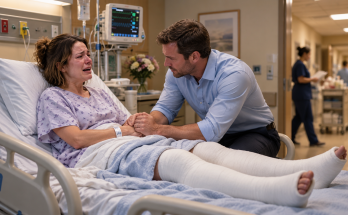
I was ten years old when my grandmother took me to an orthopedic clinic with a small padlock attached to my back brace. She told the doctor it was necessary so I wouldn’t take it off. At first, he said nothing. Then he asked for a cable cutter, unlocked the brace, and examined the marks it had left on my skin. When he finally turned to my father, he asked one question that changed everything.

Part 1: The Lock on My Brace
I was ten years old when my grandmother took me to a rural orthopedic clinic with a brass padlock fastened to my back brace.
A thin steel cable had been threaded through the release loops, making it impossible for me to open the straps without the key she kept in her purse.
The brace was supposed to support my spine while doctors treated a serious curve. I was told to wear it most of the day, but the instructions also said it had to be removed regularly for bathing, skin checks, and emergencies.
Grandma started locking it after I walked down our gravel driveway one evening to check the mail. She told my father I had tried to run toward the road, then convinced him the clinic wanted the brace secured because I could not be trusted.
My mother had died three years earlier, and Dad worked early shifts at the lumber mill. Grandma handled my mornings, school routine, and medical appointments, so her version of things was easier for him to believe.
That morning, my ribs hurt where the brace had rubbed too long. Grandma refused to give me breakfast, saying children who complained before doctor visits only made themselves sick.
Dr. Ethan Mercer, my orthopedic surgeon, noticed the padlock the moment I took off my coat.
He asked Grandma for the key.
She folded my coat over her lap and said she had left it at home.
“I can wait until next time,” I said quickly.
But Dr. Mercer looked at me, not her.
“Can you breathe comfortably? Has the brace been removed this week? Has anyone checked your skin?”
Grandma answered every question before I could.
“She exaggerates. She takes it off when no one is looking. She invents problems because she’s embarrassed at school.”
Dr. Mercer called in a nurse.
“Bring me a medical cable cutter.”
Grandma protested, saying cutting the lock would reward bad behavior.
Dr. Mercer’s voice stayed calm.
“No child stays inside a medical device this clinic cannot remove.”
The cable snapped with one cut.
When he opened the brace, the padlock and broken steel pieces fell onto the exam table.
I took the deepest breath I had taken in days.
Then I whispered, “Do I finally have permission to breathe?”
The room went silent.
Dr. Mercer examined the pressure marks and irritated skin, documenting everything carefully. Then he asked Grandma to wait outside while the nurse stayed with me.
Without her in the room, answering still felt dangerous.
Dr. Mercer asked how often the brace was locked.
“I don’t know,” I said. “She checks it every night.”
“Could you remove it if you felt sick or couldn’t breathe?”
“No.”
“Did you ever have the key?”
I shook my head.
A social worker, Ms. Parker, came in and explained that the clinic had to report concerns about a child being restrained inside medical equipment.
That scared me.
Grandma always said children who caused family trouble could be sent away.
Almost an hour later, Dad arrived from the mill with sawdust on his shirt. Grandma met him first and said I had upset myself over a safety measure.
But when Dad entered the exam room, his eyes went from my skin marks to the cut cable sealed in a bag.
He looked confused.
Not angry.
That was when I realized he truly had not known.
“She told me the clinic required it,” Dad said. “I thought the lock was part of the treatment.”
Dr. Mercer placed the manufacturer’s instructions in front of him and showed him the section requiring daily skin checks. Then he demonstrated how every strap was designed to open quickly without tools.
Grandma stood near the door.
“He misunderstood me.”
Dad stared at the bag with the padlock inside.
Dr. Mercer looked directly at him.
“Who told you locking your daughter inside this brace was medically necessary?”
Dad slowly turned toward Grandma.
“Mom… you told me the lock came from this clinic.
PART 2: THE KEY SHE KEPT IN HER PURSE
“Mom… you told me the lock came from this clinic.”
Dad’s voice was barely above a whisper.
Grandma stood beside the exam-room door with her handbag pressed against her ribs.
For the first time that morning, she looked smaller.
Not sorry.
Cornered.
“There must have been a misunderstanding.”
Dad stared at her.
“No.”
Grandma blinked.
He almost never interrupted her.
Not even when I was little.
Not even after Mom died.
Grandma had moved into our house three months after the funeral and somehow, without anyone announcing it, every room began revolving around her rules.
Dinner was at five-thirty.
Shoes stayed by the door.
The television went off at eight.
Medicine was taken when she said.
Questions were answered once.
Complaints were not repeated.
Dad called it structure.
Grandma called it surviving.
I had never known what I was allowed to call it.
Dad pointed toward the clear evidence bag containing the broken steel cable and brass padlock.
“You told me Dr. Mercer wanted that.”
Grandma’s face tightened.
“I said the doctor wanted her to keep the brace on.”
“That isn’t what I asked.”
“David—”
My father flinched at his name.
I did too.
Grandma only used it that way when she was preparing to remind him that he was still her son before he was anybody else’s father.
“You are exhausted,” she said.
“You work twelve-hour shifts.”
“You cannot watch her every second.”
She glanced toward me.
“She removes the brace.”
I opened my mouth.
Grandma’s eyes found mine.
My words disappeared.
Dr. Mercer noticed.
He stepped slightly between us.
Not dramatically.
Just enough that I could no longer see Grandma without looking around him.
It was a small kindness.
I remember it more clearly than most of the things people said that day.
Dad looked at me.
“Did you take it off?”
My throat tightened.
Before I could answer, Dr. Mercer said:
“Ask her again when her grandmother isn’t in the room.”
Grandma’s face flushed.
“That is completely unnecessary.”
Ms. Parker, the social worker, stood.
“Mrs. Hale, I need you to come with me for a few minutes.”
Grandma stared at her.
“I’m not leaving my granddaughter alone with strangers.”
Dad laughed.
It was one short, broken sound.
“Strangers?”
Grandma turned toward him.
“David.”
“The stranger cut a lock off my daughter because her grandmother lied to me.”
Her face hardened.
“I did what was necessary.”
Dr. Mercer answered before Dad could.
“No.”
His voice remained calm.
“You did what you decided was necessary.”
Grandma reached for her coat.
“This appointment is over.”
“No.”
Dad said it.
Not Dr. Mercer.
Dad.
Grandma froze.
I looked at him.
Sawdust still clung to one shoulder of his work shirt.
His hands were rough and cracked from the mill.
He looked tired.
He always looked tired.
But something in his face had changed.
For years, Dad had stood between Grandma and the rest of the world.
That morning, for the first time, he moved to stand between her and me.
“We’re not leaving,” he said.
Grandma stared at him.
Then she smiled.
It was the smile I feared most.
Not warm.
Not angry.
Patient.
“You don’t understand what she’s like when you’re gone.”
My stomach dropped.
Dad heard it.
“What is she like?”
Grandma shook her head.
“Difficult.”
The word struck harder than it should have.
Maybe because I had heard it so many times.
Difficult.
Sensitive.
Dramatic.
Ungrateful.
Stubborn.
My entire childhood could have been filed beneath those five words.
Dad looked at me.
Then back at her.
“What does difficult mean?”
Grandma sighed.
“She fights the brace.”
“I don’t.”
The words came out before I could stop them.
Every adult turned toward me.
My heart slammed against my ribs.
Grandma’s eyes narrowed.
I almost apologized.
Instead, Dr. Mercer crouched slightly so he was closer to my height.
“You can finish.”
My mouth went dry.
“I don’t fight it.”
Grandma scoffed.
I jumped.
Dad heard the sound.
His face changed.
I forced myself to continue.
“I ask to take it off when it hurts.”
Grandma opened her mouth.
Ms. Parker stopped her.
“Please let her speak.”
Grandma looked furious.
I kept my eyes on Dr. Mercer.
“It gets sweaty.”
I whispered.
“And sometimes the edge digs in here.”
I touched my side.
“I ask Grandma to check.”
“What does she say?”
“She says I’m trying to get out of wearing it.”
“Does she take it off for bathing?”
I hesitated.
“Sometimes.”
“How often?”
I looked down.
“I don’t know.”
Dad’s voice broke.
“What do you mean you don’t know?”
I shrank automatically.
He saw it.
His whole face changed.
Not anger.
Horror that I thought anger was coming.
Dad lowered his voice immediately.
“I’m not mad at you.”
I stared at my shoes.
“When was the last time it came off before today?”
Dr. Mercer asked.
I tried counting backward.
Clinic day was Thursday.
There had been school Wednesday.
Tuesday Grandma washed my hair leaning over the kitchen sink.
Monday she wiped around the edges with a wet cloth.
Sunday—
My stomach tightened.
“Saturday.”
Dad went completely still.
“Five days?”
I nodded.
Grandma snapped:
“That is not true.”
I flinched again.
Dr. Mercer stood.
“Mrs. Hale, outside.”
“You cannot order me out.”
“In this examination room, I can.”
The nurse opened the door.
Grandma looked at Dad.
She expected him to defend her.
I could see it.
So could he.
He did not.
She gathered her coat and walked out with Ms. Parker.
Before the door closed, Grandma looked at me.
Not angry.
Worse.
Disappointed.
That look had controlled me for years.
The door clicked shut.
And suddenly I could breathe again.
Not perfectly.
My ribs still hurt.
But enough.
Dad sat beside me.
For a moment, he said nothing.
Then:
“Sweetheart.”
His voice broke on the word.
I looked away.
He rubbed both hands across his face.
“How long has she been locking it?”
I shrugged.
“Tell me the best you can.”
“A while.”
“How long is a while?”
I hated that question.
Children do not organize fear by calendar.
We remember before and after.
Before Grandma started sleeping with the key in her room.
After I stopped asking to bathe alone.
Before the little brass lock.
After.
“I think since summer.”
Dad stared.
It was November.
“Summer?”
I nodded.
“Why didn’t you tell me?”
There it was.
The question every frightened child dreads.
Not because the parent means blame.
Because the child has spent so long rehearsing reasons.
I looked at him.
“I did.”
Dad stopped.
“What?”
My hands began trembling.
“I told you it hurt.”
His face went blank.
“I know.”
“You said Grandma knew how to manage it.”
He closed his eyes.
I continued because somehow saying one thing made the others easier.
“I told you she wouldn’t give me the key.”
Dad looked at me.
“When?”
“The night you were eating cereal.”
He stared.
I remembered it perfectly.
Dad had come home after overtime.
Almost eleven.
He stood at the kitchen counter eating cornflakes straight from a mixing bowl because every clean regular bowl was in the dishwasher.
I came downstairs in pajamas.
I said:
“Dad, Grandma has the key again.”
He barely looked up.
He said:
“She’s helping you stay on schedule, kiddo.”
Then kissed the top of my head.
I went upstairs.
Dad remembered.
I saw the memory arrive in his face.
He covered his mouth.
“Oh God.”
I immediately said:
“It’s okay.”
He looked at me.
“No.”
Tears filled his eyes.
“No, sweetheart.”
He moved closer but stopped before touching me.
“Can I hug you?”
That question almost made me cry.
Nobody asked permission to touch me anymore.
I nodded.
Dad wrapped his arms around me carefully, avoiding the irritated skin along my ribs.
I buried my face against his work shirt.
He smelled like sawdust.
Machine oil.
Cold air.
Home.
“I’m sorry.”
His chest shook.
“I’m so sorry.”
I whispered:
“I should’ve explained better.”
Dad pulled back.
“No.”
His hands stayed gently on my shoulders.
“You are ten.”
I stared.
“You are not supposed to become better at explaining pain so adults will listen.”
Dr. Mercer looked away for a second.
So did the nurse.
Dad wiped his eyes.
“I should have asked another question.”
That sentence stayed with me.
Years later, whenever someone told me children were unreliable because they did not explain things clearly, I remembered my father.
Children often explain exactly as much as they feel safe explaining.
Adults simply stop listening too soon.
Dr. Mercer finished examining me.
The brace itself was still medically necessary.
That frightened me.
I thought if the lock was wrong, maybe the whole thing could disappear.
But my spine had not changed just because Grandma had misused the treatment.
Dr. Mercer showed me a replacement brace.
Same purpose.
Different fit.
He explained every strap.
“This one opens here.”
He showed me.
“And here.”
Another.
“No lock.”
I asked:
“Can Grandma put one on?”
Dad’s face collapsed.
Dr. Mercer answered immediately.
“No.”
“Even if I’m bad?”
“You wearing medical equipment is not about being good or bad.”
I stared at him.
He continued.
“If something hurts, you tell someone.”
“If your skin needs checking, it comes off.”
“If you are sick and need it off quickly, it comes off.”
“And nobody gets to lock it because they are angry with you.”
I swallowed.
“What if I take it off when I’m not supposed to?”
“Then the adults responsible for you talk with you and your medical team.”
He smiled gently.
“They do not turn your treatment into punishment.”
Treatment.
Punishment.
Two separate things.
That distinction had never occurred to me.
The nurse brought soft gauze and treated the irritated places.
I watched her hands.
Gentle.
No scolding.
No:
Hold still or you’ll make it worse.
Just:
“Tell me if this stings.”
It did.
I told her.
She stopped.
That was new too.
Eventually Ms. Parker returned.
Without Grandma.
She sat across from Dad.
“I need to discuss what happens next.”
Dad’s jaw tightened.
“Okay.”
“Your mother cannot take her home right now.”
Dad nodded immediately.
Good.
No argument.
No delay.
Ms. Parker looked at me.
“Do you understand what that means?”
I whispered:
“Grandma’s mad?”
“No.”
She spoke gently.
“It means the adults are going to make sure you’re somewhere safe while we understand what happened.”
“Am I being sent away?”
Dad turned toward me.
“What?”
I stared at the floor.
“Grandma said kids who make trouble can get sent somewhere.”
Silence.
A terrible one.
Dad slowly looked toward the door.
“She said that?”
I nodded.
Ms. Parker asked:
“When?”
“A lot.”
Dad stood.
The chair legs scraped the floor.
Dr. Mercer moved slightly, but Dad did not go toward the door.
He simply paced once and turned back.
“She told you that if you talked about things at home, someone would take you away?”
I nodded.
“She said social workers split families up.”
Ms. Parker’s face tightened.
“Did she use my job title?”
I shook my head.
“She said government ladies.”
For some reason, the nurse almost smiled.
Not because it was funny.
Because Grandma’s vocabulary was so specific.
I continued.
“She said if I embarrassed Dad, they’d think he was a bad father.”
Dad stopped moving.
There it was.
The chain Grandma had built.
Tell the truth.
Lose Dad.
Complain.
Get removed.
Ask for help.
Destroy the family.
I had believed silence was something I was doing for him.
Dad crouched in front of me.
“She was wrong.”
I looked at him.
“You’re not mad?”
“At you?”
I nodded.
“No.”
His answer came so fast it startled me.
“I’m mad at myself.”
Ms. Parker spoke gently.
“David, that distinction matters, but be careful about saying it to her too often.”
Dad looked confused.
“Why?”
“Children can hear a parent’s guilt and decide they need to comfort the parent.”
She looked at me.
I had already been doing exactly that.
“It’s not your job to make Dad feel better,” she said.
I hated that immediately.
Of course it was.
That had been my job since Mom died.
Dad cried in the garage.
I brought coffee.
Dad worked doubles.
I kept quiet.
Dad looked tired.
I said school was fine.
Dad forgot permission slips.
I told teachers he was busy.
Adults called me mature.
Nobody noticed maturity can sometimes just mean a child became convenient.
Ms. Parker looked at Dad.
“She needs permission to be the child in the room.”
Dad nodded.
Tears returned to his eyes.
“Okay.”
Then:
“I can do that.”
The clinic called my school.
Not to tell them everything.
Only enough.
I would not return that afternoon.
The school nurse was asked to provide any records of complaints involving the brace.
That was when the next surprise came.
There were records.
A lot of them.
The school nurse faxed over seven visits from the previous two months.
Seven.
I stared at the pages.
I remembered maybe three.
Dr. Mercer read them.
Skin irritation.
Difficulty breathing after recess.
Pain near the hip.
A complaint that the brace “felt too tight.”
Each time, the nurse had called the number listed as primary guardian contact.
Grandma’s.
Dad looked up.
“Why wasn’t I called?”
The clinic nurse pointed to the school form.
Grandma had been listed first.
Dad second.
But beside Dad’s number was a note.
Work number—emergency only. Guardian requests grandmother be contacted for routine concerns.
Dad stared.
“I never requested that.”
My stomach tightened.
Ms. Parker asked:
“Who completed the form?”
Dad looked at the signature.
His name.
He went still.
“That isn’t mine.”
The room changed.
Dr. Mercer looked over.
“Are you sure?”
Dad took the paper.
“My D doesn’t look like that.”
I stared at him.
The same way Grandma said doctors wanted the lock.
The same way she answered every question for me.
She had not simply controlled what happened at home.
She had controlled who could reach Dad.
Ms. Parker asked the school to send the entire emergency-contact packet.
More pages arrived.
Dad’s signature appeared twice.
He denied both.
One form authorized Grandma to make medical decisions during school hours.
Dad had signed a limited permission months earlier.
This one was broader.
A lot broader.
He stared at it.
“I didn’t sign this.”
Ms. Parker circled the date.
Dad looked closer.
“I wasn’t even in town.”
“Where were you?”
“Mill safety training in Kentucky.”
The nurse and Ms. Parker exchanged a glance.
Dad looked toward the hallway.
“What has she been signing?”
Nobody knew yet.
That question frightened me more than the lock.
We spent almost five hours at the clinic.
By the time we left, daylight had faded.
Grandma was gone.
Ms. Parker had arranged for her to leave separately with my aunt Susan, Dad’s older sister.
Dad and I drove home together.
Just us.
That had not happened in months.
I sat in the passenger seat because the back seat made my ribs ache.
Dad drove slowly.
Too slowly.
Every few minutes he glanced at me.
Finally I said:
“I’m not going to disappear.”
His hands tightened on the wheel.
“I know.”
Another mile.
Then:
“Why did Grandma say I ran toward the road?”
Dad asked.
I stared through the windshield.
“I went to the mailbox.”
“At night?”
“It was six.”
“In October.”
“Yes.”
“Was it dark?”
“A little.”
“Did you go toward the road?”
“The mailbox is by the road.”
Dad closed his eyes briefly.
Of course.
The lie had been built from enough truth to sound reasonable.
I went toward the road.
Because that was where the mailbox was.
Grandma transformed direction into intention.
“What happened when you came back?”
I looked down.
“She was waiting.”
“What did she do?”
I went quiet.
Dad did not push.
That helped.
Finally:
“She said I proved I couldn’t be trusted.”
“And then?”
“She took the brace off.”
Dad glanced at me.
“For a skin check?”
“No.”
My throat tightened.
“She made me stand there.”
“Where?”
“Bathroom.”
“For how long?”
“I don’t know.”
“Why?”
“She said I needed to learn what the brace was doing for me.”
Dad’s face tightened.
“What does that mean?”
“She made me look in the mirror without it.”
I touched my side.
“She said my back looked wrong.”
Dad stopped breathing.
“She told you that?”
I nodded.
“She said if I didn’t obey, I’d get worse and people would stare.”
Dad’s eyes filled.
“She said Mom would be ashamed because Mom always wanted me to grow up pretty.”
The car drifted slightly.
Dad corrected immediately.
Then pulled onto the shoulder.
He put the car in park.
For several seconds, he stared straight ahead.
I watched his jaw shake.
Mom.
Nobody had used Mom against him.
Not like that.
Dad whispered:
“Your mother never said that.”
I looked at him.
“Never.”
His voice broke.
“She loved you before she knew what you would look like.”
My eyes filled.
“She loved you when you were bald.”
I laughed weakly.
Dad did too.
“She said you looked like a potato.”
“That’s mean.”
“She said a beautiful potato.”
I smiled.
Then cried.
Dad cried too.
He did not ask me to stop.
We sat beside the highway with trucks passing, mourning a woman who had been dead three years and the things being said in her name.
Dad whispered:
“Grandma does not get to tell you what your mother would think.”
I nodded.
“Neither do I, really.”
He looked at me.
“But I can tell you what she actually said.”
“What?”
“The day you were born.”
Dad smiled through tears.
“She counted all your fingers.”
“Then your toes.”
“Then she looked at me and said, ‘She’s here. Everything else is details.’”
My throat hurt.
Everything else is details.
My spine.
The brace.
The scarred skin.
Details.
Not shame.
Not punishment.
Details.
Dad started driving again.
When we reached our street, a sheriff’s vehicle was parked outside our house.
My stomach dropped.
Dad noticed.
“It’s okay.”
I did not believe him.
Ms. Parker had warned us someone might visit.
Still, seeing the vehicle outside made Grandma’s old threats roar inside my head.
Government ladies.
Sent away.
Family destroyed.
Dad parked.
Before opening his door, he looked at me.
“You’re staying with me.”
I stared.
“Okay?”
I nodded.
“Whatever happens with Grandma…”
His voice shook.
“…you are not being punished for telling the truth.”
We walked inside.
A child-welfare investigator named Mr. Alvarez was waiting with another deputy.
The kitchen looked strange.
Grandma’s purse was gone.
Her coat missing.
Her coffee cup still sat beside the sink.
Mr. Alvarez spoke with Dad first.
Then me.
Separately.
I repeated more of the same.
The locked brace.
The key.
The bathroom mirror.
The threats about social workers.
Then he asked:
“Does your grandmother lock anything else?”
I frowned.
“What?”
“Doors.”
“Cabinets.”
“Your room.”
I thought.
“The pantry.”
Dad had complained about that.
Grandma said I stole snacks.
I had once taken crackers after she refused dinner because I talked back.
I did not tell Dad the dinner part.
Now I did.
Mr. Alvarez wrote it down.
“What about your bedroom?”
“No.”
Then I remembered.
“The outside lock.”
His pen stopped.
“What outside lock?”
I wished I had not said it.
Dad was in another room.
He could not hear.
Mr. Alvarez remained calm.
“Tell me what you mean.”
“There’s a hook.”
“On your bedroom door?”
I nodded.
“Inside or outside?”
“Outside.”
His expression changed very slightly.
“Does anyone use it?”
“Only when I won’t stay in bed.”
My heart began pounding.
“How often?”
“I don’t know.”
“Can you open the door when the hook is used?”
“No.”
He wrote something.
“Does your father know?”
“No.”
That answer came immediately.
Because Dad worked early shifts.
He left at 4:40 every morning.
Some nights Grandma said bedtime started at seven because Dad needed sleep.
He thought I stayed in my room because I was obedient.
He did not know obedience sometimes had hardware.
Mr. Alvarez stood.
“I need to see it.”
We went upstairs.
Dad joined us halfway.
“What’s going on?”
Nobody answered immediately.
Mr. Alvarez reached my door.
There it was.
Small metal hook.
White paint scratched around it from use.
Dad stared.
His face went blank.
“What is that?”
I looked at the floor.
Mr. Alvarez asked:
“Have you seen this before?”
Dad walked closer.
Touched it.
“No.”
He looked at me.
“Does she lock this?”
I nodded.
Dad stepped backward.
As if the door itself had hit him.
“How did I not see this?”
Mr. Alvarez answered quietly.
“Sometimes people don’t notice what they are not expecting to find.”
Dad stared at the hook.
Then something changed in his face.
“Wait.”
He turned.
Walked down the hall.
Into Grandma’s room.
I followed at a distance.
Dad opened the nightstand drawer.
Nothing.
Then the dresser.
Nothing.
He opened the closet.
A box sat on the upper shelf.
Gray plastic.
The kind Grandma used for documents.
Dad pulled it down.
Mr. Alvarez stepped closer.
“David, don’t start going through things if you think they may matter to an investigation.”
Dad stopped.
“This is my house.”
“I understand.”
“But if you think there are records connected to what happened, we should document before moving them.”
Dad nodded.
He put the box on the bed.
The deputy photographed it.
Then Mr. Alvarez opened it while Dad watched.
Inside were medical papers.
School forms.
Receipts.
My mother’s death certificate.
Insurance records.
And a spiral notebook.
Grandma’s handwriting.
Dates filled the pages.
My stomach turned before anyone read a word.
Dad opened to the most recent entries.
There were notes about me.
Every day.
November 3 — refused oatmeal. Argumentative.
November 4 — complained brace too tight after school. Attention-seeking.
November 5 — asked David whether she could stay home. Redirected.
Redirected.
That word frightened me.
Dad turned pages.
June.
July.
August.
Descriptions.
Behavior.
Punishments.
What Grandma called incidents.
Then one entry:
July 18 — removed brace in bathroom without permission. Locking system necessary from this point forward. David should not be burdened with details unless needed.
Dad sat on the bed.
He looked sick.
“She planned it.”
Mr. Alvarez took the notebook carefully.
Another entry.
August 2 — clinic follow-up. Child nearly told nurse about key. Reminded her that medical complaints may result in placement if family cannot manage her.
My cheeks burned.
Seeing fear translated into handwriting was strange.
Things I had believed were private shame now existed as evidence.
Dad kept looking.
Then he reached an older section.
Before the brace.
Before surgery.
Before Grandma moved in full-time.
He stopped.
“What?”
Mr. Alvarez asked.
Dad did not answer.
He turned another page.
Then another.
His face drained of color.
“What is it?”
I asked.
Dad looked at me.
Then toward Mr. Alvarez.
“This is from when my wife was alive.”
My stomach tightened.
Mom?
Dad read silently.
His hand began shaking.
Then he whispered:
“She was writing about Sarah.”
My mother.
Not me.
Grandma had kept notes about Mom too.
Sarah forgets appointments.
Sarah overreacts to criticism.
Sarah allows child too much freedom.
Sarah undermines structure.
Dad stared.
Then another line.
His mouth fell open.
“What?”
Mr. Alvarez asked.
Dad swallowed.
“She wrote…”
He stopped.
Started again.
“‘David is too protective of Sarah to see decline clearly.’”
The room went cold.
My mother had died from an aneurysm.
Sudden.
Nothing to do with mental decline.
Dad turned pages faster.
Notes from the final year of Mom’s life.
Grandma had been building the same story.
Forgetful.
Unstable.
Overwhelmed.
Too emotional.
The same words later used for me.
Dad looked sick.
Then an envelope slid from the back of the notebook and landed on the bed.
Old.
Sealed.
Dad’s name written across the front.
DAVID
He stared at it.
The handwriting was not Grandma’s.
I knew that before he touched it.
Because I had seen that handwriting on birthday cards.
On lunchbox notes.
On the small piece of paper I kept under my pillow for years after the funeral.
My mother’s.
Dad stopped breathing.
“Sarah.”
The envelope had been sealed for more than three years.
Hidden in Grandma’s notebook.
Dad looked at Mr. Alvarez.
“Can I open this?”
He nodded.
The deputy photographed it first.
Then Dad broke the seal.
Inside were four handwritten pages.
Dad unfolded them.
His hands shook.
He read the first lines silently.
Then sat down.
“What does it say?”
I asked.
Dad looked at me.
His face collapsed.
For several seconds, he could not speak.
Finally:
“Your mom wrote this to me.”
“When?”
He looked at the date.
“Eleven days before she died.”
My heart stopped.
Dad had never seen it.
I knew that instantly.
“What does it say?”
Dad looked toward the page.
Then toward the investigator.
And when he finally spoke, his voice sounded like something inside him had broken open.
“She was afraid of Grandma too.”
The room went silent.
Dad kept reading.
Tears ran down his face.
Then he reached the second page.
His expression changed again.
Not grief this time.
Shock.
“What?”
I whispered.
Dad looked at Grandma’s notebook.
Then at Mom’s letter.
Then at me.
And said:
“Sarah didn’t ask your grandmother to move in after she got sick.”
I frowned.
“I thought she did.”
“So did I.”
He shook his head.
“She wanted her out.”
My whole body went cold.
Dad looked back at the letter.
Then read one sentence aloud:
David, if anything ever happens to me, please do not let your mother raise our daughter simply because she convinces you she knows better.
Nobody moved.
Not Mr. Alvarez.
Not the deputy.
Not me.
Dad covered his mouth.
The page shook between his hands.
Then he whispered:
“She tried to warn me.”
I stared at Mom’s handwriting.
Three years hidden inside Grandma’s box.
Three years during which Grandma had stepped into our kitchen, our school forms, my medical appointments, my bedroom door, and finally my brace.
Dad unfolded the last page.
There was something attached to it.
A photocopy.
An old clinic record.
Not mine.
Mom’s.
Dad stared.
“What is that?”
Mr. Alvarez asked.
Dad’s face went white.
“It’s from when Sarah was pregnant.”
“With her?”
The investigator glanced at me.
Dad nodded.
Then read the handwritten note Mom had attached.
His breathing stopped.
“What?”
I asked.
Dad looked at me.
Then at the little metal hook on my bedroom door.
His voice dropped.
“Your grandmother did this before.”
I felt cold all over.
“To Mom?”
Dad shook his head.
“No.”
He held up the old clinic record.
“To another child.”
The air left the room.
“What child?”
Dad stared at the name printed across the top of the page.
A name I had never heard.
Then he whispered:
“My sister.”
I frowned.
Dad did not have a sister.
At least I had never known one.
Grandma had always told me Dad was an only child.
Mr. Alvarez stepped closer.
“You have a sister?”
Dad looked as confused as I felt.
“No.”
Then he looked at the record again.
Or perhaps he thought he did not.
The file was thirty-seven years old.
Grandma’s name appeared under guardian.
A teenage girl’s name appeared under patient.
And beside the diagnosis section was an old handwritten note:
Guardian repeatedly interferes with prescribed orthopedic device access. Patient reports being unable to remove brace independently at home.
Dad read it twice.
Then looked at the broken brass padlock downstairs as though he could see it through the floor.
Thirty-seven years.
Another girl.
Another brace.
Another guardian deciding access belonged to her.
Dad whispered:
“Who is Emily?”
I had never seen him look so lost.
Mr. Alvarez carefully took the page.
Then something slipped from behind it.
A photograph.
Black and white.
Two children standing beside Grandma when she was young.
One was my father.
Maybe five years old.
Beside him stood an older girl.
Thin.
Serious.
Wearing a stiff orthopedic brace beneath her dress.
On the back, my mother had written:
Emily Mercer — David’s sister. Ask why no one speaks her name.
Dad stared at the photograph.
Then sank onto Grandma’s bed.
“My sister.”
The word sounded impossible in his mouth.
I looked at the girl’s face.
She had Dad’s eyes.
My eyes.
And suddenly the lock on my brace did not feel like the beginning of the story anymore.
It felt like something Grandma had been practicing long before I was born.
Dad looked toward Mr. Alvarez.
“Can we find her?”
The investigator studied the old medical page.
“If she’s alive, we can try.”
Dad stared at the photograph.
Then Mom’s hidden letter.
Then Grandma’s notebook documenting me as if I were a problem to be managed.
His face hardened.
Not violently.
Clearly.
For the first time, he looked like a man who had stopped asking whether his mother meant well.
He looked like a father finally asking what she had actually done.
And somewhere outside our house, Grandma still had the key she had claimed to leave at home.
But now we had found something she had spent nearly forty years trying to keep locked away.
A name.
A photograph.
A girl in another brace.
Emily Mercer.
My father’s sister.
The aunt I had never been told existed.
And according to my mother’s final letter, Emily was the one person who could tell us what Grandma had done the first time nobody believed a child.
PART 3: THE GIRL GRANDMA ERASED
My father stared at the black-and-white photograph for so long that I began to wonder if he had forgotten anyone else was in the room.
The girl beside him could not have been older than thirteen.
Thin face.
Dark hair.
A stiff orthopedic brace visible beneath her dress.
One hand rested against the porch railing.
The other was hidden behind her back.
My father looked five.
Maybe six.
He was smiling.
Emily was not.
On the back, in my mother’s handwriting, were the words:
Emily Mercer — David’s sister. Ask why no one speaks her name.
Dad read the sentence again.
Then again.
“I don’t remember her.”
His voice sounded ashamed.
Mr. Alvarez sat across from him.
“You were very young.”
Dad shook his head.
“No.”
He touched Emily’s face in the photograph.
“I should remember my sister.”
“Not if everyone spent decades making sure you didn’t.”
That was the first time I understood that forgetting can be taught.
Not just by lies.
By silence.
By missing photographs.
By stories never told.
By adults acting as though a person never existed until a child stops asking where they went.
Dad looked at Mom’s letter again.
On the final page, she had written one more line.
If Emily is still alive, she knows what your mother is capable of when medicine gives her an excuse to control someone.
Dad closed his eyes.
Then whispered:
“Sarah knew.”
My mother had known.
At least enough to be afraid.
And Grandma had hidden the letter until Mom was safely beyond explaining it herself.
That realization hurt in a way I could not name.
Mom had been dead three years.
For those three years, Grandma had spoken about her often.
“She would want you to listen.”
“Your mother believed in discipline.”
“Your mother trusted me.”
Every sentence had been presented like a message from heaven.
Now we knew Mom had written the opposite while she was still alive.
She did not trust Grandma.
She had tried to warn Dad.
And Grandma had buried the warning in a plastic box beside records documenting all the ways she believed I needed correction.
Dad looked at Mr. Alvarez.
“Find Emily.”
His voice was steady now.
“If she wants nothing to do with us, I’ll respect it.”
He swallowed.
“But find her.”
The search took three days.
Three days felt like three months.
Grandma stayed with Aunt Susan while the investigation continued.
Dad would not let her return to the house.
Not yet.
She called.
At first constantly.
Then less.
Her messages changed tone.
The first:
David, you are overreacting.
Then:
That social worker is poisoning you against your own mother.
Then:
The girl is upset and confused. You need to think about what losing family will do to her.
I hated that one.
Because Grandma still refused to use my name when discussing me with Dad.
The girl.
As if reducing me to a category made it easier to manage me.
Then came:
Please call me. There are things you do not understand about Emily.
That was the first message Dad saved.
Not because he planned to answer.
Because it proved Grandma knew exactly who Emily was.
On Sunday afternoon, Mr. Alvarez called.
Dad put the phone on speaker.
I sat beside him at the kitchen table.
The little metal hook had already been removed from my bedroom door.
Dad had left the screw holes visible.
He said he would patch them when I wanted.
I had not decided yet.
Part of me wanted the holes there.
Proof.
Not forever.
Just until I stopped wondering if I had imagined what happened.
Mr. Alvarez said:
“We located Emily.”
Dad’s face went white.
“Alive?”
“Yes.”
I did not realize I had been holding my breath until it escaped.
“Where?”
“Michigan.”
Dad sat back.
Only a few hours away.
A sister erased for nearly four decades had been living within driving distance.
“Does she know about me?”
Mr. Alvarez paused.
“Yes.”
Dad closed his eyes.
That answer somehow hurt more.
“Does she want to speak to me?”
“She said she would.”
Dad covered his mouth.
I watched tears gather behind his fingers.
Then Mr. Alvarez added:
“She asked about your daughter first.”
Dad looked toward me.
“What did you tell her?”
“That you were both safe.”
Silence.
Then:
“She cried.”
So did Dad.
Emily did not come to our house.
She chose a neutral place.
A small conference room at the county family-services building.
Dad told me I did not have to go.
I said:
“I want to.”
Then hesitated.
“If she does.”
That mattered.
Adults had spent too much time deciding things in rooms where the affected person was absent.
Mr. Alvarez asked Emily.
She agreed.
The day we met her, Dad changed shirts three times.
I had never seen him care what he wore unless someone was getting married or buried.
He finally chose a blue button-down.
Before we left, he stood near my bedroom door.
The missing hook left two dark holes in the white paint.
“You sure?”
I nodded.
He looked at me.
“Okay.”
Then he held out his hand.
I took it.
Emily Mercer was fifty-two years old.
She stood when we entered.
For one second, I saw Dad stop breathing.
Because the resemblance was undeniable.
Same nose.
Same eyes.
Same shape around the mouth.
She was shorter than Dad.
Her dark hair had streaks of silver.
She walked with a slight stiffness on one side.
And when she looked at me, her face broke immediately.
“Oh.”
That was all.
Just:
“Oh.”
I did not know whether to hug her.
Neither did she.
So we stood there awkwardly until she asked:
“May I?”
I nodded.
Her arms went around me carefully.
Not tightly.
Carefully.
I remember that.
She knew what it meant for a child to hate being trapped.
When she stepped back, she looked at Dad.
They stared at each other.
Brother.
Sister.
Forty years of absence between them.
Dad whispered:
“Emily?”
She smiled through tears.
“You got old.”
Dad laughed.
Then cried.
“So did you.”
“Rude.”
That broke something open.
Dad covered his face.
Emily crossed the room and hugged him.
He collapsed against her.
Not literally.
But close.
I had never seen my father held by anyone older than him.
Not since Mom died.
Maybe not ever.
He whispered:
“I’m sorry.”
Emily pulled back.
“For what?”
“I forgot you.”
Her face changed.
“Oh, David.”
“I forgot my own sister.”
“You were five.”
“I should have remembered something.”
“You remembered exactly what they left you enough permission to remember.”
Dad cried harder.
Emily touched his cheek.
“You were a little boy.”
Those words did something to him.
I could see it.
For years, Grandma had told Dad that family responsibility was his job.
After Mom died, he became everything at once.
Widower.
Father.
Worker.
Son.
He wore guilt like another uniform.
Emily was the first person I ever heard tell him he had once been a child too.
We sat.
Mr. Alvarez stayed near the door.
Ms. Parker joined us.
No one rushed.
Then Emily placed an old envelope on the table.
Inside were photographs.
Medical records.
Letters.
One photograph showed her at fourteen.
Different brace.
Same serious eyes.
Another showed Grandma standing behind her.
Young.
Beautiful.
Hand resting on Emily’s shoulder.
It looked like an ordinary mother-daughter picture.
Emily stared at it.
“Pictures lie by leaving out sound.”
I looked at her.
“What sound?”
“The lock.”
My stomach turned.
Dad went still.
Emily looked at me.
“She locked your brace?”
I nodded.
“With a padlock.”
Emily closed her eyes.
“Mine was a chain.”
Silence.
Not heavy steel.
Not dramatic.
A small chain threaded through the release hardware.
Grandma kept the key.
Emily’s doctor had told the family the brace needed consistent use.
Grandma interpreted consistent as uninterrupted.
When Emily complained, Grandma said pain meant the treatment was working.
When the skin under the brace became irritated, she accused Emily of scratching herself for sympathy.
When she asked to remove it at night because she felt sick, Grandma called her manipulative.
Dad whispered:
“Why?”
Emily looked at him.
“Our father was gone most of the time.”
Dad frowned.
“My father?”
“Our father.”
She smiled sadly.
“Your father too.”
Dad barely remembered him.
He died when Dad was young.
Emily continued.
“He worked long-haul trucking.”
“Mom handled everything at home.”
Her expression hardened.
“And once a doctor said something, Mom turned it into law.”
I understood immediately.
A rule became control.
Treatment became obedience.
Emily continued.
“She liked medical authority because nobody argued with it.”
Dad looked sick.
“She told neighbors the doctor required the chain?”
“Yes.”
“Did he?”
“No.”
Same lie.
Thirty-seven years apart.
Different hardware.
Same sentence.
I stared at my hands.
Emily noticed.
“Hey.”
I looked up.
“You did not inherit what she did.”
I frowned.
“What?”
“You’re looking at me like you just found out something lives in your blood.”
Tears filled my eyes.
I had not realized that was what I was afraid of.
She leaned closer.
“It doesn’t.”
She tapped the table.
“Patterns can move through families.”
Then:
“But so can stopping them.”
I cried.
Quietly.
Dad reached for my hand.
Emily continued.
“When I was fifteen, I finally told a nurse.”
The old clinic record.
Same one Mom copied.
“The nurse reported it.”
“What happened?”
Dad asked.
“Mom said I was unstable.”
“Of course.”
Emily smiled without humor.
“She said I hated the brace.”
“I did.”
“She said I was rebellious.”
“I was.”
“She said I wanted attention.”
“I probably did.”
Her eyes hardened.
“None of those things made it okay to lock me inside medical equipment.”
That sentence mattered.
Because abuse does not require a perfect victim.
Emily could have been rebellious.
Difficult.
Angry.
She still deserved access to her own body.
“What happened after the report?”
I asked.
Emily looked toward the window.
“My aunt took me.”
Dad frowned.
“What aunt?”
“Dad’s sister.”
Another relative erased.
Grandma had apparently rebuilt the entire family tree around what she wanted remembered.
“I lived with her until I graduated.”
“Why didn’t you come back?”
Emily looked at Dad.
“I tried.”
His face changed.
“What?”
“I wrote.”
Dad shook his head.
“You were five.”
“I know.”
“I wrote Mom.”
“She returned everything.”
Emily opened another envelope.
Several letters.
Stamped.
Returned.
Some unopened.
“I called when you were older.”
“Mom said you didn’t want contact.”
Dad stared.
“She told me you were ashamed of me.”
His mouth fell open.
“I didn’t even know you existed.”
“I figured that out eventually.”
Emily looked at him.
“But by then I had spent years believing my little brother thought I was crazy.”
Dad started sobbing.
He stood.
Walked toward the wall.
Pressed one hand against it.
I knew that posture.
It was what he did when grief became too large for furniture.
Emily let him.
Then she said:
“This part isn’t your fault.”
He turned.
“Don’t.”
“It isn’t.”
“I lived in that house.”
“You were five.”
“I grew up with her.”
“You were a child.”
“She raised me.”
“Yes.”
“And I never questioned why there were no baby pictures of us together.”
Emily’s eyes softened.
“Because she told you there was nothing to question.”
Dad wiped his face.
Then asked:
“Why didn’t Sarah tell me?”
The room changed.
Mom.
Emily looked surprised.
“Sarah knew?”
I showed her the letter.
Not all of it.
Dad handed over a copy.
Emily read.
Her face changed slowly.
“She found me.”
Dad froze.
“What?”
Emily looked up.
“Sarah contacted me.”
“When?”
“About four years ago.”
The year before Mom died.
Dad sat down.
“She never told me.”
“She said she was trying to understand your mother.”
My stomach tightened.
Emily continued.
“Apparently after your wife got sick of being corrected all the time, she started digging.”
That sounded like Mom.
Quiet until she was not.
Patient until she reached the end.
Emily said Mom found an old family photograph in storage.
Asked Grandma who she was.
Grandma claimed Emily was a cousin.
Mom did not believe her.
So she searched.
Old school records.
Obituary archives.
Eventually, she found Emily.
“What did Sarah say?”
Dad asked.
Emily smiled sadly.
“She apologized.”
“For what?”
“Nothing.”
“She just said, ‘I’m sorry nobody came looking sooner.’”
Dad covered his face again.
Mom had reached the place he had not known existed.
“What else?”
“She asked whether your mother had always been controlling.”
Emily looked at me.
“I told her yes.”
“She asked about doctors.”
“The brace.”
“School.”
“Food.”
“Punishments.”
“Everything.”
Dad whispered:
“And Sarah wrote the letter.”
“Yes.”
“Why didn’t she give it to me?”
Emily hesitated.
“She said she was trying to find the right time.”
That hurt.
Because sometimes the right time never comes.
Mom had eleven days left.
She did not know that.
No one did.
Dad looked down.
Then Emily said:
“She was afraid you’d think she hated your mother.”
He laughed through tears.
“That sounds right.”
“She kept saying, ‘David has already lost so much.’”
My heart cracked.
Even Mom had confused protecting Dad with delaying truth.
Not maliciously.
But still.
Silence had passed through our family like an heirloom nobody wanted to admit they owned.
Emily looked at me.
“Your mother was trying.”
I nodded.
“I know.”
“She believed you.”
“What?”
Emily touched Mom’s letter.
“She wrote me that you had started getting scared around your grandmother.”
My throat tightened.
“Before she died?”
“Yes.”
I had been seven.
I barely remembered.
Emily continued.
“She noticed little things.”
“You didn’t want Grandma brushing your hair.”
“You hid food.”
“You asked permission for things other kids just did.”
Dad stared at me.
I had no memory of some of it.
“But after Sarah died…”
Emily’s voice softened.
“…your grandmother became useful.”
Dad flinched.
That was the truth.
Brutal.
Uncomfortable.
Dad was grieving.
Working.
Barely functioning.
Grandma stepped in.
Laundry done.
Lunches packed.
Appointments handled.
House clean.
Permission slips signed.
Every practical burden lifted.
And in exchange, Dad stopped looking too closely at how she achieved order.
He did not mean to.
But results can make control look like competence.
Dad whispered:
“I handed her everything.”
Emily answered:
“You handed help to someone you trusted.”
He looked at her.
“Then I stopped checking.”
“Yes.”
No excuse.
No cruelty.
Truth.
Dad nodded.
“I did.”
That was the beginning of his accountability.
Not:
I didn’t know.
Not:
She fooled me.
Both were true.
But incomplete.
He had missed things because he was exhausted.
He had also chosen easier explanations when questions felt too heavy.
And I loved him more when he admitted both.
Grandma was interviewed the following week.
I was not there.
Dad was.
Emily chose to attend part of it.
Aunt Susan came too.
That was when Susan admitted she knew Emily existed.
Dad nearly left the room.
Susan was twelve when Emily left.
Old enough to remember.
She said Grandma told everyone Emily had become dangerous.
That she attacked family members.
That she was placed with relatives because she needed “special handling.”
Emily stared at her.
“I threw a hairbrush.”
Susan cried.
“I know.”
“One hairbrush.”
“I know.”
“And Mom turned that into me being dangerous.”
“I know.”
Susan covered her face.
“I was a kid.”
Emily nodded.
“You were.”
Then Susan whispered:
“But I wasn’t a kid forever.”
That sentence was the reason Emily eventually forgave her.
Not immediately.
Years later.
Because Susan did not hide behind childhood forever.
Grandma denied much of it.
Then minimized the rest.
The lock on my brace?
She called it a safety precaution.
The hook on my door?
A bedtime tool.
The food restrictions?
Discipline.
The school signatures?
Convenience.
Emily’s chain?
Different time.
Different doctors.
Different standards.
Mom’s hidden letter?
Private family matter.
Everything had a name that removed the harm.
Finally Dad asked her:
“Did the clinic tell you to lock my daughter’s brace?”
Grandma looked at him.
“No.”
Silence.
Dad breathed out.
“Did Emily’s doctor tell you to chain hers?”
“No.”
Another silence.
“Then why did you do it?”
Grandma’s face hardened.
“Because neither of them listened.”
There.
The truth.
Not medical need.
Not misunderstanding.
Obedience.
Dad whispered:
“You used their treatment to control them.”
“I kept them safe.”
“You made safety mean they could not say no.”
“I was the adult.”
Dad’s eyes filled.
“So am I.”
Grandma went quiet.
He continued.
“And I’m telling you now.”
His voice broke.
“You are not allowed to be alone with my daughter.”
Grandma stared.
“What?”
“You heard me.”
“David.”
“No.”
She looked toward me even though I was not in the room.
Later Dad told me her face changed when she realized I was no longer available to be discussed as a problem he needed help solving.
“You would keep my granddaughter from me?”
Dad answered:
“I am keeping my daughter safe.”
Grandma cried.
Real tears.
I believe they were real.
That did not change the boundary.
She faced consequences.
Not prison.
Not some dramatic public destruction.
Real life is often quieter.
Child-welfare restrictions.
Loss of unsupervised access.
Review of the forged school and medical forms.
Required counseling before any possibility of contact.
The clinic documented everything.
The school changed all permissions.
Dad became the sole authorized medical decision-maker except in true emergency circumstances.
Then he added one more instruction.
Any time I had a medical appointment, staff were to speak directly to me too.
Not only him.
At ten.
That felt enormous.
Dr. Mercer replaced my brace.
The new one had quick-release straps.
For the first month, I checked them constantly.
At school.
Before bed.
In the bathroom.
Click.
Open.
Close.
Open.
Close.
I needed proof that I could get out.
One evening Dad saw me doing it.
He did not say:
“Leave it alone.”
He asked:
“Want me to check it with you?”
I nodded.
We checked every strap.
Then he said:
“You know you’re allowed to open it if you need to.”
“I know.”
“Even if I’m asleep.”
“I know.”
“Even if you think I’ll be annoyed.”
I looked at him.
“Will you?”
“Maybe.”
I laughed.
He smiled.
“Parents are allowed to be annoyed.”
Then his face softened.
“Children are still allowed to breathe.”
That became our joke.
Not funny at first.
Then eventually funny.
Whenever Dad tightened something too much:
“Permission to breathe?”
He would groan.
“You’re going to use that forever.”
“Yes.”
“Fair.”
Healing entered through humor sometimes.
Emily came back into our lives slowly.
She never tried to become Aunt Emily overnight.
She mailed postcards.
Called Dad once a month.
Visited twice that first year.
She taught me how to sew a loose edge on a brace undershirt so it would not rub.
She knew tricks no doctor had taught me.
One afternoon, I asked:
“Did your back get better?”
She thought.
“Some.”
“Did the brace work?”
“Yes.”
I hated that answer.
She saw my face.
“Something can help your body and still be misused by someone.”
I looked down.
“So I shouldn’t hate mine?”
“You can hate it.”
She smiled.
“You just don’t have to hate yourself for needing it.”
I cried.
That sentence stayed too.
I finished treatment at thirteen.
The final day, Dr. Mercer told me I no longer needed the brace.
He unfastened the straps.
One by one.
No cable cutters.
No padlock.
No one holding a key.
He asked:
“Want to do the last one?”
I nodded.
My fingers shook.
Then I opened it.
The brace loosened.
I stepped out.
Dad cried.
Of course.
I laughed at him.
“Again?”
“Shut up.”
Dr. Mercer smiled.
I took the deepest breath I could.
Not because I had been trapped.
Not anymore.
Because breathing freely had become a ceremony.
Grandma did not see me during those three years.
That was partly Dad’s choice.
Partly mine.
At thirteen, I was asked whether I wanted contact.
I said:
“No.”
Nobody argued.
That was how I knew things had changed.
No:
But she’s family.
No:
She’s old.
No:
You’ll regret it.
Just:
Okay.
At sixteen, I changed my mind.
Not because I missed Grandma exactly.
Because I had questions.
We met in a therapist’s office.
Dad waited outside.
My choice.
Grandma looked much older.
Her hair was completely white.
Hands thinner.
For the first time, she looked nervous around me.
I sat across from her.
She said:
“You’ve grown.”
I answered:
“That happens.”
She almost smiled.
Then stopped.
I asked the question I had carried for six years.
“Why did you lock it?”
Grandma looked down.
“I thought you would remove it.”
“Why did that scare you?”
She took a breath.
“Because I failed with Emily.”
My chest tightened.
“What does that mean?”
“She stopped wearing hers.”
“She fought me.”
“She left.”
Grandma’s eyes filled.
“And for years I told myself if I had been stricter earlier, maybe everything would have turned out differently.”
I stared.
Emily leaving had become proof Grandma needed more control, not less.
That is how some people survive guilt.
They turn it into justification.
“You thought if you controlled me better, I wouldn’t leave.”
“Yes.”
I swallowed.
“Did you love me?”
Grandma looked shocked.
“Of course.”
“Then why did you scare me?”
Her face collapsed.
“I don’t know how to answer that.”
I did.
“You loved obedience too.”
She stared at me.
I continued.
“Maybe more.”
Grandma began crying.
I felt nothing triumphant.
Only tired.
Then she whispered:
“I’m sorry.”
I waited.
She continued.
“For the lock.”
“For the door.”
“For the food.”
“For telling you social workers would take you.”
Good.
Specific.
“For using your mother’s name.”
My eyes filled.
That one hurt most.
Grandma cried harder.
“I should never have told you what Sarah would think.”
“No.”
“She was your mother.”
“Yes.”
“And I used her because you listened when I said her name.”
I looked away.
That was the first apology that felt like understanding.
Not enough to restore what had been.
Enough to stop needing more.
I said:
“I don’t trust you.”
Grandma nodded.
“I know.”
“I don’t want you making medical decisions for me.”
“I understand.”
“I don’t want you ever touching a lock on anything I wear.”
Her mouth trembled.
“I understand.”
Then:
“I don’t know if I want to see you again.”
She cried.
But she said:
“Okay.”
That word was her greatest change.
Okay.
No argument.
No guilt.
No threat.
I saw her four more times before she died.
Never alone.
Always because I chose to.
Our relationship did not become warm and perfect.
That would be dishonest.
But it became real.
She learned to ask:
“Can I hug you?”
Sometimes I said yes.
Sometimes no.
She accepted both.
Emily never reconciled fully with her.
She sent one letter.
That was enough.
Dad rebuilt his relationship with Emily.
Forty years late.
But real.
They spent holidays together.
Argued about politics.
Discovered they both hated olives.
Emily told him embarrassing childhood stories he had forgotten.
Once she brought an old photograph of Dad wearing no pants in a kiddie pool.
He tried to destroy it.
I saved a copy.
Family tradition.
Susan apologized too.
Slowly.
Not everyone became close.
But silence stopped being the price of belonging.
Dad changed most of all.
He quit letting exhaustion answer questions for him.
If I said something hurt, he asked where.
If school called, he called back himself.
If he did not understand a medical instruction, he asked the doctor directly.
He still made mistakes.
Good parents do.
But he stopped treating questions like accusations.
Years later, when I was twenty-two, I needed surgery related to my spine.
Nothing dramatic.
But I was terrified.
The morning of surgery, Dad sat beside the hospital bed.
I wore a paper gown.
No brace.
No lock.
Still, my hands shook.
Dad asked:
“Want me to stay?”
“Yes.”
“Want me to talk?”
“No.”
“Want me to shut up?”
“Yes.”
He nodded.
“Finally, a medical instruction I understand.”
I laughed.
Then cried.
Before they wheeled me away, I looked at him.
“Dad?”
“Yeah?”
“Permission to breathe?”
His face broke.
He bent down and kissed my forehead.
“Always.”
That was when I knew the story had truly ended.
Not when Grandma apologized.
Not when the brace came off.
Not when Emily returned.
When the sentence that once came from fear became something tender between my father and me.
Grandma died when I was twenty-four.
Dad called me first.
Not to tell me how to feel.
Just:
“She’s gone.”
I sat quietly.
Sad.
Relieved.
Guilty for the relief.
Then no longer guilty.
People can die loved and still leave wounds.
Both are allowed.
At her funeral, Emily stood beside Dad.
For the first time publicly.
When someone asked who she was, Dad answered:
“My sister.”
Simple.
No explanation.
No shame.
My sister.
Emily cried harder than she expected.
I held her hand.
Afterward, Dad found an envelope Grandma had left for me.
I almost did not open it.
Then I did.
Inside was a small brass key.
My stomach turned.
The key.
Not the original one.
That had been taken as evidence years earlier.
This one was symbolic.
Beside it was a note.
I spent too much of my life believing that keeping the key made me responsible.
I stopped.
Then read the rest.
It only made everyone else dependent on my permission.
My eyes filled.
I hope you spend your life giving keys back.
That was all.
No request for forgiveness.
No plea to remember her kindly.
Just a lesson finally learned.
I kept the note.
Not the key.
I threw the key into a river.
Emily laughed when I told her.
“Dramatic.”
“Yes.”
“You could’ve recycled it.”
“Ruins the symbolism.”
She rolled her eyes.
I became a physical therapist.
Not because trauma magically gave me a calling.
I hate when people say that.
Pain should not get credit for every good thing that comes after it.
I chose the job because I liked anatomy.
Because I liked helping people move.
Because I understood that medical equipment can feel like both rescue and prison depending on how it is used.
My patients include children sometimes.
Whenever I fit a brace, I explain every strap to them.
Not only the parents.
The child.
“This opens here.”
“This adjusts here.”
“If this hurts, tell us.”
“You’re allowed to ask questions.”
Adults occasionally interrupt.
I stop them gently.
“I’m asking the patient.”
Every time, I think of Dr. Ethan Mercer.
The cable cutter.
The broken lock hitting the exam table.
The breath I took after.
I stayed in contact with him.
Years later, when I finished graduate school, I sent him a photograph.
Cap.
Gown.
Dad and Emily beside me.
On the back, I wrote:
Thank you for asking who had the key.
He sent a note back.
One sentence.
You always deserved access to your own breath.
I framed it.
Today, Dad is older than Grandma was when she first moved into our house.
He asks for help more now.
That is strange.
Sometimes he forgets things.
Leaves keys in the refrigerator.
Calls me twice to ask the same question.
We laugh.
But whenever I help him, I remember what he learned.
I ask.
“Do you want me to handle this?”
“Do you want me to drive?”
“Do you want me to speak to the doctor?”
Usually he says yes.
Sometimes no.
I respect both.
Aging did not make Grandma evil.
Fear did not make Dad weak.
Grief did not make me difficult.
Those are the easy explanations families use when truth is more complicated.
Grandma believed control was care.
Dad believed help was always trustworthy.
I believed being easy to manage kept the family safe.
We were all wrong.
Care without consent can become captivity.
Trust without attention can become blindness.
And a child who never complains may not be comfortable.
She may simply have learned that comfort costs too much to ask for.
I was ten years old when a doctor cut a brass padlock off my back brace.
At the time, I thought the lock was the worst thing he found.
It wasn’t.
The lock was visible.
The deeper damage was everything attached to it.
The threats.
The silence.
The forged forms.
The locked bedroom door.
The dead mother whose words had been rewritten.
The missing aunt whose entire existence had been erased because she told the truth first.
But once Dr. Mercer cut the cable, something else opened too.
Dad started asking questions.
Then I started answering them.
Then Emily’s name returned.
Then Mom’s letter returned.
Then our family stopped organizing itself around Grandma’s version of what love required.
Years later, Emily once asked me:
“If he hadn’t cut the lock, do you think anyone would have figured it out?”
I thought for a long time.
Then said:
“Maybe.”
She nodded.
“But later.”
“Yes.”
That was the part that mattered.
Later can be expensive.
Later can mean another injury.
Another child.
Another locked door.
Another decade.
Sometimes doing the right thing is not complicated.
Sometimes it is one doctor looking at something everyone else has accepted and saying:
No.
This is not normal.
No child stays inside a medical device we cannot remove.
That sentence changed my life.
Not because Dr. Mercer rescued me forever.
He didn’t.
Dad had to change.
I had to heal.
Emily had to decide whether she wanted us.
Grandma had to face what she had done.
A whole family had to relearn the difference between authority and care.
But the first step was simple.
Someone cut the lock.
And once it fell onto that exam table, no one could pretend the cage was part of the treatment anymore.
THE END STORIES! THANK YOU FOR READING GOOD LUCK !❤️
Related Posts