“Dad.” The word landed harder than anything else Greta had told me. For a second, I genuinely wondered whether the hospital fluorescent lights had finally scrambled my brain.
I looked at my ten-year-old daughter. Then at Karen. Then back at the photograph trembling between my fingers. “That woman called Owen… Dad?” Greta nodded. “She yelled it.”
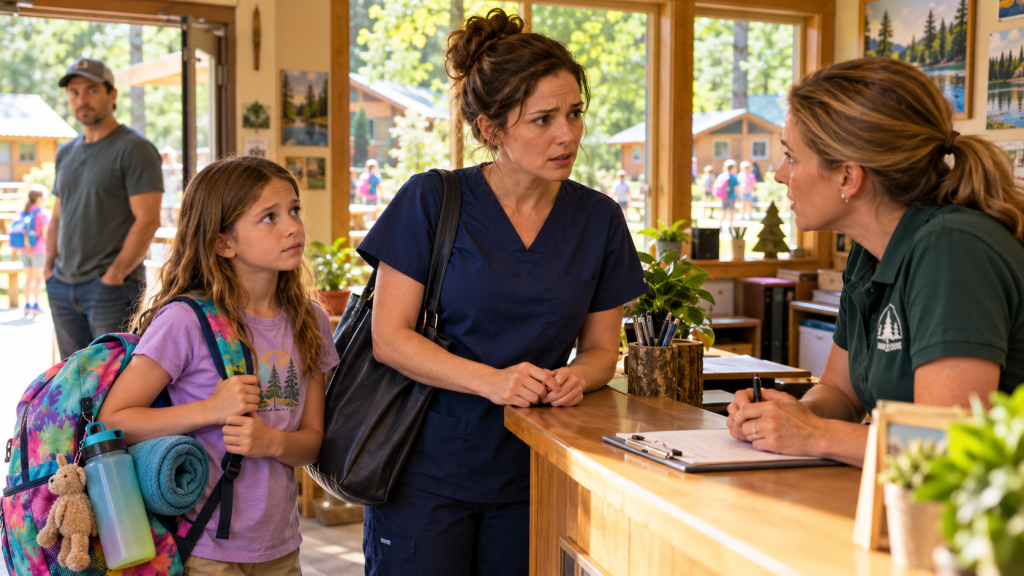
My throat tightened. “What exactly did she say?” Greta stared down at her sneakers. “She said, ‘Dad, you don’t get to run away again.’” Every hair along my arms lifted. Karen gently pulled another chair toward me.
“Sit down.”
“I’m fine.”
“You’re shaking.”
I looked at my hands.
She was right.
I sat.
Greta immediately moved closer.
I wrapped one arm around her.
“Start from the beginning.”
She swallowed.
“Owen was driving normal.”
“Okay.”
“And then we were almost here.”
“How close?”
“I could see the camp sign.”
“Then what?”
“There was a lady standing beside a blue car.”
Greta looked nervous.
“She waved at us.”
“Owen stopped.”
“Did he know her?”
Greta nodded.
“He looked scared.”
That frightened me more than if she had said angry.
Owen did not scare easily.
He was the person I called when a pipe burst under my kitchen sink at midnight.
The person who calmly changed a tire while trucks blew past us on the interstate.
The person who once drove across town during an ice storm because Greta had a fever and I was terrified to leave her alone while I picked up medicine.
Scared did not fit Owen.
“What happened next?”
“He got out.”
“Did he tell you to stay in the car?”
“Yes.”
“Did you?”
“For a little bit.”
I almost smiled despite everything.
Of course she didn’t.
Greta inherited curiosity from me and caution from absolutely nobody.
She continued.
“They were arguing.”
“What were they saying?”
“I couldn’t hear everything.”
“What did you hear?”
Greta’s brow wrinkled.
“She said, ‘You’ve had ten years.’”
My stomach twisted.
“And?”
“She said, ‘Either you tell Rachel today, or I will.’”
My heart stopped.
She knew my name.
The woman knew my name.
Greta continued.
“Then Owen said I shouldn’t be there.”
“The lady said that was his fault.”
“I got out because I thought something bad was happening.”
I pulled her closer.
“What did Owen do?”
“He got mad.”
“At you?”
“No.”
She thought.
“Scared-mad.”
That description was so perfectly childlike and so precise that it hurt.
“He told me to get back in the car.”
“Then the lady looked at me.”
Greta’s eyes filled.
“She asked if my name was Greta.”
I went cold.
“What did you say?”
“Yes.”
“Did she touch you?”
“No.”
“Did she come close?”
“No.”
Good.
At least that.
“She started crying.”
Greta continued.
“Then she took the picture out of her bag.”
The photograph.
Me.
Seventeen years old.
Hospital gown.
Sweaty hair.
Exhausted.
Holding a newborn child against my chest.
Greta.
I had not seen that photograph since the week she was born.
I thought it had disappeared with everything else from that terrible year.
“Did Owen give her that picture?”
Greta shook her head.
“She already had it.”
I stared at the image.
Then turned it over again.
Ask your mother who your father really is.
Not handwriting I recognized.
“Did she write this in front of you?”
“No.”
“It was already there.”
“What did Owen say?”
“He took it away from me.”
“But you have it.”
“I took it back.”
I closed my eyes.
Naturally.
My daughter was ten.
Not easily disarmed.
“What happened after that?”
Greta’s voice became smaller.
“Owen told me the lady was confused.”
“He said I should go inside camp.”
“I asked who she was.”
“He said nobody.”
My jaw tightened.
“And then?”
“He carried my suitcase to the gate.”
“Did he come inside?”
“No.”
“He told me I was old enough.”
My anger finally found somewhere to stand.
“You are ten.”
Greta nodded.
“I know.”
“He told me the camp people were right inside.”
“He said he needed to handle something.”
“He told me not to tell you because you were working.”
I closed my eyes.
There it was.
The part I could not forgive with excuses.
Whatever secret Owen had been carrying, he had placed it above the safety procedure for my child.
He left her at a camp entrance.
Alone.
Then texted me:
Greta’s checked in. She’s excited. Everything’s good.
A lie.
Karen said quietly,
“One of our junior counselors saw Greta walking in alone with luggage.”
“She brought her directly to registration.”
“When we checked the authorized drop-off sheet, Owen’s name was listed.”
“But no adult had signed her in.”
I nodded.
“You called me because of that?”
“Initially.”
My stomach tightened.
“Initially?”
Karen hesitated.
“Then we reviewed the front-gate camera.”
I looked at Greta.
She stared at the carpet.
Karen continued.
“We saw the argument.”
“No audio.”
“But the woman was visibly upset.”
“Owen left in her vehicle after putting Greta’s suitcase at the gate.”
“He left his own car?”
Greta nodded.
“The lady drove.”
That made no sense.
“Where is Owen’s car?”
“Still parked near the camp access road.”
Karen said.
I stood.
“Call the police.”
She held up one hand.
“I already contacted the county sheriff’s office.”
Good.
I almost hugged her.
Instead I said,
“Thank you.”
Greta whispered,
“Is Owen bad?”
That question stopped everything.
I looked at her.
Ten-year-olds deserve truth.
They also do not deserve adult conclusions before the adults have facts.
“I don’t know what Owen has done.”
“But I know leaving you alone and lying to me about checking you in was wrong.”
She nodded.
“Are you mad at him?”
“Yes.”
“Do you hate him?”
“No.”
Not yet.
Maybe never.
Those things are different.
Twenty minutes later, Deputy Carla Benton sat across from us.
She was calm.
Middle-aged.
No dramatic police voice.
She asked Greta only the questions she needed.
Then stopped.
No interrogation.
No making my child repeat the same frightening story for every adult who entered the room.
Afterward, she asked Karen for the camera footage.
Then she turned to me.
“Full name of the man?”
“Owen Blake.”
“Date of birth?”
“I don’t know.”
“Approximate age?”
“Fifty-eight.”
“Address?”
I gave it.
“Phone?”
I gave that too.
Deputy Benton typed.
Then frowned.
“Are you sure the surname is Blake?”
I stared.
“Yes.”
“Why?”
She looked at the screen.
“The vehicle registered to that phone contact and address is under Owen Mercer.”
My body went cold.
“Mercer?”
“Yes.”
I stared at the photograph in my hand.
Mercer.
I had known exactly one family with that name.
Seventeen years earlier.
I whispered,
“No.”
Greta looked at me.
“What?”
I could not answer.
Deputy Benton noticed.
“Does that name mean something to you?”
I sat down again.
“Ethan Mercer.”
The name tasted old.
Like opening a sealed room inside myself.
“Who is Ethan?”
Greta asked.
I looked at my daughter.
I had always told her a version.
Not a lie.
But a version sized for childhood.
Your father was young.
We were not together when you were born.
He died when you were a baby.
I had never given her the whole story because the whole story had holes I could not explain myself.
“Ethan was your biological father.”
Greta stared.
“Owen knows him?”
I could barely speak.
“I think Owen might be related to him.”
Deputy Benton asked,
“What was your relationship with Ethan Mercer?”
I looked down at the photograph.
“He was my boyfriend.”
“How old were you?”
“Seventeen.”
“And him?”
“Eighteen.”
“What happened?”
My throat tightened.
“He left.”
That was the story I had carried.
Then:
“He died six months after Greta was born.”
Greta’s fingers tightened around my hand.
“How?”
“A training accident.”
She knew he had died.
Not the details.
I never imagined the details might matter now.
Deputy Benton asked,
“Did you know his family?”
“No.”
That answer had always embarrassed me.
But it was true.
Ethan and I were teenagers.
His parents had divorced when he was little.
He lived mostly with his mother.
I met her once.
Briefly.
His father was “somewhere in Tennessee,” according to Ethan.
He rarely spoke about him.
When I got pregnant, Ethan panicked.
So did I.
We fought.
Then, three weeks later, he told me he was leaving town for a training program connected to the National Guard.
He promised it was temporary.
For two months, he called.
Then the calls stopped.
I assumed he had changed his mind about us.
His mother told me he needed space.
She said his life could not end at eighteen because I had “made a mistake.”
Then I moved in with my aunt.
Greta was born.
Six months later, I learned Ethan had died.
That was all.
No funeral invitation.
No letters.
No family contact.
Nothing.
I had spent seventeen years believing that before he died, Ethan had simply chosen not to come back.
Deputy Benton asked,
“Did Ethan ever mention an Owen?”
“No.”
Then something old and uncomfortable stirred.
“He said his father’s name was Daniel.”
The deputy frowned.
“Not Owen?”
“No.”
Then I remembered a detail so small I had never given it value.
Ethan once complained that his father used his middle name.
I could hear him saying it:
He changes names like other people change shirts. Daniel, Owen, whatever makes him feel like a new man.
I had laughed.
Teenage sarcasm.
Nothing more.
Until now.
I stared at Deputy Benton.
“Owen’s middle name may be Daniel.”
She began typing again.
Then looked up.
“Stay here.”
I hated those words.
She stepped into the hall.
Greta looked at me.
“Is Owen my grandpa?”
My eyes filled.
“I don’t know.”
“But maybe.”
She looked frightened.
Then angry.
“Why didn’t he tell us?”
“I don’t know.”
That became the sentence of the day.
I don’t know.
Parents hate saying it.
We prefer answers even when answers are fiction.
But I was done replacing uncertainty with comforting guesses.
Forty minutes later, Deputy Benton returned.
Her face had changed.
“We located Owen.”
My knees weakened.
“Is he okay?”
“Yes.”
“Where?”
“At an attorney’s office in town.”
I stared.
“An attorney?”
“He’s with a woman named Mara Mercer.”
Greta whispered,
“That’s her.”
I looked at the deputy.
“Who is Mara?”
Deputy Benton hesitated.
“According to preliminary records, she is Owen Mercer’s adult daughter.”
There it was.
Dad.
Not a code.
Not a misunderstanding.
She really was his daughter.
“And Ethan?”
The deputy looked at me carefully.
“Records indicate Ethan Mercer was also Owen Mercer’s son.”
My heart stopped.
Greta’s mouth fell open.
Owen.
My best friend.
The man who changed the batteries in my smoke detectors.
The man who taught Greta to cast a fishing line.
The man who held my hand after my appendectomy.
The man whose Christmas gifts were always practical and slightly boring.
He was her grandfather.
And for years, he had sat at my kitchen table knowing it.
My stomach turned.
“How long has he known?”
Deputy Benton shook her head.
“You need to ask him.”
I laughed once.
It sounded ugly.
“Oh, I will.”
She continued.
“There’s another issue.”
Of course there was.
“Mara told officers she was trying to deliver family documents to you.”
“What documents?”
“She says they belonged to Ethan.”
I stopped breathing.
Greta leaned into me.
Deputy Benton continued.
“Letters.”
I stared.
“What?”
“She says there are letters Ethan wrote to you.”
The world narrowed to one word.
Letters.
I had waited for letters.
I had checked mailboxes.
I had asked my aunt if anything arrived.
I had spent months deciding whether silence meant cowardice or rejection.
I whispered,
“How many?”
“According to Mara, fourteen.”
My eyes blurred.
Greta said,
“Mom?”
I could not answer.
Fourteen.
Not one.
Not a birthday card.
Fourteen letters.
I stood too fast and had to grip the desk.
“Where are they?”
“With Mara.”
“Why?”
“She found them in Owen’s storage after their mother died earlier this year.”
I stared.
“Their mother?”
“Owen’s former wife.”
I barely heard the rest.
Greta squeezed my hand.
“Mommy.”
I looked at her.
Her face was scared again.
And suddenly I realized I was leaving her behind emotionally the way Owen had left her at the gate.
I forced myself back into the room.
“I’m okay.”
She stared skeptically.
“You’re crying.”
“I can cry and still be okay.”
She considered that.
Then nodded.
Fair.
Deputy Benton asked whether I wanted to make a formal complaint about Owen leaving Greta unsupervised at the camp entrance.
“Yes.”
Immediately.
It did not matter who he was.
Grandfather did not erase responsibility.
Family does not create permission after the fact.
Then she asked whether I wanted to speak with Owen that day.
Every part of me screamed yes.
But I looked at Greta.
“Not with her.”
Greta protested.
“I want to know.”
“I know.”
“No.”
Her face hardened.
“Why?”
“Because adults have already put you in the middle of this once today.”
“I’m not doing it again.”
She looked furious.
That was okay.
A child can be angry at a boundary and still need it.
Karen arranged for Greta to stay in the camp office with a counselor until my sister could pick her up.
Greta did not want to go to camp anymore.
I did not force her.
Summer camp could survive without us.
Before leaving, she wrapped both arms around me.
“Are you coming back?”
The question broke my heart.
“Of course.”
“Owen said he was coming back too.”
I froze.
Then understood.
Promises had become unstable in one afternoon.
I knelt.
“I’m not asking you to trust the sentence because I said it.”
Her brow furrowed.
“What?”
“I’m telling you Aunt Lisa is picking you up.”
“You’re going to her house.”
“I am meeting with the police.”
“Then I am driving directly to Aunt Lisa’s.”
“You can track my phone.”
“If anything changes, I call.”
She studied me.
Then nodded.
A plan.
Not reassurance.
Plans rebuild safety better than pretty words.
I met Owen at the sheriff’s office.
Not the attorney’s office.
My choice.
Neutral ground.
A deputy nearby.
No child.
No secrets.
Owen was sitting at a metal table when I entered.
He looked ten years older than he had that morning.
No gentle smile.
No joking.
His hands were folded.
Mara sat beside him.
I recognized her immediately.
Same sharp cheekbones Ethan had.
Same dark eyes.
She stood.
“Rachel.”
My name in her mouth made me furious.
“Do not speak to me like we know each other.”
She sat down again.
Owen looked at me.
“I’m sorry.”
I put my purse on the floor.
Then the photograph on the table.
“Start with your name.”
He closed his eyes.
“Owen Daniel Mercer.”
I laughed bitterly.
“Blake?”
“My mother’s maiden name.”
“So you lied.”
“Yes.”
“How long have you known Greta is your granddaughter?”
His eyes filled.
“Since before she was born.”
Something inside me went silent.
“Before?”
“Yes.”
I stared at him.
“You knew about me?”
“Yes.”
“Ethan told you?”
“Yes.”
“When?”
“When you were pregnant.”
I sat back.
The man across from me had watched me struggle as a single mother for years.
Known exactly who my daughter was.
Known the entire time.
“Why didn’t you come then?”
His face crumpled.
“Because I wasn’t in Ethan’s life the way I should have been.”
“That doesn’t answer me.”
“No.”
He nodded.
“It doesn’t.”
He took a breath.
“I left his mother when Ethan was eight.”
“I drank.”
“I was unreliable.”
“I disappeared for months at a time.”
“I got sober when he was fifteen.”
“By then, he hated me.”
I said nothing.
“He started talking to me again when he was seventeen.”
“Mostly when he needed money.”
“Or advice he didn’t want from his mother.”
Owen gave a broken smile.
“That still felt like a gift.”
My throat tightened.
“He told me about you.”
“The pregnancy.”
“He was terrified.”
“I told him not to run.”
That surprised me.
“Then why did he?”
“He didn’t.”
The room disappeared.
“What?”
Owen looked directly at me.
“He didn’t run from you.”
I gripped the table.
“He left.”
“Yes.”
“For training.”
“Yes.”
“And then he stopped calling.”
Owen’s eyes filled.
“Because he was injured.”
My heart began pounding.
“What?”
“Vehicle accident during training.”
“He survived.”
“But he had a head injury.”
“He was hospitalized.”
“For how long?”
“Almost seven weeks.”
I stared.
“No.”
“Yes.”
“No one told me.”
“I know.”
“His mother knew?”
“Yes.”
My hands began shaking.
“And you?”
“Yes.”
I stood.
The deputy near the wall straightened.
I did not move toward Owen.
I only needed to stand because sitting felt impossible.
“You all knew I was pregnant.”
“Yes.”
“You knew I was waiting.”
“Yes.”
“You knew he was in a hospital.”
“Yes.”
“And nobody called me?”
Owen started crying.
“His mother blamed you.”
I laughed.
“Of course.”
“She said Ethan needed to focus on recovery.”
“She said hearing from you would make him leave rehabilitation early.”
“And you believed her?”
“No.”
That was worse.
“I was a coward.”
The sentence came softly.
No defense.
“I argued.”
“Then I let her decide.”
I stared at him.
“What happened when he recovered?”
“He contacted you.”
“No.”
“He tried.”
My body went cold.
“The letters.”
Owen nodded.
“He wrote fourteen.”
“Did you keep them?”
“No.”
“Then why does your daughter have them?”
Owen looked at Mara.
She opened a leather folder.
Inside were envelopes.
Old.
Yellowed.
My name written across them in handwriting I recognized instantly.
Ethan.
My knees nearly gave out.
I sat.
I touched the top envelope.
Did not open it.
Not yet.
“Where were these?”
Mara answered.
“In my mother’s things.”
I looked at her.
“Your mother?”
“Denise.”
Ethan’s mother.
The woman who told me her son needed space.
My stomach twisted.
“She intercepted them.”
Mara nodded.
“I think so.”
I stared at Owen.
“Did you know?”
“Not then.”
“When did you know?”
“After Ethan died.”
I closed my eyes.
Of course.
Always after.
Always too late.
“How?”
“I found a carbon copy of one letter in his duffel.”
“He mentioned sending you money.”
“Baby clothes.”
“He wrote that you hadn’t answered.”
“I knew something was wrong.”
“So what did you do?”
“I confronted Denise.”
“And?”
“She admitted she had been intercepting mail.”
Mara closed her eyes.
Owen continued.
“She said she destroyed most of it.”
“Apparently she didn’t.”
I stared at the fourteen envelopes.
“She kept them.”
“Yes.”
“Why?”
Mara whispered,
“My mother kept everything.”
“Even things she wanted buried.”
I looked at Owen.
“And after you knew?”
His face collapsed.
“I should have found you.”
“Yes.”
“I tried.”
I laughed bitterly.
“Did you?”
“Yes.”
“For about a year.”
“You had my name.”
“I had an old address.”
“You could have done more.”
“I know.”
“Did you hire anyone?”
“No.”
“Call hospitals?”
“No.”
“Check voter records?”
“No.”
“Search employment?”
“No.”
“Then don’t say you tried like you crossed a continent barefoot.”
He closed his eyes.
“You’re right.”
I hated how often his honest answers robbed me of something to fight against.
I wanted excuses.
Excuses are easier to hate.
He gave me failure instead.
Plain.
Unprotected.
Mara slid another envelope across the table.
“This one wasn’t mailed.”
I looked at her.
“What is it?”
“Ethan’s.”
“Found in his duffel after he died.”
My hands trembled.
I opened it.
The paper was thin.
Creased.
His handwriting leaned hard to the right.
Rachel,
If Mom tells you I don’t want this baby, don’t believe her.
I stopped.
The room blurred.
I forced myself to continue.
I’m scared out of my mind. I don’t know how to be a dad. I barely know how to be eighteen. But I keep thinking about that tiny heartbeat and I know I want to try.
I covered my mouth.
Owen was crying openly now.
I read on.
Dad says being afraid is not the same as leaving. He would know.
I looked at Owen.
He closed his eyes.
The letter continued.
I have training for eight weeks. When I get back, I’m coming to Birmingham. I want to talk about work and school and what you need. I don’t want you doing this alone.
My vision collapsed entirely.
For seventeen years, I had told myself Ethan left.
That he panicked.
That he chose a different life.
I built anger around that belief because anger hurt less than wondering whether I was unlovable.
He had planned to return.
Then an accident.
Then a mother who intercepted letters.
Then death.
I whispered,
“How did he die?”
Owen’s voice cracked.
“Second accident.”
“What?”
“Three months after he returned to training.”
“A transport vehicle rolled during a storm.”
“Ethan and another trainee died.”
I had known accident.
Not that there were two.
I pressed the letter to the table.
“Did he know Greta was born?”
Owen nodded.
“Yes.”
My breath stopped.
“He knew?”
“Yes.”
“How?”
“I told him.”
“You?”
“Yes.”
“Denise wouldn’t.”
“So I did.”
I stared.
“What did you tell him?”
“That she was a girl.”
“That you named her Greta.”
“That she was healthy.”
“He cried.”
I started crying too.
“Did he ever see a picture?”
Owen nodded toward the photograph.
“That one.”
My hands froze.
“This was his?”
“Yes.”
“How did he get it?”
“Your friend Maya mailed it to the address he gave her.”
I stared.
Maya.
A friend I had lost touch with years ago.
I vaguely remembered her saying Ethan had asked for an address.
I never knew she sent a photograph.
Owen whispered,
“He carried it.”
“That’s why Mara has a copy.”
I stared at the picture.
I had thought it was lost.
It had spent years with him.
That broke something open inside me.
Not grief exactly.
Grief I knew.
This was retroactive grief.
The pain of discovering the past had contained love you never received.
I looked at Owen.
“Then why did you become my friend?”
He lowered his head.
There.
The question he had feared most.
“I found you five years ago.”
I stared.
“How?”
“Internet.”
“So suddenly the internet worked.”
He winced.
“Yes.”
“At that point?”
“Yes.”
“Why?”
“Because I saw an article about you.”
My hospital had featured me in a community story after a pediatric resuscitation training initiative.
My picture.
My name.
Greta mentioned.
Single mother.
Owen found us.
“What did you plan to do?”
“Tell you.”
“But?”
“I saw you at the coffee shop across from the hospital.”
“You looked…”
He stopped.
“What?”
“Happy.”
I laughed bitterly.
“That stopped you?”
“No.”
“I was afraid.”
“Of what?”
“That you’d ask where I had been.”
“You should have been.”
“Yes.”
“And?”
“That you’d tell me I had no right to Greta.”
“You didn’t.”
“I know.”
“So you lied instead.”
“Yes.”
“How did we even become friends?”
He looked ashamed.
“I engineered it.”
That word made me nauseous.
“What does that mean?”
“I learned where you volunteered.”
“The hospital fundraiser.”
“You were fixing the broken display stand.”
“Yes.”
“I offered to help.”
I remembered.
Of course I remembered.
Owen with a screwdriver.
Warm smile.
A joke about hospital equipment being designed by people who hated nurses.
It had felt accidental.
It wasn’t.
He continued.
“Then we saw each other again.”
“Because you made sure we did.”
“Yes.”
I pushed my chair away.
Everything good became contaminated for one second.
Birthday parties.
School plays.
Emergency pickups.
The time he sat with Greta during my mother’s funeral.
The time he built her science-fair display.
The time he drove two hours to bring me forgotten medication during a trip.
Were those kindnesses real?
Or surveillance?
I asked him.
“Did you ever actually care about me?”
He looked horrified.
“Yes.”
“Or were you watching your granddaughter?”
“Both.”
At least he did not lie.
“I started because of Greta.”
“Then you became my friend.”
“I should have told you.”
“Every day.”
“Yes.”
“Every birthday?”
“Yes.”
“Every Christmas?”
“Yes.”
“Every time you called yourself practically family?”
His face broke.
“Yes.”
I stood.
“I need air.”
Mara followed me into the hall.
I turned.
“No.”
She stopped.
“Rachel.”
“You gave my daughter that photograph.”
“Yes.”
“You told her to ask who her father really was.”
“Yes.”
“What made you think you had the right?”
Her face changed.
Anger met anger.
“I had just found out my father had been secretly spending years with a niece I didn’t know existed.”
“That does not give you the right to unload adult secrets onto a ten-year-old.”
“I didn’t know she was ten.”
I stared.
“She is a child.”
“I know that now.”
“You knew then.”
Mara looked away.
She had no answer.
I continued.
“You were angry at Owen.”
“Yes.”
“So you used Greta to punish him.”
Her eyes filled.
“That wasn’t—”
“Intent?”
I laughed.
“I don’t care.”
“You put a photograph in a child’s hand that questioned her identity.”
“You told her to interrogate her mother.”
“You turned my daughter into a message.”
Mara went pale.
“You’re right.”
Good.
“I’m sorry.”
“Apologize to Greta someday if she wants to hear it.”
“Not today.”
She nodded.
Then handed me a card.
“My number.”
I did not take it.
She set it on the bench.
Fair enough.
I drove to my sister’s house that evening.
Greta was in the kitchen eating cereal.
Dinner cereal.
A family tradition for disastrous days.
She looked up.
“Is Owen my grandpa?”
Straight to it.
I sat beside her.
“Yes.”
She stared into the bowl.
“And the lady?”
“His daughter.”
“So she’s…”
“Your aunt.”
Greta’s eyes widened.
“I have an aunt?”
“Yes.”
“Do I have cousins?”
“I don’t know.”
This time the sentence almost made us both laugh.
Then she asked,
“Did you know Owen was Grandpa?”
“No.”
“Did he know?”
“Yes.”
Her face hardened.
“How long?”
“Your whole life.”
She pushed the cereal away.
“That’s creepy.”
I almost corrected her.
Then didn’t.
It was her word.
Her feeling.
She had earned both.
“He lied.”
“Yes.”
“Why?”
“Because he was ashamed and afraid.”
“That’s stupid.”
“Yes.”
Children are wonderfully efficient sometimes.
Then:
“Was my dad bad?”
My heart broke.
“No.”
“What did he do?”
I took a breath.
“Your father was very young.”
“He was scared.”
“He went away for training.”
“He got hurt.”
“Some adults kept information from us.”
“He tried to write to me.”
Greta looked up.
“He wanted me?”
My eyes filled.
“Yes.”
That was the question underneath everything.
Not identity.
Not names.
Wanted.
“Yes.”
“He knew you were born.”
“He saw your picture.”
“He knew your name.”
“He wanted to meet you.”
Greta started crying.
I pulled her close.
This time she did not stiffen.
She curled against me.
“Why didn’t he?”
“Because he died before he could.”
She sobbed.
Ten years of grief arrived for someone she had never met.
That is possible.
You can miss a person retroactively.
Especially when you discover they missed you first.
She asked,
“Did Owen know Dad wanted me?”
“Yes.”
“And he still didn’t tell us?”
“Yes.”
Her little hands curled into fists.
“I hate him.”
I did not say:
No, you don’t.
I did not say:
He loves you.
Both would have stolen her right to feel.
I said,
“You can be angry.”
She cried harder.
Three days later, Owen was formally cited for leaving Greta unattended during the camp drop-off and faced additional consequences from the camp’s complaint.
It was not treated like kidnapping.
Because he had not abducted her.
He had been authorized to transport her.
He had left her at the correct camp property.
She was safe.
But the fact that something was not the worst crime imaginable did not make it acceptable.
The sheriff’s office documented it.
The camp permanently removed him from authorized pickup lists.
So did I.
Immediately.
No school pickups.
No camp.
No emergency contact.
No unsupervised access to Greta.
Owen accepted every restriction.
He did not argue.
That helped.
Not enough.
But it helped.
I also changed my locks.
Not because he had ever entered without permission.
Because I needed my home to feel like mine again.
I told Owen by text:
Do not come here. Do not contact Greta directly. If you need to communicate, contact me by email.
He replied:
Understood. I am sorry.
Nothing else.
No guilt.
No “after everything I did for you.”
No demand to explain.
That mattered.
The letters took weeks to read.
I could not do all fourteen at once.
The first made me cry.
The second made me furious.
The third made me put the box away for four days.
Ethan wrote about stupid things.
A vending machine eating his dollar.
A sergeant who hated him.
A song that reminded him of me.
Baby names.
He hated the name Greta at first.
That made me laugh so hard I cried.
In letter six, he wrote:
Greta sounds like someone who runs a library and scares men.
I read that to Greta.
She looked offended.
“I like libraries.”
“Apparently your father predicted that.”
She smiled.
Then asked:
“Did he change his mind?”
I showed her the next line.
Actually, I kind of love it now.
She held the page against her chest.
That letter became hers.
The others stayed with me until she was older.
Some parts belonged to adult history.
Children should not inherit every raw detail just because the details concern them.
Ethan wrote about his mother.
About anger.
About me.
About guilt.
About sex.
About fear.
About wondering whether we would survive as a couple.
That last part mattered.
He loved me.
He also was not certain we would remain together.
Real love is less cinematic than memory makes it.
But he was clear about one thing.
He wanted to help raise his child.
That was enough.
Mara contacted me after a month.
Email.
No manipulation.
I owe Greta an apology. I will wait until you and she decide whether she wants it.
Then:
I also owe you one. I was angry at Dad and turned information into a weapon. I told myself I was exposing a lie. What I actually did was drag a child into an adult fight.
Specific.
Good.
I replied:
Thank you. Not yet.
She answered:
Understood.
That was it.
Boundaries respected are more persuasive than apologies repeated.
Owen began therapy.
I learned that only because he told me once in an email after I asked what he was doing to ensure he would not put Greta in that position again.
He wrote:
I have spent most of my life deciding that shame is a reason to delay telling the truth. I am working on that.
I saved the sentence.
Not because it fixed anything.
Because it correctly named the disease.
Shame.
People think shame makes people honest.
Often it does the opposite.
Guilt says:
I did something wrong.
Shame says:
If people know what I did, I will become unlovable.
So shame hides.
Then the hiding creates new wrongs.
Owen had been ashamed he failed Ethan.
Ashamed he did not find me sooner.
Ashamed he approached me deceptively.
Every year the truth became harder.
So he delayed.
Then delayed again.
Until a decade of delay was sitting in a minivan wearing a camp T-shirt.
Greta refused to see him for six months.
I let her.
I did not make her responsible for his loneliness.
He sent birthday gifts through me.
She returned the first one.
A telescope.
She loved astronomy.
He knew that.
She stared at the box for three minutes.
Then said,
“I don’t want something that makes me feel like I have to forgive him.”
I nearly cried.
Ten years old.
Already understanding a boundary some adults never learn.
I mailed it back.
Owen emailed:
I understand. No more gifts unless she asks.
He kept his word.
At Christmas, nothing.
Greta noticed.
“Did he forget me?”
The question hurt.
“No.”
“How do you know?”
“Because he asked me whether he could send something.”
“And?”
“I told him not unless you wanted it.”
She stared.
“Oh.”
Then she went back to decorating cookies.
Two weeks later, she said:
“He can send a card.”
So he did.
One card.
No money.
No guilt.
Inside:
Greta, I am sorry I lied about who I was and left you at camp without making sure an adult had checked you in. You did nothing wrong. You do not owe me a reply. Love, Owen.
She read it twice.
Then said,
“He wrote Owen.”
“Yes.”
“Not Grandpa.”
“Yes.”
“Good.”
That mattered.
He did not assign himself a title she had not given him.
A year passed.
Greta asked to meet Mara first.
That surprised me.
“Why her?”
“She’s my aunt.”
“And Owen is your grandfather.”
“She made one bad choice.”
“He made like a hundred.”
Fair.
Mara came to a café.
No private home.
No surprise.
She brought nothing.
Smart.
Greta sat across from her.
Mara looked terrified.
“I’m sorry.”
Greta folded her arms.
“For what?”
Mara swallowed.
“For giving you that photograph.”
“And?”
“For telling you to ask your mother who your father really was.”
“And?”
Mara looked at me.
I stayed silent.
This was hers.
“For being angry at my dad and making you carry it.”
Greta nodded.
“Okay.”
Mara looked startled.
“That’s it?”
“I don’t know you enough to be mad for a year.”
I nearly laughed.
Mara did too.
Then started crying.
Greta rolled her eyes.
“Adults cry a lot.”
Correct.
The meeting lasted forty minutes.
Mara told Greta about Ethan as a brother.
How he hated mushrooms.
How he slept through alarms.
How he once dyed his hair blond and looked terrible.
How he loved old pickup trucks.
Greta listened.
Then asked:
“Did he talk about me?”
Mara’s eyes filled.
“Yes.”
“Before he died, he called me.”
“What did he say?”
“He said he had a daughter.”
“He said her name was Greta.”
Mara smiled.
“He said he was scared she would grow up before he figured out how to be useful.”
Greta whispered,
“He didn’t get to.”
“No.”
Then Mara added:
“But he wanted to.”
That became enough.
Greta met Owen again at twelve.
Two years after summer camp.
Her choice.
Supervised by me.
At a public park.
Owen stood when we arrived.
Greta immediately said,
“Sit down.”
He sat.
I almost smiled.
She had rehearsed.
He looked older.
Thinner.
No birthday-friend charm.
No easy jokes.
Just a nervous man.
Greta sat across from him at a picnic table.
“Are you my grandpa?”
“Yes.”
“Did you know when you met me?”
“Yes.”
“Did you become Mom’s friend because of me?”
“Yes.”
“Did you ever plan to tell us?”
“Yes.”
“When?”
Owen closed his eyes.
“I kept saying soon.”
Greta frowned.
“That isn’t a time.”
“No.”
She looked at me.
Then back at him.
“Why did you leave me at camp?”
That was the question.
Not Ethan.
Not letters.
The actual harm she experienced.
Owen’s eyes filled.
“Because Mara had just confronted me.”
“I panicked.”
“I thought if I could stop her from talking to your mom, I could explain everything myself later.”
“So you picked your secret over me.”
His face crumpled.
“Yes.”
No excuse.
Greta looked away.
Then:
“That was bad.”
“Yes.”
“You’re supposed to make sure kids get inside.”
“Yes.”
“You texted Mom that I did.”
“Yes.”
“That was lying.”
“Yes.”
She stared at him for a long time.
Then asked,
“Do you think I’m stupid?”
Owen looked horrified.
“No.”
“Then why did you think I wouldn’t tell?”
He swallowed.
“Because I was only thinking about myself.”
There.
That answer mattered.
Greta leaned back.
“I don’t forgive you yet.”
“I understand.”
“You can come to my soccer game.”
My heart nearly stopped.
Owen’s did too, judging by his face.
“Okay.”
“But don’t tell people you’re Grandpa.”
He nodded.
“What should I say?”
She thought.
“Owen.”
He smiled through tears.
“Owen it is.”
That was how he returned.
Not through a door he claimed.
Through one Greta opened two inches at a time.
Soccer.
Then a school play.
Then lunch.
Eventually birthdays.
No unsupervised drives for another three years.
No emergency pickups until sixteen.
Trust rebuilt through repetition.
Not speeches.
Mara became Aunt Mara faster.
She had two children.
Yes, Greta had cousins.
Twin boys who immediately destroyed any romantic fantasy she had about cousins.
At their first holiday together, one shot a foam dart into her mashed potatoes.
Greta looked at me.
“I waited ten years for this?”
I laughed until I cried.
Family can survive becoming ordinary.
That is the goal.
Owen and I had a harder relationship.
Because Greta was not the only one betrayed.
I had loved him as a friend.
That grief was strange.
He was still alive.
Still kind.
Still the person who had shown up repeatedly.
But every memory now contained an asterisk.
One afternoon, years later, we sat outside a coffee shop.
I asked him,
“Were any of those years real?”
He looked wounded.
“All of them.”
“That’s not what I mean.”
“I know.”
He stirred his coffee.
“I began with a lie.”
“Yes.”
“But I loved you both.”
“Love is not the same thing as honesty.”
“No.”
He looked at me.
“I think I kept telling myself the kindness would eventually outweigh the lie.”
I nodded.
“That is a dangerous calculation.”
“Yes.”
He continued.
“I fixed things.”
“I showed up.”
“I tried to be useful.”
“Every good thing became evidence in my own head that I deserved to stay without telling you.”
That sentence hit me.
He had confused helpfulness with permission.
People do that.
They believe enough favors can purchase continued access to truth they have withheld.
It cannot.
I said,
“I don’t think you were fake.”
He looked up.
“I think you were real and dishonest at the same time.”
His eyes filled.
“That’s worse.”
“Maybe.”
“But it’s more accurate.”
We never became exactly what we had been.
We became something else.
He was Greta’s grandfather.
A man connected to me by history.
Someone I could eventually share a meal with.
Not the person I called at midnight.
That place never returned.
Some trust, once broken, can be repaired only into a different shape.
That is not failure.
Years later, when Greta was seventeen—the age I had been when I met Ethan—she asked to read every letter.
I hesitated.
“You’re sure?”
“Yes.”
“Some are adult.”
“I’m almost adult.”
“That argument has been rejected by mothers worldwide.”
She groaned.
We compromised.
She read them.
All fourteen.
Some with me.
Some alone.
The last one destroyed both of us.
Ethan wrote it three days before the accident that killed him.
Rachel,
Dad says I need to stop waiting until I have a perfect plan because babies do not care about plans.
Greta smiled through tears.
I have two hundred eighty dollars saved. This is not impressive. Please pretend it is.
She laughed.
Then continued.
I’m coming home next month. If you don’t want me as your boyfriend anymore, I’ll understand. I’ve been gone and everything is a mess. But I want to be Greta’s father if you let me.
Greta stopped reading.
Her shoulders shook.
I put my arm around her.
She whispered,
“He didn’t know.”
“No.”
“He thought he had time.”
“Yes.”
She cried into my shoulder.
After a while, she asked:
“Would you have stayed with him?”
I thought.
“I don’t know.”
She looked surprised.
“You loved him.”
“Yes.”
“That doesn’t answer it.”
“No.”
She smiled weakly.
Good.
She had learned.
I continued.
“We were teenagers.”
“We might have tried.”
“We might have broken up.”
“We might have gotten married and regretted it.”
“We might have built something good.”
“We don’t get to know.”
Greta nodded.
“But he wanted me.”
“Yes.”
That was the part we did know.
Sometimes certainty should remain small.
Not:
He would have been a perfect father.
Not:
We would have been a perfect family.
Just:
He wanted you.
He tried.
He loved you before he met you.
That was enough truth to build on.
When Greta graduated from high school, Owen sat three rows behind me.
Not because he was excluded.
Because seating was chaotic.
Afterward, Greta came running out in her gown.
She hugged me first.
Then Aunt Lisa.
Then Mara.
Then Owen.
For the first time in public, she said:
“Grandpa, hold this.”
And dumped her cap, flowers, and phone into his arms.
Owen froze.
He looked at me.
I smiled.
Not permission.
Recognition.
She had chosen the word.
His eyes filled.
Greta groaned.
“Don’t cry.”
He laughed.
“Too late.”
Family again.
Different.
Earned.
At twenty-one, Greta asked me one question I had always feared.
“Do you regret trusting Owen?”
We were sitting in my kitchen.
Same house.
Different paint.
She was home from college.
I thought carefully.
“No.”
Her eyebrows lifted.
“Really?”
“I regret that he lied.”
“I regret letting him drive you that day without knowing who he truly was.”
“I regret the pain.”
“But trusting someone who had spent years showing up for us was not irrational.”
She nodded.
“So you don’t think you were stupid?”
“No.”
That took years to say.
“When people deceive you, they often benefit from your normal human willingness to believe relationships are what they appear to be.”
“That doesn’t make trust foolish.”
“It makes deception effective.”
Greta thought about that.
“Would you trust him with my kid?”
I laughed.
“You don’t have a kid.”
“Hypothetical.”
“With a camp drop-off?”
She grinned.
“Absolutely not.”
We both laughed.
Owen did too when we told him.
“Fair.”
He never argued.
That became part of his redemption.
Not that we forgot.
That he stopped demanding that forgetting become proof of forgiveness.
The camp changed its procedures after that summer.
No child under twelve could be left at the entrance.
Authorized adults had to physically complete check-in.
Any discrepancy between a parent’s confirmation and the camp’s record triggered immediate contact.
Karen told me later they had assumed adults followed the obvious rules.
After Greta, they stopped assuming.
I thanked her.
She said,
“I didn’t do anything special.”
I looked at her.
“You noticed the story didn’t match the child standing in front of you.”
“That is special enough.”
I never forgot that.
The person who saved us from letting the lie stretch another day was not a detective.
Not a lawyer.
Not a family member.
A camp administrator checking a clipboard.
Ordinary diligence.
People underestimate it.
At twenty-five, Greta married a man named Noah.
Owen attended.
Mara cried more than anyone.
I carried Ethan’s final letter inside my purse.
Not because I was stuck in the past.
Because I wanted him there in the only way possible.
Before the ceremony, Greta asked:
“Do you still have Dad’s picture?”
I showed her.
The same photograph.
Seventeen-year-old me.
Newborn Greta.
The one Mara had handed her outside camp.
The photograph that once detonated our life.
On the back, the old message had faded slightly.
Ask your mother who your father really is.
Greta looked at it.
Then asked for a pen.
“What are you doing?”
She crossed out the sentence.
Not angrily.
One clean line.
Then underneath, she wrote:
He wanted me. I know.
She handed it back.
I started crying.
“Mom.”
“I know.”
“You cry.”
“Yes.”
“Constantly.”
“Correct.”
She laughed.
Then walked toward the chapel.
Owen stood near the doorway.
Older now.
Gray.
Hands trembling slightly.
Greta stopped.
“Grandpa.”
“Yes?”
“You okay?”
He smiled.
“More than okay.”
She hugged him.
I watched from a few feet away.
There was a time I believed family meant knowing exactly where everyone belonged.
Mother.
Father.
Friend.
Grandfather.
Aunt.
Then Owen shattered those labels.
For a while, I thought the answer was to make the categories rigid again.
Good people here.
Liars there.
Safe people.
Unsafe people.
But life taught me something more difficult.
A man can love a child and still betray her trust.
A woman can expose a truth and still choose the wrong person to carry it.
A mother can be deceived without being negligent.
A dead eighteen-year-old can become more real to his daughter through fourteen old letters than through a hundred invented heroic stories.
And forgiveness does not restore every privilege.
That last one matters.
Owen became Grandpa.
He never became my midnight emergency contact again.
Mara became family.
She never forgot that her first interaction with Greta was something she regretted.
Greta loved them.
She also understood why I had removed them from our lives temporarily.
No contradiction.
Healthy families can survive nuance.
The summer-camp call used to replay in my head.
I think you need to come here. It’s about the man who brought her.
For years, I thought the worst part was discovering Owen was not who he said he was.
It wasn’t.
The worst part was how many adults had decided, at different points, that their fear justified controlling someone else’s truth.
Denise intercepted Ethan’s letters because she believed she knew what future was best for her son.
Owen hid his identity because he believed his shame gave him the right to choose when I learned who he was.
Mara confronted Greta because she believed exposing a lie mattered more than choosing the right person to expose it to.
And I had spent years giving Greta a simplified version of Ethan because I thought incomplete truth would hurt less.
Some of those choices were more serious than others.
But they shared one root.
Adults deciding:
I know what you can handle.
I know what you should know.
I will control the truth for now.
After that summer, I stopped thinking honesty meant dumping every fact onto a child.
That is not honesty.
That can be cruelty.
Honesty means giving people the truth they are entitled to, at the level they can carry, without lying to preserve your own comfort.
Greta taught all of us that.
The morning I let Owen drive her to camp, I thought I was accepting help from a friend.
He thought he was doing one ordinary favor for a granddaughter who did not know he was her grandfather.
Mara thought she was finally ending a lie.
Karen thought she was resolving an incomplete check-in.
None of us understood that before the day ended, a seventeen-year-old love story I thought had died in silence would reopen.
Ethan had not abandoned us.
Owen had not been only a friend.
Mara was not a stranger.
And Greta’s family was suddenly bigger, messier, and more complicated than anything I had prepared her for.
But the most important thing that day was simpler.
My daughter was safe.
She told me what happened.
And once she did, I listened.
Everything good that came afterward started there.
THE END STORIES! THANK YOU FOR READING GOOD LUCK! ❤️
Related Posts