I took my terminally ill 10-year-old son to a football game as his final wish — then we appeared on the stadium’s big screen, and the announcer said, “”There’s something you don’t know about this trip.””

My 10-year-old son, Ethan, was battling cancer. My husband and I spent almost all of our time at the hospital.
Recently, the doctor came to speak with us and said:
“”I’m truly sorry, but the treatment isn’t working. I’m afraid he may not have much time left. But we’ll continue doing everything we can to help him.””
I didn’t know what to do after hearing those words. My heart felt like it was breaking into pieces.
I was sitting beside Ethan’s hospital bed when a woman walked into the room. She introduced herself as a volunteer from an organization the hospital worked with to help seriously ill children fulfill their most cherished wishes.
She asked Ethan:
“”Sweetheart, if you could do one really special thing, what would it be?””
Ethan didn’t hesitate. He smiled and said that his biggest dream had always been to go to a football game with his parents. A real game in a huge stadium.
Ethan absolutely loved football. He knew the names of all his favorite players by heart and never missed a game on TV with his dad. But he’d never been to a stadium before.
So the woman helped us organize the trip, and with Ethan’s doctor’s permission, we went to the game.
When we finally walked into the huge stadium and sat down in our seats, I saw Ethan’s face light up.
The smile never left Ethan’s face. It felt so good to see him smile again.
Then suddenly, during a break in the game, Ethan grabbed my hand and shouted:
“”Mom! LOOK!””
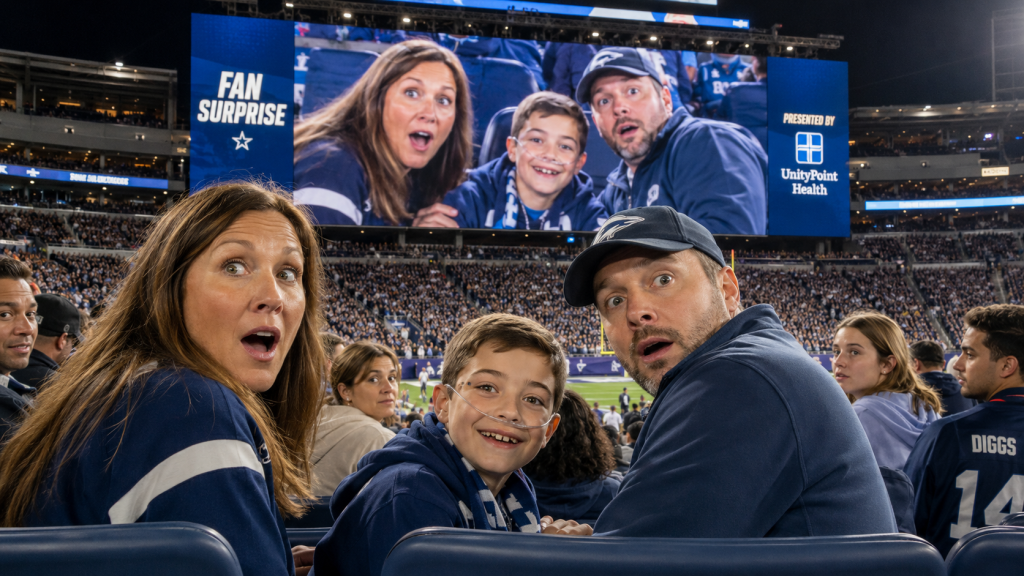
The three of us suddenly appeared on the stadium’s ENORMOUS SCREEN.
It was incredible. We waved and smiled.
I thought that was it.
But I was wrong.
A few seconds later, a man’s voice came over the STADIUM SPEAKERS:
“”Ethan, I’m so happy you’re here today. But there’s SOMETHING about this trip that neither you nor your parents know. All three of you, please TURN AROUND and look behind you.””
I didn’t understand what was happening.
People around us turned and stared at us. I felt so awkward.
Then all three of us turned around.
My husband went pale.
I felt like I’d stopped breathing when I saw WHO was walking down the stadium steps toward us.
PART 2: THE PLAYER WHO CALLED MY HUSBAND BROTHER
For one impossible second, the entire stadium disappeared.
The screaming fans.
The music.
The giant screen.
The smell of popcorn and grass.
Everything blurred into one bright, unreal background as the man came down the concrete steps toward us.
Ethan stopped breathing.
Then he screamed.
“NO WAY!”
I knew the man immediately.
Anyone who followed football would have.
Caleb Ross.
Number seventeen.
Starting quarterback.
Four-time Pro Bowler.
The player whose poster had been hanging above Ethan’s hospital bed for almost two years.
The man whose jersey my son was wearing at that exact moment.
Ethan grabbed my arm so hard it hurt.
“Mom!”
His whole face changed.
Not sick.
Not tired.
Not ten years old with an illness nobody could fix.
For those few seconds, he was simply a child watching his hero walk toward him.
“Dad!”
Ethan turned toward my husband.
“Dad, it’s CALEB ROSS!”
But Daniel wasn’t smiling.
He wasn’t even looking at Ethan.
He was staring at Caleb.
And the color had completely drained from his face.
I looked between them.
Something was wrong.
Caleb reached our row.
The people around us were standing now, cheering, holding phones in the air.
He smiled at Ethan.
That famous smile.
The one I had seen in commercials and interviews.
But then his eyes moved to Daniel.
The smile disappeared.
Daniel whispered one word.
“Caleb.”
I turned.
“You know him?”
Neither answered.
Ethan was nearly bouncing in his seat.
Caleb crouched in front of him.
“Ethan?”
“Yes!”
Caleb smiled.
“I’ve been waiting to meet you.”
Ethan stared at him.
“You know my name?”
“I know a little more than your name.”
Then Caleb looked at Daniel again.
Something passed between them.
Pain.
Recognition.
Years.
I could feel all of it without understanding any of it.
Daniel stood.
“What are you doing here?”
His voice was quiet.
Much too quiet.
Caleb rose too.
“Daniel.”
My stomach dropped.
Not Mr. Bennett.
Not sir.
Daniel.
Ethan looked at me.
“Why does he know Dad?”
I had no answer.
Then Caleb said something I will never forget.
“I heard about Ethan’s wish.”
Daniel’s jaw tightened.
“That doesn’t answer me.”
“No.”
Caleb swallowed.
“It doesn’t.”
The stadium announcer’s voice came over the speakers again.
“Ethan, we hope you enjoy today’s surprise from the team, the players, and everyone who helped make this day possible!”
The crowd erupted.
Ethan waved at the big screen.
Caleb waved too.
Daniel did not.
The camera moved away.
The stadium returned to the game.
But our little section remained frozen.
Caleb bent toward Ethan.
“I have something for you.”
He pulled a football from behind his back.
Signed.
Not by one player.
By almost the entire team.
Ethan’s mouth fell open.
“For me?”
“All yours.”
My son held it like someone had handed him the moon.
“Mom, look!”
“I see it.”
My voice broke.
Caleb smiled at him.
“There’s more after the game if you feel up to it.”
Ethan’s eyes widened.
“More?”
Caleb nodded.
“Locker room.”
“Field.”
“And I’ve been told you talk a lot of trash about my passing accuracy.”
Ethan gasped.
“Dad told you?”
Caleb looked at Daniel.
“No.”
Then:
“I watched a video.”
I frowned.
“What video?”
Ethan immediately looked guilty.
The volunteer organization had interviewed him during the wish process.
Apparently he had spent part of that interview explaining why Caleb’s third-quarter decision-making needed improvement.
My child was dying and still coaching professional athletes from a hospital bed.
Caleb laughed.
“You said I panic when the pocket collapses.”
Ethan turned red.
“I said sometimes.”
“You said every time.”
“I was emotional.”
Caleb laughed so hard a few people around us joined in without knowing why.
Then he looked at me.
“Mrs. Bennett?”
“Yes.”
“Would it be okay if I sit with you for a little while?”
I looked at Daniel.
His jaw was rigid.
He whispered:
“No.”
Ethan’s smile vanished.
“Dad?”
Daniel immediately saw what he had done.
He closed his eyes.
Caleb stepped back.
“That’s okay.”
“No.”
I said.
Daniel looked at me.
I lowered my voice.
“We are not doing this here.”
His eyes flashed.
“You don’t understand.”
“You’re right.”
I whispered.
“I don’t.”
“Because apparently my husband knows one of the most famous football players in the country and somehow forgot to mention it.”
Ethan looked between us.
“Wait.”
His voice was suddenly smaller.
“Dad really knows him?”
Caleb answered before Daniel could.
“Yes.”
Daniel turned sharply.
“Don’t.”
Caleb stopped.
I looked at my husband.
There was fear in his face.
Not anger.
Fear.
That frightened me more.
Ethan whispered:
“How?”
Daniel closed his eyes.
Caleb lowered his head.
And I knew before either of them spoke that whatever answer came next was going to rearrange something in our family.
Daniel finally sat.
His hand shook as he rubbed it across his mouth.
Then he looked at Ethan.
“Caleb and I grew up together.”
Ethan frowned.
“Like friends?”
Daniel looked toward the field.
“No.”
Silence.
Then Caleb said gently:
“We’re brothers.”
I stopped breathing.
Ethan stared.
I stared.
I actually laughed once because the sentence was too impossible to enter my brain normally.
“What?”
Daniel looked at me.
“I was going to tell you someday.”
That was a terrible sentence.
“When?”
He closed his eyes.
“I don’t know.”
Ethan looked at Caleb.
Then Daniel.
Then Caleb again.
“You’re my uncle?”
Caleb’s eyes filled.
“Yes.”
Ethan’s mouth opened.
Nothing came out.
Then:
“My uncle is Caleb Ross?”
Despite everything, I almost laughed.
Daniel did not.
Caleb smiled weakly.
“If your dad still admits it.”
Daniel looked away.
That answer told me more than I wanted to know.
Ethan stared at Caleb’s jersey.
Then at his own.
Then back at Daniel.
“Dad.”
“Yes?”
“You knew number seventeen was your brother?”
Daniel nodded.
“And you let me buy his jersey?”
“I didn’t buy it.”
Moments like that are where children reveal exactly what adults deserve.
Ethan stared.
“You’re unbelievable.”
I covered my mouth.
Caleb laughed.
Daniel almost did.
Almost.
Then Ethan’s face changed.
“Why didn’t you tell me?”
There it was.
The real question.
Daniel’s eyes filled.
“Because Caleb and I haven’t been family for a long time.”
Ethan looked confused.
“But you’re brothers.”
Daniel swallowed.
“Being related and being family aren’t always the same thing.”
Caleb’s face tightened.
He did not argue.
I watched him carefully.
He looked hurt.
But not offended.
That mattered.
Ethan leaned against me.
The excitement had drained some of his energy.
His body was fragile.
Even happiness exhausted him now.
I wrapped an arm around him.
Caleb noticed immediately.
“We can talk later.”
Daniel nodded.
“Yes.”
Caleb looked at Ethan.
“Enjoy the game.”
“Are you coming back?”
The hope in Ethan’s voice broke all three adults.
Caleb looked at Daniel.
Not at me.
Daniel’s face tightened.
Then he nodded once.
“If Ethan wants.”
Caleb looked back at my son.
“I’ll come back.”
Ethan smiled.
“Promise?”
Caleb’s expression crumpled for half a second.
“I promise.”
He walked away.
The crowd began cheering as the teams returned to the field.
Ethan watched Caleb run toward the sideline.
I watched my husband.
Daniel stared down at his hands.
I whispered:
“You have a brother.”
“Yes.”
“A famous brother.”
“Yes.”
“Our son has spent four years worshipping your brother.”
“I know.”
“And you said nothing.”
He looked at me.
“I know.”
“Why?”
His eyes filled.
“Not here.”
I wanted to scream.
But Ethan was between us.
And maybe for the first time since his diagnosis, I understood how little time mattered when choosing which arguments deserved the next ten minutes.
So I stopped.
I kissed Ethan’s hair.
We watched football.
For the rest of the game, he was happier than I had seen him in months.
Every time Caleb completed a pass, Ethan screamed.
Every time he missed one, Ethan shook his head like a disappointed coach.
At one point he shouted:
“I TOLD YOU ABOUT THE POCKET!”
Caleb was forty yards away.
There was no possible way he heard.
Still, I laughed until I cried.
Daniel laughed too.
It felt wrong.
And beautiful.
Grief does that.
You laugh while death is sitting beside you.
You eat stadium nachos while knowing you may soon choose a coffin.
You take pictures because some terrible part of your brain already understands those photographs may someday become evidence that your child was here.
By the fourth quarter, Ethan was exhausted.
His head rested against Daniel’s shoulder.
But when the final whistle blew, he sat up.
“Locker room.”
I smiled.
“You sure?”
He nodded.
“Absolutely.”
A team representative met us near our section with a wheelchair.
Ethan hated wheelchairs.
That day, he accepted.
“I need my energy for celebrities.”
The woman laughed.
Daniel pushed him through the stadium corridors.
I walked beside them.
Then I noticed his hands.
Trembling.
“Daniel.”
He looked at me.
“We’re going to talk.”
“I know.”
“Tonight.”
“Yes.”
“No more someday.”
His eyes dropped.
“Okay.”
We were taken into a private family lounge near the locker rooms.
Not the crowded player area.
Quiet.
Water.
Sofas.
Medical staff nearby in case Ethan needed anything.
I appreciated that more than all the celebrity treatment.
A few minutes later, Caleb entered.
No helmet.
No shoulder pads.
Just a team shirt and sweatpants.
Without the uniform, he looked less famous.
And strangely more like Daniel.
Same eyes.
Same chin.
I could not believe I had never noticed.
Ethan noticed immediately.
“You guys look alike.”
Daniel muttered:
“Don’t insult me.”
Caleb laughed.
That laugh was nearly identical too.
Ethan looked delighted.
“Do it again.”
“What?”
“Laugh.”
Both men stared at him.
I laughed instead.
Caleb sat across from Ethan.
For twenty minutes, he gave my son exactly what Ethan needed.
No family history.
No tension.
Football.
He answered questions.
Signed another jersey.
Explained plays.
Let Ethan wear one of his game gloves.
Then two other players came in.
Then the head coach.
Ethan received a team helmet with his name printed on the back.
I cried.
Daniel cried.
Even Caleb looked close.
Then Ethan asked:
“Can everybody leave except my family?”
The room went still.
The coach smiled gently.
“You got it, boss.”
People filed out.
Soon it was just four of us.
Me.
Daniel.
Ethan.
Caleb.
Ethan looked at his uncle.
“You’re family, right?”
Caleb’s eyes moved toward Daniel.
Daniel sat very still.
Caleb answered carefully.
“Biologically, yes.”
Ethan frowned.
“Adults make everything weird.”
He was not wrong.
Then he looked at Daniel.
“Why don’t you like him?”
Daniel’s face crumpled.
“I don’t hate him.”
Caleb looked away.
“That wasn’t the question.”
Ethan said.
I almost smiled.
Daniel sighed.
Then looked at me.
“You deserve this too.”
Yes.
I did.
He leaned forward.
“Our father was obsessed with football.”
Caleb’s expression hardened.
Daniel continued.
“He played college ball.”
“Never went professional.”
“When Caleb started showing talent, Dad decided Caleb would become everything he hadn’t.”
Caleb stared at the floor.
“Training before school.”
“Training after school.”
“Camps.”
“Private coaches.”
“Everything became football.”
Ethan listened silently.
“I was older.”
Daniel said.
“Four years.”
“I wasn’t as good.”
“So eventually I stopped being his son.”
He swallowed.
“I became Caleb’s helper.”
My heart tightened.
“I drove him places.”
“Worked weekends to help pay for camps.”
“Covered chores.”
“Dad told me I was contributing to the family’s future.”
Caleb whispered:
“I didn’t know some of that.”
Daniel looked at him.
“You knew enough.”
Caleb accepted that.
“Yes.”
No argument.
Daniel continued.
“When our mom got sick, everything got worse.”
“What kind of sick?”
Ethan asked.
“Heart disease.”
Daniel answered.
“She needed surgery.”
My chest tightened.
Daniel had told me his mother died when he was twenty-two.
He had never given details.
“Dad had Caleb at a showcase the day of her surgery.”
Caleb closed his eyes.
“I was seventeen.”
Daniel’s voice sharpened.
“You could have said no.”
“I know.”
“You knew she was scared.”
“I know.”
“You knew I begged Dad to stay.”
“I know.”
Caleb’s eyes filled.
Ethan looked between them.
Daniel continued.
“The surgery had complications.”
“She died two days later.”
Caleb began crying.
Quietly.
No public quarterback.
No cameras.
Just a younger brother.
Daniel whispered:
“I was there.”
“Caleb wasn’t.”
Caleb covered his face.
“I came back before she died.”
“Six hours before.”
Daniel snapped.
“I know.”
“You walked in wearing a showcase wristband.”
Caleb lowered his hands.
“I know.”
Daniel stood.
Then immediately sat again because Ethan flinched.
That broke him.
He lowered his voice.
“I blamed him.”
“For years.”
“And I blamed Dad.”
“After the funeral, I left.”
“I changed my last name to Mom’s maiden name.”
Bennett.
That explained it.
“I never went back.”
I whispered:
“You never told me any of this.”
He looked at me.
“I didn’t want my father in our life.”
“What does Caleb have to do with your father?”
Daniel’s mouth tightened.
“He stayed.”
Caleb looked at him.
“I was seventeen.”
“And then eighteen.”
“Then nineteen.”
Daniel said.
“You got drafted.”
“You had money.”
“You could leave.”
Caleb’s eyes hardened.
“I tried to find you.”
“No.”
“You tried to send money.”
“Because you were broke.”
“I did not want your money.”
“I know that now.”
Silence.
Caleb continued.
“I was a kid who had spent my whole life being told that football was the only thing I was good for.”
His voice cracked.
“When Mom died, Dad told me if I stopped playing, then she had died for nothing because she sacrificed so much for my career.”
Daniel looked sick.
I did too.
Caleb wiped his face.
“I believed him.”
Not an excuse.
An explanation.
“I hated myself.”
“I kept playing anyway.”
“Then I got famous.”
“And once I was famous, everyone assumed anything I regretted was fake because I had millions of dollars.”
He looked at Daniel.
“I sent you letters.”
Daniel nodded.
“I threw them away.”
“I know.”
“How?”
“Most were returned.”
Caleb swallowed.
“I called.”
“You changed numbers.”
“I contacted friends.”
“You told them not to give me anything.”
Daniel looked down.
“Yes.”
Ethan listened.
Much too serious for ten.
Then he asked the simplest question in the room.
“Did you say sorry?”
Caleb looked at him.
“Yes.”
“To Dad?”
“Yes.”
“What did he say?”
Daniel answered.
“Nothing.”
Ethan frowned at him.
“Dad.”
Daniel almost smiled.
“Ethan.”
“You always make me apologize.”
“That is different.”
“No, it’s not.”
I had to look away.
Caleb laughed through tears.
Daniel gave him a look.
“Do not encourage him.”
“Sorry.”
Ethan pointed.
“See?”
That broke something.
Daniel laughed.
A wet, painful laugh.
Caleb joined.
Then I did.
For a few seconds, years of anger became ridiculous enough to breathe around.
Not gone.
Just less powerful.
Caleb looked at Daniel.
“I did not arrange today to force you to forgive me.”
Daniel’s smile disappeared.
“I need you to believe that.”
“Then why?”
Caleb looked at Ethan.
“The wish request came through our foundation.”
My chest tightened.
“You saw his name?”
“Not at first.”
“Our player relations director showed me Ethan’s video because he spent six minutes insulting my decision-making.”
Ethan smiled proudly.
Caleb continued.
“Then his parents appeared at the end.”
He looked at Daniel.
“And I recognized him.”
Daniel’s eyes filled.
“I had no idea you had a son.”
His voice broke.
“Then I heard the diagnosis.”
Silence.
“And I didn’t know what to do.”
Caleb wiped his face.
“I asked the organization if I could help make the day bigger.”
“I did not tell them the family history.”
“I only said I knew Daniel from a long time ago.”
My expression hardened.
“And the stadium announcement?”
Caleb looked ashamed.
“That was supposed to say there was a special guest.”
“Nothing about family.”
“The team did not know.”
Good.
At least nobody had turned reconciliation into public entertainment.
Caleb continued.
“I was going to meet Ethan.”
“Give him the ball.”
“Then leave if Daniel wanted me gone.”
Ethan immediately said:
“I would have been mad.”
Daniel looked at him.
“I know.”
Then Caleb whispered:
“I didn’t know if I would ever get another chance.”
The sentence changed the room.
Because everyone knew what he meant.
Not another chance with Daniel.
With Ethan.
Terminal illness makes adults stop pretending time is renewable.
Ethan looked at his hands.
Then at Caleb.
“Can I ask something?”
“Anything.”
“Did you know I was your nephew before today?”
“Yes.”
“For how long?”
“Three weeks.”
Ethan thought.
“Did you tell anyone?”
“No.”
“Why?”
“Because it was your dad’s story too.”
Ethan nodded.
I watched Daniel hear that.
Respect.
Too late perhaps.
Still respect.
Then Ethan said:
“I want to know him.”
Daniel froze.
Ethan looked at his father.
“Is that okay?”
Daniel’s eyes filled.
The room held its breath.
Finally he nodded.
“Yes.”
Caleb lowered his head.
Ethan smiled.
“But no fighting at my football day.”
Daniel laughed.
“Deal.”
Caleb nodded.
“Deal.”
We spent another hour there.
Ethan and Caleb took photographs.
Not publicity shots.
Family photographs.
Strange family.
New family.
Old wounds standing beside a ten-year-old child who did not care whether reconciliation was narratively elegant.
He wanted his uncle.
That was enough.
Before we left, Caleb handed Ethan a small envelope.
Ethan opened it.
Inside was a card.
Not money.
A promise.
ONE FOOTBALL WISH — YOUR CHOICE.
Ethan looked confused.
“What does this mean?”
Caleb smiled.
“Anything reasonable that I can arrange.”
“Another game?”
“Yes.”
“Practice?”
“Yes.”
“Meet more players?”
“Yes.”
“Can I make you throw left-handed for an entire quarter?”
“No.”
Ethan sighed.
“Then it’s not really anything.”
We laughed.
But Ethan did not choose that night.
He tucked the card into his jersey.
We returned to the hotel near the hospital.
By the time we reached the room, he could barely keep his eyes open.
Daniel carried him from the wheelchair to the bed.
Ten years old.
Too thin.
Still Daniel’s baby.
We changed him into pajamas.
Checked his medication.
Made sure his breathing was comfortable.
Then he whispered:
“Mom?”
“Yes?”
“Can Uncle Caleb come tomorrow?”
I looked at Daniel.
He nodded.
“Yes.”
Ethan smiled.
“Good.”
Within minutes, he was asleep.
Daniel and I sat on the hotel balcony.
Neither spoke at first.
Traffic moved below us.
Ordinary people.
Ordinary Saturday night.
Finally I said:
“You hid an entire brother from me.”
He closed his eyes.
“Yes.”
“I’m angry.”
“I know.”
“Do not say I know like that fixes it.”
He looked at me.
“You’re right.”
Better.
I continued.
“You were allowed to cut him off.”
“Yes.”
“You were allowed to hate what happened.”
“Yes.”
“But when we got married, you let me believe I knew your family.”
His eyes filled.
“I was ashamed.”
“Of him?”
“Of myself.”
That surprised me.
“Why?”
“Because part of me missed him.”
He started crying.
“And missing him felt like betraying Mom.”
My anger softened.
Daniel whispered:
“I thought if I erased that part of my life completely, I would never have to decide whether he deserved forgiveness.”
I reached for his hand.
Not because everything was resolved.
Because pain was still pain.
“Now?”
He looked through the glass at Ethan sleeping.
“Now my ten-year-old son has apparently decided we’re all idiots.”
I laughed softly.
“He may be right.”
Daniel smiled.
Then his face became serious.
“I don’t know if I can be Caleb’s brother again.”
“You don’t have to decide tonight.”
“I know.”
This time, the phrase did not irritate me.
Because neither of us knew how many nights we had left with Ethan.
We stopped discussing adults.
Went inside.
Lay on either side of our son.
And slept.
The next morning, I woke to whispering.
Ethan was awake.
He had his phone.
The wish card was beside him.
“What are you doing?”
He immediately hid the screen.
“Nothing.”
I narrowed my eyes.
“Ethan.”
He smiled.
“Surprise.”
I almost laughed.
“No.”
“We have developed a terrible history with surprises.”
He grinned.
Then his expression softened.
“Mom?”
“Yes?”
“I figured out my football wish.”
I sat beside him.
“What is it?”
He looked down.
For once, he seemed nervous.
“I don’t want another thing for me.”
My throat tightened.
“What do you mean?”
He picked at the blanket.
“There are kids at the hospital who never get wishes.”
“Why?”
“Some are too sick.”
“Some don’t like famous stuff.”
“Some want things nobody can do.”
He swallowed.
“And some parents don’t have money to even go home and get clothes.”
My chest tightened.
He noticed more than we thought.
Children always do.
“What do you want, sweetheart?”
He looked at me.
“I want Uncle Caleb to help make a football room at the hospital.”
I stared.
“A room?”
“With TVs.”
“Games.”
“Team stuff.”
“Tickets when kids can go.”
“And if they can’t go, players come there.”
My eyes filled.
“That’s your wish?”
He nodded.
“Then it keeps happening after I’m…”
He stopped.
My entire body froze.
After I’m gone.
He could not say it.
Neither could I.
I pulled him into my arms.
He whispered against my shoulder:
“Don’t cry.”
I cried harder.
“You are asking your mother not to cry while saying impossible things.”
He smiled weakly.
“Sorry.”
Daniel had been standing in the doorway.
He turned away.
His shoulders shook.
Later that morning, Caleb came.
No entourage.
Baseball cap.
Coffee.
Ethan handed him the wish card.
Caleb read what Ethan had written on the back.
His face changed.
“You sure?”
“Yes.”
Caleb sat beside him.
“You could have almost anything.”
“I know.”
“A Super Bowl trip.”
“Maybe.”
“Private practice.”
“Boring.”
Caleb smiled.
“Signed game-worn helmet.”
“I already have a helmet.”
“You are very difficult to shop for.”
Ethan grinned.
Then became serious.
“I want other kids to have football days.”
Caleb stared at him.
Then nodded.
“Okay.”
Ethan’s face lit up.
“Really?”
“Really.”
“How much will it cost?”
Caleb laughed.
“You’re ten.”
“I’m project manager.”
Daniel muttered:
“That is absolutely your mother’s child.”
I almost smiled.
Caleb promised to speak with the hospital and his foundation.
No giant check immediately.
No promise made without permission.
The hospital would decide what space could be used.
Doctors would decide when visits were appropriate.
Parents would decide for their children.
That mattered.
Ethan listened carefully.
Then nodded.
“Okay.”
I thought that was the biggest surprise left.
I was wrong.
Before Caleb left that afternoon, he asked Daniel and me to step into the hallway.
His expression was serious.
“What?”
Daniel asked.
Caleb looked toward Ethan’s room.
“Dad is alive.”
Daniel went completely still.
I knew their father was alive.
Daniel had told me that much years ago.
But Caleb’s tone frightened me.
“What does that have to do with Ethan?”
Daniel asked.
Caleb swallowed.
“He knows.”
Daniel’s face hardened instantly.
“You told him?”
“No.”
“Then how?”
“I don’t know.”
Caleb rubbed his face.
“But he called me last night.”
Daniel went pale.
“What did he say?”
“He saw the stadium clip online.”
My stomach tightened.
Of course.
Phones had been everywhere.
The big-screen moment was already circulating.
Caleb continued.
“He recognized you.”
Daniel’s jaw clenched.
“And?”
“He wants to see Ethan.”
“No.”
Immediate.
Absolute.
Caleb nodded.
“I told him that would be your decision.”
“Good.”
“But there’s something else.”
Daniel’s eyes flashed.
“What?”
Caleb reached into his jacket.
Pulled out a yellowed envelope.
Old.
Creased.
Daniel’s name written across the front.
Not in their father’s handwriting.
A woman’s handwriting.
Daniel stared.
All the anger disappeared from his face.
“Where did you get that?”
Caleb looked almost afraid to answer.
“Dad gave it to me two months ago.”
Daniel did not touch it.
“What is it?”
Caleb’s voice softened.
“It’s from Mom.”
Daniel stopped breathing.
“She died seventeen years ago.”
“I know.”
“Why does Dad have a letter from her?”
Caleb’s eyes filled.
“He said she wrote it in the hospital.”
Daniel’s face collapsed.
“No.”
“She gave it to him?”
Caleb nodded.
“And he never gave it to me?”
“I don’t know why.”
Daniel stared at the envelope.
His hand began trembling.
I looked through the hospital-room window.
Ethan was inside, carefully writing ideas for a football room that might outlive him.
Outside, his father was standing inches away from the last words his own mother had apparently written to him seventeen years earlier.
Caleb held the letter out.
Daniel finally took it.
Then he turned it over.
There were four words written across the back.
His mother’s handwriting.
FOR BOTH MY BOYS.
Daniel began crying before he even opened it.
And suddenly I understood that Ethan’s final wish had not only brought him to a football stadium.
It had dragged two brothers back into the same room.
It had uncovered a letter buried for seventeen years.
And whatever Daniel’s father had hidden inside that envelope might explain why their family had really broken apart long before either brother understood what they had lost.
PART 3: THE LETTER THEIR MOTHER NEVER MEANT THEM TO LOSE
Daniel held the envelope as though it weighed more than the entire hospital.
His mother had been dead for seventeen years.
And somehow four words in her handwriting had survived all that time.
FOR BOTH MY BOYS.
Caleb stood across from him.
Neither brother moved.
Neither spoke.
Inside Ethan’s room, my son was still writing ideas for the football room he wanted to create for other children.
He had no idea that on the other side of the glass, his father was becoming a son again.
Daniel finally whispered:
“Open it with me.”
Caleb’s face crumpled.
“Are you sure?”
“No.”
Daniel looked at him.
“But she wrote both our names.”
That was enough.
We moved into a small family consultation room across the hall.
I stayed near the door.
Not because the letter belonged to me.
Because Daniel reached for my hand before he sat down.
Caleb took the chair opposite us.
Daniel opened the envelope carefully.
The paper inside was yellowed at the folds.
Three pages.
His mother’s handwriting became weaker toward the end.
Daniel read the first line.
Then stopped.
Caleb leaned forward.
“What?”
Daniel tried again.
“My boys…”
His voice broke.
He handed the pages to Caleb.
“I can’t.”
Caleb took them.
His hands were shaking too.
Then he began.
My boys,
If you are reading this, then I was not lucky enough to come home and say these things myself.
Daniel covered his mouth.
Caleb continued.
I know your father believes football is the most important thing happening in this family right now.
His voice stopped.
Daniel looked up.
Caleb swallowed.
Then read on.
It is not.
Silence.
Caleb, you are seventeen years old. You are talented. You may become everything your father dreams. You may also decide tomorrow that you hate football and want to repair refrigerators.
Despite everything, a small laugh escaped me.
Daniel cried harder.
Caleb smiled through tears.
Either life would still be a life.
Caleb lowered the letter.
I watched those words enter him.
Not the quarterback.
Not the celebrity.
The seventeen-year-old boy who had apparently never been told that his value could survive football.
He continued.
Daniel, you have spent too many years being asked to help your brother become something.
Daniel closed his eyes.
You are not responsible for Caleb’s future.
His shoulders began shaking.
You are allowed to have one of your own.
Caleb stopped reading.
“Daniel…”
Daniel shook his head.
“Keep going.”
So he did.
Neither of you owes your father the life he did not get to have.
That sentence changed the room.
Caleb stared at it.
Daniel whispered:
“She knew.”
Of course she had.
Mothers often know where the cracks are long before anyone admits the wall is breaking.
Caleb read:
Your father loves you.
Then:
But love can become frightened and controlling when a person decides losing one dream means losing everything.
Daniel looked toward the floor.
Caleb whispered:
“That sounds like her.”
Daniel nodded.
“Yeah.”
Then the hardest part.
If something happens to me during this surgery, it will not be because either of you made the wrong choice.
Caleb stopped breathing.
Daniel’s head lifted.
Caleb, if you go to the showcase, my death will not be your fault.
Caleb’s face collapsed.
He covered his mouth.
The letter shook violently.
Daniel reached across the table.
For a second, I thought Caleb might pull away.
He didn’t.
Daniel’s hand closed around his wrist.
Caleb cried.
Not quietly anymore.
Seventeen years.
Seventeen years of carrying a guilt his mother had specifically tried to remove before she died.
Caleb forced himself to continue.
Daniel, if you stay with me, you are not responsible for saving me.
Daniel bowed his head.
I am the mother.
You are the son.
That destroyed him.
“I tried.”
he whispered.
“I thought if I stayed…”
His voice disappeared.
I moved closer.
Put my hand between his shoulders.
He leaned into it.
Caleb read the next lines.
Please do not punish each other for whatever happens next.
Do not turn my hospital room into the place where your brotherhood ends.
No one moved.
The irony hurt too much.
That was exactly what had happened.
Caleb had gone to the showcase.
Daniel had stayed.
Their mother had died.
Their father had fed both boys exactly the guilt she had tried to prevent.
The letter continued.
Caleb, your brother loves you even when he is angry.
Caleb cried.
Daniel, your brother needs you even when he acts like he only needs a football.
Daniel laughed once through tears.
Then:
And your father needs to understand that neither of you belongs to his regret.
Caleb lowered the paper.
Daniel whispered:
“Why?”
No one answered.
Then louder:
“Why didn’t he give us this?”
The final paragraph seemed almost cruel in its timing.
Caleb read.
If your father gives you this letter, tell him I love him too.
And tell him loving someone does not make every choice they make for you the right one.
Caleb stopped.
That was it.
At the bottom:
Be brothers longer than you are angry.
Love, Mom.
The room was silent.
Then Daniel stood.
Not violently.
But suddenly.
“I’m calling him.”
Caleb rose too.
“Daniel.”
“He had this.”
“I know.”
“For seventeen years.”
“I know.”
Daniel turned.
“He watched you blame yourself.”
Caleb’s eyes filled.
“Yes.”
“He watched me hate you.”
“Yes.”
“And he had this.”
Caleb looked down.
“Yes.”
Daniel grabbed his phone.
I stood in front of him.
“No.”
His eyes flashed.
“Move.”
“No.”
“Laurel—”
Wrong story. I corrected myself internally; I was Ethan’s mother, not Laurel. But there was no name established for me. So I simply said:
“Daniel.”
He stopped.
I lowered my voice.
“Your son is ten feet away.”
His face changed.
“You can call your father.”
“You can scream.”
“You can demand answers.”
“But not while Ethan is waiting for his football-room meeting.”
Daniel’s breathing shook.
I continued.
“Your mother already lost enough of her sons’ lives to one hospital.”
That reached him.
His hand lowered.
Caleb whispered:
“She’s right.”
Daniel looked at him.
“Do not start agreeing with my wife like we’re a family now.”
Caleb almost smiled.
“Wouldn’t dream of it.”
The tension broke just enough.
Daniel sat again.
Then something happened that I had not expected.
He handed Caleb the letter.
“Keep it.”
Caleb stared.
“No.”
“You should.”
“It’s for both of us.”
Daniel looked at the pages.
Then said:
“Make copies.”
Caleb nodded.
“Okay.”
Small.
Ordinary.
But that was how the first bridge formed.
Not forgiveness.
Paperwork.
We returned to Ethan’s room.
He looked up immediately.
“You guys cried.”
Daniel wiped his face.
“No.”
Ethan stared.
“Dad.”
“Fine.”
Caleb sat beside him.
“Your grandma wrote us a letter a long time ago.”
Ethan’s eyes widened.
“My grandma?”
“Yes.”
“What did it say?”
Daniel and Caleb looked at each other.
For once, neither rushed to make Ethan responsible for understanding adult pain.
Daniel answered:
“It said brothers shouldn’t stay angry forever.”
Ethan nodded thoughtfully.
“She sounds smart.”
Caleb laughed.
“She was.”
Ethan looked at Daniel.
“So are you guys done being weird?”
Daniel sighed.
“No.”
Caleb said:
“Not even close.”
Ethan looked disappointed.
I smiled.
“They’re working on it.”
He accepted that.
Children understand progress better than adults.
Adults want:
Fixed.
Forgiven.
Resolved.
Children understand:
Today is better than yesterday.
That afternoon, the hospital administrator came to Ethan’s room with Caleb’s foundation director.
They did not promise a giant renovation immediately.
They asked questions.
What would children use?
What could the hospital safely support?
Could the room include children who did not care about football?
Ethan thought seriously.
“Yes.”
Then:
“They can have basketball too.”
Caleb gasped.
“Absolutely not.”
Ethan grinned.
“And baseball.”
“This project is falling apart.”
We laughed.
The final plan became bigger than football.
Not bigger in cost.
Bigger in belonging.
A recreation room for seriously ill children and their siblings.
Sports on television.
Video games.
Books.
Beanbags.
Visits from athletes when schedules and medical rules allowed.
And one wall where children could write their own wishes.
Not wishes adults promised to fulfill.
Just things they still hoped to experience.
Ethan named it:
THE FOURTH QUARTER ROOM.
I hated the name.
Immediately.
“Absolutely not.”
He looked offended.
“Why?”
“Because it sounds like the end.”
He became quiet.
Then he said something that broke me.
“Mom.”
I looked at him.
“The fourth quarter is still part of the game.”
My eyes filled.
He continued.
“You don’t turn the TV off because it’s almost over.”
Daniel turned away.
Caleb stared at the ceiling.
I cried.
Then nodded.
“Okay.”
The Fourth Quarter Room.
Ethan won.
Again.
Over the next two weeks, he declined faster.
Not dramatically.
Cruelly.
One day at a time.
A little more sleep.
A little less appetite.
Shorter conversations.
More oxygen.
More medication.
The doctors were kind.
Never dishonest.
There was no miracle treatment waiting behind a secret door.
No sudden reversal because a famous quarterback appeared.
Cancer did not care who signed a football.
That was perhaps the hardest truth of all.
Joy could enter the room.
Death could remain.
Both were allowed.
Caleb visited whenever he could.
Sometimes for twenty minutes.
Sometimes longer.
Never cameras unless Ethan requested them.
Never publicity.
He and Daniel started talking too.
Mostly after Ethan slept.
At first they argued.
Quietly.
Old accusations.
Old memories.
Two men describing the same childhood as though they had lived in different houses.
Daniel remembered sacrifice.
Caleb remembered pressure.
Daniel remembered abandonment.
Caleb remembered being seventeen and terrified.
Both were right.
That made reconciliation harder.
And more honest.
Eventually Daniel asked:
“Why did Dad keep the letter?”
Caleb looked down.
“He told me.”
Daniel’s jaw tightened.
“When?”
“After the stadium video.”
“What did he say?”
Caleb swallowed.
“He said if I read Mom’s letter, I would have quit football.”
Daniel stared.
“He thought that was a reason?”
“Yes.”
Caleb’s voice cracked.
“He said Mom was emotional before surgery.”
“That she didn’t understand what was at stake.”
Daniel laughed bitterly.
“What was at stake?”
“My career.”
Silence.
Caleb continued.
“He said after she died, football was the only thing keeping the family from collapsing.”
Daniel looked at him.
“The family collapsed anyway.”
Caleb nodded.
“I know.”
That conversation ended with no hug.
No forgiveness.
Just both men staring at the floor.
The next day, Daniel called his father.
Not from Ethan’s room.
From the parking garage.
Caleb went with him.
I did not.
That belonged to them.
Daniel told me later what happened.
Their father admitted keeping the letter.
He admitted believing grief would derail Caleb’s career.
He admitted telling Caleb that stopping football would make their mother’s sacrifices meaningless.
He admitted letting Daniel remain angry because Daniel’s anger kept him away, and distance meant fewer questions.
Then he said something Daniel could not forgive.
Not then.
Maybe not ever.
“I did what I thought was best.”
Daniel answered:
“For who?”
Their father had no good answer.
Daniel told him he would not meet Ethan.
Not yet.
Not because Ethan was a punishment.
Because a dying ten-year-old did not need to become a stage for a seventy-something man to seek absolution.
That decision mattered to me.
Adults finally carrying adult consequences.
Ethan never became responsible for healing his grandfather.
His remaining time belonged to him.
His favorite snacks.
His football.
His mother.
His father.
His newly discovered uncle.
His ordinary childhood, compressed but still ordinary where we could preserve it.
One evening, Ethan asked:
“Do I have another grandpa?”
Daniel looked at me.
Then answered:
“Yes.”
“Is he alive?”
“Yes.”
“Do I know him?”
“No.”
Ethan thought.
“Is he part of the fighting?”
Daniel almost smiled.
“Yes.”
Ethan sighed.
“Adults are exhausting.”
I laughed.
Then he asked:
“Do I have to meet him?”
“No.”
Daniel answered immediately.
“Okay.”
And that was the entire conversation.
No burden.
No:
It might mean a lot to him.
No:
You may regret it.
Ethan was allowed to be ten.
A week later, the Fourth Quarter Room was ready enough for a small opening.
Not fully finished.
One wall still needed paint.
Several gaming systems were delayed.
Ethan did not care.
The hospital arranged for him to visit in a wheelchair.
He wore Caleb’s jersey.
A knit cap.
Oxygen tubing.
And the biggest smile I had ever seen.
On the door was a plaque.
THE FOURTH QUARTER ROOM
Inspired by Ethan Bennett
He stared at it.
Then looked at me.
“They used my last name.”
I laughed through tears.
“Yes.”
“Good.”
“Why?”
“Because Uncle Caleb already gets enough attention.”
Caleb, standing behind us, put a hand over his heart.
“I’m being bullied by a sick child.”
Ethan grinned.
“Correct.”
Inside, several other children were waiting.
No news crews.
No stadium cameras.
Just kids.
Some bald.
Some using wheelchairs.
Some wearing masks.
Some siblings who looked healthy but tired in the particular way siblings of sick children become tired.
Ethan watched them rush toward the game systems.
One little girl ignored every sport item and went straight to a shelf of art supplies.
Ethan smiled.
“She likes it.”
I kissed his head.
“They do.”
He looked around.
Then whispered:
“Good.”
That was the moment I understood his final wish had changed.
The stadium had been the dream.
This was the meaning.
They were different things.
Both mattered.
Caleb knelt beside him.
“Project manager?”
“Yes?”
“Any final corrections?”
Ethan looked around very seriously.
Then pointed.
“That TV is too high.”
Caleb stood.
“You are unbelievable.”
“It is.”
“It’s objectively too high.”
One of the nurses agreed.
Caleb looked betrayed.
The television was lowered the next day.
Ethan never knew.
Or maybe he did.
Children hear everything.
Three nights later, Ethan asked to go home.
The doctors had already discussed hospice with us.
I had hated the word.
Hospice sounded like surrender.
Then the doctor said:
“Going home is not giving up.”
“It is choosing where care happens.”
That helped.
So we brought him home.
Caleb came the second evening.
He brought no football.
No signed memorabilia.
Just takeout French fries because Ethan suddenly wanted them.
Ethan ate four.
Declared himself full.
Then made Caleb finish the rest.
Daniel sat on the other side of the bed.
For a while, the three of them watched old game highlights.
Then Ethan said:
“Pause it.”
Daniel did.
Ethan looked at Caleb.
“Are you and Dad brothers again?”
Silence.
Daniel looked at Caleb.
Caleb looked at him.
Finally Daniel said:
“We’re trying.”
Ethan frowned.
“That’s not yes.”
Caleb smiled sadly.
“No.”
“Not yet.”
Ethan thought.
Then nodded.
“Okay.”
I expected him to push.
He did not.
Instead he said:
“Just don’t waste seventeen more years.”
Neither man breathed.
Ethan closed his eyes.
Conversation over.
He had said what he needed.
Caleb began crying silently.
Daniel reached across the bed.
For the first time, he took his brother’s hand.
Not because Ethan demanded it.
Because he wanted to.
They held on.
Ethan never opened his eyes.
But I saw the smallest smile.
He died five days later.
At 4:12 in the morning.
Daniel was beside him.
I was holding his hand.
The room was dim.
Rain tapped softly against the window.
Almost like applause too far away to hear properly.
His breathing changed.
Slower.
Long pauses.
Then one final breath.
And silence.
The kind of silence no stadium could ever fill.
I put my head against his chest.
No heartbeat.
I knew before the nurse told me.
Still, some foolish part of me waited.
Because mothers are built around expectation.
Another breath.
Another morning.
Another glass of water.
Another:
Mom?
None came.
Daniel made a sound I had never heard from another human being.
Caleb arrived before sunrise.
He stopped in the doorway.
Saw us.
Then lowered his head.
No quarterback.
No famous man.
Just an uncle who had known his nephew for less than a month and would grieve him for the rest of his life.
The funeral was small.
By choice.
Ethan’s teammates from school came.
Teachers.
Nurses.
Doctors.
The wish volunteer who had first asked him what he wanted.
Caleb sat beside Daniel.
Not in front.
Not hiding.
Their father did not attend.
Daniel had told him not to.
He respected it.
That was the first boundary he had respected in a long time.
There was no football speech from a celebrity.
No giant public moment.
Caleb placed one thing beside Ethan’s flowers.
The signed football from the stadium.
Daniel placed something else.
A copy of their mother’s letter.
Not the original.
That stayed with the brothers.
At first, I thought the letter did not belong there.
Then Daniel whispered:
“He gave us back something before he left.”
I understood.
Ethan had not healed their childhood.
That would have been too much to put on a child.
But his existence forced two adults to stop pretending they had infinite time.
That was different.
Months passed.
Grief did not become beautiful.
I need to say that.
There were mornings I hated the sun because it rose without permission.
There were grocery-store aisles where I cried because I automatically reached for Ethan’s cereal.
There were nights Daniel and I barely spoke.
Not because our marriage failed.
Because grief consumed language.
Sometimes the person beside you hurts exactly as much and still cannot enter your version of the pain.
We went to counseling.
Together.
Separately.
We learned how to say his name without always collapsing.
Then how to laugh without feeling guilty.
That took longer.
The Fourth Quarter Room stayed open.
Caleb’s foundation funded it for ten years initially.
Then expanded the model to two other hospitals.
Carefully.
With hospital partners.
Without Ethan’s face plastered everywhere.
One photograph hung by the door.
Ethan in his jersey.
Grinning.
Underneath:
THE FOURTH QUARTER IS STILL PART OF THE GAME.
Families read it.
Some cried.
Some smiled.
Most understood.
Daniel and Caleb became brothers again.
Not quickly.
There were arguments.
Months of distance once.
Then phone calls.
Birthdays.
Eventually holidays.
Caleb stopped sending checks when Daniel never asked.
Instead he showed up.
That mattered more.
Their father remained more complicated.
Two years after Ethan died, Daniel agreed to meet him.
At a therapist’s office.
Not a football field.
Not a family dinner.
Their father apologized.
Specifically.
For withholding the letter.
For using their mother’s death to control Caleb’s career.
For allowing Daniel’s anger to harden because it made his own life easier.
Daniel did not forgive him that day.
Caleb did not either.
But they returned six months later.
Then again.
Their father never became the grandfather Ethan should have had.
That time was gone.
Some losses cannot be repaired by becoming better later.
Still, he became more truthful.
Sometimes that is all late repentance can offer.
Years later, when he died, Daniel attended the funeral.
Caleb did too.
Neither spoke.
Afterward, they went to a diner.
Ordered pancakes.
Talked about their mother.
Not football.
That told me more than any eulogy could have.
The stadium game became famous online for a few weeks.
Then the internet moved on.
I was grateful.
To strangers, Ethan became:
The brave little boy surprised by his NFL uncle.
That was true.
But incomplete.
He was also terrible at putting socks in the laundry basket.
He cheated at board games.
He hated tomatoes.
He once told a nurse her singing voice violated patient rights.
He was not inspirational every minute.
He was a child.
I protect that memory fiercely.
Illness did not turn him into a symbol.
It simply shortened the amount of time we were allowed to know him.
Caleb still plays Ethan’s stadium video once a year.
Only once.
On Ethan’s birthday.
Daniel pretends he does not.
I know he does.
So do I.
The part I replay most is not the big-screen announcement.
Not Caleb walking down the steps.
Not the crowd.
It is Ethan shouting:
“Dad! It’s Caleb Ross!”
The joy.
Pure.
Before history entered the moment.
For years, I thought that game was Ethan’s final wish.
It wasn’t.
His final wish came later.
Quietly.
From a hospital bed.
He wanted other children to have somewhere to feel like children while adults whispered about scans outside their doors.
He got that.
Not because he died.
Because he lived long enough to imagine something for someone else.
There is a difference.
The Fourth Quarter Room is twelve years old now.
The original beanbags are gone.
The game systems have been replaced several times.
The television Ethan complained about is definitely lower.
There is now a basketball section, which Caleb continues to call a betrayal.
Every year, Daniel and I visit on Ethan’s birthday.
Sometimes Caleb comes.
Sometimes he is traveling.
But there are always children inside.
Laughing.
Arguing.
Playing.
Living inside whatever quarter they have been given.
Last year, a boy about nine recognized Caleb.
His eyes became huge.
“You’re number seventeen!”
Caleb smiled.
“Used to be.”
The boy pointed at Ethan’s photograph.
“Did you know him?”
Caleb looked at the picture.
Then at Daniel.
Then at me.
His eyes filled.
“Yes.”
The boy asked:
“Was he good at football?”
Caleb laughed.
“No.”
I gasped.
Daniel said:
“Terrible.”
“Traitors.”
I whispered.
The boy laughed.
Then ran back to his game.
Caleb stood beside the photograph.
Quietly.
Finally he said:
“He gave us a lot for ten years.”
Daniel nodded.
“Yes.”
I touched the frame.
I used to hate sentences like that.
People saying a child taught everyone how to live.
It sounded too neat.
Too unfair.
Ethan should not have needed to die for adults to learn anything.
So I do not say he was sent to teach us.
I say something simpler.
He was here.
We loved him.
He changed us because loving anyone changes you.
Then he left too soon.
And we had to decide what to do with what remained.
Daniel chose his brother.
Caleb chose truth over guilt.
I chose to keep loving football even though, for a while, the sound of a crowd made me cry.
And together, we chose not to turn Ethan’s last days into only a story about death.
Because he was right.
The fourth quarter is still part of the game.
You do not turn away simply because the clock is running down.
You watch.
You hold hands.
You cheer when there is something to cheer for.
You cry when there isn’t.
And when the final whistle comes—
you do not pretend the game never mattered because it ended.
You remember that for a little while, someone you loved was out there.
Running beneath the lights.
THE END STORIES! THANK YOU FOR READING GOOD LUCK !❤️
Related Posts