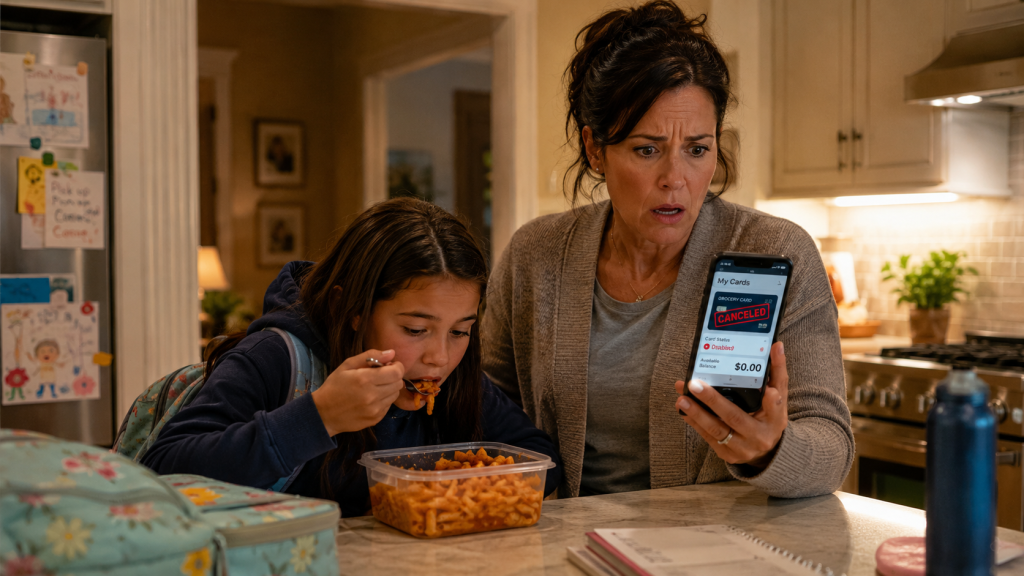
daughter went hungry at school for an entire week. When I told my mom, she brushed it off and said, “She can take crackers.” That night, I canceled the $2,800 grocery fund I had been giving her every month. By Sunday, her card was declined at the store.

For five straight school days, my eleven-year-old daughter, Sophie Bennett, came home starving.
And somehow, I didn’t realize what was happening.
Friday afternoon, I found her standing at the kitchen counter eating cold pasta straight from the container.
She was eating so quickly that I finally asked the obvious question.
“Didn’t you have lunch?”
She stopped chewing.
“My account was empty.”
I stared at her.
“Since when?”
“Monday.”
My stomach dropped.
Sophie attended a public middle school outside Columbus, Ohio, and every month I loaded money onto her cafeteria account.
A processing issue with the school’s payment system had prevented my latest transfer from showing up.
On Monday, Sophie had gone through the lunch line.
She saw the negative balance.
And instead of telling anyone, she spent the rest of the week sitting beside her friends pretending she wasn’t hungry.
“What did you eat?” I asked.
She shrugged.
“Nothing.”
That answer hit harder than any complaint could have.
Sophie had always been quiet.
She would endure being uncomfortable before risking embarrassment or making somebody else feel awkward.
That evening, furious with myself for not noticing sooner, I called my mother, Margaret Bennett.
Mom lived fifteen minutes away in a four-bedroom house I owned.
After Dad died and she began struggling financially, I stepped in so she wouldn’t have to sell the home where she had raised us.
I covered the property taxes.
Utilities.
Insurance.
Maintenance.
And groceries.
Every month, $2,800 went onto a grocery card connected directly to my account.
Mom loved organic markets.
Imported cheese.
Expensive wine.
Premium steaks.
Fresh flowers.
Elaborate Sunday dinners.
I told her exactly what had happened.
“My daughter went hungry at school for an entire week.”
Mom barely reacted.
“Well,” she said, “she can take crackers.”
For a second, I honestly thought I had heard her wrong.
“Crackers?”
“Children survive. You’re making this dramatic.”
I went completely still.
For six years, Mom’s own needs had never been considered small.
Mom needed a new refrigerator.
Mom needed help when the landscaping company raised its prices.
Mom needed expensive groceries because processed food supposedly upset her stomach.
Mom needed $2,800 every month so she could maintain the lifestyle she was accustomed to.
But my eleven-year-old daughter went without lunch for five days, and suddenly survival was good enough.
I didn’t yell.
I didn’t argue.
There was nothing left to explain.
“You’re right,” I said quietly. “People survive.”
Then I ended the call.
Later that night, after Sophie went to bed, I opened my banking app.
There it was.
Mom’s grocery card.
Monthly allowance:
$2,800.
I stared at the number.
Then I thought about Sophie sitting in a cafeteria for five straight days watching everyone else eat.
About her negative balance.
About the cold pasta she had devoured when she got home.
And about the grandmother who thought crackers were perfectly acceptable when the hungry child wasn’t her.
Then I pressed:
Cancel Card.
No warning.
No argument.
No dramatic announcement.
Sunday morning, Mom drove to her favorite upscale grocery store.
She filled her cart exactly the way she always did.
Salmon.
Imported olive oil.
Fresh berries.
Wine.
Flowers.
And two expensive ribeye steaks.
At checkout, she tapped the card.
Declined.
She frowned and tried again.
Declined.
The cashier suggested trying another payment method.
Mom stepped aside and checked the card.
This time, there had been no processing error.
No missing transfer.
No misunderstanding.
The card had worked exactly the way I intended it to.
Mom pushed her loaded cart away from the register.
Then she pulled out her phone.
My screen lit up less than a minute later.
MOM CALLING.
I let it ring.
Then came a text.
“There’s something wrong with the grocery card. Fix it.”
Not:
How is Sophie?
Not:
I’m sorry.
Not even:
Did she get lunch money sorted out?
Just:
Fix it.
I looked at the message for several seconds.
Then another one arrived.
“I have people coming for dinner tonight.”
That was when I realized Mom still didn’t understand.
She thought the card had malfunctioned.
She had no idea the $2,800 grocery fund hadn’t failed.
It had ended.
And groceries were only the first expense I was about to reconsider
PART 2: THE HOUSE MY MOTHER HAD ALREADY PROMISED AWAY
Mom called seven times before noon.
I answered none of them.
The eighth call came from my younger brother, Ryan.
That was when I knew she had stopped trying to fix the card and started recruiting witnesses.
I stared at his name on my screen.
Then answered.
“Hi.”
“What did you do to Mom?”
No hello.
No question about Sophie.
Apparently concern traveled through our family in one direction.
I leaned against the kitchen counter.
“What did she tell you?”
“That you shut off her grocery money without warning.”
“That part is true.”
Ryan exhaled sharply.
“Why?”
I almost laughed.
“Did she tell you what happened to Sophie?”
A pause.
“She said there was some lunch-account issue.”
“My eleven-year-old daughter went five days without eating lunch.”
Silence.
Then:
“Okay, that’s bad.”
Bad.
Such a small word.
“She came home Friday and ate cold pasta with her hands because she was starving.”
Ryan’s voice softened.
“I didn’t know that.”
“Mom did.”
Another pause.
“She probably didn’t understand how serious it was.”
“She said Sophie could take crackers.”
Ryan went quiet.
Good.
Let the sentence sit with somebody besides me.
Then he sighed.
“Still, cutting Mom off completely seems extreme.”
I closed my eyes.
“I canceled a grocery allowance.”
“You know that card pays for basically everything she eats.”
“No.”
I said quietly.
“I pay for basically everything she eats.”
There was a difference.
A large one.
Ryan did not seem to hear it.
“She’s sixty-eight.”
“She isn’t helpless.”
“She’s on a fixed income.”
“She receives Dad’s pension and Social Security.”
“That doesn’t go far.”
I looked around my kitchen.
Then toward the folder I had opened that morning.
Property taxes.
Utilities.
Insurance.
Repairs.
The house Mom lived in.
The house I owned.
The roof I replaced two years earlier.
The furnace I repaired last winter.
The landscaper.
The water bill.
The electric bill.
The grocery card.
Six years of telling myself:
She’s my mother.
Six years of treating that sentence like a blank check.
“Ryan.”
“What?”
“How much do you contribute to Mom each month?”
Silence.
Not hostile.
Just empty.
“I help when I can.”
“How much?”
“You know my situation.”
I did.
Ryan was thirty-nine.
Married.
Two incomes.
Two cars.
A mortgage.
Annual trips to Disney.
A boat he claimed was inexpensive because it was used.
He was not rich.
He was also not struggling enough to explain why his contribution to our mother had apparently become philosophical.
“How much?”
he asked defensively.
“Does that matter?”
“Yes.”
“Why?”
“Because you called to tell me I’m cruel for reconsidering money you do not help provide.”
That landed.
He became quiet.
Finally:
“I bought her a new microwave last Christmas.”
I stared at the wall.
“That was a gift.”
“It was four hundred dollars.”
“Wonderful.”
“My grocery card was thirty-three thousand six hundred dollars a year.”
Silence.
Ryan stopped breathing.
“What?”
I almost laughed.
Apparently nobody had ever done the multiplication.
“Twenty-eight hundred times twelve.”
He said nothing.
“That is just groceries.”
“No.”
“There’s no way she spends that.”
I looked at the transaction history.
“Oh, she does.”
Because once I started looking, I could not stop.
I had originally opened the card statements only to confirm it had been canceled.
Then curiosity took over.
Not suspicion yet.
Just curiosity.
And there it was.
Every month.
Two thousand six hundred.
Two thousand seven hundred.
Sometimes the full twenty-eight hundred.
Premium markets.
Wine shops attached to grocery stores.
Specialty butchers.
Seafood counters.
Holiday catering.
Once, almost nine hundred dollars in a single weekend.
For one woman.
I whispered:
“Ryan, do you eat at Mom’s on Sundays?”
He hesitated.
“Sometimes.”
“How often?”
“Most weeks.”
“Who else?”
“What does that have to do with anything?”
I already knew.
My aunt.
Two cousins.
Ryan’s wife.
Their children.
Neighbors.
Mom loved hosting.
She was famous for it.
People complimented her roast.
Her salmon.
Her elaborate cheese boards.
Her expensive wine.
And every time someone said:
“Margaret, you spoil us,”
Mom smiled like a queen distributing abundance.
My stomach turned.
Because apparently I had been funding the kingdom.
“Ryan.”
“What?”
“Does Mom ever send food home with you?”
Silence.
Then:
“Sometimes.”
“How much?”
“What is this, an audit?”
That answer was yes.
I looked at another charge.
Three hundred eighty-six dollars at a butcher on the Thursday before Ryan’s anniversary party.
I remembered the party.
Mom had brought steaks.
Twenty of them.
She told everyone:
“Consider it my gift.”
I sat down.
“Did Mom buy the steaks for your anniversary dinner?”
A longer silence.
“How do you know about that?”
My eyes closed.
There it was.
Not:
No.
“How much did she tell you they cost?”
“I don’t know.”
“Did you reimburse her?”
“She said it was a gift.”
“With my card.”
Silence.
Ryan finally whispered:
“Oh.”
That one tiny sound did more than twenty minutes of arguing.
I continued.
“Your daughter’s graduation brunch?”
No answer.
“The Thanksgiving turkey she brought Aunt Louise?”
Silence.
“The wine she gives people for Christmas?”
He exhaled slowly.
“I didn’t know.”
Neither had I.
That was the problem.
Mom had not been using my grocery allowance only to feed herself.
She had been using my money to perform generosity for everyone else.
My support had become her social identity.
And somehow I was still the selfish daughter.
Ryan said:
“You need to talk to her.”
“I tried.”
“No, I mean really talk.”
“I told her Sophie went hungry for five days.”
He went quiet again.
I whispered:
“That should have been enough to make her care.”
Then I ended the call.
Sophie came downstairs twenty minutes later.
Her hair was messy.
She was wearing one of my old college sweatshirts.
She opened the refrigerator.
Then stopped.
“Mom?”
“Yes?”
“Are you mad at Grandma because of me?”
My heart broke.
Immediately.
“No.”
She looked down.
“I heard part of your call.”
I walked toward her.
“Sophie, look at me.”
She did.
“This is not because of you.”
“But if I had told you Monday—”
“No.”
I knelt.
“You should have told me Monday.”
Her eyes filled.
“But that is because you deserve help when something is wrong.”
I touched her cheek.
“It is not because you are responsible for what Grandma said afterward.”
She swallowed.
“I didn’t want the lunch lady to think we were poor.”
That sentence hurt.
Not because poverty would have embarrassed me.
Because an eleven-year-old had decided hunger was safer than being judged.
“Baby.”
I sat beside her.
“Do you know what I would rather have happen?”
She shook her head.
“I would rather the school call me twenty times.”
“I would rather you tell a teacher.”
“I would rather you walk into the office and say, ‘My mom messed something up and I need lunch.’”
Her mouth twitched.
“You messed it up?”
“The payment company did.”
I sighed.
“But I am happy to take the blame if it means you eat.”
She smiled weakly.
Then:
“Grandma really said crackers?”
I wished she had not heard that.
“Yes.”
Sophie looked toward the floor.
“She always has that fancy bread.”
I nearly laughed.
Of course that was what my child noticed.
Not the hypocrisy in abstract terms.
The bread.
The twelve-dollar loaf Mom insisted was easier to digest.
Sophie whispered:
“Does Grandma not like me?”
My throat closed.
“No.”
I answered carefully.
“I think Grandma loves you.”
“Then why did she say that?”
There was no answer that would not turn my mother into either a villain or an excuse.
So I chose something in the middle.
“Sometimes people can love you and still become very comfortable with you having less than they would accept for themselves.”
Sophie frowned.
“That’s mean.”
“Yes.”
Simple.
Accurate.
Then I added:
“And it is not something you have to fix.”
She nodded.
That mattered.
Children should not be handed adult family repair jobs simply because adults created them.
I made grilled cheese.
Sophie ate two.
I watched every bite.
Probably too closely.
She noticed.
“Mom.”
“What?”
“I’m not going to disappear.”
I laughed through tears.
“Excellent.”
Mom finally appeared at my house Sunday evening.
Not alone.
She brought Aunt Louise.
Of course.
Apparently grocery-card diplomacy required backup.
I saw them through the doorbell camera.
Mom in cream slacks.
Aunt Louise holding her purse with both hands.
I opened the door.
Mom walked inside before I invited her.
Some habits die slowly.
Aunt Louise at least said:
“May I?”
“Yes.”
Mom turned immediately.
“You humiliated me.”
No preamble.
I closed the door.
“At the grocery store?”
“You knew I had people coming.”
“I knew after you texted me.”
“I had to leave an entire cart there.”
My mind produced the image.
Salmon.
Wine.
Flowers.
Ribeyes.
For some reason, I felt almost nothing.
“Did you have another payment method?”
Her face tightened.
“That is not the point.”
“It’s exactly the point.”
She had three credit cards.
A pension.
Savings.
The card was declined.
She was not stranded without food.
She was stranded without my money.
That difference seemed to offend her.
Aunt Louise touched Mom’s arm.
“Margaret, maybe sit down.”
“I don’t need to sit.”
I looked at my aunt.
“Did she tell you why I canceled it?”
Louise hesitated.
“She said you were upset over something Sophie said.”
Something Sophie said.
My blood cooled.
I looked at Mom.
“You told her Sophie caused this?”
“I said there was a misunderstanding.”
“No.”
My voice sharpened.
“There was a processing error.”
“Sophie’s cafeteria account didn’t receive the transfer.”
“She went hungry for five days.”
Aunt Louise’s face changed.
“What?”
Mom rolled her eyes.
“Not hungry like some starving child.”
I went still.
Louise stared at her.
“She did not eat lunch.”
“She ate breakfast.”
Mom snapped.
“She ate when she got home.”
I looked at my mother.
It is strange how a relationship can change without anyone moving.
She was still standing six feet away.
Still my mother.
Same perfume.
Same earrings Dad bought her for their thirtieth anniversary.
And yet I suddenly felt as though I were seeing her from a place much farther away.
“You really believe that makes it better.”
I whispered.
Mom’s mouth tightened.
“She could have said something.”
“Yes.”
“So why is this my fault?”
“It isn’t.”
She looked surprised.
Good.
“I did not cancel the card because you caused Sophie’s lunch-account problem.”
I said.
“I canceled it because the way you reacted made me realize I have been funding comforts for you that you would never consider necessary for my daughter.”
Aunt Louise looked toward Mom.
Mom’s face flushed.
“Your daughter has plenty.”
“So do you.”
Silence.
That was the first crack.
I continued.
“You told me children survive.”
“You said crackers were enough.”
“So I started asking what enough means.”
Her eyes narrowed.
“What is that supposed to mean?”
“It means I am reviewing what I pay for.”
“You promised to take care of me.”
“No.”
I shook my head.
“I promised Dad I would make sure you were secure.”
She stared.
“That is the same thing.”
“It isn’t.”
Security was shelter.
Heat.
Medication.
Food.
Safety.
Security was not imported olive oil.
Security was not fresh flowers every week.
Security was definitely not paying for wine so Mom could host Sunday dinners and receive compliments for generosity that came out of my account.
I said:
“The house remains paid.”
“Utilities remain paid for now.”
“Insurance.”
“Taxes.”
“Necessary repairs.”
“You are not being abandoned.”
Her face darkened.
“For now?”
There.
Of everything I said, those two words frightened her most.
“Yes.”
“For now.”
Aunt Louise sat slowly.
Mom stared.
“You’re threatening to throw me out?”
“No.”
“Then what?”
“I am reviewing the entire arrangement.”
Her mouth opened.
I continued.
“Six years ago, you said you needed temporary help after Dad died.”
“I gave you use of the house.”
“I covered expenses.”
“I added groceries.”
“Then landscaping.”
“Then the utility bills.”
“Then every repair.”
“Somewhere along the way, temporary help became an assumption that I would fund your entire lifestyle forever.”
Mom looked offended.
“Your father would be ashamed of you.”
That one hit.
Of course it did.
She knew where to aim.
For a second, I was sixteen again.
Dad alive.
Mom disappointed.
Me trying to earn my way back into being good.
Then Sophie’s voice echoed in my head.
My account was empty.
I breathed.
“Do not use Dad to negotiate with me.”
Mom’s face changed.
Aunt Louise whispered:
“Margaret…”
Mom snapped:
“Stay out of this.”
Louise looked at her.
“You brought me.”
I almost smiled.
Mom ignored her.
“You have more money than you know what to do with.”
“And there it is.”
“What?”
“The same argument.”
She frowned.
“Because I can afford something, you think I am obligated to provide it.”
“You’re my daughter.”
“Yes.”
“I am also Sophie’s mother.”
Silence.
I continued.
“And if I ever make my daughter feel guilty for choosing her child’s needs before my preferred groceries, I hope she cancels my card too.”
Aunt Louise covered her mouth.
Mom glared.
“You think this is funny?”
“No.”
I said.
“I think it is overdue.”
Then I put the statements on the table.
Mom’s expression changed.
“What is that?”
“The last twelve months.”
Her eyes moved toward them.
I had highlighted charges.
Not because I wanted to shame her for eating well.
Because I needed clarity.
“Four hundred dollars in steak before Ryan’s anniversary party.”
Mom stiffened.
“Three hundred in wine before Christmas.”
“No.”
“That includes groceries.”
“Seven hundred and eighty dollars before Sophie’s cousin’s graduation brunch.”
Mom looked toward Aunt Louise.
Louise frowned.
“You told me you paid for that brunch.”
Mom’s face flushed.
“I did.”
I tapped the statement.
“With my card.”
“That card was mine to use.”
“For your groceries.”
“You never said I couldn’t feed family.”
I stared.
“You’re right.”
She looked triumphant for half a second.
Then I continued.
“I never imagined I had to.”
Silence.
Mom looked away.
I said:
“I gave you that card because you told me groceries were becoming difficult.”
“They were.”
“So why were you feeding twenty people?”
“Because people come over.”
“Then people can contribute.”
“That is humiliating.”
I almost laughed.
There it was again.
Her humiliation outweighed everyone else’s needs.
My daughter should quietly eat crackers.
My mother could not possibly ask an adult guest to bring dessert.
I whispered:
“So Sophie should endure embarrassment in a cafeteria.”
“But you cannot endure telling Ryan to buy his own steaks.”
Mom’s face changed.
She knew.
That comparison reached her.
Not enough.
But it reached.
Aunt Louise quietly asked:
“How much has she spent?”
Mom turned sharply.
“Louise.”
My aunt ignored her.
I answered.
“Roughly thirty thousand dollars a year on the card.”
Louise’s mouth fell open.
“No.”
“Some years less.”
“Some almost the full thirty-three six.”
She looked at Mom.
“Margaret.”
Mom crossed her arms.
“I host.”
“You host with her money.”
Louise said.
“Whose side are you on?”
Aunt Louise stood.
“My own.”
Then:
“And apparently I need to start buying my own Christmas wine.”
The sentence almost made me laugh.
Mom did not find it funny.
Then the conversation changed.
Because Aunt Louise looked at me and asked:
“Is this why you’re selling the house?”
I froze.
Mom’s entire body went still.
I turned toward her.
“What?”
Louise’s expression changed.
She realized immediately.
“You didn’t know.”
My heartbeat slowed.
“Know what?”
Mom spoke quickly.
“Louise misunderstood.”
My aunt looked horrified.
“No, I didn’t.”
“Know what?”
I repeated.
Louise stared at Mom.
Then at me.
“Margaret told us the house was being transferred.”
I felt cold.
“What house?”
Nobody answered.
I laughed softly.
“My house?”
Mom lifted her chin.
“It was your father’s home.”
“Dad and you sold that house three years before he died.”
Silence.
This house was different.
I had bought it as an investment twelve years ago.
When Dad died, I let Mom move in because her finances had tightened and she wanted to stay near the old neighborhood.
Her name had never been on the deed.
Not once.
I whispered:
“Transferred to whom?”
Aunt Louise looked sick.
“Ryan.”
The room disappeared.
I stared at Mom.
Then:
“Excuse me?”
She sighed.
Like I was making paperwork difficult.
“Not now.”
“When?”
“Eventually.”
“What does eventually mean?”
“When I’m gone.”
I actually laughed.
A cold, disbelieving laugh.
“You told people you are leaving my house to Ryan when you die?”
Mom’s face tightened.
“He needs it more than you.”
Aunt Louise sat down again.
I stared.
The cruelty was almost impressive in its simplicity.
“My house.”
“Your brother has a family.”
“So do I.”
“You have your own home.”
“So does he.”
“His mortgage is enormous.”
“That sounds like something he and his bank should discuss.”
Mom snapped:
“You own two properties.”
“That does not make one of them yours to inherit.”
Her face turned red.
“I have lived there six years.”
“With my permission.”
“It is my home.”
“Yes.”
My voice softened.
“It is your home.”
“Not your property.”
She froze.
I meant the distinction.
I did not want to erase six years of her life in that house.
But living somewhere did not create the right to promise it away.
I asked:
“Does Ryan know?”
Silence.
“Mom.”
“Yes.”
My stomach dropped.
“How long?”
“About a year.”
I closed my eyes.
That meant when Ryan called me selfish earlier, he already believed there was a house waiting for him after Mom died.
Interesting.
Very interesting.
“Did he ask?”
“No.”
“Did you offer?”
“Yes.”
“Why?”
“Because you don’t need it.”
Again.
The family philosophy.
Need determined ownership.
Unless the thing belonged to them.
Then ownership suddenly mattered very much.
Aunt Louise whispered:
“Margaret, you cannot leave someone else’s house in your will.”
Mom snapped:
“I know that.”
I looked at her.
“Do you?”
She glared.
“I meant I wanted you to give it to him.”
I nearly laughed.
“You announced my future gift before asking me.”
“I assumed you would understand.”
That sentence.
There it was.
The same thinking behind everything.
I would understand.
I would pay.
I would allow.
I would provide.
Other people made the promise.
I was expected to become the funding source afterward.
I whispered:
“You have been telling Ryan my house will be his.”
“Yes.”
“And he believes you.”
“He knows you’ll do the right thing.”
The right thing.
I smiled.
Not happily.
“Does he?”
My phone buzzed.
Ryan.
Perfect timing.
I answered on speaker.
“Hi.”
His voice was tense.
“Is Mom there?”
“Yes.”
A pause.
Then:
“Did she tell you?”
I looked directly at her.
“She just did.”
Silence.
Ryan exhaled.
“Okay.”
“Were you planning to tell me?”
“I thought Mom already had.”
“When?”
“I don’t know.”
“Before or after she died?”
“Come on.”
“No.”
I said.
“You come on.”
Mom moved toward the phone.
“Ryan, don’t let her bully you.”
I looked at her.
Then at Aunt Louise.
Even Louise looked stunned.
Ryan said:
“I never asked for the house.”
“Good.”
“But Mom said you wouldn’t care.”
My throat tightened.
“You believed that?”
“You have the downtown place.”
“So?”
“And Mom said Dad always wanted his property kept in the family.”
I closed my eyes.
“Dad never owned this house.”
Silence.
“What?”
“I bought it.”
“When?”
“Twelve years ago.”
Ryan stopped breathing.
“No.”
“Yes.”
“Mom said Dad helped.”
“He did not.”
I looked at her.
She looked away.
Ryan whispered:
“Mom?”
She snapped:
“Your father contributed to this family in other ways.”
That was not an answer.
Ryan said:
“You told me Dad put money into the down payment.”
Mom said nothing.
There it was.
A second story.
A second credit transfer.
The house I bought had slowly become Dad’s investment in family mythology.
Then Mom’s home.
Then Ryan’s inheritance.
At some point, apparently, I disappeared from the story entirely.
I whispered:
“Ryan, the deed is in my name.”
He went quiet.
“I can send you a copy.”
“No.”
His voice changed.
“No, I believe you.”
Good.
Mom turned.
“You don’t need to encourage this.”
Ryan replied:
“Mom, you told me it was basically yours.”
“It should be.”
I stared.
Aunt Louise whispered:
“Oh, Margaret.”
Mom looked between all of us.
Cornered.
And when people who are used to controlling a room feel cornered, they often reach for cruelty.
She did.
She looked at me.
“You always were your father’s favorite.”
The room went still.
My chest tightened.
“What does that have to do with anything?”
“He helped you.”
“No.”
“You got opportunities Ryan didn’t.”
“Mom.”
“You went to college without debt.”
“Because I had scholarships.”
“Your father still helped.”
“With books.”
“Yes.”
She almost shouted.
“He helped you!”
I stared.
This was the accounting now?
Textbooks thirty years earlier were becoming justification for an entire house.
Ryan spoke through the phone.
“Mom, stop.”
She ignored him.
“You have always had more.”
I whispered:
“So this is punishment?”
Her face changed.
“No.”
“It sounds like it.”
“I’m trying to make things fair.”
There.
Fair.
The most dangerous word in families where one person gets to define the scale.
I sat down.
“Do you know what Sophie ate for lunch last week?”
Mom stared.
I continued.
“Nothing.”
“Five days.”
“And when I told you, you said crackers were enough.”
My voice shook.
“But when Ryan has a mortgage, suddenly owning another person’s house is what fairness requires.”
No one spoke.
I looked at Ryan’s name on the phone.
Then at Mom.
“I am done letting need become a weapon against whoever prepared better.”
Silence.
Mom’s face went pale.
“What does that mean?”
“It means the house arrangement is being reviewed too.”
Her mouth opened.
“You said you weren’t throwing me out.”
“I’m not.”
“Then why say that?”
“Because I need something clear.”
I leaned forward.
“You may live there under a written agreement.”
Her face hardened.
“A lease?”
“A residency agreement.”
“I am not paying you rent.”
“I didn’t ask you to.”
She blinked.
That surprised her.
I continued.
“It will say the house belongs to me.”
“You have permission to live there.”
“You cannot promise it.”
“Transfer it.”
“Borrow against it.”
“Offer it to Ryan.”
“Or represent to anyone that you have ownership rights you do not have.”
Mom stared.
“You would make your own mother sign that?”
“Yes.”
“Why?”
I looked at the woman who had just promised my property to my brother.
“Because apparently I should have done it six years ago.”
She left furious.
Aunt Louise stayed five minutes longer.
At the door, she turned.
“For what it’s worth…”
I waited.
“Your mother has always been very good at making help look like something she created herself.”
That sentence stayed with me.
“Why didn’t anyone tell me?”
Louise looked ashamed.
“Because Sunday dinner was nice.”
So simple.
So human.
Everyone enjoyed the table enough not to ask who paid for it.
She touched my arm.
“I’m sorry about Sophie.”
“Thank you.”
Then she left.
That night, Ryan called again.
This time, his voice was different.
“I’m sorry.”
I closed my eyes.
“For what?”
“For calling you selfish.”
“Okay.”
“And for believing Mom about the house without ever asking you.”
I sat.
“That part bothered me more.”
“I know.”
Then:
“I should have known.”
“No.”
I said.
“You should have asked.”
He went quiet.
“Fair.”
I almost smiled.
Then he said:
“There’s something else.”
Of course there was.
I looked at the ceiling.
“What?”
“Mom showed me paperwork.”
My stomach tightened.
“What paperwork?”
“Renovation plans.”
I sat upright.
“For the house?”
“Yes.”
“When?”
“Last month.”
“What kind of renovations?”
“She said when Sophie gets older and you don’t need the rental income, I could move in.”
I almost laughed from disbelief.
“I don’t receive rental income from Mom.”
“She told me you did.”
Of course.
“What renovations?”
“She wanted to convert the first floor study into a bedroom.”
“Why?”
“For her.”
My heart tightened.
Ryan continued.
“She said if my family moved in later, she’d stay downstairs.”
I stood.
This was no hypothetical inheritance after death.
Mom had been planning a shared future in my house while alive.
“How far did this go?”
“I thought it was just ideas.”
“Ryan.”
He hesitated.
“Mom got estimates.”
My pulse quickened.
“From contractors?”
“Yes.”
“Did anyone enter the property?”
“I don’t know.”
My stomach turned.
Mom had permission to live there.
Not redesign it for my brother.
“Anything else?”
Silence.
I hated that pause now.
“Ryan.”
“She asked me for financial documents.”
My body went cold.
“What documents?”
“Income.”
“Credit score.”
“Debt.”
“Why?”
“She said we might need them.”
“For what?”
“She mentioned refinancing.”
Everything inside me stopped.
“Refinancing what?”
“The house.”
Silence.
I gripped the counter.
“Ryan.”
“I told her I didn’t understand because I thought the house was paid off.”
“It is.”
“She said there were ways to pull equity out.”
My heartbeat began pounding.
“Did you apply for anything?”
“No.”
Immediate.
“Did Mom?”
“I don’t know.”
I closed my eyes.
Good.
Do not assume.
Do not invent crimes before facts.
“Did you sign anything?”
“No.”
“Give anyone my information?”
“No.”
“Did you give Mom yours?”
“Yes.”
My stomach tightened.
“Why?”
“I thought…”
His voice cracked.
“I thought if she was leaving me the house, maybe she wanted to make sure I could afford taxes later.”
I breathed slowly.
“Send me everything she gave you.”
“I will.”
“Tonight.”
“Okay.”
“And do not ask her about it yet.”
“Why?”
“Because I want documents before explanations.”
He understood.
“Okay.”
Ten minutes later, the email arrived.
Three attachments.
Renovation sketches.
A contractor estimate.
And a preliminary worksheet from a lending broker.
No completed loan.
No mortgage.
No signature from me.
Thank God.
But at the top of the worksheet was the property address.
My property.
Under:
Purpose of Funds
someone had typed:
Family home renovation / debt consolidation.
And below that:
Estimated Equity Available: $410,000.
My hands began shaking.
Debt consolidation.
Whose debt?
Mom had no mortgage.
Her credit cards were supposedly paid monthly.
I called Ryan back.
“What debt?”
“What?”
“The worksheet says debt consolidation.”
Silence.
“I don’t know.”
“Ryan.”
“I swear.”
Then he said:
“Wait.”
My stomach tightened.
“What?”
“Mom asked me how much we still owed.”
“On your house?”
“Yes.”
My body went cold.
“How much?”
“About one-eighty.”
I stopped breathing.
“Did you tell her?”
“Yes.”
“And did she say why?”
Ryan became silent.
Then:
“She said maybe we could wipe it out.”
There it was.
I stared at the worksheet.
Four hundred ten thousand dollars of imagined equity.
A paid-off house I owned.
A renovation to prepare for Ryan’s family.
And perhaps enough money to erase his mortgage.
All discussed without me.
Ryan whispered:
“I didn’t know it was your property.”
“I believe you.”
“I thought…”
His voice broke.
“I thought Mom was giving me something Dad left.”
“I know.”
“I feel like an idiot.”
“Don’t.”
I said.
“Just stop signing your name to stories before checking who owns them.”
He was quiet.
Then:
“Are you going to kick her out?”
I looked toward Sophie’s school lunch receipt sitting on the counter.
Then at the grocery-card statements.
Then at the lending worksheet.
“No.”
Not yet.
“But tomorrow, I’m calling my attorney.”
Ryan exhaled.
“Okay.”
“And the house will not remain an informal arrangement.”
Silence.
Then:
“I understand.”
After we hung up, I sat at the kitchen table for a long time.
I thought canceling the grocery card was about groceries.
It wasn’t.
The card had merely been the first thread.
I pulled it because my mother told me crackers were enough for my hungry child.
And suddenly six years of assumptions began unraveling.
The grocery money was not only feeding her.
Her generosity was not always hers.
The home I had provided for security had become property she felt entitled to redistribute.
And now there was a worksheet showing someone had begun imagining four hundred thousand dollars of equity as though my signature were merely a future inconvenience.
I did not know yet whether Mom had contacted a lender.
I did not know whether the worksheet had ever gone beyond preliminary conversation.
I did know one thing.
On Monday morning, before I fixed another problem for anyone in my family, I was going to find out exactly how far my mother’s plans had gone.
Because she had told Sophie that crackers were enough.
Apparently everyone else deserved steak, a paid-off house, and four hundred thousand dollars of somebody else’s equity.
And by then, I was finished pretending not to notice the difference.
PART 3: THE HOUSE SHE THOUGHT SHE COULD GIVE AWAY
Monday morning, I called my attorney before I called my mother.
That choice mattered.
For most of my life, when Mom created a problem, my first instinct was to call her and ask why.
That usually meant twenty minutes of explanations.
Then guilt.
Then some version of:
You know how hard things have been for me.
And somehow I would end the conversation apologizing for having questions.
Not this time.
I sent everything to my attorney, Laura Mitchell.
The grocery-card statements.
The renovation estimates.
The lending worksheet.
The property deed.
The messages from Ryan.
Then I explained six years of informal living arrangements in the least emotional language I could manage.
Laura listened quietly.
When I finished, she asked:
“Has your mother signed a lease?”
“No.”
“Any written life-estate agreement?”
“No.”
“Any document giving her ownership?”
“No.”
“Any power of attorney over the property?”
“No.”
“Has she ever contributed to the purchase price?”
“No.”
“Mortgage?”
“No mortgage.”
“Taxes?”
“I pay them.”
“Insurance?”
“Me.”
“Major repairs?”
“Me.”
There was a pause.
Then Laura said:
“Good.”
I nearly laughed.
“Good?”
“Legally uncomplicated is good.”
My shoulders loosened slightly.
Then she added:
“But uncomplicated does not mean do nothing.”
I looked at the lending worksheet.
“Did she try to borrow against the house?”
“We don’t know yet.”
“Can someone do that without owning it?”
“They can try many things.”
She spoke carefully.
“Whether anything becomes enforceable is another question.”
My stomach tightened.
“Could she have forged something?”
“Do not jump there.”
Good.
Facts.
Always facts.
Laura continued.
“We start by checking public property records, credit inquiries tied to the address where available, and any lender information we can properly obtain.”
“What should I do?”
“Nothing impulsive.”
“Do not change locks.”
“Do not remove belongings.”
“Do not threaten eviction.”
“I wasn’t planning to.”
“Good.”
“And don’t discuss refinancing with your mother until I understand whether this worksheet was merely exploratory or part of an actual application.”
I looked toward the refrigerator.
Sophie’s cafeteria account confirmation was attached to it now.
I had loaded funds manually Monday morning.
Then called the school.
The cafeteria manager had been horrified when she learned Sophie had skipped meals.
Apparently students with account problems were still eligible for an alternative meal.
Sophie had been too embarrassed to ask.
We changed that too.
The school counselor met with her.
Not because she was broken.
Because I wanted her to practice asking adults for help before hunger became something she thought she had to hide.
One problem at a time.
“Laura?”
“Yes?”
“I need the living arrangement formalized.”
“I agree.”
“I don’t want to throw Mom out.”
“Then don’t.”
“But I need her to stop treating the house like something she controls.”
“That can be addressed in writing.”
I closed my eyes.
For the first time all weekend, I felt something like relief.
Not because the family problem was solved.
Because there was finally a process that did not depend on who could make me feel guiltier.
By Wednesday, we had the first answers.
There was no new mortgage on the property.
No recorded lien.
No home-equity loan.
No transfer.
I sat at my desk and breathed for the first time in days.
Then Laura said:
“But your mother did contact a lending broker.”
My stomach tightened again.
“How far did it go?”
“Preliminary conversation.”
“Application?”
“Not completed.”
“Did she claim she owned the house?”
Laura paused.
That pause told me the next part would hurt.
“She described herself as the long-term resident and expected beneficiary.”
I stared at the wall.
“Beneficiary of what?”
“The property.”
My laugh came out sharp.
“According to whom?”
“She apparently said the home was intended to remain in the family and pass to your brother.”
I closed my eyes.
Of course.
Not a lie exactly.
A story repeated often enough that she had begun treating intention like title.
“Did she give them my name?”
“Yes.”
“As owner?”
“Eventually.”
“Eventually?”
“The broker asked for public ownership verification.”
I almost laughed again.
Reality had apparently entered the meeting late.
Laura continued.
“Once they saw the deed was in your name, they explained that nothing could proceed without you.”
“And?”
“Your mother said you would agree.”
There it was.
The sentence behind everything.
She’ll agree.
She won’t care.
She has enough.
She’ll understand.
Other people writing my answer before they asked the question.
My chest tightened.
“What did she want the money for?”
“Based on the broker’s notes, approximately one hundred eighty thousand to eliminate your brother’s mortgage.”
I shut my eyes.
“And the rest?”
“Renovation.”
“How much?”
“About ninety thousand.”
“That doesn’t equal four-ten.”
“No.”
“So what was the rest?”
Laura’s voice softened.
“General family reserve.”
I sat still.
General family reserve.
My house had become a bank account in my mother’s imagination.
“Was any of this illegal?”
“Based on what we know so far, no money was obtained.”
“No forged ownership document has surfaced.”
“She had conversations she was not authorized to complete.”
“That distinction is important.”
I nodded even though she could not see me.
“So what now?”
“Now we write.”
The residency agreement was twelve pages.
My mother hated every one of them.
That alone almost made me smile.
It did not charge rent.
It did not demand utilities from her immediately.
It did not humiliate her.
It simply clarified reality.
The house belonged to me.
She had permission to live there.
She could not sell it.
Promise it.
Borrow against it.
Offer it as future collateral.
Authorize structural changes without written approval.
Or represent herself as an owner.
Necessary repairs remained my responsibility.
Optional upgrades required discussion.
The grocery allowance was gone.
Permanently.
Instead, I offered a smaller monthly household support amount of six hundred dollars for six months while she adjusted her budget.
After that, she would purchase her own groceries.
I expected her to scream.
She did something worse.
She went silent.
When I brought the agreement over Friday afternoon, she sat at her dining table reading it while I waited.
This was the same table where she had served Sunday dinners for years.
My money had bought half of them.
The thought no longer made me angry.
Just tired.
Mom reached page four.
Then looked up.
“You’ve turned me into a tenant.”
“No.”
“What do you call this?”
“A written agreement.”
“In my own home.”
I took a breath.
“Mom.”
“Do not.”
Her voice sharpened.
“I raised you.”
I nodded.
“Yes.”
“I fed you.”
“Yes.”
“I gave you everything I had.”
“I know.”
“And this is what I get?”
There it was.
Parenthood turned into an invoice.
I sat across from her.
“You get a paid-off home to live in.”
“Taxes covered.”
“Insurance covered.”
“Necessary repairs covered.”
“And six months to restructure your grocery spending.”
Her eyes filled.
“That sounds so cold.”
“It is clear.”
“Families should not need contracts.”
I looked around the room.
The refrigerator I bought.
The windows I replaced.
The ceiling I repaired after a leak.
Then I said:
“Families also should not promise each other property they don’t own.”
She flinched.
Good.
Not because I wanted to hurt her.
Because reality needed somewhere to land.
“You embarrassed Ryan.”
“No.”
“He called me.”
“He feels terrible.”
“He should not.”
I said.
“You told him something was his when it wasn’t.”
Her face hardened.
“He needs that house someday.”
“You keep saying need like it creates ownership.”
“You have more than him.”
“That is not the same conversation.”
“It is to me.”
There.
Finally.
I stared at her.
“What did I do wrong?”
Her face changed.
“What?”
“For having more.”
“You didn’t do anything wrong.”
“Then why does every discussion about Ryan end with me surrendering something?”
She looked away.
“He had a harder life.”
My throat tightened.
“How?”
“He struggled more.”
“Financially?”
“Yes.”
“He changed jobs four times.”
“He bought a house he could barely afford.”
“He had children young.”
I listened.
Then said:
“Those are life circumstances.”
She turned back.
“Easy for you to say.”
“No.”
My voice shook.
“I worked sixty-hour weeks for ten years.”
“I bought that house before I had Sophie.”
“I postponed vacations.”
“I paid off debt.”
“I made choices.”
Her expression tightened.
“And Ryan made different ones.”
“Yes.”
She stared.
“So you think you’re better than him?”
“No.”
“I think his consequences are not proof I owe him my property.”
Silence.
The difference mattered.
Mom did not like it.
That did not make it less true.
Then she said something that explained more than I expected.
“Your father always worried Ryan would be left behind.”
My chest tightened.
“Dad said that?”
“Yes.”
“When?”
“Before he died.”
I sat back.
“What exactly did he say?”
Mom looked suddenly tired.
Older.
Not manipulative.
Just tired.
“He said Ryan never had your discipline.”
“That life would hit him harder.”
“He worried.”
I thought about Dad.
He loved Ryan.
Loved me.
He had also been the kind of man who would lend money and then pretend it had been a gift because asking for repayment embarrassed him.
I could see how Mom had turned his worry into an inheritance philosophy.
But that did not make it law.
“Dad worrying about Ryan is not the same as Dad giving him my house.”
She looked down.
“I know.”
That was the first time she said it.
Quietly.
Without argument.
I leaned forward.
“Then why did you tell him Dad had helped buy it?”
Her eyes filled.
For a long time, she did not answer.
Then:
“Because it sounded better.”
My stomach tightened.
“Better than what?”
She gave a broken laugh.
“Better than telling him his sister was letting me live there for free.”
I stared.
She continued.
“People asked.”
“Friends.”
“Family.”
“They would say, ‘Margaret, your daughter must be doing very well.’”
“And I…”
She stopped.
“You what?”
“I hated it.”
That surprised me.
“Hated what?”
“Feeling dependent.”
There it was.
Not entitlement first.
Shame first.
Then entitlement built around it like armor.
She wiped her eyes.
“So I started saying your father had contributed.”
“That the house was partly family property.”
“That I was staying in what was basically mine.”
My chest tightened.
“You rewrote ownership because receiving help embarrassed you.”
“Yes.”
Her voice broke.
“Then after enough years, I started believing my own version.”
I said nothing.
That was one of the saddest things she had ever admitted.
Not because it excused her.
Because it explained how gratitude had slowly become possession.
She had turned my generosity into something she deserved so she would not have to feel dependent.
Then, once she felt entitled, she began distributing it.
Food.
Wine.
Steaks.
A house.
Equity.
All so she could remain the person giving instead of the person being helped.
I whispered:
“Mom.”
She looked at me.
“You could have told people I helped you.”
She cried harder.
“I know.”
“You could have said thank you.”
“I know.”
“You didn’t have to turn my support into your achievement.”
Her face crumpled.
“I know.”
This time, I believed her.
She still did not sign that day.
I did not force her.
I left the agreement.
Told her Laura could answer questions.
Then went home.
Sophie was making macaroni and cheese.
The expensive kind she liked.
She looked at me.
“How’s Grandma?”
I thought carefully.
“Upset.”
“With you?”
“Yes.”
Sophie frowned.
“Are you okay?”
My eyes filled.
Children sometimes ask the cleanest question in the room.
“Yes.”
I smiled.
“I think I will be.”
She stirred the pot.
Then:
“Can Grandma still come to my recital?”
That hurt.
Of course.
Children do not stop loving someone because adults create boundaries.
“Yes.”
“If you want her there.”
“I do.”
“Then I’ll invite her.”
Sophie nodded.
Then said:
“Can we not talk about crackers?”
I laughed.
“Deal.”
Mom signed the agreement nine days later.
No apology first.
Just a text.
I have some questions, but I’ll sign if the wording about repairs is clarified.
I smiled when I read it.
Not because she had surrendered.
Because she was finally reading something before assuming.
Progress can look boring.
That is usually a good sign.
Laura revised one section.
Mom signed.
I signed.
Done.
Then she made her first grocery budget in thirty years.
That was apparently more traumatic than legal documents.
She called me.
“Do you know blueberries are six dollars?”
“Yes.”
“That’s absurd.”
“Yes.”
“And steak is—”
“Mom.”
She sighed.
“I know.”
Then, after a pause:
“I bought chicken.”
I smiled.
“Good.”
“I hate chicken.”
“You have survived worse.”
Silence.
Then she laughed.
Actually laughed.
“Very funny.”
It was the first time since Sophie’s lunch week that we sounded like mother and daughter instead of opposing attorneys.
I missed that.
But missing something does not mean restoring it without conditions.
Ryan apologized in person.
He came over one Saturday with coffee.
No Mom.
No wife.
Just him.
He sat on my porch.
“I should have asked you about the house.”
“Yes.”
“I feel stupid.”
“You believed Mom.”
“That’s not an excuse.”
“No.”
He looked down.
“I also liked the idea.”
That honesty mattered.
“What idea?”
“That someday we wouldn’t have a mortgage.”
He laughed weakly.
“Who wouldn’t?”
I smiled.
“Fair.”
“So when Mom said Dad had partly bought that house and wanted it to stay in the family…”
“You didn’t question it.”
“No.”
He rubbed his hands together.
“I think I wanted it to be true.”
There.
Not greed exactly.
Hope.
Still dangerous when attached to someone else’s property.
“I’m sorry.”
I nodded.
“Thank you.”
He looked at me.
“I don’t want the house.”
I almost smiled.
“You can’t reject something that was never offered.”
He winced.
“Right.”
“Sorry.”
Then he laughed.
“You’re enjoying this a little.”
“A little.”
That was okay.
We needed laughter again.
He became serious.
“What about Mom?”
“She stays.”
“Forever?”
I shrugged.
“If the arrangement keeps working.”
He nodded.
“And groceries?”
“She pays.”
“Good.”
Then:
“I’ll help.”
I looked at him.
“Because you want to?”
“Yes.”
“Not because I’m asking?”
“No.”
“Good.”
He began sending Mom two hundred dollars a month.
Not huge.
But real.
More importantly, he took over Sunday dinner once a month.
At his house.
Using his groceries.
The first time Mom attended, she brought store-brand pie.
I nearly cried from amusement.
Sophie changed too.
The school lunch problem was fixed within days.
But the deeper lesson took longer.
Her counselor worked with her on asking for help.
One afternoon, three months later, she came home and announced:
“My lunch card said low balance.”
My stomach tightened.
“And?”
“I told the cafeteria lady.”
I looked at her.
“And?”
“She said it was fine.”
Then Sophie grinned.
“And I ate.”
I hugged her so suddenly she complained I was crushing her backpack.
I did not care.
That was the victory.
Not starving quietly.
Not protecting adults from inconvenience.
Saying:
Something is wrong.
Help me.
I wished more women in my family had learned that without turning the help into something they owned.
Mom’s relationship with Sophie took longer to repair.
For weeks, Sophie was polite.
Nothing more.
Mom noticed.
At first, she complained to me.
“She barely talks to me.”
I said:
“Then give her time.”
“She’s a child.”
“Yes.”
“And children still remember how adults make them feel.”
Mom went quiet.
A month later, she asked permission to take Sophie to lunch.
I almost said no automatically.
Then I asked Sophie.
Her choice.
She said yes.
They went to a diner.
Not Mom’s usual organic café.
Sophie told me later.
“Grandma apologized.”
My heart tightened.
“What did she say?”
Sophie shrugged.
“She said she was wrong about the crackers.”
I almost laughed.
“Anything else?”
“She said she should have cared more that I was hungry.”
That mattered.
Then Sophie added:
“I told her crackers aren’t lunch.”
I covered my mouth.
“What did Grandma say?”
“She said I was right.”
Growth.
Tiny.
Expensive.
Real.
Sunday dinners changed completely.
No more giant prime rib every week.
No imported cheese boards.
No twelve bottles of wine.
People brought things.
Ryan brought salad.
Aunt Louise brought dessert.
I brought vegetables.
Mom complained the first month.
Then something strange happened.
She relaxed.
Hosting stopped costing her hundreds of dollars she did not really have.
People stayed just as long.
They laughed just as much.
Nobody loved her less because the salmon was replaced by baked chicken.
One Sunday, Aunt Louise looked around the table and said:
“You know, Margaret, this tastes exactly like dinner.”
Mom glared.
Then laughed.
I realized how much of her identity had been tied to abundance.
The table had to look expensive so she could feel secure.
Once that performance disappeared, something softer returned.
Conversation.
Ordinary food.
Enough.
Funny how the word that started all of this eventually became healthier.
Enough could mean deprivation.
Or peace.
The difference was whether someone else was deciding it for you.
A year later, Mom called me early one morning.
Not six o’clock.
Seven-thirty.
Growth.
“I want to talk about the house.”
My stomach tightened automatically.
Then she said:
“Don’t worry.”
I smiled.
“Okay.”
“I’ve been thinking.”
“Dangerous.”
“Very funny.”
Then:
“I want to start paying something.”
I was quiet.
“Toward what?”
“Utilities.”
“Mom, you don’t have to.”
“I know.”
Those words sounded different now.
Not dismissive.
Chosen.
“I want to.”
“Why?”
She was silent for a moment.
“Because I think receiving everything made me forget that it was being given.”
My throat tightened.
That sentence might have been the most important one she ever said to me.
We agreed on a modest amount.
Not because I needed it.
Because she needed participation.
There was dignity in contributing.
But dignity had to be chosen honestly, not manufactured by pretending the gift was already yours.
Two years passed.
Then three.
Mom stayed in the house.
She never promised it to Ryan again.
Never contacted another broker.
Never ordered renovations without asking.
The ridiculous equity worksheet remained in my attorney’s file as a reminder of how close assumption can come to action.
But no money was ever borrowed.
No deed changed.
No secret mortgage appeared.
Reality was less dramatic than my fear.
I was grateful for that.
Boundaries do not need catastrophe to be justified.
That was another lesson.
I did not need Mom to commit some massive fraud before I was allowed to say:
This has gone too far.
The pattern was enough.
When Sophie turned sixteen, Mom gave her a birthday card.
Inside was twenty dollars.
Sophie smiled.
“Thanks, Grandma.”
Mom looked at me.
Then said:
“I paid for that myself.”
I laughed so loudly people turned.
Sophie looked confused.
“Was that supposed to be impressive?”
“Yes.”
I said.
“Very.”
Mom rolled her eyes.
But she was smiling.
Years later, when Mom’s health began declining, we revisited the living arrangement.
This time, together.
No assumptions.
No promises to Ryan.
No dramatic family meetings.
She eventually moved into a smaller assisted-living community closer to me.
The house became empty.
For the first time in nearly fifteen years, I stood inside it without hearing Mom’s television.
The silence hurt.
I walked through the kitchen.
The living room.
The study she once planned to turn into her downstairs bedroom when Ryan moved in.
Then I laughed.
Because life had moved so far past that imaginary future.
I sold the house the following spring.
Not to Ryan.
He did not ask.
The money went into my retirement investments and part of Sophie’s college fund.
When I told Mom, she nodded.
No argument.
Then said:
“It was always yours.”
My eyes filled.
“Yes.”
She looked at me.
“I’m sorry it took me so long to say that.”
That was enough.
Mom died three years later.
Peacefully.
Not dramatically.
I sat beside her.
Ryan on the other side.
Sophie, now twenty-one, held her grandmother’s hand.
Before Mom became too tired to talk, she looked at Sophie and whispered:
“Eat lunch.”
Sophie laughed through tears.
“Grandma.”
Mom smiled.
“No crackers.”
We all cried.
Because sometimes families heal enough that the sentence which once wounded everyone can eventually become proof that the wound was finally understood.
Not erased.
Understood.
There is a difference.
After the funeral, Ryan and I cleaned out Mom’s belongings.
There was no giant estate.
No secret fortune.
Some savings.
Jewelry.
Photographs.
Her good dishes.
The expensive serving platter she had used for Sunday dinners.
Ryan held it up.
“You want this?”
I laughed.
“No.”
“Me neither.”
Sophie took it.
“Seriously?”
she asked.
“You two fought over thousands of dollars in groceries and neither wants the fancy platter?”
Ryan and I looked at each other.
Then laughed until we cried.
Sophie kept it.
She uses it for cheap tacos.
Mom would have hated that.
Then loved it.
Probably both.
For a long time, I thought the story began when Sophie went hungry.
It didn’t.
That was simply the moment I noticed.
The pattern had existed for years.
Mom needed something.
I solved it.
She became comfortable.
Comfort became expectation.
Expectation became ownership.
Then ownership became generosity toward other people.
And I kept paying because saying no felt cruel when I could technically afford yes.
That is how boundaries disappear sometimes.
Not through one dramatic violation.
Through a thousand reasonable exceptions.
A grocery card.
A utility bill.
A roof repair.
A dinner.
Then another.
Until one day someone is standing in a house you own, planning how to refinance it for somebody else, and everyone involved genuinely believes you will understand.
Sophie’s empty lunch account broke that spell.
Because suddenly the contrast became impossible to ignore.
My child believed she should sit hungry rather than inconvenience an adult.
My mother believed her preferred lifestyle should never inconvenience her.
I did not want either lesson to survive into another generation.
So I changed mine first.
Sophie is twenty-seven now.
She has a daughter.
My granddaughter is four.
Last week, Sophie called me.
“Mom?”
“Yes?”
“I need a favor.”
I smiled.
“What?”
“Can you watch Ava Friday night?”
“Absolutely.”
Then Sophie said:
“And if you ever start acting like I owe you my house because you babysit, I’m putting you in timeout.”
I laughed so hard I nearly dropped the phone.
“Understood.”
She continued:
“And I’m packing Ava lunch.”
“Good.”
“With crackers.”
I gasped.
“Too far.”
She laughed.
Then:
“Don’t worry.”
“She gets a sandwich too.”
I smiled after we hung up.
Because that was what I wanted.
Not a family where nobody needed help.
A family where help stayed help.
Where gratitude did not become ownership.
Where generosity did not become leverage.
Where children learned that asking for food was safer than staying hungry.
Where adults understood that needing something did not automatically make someone else responsible for providing it.
And where enough was something you decided for yourself.
Not something another person assigned to you while shopping with your money.
My mother once told me Sophie could survive on crackers.
She was right about one thing.
People survive.
But surviving is a very low standard for people you love.
Love should care whether they are hungry.
Love should ask before promising.
Love should be able to receive without pretending it was owed.
And sometimes love has to say no loudly enough to interrupt a pattern everyone else has mistaken for family.
I canceled one grocery card.
That was all.
But the card had been holding up far more than groceries.
It held up appearances.
Assumptions.
Entitlement.
Stories about who owned what.
And an entire family habit of letting the person with the most resources carry whatever everyone else preferred not to.
When the card declined, so did I.
I declined the guilt.
The future promises.
The imaginary inheritance.
The refinancing plan.
The idea that because I could afford something, I had already agreed to provide it.
And in the end, I did not lose my mother.
I got a more honest relationship with her.
It took time.
Anger.
Paperwork.
Apologies.
And several very ordinary chicken dinners.
But we got there.
Not perfectly.
Enough.
And this time—
enough really was enough.
THE END STORIES! THANK YOU FOR READING GOOD LUCK !❤️
Related Posts