My Son And His Wife Threw Me Through A Glass Door, Called Me Broke And Useless. I Said Nothing As Blood Ran Down My Face. That Night, I Called My Lawyer And Activated The Trust Fund. By Morning, Their House Was Frozen, And My 21 Million Was Untouchable.

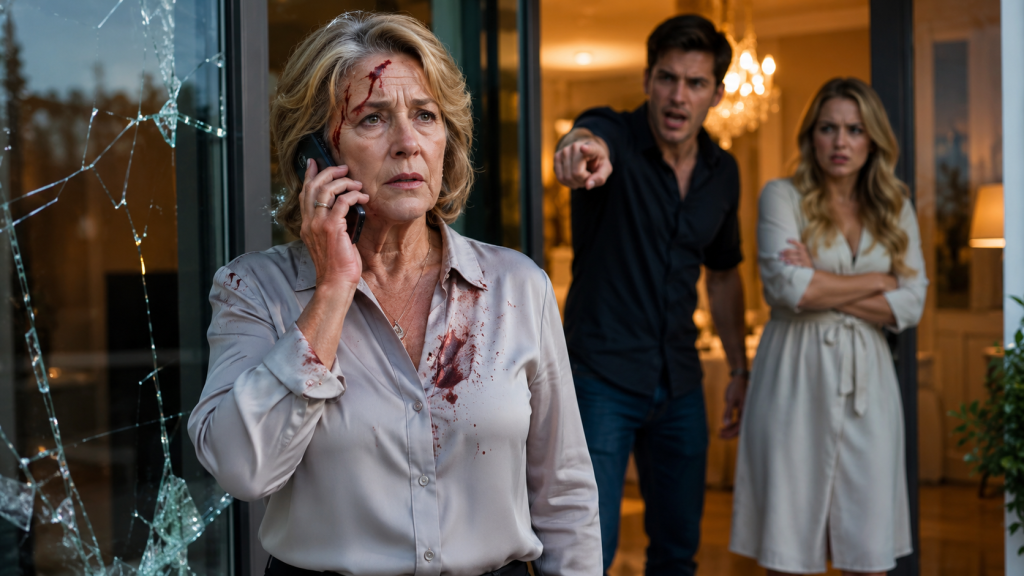
The glass door shattered before I fully understood that my own son had pushed me through it. I hit the stone terrace hard, surrounded by broken glass, while blood slid from my temple onto my blouse. Ethan stood over me and said, “Now maybe you’ll finally learn where you belong.”
For three years, I had lived quietly in the guest cottage behind Ethan’s house. Everyone believed he was the devoted son supporting his “broke, dependent mother.” Vanessa repeated that story with a sympathetic smile whenever people asked.
But they never knew the truth.
After my husband died, I let Ethan believe our family fortune was gone. I wanted to know whether my son would still love me when he thought there was nothing left to inherit.
So I lived simply. I drove an old sedan. I wore ordinary clothes. I watched what happened when Ethan thought I had no power left.
That evening, he placed papers in front of me and demanded I transfer the cottage land into Vanessa’s name.
“I’m not signing this.”
Vanessa’s face changed. “You don’t own anything. You’re living here because we allow it.”
“The land is part of a trust,” I said.
Ethan laughed. “Your imaginary trust?”
Then he grabbed my arm.
I pulled away. Vanessa opened the glass patio door behind me. For one second, I thought she was letting me leave.
Then Ethan shoved.
I fell through the glass and landed on the stone terrace. My hand shook as I tried to push myself up. Inside the house, the music kept playing like nothing had happened.
Vanessa looked down at me. “You’re broke, useless, and ungrateful.”
I pressed a linen napkin against my forehead and stood up.
I did not argue. I did not explain the trust. I did not tell them what they had just risked losing.
Ethan smiled. “Pack tonight. You’re done here.”
I walked back to the cottage, locked the door, and opened the safe beneath the floorboards.
Inside were my passport, medical directives, sealed trust documents, and one black phone.
Not everything I owned had disappeared.
Not everything Ethan believed was true.
I picked up the black phone and made the call that changed everything.
PART 2: THE CALL THAT CHANGED EVERYTHING
I stared at the black phone for several seconds.
It had been sitting inside the safe for years.
Silent.
Unassuming.
Waiting.
My fingers trembled as I picked it up.
Not because I was afraid of Ethan.
Not anymore.
I was trembling because something inside me had finally broken.
Not the glass.
Not my skin.
Something deeper.
Something far more difficult to repair.
The belief that my son would never truly hurt me.
I pressed the single button programmed into the phone.
One ring.
Then two.
A familiar voice answered.
“Mrs. Carter?”
For a moment, I couldn’t speak.
Outside my cottage window, the lights from Ethan’s house glowed warmly against the darkness.
From where I stood, the house looked peaceful.
Beautiful.
Perfect.
The same house where my own son had just pushed me through a glass door.
The same house where my blood was probably still staining the stone terrace.
The same house where they were probably drinking wine and congratulating themselves for finally getting rid of me.
“Mrs. Carter?”
The voice came again.
This time, I swallowed the ache in my throat.
“It’s me, Daniel.”
There was silence.
Then his voice changed.
He knew.
Daniel had been my husband’s attorney for almost thirty years.
He knew the Carter family better than anyone outside of it.
He had helped my husband establish the trusts.
He had watched Ethan grow from a boy who chased butterflies across our garden into the man who now looked at his own mother as an obstacle standing between him and money.
“I didn’t expect to hear from you tonight,” Daniel said quietly.
“Neither did I.”
“What happened?”
I looked down at the blood on my blouse.
My hand was still shaking.
“I need you to activate the trust protections.”
The silence that followed was different.
Heavier.
More serious.
Daniel knew exactly what those words meant.
“Has there been an incident?”
“Yes.”
“Are you safe?”
I closed my eyes.
That question hurt more than I expected.
Was I safe?
I had spent three years living behind my son’s house.
Three years listening to Vanessa complain about me.
Three years pretending not to notice when Ethan spoke to me with impatience.
Three years convincing myself that family meant forgiveness.
Even when forgiveness was never requested.
“I am now,” I whispered.
Daniel inhaled slowly.
“Do you need medical attention?”
“I have already cleaned the wound.”
“That wasn’t my question.”
For the first time that night, I almost smiled.
Daniel had always been stubborn.
My husband used to say that Daniel could argue with a thunderstorm and somehow convince the rain to stop.
“I’ll see a doctor tomorrow.”
“No,” he said.
His voice became firm.
“Tonight.”
I looked toward the house.
Music was still playing.
Soft laughter floated through the darkness.
My son was laughing.
While his mother stood alone in a cottage with blood drying against her skin.
Something inside me turned cold.
“I’ll go,” I said.
“Good.”
Then Daniel paused.
“And Margaret?”
“Yes?”
“Do not speak to Ethan or Vanessa again tonight.”
I looked at the broken pieces of my family scattered invisibly around me.
“I wasn’t planning to.”
“Good.”
His voice softened.
“Because tomorrow morning, they will be hearing from me.”
The call ended.
For several seconds, I stood completely still.
The cottage was quiet.
Too quiet.
I could hear the ticking of the clock above the fireplace.
Tick.
Tick.
Tick.
Each second felt like another door closing.
Another chapter ending.
I placed the phone back into the safe.
Then I pulled out the sealed folder beneath it.
My husband’s handwriting was still visible across the front.
For Margaret. Only when necessary.
I traced my fingers across his name.
Richard.
Even after his death, seeing his handwriting could still take my breath away.
I remembered the night he created the trust.
We had been sitting in his study.
The fire was burning.
Rain tapped gently against the windows.
Ethan had been upstairs, twenty-three years old at the time, talking excitedly about his future.
Richard had looked at me and said something I never forgot.
“Money doesn’t change people, Margaret.”
I had raised an eyebrow.
“Of course it does.”
He smiled.
“No.”
Then his expression became serious.
“It reveals them.”
I hated those words when he said them.
Not because they were cruel.
Because I knew he might be right.
“Why are you doing this?” I had asked, looking at the documents.
“Because I want you protected.”
“From what?”
Richard had looked toward the ceiling.
Toward the room where our son slept.
“From anyone who believes your kindness makes you weak.”
At the time, I thought he was being overly cautious.
Richard had always been the careful one.
He read contracts twice.
He remembered birthdays no one else remembered.
He locked doors even when we lived in neighborhoods where everyone knew everyone.
And he loved Ethan.
God, he loved that boy.
Which was why I never imagined those words would someday apply to our own son.
I sat down at the kitchen table.
The folder felt heavy in my hands.
Inside were documents that Ethan had never seen.
Documents that explained exactly why the cottage existed.
Exactly who owned the land beneath Ethan’s house.
Exactly where the money had gone.
And exactly what would happen if someone attempted to manipulate, threaten, or financially exploit me.
Twenty-one million dollars.
That was what Ethan believed had disappeared after Richard died.
He thought the investments had failed.
He thought the businesses had collapsed.
He thought his father had left behind debts and disappointment.
I had allowed him to believe it.
Not because I wanted to punish him.
At least, not in the beginning.
I simply wanted the truth.
I wanted to know whether my son loved me.
Or whether he loved the idea of inheriting from me.
Three years.
That was how long I had waited.
Three years of pretending.
Three years of listening.
Three years of being called forgetful, difficult, dependent, embarrassing.
Three years of watching Vanessa smile at me while quietly checking my purse.
Three years of hearing Ethan say things like—
“You don’t understand how expensive life is.”
“You should be grateful we let you stay.”
“You don’t have anything left.”
And the worst one.
“Dad would be ashamed of what you’ve become.”
That one had almost broken me.
But I never responded.
Because I had needed to know.
Now I did.
I closed the folder.
The answer was clear.
My son did not love me when he believed I had nothing.
He tolerated me.
And tonight, he had stopped even doing that.
The emergency clinic was nearly empty when I arrived.
A nurse cleaned the wound on my forehead.
Tiny pieces of glass had become embedded near my hairline.
I stared at the ceiling while she worked.
“Accident?” she asked gently.
I almost answered automatically.
Yes.
It was easier.
Women my age were taught to make things easier.
Don’t cause trouble.
Don’t embarrass the family.
Don’t make a scene.
Protect the people you love.
Even when they don’t protect you.
But then I thought about Ethan standing over me.
Now maybe you’ll finally learn where you belong.
I opened my eyes.
“No.”
The nurse stopped.
“No?”
“My son pushed me.”
Her expression changed.
I saw concern.
Then anger.
Then the professional calm of someone who had heard stories like mine before.
“Would you like us to contact the police?”
I hesitated.
That was the hardest question.
Because no matter what Ethan had done, a small part of me still saw him as a child.
The little boy who used to crawl into my bed during thunderstorms.
The teenager who had cried when our golden retriever died.
The young man who held my hand during Richard’s funeral.
Where had that boy gone?
Or perhaps the harder question was—
Had I ever truly known him?
“Not yet,” I said.
The nurse nodded.
“You can change your mind.”
I knew.
And for the first time, I understood that changing my mind was something I was finally allowed to do.
I returned to the cottage after midnight.
Ethan’s house was dark.
The music had stopped.
The terrace lights were still on.
Through the window, I could see the shattered glass.
No one had cleaned it.
No one had come looking for me.
No one had asked if I was alive.
I stood there for a long moment.
Then I walked inside.
I locked the door.
And I slept.
Not well.
But deeply enough to dream of Richard.
He was standing in our old kitchen.
Young.
Healthy.
Smiling.
“You always were too forgiving,” he told me.
I woke up before sunrise.
My face hurt.
My heart hurt worse.
But something had changed.
I was no longer waiting for Ethan to become the son I remembered.
I was finally seeing the man he had chosen to become.
At 7:12 in the morning, my phone rang.
Daniel.
“They’ve been notified,” he said.
I sat up in bed.
“Already?”
“Yes.”
“What exactly did you do?”
Daniel paused.
“Margaret.”
“Yes?”
“You asked me to activate the trust protections.”
“I know.”
“And that’s what I did.”
His voice sounded almost amused.
But beneath it was something serious.
“Ethan and Vanessa have received notice that no assets belonging to you may be transferred, sold, borrowed against, refinanced, or otherwise manipulated pending legal review.”
I stared toward the ceiling.
“And their house?”
“Technically?”
Daniel said.
I knew that tone.
“Technically what?”
“The land beneath their house belongs to the Carter Family Preservation Trust.”
I closed my eyes.
Ethan knew that.
Or he should have.
But he had never cared about paperwork.
Richard handled those things.
Then Daniel.
Then me.
Ethan simply enjoyed the results.
“What happens now?”
“The property has been frozen.”
A strange silence filled the room.
I had imagined this moment many times.
But I didn’t feel victorious.
I felt tired.
Terribly tired.
“And the twenty-one million?”
Daniel’s answer came without hesitation.
“Untouchable.”
I looked down at my hands.
For three years, Ethan believed I had nothing.
Now he would discover that I had everything he thought he could take.
“Thank you,” I whispered.
“There’s something else.”
My stomach tightened.
“What?”
“Vanessa attempted to access one of the family accounts this morning.”
I said nothing.
“She failed.”
Of course she did.
Vanessa had always been curious about money.
She knew the price of everything.
And somehow, the value of nothing.
“She called the bank,” Daniel continued.
“Twice.”
I could imagine her.
Standing in the kitchen.
Perfect hair.
Perfect clothes.
Perfect smile disappearing when the banker politely told her no.
“And Ethan?”
Daniel exhaled.
“He’s angry.”
A bitter laugh escaped me.
“Imagine that.”
“He’s demanding to speak with you.”
I looked toward the window.
The morning sun had begun to rise.
For the first time in years, I felt no desire to run from the day.
“No.”
Daniel was quiet.
“No?”
“I won’t speak to him.”
“Good.”
I smiled faintly.
“Daniel?”
“Yes?”
“Send me the full documents.”
“They’re already on their way.”
The call ended.
Ten minutes later, I heard pounding on my door.
Not knocking.
Pounding.
“MOM!”
Ethan.
I sat perfectly still.
“MOM, OPEN THE DOOR!”
The pounding became louder.
“WHAT DID YOU DO?”
I looked at the small lock on the cottage door.
For three years, I had felt like a guest.
But this cottage belonged to me.
The land belonged to the trust.
The trust belonged to me.
And for the first time, I understood something far more important than money.
I belonged to myself.
Ethan pounded again.
“MOM!”
I walked slowly toward the door.
Then stopped.
I did not unlock it.
“Go away, Ethan.”
Silence.
Then—
“What is wrong with you?”
I almost laughed.
What was wrong with me?
That was always the question people asked when a woman finally stopped accepting mistreatment.
“What did you do to the house?”
I leaned closer to the door.
“I didn’t do anything.”
“Don’t lie to me!”
“I didn’t lie.”
He slammed his hand against the door.
“THE BANK CALLED ME!”
“I know.”
“There’s a legal freeze on everything!”
“Yes.”
“MOM!”
His voice cracked.
And for one brief second—
One dangerous second—
My heart softened.
Then I remembered the glass.
The blood.
The stone.
The laughter.
“You pushed me through a door last night,” I said quietly.
Silence.
“I was angry.”
“You were angry?”
“You wouldn’t sign the papers!”
I closed my eyes.
There it was.
Not regret.
Not guilt.
Not concern.
An excuse.
“You were angry because I wouldn’t give you what you wanted.”
“You don’t understand.”
“No, Ethan.”
My voice became stronger.
“I understand perfectly.”
His breathing changed.
“MOM, PLEASE.”
That word.
Please.
He had finally found it.
But not because he loved me.
Because he was afraid.
“I need you to call your lawyer.”
“No.”
“Why not?”
“Because Daniel is my lawyer.”
“Dad’s lawyer!”
“My lawyer.”
“You can’t freeze my house!”
I looked around the cottage.
At the small kitchen.
The worn sofa.
The old photographs.
For three years, Ethan had made me feel small inside these walls.
No more.
“Watch me.”
His voice dropped.
“You’re really going to do this to me?”
I felt tears gather in my eyes.
Not because I was weak.
Because grief and love can live inside the same heart.
Even when one of them should have died long ago.
“You did this to yourself.”
“MOM!”
“Goodbye, Ethan.”
And I walked away.
By noon, the story had spread through the family.
My sister called first.
Then Ethan’s cousin.
Then three people who hadn’t spoken to me in years suddenly remembered my phone number.
Everyone wanted to know what happened.
Everyone wanted details.
I gave them none.
Because the truth wasn’t entertainment.
It was my life.
At 2:00 p.m., Daniel arrived at the cottage.
He looked older than I remembered.
Or perhaps the last three years had simply aged both of us.
He carried a thick folder.
And flowers.
I stared at them.
“Flowers?”
“They were on sale.”
I laughed.
A real laugh.
The first one since Richard died.
Daniel smiled.
“There she is.”
I took the flowers.
“Don’t get used to it.”
“Never.”
We sat at the kitchen table.
He opened the folder.
“Ethan has hired an attorney.”
“That was fast.”
“He believes he can challenge the trust.”
“Can he?”
Daniel looked offended.
“Margaret.”
I smiled.
“Sorry.”
“No.”
He adjusted his glasses.
“He cannot.”
We reviewed everything.
The property.
The accounts.
The trust.
The businesses.
The inheritance.
Twenty-one million dollars.
Protected.
Documented.
Untouchable.
Then Daniel placed one final document in front of me.
“What is this?”
“A temporary removal notice.”
I stared at him.
“For Ethan and Vanessa?”
“Yes.”
My heart began to pound.
“You’re evicting them?”
“The trust is reclaiming the property.”
I looked toward the window.
The house stood only a few yards away.
My son’s house.
The home where I had celebrated birthdays.
Christmas mornings.
Richard’s final Thanksgiving.
Could I really do it?
Daniel watched me carefully.
“You don’t have to sign today.”
I looked at the document.
Then I remembered Ethan’s words.
Pack tonight. You’re done here.
My hand stopped shaking.
I picked up the pen.
“No.”
Daniel looked at me.
“No?”
“I think I’ve waited long enough.”
And I signed.
That evening, Ethan came to the cottage again.
This time, he didn’t pound.
He knocked.
Softly.
I opened the door but kept the chain locked.
His eyes were red.
For a moment, he looked like my son again.
“Mom.”
I waited.
“I’m sorry.”
I wanted to believe him.
God knows I wanted to believe him.
“What are you sorry for?”
His eyes moved toward the ground.
“For everything.”
“That isn’t an answer.”
He looked up.
“The glass door.”
“Yes.”
“And what else?”
He said nothing.
I waited.
Finally, he whispered—
“I don’t know.”
There it was.
The truth.
He didn’t understand what he had done.
Not really.
He understood consequences.
Not pain.
“I loved you,” I said quietly.
His eyes filled with tears.
“Mom—”
“I loved you when you had nothing.”
He began crying.
“I loved you when you made mistakes.”
“Please.”
“I loved you when your father died and you stopped answering my calls.”
He covered his face.
“I loved you when Vanessa told everyone I was dependent on you.”
“Stop.”
“And I loved you last night.”
His shoulders shook.
“But love doesn’t mean I have to let you destroy me.”
I closed the door.
Not because I stopped loving him.
Because I finally started loving myself.
The next morning, Ethan and Vanessa left the property.
There were no dramatic police officers.
No screaming crowds.
No cameras.
Just two moving trucks.
And silence.
Vanessa never looked at me.
Ethan did.
Once.
From across the driveway.
I stood outside the cottage.
The bandage was still visible across my forehead.
He stared at it.
Then lowered his eyes.
I didn’t wave.
I didn’t smile.
I simply stood there.
Still.
Alive.
Free.
When the trucks disappeared down the road, I walked inside the main house for the first time in months.
It was quiet.
Empty.
Strange.
I walked through the rooms slowly.
Past the kitchen.
Past the living room.
Past the glass patio door.
It had been replaced overnight.
A new sheet of glass stood where the old one had shattered.
For several seconds, I stared at my reflection.
An older woman.
A bandage across her forehead.
Tired eyes.
Silver hair.
And something new.
Strength.
Not the kind that screams.
Not the kind that threatens.
The kind that survives.
I touched the glass gently.
Then turned away.
That night, I sat on the terrace with a cup of tea.
The stone had been cleaned.
No blood remained.
The broken glass was gone.
But I would remember.
Not because I wanted to live in the past.
Because some wounds become reminders.
They teach us where the line is.
They teach us what forgiveness costs.
And sometimes—
They teach us that the people we love most are not always the people who deserve unlimited access to our hearts.
A week later, I received a letter from Ethan.
I didn’t open it immediately.
It sat on the table for three days.
When I finally read it, there were only four words that mattered.
I am getting help.
I cried when I read them.
Because part of me was still his mother.
And perhaps I always would be.
But I did not call him.
Not yet.
Healing could not begin with another promise.
It had to begin with change.
Real change.
Time would decide whether that happened.
As for me—
I moved out of the cottage.
Not because I had been forced out.
But because I wanted a new beginning.
I bought a small home near the ocean.
Nothing extravagant.
Nothing that needed to impress anyone.
Every morning, I opened the windows and listened to the waves.
I drank coffee slowly.
I walked without looking over my shoulder.
And sometimes, when the sun began to rise, I thought about Richard.
I imagined him sitting beside me.
Smiling.
“You were right,” I whispered one morning.
About people.
About money.
About strength.
And perhaps, somewhere beyond the life I could see, he heard me.
The twenty-one million dollars remained untouched.
But in the end, that wasn’t what saved me.
Money gave me choices.
The trust gave me protection.
Daniel gave me guidance.
But something else saved me.
The moment I finally understood—
I did not have to prove my worth to people who benefited from making me feel worthless.
I did not have to buy love.
I did not have to tolerate cruelty because it came from family.
And I did not have to remain silent forever.
Sometimes silence is fear.
But sometimes—
Silence is simply the moment before you remember who you are.
My name was Margaret Carter.
I was seventy-two years old.
I was a widow.
A mother.
A woman with scars.
A woman who had lost more than most people would ever understand.
And I was also something else.
I was free.
One day, perhaps Ethan would earn the chance to know me again.
Not as a bank account.
Not as an inheritance.
Not as a problem to solve.
But as his mother.
Until then—
I had a life to live.
And this time, I wasn’t going to spend it proving that I deserved one.
I stepped outside onto my porch.
The morning sun warmed my face.
For the first time in years, there was no anger inside me.
No desire for revenge.
Only peace.
Because the greatest victory was never freezing Ethan’s house.
It was never protecting the twenty-one million dollars.
It was never watching the people who underestimated me finally discover the truth.
The greatest victory was walking away from the people who tried to break me—
And discovering that I was still standing.
Stronger.
Wiser.
And finally—
Home.
PART 3: THE DAY I STOPPED WAITING FOR MY SON TO SAVE ME
Three months passed before Ethan came back.
Not three days.
Not three weeks.
Three long months.
Three months of silence.
Three months of learning how quiet a life could become when the people who once filled it with pain were suddenly gone.
At first, I didn’t know what to do with peace.
That may sound strange.
But when you have spent years walking carefully around other people’s moods, peace can feel unfamiliar.
Almost suspicious.
For years, I had awakened wondering whether Vanessa would complain about something I had done.
For years, I had listened for Ethan’s footsteps and tried to guess what version of my son would walk through the door.
The charming one.
The impatient one.
The angry one.
Or the one who looked through me as if I were nothing more than an inconvenience.
Then suddenly—
There was only silence.
At my new house by the ocean, the mornings belonged to me.
The windows opened toward the water.
The curtains moved gently whenever the wind came through.
Seagulls called somewhere above the waves.
And every morning, I sat alone with my coffee and watched the sun climb slowly into the sky.
No one demanded anything from me.
No one reminded me how expensive I was.
No one asked what I planned to leave behind when I died.
For the first few weeks, I cried.
I cried over Richard.
I cried over the son I remembered.
And sometimes, I cried for the woman I had become while trying to keep everyone else happy.
I had spent so much of my life being someone’s wife.
Someone’s mother.
Someone’s caretaker.
Someone’s source of comfort.
I had forgotten that before all of those things—
I was Margaret.
And Margaret still had dreams.
Small dreams, perhaps.
But they were mine.
I began planting flowers behind the house.
I bought books I had been meaning to read for years.
I took long walks near the water.
And one afternoon, I signed up to volunteer at a small community center.
The first day I arrived, a little girl named Lily asked me why I was there.
I smiled at her.
“I’m trying to learn something.”
She looked confused.
“What?”
“How to begin again.”
She thought about it seriously.
Then she nodded.
“My mom says beginnings are scary.”
“She is right.”
“But endings are scary too.”
I looked at her.
Children have a way of saying things that adults spend years trying to understand.
“Yes,” I said softly.
“They are.”
Lily smiled.
“Then maybe you should have both.”
I laughed.
And for the rest of the day, those words stayed with me.
Maybe you should have both.
Perhaps that was what life truly was.
A collection of endings.
A collection of beginnings.
And sometimes—
The two happened at exactly the same time.
The letter arrived on a Tuesday morning.
I knew Ethan’s handwriting immediately.
My hands became cold before I even opened the envelope.
For several minutes, I simply stared at his name.
Mom.
Such a small word.
Yet it still carried an entire lifetime inside it.
I made tea.
I sat by the window.
Then I opened the letter.
There were several pages.
The first line made my heart stop.
I don’t expect you to forgive me.
I read it again.
Then I continued.
Ethan wrote that after leaving the house, he and Vanessa had separated.
Their marriage had not survived the consequences of what happened.
Vanessa blamed him.
Ethan blamed her.
For weeks, according to his letter, they had done what people often do when their lives fall apart.
They looked everywhere except at themselves.
But eventually, Ethan said, he could no longer do that.
He began attending counseling.
At first, he wrote, he went because the court required certain evaluations after the investigation into the assault.
But eventually, he stayed because he needed help.
He wrote about his anger.
His resentment.
His jealousy.
And the truth he had spent years refusing to admit.
I was angry at Dad for dying.
I stopped reading.
The waves crashed outside.
Slowly.
Steadily.
Like a heart continuing to beat after it has been broken.
I had never thought about that.
Not deeply enough.
Ethan had loved his father.
But grief does strange things to people.
Sometimes sadness becomes silence.
Sometimes silence becomes anger.
And sometimes anger searches for someone safe enough to hurt.
I read the next page.
You were the only person left who reminded me of him.
My eyes filled with tears.
Every time I looked at you, I remembered what I lost. Instead of grieving, I became angry. And because you kept forgiving me, I convinced myself I could keep treating you badly.
That sentence hurt.
Not because it was untrue.
Because it was.
I folded the letter and placed it on the table.
For a long time, I watched the ocean.
Forgiveness.
People spoke about it as if it were always beautiful.
As if forgiving someone automatically repaired everything.
But forgiveness was not a bridge that could be built by one person.
Trust required two people.
And Ethan had burned every bridge between us.
Still—
There was one thing I had learned since leaving him.
I could love my son and still protect myself from him.
Those two things did not cancel each other out.
A week later, Daniel called.
“There has been a development.”
I was sitting in the garden.
“What kind of development?”
“Ethan has agreed to accept responsibility.”
My hands stopped moving.
“For what?”
“For everything.”
Daniel’s voice became quieter.
“He has signed a statement acknowledging what happened that night.”
I closed my eyes.
“He admitted it?”
“Yes.”
“He didn’t blame Vanessa?”
“No.”
“He didn’t say I provoked him?”
“No.”
The silence between us grew.
For months, I had wondered whether Ethan would ever tell the truth.
Not the truth that made him look better.
The truth that cost him something.
“There’s more,” Daniel said.
I already knew from his tone that I wasn’t going to like it.
“What?”
“He wants to see you.”
My heart began beating faster.
“No.”
Daniel was quiet.
“I haven’t told him that yet.”
“Then tell him.”
“Margaret.”
“Daniel.”
“You don’t have to see him.”
“I know.”
“But?”
I looked toward the ocean.
“But I don’t know if I should.”
Daniel sighed.
“I was afraid you would say that.”
I smiled faintly.
“You know me too well.”
“Yes.”
He paused.
“Do you want my professional advice?”
“No.”
“My personal advice?”
“That’s more dangerous.”
He laughed.
“Meet him somewhere public.”
I said nothing.
“Bring someone you trust.”
Still nothing.
“And leave whenever you want.”
I looked at the flowers growing near my porch.
For three years, I had stayed because I was afraid of losing my son.
But I had lost him anyway.
Perhaps now, I needed to stop making decisions from fear.
“Arrange it,” I said.
The meeting took place at a small café near the water.
I arrived early.
Not because I was nervous.
That was what I told myself.
But when the door opened and Ethan walked inside, my heart still recognized him before my mind could protect me.
He looked thinner.
Older.
Not physically old.
Just tired.
The kind of tiredness that came from finally having nowhere left to hide.
He saw me.
And stopped.
For a moment, neither of us moved.
Then he walked toward the table.
“Hi, Mom.”
I looked at him.
“Hello, Ethan.”
He sat down slowly.
Neither of us reached for the menu.
Neither of us knew where to begin.
Finally, he looked at my forehead.
The wound had healed.
Only a faint scar remained.
But he saw it.
I watched his face change.
His eyes filled with tears.
“I did that.”
I said nothing.
“I keep thinking about it.”
Still, I said nothing.
“The sound of the glass.”
His voice cracked.
“You falling.”
My hands remained folded in front of me.
“I don’t know how I became that person.”
For the first time, I answered.
“You became that person slowly.”
He looked at me.
“People don’t usually become cruel in one night, Ethan.”
His tears fell.
“Cruelty grows when people keep excusing it.”
He lowered his head.
“I know.”
“No.”
My voice remained gentle.
“You are beginning to know.”
He nodded.
And for a moment, I saw the little boy who used to bring me dandelions from the yard.
The teenager who asked me to wait awake until he came home.
The man who once held me at his father’s funeral.
I loved all of those versions of him.
But loving them did not erase the man sitting in front of me now.
“I am sorry,” he whispered.
I waited.
He looked at me again.
“I am sorry for pushing you.”
“Yes.”
“I am sorry for humiliating you.”
I nodded.
“I am sorry for calling you useless.”
My eyes began to burn.
“And?”
He swallowed.
“I am sorry that I made you believe you had to hide your money to find out whether I loved you.”
That one broke something inside me.
Not painfully.
Quietly.
Like ice finally beginning to melt.
“You knew?” I asked.
“Not at first.”
He wiped his eyes.
“But after everything happened, I realized something.”
“What?”
“Even when I thought you had nothing, I should have treated you like you were everything.”
I looked away.
Because sometimes, the words you wait years to hear arrive too late to repair what they broke.
But perhaps—
They can still begin something new.
Ethan and I spoke for almost two hours.
We did not laugh much.
There was nothing funny about the years we had lost.
But we talked.
Honestly.
For the first time in a very long time.
He told me about counseling.
About the anger he had carried since Richard died.
About his fear that he would never be successful enough.
About the jealousy he felt toward the life his father had built.
“And when you seemed to lose everything,” he said, “I thought I was better than you.”
I looked at him.
“Were you?”
His eyes filled with shame.
“No.”
“Why?”
“Because you were never measuring your life by money.”
I nodded.
“And you were.”
“Yes.”
The answer was painful.
But honest.
And honesty was where healing had to begin.
Not with excuses.
Not with flowers.
Not with promises.
With truth.
Before we left the café, Ethan reached across the table.
His hand stopped halfway.
He didn’t touch me.
He waited.
I looked at his hand.
Then slowly—
I placed mine beside it.
Not in it.
Beside it.
A small distance remained between us.
But it was less than before.
For now—
That was enough.
Six months later, Ethan appeared in court.
I did not attend.
I had given my statement.
The evidence existed.
The photographs existed.
The medical records existed.
And Ethan’s own admission existed.
I did not want revenge.
But I had learned something important.
Consequences were not revenge.
Boundaries were not cruelty.
And accountability was not hatred.
Ethan accepted the legal consequences of what he had done.
He completed the requirements ordered by the court.
He continued counseling.
And for the first time in years, his life was no longer built around what he could take from someone else.
He found work.
A real job.
Nothing glamorous.
Nothing connected to my money.
He rented a small apartment.
And according to Daniel, he paid every bill himself.
I smiled when I heard that.
Not because I wanted him to struggle.
Because independence was something he needed to learn.
Some lessons cannot be inherited.
Vanessa never returned.
I heard that she moved to another city.
I did not follow her life.
I did not ask questions.
I did not wish her harm.
I simply let her go.
There are people who enter our lives as lessons.
Not because we deserved the pain they caused.
But because they teach us what we will never again accept.
And Vanessa had taught me something.
A smile is not always kindness.
Polite words are not always love.
And sometimes the people who stand beside your family are quietly waiting to see what they can take from it.
I hoped she would someday find the courage to look honestly at herself.
But that was no longer my responsibility.
I had spent enough years carrying other people’s choices.
It was time to put them down.
One year after the night of the broken glass, I returned to the old property.
Not because I wanted to live there again.
I didn’t.
The trust had sold the house.
The money from the sale remained protected.
But before the final papers were completed, I wanted to see it one last time.
Daniel came with me.
“You don’t have to do this,” he said.
“I know.”
The house was empty.
The rooms echoed.
Without furniture and music, it looked smaller than I remembered.
I walked through the hallway.
Past the kitchen.
Past the living room.
And finally—
I stood before the glass patio door.
A new family would soon live there.
Children might run through the rooms.
Someone might host birthday parties.
Someone might fall in love.
Someone might believe the house was simply a house.
They would never know what had happened there.
And that was fine.
Not every painful memory needed to become a monument.
I touched the glass.
Then I smiled.
Daniel looked at me.
“What?”
“I used to think this was where everything ended.”
“And now?”
I turned toward him.
“Now I think it was where I began.”
He smiled.
“I think Richard would like that.”
My eyes filled with tears.
“So do I.”
We walked away.
And I never looked back.
A few months later, I made a decision about the twenty-one million dollars.
For years, the money had represented security.
Then it represented secrecy.
Then it represented power.
But I didn’t want the rest of my life to be defined by protecting it.
I wanted it to mean something.
So I created a foundation in Richard’s name.
Not a grand organization with my photograph on every wall.
That wasn’t what I wanted.
The foundation would help older people who had nowhere to go.
Women and men who had been financially manipulated by family.
People who had been told they were burdens.
People who had been made to feel invisible inside their own homes.
The first day the foundation opened, I stood quietly in the back.
No cameras.
No speeches.
No applause.
I watched an elderly woman walk through the door with her daughter.
She looked nervous.
Confused.
Ashamed.
I recognized that look.
I had worn it myself.
A volunteer greeted her.
The woman began crying.
And suddenly, I understood.
This was what money was supposed to do.
Not make people feel powerful over others.
But give people choices.
Give them safety.
Give them a door that opened instead of one that shattered.
I left the building quietly.
Outside, the sun was shining.
I stood there for several minutes and let the warmth touch my face.
Then I whispered—
“This is for you, Richard.”
The wind moved through the trees.
And somehow—
That was enough.
Two years after the night Ethan pushed me through the glass door, he came to my house for dinner.
Not because I invited him immediately.
Trust had taken time.
Months.
Then more months.
He visited occasionally.
We talked.
Sometimes awkwardly.
Sometimes painfully.
But gradually, I began to see change.
Not perfection.
I no longer expected that.
Just change.
Real change.
The kind that appears quietly.
He apologized without being asked.
He listened when I spoke.
He stopped explaining why his life was difficult.
And most importantly—
He stopped asking me for money.
One evening, he arrived carrying a small paper bag.
“What is that?” I asked.
“Dinner.”
“You cooked?”
He smiled nervously.
“Don’t sound so surprised.”
“I am surprised.”
He laughed.
For a moment, the years disappeared.
Just for a moment.
He placed the food on the table.
Then handed me a small envelope.
“What is this?”
“Open it.”
Inside was a photograph.
Ethan.
At six years old.
Standing beside Richard.
Both of them covered in dirt.
They had been building a treehouse.
I remembered that day.
Richard had complained for hours about Ethan holding the hammer incorrectly.
Ethan had insisted he knew exactly what he was doing.
And I had stood in the kitchen window laughing at both of them.
On the back of the photograph, Ethan had written—
Thank you for remembering who Dad taught us to be.
My eyes filled with tears.
I looked up.
Ethan was crying too.
“I’m still learning,” he said.
“So am I.”
He nodded.
“Do you think we’ll ever be okay?”
I thought carefully.
Because this time, I refused to offer easy answers.
“We may never become who we were.”
His face fell slightly.
“But perhaps that’s not the goal.”
“What is?”
I reached across the table.
This time—
I took his hand.
“To become better than we were.”
He cried.
And so did I.
Not because everything was forgiven.
Not because everything was forgotten.
But because sometimes healing does not mean returning to the past.
Sometimes—
Healing means building a future that the past can no longer destroy.
Years later, people still asked me about the night of the broken glass.
They had heard parts of the story.
Some knew about the trust.
Some knew about the money.
Some knew about the frozen property.
And almost everyone asked the same question.
“Was it worth it?”
I always knew what they meant.
Was the fight worth it?
Was the pain worth it?
Was losing my relationship with my son worth protecting myself?
I would look at the ocean outside my window.
Then I would answer.
“No.”
They always looked surprised.
“The pain was never worth it.”
I would pause.
“But learning that I deserved better was.”
Because no amount of money can replace peace.
No inheritance can purchase genuine love.
And no family name gives anyone permission to destroy you.
I loved my son.
I still did.
Love did not disappear simply because someone hurt you.
But love changed.
It became wiser.
Stronger.
It learned to say no.
It learned to walk away.
And eventually—
It learned to return carefully.
With open eyes.
One quiet morning, I woke before sunrise.
The house was silent.
I made coffee and walked toward the ocean.
My hair had turned completely silver by then.
My hands were thinner.
My steps were slower.
But I felt lighter than I had in years.
I sat on a bench overlooking the water.
The horizon slowly turned gold.
And suddenly, I thought about the woman I had been on that terrible night.
Bleeding.
Alone.
Standing outside the house of the son she had spent her entire life loving.
I wished I could go back to her.
Not to change what happened.
But simply to hold her hand.
I would tell her—
You are not useless.
You are not a burden.
You are not too old to begin again.
You are not difficult for asking to be treated with respect.
You are not selfish for protecting yourself.
And you do not have to earn love by accepting pain.
I would tell her—
One day, you will wake up.
And the scar will still be there.
But it won’t hurt the same way.
One day, you will laugh without feeling guilty.
One day, you will look at your life and realize—
You survived the moment you thought would destroy you.
The sun rose completely.
Light covered the water.
I closed my eyes.
And for the first time, I didn’t think about money.
I didn’t think about the twenty-one million dollars.
I didn’t think about Ethan’s mistakes.
I didn’t think about Vanessa.
I didn’t think about the glass.
I simply listened to the waves.
In.
Out.
Again.
And again.
Like life.
Like forgiveness.
Like beginning again.
My phone vibrated in my pocket.
A message from Ethan.
Good morning, Mom. I hope you have a beautiful day.
I smiled.
Then I typed back—
Good morning, Ethan. I already am.
I placed the phone beside me.
The ocean stretched endlessly before my eyes.
And I finally understood something I should have known long ago.
My life was never hidden inside a trust fund.
It was never trapped inside a house.
It was never waiting for my son to become the person I wanted him to be.
My life had always been mine.
Even when I forgot it.
Even when others tried to take it from me.
Even when I was bleeding on cold stone beneath broken glass.
I was still there.
Margaret.
A woman.
A mother.
A widow.
A survivor.
Not perfect.
Not unbroken.
But still standing.
And perhaps that was the most beautiful ending of all.
Not that my son lost everything.
Not that I kept the money.
Not that the house was frozen.
Not even that the truth finally came out.
The most beautiful ending was this—
I stopped waiting for someone else to decide my worth.
I stopped confusing sacrifice with love.
I stopped believing that family meant I had to accept cruelty.
And I finally opened the door to a life where I could breathe.
The woman who had fallen through the glass door did not disappear that night.
She rose.
Slowly.
Painfully.
Beautifully.
She gathered the broken pieces of herself.
She stopped apologizing for taking up space.
She stopped begging to be loved.
And she walked toward the light.
Not because she had forgotten the darkness.
But because she had finally learned—
Darkness was never meant to be her home.
The waves continued to move beneath the morning sun.
I stood from the bench.
For a moment, I looked toward the horizon.
Then I smiled.
And walked home.
Not to the house Ethan had once controlled.
Not to the cottage where I had hidden.
Not to the past.
I walked home to myself.
And this time—
I had no intention of ever leaving again.
PART 3: THE DAY I STOPPED WAITING FOR MY SON TO SAVE ME
Three months passed before Ethan came back.
Not three days.
Not three weeks.
Three long months.
Three months of silence.
Three months of learning how quiet a life could become when the people who once filled it with pain were suddenly gone.
At first, I didn’t know what to do with peace.
That may sound strange.
But when you have spent years walking carefully around other people’s moods, peace can feel unfamiliar.
Almost suspicious.
For years, I had awakened wondering whether Vanessa would complain about something I had done.
For years, I had listened for Ethan’s footsteps and tried to guess what version of my son would walk through the door.
The charming one.
The impatient one.
The angry one.
Or the one who looked through me as if I were nothing more than an inconvenience.
Then suddenly—
There was only silence.
At my new house by the ocean, the mornings belonged to me.
The windows opened toward the water.
The curtains moved gently whenever the wind came through.
Seagulls called somewhere above the waves.
And every morning, I sat alone with my coffee and watched the sun climb slowly into the sky.
No one demanded anything from me.
No one reminded me how expensive I was.
No one asked what I planned to leave behind when I died.
For the first few weeks, I cried.
I cried over Richard.
I cried over the son I remembered.
And sometimes, I cried for the woman I had become while trying to keep everyone else happy.
I had spent so much of my life being someone’s wife.
Someone’s mother.
Someone’s caretaker.
Someone’s source of comfort.
I had forgotten that before all of those things—
I was Margaret.
And Margaret still had dreams.
Small dreams, perhaps.
But they were mine.
I began planting flowers behind the house.
I bought books I had been meaning to read for years.
I took long walks near the water.
And one afternoon, I signed up to volunteer at a small community center.
The first day I arrived, a little girl named Lily asked me why I was there.
I smiled at her.
“I’m trying to learn something.”
She looked confused.
“What?”
“How to begin again.”
She thought about it seriously.
Then she nodded.
“My mom says beginnings are scary.”
“She is right.”
“But endings are scary too.”
I looked at her.
Children have a way of saying things that adults spend years trying to understand.
“Yes,” I said softly.
“They are.”
Lily smiled.
“Then maybe you should have both.”
I laughed.
And for the rest of the day, those words stayed with me.
Maybe you should have both.
Perhaps that was what life truly was.
A collection of endings.
A collection of beginnings.
And sometimes—
The two happened at exactly the same time.
The letter arrived on a Tuesday morning.
I knew Ethan’s handwriting immediately.
My hands became cold before I even opened the envelope.
For several minutes, I simply stared at his name.
Mom.
Such a small word.
Yet it still carried an entire lifetime inside it.
I made tea.
I sat by the window.
Then I opened the letter.
There were several pages.
The first line made my heart stop.
I don’t expect you to forgive me.
I read it again.
Then I continued.
Ethan wrote that after leaving the house, he and Vanessa had separated.
Their marriage had not survived the consequences of what happened.
Vanessa blamed him.
Ethan blamed her.
For weeks, according to his letter, they had done what people often do when their lives fall apart.
They looked everywhere except at themselves.
But eventually, Ethan said, he could no longer do that.
He began attending counseling.
At first, he wrote, he went because the court required certain evaluations after the investigation into the assault.
But eventually, he stayed because he needed help.
He wrote about his anger.
His resentment.
His jealousy.
And the truth he had spent years refusing to admit.
I was angry at Dad for dying.
I stopped reading.
The waves crashed outside.
Slowly.
Steadily.
Like a heart continuing to beat after it has been broken.
I had never thought about that.
Not deeply enough.
Ethan had loved his father.
But grief does strange things to people.
Sometimes sadness becomes silence.
Sometimes silence becomes anger.
And sometimes anger searches for someone safe enough to hurt.
I read the next page.
You were the only person left who reminded me of him.
My eyes filled with tears.
Every time I looked at you, I remembered what I lost. Instead of grieving, I became angry. And because you kept forgiving me, I convinced myself I could keep treating you badly.
That sentence hurt.
Not because it was untrue.
Because it was.
I folded the letter and placed it on the table.
For a long time, I watched the ocean.
Forgiveness.
People spoke about it as if it were always beautiful.
As if forgiving someone automatically repaired everything.
But forgiveness was not a bridge that could be built by one person.
Trust required two people.
And Ethan had burned every bridge between us.
Still—
There was one thing I had learned since leaving him.
I could love my son and still protect myself from him.
Those two things did not cancel each other out.
A week later, Daniel called.
“There has been a development.”
I was sitting in the garden.
“What kind of development?”
“Ethan has agreed to accept responsibility.”
My hands stopped moving.
“For what?”
“For everything.”
Daniel’s voice became quieter.
“He has signed a statement acknowledging what happened that night.”
I closed my eyes.
“He admitted it?”
“Yes.”
“He didn’t blame Vanessa?”
“No.”
“He didn’t say I provoked him?”
“No.”
The silence between us grew.
For months, I had wondered whether Ethan would ever tell the truth.
Not the truth that made him look better.
The truth that cost him something.
“There’s more,” Daniel said.
I already knew from his tone that I wasn’t going to like it.
“What?”
“He wants to see you.”
My heart began beating faster.
“No.”
Daniel was quiet.
“I haven’t told him that yet.”
“Then tell him.”
“Margaret.”
“Daniel.”
“You don’t have to see him.”
“I know.”
“But?”
I looked toward the ocean.
“But I don’t know if I should.”
Daniel sighed.
“I was afraid you would say that.”
I smiled faintly.
“You know me too well.”
“Yes.”
He paused.
“Do you want my professional advice?”
“No.”
“My personal advice?”
“That’s more dangerous.”
He laughed.
“Meet him somewhere public.”
I said nothing.
“Bring someone you trust.”
Still nothing.
“And leave whenever you want.”
I looked at the flowers growing near my porch.
For three years, I had stayed because I was afraid of losing my son.
But I had lost him anyway.
Perhaps now, I needed to stop making decisions from fear.
“Arrange it,” I said.
The meeting took place at a small café near the water.
I arrived early.
Not because I was nervous.
That was what I told myself.
But when the door opened and Ethan walked inside, my heart still recognized him before my mind could protect me.
He looked thinner.
Older.
Not physically old.
Just tired.
The kind of tiredness that came from finally having nowhere left to hide.
He saw me.
And stopped.
For a moment, neither of us moved.
Then he walked toward the table.
“Hi, Mom.”
I looked at him.
“Hello, Ethan.”
He sat down slowly.
Neither of us reached for the menu.
Neither of us knew where to begin.
Finally, he looked at my forehead.
The wound had healed.
Only a faint scar remained.
But he saw it.
I watched his face change.
His eyes filled with tears.
“I did that.”
I said nothing.
“I keep thinking about it.”
Still, I said nothing.
“The sound of the glass.”
His voice cracked.
“You falling.”
My hands remained folded in front of me.
“I don’t know how I became that person.”
For the first time, I answered.
“You became that person slowly.”
He looked at me.
“People don’t usually become cruel in one night, Ethan.”
His tears fell.
“Cruelty grows when people keep excusing it.”
He lowered his head.
“I know.”
“No.”
My voice remained gentle.
“You are beginning to know.”
He nodded.
And for a moment, I saw the little boy who used to bring me dandelions from the yard.
The teenager who asked me to wait awake until he came home.
The man who once held me at his father’s funeral.
I loved all of those versions of him.
But loving them did not erase the man sitting in front of me now.
“I am sorry,” he whispered.
I waited.
He looked at me again.
“I am sorry for pushing you.”
“Yes.”
“I am sorry for humiliating you.”
I nodded.
“I am sorry for calling you useless.”
My eyes began to burn.
“And?”
He swallowed.
“I am sorry that I made you believe you had to hide your money to find out whether I loved you.”
That one broke something inside me.
Not painfully.
Quietly.
Like ice finally beginning to melt.
“You knew?” I asked.
“Not at first.”
He wiped his eyes.
“But after everything happened, I realized something.”
“What?”
“Even when I thought you had nothing, I should have treated you like you were everything.”
I looked away.
Because sometimes, the words you wait years to hear arrive too late to repair what they broke.
But perhaps—
They can still begin something new.
Ethan and I spoke for almost two hours.
We did not laugh much.
There was nothing funny about the years we had lost.
But we talked.
Honestly.
For the first time in a very long time.
He told me about counseling.
About the anger he had carried since Richard died.
About his fear that he would never be successful enough.
About the jealousy he felt toward the life his father had built.
“And when you seemed to lose everything,” he said, “I thought I was better than you.”
I looked at him.
“Were you?”
His eyes filled with shame.
“No.”
“Why?”
“Because you were never measuring your life by money.”
I nodded.
“And you were.”
“Yes.”
The answer was painful.
But honest.
And honesty was where healing had to begin.
Not with excuses.
Not with flowers.
Not with promises.
With truth.
Before we left the café, Ethan reached across the table.
His hand stopped halfway.
He didn’t touch me.
He waited.
I looked at his hand.
Then slowly—
I placed mine beside it.
Not in it.
Beside it.
A small distance remained between us.
But it was less than before.
For now—
That was enough.
Six months later, Ethan appeared in court.
I did not attend.
I had given my statement.
The evidence existed.
The photographs existed.
The medical records existed.
And Ethan’s own admission existed.
I did not want revenge.
But I had learned something important.
Consequences were not revenge.
Boundaries were not cruelty.
And accountability was not hatred.
Ethan accepted the legal consequences of what he had done.
He completed the requirements ordered by the court.
He continued counseling.
And for the first time in years, his life was no longer built around what he could take from someone else.
He found work.
A real job.
Nothing glamorous.
Nothing connected to my money.
He rented a small apartment.
And according to Daniel, he paid every bill himself.
I smiled when I heard that.
Not because I wanted him to struggle.
Because independence was something he needed to learn.
Some lessons cannot be inherited.
Vanessa never returned.
I heard that she moved to another city.
I did not follow her life.
I did not ask questions.
I did not wish her harm.
I simply let her go.
There are people who enter our lives as lessons.
Not because we deserved the pain they caused.
But because they teach us what we will never again accept.
And Vanessa had taught me something.
A smile is not always kindness.
Polite words are not always love.
And sometimes the people who stand beside your family are quietly waiting to see what they can take from it.
I hoped she would someday find the courage to look honestly at herself.
But that was no longer my responsibility.
I had spent enough years carrying other people’s choices.
It was time to put them down.
One year after the night of the broken glass, I returned to the old property.
Not because I wanted to live there again.
I didn’t.
The trust had sold the house.
The money from the sale remained protected.
But before the final papers were completed, I wanted to see it one last time.
Daniel came with me.
“You don’t have to do this,” he said.
“I know.”
The house was empty.
The rooms echoed.
Without furniture and music, it looked smaller than I remembered.
I walked through the hallway.
Past the kitchen.
Past the living room.
And finally—
I stood before the glass patio door.
A new family would soon live there.
Children might run through the rooms.
Someone might host birthday parties.
Someone might fall in love.
Someone might believe the house was simply a house.
They would never know what had happened there.
And that was fine.
Not every painful memory needed to become a monument.
I touched the glass.
Then I smiled.
Daniel looked at me.
“What?”
“I used to think this was where everything ended.”
“And now?”
I turned toward him.
“Now I think it was where I began.”
He smiled.
“I think Richard would like that.”
My eyes filled with tears.
“So do I.”
We walked away.
And I never looked back.
A few months later, I made a decision about the twenty-one million dollars.
For years, the money had represented security.
Then it represented secrecy.
Then it represented power.
But I didn’t want the rest of my life to be defined by protecting it.
I wanted it to mean something.
So I created a foundation in Richard’s name.
Not a grand organization with my photograph on every wall.
That wasn’t what I wanted.
The foundation would help older people who had nowhere to go.
Women and men who had been financially manipulated by family.
People who had been told they were burdens.
People who had been made to feel invisible inside their own homes.
The first day the foundation opened, I stood quietly in the back.
No cameras.
No speeches.
No applause.
I watched an elderly woman walk through the door with her daughter.
She looked nervous.
Confused.
Ashamed.
I recognized that look.
I had worn it myself.
A volunteer greeted her.
The woman began crying.
And suddenly, I understood.
This was what money was supposed to do.
Not make people feel powerful over others.
But give people choices.
Give them safety.
Give them a door that opened instead of one that shattered.
I left the building quietly.
Outside, the sun was shining.
I stood there for several minutes and let the warmth touch my face.
Then I whispered—
“This is for you, Richard.”
The wind moved through the trees.
And somehow—
That was enough.
Two years after the night Ethan pushed me through the glass door, he came to my house for dinner.
Not because I invited him immediately.
Trust had taken time.
Months.
Then more months.
He visited occasionally.
We talked.
Sometimes awkwardly.
Sometimes painfully.
But gradually, I began to see change.
Not perfection.
I no longer expected that.
Just change.
Real change.
The kind that appears quietly.
He apologized without being asked.
He listened when I spoke.
He stopped explaining why his life was difficult.
And most importantly—
He stopped asking me for money.
One evening, he arrived carrying a small paper bag.
“What is that?” I asked.
“Dinner.”
“You cooked?”
He smiled nervously.
“Don’t sound so surprised.”
“I am surprised.”
He laughed.
For a moment, the years disappeared.
Just for a moment.
He placed the food on the table.
Then handed me a small envelope.
“What is this?”
“Open it.”
Inside was a photograph.
Ethan.
At six years old.
Standing beside Richard.
Both of them covered in dirt.
They had been building a treehouse.
I remembered that day.
Richard had complained for hours about Ethan holding the hammer incorrectly.
Ethan had insisted he knew exactly what he was doing.
And I had stood in the kitchen window laughing at both of them.
On the back of the photograph, Ethan had written—
Thank you for remembering who Dad taught us to be.
My eyes filled with tears.
I looked up.
Ethan was crying too.
“I’m still learning,” he said.
“So am I.”
He nodded.
“Do you think we’ll ever be okay?”
I thought carefully.
Because this time, I refused to offer easy answers.
“We may never become who we were.”
His face fell slightly.
“But perhaps that’s not the goal.”
“What is?”
I reached across the table.
This time—
I took his hand.
“To become better than we were.”
He cried.
And so did I.
Not because everything was forgiven.
Not because everything was forgotten.
But because sometimes healing does not mean returning to the past.
Sometimes—
Healing means building a future that the past can no longer destroy.
Years later, people still asked me about the night of the broken glass.
They had heard parts of the story.
Some knew about the trust.
Some knew about the money.
Some knew about the frozen property.
And almost everyone asked the same question.
“Was it worth it?”
I always knew what they meant.
Was the fight worth it?
Was the pain worth it?
Was losing my relationship with my son worth protecting myself?
I would look at the ocean outside my window.
Then I would answer.
“No.”
They always looked surprised.
“The pain was never worth it.”
I would pause.
“But learning that I deserved better was.”
Because no amount of money can replace peace.
No inheritance can purchase genuine love.
And no family name gives anyone permission to destroy you.
I loved my son.
I still did.
Love did not disappear simply because someone hurt you.
But love changed.
It became wiser.
Stronger.
It learned to say no.
It learned to walk away.
And eventually—
It learned to return carefully.
With open eyes.
One quiet morning, I woke before sunrise.
The house was silent.
I made coffee and walked toward the ocean.
My hair had turned completely silver by then.
My hands were thinner.
My steps were slower.
But I felt lighter than I had in years.
I sat on a bench overlooking the water.
The horizon slowly turned gold.
And suddenly, I thought about the woman I had been on that terrible night.
Bleeding.
Alone.
Standing outside the house of the son she had spent her entire life loving.
I wished I could go back to her.
Not to change what happened.
But simply to hold her hand.
I would tell her—
You are not useless.
You are not a burden.
You are not too old to begin again.
You are not difficult for asking to be treated with respect.
You are not selfish for protecting yourself.
And you do not have to earn love by accepting pain.
I would tell her—
One day, you will wake up.
And the scar will still be there.
But it won’t hurt the same way.
One day, you will laugh without feeling guilty.
One day, you will look at your life and realize—
You survived the moment you thought would destroy you.
The sun rose completely.
Light covered the water.
I closed my eyes.
And for the first time, I didn’t think about money.
I didn’t think about the twenty-one million dollars.
I didn’t think about Ethan’s mistakes.
I didn’t think about Vanessa.
I didn’t think about the glass.
I simply listened to the waves.
In.
Out.
Again.
And again.
Like life.
Like forgiveness.
Like beginning again.
My phone vibrated in my pocket.
A message from Ethan.
Good morning, Mom. I hope you have a beautiful day.
I smiled.
Then I typed back—
Good morning, Ethan. I already am.
I placed the phone beside me.
The ocean stretched endlessly before my eyes.
And I finally understood something I should have known long ago.
My life was never hidden inside a trust fund.
It was never trapped inside a house.
It was never waiting for my son to become the person I wanted him to be.
My life had always been mine.
Even when I forgot it.
Even when others tried to take it from me.
Even when I was bleeding on cold stone beneath broken glass.
I was still there.
Margaret.
A woman.
A mother.
A widow.
A survivor.
Not perfect.
Not unbroken.
But still standing.
And perhaps that was the most beautiful ending of all.
Not that my son lost everything.
Not that I kept the money.
Not that the house was frozen.
Not even that the truth finally came out.
The most beautiful ending was this—
I stopped waiting for someone else to decide my worth.
I stopped confusing sacrifice with love.
I stopped believing that family meant I had to accept cruelty.
And I finally opened the door to a life where I could breathe.
The woman who had fallen through the glass door did not disappear that night.
She rose.
Slowly.
Painfully.
Beautifully.
She gathered the broken pieces of herself.
She stopped apologizing for taking up space.
She stopped begging to be loved.
And she walked toward the light.
Not because she had forgotten the darkness.
But because she had finally learned—
Darkness was never meant to be her home.
The waves continued to move beneath the morning sun.
I stood from the bench.
For a moment, I looked toward the horizon.
Then I smiled.
And walked home.
Not to the house Ethan had once controlled.
Not to the cottage where I had hidden.
Not to the past.
I walked home to myself.
And this time—
I had no intention of ever leaving again.
THE END STORIES! THANK YOU FOR READING GOOD LUCK !❤️
Related Posts