My husband waited until the home nurse left before shoving my head over the trash can because I couldn’t keep dinner down. Then he pressed his finger into the tender surgical area until I gasped and the dressing started to stain. “Tell the nurse cancer did it,” he said. I looked at the clock. The nurse had forgotten her bag—and her car was still in our driveway.
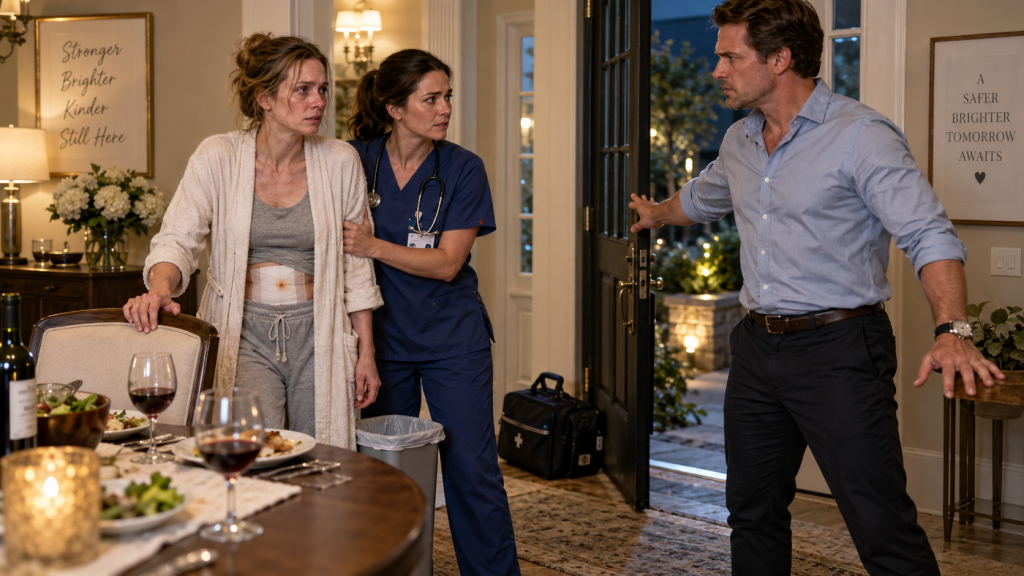
The front doorknob turned before I had time to answer him. He heard it too. His finger came off the dressing, and the hard look on his face changed so fast it scared me almost as much as the pain.
The nurse stepped back inside, apologizing for forgetting her bag. Then she saw me bent beside the trash can. Her eyes went straight to the fresh stain spreading through the dressing she had checked only minutes earlier.
“What happened?” she asked.
“She got sick again,” my husband said immediately. “It’s the cancer.”
The nurse kept her eyes on me.
“I asked her.”
My husband stayed close enough that I could feel his leg against the side of my chair. The adhesive pulled at my skin every time I breathed, and the sour taste from dinner still coated my mouth. I knew exactly what he expected me to say.
I looked at the nurse. I looked at her bag near the doorway. I looked at my husband’s hand hanging beside his thigh. Then I looked at the front door.
And I stopped protecting him.
“He pushed my head over the trash can,” I said. My voice sounded thin, but it was mine. “And he pressed on the surgical area after you left.”
My husband gave a short laugh, like I had embarrassed him over something ridiculous. “She’s in pain. She doesn’t know what she’s saying.”
The nurse didn’t argue with him. She came closer to me instead, crouching just enough to examine the dressing without touching it.
“When I left,” she said carefully, “this dressing was clean.”
That was the first thing he couldn’t explain away.
He tried anyway. He talked about dinner. He talked about nausea. He talked about how difficult the last few weeks had been for both of us, as if exhaustion had somehow put his hand on my body.
The nurse let him finish.
Then she asked me, “Do you want me to stay?”
“Yes.”
One word.
My husband’s jaw tightened.
The nurse asked again, slower this time. “Do you want to be alone with him right now?”
“No.”
He stepped toward us. “This is getting blown way out of proportion.”
The nurse straightened. She didn’t make a speech. She didn’t accuse him of anything she hadn’t personally seen. She simply moved her forgotten bag farther from him and closer to me, then asked whether I wanted to leave the room with her.
For weeks after surgery, I had measured every decision by what would make the next hour easier. Could I keep food down? Could I get through the shower? Could I sleep without pulling something?
I had gotten used to thinking small because my body demanded it.
But small decisions still count.
“Yes,” I said. “I want to go with you.”
My husband stared at me as though I had broken some private agreement simply by saying it where another person could hear.
“You’re seriously doing this?” he asked.
The nurse picked up her bag. “She answered the question.”
I put one hand on the chair and pushed myself upright. Pain caught beneath the dressing, sharp enough to stop me halfway, but the nurse offered her arm and waited for me to decide whether to take it.
I did.
My husband moved first.
Then he stepped between us and the front door.
PART 2 — THE DOOR HE TRIED TO BLOCK
Then he stepped between us and the front door.
For one second, nobody moved.
My husband, Daniel, stood with one hand braced against the wall and the other hanging at his side.
He was not touching either of us.
That was the first thing I noticed.
He was too careful for that now.
The nurse had returned.
There was a witness.
Everything about him changed when witnesses appeared.
His shoulders lowered.
His voice softened.
Even his face rearranged itself into something wounded.
Reasonable.
Almost loving.
“Claire,” he said quietly, “you’re not thinking clearly.”
The nurse beside me did not answer for me.
That mattered.
She simply kept her arm steady beneath mine.
I could feel the warmth of her sleeve against my skin.
Daniel looked at her.
“I appreciate everything you’ve done for my wife, but she’s exhausted. She’s on medication. She’s been emotional.”
The word emotional landed exactly where he wanted it to.
For months, he had used it whenever I questioned him.
If I cried, I was emotional.
If I was angry, I was emotional.
If I remembered something differently, I was confused from treatment.
If I asked why money was missing from our account, I was overwhelmed.
If I asked why he had changed the password to my patient portal, I was stressing myself unnecessarily.
Everything had an explanation.
And somehow every explanation ended with me trusting him more and myself less.
The nurse’s name was Marisol Vega.
She had been coming to the house three afternoons a week since my surgery.
She was fifty-two, wore her dark hair pinned low at the back of her neck, and had the habit of speaking gently without ever sounding uncertain.
That afternoon, she looked past Daniel toward the door.
Then back at me.
“Claire,” she said, “do you want to stay here?”
“No.”
My voice was stronger this time.
Daniel exhaled.
“Come on.”
I looked at him.
“No.”
Something flashed in his eyes.
Not enough for Marisol to call it anger.
Enough for me to recognize it.
He stepped slightly closer.
“Where exactly are you going to go?”
Marisol’s grip on my arm tightened just a little.
Not ownership.
Support.
I answered before fear could.
“Away from you.”
Silence.
That sentence changed the room.
For years, Daniel had expected arguments to remain contained inside our marriage.
Private words.
Private apologies.
Private bruises disguised as accidents.
Private insults softened the next morning with coffee.
But I had just said the truth aloud in front of someone else.
Away from you.
And once a truth exists outside the marriage, it becomes harder to drag back inside.
Daniel looked at Marisol.
“You need to leave.”
She shook her head.
“I won’t leave while my patient is asking me to stay.”
“She is my wife.”
“She is also my patient.”
His face hardened.
“You are in my house.”
Marisol stayed calm.
“That doesn’t change what she just told me.”
He laughed bitterly.
“You think you know what’s happening here because you walk in for forty-five minutes three times a week?”
“No.”
She glanced at my dressing.
“But I know what I saw ten minutes ago.”
Daniel went quiet.
That was the second thing he could not explain away.
The stain.
Before leaving, Marisol had checked the surgical dressing carefully.
Clean.
Dry.
No new drainage.
Then she returned.
Fresh blood.
A wife bent over a trash can.
A husband already talking before anyone asked him a question.
Daniel knew how bad it looked.
I could see him calculating.
Then he changed tactics.
“Claire.”
His voice softened.
“Please sit down.”
I stared at him.
“You’re hurting yourself.”
That nearly made me laugh.
He had pressed his finger directly into the surgical area.
Now he was concerned I might hurt myself by standing.
Marisol whispered:
“Can you walk?”
I nodded.
“I think so.”
“Slowly.”
Daniel still blocked the door.
Marisol looked at him.
“Please move.”
He folded his arms.
“No.”
One word.
Simple.
And suddenly the pleasant husband disappeared.
Marisol’s expression changed.
She reached into the pocket of her scrub jacket.
Daniel saw it.
“What are you doing?”
“I’m calling for assistance.”
His face drained.
“Assistance?”
“She wants to leave.”
“This is a family matter.”
“She wants to leave.”
“I said she’s not thinking clearly.”
Marisol looked at me.
“Claire, do you know where you are?”
Daniel laughed.
“Oh, for God’s sake.”
I ignored him.
“My house.”
“What city?”
“Milford.”
“What day is it?”
“Thursday.”
“What month?”
“October.”
Marisol nodded.
“Do you know why I’m here?”
“Post-surgical wound care.”
“Do you understand what may happen if you leave with me?”
I swallowed.
“Yes.”
“What may happen?”
“My husband may become angry.”
Daniel scoffed.
“That’s not what she meant.”
Marisol never looked away from me.
“What else?”
“I may need to be examined because the dressing is bleeding.”
“Yes.”
“And you may have to document what I said.”
“Yes.”
I nodded.
“I understand.”
Then Marisol looked at Daniel.
“She is oriented.”
His face tightened.
“She’s still medicated.”
“So are many patients who can make their own decisions.”
“You’re not qualified to determine—”
“I am qualified to assess whether I need help getting my patient safely out of this room.”
That stopped him.
Only for a second.
Then he stepped toward her.
Not fast.
That would have been too obvious.
But I saw it.
The old intimidation.
The way he used height and proximity instead of fists when someone else was watching.
Marisol took out her phone.
“Step back.”
Daniel smiled.
It was the smile I hated most.
The one that said he had already decided you were ridiculous.
“Are you threatening me?”
“No.”
She tapped the screen.
“I’m calling emergency services.”
He moved away immediately.
That was when I knew.
Not suspected.
Knew.
Daniel was not out of control.
He was never out of control.
He knew exactly when to stop.
Exactly when to lower his voice.
Exactly which actions were safe when nobody could see and which ones became dangerous the moment another person entered the room.
For months, I had blamed stress.
Fear.
My diagnosis.
His exhaustion.
I had told myself that good men sometimes broke beneath terrible circumstances.
But good men who break do not suddenly become careful around witnesses.
Daniel was careful.
That meant there was intention inside what he did.
And intention was harder to forgive.
Marisol spoke into the phone.
She gave the address.
Explained that her adult patient wanted to leave the residence.
Explained there had been a possible assault involving a recent surgical site.
Daniel paced toward the kitchen.
He picked up his keys.
For one terrified second, I thought he might leave.
Then I realized what he was actually doing.
My medication.
The prescription bottles were inside the kitchen cabinet where he had insisted on keeping them.
He reached toward it.
“Daniel.”
My voice stopped him.
He looked at me.
“Don’t touch those.”
His face changed.
Marisol heard.
She turned.
“What medications?”
I swallowed.
“My pain medication.”
Daniel laughed.
“She doesn’t manage them herself.”
“Why?”
“She forgets.”
I stared at him.
“I don’t.”
“You have.”
“Once.”
“You took two doses too close together.”
“No.”
He froze.
There.
A memory I had never been completely sure about.
Three weeks earlier, I woke on the bathroom floor.
Daniel told me I had accidentally doubled my pain medicine.
I believed him because the bottle was beside the sink.
But I had no memory of taking the second dose.
I looked at Marisol.
“He handles all of my pills.”
Her eyes sharpened.
“By your choice?”
I opened my mouth.
Then stopped.
Had it been?
After surgery, Daniel made a chart.
Morning medications.
Afternoon.
Night.
At first, I was grateful.
Then the bottles disappeared from my bedside.
Then my phone alarms disappeared.
Then he told me I was too foggy to manage them safely.
At some point, assistance became control.
I had not noticed the exact moment.
“No.”
My voice shook.
“Not anymore.”
Daniel opened the cabinet anyway.
Marisol spoke sharply.
“Do not alter or remove anything.”
He laughed.
“What, now you’re a police officer?”
“No.”
She looked at him.
“But they’re coming.”
The word changed him again.
Police.
For the first time, actual fear entered his face.
He shut the cabinet.
Then he pointed at me.
“You realize what you’re doing?”
My body went cold.
That sentence had always worked.
You realize what you’re doing?
As though his actions became my responsibility the moment I named them.
I looked at him.
“Yes.”
And I did.
For once, yes.
I knew exactly what I was doing.
I was choosing a future I could not picture over a present I finally understood.
Sirens did not come.
Just two vehicles pulling quietly into the driveway.
One police cruiser.
One ambulance.
Daniel moved toward the living room before the knock.
He straightened a couch cushion.
That almost made me cry.
Not because it mattered.
Because it was so him.
Even then.
Even with blood beneath my dressing.
Even with police at the door.
He needed the room to look normal.
Officer Renee Park entered first.
A paramedic followed.
Marisol spoke to them before Daniel could.
That mattered too.
He kept trying.
“She has cancer.”
“She’s recovering.”
“She’s confused.”
“She vomited.”
“She gets dramatic when she’s scared.”
Officer Park listened.
Then she asked him to wait in another room.
He refused.
“I’m staying with my wife.”
I said:
“No.”
He stared at me.
The officer turned toward him.
“Sir, step into the kitchen.”
“This is my house.”
“And I’m asking you to step into the kitchen.”
His jaw tightened.
For half a second, I saw the man who waited until nurses left.
Then he smiled.
“Of course.”
That smile made me shiver harder than shouting would have.
He walked away.
The paramedic examined my dressing.
When he lifted one corner, pain shot so sharply through me that I gasped.
Marisol touched my shoulder.
The paramedic’s face tightened.
“We need to take you in.”
“Did he damage something?”
“I can’t tell here.”
My heart began pounding.
Surgery had already terrified me.
The incision.
The drains.
The pathology.
The waiting.
Now Daniel had turned even healing into something I could not trust.
Officer Park crouched in front of me.
“Claire, I need to ask you some questions.”
I nodded.
“Did your husband cause the bleeding?”
“Yes.”
“How?”
“He pushed his finger into the surgical area.”
“Once?”
I stared at her.
The question opened something.
Not once.
I had thought tonight was the first time he had touched the wound deliberately.
It wasn’t.
There had been other moments.
When he “helped” adjust my pillow and pressed too hard.
When he hugged me from behind after an argument and squeezed exactly where the drain had been removed.
When he changed my dressing once and pulled the adhesive so sharply I cried out.
He apologized every time.
Careless.
Tired.
Accident.
My eyes filled.
“I don’t know.”
Officer Park waited.
I whispered:
“I don’t know anymore.”
She nodded.
That was enough for then.
“Has he hurt you in other ways?”
Daniel’s voice carried faintly from the kitchen.
Polite.
Explaining something to another officer.
I lowered mine.
“Yes.”
Marisol’s face changed.
Officer Park stayed calm.
“How?”
I looked at my hands.
“He grabs my wrists.”
“How often?”
“I don’t know.”
“Has he hit you?”
“No.”
Then:
“Yes.”
The word surprised me.
Officer Park did not.
“When?”
“Two months ago.”
Memory returned in pieces.
Daniel and I arguing in the garage.
Me asking why he had missed my oncology appointment.
Him saying work mattered too.
Me accusing him of not caring.
His palm across my cheek.
Not hard enough to knock me down.
Hard enough that my ear rang.
He apologized immediately.
Cried.
Said I had scared him.
Said he was becoming someone he hated because he was terrified of losing me.
I comforted him.
That memory sickened me now.
“I called it a slap.”
I whispered.
Officer Park said:
“That is hitting.”
I nodded.
Tears slipped down my face.
“There’s more.”
And once I started, the memories came faster.
He punched the wall beside my head.
He threw my phone once.
He locked me out of our bedroom.
He called me disgusting after chemotherapy made me vomit during dinner.
Then bought flowers the next morning.
He told me no one else would put up with how sick I was.
Then held me while I cried.
He took over our finances because I was “too overwhelmed.”
He canceled a visit from my sister because I “needed rest.”
He told friends I did not want visitors.
He told me they had stopped calling because illness made people uncomfortable.
I believed him.
God.
I believed him.
Officer Park asked:
“Do you have somewhere safe to stay?”
My mind went blank.
My sister lived three hours away.
My mother was dead.
My father was in assisted living.
Friends?
I had friends once.
Before treatment.
Before Daniel started answering my phone.
Before I became tired of explaining why I always canceled.
“I don’t know.”
Marisol said:
“She can’t go back here tonight.”
I looked at her.
Daniel had already become the house.
Not my house.
His.
That realization hurt almost as much as the wound.
The paramedic brought a stretcher.
“I can walk.”
He smiled gently.
“I believe you.”
Then he looked at the fresh stain.
“But you don’t have to.”
Something about that broke me.
You don’t have to.
I had forgotten those words existed.
I let them help me onto the stretcher.
As they rolled me toward the front door, Daniel stepped out of the kitchen.
He looked at me.
Not angry.
Not now.
His eyes filled with tears.
“Claire.”
My heart reacted before my mind did.
Eight years of marriage.
His hand in mine at my first biopsy.
The night he slept in a chair beside my hospital bed.
The way he once kissed my bald head and called me beautiful.
People want abuse to erase every good memory.
It doesn’t.
That is what makes leaving so difficult.
The person who hurts you may still be the person who once made you feel safest.
Both memories live in the same body.
Daniel moved toward the stretcher.
Officer Park stopped him.
“Stay where you are.”
His voice broke.
“Baby.”
I shut my eyes.
He had not called me that in weeks.
“Please don’t do this.”
Tears came anyway.
Not because I wanted to stay.
Because some part of me still wanted him to become the person I remembered.
“I love you.”
He said it so softly.
I opened my eyes.
“I know.”
He looked hopeful.
That hurt.
Then I finished.
“But I’m afraid of you.”
His face collapsed.
The paramedics rolled me outside.
For the first time in months, cold evening air touched my face without Daniel deciding whether I needed a coat.
I breathed deeply.
It hurt.
I did it again.
At the hospital, the surgeon on call examined the wound.
The pressure had caused partial separation near the incision.
Not catastrophic.
But not nothing.
The dressing had to be replaced.
Imaging was ordered because of the pain.
I lay beneath white lights while strangers documented everything.
Measurements.
Photographs.
Tenderness.
Bruising.
Each detail made it more real.
Evidence is cruel that way.
It takes the thing you spent months minimizing and gives it dimensions.
Seven centimeters.
Purple discoloration.
Fresh bleeding.
Guarding.
Pain rated eight out of ten.
I stared at the ceiling while a nurse photographed bruises along my wrist.
I had forgotten they were there.
Daniel told me I bruised easily because of treatment.
Maybe I did.
But finger-shaped bruises still required fingers.
Around midnight, a hospital social worker named Denise came in.
She carried no clipboard at first.
Just two cups of water.
She sat beside my bed.
“Marisol told me you may not feel safe returning home.”
I looked toward the door.
“No.”
“Do you want information about emergency shelter?”
The word shelter frightened me.
I pictured gym mats.
Strangers.
Fluorescent lights.
“Maybe.”
“That’s okay.”
She waited.
“You don’t have to decide everything tonight.”
Again.
You don’t have to.
I cried.
Denise did not interrupt.
When I finally stopped, I asked:
“Do you think I’m stupid?”
She frowned.
“For what?”
“For staying.”
“No.”
“I should have known.”
She leaned back.
“Known what?”
“That it would get worse.”
“Did he tell you it would?”
“No.”
“Did he apologize?”
“Yes.”
“Did he blame stress?”
“Yes.”
“Your illness?”
“Yes.”
“Did he sometimes take care of you?”
My throat tightened.
“Yes.”
“Did he sometimes frighten you?”
“Yes.”
She nodded.
“Then you were living with conflicting information.”
I stared at her.
She continued.
“People make decisions using what they know and what they hope.”
I looked down at the blanket.
“I hoped a lot.”
“I imagine you did.”
I laughed weakly.
“That sounds pathetic.”
“No.”
Her voice stayed gentle.
“It sounds expensive.”
I looked at her.
“Hope can cost people a lot.”
That sentence stayed with me.
At 1:13 a.m., Officer Park returned.
She had questions.
More importantly, she had something I had not expected.
My phone.
Daniel had handed it over voluntarily.
Apparently, he wanted to prove he had nothing to hide.
That confidence interested the officer.
Especially because he had deleted messages.
“Deleted?”
I stared at her.
“Between whom?”
“You and him.”
My stomach turned.
“I didn’t delete anything.”
“We know.”
She placed the phone on the tray beside me.
“There are recoverable backups.”
I suddenly remembered arguments where Daniel took my phone after.
He said I had written things while medicated.
He said he was protecting me from embarrassing myself.
“What did he delete?”
“We’re still reviewing.”
My heartbeat changed.
Then she asked:
“Did you know your husband has been communicating with your insurance company directly?”
I frowned.
“He handles the paperwork.”
“Did you authorize him to make changes?”
“What changes?”
She paused.
“Beneficiary information.”
My mouth went dry.
“What beneficiary information?”
She looked at Denise.
Then back at me.
“Claire, is there a life insurance policy in your name?”
I stared.
“Yes.”
“How much?”
“Five hundred thousand.”
“Who is the beneficiary?”
“Daniel.”
Her expression did not change.
But something inside me did.
I laughed nervously.
“That’s normal.”
“No one said it isn’t.”
“What are you asking?”
“Your husband contacted the carrier six weeks ago.”
I stopped.
“What about?”
“He requested confirmation that the policy was active.”
My skin went cold.
“That could be normal.”
“Yes.”
“He also asked whether cancer treatment affected payout eligibility.”
The room became silent.
I stared at her.
“No.”
Officer Park spoke carefully.
“We are not drawing conclusions from one phone call.”
“He manages everything.”
“I understand.”
“He probably needed to know.”
“That’s possible.”
I nodded too quickly.
“Yes.”
Then she continued.
“He made three calls.”
My hands began shaking.
“What did he ask?”
“Whether accidental injury during treatment could complicate a claim.”
I stopped breathing.
No.
No.
“No.”
Denise moved closer.
Officer Park remained calm.
“Again, we are investigating.”
I looked at the ceiling.
Daniel pressed my wound.
Daniel controlled my medication.
Daniel asked about insurance.
My brain tried to reject the pattern.
Because accepting it meant something worse than cruelty.
It meant calculation.
“I need air.”
My voice sounded distant.
Denise opened the door slightly.
I could not move.
The surgical pain suddenly felt irrelevant.
Officer Park asked:
“Did your husband know your prognosis?”
“Yes.”
“What is it?”
I swallowed.
“Good.”
She paused.
“Good?”
“Yes.”
I almost laughed.
The word sounded absurd in that room.
“My cancer was caught early.”
Tears filled my eyes.
“Surgery went well.”
“Chemo is precautionary.”
Officer Park’s expression changed.
“Did Daniel know that?”
“Yes.”
“Did he understand you were expected to recover?”
“Yes.”
My hands went cold.
Then why ask whether cancer affected a life insurance payout?
Why ask about accidental injury?
Why press directly into healing tissue?
I covered my mouth.
Denise whispered:
“Claire.”
I looked at her.
And then another memory returned.
Three weeks earlier.
Daniel standing in the pharmacy parking lot.
Angry because my oncologist had changed my anti-nausea medication.
He said:
“They keep changing everything. How am I supposed to keep track?”
At the time, I thought he meant scheduling.
Now I remembered what he asked next.
“Did they say anything about interactions with your pain medication?”
I told him no.
That night, I slept for fourteen hours.
He said treatment exhausted me.
I believed him.
I looked at Officer Park.
“The night I woke on the bathroom floor.”
She leaned closer.
“What night?”
“Three weeks ago.”
I could barely speak.
“He said I doubled my pain pills.”
“Did you?”
“I don’t remember.”
“Was medical care sought?”
“No.”
“Why?”
“He said I’d be embarrassed.”
The officer wrote something down.
My stomach twisted.
“My pill bottles are at the house.”
“We collected them.”
I stared.
“You did?”
“With your permission earlier.”
I barely remembered signing the form.
Pain.
Fear.
Too many questions.
“What happens now?”
“Medication counts.”
“Pharmacy records.”
“Your bloodwork tonight.”
She paused.
“Whatever the evidence supports.”
Evidence.
Again.
I closed my eyes.
I had cancer.
And somehow cancer had become the least frightening thing in my life.
At 3:40 a.m., Denise arranged a temporary placement at a confidential recovery residence connected to the hospital.
Not a shelter exactly.
A small furnished apartment used for medically vulnerable patients who could not safely return home.
Three weeks.
Maybe longer.
I asked:
“What about my things?”
“Someone can help retrieve them.”
“My clothes?”
“Yes.”
“My medical records?”
“Yes.”
“My mother’s jewelry?”
“Yes.”
I almost laughed.
Such ordinary things.
How strange that escape becomes real through toothbrushes and sweaters.
Before sunrise, Marisol returned.
She was not scheduled.
She came anyway.
When she stepped into my room, I cried.
“I’m sorry.”
Her face tightened.
“For what?”
“You forgot your bag.”
She stared at me.
Then understood.
If she had not forgotten it…
If she had driven away…
If Daniel had had another hour…
I could not finish the thought.
Marisol came closer.
“No.”
She shook her head.
“Don’t turn my mistake into your blame.”
My eyes filled.
“But if you hadn’t come back—”
“I did.”
She took my hand.
“And you told the truth.”
I looked at her.
“You did that.”
“No one else.”
That mattered.
Because for the first time, I understood that Marisol did not save me by returning.
She opened a door.
I still had to walk through it.
At 6:18 a.m., my phone buzzed.
Unknown number.
A text.
Please come home. I’m sorry. I was scared. I love you.
Daniel.
Another.
You’re sick. We can fix this.
Then:
Don’t let strangers destroy our marriage.
I stared at the message.
Strangers.
The nurse who saw blood.
The officer who listened.
The social worker who gave me water.
People I had known less than a day.
And somehow they had treated me more gently than the man who promised to love me in sickness and in health.
Another message arrived.
This one different.
You know what happens if you accuse me.
My heart stopped.
I showed Officer Park.
She read it twice.
“What does that mean?”
“I don’t know.”
But I did.
Not exactly.
Something about our finances.
Daniel had said months ago:
“If anyone looks closely at those accounts, they’ll think you’re the one spending.”
I had assumed it was another insult.
Now I remembered.
My signature.
Documents.
Insurance reimbursements.
Medical expenses he handled.
I looked at Officer Park.
“He controls our bank accounts.”
Her expression sharpened.
“Do you have access?”
“Technically.”
“Practically?”
I swallowed.
“No.”
“Do you know your balances?”
“No.”
“Any recent loans?”
“I don’t think so.”
“Credit cards?”
“One.”
“In your name?”
“Yes.”
“Do you have the card?”
“No.”
“Who does?”
“Daniel.”
The room became very quiet.
Officer Park asked:
“Claire, has anyone reviewed your finances independently?”
“No.”
She looked at Denise.
Then back at me.
“We should.”
I thought about the insurance calls.
The pills.
The hidden phone messages.
The credit card.
And suddenly I understood something terrifying.
Maybe Daniel had not begun hurting me because cancer made him cruel.
Maybe cancer had simply made me easier to isolate.
Sicker.
Weaker.
More believable as confused.
More dependent.
My diagnosis had not created the man he became.
It had given him opportunity.
By noon, a hospital advocate helped me freeze my credit.
That was when we found the first loan.
$68,000.
Opened four months earlier.
In my name.
I stared at the screen.
“What is that?”
The advocate frowned.
“Home equity line.”
“I never signed this.”
“Your signature is on the application.”
“No.”
I shook my head.
“No.”
There was another account.
$22,000 credit limit.
Nearly maxed.
Then a cash transfer.
$15,000.
Destination unknown.
I felt numb.
Not angry.
Not yet.
Just tired.
I had spent months believing Daniel was sacrificing everything to care for me.
He told friends he reduced his hours.
Told my sister he was drowning in medical bills.
Told me we needed to be careful.
I stopped buying anything unnecessary.
Canceled subscriptions.
Sold jewelry.
Used an old phone.
All while he borrowed against my name.
“Where did the money go?”
The advocate looked at me.
“We’ll need records.”
I nodded.
Then my phone buzzed again.
Not Daniel.
My sister, Anne.
A message.
Why did Daniel call me saying you had a mental breakdown?
I stared.
Then another:
Claire, where are you?
My throat closed.
For months, I thought Anne had stopped caring.
Daniel told me she was uncomfortable around illness.
He told me she made excuses.
He told me she once said:
“I can’t watch Claire become someone else.”
I believed him.
My hands shook as I called her.
She answered immediately.
“Claire?”
I cried at the sound of her voice.
“Where are you?”
“Hospital.”
“What happened?”
I could not speak.
She kept saying my name.
Finally, I whispered:
“Did you stop coming because of me?”
Silence.
Then:
“What?”
“Daniel said—”
“What did he say?”
I closed my eyes.
“He said you couldn’t handle seeing me sick.”
Anne’s voice changed.
“Claire, I have been trying to see you for three months.”
My entire body went cold.
“No.”
“Yes.”
“He said you didn’t want visitors.”
I covered my mouth.
“He said you were embarrassed about losing weight.”
“No.”
“He told me you were angry that I kept offering to help.”
“No.”
“He blocked me.”
Tears streamed down my face.
“I thought you left.”
Anne started crying too.
“I thought you wanted me gone.”
For a moment, neither of us could speak.
Daniel had not merely isolated me.
He had built a different story for everyone.
To me:
They stopped calling.
To them:
Claire wants space.
He stood between us.
Then blamed the distance on both sides.
“Anne.”
“Yes?”
“I need you.”
Her answer came instantly.
“I’m coming.”
Not someday.
Not let me check.
Coming.
I cried harder.
After we hung up, Officer Park returned with an evidence technician.
Her face was serious.
“Claire.”
My stomach tightened.
“What?”
“We got preliminary medication counts.”
I stared.
“And?”
“The pain medication bottle is short.”
My hands became cold.
“How short?”
“Significantly.”
“But I didn’t take them.”
“I know you’re saying that.”
“No.”
My voice broke.
“I didn’t.”
“We are also waiting on toxicology.”
I looked at her.
“What do you think he did?”
She did not answer.
Good officers apparently did not tell frightened women what they feared before evidence was finished.
But I saw enough.
“Is Daniel still at the house?”
“No.”
My heart stopped.
“What?”
“He left after we cleared the scene.”
“Where?”
“We don’t know.”
Fear moved through me so fast I became dizzy.
“Can he come here?”
“Security has his photograph.”
“What about the apartment?”
“Address is confidential.”
“What about Anne?”
“We’ll coordinate.”
I nodded.
Then Officer Park placed a clear evidence sleeve on the table.
Inside was a printed receipt.
I frowned.
“What is that?”
“Found in his desk.”
My eyes moved across the page.
A hotel.
Two nights.
City center.
Three weeks earlier.
Exactly the weekend Daniel told me he had been at a medical billing conference.
I looked at the name.
Two guests.
Daniel Hale.
And someone else.
Rebecca Sloan.
I did not recognize it.
My heart sank anyway.
“Who is she?”
“We don’t know yet.”
Of course.
Another secret.
Another locked door.
I thought I had discovered the worst thing when he pressed his finger into my wound.
Then I thought it was the insurance calls.
Then the missing medication.
Then the loans.
Now another woman’s name sat beside my husband’s on a hotel receipt.
Officer Park started to take it back.
“Wait.”
I leaned closer.
There was a handwritten note at the bottom.
Discuss transfer before 11/1.
I frowned.
“What transfer?”
She looked at me.
“That’s what we’re trying to determine.”
I stared at the date.
November first.
Two weeks away.
Daniel had been arranging something.
Money?
Property?
Insurance?
I did not know.
Then my phone buzzed one more time.
A voicemail from Daniel.
I did not play it alone.
Officer Park stayed.
Denise stayed.
Marisol stayed.
I pressed speaker.
Daniel’s voice filled the hospital room.
Calm.
Almost tender.
“Claire.”
A pause.
“I know you’re scared.”
My hands tightened.
“You’re surrounded by people who don’t understand us.”
Another pause.
“I can forgive what you said.”
I almost laughed.
Forgive me.
He continued.
“But you need to come home before you make this worse.”
Silence.
Then his tone changed.
Barely.
“If the police look at our finances, they’re going to find your signatures.”
My skin went cold.
“And if they look at your medication records, they’re going to see you’ve been confused for months.”
Officer Park’s face hardened.
Daniel continued.
“I don’t want anyone thinking you did something to yourself.”
My breath stopped.
There.
Not a threat exactly.
Worse.
A story.
One he had already prepared.
Sick wife.
Cancer.
Medication.
Confusion.
Financial problems.
Possible self-harm.
He was not simply afraid of being exposed.
He had built an explanation for me in advance.
Then he said:
“I love you.”
And the voicemail ended.
Nobody spoke.
I stared at the phone.
Then at Marisol.
Her forgotten bag.
Her car in the driveway.
The stain on my dressing.
Small things.
Tiny accidents.
The kind that divide a life into before and after.
Officer Park finally asked:
“Claire, do you know what he meant by ‘something to yourself’?”
I shook my head.
“No.”
Then I remembered the bathroom floor.
The missing pills.
The insurance policy.
Accidental injury.
Cancer payout eligibility.
And I whispered:
“Maybe he planned for everyone to think I overdosed.”
The room went still.
Officer Park did not tell me I was right.
She did not need to.
Her face told me the possibility was no longer absurd.
I lay back against the hospital pillow.
For months, I had believed I was fighting cancer.
That had been the battle everyone could see.
But while doctors removed tumors and nurses changed dressings, something else had been growing inside my house.
Control.
Isolation.
Debt.
Fear.
A story designed to make me disappear while leaving Daniel innocent.
I looked toward the morning light beginning to fill the windows.
Then I asked the question that changed everything.
“What do we need to prove it?”
Officer Park stared at me.
Not poor Claire.
Not sick Claire.
Not confused Claire.
Just me.
“Everything.”
I nodded.
“Then let’s find everything.”
And somewhere across town, Daniel still believed cancer had made me weak enough to control.
He had no idea that the nurse who forgot her bag had left something else behind too.
A small home-care camera used to document wound treatment.
It had been sitting on the side table.
Recording.
And when Marisol remembered it hours later, she called the hospital with four words that made every officer in the room look up.
“It captured the whole thing.”
PART 3 — THE CAMERA THAT SAW EVERYTHING
“It captured the whole thing.”
For several seconds, nobody in my hospital room moved.
Marisol’s voice had come through Officer Park’s phone on speaker.
Calm.
Professional.
But underneath it, I heard something else.
Shock.
The room felt suddenly too still.
My heart monitor continued its soft electronic rhythm beside me.
A cart rattled somewhere down the hallway.
Morning sunlight had begun touching the far edge of the floor.
And in the middle of all that ordinary hospital noise, one sentence had just split my life open again.
Officer Park leaned closer to the phone.
“From when?”
Marisol answered immediately.
“I turned it on during the dressing change because I was documenting the incision.”
My breathing became shallow.
“I thought I shut it off before I left.”
She paused.
“I didn’t.”
Officer Park’s expression sharpened.
“How long did it record?”
“Twenty-seven minutes.”
My hands went cold.
Twenty-seven minutes.
Enough.
More than enough.
Marisol continued.
“It was sitting on the side table facing the kitchen.”
I closed my eyes.
I could see the room.
The trash can.
Daniel’s hand.
The chair.
The clock.
His finger pressing directly into the surgical area while telling me what lie to repeat.
Cancer did it.
Officer Park asked:
“Do you still have the device?”
“Yes.”
“Do not alter, copy, or delete anything.”
“I haven’t.”
“Where are you?”
“In my car outside the agency office.”
“Stay there. Someone will meet you.”
Marisol hesitated.
Then her voice softened.
“Can Claire hear me?”
Officer Park looked at me.
I nodded.
“She can.”
There was a pause.
Then Marisol said:
“Claire?”
“Yes?”
My voice shook.
“I believe you.”
Three words.
That was all.
And somehow those three words hurt more than every accusation Daniel had ever made.
Because I had not realized how badly I needed to hear them.
I pressed my hand over my mouth.
Tears came.
Not panic.
Not grief.
Relief.
The kind that arrives so late it almost feels painful.
“I believe you,” she said again.
I cried harder.
Officer Park ended the call a few moments later.
Nobody rushed me.
Nobody told me to calm down.
Denise simply placed tissues beside my hand.
I stared at the blanket.
Then whispered:
“He’s going to say the video is taken out of context.”
Officer Park nodded.
“He may.”
“He’ll say I provoked him.”
“He may.”
“He’ll say I’m confused.”
“He may.”
I looked up.
“But the camera shows it.”
“Yes.”
“The whole thing.”
“Yes.”
Something inside me loosened.
Not completely.
But enough.
For months, Daniel had lived inside the space between what happened and what could be proved.
He knew bruises faded.
He knew apologies confused memory.
He knew sick people doubted themselves.
He knew marriage provided cover for cruelty because everyone wanted to believe the husband carrying medication bottles was a caregiver, not a danger.
But the camera did not love him.
It did not fear him.
It did not remember our wedding.
It did not care that he cried after hurting me.
It simply recorded.
At 10:41 that morning, Officer Park returned.
She had seen the footage.
I knew before she spoke.
Her face was different.
There was anger there now.
Controlled.
Official.
But unmistakable.
“Claire.”
I sat straighter.
“Did you watch it?”
“Yes.”
My stomach twisted.
“How bad?”
She gave me a long look.
“Worse than your description.”
I shut my eyes.
I had underestimated it.
Of course I had.
People living inside danger often become poor narrators of their own pain.
You shrink the language so the life remains survivable.
He grabbed me becomes we argued.
He hit me becomes he lost control.
He frightened me becomes we were both stressed.
He pressed into my surgical wound becomes maybe it wasn’t that hard.
The video did not shrink anything.
Officer Park pulled up a chair.
“The recording shows him pushing you toward the trash can.”
I nodded.
“It shows him placing pressure directly over the surgical area.”
My throat tightened.
“It also captured what he said.”
I already knew.
“Tell the nurse cancer did it.”
“Yes.”
She paused.
“There’s more.”
My stomach dropped.
“What?”
“Before that.”
I frowned.
She watched me carefully.
“Approximately three minutes before he came toward you, he picked up one of your medication bottles.”
I stopped breathing.
“What did he do?”
“He removed pills.”
My skin went cold.
“How many?”
“We can’t determine exactly from video.”
I stared.
“He put them in his pocket.”
Officer Park nodded.
My mind raced backward.
The missing pills.
The bathroom floor.
The toxicology.
The insurance questions.
Daniel had not merely controlled medication.
He had been removing it.
Why?
Selling it?
Hiding it?
Using it to create evidence?
I asked:
“Did he put anything in my food?”
“Not on that recording.”
I exhaled slightly.
Then she continued.
“But we have your toxicology results.”
My chest tightened again.
“What did they find?”
“A higher level of your prescribed pain medication than would be expected from the dose documented by the hospital discharge plan.”
I stared at her.
“No.”
“We need a specialist to interpret exact timing.”
“I didn’t take extra.”
“I know that’s what you’ve told us.”
“I didn’t.”
My voice broke.
“I believe you.”
The phrase landed differently this time.
Not comfort.
Evidence beginning to line up.
I looked at Denise.
Then back at Officer Park.
“Did he dose me?”
“We don’t know yet.”
“But he could have.”
“Yes.”
I thought about all the days I had slept too long.
Mornings I woke dizzy.
The time I dropped a glass because my hands would not cooperate.
Daniel said chemotherapy did strange things.
Maybe some of that had been treatment.
Maybe some of it had been him.
The uncertainty felt almost worse than knowing.
Officer Park continued.
“We also traced the hotel receipt.”
Rebecca Sloan.
I had almost forgotten her.
“Who is she?”
Officer Park opened a folder.
“Financial adviser.”
I frowned.
“For Daniel?”
“Not exactly.”
She slid a photograph toward me.
Rebecca stood beside a dark-haired man at a charity event.
Professional.
Forties.
Confident.
Nothing about her looked scandalous.
My brain had expected mistress.
Maybe because affairs were familiar.
This was something else.
“She works in wealth management.”
I stared.
“What does that have to do with me?”
“Your husband met with her several times.”
“For investments?”
Officer Park hesitated.
“For asset transfer planning.”
The words made my stomach turn.
“What assets?”
“Yours.”
Silence.
I laughed once.
Because apparently my life had become a list of things Daniel had decided belonged to him.
My body.
My medication.
My phone.
My friends.
My credit.
Now my assets.
“What exactly was he trying to transfer?”
“A portion of the home equity line.”
I swallowed.
“The sixty-eight thousand.”
“Yes.”
“And the fifteen-thousand-dollar cash transfer?”
“Linked to an account managed through Sloan’s office.”
I stared.
“So she was helping him steal.”
“Possibly.”
“Did she know it was fraudulent?”
“Under investigation.”
I looked away.
There was more.
I knew it.
Officer Park had learned to pause before giving me the next blow.
“What else?”
“She helped create a trust instrument.”
My pulse slowed.
“What trust?”
“For anticipated insurance proceeds.”
I stopped breathing.
“No.”
Denise shifted closer.
Officer Park kept her voice even.
“Daniel appears to have been discussing ways to place life-insurance funds into a managed account after your death.”
After your death.
The words did not sound like mine.
They sounded like something happening to somebody else.
Some tragic wife.
Some poor woman.
Not me.
I touched the hospital bracelet around my wrist.
“I’m not dying.”
“I know.”
“My oncologist said my prognosis is good.”
“I know.”
“Then why plan for my death?”
Nobody answered.
There was no answer that did not terrify me.
At 1:30 that afternoon, Anne arrived.
I heard her before I saw her.
My sister had always walked too fast.
Even in hospitals.
The door opened.
Then she stopped.
For one second, we simply looked at each other.
Three months of lies stood between us.
Daniel had told me Anne could not bear to see me sick.
He told Anne I wanted privacy.
He had taken two women who loved each other and made each believe the other had chosen distance.
Anne crossed the room in four steps.
She hugged me carefully.
So carefully.
Her arms wrapped around my shoulders without touching the incision.
That almost destroyed me.
“You’re here.”
She pulled back.
“Of course I’m here.”
“I thought—”
“I know.”
Her eyes filled.
“I know what he told you.”
“I’m sorry.”
“No.”
She shook her head.
“No apologies.”
Then she looked at the dressing.
“What did he do?”
I could not say it all again.
Not yet.
So I whispered:
“He hurt me.”
Anne’s face collapsed.
I had expected anger.
She looked heartbroken.
Maybe because she remembered Daniel too.
The man who grilled burgers at her son’s birthday.
The man who drove her home after dental surgery.
The man who helped carry our father’s furniture into assisted living.
People want evil to announce itself.
Instead, sometimes it carries boxes for your family.
Anne sat beside me.
“What happens now?”
I looked toward Officer Park.
“Daniel’s being located.”
Anne frowned.
“Located?”
“He’s gone.”
Her face changed.
“What?”
“He left the house.”
Anne immediately stood.
“Then you’re not leaving this hospital alone.”
“I’m going to the recovery apartment.”
“You’re not staying there alone either.”
“Anne—”
“No.”
She wiped her face.
“You spent months being told needing people made you difficult.”
Her voice broke.
“I’m not letting you believe that for one more day.”
I stared at her.
Then nodded.
“Okay.”
She sat again.
That single okay felt enormous.
Maybe healing began there.
Not with bravery.
With allowing someone to help.
Daniel was arrested that evening.
Not dramatically.
No chase.
No airport.
No weapon.
He had been sitting inside a hotel bar forty miles away.
Using a credit card in my name.
Of course.
Officer Park told me at 7:16 p.m.
I expected relief.
Instead, I started shaking.
“Is he coming here?”
“No.”
“Can he call me?”
“Not directly once the order is processed.”
“What if he gets released?”
“We’ll tell you.”
“What if—”
Anne took my hand.
I stopped.
For months, Daniel had trained my nervous system to think five steps ahead.
What will he do?
What mood will he be in?
What do I say?
What do I hide?
What version of me will keep the evening safe?
Even after his arrest, my body remained married to anticipation.
That took longer to leave than he did.
The next day, investigators found his laptop.
That was where the rest of the plan finally appeared.
Spreadsheets.
Insurance documents.
Draft emails.
Medical notes copied from my patient portal.
Photographs.
One folder named:
CLAIRE DECLINE
I sat inside a conference room at the hospital with Anne beside me while Officer Park explained.
Daniel had been documenting my “confusion” for months.
Sometimes real treatment side effects.
Sometimes exaggerated.
Sometimes invented.
He had emailed himself notes after arguments.
Claire forgot medication.
Claire became irrational.
Claire accused me of stealing.
Claire talked about being tired of treatment.
Claire cried and said she couldn’t keep doing this.
Ordinary statements from a sick woman turned into a record designed to mean something darker.
“He was building a narrative,” Officer Park said.
I stared at the table.
The exact word I had feared.
A narrative.
My cancer became evidence.
My exhaustion became evidence.
My pain became evidence.
My fear became evidence.
All arranged to point toward one conclusion.
That if something happened to me, I had caused it myself.
My stomach turned.
“What was November first?”
Officer Park knew exactly what I meant.
The handwritten note on Rebecca Sloan’s hotel receipt.
Discuss transfer before 11/1.
“She had arranged a larger account transfer for that date.”
“How much?”
“Approximately one hundred fifty thousand dollars, contingent on refinancing approval.”
“But where would that money come from?”
“The house.”
I stared.
“Our house?”
“Yes.”
“We don’t have that much accessible equity.”
“You did.”
My chest tightened.
“What do you mean, I did?”
“Your mother’s inheritance.”
The room went silent.
My mother had left me $180,000.
I had never touched most of it.
Daniel repeatedly told me to keep it separate.
“For your security,” he said.
My heart sank.
“He accessed it.”
“Not directly.”
Officer Park turned another document toward me.
“He prepared a power-of-attorney form.”
I stared at my signature.
Fake.
Almost perfect.
But fake.
“He forged this too.”
“Yes.”
Anne swore softly.
I whispered:
“How much did he take?”
“Thirty-six thousand appears to have moved before the bank flagged another transfer.”
I closed my eyes.
My mother’s money.
She had worked thirty years as a school secretary.
Saved everything.
Coupons folded into envelopes.
Coffee made at home.
Christmas gifts purchased in July because sales mattered.
After she died, I almost refused the inheritance.
Dad said:
“Your mother saved because giving something to you after she was gone made her feel less afraid of leaving.”
Daniel knew that.
And still touched it.
That betrayal felt different.
Some thefts steal money.
Others steal meaning.
“What happened to the thirty-six thousand?”
Officer Park hesitated.
“Part went toward Daniel’s private debt.”
“Private?”
“Gambling.”
I opened my eyes.
“What?”
Anne stared too.
“Daniel doesn’t gamble.”
Apparently, I had said that sentence too confidently.
Officer Park slid more records forward.
Sports betting.
Online accounts.
Casino withdrawals.
Nearly ninety thousand dollars over two years.
I laughed.
Then covered my face.
This man.
My husband.
The caregiver everyone praised.
Had been gambling while telling me chemotherapy was making our finances difficult.
He had convinced me to sell jewelry.
He had canceled meal delivery.
He had complained when Anne sent groceries because he said charity embarrassed him.
All while losing tens of thousands.
The shame I had been carrying suddenly shifted.
It had never belonged to me.
“Was Rebecca part of that?”
“No evidence yet.”
“So why help him?”
“Commission.”
Simple.
Ugly.
Plausible.
Not everyone in a betrayal needs to be evil.
Sometimes greed is ordinary.
Paperwork.
Fees.
Looking away when the client’s story seems strange because asking questions might stop the transaction.
Over the next three weeks, my life became administrative.
That surprised me.
Movies make escape look emotional.
Doors slamming.
Suitcases.
Police lights.
In reality, escape involved passwords.
New bank accounts.
Credit freezes.
Medical authorization forms.
A protective order.
Changing emergency contacts.
Closing joint cards.
Removing Daniel from the patient portal.
Replacing my driver’s license because he had copies.
Relearning where every important document lived.
Anne stayed with me through almost all of it.
Sometimes we fought.
Not seriously.
I hated feeling watched.
She hated leaving me alone.
One night in the recovery apartment, I snapped:
“I don’t need another person managing me.”
Her face fell.
I regretted it instantly.
But she nodded.
“You’re right.”
Then she did something Daniel never did.
She changed.
The next morning, she asked before entering my room.
Asked before organizing medication.
Asked whether I wanted company at the oncology appointment.
Asked whether I wanted soup or wanted to be left alone.
Choice.
Tiny, ordinary choice.
I had no idea how starved I was for it.
My surgical wound healed.
Slowly.
The cancer treatment continued.
The oncologist reviewed everything and adjusted my medications.
When I told her what had happened, she cried.
That embarrassed me.
Then made me angry.
Then grateful.
“I should have noticed something,” she said.
I shook my head.
“Everyone keeps saying that.”
She looked at me.
“Maybe we all should stop making you carry our regret too.”
That was one of the smartest things anyone said to me.
Daniel pleaded not guilty at first.
Then the camera footage was authenticated.
Then toxicology experts reviewed my earlier hospital records.
A second medical record from the bathroom-floor incident showed levels consistent with medication overuse.
The prosecution could not prove every suspicion.
That mattered.
Truth is not the same as what a court can prove.
I learned to live with that.
They could prove assault.
Coercive financial behavior.
Identity-related fraud.
Forgery.
Theft.
Violation of medical autonomy.
Other charges remained disputed.
Daniel’s attorney tried to portray him as a terrified husband overwhelmed by his wife’s illness.
Then the video played.
Not in open court at first.
In a pretrial hearing.
I attended.
Against everyone’s advice except my own.
The room was smaller than I expected.
Daniel sat at the defense table.
He looked thinner.
Older.
When I entered, he turned.
Our eyes met.
For one awful second, I saw my husband.
Not the defendant.
The man I married.
I remembered dancing barefoot in our kitchen.
The trip to Maine.
The day he held my mother’s hand in hospice.
The Christmas he built a bookshelf because I complained we had no space left.
Then the video began.
There he was.
Standing behind me.
Pushing.
Pressing.
My body folding around pain.
His voice:
“Tell the nurse cancer did it.”
Something inside me finally separated.
Memory Daniel.
Real Daniel.
I no longer had to choose which one was true.
Both were.
He had loved me.
And he had abused me.
One truth did not cancel the other.
But only one determined whether I could safely go back.
I never would.
After the hearing, Daniel tried to speak to me as officers moved him out.
“Claire.”
I kept walking.
“Claire, please.”
I stopped.
Anne touched my arm.
I turned.
Daniel looked at me through the space between two deputies.
His eyes filled.
“I’m sorry.”
There was a time those words controlled my entire nervous system.
I’m sorry.
He said them after the slap.
After the wall.
After crushing my phone.
After telling me nobody else would want a sick wife.
Sorry had once been the bridge that carried me back every time.
Now it was simply a word.
“I know.”
His face changed.
Hope.
Always hope.
Then I said:
“But you don’t get to come home.”
His eyes closed.
Neither did I.
That house was sold during the divorce proceedings.
I wanted nothing from it except my mother’s jewelry, photo albums, books, and one ceramic bowl Anne made me in high school.
Daniel fought over the money.
Of course he did.
Eventually, restitution and legal settlements consumed much of what would have been his share.
His gambling debts surfaced publicly.
Rebecca lost her position after an internal investigation concluded she had ignored compliance concerns surrounding forged documents.
She was not charged with participating in any plan to harm me.
I accepted that.
For a while, I wanted everyone connected to Daniel punished.
Then I realized anger could become another house I could not leave.
I did not need every person ruined.
I needed boundaries.
Truth.
Safety.
The court case ended fourteen months later.
Daniel accepted a plea agreement.
He received prison time.
Not forever.
Long enough.
People asked whether I thought the sentence was enough.
I never knew how to answer.
What number of years equals a person learning to sleep with one eye open?
What sentence repays the moment you realize your medication may have been used against you?
What punishment returns trust?
Courts sentence crimes.
They do not restore lives.
That part belonged to me.
Two years after Marisol forgot her bag, my oncologist said:
“No evidence of disease.”
I stared at her.
“What?”
She smiled.
“No evidence of disease.”
I had imagined that moment during chemotherapy.
I thought I would scream.
Cry.
Call everyone.
Instead, I sat completely still.
Then whispered:
“Can you say it again?”
She did.
I cried the second time.
Anne was beside me.
She cried harder.
Afterward, we went for pancakes.
At noon.
Because I wanted pancakes.
No celebration dinner.
No champagne.
No speeches.
Just syrup and coffee.
I ate the entire plate.
That mattered.
For months after surgery, food had become shame.
Nausea.
Daniel’s disgust.
The trash can.
Now I sat in a sunny diner and ate slowly while Anne complained that I stole her bacon.
My body belonged to me again.
Not perfectly.
There were scars.
A long one beneath my breast.
Small marks from ports.
A tenderness that returned when weather changed.
For a while, I hated them.
Then one morning, I stood in front of the mirror after a shower.
No dressing.
No bruises.
No hands near me except mine.
I touched the surgical scar.
Carefully.
It did not hurt.
I cried.
Not because the scar was ugly.
Because healing had happened while I was busy surviving everything else.
Marisol and I stayed in touch.
She hated being called the woman who saved me.
Whenever Anne said it, Marisol corrected her.
“I forgot a bag.”
Then she would look at me.
“Claire did the rest.”
On the third anniversary of that night, I invited her to dinner.
At my new house.
Small.
One story.
Yellow kitchen.
Too many plants.
Anne came.
Marisol came.
Officer Park came after pretending she did not attend patient dinners.
Denise brought pie.
We laughed.
Real laughter.
The kind that makes your stomach hurt.
At one point, Marisol looked around.
“Where are the trash cans?”
I stared.
Then realized.
I kept the kitchen trash can inside a cabinet now.
I had done it unconsciously.
For years after leaving Daniel, seeing one beside a chair made my throat tighten.
“I hide them.”
Everyone went quiet.
I smiled.
“It’s okay.”
And it was.
Trauma has strange leftovers.
Sometimes they are dramatic.
Nightmares.
Panic.
Sometimes they are furniture placement.
The smell of certain tea.
The sound of a suitcase zipper.
A sentence.
A clock.
I still looked at clocks differently after 6:15.
That was when Daniel first texted after I left.
Please come home.
For a long time, the phrase made me anxious.
Come home.
Home used to mean Daniel.
Then it meant danger.
Eventually, it became mine again.
I bought the new house with part of my mother’s recovered inheritance.
I painted the bedroom green.
Daniel hated green.
That was not why I chose it.
At least, I told myself it wasn’t.
I filled one room with books.
Another became a guest room for Anne.
She complained the mattress was too firm.
I told her to go home.
She did not.
My father visited once before he died.
He sat on my porch wrapped in a blanket and looked toward the garden.
He had dementia by then.
Some days he knew exactly what happened.
Other days he asked when Daniel was arriving.
The first time, I cried in the bathroom.
The second, I simply said:
“He doesn’t live here.”
Dad nodded.
“Good.”
I stared at him.
Maybe he remembered.
Maybe he did not.
Then he said:
“House feels peaceful.”
I smiled.
“Yes.”
That was enough.
Years later, people would sometimes ask me:
“When did you know you were going to leave?”
They expected an answer like:
When he hit me.
When I found the loans.
When I discovered the insurance plan.
But that was not it.
I knew when Marisol asked:
“Do you want to be alone with him right now?”
And I said:
“No.”
One word.
That was the beginning.
Not police.
Not evidence.
Not prison.
No.
Abuse had trained me to think escape needed a perfect case.
Enough bruises.
Enough witnesses.
Enough proof.
Enough justification to survive everyone asking:
But was it really that bad?
I learned something different.
You are allowed to leave because you are afraid.
You are allowed to leave because someone hurts you.
You are allowed to leave because your body becomes tense when their car enters the driveway.
You do not need a camera.
I happened to have one.
But the truth existed before the recording did.
Five years after Daniel’s arrest, I received a letter from him.
His handwriting was familiar.
I almost threw it away.
Then I read it.
He said prison forced him to confront things.
Control.
Debt.
Gambling.
Resentment.
Fear.
He said watching me become sick had made him terrified.
Then angry.
Then ashamed of being angry.
He said none of that excused what he did.
That line mattered more than the rest.
He apologized.
Not just for the wound.
For isolating me.
For using my illness.
For lying to Anne.
For stealing.
For treating my survival as an obstacle to his plans.
At the end, he wrote:
I loved you, Claire. I know that may be the cruelest thing to say after everything.
I sat with that sentence for a long time.
Then I believed it.
Not because I wanted him back.
Because I no longer needed love to mean safety.
Someone can love you and still be dangerous.
Someone can love you badly enough that leaving becomes necessary.
Love alone is not a moral achievement.
What people do with it matters.
Daniel asked whether I could forgive him.
I never replied.
Maybe I did.
Eventually.
But forgiveness was not a doorway back into my life.
It was more like setting down a suitcase I had carried too long.
One spring morning, six years after cancer, I sat outside with coffee.
My hair had grown back.
Different texture.
Curlier.
I liked it.
Anne said it made me look rebellious.
I told her cancer apparently came with free styling.
The garden was beginning to bloom.
My scar ached slightly because rain was coming.
I pressed my hand over it.
Not fear.
Just awareness.
Then I noticed the trash collection truck at the curb.
One of the workers rolled my bin away.
The sound made me remember everything.
Daniel.
The chair.
The stain.
The nurse returning.
The door he tried to block.
For a moment, grief moved through me.
Not grief for him.
For myself.
The woman who once believed being sick made her difficult to love.
The woman who thought asking for help made her weak.
The woman who spent months protecting a man who had already stopped protecting her.
I wish I could go back and tell her something.
Not:
Leave sooner.
That would be cruel.
She left when she could.
I would tell her:
You are still in there.
Under the fear.
Under the medication.
Under the bruises.
Under the version of you he keeps describing to everyone.
You are still there.
And one day, your voice will sound like yours again.
I took another sip of coffee.
The morning was quiet.
No one monitored my medication.
No one controlled my phone.
No one criticized what I ate.
No one stood between me and a door.
A breeze moved through the garden.
Inside the house, my phone rang.
Anne.
I smiled before answering.
“What?”
“Good morning to you too.”
“You only call this early when you want something.”
“I want brunch.”
“Then say that.”
“Do you want brunch?”
“Yes.”
“See? Growth.”
I laughed.
After we hung up, I went inside to change.
At the hallway mirror, I stopped.
For years, I had hated photographs of myself from treatment.
Thin.
Pale.
Hair gone.
Eyes frightened.
Now I kept one framed near the mirror.
Not the worst one.
Not the best.
Just me.
Marisol had taken it at the recovery apartment.
I was sitting beside a window wearing Anne’s oversized sweatshirt.
No makeup.
Scar healing.
Exhausted.
Alive.
On the back, Marisol had written:
The day she started choosing herself.
I used to think survival meant beating cancer.
Then I thought it meant surviving Daniel.
Now I understand survival is not one finish line.
It is thousands of ordinary mornings afterward.
Choosing breakfast.
Answering your sister.
Trusting a nurse.
Taking your own medication.
Locking your own door.
Learning that peace can feel boring and discovering that boring is beautiful.
The camera captured what Daniel did.
That helped the police.
Helped the lawyers.
Helped the court.
But the camera did not save my life.
The moment that saved my life happened before anyone knew it was recording.
Marisol asked:
“Do you want to be alone with him?”
And for the first time in months, I listened to the answer inside myself instead of the answer Daniel wanted.
“No.”
That word carried me through the doorway.
Through the hospital.
Through court.
Through treatment.
Through grief.
All the way into a life where nobody has to forget a bag for me to be safe.
And sometimes, late at night, when the house is quiet and rain taps softly against my bedroom window, I think about that front door.
Daniel standing in front of it.
Believing he could decide whether I left.
He was wrong.
The door was never really his to guard.
My fear just made me forget I still had the right to walk through it.
I remember now.
Every day.
And I never intend to forget again.
THE END STORIES! THANK YOU FOR READING GOOD LUCK !❤️
Related Posts