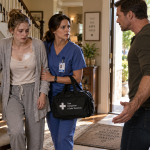
I went to see a different gynecologist. My husband had always used the word “protection” whenever he took something away from me. Then Dr. Reed shut off the ultrasound screen and asked me to sign an emergency imaging consent form after telling me, “There is something inside your body that shouldn’t be there.” My husband kept calling from outside.

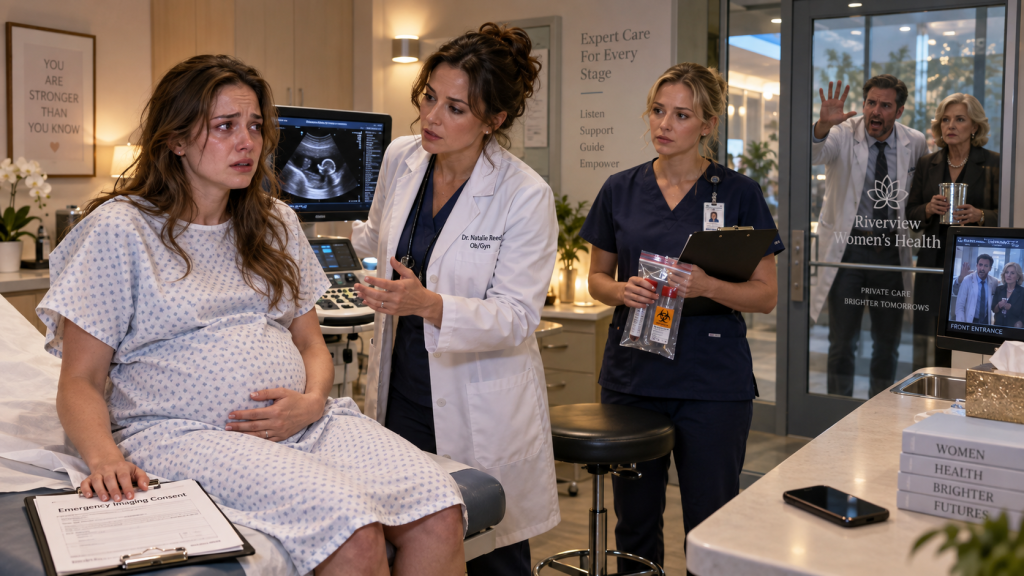
The paper gown clung to my thighs when the air vent kicked on. I was seven months pregnant, sitting on an exam table inside a clinic Aaron had never approved of, trying to breathe as though this were an ordinary appointment.
Dr. Natalie Reed had seemed warm when she came in. She asked about my cravings, my sleep, and whether I had experienced any dizziness after the injections.
“Injections?” I repeated.
Her smile faded slowly, like a door being pushed shut.
She moved the ultrasound probe across my stomach again. The machine hummed while she saved image after image. My son kicked suddenly beneath her hand.
“Who handled your previous appointments?” she asked.
“My husband. Aaron Mitchell. He’s an OB-GYN.”
Her fingers stopped.
Then she reached across me and shut off the monitor.
For several seconds, I heard only the paper crinkling beneath my back and my pulse pounding in my ears. Dr. Reed glanced at her nurse, then at the closed door, and finally at the phone vibrating beside my purse.
Aaron.
His photo filled the screen. He was wearing his white coat and smiling like a man who had never raised his voice.
He called that smile concern when he told me not to visit my parents. He called it caution when he canceled my trip to my cousin’s wedding. He called it protection when he took away my car keys.
Protection.
That word had followed me through my own home like another kind of lock.
“Don’t answer it,” Dr. Reed said.
The phone stopped ringing and immediately started again.
Where are you?
The driver said you didn’t go to church.
Anna, answer the phone right now.
Dr. Reed gently removed the phone from my shaking hand and placed it facedown on the counter.
“Mrs. Mitchell, I need your consent to officially document what I found.”
“Is my baby all right?”
Before answering, she looked at my stomach. That single glance frightened me more than screaming ever could have.
“Your baby has a heartbeat,” she said. “But there is something inside you that is not supposed to be there.”
I pressed both hands against my belly.
“Inside me?”
She nodded once.
The nurse returned with a clipboard. It was not the friendly intake paperwork I had filled out at the front desk. Across the top were the words EMERGENCY IMAGING CONSENT, followed by my name and the clinic’s timestamp.
My vision blurred.
“If I sign this,” I whispered, “will Aaron be able to see it?”
Dr. Reed placed a pen between my fingers.
“No. This record is already outside his system.”
For the first time that morning, I took a real breath.
I signed.
The nurse drew blood. Dr. Reed labeled a urine container and sealed every sample tube inside a clear bag, turning each label outward so my name remained visible. She worked with the controlled urgency of someone building a barrier before the flood reached the door.
“Has your husband been giving you anything at home?” she asked.
“Vitamin injections.”
“Anything you’ve been drinking?”
I pictured Sylvia, my mother-in-law, standing beside my bed with polished silver cups in her hands and that endlessly patient expression on her face.
“Herbal drinks,” I said. “Every morning.”
The nurse’s pen stopped moving.
Dr. Reed did not look shocked. She looked furious—and she was fighting hard not to show it.
Then the clinic doorbell rang.
Once.
Twice.
The nurse rushed to the security monitor. Her expression changed before she spoke.
“Doctor,” she whispered, “it’s him.”
Dr. Reed turned the screen toward me.
Aaron stood outside the glass entrance doors in his white coat. His hair was perfectly neat, but his chest was rising much too fast. Sylvia stood beside him in pearl earrings and a soft cardigan.
In her hand was the exact silver cup she carried into my bedroom every morning.
Aaron raised his fist and struck the glass.
“Anna! Open the door!”
I jerked so hard that the paper beneath me ripped.
Sylvia did not knock. She simply lifted the cup higher, almost as though she were presenting an offering.
Dr. Reed stepped closer to the security screen.
“Zoom in,” she told the nurse.
The nurse clicked the controls.
Dr. Reed enlarged the image, and the silver cup slowly tilted toward the camera.
The silver cup tilted toward the camera.
At first, I thought Sylvia was simply holding it badly.
Then a thin stream of pale liquid slid over the rim.
Dr. Reed leaned toward the monitor.
“Freeze that.”
The nurse stopped the video.
The image sharpened.
Aaron stood beside his mother with one hand pressed against the clinic doors.
Sylvia held the cup at chest height.
And down the side of the polished silver was a chalky white residue.
The exact same residue I had noticed every morning for weeks.
I had asked Sylvia about it once.
She smiled and said the herbs settled quickly.
Then she stirred the drink with a spoon and held it toward me.
“For the baby.”
Everything was always for the baby.
The injections.
The drinks.
The locked medicine cabinet.
The canceled trips.
The driver Aaron hired after he “worried” pregnancy made me too dizzy to drive.
Protection.
I had stopped hearing the word as kindness months ago.
Dr. Reed turned toward me.
“Anna.”
I looked at her.
“Have you had any of that drink today?”
My stomach dropped.
“Yes.”
“How much?”
“Half.”
“When?”
“About seven.”
She checked the clock.
Nearly eleven.
“Any dizziness?”
“Yes.”
“More than usual?”
I thought about the car ride.
The way the buildings seemed to slide slightly when I turned my head.
The way my fingers had felt numb while signing the intake form.
“I thought I was nervous.”
Dr. Reed’s face tightened.
“Maybe.”
She did not say anything else.
That frightened me.
Outside, Aaron pounded against the glass again.
“Anna!”
His voice carried faintly through the security monitor.
“Open the door!”
The nurse looked toward Dr. Reed.
“Security is on the way.”
Aaron shouted again.
Then Sylvia placed her free hand on his arm.
I had seen her do that a thousand times.
The calming mother.
The dignified one.
The woman who apologized for her son before he had to apologize for himself.
Even through a grainy monitor, I could see her lips moving.
Aaron stopped pounding.
Straightened his white coat.
Then stepped toward the intercom.
His voice came through the wall speaker a moment later.
Professional.
Controlled.
“Dr. Reed, I’m Dr. Aaron Mitchell.”
Dr. Reed did not answer.
“I believe my wife is inside.”
Silence.
“She has a complicated pregnancy and is experiencing significant anxiety.”
My skin went cold.
There it was.
Anxiety.
The word he used whenever I remembered something differently.
The word he used when I asked why my phone location had to remain turned on.
The word he used when I woke at three in the morning and found him reading my messages.
Dr. Reed walked to the intercom.
She pressed the button.
“Dr. Mitchell, this is a private clinical appointment.”
His voice sharpened.
“I am her treating physician.”
“No.”
Silence.
Then:
“Excuse me?”
“You are her husband.”
Dr. Reed looked straight at the security camera.
“And based on the records I have in front of me, you are not listed as the physician responsible for her care at this clinic.”
Aaron laughed.
“I’m the obstetrician who has managed her pregnancy from the beginning.”
Dr. Reed replied:
“Which is precisely why you will wait outside.”
His face changed.
Only for a second.
But I saw it.
So did she.
The smile disappeared.
The husband disappeared.
Something colder took his place.
“Anna is not capable of making medical decisions without consultation.”
The room went silent.
My pulse slammed inside my ears.
Dr. Reed turned slowly toward me.
“Did you sign anything giving him medical power of attorney?”
“No.”
“Healthcare proxy?”
“I don’t think so.”
Aaron’s voice came again.
“I have documentation.”
My stomach twisted.
Dr. Reed’s eyes sharpened.
“What documentation?”
No answer.
“Aaron?”
I did not mean to say his name.
It slipped out.
His head snapped toward the camera.
“Anna.”
His voice softened immediately.
“Baby, come outside.”
I froze.
“You’re confused.”
My hands clenched around the edge of the exam table.
“Come home.”
That word.
Home.
For years it had meant safety.
Then gradually it had come to mean the place where I needed permission to leave.
“I’m not coming out.”
The words surprised me.
They surprised him too.
I saw it in his face.
Sylvia stepped toward the intercom.
“Anna, sweetheart.”
My stomach turned.
“Your husband is worried sick.”
I stared at the silver cup.
“Why did you bring that?”
She froze.
“What?”
“The cup.”
No answer.
“What’s in it?”
Sylvia glanced at Aaron.
That glance was small.
Quick.
But it happened.
Dr. Reed saw it.
The nurse saw it.
And suddenly, I understood something that made my skin crawl.
They had rehearsed this too.
Maybe not this exact clinic.
Not Dr. Reed.
But the possibility that I might leave the path they created for me.
Aaron had always known where I was.
The driver.
My phone.
My calendar.
My mother-in-law appearing whenever he was working.
He had built my pregnancy like a hallway with no unlocked doors.
I whispered:
“He knew I was here before I told him.”
Dr. Reed looked at me.
“How?”
“The driver.”
“What driver?”
“Aaron hired him.”
“When?”
“Four months ago.”
“Why?”
“He said I was fainting.”
“Were you?”
I opened my mouth.
Then stopped.
Was I?
I had felt dizzy.
Sleepy.
Weak.
Sometimes barely able to remember entire mornings.
But now there was a silver cup.
Injections.
A foreign object inside me.
And a husband who arrived at a clinic within minutes of learning I was somewhere he had not approved.
“I don’t know.”
My voice broke.
For the first time in months, I said the truth.
“I don’t know what has been happening to me.”
Dr. Reed came closer.
She did not touch me.
“Then we start with what we can prove.”
Security arrived at the front entrance.
Two men in dark uniforms.
Aaron immediately transformed again.
Hands visible.
Voice calm.
He began explaining.
His pregnant wife was distressed.
He was a physician.
He feared she was receiving unnecessary treatment from a doctor who did not know her history.
Sylvia stood beside him looking devastated.
If I had watched them without knowing anything else, I might have believed them.
That frightened me most.
People always imagine control looks like screaming.
Sometimes it looks like a white coat.
Pearl earrings.
Concerned voices.
A silver cup held with two hands.
The nurse came back carrying a sealed evidence bag.
Dr. Reed pointed toward the cup on the monitor.
“If security can legally secure that item without confrontation, I want it preserved.”
The nurse nodded.
I stared.
“What do you think is in it?”
Dr. Reed looked at me.
“I don’t know.”
“Do you think it’s poison?”
“No.”
She said it firmly.
“Do not jump ahead of evidence.”
I nodded.
That helped more than reassurance would have.
“What did you see on the ultrasound?”
Her expression changed.
“We need better imaging.”
“What kind?”
“A detailed scan at the hospital.”
My heart began racing.
“Is it attached to the baby?”
“No.”
Relief hit so hard I nearly sobbed.
“Then where?”
She hesitated.
“Near the lower uterine segment.”
I stared.
“What is it?”
“I can’t identify it confidently from this equipment.”
“Guess.”
She shook her head.
“I won’t.”
“Please.”
My eyes filled.
“I need something.”
Dr. Reed’s face softened.
“It appears to be a small foreign object.”
The words made no sense.
“A foreign object?”
“Yes.”
“How would something get there?”
Silence.
My lungs tightened.
“No.”
Dr. Reed watched me.
“No.”
I pressed a hand over my stomach.
“I would know.”
Maybe I meant if someone put something inside me.
Maybe I meant if a doctor did.
Maybe I meant if my own body had been used without me remembering.
Dr. Reed said gently:
“Not necessarily.”
I started shaking.
“There were procedures.”
“What procedures?”
“Aaron did some exams at home.”
Her face went very still.
“At home?”
“He said my cervix needed monitoring.”
“When?”
“Several times.”
“How?”
My throat closed.
I could not explain it without feeling exposed.
Humiliated.
Dr. Reed seemed to understand.
“You don’t need to describe everything right now.”
Tears slid down my face.
“He’s a doctor.”
I whispered it like a defense.
Maybe for him.
Maybe for me.
“He said going to the hospital would expose me to infections.”
She nodded slowly.
“Did you consent to those examinations?”
“I think so.”
The answer sounded pathetic.
I covered my face.
Dr. Reed said:
“Anna.”
I lowered my hands.
“Consent is not a memory test.”
I stared at her.
“If you were misled about what was being done or why, that matters.”
My eyes filled again.
Outside, Sylvia was arguing with security now.
Not loudly.
She never got loud.
She was pointing toward me through the glass.
Then toward herself.
Mother.
Family.
Access.
I could almost hear the language without sound.
We take care of her.
She gets frightened.
She doesn’t understand.
Dr. Reed said:
“We’re transferring you to the hospital.”
My stomach dropped.
“Aaron works there.”
“Which hospital?”
“St. Matthew’s.”
She nodded.
“We’re not going there.”
I looked at her.
“There’s another maternal-fetal medicine center twenty minutes away.”
“Aaron knows people everywhere.”
“Then we use names he doesn’t.”
That sentence nearly broke me.
Not because it was dramatic.
Because someone had finally understood that medical credentials did not automatically make him safe.
The nurse brought me clothing.
Not my own.
Loose sweatpants.
A sweatshirt.
Someone had removed the clinic logo from the paper bag.
“Why?”
I asked.
The nurse smiled sadly.
“So nobody outside can tell where you’re going.”
My chest tightened.
Was this really my life now?
I changed slowly.
My son moved beneath my ribs.
A hard little kick.
I pressed my palm there.
“Hey.”
My voice cracked.
“Mom’s trying.”
I had never thought of myself as someone who needed to say that.
Trying.
Pregnancy had made me feel incompetent long before Aaron explicitly said so.
He knew more.
He was the physician.
He understood every number.
Every lab.
Every ache.
Eventually I stopped asking what the numbers meant.
Then I stopped asking for copies.
Then I stopped attending appointments alone.
Then appointments stopped feeling like mine.
The hospital transport arrived through the rear entrance.
Before we left, Dr. Reed crouched beside me.
“Do you want us to notify your husband where you are going?”
“No.”
The answer came immediately.
“Your mother-in-law?”
“No.”
“Anyone else?”
I thought about my parents.
Aaron said my mother was too anxious and would make the pregnancy harder.
He said Dad asked invasive questions.
He said they resented his expertise.
I had not seen them in five months.
“My sister.”
“What’s her name?”
“Laura.”
“Number?”
I gave it.
The nurse called.
Laura answered on the first ring.
When she heard the nurse introduce herself, her voice came through loud enough that I heard it.
“Is Anna alive?”
I froze.
The nurse looked at me.
“What?”
Laura started crying.
“Aaron told us she didn’t want contact.”
My stomach collapsed.
“No.”
I grabbed the phone.
“Laura?”
Silence.
Then a sob.
“Anna?”
I started crying.
“I thought you stopped calling.”
“What?”
“Aaron said—”
“No.”
Her voice broke.
“No, no, no.”
She had been calling.
Texting.
Emailing.
Aaron told her I needed peace.
He told my parents pregnancy had made me “fragile.”
He told them too much contact elevated my blood pressure.
He told me they were offended when I stopped answering quickly.
He built silence from both sides.
I whispered:
“I need you.”
Her answer was immediate.
“Where?”
The nurse interrupted gently.
“We’ll contact you with a safe location.”
Laura did not argue.
She simply said:
“I’m coming.”
I pressed the phone against my chest after the call ended.
For months, Aaron had told me isolation was something other people were doing to me.
They were too stressful.
Too emotional.
Too disrespectful of his medical expertise.
Now I saw the pattern.
Protection meant subtraction.
First my parents.
Then Laura.
Then the car.
Then appointments.
Then passwords.
Then choices.
The hospital staff met us through a private intake entrance.
I was registered under restricted-access protocol.
That made everything feel terrifyingly official.
A maternal-fetal medicine specialist named Dr. Samuel Ortiz performed the imaging.
He did not know Aaron.
I asked twice.
He promised.
The room was darker than Dr. Reed’s clinic.
Machines hummed.
A nurse held my hand while Dr. Ortiz worked in silence.
My baby appeared on the screen.
Head.
Spine.
Hands.
Tiny mouth.
For a moment, I forgot everything.
“There he is.”
The nurse smiled.
“He looks active.”
My son kicked as though trying to prove her right.
I cried.
“Is he okay?”
Dr. Ortiz measured.
Saved images.
Checked blood flow.
Checked the placenta.
Then finally:
“Your baby appears stable right now.”
I breathed.
Not perfect.
Not all clear.
Stable.
I would take stable.
Then his expression changed.
He moved the image lower.
The room became quiet.
Dr. Reed stood beside him.
They spoke softly.
Technical words I barely understood.
Artifact.
Position.
Foreign body.
Prior instrumentation.
I gripped the sheet.
“Tell me.”
Dr. Ortiz looked at me.
“There is an object near your cervix.”
My pulse hammered.
“What kind of object?”
“We cannot determine exactly until it is evaluated more directly.”
“Did Aaron put it there?”
“I cannot answer that.”
“Could he have?”
Silence.
Dr. Reed finally said:
“It would not have appeared there on its own.”
My chest collapsed.
The nurse tightened her hand around mine.
“What does it do?”
I asked.
Dr. Ortiz chose his words carefully.
“Depending on what it is, it could irritate tissue or affect the cervix.”
My son kicked again.
I stared at the screen.
“Could it make me lose the baby?”
Nobody answered immediately.
That was answer enough.
I started crying.
Not softly.
Not beautifully.
I curled one hand over my mouth while my stomach tightened beneath the other.
Aaron had told me every decision he made was to protect our son.
What if something he did had put our son at risk?
The thought was too large.
Dr. Ortiz said:
“We need to focus on what we know.”
I looked at him.
“The baby is stable.”
I nodded.
“We’re admitting you.”
Another nod.
“We will consult specialists.”
I nodded again.
“And no procedure will be done without explaining it to you first.”
That one stopped me.
I stared at him.
He understood.
“Every time.”
My throat tightened.
“You decide.”
I cried harder.
A few hours later, Laura arrived.
She ran into the room and stopped when she saw me.
I had not realized how much I missed her face.
She looked almost exactly the same.
Messy ponytail.
Red sweater.
Tears already falling.
She crossed the room and hugged me.
I held her like I was trying to recover five missing months through pressure alone.
“I thought you hated me.”
I whispered.
She pulled back.
“What?”
“Aaron said you told him I was impossible to talk to.”
Her face changed.
“He told me you blocked me.”
“I didn’t.”
“I know now.”
We cried.
Then laughed once because crying that hard becomes absurd eventually.
She touched my stomach.
“He okay?”
“Stable.”
She nodded.
“That’s good.”
Then she asked:
“Where’s Aaron?”
I looked toward the door.
“I don’t know.”
For the first time since I met him, that was true.
And I liked it.
At six that evening, hospital security called my room.
Aaron had found me.
Of course he had.
A physician he knew had seen my restricted admission flag and called him.
The hospital began an internal review immediately.
Aaron stood downstairs with an attorney.
Not Sylvia.
An attorney.
That told me something.
He was no longer pretending this was simply marital concern.
He was preparing.
Dr. Reed came into my room carrying a clear evidence bag.
Inside was the silver cup.
Security had persuaded Sylvia to leave it behind after she attempted to pour the contents into a planter outside the clinic.
Laura stared.
“What is that?”
I almost laughed.
“My morning health drink.”
Her face twisted.
“She still makes you drink those?”
I turned.
“Still?”
Laura froze.
“You know about them?”
“She gave you those before you were pregnant.”
My blood went cold.
“What?”
“Last Christmas.”
I stared.
“I wasn’t there last Christmas.”
“Yes, you were.”
“No.”
My heart started pounding.
“Aaron said we stayed home because I had the flu.”
Laura looked horrified.
“You came.”
The room tilted.
“What are you talking about?”
“You were at Mom and Dad’s.”
“No.”
“Yes.”
“You slept almost the entire afternoon.”
I could not breathe.
Laura continued.
“Sylvia brought you.”
My entire body went cold.
“Aaron came later.”
“You looked awful.”
“We thought you were sick.”
I stared at Dr. Reed.
Memory returned in flashes.
A couch.
Christmas music.
My father’s blue sweater.
Maybe.
Or maybe I was constructing it because Laura said it.
“I don’t remember.”
Laura covered her mouth.
“I thought you were taking something for nausea.”
I looked at the silver cup.
A drink that predated pregnancy.
A pattern older than the baby.
Protection had started much earlier than I thought.
Dr. Reed’s phone rang.
She answered.
Listened.
Then her face changed.
“What?”
She stepped away.
Asked several questions.
Then hung up.
I stared.
“What happened?”
“The preliminary laboratory screen.”
My stomach tightened.
“The drink?”
“Yes.”
Laura moved closer.
“What’s in it?”
Dr. Reed did not answer immediately.
She looked at me.
“There appears to be a prescription sedating agent in the sample.”
The room became silent.
My pulse roared.
“No.”
“It is preliminary.”
“Sylvia gave me that every morning.”
“I know.”
“No.”
I shook my head.
“Aaron said it was herbs.”
“I know.”
My hands started shaking.
“Could it explain memory problems?”
“Possibly.”
“The dizziness?”
“Possibly.”
“The sleeping?”
“Possibly.”
“Christmas?”
She would not guess.
“Possibly.”
That word became unbearable.
Possible.
Possible.
Possible.
A thousand pieces of my life suddenly loosened.
Mornings I slept until noon.
Appointments I barely remembered.
Documents Aaron said I had signed.
Arguments he said I had forgotten.
Times he told me:
“You agreed to this, Anna.”
Had I?
I looked at Laura.
“I need my documents.”
“What documents?”
“Everything.”
My voice sharpened.
“Marriage papers.”
“Medical forms.”
“Insurance.”
“Anything Aaron ever said I signed.”
Dr. Reed nodded.
“That is reasonable.”
Then the hospital room phone rang.
Security.
This time, Sylvia was downstairs too.
And she was crying.
Not angry.
Crying.
She had come without Aaron.
“She says she needs to speak to Anna privately.”
Laura immediately said:
“No.”
I almost agreed.
Then security added:
“She says Dr. Mitchell does not know she is here.”
That changed things.
I looked at Dr. Reed.
She frowned.
“This could be manipulation.”
“I know.”
“You do not owe her access.”
“I know.”
Laura squeezed my hand.
“What do you want?”
That question.
Not what is safest according to Aaron.
Not what protects the baby according to Sylvia.
What do you want?
I thought.
Then said:
“I want to hear what she says.”
Security brought Sylvia upstairs under supervision.
She entered without pearls.
That was the first thing I noticed.
No cardigan either.
Just a gray coat buttoned incorrectly.
Her hair was loose.
She looked nothing like the woman who stood outside Dr. Reed’s clinic holding a silver cup as though she were bringing communion.
She stopped near the doorway.
“Anna.”
I did not answer.
She looked at Laura.
Then Dr. Reed.
Then the security officer.
“Can we be alone?”
“No.”
My voice surprised her.
She nodded.
“Okay.”
She sat.
Her hands trembled.
For almost a full minute, nobody spoke.
Then Sylvia whispered:
“Aaron lied to me.”
Laura laughed sharply.
“Get in line.”
Sylvia flinched.
I said:
“About what?”
Her eyes filled.
“The injections.”
My stomach turned.
“What about them?”
“He said they were approved.”
“Approved for what?”
“To prevent early labor.”
Dr. Reed’s face hardened.
“What medication?”
Sylvia shook her head.
“I don’t know.”
“You administered them?”
“Sometimes.”
I stopped breathing.
Sylvia looked at me.
“I thought I was helping.”
I almost laughed.
Everyone was always helping me.
“How many?”
“I don’t know.”
“How many times did you inject me?”
“Six.”
My hands went numb.
“Did you know what was in them?”
“No.”
“Did you ask?”
She started crying.
“I trusted my son.”
I stared at her.
Trust.
The word had become grotesque.
“And the drink?”
She looked down.
“He told me it was for anxiety and nausea.”
“You knew it contained prescription medication.”
Her silence answered.
“Sylvia.”
“Yes.”
The word was tiny.
Laura swore under her breath.
I felt strangely calm.
“When did he start giving it to me?”
“Before the pregnancy.”
“How long before?”
She hesitated.
“Almost a year.”
The room disappeared.
A year.
Not seven months.
Not pregnancy.
A year.
“Why?”
Sylvia’s face crumpled.
“He said you were having panic episodes.”
“I wasn’t.”
“I know that now.”
“When did you know?”
No answer.
“When?”
“Three months ago.”
My chest hurt.
“And you kept giving it to me.”
She sobbed.
“He said stopping suddenly would be dangerous.”
Dr. Reed spoke for the first time.
“So you did not independently verify that.”
Sylvia shook her head.
“No.”
I stared at her.
Three months.
She had known something was wrong for three months.
Still came into my bedroom.
Still stirred the drink.
Still told me:
For the baby.
“What changed today?”
I asked.
She looked toward the door.
Then lowered her voice.
“I found the file.”
Aaron had files everywhere.
Locked drawers.
Home office.
Hospital bag.
“What file?”
“The pregnancy planning file.”
My skin went cold.
Laura frowned.
“Planning?”
Sylvia nodded.
“I thought it was insurance.”
She reached inside her coat.
The security officer immediately stepped forward.
Sylvia froze.
“It’s paper.”
He checked.
Then allowed her to remove a folded packet.
She placed it on the bedside table.
I stared.
My name was on the front.
ANNA MITCHELL — REPRODUCTIVE MANAGEMENT
Every hair on my arms rose.
Dr. Reed took the packet.
Opened it.
Her expression changed after the first page.
Then again after the second.
“What?”
I whispered.
She did not answer.
“Dr. Reed.”
She looked at me.
“Aaron has been tracking your medications.”
“I know.”
“No.”
Her face was pale.
“Not just during pregnancy.”
She turned the page toward me.
Dates.
Dosages.
Appointments.
Notes.
Ovulation.
Sedation.
Procedure windows.
My stomach turned.
“What is this?”
Dr. Reed looked toward Sylvia.
“Where did you find it?”
“In his locked desk.”
“How did you get in?”
“I have the emergency key.”
Laura leaned closer.
I stared at one entry.
A date nineteen months earlier.
Next to it:
Procedure completed. No complications. Patient remained unaware.
The words blurred.
I stopped breathing.
“What procedure?”
Dr. Reed flipped to the next page.
Her face went completely still.
“No.”
I grabbed her wrist.
“What?”
She looked at me.
Then at my stomach.
Then back at the file.
“Anna…”
“What did he do?”
She swallowed.
“The foreign object we saw today…”
My pulse hammered.
“What about it?”
“There’s a reference here.”
I could barely hear her.
“To what?”
Dr. Reed read silently once more.
Then whispered:
“He put it there.”
The room went cold.
Laura covered her mouth.
Sylvia started sobbing.
I stared at Aaron’s handwriting.
The handwriting I had seen on birthday cards.
Grocery lists.
Notes beside my coffee.
My husband’s handwriting.
And beside the procedure date was a short clinical notation describing an object inserted without my knowledge.
But underneath that was something even worse.
Another line.
Another date.
Eleven months later.
Removal deferred due confirmed pregnancy. Continue monitoring until delivery.
My blood turned to ice.
I looked at Dr. Reed.
“He knew it was still inside me.”
“Yes.”
“He knew before I got pregnant.”
“Yes.”
“Then why would he leave it?”
Nobody answered.
I looked down at the final page.
There was a section titled:
OBJECTIVE.
My hands shook so badly Laura had to steady the paper.
Underneath, Aaron had written six words.
Six words that made the entire room disappear.
Maintain dependency through medically managed pregnancy.
I read them again.
Then again.
Dependency.
Not protection.
Not care.
Not love.
Dependency.
My son kicked beneath my hand.
Hard.
Alive.
Real.
I looked at Sylvia.
“You knew about this?”
She shook her head violently.
“No.”
“Did you know he wanted me pregnant?”
Her face changed.
That was enough.
“Sylvia.”
She cried harder.
“He said a baby would help.”
“Help what?”
“Your marriage.”
I stared.
“Our marriage was not broken.”
Not then.
Not before the drinks.
Not before the keys disappeared.
Not before everyone I loved supposedly stopped calling.
Sylvia whispered:
“He said you were thinking of leaving.”
My heart stopped.
I had been.
Not dramatically.
Not with a lawyer.
Just thoughts.
Small ones.
I had told Laura once that Aaron’s need to control everything was exhausting me.
I had looked at apartments online.
Not because I had decided.
Because I wanted to know I could.
Somehow he found out.
And less than a year later, I was pregnant.
Sedated.
Isolated.
Monitored.
I whispered:
“He did this because I was going to leave.”
No one answered.
Then Sylvia said:
“There’s more.”
I almost laughed.
There was always more.
“What?”
She pointed to the back of the file.
Dr. Reed turned several pages.
Then stopped.
I watched her eyes move.
Slowly.
Laura noticed too.
“What is it?”
Dr. Reed looked at me.
“Anna…”
I was tired of hearing my name like a warning.
“Say it.”
She inhaled.
“There is an embryo transfer record.”
The room stopped.
“What?”
I pressed both hands over my stomach.
“No.”
“You told me this pregnancy was spontaneous.”
“It was.”
Aaron and I had been trying only casually.
No fertility clinic.
No IVF.
No embryo transfer.
I stared at her.
“There was no transfer.”
Dr. Reed looked at the document.
“According to this, there was.”
I felt sick.
“That’s impossible.”
Laura whispered:
“Could he fake the record?”
“Yes.”
Dr. Reed nodded.
“Absolutely.”
Relief came too fast.
Then she continued.
“But we have to verify it.”
I looked down.
The clinic listed on the page was not Aaron’s hospital.
It was a private reproductive center two counties away.
One I had never heard of.
Patient name:
Anna Mitchell.
Procedure date:
Seven months earlier.
My pulse roared.
I thought back to that week.
Aaron said I had a severe stomach virus.
I remembered sleeping.
A lot.
Sylvia staying over.
Waking with cramping.
Aaron saying dehydration caused it.
No.
No.
I turned to Sylvia.
“Were you there?”
Her face collapsed.
“I drove you.”
Laura stood.
“You what?”
Sylvia cried.
“He said you knew.”
My world tilted.
“I was barely awake.”
“He said you were sedated because you panicked during procedures.”
“I didn’t consent.”
“I know that now.”
My hands shook violently.
I looked at Dr. Reed.
“Whose embryo?”
She went still.
That was the question.
The only one left.
My hand covered the place my son had just kicked.
My baby.
My son.
Nothing Aaron had done could change the love I already felt.
But biology had suddenly become another locked door.
Dr. Reed looked at the transfer sheet.
“The donor information is coded.”
“Donor?”
My heart stopped.
She nodded carefully.
“There’s no parentage information on this page.”
I could barely breathe.
Laura sat beside me.
I whispered:
“Is he mine?”
Dr. Reed immediately took my hand.
“He is your baby.”
I started crying.
“That’s not what I asked.”
“I know.”
She squeezed gently.
“And we can find out.”
I looked at the file.
Aaron had controlled my car.
My family.
My medicine.
My appointments.
My memories.
Now I was staring at evidence suggesting he may have controlled conception itself.
The room phone rang.
Security.
Dr. Reed answered.
Listened.
Then looked at me.
“Aaron has left the hospital.”
I almost laughed.
Of course.
“He knows Sylvia is here?”
“We think so.”
My phone buzzed on the table.
One message.
From Aaron.
Do not believe my mother. She is confused.
Then another.
You consented to everything.
My hands went cold.
Then a third.
And before you start asking questions about the baby, remember who protected you when you couldn’t even protect yourself.
I stared at the screen.
Laura whispered:
“Oh my God.”
But it was the next message that finally made Dr. Reed pick up her own phone and call hospital security again.
Because Aaron wrote:
If they run DNA, you are going to destroy this family.
I read it twice.
My son moved beneath my hand.
I looked at Dr. Reed.
Then Laura.
Then Sylvia.
And for the first time since walking into that clinic, fear gave way to something else.
Not courage exactly.
Anger.
Clean.
Sharp.
Mine.
I handed Dr. Reed the phone.
“Run it.”
She looked at me.
“The DNA?”
“Yes.”
My voice shook.
But it did not weaken.
“I want every test.”
“Every record.”
“Every signature.”
“Every medication.”
“And I want someone outside Aaron’s hospital to tell me exactly what was done to my body.”
Sylvia began crying harder.
I looked at her.
“No more protection.”
She went still.
“No more deciding what I can handle.”
I looked down at the file.
At the words in Aaron’s handwriting.
At the pregnancy he had apparently “managed.”
At the son kicking beneath my palm.
Then I said the sentence my husband had spent more than a year making sure I would never say.
“I want the truth.”
And seventy-two hours later, when the first independent genetic report came back, Dr. Reed entered my hospital room with Laura beside her.
She closed the door.
Sat down.
And placed the report in my hands.
Aaron Mitchell was listed first.
I found the conclusion.
Then stopped breathing.
Excluded as biological father.
My vision blurred.
Laura grabbed my shoulder.
I looked at Dr. Reed.
“If Aaron isn’t the father…”
I could barely finish.
“…then who is?”
She looked toward the sealed reproductive file investigators had obtained that morning.
Her expression made my blood run cold.
“The clinic released the donor code.”
I waited.
Dr. Reed swallowed.
“And Anna…”
She glanced toward Sylvia.
“…the donor was not anonymous.”
Sylvia’s face turned completely white.
I looked between them.
“Who?”
Nobody answered at first.
Then Dr. Reed placed a second document on the bed.
I read the name.
And everything I thought I understood about Aaron’s family shattered at once.
PART 3 — THE NAME ON THE DONOR RECORD
The name on the second page was:
Daniel Mitchell.
For several seconds, the letters meant nothing.
Then my mind caught up.
Daniel.
Aaron’s younger brother.
Sylvia’s other son.
The man whose photograph still hung above the piano in her living room.
The man who had died six years earlier.
I looked at Dr. Reed.
Then at Sylvia.
Then back at the paper.
“No.”
My voice barely existed.
Sylvia covered her mouth.
Laura whispered:
“Daniel?”
I could hear the horror in her voice.
She knew the name too.
Everyone who had ever spent more than an hour with Aaron’s family knew about Daniel.
Daniel the gentle one.
Daniel the musician.
Daniel who got leukemia at twenty-seven.
Daniel who spent two years fighting before the disease came back harder.
Daniel whose death transformed Sylvia into a woman who treated grief like a religion.
Every Christmas, she lit a candle for him.
Every birthday, she cooked his favorite meal.
Aaron almost never spoke about him.
I assumed the grief was too deep.
Now his name was sitting on a reproductive-clinic document beside the word:
Donor.
I looked at Sylvia.
“What did you do?”
She started shaking.
“Anna…”
“What did you do?”
Dr. Reed quietly stepped closer to the bed.
Laura stood beside me.
Sylvia remained near the wall.
Her face had gone almost gray.
“Aaron couldn’t have children.”
The sentence landed softly.
Almost gently.
That made it worse.
I stared at her.
“What?”
“He found out years ago.”
My mind stalled.
“No.”
Sylvia cried.
“He had an infection when he was nineteen.”
“What kind?”
“It damaged his fertility.”
I looked toward Dr. Reed.
She did not interrupt.
I turned back to Sylvia.
“He told me everything was normal.”
“He lied.”
The word came out of her mouth with visible pain.
My husband.
The doctor.
The man who had spent seven months telling me my pregnancy was high-risk because my body was unpredictable.
The man who monitored me.
Sedated me.
Isolated me.
And apparently, he had known from the beginning that the child inside me could not be his.
“Did you know?”
I asked.
Sylvia closed her eyes.
“About his infertility?”
“Yes.”
“For how long?”
“Almost fifteen years.”
My stomach turned.
Fifteen.
Before I met him.
Before he proposed.
Before our wedding.
Before every conversation we had about children.
I remembered Aaron lying beside me one Sunday morning three years earlier.
His hand on my stomach.
“We’ll have one when you’re ready.”
I had kissed him.
Apologized for waiting.
He already knew.
“What does Daniel have to do with this?”
Sylvia began sobbing.
When she spoke, the words came slowly.
“Before chemotherapy, Daniel stored reproductive material.”
I stared at her.
“His sperm.”
She nodded.
“He wanted children someday.”
My throat tightened.
Daniel never got someday.
He died.
And apparently, some part of him remained frozen inside a clinic long after everyone else had buried him.
“Who had authority over it?”
Dr. Reed asked.
Sylvia wiped her face.
“Daniel.”
“After his death?”
Silence.
“Sylvia.”
She whispered:
“There was a directive.”
My stomach turned again.
“What directive?”
“He wanted the samples destroyed if he died.”
Laura swore.
I felt strangely cold.
“Destroyed.”
“Yes.”
“And they weren’t.”
Sylvia shook her head.
“No.”
“Why?”
Her face collapsed.
“I couldn’t.”
I stared.
“You couldn’t let them destroy them.”
“He was my son.”
“So you kept them.”
“I asked the clinic for time.”
“How much?”
“Years.”
“And then?”
She looked at the floor.
“Aaron found out.”
My pulse changed.
“When?”
“Two years ago.”
Everything began aligning.
The drinks.
The tracking.
The pregnancy planning.
The procedures.
Not one impulsive crime.
A project.
“What did Aaron say when he found out Daniel’s samples still existed?”
Sylvia took a shaking breath.
“He said it was fate.”
I almost laughed.
Fate.
How convenient.
“He said if he couldn’t have children biologically…”
She stopped.
“Finish it.”
“He said Daniel was the closest thing.”
My son kicked beneath my hand.
Hard.
I pressed my palm over him.
Daniel’s child.
My child.
Not Aaron’s.
The words made me dizzy.
“Did Daniel consent?”
“No.”
“Did I?”
“No.”
Sylvia started crying harder.
“No.”
The second no mattered more.
Because for months, Aaron had apparently built an entire medical structure around avoiding that word.
No.
No, I did not consent.
No, Daniel did not consent.
Yet here was a living child created from both our bodies.
I looked at Dr. Reed.
“How could a clinic do this?”
Her expression was grim.
“It should not have happened.”
“Did they know Daniel was dead?”
“We are still investigating.”
“Did they know I was sedated?”
“We are still investigating.”
“Did they know I didn’t consent?”
She paused.
“That is exactly what needs to be determined.”
I laughed bitterly.
“My name is on the paperwork.”
“Yes.”
“My signature?”
“Yes.”
“Is it mine?”
Dr. Reed looked at me.
“We don’t know yet.”
I did.
Not completely.
But I knew the answer in my bones.
Aaron had spent a year creating a version of me who could be made to agree to things I never remembered.
Sedation.
Anxiety.
Dependence.
Confusion.
He did not simply need my body.
He needed my credibility weakened before he used it.
I looked at Sylvia.
“Were you there for the transfer?”
She nodded.
Laura stepped forward.
“You drove her.”
Sylvia whispered:
“Yes.”
“Barely awake.”
“Yes.”
“And you thought she knew?”
Sylvia covered her face.
“At first.”
I stared.
“At first.”
She lowered her hands.
“I knew something was wrong when you kept asking why your abdomen hurt afterward.”
My breathing stopped.
“You knew then.”
“Yes.”
“And you said nothing.”
“I asked Aaron.”
“Of course you did.”
“He told me you had panic amnesia.”
I laughed.
The phrase was so absurdly medical that I could almost hear Aaron inventing it.
“And you believed him?”
“For a while.”
“How long?”
“Two days.”
I went completely still.
“Two days.”
“Yes.”
“Then after two days, you knew I hadn’t consented.”
She cried.
“Yes.”
“And you kept helping him.”
Her face broke.
“Yes.”
The room became silent.
I had spent months seeing Sylvia as Aaron’s extension.
Now, for the first time, I saw the exact shape of her guilt.
She had not known everything.
But she had known enough.
Enough to stop.
Enough to warn me.
Enough to choose me over her son’s secret.
She didn’t.
I looked at her.
“Why?”
She stared at Daniel’s name on the paper.
And when she answered, the truth was uglier than anything I expected.
“I wanted Daniel back.”
My anger faltered.
Not disappeared.
Falters are not forgiveness.
But I understood the sentence.
Not literally.
Grief does not make people insane in such neat ways.
But Sylvia had spent six years building a shrine around absence.
Then Aaron offered her a child who would be genetically Daniel’s.
A grandchild.
Daniel’s son.
Some unbearable part of her must have heard miracle where she should have heard violation.
She whispered:
“When Aaron told me you were pregnant…”
Her mouth trembled.
“…I thought maybe something good had come from something terrible.”
I stared at her.
“For you.”
She closed her eyes.
“Yes.”
“Not for me.”
“No.”
“Not for Daniel.”
“No.”
“For you.”
She nodded.
I cried then.
Not only because of what she had done.
Because grief had twisted an entire family into believing my body could become an answer to someone else’s loss.
I looked down at my stomach.
“My son is not Daniel coming back.”
Sylvia sobbed.
“I know.”
“No.”
My voice hardened.
“You need to know it.”
She looked at me.
“He is not your dead son returned.”
“No.”
“He is not Aaron’s substitute child.”
“No.”
“He is not a family cure.”
“No.”
I pressed my hand over the baby.
“He is himself.”
Sylvia nodded violently.
“Yes.”
“That is the only way you ever get to love him.”
She covered her face.
“I understand.”
I did not know if she did.
Not yet.
Understanding is proven over time.
Not tears.
Dr. Reed closed the reproductive file.
“We need to focus on Anna and the baby now.”
Thank God.
Not Aaron.
Not Sylvia.
Not Daniel.
Me.
My baby.
“What happens with the object?”
I asked.
Dr. Reed looked toward Dr. Ortiz, who had entered quietly during the conversation.
He sat beside the bed.
“We believe it should be removed.”
My heart jumped.
“Now?”
“Not necessarily this minute.”
“Will removal hurt him?”
“We will plan carefully.”
He explained.
Slowly.
No jargon without translation.
No decisions above my head.
The object appeared to be a small cervical device placed for reasons no legitimate treatment plan could explain from the records they currently had.
It had caused localized irritation.
But my cervix remained stable enough that immediate delivery did not appear necessary.
They wanted specialists present.
Maternal-fetal medicine.
Surgery.
Neonatal support nearby, just in case.
Every time someone described a risk, they described the choice too.
That was new.
I asked questions until I ran out.
Nobody told me I was anxious.
Nobody sighed.
Nobody said:
Trust me, I’m the doctor.
Instead they said:
Here is what we know.
Here is what we don’t.
Here is what we recommend.
Here is what you decide.
By evening, I signed the removal consent.
My signature looked strange on the page.
Not because my hand shook.
Because it belonged to me.
The procedure happened the next morning.
Laura waited outside.
Dr. Reed stayed.
My son’s heartbeat remained steady.
When they removed the object, it was smaller than I imagined.
A little medical device.
Plastic and metal.
Almost ordinary.
I stared at the sealed evidence container afterward.
Something so tiny had carried so much fear.
“Did Aaron put that inside me?”
I asked.
Dr. Reed answered carefully.
“The record suggests he did.”
“Can you prove it?”
“Investigators will try.”
That became another lesson.
There would be things I knew emotionally before anyone could prove them legally.
I had to learn to tolerate that gap.
The baby remained stable.
So did I.
And once the immediate danger passed, everything else moved very quickly.
Hospital legal counsel became involved.
Then the state medical board.
Then police.
Then attorneys who specialized in medical misconduct and reproductive consent.
The private fertility clinic turned over records under court order.
The signatures were examined.
Some were mine.
That devastated me.
Then an expert explained something I had never considered.
A signature can be real and consent can still be absent.
Aaron had sometimes placed papers in front of me while I was sedated.
Or misrepresented what they were.
One document I genuinely signed was labeled as consent for “sedation-assisted reproductive evaluation.”
Buried on a later page was language about embryo transfer.
I had never been shown that page.
Another signature had been forged.
Two were digitally copied from other records.
My life had become a patchwork of stolen permissions.
The clinic could not explain why no independent consent verification had occurred.
One nurse eventually admitted Aaron presented himself as both spouse and coordinating physician.
He told them I had severe procedure-related anxiety.
He told them I preferred minimal discussion because information triggered panic episodes.
He turned my silence into a diagnosis.
Then used the diagnosis to justify more silence.
The reproductive specialist who performed the transfer was placed under investigation.
Records showed Daniel’s stored sperm had been retained improperly after his death.
There were conflicting forms.
A destruction directive.
Then a later authorization supposedly changing it.
The later authorization was fraudulent.
Aaron had forged Daniel’s name too.
That one destroyed Sylvia in a way nothing else had.
I was present when her attorney told her.
She sat beside the hospital window.
Her face emptied.
“He forged Daniel?”
“Yes.”
She whispered:
“My dead son.”
Nobody answered.
For years, she had convinced herself that preserving Daniel’s samples honored him.
Then Aaron crossed the final line.
He used his dead brother’s identity the same way he used mine.
As material.
As permission.
As something that could not argue back.
Sylvia cried for nearly an hour.
I did not comfort her.
But I did not hate her either.
Those were separate things.
Aaron was arrested two weeks later.
Not because everything had already been proven.
Because investigators alleged enough surrounding the sedating medication, forged medical documents, unauthorized procedures, and reproductive records to act.
His medical license was immediately suspended pending investigation.
I heard that news from Laura.
I expected satisfaction.
Instead, I felt grief.
Medicine had been Aaron’s whole identity.
White coat.
Respect.
Authority.
The thing everyone trusted when I said:
Something feels wrong.
He’s a doctor, Anna.
He knows.
He had used expertise like a key.
Now that key no longer opened every door.
At the first hearing, Aaron looked at me.
I almost did not recognize him without the white coat.
Just a man in a dark suit.
His hair slightly too long.
His face tired.
For the first time, he could not reach me before other people heard what happened.
He tried anyway.
“Anna.”
His attorney immediately touched his arm.
He stopped.
I looked at him.
There was a time when hearing my name in his voice could calm me.
Later it made me afraid.
That day, it made me tired.
He mouthed:
“I love you.”
I stared.
Then shook my head.
Not because I believed he never loved me.
That would have been easier.
Maybe he did.
Maybe love and control grew together inside him until he could no longer tell the difference.
But I could.
Finally.
Love does not require someone else to become smaller so you can feel safe.
The divorce filing happened before my son was born.
Aaron opposed it.
Then contested property.
Then medical decisions.
Then tried to assert parental rights.
That became complicated quickly.
Because biologically, he was not the father.
Legally, the marriage created questions.
The reproductive fraud created more.
My attorneys handled it.
I refused to make every legal battle the center of my pregnancy.
That was one of the hardest choices.
Aaron had already taken enough.
He would not take the last two months by making every day about him.
So I went to prenatal appointments.
With Laura.
Sometimes with Mom.
Eventually Dad.
The first time my parents saw me after five months, my mother held my face between her hands and cried.
“I thought you didn’t want us.”
I whispered:
“I thought you left.”
We stood in the hallway and grieved months neither side had chosen to lose.
Aaron had taken time.
Not forever.
But enough to make every reunion bittersweet.
My father said almost nothing.
Then he walked outside and punched the hospital parking-garage wall.
Broke two knuckles.
My mother was furious.
I laughed for the first time in weeks.
Dad looked offended.
“It isn’t funny.”
“It’s a little funny.”
He finally laughed too.
Healing entered strangely.
My son came five weeks later.
Thirty-eight weeks.
Six pounds, eleven ounces.
A full head of dark hair.
Furious lungs.
Perfectly himself.
When they placed him on my chest, I stopped understanding language.
Everything became warmth.
Weight.
Sound.
My hand covered his back.
Tiny breaths.
Tiny fingers.
My son.
Not Aaron’s proof.
Not Daniel’s return.
Not Sylvia’s redemption.
Mine.
His own.
I named him:
Eli Daniel Hart.
Hart was my maiden name.
Daniel was not a tribute to what Aaron had done.
It was a reclamation.
Because none of this had been Daniel’s choice either.
He had wanted children someday.
Not this way.
I could not undo what happened.
But I could refuse to let Daniel exist in the story only as stolen biological material.
I asked Sylvia before putting the middle name on the birth certificate.
I did not have to.
I chose to.
She cried.
“Are you sure?”
“Yes.”
She looked at Eli.
Then at me.
“He would have loved that.”
I answered gently:
“You don’t know.”
She looked surprised.
I continued.
“We can hope.”
She nodded.
That mattered.
No more turning dead people into permission.
Hope.
Not certainty.
Eli went home with me to my parents’ house first.
Not the house I shared with Aaron.
I could not sleep there.
Not yet.
Every room held a question.
What happened here?
What was in the drink?
What did he do while I slept?
So we stayed with Mom and Dad for three months.
Laura practically moved in too.
I learned motherhood among noise.
Dad heating bottles badly.
Mom folding tiny clothes as though they were ceremonial fabric.
Laura taking Eli at four in the morning so I could sleep two uninterrupted hours.
For the first time, help did not feel like control.
That distinction took practice.
Someone would say:
“Want me to hold him?”
Not:
Give him to me.
“Would you like me to make lunch?”
Not:
You need to eat.
“Do you want advice?”
That one almost made me cry.
People asking permission for ordinary care.
I had forgotten care could leave room around you.
Sylvia did not see Eli immediately.
That was my choice.
She asked once.
My attorney relayed it.
I said no.
She did not ask again.
Six months later, I invited her to meet him.
Public place.
Laura nearby.
My terms.
Sylvia arrived early.
No silver cup.
No pearls.
Nothing in her hands except a children’s book.
She sat across from me.
Eli slept against my chest.
Her face broke when she saw him.
For one terrifying second, I saw Daniel’s ghost move across her expression.
Then she looked at me.
“May I?”
That word saved the moment.
May I.
Permission.
I handed Eli over.
She held him.
Cried silently.
Then whispered:
“Hello, Eli.”
Not Daniel.
Eli.
I watched her understand.
That was the beginning of whatever relationship we would eventually have.
Not mother-in-law and daughter-in-law.
That was gone.
Something smaller.
More honest.
Boundaries with affection inside them.
Years later, she admitted:
“I thought love gave me the right to save pieces of Daniel.”
I said:
“Love gives us responsibility, not ownership.”
She nodded.
“I know.”
By then, I believed she did.
Aaron’s case took almost two years.
Some accusations were difficult to prove.
Others were not.
The forged records.
Unauthorized use of reproductive material.
Fraudulent consent documentation.
Prescription misuse.
Improper medical involvement with a spouse.
The sedating medication.
His manipulation of medical systems.
Civil cases ran beside criminal proceedings.
The fertility clinic settled.
Several licenses were disciplined.
Policies changed.
Independent consent verification became mandatory in cases involving spouses who were also medical professionals.
I never considered that justice.
Policies are not payment for what happened.
But if another woman somewhere someday hears a doctor say:
“I need to speak with you alone before proceeding,”
and that question gives her one clear moment to say no—
then something useful survived.
Aaron ultimately accepted a plea agreement on several counts.
His medical license was revoked.
He received prison time.
Not for every thing I believed he had done.
For what prosecutors could prove.
I attended sentencing.
One time.
He asked to speak.
The judge allowed it.
Aaron stood.
He looked older.
Smaller.
His voice shook.
He apologized to me.
To Eli.
To Daniel.
To his mother.
He said he became obsessed with preserving his family.
He said infertility made him feel defective.
He said when he discovered Daniel’s stored sperm still existed, grief and jealousy became something he convinced himself was logic.
Then he said:
“I thought if Anna had a child connected to me closely enough, she would never leave.”
The courtroom became silent.
There it was.
At last.
Not protection.
Not anxiety.
Not medicine.
Fear.
He wanted a baby to become an anchor.
Then built medical chains around the anchor.
I cried.
Not for him.
For the woman I had been.
The woman who thought being watched meant being treasured.
Afterward, Aaron looked at me as deputies led him away.
I did not look back twice.
Once was enough.
Eli is seven now.
Curious.
Loud.
Obsessed with astronomy.
He asks questions faster than anyone can answer them.
One day, he asked why his middle name is Daniel.
I sat beside him on the porch.
He was too young for the whole story.
Truth should grow with children, not crush them.
So I said:
“Daniel was someone in your biological family who died before you were born.”
“Was he nice?”
“I think so.”
“Did he know me?”
“No.”
Eli thought about that.
“Would he like me?”
I smiled.
“I hope so.”
He nodded.
Then asked whether Mars has volcanoes.
Children are merciful like that.
They do not always demand you stay inside the painful room.
Sometimes they open another door.
My relationship with Sylvia remained careful.
She eventually became Grandma Sylvia.
Under boundaries.
No unsupervised medical decisions.
No secrecy.
No pretending.
She respected every rule.
Maybe because she finally understood that access was no longer something she deserved automatically.
It was something built through trust.
My parents adore Eli.
Laura teaches him terrible jokes.
Dr. Reed sends a birthday card every year.
The first one simply said:
Keep asking questions.
I framed it.
Three years after Eli was born, I returned to Dr. Reed’s clinic for an ordinary annual exam.
Ordinary.
I had not understood how beautiful that word could be.
The same vent blew cool air against my legs.
The same paper gown crinkled.
Different room.
Different woman sitting on the table.
Dr. Reed came in.
She smiled.
“Nervous?”
“Yes.”
“Want to stop?”
I almost laughed.
“No.”
She explained every step.
Before touching me, she asked:
“Ready?”
The word hit something deep.
I nodded.
“Yes.”
Afterward, I sat in my car and cried.
Not because anything was wrong.
Because nothing was.
No hidden object.
No husband outside.
No driver reporting my location.
No silver cup.
No secret record.
Just my body.
Mine.
I sold the house Aaron and I shared.
People asked why I did not keep it.
It was legally mine after the divorce.
I did not care.
Ownership and peace are not always the same thing.
I bought a smaller house near my parents.
Big windows.
Yellow kitchen.
A garden Eli destroys every spring by digging for “fossils.”
There is no camera over the front door connected to anyone else’s phone.
No locked medicine cabinet.
No tracker in my car.
The first night there, I put my keys on the kitchen counter.
Then stared at them.
For years, Aaron held my keys.
Protection.
The driver was safer.
Pregnant women get dizzy.
What if something happened?
That night, I picked them up again.
Drove around the block.
Just once.
No destination.
No permission.
I cried the whole way.
Freedom can be embarrassingly small when you first get it back.
A key.
A ten-minute drive.
A doctor who waits for yes.
Years later, people still ask me how I did not know.
Sometimes politely.
Sometimes not.
How did you not know your husband was drugging you?
How did you not know about the procedure?
How did you let him control appointments?
I used to torture myself with those questions too.
Then I learned to ask a better one.
How did he make everything look enough like care that I stopped recognizing control?
That answer was easier.
Gradually.
He never walked into our marriage and said:
I want to own your choices.
He said:
Let me handle it.
You’re tired.
I know medicine.
You don’t need the stress.
Stay home.
I’ll drive.
I’ll speak to them.
Your family upsets you.
Trust me.
Protection.
Protection.
Protection.
Until every protected thing was also something I no longer controlled.
My phone.
My car.
My appointments.
My medication.
My relationships.
My body.
Even conception.
That is why I no longer use protection as a synonym for love.
Real protection does not require your silence.
Real protection does not hide information from you.
Real protection does not need you confused.
And real love is not frightened by your ability to leave.
One summer evening, Eli and I sat beside the garden.
He had dirt across both knees.
I was drinking lemonade.
He asked:
“Mom?”
“Yeah?”
“What does protected mean?”
The word stopped me.
He had heard it on a nature documentary.
Baby turtles.
Protected species.
I smiled.
“It means something is kept safe.”
He thought.
“Like you keep me safe?”
“Yes.”
Then he asked:
“But I can still go places.”
My eyes filled.
“Yes.”
“You don’t keep me in the house.”
“No.”
“Because that would be weird.”
I laughed so hard he stared at me.
“Yes, buddy.”
I wiped my eyes.
“That would be weird.”
He shrugged and returned to digging.
I sat there watching him.
Seven years earlier, Aaron had believed protection meant making departure impossible.
Now my son had explained the difference in three sentences.
Keep someone safe.
Let them move.
Let them become.
Love without captivity.
That evening, after Eli went to bed, I opened an old box of documents.
The emergency imaging consent was inside.
My signature at the bottom.
The first document I had signed outside Aaron’s system.
I held it for a long time.
That page marked the beginning.
Not the DNA report.
Not the arrest.
Not the divorce.
A pen between my fingers.
A doctor saying:
This record is outside his system.
And me breathing.
Really breathing.
Then signing my own name.
I placed the form back in the box.
Not as evidence anymore.
As a reminder.
Aaron once believed my body was something he could manage.
Sylvia once believed grief gave her permission to help him.
A clinic once believed a husband in a white coat could speak more authoritatively about my wishes than I could.
They were all wrong.
My son is not evidence of their power.
He is not the terrible thing that happened to me.
He is not Aaron’s child.
Not a replacement for Daniel.
Not a symbol of the clinic’s failure.
He is Eli.
A boy who loves stars.
Hates peas.
Sleeps sideways.
And believes every cardboard box can become a spaceship.
And I am not the woman from that exam room anymore.
I still remember her.
Seven months pregnant.
Paper gown sticking to her legs.
Phone vibrating.
Terrified to sign a form because she was afraid her husband might find out.
I used to feel ashamed of her.
Now I love her.
Because she went anyway.
Different doctor.
Different clinic.
One unauthorized appointment.
One small act of disobedience.
That was all it took to put her in a room where someone finally turned off the ultrasound monitor, looked her in the eye, and asked what she wanted.
Sometimes saving your life does not begin with courage.
Sometimes it begins with suspicion.
A question.
A second opinion.
A signature.
A locked door your husband is standing outside instead of inside.
And one doctor saying:
“Don’t answer the phone.”
I didn’t.
Years later, the phone no longer rings.
The silver cup is gone.
The hidden object is gone.
Aaron is gone.
The fear is quieter.
My son is asleep upstairs.
My car keys are mine.
My medical records are mine.
My body is mine.
And the word protection?
I finally know what it means.
Protection is not someone taking your choices away.
It is having people around you who make sure nobody can.
That was the truth waiting for me on the other side of Dr. Reed’s door.
And once I found it, I never surrendered it again.
THE END STORIES! THANK YOU FOR READING GOOD LUCK !❤️
Related Posts