The words coming from our television were so quiet that I almost wished I hadn’t heard them. “The money isn’t all we’re after.” Rick’s voice sounded different through the baby monitor recording. Not louder. Not angrier. Just colder. The kind of voice a man uses when he believes everyone who might object has already been defeated.
Tara sat beside him at our kitchen table, holding the blue folder marked AMY’S ESTATE. On the screen, Rick leaned closer to her. “We need the land too. That girl’s name is the only thing standing between us and the sale.” Amy’s father, Robert, gripped the back of his chair. My mother-in-law from my first marriage, Ellen, covered her mouth.
And my daughter went completely still beside me. I stared at the television. “What land?” I whispered. Kaylee turned toward me. “Dad, please watch.” The recording continued. Tara opened the folder and removed a document. “The offer expires at the end of January,” she said. “If Wade comes home before we get this signed, we’ll lose everything.”
Rick laughed.
“Wade believes whatever you tell him. He’s on the road three weeks a month, for God’s sake.”
Tara frowned.
“And if Kaylee refuses?”
“Then we make sure everyone believes she’s unstable. The residential program keeps her out of the way. Wade signs the paperwork, and we tell the buyers she’s agreed.”
Tara glanced toward the camera without realizing it was recording.
“What about her grandparents?”
Rick waved a hand dismissively.
“Two old people in Lubbock? What are they going to do?”
Behind me, Robert’s chair scraped against the floor.
He stood slowly.
Robert had been a farmer for most of his life. He was seventy-four now, with thick hands, silver hair, and a back that still carried the shape of years spent working beneath the Texas sun.
He rarely raised his voice.
But when he spoke, every person in that room heard him.
“That land belongs to my granddaughter.”
Rick’s face changed.
He had been lounging beside the fireplace, watching his own voice expose him.
Now he stood.
“Everybody needs to calm down.”
Robert pointed toward the television.
“You were trying to steal Amy’s land?”
Tara quickly stepped forward.
“Nobody is stealing anything.”
Joanne turned toward her.
“Then why were you discussing sending a sixteen-year-old girl away until her father signed documents?”
Tara’s lips parted.
No answer came.
I looked at Kaylee.
She was staring down at the table, her hands trembling in her lap.
I placed my arm around her shoulders.
“Sweetheart, how long have you known about this?”
She swallowed.
“Since Christmas.”
Christmas.
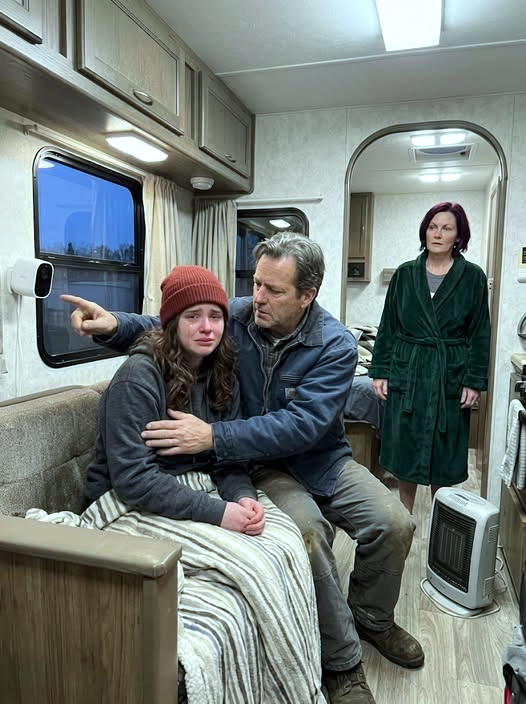
She had been sleeping in that freezing camper for weeks by then.
I remembered calling her from a truck stop outside Memphis on Christmas Eve.
I’d asked what Santa had brought.
She told me Tara had given her fuzzy socks.
Then she’d changed the subject and asked whether the roads were icy.
I had believed she was sitting beside our fireplace, surrounded by warmth.
Instead, she’d been sleeping behind the house in an unheated camper, frightened that the people inside might discover what she’d recorded.
I looked toward Tara.
“You put my daughter outside in nineteen-degree weather because she knew about this?”
Tara folded her arms.
“She was being punished.”
“For stealing forty dollars?”
“Yes.”
I pointed toward the television.
“We just watched Rick plant the money.”
Rick stepped forward.
“Those videos could be edited.”
I looked at him.
“Then you’ll have no problem explaining them to the investigators.”
His expression changed.
For a moment, the room was silent except for the faint hum of the refrigerator.
Then Tara said something I will never forget.
“Wade, don’t be ridiculous. We’ve practically raised Kaylee while you’ve been driving.”
I stared at her.
She continued.
“You leave for weeks. You don’t know what she’s like when you’re gone.”
I felt my stomach tighten.
Because there was one part of that accusation that hurt precisely because it contained a truth.
I had been gone.
I had trusted Tara to take care of my daughter.
And while I drove thousands of miles to provide for our family, I had failed to recognize what was happening inside my own home.
But my failure to see it did not excuse what they had done.
I looked at Kaylee.
Her face was pale.
Her eyes were fixed on the cake.
Strawberry.
Her favorite.
She had been excited about turning sixteen since summer.
Now she was sitting through the most terrible birthday celebration I could imagine.
I lowered my voice.
“Kaylee, look at me.”
She did.
“You don’t have to show anything else tonight.”
Tears filled her eyes.
“But Dad, the papers—”
“We’ll preserve everything. I promise.”
I touched her cheek.
“Right now, I need to know whether you’re warm enough.”
That was when her face crumpled.
Not at the accusations.
Not at the mention of the money.
At a simple question about whether she was warm.
She leaned against me and began crying.
I held her.
And I understood how long she’d been waiting for someone to ask.
Deputy Maria Delgado arrived twenty minutes later.
She came with another officer after the sheriff’s department received my report.
I had contacted them before the party, after finding Kaylee in the camper.
I had also called her pediatrician’s after-hours service and described the cold exposure, her weight loss, and the fact that she’d been sleeping outside.
The nurse told me to have her medically evaluated promptly.
I’d wanted to do it immediately.
Kaylee had begged me to let her show the evidence before Tara could destroy it.
Looking back, I wished I had taken her straight to the emergency department.
But by the time I understood how serious things were, I had already decided one thing.
My daughter would never spend another night in that camper.
Deputy Delgado listened carefully as I explained what I’d found.
She spoke with Kaylee privately, with Joanne nearby at my daughter’s request.
The officers documented the camper, the disconnected heater, the missing bedroom furniture, and the recordings Kaylee had saved.
They also spoke separately with Tara and Rick.
Rick insisted the camper had been Kaylee’s choice.
Tara claimed she was disciplining a difficult teenager.
But when Deputy Delgado asked whether either adult had checked the temperature inside the camper, Tara couldn’t answer.
The deputy looked toward the backyard.
“You knew she was sleeping there during freezing weather?”
Tara shifted.
“She had blankets.”
“And the heater?”
“She kept unplugging it.”
From the hallway, Kaylee spoke.
“No.”
Everyone turned.
My daughter stood beside Joanne, wrapped in one of my old flannel shirts.
“Rick unplugged it whenever Dad called,” she whispered. “He said I needed to learn that lying had consequences.”
I felt something tear inside my chest.
Deputy Delgado crouched slightly so she could speak to Kaylee at eye level.
“Thank you for telling me.”
Then she looked at the adults.
“We’re documenting these allegations and making the appropriate child-protection referral. There will be further questions.”
Rick scoffed.
“This is a family matter.”
The deputy’s expression didn’t change.
“That doesn’t make a child’s safety optional.”
Rick stopped smiling.
And for the first time since I’d met him, I saw something that looked like fear.
We went to the emergency department that night.
Joanne drove.
I sat in the back seat beside Kaylee, holding her hand while the road lights moved across her face.
She kept apologizing.
“I’m sorry, Dad.”
I looked at her.
“For what?”
“For ruining the party.”
My throat tightened.
“Baby, you didn’t ruin anything.”
She stared out the window.
“Tara said you’d be angry if you came home and found out.”
I swallowed.
“She said I’d lose my job if people thought I couldn’t control my daughter.”
Kaylee nodded.
“And Rick said if I caused trouble, you might have to sell the house.”
I closed my eyes.
The house.
The one Amy and I had planned together.
I paid the mortgage with years of long-haul driving, but Amy had picked the paint colors and planted the rosebush beside the porch.
After she died, I kept everything almost exactly as she’d left it.
Sometimes, when I came home after three weeks on the road, I stood in the doorway and could almost imagine her calling from the kitchen.
That house wasn’t a symbol of wealth.
It was the last place our family had been whole.
And Tara had apparently used the threat of losing it to keep our daughter quiet.
I squeezed Kaylee’s hand.
“Listen to me. I made choices about my work because I wanted to provide for you. But none of those choices made you responsible for protecting my job, my house, or my feelings.”
She looked at me.
“You’re my child. You shouldn’t have to carry adult problems.”
Her eyes filled.
Then she asked, “Are you going to leave again?”
I felt the question like a knife.
“I don’t know exactly what work will look like yet.”
Her face fell.
“But I know we’re going to make changes. And you won’t be left alone with Tara and Rick.”
She lowered her head.
I wished I could promise I’d never drive another mile.
But an honest promise mattered more than a comforting one I might not keep.
So I held her hand all the way to the hospital.
The doctor who examined Kaylee was named Dr. Lena Torres.
She was in her forties, with dark hair pulled into a bun and a calm, unhurried manner.
She listened as Kaylee described the sleeping arrangements.
The cold.
The unplugged heater.
The meals she’d sometimes missed because Tara said she’d been disrespectful.
And the way she’d learned to smile during my phone calls so I wouldn’t ask questions.
I sat beside the examination table.
With every sentence, I felt smaller.
Dr. Torres checked Kaylee’s temperature, circulation, weight, and general condition.
She ordered tests based on the history and her findings and arranged for follow-up care.
Kaylee was no longer dangerously cold by the time we arrived, but the doctor was concerned about her nutritional status, stress, and prolonged exposure to unsafe living conditions.
“How long were you sleeping outside?” she asked.
Kaylee looked at me.
“Since Thanksgiving.”
Dr. Torres nodded gently.
“That must have been frightening.”
Kaylee stared at her hands.
“Sometimes.”
“Did you feel safe coming into the house if you needed help?”
Kaylee shook her head.
“Rick would stand by the back door.”
My hands tightened.
Dr. Torres turned toward me.
“Mr. Carter, we need to discuss her safety and arrange appropriate support.”
I nodded.
“Whatever she needs.”
The doctor looked at me carefully.
“She needs a stable place to sleep, reliable meals, medical follow-up, and reassurance that she’s not being punished for telling the truth.”
I looked toward Kaylee.
My daughter was staring at the sheet covering her legs.
I swallowed.
“She’ll have all of that.”
Dr. Torres continued.
“Recovery from this kind of experience isn’t only physical. We’ll discuss counseling and other support with both of you.”
I nodded.
Then I asked the question I’d been afraid to speak.
“Is she going to be okay?”
The doctor didn’t offer an easy promise.
“She has been through something serious. But she’s here, she’s receiving care, and she has a parent prepared to make changes. Those are important starting points.”
I covered my face.
For a moment, I couldn’t stop crying.
Then a hand touched my arm.
Kaylee’s.
“Dad.”
I looked up.
She was crying too.
“I’m okay right now.”
I reached for her.
And I realized that for five weeks, she’d been trying to convince me everything was fine because she believed my happiness depended on it.
No more.
That night, I stopped asking her to be brave.
I promised instead that she could be frightened, angry, exhausted, or silent.
And I would still be her father.
The next morning, Robert and Ellen met us at Joanne’s house.
I’d decided we wouldn’t return to the family home until the safety situation was addressed.
Rick was still there.
Tara had sent me sixteen messages overnight, most of them demanding that I stop making her look like a criminal.
Joanne’s house was smaller than mine, but Kaylee had a warm bedroom, clean sheets, and a lock on the bathroom door.
When I asked what she wanted for breakfast, she looked surprised.
“Can I have eggs?”
I stared.
“Of course.”
“Two?”
My throat tightened.
“Baby, you can have as many eggs as you want.”
She ate three.
Then fell asleep on Joanne’s couch beneath a soft blanket.
Robert waited until she was resting before opening the folder he’d brought from Lubbock.
“Wade, we need to talk about Amy’s property.”
I sat opposite him.
“Is this about the land near Canyon?”
He nodded.
Ellen placed an old photograph on the table.
It showed Amy standing beside a wooden fence, holding a little girl in a pink jacket.
Kaylee had been three.
Behind them stretched a field of yellow grass and a low ridge of red Texas earth.
I’d taken that photograph myself.
Amy had inherited twenty-four acres near Canyon from her grandfather.
Before she died, she’d arranged for that land to be held for Kaylee’s benefit through an estate plan prepared by an attorney in Lubbock.
Robert and Ellen were involved in administering the arrangement.
I knew the land existed.
I knew Amy wanted Kaylee to have it when she was older.
But it hadn’t generated meaningful income, and I hadn’t followed its value closely.
Robert unfolded a letter.
“Last spring, a development company contacted us about purchasing the acreage.”
I frowned.
“What for?”
“There’s a proposed logistics and distribution project in that area. Nothing is final, but the land’s location has attracted interest.”
“How much interest?”
Robert looked at Ellen.
Then back at me.
“An offer of just over one million dollars.”
I stared at him.
“What?”
He nodded.
“One million eighty thousand, before expenses and any taxes.”
I sat back.
I’d spent years worrying about how to make sure Kaylee could afford college.
Driving late into the night.
Skipping vacations.
Taking extra loads whenever the bills piled up.
And all that time, land Amy left for our daughter might have become valuable enough to change her future.
“Why didn’t you tell me?”
Robert looked uncomfortable.
“We received the first serious offer in October. We intended to discuss it when you came home for Thanksgiving.”
I stared.
“That’s when Tara sent Kaylee to the camper.”
Ellen nodded slowly.
“We called your house. Tara said you weren’t available and that Kaylee didn’t want to talk to us.”
I felt cold.
Robert continued.
“Then an attorney contacted us claiming Tara and Rick were helping coordinate a sale on Kaylee’s behalf.”
I looked up.
“What attorney?”
He passed me a business card.
Bennett Land Acquisitions.
And beneath the company name was a contact number.
I recognized it.
Rick’s.
I stared at Robert.
“Rick was pretending to represent the buyer?”
Robert shook his head.
“At first, we thought he was merely introducing someone. Then he sent documents suggesting he had authority to negotiate for Kaylee.”
My stomach tightened.
“Did you sign anything?”
“No.”
Robert’s expression hardened.
“We told him the property was held for Kaylee and that any transaction had to comply with the trust terms and applicable law.”
Ellen leaned forward.
“That’s when Tara started telling us Kaylee had become difficult.”
I closed my eyes.
The timing was no coincidence.
Thanksgiving.
The camper.
The fabricated theft.
The troubled-girls program.
They had begun isolating my daughter almost immediately after the land negotiations became serious.
Robert looked toward the living room, where Kaylee was sleeping.
“That little girl wasn’t standing between them and a sale, Wade.”
His voice broke.
“She was standing between them and stealing something Amy left her.”
I drove to our house that afternoon with Joanne and Deputy Delgado.
The deputy wasn’t there to throw anyone out or decide who owned the property.
She was there because of the safety concerns, and because I had requested assistance documenting and retrieving Kaylee’s personal belongings without a confrontation.
Tara opened the front door.
She was wearing jeans and one of my old sweatshirts.
For a moment, she looked almost normal.
The woman who used to bring me coffee before I left for long trips.
The woman who’d kissed me goodbye beneath the porch light.
The woman I’d trusted to love my daughter.
“Wade,” she began. “Thank God. We need to talk.”
I looked past her.
Rick was sitting in my recliner.
Again.
His boots were on the coffee table.
Again.
And the sight made something inside me go perfectly still.
“Where are Kaylee’s things?” I asked.
Tara blinked.
“What?”
“Her clothes. Her schoolbooks. The photographs from her bedroom. Where did you put them?”
She folded her arms.
“Wade, we need to discuss what happened last night.”
“We will. Through the appropriate people.”
Rick stood.
“Come on, man. You’re blowing this out of proportion.”
I looked at him.
“She was sleeping outside in freezing weather.”
He shrugged.
“She’s a teenager. Teenagers exaggerate.”
Deputy Delgado stepped forward.
“Mr. Collins, please let us speak with everyone without interruptions.”
Rick opened his mouth, then closed it.
Joanne walked down the hallway with me.
The door to Kaylee’s former bedroom stood open.
The treadmill was still there.
So was the weight bench.
On the wall hung a framed motivational poster.
NO EXCUSES.
I stared at it.
Then Joanne whispered, “Wade.”
I turned.
She had opened the closet.
On the top shelf sat three cardboard boxes.
Inside were Kaylee’s schoolbooks.
Her softball trophies.
The pink jewelry box Amy gave her when she was six.
And a framed photograph of the three of us taken at the county fair the summer before Amy became ill.
I picked it up.
Amy was smiling.
Kaylee had cotton candy on her face.
I stood behind them with my arms around both.
I remembered that day.
We rode the Ferris wheel twice.
Amy bought a stuffed bear that was almost bigger than our daughter.
And when we drove home, Kaylee fell asleep against her mother’s shoulder.
I stared at the photograph.
Then looked around the room.
Everything that made the space hers had been boxed away.
As though she had never lived there.
Joanne touched my shoulder.
“Let’s get her things.”
We carried the boxes into the hallway.
Tara watched from the kitchen.
“You’re really doing this?”
I looked at her.
“Yes.”
“Over one punishment?”
I stopped.
I thought of Kaylee curled beneath blankets in the camper.
The space heater without power.
Her trembling hands.
The way she’d whispered that she could endure two more years.
“Five weeks,” I said quietly. “You kept her outside for five weeks.”
Tara rolled her eyes.
“She was being difficult.”
I looked directly at her.
“She was a child.”
For once, Tara said nothing.
We found the rest of Kaylee’s belongings in the garage.
Her softball bag was behind a stack of paint cans.
Her winter boots were in a plastic bin.
The sweater Amy knitted before her final hospitalization had been shoved beneath a pile of old towels.
I lifted it carefully.
It was pale yellow.
A little uneven at the sleeves.
Amy had never been particularly good at knitting.
She used to laugh that every sweater she made looked as though it had been assembled during an earthquake.
But Kaylee loved that sweater.
She wore it every winter, even after it became too small.
I held it against my chest.
And suddenly I couldn’t breathe.
Joanne watched me.
“You okay?”
I shook my head.
“No.”
She stepped closer.
I whispered, “I promised Amy I’d take care of her.”
My sister’s eyes filled.
“You have been taking care of her.”
I looked at her.
“Not enough.”
Joanne took the sweater gently from my hands.
“Wade, you trusted someone who worked very hard to deceive you.”
I shook my head.
“I should have seen it.”
“Yes,” she said softly. “There were things you needed to notice. And now you know.”
I looked up.
She continued.
“But don’t spend so much time punishing yourself that you forget what Kaylee needs next.”
I closed my eyes.
That was Joanne.
She didn’t excuse the truth.
She also didn’t let guilt become an excuse for standing still.
I nodded.
Then we carried the final boxes to my truck.
The financial evidence emerged over the next two weeks.
I hired an attorney named Grace Mercer, who worked with an independent accountant and the lawyer who had helped Amy establish the trust for Kaylee.
The documents from the birthday recording were only the beginning.
Rick had represented himself to the prospective land buyer as someone authorized to coordinate the sale.
He’d exchanged drafts of purchase agreements.
Sent photographs of the acreage.
And claimed that Kaylee’s legal representatives had agreed to the proposed terms.
But the real trust documents didn’t give him that authority.
Nor did they allow Tara to assume it by marrying me.
Grace explained that selling trust property wasn’t as simple as signing a paper across a kitchen table.
The actual trustees had duties to protect Kaylee’s interests.
They had to consider the trust terms, the proposed price, and the legal requirements involved.
And because the beneficiary was still a minor, there were additional safeguards that could become important.
Rick had apparently hoped to bypass those safeguards using a combination of false authority, pressure on me, and the story that Kaylee had become emotionally unstable.
But that wasn’t the worst of what Grace found.
One afternoon, she called and asked me to come to her office.
I arrived with Robert.
She placed a copy of a letter in front of us.
It was addressed to Bennett Land Acquisitions.
According to the letter, Wade Carter had authorized Rick Collins to act as his representative in negotiations concerning the property.
My name appeared at the bottom.
The signature looked close enough to mine to fool someone who didn’t know me.
I stared.
“I didn’t sign that.”
Grace nodded.
“We’re having the signature examined. But there’s more.”
She turned to another page.
The buyer had advanced seventy-five thousand dollars as a refundable good-faith payment into an account identified as belonging to the purported seller’s representative.
The account belonged to Rick.
Robert’s face hardened.
“He collected money against land he didn’t own?”
“That’s what the transaction records indicate,” Grace said. “The buyer may have its own claims, and the investigators are reviewing what representations were made.”
I looked down.
Seventy-five thousand dollars.
And Rick had wanted more.
A sale that might have generated over a million dollars for Kaylee’s future.
A college education.
A first home.
The security Amy had desperately wanted our daughter to have.
They hadn’t viewed any of that as belonging to Kaylee.
They had viewed it as something they could capture.
I asked, “Did Tara know about the advance?”
Grace opened another document.
A message from Rick to Tara.
The deposit cleared. Keep Wade calm until we get his signature on the full agreement.
Tara’s reply appeared beneath it.
He won’t question me. The girl is the problem.
I stared at those words.
The girl.
Not Kaylee.
Not my daughter.
Not the child who had spent years trying to earn Tara’s affection.
Just an obstacle.
Something standing between them and money.
I leaned back.
And for the first time, I understood exactly why Tara had smiled when she told me Kaylee preferred sleeping outside.
She believed she’d already trained my daughter to accept whatever happened to her.
She hadn’t expected Kaylee to keep evidence.
And she certainly hadn’t expected me to come home early.
The recordings from the baby monitor became part of the investigation.
Kaylee had found the old camera in a storage box shortly after Tara moved her into the camper.
Amy and I had used it when Kaylee was a baby.
Years later, I’d repurposed it to watch our old dog while we were away from the house.
It had been forgotten after the dog died.
But Kaylee remembered how it worked.
She’d quietly set the camera high above the kitchen cabinets and connected it through the home network to the old tablet I’d given her.
The monitor’s parent unit remained in the camper, where she could hear what was happening inside the house.
She had also saved selected recordings to the tablet whenever she heard Tara or Rick discussing her.
I wished she’d been able to tell me sooner.
But by then I understood why she hadn’t.
Tara checked her phone.
Rick listened whenever she spoke to me.
And Kaylee believed that if she made one mistake, the adults controlling her home would make life even worse.
The recordings documented the planted money, the disconnected heater, discussions of the trust property, and repeated threats concerning the residential program.
Investigators preserved the original files and examined their dates and contents.
A child-protection investigation proceeded separately from the questions about the land transactions.
I didn’t know how every part would end.
But I knew my daughter’s story was no longer being dismissed as a difficult teenager exaggerating.
It was being examined.
And for the first time, Kaylee wasn’t the only person carrying the truth.
Three weeks after the party, Kaylee asked me a question I wasn’t prepared to answer.
We were sitting in Joanne’s kitchen.
She had started eating regular meals again, and the doctor was pleased with her progress.
Her cheeks were gradually regaining their color.
She’d returned to school with support from a counselor and staff members who understood that she might need time to feel safe.
But every night, she still checked the bedroom window before going to sleep.
Sometimes she woke suddenly and asked whether the heater was working.
Sometimes she hid food in her backpack.
And once, when Joanne asked her to put away her laundry, Kaylee began apologizing so desperately that my sister had to sit beside her and explain she wasn’t in trouble.
I had never imagined how deeply those five weeks would change her.
That afternoon, Kaylee was peeling an orange when she looked at me.
“Dad?”
“Yeah, baby?”
“Are you going to divorce Tara?”
I put down my coffee.
“Yes.”
She stared at the orange peel.
“Because of me?”
My chest tightened.
“No.”
“But if I hadn’t shown everyone the videos—”
I moved my chair closer.
“Kaylee, look at me.”
She raised her eyes.
“I’m ending the marriage because Tara made choices that hurt you, lied to me, and violated the trust our family depended on.”
Tears gathered in her eyes.
“You wouldn’t have known if I hadn’t recorded it.”
“That’s true.”
I took her hand.
“But telling the truth isn’t what broke our family. The people who mistreated you did that.”
She swallowed.
Then whispered, “I thought you wouldn’t believe me.”
The words hurt.
More than I wanted to admit.
I looked at her carefully.
“Why?”
She hesitated.
“Because Tara said you loved her. She said she was the only reason you could keep driving and making money. And Rick said if I complained, you’d think I was trying to ruin your marriage.”
I closed my eyes.
“Kaylee, I need to apologize.”
She looked startled.
“For what?”
“For leaving you in a situation I wasn’t checking carefully enough.”
She started to shake her head.
I continued.
“I believed Tara. I should have been listening more closely to you.”
A tear slipped down her cheek.
“And I should have noticed when you sounded frightened on the phone.”
She looked down.
I squeezed her hand.
“You didn’t cause any of this. You shouldn’t have had to gather evidence just to convince your father you needed help.”
For a moment, she said nothing.
Then she leaned against my shoulder.
“I missed you, Dad.”
I held her tightly.
“I missed you too.”
But inside, I understood that missing her wasn’t enough.
I needed to change how we lived.
I called my dispatcher the following morning.
His name was Hank Willis.
We’d worked together for eleven years.
He knew my routes, my truck, and how many times I’d taken additional loads to put money aside for Kaylee.
When I told him what had happened, he was quiet.
Then he said, “Wade, I wish you’d told me you needed to be home.”
I looked toward Joanne’s backyard.
“I didn’t know how badly.”
He paused.
“Well, we have local and regional work.”
I frowned.
“Doesn’t pay as much.”
“No.”
“Less mileage.”
“Yes.”
I was silent.
Hank continued.
“But you’ll be home most nights.”
I closed my eyes.
For years, I’d believed being a good father meant taking the hardest routes.
Driving through storms.
Eating meals at truck stops.
Sleeping in narrow bunks while other families sat down together at dinner.
I thought every hour on the road was another hour of security I was building for Kaylee.
And I wasn’t ashamed of working hard.
But money couldn’t replace knowing what was happening in my own house.
It couldn’t sit beside a frightened teenager.
It couldn’t notice when her voice changed.
I took a slow breath.
“Hank, put me on the regional schedule.”
He didn’t hesitate.
“You got it.”
I looked toward the window.
Kaylee was outside with Joanne, helping plant spring bulbs.
For the first time in months, she looked peaceful.
I smiled.
“And Hank?”
“Yeah?”
“Thank you.”
He chuckled.
“Just make sure you still bring me those awful gas-station donuts.”
I laughed.
“Deal.”
The house became mine again gradually.
Grace helped me address the separation and property issues.
Tara and Rick eventually left after legal counsel became involved and the necessary arrangements were made.
I changed the locks when I was entitled to do so.
Replaced the security system.
And removed the treadmill and weight bench from Kaylee’s bedroom.
I wanted to put her old furniture back exactly as it had been.
But one afternoon, Kaylee stood in the doorway and shook her head.
“Dad, can we change it?”
I looked at her.
“Change what?”
“The room.”
I felt a pang of sadness.
“Of course.”
She studied the empty walls.
“I don’t want it to look like it did before.”
I nodded.
“Okay.”
“Can we paint it blue?”
“Absolutely.”
“And can I have a desk by the window?”
“Whatever you like.”
She smiled faintly.
Then added, “Maybe a bigger bookshelf.”
I laughed.
“Now you’re getting expensive.”
She laughed too.
It was a small sound.
But I hadn’t heard it often enough.
We spent the next weekend painting.
Joanne came over with sandwiches.
Robert helped assemble a new bed.
Ellen brought curtains.
And Kaylee chose a soft blue shade that reminded her of the sky just before sunrise.
By Sunday evening, the room was finished.
There was a bed with a thick quilt.
A desk beside the window.
Shelves for her books and softball trophies.
And a little framed photograph of Amy resting on the bedside table.
Kaylee stood in the doorway.
For a moment, she didn’t move.
Then she walked inside and sat on the bed.
I watched her.
“Do you like it?”
She looked around.
Then nodded.
“It’s warm.”
My throat tightened.
I wanted to tell her she’d never have to think about warmth again.
But I knew healing wasn’t that simple.
So I sat beside her.
And said, “You can sleep here every night. Nobody is going to make you earn that.”
She looked at me.
Then leaned against my shoulder.
And for a long while, we simply sat together.
The land near Canyon remained in trust for Kaylee.
Robert and Ellen, working with the trust attorney, chose not to rush into a sale while the investigation continued.
They obtained an independent appraisal and reviewed the proposed development plans.
The original buyer cooperated with inquiries into Rick’s representations and the advance payment.
The trust’s actual authority was clarified.
And every document involving the property was examined carefully.
There were legal consequences for the false representations and disputed documents, though those proceedings took time and did not resolve everything at once.
The child-protection findings also became important in our family proceedings.
Tara continued claiming that she’d been trying to discipline a difficult girl.
But the evidence of the conditions Kaylee endured could not be explained away by calling it punishment.
Rick’s involvement in the financial arrangements drew additional scrutiny.
I let the lawyers and investigators do their jobs.
Not because I stopped caring.
But because my daughter needed a father more than she needed a man consumed by revenge.
And I had already spent too many years believing my work outside the home was more important than what happened inside it.
One evening, Ellen brought an envelope to the house.
It was cream-colored, with my daughter’s name written across the front.
For Kaylee, on her sixteenth birthday.
I recognized Amy’s handwriting immediately.
My breath caught.
“Where did you get this?”
Ellen smiled sadly.
“Amy gave it to me before she died.”
I stared at the envelope.
“She wrote letters?”
Ellen nodded.
“Several. She knew she might not be there for the important birthdays. She wanted Kaylee to have something from her.”
My hands began trembling.
“Why didn’t you bring it before?”
“We did. We brought it to the party, but after everything happened, it didn’t feel right to hand it over in the middle of the chaos.”
I nodded.
Ellen placed the envelope in my palm.
“She wanted you to read this one together.”
I looked toward the living room.
Kaylee was sitting on the floor beside Joanne, sorting through old family photographs.
I called her name.
She looked up.
Then saw the envelope.
Her expression changed.
“Is that Mom’s handwriting?”
I nodded.
She came slowly toward me.
I handed it to her.
For a moment, she simply held it.
Then she whispered, “Can you read it?”
I sat beside her on the couch.
Carefully, I opened the envelope.
Inside was a folded sheet of paper.
Amy’s words filled the page.
My beautiful Kaylee,
If you’re reading this, you’re sixteen years old.
I wish I could see you today. I wish I could embarrass you by singing too loudly and insisting on taking a hundred photographs.
I wonder whether you still love strawberries. I wonder whether you still laugh with your whole face. And I hope you know how much joy you brought into my life.
I paused.
My throat had tightened.
Kaylee took my hand.
I continued.
Sixteen is such a wonderful age, sweetheart. You’re old enough to begin discovering who you want to become, but you don’t have to have everything figured out.
There will be people who tell you that being kind means staying quiet.
There will be people who try to make you feel difficult for having feelings or asking questions.
Please don’t believe them.
Tears ran down Kaylee’s face.
I kept reading.
You are allowed to say no.
You are allowed to ask for help.
You are allowed to take up space.
And you are allowed to walk away from anyone who makes you feel that love is something you must earn through suffering.
I stopped.
For a moment, the only sound in the room was the ticking of the old clock above the fireplace.
Amy had written those words years before Tara entered our lives.
She couldn’t have known what would happen.
And yet her words seemed to reach straight into the place where Kaylee had been hurting.
I wiped my eyes and read the final paragraph.
Your daddy loves you more than anything in this world. He won’t always be perfect. Neither would I have been. But whenever life becomes frightening, I hope you’ll remember that asking for help is never something to be ashamed of.
Happy sixteenth birthday, my darling girl.
Love always, Mom.
Kaylee began sobbing.
I put the letter down and held her.
For a long time, we cried together.
Then she whispered something that nearly broke me.
“Dad, I thought Mom would be disappointed in me.”
I pulled back.
“Why?”
“Because I couldn’t make Tara like me.”
My eyes filled.
I took her face in my hands.
“Kaylee, your mother loved you before you could say a single word. She loved you when you cried, when you got angry, when you made mistakes, and when you needed help.”
I kissed her forehead.
“You didn’t have to make anybody like you to deserve kindness.”
She nodded through her tears.
Then she folded Amy’s letter carefully and held it against her chest.
For the first time since coming home, she looked like a girl who believed the future might contain something beautiful again.
The following spring, Kaylee returned to softball.
She was nervous at first.
Her strength had improved, but she’d missed practices and worried that her teammates would ask questions.
Her coach, Mrs. Bennett, welcomed her back without making a spectacle of it.
The other girls cheered when she stepped onto the field.
And I sat in the bleachers for every game my schedule allowed.
Sometimes Kaylee struck out.
Sometimes she made an error.
Once, she hit a ball so hard it sailed beyond the outfield fence.
She came running toward the dugout, laughing.
I stood and applauded until my hands hurt.
Not because she’d hit a home run.
Because she was laughing again.
Because she was sixteen and learning to trust the world beyond our backyard.
Because every ordinary afternoon she spent playing with friends was another piece of childhood returning to her.
And because I was there to see it.
A year after that terrible birthday, I bought another strawberry cake.
Nothing fancy.
Just a grocery-store cake with white frosting and seventeen pink candles.
Kaylee stood beside the kitchen table wearing her softball jersey.
Joanne brought ice cream.
Robert and Ellen drove from Lubbock.
And when everyone finished singing, Kaylee closed her eyes and made a wish.
I didn’t ask what it was.
Some wishes belong entirely to the person making them.
After dinner, we sat on the back porch.
The old camper was gone.
I’d had it removed months earlier, after Kaylee told me she no longer wanted to see it from her bedroom window.
In its place, we’d planted a small garden.
Tomatoes.
Sunflowers.
And a row of pink roses like the ones Amy had grown.
Kaylee sat beside me, wrapped in a warm blanket.
For a while, we watched the sunset.
Then she rested her head against my shoulder.
“Dad?”
“Yeah, baby?”
“Do you ever wish you hadn’t come home early?”
I looked at her.
“What?”
“If you’d finished your route, maybe you wouldn’t have found out about Tara and Rick until later.”
I took a slow breath.
“Kaylee, I wish you’d never been hurt.”
She nodded.
“But I will never regret coming home.”
She was quiet for a moment.
Then she asked, “Are we going to be okay?”
I looked toward the garden.
The roses were beginning to bloom.
Inside the house, Joanne was laughing with Ellen.
The kitchen smelled of birthday cake.
And my truck was parked in the driveway, where it would remain that night.
I put my arm around my daughter.
“Yes, sweetheart.”
She looked at me.
“How do you know?”
I thought about the question.
For years, I had believed safety meant having enough money in the bank, a roof overhead, and a dependable job.
Those things mattered.
But they hadn’t protected Kaylee from people who were supposed to care about her.
Now I understood that safety also meant being heard.
Believed.
Respected.
It meant having someone notice when you were frightened.
And someone who wouldn’t make you prove your worth before offering warmth.
I kissed the top of her head.
“Because whatever happens next, we’re going to face it together.”
Kaylee smiled.
Then she reached for my hand.
“Dad?”
“Yeah?”
“I’m glad you came home.”
My throat tightened.
“Me too, baby.”
I looked toward the place where the camper once stood.
A year earlier, my daughter had been curled up inside it in two coats, begging me not to make things worse.
She’d believed she had to survive another two years before she could be free.
Now she was sitting beside me beneath the evening sky, planning college visits, softball games, and the life she wanted to build.
Tara had called her difficult.
Rick had called her a liar.
But neither had understood the strength of the girl they were trying to silence.
And I had learned something I would carry for the rest of my life.
Providing for your family means more than paying the bills. It means making sure the people you love are safe enough to tell you when something is wrong.
I squeezed Kaylee’s hand.
She squeezed mine.
And beneath the first stars of the evening, I finally felt what I’d spent years driving thousands of miles to provide.
Not wealth.
Not a perfect house.
Not a family that never experienced pain.
Just a place where my daughter could close her eyes, knowing she was loved, believed, and safe.
I looked toward the warm light spilling from our kitchen window.
Then whispered, “Welcome home, sweetheart.”
Kaylee smiled.
And answered, “You too, Dad.”
THE END STORIES! THANK YOU FOR READING GOOD LUCK !❤️
Related Posts