“My MIL Called 911 When I Refused to Let Her Move In—Then the Officer Asked Who Owned the House. At 4:17 on a Thursday afternoon, my husband texted me: “Mom’s moving in. It’s already decided.”

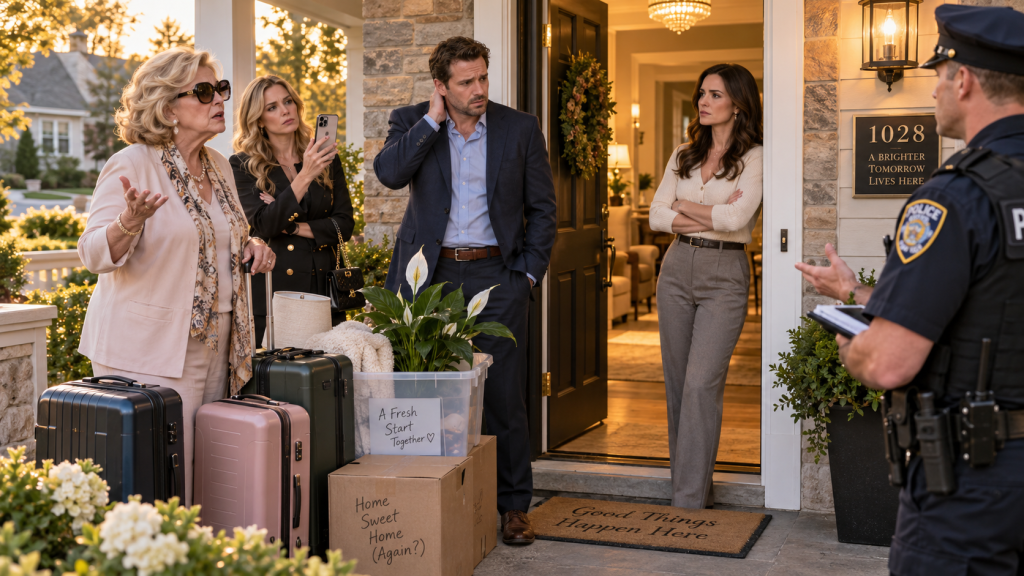
Fifty-four minutes later, she was standing on my porch with three suitcases.
I was sitting at the kitchen table finishing a work report when Mark’s message came through.
I read it twice.
Then I called him.
“What does ‘already decided’ mean?”
“Mom needs somewhere to stay for a while.”
“How long?”
“A few weeks. Maybe a couple months.”
I slowly closed my laptop.
“And when exactly were you planning to ask me?”
“She’s my mother.”
“I know who she is.”
He sighed.
“Her rent went up. She hates her apartment. She’s lonely. Lisa can’t take her.”
“Why not?”
“She needs her spare room for work.”
I stared at the wall.
“So Lisa’s office is protected, but mine isn’t?”
“You’re home three days a week. We can move your desk upstairs.”
That was the moment I realized he had already chosen my office for his mother.
“You already made the entire plan. I’m just finding out what my part is.”
Mark said we’d talk when he got home.
I told him to call his mother before she arrived.
Then there was a pause.
A long one.
“Mark… is she already on her way?”
He hung up.
At 5:11, a silver SUV pulled into the driveway.
Diane climbed out first.
Then Mark’s sister, Lisa.
That was when I knew this had all been arranged long before he texted me.
Together, they started unloading everything.
Three suitcases.
Storage bins.
A garment bag.
Toiletries.
Prescription bags.
And even a peace lily.
The doorbell rang.
I opened it.
Diane smiled.
“Which room did Mark clear out?”
“He didn’t.”
Her smile disappeared immediately.
Lisa sighed.
“Oh, Claire, don’t start.”
I looked at the mountain of luggage behind them.
“You two are standing on my porch with enough stuff to move in.”
Diane frowned.
“Mark said I could stay here.”
“You’re welcome inside as a guest. You’re not moving in today.”
“My son lives here.”
“Yes.”
“Then move, sweetheart. These bags are heavy.”
I stayed exactly where I was.
“The luggage stays outside until Mark and I have an actual conversation.”
Lisa laughed.
“She’s seventy-four.”
“Yes, Lisa. Mark mentioned that. It continues to be true.”
Diane’s face hardened.
“My son does not need permission to let his mother into his house.”
That sentence caught my attention.
Lisa pulled out her phone and started recording.
Diane called Mark.
No answer.
Then she looked at me and said:
“My son owns this house.”
I almost corrected her.
Almost.
But suddenly, years of little comments about how lucky I was that Mark “provided” so well started making much more sense.
Diane pulled out her phone.
“Who are you calling?” I asked.
“911.”
I genuinely thought she was bluffing.
She wasn’t.
“My daughter-in-law has locked me out of my son’s house and refuses to let me inside,” she told the dispatcher.
I could have ended the whole argument immediately.
Every document I needed was inside.
But by that point, I wanted Mark to explain it himself.
At 5:34, his car pulled into the driveway.
Almost at the exact same moment, a police cruiser arrived.
Mark looked at his mother.
Then Lisa.
Then the luggage.
Then the flashing lights.
For the first time all afternoon, he looked like he understood just how badly he had miscalculated.
Officer Ruiz stepped out.
Diane hurried toward him.
“Officer, thank goodness.”
He glanced at the luggage.
“Who called?”
“I did. My daughter-in-law is refusing to let me into my son’s house.”
Lisa folded her arms.
“She’s being completely unreasonable.”
Officer Ruiz looked at me.
“Ma’am?”
“Claire Bennett. I live here.”
“Does Mrs. Bennett live at this address too?”
Diane answered before I could.
“I’m moving in today.”
The officer looked back at her.
“Have you ever lived here before?”
“No.”
“Do you receive mail here?”
“No, but my son told me I could stay.”
Then Ruiz turned toward Mark.
“Sir?”
Mark stepped forward.
“I’m Mark Bennett.”
The officer nodded.
“Do you own the property?”
It was such a simple question.
That was what made the silence so ugly.
Mark looked at me.
Then at his mother.
Then back at Officer Ruiz.
“Claire,” he said, “can we please stop embarrassing everybody?”
There it was.
Not:
“Mom, you misunderstood.”
Not:
“Officer, the house belongs to Claire.”
Not even:
“I handled this badly.”
Apparently, I was the one embarrassing everybody.
Officer Ruiz waited.
“Sir, I still need an answer.”
Mark swallowed.
And when he finally opened his mouth, Diane’s expression changed before he even finished the sentence.
Because the truth about who actually owned the house was about to turn her 911 call into a much bigger problem than she expected.
PART 2
Mark swallowed.
Then he looked at his mother.
That was the part I noticed first.
Not me.
Not Officer Ruiz.
His mother.
As though the answer belonged to her more than it belonged to the truth.
Finally, he said:
“The house is in Claire’s name.”
Diane blinked.
Lisa stopped recording.
Officer Ruiz looked at me.
“Entirely?”
“Yes.”
I answered before Mark could soften it.
“Entirely.”
The officer nodded.
“Did Mr. Bennett contribute to the purchase?”
Mark opened his mouth.
I said:
“No.”
That one hurt him.
I saw it.
Not because it was cruel.
Because it was public.
For nine years, he had allowed his family to believe he had bought this house.
Not once had he corrected them when Diane called it “Mark’s place.”
Not once when Lisa joked that I had “married into a nice zip code.”
Not once when his uncle told me I was fortunate Mark had done so well.
I always thought Mark simply didn’t care enough to correct them.
Standing there beside a police cruiser, I began to understand that maybe he cared very much.
Officer Ruiz turned toward Diane.
“Ma’am, if the homeowner does not consent to you residing here, you cannot simply move in.”
Diane’s face changed.
“This is ridiculous.”
Ruiz remained calm.
“It is not a police matter for you to force occupancy into a residence you have never lived in.”
“But my son lives here.”
“Yes.”
“So he can invite me.”
“He can invite you as a guest.”
The officer looked at me.
“But if the sole property owner objects to you establishing residence, that is a civil issue, and you do not have a right to force entry today.”
Diane looked at Mark.
“Tell him.”
Mark rubbed his forehead.
“Mom.”
“No.”
She pointed toward the house.
“You told me this was your home.”
“It is my home.”
“That is not what he asked.”
Her voice sharpened.
“Do you own it?”
Mark said nothing.
Lisa turned toward him.
“You said you bought this place after the wedding.”
I looked at him.
Interesting.
He had not just allowed an assumption.
He had apparently built one.
Mark looked embarrassed.
“I said we bought it.”
“No.”
Lisa’s expression hardened.
“You said, ‘I bought a place in Fairfax.’”
The memory seemed to return to him.
He looked at me.
I almost laughed.
Nine years of correcting me privately over tiny details.
Nine years of insisting wording mattered.
Now suddenly:
“I didn’t mean it literally.”
Diane’s face had gone pale.
“Then whose money paid for this house?”
I looked at her.
“Mine.”
She stared.
“What do you mean yours?”
I wanted to ask how many definitions the word needed.
Instead, I said:
“I bought the house before Mark and I were married.”
Silence.
The property had been mine for twelve years.
I had purchased it at thirty-one after selling my first condo and receiving a modest inheritance from my father.
Nothing glamorous.
Nothing secret.
Mark knew that when we met.
He moved in eighteen months after our wedding because his lease ended and we agreed it made more sense than buying somewhere else immediately.
We had discussed possibly purchasing something together one day.
Then life happened.
Work.
Repairs.
Travel.
His mother’s medical bills.
Lisa’s divorce.
Years passed.
The house remained mine.
The deed never changed.
Diane stared at Mark.
“You moved into her house?”
I nearly laughed.
The disgust in her voice was breathtaking.
As if a man living in a home owned by his wife represented a humiliation too terrible to survive.
Mark’s jaw tightened.
“We’re married.”
“That is not what you told me.”
“There was no reason to get into legal paperwork with you.”
Lisa laughed.
“Oh, there was apparently plenty of reason.”
For the first time all evening, her irritation shifted away from me.
Officer Ruiz glanced toward the suitcases.
“Is anyone threatening anyone right now?”
“No.”
I said it immediately.
Diane turned toward him.
“She is throwing a seventy-four-year-old woman into the street.”
I closed my eyes.
“You have an apartment.”
“I gave notice.”
That made me open them.
“What?”
Diane looked at Mark.
He looked at the ground.
The world became very quiet.
“You gave notice on your apartment?”
“Yes.”
“When?”
“Three weeks ago.”
I turned toward Mark.
Three weeks.
He had texted me fifty-four minutes before Diane arrived.
Already decided.
Apparently, “already” meant much earlier than I imagined.
“You knew.”
He exhaled.
“Claire—”
“You knew she had already given notice.”
“Yes.”
My stomach dropped.
“How long have you known?”
He hesitated.
That was enough.
“How long?”
“About two weeks.”
Diane snapped:
“Almost three.”
Mark shot her a look.
She noticed.
“So now I’m supposed to lie for you too?”
Lisa muttered:
“Unbelievable.”
I stood there staring at the man I had been married to for nine years.
Not because his mother needed help.
Not because he wanted her close.
Those things could have been discussed.
What hollowed me out was simpler.
He had known she had already given up her apartment.
He had let her pack.
Let Lisa arrange transportation.
Let all of them make a plan involving my home.
Then he texted me less than an hour before she arrived so that my only practical options would be compliance or public cruelty.
I understood the strategy perfectly now.
Not persuasion.
Pressure.
He had created a situation where saying no would look monstrous.
And he had counted on me hating that feeling more than I hated being ignored.
Officer Ruiz asked:
“Does Mrs. Bennett have somewhere to stay tonight?”
Diane lifted her chin.
“Apparently not.”
Lisa sighed.
“She can come with me.”
Diane turned sharply.
“You said no.”
“I said I didn’t want this permanent.”
“You told me the office was nonnegotiable.”
Lisa glanced at me.
Her face changed slightly.
She heard it now.
Her office was nonnegotiable.
Mine had been assigned without consultation.
Diane said:
“I packed everything because Mark said it was settled.”
Officer Ruiz looked at Mark.
“Sir, did you tell your mother she could move into this address permanently or semi-permanently?”
Mark rubbed the back of his neck.
“I said she could stay until we figured things out.”
“Did your wife agree?”
Silence.
Ruiz did not need another answer.
He nodded once.
“All right.”
Then he turned toward Diane.
“Your belongings need to leave the property tonight.”
Diane looked horrified.
“This is insane.”
“No, ma’am.”
His voice was gentle.
“This is a domestic disagreement about permission to reside here.”
He pointed toward the luggage.
“You do not currently have permission from the owner.”
Diane’s face reddened.
Then she turned toward me.
“You enjoy this.”
I stared.
“What?”
“Making Mark look small.”
That sentence landed oddly.
Not because it was true.
Because it sounded practiced.
I looked at Mark.
His face changed.
Very slightly.
I filed that away.
Diane continued.
“You always have.”
“No.”
I shook my head.
“I actually spent years making him look bigger.”
That silenced everyone.
Mark’s face went still.
I had not planned to say it.
But once the sentence existed, I realized how true it was.
I paid for repairs without mentioning it.
Covered vacations when his consulting income dipped.
Loaned money to his business.
Handled household emergencies quietly.
Never corrected his mother.
Never contradicted stories that made him look like the provider.
Not because he demanded it directly.
Because each correction became exhausting.
If I said I bought something:
Why do you need everyone to know?
If I mentioned my salary:
Why are you competing with me?
If I corrected Diane:
Can’t you just let Mom feel proud of her son?
So I stopped.
And eventually, silence became evidence in their minds.
Evidence that Mark funded the life around me.
Officer Ruiz gave us a few more instructions.
No forced entry.
No removing property from inside without permission.
No threats.
If a civil dispute developed, lawyers could handle it.
Then he left.
The cruiser disappeared around the corner.
And the real argument began.
Diane stepped toward Mark.
“You humiliated me.”
Mark looked exhausted.
“Mom.”
“You let me call the police on a house you don’t even own.”
“I didn’t tell you to call 911.”
“You told me I was moving in.”
“I said we’d make it work.”
“You said Claire would get over it.”
My head turned.
Mark closed his eyes.
There it was.
He opened them again.
“I said she’d understand.”
“No.”
Diane pointed toward him.
“You said, ‘She’ll be upset for a day, then she’ll adjust.’”
Something inside me went very calm.
That was worse.
Not because he expected me to forgive him.
Because he had modeled my boundaries as temporary emotions.
Claire will be upset.
Claire will adjust.
Claire always adjusts.
I looked at him.
“Is that how you think I work?”
He stared.
“No.”
“Really?”
Silence.
“Because that sounds exactly like how you planned this.”
Lisa quietly lowered her phone.
She was no longer recording.
I looked at her.
“Why?”
She frowned.
“What?”
“Why did you agree to help move her here?”
Lisa sighed.
“Because Mark said you had already discussed it.”
I turned.
Mark went pale.
Lisa continued.
“He said you weren’t thrilled but you agreed.”
Diane looked at him too.
“You told me the same thing.”
I stared at my husband.
The betrayal changed shape again.
Not avoidance.
Not cowardice.
Lying.
He had told them I agreed.
Then told me it was already decided.
He had built consent out of two different lies.
“Mark.”
He held up a hand.
“I was going to fix it.”
I laughed.
The sound surprised me.
“When?”
“Tonight.”
“How?”
“I thought once everyone was here, we could sit down.”
“Everyone.”
I looked at the three of them.
“Everyone except the person who owns the house.”
His mouth tightened.
“That’s not fair.”
I almost smiled.
“That sentence has been doing very heavy lifting today.”
Diane looked at me.
“Fine.”
She crossed her arms.
“You own the house.”
The way she said it made ownership sound like a personality defect.
“You’ve made your point.”
“No.”
I looked at the luggage.
“The point is the bags are leaving.”
Her mouth fell open.
“You cannot possibly expect me to go back to an apartment I no longer have.”
“I expect Mark to solve the emergency he created.”
Mark stared.
“What do you want me to do?”
I looked at him.
That question.
Finally.
Not:
What do you want from me?
What do you want me to do?
Different.
“I want you to help your mother find a hotel tonight.”
Diane gasped.
“Then tomorrow, you can help her arrange somewhere else.”
“A hotel?”
“Yes.”
“For your mother?”
“For your mother.”
I held his gaze.
“You volunteered my home.”
“You fix the consequences.”
Mark looked at Diane.
Then at Lisa.
Lisa shrugged.
“I can take her for three nights.”
Diane stared.
“Three?”
“That’s what I can do.”
“And after that?”
Lisa said:
“We figure it out.”
Diane looked betrayed.
Interesting how quickly boundaries became cruelty when they were finally applied to her.
Eventually, the luggage went back into the SUV.
Not all of it neatly.
One storage bin would not fit.
Mark put it into his trunk.
The peace lily ended up on Lisa’s passenger floor.
Before leaving, Diane turned toward me.
“This changes things.”
I nodded.
“Yes.”
She seemed surprised I agreed.
Then she left.
Lisa followed.
Mark stayed.
For a long moment, we stood in the driveway with evening settling around us.
Neighbors had watched.
Of course they had.
Curtains moved.
Garage doors stayed suspiciously open.
I almost laughed.
Mark looked at me.
“Can we go inside?”
I considered it.
Then stepped aside.
He entered my house differently this time.
That was impossible not to notice.
For years, he walked through the front door without thinking.
Shoes off wherever.
Keys on the table.
Mail on the counter.
Home.
That night, he paused.
As if the police officer’s question had changed the dimensions.
Who owns the property?
Me.
The answer was not new.
But suddenly, it was visible.
We sat in the kitchen.
The same place where I had been working before his text arrived.
My laptop was still closed beside the fruit bowl.
The entire disaster had taken less than three hours.
It felt like three years.
Mark said:
“I messed up.”
I waited.
“I handled it badly.”
“That is true.”
He rubbed his forehead.
“I knew you’d say no.”
I looked at him.
There.
At least we were getting closer.
“So you didn’t ask.”
“I thought you might say yes eventually.”
“But you knew I’d say no initially.”
He looked down.
“Yes.”
“Why?”
“Because of your office.”
“No.”
I shook my head.
“That’s the practical reason.”
His face tightened.
“What’s the real one?”
Silence.
“Mark.”
He looked up.
“Because you don’t like Mom.”
I almost laughed.
“I don’t trust your mother in my home.”
“That’s what I mean.”
“No.”
“It isn’t.”
I leaned back.
“Your mother enters rooms without knocking.”
Silence.
“She reads mail.”
“That was one time.”
“She went through my desk.”
“She was looking for a pen.”
“She opened a closed drawer.”
He looked away.
“She criticized what I spend.”
“She comments on my medication.”
“She rearranged my kitchen twice.”
“She told my niece I was selfish for not having children.”
Mark flinched.
“That was years ago.”
“Yes.”
“And you told me to let it go because she was grieving Dad.”
Silence.
I continued.
“She borrowed my car without asking.”
“She called my work ‘computer stuff.’”
“She told your friends you paid for this house.”
“She said you gave me the office because I needed to feel important.”
His face changed.
I had never told him that one.
“When?”
“Last Thanksgiving.”
He closed his eyes.
“Why didn’t you tell me?”
I stared.
“I did.”
His eyes opened.
“You said, ‘That’s just Mom being Mom.’”
Silence.
Something passed through his face.
Memory.
Shame, maybe.
Not enough yet.
Then I asked:
“What did you promise her?”
His jaw tightened.
“What?”
“You didn’t just promise a room.”
“How do you know?”
“Because she brought prescription bags, storage bins, and a plant.”
I leaned forward.
“She gave up her apartment.”
“What else did you promise?”
He looked toward the hallway.
I waited.
Finally:
“That we’d convert your office into her bedroom.”
“I know.”
“And?”
“The upstairs guest room into a sitting room.”
I stared.
“My guest room?”
“She needs somewhere to watch TV.”
I actually laughed.
“You assigned two rooms?”
“It wasn’t permanent.”
“Anything else?”
He hesitated.
My stomach tightened.
“Mark.”
He rubbed his face.
“She sold some furniture.”
“What?”
“Most of it.”
“Because you told her she was moving in.”
“Yes.”
I stood.
Anger arrived finally.
Hot.
Clean.
“You dismantled her apartment before telling me.”
“I know.”
“No.”
I pointed at the table.
“You knew I had not agreed.”
His voice sharpened.
“I was trying to help my mother.”
“And I was the easiest person to sacrifice.”
“That is not what happened.”
“It is exactly what happened.”
I started counting.
“Lisa’s office stayed.”
“Diane’s comfort came first.”
“Your promise stayed intact.”
“My office disappeared.”
“My privacy disappeared.”
“My consent disappeared.”
I looked at him.
“Interesting pattern.”
He stood too.
“Stop making me sound like some monster.”
“I didn’t.”
My voice was quieter.
“You’re doing that yourself.”
That hurt.
He sat back down.
For several minutes, neither of us spoke.
Then he whispered:
“I thought you’d adjust.”
There it was again.
Not malicious.
Worse.
Normal.
He genuinely believed my discomfort was an adjustable household expense.
I looked at him.
“Why?”
He swallowed.
“Because you always do.”
The sentence broke something.
Not loudly.
Just enough.
I realized then that patience can become evidence against you.
Every time I compromised, he learned that my no was negotiable.
Every time I let something go, he learned there was no cost to crossing the line.
Every time I prioritized peace, he mistook the peace for permission.
I sat down again.
“Mark.”
He looked at me.
“I need you to leave tonight.”
His face emptied.
“What?”
“I need space.”
“This is my home too.”
I stared.
He heard it.
We both did.
The sentence.
After everything that happened outside.
He looked down.
“Claire.”
“I am not saying you can never come back.”
My throat tightened.
“I am saying I don’t want to sleep beside you tonight.”
He closed his eyes.
Then nodded.
That surprised me.
Maybe he was too tired to argue.
Maybe the truth had finally become heavy enough.
He packed a bag.
Ten minutes.
No drama.
At the front door, he turned.
“I really did think I was helping.”
I looked at him.
“I know.”
That was the problem.
He left.
I locked the door.
Then I cried.
Not because I regretted it.
Because marriage is strange.
You can be furious with someone and still feel the shape of them missing from a room.
I slept badly.
At 6:42 the next morning, I woke to twelve messages.
Three from Mark.
Five from Diane.
Two from Lisa.
Two from an unknown number.
I ignored all but Lisa.
Her message read:
Call me before you talk to Mark. There is something you need to know.
My stomach tightened.
I called.
She answered immediately.
“Are you alone?”
“Yes.”
“Is Mark there?”
“No.”
She exhaled.
“Good.”
“What happened?”
“I went through Mom’s apartment paperwork.”
I frowned.
“Why?”
“Because she kept saying she gave notice.”
“And?”
“She didn’t.”
I sat up.
“What?”
“She didn’t give ordinary notice.”
My pulse changed.
“What did she do?”
“She terminated the lease early.”
“Why does that matter?”
“Because she paid a penalty.”
“How much?”
“Almost six thousand dollars.”
I frowned.
“Why would she do that if money was the problem?”
“Exactly.”
Silence.
Lisa continued.
“Mom’s rent didn’t go up.”
I stopped.
“What?”
“The new lease offer was basically the same.”
“Then why did Mark tell me it went up?”
“I don’t know.”
My stomach tightened.
“Did she tell him that?”
“I asked her.”
“And?”
“She said Mark knew.”
The room went quiet.
Mark knew.
I got out of bed.
“What else?”
Lisa hesitated.
“There’s a house.”
My pulse jumped.
“What house?”
“She has been trying to buy a townhouse.”
I stared.
“With what money?”
“I don’t know.”
“How expensive?”
“About seven hundred thousand.”
I laughed because the alternative was swearing.
“Diane can’t afford that.”
“I know.”
“Then what?”
Lisa lowered her voice.
“There’s a loan preapproval.”
“For her?”
“Yes.”
“With a co-borrower.”
My skin went cold.
“Mark?”
“No.”
That surprised me.
“Who?”
She hesitated.
Then:
“You.”
Everything inside me stopped.
“What?”
“Your name is on the application.”
My hand tightened around the phone.
“No.”
“Yes.”
“I never applied for anything.”
“I know.”
“How do you know?”
“Because Mom left a copy in the folder.”
I started walking toward the kitchen.
“Send it.”
“I already did.”
My email chimed.
PDF.
I opened it.
Property:
Oak Ridge Townhomes.
Purchase price:
$698,000.
Primary borrower:
Diane Bennett.
Co-borrower:
Claire Bennett.
Income listed under me.
My income.
Exact to the dollar.
Employer.
Title.
Approximate retirement assets.
Credit score range.
My breathing slowed.
“How did she get this?”
Lisa said:
“I don’t know.”
I did.
Or at least I knew who could.
Mark.
Joint tax returns.
Insurance documents.
Old mortgage files.
My pay information.
Everything.
I scrolled.
Then stopped.
Consent authorization.
Electronic signature.
Claire Bennett.
Not mine.
It looked close.
Too close.
“Lisa.”
“Yes?”
“There’s a signature.”
Silence.
“I saw it.”
“Did Mom say where she got it?”
“She said Mark handled the paperwork.”
My stomach dropped.
Of course.
I hung up and called Mark.
He answered on the first ring.
“Claire.”
“Did you apply for a mortgage using my information?”
Silence.
That was enough.
I closed my eyes.
“Mark.”
“Let me explain.”
My knees weakened.
I sat down.
“You used my financial information.”
“It wasn’t final.”
“You forged my signature.”
“I didn’t forge anything.”
“Then who signed?”
Silence.
“Mark.”
“I used an electronic authorization we already had.”
“What authorization?”
“From the refinance.”
I felt cold.
We refinanced nothing.
Then I remembered.
Two years earlier, I had signed a digital consent for insurance and estate-planning documents through Mark’s financial adviser.
He had access to the signature file.
My stomach turned.
“You copied my signature.”
“No.”
His voice sharpened.
“It was a stored signature.”
“That I did not authorize for this.”
Silence.
“Why?”
He exhaled.
“Mom needed to qualify.”
“So you put me on the loan?”
“As a temporary co-borrower.”
I actually laughed.
“Temporary.”
“The plan was to remove you after closing.”
“Without telling me.”
“I was going to tell you.”
“When?”
Silence.
“After I owed seven hundred thousand dollars?”
“It wouldn’t have worked like that.”
“How would it work, Mark?”
His voice rose.
“She was going to sell some investments.”
“What investments?”
“I don’t know.”
“Then what exactly was the plan?”
He went quiet.
And suddenly, the move-in made sense.
Not emotionally.
Financially.
“Mark.”
“What?”
“Was she moving into my house because the townhouse purchase hadn’t closed?”
Silence.
My skin went cold.
“That’s it.”
“No.”
“That’s why the timing was urgent.”
“Claire—”
“The mortgage got delayed.”
Nothing.
“So she ended her lease.”
Nothing.
“And you decided she’d live here until the financing cleared.”
He exhaled.
“Yes.”
I closed my eyes.
“How long?”
“Maybe six weeks.”
I almost laughed.
“A couple months.”
The exact phrase from his text.
He had known all of it.
The apartment.
The townhouse.
The application.
My forged—or “stored”—signature.
And he still framed it as loneliness and rising rent.
I asked:
“Why did she need my income?”
He went silent.
“Mark.”
“Her debt ratio was too high.”
“What debt?”
Another silence.
Then:
“Credit cards.”
“How much?”
“I’m not sure.”
“Try.”
“About ninety thousand.”
My mouth went dry.
“Ninety?”
“And a personal loan.”
“How much?”
“Fifty.”
I stood.
“What?”
“She helped Lisa during the divorce.”
Lisa had never mentioned that.
Maybe she didn’t know.
Maybe that was another lie.
Mark continued.
“She had some expenses after Dad died.”
“How much debt total?”
He swallowed.
“About one hundred eighty thousand.”
I stared at the wall.
Diane was not losing her apartment because rent rose.
She was drowning in debt.
Trying to buy a $698,000 townhouse.
Using my income.
My credit.
My signature.
And Mark had planned to install her in my house while the fraud cleared.
My voice became very quiet.
“Did you expect me to sign closing documents later?”
Silence.
“Mark.”
“I thought once you understood the situation—”
I laughed.
There it was.
The entire strategy.
Create the obligation first.
Then explain.
Make refusal expensive.
Then call resistance cruel.
“You thought I would adjust.”
He said nothing.
I hung up.
By eight o’clock, I had frozen my credit.
By eight-thirty, I had called the lender.
At nine, their fraud department confirmed something worse.
The application had not merely been started.
It had passed preliminary underwriting.
Documents had been uploaded.
Tax returns.
Bank statements.
Employment verification.
Asset summaries.
All mine.
Some records Mark had legitimate access to as my husband.
Some he did not.
At 9:26, the fraud investigator asked:
“Mrs. Bennett, did you authorize a gift letter?”
My stomach dropped.
“What gift letter?”
A document arrived by secure email.
I opened it.
Gift commitment: $125,000.
Donor:
Claire Bennett.
Recipient:
Diane Bennett.
Purpose:
Down payment.
My signature beneath it.
Again.
Not mine.
I sat very still.
One hundred twenty-five thousand dollars.
They had not only used my income to qualify Diane.
They had told the lender I was giving her the down payment.
I called Lisa back.
She went silent when I told her.
Then whispered:
“Oh my God.”
“Did you know?”
“No.”
I believed her.
Then she said:
“Claire.”
“What?”
“There’s something else.”
Of course there was.
“Mom told me yesterday that once she moved in, she was going to help you and Mark get organized financially.”
I almost laughed.
“What does that mean?”
“I thought she meant budgeting.”
“Now?”
Lisa’s voice tightened.
“She said you have too much money sitting in accounts that aren’t helping the family.”
My skin went cold.
“What accounts?”
“I don’t know.”
“Did she say anything specific?”
Silence.
Then:
“Your father’s inheritance.”
I stopped breathing.
My father had left me $340,000 when he died.
Most of it was invested separately in my name.
Mark knew.
Diane should not have.
“How does she know about that?”
Lisa whispered:
“I think Mark told her.”
I stared at the kitchen table.
The house.
The inheritance.
My income.
My signature.
For years, Diane told everyone how fortunate I was to have a husband who provided.
Meanwhile, behind closed doors, her son had been treating my assets like resources the family could access if they created enough urgency.
Then my phone buzzed.
An email from the lender’s fraud department.
Additional document attached for review.
I opened it.
A balance sheet.
Not Diane’s.
Mine.
Assets listed.
House estimated value.
Retirement.
Investments.
Inheritance account.
Cash.
At the bottom was a handwritten note scanned into the file.
Claire assets available if needed. Mark confirms family cooperation.
My hands started shaking.
Family cooperation.
I knew exactly what that meant now.
Claire will adjust.
Claire will understand.
Claire always does.
Then another page loaded.
Proposed secondary collateral.
My house.
I stopped breathing.
No.
I read it again.
The house Diane had called her son’s.
The house Mark never owned.
They had included it as a possible source of collateral if Diane’s financing needed additional support.
The lender had not approved that structure.
Not yet.
But someone had offered it.
I called the fraud investigator.
“Who submitted the collateral worksheet?”
Keyboard sounds.
Then:
“Mark Bennett.”
My body went cold.
“When?”
A pause.
“Eleven days ago.”
Eleven days.
Long before the text.
Long before the luggage.
Long before Diane called 911 and told police my husband owned the house.
Mark had already represented my house as potentially available to secure his mother’s debt.
I thanked the investigator.
Ended the call.
Then I sat alone in the kitchen.
For nearly an hour.
No crying.
No anger.
Just stillness.
At 10:41, Mark arrived.
I watched him through the camera.
He rang the bell.
Once.
Then again.
I opened the door but did not step aside.
He looked terrible.
“Claire.”
I held up the collateral worksheet.
His face changed.
That was enough.
“You offered my house.”
He closed his eyes.
“It was preliminary.”
“You offered my house.”
“The lender needed to see options.”
“It is not your option.”
“I know that.”
“Do you?”
His face tightened.
“Nothing was signed.”
“You signed my name to a gift letter.”
“No.”
“I told you, the stored signature—”
“Stop.”
My voice cracked like a whip.
He went silent.
I had never spoken to him like that.
Maybe that was why it worked.
“You do not get to rename forgery because the file was convenient.”
His face paled.
“I was trying to help Mom.”
“You were trying to help your mother with my money.”
Silence.
“My credit.”
Silence.
“My house.”
Nothing.
“My consent.”
He looked down.
I whispered:
“And you still thought the biggest problem yesterday was that I embarrassed everybody.”
His face collapsed.
“I know.”
“No.”
I shook my head.
“You know now.”
That difference mattered.
He looked at me.
“What happens?”
For the second time in two days, he asked the right question too late.
I held the door.
“I’ve contacted a lawyer.”
His face changed.
“Claire.”
“I’ve frozen my credit.”
“Okay.”
“The lender is treating the application as fraud.”
His mouth opened.
Nothing came out.
“And I am reviewing every financial document you have touched in the last five years.”
He went pale.
That reaction was too strong.
I saw it.
Immediately.
“What?”
He shook his head.
“Nothing.”
My pulse changed.
“Mark.”
“Claire, don’t.”
There.
Not don’t misunderstand.
Don’t.
My stomach tightened.
“What else did you do?”
Silence.
“Mark.”
He looked at me.
Then away.
And suddenly I understood that the mortgage application might not be the beginning.
It might simply be the first thing I had caught.
I whispered:
“How long?”
His jaw tightened.
“How long have you been using my information?”
He did not answer.
I stepped back.
“Get off my porch.”
His head snapped up.
“Claire.”
“Now.”
He took one step toward me.
Then stopped himself.
Maybe he remembered Officer Ruiz.
Maybe he remembered who owned the house.
He backed away.
Before reaching his car, he turned.
“I never wanted to hurt you.”
I looked at him.
“That stopped being enough a long time ago.”
He left.
At 1:13 that afternoon, my attorney called.
Her name was Renee Walsh.
She had spent the morning pulling records.
Her voice was too calm.
The kind of calm professionals use when the news is not.
“Claire.”
“Yes?”
“We found something.”
My stomach tightened.
“What?”
“Did you and Mark ever open a home-equity line?”
“No.”
Silence.
“Are you sure?”
I stood.
“Yes.”
“How much?”
I asked.
Renee hesitated.
“Two hundred fifty thousand dollars.”
My knees weakened.
“No.”
“It was opened three years ago.”
“No.”
“There have been draws.”
“How much?”
“Approximately one hundred seventy-eight thousand.”
I grabbed the edge of the counter.
“Where did the money go?”
“That is what we’re tracing.”
My heart hammered.
“Is my signature on it?”
A pause.
“Yes.”
“Not mine.”
“I assumed.”
I closed my eyes.
Three years.
Not eleven days.
Three years.
“What was the line used for?”
Renee’s voice lowered.
“Claire, one recipient account appears repeatedly.”
“Whose?”
Silence.
Then:
“Diane Bennett.”
My stomach turned.
“How much?”
“Directly?”
“Yes.”
“Just under ninety-four thousand.”
I could not breathe.
“And the rest?”
“We’re tracing transfers through another account.”
“Whose?”
Renee paused.
“Mark’s business account.”
The room disappeared.
I thought of every family dinner.
Every comment about Mark providing.
Every joke about my career.
Every time Diane praised her son for giving me such a beautiful home.
Meanwhile, money borrowed secretly against that home had apparently been flowing toward her.
I whispered:
“Renee.”
“Yes?”
“Tell me the worst part.”
She was silent for several seconds.
Then:
“There’s an extension request from last year.”
My hands tightened.
“And?”
“The bank questioned whether the house remained solely your separate property.”
I stopped breathing.
“What did Mark say?”
Renee exhaled.
“He submitted a document stating you had transferred a fifty-percent marital interest to him.”
The world went quiet.
“I never did.”
“I know.”
“What document?”
“A quitclaim deed.”
My skin went cold.
My house.
The one Officer Ruiz had asked about.
The one Mark admitted I owned.
The one Diane had believed belonged to her son.
There was apparently a deed somewhere saying half of it did.
A deed I had never signed.
I whispered:
“Is it recorded?”
Renee paused.
Then said:
“Yes.”
My hand went numb around the phone.
“How?”
“We’re investigating.”
“Who notarized it?”
Another pause.
Then the answer came.
“Diane Bennett.”
I stopped breathing.
His mother.
A retired notary.
The woman who called 911 because I refused to let her move into my house.
The woman who insisted her son owned it.
Maybe she had not simply believed that lie.
Maybe she had helped create the paperwork designed to make it true.
And suddenly, her arrival with three suitcases did not feel like entitlement anymore.
It felt like confidence.
The confidence of a woman who thought she had already helped put her son’s name on my home.
I looked toward the front door.
At the place where she had stood the night before.
Demanding I move.
Sweetheart, these bags are heavy.
I had thought the fight was about a bedroom.
It wasn’t.
The bedroom was only the first room they expected me to surrender.
Somewhere in the last three years, Mark and Diane had apparently decided that if my money, my credit, my office, and my house could help the family, then my permission was simply another inconvenience they could handle afterward.
And for the first time since Officer Ruiz asked who owned the property, I understood why Mark had looked so frightened before answering.
He had not only been afraid his mother would discover the house belonged to me.
He had been afraid I would discover there was already a document saying part of it belonged to him.
PART 3 — THE DEED THEY THOUGHT I WOULD NEVER FIND
The quitclaim deed was recorded eighteen months earlier.
That detail mattered.
Because it meant this had not been one desperate mistake.
Not one panicked decision.
Not a foolish favor Mark made for his mother because she had gotten herself into debt.
Eighteen months.
Long enough for birthdays.
Anniversaries.
Christmas dinner.
Long enough for Mark to kiss me goodnight hundreds of times while a public record somewhere quietly claimed he owned half my house.
I stood in my kitchen holding the phone to my ear.
Renee Walsh, my attorney, waited silently.
Finally, I asked:
“Can he actually take half the house?”
“No.”
The answer came quickly.
My knees almost gave out.
“No?”
“If the signature is forged and the deed was fraudulently recorded, we can challenge it.”
I closed my eyes.
“But it exists.”
“Yes.”
“And the home-equity line was issued because of it.”
“Partly.”
My stomach turned.
“How did nobody contact me?”
“They did.”
I opened my eyes.
“What?”
Renee paused.
“There are notices in the lender file.”
“I never got notices.”
“They were mailed.”
“To where?”
She gave me an address.
I knew it immediately.
Mark’s business office.
Not our house.
Not my work address.
His office.
He had changed the correspondence address.
I whispered:
“Of course.”
Renee continued.
“Some statements were also electronic.”
“I never saw them.”
“The email listed wasn’t your normal email.”
My skin went cold.
“What was it?”
She read it.
It looked almost exactly like mine.
One extra letter.
A small variation most people would never notice.
A fake email account built to impersonate me.
I laughed once.
It sounded wrong in the quiet kitchen.
Not amused.
Hollow.
“How long?”
“Account creation appears to be about three years ago.”
Three years again.
Three years of paperwork.
Three years of borrowed money.
Three years of false signatures.
Three years of my husband saying things like:
We’re a team.
While apparently using my financial identity behind my back.
Renee said:
“We’re issuing formal notices today.”
“To whom?”
“The lender.”
“The county recorder.”
“Mark.”
“And Diane.”
My throat tightened at her name.
“Can Diane claim she thought I signed the deed?”
“She can claim whatever she wants.”
Renee’s voice stayed calm.
“But notarizing a signature generally means attesting to the signer’s identity and execution.”
I looked at the wall.
Diane had notarized my forged signature.
Either she knew.
Or she was willing to claim she watched something she had not watched.
Neither possibility looked good.
“What happens to the home-equity line?”
“We dispute it.”
“How long will that take?”
“A while.”
“What about the money?”
“We trace it.”
Silence.
Then I asked:
“Should I call the police?”
Renee answered carefully.
“I think you should make a report.”
The sentence chilled me more than I expected.
Police had been at my house the night before.
Because Diane called them.
She called 911 claiming I was keeping her out of her son’s home.
And less than twenty-four hours later, I was being advised to report evidence suggesting she and her son had created false ownership documents against that same property.
The irony was so sharp it almost felt cruel.
I said:
“I want Officer Ruiz.”
Renee paused.
“You know him?”
“Not really.”
“But I think he should hear how the story ended.”
Officer Ruiz came back that afternoon.
This time there were no suitcases on the porch.
No peace lily.
No Lisa recording.
No Diane insisting my house belonged to her son.
Just me.
Renee.
A folder.
And a printout of a deed carrying a signature that looked enough like mine to frighten me.
Ruiz sat at my dining table.
He read the first page.
Then the second.
Then looked at me.
“You’re saying you never signed this?”
“No.”
“You never transferred fifty percent ownership to your husband?”
“No.”
“Were you present when Mrs. Diane Bennett notarized this document?”
“No.”
“Did you authorize anyone to sign for you?”
“No.”
His expression changed.
Not dramatically.
Professionally.
But I saw it.
He remembered yesterday.
“So when I asked who owned the house…”
“Mark knew this document existed.”
“Yes.”
“He still admitted it was mine.”
“Yes.”
Ruiz looked down again.
Then asked:
“Why?”
I laughed softly.
“I think because he knew I didn’t know about the deed.”
That was the strangest part.
The fake deed was useful only while I remained ignorant.
The moment I learned it existed, Mark’s certainty collapsed.
Ruiz took the report.
The lender opened an internal fraud investigation.
The county placed a notice against the disputed deed.
My credit remained frozen.
Renee sent preservation letters.
And for the first time in my marriage, I stopped trying to protect Mark from the consequences of something he had done.
He called thirty-one times that day.
I answered once.
“Claire.”
His voice sounded exhausted.
“I need to explain.”
“No.”
“Please.”
“Did you sign my name on the deed?”
Silence.
That was enough.
I closed my eyes.
“Did you?”
He whispered:
“I used the signature file.”
I laughed.
He hated that word now.
“Mark.”
“I know how it sounds.”
“How it sounds?”
I stood from the table.
“You transferred half my house to yourself.”
“Only on paper.”
I went still.
Only on paper.
The sentence was so absurd that for one second, I thought I had misunderstood.
Then I said:
“Ownership is paper.”
Silence.
“Mortgages are paper.”
“Loans are paper.”
“Debt is paper.”
“You do not get to say ‘only on paper’ after using that paper to borrow one hundred seventy-eight thousand dollars.”
He started talking quickly.
“The money was supposed to come back.”
Of course.
Always.
Everyone who takes money without permission seems to believe intent to replace it cleans the theft.
“When?”
“Once Mom sold the townhouse.”
“What townhouse?”
“The one she was trying to buy.”
I stared.
“That makes no sense.”
He exhaled.
“I know.”
“No, explain it.”
He went quiet.
I waited.
Finally:
“Mom had equity from an old investment account.”
“How much?”
“Not enough.”
“Then what was the plan?”
“She thought property values would rise.”
I closed my eyes.
There it was.
Speculation.
Debt stacked on debt.
Borrow against my house.
Help Diane cover debts.
Get her into another expensive property.
Hope it appreciated.
Eventually refinance.
Eventually repay.
Eventually tell me.
Maybe.
I asked:
“How much of the $178,000 went to your mother?”
“About ninety.”
“I know that.”
His breathing changed.
“How much went to you?”
Silence.
“Mark.”
“Some.”
“How much?”
“Forty-two.”
My stomach dropped.
“For what?”
“Business cash flow.”
Of course.
His consulting company had been struggling for two years.
He told me clients were slow paying.
He told me he had everything under control.
I had offered to help once.
He got angry.
“I don’t need you to rescue me.”
Apparently, he only objected when help required asking.
“What about the rest?”
He hesitated.
“Credit cards.”
“Whose?”
“Ours.”
“No.”
I said it sharply.
“Mine or yours?”
Silence.
“Yours?”
“Yes.”
“How much debt?”
“About thirty-eight thousand.”
I gripped the edge of the counter.
Luxury dinners.
Trips.
Gifts for Diane.
Business lunches.
Things I assumed came from his income.
A life funded partly by debt against my house.
Mark whispered:
“I was going to fix it.”
I stared out the window.
“I believe you.”
He went quiet.
I continued.
“That doesn’t make it better.”
“Claire—”
“You didn’t tell me because you knew I would say no.”
Silence.
“And every time you knew I would say no, you treated that like a logistical obstacle.”
“That’s not fair.”
I almost laughed.
“Still using that sentence?”
He exhaled.
Then said quietly:
“Yes.”
“Yes what?”
“Yes.”
His voice broke.
“I knew you would say no.”
There it was.
Finally.
No pretending.
No stored-signature vocabulary.
No family cooperation.
No temporary co-borrower.
Just truth.
He knew.
And he did it anyway.
I said:
“We’re done.”
Silence.
Then:
“What?”
“Our marriage.”
His breathing stopped.
“Claire.”
“No.”
“You’re angry.”
“I am.”
“You don’t make decisions like this while angry.”
I almost smiled.
There was that strategy again.
My no as emotion.
My boundary as a temporary state.
“Mark.”
He went quiet.
“I am not ending the marriage because I am angry.”
My voice stayed calm.
“I’m ending it because I now know what kind of marriage I was in.”
Silence.
He whispered:
“Please don’t do this.”
I answered:
“You already did.”
Then I hung up.
I filed for divorce the following week.
Not dramatically.
No revenge post.
No announcement.
Just paperwork.
Real paperwork.
Signed by me.
That distinction mattered.
The financial investigation unfolded over months.
Slowly.
Painfully.
And with less drama than people imagine.
Fraud is boring when professionals dismantle it.
Bank statements.
Metadata.
Email addresses.
IP logs.
Notary records.
Transfers.
Applications.
Signature files.
A thousand little facts.
But facts accumulate.
And eventually, even a family story as old as ours could not stand under them.
The fake email had been accessed mostly from Mark’s office computer.
The quitclaim deed had been created there too.
Diane’s notary journal contained an entry for the deed.
My name.
My supposed identification.
My alleged presence.
But the date created another problem.
I had been in Chicago for work that day.
Flight records.
Hotel receipt.
Security badge logs.
A photograph from a client dinner posted publicly at 7:42 p.m.
I was five hundred miles away from the table where Diane claimed to have watched me sign.
That was the moment her defense started collapsing.
At first, she blamed Mark.
He told me Claire signed earlier.
Then:
I thought it was valid.
Then:
I was trying to help my son.
Then finally:
I didn’t think Claire would object because they were married.
That sentence found its way into an interview summary.
I read it twice.
Marriage, in Diane’s mind, had apparently erased ownership.
Consent.
Privacy.
No wonder she showed up with luggage.
No wonder she called 911.
No wonder she said:
My son does not need permission.
She had been living inside that belief long before the suitcases arrived.
Lisa reacted differently.
She called me after giving her statement.
“I’m sorry.”
I sat at the kitchen table.
“For what?”
“I knew Mom leaned on Mark for money.”
“That isn’t your fault.”
“No.”
She paused.
“But I liked that it wasn’t me.”
That was honest.
“I protected my office because I had learned that if I didn’t draw a line, Mom would take over my whole house.”
I said nothing.
Lisa continued.
“And then I helped load her things into a van so she could take over yours.”
My throat tightened.
“I didn’t think about it that way.”
“I know.”
She cried.
“I’m sorry.”
I believed her.
That did not make us close overnight.
But she cooperated.
Turned over texts.
Emails.
Messages from Mark.
One especially mattered.
It was from six months earlier.
Mark to Lisa:
Claire doesn’t need to know all the financing details. She gets anxious when family and money mix.
I stared at it.
I did not get anxious.
I got informed.
And informed women are difficult to manipulate.
Another message:
Once Mom is settled, Claire won’t throw her out. She hates being the bad guy.
That one hurt more.
Because it was true.
Or had been.
Mark knew exactly which part of my personality to use.
Not weakness.
Conscience.
He knew I would tolerate discomfort rather than look cruel.
That was the part I had to forgive in myself later.
Not because kindness was foolish.
Because kindness without boundaries had become predictable enough for other people to exploit.
The lender eventually admitted its verification process had failed.
The home-equity line had been opened using fraudulent documentation.
The recorded deed was invalidated by court order.
My full ownership was restored publicly and cleanly.
I remember the day Renee called.
“It’s done.”
I was standing in the hallway.
“What’s done?”
“The deed.”
My chest tightened.
“The court entered the order.”
“It’s void.”
I leaned against the wall.
For months, I had known intellectually the house was mine.
But hearing someone say the false document no longer existed felt different.
I started crying.
Renee waited.
Then said:
“Want me to email the order?”
“Yes.”
I printed it.
Not because I needed paper to know what was mine.
Because sometimes paper deserves to be used correctly.
I placed the order in a folder.
Then I put it in the same desk drawer where I kept my original deed.
Mark faced criminal charges related to forgery, fraudulent loan documents, identity misuse, and financial misconduct.
Diane faced consequences for the false notarization and her role in the applications.
She was no longer a commissioned notary by then, but the older records still mattered.
Not every allegation stuck.
Not every dollar came back.
But enough did.
The lender absorbed part of the loss after the fraudulent line was invalidated.
Mark was ordered to repay substantial amounts tied to money that had gone into his business and personal debt.
Diane was held responsible for funds traceable to her.
The proposed townhouse purchase collapsed completely.
She moved into a smaller rental.
Not with me.
Not with Lisa.
She hated that.
For a while, she told relatives I had destroyed the family over paperwork.
That phrase came back to me through cousins.
Over paperwork.
I almost admired the consistency.
A forged deed.
A fake mortgage application.
A $125,000 gift letter.
A hidden home-equity line.
Apparently all paperwork.
One aunt called me.
“Diane says there were misunderstandings.”
I answered:
“There were signatures.”
She went quiet.
That usually ended the conversation.
The divorce took fourteen months.
Mark fought harder over the marriage than the house.
That surprised me.
He wrote letters.
Long ones.
Some angry.
Some remorseful.
Some full of memories.
The cabin trip.
Our wedding.
The night my father died and Mark slept on the floor beside me because I could not stop crying.
Those memories were real.
That was what made leaving painful.
A bad marriage does not require every moment to have been bad.
People can love you and still violate you.
People can comfort you in grief and later steal from you.
Contradiction does not cancel harm.
At mediation, Mark looked thinner.
Older.
He said:
“I never stopped loving you.”
I believed him.
Then I said:
“That was never the only requirement.”
His face broke.
For once, he did not argue.
He signed.
The marriage ended.
The house remained mine.
Not because I won it.
Because it always had been.
That distinction mattered enormously.
Diane wrote me one letter after Mark’s plea agreement.
Four pages.
The first page was defensive.
She had been scared.
Debt had gotten out of control.
She thought Mark would fix everything.
She thought marriage meant shared assets.
I almost stopped reading.
Then near the end, something changed.
She wrote:
I called 911 because I believed I had rights in your house through my son. I see now that this belief was part of a larger way I treated you. I thought your boundaries were obstacles because Mark had taught me they could be overcome, and I had taught him the same thing.
I sat with that.
Then:
You were not keeping me out of my son’s house. You were standing in your own doorway saying no.
That was the first fully honest sentence she ever gave me.
I did not answer.
Not because it meant nothing.
Because not every apology requires a renewed relationship.
Lisa and I eventually became friendly.
Not sisters.
Not best friends.
Something quieter.
She would text occasionally.
Birthday wishes.
A joke.
A question about a contractor.
Once, years later, she wrote:
Mom asked to stay with me for two weeks. I said yes, but I gave her a move-out date in writing.
I laughed for five minutes.
Then replied:
Growth.
My life became quieter after the divorce.
At first, quiet felt strange.
I kept expecting a crisis.
A message.
Some new document with my name on it.
I checked my credit obsessively.
Opened every envelope.
Reviewed every statement.
Eventually, that eased.
I renovated my office.
Not because Diane had almost taken it.
Because I wanted to.
New shelves.
A better desk.
A deep green wall.
I bought a ridiculous chair that cost too much and made no apology for it.
The room became my favorite place in the house.
Some mornings, I would sit there with coffee and remember Mark saying:
We can move your desk upstairs.
Such a small sentence.
Yet inside it was the entire marriage.
Your space is the easiest space to move.
Your work is the easiest work to interrupt.
Your no is the easiest no to negotiate.
Not anymore.
Three years later, I refinanced the house.
Legitimately.
By myself.
At closing, the title agent slid a document toward me.
“Sign here.”
I laughed unexpectedly.
She looked nervous.
“Everything okay?”
“Yes.”
I picked up the pen.
“I just appreciate being asked.”
She smiled.
I signed.
My actual signature.
Messy.
Uneven.
Mine.
The first Christmas after the divorce, I hosted dinner.
Small.
My cousin Jenna.
Two friends.
Lisa came for dessert.
No Diane.
No Mark.
No tension.
At one point, someone spilled wine near the rug.
Everyone froze for half a second.
Then I laughed.
“Get a towel.”
That was it.
No one was punished.
No one made to feel like a burden.
No one told the homeowner what she had to accept to keep peace.
Years passed.
Mark completed his sentence and restitution obligations.
We spoke once after that.
By chance.
A grocery store.
Of all places.
He stood near the produce section holding avocados.
I almost laughed at the ordinariness.
“Claire.”
“Mark.”
He looked different.
Softer somehow.
Less certain.
He said:
“I heard you remodeled.”
I smiled.
“The office.”
He laughed sadly.
“Of course.”
Then he looked at me.
“I’m sorry.”
Not:
For everything.
Not:
If you were hurt.
Just sorry.
I nodded.
“I know.”
He asked:
“Are you happy?”
I thought about it.
Then answered honestly.
“Yes.”
His eyes filled.
“That’s good.”
And it was.
Not revenge.
Not triumph.
Just good.
We walked away in different directions.
I did not look back.
Diane died several years later.
Lisa called to tell me.
I felt sadness.
Not grief exactly.
Something quieter.
A recognition that one of the people who had shaped a painful chapter of my life was gone.
I sent flowers.
No message beyond my name.
That was enough.
People sometimes ask what I remember most about the entire story.
They expect the forged deed.
The hidden loan.
The $178,000.
The fake email.
The townhouse application.
But those things came later.
What I remember is Diane standing on my porch with three suitcases.
A peace lily.
Lisa recording.
Mark arriving.
The police cruiser behind him.
Officer Ruiz asking one ordinary question:
“Do you own the property?”
That question exposed everything.
Not immediately.
But eventually.
Because ownership was never only about the house.
It was about the assumption beneath it.
Mark believed my money could become family money if the need was urgent enough.
Diane believed my rooms could become her rooms if her son said so.
They both believed my resistance would soften with pressure.
They thought saying no was simply the first stage of my eventual yes.
That was the real fraud.
The paperwork only made it visible.
I still live in the house.
The same one.
I considered selling it.
For a while, I worried the memories would make every room feel contaminated.
They didn’t.
Because houses are patient.
They wait for the people inside them to change the story.
The porch where Diane called 911 now has two chairs.
Mine.
And one for whoever I invite.
The office stayed an office.
The guest room stayed a guest room.
Nobody gets a room here because they arrive with luggage.
Nobody gets access because they are family.
Nobody gets ownership because they are married to me.
Permission matters.
That sounds obvious.
It was not obvious inside my marriage.
Now it is.
Sometimes, on Thursday afternoons, I think about 4:17.
The text.
Mom’s moving in. It’s already decided.
I kept that screenshot.
Not for court.
That ended years ago.
I kept it because those four words taught me something I should have understood sooner.
It’s already decided.
No decision about my home is already decided without me.
No decision about my money.
My work.
My credit.
My signature.
My life.
That is what changed.
Not just the locks.
Not just the deed.
Me.
The woman standing on that porch at 5:11 still believed saying no required a defense.
The woman I am now knows better.
No can be complete.
No can be calm.
No can stand in a doorway while three suitcases wait outside.
And sometimes, the person calling you unreasonable is simply the person who was counting on your permission being optional.
Diane thought the police would make me open the door.
Instead, Officer Ruiz asked who owned the house.
Mark thought the answer would embarrass everyone.
He was right.
Just not in the way he expected.
Because the most embarrassing thing that evening was never that the house belonged to me.
It was how many people had built plans around the assumption that my ownership did not matter.
They were wrong.
The house was mine.
The signature was mine.
The money was mine.
The answer was mine.
And for the first time in years, so was the front door.
THE END STORIES! THANK YOU FOR READING GOOD LUCK !❤️
Related Posts