PART 3 — THE LIFE I HAD ALREADY CHOSEN
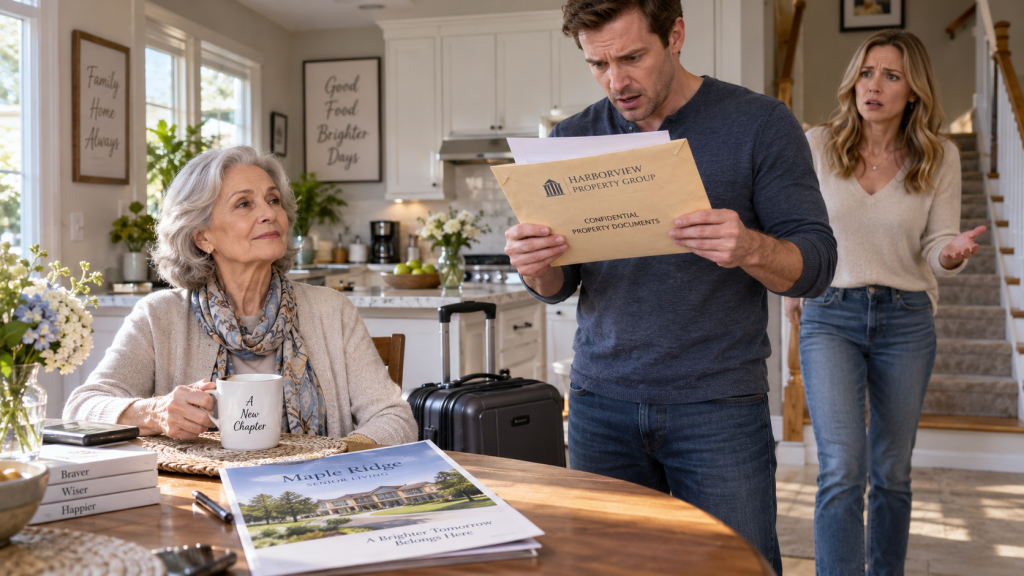
Graham read the letter twice.
Then a third time.
His lips moved silently over my handwriting as though repeating the words might rearrange them into something less frightening.
Paige stood beside him in her robe.
Her hair was still damp from the shower.
“What does it say?”
Graham did not answer.
He simply looked at me.
There are moments when a child becomes aware that his mother existed before he did.
That she has had a private mind all along.
A history.
A bank account.
Regrets.
Plans.
A self that did not begin with giving birth to him.
That morning, at seventy-three years old, I watched my fifty-one-year-old son discover his mother was a person.
“Mom.”
His voice came out thin.
“What is this?”
I set down my coffee.
“You’re holding it.”
“T&E owns this house.”
“Yes.”
“You knew?”
“Yes.”
“How?”
Paige snatched the notice from his hand.
Her eyes moved quickly.
Thirty days.
Termination of month-to-month tenancy.
Property to be marketed after possession.
Normal language.
Nothing threatening.
Nothing dramatic.
Yet her face grew paler with every line.
“What do you mean T&E owns the house?”
she demanded.
I looked at Graham.
He had reached my letter now.
Not the legal notice.
My letter.
The personal one.
He read the first paragraph.
Then looked at me again.
“T&E.”
he whispered.
I nodded.
“Thomas and Evelyn.”
Something passed across his face.
Recognition arriving twenty years late.
He remembered the boxes.
Of course he did.
T&E Outdoor Supply.
His father’s small fishing business.
The initials Thomas painted by hand on the first delivery van because we could not afford professional lettering.
Graham had grown up helping stack those boxes in our garage.
And still, when the name appeared on his rent statement, he had never wondered.
That hurt.
Not because I expected him to solve a puzzle.
Because it showed how thoroughly he had stopped imagining I might have a life outside the role he had assigned me.
Paige looked from him to me.
“What is happening?”
Graham handed her my letter.
She read faster than he had.
Halfway through, she stopped.
“No.”
Not disbelief.
Refusal.
As though reality had entered without knocking and she could send it back.
“This is ridiculous.”
I folded my hands in my lap.
“No.”
she repeated.
“You didn’t buy this house.”
“Yes.”
“With what?”
There it was.
Not:
Why didn’t you tell us?
Not:
Are you leaving?
With what?
The question carried years of assumptions.
My widow’s pension.
My little savings.
My coupons.
The groceries I bought carefully.
They thought they had seen the borders of my life because I had never announced what existed beyond them.
“I had money.”
I said.
Paige almost laughed.
“From where?”
Graham’s eyes moved toward me.
Then widened.
The birthday.
The scratch ticket.
Perhaps some memories wait quietly for the right key.
“Mom.”
he whispered.
I looked at him.
“That ticket.”
The room became still.
Paige frowned.
“What ticket?”
Graham stared at me.
“The birthday ticket.”
I said nothing.
His mouth opened.
Closed.
“How much?”
he asked.
I smiled sadly.
“Enough.”
Paige sat down without meaning to.
The chair simply caught her.
“No.”
she said again.
Graham’s face had changed in a different way.
He was reconstructing ten months.
My taxi rides downtown.
The lawyer.
The new landlord.
My occasional Saturday visits to Wilmington that I had called “time with Ruth.”
The way I stopped discussing my bank account whenever Paige commented on rising grocery prices.
The new shoes I bought and said were on sale.
The calm.
People often mistake calm for ignorance when it does not benefit them.
“How much did you win?”
Paige asked.
I looked at her.
“That is private.”
Her face tightened.
“We’re family.”
I nearly smiled.
It was remarkable how quickly family became sacred after money entered the room.
Graham sat opposite me.
“Mom, please.”
I had not heard him say please like that in years.
Not since Thomas died.
Not since Graham stood beside me at the funeral home and asked me to come live with them because he was worried I would spend every night alone.
That version of my son was still somewhere inside him.
I had to remember that.
People are rarely only the worst thing they have done.
That does not mean you hand them the keys again.
“It was an eleven-million-dollar advertised prize.”
I said.
Paige inhaled sharply.
“But I did not receive eleven million dollars in my pocket.”
“There were tax considerations and payout decisions.”
“Martin helped me.”
“Martin?”
Graham asked.
“My attorney.”
He blinked.
“You have an attorney?”
I almost laughed.
“Yes, Graham.”
“Old women are permitted lawyers.”
He flinched.
Good.
Not because I wanted to hurt him.
Because sometimes a sharp sentence clears fog.
Paige leaned forward.
“So you’re a millionaire.”
I looked at her.
“I am financially secure.”
Her eyes filled.
I could almost see numbers forming behind them.
Mortgage.
Tuition.
Vacations.
Debt.
Cars.
The kitchen renovation she had wanted.
I did not judge her for thinking about money.
Money invites arithmetic.
I judged what people did after the numbers appeared.
Graham rubbed his face.
“Why didn’t you tell me?”
I had waited ten months for him to ask that.
Now that he had, the answer felt almost too simple.
“Because I wanted time to find out whether anything changed when nobody knew.”
He stared.
“What does that mean?”
“It means I wanted to know whether I was loved differently from the help I provided.”
Paige looked offended.
“We love you.”
I turned toward her.
“I believe you feel something for me.”
“That isn’t the same as treating me well.”
She looked away.
Graham’s voice hardened.
“So this is punishment?”
“No.”
“You secretly buy the house and evict us?”
“I bought the house because the owner wanted to sell.”
“You could have told us.”
“Yes.”
“You could have let us buy it.”
“Could you?”
That stopped him.
The rent was already stretching them.
Graham knew it.
Paige knew it.
I knew it because, without their knowledge, I had spent months reviewing the payment history of a property I owned.
They had paid on time.
Mostly.
I had never raised the rent.
I had never imposed new fees.
I had never entered the property without notice.
My ownership had changed nothing for them.
Until now.
“The notice is lawful.”
I said.
“You are month-to-month.”
“Martin verified it.”
“You have the full notice period required under the lease and local law.”
“And if you need a few extra days because of the children, my property manager has authority to discuss a reasonable extension.”
Paige stared.
“You’re throwing your grandchildren out.”
There it was.
I had expected it.
It still hurt.
“No.”
I said quietly.
“I am ending a tenancy.”
“It affects the children.”
“Yes.”
“That is why I am not demanding you leave tomorrow.”
“You’re leaving today.”
Graham said.
His eyes had finally found the suitcase by the bedroom door.
“Yes.”
“To where?”
“Wilmington.”
“Ruth?”
“Near Ruth.”
His face tightened.
“What do you mean near Ruth?”
“I bought a home.”
Another silence.
“You bought another house?”
“Yes.”
“A cottage.”
“Yellow.”
“Two bedrooms.”
“Rose bushes.”
“A porch.”
I could not help it.
My voice softened when I described it.
I loved that house.
Not because it was expensive.
It was not.
Because every object inside it had been chosen by me.
No one had moved me there.
No one had reserved it.
No one had printed a cheerful brochure explaining why I would be happier among people my age.
I had walked into the yellow kitchen and thought:
Here.
That was the entire process.
Graham’s eyes filled.
“You were just going to leave?”
“No.”
“I am leaving.”
“Today?”
“Yes.”
“What about Christmas?”
It was December first.
Still weeks away.
I almost smiled at the reflex.
The family calendar.
The holiday meal I usually planned.
The gifts I usually wrapped.
The mashed potatoes everyone liked because I browned the butter.
“Christmas will happen.”
I said.
“Whether I am in this house or not.”
“That’s not what I mean.”
“I know.”
Paige stood.
Her face had gone from shock to anger.
“You have been deceiving us for ten months.”
I considered that.
“Yes.”
“In some ways.”
She seemed surprised I admitted it.
“I kept the lottery private.”
“I kept the cottage private.”
“I did not tell you I owned this house.”
“Why is that acceptable?”
A fair question.
I sat back.
“It may not have been kind in every respect.”
I said.
“But I was protecting my financial privacy while I decided what I wanted.”
“I did not take your money.”
“I did not alter your lease.”
“I did not make decisions about where you would live without your knowledge.”
Then I looked at the Pine Harbor brochure still sitting on the sideboard.
The smile left her face.
There are mirrors people dislike because they work.
“That’s different.”
Paige said.
“Why?”
“We were trying to help.”
“I was trying to protect myself.”
“So intention matters for you but not for us?”
Another fair question.
I respected her for it.
“It matters.”
I said.
“That is why I am not saying you are monsters.”
Graham closed his eyes.
“But good intentions do not turn me into a child.”
I looked at him.
“You selected a residence.”
“Paid a deposit.”
“Chose a move-out date.”
“And decided my bedroom would go to Owen.”
“All before asking me what I wanted.”
“You were going to tell me after the plan was complete.”
“That is not help.”
“That is management.”
Paige’s eyes filled.
“We thought you’d resist because you’re stubborn.”
“Yes.”
I said.
“I would have.”
“Because I did not want to go.”
She had no answer.
The doorbell rang.
8:56.
Too early for the taxi.
Graham looked toward the hallway.
I knew who it would be.
Ruth.
I had asked my sister to come early in case leaving became emotionally difficult.
Apparently at seventy-three I still needed a big sister.
She was seventy-six.
Some arrangements never expire.
Graham opened the door.
Ruth walked in wearing a red wool coat and carrying two travel mugs.
She looked at Graham.
Then Paige.
Then me.
“Morning.”
she said.
Nobody answered.
Ruth lifted one mug.
“Coffee?”
That was my sister.
A house could be burning and she would check whether anyone wanted cream.
Graham looked at her.
“You knew.”
“Yes.”
“For how long?”
“Long enough.”
“You helped her hide this?”
Ruth sighed.
“Graham, your mother is seventy-three.”
“She does not require permission from her sister to have secrets.”
He looked wounded.
Not angry anymore.
Wounded.
That was harder.
“Everybody knew except me.”
I stood.
“No.”
“Martin knew.”
“Ruth knew.”
“That is everybody who knew.”
“What about the grandchildren?”
“No.”
“Friends?”
“No.”
“Your church group?”
“No.”
“Then why them?”
“Because they were helping me do specific things.”
“Martin with the money.”
“Ruth with the cottage.”
I paused.
“You were not excluded because I stopped loving you.”
“You were excluded because I needed one decision in my life that did not pass through this house first.”
Graham sat down.
His anger seemed to leave his body all at once.
He looked tired.
“Was it that bad here?”
The question was finally about me.
Not money.
Not property.
Not logistics.
Me.
I sat again.
“No.”
I said.
Then:
“Yes.”
His face broke.
I reached across the table.
Not all the way to his hand.
Halfway.
Because truth deserved precision.
“You gave me somewhere to live when your father died.”
“I will always be grateful for that.”
“You sat with me when I could not sleep.”
“You took me to the cemetery every Sunday for months.”
“You made space.”
His eyes filled more.
“So no.”
“It was not always bad.”
Then I continued.
“But slowly, the space stopped feeling like mine.”
I looked toward the hallway.
The downstairs bedroom.
Four years of my clothes.
My sewing basket.
Thomas’s photograph on the dresser.
The chair where I read.
A room everyone had already reassigned while I was still sleeping in it.
“I became useful.”
I said.
“I cooked.”
“I cleaned.”
“I watched the children.”
“I paid for groceries.”
“I drove Owen to practice.”
“I picked Lily up after school.”
“And I told myself this was how families worked.”
“Sometimes it is.”
I looked at Paige.
“But nobody asked whether I wanted those things to become my job.”
Paige looked down.
“And when I became tired…”
I swallowed.
“I heard you call me a problem.”
Graham went pale.
He remembered.
“You heard that?”
“Yes.”
“When?”
“Months ago.”
“Mom—”
“I heard your answer too.”
His face crumpled.
“What do you expect me to do? She’s still my mother.”
I repeated it gently.
Not to wound.
To tell the truth exactly.
He covered his mouth.
“I didn’t mean—”
“I know.”
“What did you mean?”
He could not answer.
Neither could I.
Maybe he had meant:
I love her, but this is hard.
Maybe he had meant:
I feel responsible.
Maybe he had meant:
I wish somebody else would solve this.
Words are not always full confessions of the soul.
But they still land where they land.
“I should have talked to you.”
he said.
“Yes.”
“You should have talked to me too.”
I nodded.
“Yes.”
That surprised him.
“I should have.”
There.
No sainthood.
I had kept silent until silence became strategy.
I had hidden the ticket.
The property.
The cottage.
Then arranged a letter to arrive like a curtain rising.
Part of me had wanted them to feel what it was like to discover a major life decision after someone else had already made it.
I could admit that.
“I was hurt.”
I said.
“And being hurt made secrecy feel powerful.”
Ruth looked at me.
A small approving nod.
She had said something similar months earlier.
I had ignored her.
Sisters are annoyingly patient when they expect to be proven right.
Paige crossed her arms.
“So you admit this is revenge.”
“No.”
“Some of the timing was anger.”
I said.
“The decision was not.”
“I want my own home.”
“I do not want to own yours.”
“That is why this house is being sold after you leave.”
“I could keep collecting rent.”
“I do not want that connection.”
Graham looked at me.
“You’re selling it?”
“Yes.”
“So this isn’t about making money from us.”
“No.”
“That would be a terrible investment strategy.”
Ruth muttered.
I almost laughed.
Paige did not.
The taxi pulled into the driveway at 9:11.
I could see it through the window.
Yellow light on wet pavement.
For a moment, no one moved.
Then Lily came down the stairs.
Twelve years old.
Pajamas.
Hair tangled.
She stopped when she saw my suitcase.
“Grandma?”
My heart broke differently.
Children had not arranged Pine Harbor.
Children had not called me a problem.
They had laughed at the scratch-ticket joke because adults taught them the room’s rules.
That was not the same thing.
“Come here.”
I said.
She ran to me.
I held her.
Hard.
“Where are you going?”
she asked.
“I’m moving.”
Her whole body stiffened.
“Why?”
Graham opened his mouth.
I looked at him.
He closed it.
Good.
No adult blame through children.
“I bought a little house near Aunt Ruth.”
I said.
“You did?”
“Yes.”
“Why?”
“Because I wanted one.”
She pulled back.
“You’re not going to the old-people place?”
Paige closed her eyes.
Children have no respect for euphemism.
“No.”
I smiled.
“Not right now.”
“Are you mad at us?”
“No.”
“Your parents and I have some things to work out.”
“But none of it is your job.”
“What about my room at your new house?”
That almost undid me.
“You have one.”
Her face changed.
“I do?”
“The second bedroom.”
Ruth coughed.
“You told me it was a guest room.”
“It is.”
I said.
“Lily is a guest.”
Lily hugged me again.
Owen came down next.
Sixteen.
Old enough to understand something serious was happening.
Young enough to look guilty about the bedroom.
“Grandma.”
he said.
I smiled.
“Hello, darling.”
His eyes went to the suitcase.
Then the Pine Harbor brochure.
Then his parents.
“It was because of my room?”
Graham stood.
“No.”
I spoke before he could build a lie out of kindness.
“Partly.”
Owen’s face fell.
I went to him.
“But listen to me.”
I touched his arm.
“You did not ask anyone to move me.”
“No.”
“Then you did not cause this.”
“But I said I wanted downstairs.”
“You are allowed to want a bigger room.”
“Adults are responsible for deciding how to respond.”
He looked at his parents.
Then back at me.
“Can I still come see you?”
I nearly lost my voice.
“Yes.”
“Always.”
That was the promise I could make.
I took my coat.
Ruth lifted my suitcase before Graham could.
He looked at me helplessly.
“Mom.”
“Yes?”
“Please don’t leave like this.”
I stood still.
“How should I leave?”
“I don’t know.”
Neither did I.
There is no graceful way to end a version of your family.
So I walked to him.
Put my hand against his cheek.
The same cheek I had kissed when he was five and feverish.
When he was eighteen and leaving for college.
When his father died.
My son.
Still.
Always.
“I love you.”
I said.
His face collapsed.
“Then stay.”
“No.”
That was the lesson we both needed.
Love and staying were not the same sentence.
“I’ll call.”
I said.
“When?”
“When I’m ready.”
He nodded because there was nothing else to do.
Then I walked out.
The yellow cottage smelled faintly of lemon polish when I arrived.
Ruth had opened the windows the day before.
Fresh air moved through the kitchen.
My kitchen.
Yellow cabinets.
White curtains.
A bowl of apples on the table.
The ridiculous blue sofa I had bought because Thomas always hated blue furniture.
I stood in the doorway and started crying.
Ruth set down the suitcase.
“Oh, Evie.”
“I’m fine.”
“You’ve been saying that since 1968.”
She took off her coat.
“Try another sentence.”
I laughed through tears.
“I’m terrified.”
“Better.”
“I’m happy.”
“Also good.”
“I feel guilty.”
“There she is.”
My sister hugged me.
The first night was awful.
That surprised me.
I had imagined peace.
Instead, every creak woke me.
No grandchildren upstairs.
No Paige running the dishwasher.
No Graham opening the refrigerator at midnight.
No one asking whether we had milk.
Freedom sounded like a refrigerator motor and rain tapping a window.
At 2:13 in the morning, I nearly called Graham.
Then stopped.
Not because calling would be weakness.
Because I knew what I wanted.
Not conversation.
Retreat.
I wanted the familiar simply because it was familiar.
Those are different things.
So I made tea.
Sat in the reading chair.
And let loneliness be lonely.
It did not kill me.
By morning, sunlight filled the yellow kitchen.
I made one egg.
One piece of toast.
And for the first time in four years, nobody asked what was for breakfast.
I cried again.
Then laughed.
Apparently independence is emotionally inefficient.
The first week, Graham called every day.
I answered twice.
The first conversation lasted three minutes.
“Are you okay?”
“Yes.”
“Do you need anything?”
“No.”
“Do you hate me?”
“No.”
“Can we talk?”
“Not yet.”
That was all.
The second call, he asked about the house.
Not the money.
The cottage.
“Is the roof good?”
“Yes.”
“Furnace?”
“New.”
“Locks?”
“Changed.”
“Smoke detectors?”
“Graham.”
“I’m asking.”
“I know.”
I smiled despite myself.
Some concern survives even when relationships fracture.
“Everything is safe.”
“Okay.”
Then:
“Lily wants to call.”
“Put her on.”
He did.
Progress.
Paige did not contact me for nineteen days.
Then a letter arrived.
Handwritten.
Three pages.
I expected an apology.
Instead, the first page was mostly defense.
She had been overwhelmed.
Her job had become demanding.
The house was crowded.
Owen needed privacy.
Pine Harbor had excellent reviews.
They had not planned to “dump” me anywhere.
I read it all.
Did not answer.
The second page changed.
I keep thinking about your birthday.
I stopped.
She continued.
I thought the scratch ticket was funny because two dollars felt deliberately cheap. I knew that. That was the joke. I realize now I gave my children permission to laugh at you.
My throat tightened.
That was honest.
Then:
I also realize I became comfortable receiving things from you while calling them small. Meals. Childcare. Groceries. Rides. Laundry. I let “Grandma helps” turn into “Grandma handles it.”
Better.
Then:
I am sorry I helped make your usefulness the price of belonging here.
I put the letter down.
There it was.
Not perfect.
But real.
I still did not answer immediately.
Apologies are not invoices.
They do not become overdue because someone sent them sincerely.
Three days later, I wrote:
Thank you for taking responsibility without asking me to make you feel better. I am not ready to return to how things were. I do want us to find something healthier eventually.
That was enough.
The house sale created the next crisis.
Graham and Paige could not qualify comfortably to buy it at market value.
I knew that before they did.
Not because I used secret information.
Because I knew the neighborhood.
Their rent.
Their income.
The property value.
Math.
Graham called.
“Would you sell it to us?”
“Yes.”
He became quiet.
“Really?”
“At market value.”
Another silence.
“Oh.”
There it was.
The unspoken hope.
Family price.
Mother price.
Lottery price.
I continued.
“You would need financing you can afford.”
“I am not carrying a private mortgage.”
“I am not guaranteeing it.”
“And I am not gifting the difference.”
His voice tightened.
“You have millions.”
“Yes.”
I said.
“I do.”
Money made the word no more offensive to people who believed yes would cost you nothing.
“Why not help us?”
he asked.
I could have answered sharply.
Instead:
“Because helping is something I choose.”
“Not something you become entitled to because I can afford it.”
“We supported you for four years.”
There.
I had expected that too.
“Yes.”
I said.
“And I contributed during those four years.”
“Not rent.”
“No.”
“You asked me not to.”
Silence.
“I bought groceries.”
“Paid utilities sometimes.”
“Provided childcare.”
“Cooked.”
“Cleaned.”
“Helped with insurance.”
I stopped.
“This is exactly the accounting I do not want between us.”
“If we start calculating who owes whom for family life, we will destroy whatever is left.”
He was quiet.
Then:
“So you won’t help.”
“Not with buying that house.”
“No.”
That was the first time I refused him without explanation beyond what was needed.
It felt terrible.
Then clean.
They found another rental eight miles away.
Smaller.
Not disastrous.
Owen still got his own room.
Lily complained the bathroom was ugly.
Life continued.
The old house sold to a young couple expecting their first child.
I never met them.
Martin handled everything.
The profit from the sale went into investments.
Nothing dramatic.
No mansion.
No revenge purchase.
Money is less exciting when competent people manage it.
That is usually good.
The grandchildren’s educational trusts became known accidentally.
Graham learned when he asked Martin whether there was anything in my estate plan he needed to know.
Martin told him only what he was authorized to disclose.
There were trusts for Owen and Lily.
Their parents were not trustees.
The money was restricted for education and certain later-life purposes.
Graham called me immediately.
“You did this before you left?”
“Yes.”
“How much?”
“Enough.”
He laughed bitterly.
“You love that word now.”
“I do.”
“Why can’t we manage the trusts?”
“Because they are for the children.”
“We are their parents.”
“Yes.”
“And I wanted independent trustees.”
He heard the meaning.
“You don’t trust us.”
“Not with that money.”
Sometimes precision is kinder than vagueness.
He became very quiet.
“Do you think I’d steal from my children?”
“No.”
“Then what?”
“I think money changes family behavior.”
“I wanted that money protected from pressure.”
“Yours.”
“Mine.”
“Anyone’s.”
He exhaled.
“You really planned all of this.”
“I planned what I could.”
“You sound proud.”
I thought.
“Yes.”
I said.
“I am.”
That was new too.
By spring, the roses at the cottage began blooming.
Thomas loved roses.
Could not grow them.
He overwatered everything.
I used to tease him that marriage to me was the only living thing he had managed not to drown.
He would say:
“Give me time.”
Then kiss me.
Grief changes after enough years.
It stops arriving only as pain.
Sometimes it arrives as a joke nobody else heard.
I sat on the porch with coffee and missed him without collapsing.
That was another form of wealth.
Ruth came over every Thursday.
We played cards.
She cheated.
Denied it.
We argued.
Wonderful.
I joined a book club.
Hated the first book.
Liked the women.
Took a pottery class.
Produced a bowl so ugly Lily asked if it had been damaged in the kiln.
I kept it.
Freedom does not have to be impressive.
That may be the best thing about it.
For years, my identity had been built around usefulness.
Wife.
Mother.
Grandmother.
Cook.
Driver.
Helper.
Widow who should not be alone.
Older woman who needed looking after.
Millionaire.
Even that word tried to become a job people could assign me.
Benefactor.
Rescuer.
Solution.
I resisted.
I wanted to be Evelyn.
Some days Evelyn did absolutely nothing productive.
Revolutionary.
Graham came to the cottage for the first time four months after I moved.
Alone.
He stood on the porch holding grocery-store flowers.
Not expensive.
Daisies.
My favorite.
His father used to bring them because Thomas said roses were “too full of themselves.”
Graham remembered.
That mattered.
“Can I come in?”
he asked.
The sentence almost broke me.
Not because of the flowers.
Because he asked.
“Yes.”
I stepped aside.
He walked through slowly.
Yellow kitchen.
Blue sofa.
Photographs.
Books.
The quilt Ruth made.
Thomas’s fishing hat hanging beside the back door.
“You’re happy.”
he said.
It sounded surprised.
“I am.”
He nodded.
“I thought…”
“What?”
He sat.
“That you’d get lonely.”
“I do.”
He looked up.
“Sometimes.”
I continued.
“Lonely is not the same as wanting my old life back.”
That was hard for him.
It had been hard for me too.
We drank coffee.
For twenty minutes, nothing serious.
Then Graham put down his cup.
“I’ve been seeing someone.”
I nearly choked.
“What?”
He laughed for the first time.
“A therapist.”
“Oh.”
“Paige too.”
“Together?”
“Some sessions.”
“Separate ones too.”
I nodded.
“Good.”
He stared at his hands.
“I keep thinking about when Dad died.”
So did I.
“You fell apart.”
he said.
“I did.”
“I told myself bringing you home saved you.”
I looked at him.
“It helped me.”
“But I think I never stopped seeing you as the woman from those first six months.”
“Fragile.”
“Sad.”
“Needing us.”
His voice cracked.
“So every time you did more, I didn’t update the picture.”
That sentence stayed with me.
Didn’t update the picture.
How many families do that?
We memorize one another in old forms.
The irresponsible brother.
The strong daughter.
The difficult mother.
The successful son.
Then years pass and nobody checks whether the description still fits.
“I liked needing to be the one who saved you.”
Graham said.
I stayed quiet.
“And when you became capable again…”
He laughed sadly.
“You were always capable.”
“I know that now.”
“Anyway.”
“I think I still needed you to be dependent.”
“Why?”
He swallowed.
“Because Dad died.”
There it was.
The small boy inside the man.
“If you needed me, you couldn’t leave too.”
My eyes filled.
Oh, Graham.
There are betrayals that become more painful when you understand the frightened part beneath them.
Not less wrong.
More human.
I reached for his hand.
This time all the way.
“I wasn’t leaving you.”
I said.
“I know.”
“But you did.”
“Yes.”
He looked at me.
“Because I made staying too expensive in ways that had nothing to do with money.”
I squeezed his hand.
“That is close.”
He laughed through tears.
“Still grading me.”
“I was married to your father for forty-three years.”
“Someone had to maintain standards.”
We both cried then.
And laughed.
Sometimes repair begins when two people can stand in the same truth without forcing it to become a verdict.
“Why didn’t you tell me about the ticket?”
he asked eventually.
“Because I did not trust the situation.”
“Me?”
“Partly.”
He nodded.
“Fair.”
“I also did not trust myself.”
That surprised him.
“What does that mean?”
“I had spent my whole life solving things for people.”
“If I had told everyone immediately, I might have started giving before I even decided what I wanted.”
He stared.
“That sounds like you.”
“It does.”
“I needed privacy long enough to discover whether generosity was still generosity when nobody expected it.”
“And?”
I smiled.
“It is.”
“When I choose it.”
I told him then about the trust for the grandchildren.
Not the amounts.
The design.
Education.
Medical emergencies.
Later distributions at ages when they would be adults.
Independent trustee.
No parental access.
No borrowing.
No advances against it.
Graham listened.
Then nodded.
“I’m glad.”
I raised an eyebrow.
“You weren’t four months ago.”
“I wasn’t four months ago.”
That was enough.
Paige came two weeks later.
Also alone.
No flowers.
She brought my casserole dish.
The blue one.
I had forgotten it.
“I thought you might want this.”
I laughed.
“You drove fifteen minutes to return Tupperware?”
“It’s stoneware.”
“Important distinction.”
She smiled nervously.
Then looked toward the door.
“May I?”
“Yes.”
Again.
Ask.
Such a small repair.
Paige walked through the house.
Stopped at the kitchen.
“I understand.”
she said.
“What?”
“Why you bought this place.”
I leaned against the counter.
“Why?”
“It looks like you.”
I had never thought of a house that way.
“What does that mean?”
“Warm.”
“Old-fashioned.”
“A little too much yellow.”
I laughed.
“There’s the Paige I know.”
Her eyes filled.
“I’m sorry.”
I waited.
She did not say:
For everything.
Instead, she named things.
“For calling you a problem.”
“For making plans about Pine Harbor without asking.”
“For letting childcare become your responsibility.”
“For laughing at the ticket.”
“For acting angry about the house because I thought your money should solve our problem.”
She breathed.
“And for feeling cheated when I found out you had money.”
That one was brave.
I looked at her.
“Why did you feel cheated?”
“Because I had spent years telling myself we were carrying you.”
Her face twisted.
“And then I found out you could have left whenever you wanted.”
Ah.
There it was.
Not greed exactly.
Narrative.
She had needed to believe the arrangement benefited me more.
Otherwise, she might have had to examine how much I was giving.
“I made your dependence part of the reason I didn’t feel guilty asking so much.”
she said.
“If you needed us, then it felt fair that we needed you.”
I nodded.
“And when I found out you didn’t need us…”
She looked down.
“I had to see the imbalance.”
Silence.
Then:
“That was ugly.”
“Yes.”
I did not rescue her.
She deserved the respect of surviving an honest answer.
We did not become close overnight.
That would have been another lie.
But she began bringing Lily to visit.
Then Owen.
Eventually Graham came too.
At first, every family visit felt formal.
People asked before opening cupboards.
Ridiculous.
Then, slowly, ordinary behavior returned.
Graham reached for the coffee without asking.
Paige complained about my thermostat.
Lily left socks under the sofa.
Owen ate three sandwiches.
Ordinary is the reward.
The first Christmas after I moved, I refused to host everyone.
That caused minor panic.
“But your house is closer to Ruth.”
Graham said.
“So?”
“We thought—”
“No.”
I smiled.
“I will bring dessert to your house.”
Paige stared.
“You’re serious?”
“Yes.”
“But you always cook.”
“Correct.”
“And this year I am not.”
They ordered a turkey from a grocery store.
It was dry.
Nobody died.
Important discovery.
I made pie.
One pie.
Not four.
At dinner, Lily brought me a small wrapped box.
Inside was a bus pass.
Not a real long-term one.
A novelty card she had made herself.
On the front she wrote:
FOR GRANDMA — ENOUGH FOR THE BUS
I stared.
The whole table became quiet.
Lily’s face changed.
“Was that mean?”
“No.”
My voice broke.
“No, sweetheart.”
I started laughing.
Then crying.
The old joke.
Transformed by someone who loved me.
On the back she had written:
But you have to come back.
I hugged her.
“I will.”
Paige looked at me across the table.
Her eyes wet.
“I’m sorry about that birthday.”
“I know.”
Graham looked down.
“So am I.”
“I know.”
No speeches.
Christmas had enough decorations.
Owen used part of his education trust five years later.
College.
Engineering.
He received an acceptance letter and called me before his parents.
I pretended not to be delighted by that.
Failed.
“Grandma.”
“What?”
“I got in.”
I screamed.
At seventy-eight, dignity becomes optional.
Before the first tuition distribution, the trustee met with Owen.
Not his parents.
Owen.
The money belonged to his future.
The trustee explained the limits.
He asked questions.
Signed acknowledgments.
Graham sat outside.
That mattered to me.
Later, he said:
“I understand why you did it this way.”
“Good.”
“Still feels strange.”
“Also good.”
Trust should not require pretending safeguards are insults.
Lily used hers differently.
She did not go straight to college.
That caused Graham emotional collapse.
“Gap year?”
he said as though she had announced maritime piracy.
I reminded him:
“She is eighteen.”
He glared.
“You’re enjoying this.”
“A little.”
Lily spent eight months volunteering with an environmental group, then enrolled in nursing school.
The trust paid tuition.
Not the gap-year travel.
She worked for that.
Choices.
Boundaries.
Money with structure.
I found I liked that balance.
I gave Graham and Paige money exactly once.
Not millions.
Not a house.
When Graham lost his job after his company reorganized, they fell behind during a difficult three-month stretch.
He came to me.
Not entitled.
Embarrassed.
“Mom, I need to ask something.”
I knew immediately.
“Sit.”
He explained.
Showed me numbers.
A budget.
He had learned to bring facts.
Thomas would have been proud.
Then he said:
“If you say no, I’ll understand.”
That was when I knew I could say yes.
Because the no had room to exist.
I paid three months of their health-insurance premiums directly.
Gift.
No repayment.
Defined.
Limited.
Chosen.
Graham cried.
Not because of the money.
Because he understood the condition that made giving safe.
Freedom.
“You could pay off everything.”
he said once.
Not asking.
Just observing.
“Yes.”
“Why don’t you?”
I looked at him.
“Because being able to remove every difficulty from your life does not mean I should.”
He nodded.
“I think I used to hear that as punishment.”
“And now?”
“I hear it as you remembering I’m an adult.”
Exactly.
Money did change me.
I would be lying if I said it didn’t.
I stopped clipping coupons unless I enjoyed it.
Turned the heat up two degrees in winter.
Bought good shoes.
Paid someone to clean the gutters because climbing ladders at seventy-four is not independence.
It is stupidity.
I traveled with Ruth.
Charleston.
Savannah.
Quebec City.
A river cruise through Europe where Ruth flirted shamelessly with a widower from Minnesota and denied it afterward.
We laughed until we hurt.
I paid for her ticket.
She accepted because she knew I wanted to.
No debt.
No ledger.
Just sisters.
I donated quietly too.
The library where Thomas took Graham every Saturday.
A hospice program that helped us when Thomas was dying.
A scholarship for older students returning to school after raising children.
I did not put my name on buildings.
I had spent enough of my life learning that being seen and being valued were different things.
Martin became a friend.
Not close enough to know my pie recipe.
Close enough to tell me when I was being foolish.
At seventy-six, I told him I wanted to give Graham a large sum because he and Paige were struggling with retirement savings.
Martin asked:
“Why?”
“I can.”
“That is not a reason.”
Annoying man.
I went home.
Thought.
Realized I wanted to erase guilt.
Not help.
So I did nothing that week.
Months later, I created a modest annual-gift plan for both my children’s households—Graham and, through a separate arrangement, Ruth’s daughter whom I also loved.
Transparent.
Equal principles.
No emergencies manufactured to access more.
Generosity works better when it is not a rescue reflex.
At eighty, I toured Pine Harbor Senior Living.
Voluntarily.
That part still makes me laugh.
Ruth’s knees were getting bad.
My cottage stairs were becoming annoying.
I was not ready to move, but I wanted information.
The same cheerful couple remained on the brochure.
Probably stock photography.
They had not aged.
Suspicious.
A young woman named Marissa showed me the independent-living apartments.
I asked questions.
Meals.
Transportation.
Emergency response.
Guest policy.
Costs.
Contract terms.
Every question Graham and Paige should have asked with me years earlier.
At the end, Marissa said:
“Do you want to reserve anything?”
“No.”
“Would you like us to call your family?”
“No.”
She smiled.
“Take your time.”
What a concept.
I told Graham about the visit that evening.
He nearly dropped the phone.
“You went where?”
“Pine Harbor.”
“Why?”
“To look.”
“Are you moving?”
“No.”
“Do you want me to come next time?”
I smiled.
“Yes.”
That was the difference.
Next time, I asked him.
A year later, Ruth fell.
Not badly.
Bad enough.
Her house became difficult.
She chose an apartment at Pine Harbor.
I helped her move.
The irony was so complete that we laughed while unpacking towels.
“This place is nice.”
she admitted.
“I know.”
“You could move in next door.”
“Don’t start.”
“I’m older than you.”
“By three years.”
“Respect your elders.”
I threw a pillow at her.
Eventually I did move.
At eighty-three.
Not because Graham needed my room.
Not because Paige placed a deposit.
Not because a brochure appeared during dinner.
Because one morning I stood in my yellow kitchen after nearly slipping on the back steps and thought:
I am done maintaining a house.
That simple.
I called Graham.
“I’m moving.”
Long silence.
Then:
“Where?”
“Pine Harbor.”
Another silence.
Then we both started laughing.
Hard.
The kind that steals breath.
“Mom.”
he said.
“I know.”
“You cannot make this up.”
“I am aware.”
“Do you want me to visit it with you?”
“Yes.”
There.
Full circle without pretending the first time had been acceptable.
Same place.
Different choice.
Choice changes everything.
We toured together.
Graham asked fewer questions than I did.
Good.
At one point the director asked him:
“Does your mother need assistance managing finances?”
Graham almost choked.
“No.”
I smiled sweetly.
“He finally learned.”
The poor director had no idea why we were laughing.
I sold the cottage.
That hurt.
More than leaving Graham’s house.
Because the cottage had been mine in a way few places had ever been.
I stood in the yellow kitchen one last time.
Touched the counter.
Looked at the window where morning light always landed.
I had imagined spending the rest of my life there.
Instead, the house had done something better.
It had taught me I could leave because I chose to.
Even a place of freedom should not become another cage.
Graham helped carry boxes.
Paige wrapped dishes.
Lily, now an adult nurse, stole my ugly pottery bowl.
“I want this.”
“Why?”
“It’s terrible.”
Family tradition, apparently.
Owen took Thomas’s fishing hat.
Asked first.
Always ask.
At Pine Harbor, I chose a one-bedroom apartment overlooking a garden.
Not the studio Graham and Paige had once reserved.
I did not need two bedrooms anymore.
Grandchildren could stay at hotels.
This shocked them.
Healthy disappointment.
I brought the blue chair.
Thomas’s photograph.
My books.
A yellow kettle from the cottage.
Not the whole kitchen.
Just enough yellow to remind me.
On my first night there, Graham stayed until I told him to go.
“Are you sure?”
“Yes.”
“You have your phone?”
“Yes.”
“Emergency button?”
“Yes.”
“Door locked?”
“Graham.”
He laughed.
“Right.”
He kissed my forehead.
Then paused at the door.
“Mom?”
“Yes?”
“I’m glad you came here when you wanted to.”
My eyes filled.
“So am I.”
He left.
I slept beautifully.
Paige and I became something like friends in my later years.
Not mother and daughter.
Not exactly.
Two women who had hurt each other, then learned not to repeat it.
She called before visiting.
Not because she had to forever.
Because habits matter.
Eventually I told her:
“You can stop asking whether you may enter every time.”
She smiled.
“No.”
“I think I’ll keep that one.”
Fair.
One afternoon, she brought a scratch-off ticket.
Two dollars.
I stared at it.
She looked horrified.
“Oh no.”
Then I burst out laughing.
She covered her face.
“I didn’t even think.”
“Give it to me.”
“No.”
“I’m throwing it away.”
“Paige.”
I held out my hand.
She surrendered it.
I scratched.
Lost.
Completely.
We laughed until a nurse passing the lounge asked whether we were all right.
“Never better.”
I said.
And meant it.
My relationship with Graham never returned to the innocence we had before Thomas died.
That is not a sad ending.
Innocence is overrated.
We had something better.
Knowledge.
He knew I could leave.
I knew he could disappoint me and still be my son.
He stopped treating closeness as proof of entitlement.
I stopped treating sacrifice as proof of love.
We called each other because we wanted to.
Not because one person’s need made the other responsible.
When Graham turned sixty, I gave him something from Thomas.
An old tackle box.
Inside were fishing lures, rusted hooks, and a small envelope.
Graham opened it.
A note from his father written decades earlier.
I had found it while moving.
Thomas had written:
Graham — if you ever become a father, remember that raising a child means teaching him how to leave you well. Love is not keeping.
Graham read it twice.
Then cried.
“So Dad was smarter than us.”
he said.
“Occasionally.”
I replied.
“Do not exaggerate.”
He looked at me.
“You taught me how to leave you badly.”
I raised an eyebrow.
He corrected himself.
“No.”
“You taught me how to let you leave.”
Better.
I lived long enough to see Owen marry.
Lily become a mother.
That changed something in the family again.
When Lily had her first baby, she called me from the hospital.
“Grandma.”
“Yes?”
“I need help.”
My whole body activated.
Old reflex.
“What do you need?”
There was a pause.
Then she said:
“Can you come tomorrow for two hours so I can sleep?”
A request.
Specific.
Limited.
I smiled.
“Yes.”
The next day, Graham drove me.
I held my great-granddaughter while Lily slept.
Two hours.
At the end, I gave the baby back.
No martyrdom.
No:
Leave her with me all day.
No:
You should do this.
No turning usefulness into access.
I went home tired and happy.
That was love too.
The educational trusts did what they were designed to do.
They paid for school.
Nothing flashy.
No sports cars.
No luxury apartments.
When both grandchildren were older, the remaining funds transitioned according to the terms Martin and I had created.
By then they were adults.
They understood the history.
Not all details.
Enough.
Lily once asked:
“Did Mom and Dad try to take your money?”
“No.”
I answered immediately.
Because truth matters.
“They did not know it existed.”
“They made decisions about me that I did not agree with.”
“That is different.”
She nodded.
“Did they get greedy after they found out?”
“Sometimes.”
I smiled.
“So did I.”
“What?”
“I wanted money to prove something.”
“Money is very good at becoming whatever emotion you hand it.”
She wrote that down in her phone.
“What are you doing?”
“Stealing that.”
“Family tradition.”
We laughed.
I did not leave everything to Graham when I died.
Nor did I disinherit him theatrically.
I revised my estate plan several times as life changed.
Some went to Graham.
Some to the grandchildren and great-grandchildren through trusts.
Some to charities.
Some to Ruth while she was alive, then to causes she loved after she died.
Martin once asked:
“Do you want Graham to know the approximate structure?”
“Yes.”
I told him.
No surprise will.
No final punishment from the grave.
I had experienced enough family decisions delivered after they were complete.
I would not make death my last secret.
When I told Graham, he became emotional.
“Mom, I don’t need any of it.”
“I know.”
“That’s why you can receive it.”
He laughed.
“Is that how this works?”
“For me.”
He nodded.
Then asked:
“Are you leaving me the scratch ticket?”
I had kept it.
The original.
Claimed, documented, canceled, and returned to me as part of the memorabilia after the process was complete.
The silver scratched away.
Two dollars transformed into a life.
“Yes.”
I said.
“That one is yours.”
He laughed.
Then cried.
I kept it in a small frame.
Not because it represented money.
Because it represented the last birthday I spent believing being underestimated was the same thing as being powerless.
It was not.
Power is not always loud.
Sometimes power is knowing something and not being required to announce it.
Sometimes it is leaving.
Sometimes staying.
Sometimes paying.
Sometimes refusing.
Sometimes telling your son:
No.
And trusting that if the relationship is real, it can survive the word.
Ruth died before me.
That was the hardest loss of my later life.
She was eighty-nine.
Still cheating at cards.
Still denying it.
At the memorial, Graham sat beside me.
He did not say:
You should come live with us.
He said:
“Do you want me to stay tonight?”
I looked at him.
“Yes.”
So he did.
On the sofa.
Like when he was a boy and Thomas worked nights.
No decisions.
No plans.
Just presence.
That was when I knew we had truly repaired something.
Not erased it.
Repaired.
Years earlier, he had responded to my sadness by deciding where I should live.
Now he responded by asking what I needed tonight.
That was the entire journey.
Maybe all real growth is that small.
On my ninetieth birthday, the family gathered at Pine Harbor.
Graham.
Paige.
Owen and his wife.
Lily and her children.
Too many balloons.
Bad cake.
I no longer baked my own.
Progress.
Paige handed me a card.
I opened it cautiously.
Inside was a two-dollar bill.
I laughed before reading.
She had written:
For the bus. Just in case.
Below that, Graham added:
But only if you choose the destination.
I could not speak for a while.
The family grew quiet.
Then I looked around.
At all of them.
The people who had loved me badly sometimes.
The people I had loved badly sometimes.
The ones who had learned.
The ones who were still learning.
Me included.
I thought of my seventy-third birthday.
The scratch of my thumbnail against silver coating.
Nobody watching.
The winning numbers beneath.
I thought money had changed my life.
It did.
But not in the way people imagine.
The millions gave me a cottage.
Security.
Travel.
Choices.
Useful things.
But the real transformation happened because the ticket forced me to ask a question I had avoided for years:
If I no longer need to be useful to deserve a place, where do I actually want to be?
That question was worth more than eleven million dollars.
It took me years to answer.
Sometimes I still am answering.
People think independence means needing nobody.
At seventy-three, I thought that too.
By ninety, I knew better.
Independence means your yes belongs to you.
So does your no.
It means receiving help without surrendering authority.
Giving help without buying gratitude.
Loving people without making yourself their furniture.
Letting them love you without handing them the deed to your life.
I did not win because I became rich.
I was lucky.
There is no virtue in a winning ticket.
The machine does not reward character.
Two dollars and random numbers.
That is all.
What mattered was what I did after luck arrived.
I did not buy a mansion.
I did not humiliate my son.
I did not make my grandchildren choose sides.
I did not spend the rest of my life proving everyone had underestimated me.
Eventually, I stopped caring whether they had.
Being accurately understood is lovely.
Being free does not require it.
The yellow cottage is gone now.
Someone else lives there.
I hope they like the roses.
The old rental house sold decades ago.
Pine Harbor renovated twice.
Thomas’s fishing company disappeared long before any of this.
T&E became a legal entity, then eventually dissolved after its purpose was finished.
Thomas and Evelyn.
Two initials.
One life after another.
What lasted was not the company.
Not the money.
Not even the houses.
What lasted were the choices.
The morning I left Graham’s home, he thought the letter in his hands was the shocking part.
It wasn’t.
The letter was only paper.
The real surprise was me.
His mother.
Seventy-three.
Suitcase packed.
Taxi waiting.
Not asking where she was allowed to go.
He looked at me as though he had never known me.
Maybe he hadn’t.
Maybe I had not known myself either.
Sometimes leaving is how two people finally meet.
And that scratch ticket?
Graham keeps it now.
In his study.
Beside a photograph of Thomas and me when we were young.
On the back of the frame, I asked Martin to place one final note for him.
Nothing dramatic.
Just this:
My dear boy,
You were never the reason I needed freedom.
You were one of the people I had to learn to love without disappearing inside the loving.
There is a difference.
I hope you remember it with your own children.
Love, Mom.
If there is one thing I want my family to remember, it is not that Grandma won the lottery.
Not that she secretly bought the house.
Not that she walked away with millions while everybody else stared.
Those are entertaining details.
Life is not built from entertaining details.
It is built from ordinary permissions.
May I come in?
Do you want help?
Would you like to stay?
Are you ready to leave?
What do you want?
Such small questions.
They would have changed everything sooner.
Eventually, they changed everything anyway.
For my seventy-third birthday, my daughter-in-law gave me a two-dollar scratch ticket and laughed.
For a while, I thought the winning numbers beneath the silver coating were the gift.
They were not.
The gift was realizing I still had a future.
And that future did not need anyone else to choose the room, the house, the timetable, or the destination.
All I had to do was claim it.
So I did.
Quietly.
Completely.
And for the rest of my life, whenever someone asked where I wanted to go next, I never again answered with what would be easiest for everyone else.
I answered for myself.
THE END STORIES! THANK YOU FOR READING GOOD LUCK !❤️
Related Posts