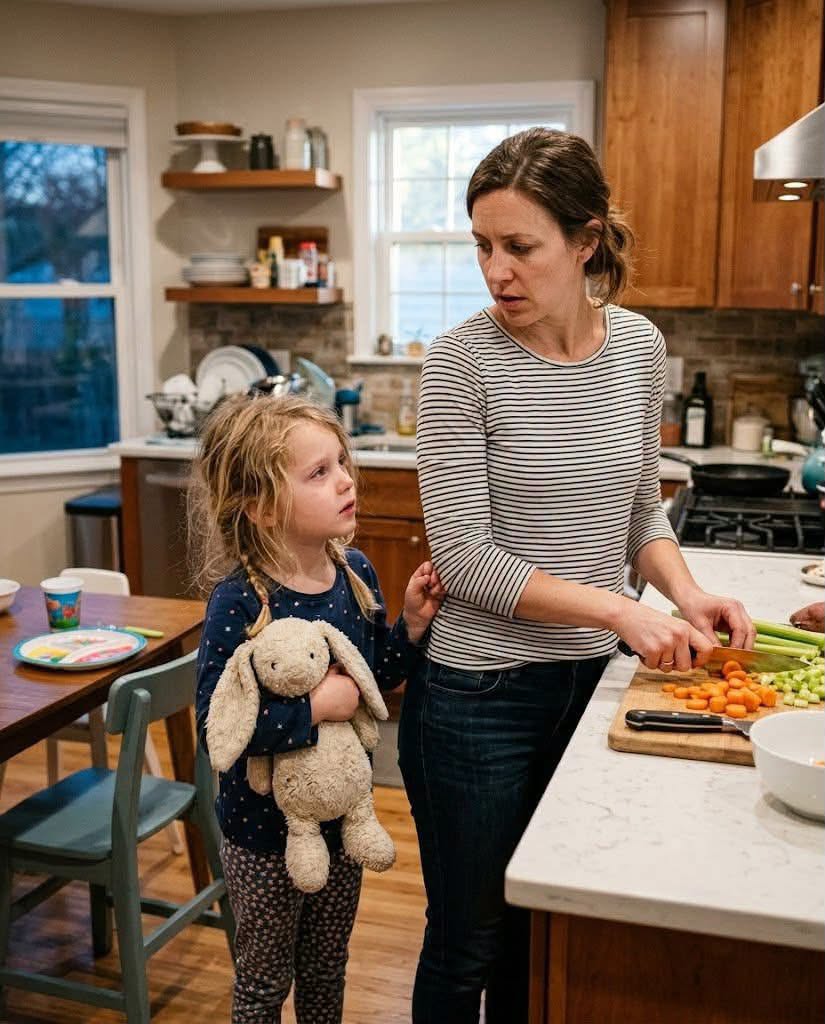
My 4-Year-Old Daughter Whispered, “Mummy, Can I Stop?” Then I Found Out What My Mother-In-Law Had Been Giving Her. I was chopping vegetables when Emma tugged on my sleeve and whispered those words.

At first, I thought she meant dinner. I thought she was tired, overwhelmed, or just ready to leave the table.
Then I looked at her face.
Her eyes were heavy. Her little bunny was crushed against her chest so tightly its ears were folded under her fingers. And behind that tired look was something I had never seen before.
Fear.
My mother-in-law had been staying with us for three weeks. To everyone else, she was sweet. She smiled at neighbours, offered advice, and acted like the perfect grandmother.
But inside our home, she constantly corrected my parenting and called my little girl “difficult.”
I put the knife down, crouched beside Emma, and asked the one question that changed everything.
“Stop what, sweetheart?”
She buried her face into the worn fur of her bunny.
“The pink spoon,” she whispered. “Grandma says it makes me good.”
The kitchen suddenly felt different. The smell of onions on my hands, the running faucet, the dinner waiting on the counter — all of it became background noise.
I asked Emma what was in the spoon.
She didn’t know.
She only knew Grandma gave it to her when she cried, asked for me, or refused to nap.
“It makes my legs sleepy,” she said. “Grandma says I can stop being difficult.”
I grabbed my keys and left dinner exactly where it was.
At the paediatric clinic, Emma sat curled in a plastic chair with her bunny under her chin. Her eyes kept drifting closed, then opening every time someone walked nearby.
The clinician spoke gently and asked simple questions.
Emma told her about the pink plastic spoon, the sweet liquid, and the secret Grandma told her to keep because Mommy would “make Grandma go away.”
The clinician looked at me carefully.
“We need to identify anything she may have been given,” she said. “She should not receive another dose.”
I called my husband and told him to check every bottle in the house.
At first, he defended his mother.
He said she could be controlling, but she would never intentionally hurt Emma.
Then he stopped talking.
A bottle of children’s nighttime medicine was missing from the hall cabinet.
Twenty minutes later, he walked into the clinic holding the opened bottle.
His mother came in behind him, furious that we had “turned a nap into an emergency.”
The second Emma saw her, she slipped off the chair and hid behind me.
My mother-in-law reached for the bunny.
“Come here,” she said. “Enough of this performance.”
I stepped between them, keeping Emma safely behind me.
Emma’s hands tightened around her bunny.
“No, Grandma,” she said. “I don’t want the spoon.”
The clinician appeared at the exam-room doorway. My husband stood beside her, still holding the bottle.
And then my mother-in-law finally admitted it.
She had given Emma some of it.
She insisted it was only a small amount and claimed Emma needed help calming down.
My husband looked at her.
“You told me it was vitamins.”
She didn’t even look sorry.
“And you believed me because you wanted her quiet too.”
I looked down at Emma, whose eyes were fixed on her father.
Then she whispered the sentence that changed everything.
“Daddy watched Grandma give it to me once.”
PART 2
The room went completely silent.
Not the ordinary kind of silence that follows an accusation.
This one felt physical.
Heavy.
Like the air itself had stopped moving.
Emma remained behind me with one arm wrapped around my leg and her bunny crushed against her chest.
My husband stared at her.
His name was Michael.
For nine years, I had trusted that man with every vulnerable piece of my life.
And in one sentence, our four-year-old daughter had made me wonder whether I knew him at all.
“Emma.”
His voice came out thin.
“What do you mean Daddy watched?”
She looked at him.
Then immediately looked away.
That hurt more than anything.
Children do not know the language adults use for betrayal.
They do not say:
You failed to protect me.
They simply stop looking at you when they are afraid the answer will hurt.
Emma whispered:
“Grandma gave me the spoon when I was crying because I wanted Mommy.”
My skin went cold.
Michael swallowed.
“When?”
She pointed vaguely toward the floor.
“At home.”
“I know, sweetheart.”
His voice trembled.
“What day?”
Emma shrugged.
Four years old.
Days were breakfast and bedtime.
Cartoons and preschool.
Yesterday was sometimes last week.
Last week could mean this morning.
The clinician stepped farther into the room.
Her name was Dr. Priya Shah.
She crouched low enough that Emma did not have to look up at another adult.
“Emma, did Daddy see Grandma put the medicine in your mouth?”
Emma nodded.
Michael covered his face.
“No.”
I turned toward him.
He dropped his hands.
“I saw Mom give her something.”
Something.
That word made my anger rise.
“What something?”
“I thought it was the vitamins.”
Helen—my mother-in-law—gave a sharp laugh.
“There.”
She folded her arms.
“I told you.”
Michael turned toward her.
“Stop.”
She blinked.
It may have been the first time in his life he had said that word to her and expected it to mean anything.
Michael looked back at me.
“Claire, she told me she started giving Emma a children’s vitamin because she was being picky.”
I stared.
“And you watched?”
“Yes.”
“What color was it?”
He hesitated.
“Honey-colored.”
“And the spoon?”
His face changed.
“Pink.”
There it was.
He knew the spoon.
Maybe not the liquid.
Maybe not yet.
But he knew enough to recognize the ritual Emma had described.
I asked:
“What happened after?”
Michael closed his eyes.
“She fell asleep.”
My stomach turned.
“How fast?”
“I don’t know.”
“Michael.”
“Maybe twenty minutes.”
Dr. Shah straightened slightly.
“Was that unusual for Emma?”
“Yes.”
I answered.
Michael said nothing.
I looked at him.
“She does not fall asleep twenty minutes after getting upset.”
His face went pale.
“She’d missed her nap.”
“No.”
“She had.”
“That day?”
“Yes.”
“How do you know?”
“Mom told me.”
Of course.
Helen supplied the facts.
Michael supplied the trust.
Emma supplied the body.
Dr. Shah asked:
“Did you notice anything else?”
Michael stared at the bottle in his hand.
“She was hard to wake.”
I stopped breathing.
“What?”
He looked at me.
“She slept through dinner.”
I remembered that night.
Nine days earlier.
I had come home from a late meeting and found Emma asleep at seven.
Helen said she had thrown a tantrum after I left and exhausted herself.
I kissed her forehead.
Her skin felt warm.
Her breathing slow.
I remember joking that she had finally discovered the joy of an early bedtime.
I had not known.
God.
I had not known.
I whispered:
“You told me she was tired.”
Michael’s eyes filled.
“I thought she was.”
“No.”
I shook my head.
“You thought whatever your mother told you to think.”
Helen snapped:
“That is enough.”
Dr. Shah turned toward her.
“No, Mrs. Walker.”
Her voice remained calm.
“It isn’t.”
Helen’s mouth tightened.
Dr. Shah continued:
“We need accurate information about what Emma received, how much, and how often.”
“I told you.”
Helen looked offended.
“It was children’s medicine.”
“That does not answer the question.”
“It was a safe amount.”
“How much?”
Helen said nothing.
Dr. Shah waited.
“How much did you give her?”
“A teaspoon.”
My heart dropped.
Emma whispered from behind me:
“Sometimes two pink spoons.”
Everything inside me stopped.
Helen turned sharply.
“Emma.”
My daughter flinched.
I stepped between them completely.
“Do not say her name like that.”
Helen stared at me.
I had never spoken to her that way.
Not once.
For eight years, I had swallowed correction after correction.
She did not approve of breastfeeding.
Then she did not approve when I stopped.
She thought Emma’s bedtime was too late.
Then too early.
Too much comfort.
Too much choice.
Too many snacks.
Too many feelings.
Always something.
I had spent years telling myself she was opinionated because she cared.
Now my daughter was hiding from her.
I whispered:
“You don’t get to intimidate her because she remembers.”
Helen’s face hardened.
“I was not intimidating anyone.”
Emma’s grip tightened around my leg.
I did not need to argue.
Her body had already answered.
Dr. Shah looked at Michael.
“Can I see the bottle?”
He handed it over.
She checked the label.
Then the measuring instructions.
The active ingredients.
Her expression became more serious.
“This product is not intended to be used as a behavioral calming medication.”
Helen scoffed.
“I never said it was.”
“You gave it when she cried?”
“She needed sleep.”
“When she asked for her mother?”
“She became hysterical.”
“She is four.”
Helen looked away.
Dr. Shah continued.
“How many times?”
Silence.
“Mrs. Walker.”
“A few.”
“How many?”
“Three.”
Emma whispered:
“More.”
I closed my eyes.
Helen said immediately:
“She doesn’t know numbers properly.”
Emma leaned around me.
“I know five.”
My heart broke.
Dr. Shah asked gently:
“Did Grandma give it more than five times?”
Emma nodded.
Helen stepped backward.
“This is becoming ridiculous.”
Michael looked at her.
“How many times?”
His voice had changed.
Not loud.
Worse.
Empty.
Helen looked at her son.
“I helped you.”
“That is not what I asked.”
“You both complained she wasn’t sleeping.”
I stared.
“We complained?”
“You said you were exhausted.”
“Every parent says that.”
“You said bedtime was ruining your marriage.”
That sentence landed differently.
Michael looked away.
I turned toward him.
“What?”
He swallowed.
“I said we never had time together anymore.”
My chest tightened.
“When?”
“A couple months ago.”
“To her?”
“Yes.”
Of course.
A private frustration.
Turned into permission.
Helen looked almost triumphant.
“You see?”
“No.”
I said it sharply.
“What I see is that you heard two tired parents complain and decided the solution was medicating their child without telling them.”
“She was not medicated.”
Dr. Shah held up the bottle.
“Yes, she was.”
Helen stared.
“It is sold in a pharmacy without a prescription.”
“That does not make unauthorized repeated dosing appropriate.”
Silence.
The room became clinical again.
Dr. Shah called poison control.
Bloodwork.
Observation.
Questions.
No drama.
That steadiness helped.
Emma sat on my lap while they checked her pulse again.
Michael stayed against the wall.
Helen was asked to wait outside.
She refused at first.
Then clinic security arrived.
The expression on her face when she realized someone else could actually make her leave was something I would remember for years.
“You are throwing me out?”
she asked Michael.
He did not look at her.
“Yes.”
That answer came too late.
But it came.
Security escorted her into the hallway.
Emma watched until the door closed.
Then her body changed.
Her shoulders lowered.
Her breathing slowed.
Children tell the truth even when their mouths are tired.
Dr. Shah noticed too.
She sat beside us.
“Emma, does Grandma ever tell you not to tell Mommy about the spoon?”
Emma nodded.
“What does she say?”
My daughter looked at me.
“She says secrets make Grandma happy.”
I felt sick.
“And what happens if you tell?”
Emma rubbed the bunny’s ear between her fingers.
“Grandma has to go away.”
I swallowed.
“And you didn’t want Grandma to go away?”
She shook her head.
“Daddy gets sad.”
Michael made a sound behind us.
I turned.
He looked like someone had hit him.
“What do you mean?”
he asked.
Emma looked at him reluctantly.
“Grandma said you need her.”
The room went still again.
Michael sat down.
Slowly.
“What else did Grandma say?”
Emma whispered:
“That Mommy makes rules because Mommy doesn’t like Grandma.”
My throat tightened.
Helen had been teaching our daughter a story.
Not just secrecy.
Allegiance.
If Mommy finds out, Grandma leaves.
If Grandma leaves, Daddy is sad.
If Daddy is sad, it is because Mommy made rules.
A four-year-old had been made responsible for keeping the adults together.
Michael covered his mouth.
I stared at him.
“How long has she been saying things like this?”
He shook his head.
“I didn’t know.”
“Did you?”
“No.”
“Michael.”
“I swear.”
I believed he did not know that part.
That did not make the rest disappear.
Dr. Shah asked Emma:
“Does Grandma give you anything else?”
My skin went cold.
Emma thought.
Then nodded.
“The little white one.”
Michael and I looked at each other.
“What white one?”
I asked.
Emma held two fingers close together.
“Tiny.”
“A pill?”
She shrugged.
“Grandma squishes it.”
My heart stopped.
Dr. Shah leaned forward.
“What does she do after she squishes it?”
Emma touched her tongue.
“Puts it in applesauce.”
Michael stood so quickly the chair scraped backward.
“No.”
He looked toward the door.
“No.”
I grabbed his wrist.
“Do not go out there.”
He stared.
“That’s my mother.”
“Exactly.”
His chest rose and fell.
Dr. Shah said:
“Let staff handle her.”
Then she asked Emma:
“What happens after the applesauce?”
Emma thought carefully.
“My head feels floaty.”
I closed my eyes.
Michael whispered:
“Oh my God.”
Dr. Shah’s tone changed.
More urgent now.
She asked what the pill looked like.
Round?
Oval?
Letters?
Emma was four.
She knew tiny.
White.
Crushed.
That was all.
The clinic contacted emergency services.
We were no longer staying there.
Emma was being transferred to the pediatric emergency department for fuller evaluation.
This time Helen did not come with us.
Police did.
Not because anyone had proven exactly what she gave.
Because a four-year-old had disclosed repeated secret medication by an adult caregiver.
The officer who spoke to me was named Elena Vasquez.
She asked whether Helen still had access to our home.
“Yes.”
“Key?”
“Yes.”
“Any medication of her own in the house?”
My stomach tightened.
“Yes.”
“Where?”
“She keeps a toiletry bag in the guest bathroom.”
Michael went pale.
“My mother takes anxiety medication.”
I looked at him.
“What?”
He swallowed.
“She has for years.”
“What kind?”
“I don’t know.”
Officer Vasquez looked at him.
“Prescription?”
“Yes.”
“What else?”
“Sleep medication sometimes.”
The room tilted.
Sleep medication.
Crushed white pill.
Applesauce.
No.
I forced myself not to jump ahead.
We did not know.
We did not know.
That sentence became the rope I held.
At the hospital, Emma was examined again.
Bloodwork.
Urine testing.
Monitoring.
The emergency physician explained that some substances may not be easily identified depending on timing.
He would not promise answers.
I appreciated that.
Truth again.
Careful.
Measured.
Not every frightening possibility becomes fact.
But then one preliminary screen came back abnormal.
Something consistent with sedating medication.
Not the children’s nighttime medicine alone.
The doctor looked at me.
“Has Emma been prescribed anything for sleep, anxiety, seizures, or behavior?”
“No.”
“Nothing?”
“Nothing.”
Michael stared at the floor.
The doctor asked:
“Any chance she accidentally accessed an adult prescription?”
I looked at my husband.
He shook his head.
“Everything is supposed to be locked.”
Supposed to be.
Helen had been staying in our house for three weeks.
Three weeks of becoming the helpful grandmother.
Picking Emma up from preschool twice.
Handling naps.
Offering to let me rest.
Insisting she could manage bedtime.
I had thanked her.
That memory made me nauseous.
Officer Vasquez arranged for another team to accompany Michael back to the house.
Not me.
I stayed with Emma.
I needed to.
She was lying under a pale hospital blanket watching cartoons without really watching them.
After twenty minutes, she looked at me.
“Mummy?”
“Yes, sweetheart?”
“Am I bad?”
I stopped breathing.
I moved beside her.
“No.”
She looked uncertain.
“Grandma says the spoon makes me good.”
My heart broke so quietly I almost missed it.
I touched her hair.
“Listen to me.”
She watched.
“You do not need medicine to be good.”
Her eyes filled.
“You do not need to be quiet to be good.”
A tear slipped down her cheek.
“You do not need to sleep when somebody wants you to be good.”
Another tear.
“You can cry.”
“You can be mad.”
“You can say no.”
Her mouth trembled.
“Even to Grandma?”
“Yes.”
My voice broke.
“Especially about your body.”
She stared at me.
Then whispered:
“Even to Daddy?”
That one hurt.
I swallowed.
“Yes.”
Behind me, the empty chair where Michael had been felt enormous.
“Even to Daddy.”
Emma nodded.
Then held the bunny out.
“Bunny says no too.”
I kissed its worn head.
“Bunny is very smart.”
She smiled.
Tiny.
But real.
Michael returned nearly two hours later.
He looked destroyed.
He carried no bag.
No bottle.
Nothing.
Officer Vasquez followed him in.
I stood.
“What did you find?”
Michael could not answer.
The officer did.
“In the guest bathroom, we located several prescription containers belonging to Mrs. Walker.”
My stomach tightened.
“One is a sedative medication.”
I closed my eyes.
“White?”
“Yes.”
“Small?”
“Yes.”
Michael sat down.
Officer Vasquez continued.
“The bottle count appears inconsistent with the prescription date.”
My mouth went dry.
“Meaning?”
“There appear to be more tablets missing than would be expected based on the prescribed directions.”
“How many?”
“We’re documenting that.”
Not speculation.
Again.
I nodded.
“Anything else?”
The officer looked at Michael.
He stared at his hands.
“What?”
I asked.
Michael whispered:
“There was a notebook.”
My chest tightened.
“What notebook?”
He looked at me.
“Mom’s.”
Officer Vasquez opened a clear evidence bag enough to show us a photographed page, not the original.
Dates.
Times.
Short notes.
My skin went cold.
Mon 1:15 — refused nap / 1 spoon
Tue 6:40 — crying for Claire / 1 spoon
Thu 12:50 — tantrum / 1 spoon + applesauce
Sat 7:10 — overtired / applesauce
My breathing stopped.
Not a few times.
Documented.
Repeated.
Planned.
Behavior followed by dose.
Dose followed by quiet.
Emma had been telling the truth perfectly.
The notebook continued.
Worked well.
Slept 2 hrs.
Less defiant after.
Defiant.
My four-year-old.
I had to sit down.
Michael whispered:
“I didn’t know.”
I turned toward him.
For the first time, I did not care whether he knew all of it.
I cared about what he had known.
“You saw her dose Emma once.”
“Yes.”
“You saw Emma become hard to wake.”
“Yes.”
“You accepted vitamins.”
“Yes.”
“You never checked the bottle.”
He closed his eyes.
“No.”
“You never asked me.”
“No.”
“Why?”
He looked at me.
And finally, after hours of fear and excuses, he gave me an honest answer.
“Because it was easier.”
That broke me.
Not because it was surprising.
Because it was true.
His mother was there.
Emma was quieter.
Bedtime got easier.
We got an evening together.
Michael had seen something odd.
Maybe enough to investigate.
And he chose not to.
Not because he wanted our daughter hurt.
Because the result benefited him.
Sometimes neglect does not look like hatred.
Sometimes it looks like enjoying the quiet enough not to ask what bought it.
Michael cried.
“I thought she was helping.”
I stared at him.
“You thought not knowing was easier than finding out.”
He nodded.
Once.
That was the first thing he did right all night.
He did not defend himself.
Officer Vasquez asked about Helen’s access to Emma’s preschool.
My stomach tightened again.
“She picked her up twice.”
“Authorized?”
“Yes.”
“Any other caregivers?”
“No.”
“Any other children Mrs. Walker watches?”
Michael looked up.
His face changed.
“My sister’s son.”
I turned.
“What?”
“Oliver.”
His nephew.
Six years old.
Helen babysat him every Wednesday.
For years.
Officer Vasquez’s expression sharpened.
“How often?”
“Once a week.”
Michael grabbed his phone.
“I need to call Rebecca.”
His sister.
This time, nobody stopped him.
He called.
She answered.
He said:
“Has Mom ever given Oliver anything to make him sleep?”
Silence.
Then Rebecca laughed nervously.
“What?”
“Answer me.”
A pause.
“She gives him some children’s sleep syrup when he’s overtired.”
My stomach dropped.
“Rebecca.”
Michael’s voice cracked.
“How long?”
“I don’t know.”
“A year?”
Silence.
“Maybe.”
He stood.
“Has she ever given him pills?”
That changed Rebecca’s tone.
“What pills?”
“Ask Oliver.”
Silence.
Then:
“Michael, what happened?”
He told her.
Not everything.
Enough.
Rebecca started crying.
The call ended with her saying she was taking Oliver to be checked.
Helen’s behavior was not about Emma specifically.
That somehow made it better and worse at the same time.
She had built a philosophy.
Children who resisted were difficult.
Difficult children needed calming.
Adults who questioned her were overreacting.
And because she presented as competent, experienced, loving Grandma, people trusted her.
Including us.
At midnight, Michael received a text from his mother.
He showed me.
You have let Claire turn this family against me.
Not:
How is Emma?
Not:
Is she okay?
Family against me.
I looked at Michael.
“What are you going to do?”
He stared at the message.
Then blocked her.
For once, immediately.
No debate.
No:
She’s still my mother.
He blocked her.
Then gave Officer Vasquez the phone.
Helen was not allowed back into our house.
A temporary protective measure was put in place while the investigation continued.
Her belongings were collected later under supervision.
She screamed at Michael in the driveway.
I watched through the upstairs window.
“You choose that woman over your mother?”
Michael stood beside the officer.
I could not hear his answer through the glass.
But later he told me.
“I’m choosing my daughter over the person who drugged her.”
Helen slapped him.
The officer stepped forward.
Michael did not hit back.
He simply walked away.
I wish I could say that moment repaired something between us.
It did not.
Protecting Emma after the truth was exposed did not erase failing her before.
The next morning, the pediatric team told us Emma was stable.
No evidence of lasting organ damage.
No respiratory complication.
No seizure.
The sedating substance appeared to have cleared.
I cried so hard the doctor handed me tissues and waited.
Emma was going to be okay physically.
That was the sentence I had needed.
Physically.
The other part would take longer.
Before discharge, a child-protection social worker came in.
My stomach tightened.
Michael’s too.
Her name was June Parker.
She asked about the home.
Helen’s access.
Medication storage.
What Michael saw.
Why he did not intervene.
He answered.
Honestly.
He did not make himself look better.
That mattered.
Then June asked if Emma could safely return home.
I answered:
“Yes, if Helen is not there.”
She looked at Michael.
He said:
“She will never be alone with Emma again.”
June wrote it down.
Then she asked me:
“Do you feel confident Mr. Walker will follow that boundary?”
I looked at my husband.
There was a time the answer would have been automatic.
Of course.
Now I had to think.
That was the damage.
Finally:
“Yes.”
Then I added:
“But I’m not pretending everything between us is okay.”
Michael looked down.
June nodded.
“That is a separate decision.”
I appreciated her for that.
Not every crisis had to force every answer at once.
We brought Emma home that afternoon.
The vegetables from dinner were still sitting where I had left them.
Wilted.
The onion smell remained faintly in the kitchen.
The pink spoon was gone.
Police had taken it.
I stood staring at the empty place in the drawer.
Michael came behind me.
“Claire.”
I turned.
He looked terrible.
“Did you ever know it wasn’t vitamins?”
“No.”
“Did you ever suspect?”
He hesitated.
That hesitation nearly stopped my heart.
“Michael.”
“One time.”
I stared.
“What?”
He rubbed both hands over his face.
“After she slept through dinner.”
My chest tightened.
“I asked Mom if the vitamin made her sleepy.”
I said nothing.
“She laughed.”
“What did she say?”
His eyes filled.
“She said, ‘A peaceful child is a healthy child.’”
My stomach turned.
“And then?”
“I asked what was actually in it.”
Silence.
“And?”
“She told me not to worry.”
My hands went cold.
“You asked.”
“Yes.”
“You suspected enough to ask.”
“Yes.”
“And when she refused to answer?”
He started crying.
“I let it go.”
I stared at him.
Why?
I did not need to ask.
He had already answered.
Because it was easier.
He whispered:
“I don’t expect you to forgive me.”
Good.
Because I couldn’t.
Not then.
Maybe not ever in the way he wanted.
Then my phone rang.
Rebecca.
Michael’s sister.
I answered.
She was crying.
“Oliver told us.”
My skin went cold.
“Told you what?”
“She gave him the applesauce too.”
I closed my eyes.
“How often?”
“He doesn’t know.”
Rebecca sobbed.
“But there’s something else.”
My stomach tightened.
“What?”
“Oliver says Grandma has a special cabinet at her apartment.”
Michael and I looked at each other.
“What cabinet?”
Rebecca continued.
“He says she keeps ‘quiet medicine’ there.”
My pulse changed.
“Quiet medicine?”
“He says Grandma calls it that.”
I felt sick.
Police had searched only the belongings Helen kept in our house.
Not her apartment.
Not yet.
Rebecca continued.
“And Claire…”
She stopped.
“What?”
“Oliver says there are names on the boxes.”
I stared.
“What names?”
“He remembers his.”
Silence.
“And Emma’s.”
My body went cold.
Emma’s name.
At Helen’s apartment.
A box prepared for my daughter.
This was not something she had improvised after moving into our house.
She had planned for Emma before she ever arrived.
Michael took the phone.
“What else did he see?”
Rebecca’s voice shook.
“He said Grandma has notebooks.”
“How many?”
“A lot.”
The room went silent.
I thought of the single notebook police found in the guest bathroom.
Dates.
Behavior.
Doses.
Worked well.
Less defiant after.
One notebook was not the beginning.
It was only the one Helen happened to bring with her.
Rebecca whispered:
“Oliver says she writes things down about all the grandchildren.”
My mouth went dry.
All.
Not two.
Michael had three cousins with young children.
Helen babysat them too.
Not often.
But enough.
Michael looked at me.
His face had gone white.
Then Rebecca said:
“There’s one more thing Oliver told me.”
I almost did not want to ask.
“What?”
“He says Grandma told him the medicine is what makes children easier for their parents to love.”
I stopped breathing.
Behind me, Emma was sitting on the living-room rug.
Her bunny in her lap.
Building a tower from wooden blocks.
Every few seconds, she knocked it down herself and laughed.
Too loud.
Beautifully loud.
I watched her.
Then Rebecca’s next words came through the phone.
“Police are going to Helen’s apartment.”
My eyes stayed on Emma.
Michael whispered:
“What do you think they’ll find?”
I looked at him.
I did not answer.
Because for three weeks, I had believed the danger arrived in our home inside one grandmother’s suitcase.
Now I understood the suitcase had only carried a small piece of something Helen had been doing for much longer.
The pink spoon was not her secret.
It was her method.
And somewhere across town, behind a locked cabinet door, investigators were about to find out how many children she had decided needed to become “good.”
PART 3 — THE CABINET MARKED WITH THEIR NAMES
Police entered Helen’s apartment at 8:43 the next morning.
I know the exact time because Rebecca texted me.
They’re inside.
Two words.
That was all.
I was sitting at the kitchen table with Emma on my lap.
Her bunny was tucked under one arm.
A bowl of cereal sat untouched in front of her because she kept asking whether Grandma was coming back.
“No,” I told her.
Each time.
“No, sweetheart.”
Then, because I had learned how important complete answers were:
“Grandma is not coming back to live here.”
Emma would nod.
Then ask again twenty minutes later.
Fear does not disappear because a parent answers correctly once.
Sometimes a child has to borrow certainty over and over until she can hold it herself.
Michael sat across from us.
He had barely slept.
Neither had I.
His mother had become the subject of an investigation overnight.
His sister was at a pediatric clinic with Oliver.
His phone kept buzzing with relatives asking questions.
He ignored all of them.
Once, he would have considered that rude.
Now he understood that not every person deserves immediate access just because they share your last name.
At 10:11, Officer Vasquez called.
I stepped into the pantry because I did not want Emma hearing adult words she would not understand.
Michael followed.
I almost told him to stay outside.
Then I decided he needed to hear it too.
Vasquez’s voice was careful.
“We located the cabinet.”
My stomach tightened.
“Was Oliver right?”
“Yes.”
I closed my eyes.
The cabinet was in Helen’s bedroom.
Locked.
Inside were medications.
Some over-the-counter.
Some prescription.
Containers.
Measuring spoons.
Notes.
And boxes.
Five boxes.
Each with a child’s name.
Emma.
Oliver.
Two of Michael’s cousin’s children.
And one child neither of us recognized at first.
A neighbor’s grandson Helen occasionally watched.
My hand went numb around the phone.
Five children.
Not one impulsive mistake.
Not one bad afternoon.
Not even one grandmother overstepping because she thought she knew better.
A system.
A private system built around quiet.
Vasquez continued.
“Some of the containers were empty.”
I swallowed.
“Does that mean she gave all of it?”
“We don’t know.”
Good.
Careful truth.
I had learned to value it.
“There are notebooks?”
Michael asked.
“Yes.”
“How many?”
“Seven.”
He closed his eyes.
Seven notebooks.
Years.
Not weeks.
Vasquez explained investigators were working with medical professionals and child-protection specialists.
The records appeared to track behavior.
Crying.
Resistance.
Sleep.
Meals.
Tantrums.
Separation from parents.
Then comments about whether a child had become calmer afterward.
She did not read the details.
I was grateful.
I already knew enough.
“What about Emma?”
I asked.
“Her name appears more than once.”
My chest tightened.
“How long?”
A pause.
“The earliest entry we’ve identified is from eight months ago.”
Eight months.
My knees weakened.
Michael caught the edge of the shelf beside him.
Helen had only been staying with us three weeks.
But she had watched Emma before.
Weekend visits.
Afternoons.
A sleepover six months earlier that Emma begged to leave the next morning.
I remembered.
God.
I remembered.
Emma had been clingy when she came home.
I asked what happened.
Helen laughed.
“She’s just dramatic when she doesn’t get her way.”
I accepted it.
Why?
Because adults are good at making a child’s distress sound like personality.
I whispered:
“Eight months?”
“Yes.”
The room blurred.
Michael sat down on a folded step stool.
I stayed standing.
I could not sit.
Not yet.
“What did she write?”
I asked.
Officer Vasquez hesitated.
“You don’t need every detail today.”
“I need enough.”
A pause.
Then:
“One early entry refers to Emma refusing bedtime during an overnight visit.”
My throat tightened.
“Another says she cried for you.”
I covered my mouth.
“Afterward, Helen wrote that she ‘settled.’”
That word.
Settled.
As though my daughter had been dust in a jar.
Something to wait out.
Then Vasquez said:
“There are also references to keeping administration secret from parents because, in her words, they would ‘overreact.’”
Michael lowered his head.
He was crying silently now.
I did not comfort him.
Not because I hated him.
Because our daughter deserved to be the center of the room.
Not his guilt.
Not my grief.
Emma.
“Officer…”
My voice shook.
“Did Helen write anything about why she was doing it?”
There was a long pause.
Then:
“Yes.”
“What?”
“She repeatedly describes certain children as difficult, manipulative, spoiled, or overstimulated.”
My stomach twisted.
Four.
Emma was four.
“She appears to have believed that making children quieter helped parents.”
Michael whispered:
“She thought she was helping.”
Officer Vasquez answered:
“That is what the writings suggest.”
I looked at him.
Then said:
“Believing you’re helping doesn’t make harm disappear.”
He nodded.
He knew that sentence was not only about Helen.
The other families were contacted that day.
Two children had no clear medical evidence of recent exposure.
One parent remembered unexplained drowsiness after Helen babysat.
Another remembered a child saying Grandma had “sleepy applesauce.”
No one had understood.
Because the words came from children.
And adults are experts at translating alarming things into harmless ones when the alternative would require changing our lives.
Kids say weird things.
They imagine.
They misunderstand.
Grandma would never.
That last sentence had protected Helen more than any lock ever could.
Grandma would never.
Except Grandma had.
The investigation widened.
Helen’s lawyer released a statement through family.
She had only been trying to manage difficult sleep behavior.
She never intended harm.
She had decades of childcare experience.
The children were loved.
That word angered me.
Loved.
As if love were a disinfectant.
As if calling an act loving removed the child’s fear.
Emma did not hide behind me because she misunderstood love.
She hid because her body remembered danger before any adult in that room admitted it.
Michael’s extended family fractured immediately.
Some people believed us.
Others defended Helen.
“She raised three children.”
“She knows more than young parents.”
“No grandmother would intentionally hurt her grandchildren.”
“She probably gave them harmless medicine.”
“Claire has always disliked Helen.”
That one came from Michael’s aunt.
When he read the message, something changed in his face.
I expected him to explain.
To say she didn’t know the full story.
Instead, he typed:
Emma said no. Mom kept doing it. That is the only fact you need before choosing whether to defend her.
Then he blocked the thread.
I stared at him.
He looked at me.
“What?”
“Nothing.”
But it was not nothing.
For years, I had been the one who absorbed family conflict because Michael wanted harmony.
Now he was letting harmony break instead of asking me or Emma to bend.
It mattered.
It did not erase the past.
But it mattered.
The hardest conversation came three nights later.
Emma was asleep.
Michael and I sat in the kitchen.
The knife I had abandoned on the cutting board that first night was gone.
The vegetables had gone into the trash days earlier.
Still, I kept looking at the counter.
That was where Emma tugged my sleeve.
Mummy, can I stop?
Michael spoke first.
“I need to tell you something.”
My stomach tightened.
“I don’t know if there’s anything left you could say that surprises me.”
He looked down.
“That night I saw Mom give Emma the spoon…”
“Yes?”
“I didn’t just ask her what it was.”
My body went cold.
He continued.
“I picked up the bottle afterward.”
I stopped breathing.
“What bottle?”
“The children’s nighttime medicine.”
Silence.
“You saw the label.”
“Yes.”
I stared at him.
The room changed.
Again.
“I thought you believed it was vitamins.”
“At first.”
My voice disappeared.
“At first?”
He started crying.
“I saw what it was after Emma fell asleep.”
I stood.
The chair scraped behind me.
“No.”
“Claire—”
“You knew.”
“I knew that night.”
My heart hammered.
“And you said nothing.”
“I told Mom not to do it again.”
I stared.
“You told her not to do it again.”
“Yes.”
“Did you tell me?”
“No.”
“Did you throw it away?”
“No.”
“Did you take away her access to Emma?”
“No.”
He covered his face.
“I thought I handled it.”
That sentence almost made me sick.
Handled it.
A quiet private correction.
No consequences.
No disclosure.
No protection.
Just a son telling his mother:
Please don’t.
Then hoping obedience would appear because confrontation had been unpleasant.
I whispered:
“Why didn’t you tell me?”
He dropped his hands.
His face was wet.
“Because you would have made her leave.”
I stopped.
There it was.
Not confusion.
Not denial.
Choice.
He knew what I would do.
He knew I would protect Emma.
And because that would force his mother out of the house, he hid the truth.
I stared at him.
“So you protected her.”
“No.”
He shook his head.
“I thought I was protecting everyone.”
I laughed.
Not kindly.
“No.”
My voice broke.
“You protected yourself from having to choose.”
He went silent.
“That’s different.”
His face collapsed.
I continued.
“You wanted Emma safe.”
“Yes.”
“You wanted your mother happy.”
“Yes.”
“You wanted me calm.”
“Yes.”
“You wanted the house peaceful.”
He nodded.
“And because all four of those things couldn’t exist at the same time, you picked the version where I didn’t know.”
Michael cried harder.
I did too.
Because I loved him.
That was the terrible thing.
Love did not disappear when trust did.
It remained there, making every decision hurt more.
He whispered:
“I’m sorry.”
“I know.”
“I should have told you.”
“Yes.”
“I should have made her leave.”
“Yes.”
“I failed Emma.”
That sentence mattered.
No:
We failed.
No:
Everyone made mistakes.
“I failed her.”
I sat down again.
For a long time, neither of us spoke.
Finally, I said:
“I need you to move out for a while.”
His face went white.
“Claire.”
“I need space.”
“Please.”
“I’m not making a final decision tonight.”
He closed his eyes.
“But I cannot heal Emma while also reassuring you that our marriage is okay.”
That stopped him.
Because it was true.
Once, I would have comforted him immediately.
Now I understood how quickly another adult’s guilt can become one more thing a mother is expected to carry.
I did not have room.
Not then.
Michael moved into a furnished apartment near his office.
He saw Emma regularly.
At first, only with me or Rebecca present.
Not because I believed he would medicate her.
I didn’t.
Because Emma no longer trusted adults easily.
Including him.
The first time he arrived to see her after moving out, she stayed behind the couch.
He sat on the floor across the room.
Did not approach.
Did not call her dramatic.
Did not tell her she was hurting Daddy’s feelings.
He simply said:
“I’m going to sit here until you decide what you want.”
Ten minutes passed.
Then Emma came out.
Still holding Bunny.
She stopped several feet away.
“Daddy?”
“Yes?”
“Do you have medicine?”
His face broke.
“No.”
“Promise?”
“Yes.”
Then he corrected himself.
“No.”
Emma looked confused.
Michael swallowed.
“I shouldn’t just say promise.”
He held out empty hands.
“I don’t have medicine.”
Then:
“And nobody is allowed to give you medicine without Mommy or your doctor knowing.”
Emma looked at me.
I nodded.
She walked closer.
Michael cried quietly.
He did not ask for a hug.
Eventually Emma climbed into his lap herself.
That mattered more than any apology.
Helen was arrested several weeks into the investigation.
Not for being a difficult grandmother.
Not for criticizing parenting.
For conduct connected to secretly administering substances to children and related offenses prosecutors believed they could prove.
The exact charges changed as evidence was reviewed.
Some allegations involved Emma.
Some the other children.
There were arguments over what could be medically established.
What could be tied to which date.
Which notebook entries reflected actual administration versus intent.
It was messy.
Real legal cases often are.
But the notebooks existed.
The cabinet existed.
The children’s disclosures existed.
And Helen had already admitted giving Emma medication without my consent.
That alone changed the story she could tell.
At first, she fought everything.
Then she blamed me.
Michael.
Modern parenting.
Children who lacked discipline.
One statement from her interview reached me through the case:
Parents today are afraid to make children behave.
I sat with that sentence for a long time.
Then I looked at Emma coloring at the kitchen table.
She was singing to Bunny.
Loudly.
Wrong lyrics.
Completely unbothered.
Behave.
Such a dangerous word when obedience matters more than safety.
Eventually, Helen accepted a plea agreement covering the strongest provable conduct.
There were legal restrictions.
Supervised or prohibited contact depending on the child.
Treatment requirements.
A criminal record.
No unsupervised caregiving.
The family mythology around her ended.
That might have hurt her most.
She had built her identity around being the grandmother who knew best.
The one everybody trusted.
Afterward, nobody could hand her a child without remembering the cabinet.
Rebecca testified.
So did Michael.
I gave a statement.
I did not ask for maximum vengeance.
I asked for accountability.
There is a difference.
At sentencing, Helen looked at me.
Then at Michael.
Then at the floor.
Her attorney read part of a letter she had written.
She said she had mistaken control for care.
She said quiet children made her feel competent.
She said crying triggered something in her that she interpreted as defiance.
She said she understood now that she had no right to medicate behavior.
I believed she understood the words.
I did not know whether she understood the damage.
Maybe that comes later.
Maybe never.
I stopped needing the answer.
Emma’s recovery did not happen in a courtroom.
It happened at bedtime.
The first week home, she refused applesauce.
Any applesauce.
Even unopened cups.
I threw them all away.
Then one afternoon, three months later, she saw a pouch at the grocery store.
She pointed.
“Can I have that?”
My chest tightened.
“Are you sure?”
She nodded.
At home, I opened it in front of her.
Showed her the seal.
Let her smell it.
She ate two bites.
Then put it down.
“I’m done.”
I smiled.
“Okay.”
She stared at me.
“That’s okay?”
“Yes.”
“Even if I don’t finish?”
“Yes.”
She pushed the pouch away.
Then grinned.
Such a tiny moment.
But I went into the bathroom afterward and cried.
Because healing sometimes looks like a child leaving food unfinished and discovering no one becomes angry.
The pink spoon was harder.
For months, she would not use any pink spoon.
We had one in the kitchen drawer.
I almost threw it away.
Then Emma saw me holding it.
She froze.
I put it on the counter immediately.
“You don’t have to use it.”
She looked at me.
“Ever?”
“Ever.”
She thought for a moment.
Then said:
“Can we give it to Bunny?”
I almost laughed.
“For what?”
“Bunny’s cereal.”
We made Bunny imaginary cereal.
Emma fed him with the pink spoon.
Then left it inside his toy basket.
It stopped being medicine.
Stopped being Grandma.
It became Bunny’s spoon.
Children reclaim things in strange and beautiful ways.
Therapy helped.
Emma learned a sentence we repeated until it became instinct.
My body, my answer.
If someone wanted to hug her:
My body, my answer.
If a doctor needed to examine her:
Explain first.
If medication was necessary:
Mommy or Daddy tells her what it is.
No secret medicine.
No secret touching.
No adult gets to say:
Don’t tell Mommy.
The therapist also told us something I needed.
“Do not make Emma responsible for protecting herself from adults.”
That changed how I spoke.
I did not say:
You should have told me sooner.
Instead:
I’m glad you told me when you could.
I did not say:
Never let anyone give you anything.
Instead:
Adults are responsible for keeping medicine safe.
I did not make her bravery another job.
Michael went to therapy too.
Not marriage therapy at first.
His own.
He needed to understand why his mother’s discomfort had always felt more dangerous to him than everyone else’s.
He grew up with a woman who made silence feel like love.
If she was pleased, the house was calm.
If she was challenged, everyone paid.
Michael learned young that his job was to smooth.
Explain.
Soften.
Keep Mom from exploding.
Then he brought that skill into our marriage and called it peacemaking.
It worked until protecting peace meant hiding something from me about our daughter.
Eight months after he moved out, he asked if I would attend one counseling session with him.
I said yes.
Not because I had decided to stay married.
Because I wanted to understand whether trust could exist again.
During that session, the therapist asked:
“What do you think Claire needs from you?”
Michael looked at me.
Then said:
“For me to stop asking her to make my guilt easier.”
I cried.
That was the first answer that gave me hope.
Not:
Forgive me.
Not:
Trust me.
Not:
Come home.
Stop making his guilt my job.
We continued counseling.
Slowly.
Painfully.
There were sessions when I left angrier than I arrived.
There were nights I thought divorce would be kinder.
There were other nights when Michael read to Emma over video call and she fell asleep laughing.
Love was still there.
But I no longer treated love as the deciding vote.
Trust had to vote too.
Safety.
Accountability.
Time.
Fourteen months after Michael moved out, he came home.
Not because everything was fixed.
Because enough had changed that I wanted to try.
His first night back, he unpacked one suitcase.
Not five.
Not everything.
One.
He looked at me.
“Okay?”
I understood the question.
Not possession.
Permission.
“Yes.”
We rebuilt carefully.
Helen never returned to our home.
Not once.
Michael saw her eventually under structured circumstances after legal restrictions eased.
He did not take Emma.
That boundary did not change.
Helen sent birthday cards.
I kept them until Emma was old enough to choose.
At six, she did not want them.
At eight, she read one.
Then put it away.
At ten, she asked why Grandma did what she did.
I told her the truth in language she could carry.
“Grandma believed quiet children were good children.”
Emma frowned.
“That’s silly.”
“Yes.”
“She gave medicine because I cried?”
“Yes.”
“Was crying bad?”
“No.”
Emma thought.
Then said:
“Grandma was wrong.”
“Yes.”
That was enough for ten.
Oliver healed too.
Rebecca became fierce about consent.
Every medication.
Every babysitter.
Every sleepover.
The other families changed in their own ways.
Some relationships survived.
Some did not.
That was not my responsibility.
My responsibility was one child.
Then two parents learning how to deserve her trust.
Years passed.
Bunny lost one eye.
Then an ear seam split.
Emma refused replacement surgery, as she called it, until she was twelve.
By then, Bunny sat mostly on a shelf.
Still present.
Still family.
At thirteen, Emma had friends over for a sleepover.
Five girls.
Too much pizza.
Music loud enough to rattle the hallway picture frames.
Michael looked at me from the kitchen.
Once, silence would have sounded like success.
That night, noise did.
Emma ran downstairs.
“Mom!”
“What?”
“Can we make milkshakes?”
“At midnight?”
“Yes.”
“No.”
She groaned dramatically.
“Why?”
“Because I love myself.”
Her friends laughed.
Emma rolled her eyes.
Then smiled.
A normal disagreement.
No fear.
No medicine.
No little girl wondering whether being difficult made her less lovable.
That was victory.
Years after everything happened, Dr. Shah retired.
Before she did, I sent her a card.
Nothing elaborate.
Just:
Thank you for listening to a four-year-old.
She wrote back.
She made it easy. She told the truth.
I kept that card.
Because for so long, I thought the most important moment in the story was finding the bottle.
It wasn’t.
Or Helen admitting the dose.
Or the cabinet.
Or the notebooks.
The most important moment came earlier.
I was chopping vegetables.
Emma tugged my sleeve.
“Mummy, can I stop?”
That was the whole story.
A child asking permission to refuse something happening to her own body.
And a mother finally understanding the question.
For months afterward, I tortured myself with:
Why didn’t she tell me sooner?
Then therapy helped me ask the better question.
Why did she think she needed permission to stop?
Helen had taught her that adults decided when her feelings were acceptable.
When she slept.
When she cried.
When she became “good.”
My job was not to teach Emma to report abuse perfectly.
My job was to build a home where no adult outranked her right to say:
Stop.
Michael understood that too.
Years later, Emma came home from school furious because a teacher had insisted she stay in a club she wanted to quit.
She dumped her backpack on the floor.
“I said I don’t want to do it anymore.”
I looked at her.
“And?”
“They said I committed for the semester.”
“Did you?”
“Yes.”
“Can you finish safely?”
“Yes.”
“Then maybe we talk about responsibility.”
She folded her arms.
“But I still get to hate it.”
I smiled.
“Absolutely.”
She stopped.
Then laughed.
“You always say feelings aren’t disobedience.”
“I do.”
“Grandma would hate that.”
Silence.
Then both of us laughed.
Not cruelly.
Just because the truth no longer frightened us.
The last time Emma asked about Helen, she was sixteen.
“Do you forgive her?”
I thought for a long time.
Then answered:
“I don’t organize my life around that question anymore.”
She nodded.
“Is that a no?”
“Maybe.”
I smiled.
“But forgiveness and access are different things.”
Emma looked toward the old Bunny on her shelf.
Then said:
“Good.”
I asked:
“Do you?”
She shrugged.
“I don’t know.”
Then:
“I’m just glad she can’t make me sleepy anymore.”
My throat tightened.
I pulled her into a hug.
She hugged back.
By choice.
Always by choice.
Michael and I stayed married.
That is not the ending everyone expects.
Some people believe betrayal requires divorce for the story to respect itself.
Others believe reconciliation proves love conquered everything.
Neither is true.
Staying was not victory.
Leaving would not have been failure.
I stayed because Michael changed in ways that did not depend on me pretending the past was smaller.
He never said:
But I didn’t know everything.
He said:
I knew enough once, and I chose comfort.
He never asked Emma to reassure him.
He let her trust return at her speed.
He never again asked me to absorb his mother’s behavior to preserve peace.
And when family members complained that Helen was being punished too harshly, Michael answered them himself.
Not me.
That mattered.
We did not return to the marriage we had.
We built another one.
The first depended too much on silence.
The second did not.
On Emma’s eighteenth birthday, we had dinner at home.
Nothing fancy.
Her choice.
Pizza.
Chocolate cake.
Three friends.
Rebecca and Oliver.
Michael.
Me.
Before dessert, Emma disappeared upstairs.
She came back holding Bunny.
One eye.
Repaired ear.
Faded fur.
And tucked under his arm was the old pink spoon.
I stared.
“You still have that?”
She laughed.
“Obviously.”
“What are you doing with it?”
She placed the spoon on the table.
“Bunny wants cake.”
Everyone laughed.
She scooped the tiniest dot of frosting onto it and touched it to Bunny’s mouth.
Then she looked at me.
I was crying.
“Oh my God, Mom.”
“Sorry.”
“You are so emotional.”
“I wonder why.”
She smiled.
Then her expression softened.
“Do you remember what I asked you?”
My heart stopped.
“Yes.”
She did too.
“Mummy, can I stop?”
I nodded.
Emma looked around the table.
Then back at me.
“You said yes.”
My throat closed.
“I did.”
She shook her head.
“No.”
“You didn’t just say yes.”
Her eyes filled.
“You stopped everything.”
I cried then.
So did Michael.
Emma reached across the table and took my hand.
“I don’t remember all of it anymore.”
“Good.”
“But I remember you believing me.”
That sentence was worth every courtroom.
Every sleepless night.
Every therapy session.
Every broken family relationship.
I squeezed her hand.
“You made it very easy.”
She smiled.
Dr. Shah’s words.
Then she picked up the spoon.
Carried it to the kitchen.
And dropped it into the trash.
No ceremony.
No dramatic speech.
Just plastic hitting the bottom of a bin.
I looked at her.
“You sure?”
She shrugged.
“Bunny’s eighteen too.”
Then she walked back to the table.
The spoon was gone.
The memory was not.
But memories do not need to disappear before they lose authority.
That was something Helen never understood.
Control tries to make people smaller so they are easier to manage.
Love does the opposite.
Love makes room.
For noise.
For tears.
For questions.
For anger.
For a four-year-old gripping a worn bunny and saying she does not want something anymore.
Helen spent years believing a quiet child was a good child.
I know better now.
A safe child is not always quiet.
Sometimes she cries.
Sometimes she screams.
Sometimes she refuses dinner.
Sometimes she will not nap.
Sometimes she argues all the way to bedtime and asks for water three times.
Sometimes she says no.
And when she does, the people who love her do not reach for something to make the no disappear.
They listen.
That was the promise I made to Emma the night she asked if she could stop.
And it became the rule that rebuilt our family.
You can stop.
You can speak.
You can ask.
You can refuse.
You can tell me even when someone says not to.
And no adult—not Grandma, not Daddy, not Mommy, not anyone—gets to decide that your silence matters more than your safety.
Emma is grown now.
Bunny still sits on a shelf in her college apartment.
The spoon is gone.
Helen is no longer part of her life.
And whenever I think about the child who stood beside me in that kitchen with sleepy legs and frightened eyes, I wish I could go back and tell her something.
Not:
Be brave.
She already was.
Not:
Tell sooner.
She told when she could.
I would crouch beside her again.
Take the knife off the counter.
Look her in the eyes.
And answer the question exactly the same way.
“Yes, sweetheart.”
“You can stop.”
And this time, nobody gets to start it again.
THE END STORIES! THANK YOU FOR READING GOOD LUCK !❤️
Related Posts