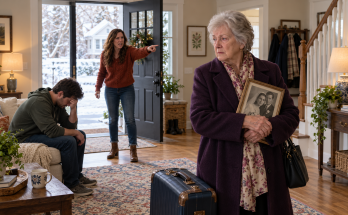
I read Luke’s words three times before I understood them. Dad didn’t just leave us. He left something in your name, and we need to tell you before it’s too late. The police cruiser moved through the darkness, its headlights illuminating the narrow road ahead. Officer Ramirez kept both hands on the steering wheel.
I sat beside him clutching a folded birthday note, my purse, and the little blue cardigan I’d grabbed from the hallway without thinking. My youngest son was in surgery. Five of my other children were in the hospital. And somehow, the man who had abandoned us years earlier had found a way to reach into our lives again.
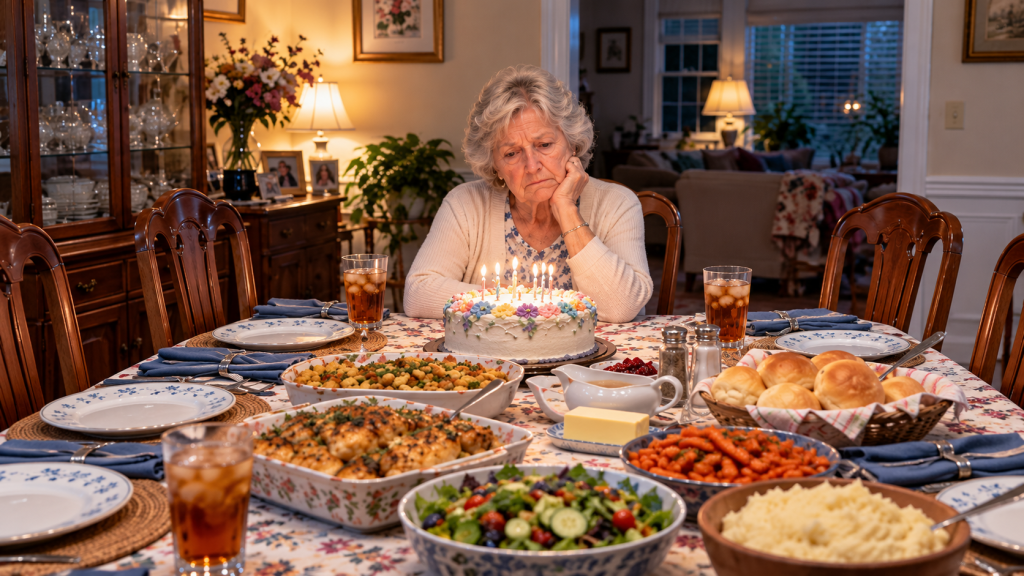
“Ma’am?” I turned. Officer Ramirez glanced at me. “Are you feeling all right?” I almost laughed. What a question. At sixty years old, I’d learned to answer that question automatically. I’m fine. I’d said it when my husband left. When the electricity was disconnected because I couldn’t pay the bill.
When my youngest needed new shoes and I had exactly fourteen dollars in my checking account.
When I worked a morning shift at the grocery store and an evening shift cleaning offices, then came home to six sleeping children and a kitchen full of dishes.
I’d said it so often that eventually I’d almost believed it.
But that night, with six signatures trembling in my hands, I couldn’t say it.
“No,” I whispered.
The officer nodded.
“That’s understandable.”
I looked at him.
“Do you have children?”
“Two daughters.”
“How old?”
“Eleven and fourteen.”
I pressed the note against my chest.
“Mine used to be that little.”
He glanced toward me.
“They’re being cared for, Mrs. Walsh.”
I nodded.
My name was Marianne Walsh.
For thirty-five years, people had mostly called me someone’s mother.
Sarah’s mother.
Ben’s mother.
Anna’s mother.
James’s mother.
Sophie’s mother.
Luke’s mother.
Before that, I’d been Graham Walsh’s wife.
Now I was sixty, divorced, and sitting in the passenger seat of a police cruiser wondering whether I’d ever hear my youngest son’s voice again.
Officer Ramirez slowed for a traffic light.
“Would you like me to tell you what I know about the accident?”
I swallowed.
“Please.”
“The van was traveling west on County Road Nine. Preliminary information indicates another vehicle crossed into its path near the intersection.”
I closed my eyes.
“The collision was serious. Emergency services transported everyone to the regional hospital.”
“Was Luke driving?”
“No. Your son Benjamin was.”
I pressed my hand against my mouth.
“Is he hurt badly?”
“His injuries have been assessed, and he’s reported to be stable. The medical team can give you more accurate details when we arrive.”
I nodded.
Then asked the only question that mattered.
“Will Luke live?”
Officer Ramirez was silent for a moment.
“I don’t have that answer, ma’am.”
I stared through the windshield.
I appreciated that he didn’t lie.
But I would have given anything for a comforting lie just then.
The emergency department smelled of antiseptic, coffee, and rain-soaked coats.
A nurse led me to a family consultation room.
My knees felt strangely weak.
The little blue cardigan I’d grabbed from home was twisted around my fingers.
Then the door opened.
“Mom?”
I looked up.
Sarah stood in the doorway.
My oldest daughter.
Thirty-five years old now.
A woman with a career, a husband, and two children of her own.
Her left arm was in a sling.
There was a bandage above her eyebrow.
But she was standing.
Alive.
“Sarah!”
I crossed the room so quickly that my handbag fell to the floor.
She caught me with her good arm.
I held her against me, trembling.
“Mom, I’m okay.”
I pulled back.
“You’re hurt.”
“Just a broken collarbone and some cuts. I’m all right.”
I touched her face.
Her hair was tangled.
Her cheeks were pale.
But I could feel her breathing.
I kissed her forehead the way I had when she was five.
Then she began crying.
“I’m sorry, Mom.”
I stared at her.
“For what?”
“For your birthday.”
I shook my head.
“Don’t you dare apologize for that.”
Her face crumpled.
“We were coming. We really were.”
“I know.”
“We wanted it to be a surprise.”
I held her tighter.
“Sweetheart, I know.”
Then I looked toward the hallway.
“Where are the others?”
Sarah wiped her eyes.
“Ben has bruised ribs. Anna broke her wrist. James hurt his shoulder. Sophie’s being monitored for a concussion.”
“And Luke?”
Her expression changed.
My heart stopped.
“Sarah?”
She swallowed.
“He had internal bleeding. They took him straight into surgery.”
I covered my mouth.
Sarah reached for my hand.
“The surgeon said they were working as quickly as they could.”
I sat down because my legs would no longer hold me.
My six children.
I’d spent the entire afternoon believing they’d forgotten me.
I’d watched the clock until every passing minute felt like proof that I didn’t matter.
But they hadn’t forgotten.
They had been driving toward me.
They had been coming home.
And now one of them might never make it.
I bent forward and began sobbing.
Sarah knelt beside my chair despite her injuries.
“Mom, please.”
I looked at her.
She was crying too.
“We’re here,” she whispered. “We’re all here.”
I wanted to believe her.
But until I heard Luke’s voice, the words felt unbearably fragile.
The next person through the door was Benjamin.
At thirty-three, Ben had his father’s broad shoulders and my dark eyes.
He walked slowly, holding his side.
When he saw me, his face collapsed.
“Mom.”
I stood.
He approached carefully.
Then he put his arms around me.
“I’m sorry.”
I closed my eyes.
“Ben, stop apologizing.”
His voice broke.
“I was driving.”
I held him tighter.
“The police officer told me.”
“I saw the car coming. I tried to stop.”
His breathing became uneven.
“I thought I had enough time.”
I pulled back.
“Benjamin, look at me.”
He did.
His eyes were red.
“You didn’t choose for another vehicle to cross in front of you.”
He shook his head.
“But if I’d taken the highway—”
“No.”
My voice was firmer than I intended.
He stared.
I touched his cheek.
“We will listen to what the investigation establishes. But I’m not going to let you decide this was your fault because you’re frightened.”
His mouth trembled.
For a moment, he looked fourteen again.
The boy who’d once broken a neighbor’s window and spent all afternoon worrying I’d stop loving him.
I hugged him.
And for the first time that evening, I felt something familiar.
The strength that came when one of my children needed me.
I’d thought I had lost that place in their lives.
But there it was.
Waiting beneath the years.
Anna arrived next, her wrist supported in a splint.
James followed, walking stiffly with his arm resting against his chest.
Sophie came last, accompanied by a nurse who reminded her to sit down and rest.
My children gathered around me.
Five grown people.
Five injured people.
Five lives that had begun inside my body.
I looked at their faces.
Sarah’s pale forehead.
Ben’s trembling jaw.
Anna’s swollen wrist.
James’s bruised shoulder.
Sophie’s exhausted eyes.
Then I looked toward the empty chair.
Luke.
My baby.
Even at twenty-five, he was still the boy who’d fallen asleep in my lap when his older siblings were shouting over the television.
The child who collected smooth stones from the sidewalk.
Who asked questions about the moon.
Who used to run to the front door when I came home from cleaning offices and announce, “Mommy’s back! Everybody, Mommy’s back!”
I pressed my hands together.
“Tell me what happened.”
Sarah glanced at the others.
Then she sat beside me.
“We planned everything six weeks ago.”
I frowned.
“Everything?”
She nodded.
“We wanted to surprise you for your sixtieth.”
Ben wiped his face.
“We knew you’d been asking us to get together.”
Anna looked down.
“And we knew we hadn’t been good about visiting.”
My throat tightened.
James continued.
“So Luke made a group chat. He said we should all fly in on the same day and come to the house together.”
Sophie smiled faintly.
“He even made a schedule.”
I almost laughed.
Luke had always made lists.
At eight, he wrote down which of his siblings owed him favors.
At twelve, he created a spreadsheet to track which birthday cakes everyone liked.
At sixteen, he made a chart of my work shifts so he could leave notes where I’d find them.
I wiped my cheeks.
“That sounds like Luke.”
Sarah nodded.
“He was so excited.”
Then her expression darkened.
“We all met at the airport. Rented the van. Stopped to pick up flowers and your birthday present.”
I stared at her.
“What present?”
She shook her head.
“That’s not important right now.”
I reached for her hand.
“Nothing matters more than knowing he’s going to be all right.”
She nodded.
Then whispered, “I know.”
For a long while, nobody spoke.
We just sat together.
The family I’d wished for.
The family I’d been certain had forgotten me.
Now gathered in a hospital room beneath fluorescent lights, terrified for the one person who wasn’t there.
At 11:26 that night, Luke’s surgeon came into the consultation room.
His name was Dr. Adam Keller.
He looked tired.
There was a crease across his forehead where his surgical cap had rested.
I stood immediately.
“Luke?”
Dr. Keller nodded.
“Your son came through surgery.”
My knees weakened.
Sarah caught my arm.
“He’s alive?”
“Yes.”
I began crying so hard I could barely hear the next words.
The doctor explained that Luke had sustained serious abdominal injuries and internal bleeding.
The surgical team had controlled the bleeding and addressed the damage, but he still required close monitoring.
His condition remained serious.
There could be complications.
He would need time.
But he was alive.
Alive.
I pressed both hands against my mouth.
“Can I see him?”
“Once he’s settled in the intensive care unit, the team will arrange a visit.”
I nodded.
“Thank you.”
Then I took a step toward the surgeon.
“Doctor, I don’t know how to thank you.”
His expression softened.
“Your son has a strong team caring for him.”
I reached for his hand anyway.
He let me hold it.
And I whispered, “You gave me back my birthday.”
Dr. Keller looked at me for a moment.
Then gently squeezed my fingers.
“Let’s get him through the next few days.”
I nodded.
Hope was not certainty.
I knew that.
But it was enough to keep breathing.
Luke was transferred to intensive care shortly after midnight.
I was allowed to visit briefly.
The room was dim.
There were tubes, monitors, and bandages beneath his hospital gown.
His face looked impossibly young.
I stood beside the bed, struggling to reconcile the grown man in front of me with the little boy who’d once demanded that I inspect every stone he collected.
I touched his hand.
“Hi, baby.”
He didn’t answer.
I swallowed.
“It’s Mom.”
The monitor continued its steady rhythm.
I moved closer.
“Your brother tells me you organized a birthday surprise.”
My voice cracked.
“Well, sweetheart, this is certainly a memorable one.”
I tried to smile.
Couldn’t.
Then I leaned down.
“Luke, I need you to keep fighting. Not because I need a birthday present. Not because you owe me anything.”
Tears slipped down my face.
“But because there are so many things you haven’t had the chance to do yet.”
I touched his forehead.
“You’ve got a whole life waiting for you.”
Behind me, a nurse quietly adjusted a monitor.
I stayed until she gently told me the team needed to continue their work.
Before leaving, I kissed Luke’s hand.
“I love you.”
Then I looked at his face.
“And you’re not allowed to use this as an excuse to forget my birthday next year.”
It was the kind of joke he’d have made.
And somehow, speaking to him as though he could still hear me made the room a little less frightening.
We spent the rest of the night in the family waiting area.
Sarah rested with her arm supported.
Sophie slept in a reclining chair after the medical team confirmed it was appropriate.
Ben sat near the window, watching rain move across the glass.
Anna held a paper cup of tea she never drank.
James made repeated trips to the vending machine, bringing back snacks nobody wanted.
Around three in the morning, Sarah approached me.
“Mom, there’s something we should explain.”
I looked up.
She was holding a blue folder.
The same kind I’d used for years to organize school forms, utility bills, and medical records.
“Is this about Luke’s note?”
She nodded.
I felt my stomach tighten.
“Tell me.”
She sat beside me.
“Remember when you said the roof was leaking?”
I frowned.
“Last autumn?”
“Yes.”
I’d mentioned it during a telephone call.
The kitchen ceiling had developed a yellow stain after a heavy storm.
I’d put a bucket beneath it and told myself I’d find the money for repairs when I could.
Sarah continued.
“Luke asked us whether we could help pay for a new roof as a birthday gift.”
I stared at her.
“A roof?”
She smiled sadly.
“He said you wouldn’t want anything expensive for yourself, so we should fix something that worried you.”
Tears filled my eyes.
That sounded exactly like Luke.
She opened the folder.
“We contacted a roofing company, got an estimate, and talked about sharing the cost.”
I looked around at my children.
Ben nodded.
“We were all putting money in.”
Anna added quietly, “And we wanted to have the wiring checked too.”
I swallowed.
“You didn’t need to do that.”
James gave me a sad smile.
“Mom, you spent years doing things you didn’t need to do for us.”
I looked down at the folder.
Then Sarah turned a page.
“Before arranging the financing, Luke suggested checking the house records. He wanted to make sure there weren’t any problems with the title.”
I frowned.
“Why would there be?”
“That’s what we thought.”
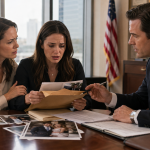
She handed me a document.
At the top was the name of a lending company I didn’t recognize.
NORTH COUNTY FINANCIAL SERVICES.
Beneath it was my address.
My house.
And a balance.
$214,680.
I stared.
“What is this?”
Sarah swallowed.
“A secured loan recorded against the house.”
I shook my head.
“That’s impossible.”
Ben leaned forward.
“Mom, the loan originated shortly before Dad left.”
My heart began pounding.
“I never borrowed that money.”
Sarah nodded.
“We believe you.”
I looked down again.
There was my name.
Marianne Elizabeth Walsh.
A loan application.
A signature.
And a notarized acknowledgment.
I stared at the signature.
It looked like mine.
But the final letter was wrong.
I’ve always made the last H in Walsh with a long tail.
This one stopped abruptly.
I whispered, “I didn’t sign this.”
Sarah touched my shoulder.
“We know you say you didn’t. That’s why we contacted an attorney to review it.”
My hands began trembling.
“How much did Graham borrow?”
“The original amount was a hundred and forty-eight thousand dollars.”
I covered my mouth.
My husband had left us with six children and a mortgage.
But apparently, he’d left something else behind.
A debt tied to the home where those children slept.
Sarah turned another page.
“The loan had a long interest-only period. Payments appear to have been made from an account connected to Dad’s business overseas.”
I frowned.
“Then why is there a problem now?”
Ben answered.
“The payments stopped several months ago. The lender has begun collection proceedings.”
I stared at him.
“Against my house?”
He nodded.
“The records include a notice about an intended foreclosure process. We can’t assume that can legally proceed, especially if the signature was forged, but it needs an immediate response.”
My hands went cold.
For almost fifteen years, I’d worked to keep that house.
I had scrubbed office floors to pay the mortgage.
Skipped dental appointments.
Put off buying new clothes.
Watched every dollar.
And now I was learning that the man who abandoned us might have placed another financial burden on the house before he walked away.
I looked at Sarah.
“Why didn’t you tell me immediately?”
Tears filled her eyes.
“We wanted to get advice first. We didn’t want to frighten you without knowing what it meant.”
I glanced toward Luke’s handwritten note.
Before it’s too late.
My youngest son had known I might lose the home I’d spent my life protecting.
And instead of leaving me to face it, he’d gathered his brothers and sisters.
I began crying.
Sarah reached for me.
“I’m sorry, Mom.”
I shook my head.
“Not for this.”
I looked around the room.
“Whatever happens with that house, I can face it.”
My voice broke.
“But I need all six of you to come home from this hospital.”
By morning, the investigation into the accident had begun to clarify what happened.
The driver of the other vehicle had entered the intersection against the signal, according to preliminary witness accounts and available camera footage.
There would be further review.
Insurance matters.
Statements.
Questions.
But the evidence so far did not support Ben’s fear that he’d caused the collision simply by choosing that road.
When Officer Ramirez came to update us, Ben listened quietly.
Then he sat down beside me.
“Mom?”
“Yes?”
“I kept thinking about how angry you must have been waiting.”
I looked at him.
He continued.
“Four hours. No calls. Nobody showing up.”
I swallowed.
“It was lonely.”
He closed his eyes.
“I’m sorry.”
I touched his hand.
“Ben, I don’t blame you for the accident.”
“I know.”
He looked at me.
“But I haven’t been there enough before this. That part is my fault.”
I stared at him.
He continued.
“Every time you invited me, I had something else happening. Work. The kids. A trip. Something.”
His voice broke.
“And I always figured there’d be another Sunday.”
I nodded slowly.
“That’s what I told myself too.”
He looked toward the ICU doors.
“Then last night happened.”
For a long time, we sat quietly.
Finally, I said, “Ben, I don’t want you carrying guilt for the rest of your life.”
He nodded.
“But I do want us to stop treating time together as something we can always postpone.”
His eyes filled.
“I want that too.”
I held his hand.
And for the first time, I allowed myself to imagine a future that looked different from the lonely years behind us.
Not because an accident had magically repaired our family.
But because we were finally saying things we’d been too busy, too proud, or too frightened to admit.
Two days later, Luke opened his eyes.
It happened while Sarah was sitting beside him.
She called me from the corridor.
“Mom, come quickly.”
My heart nearly stopped.
I hurried toward the ICU, frightened by the urgency in her voice.
Then I saw her smiling through tears.
“He woke up.”
I entered the room.
Luke lay against the pillows, pale and exhausted.
His eyes were half-open.
I approached slowly.
“Luke?”
He looked toward me.
His lips moved.
The words were faint.
“Mom?”
I covered my mouth.
For a moment, I couldn’t speak.
Then I reached for his hand.
“I’m here, sweetheart.”
He looked confused.
His eyes moved around the room.
“Hospital?”
I nodded.
“There was an accident.”
He closed his eyes briefly.
Then looked at me again.
“Birthday?”
I began crying.
“Oh, Luke.”
His mouth moved.
“Sorry.”
I shook my head.
“No.”
He tried again.
“Cake?”
A laugh burst out of me.
I couldn’t help it.
“Yes, sweetheart. There was a cake.”
He looked relieved.
Then whispered, “Save me some.”
I laughed through tears.
“Luke Walsh, if you think I won’t bake you another cake after this, you’ve forgotten who your mother is.”
He managed the faintest smile.
The nurse reminded us that he needed rest.
I nodded.
But before stepping away, I bent close.
“Your birthday surprise worked, baby.”
His eyes opened slightly.
“Did it?”
I kissed his forehead.
“You brought all of us together.”
Then I added, “Next time, just call first.”
His weak smile widened.
And for the first time since the police officer appeared at my door, I felt joy without fear immediately swallowing it.
Not because everything was suddenly safe.
But because my youngest son had opened his eyes.
And I had been there to see them.
Luke spent another week in the hospital before the doctors began discussing rehabilitation and eventual discharge.
His recovery would take time.
He was weak.
He tired easily.
And there were days when pain made him frustrated enough to refuse visitors.
But he was alive, improving, and determined to walk out of the hospital when his medical team said he was ready.
That was enough for me.
Meanwhile, Sarah arranged a meeting with the attorney the children had contacted before the accident.
Her name was Nadia Ellis.
She had spent almost twenty years handling property disputes and financial fraud cases.
I arrived carrying the blue folder.
Sarah came with me, her arm still in a sling.
Nadia reviewed the documents carefully.
Then she looked at me.
“Mrs. Walsh, the first thing I want you to understand is that a recorded mortgage doesn’t necessarily establish that you knowingly agreed to it.”
I nodded.
“But the lender says I owe the money.”
“That’s their position based on the documents. We’re going to challenge the authorization and examine how the loan was originated.”
She opened another page.
“Your children have already obtained a copy of the recorded security instrument. We’ve also requested the original application, identification records, and notary information.”
I swallowed.
“Can they take my house while we’re sorting this out?”
“We’re seeking to stop any enforcement while the dispute is investigated. There are deadlines we must address, so we’ll act promptly.”
I looked down.
For years, my children had believed I could solve anything.
Broken toys.
Missed buses.
School problems.
Unexpected bills.
Now I was sitting beside my oldest daughter, admitting that I couldn’t solve this alone.
Sarah touched my arm.
“Mom, we’re here.”
I looked at her.
Then nodded.
“I know.”
And for the first time, accepting help didn’t feel like failure.
The next discovery came from an unexpected place.
The notary whose signature appeared on the loan documents was still alive.
His name was Harold Pierce.
He had retired several years earlier.
When investigators contacted him, he acknowledged that Graham Walsh had been a client.
But he couldn’t locate a proper journal entry establishing that I had appeared before him to sign the disputed document.
Then the lender supplied an old identification record.
Nadia showed it to me during our second meeting.
I stared at the image.
It was a copy of my driver’s license.
The same license Graham had used years earlier when we refinanced our original mortgage.
I recognized the photograph.
My hair was shorter.
I was wearing the blue blouse Sarah gave me for Mother’s Day.
Nadia pointed toward the application.
“The lender’s file indicates the identity verification was completed using this copy. We’re examining whether proper personal verification occurred.”
I swallowed.
“That doesn’t prove I signed.”
“Correct.”
Then Sarah leaned forward.
“Mom, look at the time.”
I frowned.
The notarization was listed as taking place at 2:40 in the afternoon.
In another city.
I stared at the date.
April fourteenth.
Fourteen years earlier.
I remembered that day.
Not because of the loan.
Because it was the day Luke broke his arm falling from his bicycle.
I had been working at the grocery store when the school nurse called.
I left work early, picked him up, and took him to urgent care.
He’d cried because he thought he wouldn’t be able to play baseball.
I remembered sitting beside him while the doctor examined his arm.
Nadia looked at me.
“Would you have any records from that day?”
I sat up.
“The urgent care records.”
Sarah stared.
“Mom?”
I looked at her.
“Luke broke his arm. I took him to the doctor that afternoon.”
Nadia nodded slowly.
“Medical records, employment records, and any other contemporaneous documents may help establish where you were.”
I felt my heart pounding.
For years, I’d viewed that day as one of thousands of exhausting afternoons spent taking care of my children.
Now it might help prove that I wasn’t standing before a notary in another city signing away part of my family’s security.
I covered my mouth.
Then began laughing through tears.
Sarah looked at me.
“Mom?”
I shook my head.
“Your brother broke his arm, and I thought the worst thing that could happen was missing another shift.”
She squeezed my hand.
I looked toward the ceiling.
“Graham never imagined I’d remember.”
Nadia’s expression remained careful.
“Let’s obtain the records and see what they establish.”
I nodded.
But for the first time, I felt as though the truth might be something we could actually prove.
Several weeks later, the evidence had become much stronger.
The old medical records confirmed Luke’s urgent care visit.
My employer’s archived payroll records supported my account of leaving work early.
And the notary’s own records raised serious concerns about the purported signing.
The lender agreed to suspend enforcement activity while the disputed loan was reviewed.
That didn’t erase the debt from the records.
It didn’t guarantee the final outcome.
But it gave us time to pursue the evidence.
Then Nadia called with another discovery.
The original loan proceeds had been wired into an account associated with a business Graham established overseas.
A restaurant called Blue Harbor Café.
I stared at the name.
Graham used to tell our children that one day he’d open a café beside the sea.
He’d talk about warm mornings, fishing boats, and drinking coffee without worrying about bills.
I had always assumed it was a harmless dream.
Now I understood who had paid for it.
The money borrowed against the house I’d struggled to keep had helped finance the life he chose after leaving us.
I sat at my kitchen table holding the report.
For fourteen years, I’d blamed myself whenever the money ran out before payday.
I’d felt guilty when Sarah couldn’t go on an expensive school trip.
When Ben needed braces.
When Anna wore her older sister’s winter coat.
When James wanted to join a sports team.
When Sophie needed extra textbooks.
When Luke asked why other children went on vacation and we never did.
I’d told myself I simply wasn’t earning enough.
But Graham had taken something that could have helped keep our family secure.
Then left us to survive without him.
For a long time, I sat motionless.
Then I picked up the telephone.
I called Nadia.
“I want to proceed.”
She paused.
“With challenging the lien and pursuing the related claims?”
“Yes.”
My voice trembled.
“And I don’t want to hide what happened just because Graham is my children’s father.”
Nadia answered gently.
“That’s a decision you’re entitled to make.”
I looked toward the framed photographs on my wall.
Six children.
Six faces.
Six reasons I’d kept going when I thought I couldn’t.
“I’m finished protecting him from the consequences of leaving us.”
Graham contacted me shortly afterward.
I hadn’t heard his voice in almost three years.
The last time he’d called, he wanted me to convince Luke to answer his messages.
Now he sounded older.
Tired.
But the familiar confidence remained.
“Marianne.”
I closed my eyes.
“Graham.”
“I hear you’ve been making accusations.”
I looked toward the kitchen window.
“Your loan is being investigated.”
He sighed.
“That old thing?”
I stared at the telephone.
“That old thing is attached to my house.”
“I made the payments for years.”
“With money that came from where?”
Silence.
I took a breath.
“Graham, did you forge my signature?”
He didn’t answer.
I waited.
Finally, he said, “We were married. Everything belonged to both of us.”
I felt something inside me harden.
“That isn’t an answer.”
He exhaled sharply.
“Marianne, I was trying to build a future.”
I looked down at my hands.
“You already had a future.”
My voice broke.
“You had six children. You had a home. You had people who loved you.”
He was silent.
“And you left.”
He muttered, “You don’t understand.”
I almost laughed.
For fourteen years, I’d told myself that perhaps I didn’t understand.
That maybe Graham had been unhappy in a way I couldn’t see.
That perhaps I hadn’t been interesting enough.
Beautiful enough.
Patient enough.
Now I was sixty, sitting in the kitchen I’d kept warm for six children, listening to him make the same excuses.
“No, Graham,” I whispered. “I understand perfectly.”
He sighed.
“Are you going to ruin me over money?”
I looked at the family photographs again.
“No.”
A pause.
“I’m going to protect the home you left us in.”
Then I ended the call.
And for the first time since he walked out with his suitcase, I didn’t cry afterward.
The loan dispute was resolved through a combination of documentary evidence, formal legal proceedings, and negotiations with the lender.
The contested signature and acknowledgment could not be substantiated as a valid authorization by me.
The lender eventually agreed to release the disputed lien under the settlement terms, while preserving its rights to pursue responsible parties.
The investigation into the origination of the loan continued separately.
There was no sudden courtroom applause.
No miraculous check.
No judge announcing that fourteen years of suffering had been undone.
There were forms.
Interviews.
Deadlines.
Records.
And months of work.
But eventually, I received confirmation that the disputed lien had been released.
I sat at the kitchen table with the letter in my hands.
The same table where I’d helped my children with homework.
The same table where I’d counted coins to buy groceries.
The same table where I’d ironed napkins for my sixtieth birthday dinner.
Then I began crying.
Not because I’d become wealthy.
I hadn’t.
I still had bills.
I still needed to budget.
But the house was secure from that particular claim.
The home I’d kept standing through years of exhaustion was finally free of a debt I hadn’t knowingly accepted.
I called Sarah first.
She answered immediately.
“Mom?”
I tried to speak.
My voice broke.
“It’s over.”
There was a pause.
Then she began crying too.
“The house?”
“Yes.”
I heard her call to her husband.
Then she said, “Mom, we’re coming over.”
I laughed through tears.
“Sweetheart, you live three states away.”
“I know.”
“Sarah—”
She interrupted gently.
“Then I’ll call you tonight. And I’ll visit next month, just like we planned.”
I smiled.
That answer meant more than a grand promise.
Because now we were learning to build a family around things we could actually keep.
Luke’s recovery took longer than any of us expected.
He needed physical therapy to rebuild his strength.
He grew frustrated when ordinary movements exhausted him.
Some days, he called me sounding cheerful.
Other days, he barely spoke.
But he kept going.
And every week, one of his siblings made time to check on him.
Not because Sarah organized a schedule.
Not because anyone threatened to feel hurt.
Because the accident had forced us to recognize how much we had been living as separate people.
We started a Sunday evening family call.
At first, it felt awkward.
Six voices talking over one another.
Children interrupting.
Someone’s dinner burning.
Ben forgetting to charge his phone.
James complaining about his internet connection.
But slowly, those calls became something we looked forward to.
Sarah started visiting every few months.
Anna came to help organize the house repairs.
James spent a weekend fixing the kitchen cabinets.
Sophie visited during school holidays and brought her children.
Ben began calling on his way home from work.
And Luke, once his health permitted, came to stay for several weeks.
We talked about everything.
Work.
Marriage.
Money.
Our father.
The years we’d lost.
Sometimes we argued.
Sometimes old resentments surfaced.
But for the first time in years, we stopped pretending that love could survive indefinitely without attention.
One afternoon, Luke sat beside me on the porch.
He was still recovering, but he’d begun walking around the neighborhood each morning.
“Mom?”
“Yes, sweetheart?”
“Do you ever wish we hadn’t planned the surprise?”
I looked at him.
“Why would I wish that?”
He stared at the garden.
“Because of the accident.”
I reached for his hand.
“Luke, the accident was terrible. But wanting to come home wasn’t a mistake.”
He nodded slowly.
Then whispered, “I thought maybe if we’d just called you instead, none of it would have happened.”
I considered his words.
“Maybe the evening would have been different. But we can’t know that.”
He looked at me.
“What we can do,” I continued, “is make sure we never need another terrible event to remind us to spend time together.”
His eyes filled.
Then he smiled.
“Deal.”
On my sixty-first birthday, I woke to the smell of cinnamon.
For a moment, I thought I was dreaming.
Then I heard someone laughing in the kitchen.
I pulled on my slippers and walked down the hallway.
And stopped.
All six of my children were there.
Sarah stood beside the stove.
Ben was setting plates on the table.
Anna was arguing with James about how much sugar belonged in the coffee.
Sophie was decorating a cake.
And Luke was sitting in my old chair, carefully peeling apples.
For one beautiful moment, I couldn’t speak.
Then Luke looked up.
“Morning, Mom.”
I covered my mouth.
“What are you all doing?”
Sarah smiled.
“Making breakfast.”
I looked at the clock.
Eight fifteen.
No waiting until noon.
No wondering whether somebody would remember.
No lonely table.
My children had arrived the previous evening, coordinating their visits in advance, and I’d slept so peacefully that I hadn’t heard them moving around downstairs.
Ben pulled out a chair.
“Sit down, Mom.”
I laughed.
“You don’t need to make such a fuss.”
He grinned.
“Yes, we do.”
I sat.
Seven places were arranged around the table.
Exactly as I’d dreamed the year before.
But this time, I hadn’t cooked everything myself.
I hadn’t exhausted myself trying to create a perfect evening.
I hadn’t spent four hours staring at an empty driveway.
My children were there because they wanted to be.
Sarah placed a plate before me.
Scrambled eggs.
Toast.
Fresh fruit.
And one slightly misshapen cinnamon roll.
I looked up.
“Who made this?”
James raised his hand.
“I would like everyone to remember that I am not a professional baker.”
We laughed.
Then Sophie brought out the cake.
It was decorated with seven little hearts.
One for each of us.
At the center, written in blue frosting, were the words:
MOM, YOU NEVER HAVE TO WAIT ALONE AGAIN.
I began crying.
Sarah came behind my chair and put her arms around me.
“Happy birthday, Mom.”
I looked around the table.
At the six people I’d once carried inside me.
The six children I’d fed, clothed, worried over, and loved through every difficult year.
They weren’t children anymore.
They had their own lives.
Their own responsibilities.
Their own struggles.
And I no longer needed them to live under my roof to know I mattered.
I only needed us to keep making room for one another.
Luke reached into his pocket.
“Mom, there’s one more thing.”
He handed me the original folded note from the accident.
The paper was creased and worn.
I’d kept it tucked inside my Bible for a year.
Now he’d added one sentence beneath the six signatures.
We cannot give you back the years we missed, but we can stop missing the ones ahead.
I pressed the paper against my heart.
Then looked at my children.
“I love you,” I whispered.
Ben smiled.
“We know, Mom.”
I shook my head gently.
“Then let me tell you something else.”
They became quiet.
“For years, I believed that if I sacrificed enough, none of you would ever have to struggle.”
My voice trembled.
“But I was wrong about something.”
I looked around the table.
“I thought being a good mother meant never asking for anything in return.”
Sarah reached for my hand.
I continued.
“Now I know it’s all right to say I miss you. It’s all right to ask for your time. And it’s all right for you to tell me when life is difficult too.”
Tears filled Anna’s eyes.
“We’re sorry we forgot that, Mom.”
I smiled.
“Then let’s keep remembering.”
Luke lifted his coffee cup.
“To Mom.”
The others raised theirs.
“To Mom!”
And for the first time in longer than I could remember, my house was loud.
Beautifully, wonderfully loud.
Just as their father had once dreamed it would be.
But unlike the man who left because family life became difficult, the people sitting around my table had learned that love wasn’t measured by how little trouble someone caused.
It was measured by whether we kept showing up.
I looked at the clock.
A year earlier, I’d spent four hours counting the people who hadn’t arrived.
Now I had six people telling me to blow out my candles before the frosting melted.
I laughed through tears.
Then closed my eyes and made a wish.
Not for money.
Not for a perfect family.
Not even for more years.
I wished that whatever time we had left, we would remember to share it.
Because the greatest gift my children gave me wasn’t a house repair, a birthday cake, or even the protection of the home I’d fought to keep.
It was the moment they understood that a mother’s love may be endless, but her time on this earth is not.
And that evening, as we sat around the same table where I’d once cried alone, I finally understood something beautiful.
I had spent my life making sure my children always had a home to return to.
Now they were making sure I had a family that returned.
THE END STORIES! THANK YOU FOR READING GOOD LUCK !❤️
Related Posts