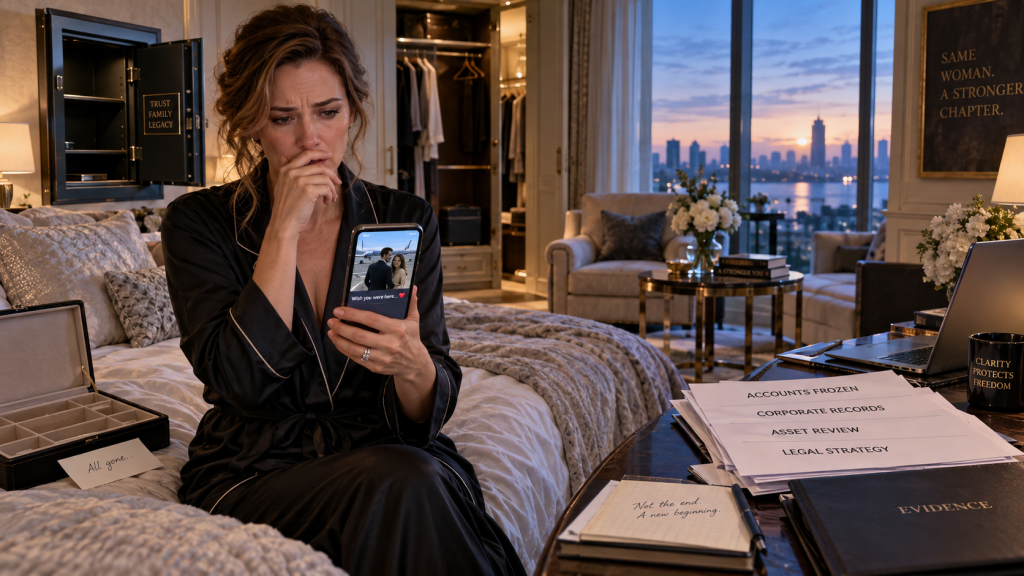
“At exactly 2:00 a.m., I lay completely still while my husband packed a suitcase, convinced I was fast asleep. Before leaving, Daniel leaned over me, kissed my forehead, and whispered, “Poor Audrey. You never saw this coming.”

He was wrong.
I had already seen more than he realized.
Earlier that night, something about the tea Daniel brought me had felt unusual.
The taste was different, and after months of quietly questioning his behavior, I had learned not to ignore small details.
So instead of finishing it, I poured the tea away and returned to bed.
A little while later, Daniel came upstairs to check on me.
I kept my eyes closed and my breathing slow.
He believed I was deeply asleep.
From beneath barely opened eyes, I watched him cross the bedroom and unlock our safe.
One by one, he removed passports.
Cash.
Jewelry boxes.
And a folder labeled HAWTHORNE HOLDINGS.
There was no hesitation in the way he moved.
He packed like someone who had been preparing for this moment for a long time.
Then he reached for my mother’s diamond bracelet.
That hurt more than the money.
My mother had worn that bracelet on the night she officially transferred control of our family company to me.
Daniel had always called it “sentimental junk.”
Now he slipped it into his pocket as though it belonged to him.
At 2:37 a.m., the front door closed.
I waited several more minutes before sitting up.
My hands were shaking.
Not because I felt helpless.
Because everything I had suspected was finally becoming real.
For months, Daniel had treated me like background decoration.
His quiet wife.
Too emotional for serious business.
Too soft to understand complicated finances.
Too uninvolved to notice what was happening around her.
What Daniel never fully understood was that before I married him, I had spent twelve years reviewing financial misconduct for my mother’s company.
And three weeks earlier, I had discovered the first suspicious authorization.
Then another.
Then an account I didn’t recognize.
Finally, I found hotel and travel records connected repeatedly to one name.
Vanessa Cole.
Daniel’s so-called consultant.
By then, I had already spoken privately with our corporate attorney.
I had also contacted the bank’s fraud department and two independent directors.
I never confronted Daniel.
I didn’t want another argument.
I didn’t want excuses.
I wanted facts.
Before sunrise, I photographed the open safe.
The empty jewelry case.
The missing company folder.
And anything else that might become important later.
Then I sent everything to the secure email account our attorney had arranged for me.
I didn’t cry.
There would be time for that later.
First, I needed to protect myself and the company my mother had spent her life building.
At 5:46 a.m., my phone lit up.
Daniel had sent me a photograph from the airport.
He was smiling beside Vanessa.
And around her wrist was what she clearly believed was my mother’s diamond bracelet.
Under the picture, Daniel had written:
“Goodbye, useless woman. By morning, there’ll be nothing left for you.”
For several seconds, I simply stared at the screen.
Daniel believed he had won.
He thought I would wake up betrayed.
Heartbroken.
And financially ruined.
What he didn’t know was that I had been preparing for this moment too.
I let my heartbeat settle.
Then I typed four words.
“The accounts are frozen.”
His call came almost immediately.
PART 2
Daniel’s call came almost immediately.
I watched his name pulse across my screen.
Once.
Twice.
Three times.
He had spent months treating my silence like stupidity.
Now, suddenly, he wanted to hear my voice.
I answered on the fourth ring.
“Good morning.”
For half a second, he said nothing.
Then:
“What did you do?”
Not hello.
Not Audrey.
Not an accusation about the marriage.
The accounts.
That told me exactly what mattered most.
I walked into the kitchen and turned on one small light above the stove.
The house felt enormous without him in it.
“What do you mean?”
“Don’t play games with me.”
His voice was low.
Sharp.
Behind him, I could hear airport noise.
Announcements.
Rolling suitcases.
People beginning ordinary vacations while my husband stood somewhere beside his mistress discovering that the life he planned to steal had stopped cooperating.
“You said the accounts are frozen.”
“They are.”
“How?”
I leaned against the counter.
“By asking the bank to freeze them.”
Silence.
Then:
“You cannot freeze corporate accounts by yourself.”
“That’s true.”
His breathing changed.
“You needed authorization.”
“Yes.”
“From who?”
I almost smiled.
Two weeks earlier, I had sat in a private conference room with Elena Park, Hawthorne Holdings’ general counsel, and two independent directors.
David Lin.
Margaret Cho.
Neither of them liked drama.
That was why I trusted them.
I had shown them duplicate vendor invoices.
Unapproved transfers.
A consulting contract tied to Vanessa.
And three electronic approvals supposedly made by me during times I could prove I had been elsewhere.
We did not accuse Daniel of everything.
We did something better.
We documented.
Then we passed an emergency board resolution requiring additional authorization on sensitive transfers and temporary holds if specified fraud triggers appeared.
Daniel never knew.
Because Daniel had stopped attending board meetings unless he thought there would be photographs.
I said:
“People who actually read the documents.”
His voice sharpened.
“You went to the board?”
“I did.”
“You had no right.”
That almost made me laugh.
“I’m chair.”
“You’re my wife.”
There it was.
As if one title canceled the other.
I looked toward the dark living room.
“How’s Vanessa?”
Silence.
Then:
“Do not drag her into this.”
I stared at the photograph he had sent me less than ten minutes earlier.
Vanessa smiling.
Her wrist tilted toward the camera.
My mother’s bracelet sparkling under airport lights.
“You put her in the picture.”
“That bracelet is not yours anymore.”
My pulse slowed.
Not yours anymore.
Interesting.
“Who told you that?”
He went quiet.
I continued.
“Did you sell it?”
“No.”
“Give it to her?”
“It was part of our marital property.”
“No.”
Daniel exhaled sharply.
“Audrey, stop.”
“Mom gave it to me before our wedding.”
“That doesn’t matter.”
“It does to me.”
“God, you always do this.”
“Do what?”
“Turn everything into some emotional inheritance ritual.”
For one second, the old hurt rose.
My mother had died eighteen months earlier.
Cancer.
Fast.
Brutal.
Daniel attended the funeral.
Held my hand.
Told everyone he would take care of me.
Then, six weeks later, asked whether I had thought about selling the house she left me.
Three months later, he started lobbying for access to my voting shares.
He called it efficiency.
I had called it marriage.
Now I understood both terms differently.
I said:
“Put Vanessa on.”
“What?”
“You heard me.”
“No.”
“Then I’ll call her myself.”
That frightened him.
I heard it.
“Why?”
“I want to ask whether she knows that bracelet was reported stolen thirty-one minutes ago.”
Silence.
Then something muffled.
A woman’s voice.
Vanessa.
“What did she say?”
Daniel moved away from the phone.
“Audrey.”
“Yes?”
“You called the police?”
“I documented missing personal property.”
“You are insane.”
“No.”
My voice stayed calm.
“I am finally being precise.”
He swore under his breath.
Then:
“You have no idea what you’ve done.”
I looked at the clock.
5:53.
“Actually, Daniel, that sentence belongs to you.”
I ended the call.
My hands started shaking afterward.
That was the part nobody sees in stories about revenge.
The body does not always understand that you are winning.
It still knows the person on the other end once slept beside you.
Still knows his footsteps.
His coffee order.
The shape of his hand around a wineglass.
Your nervous system can grieve someone while your mind is gathering evidence against them.
I sat at the kitchen table.
Then I cried.
Not for long.
Five minutes.
Maybe seven.
Afterward, I washed my face and called Elena.
She answered immediately.
“You spoke to him?”
“Yes.”
“Did you tell him anything beyond the freeze?”
“No.”
“Good.”
“He knows the board is involved.”
“That was inevitable.”
I looked toward the empty safe upstairs.
“What happens now?”
“First, nobody touches the accounts.”
“Then?”
“We verify what he took.”
“The Hawthorne Holdings folder is missing.”
Silence.
Elena became very still on the line.
“Which folder?”
“The black one from my safe.”
“Label?”
“HAWTHORNE HOLDINGS.”
A pause.
“Audrey, what was inside it?”
“I thought old corporate records.”
“Thought?”
“My mother kept it.”
I closed my eyes.
“She told me never to discard it.”
Elena’s voice changed.
“Did you ever review it?”
“Not fully.”
“Why not?”
Because grief makes paperwork heavy.
Because every page in my mother’s handwriting felt like opening a room I was not ready to enter.
Because I had assumed a locked safe inside my own bedroom was safe.
“I kept putting it off.”
Elena said nothing judgmental.
Then:
“We need to know exactly what was in that folder.”
“How?”
“Your mother was meticulous.”
I smiled faintly.
“That’s an understatement.”
“If those were corporate records, there are probably copies.”
“Where?”
“I’ll check archives.”
Then she added:
“Do not go after Daniel.”
“I wasn’t planning to.”
“Good.”
“Where is he flying?”
“I don’t know.”
I checked the photo again.
Behind them, a gate number.
Partially visible.
And an airline logo.
I told Elena.
She said:
“I’ll have security and counsel preserve what matters.”
“Can we stop them?”
“From boarding?”
“Yes.”
“Audrey, this is not a movie.”
I almost laughed.
“I know.”
“We do not control airports.”
“Right.”
“But if he is carrying stolen corporate materials, law enforcement may care.”
I looked at the empty safe.
“What if the folder is more important than we think?”
Elena was quiet.
Then:
“I suspect it is.”
At 6:24, Margaret Cho called.
She was one of the independent directors.
Seventy-one.
Silver hair.
The kind of woman who could silence a boardroom by removing her glasses.
“I’m told Daniel has left.”
“Yes.”
“With Ms. Cole?”
“Yes.”
“Good.”
I blinked.
“Good?”
“Distance makes stupid people reveal their plans.”
That was very Margaret.
She continued.
“We found something overnight.”
My stomach tightened.
“What?”
“Vanessa Cole is not simply a consultant.”
“I know about the travel.”
“Not what I mean.”
Margaret paused.
“She is listed as the sole manager of a company called Cole Strategic Partners.”
“I’ve seen that.”
“Yes.”
“But Cole Strategic Partners owns eighty percent of another entity.”
“What entity?”
“Westbridge Capital Solutions.”
The name meant nothing to me.
“What do they do?”
“On paper?”
“Yes.”
“Acquisitions.”
My chest tightened.
“And in reality?”
“We’re still finding out.”
A pause.
“Six months ago, Westbridge submitted a confidential expression of interest to purchase Hawthorne Precision Systems.”
I stood.
Hawthorne Precision Systems was our most profitable subsidiary.
Defense-grade industrial components.
Medical manufacturing.
Forty percent of group earnings.
My mother had built it from a machine shop with six employees.
“Purchase it from who?”
“The company.”
“No.”
I said it immediately.
“The board never discussed a sale.”
“I know.”
“Then how did they get internal numbers?”
Silence.
My hand tightened around the phone.
“Margaret.”
“That is the question.”
A cold feeling moved through me.
Internal numbers.
Forecasts.
Margin information.
Supplier contracts.
Things Daniel sometimes saw because I made the mistake of thinking a spouse asking about work was simply interested in my day.
“What was the offer?”
“Low.”
“How low?”
“About sixty percent of what I would consider reasonable enterprise value.”
My stomach turned.
A deliberate undervaluation.
“Who responded?”
“Someone using the title Executive Strategy Liaison.”
I frowned.
“We don’t have that role.”
“No.”
Margaret continued.
“But the email signature used Daniel’s personal mobile number.”
I stopped breathing.
“No.”
“Yes.”
“What did he tell them?”
“That the board could be persuaded.”
My jaw tightened.
“And me?”
A pause.
Margaret’s voice softened.
“He described you as emotionally attached to the company but financially unsophisticated.”
I laughed.
Actually laughed.
Twelve years in financial misconduct review.
Seven years on the audit committee.
Three as chair.
Financially unsophisticated.
Margaret continued.
“He said your resistance could likely be overcome if the transaction was structured as a liquidity event rather than a sale.”
The insult almost became beautiful in its arrogance.
Daniel thought changing vocabulary would change ownership.
“What did Vanessa do?”
“Negotiated.”
“With her own company?”
“Yes.”
My stomach turned.
A buyer he was secretly helping.
A consultant sleeping with him.
Inside financial information.
And a company asset he thought I could be persuaded to surrender cheaply.
“Margaret.”
“Yes?”
“Why leave now?”
“That concerns me too.”
I looked at the time.
6:31.
“What happens today?”
“Emergency board meeting at nine.”
“I’ll be there.”
Then she said:
“Audrey.”
“Yes?”
“Do not be embarrassed.”
I went quiet.
She continued.
“Men like Daniel survive because intelligent women waste time being ashamed that they trusted them.”
My eyes filled.
“That shame belongs to him.”
I swallowed.
“Thank you.”
“I’m not being kind.”
Margaret’s voice sharpened.
“I need my chair functional.”
I laughed through tears.
There she was.
At 7:02, the police arrived.
Two officers.
Professional.
Unimpressed by wealth.
Exactly what I needed.
I showed them the open safe.
The empty bracelet case.
Photographs from before Daniel left.
Security camera footage from the hallway showing him carrying a suitcase.
The airport photo he sent me himself.
One officer looked at Vanessa’s wrist.
Then at the bracelet receipt and insurance record I had found.
“Distinctive.”
“Yes.”
“Approximate value?”
“Financial?”
“Yes.”
“About forty thousand.”
“Sentimental?”
I stared at him.
“Not measurable.”
He nodded.
I also reported the missing corporate folder.
That part moved into a different category quickly.
Company counsel would handle sensitive records.
The officers gave me a report number.
They did not promise an arrest.
Did not promise recovery.
I respected that.
At 7:48, I received a text from Daniel.
You’ve made a very serious mistake.
I screenshotted it.
Sent it to Elena.
Then another.
There are documents you signed that you clearly don’t remember.
My pulse changed.
I read it twice.
Signed.
Not:
Agreed to.
Signed.
I called Elena.
“He just texted me.”
I read it.
Silence.
Then:
“Do not answer.”
“What documents?”
“I don’t know.”
“You sound like you have an idea.”
A pause.
“Audrey, your mother changed the company’s governance structure shortly before she died.”
“I know.”
“She transferred voting control to you.”
“Yes.”
“But there was another layer.”
My chest tightened.
“What layer?”
“Certain crown-jewel assets cannot be sold without your personal written approval plus approval of two independent directors.”
“I know that too.”
“No.”
Elena’s voice went lower.
“There was a private side agreement.”
I frowned.
“What side agreement?”
“Your mother created it after Daniel began asking her questions about control.”
I stopped breathing.
“What questions?”
“She never told you?”
“No.”
Elena exhaled.
“She told me he asked what would happen if you became incapacitated.”
My skin went cold.
“When?”
“Almost two years ago.”
Before Mom died.
Before the suspicious accounts.
Before Vanessa’s name appeared.
Daniel had already been asking what happened if I could not make decisions.
The tea flashed through my mind.
Different taste.
Heavy sleep he expected.
No.
I forced myself not to jump.
Suspicion is not proof.
“What did Mom do?”
“She amended governance.”
“How?”
“If you were temporarily incapacitated, voting authority would not pass to a spouse.”
I closed my eyes.
“Who would get it?”
“A three-person independent committee.”
A laugh escaped me.
Mom.
Of course.
Even dying, Evelyn Hawthorne had been more suspicious than I was.
“Daniel knew?”
“Not the final structure.”
“He thought he would get control?”
“We believe he may have assumed normal spousal authority or an older proxy would apply.”
I sat down.
“And the folder?”
Elena went quiet.
My stomach tightened.
“What was in it?”
“We found the archive index.”
Then:
“The original side agreement.”
I closed my eyes.
“Anything else?”
“Yes.”
“Your mother’s handwritten memo documenting her concerns about Daniel.”
I stopped breathing.
My mother had known.
Not everything.
But something.
“What did she write?”
Elena hesitated.
“I want you to read it yourself.”
“No.”
“Read me one line.”
Silence.
Then Elena said:
“She wrote…”
A pause.
“Daniel confuses Audrey’s trust with his entitlement.”
My eyes filled immediately.
Mom.
Eighteen months dead.
Still warning me.
I pressed my hand to my mouth.
Elena continued softly:
“There’s another line.”
I waited.
“If he ever pushes for control during a period when Audrey is unwell, assume the timing is not accidental.”
The kitchen turned cold.
The tea.
Again.
I closed my eyes.
No.
I was not going to turn one odd cup of tea into a conclusion.
Not yet.
I said:
“We need the folder back.”
“Yes.”
“And if he has the original side agreement?”
“It won’t give him power.”
“What could he do with it?”
“Learn exactly why his plan fails.”
That mattered.
At nine, the emergency board meeting began.
Seven directors.
Elena.
Me.
No Daniel.
No Vanessa.
We suspended Daniel’s remaining consultant access immediately.
Revoked credentials.
Notified banks.
Locked internal systems.
Preserved logs.
Then IT presented access history.
Daniel had downloaded files from my office computer twelve days earlier.
Vanessa’s company had received some of them less than an hour later.
Supplier data.
Pricing models.
A draft valuation.
Not enough to sell the company.
Enough to help a buyer know how to attack it.
Then the security director spoke.
“We also found attempted access to executive succession records.”
My stomach tightened.
“When?”
“Last night.”
“What time?”
“1:42 a.m.”
Before he packed.
Before he kissed my forehead.
Poor Audrey.
You never saw this coming.
He had checked whether something changed.
Maybe he was trying to confirm who would control the company after I became “unavailable.”
Margaret looked at me.
“Audrey?”
“I’m fine.”
I was not.
But I was functional.
That had to be enough.
Then David Lin asked:
“Where are they going?”
IT had something.
Daniel’s corporate travel profile had been accessed from his phone.
A reservation.
Two tickets.
Cancún first.
Then onward to Grand Cayman forty-eight hours later.
My stomach turned.
Cayman.
Margaret said:
“Classic.”
Elena shook her head.
“Do not assume.”
Good.
Again.
Careful truth.
Maybe vacation.
Maybe banking.
Maybe both.
Then IT found one more thing.
A document uploaded at 1:51 a.m.
Filename:
AUDREY AUTHORIZATION FINAL.pdf
My pulse stopped.
“Open it.”
Elena looked at me.
“We should preserve it first.”
“Then open the preserved copy.”
A minute later, it appeared on the screen.
A board consent.
My name.
My supposed authorization.
The document stated that due to temporary health issues, I delegated authority over certain strategic transactions to Daniel for thirty days.
My signature was at the bottom.
Perfect.
Except I had never signed it.
The room went silent.
Margaret removed her glasses.
“Well.”
I stared at the date.
Yesterday.
My stomach tightened.
“He planned to file this after leaving.”
Elena nodded slowly.
“Likely.”
“Health issues.”
I whispered.
The tea again.
Heavy sleep.
Daniel checking on me.
His certainty I would not wake.
Had he planned to tell people I was unwell?
Or simply asleep?
I did not know.
Then David said:
“There’s a medical note attached.”
My blood went cold.
“What?”
A one-page letter.
Supposedly from Dr. Leonard Price.
A physician I had seen twice for migraines.
It stated I had recently experienced episodes of confusion, exhaustion, and impaired judgment.
I stared.
None of that was true.
At least not medically documented.
Elena immediately called the doctor’s office.
Twenty minutes later, confirmation came.
Dr. Price had not written the letter.
The signature was not his.
Now we had something worse.
Not only a forged corporate authorization.
A fake medical basis.
A story.
My husband had been constructing a reason I could not be trusted with my own company.
I sat completely still.
Margaret looked at me.
“Breathe.”
I almost snapped at her.
Then realized I had been holding my breath.
I inhaled.
Exhaled.
No one spoke for a moment.
Then Elena said:
“This goes to law enforcement.”
I nodded.
“Yes.”
The meeting ended at eleven-thirty.
By noon, Daniel’s authority inside Hawthorne Holdings no longer existed.
Not informally.
Not technically.
Not anywhere.
At 12:16, my phone rang from an international number.
I answered.
Daniel.
His voice sounded different.
Less confident.
“You have no idea what you’re destroying.”
I looked out my office window.
“Apparently your morning.”
He ignored that.
“Vanessa says the banks are refusing every transfer.”
“Good.”
“You froze my personal card.”
“No.”
“I froze cards tied to company accounts.”
“This is marital sabotage.”
“You’re in another country with stolen corporate records.”
Silence.
Then:
“You need to call Elena and reverse the board action.”
“No.”
“Audrey.”
“No.”
He lowered his voice.
“There are things in that folder that will ruin your mother’s reputation.”
My chest tightened.
“What things?”
“Ask your lawyer.”
He was bluffing.
Maybe.
“What does that mean?”
“Your mother was not the saint you think she was.”
I felt anger rise.
Not because he insulted Mom.
Because he wanted me emotional.
He always did better when I was defending instead of asking.
So I asked:
“Where is the folder?”
Silence.
“Daniel.”
“You don’t need it.”
“Where is it?”
“Safe.”
“Your definition of that word has become unreliable.”
He laughed bitterly.
Then:
“Vanessa has it.”
My stomach tightened.
“Why?”
Another silence.
Then a woman’s voice in the background.
Vanessa.
Sharp.
Angry.
“What did you tell her?”
Daniel moved away.
I heard enough.
“You said this was done.”
Vanessa.
Then:
“You said she signed everything.”
My pulse changed.
Daniel hissed something.
I put the call on speaker and activated recording through the legal call-record process Elena had already advised for future communications.
Daniel returned.
“Audrey.”
“Yes?”
“Call off the fraud complaint.”
“No.”
“If you don’t, you will regret it.”
“Is Vanessa wearing my mother’s bracelet?”
Silence.
Then Vanessa’s voice, louder:
“You told me it was yours to give.”
There it was.
Not innocence.
But conflict.
I said:
“Vanessa?”
Silence.
“Vanessa Cole, can you hear me?”
Daniel shouted:
“Do not talk to her.”
Too late.
Vanessa came onto the line.
Her voice shook.
“He said you were separated.”
I closed my eyes.
Of course.
“How long?”
“What?”
“How long did he tell you we were separated?”
“Almost a year.”
I laughed once.
Daniel and I had hosted Christmas together seven months earlier.
Our anniversary dinner four months ago.
I said:
“He slept in my bed last night.”
Silence.
Then Vanessa whispered:
“What?”
Daniel swore.
I continued.
“He brought me tea.”
“He waited until he thought I was asleep.”
“He emptied our safe.”
“You boarded a plane with him before sunrise.”
Vanessa’s breathing changed.
“He said you knew he was leaving.”
“No.”
“He said the company sale was approved.”
“No.”
Silence.
Then:
“He said Hawthorne Precision was being sold to Westbridge.”
“No.”
“He said you signed.”
“No.”
I heard something hit a table.
Maybe a glass.
Vanessa turned on Daniel.
“You said the transfer cleared.”
He snapped:
“Stop talking.”
Then I asked the question that mattered.
“Vanessa, why is the Hawthorne folder with you?”
Silence.
She hesitated.
Daniel said:
“Hang up.”
Vanessa ignored him.
“He told me it contained the signed authority we needed.”
My chest tightened.
“Needed for what?”
Daniel shouted her name.
She answered anyway.
“To close.”
Silence.
“Close what?”
Her voice dropped.
“The sale.”
My heart slowed.
“What sale?”
“Hawthorne Precision.”
“No.”
I said it softly.
“That company was never for sale.”
Vanessa went quiet.
Then:
“Daniel said you were stepping down.”
The room around me felt suddenly very cold.
“Why would I step down?”
Another pause.
“He said…”
She stopped.
“What?”
“He said you were ill.”
There it was.
The fake doctor letter.
The authorization.
The tea.
The plan had not been simply to leave me.
Daniel had built a version of me that could be removed.
Confused.
Unwell.
Stepping aside.
And while I was supposedly incapable of making decisions, he would transfer authority to himself and sell our strongest subsidiary cheaply to a buyer connected to Vanessa.
Then disappear with cash before anyone understood.
I asked:
“When was closing?”
Silence.
Daniel yelled:
“Do not answer.”
Vanessa whispered:
“Today.”
My skin went cold.
“What time?”
“Three.”
Less than three hours.
I stood.
“What was Daniel supposed to receive personally?”
Silence.
Then:
“Vanessa.”
She started crying.
“Eight million.”
The number landed differently from everything else.
Eight million dollars.
There it was.
Not merely stolen jewelry.
Not only an affair.
A private payout.
Daniel had apparently arranged to receive millions if the transaction closed.
Enough money to disappear.
Enough money to make my company’s loss worth his betrayal.
Daniel grabbed the phone.
“You stupid—”
The call ended.
I immediately called Elena.
“Closing is at three.”
Her voice sharpened.
“Who told you?”
“Vanessa.”
“What sale?”
“Hawthorne Precision.”
Silence.
Then:
“Payout to Daniel is eight million.”
Elena swore for the first time since I had known her.
That frightened me almost as much as the number.
Within twenty minutes, every relevant institution had formal notice of the fraud dispute.
The board issued written rejection of any purported sale.
The buyer’s counsel was contacted.
Bank counsel.
Outside corporate counsel.
Insurers.
Regulators where required.
I watched attorneys move faster than panic.
That was reassuring.
At 2:41, Elena called.
“The closing is dead.”
My knees weakened.
“Dead?”
“Buyer suspended the transaction.”
I sat down.
“Completely?”
“For today.”
That was enough.
Then:
“And their counsel wants to know why Vanessa Cole represented that you had approved the sale.”
I closed my eyes.
“Good question.”
At 3:08, my phone buzzed.
A photograph.
From Vanessa.
The black Hawthorne Holdings folder.
Sitting on what looked like a hotel bed.
Underneath:
He lied to me too.
Another message.
I’m giving this to local counsel.
Then:
There’s something inside you need to know about.
My pulse changed.
I called Elena.
She said:
“Do not ask her to send sensitive corporate materials directly.”
“I know.”
“What did she find?”
“She hasn’t said.”
Ten minutes later, Vanessa sent one photograph anyway.
Not of company data.
A handwritten page.
My mother’s writing.
At the top:
PRIVATE — AUDREY ONLY
My breath stopped.
The page was dated nineteen months earlier.
One month before Mom died.
I enlarged the image.
My mother had written:
If Audrey is reading this, then Daniel has probably done exactly what I feared.
My eyes filled.
I kept reading.
He asked me twice whether Audrey’s voting control would pass to him if she became medically unable to act. I told him no. He became angry enough that I began documenting our conversations.
My hands shook.
Then:
I later learned he approached a lender using projections from Hawthorne Precision without authorization.
So this had started before Vanessa.
Before the current scheme.
Daniel had been testing the edges of control for years.
Then the final paragraph.
There is one thing Audrey does not know.
I stopped.
My heart pounded.
I changed the beneficial ownership of Hawthorne Holdings six months ago.
What?
I read it again.
Changed beneficial ownership.
No.
Mom transferred control to me.
Everyone knew that.
The next sentence made no sense.
Audrey controls the company, but thirty percent of the underlying family shares were placed into a separate irrevocable trust.
I stared.
A trust.
For who?
I read faster.
I did this because Daniel was already asking what he would inherit through marriage.
My skin went cold.
Then the line beneath it:
The beneficiary is not Audrey.
My breath stopped.
Not me?
What was Mom doing?
I scrolled.
The beneficiary is the child Daniel believes never existed.
Everything inside me went silent.
Child.
What child?
I read the next sentence three times.
Her name is Lily Hawthorne.
My hands went numb.
I had never heard that name.
Then:
She is Audrey’s half-sister.
I stopped breathing.
No.
No.
My mother had only one child.
Me.
That was what I had known my entire life.
I read on.
Audrey’s father knew. Daniel does not.
My eyes blurred.
Lily was born before Audrey and placed for adoption under circumstances I have regretted every day since. I found her two years ago. She asked for no money and no place in the company. I created the trust because she is my daughter too, whether or not I had the courage to raise her.
My heart hammered.
A sister.
My mother had hidden a daughter.
And Daniel had stolen the folder containing the evidence.
The final line was underlined.
If Daniel finds Lily before Audrey does, protect her. He will see her only as the one person who can stop him from controlling what he thinks will eventually become entirely his.
I stared at the screen.
Then my phone rang.
Unknown number.
Oregon area code.
I answered.
“Hello?”
A woman’s voice.
Quiet.
Careful.
“Is this Audrey Hawthorne?”
“Yes.”
She inhaled.
“My name is Lily Bennett.”
My heart stopped.
Then she said:
“I think your mother was mine too.”
I could not speak.
And then she added the sentence that turned the entire night into something even larger.
“Daniel contacted me three months ago.”
My blood went cold.
“What?”
“He offered me money.”
I stood.
“How much?”
“Two million dollars.”
“For what?”
Silence.
Then Lily whispered:
“To sign away everything your mother left me.”
My hand tightened around the phone.
“And did you?”
“No.”
Relief came too quickly.
Then she said:
“That’s why I’m calling.”
My pulse changed.
“What happened?”
Lily’s voice trembled.
“Because this morning he sent me another offer.”
“How much?”
“Five million.”
I stared at the black folder on my screen.
“And what did he want this time?”
Lily went quiet for several seconds.
Then:
“He wanted me to sign a statement saying your mother was mentally incompetent when she created my trust.”
The room turned cold.
If Lily attacked Mom’s capacity—
If the trust collapsed—
If Daniel could discredit Mom’s late changes—
Then perhaps he could attack other governance protections too.
I whispered:
“Did you answer him?”
“Yes.”
My chest tightened.
“What did you say?”
For the first time, Lily’s voice became steady.
“I told him he had called the wrong daughter.”
And in that moment, I understood that Daniel’s plan had not failed simply because I froze the accounts.
It was failing because he had made the same mistake with both of Evelyn Hawthorne’s daughters.
He saw women as signatures.
Shares.
Weaknesses.
Things to be managed quietly until their value could be transferred somewhere useful.
He had never considered what would happen if the women he underestimated finally spoke to each other.
PART 3 — THE DAUGHTERS HE THOUGHT HE COULD BUY
“I told him he had called the wrong daughter.”
For a moment, I forgot how to breathe.
Lily’s voice came through the phone quietly.
Steady.
Almost amused.
As though she had spent years learning how to make fear smaller by refusing to feed it.
I sat down.
“Where are you?”
“At home.”
“Are you alone?”
A pause.
“My husband is here.”
Relief moved through me.
“Good.”
Then I realized how strange that sounded.
I had known this woman for less than three minutes.
Yet some old instinct had already started arranging itself around the word sister.
Not love.
Not yet.
Something more primitive.
Recognition.
I asked:
“Did Daniel threaten you?”
“Not directly.”
“What did he say?”
“He said I should think carefully about what happens to ordinary people when they involve themselves in corporations they don’t understand.”
My jaw tightened.
Ordinary people.
Of course.
Daniel had a category for everyone he underestimated.
I had been emotional.
Lily was ordinary.
Vanessa was useful.
My mother had been sentimental.
Everybody became something smaller in Daniel’s language.
It made managing us easier.
“What else?”
Lily continued.
“He said your mother made decisions while heavily medicated.”
“That’s false.”
“I know.”
“How?”
“Because I met her.”
My heart stopped.
“You met Mom?”
“Twice.”
I closed my eyes.
There it was.
Another room in my mother’s life I had never entered.
“What was she like with you?”
Lily went quiet.
Then:
“Terrified.”
That answer surprised me.
“Terrified?”
“She kept apologizing.”
My throat tightened.
“She said she had spent thirty-eight years rehearsing what she would say if she ever found me.”
I pressed my hand to my mouth.
Lily continued.
“She had an envelope.”
“Of course she did.”
Lily laughed softly.
“You sound like you know that habit.”
“I do.”
“She brought photographs.”
“Birth records.”
“A hospital bracelet.”
“And a letter she had written when I was born but never mailed.”
I cried silently.
Not because I suddenly understood Mom.
Because I didn’t.
That was the pain.
Death freezes people mid-explanation.
You are left holding the pieces they had not yet learned how to hand you.
I whispered:
“Why didn’t she tell me?”
“I asked her that.”
My chest tightened.
“What did she say?”
Lily hesitated.
“She said she was afraid you would think she had built your childhood out of guilt.”
I closed my eyes.
That sounded like Mom.
Complicated even in remorse.
Lily continued.
“She also said Daniel had been asking questions about inheritance.”
My anger returned.
“She knew that long ago.”
“Yes.”
“She said she wanted to protect the trust before telling you anything because once you knew about me, Daniel might realize I existed.”
My stomach tightened.
“So she kept you hidden.”
“Yes.”
“For safety?”
“Partly.”
Silence.
“And partly because she was ashamed.”
That mattered too.
No saint.
No perfect mother.
Just a woman who had done something painful decades earlier and spent years trying to decide whether correcting it late was brave or selfish.
I asked:
“What do you want?”
Lily went quiet.
“From the trust?”
“From any of this.”
She exhaled.
“I want Daniel to stop calling me.”
Despite everything, I laughed.
“So do I.”
Then she added:
“And I want to meet you.”
My throat closed.
I looked toward the window.
The sun was bright outside.
Ordinary.
Almost offensive.
“Yes.”
The word surprised me with how quickly it came.
“Yes.”
We agreed to meet two days later.
Not at Hawthorne Holdings.
Not at a lawyer’s office.
Not at my house.
A quiet café outside Salem.
Neutral ground.
Elena came with me but sat at another table.
Lily arrived five minutes early.
I knew her immediately.
Not because she looked exactly like Mom.
She didn’t.
She was taller.
Softer around the eyes.
Her hair was lighter than mine.
But when she turned after hearing the door open, she tilted her head the same way I did when confused.
It stopped me.
She saw it too.
For a second, neither of us moved.
Then Lily smiled.
“This is weird.”
I laughed.
“Thank God you said it first.”
We sat.
No dramatic hug.
Not yet.
We ordered coffee neither of us drank.
For the first twenty minutes, we talked like strangers.
Where do you live?
What do you do?
Do you have children?
She did.
A twenty-year-old son named Aaron.
I had a nephew.
That thought almost made me dizzy.
Lily worked as a high school librarian.
She hated olives.
Loved thunderstorms.
Had been married twenty-four years.
Her adoptive parents had been kind.
Both gone now.
She had always known she was adopted.
That part struck me.
“You knew?”
“Yes.”
“All your life?”
“As long as I can remember.”
“Did you know who Mom was?”
“No.”
“Did you search?”
“Once.”
“In my thirties.”
“Then stopped.”
“Why?”
She smiled sadly.
“My parents were getting older.”
“I didn’t want them to think I was looking for replacements.”
The sentence hurt.
Different secret.
Same fear.
Parents terrified that love could be redistributed if biology entered the room.
I said:
“My mother should have found you sooner.”
Lily looked down.
“Maybe.”
“She was nineteen.”
“No.”
“She was twenty-two.”
I blinked.
“What?”
“She was twenty-two when I was born.”
I sat very still.
Mom had married my father at twenty-three.
I was born three years later.
Lily existed before the marriage.
Before me.
Before Hawthorne Holdings became large.
A completely different life.
Lily continued.
“The adoption wasn’t because she didn’t want me.”
My throat tightened.
“What happened?”
“She was unmarried.”
“Her parents were strict.”
“Her father told her if she kept me, she could never come home.”
Grandpa Hawthorne.
I barely remembered him.
Stern.
Quiet.
The kind of man who wore a tie to breakfast.
“And she gave you up.”
Lily nodded.
“She said she signed everything after being told I would have a more stable family.”
Her eyes filled.
“She believed she was choosing my future.”
I stared at the table.
Our mother had built a company around controlling risk.
Maybe because her first major life decision had been made for her by people insisting they knew what was safest.
That realization changed something inside me.
Not forgiveness.
Context.
They are not the same.
Lily reached into her bag.
“I have something for you.”
She handed me a sealed envelope.
Mom’s handwriting.
My name.
Again.
I laughed through tears.
“She loved envelopes.”
“Apparently.”
I opened it.
Three pages.
Mom began:
Audrey, if Lily has given you this, then the two things I feared and hoped for have both happened.
My vision blurred.
You know.
And you found each other.
I swallowed.
Then continued.
I am sorry I made secrecy do the work courage should have done.
That sentence stopped me.
I read it again.
Secrecy doing courage’s work.
Daniel had done that too.
But differently.
Mom hid truth because she feared harm.
Daniel hid truth to create advantage.
Both secrecy.
Different morality.
Still damage.
Mom continued.
Lily is not a threat to you.
You are not a threat to her.
If anyone tells either of you that one daughter’s existence reduces what belongs to the other, do not believe them.
My eyes filled.
That includes Daniel.
Lily was crying too.
I kept reading.
Thirty percent of the family shares belong in trust for Lily because they should have had a chance to belong to her long ago.
The remaining controlling interest stays with Audrey because she has spent half her life earning the right to lead the company.
I laughed softly.
Even in confession, Mom remained a chairwoman.
Then:
Do not confuse equality with sameness.
I owe Lily repair.
I owe Audrey trust.
Those are different debts.
My throat closed.
The final paragraph was worse.
Better.
Both.
Audrey, I know you will be angry that I did not tell you.
Be angry.
Do not waste your life trying to turn me into a better dead woman than I was alive.
I cried then.
Hard.
Because that was Mom exactly.
No mythology.
No sainthood.
No sentimental instructions to forgive her.
Just:
See me accurately.
Lily reached across the table.
Stopped.
Then asked:
“Can I?”
I nodded.
She took my hand.
That was our first touch.
Two daughters.
One mother.
Thirty-eight lost years between us.
And Daniel, somehow, had believed five million dollars could convince one of us to erase the other.
He really did not understand women.
The legal collapse of his plan began that same week.
Vanessa returned to the United States voluntarily.
That surprised everyone.
Including me.
She turned over the Hawthorne folder through counsel.
My mother’s original side agreement was intact.
So were her notes about Daniel.
Vanessa also turned over messages.
Hundreds.
Some romantic.
Some transactional.
Some devastating.
Daniel had told her we were separated.
Then said our marriage was legally intact only because certain asset transfers would become easier if he remained my spouse.
He told Vanessa I was “too medicated to manage conflict.”
False.
He told her Mom had left the company poorly structured.
False.
He promised Vanessa equity after the Hawthorne Precision sale.
That explained her willingness to participate.
Not innocence.
Motive.
She knew internal information was being used improperly.
She knew the sale had not gone through ordinary board approval.
What she claimed not to know was that my signatures and the medical letter were forged.
The messages partly supported that.
Partly did not.
Her own consequences followed.
She cooperated early enough to reduce some exposure.
Westbridge Capital distanced itself.
The proposed purchase evaporated.
Investors fled.
Cole Strategic Partners collapsed.
The bracelet?
Vanessa returned it personally through her attorney.
When the jewelry box came back, I sat alone in my office before opening it.
My mother’s bracelet rested inside.
The clasp slightly scratched.
Otherwise unchanged.
I picked it up.
For years, Daniel called it sentimental junk.
He never understood why I cared.
The diamonds were not the point.
Mom wore it when she transferred control to me.
That night, after the board dinner, she took my face in both hands and said:
“You will spend years wondering whether you are ready.”
Then:
“Do the work anyway.”
I fastened the bracelet around my wrist.
Not because I needed armor.
Because I finally understood what inheritance meant.
Not possession.
Responsibility.
Daniel was arrested after returning to the United States.
He did not come home voluntarily.
He came because the financial structure he expected abroad stopped working.
The eight-million-dollar personal payment tied to the proposed sale was frozen before transfer.
Accounts linked to him were flagged.
His travel became more complicated once investigators formalized allegations involving forged documents, corporate theft, wire activity, and the stolen property.
I saw him only twice during the legal process.
The first time was at a preliminary hearing.
He looked at me across the room.
Not remorseful.
Angry.
That hurt less than I expected.
At some point, betrayal becomes so thoroughly documented that the betrayer’s expression stops mattering.
The second time was during mediation connected to the divorce and restitution.
He asked to speak privately.
My lawyer said no.
Good.
We spoke across a table.
Daniel looked older.
“Vanessa ruined everything.”
I stared.
That was his first sentence.
Not:
I’m sorry.
Vanessa.
I almost smiled.
“No.”
He frowned.
“She gave them the folder.”
“Yes.”
“She gave them messages.”
“Yes.”
“She turned on me.”
“No.”
I leaned forward.
“You built a plan that required every woman around you to remain exactly as useful as you imagined.”
Silence.
“Vanessa was supposed to stay loyal.”
“Lily was supposed to take the money.”
“I was supposed to stay asleep.”
His face changed.
There.
The tea.
For months I had wondered.
Toxicology had become impossible by the time anyone could test anything.
The tea was gone.
No proof.
I had accepted that.
But Daniel’s face told me something.
Not enough for court.
Enough for me.
I asked:
“What was in the tea?”
His lawyer immediately said:
“Do not answer.”
Daniel stared at me.
Then smiled faintly.
That smile chilled me more than a confession.
I leaned back.
“Fine.”
I never got legal certainty about the tea.
Eventually, I stopped needing it.
That mattered.
I knew he expected me deeply asleep.
I knew he forged a medical letter saying I was impaired.
I knew he created authority documents based on that story.
I knew enough.
People sometimes destroy their own peace by demanding one final piece of proof when the existing mountain is already sufficient.
I refused.
The divorce was straightforward compared with the corporate case.
Prenuptial agreement.
Separate family shares.
Clear records.
Daniel tried to argue his contributions increased Hawthorne’s value.
Our lawyers answered with years of audited performance.
His actual role was far smaller than the mythology he had built around himself.
He left the marriage with far less than he expected.
But I did not celebrate.
The man had been my husband for eleven years.
There were real memories.
The night my mother died, he sat on the bathroom floor beside me until sunrise.
That happened.
He also tried to steal from me.
That happened too.
Human beings are inconvenient that way.
One truth does not erase another.
Eventually, Daniel accepted a plea arrangement after prosecutors and regulators assembled enough evidence around forged authority documents, misuse of confidential company information, attempted fraudulent transfers, and related conduct.
There was incarceration.
Restitution.
Asset forfeiture.
Professional consequences.
He did not disappear into prison forever.
Life is rarely written that neatly.
But the version of Daniel who believed he could walk onto a plane with passports, jewelry, company secrets, and an eight-million-dollar escape waiting on the other side was gone.
His access disappeared first.
Then his reputation.
Then his money.
Then me.
Lily’s trust survived.
That was the part Daniel fought hardest.
Through attorneys, he challenged Mom’s capacity.
Exactly as he had asked Lily to do.
It failed.
Mom’s doctors provided records.
Board minutes showed her clarity.
Elena had contemporaneous notes.
The trust documents had been reviewed by independent counsel.
And Lily herself refused every attempt to portray our mother as confused.
“She was ashamed,” Lily testified.
“Not incompetent.”
That sentence mattered.
Mom had been dying.
But dying is not the same as incapable.
Sadness is not incapacity.
Regret is not incompetence.
Women’s emotional states had been Daniel’s favorite doorway into their money.
That door finally closed.
Lily received the thirty-percent beneficial interest Mom intended.
Not direct corporate control.
The trust structure protected the shares.
She had income rights and long-term protections but no obligation to become an executive.
She was relieved.
“I don’t want to run a manufacturing company.”
I laughed.
“I don’t want to alphabetize seven thousand library books.”
“Fair.”
For the first year, we barely knew how to be sisters.
There is no manual for beginning siblinghood in middle age.
We tried too hard at first.
Weekly dinners.
Long calls.
Sharing photographs.
Then one evening Lily said:
“You know we’re allowed to be normal, right?”
I laughed.
“What does normal mean?”
“Maybe sometimes we don’t talk for two weeks.”
That helped.
We stopped trying to recover thirty-eight years.
You cannot.
Lost time does not become less lost because you exhaust yourself reconstructing it.
Instead, we built new time.
Slowly.
She came to my birthday.
I met Aaron.
My nephew was funny.
Sarcastic.
He looked more like Mom than either of us.
That felt unfair.
Lily came to Hawthorne once.
Just once.
I gave her a tour.
She stood on the factory floor beneath the enormous Hawthorne Precision sign.
“This all came from her?”
“Eventually.”
I smiled.
“She started with one leased building.”
Lily looked overwhelmed.
Then:
“Did she love this more than people?”
I thought.
“Sometimes.”
That honesty mattered.
Then I added:
“But I think she eventually learned buildings don’t forgive you.”
Lily smiled sadly.
“Neither do daughters.”
“No.”
“But sometimes daughters understand.”
She looked at me.
“Sometimes.”
We created a foundation together two years later.
Not in Mom’s name.
That surprised people.
Instead, we focused on support for women rebuilding careers after family disruption, caregiving, financial abuse, or abandonment.
Lily chose the mission.
I funded most of it initially.
She refused to become a ceremonial beneficiary.
“If my name is on anything, I work.”
Another family trait.
The foundation eventually became one of the things I was proudest of.
Not because it repaired Mom’s choices.
It did not.
Children are not charities through which parents erase guilt.
But we could take what we inherited and decide what kind of future it would finance.
Hawthorne Holdings changed too.
I rebuilt governance.
No spouse access without formal role.
No family privilege.
No side-door consulting contracts.
Independent review of executive-related transactions.
I had spent years believing trust made controls unnecessary.
Daniel taught me the opposite.
Good governance is not an insult to people you love.
It protects love from temptation.
Margaret retired three years later.
At her final board dinner, she raised a glass toward me.
“To Audrey.”
I groaned.
She ignored me.
“Who finally learned that being underestimated is useful only until you start underestimating yourself.”
I cried.
Margaret pretended not to notice.
Elena stayed.
Of course.
She later became chief legal officer.
Once, during a meeting, she slid a folder toward me labeled HAWTHORNE HOLDINGS.
I froze.
She noticed.
Then smiled.
“This one is boring.”
“Good.”
“Insurance renewals.”
“Beautiful.”
Some objects keep echoes.
But echoes fade.
The bedroom safe came out.
Completely.
I had it removed.
Not because I feared another Daniel.
Because I hated looking at it.
In its place, I built bookshelves.
Mom’s bracelet stayed in a bank vault most of the time.
I wore it on significant nights.
Not every important moment.
Just ones I chose.
Choice became a quiet obsession after Daniel.
Where do I live?
Who gets access?
What do I sign?
Who gets to know what?
Do I want company?
Do I want silence?
Freedom often returns through very boring questions.
That is why it lasts.
Five years after the night Daniel left, Lily and I spent Christmas together.
Our first Christmas without court dates.
Without lawyers.
Without some document needing urgent review.
Aaron came.
A few cousins.
Elena.
Margaret, who complained about the turkey and then ate twice.
At some point, Lily wandered into my kitchen while I was making tea.
She watched me.
Then said:
“You’re staring at the cup.”
I looked down.
I was.
Steam curling upward.
For years, I had not let anyone make tea for me.
Not consciously.
I just always did it myself.
I laughed.
“Old habit.”
Lily leaned against the counter.
“Want me to make it?”
My body reacted before my mind did.
A tiny tightening.
She noticed.
Immediately.
Then stepped back.
“Never mind.”
I looked at her.
No offense.
No pressure.
No:
Don’t you trust me?
Just space.
I handed her the kettle.
“Actually.”
She smiled.
“You sure?”
“Yes.”
She made tea.
I watched.
Sugar.
Lemon.
Nothing else.
Then she handed me the cup.
I drank it.
Such a ridiculous little thing.
But afterward, I stood at the sink and cried.
Healing rarely announces itself.
Sometimes it tastes like tea someone else made.
The biggest decision came seven years after Daniel left.
Hawthorne Holdings had grown substantially.
I was fifty-three.
Tired in a good way.
For the first time, I began planning succession.
Not because I was sick.
Not because someone was pushing me out.
Because I wanted to decide before life decided for me.
I did not sell Hawthorne Precision.
Daniel had nearly stolen it for sixty percent of its value.
Instead, we invested in it.
Expanded.
Created employee ownership participation.
Made the company less dependent on any single family member.
Including me.
Mom had built Hawthorne around family control.
I chose something broader.
Family legacy did not have to mean family possession forever.
Lily supported it immediately.
“She would argue.”
“Mom?”
“Yes.”
“She would.”
“Then eventually admit you were right.”
I laughed.
“That part is less certain.”
On the final day I served as chair, I wore Mom’s bracelet.
I stood in the same boardroom where she transferred control to me years earlier.
Margaret was there.
Elena.
Lily.
Aaron.
Employees who had been with us twenty, thirty, even forty years.
I gave no dramatic speech about Daniel.
He did not deserve that much space.
I talked about stewardship.
About how companies become dangerous when people confuse control with entitlement.
About how leadership should survive the person holding it.
Then I removed the chairwoman’s badge from my jacket.
Not the bracelet.
That stayed.
Afterward, Lily and I stood alone near the windows.
She asked:
“How does it feel?”
I thought.
“Like Mom just handed me the keys.”
“And?”
“And I finally gave some back.”
She smiled.
“That sounds healthy.”
“Don’t spread it around.”
We laughed.
My mother’s final envelope stayed in my desk for years.
Eventually, I framed one sentence.
Not the one about Daniel.
Not the company.
This one:
I am sorry I made secrecy do the work courage should have done.
It became a rule.
Not only for business.
For life.
When something hurts, name it.
When trust breaks, say it.
When a boundary matters, speak before resentment learns to speak for you.
When you love someone, do not make them discover important truths from strangers.
Mom failed that with Lily.
Daniel failed it with me in almost every possible way.
I did not want to repeat either inheritance.
The strangest part is that I eventually became grateful for that night.
Not grateful Daniel betrayed me.
Never.
But grateful I listened to the smallest unease.
The tea tasted wrong.
That was all.
A tiny detail.
I could have ignored it.
For years, women in my family had been taught to distrust discomfort.
Don’t overreact.
Don’t make trouble.
Don’t assume the worst.
Be reasonable.
Be gracious.
Be soft.
That night, I learned softness does not require self-abandonment.
I poured out the tea.
Pretended to sleep.
Watched.
Documented.
Called the right people.
And when Daniel sent me that airport photograph wearing victory across his face, he believed the story had already ended.
Poor Audrey.
You never saw this coming.
He was right about one thing.
I had not seen Lily coming.
I had not seen my mother’s hidden trust.
I had not seen all the grief buried behind Hawthorne Holdings.
But Daniel?
I had seen enough.
That was all I needed.
Years later, Lily asked me what became of the photograph from the airport.
I still had it.
Daniel smiling.
Vanessa beside him.
Mom’s bracelet on her wrist.
The caption underneath:
Goodbye, useless woman. By morning, there’ll be nothing left for you.
Lily stared at it.
Then burst out laughing.
“What?”
I asked.
She pointed at Daniel.
“He really believed that?”
“Yes.”
“He thought you’d have nothing?”
“Yes.”
She shook her head.
Then looked at me.
“At that exact moment, you had a company.”
“Yes.”
“A frozen banking system.”
“Yes.”
“Independent directors.”
“Yes.”
“Lawyers.”
“Yes.”
“A secret sister.”
I smiled.
“Didn’t know about that yet.”
“Still counts.”
I laughed.
Then she said:
“And he had a suitcase.”
That became our joke.
For years.
Whenever one of us worried somebody more powerful had an advantage, Lily would say:
“Yes, but do they have a suitcase?”
Ridiculous.
Perfect.
Because that was Daniel in the end.
A man who confused possession with power.
Passports.
Cash.
Jewelry.
Documents.
A suitcase full of things.
Meanwhile, the things that actually mattered could not be packed.
The board’s trust.
The truth.
My mother’s governance protections.
Lily’s refusal.
My own ability to say no.
That was the inheritance Daniel never understood.
Today, Mom’s bracelet belongs to both of us in a way.
Legally, mine.
Emotionally, shared.
When Aaron got married, Lily asked if his bride could wear it.
I said yes.
At the wedding, Lily fastened it around the young woman’s wrist.
Then looked at me.
“You okay?”
I smiled.
“Yes.”
And I was.
Once, seeing that bracelet on another woman’s wrist had felt like desecration.
Now it felt generous.
Because theft and sharing are opposites.
The object was the same.
Consent changed everything.
That may be the simplest lesson of the entire story.
Daniel thought marriage gave him access.
To my safe.
My company.
My signature.
My mother’s jewelry.
My future.
It did not.
Love is not access without permission.
Marriage is not ownership.
Trust is not a blank authorization.
And silence is not consent.
At exactly two in the morning all those years ago, I lay completely still while my husband packed a suitcase and whispered:
“Poor Audrey. You never saw this coming.”
For a long time, that sentence lived inside me.
Then one day, it stopped sounding cruel.
It became almost funny.
Because Daniel had spent years deciding I was too soft to notice danger.
Too emotional to understand money.
Too loyal to resist him.
He mistook quiet for ignorance.
And that was the mistake that destroyed his plan.
He thought the woman in the bed was asleep.
She wasn’t.
He thought the company was available.
It wasn’t.
He thought Vanessa would stay useful.
She didn’t.
He thought Lily could be bought.
She couldn’t.
He thought my mother’s secrets had made us weak.
In the end, they forced two daughters to find each other.
And he thought by morning there would be nothing left for me.
He was wrong about that too.
When the sun came up, I still had my name.
My company.
My mother’s legacy.
My judgment.
My future.
And, somewhere I had not yet discovered, I had a sister.
Daniel left carrying everything he thought was valuable.
By the time the truth finished catching up with him, all he really had left was the suitcase.
I had everything that could not be stolen.
THE END STORIES! THANK YOU FOR READING GOOD LUCK !❤️
Related Posts