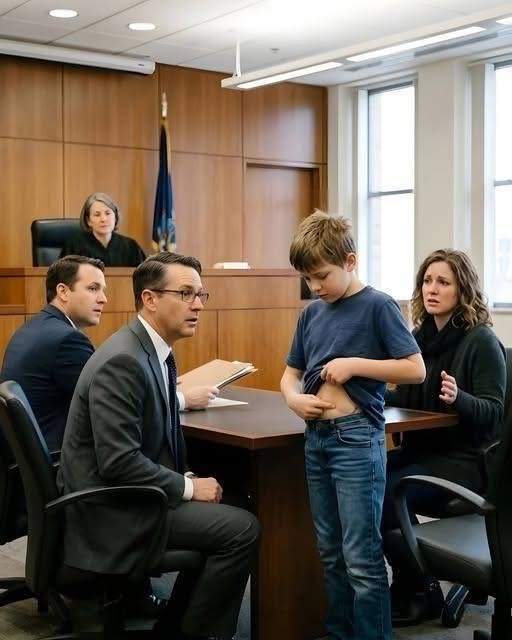
My ex-husband bankrupted me, got me fired, and starved us. In family court, his lawyer held up a photo of our 8-year-old son in a dirty shirt to steal full custody. “She can’t even provide clean clothes. She’s an unfit mother,” the lawyer sneered.

My wealthy ex smirked, wearing a $10k watch. He thought I was broken. But he didn’t expect my 8-year-old son to stand up. My boy lifted the hem of that faded, “dirty” shirt and showed the judge something that made my ex turn ghost-white…
The family courtroom in Knoxville felt colder than the freezing January air outside. I sat at the narrow wooden table with my eight-year-old son, Nolan, beside me, his small hand tucked inside mine.
He wore a navy-blue shirt with a tiny moon embroidered above the pocket. I had scrubbed it until my knuckles were raw, but a few stubborn stains still wouldn’t come out.
Across the aisle sat my ex-husband, Grant.
He looked completely comfortable.
Tailored charcoal suit. Expensive attorney beside him. A $10,000 watch on his wrist—the same kind of luxury he somehow afforded after claiming he was “too broke” to pay child support.
For two years, Grant had made my life smaller piece by piece. Anonymous complaints cost me my job. Landlords suddenly stopped wanting us as tenants. Money disappeared faster than I could replace it, and every setback seemed to arrive right when I was starting to recover.
By the time we walked into family court, I was exhausted, broke, and terrified that exhaustion itself would be used against me.
Then Grant’s attorney stood.
Carroway lifted a large glossy photograph where the judge could see it clearly. It showed Nolan leaving school a few days earlier in that same blue shirt, dark sticky stains smeared across the fabric. He looked tired and rumpled.
“Your Honor, this image taken by our investigator speaks for itself,” Carroway said. “The child is repeatedly seen wearing soiled clothing. His mother lives in squalor and works erratic hours. She cannot even provide consistently clean attire. She is completely unfit to be a mother!”
I felt Nolan’s fingers tighten around mine.
His head dropped. His ears turned bright pink.
Grant smirked.
That hurt more than the accusation.
Four months earlier, after Grant’s sabotage had left me with almost nothing, I had pawned my grandmother’s antique locket. It was the only valuable thing I still owned.
I used the money to buy Nolan that exact shirt for his birthday.
He loved the little embroidered moon.
Now the shirt I had sacrificed something precious to give him was being held up as proof that I didn’t love him enough.
I wanted to defend myself. I wanted to explain every missed paycheck, every late-night shift, every load of laundry washed by hand when money was too tight for anything else.
But every explanation sounded weak against that glossy photograph.
Carroway had a picture.
Grant had money.
I had a stained shirt and a little boy being humiliated in front of strangers.
For one terrible moment, I thought Grant had finally done it. I thought he had pushed me so far down that I no longer had anything left to fight with.
Then Nolan’s hand slipped out of mine.
I turned toward him.
He slid off his chair and stood.
Before I could whisper his name, my eight-year-old son walked toward the judge’s bench. His shoulders were small, but they were squared. His sneakers made soft sounds against the courtroom floor as every adult in the room watched him.
“Your Honor,” Nolan said, his voice clearer than I expected. “My dad’s lawyer is lying.”
Carroway frowned.
Grant’s smirk tightened.
I couldn’t move.
Nolan turned just enough to face his father. He never looked away from Grant as he reached down and grabbed the hem of the faded blue shirt they had just used to shame both of us.
His fingers curled into the fabric.
Then my son pulled the shirt higher.
PART 2 — THE SHIRT THEY USED AS EVIDENCE
Nolan pulled the shirt higher.
At first, I did not understand what I was seeing.
His stomach.
His thin ribs.
The pale skin above the waistband of his jeans.
Then the courtroom disappeared around me.
There were bruises.
Not one.
Several.
Darkening along his right side beneath the rib cage.
A yellow-purple mark near his hip.
And just above it, a small square bandage with the logo of his elementary school nurse printed across the edge.
My hand flew to my mouth.
“Nolan.”
My voice barely existed.
He looked at the judge.
“Dad did this.”
Everything stopped.
The air.
The lawyers.
Even the court reporter seemed to freeze for half a second before her fingers began moving again.
Grant’s face turned white.
Not pale.
White.
Carroway stood so quickly his chair scraped backward.
“Your Honor, I object to—”
Judge Evelyn Hart raised one hand.
“Sit down.”
Carroway stopped.
“Your Honor, this is highly improper. The child has not been called as a witness, there has been no foundation, and—”
“I said sit down, Mr. Carroway.”
The judge’s voice was not loud.
It did not need to be.
Carroway sat.
Grant did not.
He stared at Nolan.
“Nolan.”
The sound of his father saying his name changed my son immediately.
His shoulders tightened.
His shirt dropped from one hand.
He took one small step backward.
That movement said more to me than the bruises.
Fear had a posture.
And my son knew it.
Judge Hart noticed too.
She leaned forward.
“Nolan.”
He looked at her.
“Would you like to come back to your mother?”
He nodded.
“Yes, ma’am.”
“Then go sit beside her.”
He walked back.
The second he reached me, I pulled him gently against my side.
I wanted to hold him.
I wanted to inspect every bruise.
I wanted to ask why he had not told me.
I wanted to scream at Grant.
Instead, I did none of those things.
Because Nolan was shaking.
And for once, what I wanted mattered less than what he needed.
I whispered:
“I’m right here.”
His fingers closed around mine.
Across the aisle, Grant finally sat.
He did not look rich anymore.
Not powerful.
Not untouchable.
He looked like a man whose child had just opened a door he had spent months barricading.
Judge Hart removed her glasses.
“Mr. Carroway.”
“Yes, Your Honor?”
“Your petition argues that Ms. Porter’s alleged neglect places this child at risk.”
“Yes.”
“And you have now heard an allegation from the child himself that these injuries occurred while he was with your client.”
Carroway glanced at Grant.
“An allegation, Your Honor.”
“Correct.”
The judge’s voice sharpened.
“Which is why nobody in this courtroom is going to decide its truth in the next thirty seconds.”
She turned toward the bailiff.
“Please contact the guardian ad litem and child protective services representative assigned to this docket.”
Grant leaned toward his attorney.
Carroway whispered something.
Then Grant shook his head hard.
I saw anger break through the fear.
“This is ridiculous.”
The judge looked at him.
“Mr. Porter.”
“My son is confused.”
Nolan’s fingers dug into mine.
Grant continued.
“He roughhouses.”
“He falls.”
“He’s eight.”
Judge Hart stared at him.
“Your son has not yet been asked a single substantive question.”
Grant stopped.
The judge let that fact sit in the room.
Then she said:
“Do not speak to the child.”
Grant’s jaw tightened.
“Yes, Your Honor.”
His watch gleamed beneath the courtroom lights.
Ten thousand dollars.
And suddenly it looked absurd.
A glittering thing on the wrist of a man who had spent two years telling everyone around him that money was proof he knew how to care for a child.
A woman named Ms. Reeves arrived twenty minutes later.
She was Nolan’s guardian ad litem.
I had met her twice before.
She always wore sensible shoes and spoke in the steady tone of somebody who had learned that family court contained enough emotion already.
She knelt beside Nolan.
“Hey, buddy.”
“Hi.”
“Remember me?”
“Yes.”
“Can I talk with you somewhere private?”
He looked at me.
That broke my heart.
Not because he was afraid of her.
Because he was checking whether I would disappear if he left the room.
I squeezed his hand.
“I’ll be right here.”
Grant shifted across the aisle.
Nolan noticed.
The guardian did too.
She said:
“You can bring your mom to the door.”
That was enough.
We walked to a small conference room behind the courtroom.
I stopped at the doorway.
Nolan turned back.
“Mom?”
“Yes?”
“If I tell her everything, am I going to have to live with Dad?”
My stomach dropped.
“No one can promise you what a judge will decide.”
Ms. Reeves answered gently before I could.
“But telling the truth will not get you in trouble.”
Nolan swallowed.
Then:
“Dad said it would.”
My whole body went cold.
Ms. Reeves’s expression did not change.
“That’s something you can tell me about.”
Nolan nodded.
Then entered the room.
The door closed.
And I stood in the hallway trying to remember how to breathe.
Grant’s attorney approached.
My lawyer, Danielle Cross, stepped between us immediately.
“Not now.”
Carroway lifted both hands.
“I need to discuss a possible stipulation.”
“With me.”
Danielle said.
“Not my client.”
I almost laughed.
Six months ago, I would have felt small behind her.
That morning, I felt protected.
There is a difference.
Carroway lowered his voice.
“This situation has escalated unnecessarily.”
Danielle stared at him.
“A child just disclosed injuries.”
“That does not establish causation.”
“No.”
“And neither does a photograph of ketchup establish neglect.”
His face tightened.
That sentence surprised me.
I looked at Danielle.
She glanced at me.
Later.
Apparently she had already started thinking about the photograph differently.
Grant stood several feet away.
He was typing furiously on his phone.
Then he caught me looking at him.
His expression changed.
For one second, I saw the man I had married.
The charming one.
The calm one.
The man who used to kneel on the kitchen floor and build Lego towers with Nolan.
He gave me a look that said:
Please.
Not apology.
Not yet.
Just:
Stop this.
Protect me.
Old habits moved inside me.
Marriage teaches reflexes long after love ends.
Then I looked at my son’s empty chair.
I turned away.
Nolan came back almost forty minutes later.
His eyes were swollen.
Ms. Reeves walked beside him.
She whispered something to Danielle.
Danielle’s face changed.
Then Ms. Reeves approached the bench.
“Your Honor, may we have a brief conference?”
The judge nodded.
Lawyers approached.
Quiet discussion.
I could hear nothing.
Grant kept glancing toward Nolan.
Nolan stared at the floor.
Finally, the judge returned.
She addressed the courtroom.
“This matter will be recessed for thirty minutes.”
She looked directly at Grant.
“Mr. Porter, you are not to have contact with Nolan during the recess.”
Grant stood.
“Your Honor—”
“No.”
One word.
He sat again.
I looked at Nolan.
“What happened?”
He leaned into me.
Then whispered:
“Dad made the shirt dirty.”
I stopped breathing.
“What?”
His voice became smaller.
“The picture.”
I stared.
“What do you mean?”
He swallowed.
“That day when Dad picked me up from school.”
I remembered.
Three days earlier.
Grant had exercised a midweek visit.
Nolan returned two hours later saying his stomach hurt.
The blue shirt had been stained.
I washed it that night.
He had told me he spilled something.
I did not ask much.
Why would I?
Eight-year-olds spill things.
“What happened?”
I whispered.
“Dad bought a chocolate milkshake.”
My skin went cold.
“He said I could have it.”
“We were in the parking lot near school.”
“He told me to hold it.”
Then Nolan’s face twisted.
“He knocked it into me.”
I stared.
“He what?”
“Like this.”
Nolan mimed bumping his own arm.
“It spilled on my shirt.”
“He got mad.”
“Said I was careless.”
“Then that man took pictures.”
The investigator.
My entire body went numb.
“Was the man already there?”
Nolan nodded.
“Yes.”
“Did Dad know him?”
“Yes.”
“They talked first.”
My heart pounded.
“What happened after?”
“Dad said Mom should buy me better clothes.”
I nearly broke.
The shirt.
My grandmother’s locket.
The moon.
The hours I spent scrubbing it.
Grant had taken something I sacrificed to give our child and dirtied it so he could photograph the result.
Then he had returned Nolan to me and waited for court.
“Nolan.”
My voice shook.
“Why didn’t you tell me?”
His face crumpled.
“Dad said if I did, the judge would think I was lying.”
Then:
“He said judges don’t like kids who choose sides.”
I closed my eyes.
Of course.
He had taught an eight-year-old that speaking truth was betrayal.
“And the bruises?”
Nolan froze.
I immediately stopped.
“You do not have to tell me.”
He looked surprised.
“I’m not mad.”
“I promise.”
“You can tell the people whose job it is to ask.”
Tears filled his eyes.
Then he leaned against me.
“Okay.”
That was all.
When court resumed, Ms. Reeves spoke first.
“Your Honor, based on my interview with Nolan, I am requesting an immediate modification of the temporary parenting arrangement pending investigation.”
Carroway stood.
“We object.”
Judge Hart looked at him.
“I expected that.”
Ms. Reeves continued.
“The child reports that during the last visit, Mr. Porter intentionally caused food to spill onto the shirt subsequently photographed by the private investigator.”
A murmur moved through the courtroom.
Carroway’s face tightened.
“That is hearsay.”
“This is a temporary custody proceeding.”
Judge Hart replied.
“I will consider appropriate information with the weight it deserves.”
Ms. Reeves continued.
“The child additionally reports being grabbed around the torso during a separate argument at his father’s residence three nights earlier.”
My stomach dropped.
I turned toward Nolan.
He stared straight ahead.
She continued.
“Nolan reports his father became angry when he refused to tell his mother that he wanted to live primarily with his father.”
Grant stood.
“That is a lie.”
The bailiff immediately moved.
Judge Hart’s voice cut through the room.
“Sit down.”
Grant did not.
“Your Honor, my son has been coached.”
Nolan flinched.
The judge saw.
Everyone saw.
Judge Hart’s face hardened.
“Mr. Porter, sit down now.”
He did.
For the first time since the divorce, I saw Grant lose control publicly.
That mattered.
He had built his entire power around appearing reasonable while I appeared desperate.
Money made him polished.
Exhaustion made me look scattered.
He had spent two years betting everyone would confuse presentation with character.
Now his own anger was damaging the costume.
Danielle stood.
“Your Honor, in light of the child’s disclosure regarding the investigator photograph, we request production of all raw images, metadata, communications, invoices, and instructions between Mr. Porter, counsel, and the investigator.”
Carroway stood.
“That is overly broad.”
“Your own exhibit is now alleged to have been staged.”
Danielle replied.
“The chain of creation is directly relevant.”
Judge Hart nodded.
“Granted as to the photograph and closely related communications.”
Carroway looked at Grant.
Grant stared at the table.
Then Danielle added:
“We also request preservation of the school’s exterior security footage from the date in question.”
My head turned toward her.
She had thought of it.
Of course.
The school parking lot had cameras.
Grant’s face changed.
Barely.
But enough.
Danielle saw.
So did I.
For the first time that morning, hope entered me.
Not victory.
Hope.
There might be a camera.
The truth might exist somewhere that had no memory to intimidate.
Then Judge Hart spoke directly to Grant.
“Pending further investigation, your unsupervised parenting time is suspended.”
His face went rigid.
“Your Honor.”
“Supervised contact may be arranged through the approved center after consultation with the guardian ad litem.”
“You’re taking my son because of one story?”
The judge’s expression cooled.
“No, Mr. Porter.”
“I am entering a temporary protective order because there are allegations of physical handling, possible witness intimidation, and possible fabrication of evidence.”
She leaned forward.
“Do not simplify what I just said.”
Grant looked at Nolan.
It was only a glance.
But Nolan moved closer to me.
The judge noticed that too.
Then she turned to me.
“Ms. Porter.”
I stood.
“Yes, Your Honor?”
“This order is not a final determination that every allegation is true.”
“I understand.”
“You are also instructed not to question Nolan about the details beyond what is necessary for his immediate care.”
“Yes.”
“Allow trained professionals to do that.”
“Yes.”
“And do not discuss this case with him as though he is responsible for the outcome.”
My throat tightened.
“I won’t.”
She nodded.
Then:
“Children should not have to carry the litigation of their parents.”
That sentence stayed with me.
Because Grant had already made Nolan carry too much.
I refused to add my side of the weight.
We left through a side hallway.
Nolan held my hand.
Outside, snow had started falling.
Small flakes.
Almost beautiful.
I knelt beside him near the courthouse steps.
“Are you okay?”
He shrugged.
“I think.”
“Good answer.”
“Is Dad mad?”
I wanted to say:
Who cares?
Instead:
“Probably.”
Nolan looked frightened.
I touched his cheek.
“His feelings are not your job.”
He stared.
“But I told.”
“Yes.”
“He said—”
“I know.”
I swallowed.
“Telling the truth does not make you responsible for what happens to an adult because of it.”
His eyes filled.
“What if he hates me?”
My heart split open.
“Nolan.”
I took both his hands.
“Adults are responsible for loving children without making children earn safety through silence.”
He blinked.
Maybe too many words.
So I made it smaller.
“You did not do anything wrong.”
“Promise?”
“Promise.”
He nodded.
Then asked:
“Can we get hot chocolate?”
I almost laughed.
“Yes.”
Eight years old.
Courtroom bombshell.
Then hot chocolate.
Thank God children still have places trauma has not yet reached.
Danielle called me that night.
“Nolan’s school had the footage.”
I sat straight up.
“What?”
“They preserved it.”
My hands started shaking.
“Can we see it?”
“Not yet.”
“But the school’s counsel confirmed there is video from the pickup area.”
My heart pounded.
“And?”
“They won’t characterize everything over the phone.”
Then:
“But they confirmed Grant’s vehicle was parked there for approximately twenty minutes before Nolan exited the school.”
I frowned.
“So?”
“The investigator’s photograph was timestamped seven minutes after Nolan got into Grant’s car.”
I stopped.
“That means…”
“Yes.”
Danielle’s voice hardened.
“The photograph Carroway described as Nolan ‘leaving school’ was not taken when he exited the building.”
“It was taken after he had already been with Grant.”
My whole body went cold.
Not proof of the milkshake yet.
But the courtroom description had been false.
They had presented the image as though the dirt existed before Grant had custody.
It didn’t.
The timeline cracked their story open.
“Does Carroway know?”
“He will.”
“Tomorrow.”
I should have felt triumphant.
Instead, I thought of Nolan holding a milkshake his father planned to spill.
My little boy realizing halfway through some adult setup that he was not being treated like a son.
He was being used like an exhibit.
I went into his room.
He was asleep.
The moon shirt hung over the back of a chair.
I touched the tiny embroidered crescent.
Then cried quietly.
Two days later, the school footage arrived.
Danielle watched it first.
Then called me to her office.
“You should see this.”
I sat beside her.
Video.
No sound.
Timestamp in the corner.
Nolan exited school.
Clean shirt.
There.
The moon visible.
No dark stains.
My breath caught.
He approached Grant’s SUV.
Grant hugged him.
For one second, they looked normal.
Then an unfamiliar sedan pulled into the next row.
The investigator.
Grant walked over.
They spoke.
The investigator raised a camera.
Grant returned to Nolan.
Opened the passenger door.
Reached inside.
Then handed Nolan a drink.
Several minutes passed.
Nolan stood beside the vehicle.
Grant gestured.
Nolan shook his head.
Grant’s posture changed.
Then he grabbed Nolan by the upper arm.
Not violently enough for the camera to show everything.
Enough.
He repositioned him.
Then, suddenly, the cup tipped.
Dark liquid across the shirt.
I stopped breathing.
Nolan jumped backward.
Grant pointed toward him.
The investigator raised the camera.
Click.
Click.
Click.
Even without sound, the sequence was unmistakable.
Danielle paused the footage.
I stared at the screen.
Clean child.
Father.
Drink.
Spill.
Photograph.
The courtroom exhibit had not captured neglect.
It had captured a setup.
“Can he explain this?”
I whispered.
“People can explain anything.”
Danielle said.
“That doesn’t mean the explanation survives evidence.”
She pressed play again.
The investigator took several more pictures.
Then Grant wiped Nolan’s face.
Bent down.
Spoke to him.
Nolan looked at the ground.
Then the video ended.
I covered my face.
“He knew a school camera might see.”
“Maybe he didn’t realize the angle.”
“How could he be that arrogant?”
Danielle looked at me.
“People who control the story for long enough often stop imagining someone else has a copy.”
That sentence stayed with me too.
The investigator changed his story quickly.
His name was Brent Holcomb.
Once subpoenaed, he denied knowing Grant intended to spill anything.
He said Grant told him Nolan frequently arrived from my care in dirty clothing and asked him to document the condition.
Then the school video showed Nolan leaving clean.
Holcomb insisted he did not notice.
Maybe.
Then discovery produced a text.
From Grant.
Sent the morning of the photograph.
Need a clear image today. Same shirt if possible.
Holcomb replied:
Understood.
Another message.
Grant:
Make sure the stains read on camera.
I stared at those words until nausea rose in my throat.
Danielle looked at me.
“This is useful.”
Useful.
Legal language sometimes sounds obscene next to emotional reality.
My son’s humiliation.
Useful.
But she was right.
Then something bigger happened.
Holcomb turned over his invoice history.
He had worked for Grant before.
Not once.
Eleven times.
Not only custody surveillance.
He had photographed me leaving work.
My apartment.
Nolan’s school.
The grocery store.
Then one invoice description made Danielle go quiet.
Employment verification — communication with HR contact.
I stared.
“What does that mean?”
She looked at me.
“Do you remember the anonymous complaint that got you fired?”
My whole body went cold.
Of course I remembered.
I had worked accounts receivable for a medical equipment company.
Someone claimed I had improperly accessed customer records.
My employer investigated.
No criminal finding.
No proof.
But they said trust had been damaged.
I lost the job anyway.
“I thought the complaint was anonymous.”
“So did your employer.”
Danielle tapped the invoice.
“This suggests Holcomb may know more.”
My hands started shaking.
“Grant got me fired?”
“We do not know that yet.”
Facts.
Again.
But my body had already begun assembling two years into one pattern.
The job.
The landlord suddenly refusing to renew.
The daycare reporting a “concern” that was investigated and dismissed.
My bank account repeatedly falling behind because Grant delayed child support until enforcement deadlines.
Every time I stood up, something unseen knocked my knees out.
I had thought I was unlucky.
Maybe I had been targeted.
Danielle said:
“We’re going to follow the documents.”
I nodded.
Then whispered:
“I’m scared.”
“Of what?”
“That if all of this is true, I was not failing.”
She looked confused.
“That should be relief.”
“No.”
Tears filled my eyes.
“Because if I was failing, maybe I could have worked harder.”
“If he was doing this on purpose…”
I stopped.
Then:
“How do you outrun somebody who keeps moving the ground?”
Danielle’s face softened.
“You stop running alone.”
That answer almost broke me.
Holcomb eventually admitted he contacted my former employer.
He claimed he was conducting a “background verification” for Grant because Grant worried about Nolan being exposed to confidential medical information.
Nonsense.
But it led to emails.
One from Grant.
Subject:
Concern regarding employee conduct.
Sent from a throwaway account.
Same wording as the anonymous complaint.
Not absolute proof by itself.
Then forensic review linked a recovery phone number to a prepaid device paid for with Grant’s card.
The story tightened.
My former employer reopened its internal file.
They found the complaint contained details not available to the public.
Details Grant knew because I once vented to him about work procedures during the marriage.
I cried when I saw that.
Not because I wanted the job back.
Because I remembered sitting at our kitchen table before the divorce, trusting my husband with boring details of my day.
Years later, he had apparently turned those details into a weapon.
He had known exactly which accusation would sound plausible.
Not because he knew my employer.
Because he knew me.
That betrayal felt more intimate than the custody hearing.
Then came the apartment.
Our second landlord after the divorce.
The one who refused renewal with thirty days’ notice after a year of perfect rent payments.
Danielle found an email.
Grant to Holcomb:
See if landlord understands there may be custody instability. Don’t threaten. Just make him nervous.
I stared at it.
My hands went cold.
Grant had never needed to say:
Evict her.
He simply created fear around me and let other people do the damage.
That was his gift.
Pressure without fingerprints.
Except now there were fingerprints.
Emails.
Invoices.
Metadata.
Messages.
A school video.
The story he built had become too large to hide inside charm.
Grant stopped smirking in court.
The next hearing, his ten-thousand-dollar watch remained.
But his face had changed.
He looked tired.
Carroway looked worse.
The judge began with the school video.
Then the messages.
Then the investigator’s invoice.
Carroway tried to distance himself from how the photograph had been created.
Judge Hart asked directly:
“Did you know the image had been taken after the child entered your client’s custody?”
Carroway paused.
“That was not my understanding when I initially offered it.”
Important answer.
Not denial forever.
His own reputation now depended on truth too.
The judge turned toward Grant.
“Mr. Porter, did you instruct an investigator to create evidence intended to make it appear your son arrived from his mother’s care in soiled clothing?”
Grant’s lawyer whispered to him.
Grant stared straight ahead.
“I invoke my right not to answer on advice of counsel.”
The courtroom went completely silent.
My breathing stopped.
Not a confession.
I knew that.
The judge knew it.
But the man who once loved explaining how incompetent I was suddenly had nothing to say.
That was enough for that day.
The bruises were investigated separately.
Medical examination found they were consistent with Nolan’s description of being gripped forcefully around the side and hip, though medicine could not say exactly who caused every mark.
That distinction mattered.
Nolan’s interview was handled by trained professionals.
Not me.
I never made him retell the story at the dinner table.
What I learned later was enough.
During visitation, Grant repeatedly pressured Nolan to say he wanted to live with him.
Nolan refused.
Grant became angry.
Grabbed him.
Told him:
“You are making this harder than it needs to be.”
Then:
“If your mother loses custody, it will be because she cannot take care of you.”
My son had carried that sentence for days.
He thought every stain, every late bill, every cheap dinner might eventually be used to take me away.
Grant had not only sabotaged my life.
He had taught Nolan to watch me struggle and interpret it as danger.
I hated him for that more than I hated him for my job.
Therapy became part of Nolan’s week.
At first, he hated it.
“Do I have to talk about Dad?”
“No.”
“Then what do I talk about?”
“Anything.”
“That’s dumb.”
Fair.
For three sessions he talked about Minecraft.
Then dinosaurs.
Then school.
Then one day he came home and asked:
“Mom?”
“Yes?”
“Are we poor because of me?”
My heart stopped.
“What?”
“Dad said court costs money.”
I sat beside him.
“Nolan.”
“No.”
I took his hands.
“Adults make financial decisions.”
“Adults pay lawyers.”
“You are never responsible for whether I have money.”
He stared.
“But you sold Grandma’s necklace for my shirt.”
The locket.
My throat tightened.
“How do you know?”
“I heard you tell Aunt Melissa.”
Of course.
Children hear everything adults imagine they miss.
I swallowed.
“I sold the locket because I chose to.”
“You didn’t make me.”
“But it was for me.”
“Yes.”
“Do you want it back?”
I started crying.
“No.”
I touched the moon on his shirt.
“I wanted you more than I wanted an object.”
He frowned.
“But Grandma gave it to you.”
“Yes.”
“And I loved it.”
“Then why sell it?”
“Because sometimes love changes form.”
He looked confused.
So I made it smaller.
“It was a necklace.”
“Then it became your shirt.”
That made him smile.
A little.
Then:
“Even with stains?”
“Especially with stains.”
My former employer eventually offered me my job back.
Not immediately.
There were lawyers.
Apologies.
HR review.
Their attorney called what happened “a serious process failure.”
Another respectable phrase.
I did not return.
Instead, they settled my employment claim and gave me a neutral-to-positive reference.
That money saved us.
Not made us rich.
Saved us.
I paid overdue bills.
Moved into a better apartment.
Bought groceries without calculating every item in my head.
Then I did something extravagant.
I bought a washing machine.
Used.
Nothing fancy.
When it completed the first cycle in our new place, I sat on the floor and cried.
Nolan found me.
“Mom?”
“I’m happy.”
“You cry weird.”
True.
I watched clean shirts tumble in the dryer.
There are people who think poverty is dramatic.
Mostly it is repetitive.
Counting quarters.
Choosing which bill.
Scrubbing stains by hand because laundromat money became lunch money.
Relief is repetitive too.
Clean towels.
A full refrigerator.
Shoes bought before the old pair develops holes.
Ordinary dignity returning one household task at a time.
The custody case changed slowly.
Not one magical hearing.
No judge declared Grant evil and handed me a victory.
Supervised visitation continued.
Then was reduced when Nolan became distressed.
Evaluations.
Reviews.
Evidence.
Grant’s own conduct.
Over time, the court placed primary custody with me and tightly structured Grant’s contact around Nolan’s safety and therapeutic recommendations.
The court also referred concerns about evidence manipulation and other conduct to appropriate authorities.
Some matters became separate civil issues.
Others had potential criminal implications.
I learned to stop needing one courtroom to solve everything.
Family court could protect Nolan.
Employment proceedings could address my job.
Financial discovery could address money.
Different doors.
Different keys.
Grant’s power had depended on making everything feel like one enormous personal failure.
The law broke it into facts.
That helped.
The financial discovery hurt almost as much as anything.
Grant had claimed business losses.
Low liquidity.
High expenses.
That was how he justified delayed support.
Then records showed discretionary spending far beyond what he admitted.
Luxury watches.
Travel.
Country-club payments.
Consulting fees to Holcomb.
Almost forty thousand dollars over two years spent investigating and pressuring me.
Forty thousand.
I stared at the number.
I had once skipped dinner so Nolan could have enough breakfast cereal for the week.
Grant spent thousands documenting my poverty while helping create it.
That detail reached the judge.
She did not appreciate the irony.
Neither did I.
Support orders changed.
Arrears were addressed.
Fees shifted.
Again, not a lottery.
Not revenge.
But for the first time, money stopped flowing only in the direction of whoever already had more.
Grant wrote Nolan letters.
At first, the therapist screened them.
One said:
I’m sorry grown-up problems affected you.
I hated that.
“Grown-up problems.”
Passive.
Clouds simply forming overhead.
The therapist apparently did too.
The next letter was different.
I am sorry I asked you to say things you did not believe.
Better.
Then:
I am sorry I made the milkshake spill and let someone photograph you afterward.
My chest tightened.
Nolan read it.
Then put it down.
“Why is he saying sorry now?”
I answered carefully.
“Because maybe he understands more now.”
“Do I have to forgive him?”
“No.”
“Ever?”
“No.”
He thought.
“Can I later?”
“Yes.”
“What if I forgive him and then get mad again?”
“Yes.”
He frowned.
“That wasn’t the question.”
I laughed.
“You can.”
He smiled.
Good.
Emotions were no longer court exhibits in our house.
They were allowed to change.
Grant lost more than custody.
His business reputation suffered when litigation exposed some of what he had done.
People who once accepted his version of me began avoiding eye contact.
A few apologized.
Most did not.
I learned not to need them to.
The worst apology came from a woman I knew socially.
She said:
“I always wondered whether there was more to the story.”
I smiled.
“Then you should have wondered louder.”
She had no answer.
I walked away.
That was healing too.
Not performing graciousness for people who had enjoyed my humiliation quietly.
Carroway withdrew from representing Grant after the evidence-staging issue developed.
I never learned everything about what he knew and when.
I stopped caring.
One of the greatest freedoms of recovery is realizing not every unanswered question deserves permanent residence in your head.
Did Grant plan everything from the day we separated?
Probably not.
Did resentment grow into strategy?
Maybe.
Did he truly believe I was a bad mother at some point?
I don’t know.
Control does not always require self-awareness.
Sometimes people hurt you while sincerely believing the story that justifies it.
The harm does not become smaller.
Almost a year after Nolan stood in court, Grant and I attended a parenting conference with a therapist.
Supervised.
Structured.
The first time we had sat across from each other without lawyers.
He looked older.
No watch.
Plain shirt.
I noticed immediately.
Not because I cared about the watch.
Because once it had been armor.
Grant stared at his hands.
Then said:
“I wanted to win.”
I felt cold.
The therapist waited.
Grant continued.
“After the divorce, every time something went badly for you, I felt justified.”
“If she’s struggling, I thought, then I was right to leave.”
My jaw tightened.
“We both left.”
“Yes.”
He nodded.
“But you were the one who filed.”
I had forgotten that mattered to him.
He continued.
“When you got the apartment and kept Nolan primarily, I felt like I lost.”
“So I started looking for proof that you were failing.”
I stared.
“And when you couldn’t find it?”
He closed his eyes.
“I helped create it.”
There.
No lawyer.
No courtroom.
Truth.
I felt nothing like relief.
Just sadness.
“You got me fired.”
He nodded.
“Yes.”
“You contacted my landlord.”
“Yes.”
“You staged the shirt.”
His face broke.
“Yes.”
“You grabbed Nolan.”
He started crying.
“Yes.”
I wanted to scream.
Instead, I said:
“You did all of that because losing felt worse to you than hurting us.”
He covered his face.
“I think so.”
“That is terrifying.”
“I know.”
The therapist interrupted gently.
“Grant, do not ask her to reassure you.”
He lowered his hands.
“I wasn’t.”
“You were about to.”
She was right.
Old habits.
He breathed.
Then said:
“I am sorry.”
I looked at him.
“I believe you.”
His eyes lifted.
“But I do not trust you.”
He nodded.
“I understand.”
That was the correct answer.
Nolan eventually saw his father again in supervised settings.
Slowly.
At first, he barely spoke.
Grant did not push.
That mattered.
One afternoon they built a model airplane.
Nolan came home carrying it.
“Dad let me do the wings wrong.”
I smiled.
“Did you want them wrong?”
“Yes.”
“Then good.”
He stared at the model.
“Dad used to fix everything.”
I knew what he meant.
Not airplanes.
People.
Stories.
Outcomes.
“Maybe he’s learning.”
“Do grown-ups learn slow?”
“Painfully.”
Nolan nodded.
Then took the airplane to his room.
By twelve, Nolan’s contact with Grant had expanded modestly.
Only because Nolan wanted it.
Only after professionals agreed.
Grant had changed in some ways.
I acknowledge that.
Not for him.
For accuracy.
He stopped trying to win conversations.
Stopped criticizing me to Nolan.
Paid support consistently.
Attended therapy.
Accepted limits.
Never again hired an investigator.
Never again contested every ordinary parenting decision.
Change did not rewrite the past.
But Nolan deserved permission to know his father as a complicated human being rather than a monster I needed him to hate on my behalf.
That was one of the hardest gifts I ever gave my child.
Not access.
Freedom from my anger becoming his identity.
The blue moon shirt lasted another year.
Then Nolan outgrew it.
He refused to throw it away.
“Why?”
I asked.
“It’s famous.”
I laughed.
“Absolutely not.”
“It was in court.”
“That does not make it famous.”
He folded it anyway.
Put it in the back of his closet.
Years later, when we moved, I found it.
The stains were still faintly visible.
I held it.
For a moment, I was back in Knoxville.
Cold courtroom.
Grant’s smirk.
Carroway holding the glossy photograph.
My son standing.
Then I remembered the other part.
Nolan lifting the shirt.
Telling the truth.
Not because I asked him.
Because he had reached the limit of watching adults lie about his life.
I almost kept it.
Then asked him.
He was sixteen.
“Do you want this?”
He stared.
Then laughed.
“Why do you still have that?”
“You kept it.”
“I was nine.”
“Eight.”
“Same thing.”
“Do you want it?”
He thought.
Then:
“No.”
“Sure?”
“Yes.”
He took it from me.
Then dropped it into the donation bag.
No ceremony.
No fire.
No monument.
That mattered.
The shirt did not deserve to own us forever.
I bought another locket years later.
Not my grandmother’s.
That one was gone.
Some losses cannot be restored by purchasing substitutes.
Still, on my fiftieth birthday, Nolan gave me a small silver necklace.
Moon-shaped.
I opened the box and cried.
He rolled his eyes.
“You cry at everything.”
“Occupational hazard.”
He sat beside me.
“I remember the shirt.”
“I know.”
“Do you regret selling Grandma’s locket?”
I thought.
“Yes.”
His face fell.
Then I smiled.
“And no.”
“Helpful.”
“I regret needing to.”
“I don’t regret choosing you.”
His eyes filled.
He looked away quickly.
“Okay.”
Then:
“Put it on.”
I did.
A small moon against my chest.
Not replacement.
Continuation.
People love courtroom stories because they want one dramatic reveal to fix everything.
A child stands.
A shirt lifts.
A wealthy father turns pale.
Judge sees truth.
Mother wins.
The end.
Real life is slower.
Nolan’s courage did not instantly give me back my job.
It did not refill my bank account.
It did not erase bruises.
It did not restore my grandmother’s locket.
It did not heal the fear Grant had placed inside him.
What it did was stop the lie from moving forward unchallenged.
That was enough to begin.
One truth.
Then another.
School footage.
Messages.
Invoices.
Employment records.
Financial statements.
A custody draft.
A hidden complaint.
One document at a time, the life Grant had manufactured around me collapsed back into facts.
And facts were kinder than his story.
Even when they hurt.
Years later, Nolan asked:
“Were you really poor?”
We were driving him to college.
He was eighteen.
Same age I was when I thought adults understood life.
“Yes.”
“How bad?”
I smiled.
“You ate a lot of eggs.”
“I like eggs.”
“Because I sold poverty as breakfast enthusiasm.”
He laughed.
Then became serious.
“Were you scared I’d get taken away?”
My hands tightened around the steering wheel.
“Yes.”
“Did you think Dad would win?”
“Yes.”
He became quiet.
Then:
“I thought he would too.”
My chest hurt.
“How old were you when you thought that?”
“Eight.”
Of course.
He looked out the window.
“I thought money meant judges listened more.”
I swallowed.
“What do you think now?”
He shrugged.
“Money makes people louder.”
Then:
“But evidence lasts longer.”
I looked at him in the mirror.
My boy.
Not eight anymore.
“That’s pretty good.”
“I’m an engineering major.”
“Those two things are unrelated.”
He smiled.
Then asked:
“Do you hate Dad?”
I thought carefully.
“No.”
“Did you?”
“Yes.”
“For how long?”
“Long enough.”
He nodded.
“Do you forgive him?”
I looked toward the highway.
“I stopped needing that word.”
He frowned.
“Mom.”
“What?”
“That’s annoyingly vague.”
Fair.
I smiled.
“I don’t excuse him.”
“I don’t trust him with certain parts of my life.”
“I also don’t wake up angry anymore.”
“That’s where I ended up.”
He nodded.
“I think me too.”
That was enough.
Grant never became the father he imagined himself to be in court.
The superior one.
The wealthy provider arriving to rescue a child from a struggling mother.
Good.
That man had never existed.
But he eventually became something less impressive and more useful.
A father who showed up when permitted.
Accepted when Nolan said no.
Paid what he owed.
Listened more.
Defended less.
When Nolan graduated college, Grant sat three seats away from me.
No lawyer.
No investigator.
No photograph.
Just two aging parents watching their son cross a stage.
Nolan found us afterward.
Hugged me first.
Then Grant.
Nobody measured it.
Nobody won.
That may have been the healthiest family moment we ever had.
After photographs, Grant approached me.
He looked at the silver moon around my neck.
“Nolan give you that?”
“Yes.”
He nodded.
Then:
“I still think about that shirt.”
“So do I.”
He swallowed.
“I’m sorry.”
“I know.”
He almost smiled.
“Do you believe me?”
“Yes.”
He looked surprised.
“Does that matter?”
“To me?”
“No.”
I thought.
“It probably matters to you.”
He nodded.
Then:
“Thank you for not teaching him to hate me.”
My chest tightened.
“I didn’t protect you.”
“I protected him from carrying one more adult burden.”
Grant looked down.
“That sounds like you.”
Years ago, I might have taken that as a compliment.
Now it was simply observation.
He walked away.
I watched him join Nolan.
My son laughed at something he said.
I felt no jealousy.
No fear.
No need to know the joke.
Freedom.
The photograph Carroway held up in court still exists somewhere.
Maybe in an archived case file.
A glossy image of an eight-year-old child in a stained blue shirt.
If you looked only at the photograph, you might believe what Grant wanted you to believe.
Poor child.
Neglectful mother.
Look how dirty.
Pictures can lie without being fake.
That is something I learned.
A camera captures what is in front of it.
Not always who put it there.
Context is where truth lives.
Outside the frame was a father.
A milkshake.
An investigator.
A plan.
A mother who had washed that same shirt by hand.
A grandmother’s locket converted into birthday fabric.
A child who knew much more than adults realized.
That is why I no longer fear ugly photographs.
I fear stories that refuse context.
Nolan is twenty-six now.
He has a son.
My grandson, Caleb.
Last summer, Caleb came to my house wearing a white shirt covered in purple paint.
I opened the door and laughed.
“What happened to you?”
He grinned.
“Art.”
Nolan stood behind him.
“He ignored the apron.”
Caleb looked worried.
“Grandma, is my shirt bad?”
I froze for half a second.
Then knelt.
“No.”
“It’s dirty.”
“Yes.”
“Is that bad?”
“No.”
“Sometimes dirty clothes mean somebody had a good day.”
He smiled.
Then ran inside.
Nolan stayed at the door.
He had heard.
Of course.
He looked at me.
“You okay?”
“Yes.”
He smiled.
“Good.”
Then walked inside.
Later that night, I found purple paint on my sofa.
Of course.
I stared.
Then laughed.
There was once a time when a stain meant evidence.
Neglect.
Court.
Fear.
Now a stain was simply a child making something with his hands.
That change felt almost sacred.
I wiped what I could.
A faint mark remained.
I left it.
Not intentionally.
It just never came out.
Some stains are like that.
They stay.
But they stop telling the same story.
If I could go back to that courtroom morning, I would not tell myself that everything works out.
That would be dishonest.
There were brutal months ahead.
Bills.
Depositions.
Therapy.
Evidence requests.
More court.
Nights when Nolan woke crying.
Mornings when I stared at the refrigerator wondering whether groceries would last.
I would not promise easy.
I would tell myself something better.
That photograph is not the whole story.
That watch is not power.
Your poverty is not a character flaw.
Your exhaustion is not evidence against your motherhood.
And your son should never have needed to stand up for you—
but when he does, listen.
Not because an eight-year-old should save his mother.
He should not.
But because children often tell the truth adults have made too complicated.
Grant had spent two years making me believe I was failing.
Nolan lifted one faded shirt and forced everyone to look underneath the story.
There were bruises.
There was fear.
There was evidence.
And eventually, there was proof that the dirt everyone blamed on me had been placed there by the person pointing at it.
That was the pattern of my whole life with Grant.
He created instability.
Then photographed me standing inside it.
He took resources.
Then called me poor.
He damaged work.
Then called me unemployed.
He frightened landlords.
Then called me homeless.
He stained a shirt.
Then called me neglectful.
Once I saw the pattern, I stopped defending each stain separately.
I started showing where they came from.
That changed everything.
The moon necklace rests against my chest as I write this.
Nolan is downstairs with Caleb.
I can hear them laughing.
Someone just dropped something.
Probably expensive.
I am not investigating unless I smell smoke.
There is laundry in the dryer.
Food in the refrigerator.
Bills paid.
Nothing luxurious.
Everything abundant.
I once thought wealth was Grant’s watch.
His lawyer.
His house.
His ability to make one phone call and cause problems in places I could barely afford to enter.
I know better now.
Wealth is a child who does not have to monitor the adults in his life.
A kitchen where nobody counts bites.
A shirt that can get dirty without becoming a moral judgment.
A home where mistakes remain mistakes instead of ammunition.
A grown son who knows he can tell you something difficult without becoming responsible for what happens afterward.
That is the kind of rich I became.
Grant never bankrupted that.
He couldn’t.
All those years ago, when Nolan stood in court and lifted the hem of his shirt, Grant turned ghost-white because he thought my son was about to expose him.
He was right.
Just not in the way any of us understood yet.
Nolan did not merely reveal bruises.
He revealed the flaw in Grant’s entire strategy.
Grant believed the person with the most money controlled the story.
He forgot one thing.
Stories can be purchased.
Photographs can be staged.
People can be intimidated.
But truth has a strange habit of surviving in places nobody thinks to control.
A school camera.
A timestamp.
A child’s memory.
An invoice.
A text message.
A moon stitched above a pocket.
For two years, Grant had made my world smaller.
That morning, my eight-year-old son made the truth bigger than him.
And once that happened, no expensive watch in the world could turn time backward.
PART 3 — THE THINGS MONEY COULD NEVER BUY BACK
For a long time, I thought the day Nolan lifted his shirt in court was the day everything changed.
It was.
But not in the way people imagine.
Nothing became easy when the judge finally saw the bruises.
No music played.
No one handed me back the money I had lost.
My old job did not reappear.
My grandmother’s locket did not climb out of a pawnshop drawer and return to my neck.
Nolan did not stop waking at night just because adults finally believed him.
Truth is powerful.
But truth is not magic.
Sometimes all it does at first is stop the lie from moving forward.
Then you still have to rebuild whatever the lie already destroyed.
That was the part nobody photographed.
The first year after the custody case nearly broke me in an entirely different way.
Not because Grant was still winning.
Because once he stopped winning, I finally had enough room to feel how tired I was.
For two years, survival had kept me moving.
Find work.
Pay rent.
Answer lawyers.
Get Nolan to school.
Appeal another decision.
Explain another complaint.
Prove another accusation false.
When you spend long enough putting out fires, your body forgets that eventually the smoke will clear.
And when it does, you discover how badly your lungs hurt.
I would drop Nolan at school and sit in my car for ten minutes before driving away.
Sometimes twenty.
No crying.
No panic.
Just stillness.
I had forgotten what stillness felt like when it did not mean waiting for another disaster.
The civil case against Grant over the employment interference took almost eighteen months.
I hated it.
Every deposition felt like being asked to prove my own life again.
Where were you working on March 4?
When did you learn about the complaint?
Who had access to the information?
Why did you fail to obtain another equivalent job immediately?
That one nearly sent me over the table.
Immediately.
As if a thirty-eight-year-old single mother could snap her fingers and manufacture income after being publicly accused of mishandling confidential records.
As if reputational damage disappeared because the accusation had been false.
As if motherhood came with spare hours hidden somewhere inside the day.
My attorney squeezed my arm beneath the table.
I answered calmly.
That became another skill.
Not because anger was wrong.
Because Grant had spent years betting that if he wounded me deeply enough, my reaction would become more interesting than what caused it.
I stopped giving him that advantage.
The settlement eventually came.
More than I expected.
Less than what two years had cost.
That is usually how money works after damage.
It is precise on paper and clumsy everywhere else.
My former employer paid part.
Grant paid part.
There were confidentiality provisions around some pieces, though not the custody record.
I did not become wealthy.
I became able to breathe.
There is a difference.
I paid off medical debt.
Built emergency savings.
Bought Nolan a real winter coat instead of telling him the old one still had another season left.
Then I did something irrational.
I went back to the pawnshop where I had sold my grandmother’s locket.
The same bell rang above the door.
Same glass cases.
Different clerk.
I gave him the receipt I had kept for years.
He typed into the computer.
My heart pounded even though I knew how unlikely it was.
Finally, he looked at me.
“I’m sorry.”
Of course.
The locket had sold almost immediately.
I smiled.
“Do you know who bought it?”
He shook his head.
“Cash sale.”
I thanked him.
Walked outside.
Then cried in the parking lot.
Not because I thought the necklace would still be there.
Because some small irrational part of me had believed justice meant getting everything back.
It doesn’t.
Sometimes justice arrives after the object has already been melted down.
After the child has already learned fear.
After the marriage has already ended.
After the job has already been lost.
Justice cannot always restore.
Sometimes it can only stop the person who kept taking.
That has to matter too.
Nolan struggled more quietly.
At school, he became obsessive about his clothes.
If a shirt got stained at lunch, he wanted to change.
Immediately.
If there was mud on his pants after recess, he became anxious.
One day his teacher called because he had started crying after another child accidentally splashed chocolate milk onto his sleeve.
I picked him up.
He sat in the passenger seat staring at the stain.
“It’s okay.”
I said.
He shook his head.
“No.”
“Nolan.”
“People will think you don’t wash my stuff.”
My heart cracked.
He was nine years old.
And somewhere in him, stained fabric still meant losing his mother.
I pulled into a parking lot.
Turned off the engine.
Then faced him.
“Look at me.”
He did.
“Your shirt can be dirty.”
His lip trembled.
“Your shoes can be dirty.”
“Your hair can be messy.”
“You can spill ketchup down your entire front.”
A tiny smile appeared.
“That’s gross.”
“Extremely.”
Then I touched the chocolate stain.
“This does not say anything about whether I love you.”
He stared at it.
“Dad said judges notice stuff.”
“Yes.”
“And Dad was wrong about what it meant.”
His eyes filled.
“What if someone takes a picture?”
“Then they will have a picture of a kid who spilled chocolate milk.”
“That’s all.”
He leaned against the seat.
Then whispered:
“I hate pictures.”
That hurt.
So we worked on that too.
His therapist suggested something I thought was ridiculous.
Give Nolan a camera.
Let him decide what photographs meant again.
I almost laughed.
Then bought a cheap digital camera from a secondhand store.
At first he photographed nothing.
Then our cat.
Then clouds.
Then a broken sidewalk.
Then me asleep on the couch with my mouth open.
I threatened legal action.
He found that hilarious.
Soon he photographed everything.
A dirty plate after pancakes.
His sneakers after rain.
A spilled bag of flour.
His own shirt after painting at school.
One day he showed me a photograph of himself in the blue moon shirt.
He had drawn marker across it deliberately.
Purple stars.
Red circles.
A ridiculous orange dinosaur near the hem.
I stared.
“You drew on your court shirt?”
He grinned.
“It’s my shirt.”
Yes.
Yes, it was.
That was the whole point.
Grant had turned that fabric into evidence.
Nolan turned it back into clothing.
Then into art.
Then eventually into nothing important at all.
Children sometimes heal by reclaiming ordinary things adults made frightening.
Grant’s consequences continued.
Financial penalties.
Professional embarrassment.
Restricted parenting.
Court scrutiny.
But the greatest consequence was one no judge imposed.
Nolan stopped trusting him.
That loss devastated Grant more than money ever could.
At first, Grant responded exactly as I expected.
Too many gifts.
Expensive sneakers.
A gaming console.
A bicycle that cost more than my first car.
The supervised visitation center had to remind him repeatedly that gifts were not the purpose of visits.
Nolan noticed.
After the third expensive present, he came home irritated.
“Why does Dad keep buying stuff?”
“Maybe he’s trying to show you he cares.”
“He could just listen.”
I looked at him.
“What do you want him to listen to?”
“That I don’t want stuff.”
Children.
Brutally efficient.
At the next family session, Nolan told Grant himself.
“I don’t want presents every time.”
Grant looked stunned.
“What do you want?”
Nolan shrugged.
“To play cards.”
So they played cards.
No watch.
No lawyer.
No expensive box.
Just two people sitting across from each other with a deck between them.
Apparently rebuilding fatherhood began with Go Fish.
Grant was terrible at accountability at first.
He wanted the apology to produce a result.
He would say:
“I said I’m sorry.”
Then look at Nolan as though forgiveness were supposed to arrive on schedule.
The therapist corrected him.
“You are apologizing to repair the harm.”
“Not to control the response.”
Grant hated that sentence.
I could tell.
Eventually he stopped fighting it.
That mattered.
Real remorse is patient.
It does not keep asking when its punishment ends.
I rebuilt my career too.
Not the old one.
A better one.
After all those months reading legal records, financial documents, employment files, and custody exhibits, I realized I was extraordinarily good at finding patterns.
Maybe trauma had trained me.
Maybe I had always been that way.
I enrolled in a bookkeeping and fraud-examination program at the community college.
Night classes.
Terrible coffee.
Students twenty years younger than me.
Nolan did homework beside me at the kitchen table.
Sometimes he complained.
“Why do you have homework?”
“Because adulthood is a scam.”
He laughed.
Then went back to fractions.
Two years later, I took a job with a regional nonprofit reviewing grant finances.
Nothing glamorous.
I loved it.
Numbers had rules.
Documents had timestamps.
Transactions left trails.
After years of living inside Grant’s manufactured reality, there was something deeply comforting about evidence that did not care who wore the more expensive watch.
The first time I caught a financial inconsistency at work, my manager stared at the spreadsheet.
“How did you notice this?”
I shrugged.
“The pattern was too neat.”
She smiled.
“You’re good at this.”
I nearly cried.
Not because I needed praise.
Because for years Grant had told me I was scattered.
Bad with money.
Unreliable.
Overwhelmed.
Eventually insults repeated often enough become background music.
You stop noticing you are dancing to them.
That day, someone handed me a different soundtrack.
Competent.
Observant.
Useful.
I carried those words home.
By the time Nolan was twelve, Grant’s visits had slowly expanded.
Supervised first.
Then monitored.
Then several hours unsupervised after professional recommendation.
I hated the first unsupervised visit.
Not because Grant had done anything new.
Because memory does not respect updated evidence.
I watched Nolan get into his father’s car.
Same shape of scene as the school footage.
My body screamed:
Stop him.
Instead, I stood still.
Grant buckled his seat belt.
Nolan waved.
They drove away.
I went inside.
Walked directly to the sink.
Then vomited.
Healing is humiliating sometimes.
My mind trusted the process before my nervous system did.
They came back three hours later.
Nolan carried a milkshake.
Of all things.
I nearly laughed.
Grant looked embarrassed.
“He picked it.”
Nolan grinned.
“I didn’t spill it.”
I said:
“Congratulations on this historic achievement.”
He rolled his eyes.
Grant looked at me.
For one second, shame crossed his face.
The milkshake.
Of course he remembered.
He did not apologize in front of Nolan.
Good.
Children should not become audiences for every adult reckoning.
He simply said:
“See you next week.”
Then left.
I stood in the doorway and realized I had survived another ordinary afternoon.
That was what recovery became.
Ordinary afternoons.
At thirteen, Nolan stopped calling the visitation schedule “Dad time.”
He called it:
“Saturday.”
That made me strangely happy.
His father had become a part of his life.
Not the axis around which it turned.
Sometimes they had good visits.
Sometimes Nolan came home annoyed.
Once Grant grounded him for lying about homework.
Nolan stormed into my kitchen.
“Dad is ridiculous.”
I nearly laughed.
Not because Grant was necessarily wrong.
Because the complaint was normal.
Not:
Dad scared me.
Not:
Dad told me to lie.
Just:
Dad took my phone because I lied about algebra.
I said:
“Did you lie?”
Nolan stared.
“That’s not the point.”
“It feels relevant.”
He groaned.
Normal conflict.
There are things survivors never expect to become grateful for.
A teenager angry at his father over homework was one of mine.
Grant and I never became friends.
People sometimes expect divorced parents to achieve a cheerful friendship as proof of maturity.
No.
We became functional.
Respectful enough.
Boundaried.
That was healthier.
We used a parenting app for years.
Then email.
Eventually text.
No late-night emotional conversations.
No discussing old marriage wounds unless a therapist required it.
We did not turn our son’s milestones into opportunities to revisit ours.
That was another form of love.
Restraint.
When Nolan was fifteen, Grant asked to speak to me after a school event.
We stood in the parking lot beneath yellow lights.
He looked nervous.
“I want to tell him everything.”
My stomach tightened.
“He knows most of it.”
“Not the job.”
“Not the landlord.”
I stared.
“Why now?”
“Because he’s old enough to understand.”
“That’s not enough.”
Grant looked confused.
“What do you mean?”
“Why do you need to tell him?”
He became quiet.
Then:
“Because I don’t want him finding out someday and thinking I hid it.”
That was better.
But not sufficient.
“And?”
Grant looked down.
“Because I think I still want him to see me as better than I was.”
There it was.
Honest.
I nodded.
“Then don’t tell him until that second reason matters less.”
Grant stared at me.
Then gave a small sad smile.
“You’ve gotten brutal.”
“No.”
“I’ve gotten expensive to manipulate.”
He laughed once.
Fair.
He waited another year.
When Nolan was sixteen, his therapist helped facilitate the conversation.
Grant told him.
The anonymous complaint.
The landlord.
The investigator.
The money.
Everything appropriate for his age.
Nolan listened silently.
Then asked:
“Why?”
Grant answered:
“Because I wanted your mother to fail.”
No excuses.
No:
I was hurt.
No:
Divorce makes people crazy.
I watched Nolan absorb it.
Then:
“Even if that hurt me?”
Grant’s face collapsed.
“I told myself it wouldn’t.”
“That’s not what I asked.”
My boy.
Still direct.
Grant swallowed.
“Yes.”
Tears ran down his face.
“Yes, I was willing to risk hurting you because I wanted to beat her.”
Nolan stared at him.
Then stood.
“I need to go.”
Grant nodded.
“Okay.”
No grabbing.
No demanding forgiveness.
No:
We’re finishing this conversation.
He let him leave.
That was growth.
It did not erase the earlier harm.
It made the present safer.
Both mattered.
Nolan did not see Grant for six weeks after that.
His choice.
Grant respected it.
Then one afternoon Nolan said:
“I think I want lunch with Dad.”
“Okay.”
“You’re not going to say anything?”
“What should I say?”
“I don’t know.”
He looked suspiciously at me.
“You used to hate him.”
“Yes.”
“Do you still?”
“No.”
“How?”
I thought.
“Because hate was expensive.”
He frowned.
“Like therapy?”
“Much more expensive.”
He smiled.
Then I became serious.
“I stopped needing him to suffer for me to feel safe.”
Nolan considered that.
Then:
“Do you trust him?”
“With you?”
“More than I used to.”
“With my bank account?”
“Absolutely not.”
He laughed.
Good.
We had reached a place where truth could include humor.
That was healing too.
Grant’s wealth changed.
His company suffered after the court records and related litigation became known.
He did not become poor.
Not remotely.
But he lost clients.
Sold the big house.
The ten-thousand-dollar watch disappeared.
I never asked whether he sold it.
Years later, Nolan told me.
“He gave it away.”
“To who?”
“A charity auction.”
I laughed.
“Of course he did.”
“What’s funny?”
“Nothing.”
It was almost too symbolic.
The watch that once flashed beneath courtroom lights while I sat terrified of losing my child was eventually converted into money for a nonprofit.
Life enjoys irony when given enough years.
My grandmother’s locket remained gone.
For a long time, I thought the silver moon Nolan later gave me replaced it.
Then I realized replacements are overrated.
Some things should remain lost.
Not because they did not matter.
Because pretending everything can be restored cheapens what loss actually means.
I missed my grandmother’s locket.
I still do.
But I gained something different.
Not better.
Different.
A necklace chosen by my son after we survived together.
One object carried inheritance.
The other carried continuation.
There was room in me for both.
When Nolan left for college, I became impossible.
Lists.
Medication.
Emergency contacts.
Laundry instructions.
Budget spreadsheet.
He stared at me.
“Mom.”
“What?”
“I’m going two hours away.”
“Crime happens within two hours.”
He put his head on the table.
“Please stop.”
I laughed.
Then stopped.
Because beneath the joke was something real.
I had spent ten years keeping him safe.
Sometimes vigilance outlives its usefulness.
I sat across from him.
“I’m sorry.”
He looked surprised.
“For what?”
“For acting like loving you means predicting every bad thing.”
His face softened.
“Dad used to do that.”
That hurt.
“Yes.”
I said.
“He did.”
I took a breath.
“I don’t want fear to turn me into another version of control.”
Nolan stared at me.
Then reached across the table.
“You’re not.”
Maybe.
But I still threw out half the spreadsheet.
Growth.
College changed him.
He became louder.
More certain.
Terrible haircut freshman year.
We do not discuss it.
He studied engineering.
Grant loved that.
I suspected Grant wanted to tell everyone genetic brilliance had prevailed.
He behaved himself.
At graduation, Nolan hugged both of us.
Then Sarah—his girlfriend then, wife later—took a photograph.
I stood beside Grant.
No tension.
No performance.
Just parents.
The photograph sat on my desk for years.
Sometimes I looked at it and remembered the courtroom exhibit.
Same basic technology.
Camera.
Image.
People.
Completely different truth.
That is the danger and beauty of photographs.
They preserve a fraction.
Never the whole.
Nolan married Sarah at twenty-seven.
Grant sat in the front row.
So did I.
Separate seats.
Same side.
Before the ceremony, Nolan asked us both into a small room.
He looked nervous.
“I want to say something.”
My heart immediately assumed disaster.
Motherhood.
He continued.
“I spent a lot of my childhood feeling like I had to decide who was right.”
I looked at Grant.
Grant looked at the floor.
Nolan continued.
“I don’t feel that way anymore.”
My eyes filled.
“I love both of you.”
Grant started crying.
“And what Dad did was wrong.”
Grant nodded.
“And what Mom went through was real.”
I swallowed.
“And neither of those things means I have to spend my wedding protecting anybody’s feelings.”
I laughed through tears.
“No.”
“You absolutely do not.”
Grant said:
“Never again.”
Nolan smiled.
“Good.”
Then:
“Also, if either of you makes a speech longer than three minutes, Sarah will kill you.”
Normal.
Thank God.
We hugged.
Then walked out separately.
No competition.
No edges of photographs.
Just family arranged honestly.
Caleb was born two years later.
My first grandson.
Grant’s too.
The first time I saw Grant hold him, something strange happened.
I felt fear.
Old.
Irrational.
Not because Grant had ever harmed a baby.
Because my body remembered Nolan at eight.
Bruises.
Court.
Control.
Grant looked up.
Maybe he saw it in my face.
He handed Caleb back to Nolan immediately.
No offense.
No:
You still don’t trust me?
No defensive joke.
Later he approached me.
“You okay?”
“Yes.”
He nodded.
Then:
“If you ever have concerns about me around Caleb, tell Nolan.”
I stared.
“Why are you saying that?”
“Because I spent years making everyone afraid to question me.”
His voice broke.
“I don’t want that around another child.”
That was perhaps the most complete apology Grant ever gave me.
Not words about the past.
A rule for the future.
Make me question-able.
Accountability had finally become something he wanted around him.
That mattered.
Caleb grew into a fearless mess.
Paint.
Mud.
Food.
Marker.
Everywhere.
The first time he came home from preschool in a filthy shirt, Nolan sent me a picture.
Caption:
Call CPS. Apparently we don’t own detergent.
I stared.
Then laughed so hard I cried.
He knew exactly what he was doing.
I replied:
Unfit father. Sending investigator immediately.
His answer:
Make sure the stains read on camera.
I stopped.
For half a second, the old message from Grant flashed through me.
Then I realized Nolan was reclaiming it.
Humor can be cruel when imposed.
Healing when chosen.
I sent back:
Too soon.
He replied:
It’s been twenty years.
Fair.
Then:
Love you, Mom.
I saved that one.
Grant died when Nolan was thirty-eight.
Heart attack.
Sudden.
He had remarried years earlier to a woman named Denise.
She was kind.
We were not close.
She called me herself.
I sat at my kitchen table after hanging up.
Aaron—yes, I married too, eventually—found me there.
“You okay?”
“I don’t know.”
That was the truth.
Grant had once been the person I feared most.
Then the man I hated.
Then the father of my son.
Then something quieter.
A complicated person at the edge of my family.
Dead.
Grief arrived strangely.
Not for the marriage.
Not exactly.
For time.
For the young man I had once loved.
For all the terrible decisions between us.
For the fact that no new apology would ever come.
No new mistake either.
Finality.
That is what death brings even to complicated relationships.
I cried.
Aaron sat beside me.
Did not ask me to justify it.
Good man.
At the funeral, Nolan gave the eulogy.
I did not know what he would say.
He stood at the front.
Tall.
Calm.
Then:
“My father made serious mistakes.”
I stopped breathing.
Denise looked down.
Nolan continued.
“He also spent many years trying to become a man who could admit them without asking other people to erase what they cost.”
My eyes filled.
“He taught me two things.”
“The first, unintentionally, was what happens when winning matters more than loving people.”
Grant’s old friends shifted.
Good.
“The second, intentionally, was that becoming better does not require pretending you were always good.”
Silence.
Then Nolan smiled faintly.
“My dad became easier to love when he stopped needing to be the hero of every story.”
I cried.
Because that was exactly true.
He did not die redeemed in some perfect cinematic sense.
He died accountable.
Imperfect.
Loved by his son.
That was enough.
After the funeral, Denise handed Nolan a box.
Inside were photographs.
Old cards.
Some court papers.
And a sealed envelope addressed to me.
I stared at it for two weeks before opening it.
Grant had written it years earlier.
Not near death.
No dramatic final confession.
Just something he apparently wanted me to have eventually.
It began:
I know you do not need another apology from me.
Good.
Then:
I spent years thinking money made me powerful because it let me create consequences faster than you could recover from them.
My throat tightened.
What I never understood was that power used that way eventually makes every relationship artificial. People agree because they are afraid of what disagreement costs.
I read slowly.
You were the first person who stopped paying that price. I hated you for it before I understood you had done both of us a favor.
I put the letter down.
Walked outside.
Cried.
Then returned.
At the end:
I am sorry about the locket. I know I did not take it directly. But I created enough hardship that you sold something you loved to buy Nolan a shirt I later used against you. There is no elegant way to apologize for that.
No.
There wasn’t.
Then:
The shirt was never dirty because you failed him. I was the one who stained it. I wish I had understood sooner how many other things in your life I was doing the same thing to.
I stopped.
There.
The entire story.
Not just chocolate milk.
My job.
Housing.
Money.
Confidence.
He had stained situations, then pointed at the mess.
Finally:
You were a better mother poor than I was a father rich.
I covered my face.
I did not need that sentence.
But somewhere in me, the woman from the Knoxville courtroom did.
The one sitting beneath fluorescent lights wondering whether money had become proof of character.
I folded the letter.
Placed it in a drawer.
Not framed.
Not sacred.
Just kept.
Some apologies belong in drawers.
Truthful.
Useful.
Not central.
Nolan found it years later after I told him he could.
He read silently.
Then:
“Dad finally understood the shirt.”
“Yes.”
“Did it make you forgive him?”
I smiled.
“We’ve discussed my feelings about that word.”
He rolled his eyes.
“Therapy answer.”
“Family tradition.”
He handed it back.
Then said:
“I’m glad he wrote it.”
“So am I.”
That was enough.
I am seventy now.
Caleb is twelve.
Nolan has gray in his beard.
This offends me.
I am far too young to have a gray-bearded son.
He disagrees.
Last weekend, he came over with Caleb after a soccer game.
Caleb’s white uniform was nearly brown.
Grass.
Mud.
Whatever mysterious substance lives on children.
He walked into my kitchen.
I stared at him.
“What happened?”
He shrugged.
“We won.”
Apparently explanation complete.
Nolan grinned.
“Think the judge will take him?”
I gave him a look.
He laughed.
Caleb frowned.
“What judge?”
“Ancient family joke.”
I said.
“Is it funny?”
“Eventually.”
He accepted that.
Then raided my refrigerator.
I watched him.
Dirty shirt.
Happy child.
No fear.
And suddenly I understood the final gift time had given me.
Not forgetting.
Transformation.
The same kind of image that once terrified me now meant almost nothing.
Mud was mud.
Stains were stains.
Clothing was clothing.
No courtroom waiting behind it.
No lawyer.
No investigator.
No father using a child’s appearance to build a lie.
Just a boy who played soccer hard enough to ruin laundry.
I loved that.
Sometimes I take the silver moon necklace off at night and hold it in my palm.
It is not my grandmother’s locket.
It never will be.
But Nolan chose it.
That matters.
The moon became a strange thread through our lives.
The embroidered moon on the blue shirt.
The moon necklace.
The nights when Nolan was little and frightened.
The years when I worked late and drove home beneath it wondering whether tomorrow would be easier.
The moon never solved anything.
It simply remained.
Maybe that is why I love it.
Some symbols do not rescue us.
They witness.
If you asked me now what Grant took from me, I could make a long list.
Money.
A job.
Security.
Housing.
Years of confidence.
The locket.
Peace.
But he did not take motherhood.
He tried to turn struggle into evidence that I was unworthy of it.
He failed.
Because motherhood was never the clean shirt.
The full bank account.
The perfect apartment.
It was the hand Nolan reached for in court.
The hot chocolate afterward.
The used washing machine.
The camera we bought to make photographs safe again.
Homework beside my night classes.
Saying:
You can forgive him later.
You can be angry again.
You are not responsible for adult consequences.
That was motherhood.
Not looking perfect while somebody photographed us.
Staying emotionally available while life looked imperfect.
Grant had money.
I had presence.
For a child, those are not interchangeable.
And if I could speak to the woman I was that January morning, I would tell her one thing before Nolan ever stood up.
Look at your son.
Not the lawyer.
Not Grant’s watch.
Not the photograph.
Your son.
Because he knows who washes his shirts.
He knows who counts change for groceries.
He knows who sits beside his bed when he is sick.
He knows why you sold the locket even if you wish he didn’t.
Children notice poverty.
But they also notice love.
Grant thought Nolan would see the same thing adults saw.
A mother struggling.
Instead, Nolan saw the reason she was struggling.
And when the adults turned his shirt into evidence, he did something no child should ever have needed to do.
He made them look underneath.
That moment did not make him responsible for saving me.
I spent years making sure he understood that.
He was not my hero because I needed rescuing.
He was a child who told the truth.
The adults finally did their jobs afterward.
That distinction matters.
The photograph from court is gone from my life.
I never requested a copy.
The shirt was donated.
The locket was sold.
Grant is dead.
Carroway retired years ago.
The school security footage probably exists only in some archived record.
Everything physical eventually disappears.
That once frightened me.
Now it comforts me.
Because what remains is not evidence.
It is consequence.
Nolan became a father who asks his son what happened before deciding what a mess means.
I became a woman who stopped interpreting hardship as shame.
Grant, eventually, became a man capable of naming what he did without forcing forgiveness.
Caleb became a child who can walk into my home covered in mud and assume the worst thing waiting for him is laundry.
That is legacy.
Not the shirt.
What came after it.
Last night, Caleb spilled chocolate milk at dinner.
Of course he did.
It ran down the front of his shirt.
He froze.
For one tiny second, something ancient moved through me.
Milkshake.
Parking lot.
Camera.
Courtroom.
Then Caleb looked at me.
“Grandma?”
I grabbed a towel.
“You’re a disaster.”
He laughed.
“Am I in trouble?”
“No.”
“Good.”
He wiped the table.
Nolan looked at me from across the room.
He knew.
We said nothing.
We did not need to.
Later, after they left, I found one small brown stain on the tablecloth.
I could have washed it immediately.
Instead, I finished my tea.
The stain waited.
Nothing bad happened.
No one came.
No one photographed it.
No one called me unfit.
It was only chocolate.
That may sound small.
It wasn’t.
There was a time when I believed every visible imperfection could be used to take something from me.
Now I know better.
A stain does not tell you who failed.
A bank balance does not tell you who loves.
An expensive watch does not tell you who keeps promises.
And a struggling mother is not automatically a bad one.
Sometimes she is simply someone carrying too much while another person works very hard to make her look weak.
Grant spent years creating stains and pointing at them.
Nolan lifted one shirt and made the whole courtroom look underneath.
What they found was not an unfit mother.
They found a frightened child.
A manipulated photograph.
A pattern.
A truth.
And eventually—
a way out.
Years later, the moon still rests against my chest.
My grandson’s dirty uniform is spinning in my washing machine.
My son is driving home to the family he built.
And there is not a single person left in my life who can make me believe that hardship is the same thing as failure.
That was the thing Grant never expected.
He thought taking my money would make me poor.
He thought taking my job would make me powerless.
He thought staining Nolan’s shirt would make me look unworthy.
He misunderstood wealth.
Power.
Motherhood.
All of it.
Because the richest thing I ever had was never something he could freeze, sabotage, photograph, or buy.
It was the little hand that once reached for mine in a cold Knoxville courtroom.
And the grown man that little boy became.
Grant could stain the shirt.
He could manipulate the picture.
He could make my life harder than it ever should have been.
But he could not make my son forget who had been there every morning when the cameras were gone.
In the end, that was the truth no amount of money could purchase—
and no amount of money could take away.
THE END STORIES! THANK YOU FOR READING GOOD LUCK !❤️
Related Posts