While I was reading my wedding vows, my mom walked up behind me and ripped off my wig. “Now he can see the bald cancer patient he’s really marrying.” My sister laughed. “Let’s see if he still says ‘I do.'” I stood there in front of every guest, until my groom reached for the microphone. They never expected what he said next.

The wig came off so hard my head snapped backward.
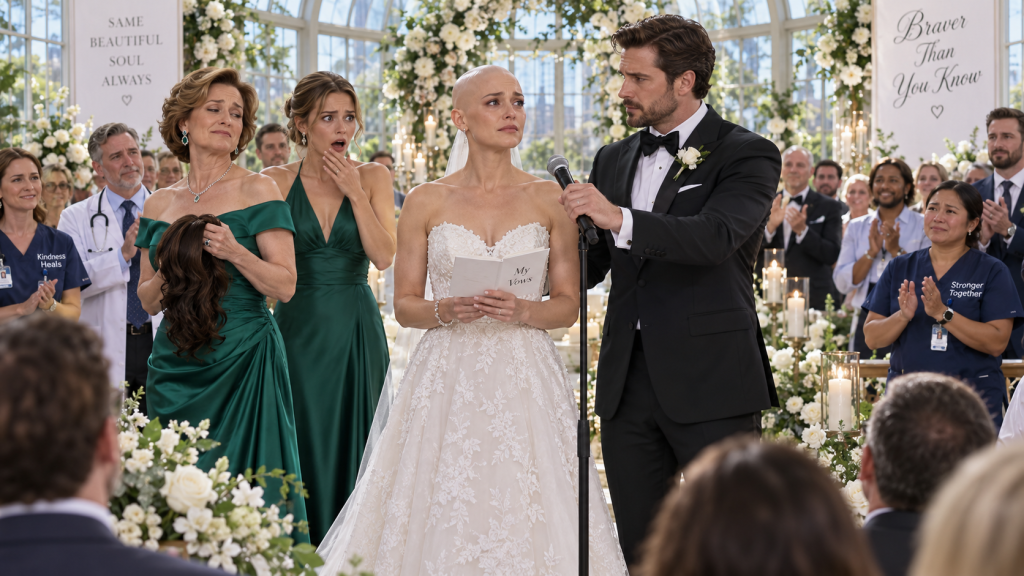
For one second, the entire glass conservatory seemed to stop breathing. My mother stood behind me in her emerald silk gown, one hand lifted high, my custom brunette medical wig dangling from her fingers like a trophy.
“Now he can see the bald cancer patient he’s really marrying,” Beatrice announced into the microphone.
The words echoed off the glass walls.
From the front row, my younger sister Khloe laughed.
“Let’s see if he still says ‘I do.'”
I was still holding my vows.
The parchment trembled once between my fingers, then went still.
There were 114 people watching. Doctors. Nurses. Engineers. Project managers. People who had seen me through the worst year of my life.
My mother thought they were about to watch me fall apart.
She had spent years believing humiliation worked on me.
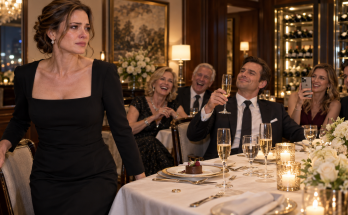
Growing up, Khloe was the daughter who matched the image my parents wanted. She had the looks my mother adored, the expensive clothes, the polished photos, and the attention. My parents poured money into her dream of becoming a luxury travel influencer.
I became the daughter they kept out of frame.
I preferred environmental engineering, calculations, water systems, and work that had nothing to do with country clubs or curated appearances. To my family, that made me plain, inconvenient, and embarrassing.
Then my biopsy came back positive for stage 2 lymphoma.
I told my parents at the long mahogany dining table, my hands shaking so badly I had to press them against my knees.
My mother did not hug me.
She worried about her bridal boutique.
She worried clients might hear there was serious illness in the family. She worried my appearance would disturb the perfect image she sold to wealthy customers.
When chemotherapy took my hair, she pushed me even farther out of sight.
Whenever clients or neighbors came over, I was expected to stay downstairs in the basement guest room. She still took money from my salary as rent while telling people I had moved away for a wellness sabbatical.
Upstairs, my mother and Khloe filmed polished lifestyle videos.
Downstairs, I handled nausea, fever, exhaustion, and fear alone.
But I also worked.
Night after night, I opened my laptop and kept building the designs for a decentralized solar-powered water filtration system. My family assumed I was disappearing.
I was not.
My engineering firm, Emerald Infrastructure, began securing major municipal contracts. Quietly, professionally, without needing my mother’s approval, I built something that belonged entirely to me.
That work eventually brought me to a municipal research pavilion, where I met Silas Thorne.
He was a senior biomedical research scientist connected to the Thorne Medical Foundation. He never stared at my missing hair. He never treated me like a tragedy.
He sat beside me through the final chemotherapy cycles.
And when my doctors told me I was in clinical remission, he was there.
That should have been enough for my family to finally see me differently.
It was not.
The moment Beatrice and Khloe realized I was marrying into the Thorne family, their indifference became obsession.
My mother tried to take over the wedding. She wanted a huge public ceremony that could double as promotion for her boutique.
Silas and I said no.
We chose a private glass house at Oak Ridgerest and invited only the 114 people who had actually supported my recovery and my career.
My mother took that boundary personally.
She arrived with Khloe in extravagant emerald gowns, both of them dressed to be noticed. For hours before the ceremony, I caught them whispering in hallways and exchanging looks.
I ignored it.
I wanted one peaceful day.
Then I stood at the altar, looked into Silas’s eyes, and began reading my vows.
That was when I felt the shadow behind me.
My mother’s hand clamped around the base of my wig.
One hard yank.
Cold air hit my scalp.
Khloe laughed before anyone else made a sound.
Beatrice lifted the wig higher.
She was waiting for disgust.
Waiting for whispers.
Waiting for Silas to look at my bare head and hesitate.
I looked at him.
He did not move.
Not backward. Not sideways. Not even an inch.
His eyes stayed on mine.
That silence changed something in the room.
My mother’s smile began to tighten.
Then a chair scraped against the floor.
Dr. Robert Evans, the oncology chief who had overseen my treatment, stood.
Another chair moved.
Sarah Jenkins, the lead structural engineer from my firm, rose beside him.
Then another.
And another.
Row by row, the doctors, nurses, engineers, and veteran project managers stood until nearly the entire congregation was on its feet.
Nobody was staring at my head.
They were staring at my mother.
The laughter died in Khloe’s throat.
Beatrice lowered the wig slightly.
No one sat down.
No one whispered.
The same people my mother had expected to judge me were now standing shoulder to shoulder, silent and rigid, creating a wall behind me. She had tried to turn my illness into a spectacle.
Instead, every face in the room had turned toward her.
For the first time that day, she looked uncertain.
Silas stepped toward me.
He did not reach for the wig.
He reached for the microphone.
My mother’s fingers tightened around the hairpiece.
“What are you doing?” she asked.
Silas turned slowly toward her.
His face was calm. Almost too calm.
Then he looked across the 114 people standing behind us, several of them watching Beatrice with expressions she clearly had not expected.
I could hear the soft hum of the conservatory ventilation.
The faint rustle of silk.
My own heartbeat.
Silas took the wireless microphone from the stand and held it at his side for one long second.
Khloe leaned toward our mother.
“Mom…”
Beatrice said nothing.
Her confidence was gone now. Her eyes moved from Silas to the guests, then back to me, as though she had finally realized this room was not filled with people she could impress.
Silas raised the microphone.
He stepped between my mother and me.
Then, in a voice so controlled that the entire room leaned in to hear it, he began:
“What this pathetic display has just revealed…
PART 2 — THE ILLNESS WAS NEVER THE SHAME
“What this pathetic display has just revealed,” Silas said, “has nothing to do with cancer.”
His voice was quiet.
That made everyone listen harder.
He looked at my mother.
Not at the wig.
Not at my bare scalp.
At her.
“The illness was never the shameful thing in this room.”
Beatrice’s face changed.
The hand holding my wig lowered another inch.
Silas continued.
“Cancer is a disease.”
“Treatment is treatment.”
“Hair falls out.”
“Bodies change.”
“People survive.”
“People don’t.”
“None of that is disgraceful.”
The conservatory was so silent that I could hear someone crying near the back.
Then Silas turned toward Khloe.
“But humiliating a woman in front of people she loves because you think her body makes her less worthy?”
He paused.
“That is shameful.”
Khloe’s lips parted.
No sound came out.
For once, my sister had nothing to add.
My mother tried to recover.
She always did.
That was one of her gifts.
Beatrice could turn cruelty into concern before most people finished processing the injury.
“Oh, please,” she said, forcing a laugh. “Don’t be dramatic. She knows I was teasing.”
I stared at her.
Something in me went still.
Not numb.
Clear.
For years, that sentence had closed every wound before I was allowed to examine it.
I was teasing.
You’re too sensitive.
You misunderstood.
You always make things worse.
Silas looked at me.
Not answering for me.
Waiting.
That mattered more than anything he had said.
My mother had tried to take my wig.
He gave me back my voice.
I took the microphone from his hand.
My scalp felt cold beneath the conservatory air.
For one second, old instinct screamed at me to cover myself.
Find the wig.
Fix it.
Restore the picture.
Make everyone comfortable.
Then Dr. Evans caught my eye from the first row.
Sarah Jenkins beside him.
Two nurses from the infusion center.
My engineering team.
People who had seen me bald before.
People who had seen me vomit into hospital bags, finish design reviews with a fever, fall asleep over calculations, cry in stairwells, laugh on days I thought I had forgotten how.
None of them looked horrified.
Only my mother did.
And I realized she was not horrified by my baldness.
She was horrified because it had failed to humiliate me.
I looked at her.
“No.”
Beatrice blinked.
“What?”
“I did not know you were teasing.”
Her face tightened.
I continued.
“You came behind me during my wedding vows and pulled something off my body without my permission.”
Her eyes flashed.
“It’s a wig.”
“It was mine.”
A small murmur moved through the room.
I looked toward Khloe.
“And you laughed.”
She crossed her arms.
“Oh my God. It was one joke.”
I nodded.
“One joke.”
Then I looked at the guests.
“At the end of a year where I lost my hair, spent nights wondering whether I would live long enough to stand here, and learned exactly which people could look at me sick without treating me like I had become unpleasant scenery.”
Khloe looked away.
I turned back to Mom.
“You hid me in a basement.”
That sentence changed the room.
My mother’s face went white.
“Don’t.”
“You charged me rent.”
“Stop.”
“You told clients I had gone away.”
“Enough.”
“No.”
The word came easily.
Almost beautifully.
“You wanted everyone to believe I disappeared.”
“I didn’t.”
“You did.”
My voice shook now.
Not from fear.
From years.
“You just never expected me to come back visible.”
Beatrice started crying.
I had seen those tears before.
They were effective.
Beautiful, even.
My mother cried without ruining makeup.
It would have been impressive if I had not spent thirty-two years studying the technique.
“I was trying to protect you.”
she whispered.
I almost laughed.
“From what?”
“People can be cruel.”
Behind her, someone actually made a sound of disbelief.
My mother heard it.
Her face tightened.
I said:
“You were the cruel person.”
That ended the performance.
The tears remained.
The softness disappeared.
“You have always been ungrateful.”
There she was.
The mother I knew.
“You think because you got sick and found some wealthy man, everyone has to worship you.”
Silas flinched at “wealthy man.”
I didn’t.
I had heard the thought before even when she did not say it aloud.
I looked at her.
“I did not marry Silas because of his family.”
She laughed bitterly.
“Convenient.”
“And he did not marry me because I survived cancer.”
“Even more convenient.”
Silas took the microphone gently from me.
Then said:
“I have known about her wig since our third date.”
Beatrice stopped.
Khloe too.
He continued.
“I helped her shave the last uneven pieces of hair after chemo because she was tired of watching them fall onto her pillow.”
My chest tightened.
I remembered that night.
Bathroom sink.
Electric clippers.
Silas crying when he thought I could not see.
He looked at my mother.
“She did not trick me.”
“She did not hide.”
“I have seen her bald.”
“I have seen her swollen from medication.”
“I have seen her exhausted.”
“I have seen her terrified.”
His voice broke slightly.
“And none of those things made me less certain.”
Then he turned to me.
“This ceremony continues only if you still want it.”
My eyes filled.
Not:
We are continuing.
Not:
Ignore them.
Only if you still want it.
Choice.
Again.
I whispered:
“I do.”
He smiled.
“Then so do I.”
Applause started somewhere behind Dr. Evans.
I hated it for half a second.
This was not supposed to become a performance.
Then I realized they were not applauding my bald head.
They were applauding the decision to continue.
That was different.
The officiant stepped forward.
A venue security manager quietly approached my mother and sister.
Beatrice saw him.
Her expression sharpened.
“You’re removing the mother of the bride?”
I looked at her.
“No.”
Her eyes went to me.
“I am.”
Silence.
“Leave.”
For the first time in my life, my mother looked genuinely stunned by a boundary.
“You cannot be serious.”
“I am.”
“This is my daughter’s wedding.”
“No.”
I looked around the room.
“It’s mine.”
Khloe stood.
“If she goes, I go.”
I almost smiled.
“That is how leaving works.”
A few people laughed despite themselves.
Khloe’s face flushed.
She reached for Mom.
Then stopped.
Maybe she had expected me to plead.
I did not.
The security manager guided them toward the side doors.
Beatrice still carried my wig.
Halfway there, I called:
“Mom.”
She turned.
I pointed.
“Leave the wig.”
The room went silent again.
She looked down at it.
For one second I saw something in her face I did not understand.
Possession.
Anger.
Then she dropped it onto an empty chair.
Not gently.
I left it there.
The ceremony continued with my bare head uncovered.
That was not a statement I had planned.
I do not want people to rewrite it as bravery.
If my mother had not ripped the wig off, I would have worn it.
I liked that wig.
It made me feel like myself on days when cancer had taken too much.
Wearing it had not been shame.
Leaving it off was not courage.
The courage was deciding that once someone used it against me, I did not need to scramble to restore their idea of how I should look.
That was different.
I picked up my vows.
The parchment still trembled.
Silas reached for my hand.
I began again.
Not from the start.
From where my mother interrupted me.
“I promise,” I read, my voice uneven, “to never confuse loving you with possessing you.”
Silas’s eyes filled.
I laughed through tears.
“Apparently that line is more relevant than I thought.”
The guests laughed softly.
Then I continued.
“I promise to tell you when I’m afraid.”
“To listen when you say no.”
“To never make your vulnerability the price of staying close to me.”
My voice broke.
“And when life changes your body, your plans, or your certainty, I promise to meet the person you become instead of punishing you for no longer matching the person I expected.”
Silas wiped one eye.
I smiled.
Then:
“And if I am fortunate enough to grow old with you, I promise I will never make baldness this dramatic again.”
The room laughed properly this time.
Even Dr. Evans.
Especially Dr. Evans.
We finished the vows.
And when the officiant asked Silas whether he took me as his wife, he looked at me as though there were only two people under the glass roof.
“I do.”
No hesitation.
No grand gesture.
Just certainty.
I said it too.
The reception began forty minutes late.
Nobody complained.
Someone found me a soft cream scarf.
I almost wore it.
Then decided I was comfortable without it.
Not symbolic.
The room was warm now.
Silas’s aunt retrieved my wig from the ceremony chair and placed it carefully in the bridal suite.
No one treated it like an embarrassing object.
That helped more than I expected.
For the first hour, the evening became almost normal.
Dinner.
Champagne.
Music.
My engineering team arguing with one of Silas’s research colleagues about filtration membranes because apparently some people can turn a wedding into a technical conference by dessert.
I loved them for it.
Then my phone began vibrating.
Mom.
Khloe.
Mom.
Unknown number.
Khloe.
I turned it off.
Silas noticed.
“You okay?”
“Yes.”
“True yes?”
I smiled.
“Medium yes.”
“Acceptable.”
He kissed my temple.
No wig between his lips and my scalp.
For a second, emotion hit me so violently I had to look down.
Not because he kissed my bald head.
Because he did it without making it meaningful.
That was the gift.
At nine thirty, Silas’s father, Jonathan Thorne, approached our table.
I had always found him intimidating.
Not because he was unkind.
Because he had the calm, economical manner of someone who had spent decades making decisions involving very large organizations and very little wasted language.
He sat beside me.
“May I interrupt?”
Silas looked at him.
“That depends.”
Jonathan almost smiled.
Then looked at me.
“There is something I believe you should know tonight.”
My stomach tightened.
“About my mother?”
“Yes.”
Of course.
Silas immediately said:
“Dad, not tonight.”
Jonathan nodded.
“That was my position too.”
Then he looked at me.
“Until the ceremony.”
I felt cold.
“What happened?”
He placed a slim folder on the table.
I did not touch it.
“What is that?”
“A proposal submitted to the Thorne Medical Foundation three weeks ago.”
Silas went still.
“By whom?”
His father looked at me.
“Beatrice Vale.”
My mother.
I stared at the folder.
“For what?”
Jonathan’s expression did not change.
“A charitable partnership.”
I nearly laughed.
“My mother owns a bridal boutique.”
“Yes.”
“That was also our concern.”
Silas leaned forward.
“Dad.”
Jonathan held up one hand.
“Compliance intercepted it before any action.”
Then to me:
“The proposal was titled the Vale Cancer Confidence Initiative.”
I felt something inside me drop.
“No.”
Jonathan nodded once.
“It described a program providing luxury styling, wigs, bridal services, and social-media storytelling for women undergoing cancer treatment.”
My hands went cold.
Silas swore under his breath.
I did not.
I could barely breathe.
“There is nothing inherently wrong with that kind of program,” Jonathan continued carefully.
“No.”
My voice sounded far away.
“Except?”
“The proposal represented that you had developed the concept with your mother based on your personal treatment experience.”
I stared.
“I did not.”
“I know.”
“How?”
“Because Silas told us.”
Silas looked furious now.
Not at me.
At the folder.
Jonathan continued.
“It also described you as the initiative’s founding survivor ambassador.”
I laughed.
A horrible little sound.
“Founding what?”
“And listed Khloe as creative director.”
Of course it did.
“How much?”
Silas asked.
His father looked at him.
“Two hundred fifty thousand dollars requested for the first year.”
I stopped breathing.
“For what?”
“Program development.”
“Marketing.”
“Boutique modifications.”
“Influencer partnerships.”
“Patient styling grants.”
My throat tightened.
“And salaries?”
Jonathan hesitated.
That was answer enough.
“How much?”
“Your mother’s projected executive compensation was forty-eight thousand.”
“Khloe’s creative and media fee was ninety thousand.”
I actually laughed.
Ninety thousand dollars.
My sister had apparently found a way to make my missing hair part of her luxury brand.
“And me?”
Jonathan’s eyes softened.
“You were listed as unpaid.”
That silenced me.
Of course.
Even in the proposal built from my cancer, I was the volunteer.
Silas stood abruptly.
“Why didn’t anyone tell us?”
Jonathan’s answer was calm.
“Because compliance was reviewing whether it was merely an inappropriate family proposal or something requiring formal response.”
“And because you were getting married.”
“I did not want a business issue detonating inside your ceremony.”
I stared at the folder.
My mother had managed that herself.
“Did she use my medical records?”
I asked.
“No.”
Relief.
Then:
“She referenced publicly knowable information and details that appear personal.”
My stomach tightened again.
“What details?”
“Treatment dates.”
“Type of chemotherapy.”
“Hair loss.”
“The basement.”
I looked up sharply.
Jonathan stopped.
“The basement?”
Silas said.
Jonathan opened the folder.
“There is a passage about how Beatrice ‘converted the lower level of the family home into a private recovery suite’ so her daughter could undergo treatment with dignity.”
The table disappeared.
I could see it.
The basement guest room.
Low ceiling.
One tiny window.
The old beige sofa.
A mini-fridge I bought myself.
The bucket beside the bed for nights I could not reach the bathroom.
My mother had called it:
private recovery suite.
I closed my eyes.
There are lies that make you angry.
Others rearrange pain.
“She charged me rent.”
I whispered.
Jonathan said nothing.
Silas sat again.
He took my hand.
I opened my eyes.
“Keep going.”
Jonathan hesitated.
“Are you sure?”
“Yes.”
Choice.
Again.
Always choice.
The proposal included photographs.
Not of me bald.
My mother did not have many.
I had avoided her camera.
Instead:
The boutique.
Luxury wigs.
Champagne.
Khloe posing beside floral displays.
One photograph of me before treatment.
Professional headshot.
The caption:
Cancer survivor and environmental engineer Evelyn Vale Thorne, whose journey inspired the initiative.
Evelyn Vale Thorne.
They had already added Silas’s surname.
Before I had married him.
Before the foundation had approved anything.
Before I had even seen the proposal.
My identity had been converted into projected branding.
Then Jonathan reached the final section.
“There is one additional issue.”
My stomach tightened.
“What?”
“A patient-story and likeness release was attached.”
Silas looked at me.
I already knew.
“Signed?”
Jonathan nodded.
My mouth went dry.
“By me?”
“Yes.”
No one spoke.
He slid the page across the table.
I looked.
My name.
My signature.
Not close.
Exact.
Because it was mine.
Or a scan of mine.
The same slight upward hook on the E.
The little break before the final n.
I had signed hundreds of engineering documents.
Medical forms.
Insurance forms.
Wedding vendor agreements.
My mother had plenty of opportunities to obtain a copy.
But I had never signed this.
Silas whispered:
“Evie?”
“I didn’t sign it.”
His father nodded.
“We assumed that might be the case.”
“Why?”
“The electronic file metadata suggests the signature image was imported, not executed within the document workflow.”
I looked at him.
“Meaning?”
“Someone inserted an existing image.”
My entire body went cold.
Silas stood again.
“This is fraud.”
Jonathan said:
“We are not labeling it yet.”
I almost smiled despite everything.
Silas looked at his father.
“She used Evelyn’s signature.”
“We have evidence of an unauthorized-looking use.”
Jonathan corrected.
“That is why compliance froze the proposal and referred it for legal review.”
Good.
Slow words.
Facts.
I had learned enough from medicine to respect the discipline of not naming something before evidence earned the name.
Still, the page shook in my hands.
“Does Khloe know about this?”
I asked.
Jonathan opened another section.
“She is copied on several emails.”
My chest tightened.
“How involved?”
“We cannot determine intent from copying alone.”
“Did she send anything?”
“Yes.”
Silas’s jaw tightened.
“What?”
Jonathan showed me an email.
From Khloe.
Subject:
Thorne launch visuals
The message read:
Once Evie and Silas are married, the family angle gets much stronger. Mom thinks we should hold the announcement until after the wedding so it feels organic instead of transactional.
I stopped.
Organic.
My cancer.
My marriage.
My mother’s boutique.
My sister’s ninety-thousand-dollar media fee.
Organic.
Another email.
Khloe to Beatrice.
Do we have Evie’s release yet? Foundation legal will ask.
Mom:
Handled.
Khloe:
She signed?
Mom:
I said handled. Stop worrying.
I stared.
That mattered.
Khloe had asked.
Mom had not clearly told her I signed.
My anger wanted to make my sister equally guilty.
Evidence refused.
Good.
Accuracy did not make Khloe innocent of the wedding humiliation.
It simply meant I could not assign her my mother’s act without proof.
I had spent my childhood being compared unfairly.
I would not become careless with blame now.
“Was this why they suddenly cared about the wedding?”
I asked.
Jonathan looked at me.
“We cannot know that from documents alone.”
But the timeline answered emotionally.
Before Silas:
Cancer was inconvenient.
My bald head threatened the boutique image.
I belonged downstairs.
After Silas:
My survival became inspirational.
My engineering title became useful.
My marriage became a family partnership.
The transformation was not love.
It was market positioning.
I felt sick.
Then Sarah Jenkins approached our table.
My colleague.
My friend.
The woman who had stood when my mother pulled off my wig.
She looked at the folder.
Then at me.
“Oh.”
“What?”
Her face changed.
“You know.”
“Apparently not enough.”
Sarah looked toward Jonathan.
“Did you tell her about Emerald?”
My stomach dropped.
Silas looked up.
“What about Emerald?”
Jonathan frowned.
“I don’t know.”
Sarah sat.
“I didn’t want to do this tonight.”
That sentence was becoming extremely unpopular.
“Do it.”
I said.
She hesitated.
Then reached into her clutch.
Pulled out her phone.
“Two months ago, our compliance office received an anonymous complaint about you.”
My blood turned cold.
“What kind?”
“That your health made you medically unreliable for field leadership.”
I stared.
“That I had concealed continuing cancer treatment.”
“I’m in remission.”
“I know.”
“That I was making unsafe decisions due to treatment-related cognitive problems.”
My hands went numb.
“Chemo brain.”
Sarah’s eyes filled.
“Yes.”
“Who sent it?”
“We didn’t know.”
“And now?”
She turned the phone toward me.
The complaint had been submitted through a web form.
Anonymous.
But someone in IT preserved routing information.
Not enough to prove identity alone.
Then Sarah showed me a screenshot from the complaint.
The language:
Evelyn has always struggled to admit weakness and may place professional pride ahead of public safety.
My stomach twisted.
Always struggled to admit weakness.
My mother had said that exact sentence to me during treatment.
Not once.
Many times.
When I tried to work.
When I drove myself to an appointment.
When I refused to move out of the basement because she wanted to convert it back for clients.
I looked at Sarah.
“Why didn’t you tell me?”
“Because the complaint was reviewed and found unsupported.”
She swallowed.
“Your medical clearance was current.”
“Project performance was strong.”
“The client raised no concern.”
“HR said there was no basis to take action.”
I should have felt relieved.
Instead I felt exposed.
Again.
“Is there a connection to Mom?”
Sarah hesitated.
“Yesterday, IT finished a deeper review because the complaint included internal project details that should not have been publicly available.”
My heart tightened.
“What details?”
“The municipality name before award announcement.”
“Your project role.”
“A specific site schedule.”
Only a few people knew.
Then:
“The submission came from an IP associated with your mother’s boutique.”
Silence.
Not proof of which person typed it.
Proof of location.
Enough to turn suspicion into something more concrete.
Khloe worked at the boutique constantly.
Mom lived there half her life.
Either could have used the network.
I stared at the table.
Silas whispered:
“Why would they try to hurt your job?”
I knew.
Or thought I did.
Then I remembered the timing.
Two months ago.
Exactly when Mom began insisting I needed to “slow down” and let her handle more of the wedding.
Exactly when I told her I would not allow the ceremony to feature boutique branding.
Exactly when Khloe complained that I was being selfish by keeping everything “small and depressing.”
Maybe they wanted me dependent.
Maybe they wanted leverage.
Maybe they wanted me removed from a project so I would have more time for their campaign.
Or maybe one of them simply wanted to punish me.
I refused to guess.
“I don’t know.”
That answer felt strong.
Jonathan looked at Sarah.
“Can your compliance office coordinate with ours?”
“Yes.”
“Tomorrow.”
I said.
They both looked at me.
“Not tonight.”
That was mine.
My wedding.
My husband.
My friends.
My dinner going cold.
The people who had stood for me deserved one evening that did not become an investigation.
Jonathan nodded.
“Tomorrow.”
Sarah too.
I closed the folder.
Then stood.
Silas looked up.
“Where are you going?”
“To dance.”
He stared.
I smiled.
“I just married you.”
His face softened.
“Yes, you did.”
“I would like at least one memory from tonight that has nothing to do with my mother.”
He stood.
“Demanding.”
“Cancer changed me.”
That made him laugh.
Good.
We danced.
Bald.
Barefoot after ten minutes because my heels hurt.
My nurses formed a ridiculous circle around us.
Dr. Evans danced like a malfunctioning crane.
Sarah cried.
Jonathan drank champagne.
For forty minutes, I forgot the folder.
That was not denial.
It was proportion.
My mother had stolen enough of my attention.
She did not get the whole wedding.
At midnight, Silas and I returned to the bridal suite.
The wig sat on the table.
Clean.
Beautiful.
Exactly as it had been before my mother turned it into a weapon.
Silas touched it.
“Want help putting it back on?”
I thought.
Then:
“Yes.”
He smiled.
No symbolism.
He helped me adjust the cap.
Straightened the part.
I looked into the mirror.
Brunette again.
Still me.
That mattered.
I did not need to reject the wig to prove I had accepted myself.
Cancer had taken enough choices.
I would keep this one.
Then I looked at the release form again.
My signature stared back.
“I know where she may have gotten this.”
Silas looked at me.
“Where?”
“Wedding contracts.”
“Which?”
“My mother insisted on handling the floral deposit before we took planning away from her.”
I opened my email.
Searched.
Three months earlier.
A vendor approval.
Signed by me.
Scanned.
Sent to Mom.
I opened the PDF.
My signature.
Same hook.
Same break.
Silas leaned closer.
“It looks identical.”
“Too identical.”
I forwarded it to Jonathan.
Then another memory came.
My medical wig.
The custom one.
Insurance had refused part of the cost.
Mom had offered to “handle the reimbursement paperwork.”
I had been too sick to argue.
I had signed a medical authorization page.
Scanned.
Emailed.
Another source.
My mother had spent years collecting pieces of my identity in ordinary family transactions.
Nothing sinister at the time.
Until consent became inconvenient.
At 12:43 a.m., my phone turned back on.
Thirty-seven missed calls.
Mostly Mom.
Nine from Khloe.
Two from an unknown number.
Then a voicemail notification.
Khloe.
I almost deleted it.
Silas said:
“You don’t have to listen.”
“I know.”
I pressed play.
Khloe was crying.
Not wedding crying.
Panicked.
“Evie, call me.”
A breath.
“Mom did something.”
My body went cold.
“I didn’t know about the signature.”
Silas looked at me.
The voicemail continued.
“I knew about the foundation proposal.”
“I knew about the campaign.”
“I thought you were being stubborn and Mom would convince you eventually.”
“I know how bad that sounds.”
Another sob.
“But I did not know she submitted it already.”
Silence.
Then:
“And I did not send the complaint to your company.”
My hand tightened.
“Evie…”
Khloe’s voice dropped.
“There’s something on Mom’s laptop you need to see before she deletes it.”
I stopped breathing.
“What?”
Silas whispered.
The voicemail continued.
“A folder.”
“She left the boutique computer unlocked after security brought us back.”
“I went looking for the foundation files because I wanted to know what she sent.”
Khloe began crying harder.
“There are documents with your name.”
“Not just the release.”
“Bank forms.”
“Insurance.”
“Something from your cancer treatment.”
My chest tightened.
Then:
“And there’s a spreadsheet with Silas’s family name at the top.”
Silas went completely still.
Khloe whispered:
“I think she’s been planning something since before you got engaged.”
The voicemail ended.
I stared at the phone.
Then immediately called her.
No answer.
Again.
No answer.
Silas called venue security.
Jonathan called his attorney.
My heartbeat climbed.
Then a text from Khloe appeared.
One photograph.
Taken crookedly from a laptop screen.
A folder name:
THORNE TRANSITION
Inside:
FOUNDATION PROPOSAL
MEDIA RELEASE
EVELYN HEALTH TIMELINE
EMERALD RISK
POST-WEDDING ACCESS
And one file that made my entire body turn cold.
POWER OF ATTORNEY — E.V.T.
I stared at it.
My new initials.
Evelyn Vale Thorne.
A name I had possessed for less than twelve hours.
Then another photograph arrived.
The document was dated for the following Monday.
It named my mother as an authorized representative for certain “medical, media, and family business matters.”
At the bottom was a signature line.
Already filled.
With my name.
I had never signed it.
But that was not the part that frightened me most.
The signature was dated two weeks before the wedding.
Before Evelyn Vale Thorne legally existed.
Silas looked at the screen.
Then at me.
And I understood something far worse than a mother trying to embarrass her bald daughter at an altar.
Beatrice had not arrived at my wedding planning only to destroy my confidence.
She had arrived expecting the marriage to happen.
She had needed it to happen.
Because somewhere between my cancer diagnosis and my wedding day, my mother had stopped treating my new life as something to resent.
She had started treating it as something she could enter through me.
And whatever THORNE TRANSITION meant, she had been preparing for it long before she ever reached for my wig.
PART 3 — THE NAME SHE THOUGHT SHE COULD USE
I stared at the photograph of the file until the words stopped looking like language.
POWER OF ATTORNEY — E.V.T.
Evelyn Vale Thorne.
My new initials.
My new name.
A name I had possessed for less than twelve hours.
Yet the document had been dated two weeks earlier.
Silas stood beside me in the bridal suite, still wearing his wedding shirt with the collar undone.
For the first time all night, he looked frightened.
Not for himself.
For me.
“Do not sign anything,” he said.
I almost laughed.
“I wasn’t planning to.”
“I know.”
He stopped.
Then corrected himself.
“Sorry.”
That mattered.
Even now.
He would not turn concern into instruction without noticing.
I looked back at the photograph.
The signature at the bottom was mine.
Or looked like mine.
The same little upward hook.
The same break near the end.
Perfect.
Too perfect.
For years, my mother had accused me of caring too much about documentation.
She should have remembered what profession she raised.
Engineers trust patterns.
And identical signatures are patterns.
Jonathan was on the phone with legal counsel within minutes.
Khloe finally answered mine.
She was crying so hard I could barely understand her.
“Where are you?”
“At the boutique.”
“Alone?”
“Yes.”
“Is Mom there?”
“No.”
“She went home with Aunt Denise.”
I closed my eyes.
“Do not delete anything.”
“I haven’t.”
“Do not send yourself every file.”
“Okay.”
“Take pictures only of what you’ve already opened and wait for instructions.”
Khloe went quiet.
Then:
“You sound like a lawyer.”
“I sound like someone who does not want us destroying evidence because we’re angry.”
Silence.
Then:
“Evie.”
“What?”
“I’m sorry.”
My chest tightened.
Not tonight.
Not yet.
“I know.”
“No.”
Her voice broke.
“You don’t.”
She swallowed.
“I knew more than I told you.”
There it was.
Of course.
“How much?”
“I knew Mom wanted to use your story for the foundation proposal.”
“I knew she wanted the boutique connected to the Thorne name.”
“I knew she thought your wedding could save the business.”
My stomach dropped.
“Save it?”
Silence.
“Khloe.”
“The boutique is in trouble.”
Beatrice’s bridal boutique had always looked successful.
Beautiful storefront.
Imported fabrics.
Private fittings.
Champagne consultations.
My mother had spent twenty years building an image of abundance so convincing that even I believed it.
Khloe said the truth was uglier.
Sales had been declining for almost three years.
Two large commercial-rent increases.
Inventory purchased on credit.
A failed expansion into luxury occasion wear.
Influencer campaigns that generated attention but not enough revenue.
Khloe’s travel brand had been partly subsidized through boutique marketing expenses.
My mother had borrowed personally.
Then borrowed again.
Not millions.
Nothing cinematic.
Enough.
Enough that the boutique could survive only if something changed.
The Vale Cancer Confidence Initiative was supposed to be that change.
New donors.
Foundation legitimacy.
Press.
A new customer segment.
My cancer turned into a rebranding strategy.
I sat on the edge of the bed.
“So when she found out I was marrying Silas…”
Khloe cried softly.
“She thought it was perfect.”
I closed my eyes.
Not:
My daughter found someone who loved her after cancer.
Perfect.
My daughter was marrying into a medical foundation.
Perfect.
“She said if the foundation backed the initiative, the boutique could reposition as a medical-luxury brand.”
Silas looked away.
His jaw tightened.
Khloe continued.
“She wanted survivor styling packages.”
“Hospital partnerships.”
“Wigs.”
“Bridal recovery stories.”
“Luxury confidence retreats.”
Every phrase sounded polished enough to hide a human being.
“And you?”
I asked.
Khloe went silent.
“What did you want?”
“I wanted the media contract.”
There.
Clean.
Ugly.
Honest.
“I thought if the foundation funded it, I could finally make my brand profitable instead of living from sponsorship to sponsorship.”
Her voice cracked.
“I knew she was using your cancer.”
“I told myself you’d agree eventually because the cause sounded good.”
My eyes filled.
“You told yourself I would agree after she made the decision.”
“Yes.”
That was the family language again.
Not consent.
Eventual compliance.
“What is THORNE TRANSITION?”
Khloe breathed in.
“I don’t know all of it.”
“Open nothing else.”
“I already opened the spreadsheet.”
Of course.
“What does it say?”
She hesitated.
Then:
“It’s not money from Silas’s family.”
I had not realized I was holding my breath until it left.
“No secret accounts?”
“No.”
“No plan to steal from the foundation?”
“Not directly.”
Silas frowned.
“Not directly?”
Khloe continued.
“It’s a timeline.”
“Wedding.”
“Name change.”
“Foundation announcement.”
“Media launch.”
“Boutique rebrand.”
“Your first appearance as Evelyn Thorne.”
My stomach twisted.
“What appearance?”
“A charity luncheon.”
“I never agreed to one.”
“I know.”
“What else?”
Silence.
“There’s a line that says, ‘Obtain family authorization before honeymoon ends.’”
I stared at Silas.
He stared back.
“Authorization for what?”
“I don’t know.”
Then Khloe whispered:
“But I think the power of attorney was supposed to make Mom the person who could approve things if you were too tired or sick.”
My body went cold.
Too tired.
Or sick.
Cancer again.
Always useful when they needed me diminished.
Jonathan’s attorney arrived at the venue shortly after one in the morning.
Her name was Meredith Sloan.
She wore jeans, a gray sweater, and the expression of a woman who had been pulled from bed and resented only the people who deserved it.
She reviewed the photographs.
Then looked at me.
“This power of attorney is not magically valid because your signature image appears on it.”
I nodded.
“Good.”
“The date problem is obvious.”
“Yes.”
“The name problem is obvious.”
“Yes.”
“And even a valid power of attorney would only convey authority actually granted under applicable law and the instrument itself.”
Silas leaned forward.
“So Beatrice couldn’t simply walk into the foundation and take money.”
“No.”
Meredith looked at him.
“Nothing about this document gives her ownership of your family foundation.”
Good.
Reality.
The monster had walls.
I could breathe again.
Then Meredith looked at me.
“But someone creating and using a document bearing your signature without authorization can still be very serious.”
I stared at the screen.
“Could she have used it already?”
“That is what we find out next.”
By sunrise, our wedding night had become three separate legal reviews.
My mother’s foundation proposal.
The complaint sent to Emerald Infrastructure.
The false-looking power of attorney and related documents.
Silas and I did not go on our honeymoon that morning.
Not because my mother won.
Because I wanted one day to understand what had been built in my name before leaving the country.
We moved the trip by a week.
The resort survived.
So did marriage.
At eight thirty, I removed my wig.
Not dramatically.
My scalp hurt.
Silas made coffee.
I sat at the hotel-room desk in one of his T-shirts while Meredith joined a video call with Jonathan’s foundation counsel and Sarah’s company compliance team.
Not how wedding magazines photograph the morning after.
Still ours.
The first relief came quickly.
No funds had been transferred from the Thorne Medical Foundation.
No grant had been approved.
No one at the foundation had accepted the power of attorney.
In fact, no one there had even seen it.
The document on Mom’s laptop appeared to be a draft.
Prepared for future use.
That distinction mattered.
Planning harm is not the same as successfully doing everything imagined in a folder.
I clung to facts.
The complaint to my employer was also more limited than I feared.
The IP address traced to the boutique network.
The browser metadata and timing narrowed the likely device.
A workstation primarily used in Beatrice’s office.
Not proof by itself of who typed every word.
But enough that company counsel wanted formal answers.
More importantly, the complaint had failed.
No project had been removed from me.
No client had withdrawn.
My professional record stood.
My work had survived someone trying to make my cancer louder than my competence.
That mattered more than revenge.
Then came the insurance file.
That one hurt.
Not financially.
Personally.
The folder contained copies of claims from my chemotherapy year.
Explanation-of-benefits forms.
Prescription records.
The reimbursement form for my wig.
Documents I had sent my mother when I was too sick to manage everything myself.
Ordinary family help.
The kind people give without expecting it to become future leverage.
My mother had kept them.
Then used details from them to build the health timeline for the foundation pitch.
Diagnosis month.
Treatment cycle dates.
Hair-loss onset.
Hospitalizations.
Remission date.
A spreadsheet reducing the most frightening year of my life to content milestones.
Under one column:
MEDIA VALUE
I stared at that heading for a long time.
Then closed the laptop.
“I’m done.”
Silas touched my shoulder.
“Done for now?”
“No.”
I looked at him.
“Done letting this be tonight.”
He understood.
We ordered pancakes.
At ten in the morning on the day after our wedding, bald and exhausted, I ate blueberry pancakes in bed with my husband while four attorneys dealt with the woman who had ripped off my wig.
It was not romantic.
It was strangely perfect.
Khloe came to see me that afternoon.
I almost refused.
Then agreed.
She arrived wearing yesterday’s makeup and ordinary sweatpants.
No camera.
No perfect hair.
No emerald silk.
For the first time in years, my sister looked younger than me.
Not physically.
Emotionally.
She sat in the chair by the window.
“I laughed.”
she said immediately.
I did not answer.
“When Mom pulled your wig off.”
“Yes.”
“I laughed.”
“Yes.”
She started crying.
“I thought she was going to embarrass you.”
“She did.”
“No.”
Khloe shook her head.
“I mean I thought it would be funny.”
I stared.
She forced herself to continue.
“I thought everyone would gasp.”
“I thought Silas might look shocked.”
“And then you’d realize you couldn’t pretend you were above us.”
There.
The ugliest truth.
Not ignorance.
Resentment.
“You thought I believed I was above you?”
“Yes.”
“Why?”
“Because everything started working for you.”
I almost laughed.
“Cancer?”
“No.”
Her face crumpled.
“After.”
“Your career.”
“Silas.”
“The foundation people.”
“All these important friends.”
“And Mom kept talking about how nobody cared about my travel work anymore.”
I stared.
“You had a career.”
“I had followers.”
“That can be a career.”
“It wasn’t paying enough.”
She looked down.
“And every time someone asked about you, Mom got angry.”
My chest tightened.
“Why?”
“Because the daughter she had hidden in the basement became the impressive one.”
Silence.
There it was.
Not cancer.
Competition.
A mother who had organized her daughters into roles years ago and panicked when reality changed the casting.
Khloe was supposed to shine.
I was supposed to be useful.
When useful became visible, everyone’s identity cracked.
Khloe wiped her face.
“I knew the campaign was wrong.”
“Why participate?”
“Because Mom said you owed us.”
My stomach tightened.
“For what?”
“For taking everything once you got better.”
I almost laughed.
“What did I take?”
“The attention.”
“The Thorne connection.”
“Your job.”
“My job?”
“I know how stupid it sounds.”
“Keep going.”
“She said we supported you during cancer and then you abandoned us when your life improved.”
I stared at her.
Supported me.
Basement.
Rent.
Silence.
Medical forms turned into marketing data.
Khloe looked sick.
“I believed some of it.”
“Did you?”
“Yes.”
“Even though you barely visited me downstairs?”
Her face collapsed.
“No.”
“Even though you made videos above my head while I was vomiting?”
“I know.”
“No.”
I leaned forward.
“You keep saying that because it is easier than sitting with the sentence.”
Khloe cried harder.
So I gave her the sentence.
“You were cruel to me when I was sick.”
She closed her eyes.
“Yes.”
“You benefited from Mom hiding me.”
“Yes.”
“You laughed when she humiliated me at my wedding.”
“Yes.”
“You knowingly helped build a campaign around my cancer without asking me.”
“Yes.”
“And you did not know she used my signature.”
“No.”
I believed her.
That distinction mattered.
“Did you send the complaint to Emerald?”
“No.”
“Did you know about it?”
She hesitated.
That was enough.
“What did you know?”
“Mom said your company needed to understand you weren’t as strong as they thought.”
My entire body went still.
“When?”
“Maybe six weeks ago.”
“And you didn’t ask what she meant?”
“I did.”
“What did she say?”
“That she had ‘made a call.’”
Silence.
“So you knew she was interfering with my job.”
“I knew something.”
“And said nothing.”
“Yes.”
There.
Not author.
Not innocent.
Khloe whispered:
“I don’t expect you to forgive me.”
“Good.”
She flinched.
I did not soften it.
Not yet.
“I’m cooperating with both compliance teams.”
“Good.”
“I gave them access to the boutique workstation.”
“Good.”
“Mom is furious.”
“That is no longer my emergency.”
Khloe almost smiled through tears.
Then stopped.
“Are you going to report her?”
“To whom?”
“Police.”
I looked at her.
“I am going to let the lawyers tell me what actually happened first.”
Khloe stared.
“Aren’t you angry?”
“Furious.”
“Then how can you—”
“Because anger is not evidence.”
Silence.
It felt like something Dr. Evans might say about test results.
Appropriate.
Cancer had taught me one useful discipline.
Do not diagnose before pathology.
Beatrice contacted me through an attorney two days later.
Not directly.
That was probably wise.
She denied trying to steal from the Thorne family.
That was technically true.
No evidence showed a plan to drain foundation accounts or access Silas’s personal wealth.
What she had wanted was legitimacy.
Association.
Brand access.
The ability to say:
My daughter, Evelyn Thorne.
Our family foundation partnership.
Inspired by our family cancer journey.
Her scheme was smaller than theft.
And in some ways more intimate.
She wanted to colonize my identity.
The power-of-attorney draft had been prepared from a generic online form.
Not by an attorney.
The signature image came from one of the medical reimbursement PDFs I had sent her during chemotherapy.
Metadata showed the document was created on her laptop.
The date had been manually entered.
The new surname had been typed before I legally adopted it.
There was no evidence it had been submitted to a bank, foundation, hospital, or other institution.
That mattered legally.
It did not make me feel better emotionally.
She had been preparing to speak in my name.
Again.
Her attorney eventually proposed a meeting.
I said no.
Then, three weeks later, changed my mind.
Not for reconciliation.
For answers.
We met in a mediator’s office.
Neutral room.
No boutique.
No family dining table.
No basement.
Mom looked older.
Not destroyed.
Not humbled into another person.
Just tired.
She wore no emerald.
Good.
I wore my wig.
Also good.
I had considered going bald just to make a point.
Then realized the point would still be allowing her to decide what my appearance meant.
So I wore what I wanted.
Mom stared at me.
“You look beautiful.”
I almost laughed.
“Don’t.”
Her face tightened.
“I was trying to be kind.”
“Then start with truth.”
She looked down.
Her attorney remained silent.
Mine too.
I asked:
“Why the power of attorney?”
Mom took a breath.
“I thought once you were married, things would move quickly.”
“What things?”
“The foundation.”
“The campaign.”
“The press.”
“You had agreed to none of them.”
“I thought you would.”
There it was.
Again.
“What if I said no?”
She looked at me.
“I thought Silas would convince you.”
My stomach turned.
“You thought my husband would override me?”
“No.”
She stopped.
Then:
“Yes.”
At least she corrected herself.
“And if he didn’t?”
Mom began crying.
“I thought you were still fragile.”
My jaw tightened.
“From cancer?”
“Yes.”
“I am in remission.”
“I know.”
“Then what did you think the power of attorney did?”
“I thought if you were exhausted or overwhelmed, I could handle paperwork.”
“Without asking.”
She looked down.
“Yes.”
“You dated it before the wedding.”
“I wanted everything ready.”
“You signed my name.”
Silence.
Then:
“I used the scan.”
“That is signing my name.”
Her eyes filled.
“I wasn’t going to use it unless you agreed.”
I stared.
“If I agreed, why would you need a forged version?”
That silenced her.
No escape.
No elegant explanation.
Because the document only made sense if my agreement was expected to remain optional.
Mom whispered:
“I panicked.”
“About the boutique?”
“Yes.”
“How bad?”
Her face collapsed.
“Bad.”
She had personally guaranteed part of the lease.
Credit-card debt.
Vendor debt.
Inventory financing.
She was not going to prison if the boutique failed.
She would lose it.
Possibly much of what she had saved.
The business had been her identity for twenty years.
Just as being the beautiful daughter had become Khloe’s.
Just as being the competent one had become mine.
Family roles everywhere.
She had seen my marriage to Silas as a bridge.
Not to his bank account.
To survival.
She convinced herself the campaign helped everyone.
Cancer patients.
The boutique.
Khloe.
The foundation.
Me.
Especially me, somehow.
People are dangerous when they can fit self-interest inside a story where everyone benefits.
“Why the complaint to Emerald?”
Her crying stopped.
That answer was harder.
“I was angry.”
There.
No noble explanation.
“You tried to damage my career.”
“I didn’t think they would fire you.”
“That is not the standard.”
“I wanted them to make you slow down.”
“Why?”
“Because you would not help with the campaign.”
My stomach turned.
“So you thought if work became smaller, I’d become more available.”
She covered her face.
“Yes.”
I sat back.
There are confessions so ugly they almost bring peace because suspicion can finally stop moving.
Mom had not tried to destroy me professionally.
She had tried to shrink my world enough that she could occupy more of it.
That was still betrayal.
Then I asked the question that mattered more than the documents.
“Why did you pull off my wig?”
Her face changed.
Not business now.
Mother and daughter.
“I was angry.”
“At what?”
“You wouldn’t acknowledge me.”
I stared.
“At the wedding?”
“You barely included me.”
“You were invited.”
“As a guest.”
“Yes.”
“I’m your mother.”
“You wanted the wedding branded through your boutique.”
“I wanted to be part of it.”
“You wanted control.”
She looked away.
I continued.
“You saw me standing there.”
“Career.”
“Friends.”
Silas.”
“Remission.”
“Everything you told yourself I couldn’t become.”
Her eyes filled.
“And you wanted me small again.”
Mom started crying.
“No.”
I waited.
Long enough.
Finally:
“Yes.”
There.
The truth I had known the second cold air hit my scalp.
“I thought if everyone saw you bald…”
She stopped.
“What?”
“That maybe they would see…”
She could not finish.
“Sick?”
Her face collapsed.
“Yes.”
“Weak?”
“Yes.”
“Less impressive?”
She covered her eyes.
“Yes.”
Silence.
Then:
“I hated myself as soon as I did it.”
“Khloe laughed.”
“I know.”
“And you held the wig up.”
“I know.”
“That was longer than one second of regret.”
She sobbed.
“Yes.”
There was nothing left to argue.
I asked:
“Do you love me?”
She looked shocked.
“Of course.”
I believed her.
That was important.
“Then understand something.”
I leaned forward.
“Love does not make what you did smaller.”
Her face tightened.
“I know.”
“No.”
“Listen.”
“You can love me and still be unsafe for me.”
Her breathing broke.
“That is where we are.”
She closed her eyes.
I continued.
“I am not asking whether you regret it.”
“I believe you do.”
“I am asking whether I can trust you with access to my life.”
She knew the answer before I said it.
“No.”
I did not cut my mother off forever that day.
I did something harder.
I made the relationship smaller.
No financial documents.
No medical forms.
No access to wedding photographs before publication.
No business discussions involving my name.
No contact with the Thorne Foundation about me.
No speaking to Emerald about my health.
No passwords.
No mail.
No “helping” with paperwork.
And no private relationship until therapy and time proved she understood why.
Mom cried.
She did not call me cruel.
That mattered.
Maybe consequences had finally made listening possible.
The foundation sent Beatrice a formal cease-and-desist-style notice regarding unauthorized representations of partnership and use of my story.
The proposal was permanently rejected.
No money changed hands.
The power-of-attorney draft was preserved as evidence.
After legal review, I chose to make a formal report concerning the unauthorized signature and employment interference.
What followed was slower and less dramatic than family gossip wanted.
Investigators reviewed documents.
Attorneys communicated.
The boutique records were examined where appropriate.
Some issues were civil.
Some potentially criminal.
Not every ugly act became a felony.
Not every lie belonged in court.
Ultimately, my mother faced consequences connected to the unauthorized document use and false representations that could be proved.
The resolution did not destroy her life.
It did end the fantasy that family permission could be manufactured afterward.
She paid legal costs.
Entered agreements restricting certain conduct.
Corrected representations.
And lost the foundation opportunity completely.
The boutique eventually closed.
Not because I ruined it.
Because it had already been failing.
That distinction mattered to me.
Khloe lost more than I expected.
The foundation barred her proposed media company from the initiative.
There was no initiative anymore.
Several brands distanced themselves after the wedding video circulated privately and then, despite everyone’s best efforts, partially online.
I hated that.
Not because she deserved protection from every consequence.
Because public humiliation is a machine nobody controls once it starts.
I refused interview requests.
Silas did too.
When a lifestyle site asked for my response to “the wig incident,” I answered once:
My cancer is not entertainment, and neither is my family conflict.
Then nothing.
No monetized revenge.
No viral campaign.
I had spent enough of my life being turned into content.
Khloe eventually rebuilt her career smaller.
Travel consulting.
Photography.
Less glamorous.
More real.
She apologized to me more than once.
I accepted the apology before I accepted closeness.
Those are different.
For almost two years, we communicated mostly by text.
Birthdays.
Health updates.
Practical things.
Then one afternoon she asked:
Can I take you to lunch?
Not:
We need to talk.
Not:
Mom says.
Can I?
I stared at the message.
Then wrote:
Yes.
That word felt different when nobody had assumed it.
At lunch, she did not bring up the wedding for twenty minutes.
Progress.
Then she said:
“I was jealous of you.”
I smiled sadly.
“I know.”
“No.”
She looked at me.
“I was jealous when you had cancer too.”
That stopped me.
“What?”
“Not of being sick.”
She looked ashamed.
“Of the way people cared about you.”
My stomach tightened.
“Doctors checked on you.”
“Coworkers came.”
“People brought food.”
“And Mom kept talking about how everything in the house had become about your treatment.”
I stared.
“You could have visited me downstairs.”
“I know.”
“I wanted to.”
“Then why didn’t you?”
She cried.
“Because Mom made pity sound contagious.”
That sentence hurt.
“She kept saying you were becoming dependent.”
“That if we made too much of your illness, you’d stop trying.”
I closed my eyes.
There it was again.
The family belief that compassion created weakness.
No wonder they had starved me of it.
Khloe whispered:
“I am sorry I believed her.”
I thought.
Then:
“You wanted to.”
She flinched.
“Partly.”
“Because it let you stay upstairs.”
Her eyes filled.
“Yes.”
Honest.
We ate lunch.
Did not hug afterward.
That came months later.
Healing did not need acceleration.
Silas and I finally took our honeymoon.
One week late.
Northern coast.
Rain every second day.
A room overlooking water.
On the third morning, I woke before him.
My wig sat on the dresser.
I looked at it.
Then at myself in the mirror.
Hair had begun returning.
Fine.
Uneven.
Soft as a child’s.
I touched it.
For months, baldness had been illness.
At the wedding, it became humiliation.
Then defiance.
I was tired of every stage meaning something.
So I put on a hat because it was cold.
That was all.
No symbolic liberation.
Just weather.
Maybe that was healing.
When your body becomes ordinary again.
My hair eventually grew back.
Curly.
Chemotherapy changed the texture.
Silas loved it.
I hated it for six months.
Then accepted that no one had asked either of us.
Bodies are rude that way.
I kept the wedding wig.
People assumed I would throw it away.
Never.
It cost a fortune.
Also, it belonged to me.
I stored it properly in the closet.
Years later, when Clara—
No.
That was another woman’s daughter.
My story had no Clara.
I smiled sometimes at how easily lives blur when told as cautionary tales.
Mine remained mine.
Evelyn.
Silas.
No symbolic child required.
My remission held.
That deserves its own sentence.
Years passed.
Tests became less frequent.
Every scan still made my stomach hurt.
Silas never said:
“It’ll be fine.”
He learned early that reassurance without evidence annoyed me.
Instead:
“I’m here.”
Better.
Dr. Evans eventually stopped being my oncologist when he retired.
At his farewell party, he hugged me and said:
“You were always a terrible patient.”
“I followed every instruction.”
“You negotiated every instruction.”
“Engineering.”
He rolled his eyes.
I cried all the way home.
Some people witness versions of you your family never sees.
They become part of your architecture.
My work grew.
The filtration system that my mother barely understood became the basis for multiple municipal installations.
Not because I was a genius emerging from cancer.
I hate that story.
The work existed before diagnosis.
Continued during treatment.
Improved after.
Illness did not give me talent.
It interrupted it.
I resumed.
That was enough.
Eventually, I led an entire water-resilience division.
My name appeared on contracts because of engineering.
Not survivor branding.
That distinction remained precious.
The Thorne Medical Foundation later created a genuine patient-support program for people undergoing cancer treatment.
Not my idea.
Not my mother’s either.
A patient advisory board developed it.
Former patients.
Oncology social workers.
Nurses.
Caregivers.
People who actually understood what was needed.
Transportation.
Childcare grants.
Utility assistance.
Meal support.
Wig stipends if patients wanted them.
Headscarves if they wanted those.
Nothing if they wanted bald heads.
Choice.
Jonathan asked whether I wanted my name attached.
“No.”
He smiled.
“I assumed.”
“Then why ask?”
“Because assumptions are how families get into trouble.”
I laughed.
Good man.
Years later, Beatrice reopened a smaller shop.
Not luxury.
Appointments only.
Different neighborhood.
She called before opening.
“I want to tell you something before you hear it elsewhere.”
Progress.
“I’m starting again.”
I was quiet.
“Do you want me to say I’m proud?”
“No.”
She surprised me.
“I just wanted you to know.”
“Okay.”
Then:
“I won’t use your name.”
My throat tightened.
“Thank you.”
That was all.
Our relationship remained limited.
Lunch every few months.
Calls.
No business.
No medical paperwork.
No pretending the past had vanished.
She changed.
Some.
Not enough to restore childhood.
Enough to create a better old age than middle age.
Sometimes that is what people manage.
One day, years after the wedding, Mom asked:
“Do you still have the wig?”
“Yes.”
“Why?”
I looked at her.
“Because I liked it.”
She began crying.
Of course.
“I thought you’d hate it because of me.”
“No.”
I smiled faintly.
“You don’t get that much power over it.”
She nodded.
That sentence became another boundary.
People who hurt us sometimes imagine they permanently own the meaning of the thing they used.
They don’t.
My wig was never my mother’s weapon.
She borrowed it for thirty seconds.
I took it back.
Khloe married eventually.
A small ceremony.
She invited me.
I went.
Mom was there.
Before the ceremony, Khloe came into the dressing room holding a hairpin.
Then stopped two feet away.
“Can I fix this?”
She pointed to a loose curl near my ear.
The question nearly broke me.
Can I?
Not grabbing.
Not correcting.
Not deciding.
I smiled.
“Yes.”
She tucked the curl gently.
Then stepped back.
“Done.”
That was all.
People expect healing to come in speeches.
Sometimes it comes in hands that finally ask before touching you.
On my tenth wedding anniversary, Silas took me back to Oak Ridgerest.
The glass conservatory still existed.
Different flowers.
Different event.
We stood outside because another wedding was being prepared inside.
I could see rows of chairs through the glass.
For a moment, I saw my mother behind me again.
Fingers in my wig.
Khloe laughing.
Cold air on my scalp.
Then I saw something else.
Dr. Evans standing.
Sarah.
The nurses.
Engineers.
Silas reaching for the microphone.
Not to rescue me.
To create room for me to speak.
That distinction had become important over the years.
He never saved me at the altar.
He stood beside me.
Then waited.
I made the decision.
Continue.
Leave the wig.
Read the vows.
Remove my mother.
Dance.
All mine.
Silas put his hands in his pockets.
“What are you thinking?”
“That your speech was too dramatic.”
He looked offended.
“It was excellent.”
“You said ‘pathetic display.’”
“Accurate.”
“Very theatrical.”
“I had a microphone.”
“Dangerous.”
He smiled.
Then:
“Would you change anything?”
I looked through the glass.
“Yes.”
“What?”
“I would have finished my vows before letting anyone speak.”
He laughed.
“You were literally in shock.”
“Still.”
I leaned into him.
Then thought.
“No.”
“I take it back.”
“I wouldn’t change that day.”
He looked surprised.
“Really?”
“I would change what Mom did.”
“What Khloe did.”
“Everything before it.”
“But once it happened?”
I looked at him.
“We handled what was in front of us.”
That was all anyone can do.
There was one thing I did change.
My vows.
Not legally.
Personally.
The original parchment had been stained by my hands and wrinkled from the ceremony.
I kept it.
On our tenth anniversary, I added one sentence beneath the last line.
I promise not to confuse being known with being owned.
Silas read it.
Then wrote beneath mine:
And I promise that loving you will never require access you did not give.
That sentence became the truest part of our marriage.
Not romance.
Consent.
Respect.
Two separate people choosing proximity over and over.
For years, people remembered my wedding because my mother ripped off my wig.
I remembered other things.
The glass ceiling glowing at sunset.
Silas’s hands shaking slightly during his vows.
Sarah sneaking me food before the ceremony.
Dr. Evans’s terrible dancing.
The nurses singing off-key.
Blueberry pancakes the next morning.
Silas helping me put the wig back on after everyone had seen me without it.
That last memory became my favorite.
Because it taught me something I had not understood at the altar.
Acceptance is not requiring someone to stay exposed forever just to prove they are unashamed.
Sometimes acceptance sounds like:
“Do you want it back on?”
And then respecting the answer.
My mother believed cancer had stripped me of value.
Then she believed surviving it had created value she could market.
Both beliefs made the same mistake.
They treated my body as an argument.
Too sick.
Inspirational.
Bald.
Beautiful.
Weak.
Brave.
Patient.
Survivor.
I became tired of every noun except one.
Evelyn.
That was enough.
I was Evelyn before the biopsy.
During chemo.
Bald.
Wigged.
Married.
Angry.
Forgiving.
Successful.
Terrified.
Alive.
No branding required.
The power-of-attorney document ended up in a legal file.
The foundation proposal too.
The anonymous complaint.
All the emails.
I kept none of them framed.
I did not need evidence of betrayal decorating my house.
I kept one object from that day.
The wig.
And one photograph.
Not the dramatic one.
There were photographs of my mother holding it.
Guests standing.
Silas with the microphone.
I never wanted them.
The one I kept was taken twenty minutes later.
After Mom and Khloe had been escorted out.
I am at the altar.
Bare head.
Eyes swollen from crying.
Silas is holding both my hands.
And we are laughing.
I do not remember what he said.
That is why I love the photograph.
The memory is no longer attached to exact words.
Only the expression.
Life continuing.
Sometimes strangers who know a simplified version ask:
“How could your own mother do that?”
I never know what answer they want.
Because she hated me?
No.
Because she was evil?
No.
Because she loved appearances more than people?
Sometimes.
Because she was terrified of losing a business that had become her identity?
Yes.
Because she had spent years confusing control with motherhood?
Yes.
Because she resented the daughter she had categorized as less impressive becoming someone she could no longer define?
Also yes.
People are rarely one motive.
Complexity does not absolve them.
It simply makes the truth accurate.
And what about Khloe?
She was jealous.
Cruel.
Complicit.
Then ashamed.
Then more honest.
Then better.
Not innocent.
Not permanently condemned to the worst laugh of her life.
I learned to leave room for people to become more than what they did to me without pretending what they did was small.
That is a difficult balance.
Worth learning.
As for Silas—
he did say “I do.”
Obviously.
But that was never the most important thing he said.
The important sentence came before the vows continued.
This ceremony continues only if you still want it.
At the time, I thought he was asking whether I still wanted to marry him.
Years later, I understood why that sentence stayed with me.
He was reminding me that humiliation had not canceled choice.
My mother could rip off the wig.
Khloe could laugh.
Guests could stare.
Cancer could change my body.
None of those things got to decide what happened next.
I did.
That was love.
Not a man dramatically choosing a bald cancer patient.
I hate that version.
Silas was not heroic because he still wanted me without hair.
Hair was never the test.
He loved me correctly in that moment because he refused to turn my vulnerability into a decision he made for me.
He handed the future back.
So when I remember standing beneath that glass ceiling with cold air against my bare scalp, I no longer remember myself as exposed.
Exposure implies something private was revealed that should have remained hidden.
Cancer was never shameful.
My scalp was never shameful.
The wig was never shameful.
What happened to me was humiliating only because humiliation was my mother’s intention.
Intent does not always get the final meaning.
She pulled off the wig expecting the room to see less of me.
Instead, I saw more clearly than I ever had.
Who stood.
Who laughed.
Who asked.
Who took.
Who waited.
Who loved me without needing ownership of the story.
And who I was once everyone else’s expectations fell away.
My mother lifted the wig and asked the room, in effect:
Now that you can really see her, do you still want her?
Years later, I finally understood the question had been aimed at the wrong person.
The person who needed to answer was never Silas.
It was me.
Could I see this body—
scarred,
changed,
temporarily bald,
sometimes frightened—
and still choose the life inside it?
Could I stop hiding in basements built by other people’s embarrassment?
Could I keep my work?
My name?
My boundaries?
My anger?
My joy?
Could I look at myself without asking whether somebody else approved of the view?
It took longer than a wedding ceremony to answer.
But eventually, I did.
Yes.
I chose her.
I chose Evelyn.
Again and again.
And once I learned to do that, nobody ever had to prove they would still say “I do.”
Because the first promise was finally mine.
THE END STORIES! THANK YOU FOR READING GOOD LUCK !❤️
Related Posts