My Son Brought His New Boyfriend Home — The Moment I Saw Him, I Called The Police
My name is Diane, and my son Tyler is nineteen, home from his first year of college, and he’d been telling me for weeks about someone new in his life, someone he was finally ready for me to meet.

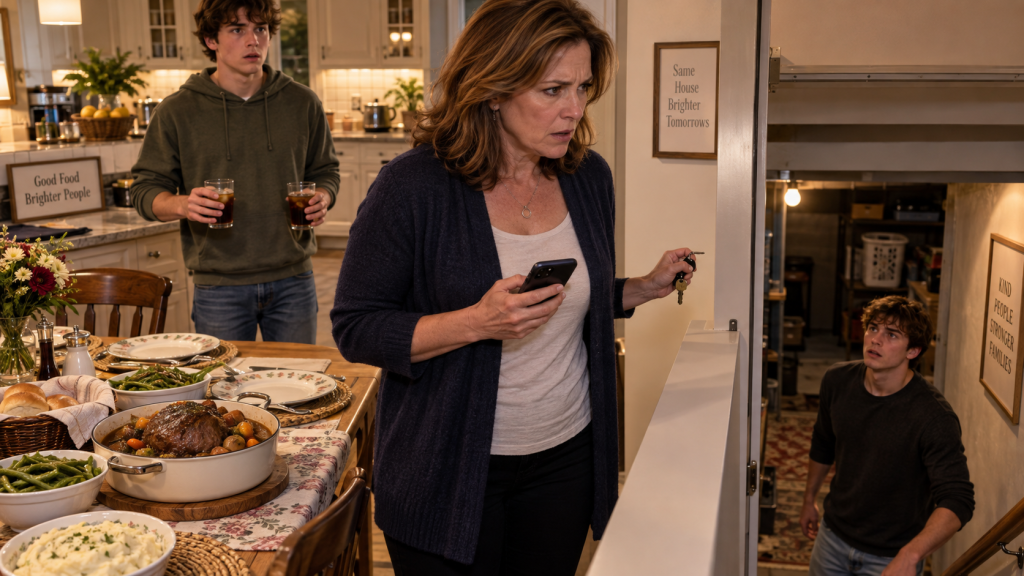
I made an effort that Sunday. I cleaned the house, made a pot roast, and put out the good dishes I usually save for holidays. I wanted this to go well for him.
The doorbell rang around four, and Tyler practically ran to answer it, grinning in a way I hadn’t seen from him in a long time.
He walked into the kitchen with a young man beside him, introducing him with obvious pride.
The second I saw his face, I froze completely, the serving spoon still in my hand, my whole body suddenly cold.
I don’t know how long I stood there before I managed to smile and say something normal-sounding, something about being so glad to finally meet him.
A few minutes later, I told Tyler I wanted to show his boyfriend something downstairs, something I kept in the basement.
Tyler smiled and said he’d be right up after grabbing drinks for everyone.
I led the young man down the stairs, let him step through the basement door first, and then, before he could say anything, I pulled the door shut behind him and turned the key in the lock.
“We’re calling the police now,” I said through the door, my voice steadier than I felt. “I’ll explain everything.”
PART 2 — THE BOY WITH TWO NAMES
For three seconds after I turned the key, there was no sound from the other side of the basement door.
Then the young man knocked once.
Not hard.
Not frightened.
Just confused.
“Mrs. Turner?”
My hand was still wrapped around the key.
My pulse was hammering so violently that the brass shook between my fingers.
Upstairs, I heard Tyler opening the refrigerator.
Glass bottles clinked.
Ordinary sounds.
The kind of sounds that belong to a Sunday dinner.
Not to a mother standing in a hallway trying to decide whether the boy her son loved had walked into her house carrying the face of someone who had vanished eleven years ago.
“Mrs. Turner?”
he said again.
“My phone is upstairs.”
That detail almost undid me.
Of course it was.
He had left it on the kitchen counter beside Tyler’s because Tyler had joked that nobody was allowed to scroll through dinner.
I shut my eyes.
What was I doing?
I had locked a nineteen-year-old boy in my basement because I recognized his face.
No warrant.
No certainty.
Only memory.
And fear.
I unlocked the door immediately.
The knob turned before I could step back.
He opened it slowly.
His expression had changed.
The warm nervous smile he entered my house with was gone.
Now he looked alert.
Careful.
“What’s happening?”
I stared at him.
At the dark hair.
The slightly uneven eyebrows.
The faint pale line beneath his chin.
And the eyes.
That was what had done it.
Those gray-green eyes.
I had seen them in photographs for more than a decade.
Only smaller.
Rounder.
Seven years old.
Missing.
Tyler came down the hallway carrying three sodas.
“Mom?”
He stopped.
“Why are you both standing here?”
The young man turned toward him.
“I don’t know.”
Tyler looked at me.
Something in my face made him put the bottles down.
“What did you do?”
“I need you both to stay calm.”
Tyler laughed once.
Not because anything was funny.
“Oh, that’s never good.”
I took out my phone.
“I’m calling the police.”
His boyfriend’s face drained.
“What?”
Tyler stared at me.
“Mom.”
“I’m not calling because he did anything.”
“That does not sound better.”
“It matters.”
I looked at the young man.
“What did you say your name was?”
His eyebrows tightened.
“Evan.”
“Full name.”
“Evan Price.”
My throat closed.
Not the name I remembered.
“Date of birth?”
Tyler stepped between us.
“Stop.”
“Tyler.”
“No.”
His voice sharpened.
“He came here to meet you.”
“And you’re interrogating him like he broke into the house.”
“I need five minutes.”
“For what?”
I looked at my son.
Then at Evan.
And understood that if I said the name aloud, everything would change even if I was wrong.
Maybe especially if I was wrong.
Still, I said it.
“Caleb Mercer.”
Evan’s face did not move.
Tyler frowned.
“Who?”
I watched Evan carefully.
Nothing.
No recognition.
No panic.
Only confusion.
That frightened me more.
I called 911.
Not because I believed there was an immediate violent threat.
Because the local missing-person case had originated in our county, and because I had no idea whether the number connected to the old investigative unit still worked.
I told dispatch exactly what I knew.
No more.
No less.
“My son brought home a young man named Evan Price.”
“I believe he strongly resembles the age-progressed image of Caleb Mercer, who disappeared in 2015.”
“No, he has not threatened anyone.”
“No, I do not have proof.”
“Yes, I understand resemblance is not identification.”
“Yes, everyone is currently safe.”
The dispatcher asked whether Evan was free to leave.
I looked at the unlocked basement door.
“Yes.”
That answer mattered.
If he wanted to walk out, I would not stop him.
Evan heard me.
His expression softened slightly.
Tyler’s did not.
He was furious.
Good.
He had a right to be.
After I hung up, Evan asked:
“Who is Caleb Mercer?”
I swallowed.
“A boy who disappeared when he was seven.”
Tyler stared.
“And you think Evan is him?”
“I think he looks like him.”
“That’s insane.”
“Maybe.”
The word surprised Tyler.
I continued.
“I could be wrong.”
“I hope I am wrong.”
Evan’s voice was quiet.
“Why do you know what he looked like?”
That was the part I had not wanted to explain over pot roast.
I sat down on the bottom stair.
“My husband investigated the case.”
Tyler went still.
“My dad?”
“Yes.”
Tyler knew his father had been a detective before he died.
He did not know much about individual cases.
I had kept that world boxed away.
Literally.
In the basement.
Evan looked toward the door behind him.
“That’s what you wanted to show me?”
“Yes.”
“Before you locked me in?”
Shame burned through me.
“I panicked.”
Tyler shook his head.
“You can’t just lock people in rooms because you recognize them from old pictures.”
“I know.”
“No, Mom.”
“I know.”
I looked at Evan.
“I’m sorry.”
He studied me.
Then nodded once.
Not forgiveness.
Acknowledgment.
Fair.
The police arrived twelve minutes later.
Two officers.
Then, twenty minutes after that, a detective from missing persons named Lena Ortiz.
She was younger than I expected.
Maybe early forties.
Dark blazer.
Hair pulled back.
A face that suggested she disliked shortcuts.
Good.
She separated us.
Also good.
Tyler hated it.
I told him:
“Let them.”
He glared at me.
“You started this.”
“Yes.”
“And now you’re acting calm.”
“No.”
I looked at my hands.
They were shaking.
“I’m acting useful.”
That he understood.
A little.
Detective Ortiz spoke to Evan first.
At the dining table.
Tyler sat nearby after Evan asked for him to remain.
I stayed in the living room.
Could not hear every word.
Only pieces.
Name.
Address.
College.
Parents.
Birth certificate.
Driver’s license.
Childhood memories.
Then:
“Do you know where you were born?”
Evan answered.
“Phoenix.”
“Hospital?”
“I don’t know.”
Something inside me tightened.
Lots of people do not know the hospital they were born in.
Not evidence.
Then:
“Do you have baby pictures?”
A pause.
“Some.”
“How early?”
Another pause.
“I don’t know.”
Tyler’s voice:
“Why does that matter?”
Ortiz:
“By itself, it may not.”
Good.
Again.
Facts.
Not a story searching for confirmation.
Then she asked:
“Any scars from childhood?”
Evan laughed nervously.
“Probably.”
“Anywhere distinctive?”
He thought.
“One under my chin.”
My lungs stopped.
The photograph.
The seven-year-old boy.
A crescent-shaped scar beneath the chin from falling off a bicycle.
I remembered because my husband had once shown me the missing-person flyer and said:
“People always look at the face. Scars survive faces changing.”
I stood.
Detective Ortiz looked toward me.
I said nothing.
She understood anyway.
Then she turned back to Evan.
“How did you get it?”
He touched the scar.
“My dad says I fell out of a tree when I was little.”
“Do you remember?”
“No.”
“How old?”
“Maybe four.”
Caleb Mercer had gotten his scar at six.
Not proof.
Just another line that did not fit neatly.
Detective Ortiz eventually came into the living room.
“Mrs. Turner.”
“Diane.”
“Diane.”
She sat.
“Tell me why you recognized him.”
I told her.
Caleb Mercer disappeared on October 17, 2015.
Seven years old.
His mother, Julia Mercer, reported him missing after a neighborhood fall festival.
He had been wearing a red jacket.
Blue sneakers.
Carrying a plastic dinosaur.
The search lasted months.
My husband, Detective Mark Turner, joined the case on day two.
It became one of the cases that changed him.
He started coming home late.
Stopped sleeping properly.
Kept photographs on the dining table.
Maps.
Timelines.
A picture of Caleb taped inside a notebook.
Then Mark died four years later from a heart attack.
The case remained unsolved.
At least as far as I knew.
“What about the family?”
Ortiz asked.
“Julia Mercer moved.”
“Where?”
“I don’t know.”
“What about Caleb’s father?”
“Dead before Caleb disappeared.”
“How?”
“Construction accident.”
Ortiz watched me.
“You know a lot.”
“My husband talked.”
“About active cases?”
I hesitated.
“More than he should have.”
She nodded.
Not approving.
Just recording.
Then she asked:
“Why did you keep the files?”
My stomach tightened.
“I didn’t know I had them at first.”
After Mark died, I boxed his office.
Years later, when I moved things from one storage unit to another, I found two cartons labeled:
MERCER
I called the department.
At least I thought I did.
A retired sergeant named Alan Greer came by.
Looked through the boxes.
Said most were copies.
Personal notes.
Duplicate photographs.
He told me the department had the official case file and I could dispose of Mark’s copies.
I did not.
I could not.
Mark had spent too much of himself on that case.
So I put them downstairs.
“What is in them?”
Ortiz asked.
“Notes.”
“Photographs.”
“Printouts.”
“Maybe witness statements.”
“Anything original?”
“I don’t know.”
She looked unhappy.
Reasonable.
“Can I see them?”
“Yes.”
We went downstairs.
Tyler and Evan remained upstairs.
Evan had not left.
That surprised me.
Maybe him too.
The boxes sat behind old Christmas decorations.
Dust on top.
My husband’s handwriting across the side.
MERCER 1
MERCER 2
When I pulled the first one forward, my chest tightened.
Mark.
His block letters.
The dent in the cardboard where he always pushed too hard with the marker.
Grief does not disappear.
It changes hiding places.
Detective Ortiz put on gloves.
Opened the first box.
Photographs.
Maps.
Photocopies.
Yellow legal pads.
A binder.
She said:
“Do you mind if I have these taken for review?”
“No.”
Then:
“If any material is actually government property, we’ll sort that out.”
“Okay.”
She flipped through the first binder.
Then stopped.
Her face changed.
“What?”
I asked.
She held up a photograph.
Seven-year-old Caleb Mercer.
School picture.
The eyes.
Evan’s eyes.
Even I hated how obvious it looked.
But photographs lie too.
Faces repeat across unrelated families.
Ortiz took out her phone.
Compared the photo to one she had taken upstairs with Evan’s consent.
Her expression remained controlled.
Then she said:
“We need DNA.”
My stomach tightened.
“From Evan?”
“With his consent.”
“And comparison to?”
“Caleb’s biological relatives or preserved reference samples if available.”
I nodded.
Real identification.
Not my memory.
Then Ortiz asked:
“Diane.”
“Yes?”
“Did Mark ever tell you he believed Caleb was alive?”
My throat tightened.
“Yes.”
“Why?”
“He said the disappearance was too clean.”
“What did that mean?”
“I don’t know exactly.”
“He thought someone knew the family’s routine.”
“He said it didn’t feel like a random abduction.”
Ortiz looked down at the notes.
“And did he ever tell you he had a suspect?”
I hesitated.
“A woman.”
Her eyes lifted.
“Name?”
“I don’t remember.”
“Try.”
I closed my eyes.
The old arguments.
Mark pacing.
Saying:
“She’s lying about where she was.”
Me telling him to stop bringing the case home.
A name.
Marianne?
Maria?
No.
Then:
“Caroline.”
Ortiz went still.
“Caroline what?”
I shook my head.
“I don’t remember.”
She opened another notebook.
Found an index page.
Ran her finger down the names.
Then stopped.
“Caroline Price?”
My body went cold.
Price.
Evan Price.
I stared.
Ortiz looked at me.
“Does that name mean anything?”
I could not speak.
Then footsteps sounded on the basement stairs.
Evan.
Tyler behind him.
Evan looked from me to Ortiz.
Then at the open boxes.
“What?”
Nobody answered immediately.
He saw the name on the page.
CAROLINE PRICE
His face changed.
“That’s my mom.”
The room went silent.
Tyler whispered:
“No.”
Evan stared at the notebook.
“My mother’s name is Caroline Price.”
Detective Ortiz closed the binder.
Not because she was hiding it.
Because the situation had changed.
“Evan.”
His face was white.
“She’s in Arizona.”
“Okay.”
“She raised me.”
“I understand.”
“She’s my mother.”
“I understand.”
He sounded angry now.
“Then why is her name in a missing-child file from Texas?”
Ortiz did not answer until she had the page in front of her.
“Because Detective Turner interviewed a Caroline Price three days after Caleb disappeared.”
My knees nearly gave out.
Evan backed into the wall.
Tyler grabbed his arm.
“What did the interview say?”
Evan asked.
Ortiz read silently first.
Then:
“It says Caroline Price was thirty-two.”
“My mom was thirty-two around then.”
“She worked as a temporary home-health aide.”
“My mom did home health.”
“She had provided short-term care to Julia Mercer’s mother.”
Evan stopped breathing.
Caleb’s grandmother.
A link.
Not random anymore.
Ortiz continued.
“According to Mark’s notes, Caroline had access to the Mercer family home twice during the month before the disappearance.”
Evan shook his head.
“No.”
“Evan—”
“No.”
“My mom never lived in Texas.”
“How do you know?”
“She told me.”
“That is different.”
The words came from Tyler.
Softly.
Evan looked at him.
Tyler’s face was devastated.
But he had said the truth.
How do you know?
She told me.
Not the same.
Evan sat down on the basement floor.
Just sat.
As if his legs had stopped belonging to him.
I knelt several feet away.
Not touching.
He looked at me.
“Why didn’t your husband find her?”
I could barely answer.
“I don’t know.”
“Did he think she took Caleb?”
“I don’t know.”
“You said he had a suspect.”
“I remembered a first name.”
“That’s not enough.”
“No.”
He covered his face.
“I have pictures.”
“What?”
“My childhood.”
“Birthdays.”
“School.”
“My mom.”
“My dad.”
Detective Ortiz asked carefully:
“Who is your father?”
“Michael Price.”
“Where is he?”
“Dead.”
“When?”
“Four years ago.”
Same year Mark died.
Probably coincidence.
My mind tried to turn everything into pattern.
I stopped it.
“How did he die?”
Ortiz asked.
“Cancer.”
“Did he raise you from infancy?”
Evan hesitated.
“Yes.”
Then:
“I think.”
The last two words broke my heart.
I think.
Identity is supposed to be the floor.
Not a question.
The DNA sample was voluntary.
Evan agreed.
Not immediately.
After two hours.
After calling his mother twelve times with no answer.
That worried him more than anything.
“She always answers.”
He said.
Maybe she was driving.
Working.
Sleeping.
Maybe.
We did not know.
Tyler sat beside him the entire time.
Did not ask:
Are you really Caleb?
Good.
He asked:
“Do you want water?”
“Do you want me to stay?”
Small questions.
Safe questions.
By evening, the old Mercer boxes were gone.
Taken for inventory and review.
The house felt wrong without them.
Lighter.
More dangerous.
Evan remained because police asked whether he had somewhere safe to stay while they tried to locate Caroline.
He could leave.
He chose not to.
That distinction mattered.
I made dinner.
The pot roast had dried out.
Nobody cared.
At one point, I looked across the table.
Tyler.
Evan.
My son holding the hand of a young man who might have grown up under a stolen name.
And I hated myself for the first thing I had done when I saw him.
Locked a door.
Maybe he had already lived an entire childhood inside someone else’s decisions.
He did not need one more adult controlling where he could go.
After dinner, I said:
“Evan.”
He looked up.
“I’m sorry again.”
“For the basement?”
“Yes.”
He stared at his plate.
Then:
“I get why you panicked.”
“That doesn’t make it right.”
He looked at me.
For the first time all day, something softened.
“Okay.”
Not forgiveness.
Still enough.
Caroline Price was located shortly after midnight.
Not arrested.
Located.
At her home outside Flagstaff.
Local officers spoke with her.
Detective Ortiz told us only what she could.
Caroline denied abducting anyone.
Denied that Evan was Caleb Mercer.
Said she had lived in Texas temporarily in 2015.
Admitted knowing the Mercer family.
Said Mark Turner had interviewed her.
Then she asked one question.
“How did Diane recognize him?”
When Ortiz told me that, my skin went cold.
“Why would she ask that?”
“I don’t know.”
“Did she know me?”
Ortiz looked at me.
“That is one of the things I need to ask you.”
“I never met her.”
“Are you certain?”
“Yes.”
Then memory betrayed me.
A woman at the door.
Years ago.
Dark hair.
A casserole dish.
No.
That was someone else.
Maybe.
I hated memory now.
Too soft.
Too eager to become evidence.
“I don’t think I met her.”
I corrected.
Ortiz nodded.
Better.
The DNA results were expedited because of the active missing-person investigation.
Still, they took two days.
The longest two days of Tyler’s life.
Probably Evan’s too.
He did not return to campus.
His professors were told he had a family emergency.
Technically true even if no one yet knew which family.
Caroline called him once.
He did not answer.
Then she texted:
Baby, please do not believe people who do not know what happened. I love you.
Evan stared at the message for twenty minutes.
Finally Tyler said:
“You don’t have to decide what it means today.”
I loved my son for that.
Not:
She’s lying.
Not:
She’s your mom.
You don’t have to decide today.
Sometimes maturity is refusing to rush someone into a conclusion just because uncertainty makes you uncomfortable.
The result came Thursday morning.
Detective Ortiz asked us to meet at the station.
Private room.
Evan.
Tyler because Evan requested him.
Me because I was the reporting witness and because the old files belonged to my late husband.
Ortiz sat across from us.
She did not dramatize.
“The DNA comparison supports that Evan Price is Caleb Mercer.”
Nobody moved.
Then Evan laughed.
One sharp sound.
“No.”
Ortiz continued.
“The probability of the tested biological relationship to Julia Mercer is consistent with a parent-child match.”
His face emptied.
Julia Mercer.
Alive.
Still living.
His biological mother.
Not Caroline.
Evan whispered:
“No.”
Tyler reached for him.
Evan pulled away.
Not rejecting Tyler.
Rejecting touch.
He stood.
Walked to the wall.
Pressed both palms against it.
“My name is Evan.”
Ortiz nodded.
“That is the name you’ve lived under.”
“My name is Evan.”
“Yes.”
“I’m not Caleb.”
She waited.
Smart woman.
Finally she said:
“You do not have to decide what name you use today.”
He started crying.
Silently.
Shoulders shaking.
“Nineteen years.”
“I know.”
“No, you don’t.”
Ortiz nodded.
“You’re right.”
That helped.
A little.
Julia Mercer was contacted.
I was not present for that call.
Thank God.
Some moments belong only to the people living them.
She had kept Caleb’s room for seven years.
Then finally moved.
Kept one box.
School papers.
A red jacket.
A plastic dinosaur.
Every birthday, she posted the age-progressed image privately to a support group.
She had never legally declared him dead.
When Ortiz told me that later, I went home and cried for a woman I had never met.
Eleven years of absence.
Then suddenly:
Found.
But not restored.
You do not return a nineteen-year-old to the place where a seven-year-old disappeared and call it fixed.
Time does not reverse because DNA speaks.
Caroline Price was arrested two days later after investigators developed evidence beyond the DNA match.
I did not know everything.
Nor should I have.
The old case was reopened fully.
Records.
Travel history.
Employment records.
School enrollment.
False documents.
Statements.
Michael Price’s role.
Whether he knew.
When he knew.
What could still be proved eleven years later.
Again:
No instant answers.
No dramatic confession under bright lights.
Process.
But Caroline’s claim that Evan was her biological child collapsed under documents and genetics.
She had registered him under a false birth record created after leaving Texas.
That much investigators confirmed.
What remained unclear was why.
Money?
Grief?
Opportunity?
Something connected to Julia’s family?
The motive was still being investigated.
Then Detective Ortiz called me back to the station.
Alone.
That frightened me.
On the table sat one of Mark’s Mercer binders.
The original.
Or his copy.
She opened it.
“Diane.”
“What?”
“There is something your husband kept that was not in the official digital case archive.”
My stomach tightened.
“What?”
“A photograph.”
She slid it toward me.
I stared.
The picture had been taken outside a grocery store.
Eleven years ago.
Two women.
One was Caroline Price.
Younger.
Dark hair.
Sunglasses.
The other was me.
I stopped breathing.
“No.”
Ortiz said nothing.
“That’s not possible.”
The image was grainy.
But it was me.
Same coat I owned back then.
Same purse.
Same haircut.
Standing beside Caroline Price.
Talking.
My knees went weak.
“I don’t remember this.”
Ortiz turned the photograph over.
Mark’s handwriting.
One line.
Diane met C.P. 10/14 — denies knowing her. Why?
My entire body turned cold.
Three days before Caleb disappeared.
I stared at my husband’s handwriting.
Then at the photograph again.
“No.”
My voice cracked.
“I told you I never knew her.”
Ortiz watched me carefully.
“Did Mark ever ask you about Caroline Price?”
“I don’t remember.”
“Did he ever accuse you of hiding something?”
My head began pounding.
Arguments.
Mark coming home furious.
Me saying:
“I already told you.”
Him saying:
“That’s not what I asked.”
Fragments.
Not enough.
Then something surfaced.
A woman crying in a parking lot.
Asking for directions.
No.
Asking for money?
I pressed my fingers against my temples.
“I met someone.”
Ortiz leaned forward.
“Who?”
“I don’t know.”
“She said her car wouldn’t start.”
“She had a boy?”
My heart stopped.
Did she?
Memory shifted.
A child in the back seat.
Dark hair.
Maybe.
Or maybe I was adding him because I knew the story now.
“I can’t trust this.”
I whispered.
Ortiz nodded.
“Good.”
That surprised me.
“Memory recovered under pressure is not automatically reliable.”
She pointed to the photograph.
“This is reliable enough to establish you were with Caroline that day.”
“What happened during that conversation requires more.”
I stared.
Then she opened another file.
“A witness told Mark that Caroline had approached a woman matching your description outside the store.”
My mouth went dry.
“Why?”
“The witness thought Caroline was asking about local pediatric clinics.”
I stared.
Tyler had severe asthma as a child.
I knew every pediatric clinic within ten miles.
Did I give her a name?
A location?
Something she later used?
My stomach turned.
“What did I do?”
Ortiz’s voice softened.
“We do not know that you did anything wrong.”
“But Mark wrote that I denied knowing her.”
“Yes.”
“Why?”
“That is what I need you to help reconstruct.”
I started crying.
Not because I suddenly believed I had participated in an abduction.
Because my husband had suspected I knew something.
And he had died without resolving it.
That night, I went downstairs.
The basement looked empty without the Mercer boxes.
Tyler found me sitting on the floor.
“Mom?”
I showed him the photograph.
He stared.
“That’s you.”
“Yes.”
“You knew Caroline?”
“I don’t remember knowing her.”
His face tightened.
“Is that different?”
“Yes.”
We sat quietly.
Then Tyler said:
“Evan is scared you knew.”
The words hurt.
“I’m scared I knew.”
“What do you remember?”
I told him.
Parking lot.
Woman.
Maybe car trouble.
Maybe asking directions.
Nothing solid.
Tyler looked at the photo.
Then:
“Dad wrote you denied knowing her.”
“Yes.”
“Did you lie?”
“I don’t know.”
That was the hardest answer.
Not:
No.
Not:
I would never.
I did not know.
I had spent eleven years assuming Mark’s obsession with the case belonged only to work.
Maybe part of it had been home.
The next morning, Detective Ortiz called.
“We found another note.”
My throat tightened.
“What?”
“Your husband’s.”
“Written the day after the photograph.”
I sat down.
She read:
Diane remembers helping C.P. locate Easton Pediatric Urgent Care. Says woman had nephew in car. Did not know name. Initial denial likely because she didn’t connect parking-lot stranger to suspect.
I stopped breathing.
Then started crying so suddenly I could not speak.
Mark had corrected it.
He had believed me.
Not completely.
Carefully.
But enough.
I had not known Caroline Price.
I had encountered her.
Helped her.
Given directions.
And forgotten.
Human.
Ordinary.
No secret complicity.
No hidden betrayal.
Just a moment that became important only after nobody could rewind it.
I pressed the phone against my forehead.
“Why wasn’t that note with the photograph?”
“It was in a separate legal pad.”
Of course.
Life-changing reassurance misplaced one box away.
Then Ortiz said:
“There’s more.”
I almost laughed.
“What now?”
“Easton Pediatric Urgent Care was where Caleb Mercer had been taken twice before his disappearance.”
My skin went cold.
“Why would Caroline ask me about it?”
“We don’t know.”
“Did she already know the Mercers used it?”
“Possibly.”
“Did I tell her?”
“Your husband’s note says you gave general directions only.”
My breathing slowed.
I had not delivered Caleb to her.
Had not knowingly helped.
Still, I had been one small piece in a timeline.
That hurt.
Then Ortiz said:
“Diane, do not turn coincidence into responsibility.”
I closed my eyes.
Detective.
Therapist.
Apparently same skill that morning.
“I’m trying.”
“I know.”
Evan met Julia Mercer a week later.
He asked Tyler to go.
Not me.
Right choice.
I did not belong in that first meeting.
Tyler told me only one detail afterward.
Julia brought no childhood photographs.
No missing posters.
No red jacket.
She brought lunch.
Evan had apparently said he did not want to be “looked at like evidence.”
So she brought sandwiches.
And asked him what music he liked.
I cried when Tyler told me.
That woman had waited eleven years and still understood that love could not arrive demanding repayment for time stolen from both of them.
Evan kept his name.
At least for then.
Legally, there were processes to correct identity records.
Emotionally, he remained Evan.
He told Julia:
“Caleb is someone I was.”
She answered:
“Then I’d like to know Evan.”
That was how they began.
Not mother and little boy restored.
Two people building a relationship around a loss neither caused.
Slow.
Painful.
Real.
Tyler stayed beside him.
That frightened me at first.
Not because they were together.
Because nineteen is young to carry another person through something this enormous.
I told Tyler:
“You are his boyfriend.”
“Not his therapist.”
He rolled his eyes.
“I know.”
“Do you?”
“Yes.”
“Good.”
Then he said:
“And you’re my mother.”
“Not the police.”
Fair.
We were all learning boundaries.
The old case became active again.
Caroline faced serious charges connected to the abduction and identity records.
Michael Price’s role remained complicated because he was dead and the surviving evidence was incomplete.
Investigators eventually concluded he likely learned Evan’s true identity years after the abduction rather than participating from the beginning, but what he did after learning remained part of the case review.
I did not receive every answer.
Neither did Evan.
Some stories end with gaps.
That is not the same as ending without truth.
There was enough truth to know who had been taken.
Who had raised him.
Who had lied.
Who had waited.
And who he chose to become afterward.
Months later, Evan came to dinner again.
Same house.
Same kitchen.
No good dishes this time.
Pizza boxes.
Better.
He stopped at the basement door.
Then looked at me.
“Still locking people down there?”
I nearly died.
Tyler shouted:
“Evan!”
He laughed.
I stared at him.
Then laughed too.
“Never again.”
He nodded.
“Good.”
That joke did not erase what I had done.
It meant the moment no longer had enough power to stay unspeakable.
Sometimes forgiveness looks like a person trusting you enough to tease the wound.
Before dinner, Evan handed me something.
A photocopy.
The original missing poster.
Seven-year-old Caleb.
Red jacket.
Gray-green eyes.
Underneath, in black marker, he had written:
Found. Still figuring out the rest.
My throat closed.
“Why are you giving me this?”
“Because you recognized me.”
I shook my head.
“That doesn’t make me a hero.”
“I know.”
Good.
Then:
“But if you hadn’t called…”
He stopped.
I looked at him.
“You don’t owe me gratitude.”
“I know.”
He smiled faintly.
“You say that a lot.”
“People need reminding.”
He nodded.
Then:
“I’m still glad you did.”
That was enough.
I placed the poster in a drawer.
Not on a wall.
Evan was no longer a missing child to display.
He was a nineteen-year-old who hated olives, loved Tyler, changed majors twice, and refused to answer to anyone shouting Caleb across a room.
He deserved present tense.
The photograph of me with Caroline stayed in the case file.
I kept a copy.
For years, I looked at it and wondered how many ordinary moments become significant only after disaster gives them context.
A stranger asking directions.
A mother making dinner.
A detective taking notes.
A child meeting someone he loves.
A face across a kitchen.
We live most of our lives without knowing which details will matter later.
Maybe that is why truth requires humility.
Memory is not a camera.
Fear is not proof.
Recognition is not identification.
Love is not ownership.
And panic is not permission to lock a door.
I learned all of that because my son brought home someone new.
I had thought the moment I saw Evan, the danger was standing in my kitchen.
I was wrong.
He was not the danger.
He was the missing piece.
The danger lived eleven years behind him.
In another name.
Another state.
Another woman’s story.
And even then, the police did not simply take my fear and call it fact.
They tested it.
Questioned it.
Compared it to records.
Then DNA.
That mattered.
Because if I had been wrong, Evan would have deserved protection from my certainty too.
Tyler eventually asked me:
“What would you have done if the DNA said no?”
I thought.
“Apologized again.”
“And?”
“Probably made you both dessert.”
“That’s it?”
“What punishment were you expecting?”
He laughed.
Then:
“Would you have felt stupid?”
“Yes.”
“Would that have been okay?”
I smiled.
“Better stupid than certain and wrong.”
He nodded.
I wished I had learned that younger.
A year later, Evan and Julia had Sunday lunch with us.
The first time.
It was awkward.
Beautifully awkward.
Julia cried when she saw the kitchen.
Not because of the house.
Because this was where I recognized him.
She looked at me.
“I don’t know what to say to you.”
I answered:
“You don’t need to thank me.”
She smiled through tears.
“Evan said you’d say that.”
Of course he did.
Then she said:
“I spent years hoping some stranger would look at him and know.”
My chest tightened.
“I nearly scared him half to death.”
She laughed.
“So I heard.”
Evan called from the dining room:
“You locked me in a basement, Diane.”
Julia stared.
I covered my face.
Tyler laughed so hard he nearly dropped a plate.
Families.
New ones.
Old ones.
Apparently humiliation survives everything.
We ate.
No speeches.
Julia and Evan talked about music.
Tyler complained about college housing.
I burned the rolls.
At one point, I looked around the table.
My son.
His boyfriend.
The woman who lost that boyfriend as a child.
Me.
Nothing about the arrangement was simple.
That was fine.
Simple had never been required.
Only honest.
My husband Mark never got to see the case reopen.
That remained painful.
Detective Ortiz eventually let me read one final note after the investigation was no longer compromised by it.
Written six months before Mark died.
Mercer case still bothers me. Someone changed the boy’s name and expected time to do the rest. Time helps people forget faces. It does not change who was taken.
I cried for an hour.
Then I thought about Evan.
Mark was right and wrong.
Time did not change the fact that Caleb Mercer had been taken.
But time had created Evan Price too.
A real person.
You could not solve the kidnapping by erasing the life that came afterward.
Identity was not a courtroom exhibit that could be returned to its original owner in perfect condition.
It had grown.
Complicated.
Survived.
So that is how the story ended.
Not with police dragging Tyler’s boyfriend away.
Not with a dangerous stranger exposed.
Not with me proved brilliant for trusting one shocked look across a kitchen.
It ended with DNA.
Records.
An old case reopened.
A mother finding the son she lost and meeting the man he became.
A young man discovering that the people who raised him had built his childhood around a lie—and still refusing to let that lie dictate every relationship afterward.
A son who learned how to love someone without becoming responsible for repairing everything broken before they met.
And a mother who learned that recognizing danger does not give you permission to become dangerous yourself.
The morning Tyler first told me he had a boyfriend, I worried about all the ordinary things mothers worry about.
Would he be kind?
Would Tyler get hurt?
Would dinner be awkward?
I never imagined I would see the face from my dead husband’s files walk into my kitchen carrying flowers.
But life does not ask whether a revelation fits the table setting.
It arrives when it arrives.
Sometimes at four on a Sunday.
Sometimes smiling beside your son.
And sometimes the right thing to do is call for help—
then step aside long enough for truth to become larger than your fear.
PART 3 — THE BOY WHO CAME HOME AS SOMEONE ELSE
The first thing Evan did after learning he was Caleb Mercer was ask everyone to stop calling him Caleb.
Not forever.
Not dramatically.
Just for now.
“I need one name I can still answer to without thinking.”
Detective Ortiz nodded.
Julia Mercer cried.
Tyler squeezed Evan’s hand.
And I understood something I had been too frightened to see the day he entered my kitchen.
Finding a missing child is not the same thing as returning him.
A seven-year-old boy had disappeared.
A nineteen-year-old man had been found.
Between those two facts stood twelve years of birthdays, scraped knees, school pictures, flu medicine, bad haircuts, report cards, first crushes, grief, lies, and love.
You could prove which child he had been.
You could not erase the person he had become.
So everyone called him Evan.
Julia did too.
That may have been the first thing she did that made him trust her.
Caroline Price’s case moved slowly.
Far more slowly than television teaches people to expect.
There were hearings.
Motions.
Old records.
New interviews.
Questions about jurisdiction.
Questions about records created in Arizona.
Questions about what evidence had survived more than a decade.
The DNA result answered identity.
It did not answer every criminal question by itself.
The prosecution still had to prove what Caroline had done, when she had done it, and what she had intended.
I was called as a witness more than once.
Not because I had seen the abduction.
I had not.
Because of the grocery-store photograph.
Because Mark had interviewed me afterward.
Because I had given Caroline directions.
For weeks, I hated that.
Every time I saw the picture, I imagined another version of that afternoon.
One where I walked away.
One where I called Mark.
One where I somehow recognized danger before it had a name.
My therapist eventually asked:
“Recognized what?”
I opened my mouth.
Then stopped.
A tired-looking woman had asked me how to get to a pediatric urgent-care clinic.
That was all I knew at the time.
Nothing about that question screamed:
I am preparing to abduct a child.
I had not missed an obvious warning.
I had been an ordinary woman in a parking lot.
Ordinary people are allowed to remain ordinary inside someone else’s crime.
That took me months to accept.
The truth about Caroline was uglier than I expected and less cinematic than I feared.
She had worked briefly as a home-health aide for Julia Mercer’s mother after surgery.
That gave her access to the family.
Their routines.
Names.
The layout of the house.
Which days Julia worked late.
Which relatives helped with Caleb.
Caroline had lost custody of her own infant daughter years earlier after a series of unstable relationships and untreated substance abuse.
The child had later been adopted.
That fact became important because prosecutors believed Caroline had developed a fixation on “getting another chance” at motherhood.
Not because grief excuses kidnapping.
It does not.
Not because losing one child made her destined to take another.
It did not.
But old journals recovered from storage showed a pattern.
She wrote about being “meant to raise a boy.”
About people receiving children they “didn’t appreciate enough.”
About watching Julia complain about exhaustion and convincing herself that Julia did not deserve Caleb.
People can build terrifying permissions from resentment.
Caroline apparently did.
The abduction itself had not been elaborate.
That was another thing that disturbed me.
Caleb disappeared during a neighborhood fall festival.
Crowded sidewalks.
Children moving between yards.
Adults distracted.
Caroline had volunteered to help Julia’s mother earlier that week.
Caleb recognized her.
That mattered.
He did not scream.
He did not think he was getting into a stranger’s car.
Caroline told him his mother had asked her to take him somewhere.
Then drove.
By the time Julia understood he was missing rather than with another relative, Caroline was already hours away.
The false birth record came later.
A different state.
A new first name.
Evan.
A story about a complicated home birth.
Michael Price eventually entered the picture.
That part remained less clear.
For months, Evan refused to hear details about the abduction.
People found that strange.
I did not.
He already knew the most important fact.
His life had been built on a lie.
He did not need every brick labeled immediately.
Julia respected that.
Caroline did not.
From jail, she wrote letters.
At first, Evan returned them unopened.
Then one day, he read one.
Afterward, he sat on our back steps for almost an hour without speaking.
Tyler stayed beside him.
No touching.
No questions.
Finally Evan said:
“She says she loved me.”
Tyler answered:
“I’m sure she thinks she did.”
Evan looked at him.
“That isn’t the same as saying she did.”
“No.”
Tyler swallowed.
“I don’t know what word belongs there.”
That was one of the wisest things my son ever said.
Sometimes people want language to solve moral contradiction.
It cannot always.
Caroline fed him.
Held him when he was sick.
Went to parent conferences.
Packed school lunches.
Taught him to drive.
And she had stolen him from another mother.
Those facts existed in the same woman.
Love does not become harmless because it feels sincere to the person giving it.
Sometimes love is possessive enough to ruin lives while still calling itself love.
Evan had to learn that slowly.
So did the rest of us.
Julia struggled too.
She had imagined the reunion for twelve years.
Of course she had.
Every missing-child parent imagines something.
A knock at the door.
A phone call.
A grown child running into their arms.
Recognition.
Relief.
Home.
Instead, Julia got a nineteen-year-old who flinched when she cried too hard.
Who called another woman Mom by reflex.
Who hated tomato soup because Caroline made it every Friday.
Who loved Arizona.
Who had childhood friends Julia had never met.
Who knew nothing about the room she kept for seven years.
Who did not remember her voice.
Julia once told me:
“I keep wanting him to remember one thing.”
We were sitting at my kitchen table.
Same kitchen where I first saw him.
“What thing?”
“Anything.”
Her eyes filled.
“The yellow blanket.”
“His father singing to him.”
“The dinosaur backpack.”
“Me.”
I reached across the table.
Then stopped.
Asked:
“Can I?”
She nodded.
I held her hand.
She whispered:
“What if he never remembers?”
I answered:
“Then you build memories he doesn’t have to recover.”
She cried.
So did I.
I do not know whether that was the right thing to say.
But it became what she did.
Their first shared birthday was awful.
Evan turned twenty.
Julia wanted to make the chocolate cake she remembered him loving at seven.
Caroline had always made lemon.
He preferred lemon.
Nobody had done anything wrong.
That almost made it worse.
Julia stood in my kitchen holding cocoa powder and looked like someone had punched her.
Evan noticed.
He said:
“I can eat chocolate.”
Julia immediately shook her head.
“No.”
He stared.
She smiled through tears.
“You don’t have to perform being my son.”
Silence.
Then Evan started crying.
Not because of cake.
Because that sentence released him from something he had been carrying since the DNA result.
He had been trying to become Caleb for her.
She had been trying not to ask.
Neither knew how to say it.
Julia put the chocolate away.
Tyler went to the store.
They bought a lemon cake.
Then Julia added twenty candles.
Not seven.
Twenty.
That mattered.
Caroline eventually pleaded guilty to serious charges rather than take the entire case to trial.
The exact legal resolution involved kidnapping-related conduct, false identity records, and other offenses prosecutors could prove after all those years.
Her sentence was substantial.
Not because a court could return twelve stolen years.
It could not.
Not because prison healed Julia.
It did not.
Because society needed to name what happened accurately.
A child was taken.
His identity was altered.
His biological family was deprived of him.
And Evan himself was deprived of the right to grow up knowing the truth about his own life.
The judge said something during sentencing that stayed with me.
Not a dramatic speech.
Just:
“The harm did not end when the child stopped being missing.”
That was exactly right.
The harm kept growing.
School forms.
Medical histories.
Family trees.
Every doctor who asked about hereditary illness.
Every document signed under a name built from a lie.
Every relationship shaped by information Evan never had.
Being found was not the opposite of being harmed.
It was the moment he could finally begin choosing what to do with the harm.
Michael Price’s role was harder.
He had died four years before the case reopened.
Records suggested he met Caroline after she had already taken Evan.
For years, investigators believed he may not have known.
Then they found an old safe-deposit box.
Inside were documents.
Not confession.
Not a full explanation.
But enough to change the story.
A copy of Caleb’s missing-person flyer.
Folded four times.
Dated approximately three years after the abduction.
A newspaper clipping showing an age-progressed image.
And a letter Michael had written but apparently never sent.
Addressed to Caroline.
It read, in part:
I know who he is. I know what you did. If I say something now, I lose him too.
Evan read that line once.
Then left the room.
No one followed immediately.
That was the first time I saw Julia look angry at someone other than Caroline.
Michael had not taken Caleb.
But at some point, he learned enough.
And chose silence.
Maybe he loved Evan.
Probably.
Again, love was not enough.
Evan struggled with Michael’s silence more than Caroline’s crime.
That surprised everyone except maybe him.
Caroline had become the person who stole him.
A terrible category.
Michael remained Dad.
The man who taught him baseball.
Checked his homework.
Stayed beside his bed during appendicitis.
Died of cancer when Evan was fifteen.
Evan had grieved him honestly.
Then learned that sometime before dying, Michael may have known Evan belonged to another family.
One night Tyler called me.
Not panicked.
Just tired.
“Mom?”
“Yes?”
“Can you come over?”
Evan had smashed a framed photograph of Michael.
Cut his hand.
Not badly.
Enough.
I drove over.
Evan sat on the bathroom floor.
Blood on a towel.
Tyler beside him.
I cleaned the cut.
No speeches.
When I finished, Evan whispered:
“I hate him.”
I nodded.
Then:
“I miss him.”
I nodded again.
Then:
“I feel disgusting for missing him.”
That was when I answered.
“You are allowed to miss the person who raised you and hate what he hid.”
Evan looked at me.
“Both?”
“Yes.”
“Isn’t that stupid?”
“No.”
I sat back.
“It’s just inconvenient.”
He laughed through tears.
Good.
Sometimes grief loosens when someone refuses to make it morally tidy.
Tyler had his own reckoning.
At first, he wanted to stay beside Evan every second.
Understandable.
Also dangerous.
He skipped classes.
Canceled plans.
Ignored his own friends.
Took every difficult mood personally.
One night I told him:
“You cannot become the emergency service for another person’s trauma.”
He got angry.
“He needs me.”
“Yes.”
“And?”
“And you are his boyfriend.”
“Not his entire support system.”
He stared.
“That sounds cold.”
“It is warm enough to last.”
He hated that sentence.
Later, he admitted it was right.
Evan began therapy.
Joined a support group for adults who had been abducted or raised under false identity circumstances.
Julia found her own therapist.
Tyler went back to being nineteen.
Classes.
Friends.
Bad laundry habits.
Love became one part of his life again.
That made their relationship stronger, not weaker.
The old Mercer case files gave us one final surprise.
Not another culprit.
Something quieter.
Mark had written a sealed note to Julia.
Never delivered.
Detective Ortiz found it clipped behind an evidence log.
She gave Julia the option to read it.
Julia asked me to sit with her.
Mark had written it four years after Caleb disappeared.
Around the time I remember him becoming exhausted by the case.
The note said:
Mrs. Mercer, I know people keep asking you to prepare for the possibility that your son may not come home. I cannot promise you anything. But I want you to know I do not believe the absence of answers is evidence that your child is gone. It only means we have failed to find the right question yet.
Julia cried before finishing.
Then:
I am sorry the system asks families like yours to become patient with uncertainty. There is nothing patient about what you are surviving.
My husband had written that.
The man I sometimes resented for bringing work home.
For staring at case files over dinner.
For waking at three in the morning.
I had forgotten the part of him that understood what the work cost other people too.
Julia pressed the note to her chest.
“I wish he knew.”
“What?”
“That he was right.”
My throat closed.
“So do I.”
Tyler graduated college two years later.
Evan took longer.
Understandably.
He changed his major from economics to social work, then changed again to public policy.
He joked that discovering your legal identity is false should automatically earn twelve elective credits.
I agreed.
Julia attended graduation.
So did Caroline?
No.
She remained incarcerated.
Evan did not invite her.
He did not owe access simply because she raised him.
That boundary took him years to say without guilt.
On the graduation program, his name appeared as:
Evan Caleb Mercer-Price
The first time I saw it, I looked at him.
He shrugged.
“Temporary experiment.”
“Price too?”
He nodded.
“People keep asking why.”
“What do you tell them?”
“That every name belonged to part of my life.”
I smiled.
“And if they don’t understand?”
“They can survive.”
Good.
Later he changed it again.
Then again.
Eventually, he settled on Evan Mercer.
Not because Julia demanded it.
She never did.
Because, in his words:
“I want one thing Caroline didn’t choose for me.”
That sentence made Julia cry for twenty minutes.
Evan told her she was being dramatic.
Progress.
Tyler and Evan broke up once.
For six months.
That part matters.
People love to assume shared trauma creates destiny.
It does not.
They were twenty-three.
They wanted different things.
Evan needed space from anyone connected to the day he was identified.
Tyler took that personally at first.
Then didn’t.
They dated other people.
Grew.
Came back together later because they chose to.
Not because a missing-child case obligated them.
When they told me they were trying again, I said:
“Good.”
Tyler stared.
“That’s it?”
“What do you want, fireworks?”
“A little enthusiasm.”
“I made pot roast the first time.”
“That went badly.”
Fair.
We ordered pizza.
Years after the case closed, I replaced the basement door.
Not because it was broken.
Because every time I saw the old lock, I remembered my hand turning the key.
I had been right to recognize something.
Right to call police.
Wrong to lock him in.
Those truths stayed together.
One afternoon, Evan came over while the carpenter was working.
He looked at the new door.
“No lock?”
“Privacy lock only.”
He raised an eyebrow.
“Very progressive.”
I laughed.
Then became serious.
“I still think about it.”
He knew what I meant.
“I know.”
“I’m sorry.”
He leaned against the wall.
“You already apologized.”
“I know.”
“Then why again?”
I thought.
“Because being right about who you were doesn’t make what I did right.”
He studied me.
Then smiled faintly.
“Okay.”
I expected more.
That was enough.
People do not owe you absolution in proportion to your regret.
Julia and I became friends.
Strange friendship.
Built around a son who was not mine and a husband who had investigated hers.
We had coffee.
Talked about Mark.
Talked about parenting adult children who insisted they were adults while still occasionally asking how long chicken could stay in the refrigerator.
Normal things.
Sometimes Julia told me about the years Caleb was missing.
Sometimes she did not.
I never asked for details.
She had spent enough time being treated as a source of tragedy.
She deserved conversations about terrible movies too.
One evening, she told me:
“For years, people called me strong.”
I nodded.
“I hated it.”
“I know.”
“They meant well.”
“I know.”
“It felt like permission to stop checking on me.”
That sentence struck me.
I thought of all the people who survive something publicly and become inspirational before anyone asks whether they are exhausted.
“I’m sorry.”
Julia smiled.
“You didn’t do it.”
“No.”
“But I recognize it.”
She looked toward Evan and Tyler arguing over a board game.
Then:
“He’s okay.”
I nodded.
“He is.”
“Not because it didn’t hurt him.”
“No.”
“Because he built a life anyway.”
“Yes.”
She smiled.
“That’s different.”
It was.
Caroline wrote one final letter before Evan asked prison staff not to forward correspondence anymore.
He let me read it years later.
She wrote:
I know everyone calls what I did kidnapping. To me, you were the child I was meant to have.
Evan had underlined that sentence.
Below it, in pen, he wrote:
That was the problem.
Nothing else needed saying.
Caroline had built her entire justification around destiny.
Meant to have.
Meant to raise.
Meant to love.
But other people are not things destiny can assign you without their consent.
Not children.
Not partners.
Not anyone.
Love that refuses another person’s reality becomes possession very quickly.
Evan understood that better than most adults ever do.
By the time Tyler and Evan married, they were thirty-one.
Yes.
Married.
Not because the story needed symmetry.
Because life kept happening.
Their wedding was small.
Backyard.
Not mine.
Evan refused basements entirely, which he claimed was unrelated.
Liar.
Julia walked him down the aisle only after asking whether he wanted her to.
He said yes.
I walked Tyler.
Halfway down, my son whispered:
“Please don’t call the police.”
I nearly broke character.
“You’re awful.”
“Genetics.”
At the altar, Evan looked at me.
Then smiled.
No fear.
No missing poster.
No basement door.
Just a man marrying my son.
That mattered more than anything.
During dinner, Julia gave a toast.
Short.
Thank God.
She said:
“I spent twelve years asking the world to bring my son back.”
Evan looked down.
Then she smiled at him.
“What I eventually learned was that nobody could bring back a seven-year-old.”
The room went quiet.
“They brought me a nineteen-year-old named Evan.”
“And the greatest gift he gave me was letting me meet him.”
Evan started crying.
So did Tyler.
So did everyone except me, obviously.
I cried hardest.
Julia continued:
“If you love someone who has survived a life you did not witness, do not ask them to become who you expected.”
“Ask who they are now.”
Then she lifted her glass.
“To being found without being erased.”
That sentence stayed with me.
Later, I stood near the edge of the yard with Detective Ortiz.
She had retired by then.
Evan invited her.
Of course he did.
She looked toward the dance floor.
“Remember when you called 911?”
“I try not to.”
“You sounded remarkably calm.”
“I was not.”
“No one ever is.”
I smiled.
Then:
“Did you know immediately?”
“That he was Caleb?”
“Yes.”
“No.”
I looked at her.
“You seemed sure.”
“I was sure enough to test.”
There it was.
The distinction that had shaped everything.
Sure enough to test.
Not sure enough to declare.
I asked:
“Do you think I did the right thing?”
Ortiz smiled.
“Calling us?”
“Yes.”
“Yes.”
“The door?”
“No.”
I laughed.
“Thank you.”
“You asked.”
Fair.
Then she looked at Evan.
“People want recognition to be the heroic part.”
“What is?”
“Verification.”
Boring answer.
Probably correct.
Mark had once written:
Time helps people forget faces. It does not change who was taken.
For years, I thought that was the ending.
Then Evan taught me a better one.
Time does change people.
It should.
The child who was taken remained real.
So did the teenager raised under another name.
So did the man who chose what to keep from both.
Truth restored history.
It did not freeze identity.
That distinction became the heart of everything.
I am older now.
Tyler calls before visiting.
Sometimes.
Evan usually remembers.
Julia lives twenty minutes away.
We have dinner once a month.
The basement became a workshop.
No lock.
Mark’s Mercer files are gone from the shelves.
The official case archive holds what matters.
I kept only one copy of the missing poster.
Not displayed.
In a box.
Beside one photograph from Tyler and Evan’s wedding.
Seven-year-old Caleb.
Thirty-one-year-old Evan.
Two images.
Neither cancels the other.
People sometimes hear the first line of this story and assume the shock is that my son brought home another man.
It never was.
Tyler being gay was not the danger.
Evan being his boyfriend was not the danger.
The danger was history arriving at my door wearing a face I recognized before I understood why.
That matters.
Because fear can easily borrow prejudice if you let it.
I never wanted Tyler to look back and wonder whether my reaction was about who he loved.
It wasn’t.
I was frightened because I had seen Evan before.
Only seven years old.
Printed on paper.
Missing.
And I no longer tell the story as though I “found” him.
I did not.
I recognized a possibility.
Police investigated.
DNA identified.
Records confirmed.
Julia showed patience.
Evan did the hardest part.
He lived with the answer.
There is a difference between discovering the truth and surviving what the truth requires of you.
Evan survived it.
Not beautifully every day.
Not gratefully.
Not as inspiration.
He got angry.
Missed classes.
Broke a picture frame.
Changed names.
Changed majors.
Broke up with Tyler.
Went back.
Ignored Julia.
Then called her.
Missed Caroline.
Hated himself for missing her.
Eventually stopped hating himself.
That was survival.
Messy enough to be real.
I also stopped pretending my own part was cleaner than it was.
I was scared.
I locked a door.
For a few minutes, I treated a nineteen-year-old like a threat before I had evidence he had done anything wrong.
Then I corrected it.
Opened the door.
Called for people who could verify what I could not.
That is one of the hardest things about being wrong inside something where you are also partly right.
You still have to own the wrong part.
I do.
The last time Evan joked about the basement was at Christmas.
He was helping me carry decorations downstairs.
At the door, he stopped dramatically.
“Should I notify my attorney?”
I rolled my eyes.
“You’re thirty-two.”
“Trauma has no expiration date.”
“Neither does sarcasm, apparently.”
He laughed.
Then walked downstairs.
By choice.
That was the part I noticed.
By choice.
The door remained open behind him.
I think about that more than I should.
That Sunday years ago, I prepared pot roast because I wanted my son’s boyfriend to feel welcome.
Then I saw his face and forgot everything except fear.
The dinner burned.
Police came.
An old case reopened.
A missing child was identified.
A mother learned her son was alive.
A young man learned his childhood was built on a stolen beginning.
And a family none of us could have imagined slowly assembled itself from pieces nobody would have chosen.
It did not become perfect.
It became truthful.
That was better.
So when people ask me what I saw the moment Tyler brought Evan into my kitchen, I no longer say:
A missing boy.
That would not be accurate.
I saw two people at once.
The seven-year-old my husband had spent years trying to find.
And the nineteen-year-old standing beside my son, nervous about meeting his boyfriend’s mother.
The mistake would have been believing only one of them was real.
Both were.
Both mattered.
And the rest of our story was learning how to let truth restore what had been stolen without stealing anything else from the person who survived it.
That is what being found should mean.
Not being returned to who everyone remembers.
Being given the truth—
and then the freedom to decide who you become next.
THE END STORIES! THANK YOU FOR READING GOOD LUCK !❤️
Related Posts