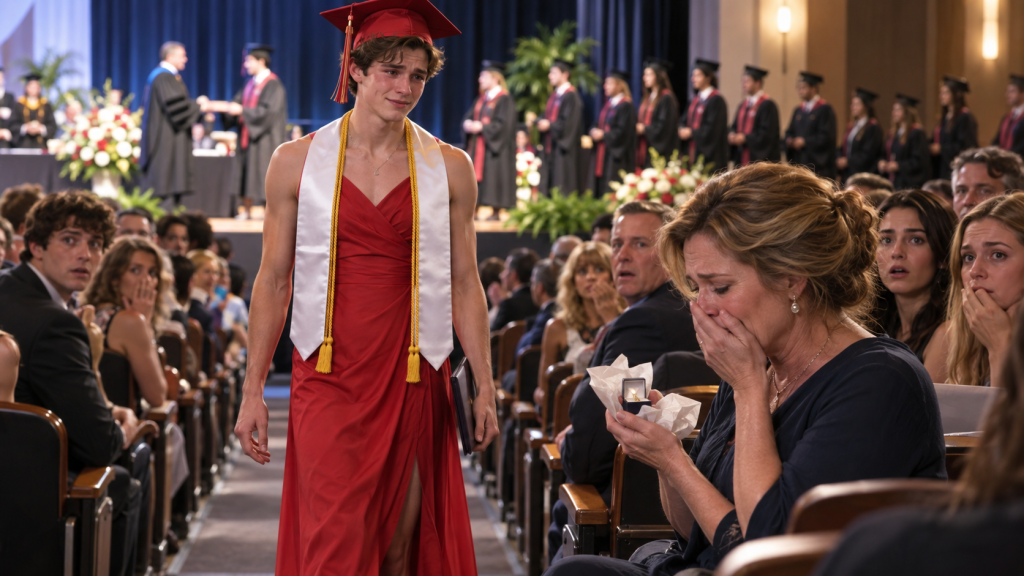
My son walked across the graduation stage wearing a bright red dress while hundreds of people laughed. I was the only person in the auditorium who knew why. The whispers started before Ethan’s name was even called.

By the time he reached the principal, people were openly staring.
Then someone behind me said loudly enough for several rows to hear:
“What is WRONG with that guy?”
A few people laughed.
I felt my entire body tense.
But Ethan never looked toward them.
He simply shook the principal’s hand, accepted his diploma, and stood there for a moment in that bright red dress as nearly six hundred people watched him.
Two weeks earlier, he had told me exactly what he planned to do.
It was after 2 a.m. in our kitchen.
Neither of us had been sleeping much.
When he showed me the dress, I immediately shook my head.
“Please don’t do this.”
He looked at me calmly.
“Mom, I have to.”
“They’ll be c.r.u.e.l to you.”
“I know.”
“Your classmates will film it. People will post it everywhere.”
“I know.”
I reached across the table and grabbed his hand.
“Then why put yourself through all of that?”
Ethan lowered his eyes to the red fabric lying between us.
Then he said quietly:
“Because I made a promise.”
I wanted to ask him to forget the promise.
I wanted to protect the son I still had from becoming the target of an entire auditorium.
But Ethan refused to change his mind.
His father was f.u.r.i.o.u.s when he found out.
He said he wouldn’t attend graduation if Ethan insisted on wearing the dress.
And he kept his word.
Ethan’s closest friend suddenly stopped answering his messages.
Even Willowcrest High called our house and gently suggested that Ethan choose what they described as a “more appropriate way” to honor the situation.
Ethan thanked them politely.
Then wore the dress anyway.
So there I was on graduation night, sitting alone in the third row while people laughed at my son.
After accepting his diploma, Ethan came down the stage steps.
But he didn’t return to his classmates.
He didn’t stop for the photographers.
Instead, he walked straight down the center aisle.
Toward me.
The whispering followed him the entire way.
When he reached my row, he stopped directly in front of my seat.
His eyes were already shining.
Then he whispered:
“This is for you, Mom.”
He paused.
“And for both of us.”
Before I could ask what he meant, Ethan reached into a hidden pocket sewn into the red dress.
He pulled out something tiny.
Flat.
Wrapped carefully in tissue paper.
Then he placed it in my trembling hands.
I slowly unfolded the paper.
And the second I saw what was inside, I b.r.o.k.e d.o.w.n.
Because suddenly I understood why Ethan had been willing to let an entire auditorium laugh at him.
I understood why he refused to change the dress.
Why his father’s anger hadn’t stopped him.
Why losing his best friend hadn’t stopped him.
And why, two weeks earlier, he had looked me directly in the eyes and said:
“I made a promise.”
Around me, the laughter began to disappear.
The woman sitting beside me leaned closer to see what Ethan had placed in my hands.
Her smile vanished instantly.
Then another mother saw it.
Then another.
Within seconds, the same row of people who had been giggling at my son had gone completely silent.
I stared down at the tiny object resting in my hands…
and finally understood something no one else in that auditorium knew.
Ethan hadn’t walked across that graduation stage alone.
PART 2 — THE RED DRESS WAS NEVER ABOUT THE DRESS
The tiny object in my hands was a school ID.
Not Ethan’s.
MAYA BENNETT
WILLOWCREST HIGH SCHOOL
CLASS OF 2026
My daughter.
My beautiful, impossible, stubborn daughter who should have been sitting with the other graduates that night.
The photograph on the card had been taken the previous September.
Maya’s dark hair fell over one shoulder.
Her smile was slightly crooked because she had refused to retake the picture after blinking during the first one.
She wore the silver earrings I gave her for her seventeenth birthday.
She looked healthy.
She looked irritated at having her photograph taken.
She looked alive.
Under the ID was a tiny folded piece of paper.
I recognized the handwriting before I opened it.
Maya’s.
Uneven from medication.
Still hers.
The note contained six words.
Don’t let me miss graduation. Promise.
I stopped breathing.
Then I broke.
Not elegantly.
Not quietly.
I bent forward in my seat and covered my mouth because the sound coming out of me did not feel human.
Ethan knelt in the aisle.
The red skirt pooled around his knees.
People were still watching.
I no longer cared.
I put both hands around his face.
“Oh, Ethan.”
He was crying now too.
“I told her I would.”
“I know.”
“I told her.”
“I know.”
“She wanted you to see it.”
I pulled him toward me.
And for one moment, there was no auditorium.
No laughter.
No phones.
No six hundred people.
Only my son in his sister’s red dress, holding together a promise I had been too frightened to let him keep.
Maya was Ethan’s twin.
Older by eleven minutes.
She never let him forget it.
“Respect your elders.”
she used to say whenever they argued.
Ethan would answer:
“You were born eleven minutes before me because you shoved.”
Maya considered this proof of leadership.
They were not identical.
Not even close.
Ethan got my pale skin and his father’s brown eyes.
Maya had Daniel’s dark hair and my green eyes.
But there were little similarities no photograph ever captured.
The way they both lifted one eyebrow when someone said something ridiculous.
The same laugh when they were genuinely surprised.
The same habit of tapping a pencil twice before writing.
As children, they fought constantly.
Then defended each other with almost frightening loyalty.
If I punished one unfairly, the other became a constitutional lawyer.
If Ethan got embarrassed in school, Maya turned it into someone else’s problem.
If Maya got sick, Ethan somehow became quieter until she recovered.
Then she didn’t recover.
Maya was diagnosed with acute leukemia during the summer before senior year.
One week she was complaining about bruises after soccer practice.
The next, we were sitting in a hospital office listening to a doctor use words I could not absorb.
Chemotherapy.
Bone marrow.
Response rates.
Infection risk.
Remission.
Treatment protocol.
Maya asked the first question.
“Can I still graduate?”
The doctor paused.
“That’s the goal.”
Maya nodded.
“Okay.”
Then she looked at Ethan.
“You’re still not borrowing my car.”
That was Maya.
Even terror had to wait behind sarcasm.
For months, graduation became the thing she aimed toward.
Not survival in some enormous philosophical sense.
Graduation.
She kept the date written in red marker on a calendar beside her hospital bed.
June 4.
She counted backward.
Ninety days.
Seventy-two.
Fifty.
When chemotherapy took her hair, she bought a ridiculous red wig online and told Ethan she looked like a “discount pop star.”
When infections forced her back into the hospital, she asked teachers to send assignments.
Not because grades mattered very much anymore.
Because school made the future feel real.
And the future had a stage in it.
She bought the dress in January.
The red one.
The one Ethan wore.
Technically, it was supposed to be for the senior dinner the night before graduation.
Maya refused white.
Said every graduation photograph looked like people were being recruited into a cult.
She wanted red.
Bright.
Impossible to ignore.
I remember standing outside the dressing room when she came out.
She spun once.
The skirt moved around her legs.
Her hair had just started growing back.
Maybe an inch.
She looked at herself in the mirror.
Then at me.
“Too much?”
“Absolutely.”
“So we’re buying it.”
I laughed.
“Yes.”
Ethan complained it cost too much.
Maya said:
“You’re jealous because my legs are better.”
He told her she looked like a fire alarm.
She threw a sock at him.
That was January.
In January, we still believed she would wear it.
By March, the cancer was back.
Aggressive.
Different words now.
Relapse.
Refractory.
Clinical trial.
Transplant possibility.
The doctors remained careful.
Hopeful where hope was medically possible.
Honest where it was not.
We became experts in reading faces before words arrived.
Maya became weaker.
Ethan became quieter.
His father became angry.
Not at Maya.
At everything.
Doctors.
Schedules.
Insurance.
Parking.
God.
Me.
Himself.
Grief had not arrived yet, so it wore anger’s clothes.
One night, about three weeks before Maya died, I found the twins whispering in her hospital room.
Ethan sat at the end of the bed.
Maya was pale.
Thin.
Her breathing slightly too fast.
But she was smiling.
The red dress hung from the bathroom door.
I frowned.
“Why is that here?”
Maya answered:
“Fashion emergency.”
Ethan looked guilty.
I thought they were planning to sneak her downstairs for photographs.
I almost laughed.
Then Maya said:
“Mom, if I can’t go to graduation, Ethan’s wearing it.”
I stared.
“What?”
“The dress.”
“No.”
Immediate.
Maya rolled her eyes.
“See?”
She looked at Ethan.
“I told you.”
I walked closer.
“No one is talking like that.”
“Mom.”
“You’re coming home.”
“Mom.”
“You’re going to graduate.”
Her face changed.
Not angry.
Sad.
“Mom.”
I stopped.
She knew.
Maybe not every detail.
Maybe not the exact number of days.
But she knew her body.
She knew the doctors had stopped saying when you leave and started saying if you’re able.
Children grow old very quickly in hospital rooms.
Maya touched the dress.
“If I’m not there, I want him to wear it.”
Ethan stared at the floor.
I looked between them.
“Why?”
Maya shrugged.
“Because it’s funny.”
Ethan laughed once.
She smiled.
Then became serious.
“Because people forget fast.”
I swallowed.
“What do you mean?”
“Everyone will cry at the funeral.”
“Then school keeps going.”
“Graduation happens.”
“They’ll read all the names.”
“Mine won’t be there.”
I sat beside her.
“Maya.”
“I know they’re putting me in the program.”
The school had already discussed ways to honor her if necessary.
An empty chair.
A flower.
A memorial line.
Things no mother should ever discuss while her child was still alive.
Maya hated all of them.
“I don’t want an empty chair.”
she said.
“Why?”
“Because empty is sad.”
She pointed at the dress.
“That isn’t empty.”
Ethan whispered:
“She wants me to walk for both of us.”
I looked at him.
“No.”
He flinched.
I regretted the sharpness immediately.
“I mean, you don’t have to do that.”
Maya said:
“He wants to.”
I turned toward her.
“Let him answer.”
Good.
Even then, she demanded that.
I looked at Ethan.
“Do you?”
He stared at the dress.
Then nodded.
“Yes.”
My throat tightened.
“People will laugh.”
Maya smiled weakly.
“Then they’re idiots.”
“Maya.”
“They are.”
Ethan laughed.
Then she looked at him.
“Promise?”
He hesitated.
Maya held out her pinkie.
Ridiculous.
Seventeen years old.
IV line taped to her hand.
Still using pinkie promises.
Ethan wrapped his finger around hers.
“Promise.”
I walked out of the room because I could not breathe.
Maya died nineteen days later.
She never came home again.
Not really.
We brought photographs.
Blankets.
Her own pillow.
The red dress went back into the closet.
Graduation remained circled in red on her calendar.
After she died, I could not erase it.
So I threw the calendar away.
Then took it out of the trash.
Then hid it in a drawer.
Grief makes you do strange things with paper.
Willowcrest held a memorial assembly.
They planted a tree.
Teachers cried.
Students posted photographs.
For about two weeks, Maya’s name was everywhere.
Then exams came.
Prom.
Senior trips.
College announcements.
Life did exactly what Maya had predicted.
It continued.
That is not cruelty.
It only feels like cruelty when someone you love is no longer moving with it.
Ethan returned to school.
People hugged him.
Then stopped hugging him.
Thank God.
He needed some normality.
But every time graduation was mentioned, I watched him go still.
I knew why.
The dress.
The promise.
I hoped he had forgotten.
That is hard to admit.
I hoped my son would break his promise to my dead daughter because I could not bear watching him become another spectacle attached to her death.
Two weeks before graduation, at two in the morning, he put the dress on our kitchen table.
“I’m doing it.”
I shook my head.
“Please don’t.”
He looked at me.
“Mom.”
“They’ll be cruel.”
“I know.”
“Your classmates will film you.”
“I know.”
“Your father will lose his mind.”
That one hurt.
Ethan looked away.
Dad had changed after Maya died.
So had I.
But Ethan’s father, Mark, had decided that moving forward meant moving away from anything that made grief visible.
Maya’s room?
Pack it.
Photographs?
A few were fine.
Hospital bracelets?
Throw them away.
Red dress?
Donate it.
He said he could not survive living in a mausoleum.
I understood that.
I disagreed with his timing.
We began fighting almost every day.
Then the marriage itself became another casualty.
We had separated four months after Maya’s death.
Not divorced yet.
But living apart.
Mark said I lived with a ghost.
I said he was running from one.
Neither sentence was entirely fair.
Both contained truth.
When Ethan told Mark about the dress, Mark exploded.
“No.”
Ethan said:
“You can’t stop me.”
“Watch me.”
“Dad.”
“This is sick.”
That word stayed in the room.
Sick.
Ethan’s face changed.
“You think Maya was sick.”
“You know that’s not what I meant.”
“You said it.”
Mark rubbed both hands over his face.
“I’m saying you cannot turn graduation into another memorial.”
“It already is.”
“No.”
“Dad, her name was supposed to be called too.”
Mark shouted:
“She is dead!”
Silence.
I watched Ethan absorb the sentence.
Not because he did not know.
Because there are ways to say the truth that become violence.
Mark realized it immediately.
His face collapsed.
“Ethan.”
“No.”
Ethan stepped backward.
“You don’t get to use that like I forgot.”
Mark started crying.
Ethan walked upstairs.
The red dress stayed on the kitchen table.
The next day Mark called me.
“If he wears that, I’m not going.”
I closed my eyes.
“Don’t say that.”
“I mean it.”
“He needs you there.”
“He needs someone to stop encouraging this.”
“I’m not encouraging it.”
“You kept the dress.”
“That isn’t the same thing.”
“You keep everything.”
There it was.
Our old wound.
I whispered:
“Mark, this isn’t about me.”
“Yes, it is.”
“No.”
“Everything is still Maya.”
His voice broke.
“I lost a daughter too.”
I knew.
God, I knew.
Then:
“I cannot sit in an auditorium and watch my son come out dressed like my dead daughter.”
I said:
“He isn’t pretending to be Maya.”
“It will feel like it.”
“That feeling is yours.”
Silence.
Then Mark hung up.
He kept his word.
He did not attend.
Ethan’s best friend, Logan, had a different reaction.
At first Logan said he would walk beside Ethan.
No matter what.
They had been friends since seventh grade.
Then, three days before graduation, a photograph leaked.
Ethan had tried the dress on at home.
He sent one picture to Logan.
Logan showed his girlfriend.
His girlfriend showed someone else.
By lunch, half the senior class knew.
Group chats exploded.
Memes appeared.
Someone added a crown.
Someone put Ethan’s head onto a drag-show poster.
Someone wrote:
MAYA 2.0
That one made him cry.
Not because they called him feminine.
Because they used her name.
Logan apologized.
Ethan did not answer.
Logan stopped texting after that.
I thought shame had made him disappear.
I was partly right.
The school called us.
The principal, Dr. Susan Keller, was kind.
Careful.
She said Ethan had the right to attend graduation in attire permitted under the ceremony’s dress guidelines.
The dress itself was not prohibited.
But administrators were worried about disruption.
They suggested other ways to honor Maya.
A ribbon.
A photograph.
A pin.
Ethan listened.
Then asked:
“If I wear a ribbon, will you read her name?”
Dr. Keller paused.
“We are planning a memorial acknowledgment.”
“That isn’t what I asked.”
I looked at him.
He continued.
“Will you call Maya Bennett when you call me?”
The school could not do that exactly.
Graduation lists were tied to enrolled graduates and official recognition procedures.
They offered a memorial statement.
Ethan thanked them.
Then said:
“I’m wearing the dress.”
So graduation came.
And people laughed.
At first.
Then I opened that tissue paper.
Maya’s ID.
Her note.
The woman beside me saw the photograph.
She knew Maya.
Everyone at Willowcrest knew Maya.
Recognition moved down the row like wind through grass.
One mother covered her mouth.
Another whispered:
“Oh my God.”
Someone behind us said:
“That was Maya’s dress?”
The laughter thinned.
Then stopped.
Not everywhere.
Six hundred people do not become saints simultaneously.
But enough.
Phones lowered.
Faces changed.
Shame replaced amusement in some.
Confusion in others.
A few people started crying.
Ethan stood in the aisle beside me.
Still wearing red.
Still shaking.
Then the principal approached the microphone.
I do not know whether she had planned what came next.
I suspect not.
She said:
“Before we continue, I want to acknowledge that tonight’s graduating class is missing someone.”
The auditorium became quiet.
“Maya Bennett should have been here.”
My hand flew to my mouth.
Ethan closed his eyes.
Dr. Keller continued.
“Maya was a member of this class.”
“A classmate.”
“A friend.”
“A sister.”
Then she looked toward Ethan.
“And she is being remembered tonight by someone who kept a promise.”
People began standing.
Not everyone.
Enough.
Applause rose.
Not the excited graduation kind.
Something slower.
Heavy.
Ethan cried.
So did I.
For one impossible moment, the red dress stopped being strange.
It became exactly what Maya wanted.
Impossible to ignore.
Then someone came running down the side aisle.
Logan.
Ethan saw him.
His face hardened.
Logan stopped three feet away.
He was crying.
“I’m sorry.”
Ethan said nothing.
Logan looked at the dress.
“I shouldn’t have shown the picture.”
“No.”
“I know.”
“That meme—”
“I didn’t make it.”
“I know.”
“I should’ve stopped them.”
“Yes.”
Logan swallowed.
Then took something out of his graduation gown.
A red ribbon.
He tied it around his wrist.
“I chickened out.”
Ethan stared at him.
Logan whispered:
“But I’m here now.”
Ethan did not hug him.
Not then.
Forgiveness is not owed on schedule.
But he moved slightly.
Enough to let Logan stand beside him.
That was something.
After the ceremony, strangers approached Ethan.
Some apologized.
Some said Maya had been in their chemistry class.
One teacher told him she remembered Maya threatening to fail deliberately because Ethan got a higher test score.
Ethan laughed.
A girl who had laughed earlier came over crying.
“I didn’t know.”
Ethan looked at her.
“That was kind of the point.”
She flinched.
He softened.
“You shouldn’t have needed to know.”
That sentence spread later.
Someone recorded it.
Of course.
By morning, videos from graduation were everywhere.
Not because Ethan had planned to become famous.
Because the internet loves context after it first loves cruelty.
Clips titled:
BOY WEARS DEAD TWIN SISTER’S DRESS TO GRADUATION
WHY THIS GRADUATE WORE RED
Millions of views.
Messages.
News requests.
Comments.
Some beautiful.
Some disgusting.
Humanity remained humanity.
Ethan ignored most of it.
Mark saw the video that night.
He called me at 11:38.
I stared at the phone.
Did not answer.
Then Ethan’s phone rang.
He looked at me.
“Do you want me to stay?”
He shook his head.
“No.”
He answered.
“Hi, Dad.”
I could not hear Mark clearly.
Only pieces.
Then Ethan said:
“You could’ve been there.”
Silence.
“You chose not to.”
Long silence.
Ethan’s face crumpled.
Then:
“No, Dad.”
“I didn’t do it to hurt you.”
Another pause.
“I did it because I told her I would.”
His voice broke.
Then he whispered:
“She asked about you too.”
I froze.
Mark must have said something.
Ethan closed his eyes.
“No.”
“You don’t know everything.”
My stomach tightened.
I stood.
“What does that mean?”
Ethan looked at me.
Too late.
He had already said it.
Mark said something urgently through the phone.
Ethan’s face changed.
Then he ended the call.
I stared.
“What don’t I know?”
He looked terrified.
Not of me.
Of hurting me.
“Mom.”
“What did Maya ask about Dad?”
He shook his head.
“Not tonight.”
My grief sharpened instantly into anger.
“No.”
“Ethan, we have been through enough secrets.”
He looked toward the crowd.
“Not here.”
That was fair.
I hated it.
Still fair.
We left graduation.
At home, the red dress went over the back of a chair.
Not folded.
Not hidden.
Ethan changed into sweatpants.
I made tea neither of us drank.
Then I put Maya’s ID and note on the kitchen table.
“Tell me.”
Ethan sat across from me.
His eyes were swollen.
For a long time, he did not speak.
Then:
“Maya made me promise two things.”
My heart started pounding.
“The dress was one.”
“What was the other?”
He stared at his hands.
“To tell Dad something after graduation.”
I waited.
“What?”
Ethan looked up.
“That she forgave him.”
The room became completely still.
“For what?”
He started crying.
I stood.
“What did Mark do?”
“Mom—”
“For what?”
Ethan whispered:
“The transplant.”
I froze.
Maya had been considered for an experimental treatment near the end.
I knew that.
A clinical trial.
Aggressive.
Risky.
There had been discussions.
Then the doctors said she was no longer eligible.
At least that was what I believed.
“What about the transplant?”
Ethan’s face folded in on itself.
“Dad told her not to do it.”
I stared.
“That’s not possible.”
“He couldn’t decide that.”
“I know.”
“Doctors decide eligibility.”
“I know.”
“Then what are you saying?”
Ethan wiped his face.
“Maya had another option.”
“A trial in Boston.”
My knees weakened.
Boston.
I remembered one phone call.
One evening Mark disappeared into the hospital consultation room with an oncologist.
He told me afterward the Boston team had declined Maya.
I believed him.
Why wouldn’t I?
He was her father.
My husband.
Ethan continued.
“They didn’t decline her.”
I could not breathe.
“Maya declined.”
My mouth went dry.
“Why?”
“She didn’t want to go.”
“No.”
That did not sound like Maya.
“She wanted everything.”
Every treatment.
Every chance.
Ethan shook his head.
“Not at the end.”
I stared.
“She was tired.”
His voice broke.
“She knew the odds.”
“The treatment might have given her more time, but it also might have meant spending almost all of it in Boston.”
“More chemo.”
“Isolation.”
“Maybe ICU.”
“She asked Dad what he thought.”
I covered my mouth.
“Why didn’t she ask me?”
Ethan started crying harder.
“Because she knew what you’d say.”
The sentence destroyed me.
“What would I say?”
“You would tell her to fight.”
I backed away.
“No.”
“Mom.”
“I would’ve listened.”
Ethan looked at me with unbearable tenderness.
“Would you?”
I opened my mouth.
Nothing came.
Because I knew.
I would have begged.
Found statistics.
Called specialists.
Sold the house.
Moved to Boston.
Slept on hospital floors.
Done anything.
Everything.
I would have called it hope.
Maybe it would have been.
Maybe it also would have made Maya responsible for saving me from losing her.
That thought cut deeper than accusation.
Ethan continued.
“Dad told her she didn’t have to do it.”
“He said if she was tired, she could stop.”
I whispered:
“No.”
Not because I believed it was wrong.
Because I could hear Mark saying it.
I could see him sitting beside her.
Angry at the universe.
Finally giving her permission to admit she was tired.
“Maya asked him if that made her a quitter.”
Ethan swallowed.
“Dad said no.”
“He said she had fought enough.”
I started crying.
Then:
“She decided not to go.”
The truth rearranged the last month of my daughter’s life.
Not abandonment.
Not a doctor’s decision.
Hers.
A seventeen-year-old girl facing terrible choices no seventeen-year-old should face.
“Why did Mark lie to me?”
I asked.
Ethan looked down.
“Maya asked him to.”
That hurt too.
“Why?”
“Because she thought you’d blame yourself.”
I laughed bitterly.
“Apparently everyone thinks that.”
Ethan reached for me.
I stepped away.
Not from him.
From the truth.
“She knew you would ask if you had pushed her too hard.”
“She didn’t want your last weeks together to become an argument about Boston.”
“So she let me believe there was no option.”
“Yes.”
“And Mark agreed.”
“Yes.”
Anger returned.
Not clean anger.
Grief-soaked.
“He had no right.”
Ethan nodded.
“I know.”
“Even if Maya asked.”
“I know.”
“He was my husband.”
“I know.”
“He let me stand at her funeral thinking medicine failed before we ran out of choices.”
Ethan whispered:
“I know.”
No defense.
Good.
“Why did Maya forgive him?”
I asked.
“Because he hated himself.”
I looked at Ethan.
“He cried in her room after you went home one night.”
“She told him he had done what she asked.”
“He said he betrayed you.”
“She said:
‘Then tell Mom someday that I chose.’”
I sat down.
Hard.
“Someday.”
“Yes.”
“Why graduation?”
Ethan looked at the red dress.
“Because she thought if she died, graduation would be the day you’d feel like she disappeared from the future.”
My eyes closed.
“She said:
‘That’s when you tell them I made choices while I was here.’”
Them.
Plural.
Me.
Mark.
Ethan.
Maybe everyone.
Then Ethan reached into the hidden pocket again.
I stared.
“There’s more?”
He nodded.
The dress had two pockets.
Of course it did.
Maya had insisted on pockets when we bought it.
“Any dress without pockets is oppression.”
she said in the store.
I had laughed.
Ethan pulled out an envelope.
My name on it.
MOM
Maya’s handwriting.
My whole body started shaking.
“Why didn’t you give me this at graduation?”
“Because she said not there.”
I stared at him.
“How long have you had it?”
“Since the hospital.”
“You’ve had a letter from Maya for three months?”
He started crying.
“I promised.”
Anger flashed.
Then stopped.
Promise.
Everything came back to promises.
I held out my hand.
Ethan gave me the envelope.
I did not open it immediately.
I traced my name.
Maya had written it before her hands became too weak.
Then I unfolded the page.
The first sentence:
Mom, please don’t be mad at Dad until you finish reading.
Of course.
Even dead, my daughter was directing traffic.
I laughed and cried at once.
Then I read.
Maya wrote that she loved me.
That she knew I would fight for her forever if medicine gave me even one percent.
That she loved that about me.
Then:
But I was tired.
Four words.
I stopped.
Read them again.
I was tired.
Not defeated.
Not abandoned.
Tired.
She wrote that Boston might have helped.
Might not.
She knew the odds were poor.
She knew treatment would be brutal.
She wanted to spend whatever time remained near home.
With us.
With Ethan.
With her own bed if possible.
With Dad making terrible grilled cheese.
With me pretending hospital coffee was drinkable.
She chose.
Then:
Dad didn’t make me stop. He was just the first person who told me I was allowed to.
I pressed the paper to my mouth.
Oh, Mark.
My anger did not disappear.
But it changed shape.
Then Maya wrote:
I didn’t tell you because I was scared you would hear “I’m done” as “I don’t love you enough to stay.” That isn’t true.
I sobbed.
Ethan came around the table and held me.
I kept reading over his shoulder.
I love you enough that leaving is the hardest thing I’ve ever done.
Then:
Please don’t make Dad carry this forever. He already thinks he failed me.
And finally:
When Ethan wears the red dress, don’t be embarrassed. He looks terrible in it, but he promised.
I laughed so hard I could not see the page.
That little monster.
Then the last line.
If everybody laughs, tell them I picked the color.
I sat at the kitchen table until nearly dawn.
Ethan fell asleep on the sofa.
The red dress remained over the chair.
Maya’s letter lay beside her school ID.
I did not call Mark.
Not yet.
Some truths need one night to become survivable.
The next morning, someone knocked.
Ethan opened the door.
Mark stood outside.
He looked terrible.
Unshaven.
Eyes red.
For several seconds, no one spoke.
Then I held up Maya’s letter.
His face crumpled.
“She gave it to you.”
“Yes.”
He nodded.
“I’m sorry.”
I looked at him.
There were a thousand things I could have said.
How dare you.
Why didn’t you tell me?
You stole my chance to understand her choice.
You let me blame the doctors.
You decided I was too fragile for the truth.
All true.
Instead, the first thing out of my mouth was:
“Did she really choose?”
Mark cried.
“Yes.”
No hesitation.
“Did you pressure her?”
“No.”
“Did you want her to go to Boston?”
His face collapsed.
“More than anything.”
There.
That mattered.
He sat at the kitchen table.
Same place where Ethan had shown me the dress two weeks earlier.
Mark told me the whole thing.
The Boston trial existed.
It was experimental.
Maya was medically eligible at first, though her odds were poor and risks severe.
The team explained everything.
She asked questions.
Then asked to speak with Mark alone.
Why him?
Because, as she told him:
“Mom will make hope sound too pretty.”
That hurt.
Also sounded exactly like her.
Maya asked:
“If I say no, am I giving up?”
Mark said:
“No.”
Then cried afterward in a hospital stairwell for twenty minutes.
She chose not to enroll.
The local medical team continued comfort-focused care and treatments aimed at keeping her stable as long as possible.
No one euthanized her.
No treatment was secretly withheld.
She made a difficult medical choice with clinicians involved.
The lie came afterward.
Mark told me Boston had decided she was not a candidate.
He thought he was protecting her decision.
Protecting me.
Protecting himself.
Maybe all three.
It was still a lie.
“I don’t forgive that yet.”
I told him.
He nodded.
“You shouldn’t.”
“I might someday.”
“I know.”
“You should have trusted me.”
“I know.”
“I was her mother.”
“I know.”
“You did not get to decide what truth I could survive.”
His face broke.
“I know.”
That was enough for that morning.
Not reconciliation.
Not revenge.
Truth.
Finally.
Then I asked:
“Why didn’t you come to graduation?”
He looked toward the red dress.
Shame filled his face.
“Because when Ethan told me, I knew what else it meant.”
I understood.
The dress was not only Maya’s memorial.
It was the deadline.
Graduation meant the secret had to come out.
Mark had promised Maya too.
He could not face me.
So he turned his fear into anger at Ethan.
Called the dress sick.
Threatened not to attend.
Then stayed away.
It was cowardly.
He knew it.
“I’m sorry.”
he whispered.
“Tell Ethan.”
“I will.”
“Not me.”
Mark nodded.
Ethan came downstairs twenty minutes later.
Saw his father.
Stopped.
Mark stood.
For once, he did not try to explain first.
He said:
“I’m sorry I didn’t come.”
Ethan’s face hardened.
Mark continued.
“I’m sorry I called what you did sick.”
“I was wrong.”
“I knew what the dress meant and I was scared of the truth that came with it.”
Ethan said nothing.
Then:
“You missed my graduation.”
“Yes.”
“You can’t redo that.”
“No.”
Silence.
Then Mark whispered:
“I know.”
Ethan looked toward Maya’s dress.
Then back at him.
“I’m not ready.”
Mark nodded.
“Okay.”
That was important too.
Forgiveness cannot be another obligation placed on the grieving.
My phone buzzed.
A message from Dr. Keller.
The school principal.
There is something you and Ethan need to see. Please call when you’re ready.
I almost ignored it.
Then called.
Her voice sounded strange.
“Mrs. Bennett, someone sent the school a video overnight.”
“What video?”
“From Maya.”
My heart stopped.
“What?”
Apparently, months earlier, Maya had recorded a short video with the school counselor.
She asked them to keep it private unless Ethan actually wore the red dress at graduation.
Of course she had.
My daughter had contingency plans from beyond the grave.
Dr. Keller said:
“She made us promise.”
Naturally.
“What does she say?”
Dr. Keller paused.
“I think you should watch it yourselves.”
A link arrived.
Ethan sat beside me.
Mark stayed across the room.
I hesitated.
Then pressed play.
Maya appeared on the screen.
Hospital room.
Short hair.
Red dress hanging behind her.
She looked thin.
Alive.
She smiled directly into the camera.
And said:
“If Ethan actually did this, first of all, I am shocked because he is a coward.”
Ethan shouted:
“Oh, come on.”
I laughed through tears.
Then Maya’s smile softened.
“Second, if you laughed at him, I hope you feel bad.”
Pause.
“Not forever.”
“Just enough to learn something.”
Then:
“People are going to think he wore this dress because he wants attention.”
“He does.”
“He’s always been dramatic.”
Ethan threw a pillow at the screen.
Then Maya became serious.
“He wore it because I asked.”
“And he said yes even though he knew people might be awful.”
“That’s what love looks like sometimes.”
“Not looking normal for someone.”
“Not looking brave.”
“Just keeping the promise after the person who asked isn’t there to check.”
My eyes blurred.
Then she said:
“And Mom, if you’re watching this, stop crying.”
Impossible.
“And Dad…”
Mark froze.
Maya looked into the camera.
“I forgive you.”
He covered his face.
“And you have to forgive yourself eventually because I’m not spending eternity listening to you complain.”
That was Maya.
Then finally:
“Everybody else, congratulations.”
“Please do something interesting with your lives.”
“And Ethan?”
She smiled.
“You look terrible in red.”
The video ended.
We sat in silence.
Then Ethan started laughing.
Not politely.
Not sadly.
Full-body laughter.
I joined him.
Eventually even Mark did.
And for the first time since Maya died, laughter did not feel like betrayal.
It felt like she had found one last way to sit at the table with us.
But the story was not over.
Because when the video ended, Dr. Keller sent one more message.
There is a second recording. Maya asked that only Ethan and his parents receive it.
My smile faded.
Ethan stared at the screen.
Mark looked at me.
For once, none of us tried to guess.
I opened the second file.
Maya appeared again.
No jokes this time.
She held something in her hands.
A folded document.
Then she said:
“I need you three to know something before you start blaming each other.”
My stomach tightened.
Ethan whispered:
“What now?”
Maya continued.
“I made another decision.”
Mark went pale.
I stared at the screen.
“What decision?”
Of course she could not hear me.
Then my daughter looked straight into the camera and said:
“It’s about what happens to the money Grandpa left me.”
I stopped breathing.
Money?
Maya had inherited money?
Ethan looked as confused as I felt.
Mark whispered:
“No.”
He knew.
I turned toward him.
“What money?”
He stared at the screen.
Maya continued:
“And before anybody fights about it, I already signed everything.”
My blood went cold.
Because suddenly I understood that graduation had not merely been the deadline for one family secret.
Maya had apparently left us one more choice she wanted respected.
And judging by Mark’s face, he had known about that one too.
PART 3 — THE PROMISE WAS NEVER ABOUT BEING BRAVE
Maya looked straight into the camera.
“It’s about what happens to the money Grandpa left me.”
I turned toward Mark so fast my neck hurt.
“What money?”
He did not answer.
Not immediately.
That was enough to tell me he knew.
On the laptop screen, Maya shifted against the hospital pillows.
She looked exhausted in the recording.
Her hair had begun growing back in uneven dark patches.
The hospital light made her face look almost translucent.
Yet her voice was steady.
“Before anybody starts fighting, I already signed everything.”
Ethan whispered:
“Oh, Maya.”
Then she smiled.
“I know Mom is making the face.”
Despite myself, I almost laughed.
Apparently even death could not protect me from my daughter’s accuracy.
Maya continued.
“Grandpa left Ethan and me money.”
“Not millionaire money.”
“So everybody calm down.”
Ethan looked at me.
“I didn’t know.”
“Neither did I.”
Mark lowered his eyes.
Maya answered the question before either of us could ask him.
“Dad knew because he helped me meet with the lawyer.”
I stared at Mark.
He closed his eyes.
Another secret.
God.
I was so tired of loving people who thought protecting me required editing reality.
Maya explained.
My father—Ethan and Maya’s grandfather—had died when the twins were fourteen.
Most of his estate went to my mother, who was still living.
But he also left each grandchild an investment account.
Not enormous.
Enough to matter.
The accounts were managed for them while they were minors.
The twins would gain direct control at eighteen.
I had known there were “grandkid accounts.”
I did not know the amounts.
Dad had always been private about money.
I assumed college funds.
And because Maya’s illness consumed every waking thought, I had never asked.
Maya and Ethan turned eighteen eleven days before she died.
Eleven days.
That detail broke something open inside me.
There had been a tiny birthday cake in her hospital room.
Eighteen candles were forbidden because of oxygen precautions, so a nurse found one ridiculous battery-operated candle that flickered when Maya blew on it.
She called adulthood “a scam.”
I had laughed.
I did not know that two days later she asked Mark to help her contact an attorney.
The account was worth a little over $83,000.
Not a fortune.
Not enough to transform anyone’s life.
Enough to make choices with.
Once Maya turned eighteen, it was hers.
The attorney had explained that because of her condition, she could make a simple will directing where the account and other personal property should go if she died.
She did.
Independently.
Mark drove her to the meeting.
He waited outside for part of it.
The attorney spoke with Maya alone to make sure the decisions were hers.
That mattered to me.
Maybe because after everything else, I needed proof that at least one adult had understood that love did not mean speaking for her.
Maya looked into the camera.
“Here’s what I did.”
She held up three fingers.
“Twenty thousand goes to Ethan.”
Ethan immediately shook his head.
“No.”
As though Maya could hear him.
She continued.
“For therapy.”
He stared at the screen.
Then Maya grinned.
“I’m joking.”
Ethan made a wounded sound.
Even Mark laughed once.
Maya added:
“It’s for whatever you want.”
“College.”
“Travel.”
“A car that does not smell like old French fries.”
“Therapy is still a good idea.”
Ethan covered his face.
“You’re unbelievable.”
I was crying and laughing at once.
She had planned that.
Of course she had.
“Twenty thousand goes to Mom.”
I stopped laughing.
“No.”
My voice came out before I could control it.
Mark looked at me.
Maya continued.
“And before she says no, yes.”
That child.
“It is not because Mom needs money.”
“She’ll say she doesn’t.”
“She probably doesn’t.”
“It’s because she spent eighteen years buying us things and pretending she didn’t want anything.”
I covered my mouth.
“I want her to take a trip.”
“Not somewhere depressing.”
“Somewhere with terrible food she can complain about.”
Tears blurred the screen.
Then her face softened.
“And I want her to buy something stupid.”
“Mom never buys stupid things.”
“She researches lamps.”
“Who researches lamps?”
Ethan whispered:
“She’s right.”
I hit his arm.
He barely noticed.
Maya continued.
“Twenty thousand goes to Dad.”
Mark bent forward.
His face disappeared into his hands.
Maya’s voice became gentler.
“Dad, you are not allowed to donate it because you feel guilty.”
Mark started sobbing.
“You didn’t make me stop treatment.”
“You didn’t kill me.”
“You did not fail.”
“Take the money.”
“Fix the boat.”
“Buy the stupid grill.”
“Go somewhere.”
“Just don’t turn it into punishment.”
Mark cried harder.
For the first time since graduation, I felt no anger toward him.
Only sorrow.
Because Maya had known exactly what each of us would do with grief.
I would cling.
Ethan would turn promises into responsibility.
Mark would convert guilt into self-denial.
She had known us.
Maybe too well.
Then Maya held up one final finger.
“The rest goes to the Willowcrest scholarship fund.”
Dr. Keller had apparently helped connect her with the school foundation after Maya asked whether there was any way to help students who missed school because of serious illness.
The remaining amount—after legal expenses and final account changes—would establish a small scholarship in Maya’s name.
Not only for students with cancer.
Any graduating Willowcrest student whose education had been disrupted by serious illness or caregiving responsibilities.
Maya said:
“People think missing school means you don’t care.”
“Sometimes you’re just busy not dying.”
Ethan sucked in a breath.
I closed my eyes.
She continued.
“So if somebody has terrible attendance because life is awful, maybe don’t assume they’re lazy.”
That was Maya.
A joke first.
Truth underneath.
Then she looked straight into the camera.
“And nobody gets to change this because I’m dead.”
The room became completely still.
Maya continued.
“I’m eighteen.”
“I talked to the lawyer.”
“I understood what I signed.”
“I chose.”
There was no anger in her voice.
That made the sentence stronger.
“I know everybody loves me.”
“But loving me does not mean changing my answer after I’m gone.”
I looked at Mark.
He was staring at the floor.
Then Maya said:
“And Mom?”
I froze.
“You are going to be mad Dad didn’t tell you.”
Correct.
“He didn’t tell you because I asked him not to.”
Also correct.
“But after graduation, he has to.”
She smiled faintly.
“If he doesn’t, haunt him.”
Ethan laughed through tears.
Mark whispered:
“Fair.”
The video ended.
Nobody spoke.
The room felt too small for all the versions of Maya inside it.
Sick Maya.
Funny Maya.
Frightened Maya.
The girl who declined Boston.
The girl who bought a red dress.
The woman—because yes, woman—who turned eighteen and sat with an attorney to decide what happened to her own money.
My daughter had spent the end of her life making choices.
And somehow the rest of us had spent months treating her death as proof that choices had been taken from her.
Some were.
Cancer took plenty.
But not all of them.
That mattered.
I turned to Mark.
“Were you ever going to tell me?”
“Yes.”
“When?”
He looked ashamed.
“Today.”
“After graduation?”
“Yes.”
“Because Maya said so?”
“Yes.”
I stood.
Anger returned.
Not the same anger.
Cleaner.
“You still should have told me about Boston after she died.”
“I know.”
“And this.”
He nodded.
“I know.”
“I was her mother.”
“I know.”
“Stop saying that.”
He flinched.
I lowered my voice.
“Knowing now does not fix choosing for me then.”
Mark stared at me.
Then nodded.
“You’re right.”
That helped more than another apology.
Ethan looked between us.
“Can we not destroy each other over everything Maya asked Dad not to tell?”
I turned.
“Excuse me?”
His face went pale.
Then he held his ground.
Good.
“She made choices too.”
“I know that.”
“Do you?”
The same question he had asked me the night before.
I hated it because I needed it.
Ethan continued.
“You keep acting like Dad hid everything because he thought you were weak.”
“Sometimes he did.”
“Maybe.”
“But sometimes Maya asked him to.”
I looked at Mark.
He said nothing.
Good.
No rescue.
Ethan continued.
“You always told us we could tell you anything.”
My throat tightened.
“But some things, Mom…”
He swallowed.
“…you made really hard to tell you.”
That hurt.
Deeply.
“What does that mean?”
“When Maya was sick, every bad update became a mission.”
“New doctor.”
“New study.”
“New diet.”
“New article.”
I opened my mouth.
He kept going.
“I know why.”
“You were trying to save her.”
“But sometimes she didn’t need another plan.”
“She needed you to sit there while she was scared.”
I started crying.
Because I remembered.
Maya once said:
“Mom, can we not talk about cancer tonight?”
I lasted fourteen minutes before mentioning a new trial.
Fourteen.
I had called that hope.
Maybe to Maya, sometimes, it had felt like pressure.
“I’m sorry.”
I said.
Not to Ethan alone.
To the empty chair.
The red dress.
The daughter who was no longer there to tell me when help stopped feeling helpful.
Ethan reached for my hand.
“You were scared too.”
“Yes.”
No excuse.
Just truth.
The will was valid.
That was the next surprise.
Or perhaps the first unsurprising thing in days.
Maya had signed it properly.
Witnesses.
Attorney.
Capacity documentation in the file because the lawyer understood a terminally ill eighteen-year-old’s decisions might later be questioned.
Not because Maya had lacked capacity.
Because good lawyers anticipate grief making relatives irrational.
The account custodian had already received notice of Maya’s death.
Nothing had been distributed yet.
The process took months.
No suitcase of cash arrived.
No one got a check at breakfast.
Probate and account administration remained stubbornly uncinematic.
I had never been more grateful for boring paperwork.
I considered refusing my twenty thousand.
The lawyer told me I could disclaim it if I truly wanted.
I almost did.
Then Ethan said:
“She literally made a video telling you not to.”
“I know.”
“So maybe stop trying to win arguments with dead Maya.”
“I am your mother.”
“And she was older than me by eleven minutes.”
“Why does everyone keep using that against me?”
Ethan smiled.
Because Maya would have.
So I accepted it.
Eventually.
I did not buy something stupid.
Not immediately.
I put the money in savings.
For three months.
Then Ethan found out and threatened to tell everyone I was violating Maya’s “spirit.”
So I booked a trip.
Portugal.
Maya had once shown me photographs of Lisbon and said the sidewalks looked “too fancy to walk on.”
I went alone.
That frightened me.
Mark and I were still separated.
Ethan was leaving for college.
For the first time in eighteen years, I had no child waiting at home.
No hospital.
No school schedule.
No marriage schedule.
Just me.
In Lisbon, I ate an expensive pastry that covered my shirt in powdered sugar.
I bought a blue ceramic bowl that did not match anything in my kitchen.
Then, because Maya had demanded stupidity, I bought a pair of ridiculous red shoes.
I wore them exactly twice.
Perfect.
Ethan used part of his money for college.
Part for therapy.
He hated admitting Maya had been right.
The first counselor was not a good fit.
The second was.
He learned something I wish every grieving sibling were told early:
Surviving does not create a debt to the person who died.
For months, Ethan had treated Maya’s promise like a job.
Wear the dress.
Give Mom the note.
Tell Dad she forgave him.
Carry the secrets.
Finish graduation for two people.
His therapist eventually asked:
“When do you get to graduate as Ethan?”
That question broke him.
In a good way.
He began separating memory from assignment.
Maya did not need him to spend the rest of his life proving he loved her.
He already had.
Mark used his inheritance too.
Eventually.
He fixed the old boat.
Maya hated that boat.
Said it smelled like “wet pennies and divorce.”
We had all laughed at the time.
Ironically, the divorce part almost became prophetic.
Mark and I spent a year in counseling.
At first, I assumed it would help us separate better.
Maybe it did.
Then something unexpected happened.
We became honest.
Not reconciled quickly.
Honest.
There is a difference.
We talked about Maya.
Really talked.
Not as a case.
Not as an accusation.
Mark admitted that when she chose not to go to Boston, he felt relief for about three seconds.
Relief that the brutal treatment might stop.
Then he hated himself for feeling it.
So he buried the guilt.
When Maya died, he could not stand looking at her room because every object became evidence of the life she lost.
I wanted the room untouched because moving anything felt like helping the world erase her.
Neither of us was wrong.
Neither method was sustainable.
We had punished each other for grieving differently.
Mark apologized again for lying about Boston.
This time he did not say:
I was protecting you.
He said:
“I was scared of your grief.”
That was more honest.
“I thought if you knew she had chosen not to go, you would blame yourself for not convincing her.”
“I probably would have.”
“I know.”
“Still not your decision.”
“I know.”
I looked at him.
He stopped.
Then corrected himself.
“You’re right.”
Better.
I apologized too.
For turning every conversation during Maya’s illness into a strategy session.
For making fear feel like something we could outwork.
For treating Mark’s quiet as surrender.
For sometimes treating Maya’s hope as mandatory.
That apology hurt.
But grief does not make us innocent simply because we were suffering.
It explains.
It does not erase.
We did not move back together.
Not then.
Maybe some stories expect the dead daughter’s message to reunite the parents by Christmas.
Life was slower.
We learned how to have dinner.
Then conversations.
Then spend holidays without reopening old wounds for sport.
Two years after Maya died, Mark and I chose to try again.
Not because Maya wanted us married.
She had never said that.
Important.
We chose.
The second version of our marriage was quieter.
We did not pretend the first had never cracked.
Some repaired things remain visibly repaired.
That does not make them weak.
Sometimes it makes you more careful where you put weight.
Mark’s relationship with Ethan took longer.
Missing graduation mattered.
There was no replacement ceremony.
No speech that restored the empty chair beside me.
Mark understood that.
He never asked Ethan to pretend otherwise.
Instead, he showed up afterward.
College move-in.
Therapy appointment when Ethan asked for a ride.
A flat tire at eleven at night.
Thanksgiving.
Ordinary opportunities.
He stopped making dramatic apologies.
Started being present.
One day, almost two years later, Ethan asked him:
“Do you want to see the graduation video?”
Mark cried before it even played.
They watched together.
That was their reconciliation.
Not forgiveness announced in a sentence.
A father finally sitting through the moment he had been too frightened to witness.
Logan and Ethan repaired their friendship too.
Slowly.
The leaked photo had consequences Logan could not undo.
He apologized without blaming his girlfriend.
Good.
He admitted he showed someone a private picture because he thought the dress was shocking and wanted another reaction.
Bad.
True.
Ethan said:
“You made me entertainment before everyone else did.”
Logan nodded.
“Yes.”
Then gave him space.
Months later, they spoke again.
By college, they were friends but not inseparable.
That seemed right.
Not every broken relationship returns to its original shape.
The graduation video followed Ethan for a while.
News organizations contacted us.
Podcasts.
Morning shows.
People wanted a beautiful story.
Teen Honors Dead Twin in Red Dress.
They wanted him to cry on cue.
Wanted me to talk about courage.
Wanted Mark’s absence explained.
Wanted Maya packaged into five minutes between weather and cooking.
We declined most of it.
Ethan agreed to one interview with the local paper because the reporter had known Maya from covering school events.
He said one thing that became the headline:
“You shouldn’t need to know someone’s grief before deciding not to laugh at them.”
I kept that clipping.
Not the viral posts.
Those disappeared faster than anyone expects.
The internet is loud.
Then hungry for something else.
Thank God.
The school established the Maya Bennett Resilience Scholarship with her remaining inheritance.
I disliked the word resilience at first.
Maya would have too.
She hated being praised for being “inspiring” simply because she attended class during treatment.
Dr. Keller listened.
The name changed.
It became the Maya Bennett Keep Going Scholarship.
That sounded more like her.
The first recipient was a boy who had missed nearly half his senior year while caring for his mother during kidney failure.
He almost did not graduate.
He did.
At the scholarship ceremony, Ethan presented the award.
Not in the red dress.
In jeans and a jacket.
His choice.
He told the boy:
“My sister would have liked you because you both hated inspirational speeches.”
Everyone laughed.
Perfect.
The red dress stayed in my closet for almost three years.
At first I could not touch it.
Then I could touch it but not move it.
Then one spring, Ethan came home from college and asked:
“What are you going to do with Maya’s dress?”
I stared at him.
“Keep it.”
“Forever?”
The question irritated me.
Then frightened me.
Forever is heavy.
I asked:
“What do you think?”
He shrugged.
“It was hers.”
“Yes.”
“Then mine for one day.”
“Yes.”
“Now it’s yours.”
I hated that answer.
Because it was true.
Again, choice.
Mine.
For a while I considered donating it to the school theater department.
Then I imagined someone cutting it apart for costumes and nearly screamed.
Not ready.
I considered storing it professionally.
That felt like embalming fabric.
Then Dr. Keller called.
The Keep Going scholarship recipient for that year was a girl named Sophie Nguyen.
Sophie had missed months of school after a heart transplant.
She was graduating.
Her family could not afford a dress for the senior dinner.
The school counselor was helping.
I stared at the red dress hanging in my closet.
Same approximate size.
For twenty minutes, I hated the idea.
Then I laughed.
Because Maya would have hated the idea of a perfectly good dress becoming holy.
She had bought it to be worn.
So I asked Sophie if she wanted to see it.
No story attached at first.
No emotional obligation.
Just:
I have a red dress that might fit.
She tried it on.
Turned toward the mirror.
Spun once.
Exactly as Maya had.
“Too much?”
she asked.
I started crying.
Sophie panicked.
“I can take it off.”
“No.”
I laughed.
“No.”
Then I said the words I had told Maya years earlier.
“Absolutely too much.”
Sophie grinned.
“So I can wear it?”
“Yes.”
I told her whose dress it was only after she chose it.
That mattered.
I did not want Maya’s memory becoming a debt Sophie had to perform.
Sophie listened.
Then asked:
“Are you sure?”
I looked at the dress.
For the first time, I did not see the hospital.
Or graduation.
I saw my daughter in a fitting room complaining that red was the only acceptable color for being impossible to ignore.
“Yes.”
I said.
“I’m sure.”
Sophie wore it.
Nothing supernatural happened.
Maya did not return through another girl.
It was simply a beautiful red dress on someone alive.
I think that would have made Maya happiest.
I kept her school ID.
And the note.
Don’t let me miss graduation. Promise.
They are in a small box now.
Not displayed.
Not hidden.
There are photographs too.
Her soccer medal.
One silver earring because the other vanished years ago.
A ridiculous hospital wristband she drew a smiley face on.
Ordinary relics.
Grief eventually learns which objects need to remain objects.
That took me years.
Five years after Maya died, Ethan graduated from college.
He called me before the ceremony.
“Mom.”
“Yes?”
“I need to tell you something.”
My entire nervous system returned to Willowcrest.
“No red dress.”
I said immediately.
He laughed.
“Relax.”
“Never begin a sentence like that with me again.”
He had sewn something into the inside pocket of his graduation gown.
Maya’s school ID.
I closed my eyes.
“You’re carrying her?”
“For a little while.”
He hesitated.
“But this graduation is mine.”
My throat tightened.
“That’s right.”
He had learned.
So had I.
He carried her without disappearing inside her memory.
That was the balance all grieving people search for.
Mark attended.
First row.
Early.
Painfully early.
He refused to risk traffic.
When Ethan crossed the stage, Mark stood and clapped until his hands hurt.
No dress.
No public secret.
No unfinished promise.
Just our son graduating.
Afterward, Ethan came down the aisle.
For one terrified second, I thought history was repeating.
He reached us.
Pulled Maya’s ID from his pocket.
Showed it to me.
Then put it back.
That was all.
No breakdown.
No announcement.
Her memory no longer needed every room to stop.
Later, the three of us went to dinner.
Mark raised his glass.
“To Ethan.”
Ethan looked suspicious.
“Only Ethan?”
Mark smiled.
“Tonight?”
“Yes.”
Something passed across Ethan’s face.
Relief.
“Thanks, Dad.”
Maya would not have been offended.
That was another lesson.
Remembering the dead does not require making every celebration partially theirs.
Love is not measured by how much joy you surrender to grief.
Years later, Ethan asked me whether I still thought he had been brave for wearing the dress.
I considered the question.
“No.”
He looked offended.
“What?”
“I think you were terrified.”
“I was.”
“I think you wanted to run away.”
“Yes.”
“I think you hated everyone staring.”
“Definitely.”
“And you did it anyway because Maya asked.”
He smiled.
“So brave.”
I shook my head.
“Maybe.”
“But I don’t think bravery was the important part.”
“What was?”
“Keeping the promise without letting the promise own the rest of your life.”
He became quiet.
Then nodded.
That was what Maya had been teaching all of us from the beginning.
She chose not to go to Boston.
That choice did not mean she wanted to die.
She chose what happened to her money.
That did not mean she expected everyone to stop living.
She asked Ethan to wear the dress.
That did not mean he needed to wear red forever.
She forgave Mark.
That did not force Ethan or me to forgive on her schedule.
Maya made her choices.
We still had ours.
That was the part grief had almost made us forget.
On what would have been the twins’ twenty-fifth birthday, Ethan came home.
He brought a small cake.
Two candles.
One for him.
One for Maya.
For years, I might have called that sad.
It wasn’t.
Not entirely.
We lit them.
Mark stood beside me.
Ethan looked at the second flame.
Then said:
“She’d be so annoying at twenty-five.”
I laughed.
“Unbearable.”
“She’d have opinions about my apartment.”
“Correct.”
“She’d still claim eleven minutes makes her older and wiser.”
“Absolutely.”
Then Ethan smiled.
“Do you think she’d be happy?”
There is no honest answer to that question.
I could have invented one.
Instead:
“I think she would have wanted the chance to find out.”
Ethan nodded.
That was sad.
True.
Enough.
Then he blew out both candles.
I sometimes return to that graduation night in my mind.
The laughter.
That stranger behind me asking:
What is wrong with that guy?
For years, I wanted to find him.
Tell him everything.
Make him ashamed.
I never did.
Eventually I stopped wanting to.
Because the answer was never that nothing was “wrong” with Ethan.
The deeper answer was that the question itself was too small.
A seventeen—then eighteen—year history cannot be read from a dress.
You do not know what someone promised.
What they lost.
What they survived.
What they are carrying in a hidden pocket.
Sometimes kindness is nothing more complicated than admitting you do not have enough information to be cruel.
The red dress is not ours anymore.
Sophie kept it after I told her she could.
Years later, she sent me a photograph from a charity gala.
Still wearing it.
She had altered the hem.
Added different straps.
For one strange second, I felt protective.
Then I smiled.
Of course she changed it.
It belonged to her now.
That is what giving something away means.
Maya would have understood.
Maybe better than I did.
I still have Dad’s—no, not Dad’s—Maya’s note.
Sometimes I unfold it.
Six words.
Don’t let me miss graduation. Promise.
For a long time, I believed Ethan had fulfilled that promise by wearing her dress across the stage.
Now I think the promise was larger.
He did not let death reduce Maya to an empty chair.
He carried her humor.
Her stubbornness.
Her choices.
Her refusal to disappear politely.
Then, when the night was over, he kept living.
That was important too.
Maya did not walk across the stage.
I no longer tell myself she did.
Grief does not need beautiful lies.
She died before graduation.
She should have been there.
She was not.
That truth remains painful.
But Ethan walked.
For himself.
Carrying something of her because he wanted to.
That is different from pretending death did not happen.
And perhaps that is what remembrance really is.
Not replacing absence.
Making room beside it.
The final photograph from that night hangs in my hallway.
Not the official stage picture.
Not Ethan alone in the red dress.
It was taken outside afterward.
Ethan stands between Mark and me.
His eyes swollen from crying.
My face is a disaster.
Mark is not there yet—because he had missed the ceremony—so actually, years later, when we reconciled, I briefly considered replacing it with a more complete family photograph.
I did not.
History does not need editing because people later improve.
The photograph remains what that night was.
Ethan.
Me.
An empty space where his father should have been.
And a bright red dress.
Not Maya.
Never Maya.
Just something she chose.
Something she loved.
Something her brother promised to carry once.
Beside that photograph sits another.
Taken at Ethan’s college graduation.
Mark is there.
So am I.
Ethan is wearing an ordinary black gown.
No one is crying.
At least not visibly.
The two photographs belong together.
One shows what grief asked of us.
The other shows that grief eventually stopped asking for everything.
I used to think the most loving thing I could do was fight loss until there was nothing left to fight.
Maya taught me otherwise.
Sometimes love fights.
Sometimes love stays.
Sometimes love lets someone stop.
Sometimes love wears a ridiculous red dress in front of six hundred people who do not understand.
And sometimes love means taking the dress off afterward.
Folding it carefully.
Walking forward in your own clothes.
Your own life.
Your own name.
That night, after Ethan’s college graduation dinner, we returned home late.
He stood in my hallway looking at the old photograph.
Then pointed at himself in the red dress.
“I really did look terrible.”
I laughed.
“You did.”
“Maya was right.”
“She usually was.”
“Don’t encourage her.”
I looked at my son.
Twenty-three now.
Older than his sister would ever be in my memory.
For years, that fact had frightened me.
Then saddened me.
Now it simply was.
Ethan touched the frame.
“Goodnight, Maya.”
Then walked upstairs.
No ceremony.
No tears.
I stood there alone for another moment.
Then switched off the hallway light.
The photograph disappeared into darkness.
Not gone.
Just not visible.
There is a difference.
I finally understood that too.
Maya had not asked us to stop time for her.
She had asked not to be forgotten while time kept moving.
Ethan kept his promise.
Eventually, so did the rest of us.
THE END STORIES! THANK YOU FOR READING GOOD LUCK !❤️
Related Posts