The deputy lowered his radio so quickly that I thought he might drop it. For a moment, the only sound on County Road 6 was the steady hum of his patrol truck and the whisper of dry corn leaves moving in the hot August wind. My mother stood beside me, one hand resting against my arm.
She was still wearing her blue flowered dress. Her handbag hung from her elbow. And although she was trying very hard to appear composed, I could feel her trembling. The deputy stared at the radio. “Sir, I was conducting a traffic stop.” The sheriff’s voice answered immediately.
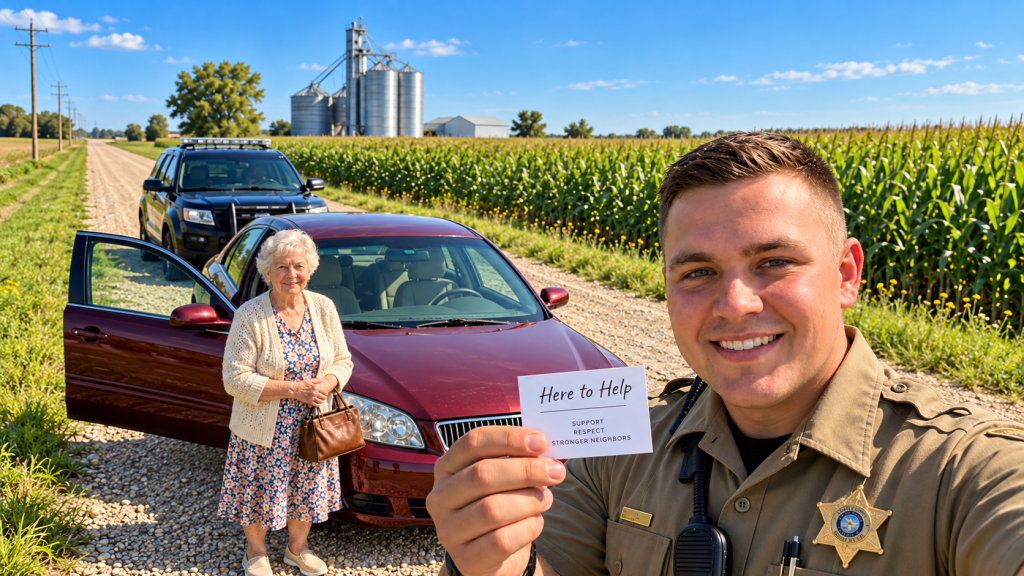
“I heard you, Deputy. I asked you to keep your body camera recording.” “Yes, sir.” “Don’t disconnect. I’m coming to your location.” The deputy glanced toward us. For the first time since he’d pulled us over, he seemed uncertain what to do with his hands. “Mrs. Hagen,” he began, “perhaps you should sit in your vehicle.”
Mom looked at him.
Her face had gone pale.
“That’s what I asked you thirty minutes ago.”
He opened his mouth.
Then closed it.
I wanted to say something terrible.
I wanted to ask whether he was still amused by her paper license.
I wanted to tell him exactly what I thought of a man who made an elderly woman stand in ninety-one-degree heat simply because he couldn’t be bothered to verify a document.
But Mom squeezed my wrist.
“Jeffrey.”
I looked at her.
“Help me into the car, please.”
That frightened me more than anything.
My mother had never liked admitting she needed help.
After my father died, she’d climbed a ladder to clean her gutters because she didn’t want to trouble anybody.
She shoveled her own driveway until she was sixty-eight.
She carried groceries in one trip even when I told her she’d tear the handles off the bags.
Now she was asking me to help her walk six feet.
I opened the passenger door.
She sat down slowly.
Her hands shook as she reached for her seat belt.
I knelt beside her.
“Mom, are you dizzy?”
“A little.”
“Are you nauseated?”
“No, honey.”
She tried to smile.
“I’m just hot.”
I touched her forehead.
Her skin was damp.
The color had drained from her cheeks.
“You’re not just hot.”
She looked at me.
“Don’t fuss.”
I stared at her.
Then I said something I should have said forty minutes earlier.
“Mom, you don’t have to make this easier for anybody.”
Her expression changed.
For a second, she looked almost surprised.
Then she rested her hand against my cheek.
“Oh, Jeffrey.”
That was all.
Two words.
But they nearly broke me.
Because I realized she’d spent the last forty minutes trying to protect me from making the situation worse, even while her own body was struggling in the heat.
A few minutes later, two vehicles appeared around the bend.
One was an ambulance.
The other was a dark sheriff’s SUV.
They stopped behind the patrol truck.
A tall man in a white uniform shirt stepped out of the SUV.
He was perhaps sixty, with gray hair, a serious expression, and the determined walk of somebody who’d heard enough before arriving.
Sheriff Thomas Bell.
I’d voted for him twice.
We’d never spoken.
He approached the deputy first.
I couldn’t hear everything they said, but I heard one question clearly.
“Did dispatch confirm the document?”
The deputy looked down.
“Yes, sir.”
“When?”
A pause.
“Earlier.”
“How much earlier?”
The deputy didn’t answer.
Sheriff Bell looked toward his radio.
“Ruth, give me the confirmation time.”
Her voice crackled through the speaker.
“Fourteen thirty-six, Sheriff. Thirty-eight minutes before my request for medical assistance.”
The sheriff stared at the deputy.
Then asked quietly, “Why was she still outside?”
The deputy said something too soft for me to hear.
The sheriff’s expression hardened.
“We’ll discuss that at the station.”
Then he turned toward Mom.
And the first thing he did surprised me.
He removed his hat.
“Mrs. Hagen?”
Mom looked up.
“Hello, Tommy.”
The sheriff’s face softened.
“Miss Shirley.”
He knelt beside the open car door.
“How are you feeling?”
“Oh, I’ve been better.”
He nodded.
“Let’s get the medics to look at you.”
Mom glanced toward the deputy.
“Is the young man in trouble?”
The sheriff hesitated.
“We’re going to review what happened.”
She nodded.
Then said, “Please make sure you review all of it.”
Something passed across the sheriff’s face.
Respect, I thought.
Not the exaggerated respect people show when they discover somebody is important.
Something quieter.
The respect of a man who understood exactly what she meant.
“I will,” he said.
And for once, I believed somebody was listening.
One of the paramedics approached carrying a medical bag.
She was a woman in her early thirties with dark hair pulled into a tight braid.
Her name patch read GRACE MORGAN.
She leaned into the passenger doorway.
“Hello, ma’am. I’m Grace. Can I check how you’re doing?”
Mom nodded.
“Of course, sweetheart.”
Grace checked her vital signs and asked questions about the heat, how long she’d been standing, and whether she felt weak or dizzy.
Then she looked at Mom more carefully.
“Wait a minute.”
Mom gave her a tired smile.
“Something wrong?”
Grace stared.
“Are you Shirley Hagen?”
My mother looked puzzled.
“Yes.”
Grace’s eyes filled.
“Oh, my goodness.”
She glanced toward the other paramedic.
Then looked back at Mom.
“My mother is Ruth Morgan.”
Mom blinked.
“Little Ruthie?”
Grace laughed.
“She doesn’t like anybody calling her that.”
Mom smiled faintly.
“She didn’t like it thirty years ago, either.”
Grace swallowed.
“Mrs. Hagen, my mother talks about you all the time.”
I stood beside the car, bewildered.
Grace continued.
“When I was a baby, I stopped breathing in my crib. Mom called the county emergency line, and you were working.”
Mom closed her eyes.
“Oh, honey.”
Grace’s voice trembled.
“She told me you stayed with her until help arrived.”
Mom shook her head.
“I was doing my job.”
Grace smiled through tears.
“That’s what Mom always says you told her.”
For a moment, nobody spoke.
Then Grace rested a hand against Mom’s shoulder.
“Well, today I’m going to do mine.”
I turned away.
I couldn’t help it.
There I was, a forty-six-year-old man standing on a dusty road with tears running down my face.
Because a young woman who’d survived a frightening night as an infant was now helping the person who’d once guided her mother through it.
And because I had spent half my life telling people that my mother just answered phones.
The paramedics recommended taking Mom to the hospital for evaluation because of her dizziness and prolonged exposure to the heat.
She protested mildly.
“We’re supposed to be at the church supper.”
I looked at her.
“Mom, the lemon bars can wait.”
She sighed.
“Ruth likes the corner pieces.”
Grace smiled.
“I’ll make sure she gets one.”
Mom looked toward the aluminum pan on the back seat.
The powdered sugar had melted into the lemon filling.
She shook her head.
“They’re a sight.”
I laughed shakily.
“Then they’re going to the hospital with us.”
Before the ambulance left, Sheriff Bell approached me.
“Mr. Hagen?”
I nodded.
“Your mother didn’t do anything wrong by presenting that temporary license. Dispatch verified it.”
I swallowed.
“Then why did he keep her standing there?”
The sheriff’s expression became grave.
“That’s exactly what we need to establish.”
He glanced toward the patrol truck.
“And this isn’t the first complaint we’ve received about how this deputy handles roadside stops.”
I looked at him.
“The other woman?”
He nodded.
“Her name is Nadine Booker. She filed a complaint after being detained along this same road last Thursday.”
My stomach tightened.
“Was she all right?”
“She needed medical attention afterward. We’re reviewing the records and speaking with witnesses.”
I looked toward Mom.
She was answering Grace’s questions from the ambulance stretcher.
Sheriff Bell followed my gaze.
Then said quietly, “Your mother asked us to say her name over the radio.”
I nodded.
“But I want you to understand something.”
I looked at him.
“She shouldn’t have needed to.”
Those words stayed with me.
Because he was right.
My mother didn’t deserve humane treatment because she’d worked in the courthouse.
She didn’t deserve shade and water because Ruth remembered her.
She didn’t deserve to be heard because a sheriff recognized her name.
She deserved those things because she was a human being.
So had Nadine Booker.
And so did every person who’d ever stood on the shoulder of that road without knowing anybody important enough to call.
At the hospital, the doctor said Mom was suffering from heat exhaustion and dehydration.
Her blood pressure had dropped when she stood up, and they wanted to monitor her until she was stable.
Fortunately, there was no indication of a more serious complication.
That should have relieved me.
But I kept picturing her in the side mirror.
One small figure in a flowered dress.
Standing beside a road where the cornfields offered no shade.
Forty minutes.
I’d sat in the passenger seat for forty minutes while my mother tried to make herself smaller than the trouble she was being given.
I couldn’t stop thinking about it.
Mom noticed.
She was lying in the hospital bed with a thin blanket pulled over her knees.
“Jeffrey, you’re wearing a hole in that floor.”
I stopped pacing.
“Sorry.”
She looked at the chair beside her.
“Sit.”
I obeyed.
For a while, we listened to the soft beeping of the monitor.
Then I said, “I should’ve done more.”
She turned her head.
“What?”
“On the road.”
I stared at my hands.
“When he made you get out, I should’ve objected. When he left you standing there, I should’ve called for help sooner.”
Mom watched me quietly.
“I could see you were getting hot. I knew it wasn’t right.”
My voice broke.
“And I just sat there.”
She reached for my hand.
“Jeffrey, that deputy had a badge and a weapon. You were trying not to make a bad situation worse.”
I shook my head.
“Still.”
“Son, being frightened doesn’t mean you failed me.”
I looked at her.
She squeezed my fingers.
“But the next time somebody needs help, don’t wait for a perfect moment to ask for it.”
I nodded.
Then I whispered, “I’m sorry.”
Her brow furrowed.
“For what?”
I looked away.
“For more than today.”
She waited.
I swallowed.
“When people asked what you did for a living, I used to say you answered phones.”
Mom was quiet.
I continued.
“I said it like it was something embarrassing.”
My throat tightened.
“I knew you worked nights. I knew you missed school plays because you were sleeping before another shift. But I never really asked what happened down there.”
She looked toward the hospital window.
“I did answer phones.”
I smiled sadly.
“Mom.”
She turned back.
“I did, Jeffrey. There isn’t anything wrong with answering phones.”
I wiped my eyes.
She continued.
“Somebody has to answer when people call.”
The simplicity of it nearly undid me.
I thought of all the times I’d dismissed her job because she hadn’t worn a judge’s robe or carried a detective’s badge.
She’d worked in the courthouse basement, where the ceiling pipes rattled and the fluorescent lights flickered.
She’d answered calls while other families slept.
And somewhere among those thousands of ordinary nights, she’d helped a frightened mother whose baby wasn’t breathing.
“Mom, why didn’t you ever tell me about Ruth?”
She looked surprised.
“Which time?”
I stared.
“What do you mean, which time?”
She gave a small smile.
“Ruth’s been working in dispatch almost as long as I did. We’ve had plenty of adventures.”
I shook my head.
“Her daughter. Grace.”
Mom’s expression softened.
“Oh.”
She looked down at the blanket.
“That was a hard night.”
I waited.
Finally, she said, “Ruth had been home with the baby. Her husband was working late. She called when Grace stopped breathing, and she was so frightened she could barely tell me the address.”
Mom’s eyes filled.
“I knew her voice. I asked her to listen to me. We got the right people moving while she stayed on the line.”
I swallowed.
“And Grace survived.”
Mom nodded.
“Thank goodness.”
I looked at her.
“That’s all you’re going to say?”
She seemed puzzled.
“What else?”
“Mom, you helped save a baby’s life.”
She shook her head.
“The responders did the lifesaving. The hospital took care of the rest.”
She paused.
“I was the voice on the telephone.”
I looked down.
Then she said something I’ll never forget.
“Jeffrey, people think important work always looks impressive. Sometimes it looks like keeping your own voice steady because somebody on the other end of the line can’t stop crying.”
My eyes filled.
I sat beside her bed, holding her hand.
And for the first time, I began understanding how little I’d known about the work that had supported our family.
Ruth arrived shortly before six.
She was a tall woman with silver streaks in her brown hair and a tired face that brightened the moment she saw Mom.
“Shirley Hagen.”
Mom smiled.
“Ruthie Morgan.”
Ruth came straight to the bedside.
Then she took Mom’s hand in both of hers.
“Don’t you ever scare me like that again.”
Mom laughed softly.
“I’ll do my best.”
Ruth’s eyes filled.
“I heard the deputy call your name.”
“I know.”
“And I told him the paper license was legitimate.”
Mom nodded.
“I know that too.”
Ruth looked toward me.
“She always was hardheaded.”
I smiled.
“She’s still got plenty of practice.”
Mom squeezed Ruth’s hand.
“Sit down before you fall down.”
Ruth pulled up a chair.
For a few minutes, they spoke about Grace, the church supper, and the lemon bars.
Then Ruth became serious.
“Shirley, there’s something I need to tell you.”
Mom looked at her.
“What is it?”
Ruth hesitated.
“That deputy had already ignored me once this week.”
I sat straighter.
“What?”
Ruth folded her hands.
“Last Thursday, he stopped another woman on County Road 6. Nadine Booker.”
Mom’s expression changed.
“Booker?”
Ruth nodded.
Mom stared.
“From Cedar Hollow?”
“That’s her.”
My mother closed her eyes.
“Oh, mercy.”
I looked between them.
“You know her?”
Mom nodded slowly.
“Nadine was a home health aide for years. Used to drive the back roads in every kind of weather, checking on people who couldn’t get into town.”
Ruth lowered her eyes.
“She’s retired now.”
I stared.
“What happened to her?”
Ruth took a breath.
“She was driving home from an appointment when the deputy stopped her. He questioned her temporary license and kept her outside while he checked it.”
My stomach tightened.
“The same thing?”
Ruth nodded.
“Not exactly the same circumstances, but enough that the complaint deserved attention. She said she asked to sit inside because she wasn’t feeling well.”
I looked at Mom.
Her eyes were filled with tears.
Ruth continued.
“Her daughter took her to urgent care afterward. Nadine filed a complaint the next morning.”
“Did the sheriff know?” I asked.
“He knew about the complaint. The review had already been opened. Today’s stop made it urgent.”
I rubbed my forehead.
“But if dispatch confirmed Mom’s license, why didn’t he let her go?”
Ruth’s expression hardened.
“That’s what the investigators need to determine.”
Then she looked toward my mother.
“Shirley, I’ve replayed that radio conversation in my head all afternoon.”
Mom squeezed her hand.
“You did your job.”
Ruth shook her head.
“I keep thinking I should’ve insisted he stop.”
Mom sat a little straighter.
“Now listen to me, Ruth Morgan.”
Ruth blinked.
“The deputy was responsible for his conduct. Not you.”
I stared at my mother.
Even from a hospital bed, she was defending the woman who’d tried to help her.
Then Mom added quietly, “But we can make sure nobody ignores that kind of thing again.”
Ruth nodded.
And I saw something pass between them.
Not a dramatic promise.
Not a secret plan.
Just two women who’d spent much of their lives listening to people in trouble, deciding that this time they weren’t going to let the story disappear into a filing cabinet.
Three days later, Sheriff Bell called.
Mom had returned home and was recovering well.
She was sitting at her kitchen table, sorting coupons and pretending she hadn’t been ordered to rest.
I was beside her with the telephone on speaker.
The sheriff explained that the deputy, whose name was Aaron Pike, had been placed on administrative leave while the department reviewed the traffic stop and earlier complaints.
Investigators were preserving body-camera footage, dispatch recordings, vehicle-location records, and witness statements.
A separate agency would assist with the review.
I asked whether the deputy had been fired.
“Not at this point,” the sheriff answered. “There’s a process we have to follow.”
Mom nodded.
“Good.”
I turned toward her.
“Good?”
She looked at me.
“Jeffrey, I want the facts examined properly. I don’t want anybody deciding punishment just because they’re angry.”
I swallowed.
The sheriff continued.
“Mrs. Hagen, I also wanted to apologize for what you experienced.”
Mom was quiet.
Then she asked, “Have you spoken to Mrs. Booker?”
There was a pause.
“Yes, ma’am.”
“Did you apologize to her?”
“Yes.”
“Good.”
She folded the coupons neatly.
“Then I have one more question.”
“Of course.”
“What happens to the next person who gets pulled over with a temporary paper license?”
The sheriff didn’t answer immediately.
Then he said, “That’s something we’re working to improve.”
Mom looked toward the window.
“Tommy, you know what bothers me?”
“What, Miss Shirley?”
“I knew to ask him to say my name on the radio.”
She paused.
“But what if somebody doesn’t know a dispatcher?”
The sheriff was silent.
“What if they’re frightened? Or new in town? Or don’t speak English very well? What if they don’t know what questions they’re allowed to ask?”
Her voice trembled.
“I don’t want another old woman standing beside that road, wondering whether she’s allowed to sit down.”
For a moment, I heard only the faint crackle of the speaker.
Then Sheriff Bell said quietly, “Neither do I.”
Mom nodded.
“Then that’s what I’d like you to remember.”
The first time I met Nadine Booker, she arrived at Mom’s house carrying a peach cobbler.
It was the Saturday after the traffic stop.
I’d gone over to repair the loose handrail on Mom’s front steps.
She was supposed to be resting.
Instead, she’d baked another pan of lemon bars and was standing at the kitchen sink arguing with me about whether they needed more powdered sugar.
Then the doorbell rang.
I opened it.
A small woman with dark skin, close-cropped gray hair, and a lavender cardigan stood on the porch.
She held a covered baking dish.
“Is Shirley Hagen home?”
“Yes, ma’am.”
She smiled faintly.
“I’m Nadine Booker.”
I went still.
The woman from the sheriff’s radio.
The one Deputy Pike had reportedly kept standing in the heat the Thursday before he stopped us.
I stepped aside.
“Please come in.”
Mom appeared in the hallway.
For a moment, the two women stared at each other.
Then Mom gasped.
“Nadine?”
Nadine’s face broke into a smile.
“Shirley?”
They moved toward each other.
And hugged.
I stood beside the door, bewildered.
Mom finally pulled back.
“Well, look at you.”
Nadine laughed.
“Look at yourself. Still getting into trouble.”
Mom smiled.
“Only the kind that finds me.”
We sat at the kitchen table.
Nadine placed the cobbler beside Mom’s lemon bars.
For a while, they talked about people I’d never met.
A neighbor who’d moved to Florida.
A retired school principal.
A family reunion that had been postponed because of the weather.
Then I asked how they knew each other.
Mom smiled.
“Nadine helped us during the flooding in ’93.”
I looked at her.
“What flooding?”
Mom raised an eyebrow.
“Jeffrey, that was the summer the creek washed out the old bridge. You were away at college.”
I remembered hearing about it.
Dad had mentioned that several farm roads were closed for days.
Nadine looked toward Mom.
“She stayed on the telephone while we found another way to get two elderly neighbors out of their house.”
Mom shook her head.
“Nadine did the hard part.”
Nadine laughed.
“I nearly drove my pickup into a ditch.”
“You kept your head.”
“Because you kept telling me where the road was still open.”
I watched them.
Two women who’d spent their lives helping other people.
Neither with a famous name.
Neither with much money.
Both carrying decades of stories nobody had thought to write down.
Then Nadine’s smile disappeared.
She looked toward her hands.
“That young deputy called me sweetheart.”
The room became quiet.
Mom reached across the table.
“He called me hon.”
Nadine nodded.
“He laughed at my license.”
Mom’s face tightened.
“Mine too.”
Nadine swallowed.
“He told me if I had nothing to hide, I shouldn’t mind waiting.”
My chest tightened.
She continued.
“I kept telling him I wasn’t feeling well. I’d just come from an appointment, and the sun was making me lightheaded.”
Mom squeezed her hand.
“What did he say?”
Nadine looked down.
“He told me to stop complaining.”
I stared at her.
Then she said something that silenced the entire kitchen.
“Shirley, I spent thirty-six years helping old people get out of bed, take their medicine, and make it safely to the bathroom.”
Her eyes filled.
“I never talked to any of them the way that boy talked to me.”
Mom nodded.
Nadine continued.
“I kept thinking somebody would drive past and recognize me. Then I was ashamed of myself for thinking that.”
I looked up.
“Why?”
“Because I realized I was hoping someone who knew me would come and make him behave.”
She wiped her eyes.
“But a person shouldn’t need a witness who knows their name to be treated properly.”
Mom’s expression softened.
“That’s exactly what I told Tommy Bell.”
Nadine smiled sadly.
“Then I hope he listened.”
For a long time, nobody spoke.
Finally, I asked why Nadine had filed a complaint.
She looked at me.
“Because he treated me like I was lying when I wasn’t.”
I nodded.
“And because my granddaughter asked why I didn’t call for help.”
Her voice trembled.
“I couldn’t think of an answer that didn’t make me feel small.”
I looked down.
I remembered my own shame.
The forty minutes I’d stayed in the passenger seat.
The way I’d been frightened to disobey the deputy even when Mom was clearly struggling.
Nadine studied my face.
“You were there with your mother?”
“Yes.”
“And you tried to help?”
I swallowed.
“Not enough.”
She considered.
Then said quietly, “You stayed with her afterward.”
I nodded.
“That’s something.”
I looked at her.
But she continued.
“Next time you see somebody having trouble, maybe you’ll know sooner what to do.”
I felt my eyes fill.
Because she hadn’t excused my silence.
She’d simply given me a way to become better.
A week later, I found the blue boxes.
They were stacked beneath Mom’s sewing table, tied with faded white string.
I’d gone upstairs looking for an old picture frame.
Mom had asked me to help her replace a photograph of Dad that had slipped behind the glass.
Instead, I discovered six cardboard boxes labeled by year.
1987–1992.
1993–1998.
1999–2004.
And so on.
I carried one downstairs.
“Mom, what’s all this?”
She glanced up from her knitting.
“Oh, goodness.”
She smiled.
“I forgot those were still there.”
I opened the lid.
Inside were letters.
Dozens of them.
Some handwritten.
Others typed on old stationery.
There were Christmas cards and postcards, children’s drawings, newspaper clippings, and little notes written on torn notebook pages.
The first letter I picked up was dated 1991.
Dear Mrs. Hagen,
Thank you for helping the ambulance find our farm when my husband fell. The road signs were down after the storm, but you remembered the old Miller place and told them exactly where to turn.
I looked at Mom.
“You kept these?”
She shrugged.
“People sent them.”
I unfolded another.
It was from a truck driver who’d become stranded during an ice storm.
He thanked her for arranging assistance when his cab heater failed.
Another came from a father whose little boy wandered away from a county fair.
Another from a woman who’d called in the middle of the night because her elderly mother was confused and frightened.
None of the letters described grand speeches.
None of them said Shirley Hagen had single-handedly saved the world.
They described a voice that answered.
A person who listened.
Someone who kept trying when a caller didn’t know the right words.
I picked up a drawing made with green and purple crayons.
It showed a telephone beneath a rainbow.
Across the bottom, in uneven childhood handwriting, were the words:
THANK YOU FOR FINDING GRANDPA.
My eyes blurred.
“Mom, why didn’t you show me any of this?”
She looked surprised.
“Well, you were busy.”
I sat down.
“Not that busy.”
She studied me.
Then said gently, “Jeffrey, you never asked.”
The words were not meant to hurt.
That made them hurt more.
I looked at the boxes.
For thirty-four years, my mother had come home from work as the rest of us were waking up.
She’d made breakfast.
Helped me find my shoes.
Reminded Dad to take his lunch.
Then she’d gone upstairs and slept until afternoon.
When people asked what she did, I’d said she answered phones.
And somehow I’d never thought to ask who was calling.
I took out another letter.
This one was from Ruth.
The paper was pale blue.
Dear Shirley,
Grace is home from the hospital. She is eating well and keeping us awake all night, which is the most wonderful thing I can imagine.
I know you’ll say you only did your job. But I need you to understand that when I was frightened enough to forget my own address, you remembered it for me.
I will never forget your voice.
I stopped reading.
My throat closed.
Mom watched me quietly.
Then she said, “Ruth kept me in lemon bars for about three years after that.”
I laughed through tears.
“Of course she did.”
Mom smiled.
For a moment, she looked much younger.
Then her expression became thoughtful.
“Not every call ended happily, Jeffrey.”
I looked up.
She folded her knitting.
“Some people we couldn’t reach in time. Some people were hurt badly. Some nights I went home wondering whether I should have asked a different question or sent somebody by another road.”
Her eyes filled.
“I kept the thank-you letters because on the hard mornings I needed to remember that trying mattered.”
I stared at her.
She continued.
“I wasn’t a hero. I was one person sitting in a room with a telephone and a map.”
I reached for her hand.
“Mom, that doesn’t make what you did small.”
She smiled faintly.
“No.”
Then she looked toward the boxes.
“It doesn’t.”
I carried the letters back upstairs later that afternoon.
But before closing the final box, I sat on the floor and read three more.
Each was different.
Each came from somebody who had once needed help.
And each told me something I should have known long before a deputy left my mother standing in the sun.
Important work doesn’t always come with an impressive title.
Sometimes its only visible reward is that someone gets to come home.
The independent review took several weeks.
I expected the sheriff’s department to announce its conclusions immediately.
It didn’t.
Investigators interviewed Mom, Nadine, me, the deputy, Ruth, and several other people who’d reported similar experiences.
They examined camera footage and dispatch records.
They reviewed whether officers had received proper training concerning temporary identification documents and heat-related risks during roadside stops.
I learned more than I ever wanted to know about how easy it could be for an ordinary complaint to disappear into a complicated administrative process.
The sheriff didn’t promise us a particular result.
Mom didn’t ask him to.
But she insisted on receiving updates through the proper channels, and Nadine did the same.
Then something unexpected happened.
A local newspaper reporter called.
She’d heard about the two traffic stops and wanted to speak with Mom.
My mother declined.
“I don’t want my photograph in the paper.”
The reporter asked whether she could speak to me.
Mom looked at me.
“That’s Jeffrey’s decision.”
I hesitated.
For years, I’d been embarrassed to say exactly what Mom did for a living.
Now I had an opportunity to tell the entire county.
But I was afraid of turning her into another kind of spectacle.
So I asked the reporter what story she wanted to write.
She surprised me.
“I want to understand why an elderly woman was made to stand in extreme heat after her document had already been verified.”
I nodded.
“And Nadine Booker?”
“Her experience is part of the same story.”
I took a breath.
“Then I’d like her to be heard too.”
The reporter agreed.
I didn’t tell her every private story in Mom’s letters.
Those belonged to the people who wrote them.
But with Mom’s permission, I described her thirty-four years of night work.
I told the reporter about the heat.
The radio call.
The verified license.
And the moment I’d realized my mother was becoming faint while I sat helplessly in the passenger seat.
Then I said something I’d never said publicly before.
“I’m ashamed I used to tell people my mother just answered phones.”
The reporter was quiet.
I continued.
“She answered people. That was the important part.”
My voice broke.
“And she shouldn’t have needed anybody to know her name before someone treated her with dignity.”
When the article appeared, that was the line the reporter used.
Not as a headline about a famous woman.
Not as a story about an elderly dispatcher who knew the sheriff.
But as a reminder that people shouldn’t have to prove their importance before being treated decently.
For the first time in my life, I felt proud to see my mother’s work described in print.
And a little ashamed that it had taken something so frightening to make me say it aloud.
The review’s findings were announced in October.
By then, the corn along County Road 6 had been harvested.
The fields that had once stood tall as hallways were open and brown, stretching beneath a cool autumn sky.
Mom had received her permanent driver’s license.
She was walking normally again, although I still caught myself studying her face whenever she stood in the sun.
The sheriff’s department confirmed that Deputy Pike had received a valid license verification well before ending Mom’s detention.
Investigators also substantiated serious concerns about his conduct during Nadine’s stop.
Additional complaints had led to a broader review of his roadside practices.
The department concluded that he had failed to follow applicable procedures and had treated members of the public disrespectfully.
Following the disciplinary process, he was dismissed from his position, and the relevant findings were referred to the state authorities responsible for reviewing officer certification.
The sheriff made no claim that every complaint represented a criminal offense.
He didn’t pretend that one dismissal would solve every problem in the department.
But he publicly acknowledged that the conduct had fallen below the standards the community was entitled to expect.
I read the announcement twice.
Then I called Mom.
“Did you hear?”
“Yes.”
“What do you think?”
She was quiet.
Finally, she said, “I hope the young man learns something.”
I stared at the phone.
“Mom, after what he did to you?”
“Jeffrey, I didn’t say he shouldn’t face consequences.”
She paused.
“I said I hope he learns.”
I sat down.
For a moment, I imagined Deputy Pike without his uniform.
A young man who would have to explain to future employers why he’d lost his position.
A man who might spend years resenting the two women who complained.
Or who might eventually understand that a badge did not make another person’s dignity optional.
I couldn’t decide which future he’d choose.
Neither could Mom.
But she was right.
Accountability would mean more if it prevented future harm than if it merely left somebody ashamed.
The county scheduled a public meeting to discuss the review and improvements to traffic-stop procedures.
I expected Mom to stay home.
Instead, she came downstairs that morning wearing her blue flowered dress.
The same dress she’d worn beside County Road 6.
I stared.
“Mom, you don’t have to wear that.”
She glanced down.
“What’s wrong with it?”
“Nothing.”
“Then I’m wearing it.”
I smiled.
She picked up her handbag.
“Besides, I pressed it this morning.”
I laughed.
“Of course you did.”
The meeting was held in the high school cafeteria.
About sixty people attended.
Some were retired officers.
Some were local residents.
Several had experienced difficult traffic stops themselves.
Nadine sat beside Mom.
Ruth sat on her other side.
Grace stood near the back wall with two coworkers.
I sat one row behind them.
Sheriff Bell began by discussing the investigation’s findings and the department’s responsibilities.
He described additional training on verifying temporary documents, procedures for monitoring the length of roadside detentions, and clear expectations for responding when someone reported distress from heat or another medical concern.
He also announced changes intended to ensure that complaints received a documented review rather than disappearing because one employee considered them minor.
Then he invited members of the community to speak.
Nadine stood first.
She walked slowly to the microphone.
For a moment, she simply looked across the room.
Then she said, “I’ve lived in this county for forty-two years.”
Her voice was steady.
“I’ve looked after people who were sick. I’ve driven neighbors to medical appointments. I’ve taken groceries to families who couldn’t get out during snowstorms.”
She paused.
“But none of that is why I deserved to be treated properly on the side of the road.”
The room became very quiet.
Nadine continued.
“I deserved it before I ever did a useful thing in this county.”
I saw Mom nod.
Nadine looked toward the sheriff.
“I don’t want the next person to have to tell a deputy their whole life story before they’re believed.”
Then she stepped away from the microphone.
People applauded.
Not loudly at first.
But steadily.
Mom reached for Nadine’s hand when she sat down.
I wiped my eyes.
Then Sheriff Bell invited Mom to speak.
She hesitated.
I could see her fingers tighten around her handbag.
Finally, she stood.
I stood too, in case she needed help.
She gave me a look.
“Jeffrey, I can walk to a microphone.”
A few people laughed.
I smiled and sat back down.
Mom approached the front.
For several seconds, she studied the audience.
Then she cleared her throat.
“My name is Shirley Hagen.”
Her voice was soft.
People leaned forward to hear.
“I worked at the county emergency desk for thirty-four years. Mostly nights.”
She smiled faintly.
“We didn’t have fancy equipment when I started. Sometimes we had a paper map, a telephone, and somebody who was frightened enough that they couldn’t remember where they lived.”
A few older residents nodded.
Mom continued.
“I learned something sitting in that basement.”
She paused.
“When people ask for help, they don’t always sound polite. Sometimes they’re angry. Sometimes they sound confused. Sometimes they’re too scared to explain themselves properly.”
She looked toward Sheriff Bell.
“And sometimes they don’t know they have the right to ask.”
My throat tightened.
Mom rested her hands against the microphone stand.
“That day on County Road 6, I knew my paper license was valid. I knew dispatch could verify it. I knew who might be listening on the radio.”
Her voice trembled.
“But I was still frightened.”
She looked toward Nadine.
“And Mrs. Booker was frightened too.”
For a moment, Mom couldn’t continue.
Then she took a breath.
“I don’t want anybody to remember my name because I knew somebody important.”
She glanced toward me.
“I want people to remember that everybody has a name.”
The room was silent.
Mom continued.
“And every name belongs to somebody who matters to someone.”
She stepped away from the microphone.
Then, to my astonishment, nearly everyone in the room stood.
I watched my mother walk back to her chair, embarrassed by the attention.
Nadine hugged her.
Ruth wiped her eyes.
And I realized that the woman I’d once described as someone who merely answered phones had just explained dignity more clearly than any speech I’d ever heard.
After the meeting, Sheriff Bell approached us.
He thanked Mom and Nadine for speaking.
Then he told them that the county was beginning a review of how rural roads, temporary documents, and medical concerns were handled during traffic stops.
He didn’t promise perfection.
Mom didn’t ask for it.
Instead, she asked whether the department would check that its improvements were actually being followed.
Sheriff Bell nodded.
“That’s part of the plan.”
She smiled.
“Then I’ll be watching.”
He laughed.
“I believe you will.”
Before we left, he handed Mom a plain envelope.
“Deputy Pike asked that this be forwarded to you.”
Mom looked down.
“What is it?”
“A letter. You don’t have to read it.”
She studied the envelope.
Then looked toward Nadine.
“Did he send you one?”
Nadine nodded.
“He did.”
Mom turned the envelope over.
Then tucked it into her handbag.
She didn’t open it that afternoon.
Or that evening.
She waited three days.
When she finally read it, I was sitting on her porch repairing the loose latch on the screen door.
She came outside and settled into her rocking chair.
“Jeffrey?”
I looked up.
“Yes?”
“Would you sit a minute?”
I put down my screwdriver.
She handed me the letter.
I read it slowly.
Deputy Pike acknowledged that he had questioned her temporary license after it was verified.
He admitted that he’d made a joke at her expense and left her standing outside longer than necessary.
He wrote that he had begun to understand how frightening his behavior must have been.
Near the bottom, he said he was sorry.
I looked toward Mom.
“Do you believe him?”
She considered.
“I believe he wrote it.”
I nodded.
“Is that enough?”
She shook her head gently.
“An apology can be a beginning. It isn’t proof of what someone will do next.”
I looked down at the letter.
Mom continued.
“I don’t need to decide whether to forgive him today.”
I stared.
Then she smiled faintly.
“Not everything has to be settled by suppertime, Jeffrey.”
I laughed through tears.
She took the letter back.
Folded it.
And placed it in her handbag.
Then she looked toward the yard.
“Now, are you going to fix that screen door or spend the rest of the afternoon sitting around?”
I smiled.
“Yes, ma’am.”
And I picked up my screwdriver.
The following Sunday, we finally made it to the church supper.
Mom insisted on baking the lemon bars herself.
I offered to help.
She handed me a knife and told me to cut them into squares.
Apparently, that’s all the responsibility she thought I could handle.
Ruth arrived early with Grace.
Nadine came carrying another peach cobbler.
The church basement smelled of coffee, roasted chicken, and warm bread.
People stopped Mom to ask how she was feeling.
Some thanked her for speaking at the public meeting.
Others remembered her from the old courthouse.
One man told her she’d helped locate his father during a winter storm.
A woman recalled calling the emergency desk when her son went missing at the fair.
Mom listened to every story with the same gentle expression.
Then she said what she always said.
“I was just doing my job.”
But this time, I heard those words differently.
She wasn’t dismissing the importance of what she’d done.
She was reminding people that kindness and competence ought to be ordinary.
Not extraordinary.
Not reserved for famous people.
Not offered only when somebody recognized a name.
Just part of doing your job properly.
Later that afternoon, a young woman approached our table.
She looked at Mom.
“Excuse me. Are you Shirley Hagen?”
Mom smiled.
“Yes, honey.”
“My grandfather used to talk about you.”
“Oh?”
“He said you helped him find assistance during the blizzard in 2003.”
Mom looked thoughtful.
“Was his name Walter Jenkins?”
The woman’s eyes widened.
“Yes!”
Mom smiled.
“Your grandpa was a stubborn man. Didn’t want to leave his tractor.”
The woman laughed.
“That’s him.”
Then she reached for Mom’s hand.
“Thank you.”
My mother squeezed her fingers.
“You’re very welcome.”
After the woman walked away, Ruth leaned toward me.
“Jeffrey, did Shirley ever tell you about the night the emergency phone lines went down during that storm?”
I smiled.
“No.”
Ruth laughed.
“Of course she didn’t.”
Mom rolled her eyes.
“Ruthie, don’t start.”
But Ruth started anyway.
And I listened.
For the rest of the afternoon, I listened.
I learned about people my mother had helped, mistakes she’d worried about, and colleagues who’d depended on her calm voice when the night seemed endless.
I learned that the courthouse basement had been more than a room filled with telephones.
It had been a place where frightened people reached for help.
And where somebody had to be willing to answer.
A month later, Mom asked me to drive her to the grocery store.
Her permanent license had arrived, but she said she wanted company.
I picked her up after lunch.
She climbed into the passenger seat with her handbag and a shopping list.
As I started the engine, she looked at the speedometer.
“Jeffrey, don’t go racing.”
I laughed.
“Mom, we’re still in the driveway.”
“Well, I’m giving you a head start.”
We drove past the courthouse.
Past the little diner where she used to stop for coffee after her night shifts.
Then onto County Road 6.
The corn had been harvested.
The fields were open.
And the shoulder where she’d stood that August afternoon looked painfully ordinary.
I slowed down.
Mom noticed.
“Thinking about that day?”
I nodded.
She looked out the window.
“So am I.”
For a while, neither of us spoke.
Then I asked, “Mom, were you afraid when you told him to say your name?”
She considered.
“Yes.”
I looked at her.
“Then how did you think to do it?”
She smiled faintly.
“I remembered the radio.”
“Because Ruth would recognize you?”
“Partly.”
She turned toward me.
“But mostly because I wanted somebody besides that deputy to hear what was happening.”
I swallowed.
“I wish I’d thought of it.”
Mom reached across and patted my hand.
“You’ve thought about plenty since.”
I nodded.
Then she said, “Jeffrey?”
“Yes?”
“Don’t spend the rest of your life being ashamed of how you handled one bad afternoon.”
I glanced toward her.
“Then what should I do?”
She smiled.
“Do better the next time somebody needs you.”
We drove on.
The afternoon sunlight stretched across the empty fields.
Mom began humming an old hymn.
And I thought about all the years I’d spent believing that my mother’s work was ordinary enough to overlook.
She never wore a badge.
Never carried a gun.
Never appeared on television.
For thirty-four years, she sat in a courthouse basement and answered calls from people who needed someone to listen.
Some nights, that meant directing help toward a frightening emergency.
Other nights, it meant simply staying on the telephone with somebody who felt alone.
But every call mattered to the person making it.
And every person mattered to my mother.
That was the lesson I should have learned long before I turned forty-six.
The deputy thought my mother was nobody because he didn’t recognize her temporary license.
I had spent years making the same mistake in a quieter way, overlooking the value of work I didn’t fully understand.
But now I knew.
My mother’s importance wasn’t something the sheriff could grant her.
It wasn’t something a dispatcher could announce over a radio.
It had been there all along.
In the nights she missed sleeping.
In the people she helped.
In the quiet courage it took to remain gentle in a world that wasn’t always gentle in return.
And most of all, in the dignity she believed every person deserved.
Even a stranger.
Even somebody who couldn’t ask for help.
Even somebody whose name she’d never heard before.
As we passed the place where the patrol truck had stood, Mom reached over and turned up the radio.
Then she smiled at me.
“Forty-eight, Jeffrey.”
I looked at the speedometer.
She was right.
Forty-eight miles an hour.
In a fifty-five.
Just the way she’d always driven.
I laughed.
And kept going.
Because my mother had never needed to be somebody important.
She’d spent thirty-four years making sure other people knew they were.
THE END STORIES! THANK YOU FOR READING GOOD LUCK !❤️
Related Posts