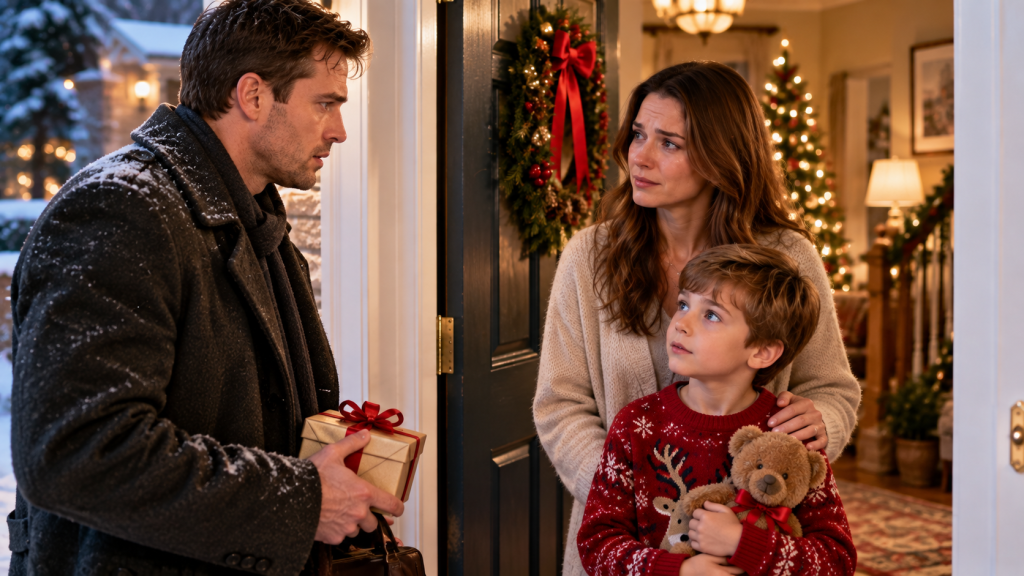
Seven years after my divorce, I went to my ex-wife’s house on Christmas Eve for one reason. I wanted to tell Jessi that I had been wrong. I wanted to apologize for the way our marriage ended and finally admit that pride had cost us both far too much.

But the moment she opened the door, a little boy appeared behind her.
He looked at me.
And everything I had planned to say vanished.
His eyes were blue-gray.
Exactly like mine.
I asked Jessi one question.
“How old is he?”
She hesitated.
Then quietly answered,
“Seven.”
For several seconds, I couldn’t move.
I thought that was the biggest shock waiting for me that night.
I was wrong.
Because a few minutes later, Jessi brought me an old envelope.
And my name was written across the front.
PART 1: THE BOY BEHIND THE DOOR
Seven years after our marriage ended, I stood on Jessi’s porch on Christmas Eve with snow gathering across the shoulders of my old Army coat.
I had rehearsed the apology during the entire drive.
I had imagined what I would say.
How I would admit that I had judged her too quickly.
How I would tell her that the version of our marriage I had carried in my head for years was not the whole truth.
Then the door opened.
Jessi stood there.
She looked older.
More tired around the eyes.
But she was still unmistakably the woman I had once expected to grow old with.
“Ivan?”
I opened my mouth.
Before I could answer, a small boy came running into the hallway behind her.
He was wearing bright red Christmas socks and carrying a crooked cardboard star.
“Mom, it fell off again.”
Then he noticed me.
He stopped.
His head tilted slightly.
My stomach tightened.
I knew that expression.
I had seen the same doubtful little look in childhood photographs of myself.
Then I noticed his eyes.
Blue-gray.
Not simply blue.
Not gray.
That strange mixture I had inherited from my father.
The same color I saw every morning in the mirror.
The boy studied me.
“Who are you?”
“My name is Ivan.”
I hesitated.
“I used to know your mother.”
Used to know her.
The words felt ridiculous.
Once, Jessi and I had known almost everything about each other.
I knew she put too much cinnamon in her coffee.
I knew she hummed whenever she was anxious.
I knew that during my deployments, she left a lamp burning in the living room because she hated coming home to a dark house.
There had been a time when I couldn’t imagine a future that didn’t include her.
The boy pointed toward my coat.
“Were you a soldier?”
“Yes.”
His face immediately brightened.
I could practically see a dozen questions forming.
But Jessi stepped between us.
“Leo, go check the cookies.”
He frowned.
“But Mom—”
“Please.”
Leo slowly turned around.
Even as he walked away, he looked back at me twice.
The moment he disappeared down the hallway, I looked at Jessi.
“How old is he?”
Her shoulders stiffened.
“Ivan, not here.”
“How old?”
She stared at me for several seconds.
Then answered quietly.
“Seven.”
The word seemed to wipe out every other sound around me.
Seven.
Our divorce had become final seven years earlier.
Three weeks later, I had left on deployment.
I stayed overseas for almost fourteen months.
I looked past Jessi through the doorway.
The house was warm.
Paper snowflakes were taped to the windows.
A model rocket sat on one shelf.
Beside it was a school photograph of Leo.
That smile.
It looked familiar too.
It reminded me of my father.
I lowered my voice.
“Jessi…”
She knew exactly what I was about to ask.
“Is he mine?”
She didn’t answer immediately.
Instead, she stepped outside and pulled the door almost closed behind her.
“His name is Leo.”
I waited.
“He doesn’t know anything about you.”
My chest tightened.
Years ago, I would have reacted differently.
I would have demanded answers.
I would have raised my voice.
I would have assumed the worst before hearing the explanation.
That version of me had already caused enough damage.
So I forced myself to stay calm.
“Did you ever try to tell me?”
Something changed in her face.
Not anger.
Pain.
Old pain.
“I wrote to you.”
I stared at her.
“Twice.”
“What?”
“The first letter came back.”
She swallowed.
“It was marked return to sender.”
“And the second?”
“I mailed it to your mother’s house because I had no idea where you were stationed.”
My stomach tightened.
“What happened to that one?”
Jessi looked directly at me.
“It disappeared.”
Before I could ask anything else, the front door opened.
Leo stood there holding three badly decorated gingerbread cookies.
“Mom, these ones are the best.”
Jessi quickly wiped the corner of one eye.
“They’re perfect.”
Leo handed one cookie to her.
Then he looked at me.
After a moment, he held another one out.
“You can have this.”
I stared at the crooked Christmas tree covered in green frosting.
“Thank you.”
He smiled.
Again, I saw my father.
Eventually, Jessi invited me inside.
I stayed near the entrance while Leo returned to the kitchen.
Neither of us seemed to know how to begin the conversation we had avoided for seven years.
Then Jessi went upstairs.
A few minutes later, she returned carrying a small wooden box.
She placed it on the table.
“What’s that?”
“Something you need to see.”
I opened the lid.
Inside was a tiny hospital bracelet.
LEO MARTIN.
Beneath it was a lock of dark baby hair tied with blue thread.
There were several photographs.
And underneath everything else was an envelope.
Old.
Still sealed.
My name was written across the front.
IVAN MARTIN.
My hands went cold.
Near the bottom, Jessi had written another line.
Please come yourself, Ivan. Don’t let your mother speak for you.
I turned the envelope over.
And that was when everything changed.
There was a postal return stamp.
Below it was handwriting I knew instantly.
My mother’s.
Wendy’s handwriting had always been sharp and distinctive.
I had seen it on birthday cards.
Christmas lists.
School forms.
Letters she sent me while I was deployed.
There was no chance I was mistaken.
Across the back of Jessi’s letter, my mother had written:
He chose the Army. He wants nothing to do with you or the child.
I read the sentence once.
Then again.
My hands started shaking.
Jessi didn’t say anything.
For seven years, I had believed she had simply moved on.
I believed she had never tried to explain anything.
I had convinced myself that whatever happened after our divorce was none of my concern.
But standing in her living room on Christmas Eve, holding a letter that had never reached me, I finally understood.
Maybe Jessi had never hidden my son from me.
Maybe someone else had decided that I didn’t deserve to know he existed.
And the person who had made that decision was my own mother.
PART 2 — THE LETTER MY MOTHER KEPT
I read my mother’s sentence a third time.
He chose the Army. He wants nothing to do with you or the child.
The handwriting did not change.
It remained Wendy’s.
Sharp.
Certain.
Final.
I looked up at Jessi.
She was standing beside the Christmas tree with both arms folded tightly across her chest.
Behind her, little paper snowflakes covered the window.
Somewhere in the kitchen, Leo was humming to himself while rearranging gingerbread cookies on a plate.
The world looked warm.
Ordinary.
I felt like someone had opened the floor beneath me.
“My mother wrote this?”
Jessi gave me a tired look.
“You know her handwriting.”
“Yes.”
“Then you know.”
I turned the envelope over again.
The postmark was seven years old.
The same month Leo was born.
I ran my thumb across the crease.
“Why did she send it back?”
“I don’t know.”
“You never asked her?”
Jessi laughed once.
No humor in it.
“I did.”
My eyes lifted.
“When?”
“The day it came back.”
“What did she say?”
“She said you had told her not to give me your deployment address.”
I stared at her.
“I never said that.”
“I know that now.”
Her voice softened.
“But I didn’t know it then.”
That sentence landed harder than accusation.
Because she had believed it.
For years.
I sat down.
My knees suddenly felt unreliable.
The wooden box remained open in front of me.
Hospital bracelet.
Baby hair.
Photographs.
One picture showed Leo asleep against Jessi’s chest.
Newborn.
Red-faced.
Tiny.
My son, maybe.
The word would not settle yet.
Not without proof.
Not because I doubted the timing.
Because seven years had taught me what assumptions could destroy.
I was not going to repeat that mistake.
“Did anyone ever test paternity?”
Jessi’s face tightened.
“No.”
“Did you ever have any reason to think he wasn’t mine?”
She stared at me.
“No.”
The answer was immediate.
Then:
“But if you want a test, we’ll do one.”
I looked down.
“I need one.”
“I know.”
No offense.
No drama.
Just reality.
I appreciated that more than she knew.
Leo appeared in the doorway carrying the cardboard star.
“It broke again.”
Jessi turned toward him.
“Bring me the tape.”
He walked toward us.
Then stopped beside my chair.
His eyes moved to the wooden box.
“What’s that?”
Jessi closed it gently.
“Old things.”
“Mine?”
“Some.”
He reached for the bracelet.
She put her hand on the lid.
“Later.”
Leo frowned.
“Why?”
“Because I said so.”
There was no sharpness in her voice.
Only boundary.
He accepted it.
Then looked at me.
“Are you staying for dinner?”
I looked at Jessi.
She looked back.
Neither of us had planned for this.
I said:
“If your mom says it’s okay.”
Leo turned immediately.
“Mom?”
Jessi closed her eyes briefly.
Then:
“Fine.”
He smiled.
“Good.”
And ran away again.
It struck me then how children can change the direction of a room without understanding anything inside it.
Dinner was unbearable.
And beautiful.
Leo talked constantly.
About school.
About planets.
About a classmate named Milo who had cheated at spelling by writing words on his sleeve.
He hated carrots.
Loved mashed potatoes.
Had recently decided he was going to be an astronaut, a firefighter, and a veterinarian.
Apparently schedules would be worked out later.
Every sentence gave me something I had missed.
First word.
First step.
First day of school.
First fever.
First loose tooth.
Seven Christmases.
Seven birthdays.
Seven years of someone else being there while I did not even know there was a place to stand.
At one point, Leo laughed with his mouth full.
Jessi told him to chew.
He rolled his eyes.
I almost smiled.
Then the grief came again.
I had never seen those eyes roll before.
After dinner, Leo insisted on showing me his model rocket.
He dragged me into the living room.
“It almost flies.”
“Almost?”
“It goes up.”
“That sounds like flying.”
“It doesn’t come down right.”
“That sounds like engineering.”
He stared at me.
“You know rockets?”
“No.”
“Then why did you say engineering?”
I laughed.
A real laugh.
First one all night.
He grinned.
Then said:
“My mom says I ask too many questions.”
From the kitchen, Jessi shouted:
“I said no such thing.”
Leo whispered:
“She did.”
I looked at him.
He looked at me.
For one terrible second, I imagined saying:
I’m your father.
The words rose all the way to my throat.
I stopped them.
Because wanting relief is not the same as a child being ready for truth.
He did not exist to solve my guilt.
Later, after Leo went upstairs to brush his teeth, Jessi stood beside the sink.
“We need rules.”
I nodded.
“Absolutely.”
“You don’t tell him anything yet.”
“Agreed.”
She looked surprised.
“You agree?”
“I came here to apologize for assuming the worst about you.”
“I’m trying not to spend the same night doing it again.”
Her face softened.
Barely.
Then:
“We do the test first.”
“Yes.”
“And if you are his father…”
She stopped.
I waited.
“You don’t suddenly become Dad because a lab says so.”
That hurt.
It was also right.
“I understand.”
“No, Ivan.”
She looked directly at me.
“You need to really understand.”
“He has a life.”
“A school.”
“Friends.”
“A routine.”
“He knows his father as a blank space because I did not know how to explain something I didn’t understand myself.”
I swallowed.
“He deserves better than another adult arriving with a lot of feelings and making him carry them.”
I nodded.
“You’re right.”
That answer seemed to take something out of her.
Maybe she had prepared for the old version of me.
The one who argued first and thought later.
I had prepared for him too.
I was trying very hard not to let him through the door.
Before leaving, I asked:
“Did my mother ever contact you again?”
Jessi became still.
“Not directly.”
“What does that mean?”
“She sent one card.”
“When?”
“Leo’s first birthday.”
My stomach tightened.
“What did it say?”
Jessi walked upstairs.
Returned with another envelope.
No return address.
Inside was a birthday card with a small printed teddy bear.
No money.
No signature.
Just one handwritten sentence.
Please stop trying to make Ivan responsible for a choice you made.
Wendy’s handwriting.
Again.
My mother knew.
Not for one night.
Not for one letter.
She knew Leo had been born.
She knew he had reached one.
And still said nothing.
I stood there holding the card.
My hands shook.
“Why did you keep this?”
Jessi’s expression was almost pitying.
“Because after enough people tell you you imagined something, you start keeping evidence.”
That sentence stayed with me.
I drove home in snow so thick I could barely see the road.
Every mile felt like a year.
I did not call Wendy that night.
That surprised me.
The old Ivan would have.
He would have driven straight to her house.
Demanded answers.
Raised his voice.
Broken something that could not be repaired.
Instead, I sat in my apartment at one in the morning with Jessi’s letter on the table.
And thought about the man I had been seven years earlier.
Not just Wendy.
Me.
Because mothers cannot intercept messages you never leave a path for.
After the divorce, I blocked Jessi’s number.
Changed email addresses when I deployed.
Told Wendy I did not want updates.
Not because Jessi had done something unforgivable.
Because I was angry.
Because I had convinced myself she had betrayed me.
Because pride felt easier than uncertainty.
I had created the silence.
My mother had filled it.
That distinction mattered.
The marriage had ended over a photograph.
That sounds ridiculous now.
At the time, it felt like proof.
Someone had sent me a picture of Jessi outside a restaurant with her coworker, Mark Dalton.
His hand was on her back.
They were close.
Too close, I thought.
When I confronted her, she said Mark had walked her to the car because she had twisted her ankle.
I did not believe her.
There had been arguments before that.
Distance.
My deployments.
Her resentment.
My defensiveness.
The photograph did not destroy the marriage by itself.
It simply gave my pride a weapon.
Wendy told me:
“A woman who respects her husband doesn’t make him wonder.”
That sentence became permission.
I stopped asking questions.
Started issuing conclusions.
By the time Jessi proved Mark’s wife had been sitting inside the restaurant with them that evening, it did not matter.
The marriage had become a courtroom where I served as both prosecutor and judge.
Jessi left.
I told everyone she had chosen someone else.
She had not.
I learned that years later.
Too late.
That was why I had gone to her house on Christmas Eve.
To apologize.
I had no idea our old mistake had grown up and learned to make cardboard stars.
The DNA test happened four days after Christmas.
Private lab.
Chain of custody.
No drama.
Leo was told the cheek swab was part of a family medical thing.
I hated the half-truth.
Jessi hated it too.
But until we knew, we did not want to place a seven-year-old inside adult uncertainty.
He swabbed his cheek and complained that the technician had no stickers.
Then asked if we could get ice cream.
Children.
Always demanding normal life in the middle of emotional disasters.
We got ice cream.
The results took five days.
I checked my email every twenty minutes.
When they arrived, I could not open them.
I called Jessi.
“They’re here.”
Silence.
“Open it.”
“You sure?”
“Yes.”
I clicked.
Read.
Then read again.
Probability of paternity greater than 99.9 percent.
The room went blurry.
“I’m his father.”
Jessi did not speak.
I started crying.
Not dignified crying.
The kind that makes breathing stupid.
“I’m his father.”
“I know.”
“You knew.”
“Yes.”
“I missed everything.”
Jessi’s voice cracked.
“I know.”
No comfort was possible.
So she did not offer fake comfort.
That was one of the reasons I had loved her.
Maybe still did in some old, transformed way.
We told Leo with a child therapist present.
Not because he was broken.
Because we were trying not to make him carry the consequences of adult mistakes alone.
Her name was Dr. Amelia Ward.
She explained beforehand:
“Keep it simple.”
“No blame.”
“No detailed history.”
“No making him choose feelings.”
“If he is happy, let him be happy.”
“If he is angry, let him be angry.”
“If he asks why you weren’t there, answer honestly in a way he can understand.”
I asked:
“What is honestly?”
She looked at me.
“That the adults did not communicate well.”
“That you did not know he existed.”
“That once you learned, you wanted to know him.”
No villains.
Not yet.
Wendy’s choices could wait until Leo was older.
He did not need a grandmother-shaped wound added to the first conversation.
We sat in Dr. Ward’s office.
Leo swung his legs.
Jessi held one hand.
I sat across from him.
Dr. Ward said:
“Leo, your mom and Ivan learned something important about your family.”
He looked at me.
“Are you my uncle?”
I almost laughed.
“No.”
“Are you Mom’s brother?”
“No.”
He frowned.
Then Jessi said:
“Ivan is your biological father.”
Silence.
Leo stared at me.
I did not move.
His face changed.
Confusion.
Then wonder.
Then something I could not read.
“My dad?”
I swallowed.
“Yes.”
He looked at Jessi.
“You said you didn’t know where my dad was.”
“I didn’t.”
“Did he know where I was?”
“No.”
Then Leo looked back at me.
“Why?”
That was the question.
The whole story collapsed into one syllable.
I said:
“Because grown-ups made mistakes.”
“Did you leave?”
My throat tightened.
“No.”
“I left your mom before I knew you existed.”
“And then I went far away for work.”
“I didn’t know you were here.”
He stared.
“Would you have come?”
Jessi’s eyes filled.
Mine too.
“Yes.”
The answer came without hesitation.
“Yes.”
Leo nodded slowly.
Then:
“Can I still call you Ivan?”
I laughed through tears.
“Absolutely.”
Good.
Let Dad be earned.
The first few weeks were strange.
I did not move into their lives.
Did not demand weekends.
Did not buy Leo a mountain of toys to compensate for time.
I wanted to.
God, I wanted to.
Instead, I showed up for two-hour visits.
Library.
Pizza.
Rocket store.
A Saturday soccer practice where Leo spent most of the game picking grass.
Normal.
I discovered he hated loud hand dryers.
Loved astronomy.
Could not whistle.
Was afraid of dogs larger than him.
And always ate the crust first.
Every small fact felt like being handed something precious.
I tried not to hold too tightly.
Then I called Wendy.
Three weeks after the DNA results.
I had delayed because I wanted Leo’s first weeks of knowing me to be about him.
Not her.
When she answered, she sounded cheerful.
“Ivan.”
“Mom.”
“I’ve been wondering when you’d call.”
That stopped me.
“Why?”
Silence.
Then:
“Jessi contacted me.”
My stomach tightened.
“When?”
“After Christmas.”
Jessi had not told me.
Probably because she wanted me to decide when to confront my mother.
Fine.
“What did she say?”
“That you know.”
I closed my eyes.
“Yes.”
Wendy began crying immediately.
I felt nothing.
Not cruelty.
Exhaustion.
“Why?”
I asked.
She started with:
“You have to understand.”
“No.”
I kept my voice calm.
“You have to answer.”
That silence lasted a long time.
Then:
“I thought she would destroy your life.”
I almost laughed.
“How?”
“You had just gotten your deployment.”
“You were finally moving forward.”
“You were angry.”
“You said you never wanted to see her again.”
“I said that before I knew she was pregnant.”
“I know.”
There.
She knew exactly what she had withheld.
“So you decided for me.”
“I was trying to protect you.”
“That phrase is doing a lot of work.”
“Ivan—”
“No.”
I stood near my apartment window.
Snow against the glass.
“You wrote that I wanted nothing to do with the child.”
“You knew that wasn’t true because I didn’t know there was a child.”
Wendy cried harder.
“I thought once you knew, you would go running back.”
I froze.
There.
The real reason.
Not doubt.
Not protection.
Control.
“You thought I would reconcile with Jessi.”
“Yes.”
“And you didn’t want that.”
“No.”
Her voice became sharper.
“I watched what that marriage did to you.”
“What did it do to me?”
“You were miserable.”
“I was arrogant.”
“That too.”
The honesty surprised me.
Then she continued.
“But Jessi challenged everything.”
“She never respected the life you chose.”
“That isn’t true.”
“She hated the deployments.”
“Yes.”
“She was allowed to.”
“You think I should have thrown away my career for her?”
“No.”
“But I should have had the right to choose what I did about my son.”
Silence.
That was the center.
Wendy whispered:
“I thought she was using the baby to pull you back.”
“Did she ask for money?”
“No.”
“Did she threaten anything?”
“No.”
“Did she demand I leave the Army?”
“No.”
“Then what exactly did she do?”
“She wrote a letter.”
I closed my eyes.
A letter.
That was all.
My mother had turned a letter into danger because she feared what truth might make me choose.
Then I asked:
“What happened to the first letter?”
“I don’t know.”
“Jessi said it came back from deployment.”
“That one wasn’t me.”
Good.
Not everything was Wendy.
Important.
“The second?”
“I returned it.”
“And the birthday card?”
Wendy began sobbing.
“Yes.”
“So for at least a year, you knew Leo existed.”
“Yes.”
“Did you ever look him up?”
Silence.
“Mom.”
“Yes.”
My skin went cold.
“What do you mean yes?”
“Jessi had social media.”
I sat down.
“You watched him?”
“Pictures.”
“Sometimes.”
“How many years?”
No answer.
“How many?”
“Most.”
The word was almost inaudible.
Most.
My mother had watched my son grow up from a distance while I did not know he breathed.
I stood again.
Too much energy inside me.
“Did you ever send anything else?”
“No.”
“Did you ever contact her again?”
“No.”
“Did you ever consider telling me?”
“Every year.”
I laughed bitterly.
“Apparently consideration runs in this family.”
She went quiet.
Fair.
Then she said:
“I’m sorry.”
I stared out the window.
Not enough.
Still true.
“I can’t talk to you right now.”
“Ivan—”
“I need space.”
“Don’t cut me off.”
The panic in her voice almost broke me.
Almost.
Then I thought of Jessi receiving that card.
Please stop trying to make Ivan responsible for a choice you made.
And I said:
“I am not punishing you.”
“I am making room to understand what you did.”
Then I hung up.
For once, she did not get the last word.
Three days later, Wendy drove to my apartment without asking.
I did not let her in.
That was new.
She stood in the hallway holding a cardboard file box.
“What is that?”
“Things.”
“What things?”
She looked ashamed.
“I kept some of them.”
My stomach turned.
“Some of what?”
“Mail.”
I stared.
She lifted the box.
“I think you should have it.”
I wanted to slam the door.
Instead, I took the box.
“Go home.”
“Ivan.”
“Please.”
She left.
I waited an hour before opening it.
Inside were old military newsletters.
Birthday cards.
Bank statements.
Things Wendy had received while I was overseas because her address was still my permanent mailing address.
Normal.
Then not normal.
A small envelope addressed to me in Jessi’s handwriting.
No return stamp.
No note from Wendy.
Just my name.
IVAN MARTIN
My hands began shaking.
The date was six months after Leo’s birth.
The envelope had been opened.
Not resealed carefully.
Opened.
I sat on the floor.
For several minutes, I could not touch it.
Then I slid the letter out.
The first line read:
Ivan, I don’t know whether you got my other letters, so I am trying one last time.
My vision blurred.
I kept reading.
Jessi told me Leo was healthy.
Six months old.
Already pulling himself upright on furniture.
She described his eyes.
My eyes.
She said she was not asking me to come back to her.
Not asking me to abandon the Army.
Not asking me for money in that letter.
She wrote:
I am asking you to decide for yourself whether you want to know your son. I will not chase you after this. I can’t keep letting your mother answer for you.
I stopped.
Pressed the paper against my knee.
Then continued.
Near the bottom:
If you do not respond, I will accept that as your answer, even though I will always wonder whether it was really yours.
Seven years.
She had waited.
Then stopped.
Not because she wanted to hide Leo.
Because silence eventually becomes an answer even when nobody meant it to.
At the very bottom, Jessi had written:
If you ever come looking, I will not lie to him about who you are. But I also will not build his childhood around waiting for a man who may never know he exists.
I put the letter down.
Then saw something else in the box.
A smaller envelope.
Different handwriting.
Wendy’s.
Addressed to herself.
Inside was a photocopy of Jessi’s letter.
And a note my mother had written.
Not sent.
Apparently for herself.
Maybe a confession she never intended anyone to find.
One sentence.
If Ivan sees this, he will go back to her, and I will lose him again.
I stared.
Again.
Lose him.
This had never been only about protecting me.
It had been about possession.
My mother thought marriage had taken me away.
The Army had taken me away.
Jessi had taken me away.
And when a child appeared who might pull me toward a family of my own, Wendy chose herself.
She chose silence.
But that was not the final thing in the box.
Under the letters was another envelope.
Thicker.
Still sealed.
My name written across the front.
Jessi’s handwriting again.
The date was different.
Two years after Leo’s birth.
I had never seen it.
No return stamp.
No postal markings on the back that suggested it had ever been sent back.
Wendy had received it.
Opened some of the others.
But not this one.
Or at least not obviously.
My chest tightened.
I called Jessi.
She answered on the second ring.
“Ivan?”
“I found another letter.”
Silence.
“What letter?”
“From you.”
“When?”
“Five years ago.”
Another pause.
Then Jessi whispered:
“Oh.”
The way she said it made my stomach drop.
“What?”
“I forgot about that one.”
“What’s in it?”
She did not answer.
“Jessi.”
Her voice changed.
“Ivan, don’t open it alone.”
I stared at the envelope.
“Why?”
“Because that letter wasn’t only about Leo.”
My fingers went cold.
“What else was it about?”
There was a long silence.
Then Jessi said:
“It was about the night our marriage ended.”
I stopped breathing.
She continued.
“And about the photograph you thought proved I had betrayed you.”
The room became very still.
“What about it?”
Jessi whispered:
“I finally found out who sent it to you.”
I stared at the envelope in my hand.
The same photograph that had helped destroy our marriage.
The same photograph my mother had encouraged me to treat as proof.
And suddenly, after seven years of believing Wendy’s worst act had been hiding my son from me, I understood that the oldest secret in the box might be the one that explained why she had wanted Jessi out of my life in the first place.
PART 3 — THE TRUTH THAT ARRIVED SEVEN YEARS LATE
I stared at the envelope in my hand.
Five years old.
Still sealed.
Jessi’s handwriting across the front.
My name.
IVAN MARTIN.
I had already learned that my mother intercepted the letter telling me Leo existed.
I had already learned that she watched photographs of my son online for years while I knew nothing about him.
I thought there was no room left inside me for another betrayal.
Then Jessi said:
“It was about the photograph.”
And suddenly I was back seven years earlier.
Standing in our kitchen.
Holding my phone.
Looking at a picture of my wife outside a restaurant with another man’s hand against her back.
Everything I had destroyed began with that image.
“Who sent it?”
I asked.
Jessi was quiet.
Then:
“Your mother.”
I closed my eyes.
“No.”
“Ivan.”
“No.”
Not because I believed Wendy was incapable anymore.
Because some truths are so perfectly shaped to explain your pain that you distrust them on principle.
“How do you know?”
“I found the original.”
My hand tightened around the envelope.
“What original?”
“The uncropped photograph.”
Silence.
I sat down.
“What was cropped?”
Jessi took a breath.
“Mark’s wife.”
The room went still.
I remembered the photograph exactly.
Jessi near the passenger side of a car.
Mark beside her.
His hand at the small of her back.
Her face turned toward him.
Close.
Intimate, if you wanted it to be.
And I had wanted it to be.
That was the part I hated admitting.
The photograph had arrived from an email address I did not recognize.
No message.
Just an image.
I showed it to Wendy before I confronted Jessi.
She stared at it and said:
“I’m sorry.”
Then:
“I knew something was wrong.”
Those words became the opening statement in the trial I conducted against my own marriage.
“What did the original show?”
I asked.
“Mark’s wife standing two feet away.”
Jessi’s voice was calm.
Too calm.
The way people sound after carrying a truth long enough for sharpness to wear down.
“She was holding my purse.”
“My ankle was swollen.”
“Mark had his hand on my back because I had almost fallen stepping off the curb.”
“His wife drove me home.”
I remembered Jessi telling me almost exactly that.
And I had laughed at her.
Actually laughed.
Because I thought the explanation was too convenient.
My stomach turned.
“How did you find out Wendy sent it?”
“A year after the divorce.”
“Mark’s wife, Nina, contacted me.”
I frowned.
“Why?”
“Because she had become friends with someone who knew your mother.”
“That person mentioned the photograph.”
My pulse quickened.
Jessi continued.
“Nina still had the original on her phone because she had taken it.”
I stared.
“Nina took the picture?”
“Yes.”
“Then how did Wendy get it?”
“Nina had posted it in a small private Facebook album from that dinner.”
“Your mother was connected to one of Nina’s relatives.”
“Someone shared the album.”
My chest tightened.
“And Mom…”
“Saved the photo.”
Jessi paused.
“Cropped Nina out.”
“Then sent it to you anonymously.”
My throat went dry.
I looked at the sealed envelope.
“Was that in here?”
“Yes.”
“I printed the original.”
“And screenshots.”
“Why didn’t you tell me some other way?”
Jessi laughed softly.
“I tried.”
My chest hurt.
Of course.
Letters.
Always letters.
“I had no number for you.”
“You had blocked me.”
“You were overseas.”
“Your mother controlled the address I had.”
“And by then…”
She stopped.
“By then what?”
“By then I was tired of chasing someone who had already decided I was guilty.”
That one belonged to me.
Not Wendy.
Me.
I opened the envelope.
Inside were four sheets.
The first was Jessi’s letter.
The second was the full photograph.
I stared.
There she was.
Jessi.
Mark.
And on the right side of the image, clearly visible, stood Nina Dalton.
Holding Jessi’s purse.
Looking toward them.
Smiling.
The cropped version had cut her out perfectly.
Not accidentally.
Deliberately.
The third sheet was a printout showing the anonymous email address that sent me the image.
The fourth was a screenshot from Nina showing that the anonymous address was connected to a recovery email ending in digits that matched Wendy’s account.
Not absolute proof by itself.
Strong enough.
Combined with what Wendy had already admitted, I knew where this was going.
At the bottom of Jessi’s letter, one sentence had been underlined.
You were wrong about me, Ivan, but I also know I cannot force you to trust what you have already chosen not to hear.
I put the paper down.
Then covered my face.
I cried for a long time.
Not because Wendy had destroyed my marriage.
That explanation would have been too easy.
She had interfered.
Manipulated.
Fed my worst instincts.
But she did not raise my voice at Jessi.
I did.
She did not refuse to listen.
I did.
She did not block Jessi’s number.
I did.
She did not sign the divorce papers.
I did.
My mother had held a match.
I had stacked the wood.
That distinction was the only thing keeping me honest.
The next morning, I drove to Jessi’s house.
Not unannounced.
I called first.
Progress.
Leo was at school.
Jessi opened the door wearing sweatpants and holding coffee.
No Christmas decorations now.
No cardboard star.
Just January.
Cold.
Ordinary.
I held up the photograph.
“I read it.”
She nodded.
“Come in.”
We sat at the same table where I had first opened Leo’s wooden box.
For a moment neither of us spoke.
Then I said:
“I’m sorry.”
Jessi looked down.
I continued.
“Not for one thing.”
“For all of it.”
“I’m sorry I believed a photograph before I believed you.”
“I’m sorry I treated suspicion like evidence.”
“I’m sorry I let my mother become the person I trusted more than my wife.”
“I’m sorry I blocked you.”
“I’m sorry I left for deployment angry enough that I made it impossible for you to reach me directly.”
My voice started shaking.
“And I’m sorry that when you tried anyway, the silence I created made it possible for someone else to answer in my name.”
Jessi’s eyes filled.
She did not interrupt.
Good.
I needed to finish without requiring her to rescue me.
“I lost seven years with Leo.”
I said.
“But I also lost seven years with you because I chose pride over uncertainty.”
“I can’t put all of that on my mother.”
“She lied.”
“She interfered.”
“What she did was unforgivable in some ways.”
“But I gave her room to do it.”
I looked at Jessi.
“I was wrong.”
There.
The reason I had gone to her house on Christmas Eve in the first place.
The apology had finally arrived.
Buried under a son.
Letters.
A mother’s deception.
Seven years.
Still mine to say.
Jessi cried quietly.
Then:
“I was angry too.”
I shook my head.
“This isn’t about balancing blame.”
“I know.”
“But I need to say it.”
So I listened.
She told me she had become harsh near the end.
Resented the Army.
Resented how deployments seemed to outrank every promise at home.
Resented Wendy’s constant advice.
Resented me for refusing to set boundaries with my mother.
She had said cruel things.
Once told me maybe I loved being needed by the Army more than I loved being married.
I remembered.
That sentence had wounded me.
Then I had used the wound as permission not to listen to anything that came afterward.
Jessi said:
“I wanted you to choose me.”
“I didn’t know how to ask without making it sound like I wanted you to stop being yourself.”
I nodded.
“I wanted you to support me without ever being allowed to be angry that my job kept taking me away.”
She smiled sadly.
“We were terrible at this.”
“Yes.”
“Very.”
Then she looked at me.
“None of that excuses your mother.”
“No.”
“And none of her choices erase yours.”
“No.”
“And Leo doesn’t mean we suddenly become a family again.”
My chest tightened.
“I know.”
That was the hardest answer.
Still necessary.
We began there.
Not with romance.
With a calendar.
Leo first.
Always.
Dr. Ward helped us structure contact.
Two afternoons a week.
Then one full Saturday.
Then dinners.
School events.
I learned the names of teachers.
Doctors.
Friends.
The dentist Leo hated because the waiting room smelled “too clean.”
I attended a parent-teacher conference and almost cried when the teacher referred to me as Leo’s father.
Jessi noticed.
Said nothing.
Thank God.
Three months after the DNA test, Leo called me Dad by accident.
We were building a model rocket on my kitchen floor.
He had glue on both hands.
The instructions made no sense.
He said:
“Dad, hold this.”
Then froze.
I froze too.
His face turned red.
“I mean Ivan.”
I picked up the piece.
“You can call me whatever feels right.”
He stared at the rocket.
Then said:
“Dad is shorter.”
I laughed.
“Efficient.”
He nodded.
That was it.
No music.
No speech.
One word entering my life as casually as if it had always lived there.
I went into the bathroom five minutes later and cried with the faucet running.
Some habits are inherited from fathers everywhere.
Wendy did not meet Leo.
Not then.
She asked.
I said no.
She cried.
I still said no.
For the first time in my life, my mother’s distress did not automatically become my responsibility.
She had known Leo existed.
Had chosen secrecy.
She did not get immediate grandmotherhood simply because the truth finally surfaced.
Access is not the same as biology.
I had learned that painfully.
She would have to as well.
I met with Wendy in March.
Neutral place.
A quiet restaurant.
No Leo.
No Jessi.
She looked smaller than I remembered.
Age had not arrived suddenly.
I had simply stopped seeing her as the person in the room with the most authority.
That changes posture.
She sat across from me.
“I’m sorry.”
I said:
“I need the whole truth.”
She nodded.
So I asked.
“Did you crop the photograph?”
Her eyes closed.
“Yes.”
No fight.
No denial.
Good.
“Why?”
Wendy looked toward the window.
“I hated what marriage was doing to you.”
“That isn’t specific.”
She swallowed.
“You were talking about leaving active duty.”
I stared.
I had forgotten.
Near the end of my marriage, I had considered transferring into a reserve role.
Not because Jessi ordered me.
Because deployments were destroying us.
Wendy had hated the idea.
My father had served thirty years.
She treated the Army like a family religion.
“What did that have to do with Jessi?”
“You were changing.”
“People change.”
“You were giving things up.”
“For my wife.”
“Yes.”
The way she said it told me everything.
To Wendy, that was the problem.
She continued.
“I thought Jessi was making you smaller.”
“I thought she resented the part of you that was strongest.”
“The Army.”
“Your father’s legacy.”
“Me.”
There.
Me.
Again.
She feared losing her place.
“So when you saw the photograph…”
“I thought…”
She stopped.
“No.”
Then corrected herself.
“I wanted it to mean something.”
My chest tightened.
Honesty can be ugly and still be useful.
“I cropped Nina out.”
“Made the anonymous account.”
“Sent it.”
“And when I showed it to you?”
“I acted shocked.”
I stared at her.
She cried.
I did not move.
“You watched me accuse my wife.”
“Yes.”
“You watched my marriage end.”
“Yes.”
“You knew the photograph was misleading.”
“Yes.”
“Then you intercepted the letter about Leo.”
“Yes.”
“Then another.”
“Yes.”
“And you watched him grow up online.”
Her voice became almost inaudible.
“Yes.”
I leaned back.
There are apologies too large for the table where they are offered.
This was one.
Wendy whispered:
“I told myself every year that it was too late.”
I thought of Jessi.
Almost calling.
Wendy.
Almost confessing.
Me.
Almost questioning.
Our family had lost years to almost.
I said:
“It was too late to undo.”
“Not too late to tell the truth.”
She nodded.
“I know.”
“No.”
I looked at her.
“You know now.”
Her face crumpled.
Good.
Not because I wanted pain.
Because truth should cost enough to be remembered.
She asked:
“Will you ever forgive me?”
I thought.
“I don’t know.”
She cried harder.
I continued.
“But forgiveness isn’t the first thing you should be worried about.”
“What is?”
“Changing.”
“For yourself.”
“Not so I’ll bring Leo over.”
“Not so Jessi will forgive you.”
“Not so we can pretend Easter is normal.”
She nodded.
I stood.
Then she said:
“I did love you.”
I looked back.
“I know.”
That was the tragedy.
People think love is enough because saying otherwise sounds cruel.
It isn’t.
Love without respect can become possession.
Love without boundaries can become control.
Love without truth can ruin the people it claims to protect.
Wendy started therapy.
I know because months later, she stopped sending me weekly apology messages.
That was the first sign something useful might be happening.
She sent one message instead:
I understand that contacting you repeatedly after you asked for space is another way of refusing your boundary. I will wait.
I read it twice.
Then put the phone down.
Progress often looks boring.
Good.
Meanwhile, Jessi and I learned to parent Leo together.
Badly at first.
We argued about bedtime.
Screen time.
Baseball.
I bought him an expensive telescope without asking.
Jessi was furious.
Rightly.
“You cannot compensate for seven years with equipment.”
“I know.”
“Do you?”
“I’m learning.”
She stared.
Then laughed despite herself.
“Take it back.”
I did.
Leo received a smaller telescope for his birthday.
From both of us.
He loved it just as much.
Humiliating.
Educational.
I attended his school play.
He was Tree Number Three.
No lines.
I clapped like he had performed Shakespeare.
Jessi elbowed me.
“Control yourself.”
“He’s excellent.”
“He’s standing still.”
“Exactly.”
Leo saw us in the audience and smiled.
That smile did something to me no military medal ever had.
Not bigger.
Different.
A part of my life I had not known was missing until it called me Dad.
Six months after Christmas, Jessi and I had dinner alone.
Not romantic.
That was the rule.
Leo was at a sleepover.
We sat outside at a small Italian restaurant.
She ordered too much cinnamon in her coffee afterward.
Some things survived seven years.
I smiled.
“What?”
“Nothing.”
“You’re doing that thing.”
“What thing?”
“Looking at me like you remembered something.”
I looked down.
“I remembered your coffee.”
She became quiet.
Then:
“I still leave a lamp on.”
My chest tightened.
“When?”
“When Leo and I come home late.”
We sat with that.
The past had not vanished.
It had simply aged.
I asked:
“Are you happy?”
Jessi thought.
“Mostly.”
Good answer.
“You?”
“More than I was.”
Also true.
Then she asked:
“Do you still love me?”
There it was.
No warning.
I almost laughed.
“You cannot ask a man that after tiramisu.”
“I just did.”
I looked at her.
“Yes.”
No point lying.
“Not in the same simple way.”
“But yes.”
She nodded.
“I think I love you too.”
My heart moved.
Then she lifted one finger.
“Do not make that into a plan.”
I laughed.
“Wouldn’t dare.”
Good.
We had already destroyed one marriage by turning feelings into conclusions too quickly.
We would not build a second one the same way.
We dated again almost a year after Christmas.
Slowly.
Painfully.
Like two people trying to learn a language they once spoke badly.
Therapy helped.
Separate.
Then together.
Not because therapists perform miracles.
Because someone neutral can sometimes point out that your “communication style” is actually just interrupting with better vocabulary.
I learned this repeatedly.
Jessi enjoyed watching.
Leo knew we were dating.
Eventually.
We did not frame it as:
Mom and Dad are getting back together.
Too much weight.
We said:
“We’re spending time together because we care about each other and want to see what happens.”
Leo considered this.
Then:
“Can we still get pizza Friday?”
“Yes.”
“Okay.”
Children know priorities.
Wendy met Leo for the first time almost eighteen months after I discovered the letters.
Not alone.
Not at her house.
Dr. Ward helped us think through it.
Leo knew enough by then to understand Wendy was my mother and had made choices that kept information from me.
Not every detail.
Not the photograph.
Not the letters word for word.
Age appropriate.
Wendy came to a park.
She brought no giant gifts.
No dramatic apology.
Good.
Leo looked at her.
“You’re my grandma?”
Wendy started crying immediately.
He looked at me.
“Is she always like this?”
I nearly laughed.
“Yes.”
Wendy laughed through tears.
Maybe the best possible beginning.
She said:
“I’m sorry I wasn’t in your life.”
Leo shrugged.
“You didn’t know me.”
Fair.
Then:
“Do you like rockets?”
Wendy smiled.
“I can learn.”
That answer mattered.
Not:
Of course.
Not pretending.
Learn.
They began there.
Limited.
Slow.
Supervised by common sense more than suspicion.
Trust should grow at the speed of evidence.
That became a family rule.
Two years after Christmas Eve, Jessi and I moved into the same house.
Not our old one.
A new place.
Neutral walls.
No ghosts assigned to specific corners.
Leo chose the room with the slanted ceiling because he said it looked like a spaceship.
I kept my apartment for three extra months.
Jessi teased me.
I said:
“Contingency planning.”
She said:
“Army.”
Probably.
Then one day I handed over the keys.
Not because I was certain nothing would go wrong.
Because uncertainty no longer frightened me enough to prevent choosing.
That was growth.
We married again the following spring.
Small.
Thirty people.
No giant church.
No elaborate reception.
Leo carried the rings.
Dropped one.
Naturally.
It rolled under a chair.
Everyone laughed.
Jessi looked at me.
I looked at her.
Seven years earlier, I would have treated a dropped ring like an omen.
Now I crawled under the chair and picked it up.
Sometimes maturity is embarrassingly practical.
Before the ceremony, Jessi said:
“We’re not doing this because of Leo.”
“I know.”
“If this goes wrong—”
“Very romantic.”
“I’m serious.”
“So am I.”
We stood backstage.
Older.
More careful.
Less certain.
That was good.
The first marriage had been full of certainty.
Certainty I knew her.
Certainty she knew me.
Certainty love would compensate for everything we refused to discuss.
Our second marriage began with better promises.
Not:
Never hurt me.
Not:
Never doubt me.
Instead:
Ask.
Listen.
Verify.
Come back to the conversation.
Do not let pride become a witness.
Do not let family speak for the person standing in front of you.
Those promises seemed less romantic.
They were stronger.
Wendy attended.
She sat in the second row.
Not beside me.
Not involved in decisions.
She cried quietly.
Afterward, she hugged Jessi only after asking.
Jessi said yes.
The hug lasted three seconds.
Enough.
No one pretended seven years disappeared.
Forgiveness did not mean pretending Wendy had not chosen control.
It meant some of us decided to see what she did with truth once she could no longer manipulate it.
She did better.
Not perfectly.
Better.
Three years later, Leo asked to see the letters.
He was ten.
I said no.
Not yet.
He frowned.
“But they’re about me.”
“Yes.”
“And you.”
“Yes.”
“So why can’t I read them?”
“Because some of what’s in them belongs to adult conflict you don’t need to carry yet.”
He considered that.
“Will you show me when I’m older?”
“Yes.”
“Promise?”
“Yes.”
He stared.
“Like actually promise?”
I laughed.
“Actually.”
Trust requires receipts when your family history is full of missing mail.
Fair.
When Leo turned thirteen, we showed him more.
Not everything.
Enough.
He learned Wendy had hidden letters.
Learned I had blocked Jessi.
Learned Jessi tried to contact me.
Learned the marriage ended partly because I believed something without listening.
He was furious.
At all of us.
Good.
He had the right.
For several weeks, he barely spoke to Wendy.
She did not guilt him.
That was the test.
She passed.
She told him:
“You’re allowed to be angry.”
Then waited.
Months later, he called her himself.
Not because anyone arranged it.
That mattered.
The old wooden box still exists.
The hospital bracelet.
Baby hair.
Photographs.
Letters.
We added things over time.
Leo’s first photograph with me.
His first Father’s Day card.
A badly drawn soldier with enormous arms.
His handwriting beneath it:
DAD YOU ARE OLD BUT GOOD.
I framed that one.
Naturally.
I kept the anonymous photograph too.
Full version.
Cropped version.
Together.
Not as punishment.
As a reminder.
The same moment can become two entirely different stories depending on what someone chooses to cut out.
That lesson applies to photographs.
Marriages.
Parents.
Memory.
For years, I had cropped my own story too.
In my version, Jessi betrayed me.
I left.
She had a child.
Life moved on.
Simple.
Then Christmas Eve returned the missing edges.
My mother.
The letters.
My son.
My pride.
The photograph.
Truth became larger.
Less flattering.
More complete.
One Christmas, years after everything began, Leo brought home a cardboard star from school.
Not the same one.
Another.
He had made it with younger kids he volunteered with.
He hung it crooked on our tree.
I laughed.
“What?”
Jessi asked.
“Nothing.”
She followed my eyes.
Then understood.
Christmas Eve.
Door opening.
Seven-year-old Leo.
Red socks.
Cardboard star.
A life waiting behind a door I had almost never reached.
Jessi took my hand.
No speech.
We did not need one.
Wendy came later that afternoon.
Knocked.
Waited.
That detail still mattered to me.
I opened the door.
She held pie.
Leo shouted from the living room:
“Grandma, you’re late.”
Wendy called back:
“I’m old.”
“Dad says that excuse doesn’t work.”
Traitor.
I stepped aside.
She looked at me.
Not asking forgiveness.
Asking entry.
Different.
I nodded.
She came in.
For a long time, I believed the worst thing my mother stole was seven years with my son.
Maybe it was.
But anger eventually taught me something else.
If I made Wendy responsible for every lost year, I would be doing the same thing I did when my marriage ended.
Choosing one person to carry a story that belonged to several choices.
Wendy intercepted the letters.
That was hers.
She cropped the photograph.
Hers.
She lied.
Hers.
I refused to listen to my wife.
Mine.
I blocked her.
Mine.
I let pride replace conversation.
Mine.
Jessi and I both allowed resentment to become our primary language before the marriage ended.
Ours.
Truth did not become weaker when responsibility was divided accurately.
It became useful.
Because then each person knew what had to change.
Leo is fifteen now.
Taller than Jessi.
Almost taller than me, which he mentions constantly.
His eyes are still blue-gray.
Mine.
My father’s.
His own.
He knows the whole story now.
Not because we sat him down and unloaded it like punishment.
Because truth was given in pieces he could carry as he grew.
He once asked:
“Do you wish Grandma never did it?”
“Yes.”
“Do you wish you never divorced Mom?”
I looked at Jessi across the kitchen.
She smiled sadly.
“That one is harder.”
Leo frowned.
“Why?”
Because if I said yes, I would be wishing away everything those seven years made us learn.
Pain is not valuable simply because it hurt.
But sometimes the people who emerge are different enough that you cannot imagine returning unchanged.
So I told him:
“I wish we had listened sooner.”
“That’s what I wish.”
He nodded.
Satisfied.
Maybe children need fewer alternate universes than adults do.
Every Christmas Eve, we make gingerbread cookies.
Leo still decorates them badly.
He claims it is intentional.
I do not believe him.
We hang a cardboard star.
And at some point in the evening, I always look toward the front door.
Seven years after my divorce, I stood outside that door believing I had come for one reason.
To apologize.
I thought I was finally brave enough to admit I had been wrong.
Then the door opened.
A little boy stood behind Jessi.
And my entire understanding of the past changed.
For years, I believed that night gave me back a son.
It did.
But that was not all.
It gave me back something smaller and more difficult.
The habit of asking before deciding.
Listening before judging.
And leaving enough room in every story for the part I may not yet know.
That was what pride had cost me the first time.
I do not intend to pay that price again.
Because sometimes the most important thing behind a closed door is not a secret.
It is the truth waiting patiently for you to stop assuming you already know what is on the other side.
THE END STORIES! THANK YOU FOR READING GOOD LUCK !❤️
Related Posts