My daughter told me to skip my own Wisconsin lake cabin because her husband wanted it to feel like “just our family,” then my phone showed he’d tried to make himself smart-lock administrator and a neighbor sent me his $525-a-night rental listing; so when they arrived on June 24 with coolers and Derek’s parents, his old code flashed red, and I opened the folder no one knew I had brought…

Part 1
My daughter called me while I was standing in my garage beside a torn bag of potting soil and told me not to come to my own cabin that summer.
“Mom,” Claire said, with the careful patience adults use when they think their parents are becoming unreasonable, “skip the cabin this year. Derek wants it to be just our family.”
For a moment, I honestly thought I had misunderstood her.
“Just your family?”
She sighed.
That sigh hurt more than the sentence. It was the same weary little breath she had started using whenever I asked for clarification and she decided clarification was conflict.
“Please don’t turn this into something,” she said. “Derek says having you there changes the dynamic.”
I looked across the garage at the row of hooks beside my workbench.
House key.
Shed key.
Mailbox key.
And near the end, on a brass ring worn smooth from use, the key to the cedar cabin on Cedar Lake, Wisconsin.
My cabin.
The one I built after my husband Robert died.
My name, Diane Mercer, was the only name on the deed.
Claire had never paid the property taxes.
Derek had never paid the insurance.
They had never paid for the dock repairs, the roof patch, the septic inspection, the new water heater, the furniture, the winterization, or the smart-lock subscription Derek liked using whenever he invited his side of the family up for weekends.
But apparently, I changed the dynamic.
“When are you going?” I asked.
“June twenty-fourth,” Claire said. “Probably eight or nine days. Derek’s parents might come for part of it.”
I almost laughed.
Derek’s parents counted as family.
I did not.
Claire must have heard something in my silence because her tone hardened.
“Mom, we just want one summer where it feels like ours.”
That sentence settled into me like a stone.
Ours.
For years, I had filled the refrigerator before they arrived. I made the beds. I left clean towels stacked in the hallway. Lily and Owen had drawers upstairs full of swimsuits, pajamas, and sunscreen. Claire kept an old sweatshirt in the mudroom. Derek stored fishing equipment in my shed as if the place came with his last name engraved under the roofline.
I had welcomed all of it.
Because I thought that was what family did.
I did not yet understand that generosity, repeated too often without boundaries, can begin to look like surrender.
“I understand,” I said.
Claire sounded relieved. “Thank you. I knew you would.”
We hung up.
For the rest of the afternoon, I worked in my garden, kneeling in the dirt, pressing marigolds into fresh soil while her words replayed in my head.
One summer where it feels like ours.
Robert and I had talked about owning a place on the water for almost thirty years. We used to drive past lake cabins and slow down like people window-shopping for a life. But something always came first. Claire’s braces. College savings. A new roof. My mother’s nursing care. Robert’s truck transmission. The thousand ordinary expenses that swallow dreams one responsible choice at a time.
Then Robert died.
A heart attack at sixty-four, sudden enough that the coffee was still warm in his mug when the ambulance took him away.
Afterward, I received the life-insurance benefit and sat at my kitchen table staring at the paperwork like grief had become a number. For months, I did nothing with it. Spending it felt like admitting Robert was not coming back to need it.
Then one day, I found an old envelope in his desk drawer.
Inside was a clipping for a wooded lot on Cedar Lake, circled in his handwriting.
Someday?
That was all he had written.
I bought a different parcel on that same lake the following spring. Narrow, wooded, sloping gently toward the water. Not grand. Not flashy. Perfect.
The cabin was finished in 2019.
Cedar walls. Two downstairs bedrooms. A sleeping loft for grandchildren. A screened porch facing the water. A small dock. A firepit. A place for Robert’s green canoe.
The first night I slept there, rain moved across the roof and the whole cabin smelled like wet cedar and sawdust. I cried so hard I scared myself. Not because I was sadder there than anywhere else, but because I could feel both things at once.
Loss.
And the life still asking me to live it.
I let Claire and Derek use the cabin almost immediately.
At first, it felt healing. Lily learning to catch bluegill off the dock. Owen falling asleep on the porch swing with a juice box in one hand. Claire standing in the kitchen wearing Robert’s old sweatshirt, saying, “Dad would have loved this.”
Derek was polite in those days.
A little entitled, perhaps, but I dismissed it. He was ambitious, confident, the kind of man who spoke as if every inconvenience had been placed in his path by less competent people. Claire said he was driven. I told myself driven was not a crime.
Then slowly, without any single moment I could point to, the language changed.
“Are we opening the cabin in May?”
“Did we stock enough propane?”
“We should upgrade the grill.”
“Derek’s parents want to come up the second weekend in July.”
We.
Our.
The cabin.
Not your cabin.
I heard it.
I let it pass.
The night Claire asked me to skip my own property, I opened the old leather folder that held the construction documents. Robert’s initials were still embossed on the front from when he used it for household papers. Inside were the deed, permits, inspection reports, contracts, insurance documents, tax bills, shoreline regulations, and receipts for almost every repair.
I was not planning revenge.
I was trying to understand how something I had paid for with grief, work, and Robert’s last gift had become a place where I needed an invitation.
Two days later, the answer began arriving.
At 7:14 in the morning, my phone lit up with an alert from the cabin’s security system.
New administrator access requested.
Derek Walsh.
I stared at the notification.
Temporary guest codes were one thing. I had created them for Claire and Derek years earlier. Administrator access was different. It could create codes, delete codes, review entry logs, change settings, and, if mishandled, lock me out of my own system.
I denied the request.
Then I took screenshots.
The librarian in me had never died. For thirty-two years, I taught children that sources mattered. Dates mattered. Records mattered. You did not simply claim something was true. You kept the page.
I called the security company and confirmed my account remained primary.
The representative assured me it did.
I changed every password anyway.
At first, I considered calling Claire.
Then my phone rang again that afternoon.
Tom Brennan.
Tom and his wife, Elisa, owned the property immediately north of mine. Tom had known Robert years earlier through a regional hardware company, and after the cabin was built, he and Elisa became the kind of neighbors people hope for near a second property. They checked pipes during freezes. Texted me after storms. Told me when unfamiliar cars sat too long in the drive.
“Diane,” Tom said carefully, “are you renting your cabin now?”
I stood very still.
“No. Why?”
“Elisa’s niece was looking for a place near Cedar Lake. She sent us a listing. I thought it looked like yours.”
Thirty seconds later, a link arrived.
I opened it at my kitchen table.
There was my cabin.
My kitchen.
My dock.
Robert’s green canoe pulled onto the shore.
The loft where Lily and Owen kept their pajamas.
The firepit where I had roasted marshmallows with them the summer before.
The description called it a private family lake retreat with exclusive dock access.
The host was Derek.
Four July weekends were blocked as booked.
Nightly rate: $525.
I sat with my hands flat on the table until the shaking stopped.
Then I created a folder on my computer and named it Cabin Records.
Screenshots of the listing.
Screenshots of the host profile.
Photos.
Calendar.
Rates.
Date stamps.
Security alert.
Access log.
Then I printed everything.
After that, I called Marisol Greene.
Marisol was a real-estate attorney in the county seat. She had handled my title work after Robert’s estate was settled and later corrected an easement description when the county updated its lake maps. She already knew the cabin’s history because her name was in the file.
I did not call a mysterious fixer.
I did not call someone powerful.
I called the woman who understood the deed.
The next morning, I sat across from Marisol while she pulled up the county land record.
She turned the monitor toward me.
“Diane,” she said, “there is no ambiguity. You own the property. No one else has a recorded interest.”
I told her about Derek’s administrator request.
“Did you approve it?”
“No.”
“Good. Keep the log.”
Then she opened the rental listing screenshots.
Her expression changed, but only slightly. Good lawyers do not waste outrage before documents are organized.
“Do not contact him through the platform,” she said. “I want a clean record of what existed before anyone realizes you’ve seen it.”
I asked the question I had avoided since Claire’s call.
“Can I sell the cabin?”
Marisol looked at me for a moment. She knew what the place had meant.
Then she said, “Of course. It’s your property.”
I looked down at Robert’s initials on the folder in my lap.
“Then I think I’m ready.”
PART 2 — THE SUMMER HE MISTOOK FOR OWNERSHIP
“I think I’m ready.”
The words surprised me after I said them.
For years, selling the cabin had felt almost obscene.
As if the cedar walls belonged partly to Robert.
As if putting a price on the property would somehow put a price on him.
Marisol did not react immediately.
She looked at me across her desk, then down at the old leather folder in my lap.
“Ready to sell?”
“Yes.”
“Or ready to make Derek understand that you could sell?”
That was why I trusted her.
She did not let emotion disguise itself as instruction.
I thought about it.
Then answered honestly.
“Sell.”
She nodded.
“Then we do this properly.”
No dramatic phone call.
No surprise buyer waiting outside.
No revenge listing with the words AVAILABLE JULY 1 splashed across the internet.
Just process.
Appraisal.
Inspection.
Insurance review.
Title work.
A licensed broker.
And, before any of that, we dealt with the problem already sitting online for $525 a night.
Marisol asked me to forward every screenshot I had taken.
The listing.
Calendar.
Rates.
Photographs.
Derek’s host profile.
Smart-lock request.
Then she asked:
“Have you checked whether this listing has reviews?”
I stared at her.
“No.”
My stomach turned before I even opened my phone.
The listing page was still active.
I scrolled.
And there they were.
Reviews.
Not one.
Not two.
Eleven.
My fingers went cold.
The oldest was from the previous summer.
Beautiful private cabin. Derek was a fantastic host. Kids loved the dock.
Another:
Perfect Wisconsin family getaway. Owner responded quickly when we had trouble with the grill.
Owner.
I read that word twice.
A third:
Second stay here. Hope to come back every year.
Second stay.
I put my phone down.
For several seconds, I could not speak.
Marisol waited.
Good lawyers understand silence too.
“He’s done this before.”
“Yes.”
“I didn’t know.”
“I understand.”
I looked at the dates.
One rental had happened during a week Derek told me he and Claire had invited “friends from church.”
Another corresponded to a weekend when Claire said Derek’s college friend needed somewhere inexpensive to stay.
One was during October, when I was visiting my sister in Minnesota.
I remembered Derek texting me:
We may go check on the cabin after the storm.
Apparently “check on the cabin” meant welcome paying strangers into it.
I felt sick.
Not because other people had slept there.
I had invited friends myself.
It was the conversion that hurt.
Hospitality had become inventory.
My home had become something Derek could monetize while still asking me to buy paper towels.
Marisol leaned forward.
“Do you want to stop the upcoming bookings?”
“Yes.”
Immediate.
No hesitation.
“Then we notify the platform that the listing is unauthorized and provide proof of ownership.”
“What happens to the guests?”
“Likely refunds or rebooking assistance through the platform, depending on their rules.”
“Will they lose money?”
“They shouldn’t if the platform handles it correctly.”
That mattered to me.
Those families had done nothing wrong.
They thought they were renting from someone authorized to rent.
I did not want their vacations destroyed simply because Derek’s conscience had taken one.
“What about Derek?”
I asked.
“If he has already received money, we need records.”
“Can you get them?”
“Not instantly.”
“First we ask him to account voluntarily.”
“If he refuses, there are legal ways to seek records if a dispute develops.”
No magic.
Fine.
Then Marisol said:
“There’s another issue.”
Of course.
“Your insurance.”
My chest tightened.
“I have normal second-home coverage.”
“Exactly.”
“If the insurer was not told about commercial short-term rentals, coverage questions could arise if something happened during a paid stay.”
I stared.
Fire.
Dock injury.
Child falling from the loft.
A renter getting hurt on wet steps.
All the ordinary things that could become extraordinary once money changed hands.
Derek had not only rented my cabin.
He had rented my risk.
I called my insurance agent from Marisol’s office.
I explained carefully.
Unauthorized short-term rentals.
Owner unaware.
Future reservations now being canceled.
The agent documented it and told me what they needed.
No catastrophe.
No immediate cancellation.
But they wanted records.
Good.
Paper again.
Dates.
Facts.
A path through anger.
The rental platform suspended the listing two days later after I provided the deed and identity verification.
The upcoming reservations were canceled through their system.
The guests were notified.
Derek received notice too.
He called me nine minutes later.
I watched his name flash across my phone.
Did not answer.
Then Claire called.
I answered hers.
“Mom.”
She was furious.
“What did you do?”
“Good afternoon to you too.”
“Derek’s listing got shut down.”
“Yes.”
Silence.
Then:
“You knew?”
“I found it.”
“Why didn’t you call us first?”
I almost laughed.
“Claire, why didn’t you call me before my cabin was offered to strangers for five hundred twenty-five dollars a night?”
She went quiet.
That was when something became clear.
“You knew he let people stay there.”
She hesitated.
“I knew friends used it sometimes.”
“Paid friends?”
“No.”
Her answer came too quickly.
Then softer:
“I don’t think so.”
There.
Not full knowledge.
Not innocence of everything either.
I asked:
“What did Derek tell you?”
“That people sometimes helped with expenses.”
“What expenses?”
“Cleaning.”
“Propane.”
“Wear and tear.”
I closed my eyes.
The propane bill came to me.
So did cleaning when I paid for it.
So did repairs.
“So where did their money go?”
“I don’t know.”
My daughter sounded smaller.
For once, I did not rush to make her feel better.
That was another habit I was trying to break.
She said:
“Mom, I really didn’t know he had it on a rental site.”
“I believe you.”
That startled her.
“You do?”
“Yes.”
Then:
“But I also think you stopped asking questions whenever the answer might create trouble between you and Derek.”
Silence.
“That’s not fair.”
“Maybe.”
I kept my voice calm.
“But it’s worth thinking about.”
Claire changed direction.
“Are you still coming up June twenty-fourth?”
I almost admired the instinct.
As though we could return to vacation logistics.
“Yes.”
Her voice sharpened.
“You said you were skipping.”
“I changed my mind.”
“Derek’s parents already planned around this.”
I looked out my office window.
There it was again.
Derek’s parents.
Their plans.
Their comfort.
Their family.
“And?”
Claire exhaled.
“You’re doing this to make a point.”
“No.”
I looked at Robert’s folder on my desk.
“I’m going to my property.”
That was all.
The appraisal happened the following week.
The appraiser walked the shoreline.
Measured rooms.
Photographed the dock.
Checked comparable lake properties.
I followed behind feeling as though someone were measuring an organ inside my body.
The cabin had appreciated.
More than I expected.
The preliminary estimate came in just under $690,000.
I sat on the porch after the appraiser left and stared at the lake.
Robert and I had once believed a cabin there belonged to people richer than we would ever be.
Now I owned one.
And was considering letting it go.
Not because Derek pushed me out.
Because I was finally asking what I wanted from it.
That distinction mattered.
I hired Karen Lowell, a local broker who specialized in lake properties.
She walked through every room without speaking much.
Then stood on the screened porch.
“If you list, this will move.”
“How fast?”
“I don’t promise timelines.”
Good.
I liked her.
“But summer inventory is tight.”
“We’ll price based on comps and condition.”
“Do you want it furnished?”
I looked around.
The old rocker.
The dining table Robert and I had chosen from an Amish workshop.
The brass reading lamp.
The green canoe outside.
“No.”
I surprised myself.
“I want some things out first.”
Karen nodded.
“Then take your time.”
I spent the next week packing memories.
Not furniture.
Memories.
Robert’s tackle box.
His old coffee thermos.
The framed photograph of him standing beside the lot before construction started, holding a shovel like he had personally conquered Wisconsin.
The green canoe.
That one required Tom’s help.
We carried it into his shed temporarily because I could not yet decide where it belonged.
Tom said nothing until we had it on the rack.
Then:
“You selling?”
“Yes.”
He looked toward the cabin.
“Hard decision.”
“Yes.”
Then he said:
“Hard doesn’t mean wrong.”
People should embroider that on pillows instead of LIVE LAUGH LOVE.
Before leaving, Tom asked:
“Did you find out about the rentals?”
“Some.”
He frowned.
“Some?”
“How many times did you see strangers?”
Tom rubbed his jaw.
“More than I thought were friends.”
My stomach tightened.
“How many?”
“Last summer?”
He thought.
“Four or five weekends.”
“Fall, maybe two.”
“And spring?”
“A couple.”
I stared at him.
“I should’ve said something.”
“You thought I knew.”
“Yes.”
He looked ashamed.
“Elisa asked once whether Derek was managing it for you.”
“What did he say?”
Tom’s face changed.
“He said the place was basically theirs now.”
I became very still.
“Basically.”
“Yes.”
“Those were his words?”
“As close as I remember.”
I nodded.
Another phrase for the folder.
Not proof of ownership.
Proof of mindset.
Sometimes that was enough to explain everything else.
Marisol requested an accounting from Derek.
Not an accusation.
A letter.
Professional.
It asked him to provide records of any paid use of the property, including reservation dates, amounts received, platform fees, cleaning charges, and any expenses paid from rental proceeds.
It also gave formal notice that his permission to offer or rent the property had never been granted and was revoked.
His standing guest access would end June twenty-third.
Any personal property he had at the cabin could be retrieved by appointment.
No hidden trap.
No throwing his fishing rods into the lake.
No changing locks while he was sleeping inside.
Clear notice.
His old code would stop working before they arrived.
Derek’s attorney answered.
That was when I knew things had become real for him.
The letter said Derek had believed he possessed “family authorization” to manage occasional short-term use of the cabin.
Marisol called me.
“Did you ever authorize him to rent it?”
“No.”
“Verbally?”
“No.”
“In writing?”
“No.”
“Ever tell him rental income could offset expenses?”
“No.”
“Ever receive rental income?”
“No.”
“Then we answer that.”
Simple.
The letter also claimed Derek used proceeds for “property-related costs and family recreation.”
Marisol asked:
“Do you know what that means?”
“No.”
“Neither do I.”
I almost laughed.
Eventually, through counsel, Derek produced partial platform summaries.
Not because he suddenly developed a conscience.
Because records existed elsewhere.
The totals made me sit down.
Over approximately eighteen months, the cabin had generated a little over $34,000 in gross bookings.
After platform fees, refunds, and cleaning charges, more than $27,000 had gone into an account controlled by Derek.
Twenty-seven thousand.
I had paid the property taxes.
Insurance.
Septic service.
Dock repair.
Utilities.
Internet.
Security subscription.
Derek had paid for some cleaning.
A propane refill once.
A replacement blender.
Maybe a few hundred dollars in supplies.
The rest?
Not yet fully accounted for.
Claire came to my house three days later.
Alone.
She sat at my kitchen table.
No careful sigh this time.
No polished tone.
Just tired.
“How much?”
I showed her.
She stared.
“Twenty-seven thousand?”
“That’s what the records show as net payouts.”
Her face went pale.
“He told me it was maybe six or seven thousand total.”
I said nothing.
She covered her mouth.
Then:
“He said he was putting it back into the cabin.”
“Did he?”
“I don’t know.”
That answer had become her new beginning.
Not convenient.
Honest.
I asked:
“Claire, did you ever ask where the money went?”
She looked away.
“No.”
“Why?”
She started crying.
“Because every time I ask Derek about money, he gets defensive.”
I felt anger rise.
Not at her.
For her.
Still, I did not make him a monster from one sentence.
“How defensive?”
“He says I don’t trust him.”
“He says he handles the complicated things so I don’t have to.”
My stomach tightened.
I knew that language.
Competence offered as a service.
Then converted into control.
“Do you have access to your joint accounts?”
“Yes.”
“Do you look?”
“Sometimes.”
“Then look.”
She stared at me.
“Not for me.”
I said.
“For yourself.”
She wiped her face.
“Are you really selling?”
“Yes.”
Her eyes closed.
There it was.
The hurt I had expected.
“What about Lily and Owen?”
“I love Lily and Owen.”
“That isn’t what I asked.”
“No.”
“It isn’t.”
I leaned forward.
“They have memories there.”
“So do I.”
“I’m not selling those.”
“They’ll still have summers.”
“Just not necessarily at that cabin.”
Claire cried quietly.
Then asked:
“Are you selling because of Derek?”
I thought.
“Partly.”
Honesty.
“But not the way you mean.”
“He didn’t make me stop loving the place.”
“He made me realize I had stopped asking whether I still wanted the responsibility.”
That was true.
The cabin had become maintenance.
Scheduling.
Stocking.
Accommodating.
Hosting.
I had spent so much effort preserving Robert’s dream that I had forgotten the dream was supposed to give me life.
Not become another job.
Claire whispered:
“I thought it would be ours someday.”
There.
Finally.
The sentence beneath all the others.
I looked at my daughter.
“Why?”
She wiped her face.
“Because I’m your only child.”
“And?”
“And Dad loved that lake.”
“He never saw this cabin.”
“No.”
“But it was from him.”
“The money was partly from his life insurance.”
“Yes.”
“And?”
Claire had no answer.
Inheritance had become expectation before I was even dead.
That realization made me sadder than angry.
“I may leave you something someday.”
I said.
“I probably will.”
“But someday is not a deed.”
Claire stared.
Good.
She needed to hear it.
Then she said:
“Derek told me you wanted us to have it.”
I became still.
“When?”
“Years ago.”
“What exactly did he say?”
She looked confused.
“That after Dad died, you built it for the family.”
“That eventually it would come to us.”
I breathed slowly.
“Did I ever say that?”
“No.”
“But…”
She stopped.
No but.
That was the problem.
June twenty-third, Karen and I signed the listing agreement.
Not a purchase contract.
Not a secret sale.
A listing.
The cabin would go on the market after I finished removing the personal things I wanted and after the unauthorized-rental issue was stabilized.
Asking price:
$699,000.
I stared at the number.
Karen asked:
“You okay?”
“Yes.”
I signed.
Every page.
Read every line.
Then put a copy into Robert’s leather folder.
Alongside the deed.
Insurance.
Tax records.
Rental screenshots.
Smart-lock logs.
Platform payout summaries.
Marisol’s notice ending Derek’s permission to rent or access without my express consent.
And the listing agreement.
Not weapons.
Documents.
There is a difference.
The morning of June twenty-fourth, I drove to Cedar Lake early.
I brought groceries for myself.
Only myself.
That felt almost rebellious.
I opened the windows.
Swept pollen from the porch.
Made coffee.
Sat facing the lake.
At 1:17 p.m., the driveway camera alerted.
A black SUV.
Then Derek’s truck.
Claire stepped out first.
Lily and Owen tumbled after her.
Then Derek.
Then his parents, Frank and Susan Walsh.
Coolers.
Fishing rods.
Beach bags.
Enough luggage for a small invasion.
My stomach tightened.
Not because they were arriving.
Because I knew what came next.
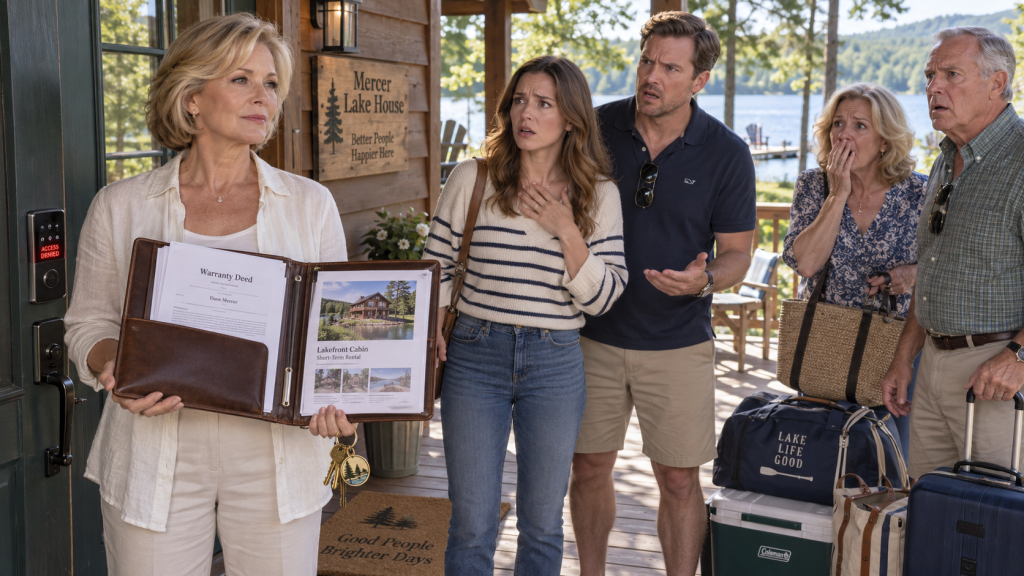
Derek reached the door first.
He punched his old code into the smart lock.
Red.
He frowned.
Tried again.
Red.
Then a third time.
Red.
Frank said something behind him.
Derek pulled out his phone.
I watched from inside.
He tried the app.
No administrator access.
No active code.
Then he knocked.
Hard.
I waited three seconds.
Opened the door.
“Hi.”
Nobody spoke.
Lily yelled:
“Grandma!”
She ran straight into me.
I hugged her.
Hard.
Whatever happened between adults, she did not become collateral.
Owen followed.
“Grandma, Dad says the lock is broken.”
I smiled.
“It’s working.”
Derek’s face changed.
Claire stared at me.
“You’re here.”
“Yes.”
“You said you understood.”
“I did.”
“That doesn’t mean I agreed.”
Frank and Susan looked uncomfortable.
Good.
They had probably been told another story.
Derek stepped forward.
“Can you let us in?”
I looked at him.
“For what?”
His jaw tightened.
“We’re staying here.”
“No.”
The word came out quietly.
Lily looked up at me.
I immediately softened.
“The kids can come in for lunch if they want.”
I looked at Claire.
“You can too.”
“Your parents can visit.”
Then at Derek.
“But no one is staying here unless I agree.”
Silence.
Susan looked at Derek.
“I thought you booked the week.”
There it was.
Booked.
Not invited.
Claire turned.
“What?”
Susan looked confused.
“Derek said this was your week.”
“It was.”
Claire said.
Then looked at me.
“Wasn’t it?”
I stepped aside.
“Come inside.”
Not because I was surrendering.
Because this conversation did not belong in front of neighbors.
They came in.
Coolers remained outside.
That detail mattered to me.
Derek noticed.
Said nothing.
We sat around the dining table.
Lily and Owen went into the loft after I told them they could.
Children should not have to attend adult property disputes.
Frank and Susan sat stiffly.
Claire looked pale.
Derek looked furious.
I put Robert’s leather folder on the table.
His initials facing up.
Derek looked at it.
“What is that?”
“Records.”
He laughed once.
“Of course.”
Claire looked at him.
“Don’t.”
Good.
New.
I opened the folder.
First page.
The deed.
I slid it toward Derek’s parents.
Susan read the owner’s name.
Diane Mercer.
Only.
She looked at Derek.
“I thought Claire was on it.”
No one spoke.
Then Frank:
“You told us this was transferred to you two.”
Claire turned so fast her chair moved.
“What?”
Derek’s face changed.
That was the first moment I understood the family lie was larger than I knew.
“Dad.”
Frank frowned.
“You said Diane put it in Claire’s name after Robert died.”
I looked at my daughter.
She looked horrified.
“I never said that.”
Frank pointed at Derek.
“He did.”
Derek rubbed his forehead.
“I said it was basically ours.”
Susan stared.
“No.”
“You said transferred.”
I almost felt sorry for him.
Words had finally become witnesses.
He snapped:
“Does the exact phrasing matter?”
“Yes.”
I said.
Everyone looked at me.
“Yes.”
“It matters.”
Then I placed the rental listing on the table.
“Owner.”
“Private family retreat.”
“Exclusive dock.”
“Five hundred twenty-five dollars a night.”
Then the payout summary.
Twenty-seven thousand dollars.
Susan’s face drained.
Frank looked at his son.
“You rented this place?”
Derek said:
“Occasionally.”
I looked at the eleven reviews.
“Repeatedly.”
Claire whispered:
“You told your parents Mom transferred it?”
Derek turned toward her.
“You knew this place would be yours eventually.”
“That’s not what I asked.”
Good.
She was learning to stay with the question.
“Did you tell them Mom gave us the cabin?”
He exhaled.
“Claire.”
“Yes or no?”
“Not exactly.”
Susan said:
“Yes.”
Everyone went quiet.
Derek glared at his mother.
She looked offended.
“Don’t look at me like that.”
“You told us.”
Good for Susan.
I moved to the next document.
Smart-lock administrator request.
June.
Derek stared.
“I was trying to manage guest access.”
“To my property.”
“For the family.”
“For renters.”
Silence.
I slid Marisol’s letter across.
Formal notice.
No authority to rent.
No standing access after June twenty-third.
No future code without my permission.
Derek laughed bitterly.
“So this is your little performance.”
I looked at him.
“No.”
“If I wanted a performance, I would have put balloons outside.”
Frank almost smiled.
Wrong moment.
He stopped.
Then came the listing agreement.
Claire saw the broker’s logo before she read the words.
Her face changed.
“Mom.”
I did not speak.
She lifted the page.
“Exclusive right to sell.”
Derek leaned forward.
“What?”
Claire looked at me.
“You listed it?”
“Yes.”
“When?”
“Yesterday.”
Her eyes filled.
“Without telling us?”
I held her gaze.
“That sentence is interesting coming from this table.”
She flinched.
I regretted the sharpness immediately.
Not the truth.
The delivery.
So I softened.
“I am telling you now.”
Derek stood.
“You can’t sell this.”
The room went completely still.
I looked up at him.
“Why not?”
“Because it’s a family property.”
“No.”
“It is property used by family.”
“Different sentence.”
He stared.
“Robert bought this for Claire.”
That one almost made me laugh.
“No.”
“Robert died before I bought the land.”
“You used his insurance.”
“Partly.”
“That makes it his legacy.”
I felt something inside me settle.
“No, Derek.”
I said it gently.
“Robert’s death is not a legal ownership structure.”
Frank looked away.
Susan closed her eyes.
Claire started crying.
Not because I had been cruel.
Because the family myth was collapsing in public.
Derek pointed at the folder.
“So what?”
“You’re going to sell because your feelings got hurt?”
“No.”
“I’m selling because I own a property I no longer want to maintain under the arrangement we’ve had.”
“You could just set rules.”
“I am.”
“This is one of them.”
His face reddened.
“You’re punishing Claire.”
I looked at my daughter.
“No.”
Claire looked back.
Painful.
Still true.
“If Claire wants to be angry with me, she can.”
“I love her enough to survive that.”
That sentence surprised even me.
For years I had given too much because I was terrified love could not survive no.
Maybe that had been the real problem.
Susan asked quietly:
“Where are we supposed to stay?”
Derek closed his eyes.
I answered.
“There are hotels in town.”
She nodded.
No argument.
Then:
“I’m sorry, Diane.”
Derek looked at her.
“For what?”
She ignored him.
“We honestly thought Claire owned part of this.”
“I believe you.”
That mattered.
Not everyone had to be guilty for me to have been wronged.
Susan had relied on her son.
That was her mistake.
Not mine to dramatize.
Frank asked:
“Can we at least unload food?”
I almost laughed.
“Yes.”
“Food can stay.”
“People cannot?”
Derek said.
I looked at him.
“Not overnight.”
He pushed his chair back.
“This is insane.”
“No.”
“Insane was listing someone else’s cabin for rent.”
His eyes narrowed.
“I was helping.”
“With what?”
“Costs.”
I opened the expense page.
“Property taxes?”
Silence.
“Insurance?”
Silence.
“Dock?”
“Roof?”
“Septic?”
“Internet?”
“Security system?”
No answer.
“You bought a blender.”
Frank looked down to hide a smile.
I did not.
Not because it was funny.
Okay.
A little because it was funny.
Claire stood.
“I need air.”
She walked onto the screened porch.
I followed.
Not immediately.
After enough time for the room to stop feeling like pursuit.
She stood facing the lake.
Crying.
I stayed beside the door.
Did not touch her until she looked at me.
Then she said:
“You could have told me before listing it.”
“Yes.”
“Why didn’t you?”
I thought.
“Because I knew you would try to make my decision about your feelings before I had finished making it.”
She cried harder.
“That’s awful.”
“It is.”
“And true.”
She wiped her face.
“Do you even care what this place means to us?”
“Yes.”
“That’s why this hurts.”
I looked across the water.
“It means something to me too.”
“More than you know.”
Claire whispered:
“I thought Dad was here.”
My heart broke.
“What?”
“Not literally.”
She almost laughed through tears.
“When we came here, I felt like Dad was still part of things.”
I closed my eyes.
There it was.
Not entitlement.
Not entirely.
Grief.
The cabin had been her connection too.
I moved closer.
“He is not in the deed.”
I said softly.
“But he is in your memories.”
“Selling the cabin cannot sell those.”
She shook her head.
“It feels like it.”
“I know.”
For the first time since the phone call, I hugged her.
She let me.
Neither of us apologized for crying.
After a while, Claire said:
“Did Derek really make twenty-seven thousand?”
“That’s what the payout records show.”
“And you got none.”
“No.”
She stared at the water.
Then:
“Do you think I knew?”
“No.”
She turned toward me.
“I don’t.”
I continued.
“But I think you accepted his version because it was easier than questioning him.”
She looked ashamed.
“I did.”
There.
A beginning.
Then she said something I did not expect.
“He told me you had promised the cabin to us.”
“When?”
“After Owen was born.”
My stomach tightened.
“What exactly did he say?”
“That you told him you wanted the place to stay with us.”
“I may have said I hoped the grandchildren would always enjoy it.”
Claire nodded.
“That’s what I remember you saying.”
“Those are different statements.”
“I know now.”
Then she looked toward the dining room.
“I think he turned one into the other.”
Maybe.
Maybe deliberately.
Maybe because Derek heard generosity as future title.
Either way, the result was the same.
When we went back inside, Derek was on his phone.
Angry.
His parents sat quietly.
Marisol had told me to expect posturing.
Threats to sue.
Claims of promises.
Fine.
People are allowed to hire lawyers.
I was done being frightened by paperwork.
Then my own phone buzzed.
A message from Marisol.
Call me when you can. Platform counsel just produced the host verification file. There’s something you need to see.
My stomach tightened.
I stepped outside.
Called.
“What?”
Marisol answered immediately.
“The platform required Derek to explain his authority to list the property after a guest questioned why the public owner record did not match his name.”
“When?”
“Last August.”
My skin went cold.
“What did he say?”
“He submitted a written explanation.”
I looked through the screen at Derek.
Still pacing inside my cabin.
“What explanation?”
Marisol hesitated.
Then:
“He wrote that the property had been transferred by you to Claire and him after Robert’s death, but the deed had not yet been updated.”
For a second, I heard nothing.
Not the lake.
Not birds.
Nothing.
“He said I transferred it?”
“Yes.”
“In writing?”
“Yes.”
“There is more.”
Of course.
“What?”
“He told the platform you remained on the public deed only for estate-planning convenience.”
I almost laughed.
Estate planning.
I had never had a conversation with Derek about my estate.
Not once.
Then Marisol said:
“And he attached a message thread with a guest in which he referred to himself as co-owner.”
I closed my eyes.
“Send it.”
“Already did.”
I returned to the dining room.
Derek looked at me.
“What now?”
I placed my phone on the table.
Opened Marisol’s email.
Then turned the screen toward Claire.
The host verification statement was short.
Formal enough to sound confident.
Property was transferred within the family after the death of Robert Mercer. My wife, Claire Walsh, and I are the beneficial owners. Diane Mercer remains listed publicly pending estate updates. We manage and control all guest use.
Claire read it once.
Then again.
Her face went white.
“I never agreed to this.”
Derek said:
“It was platform language.”
Claire looked at him.
“What does that mean?”
“They needed something.”
“So you lied.”
“No.”
“I simplified.”
Frank stood.
“Derek.”
His voice had changed.
Not angry.
Disappointed.
Sometimes that is worse.
Claire kept reading.
Then she scrolled down to the guest message.
Derek’s words.
We took over the property from Claire’s mother several years ago. She doesn’t use it much anymore, so we’ve opened a few summer weeks to guests.
Claire made a small sound.
I will never forget it.
Not crying.
Recognition.
She put the phone down.
Then looked at her husband.
“You told strangers my mother had given us her cabin.”
Derek’s face hardened.
“You knew we’d get it eventually.”
“No.”
Claire shook her head.
“No.”
“I knew you kept saying we would.”
That sentence changed the room.
Derek stared at her.
She continued.
“I thought you were repeating something Mom told you.”
“You knew she didn’t say it to me.”
“I assumed—”
“That’s the problem.”
Her voice cracked.
“We all kept assuming.”
Silence.
Then Claire asked the question nobody had asked yet.
“If you were willing to tell renters we owned the cabin…”
She swallowed.
“What else have you been telling people belongs to us?”
Derek’s expression changed.
Just slightly.
But I saw it.
And so did Claire.
For the first time that day, selling the cabin stopped being the biggest problem in the room.
PART 3 — THE CABIN I CHOSE TO LEAVE
For several seconds after Claire asked the question, nobody moved.
“If you were willing to tell renters we owned the cabin…”
Her voice trembled.
“What else have you been telling people belongs to us?”
Derek looked at her.
Then at me.
Then toward his parents.
That was enough.
There was something.
Not necessarily another crime.
Not necessarily another secret account.
But something.
Frank saw it too.
He lowered himself slowly back into his chair.
“Derek.”
His son rubbed both hands over his face.
“It’s not what everyone is making it into.”
I almost laughed.
That sentence should be printed on warning labels.
Claire did not.
She looked exhausted.
“Then tell us what it is.”
Derek stared at the table.
“I listed the cabin on a personal financial statement.”
Susan frowned.
“What does that mean?”
“It was for a loan application.”
My stomach tightened.
I looked at him.
“What loan?”
“It never closed.”
Again.
Not the question.
Claire asked:
“What loan?”
Derek exhaled.
“A business line.”
“You don’t own a business.”
Claire said.
“I was looking at buying into one.”
There it was.
Another plan he had not told her about.
Not a secret empire.
Something much more ordinary.
Derek and a former coworker had explored buying a minority stake in a regional outdoor-equipment distributor.
To qualify for financing, Derek had submitted a personal financial statement listing assets, debts, income, and expected ownership interests.
One line read:
Cedar Lake Property — estimated family equity: $340,000.
My cabin.
My title.
My taxes.
My insurance.
His “family equity.”
I asked:
“Did you tell the lender you owned it?”
“Not exactly.”
Claire closed her eyes.
“Derek.”
He snapped:
“I said it was a family asset expected to transfer.”
“Expected by whom?”
I asked.
He stared.
No answer.
Frank shook his head.
“You told me Diane had already started estate planning around it.”
I looked at him.
“She hasn’t.”
Frank’s face hardened toward his son.
Derek said:
“That was the plan.”
“No.”
I kept my voice calm.
“That was your assumption.”
“There was never a plan.”
Claire’s eyes filled.
“You put Mom’s cabin on a financial statement.”
“Yes.”
“Did you put my name on it too?”
He hesitated.
That was another answer.
“What did you write?”
Derek rubbed his forehead.
“Claire and I are anticipated beneficiaries.”
She stared.
“Beneficiaries.”
“Yes.”
“Of whose estate?”
“Your mother’s.”
I laughed once.
Not because it was funny.
Because I was sitting right there.
Alive.
Healthy.
Apparently already reduced to a projected asset transfer.
Susan whispered:
“Oh, Derek.”
He looked toward her.
“What?”
“People put expected inheritance on financial forms all the time.”
“No.”
Frank said.
“People with no judgment do.”
Silence.
Derek turned toward me.
“You would have left it to Claire anyway.”
My daughter flinched.
I looked at him.
“Maybe.”
That stopped him.
“Maybe?”
“Yes.”
“Maybe.”
I leaned forward.
“I have one daughter.”
“I love her.”
“I love my grandchildren.”
“That does not mean I am required to die according to your spreadsheet.”
Nobody spoke.
Then I added:
“And even if I had planned to leave the cabin to Claire, expected inheritance is not current ownership.”
“That difference should not require a lawyer.”
Derek looked away.
The business loan had not funded.
That mattered.
The lender had asked for documentation proving the cabin interest.
Derek stalled.
Then said the estate paperwork was “in progress.”
No deed.
No trust.
No transfer.
Eventually the lender excluded the cabin from his verified net worth.
The deal collapsed for other reasons anyway.
No lien attached.
No mortgage was placed against my property.
No one had taken money using my cabin as actual collateral.
Good.
But Derek had spent years speaking about my property as though I had already become an estate.
That was the part I could not stop feeling.
Frank asked:
“Did you show me that appraisal because of the loan?”
Derek’s face changed.
“What appraisal?”
I asked.
Frank looked embarrassed.
“Last Christmas.”
Derek had shown his father an online estimate of the cabin’s value.
He told Frank the property was worth close to seven hundred thousand.
Frank assumed Derek and Claire were discussing future planning with me.
No one had asked me.
Again.
Family assumptions stacked into imaginary facts.
I looked at Susan.
“Did you think the cabin already belonged partly to them?”
“Yes.”
She answered quickly.
“Because Derek said so.”
Not because Claire said so.
Important.
Claire looked sick.
Then Lily came down from the loft.
“Mom?”
Every adult stopped talking.
She looked around.
“Can Owen and I go to the dock?”
Claire wiped her face quickly.
“Not without an adult.”
“I’ll go.”
Frank stood.
Bless him.
Not because he needed to escape.
Because he understood children had already been upstairs too long while adults rearranged reality below them.
Susan went with him.
Lily grabbed a life jacket.
Owen shouted something about minnows.
The screen door slammed.
And for a moment, the cabin sounded normal again.
Claire remained at the table.
Derek beside her.
Me across from them.
She said:
“I need you to tell me everything now.”
Derek looked tired.
“So do I.”
“No.”
Claire shook her head.
“You don’t get to turn this into something we’re both confused about.”
Good.
That was new.
She continued.
“How many times did you rent Mom’s cabin?”
He answered.
“Fourteen bookings.”
The platform records had shown roughly that.
“How much money did you receive?”
“About twenty-seven thousand after fees.”
“Where did it go?”
He hesitated.
Claire’s face changed.
“Derek.”
“Some went to the cabin.”
“How much?”
“Maybe three thousand.”
“Where did the rest go?”
He looked down.
“Household expenses.”
I said nothing.
This was their marriage now.
Not my prosecution.
Claire asked:
“What household expenses?”
“Trips.”
“The kids’ activities.”
“Credit cards.”
“My truck payment a few times.”
“Your parents’ anniversary weekend.”
Susan and Frank were outside.
Good.
Claire whispered:
“You paid for your parents’ anniversary trip with money from Mom’s cabin?”
“Partly.”
She laughed bitterly.
“And then asked Mom not to come because you wanted the cabin to feel like our family.”
That sentence landed harder than anything I could have said.
Derek opened his mouth.
Closed it.
For once, even he understood language had run out.
I stood.
“I’m going for a walk.”
Claire looked up.
“Mom—”
“This part belongs to you two.”
She stared.
I continued.
“I’m here.”
“But I’m not going to decide your marriage for you.”
Then I picked up Robert’s leather folder.
Not because I was afraid Derek would touch it.
Because I suddenly wanted something of Robert’s in my hand.
I walked down toward the lake.
The dock was warm beneath my sandals.
Frank was teaching Owen how to thread a worm onto a hook without actually touching the worm.
An ambitious project.
Susan sat beside Lily with her feet in the water.
I walked farther down the shoreline.
Past the green canoe resting beneath the trees.
Past the place where Robert would have built a second firepit if he had lived long enough to complain about the first one.
Then I sat on a flat rock and opened the folder.
Deed.
Taxes.
Insurance.
Listing agreement.
Screenshots.
Letters.
The paperwork looked absurd against the lake.
Robert’s dream had never included title disputes.
Smart locks.
Rental platforms.
Financial statements.
He had written only one word on that old property clipping.
Someday?
I wondered what he would think.
Then stopped.
Robert had been dead six years.
Too often, I had used imagined conversations with him to avoid making decisions as myself.
Would Robert sell?
Would Robert be angry?
Would Robert let Claire keep using it?
Would Robert want Lily and Owen to inherit it?
Maybe.
Maybe not.
He was not here to answer.
I was.
That had to be enough.
Claire found me half an hour later.
She sat beside me without asking.
For a while, we watched the water.
Then:
“Derek’s leaving.”
I looked toward the cabin.
“Today?”
“Yes.”
“With his parents?”
“No.”
“His parents are taking Lily and Owen to a hotel.”
I turned.
“What about you?”
“I’m staying here tonight.”
I nodded.
“Okay.”
She stared at the lake.
“I told him I need space.”
No triumph moved through me.
That surprised me.
I had disliked Derek’s entitlement for years.
Still, he was my daughter’s husband.
Lily and Owen’s father.
A marriage cracking is not a victory simply because one spouse deserves consequences.
Claire whispered:
“I feel stupid.”
“No.”
“I let him do this.”
“You didn’t know about all of it.”
“I knew enough to ask more questions.”
That was true.
So I did not lie.
“Yes.”
She looked at me.
“You agree?”
“Yes.”
Her eyes filled.
“I thought you were supposed to make me feel better.”
“I spent too many years doing that.”
She laughed through tears.
Fair.
Then I said:
“You trusted your husband.”
“That is not stupidity.”
“But you also accepted explanations that protected your comfort.”
“That part is yours to learn from.”
Claire nodded slowly.
“Okay.”
Not defensive.
Just okay.
Progress rarely sounds dramatic.
Then she asked:
“Are you still selling?”
“Yes.”
Immediate.
She looked down.
“I thought maybe after all this…”
“No.”
She nodded.
A tear slid down her cheek.
“Okay.”
I put my arm around her.
She leaned against me.
Then I said:
“Selling it is not me rejecting you.”
“I know.”
“No.”
I looked at her.
“Know it.”
“This is not punishment.”
“I am not going to spend the rest of my life making financial decisions based on whether you understand them.”
“I love you.”
“But I need you to become able to survive my no.”
Claire cried harder.
Maybe because she knew I was right.
Maybe because she hated it.
Both were allowed.
Derek left before sunset.
No shouting.
No smashed cooler.
No dramatic final threat.
He packed his truck.
Stopped once near the porch.
Looked toward me.
Then said:
“I’m sorry.”
I almost laughed.
“For what?”
His face tightened.
Fair question.
“For overstepping.”
Too small.
He knew it.
I waited.
Then he tried again.
“For treating the cabin like it was ours.”
Better.
“And?”
He swallowed.
“For renting it.”
“And telling people?”
“Yes.”
His voice dropped.
“For telling people it had been transferred.”
Good.
Specific.
Then:
“I honestly thought it would be ours eventually.”
I looked at him.
“I know.”
That was the problem.
He had mistaken expectation for permission.
He nodded.
Then drove away.
That night, Claire and I slept at the cabin.
Different rooms.
Lily and Owen at the hotel with Frank and Susan.
The cabin was strangely quiet.
Around midnight, I heard Claire in the kitchen.
I found her sitting at the table wearing Robert’s old sweatshirt.
The same one she had worn years ago when she said:
“Dad would have loved this.”
She looked up.
“Can’t sleep?”
“No.”
I made tea.
She watched me.
Then said:
“Derek and I have money problems.”
I sat down.
“What kind?”
“Not catastrophic.”
Good.
“Credit cards.”
“A personal loan I didn’t know was as high as it is.”
“How high?”
“About thirty-eight thousand.”
I winced.
Not impossible.
Not nothing.
“He used the rental money for some of that?”
“Apparently.”
“Do you have access to the accounts now?”
“Yes.”
“Have you looked?”
“All night.”
Good.
Painful.
Necessary.
She told me the rest.
Nothing cinematic.
No offshore accounts.
No secret second family.
Derek had simply been spending more than they could comfortably afford.
Trips.
Truck.
Restaurants.
Sports programs.
Home improvements.
He believed future income would catch up.
Then he believed the cabin rentals could fill gaps.
Then he believed an eventual inheritance made their long-term picture better than it actually was.
Small assumptions.
Stacked.
Dangerous.
I recognized the pattern.
Not because I had done the same thing.
Because I had enabled another version of it.
Free cabin weekends.
Groceries waiting.
No questions.
I thought generosity was making life easier.
Sometimes easier teaches the wrong lesson.
Claire said:
“I think we’re going to separate.”
I did not say:
Good.
Did not say:
Finally.
I asked:
“Is that what you want?”
“I don’t know.”
“Then don’t decide tonight.”
She looked at me.
“After everything?”
“Yes.”
“Derek lied.”
“Yes.”
“A lot.”
“Yes.”
“That doesn’t mean you make a lifetime decision at one in the morning because you’re angry.”
She stared.
“Would you forgive him?”
“Not relevant.”
“Mom.”
“No.”
I shook my head.
“I am not married to him.”
“You are.”
“Your standards can be different from mine.”
“That is what being an adult costs.”
She groaned.
“I hate when you become wise after midnight.”
“So do I.”
The cabin went on the market four days later.
The listing photographs were beautiful.
Too beautiful.
Lake glowing gold.
Cedar siding.
Screened porch.
Dock.
The green canoe was gone by then.
I had moved it to my garage at home.
I could not leave Robert’s canoe as staging.
Some things were not included.
We received the first offer within a week.
Low.
I declined.
The second was stronger.
Cash buyer.
Still not right.
Then a family from Madison came through.
Parents.
Two teenage daughters.
A grandmother who lived with them part of the year.
They stayed on the porch for almost an hour during the showing.
Karen told me later the grandmother cried when she saw the lake.
I tried not to make that symbolic.
Failed.
Their offer was fair.
Not the highest possible fantasy number.
$684,000.
Clean financing.
Normal inspection.
Reasonable closing date.
I accepted.
Then went home and cried in my car.
The unauthorized-rental issue settled separately.
Marisol negotiated.
Derek accounted for the booking revenue as best he could.
Some expenses were legitimate cleaning and supply costs.
Those were credited.
The rest became a repayment obligation to me.
I did not demand punitive numbers.
I wanted the money he had received from my property without permission addressed.
That was all.
Derek eventually agreed to repay roughly $21,000 after documented expenses and platform fees were sorted.
Monthly payments.
No magical check.
No sheriff.
Just an agreement.
He also corrected the personal financial statement with the old lender and provided written confirmation that he held no ownership interest in the cabin.
The rental platform permanently removed his listing.
Whether they restricted his host account further was their decision.
I stopped caring.
Claire and Derek separated for six months.
Not because I ordered it.
She rented a townhouse nearby with Lily and Owen part of the week.
Derek started financial counseling.
Then individual therapy.
Claire did too.
They attempted marriage counseling.
I expected divorce.
They surprised me.
After almost a year, they decided to stay married.
I did not celebrate.
I did not object.
They rebuilt differently.
Claire gained full visibility into household finances.
No private debts.
No unilateral investments.
No inheritance assumptions entered into spreadsheets as assets.
Derek sold the truck.
That may have hurt him more than therapy.
I never asked.
He apologized to me again a year later.
This time, better.
We were at Lily’s soccer game.
No audience except children screaming at a referee.
Derek stood beside me near the bleachers.
“I thought because you were generous, I had permission to expand what you meant.”
I looked at him.
That was accurate.
He continued.
“You said we could use the cabin.”
“I turned that into manage.”
“Then rent.”
“Then inherit.”
“Then basically own.”
I nodded.
“Yes.”
“I’m sorry.”
I believed him.
That did not restore old access.
Important.
Forgiveness does not automatically regenerate passwords.
The cabin sale closed in August.
I drove up the night before.
Alone.
No Claire.
No grandchildren.
No broker.
Just me.
I slept in the downstairs bedroom with the windows open.
Rain moved over the roof sometime after midnight.
Exactly like the first night years earlier.
Wet cedar.
Dark water.
That old sound.
And I cried again.
Not as hard.
But deeply.
For Robert.
For the life we did not get.
For the cabin he never saw.
For the summers Claire did.
For Lily and Owen jumping from the dock.
For the mistake of thinking preserving a place was the same thing as preserving love.
It isn’t.
Places carry memory.
They do not own it.
In the morning, I walked through every room.
The loft.
Kitchen.
Screened porch.
I touched the dining table.
Then removed the last thing from the wall.
A small framed photograph of Robert.
He was sixty-two in it.
Standing beside the lake on a vacation years before he died.
Wind in his hair.
Squinting.
Happy.
I put the photograph into Robert’s leather folder.
Then laughed at myself.
Paperwork and a photograph.
Very romantic.
Very us.
Tom and Elisa came over before I left.
Elisa hugged me.
Tom handed me a small wooden box.
“What’s this?”
“Dock screws.”
I stared.
“Why?”
“So you’ll remember all the times I fixed things Derek said he fixed.”
I laughed so hard I cried again.
Then Tom became serious.
“You okay?”
“Yes.”
That time it was true.
Hard.
Still true.
At closing, I signed thirty-seven places.
Maybe more.
I read every page.
Karen waited patiently.
The title officer smiled.
When the final signature was done, she slid the key across the table for me to surrender.
Brass.
Old-fashioned.
The original physical key to the cabin.
I held it.
For years, the smart lock had made that key mostly unnecessary.
But I kept it anyway.
Robert would have.
Some habits are sentimental.
Not rational.
I placed it on the table.
Then let go.
That was harder than signing the deed.
The proceeds arrived two days later.
I did not announce the amount to anyone.
Not Claire.
Not Derek.
Not the church.
Not the neighbors.
My money.
I paid taxes.
Set aside investments.
Put some toward travel.
Updated my estate plan with Marisol’s colleague.
This time, Claire knew only what I wanted her to know.
Love does not require publishing your balance sheet to prove trust.
I did create education accounts for Lily and Owen.
Not huge.
Not enough to control their futures.
Enough to help.
I told Claire:
“This is for them.”
She nodded.
“No assumptions.”
I smiled.
“Exactly.”
Then she said:
“I’m learning.”
“Yes.”
We both were.
The green canoe came home with me.
For almost a year it sat in my garage.
I did not know what to do with it.
Then one spring, Lily asked:
“Grandma, are we ever going canoeing again?”
I looked at her.
“Do you want to?”
“Yes.”
So we took it to a public lake forty minutes from my house.
No private dock.
No cedar cabin.
No smart lock.
Just a county boat launch and a picnic table with peeling paint.
Lily sat in front.
Owen in the middle.
I paddled badly.
Robert would have criticized my stroke.
I told the kids that.
Lily said:
“Grandpa sounds bossy.”
“He was.”
I smiled.
“Lovably.”
That afternoon taught me something the cabin never could.
The canoe still floated without the property.
So did we.
Two years after the sale, Claire called on June twenty-fourth.
I noticed the date immediately.
She did too.
“Do you remember?”
“Yes.”
“The disaster vacation.”
“I prefer the title dispute picnic.”
She laughed.
Then:
“We rented a place.”
My stomach tightened automatically.
She heard the silence.
“Legally.”
“Good.”
“Through an actual owner.”
“Excellent.”
“We paid money.”
“Revolutionary.”
She laughed again.
Then:
“Do you want to come?”
I paused.
Not because I was hurt.
Because I wanted to answer honestly.
“Which days?”
“All of them if you want.”
I smiled.
There it was.
Invitation.
Not obligation.
Not entitlement.
Choice.
“I’ll come for three.”
“Perfect.”
The rental was smaller than my cabin.
Ugly brown carpet.
Terrible dock.
Kitchen knives so dull they could barely threaten butter.
And I had one of the best weekends of my life.
Because nobody assumed I would stock groceries.
Nobody expected me to arrive early and make beds.
Claire brought towels.
Derek cooked dinner.
Frank and Susan came one afternoon.
We split the cost.
Not because I needed the money.
Because shared use feels different when responsibility is shared too.
That night, we sat around a firepit.
Lily roasted a marshmallow until it caught fire.
Owen screamed.
Derek dropped his into the grass.
Claire laughed so hard she nearly fell out of her chair.
I looked around.
For a moment, I could almost see Robert in the empty chair near the fire.
Then I corrected myself.
Not see.
Remember.
There is a difference.
The dead do not have to remain attached to one address for memory to survive.
That realization set me free more than selling ever did.
Years later, the brass cabin key still appears in my mind sometimes.
I no longer own it.
I do not know who has it now.
Maybe the family from Madison changed the lock immediately.
Probably.
Good.
The cabin belongs to their life now.
I hope their daughters leave wet towels on the floor.
I hope the grandmother drinks coffee on the porch.
I hope somebody scratches the table and decides not to care.
Homes should be lived in.
Not preserved as monuments.
Robert’s leather folder sits in my desk.
Most of the cabin paperwork is gone now.
Archived.
The folder contains different things.
His photograph.
The original clipping with Someday?
The closing statement from the sale.
One photograph of Lily and Owen in the green canoe.
And a printed copy of the email Karen sent me after closing.
One line:
Congratulations, Diane. You chose what came next.
That is what the cabin became in the end.
Not something Derek stole.
Not something Claire lost.
Not something Robert left.
A choice.
Mine.
For years, I believed love meant leaving the door unlocked.
Come whenever.
Use whatever.
Bring whoever.
Family does not need permission.
I know better now.
Family needs permission most of all.
Because strangers usually know where the boundaries are.
Family are the people most likely to mistake closeness for access if no one teaches them otherwise.
A key is not ownership.
A guest code is not a deed.
A future inheritance is not present property.
And generosity is not an agreement to disappear from your own life.
That summer, Claire asked me to stay away from the cabin because Derek wanted it to feel like “just our family.”
For a while, those words devastated me.
Years later, I understood something almost funny.
He had been right about one thing.
I had allowed the cabin to become too much about everyone else’s family.
Their schedules.
Their guests.
Their assumptions.
Their memories.
Their convenience.
Selling it was the first time since Robert died that I asked one simple question without translating it through anyone else’s needs.
What do I want?
The answer was not revenge.
Not control.
Not even the cabin.
I wanted the right to choose.
And once I took that right back, I discovered I did not need to own a lake house to feel close to Robert.
I did not need a smart lock to know who belonged in my life.
And I did not need my daughter to agree with every boundary before I was allowed to have one.
The cabin was never proof of love.
It was wood.
Glass.
Cedar.
A dock.
A beautiful place where our family lived some beautiful years.
Then I sold it.
And the love came with me.
THE END STORIES! THANK YOU FOR READING GOOD LUCK !❤️
Related Posts