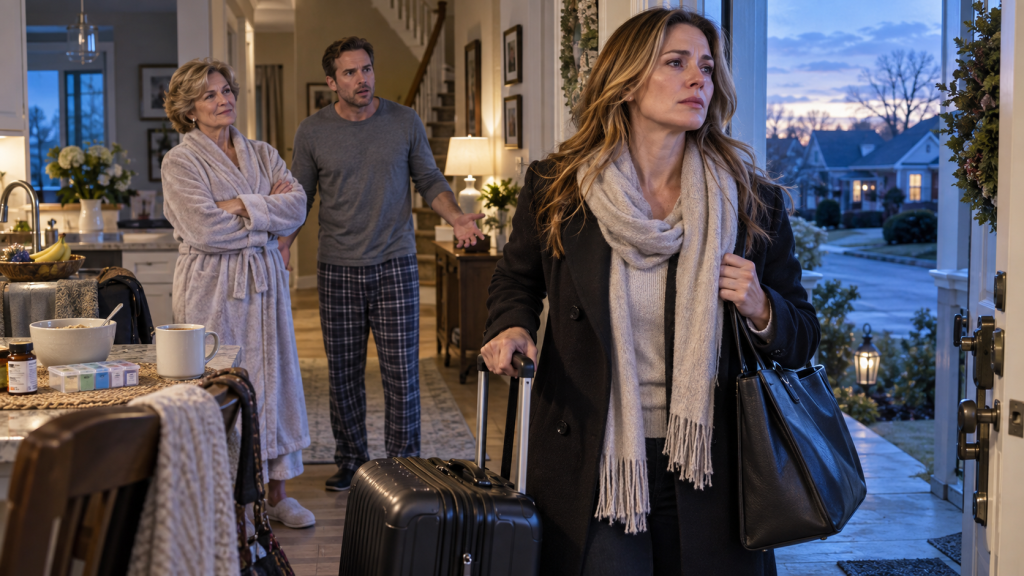
My husband brought his mother unannounced and forced me to wake up at 4:40 AM to prepare her oatmeal and meds. I grabbed my suitcase and left. Three days later he called: ‘Come back, something terrible has happened!’

At 4:40 in the morning, my husband yanked the blanket off me and said, “Get up. Mom needs oatmeal before her pills.” That was the moment I realized my marriage had not turned into a partnership—it had turned into an unpaid night shift.
I stared at Daniel through the blue darkness of our bedroom. Behind him stood his mother, Lorraine, wrapped in my robe as if she owned the place.
“She’ll be staying with us,” Daniel said. “Probably a few months.”
“You brought her here without asking me?”
Lorraine smiled. “Family shouldn’t need invitations.”
I had spent six years swallowing sentences to keep the peace. I cooked, cleaned, handled the bills, remembered Daniel’s meetings, and drove Lorraine to appointments whenever he was “too busy.” I had even postponed a promotion once because Daniel said our home needed me more. Daniel called it being supportive. Lorraine called it my duty.
But waking me before dawn to manage medication he had never bothered to learn? Something inside me finally went quiet.
Daniel pointed toward the kitchen. “Her pills are in the blue organizer. Oatmeal, no sugar. And make coffee.”
I sat up slowly. “You woke me at 4:40 for this?”
He rolled his eyes. “Don’t make everything dramatic.”
Lorraine added, “A good wife would already be downstairs.”
I looked at both of them, remembering every birthday he had forgotten and every apology I had made for problems I did not create. Then I smiled.
“All right.”
Daniel smirked, believing he had won.
I walked past the kitchen.
Instead, I entered the guest room, pulled my suitcase from the closet, and packed ten shirts, jeans, toiletries, my laptop, and one red folder from the locked bottom drawer of my desk.
Daniel followed me. “What are you doing?”
“Leaving.”
He laughed. “Over oatmeal?”
“No. Over six years.”
His face hardened. “This is my house too. You can’t just walk out because Mom needs help.”
I zipped the suitcase. “Interesting choice of words.”
He didn’t understand.
What Daniel had forgotten—or perhaps never truly understood—was that the house had been mine before our wedding. My late aunt left it to me free and clear. Daniel’s name was never added to the deed.
And the consulting company he bragged about “building with his own hands”? I had quietly financed its first two years through a separate inheritance account. Every transfer was documented. So were the personal expenses he had recently started charging to the company.
I carried my suitcase downstairs.
Lorraine stood beside the stove. “You’ll come crawling back.”
I opened the front door.
“Maybe,” I said. “But before I do, you should both learn where the oatmeal is.
PART 2 — THREE DAYS AFTER I LEFT
Three days after I left my husband standing in our kitchen with his mother and a box of uncooked oatmeal, my phone rang at 6:17 in the morning.
I was awake.
Not because someone had pulled a blanket off me.
Not because medication needed sorting.
Not because coffee had to be made before another person could begin their day.
I was awake because the motel curtains were too thin and morning light had found the gap.
For the first time in years, that felt almost luxurious.
My phone vibrated against the nightstand.
Daniel.
I watched his name appear.
Disappear.
Appear again.
He called five times.
Then six.
Then nine.
On the tenth call, I answered.
Not because I missed him.
Because something in me had gone beyond anger and entered the colder territory of curiosity.
“What?”
His breathing was uneven.
Not theatrical.
Not annoyed.
Scared.
“Where are you?”
“That is not your concern.”
“Please.”
I sat up.
That word sounded strange coming from him.
Daniel rarely said please.
He preferred statements disguised as requests.
Can you pick up Mom’s prescription?
You’ll handle dinner, right?
Move your meeting. Mine is important.
You don’t mind, do you?
Six years of marriage had taught me that a man could avoid saying “please” entirely if he simply assumed the answer would always be yes.
“What happened?”
He exhaled hard.
“Come back.”
“No.”
“Claire.”
“No.”
“Something terrible happened.”
I looked toward the motel window.
Rainwater ran in silver lines down the glass.
“What happened?”
There was silence.
Then:
“Mom collapsed.”
I straightened.
Despite everything, my first instinct was concern.
That instinct made me angry with myself.
Not because compassion was weakness.
Because I had spent so many years being trained to respond to emergencies that my body still moved before my mind had a chance to object.
“Is she conscious?”
“Yes.”
“Did you call an ambulance?”
“Yes.”
“Is she at the hospital?”
“Yes.”
“What did the doctors say?”
Daniel hesitated.
And in that hesitation, I understood.
This was not only about Lorraine.
“What else happened?”
“Claire.”
“What else?”
Another silence.
Longer this time.
Then he said, “They asked about her medications.”
I closed my eyes.
Of course they did.
“And?”
“I didn’t know.”
My jaw tightened.
“You didn’t know what she takes?”
“I know some of them.”
“How many?”
“I don’t know.”
“How many pills does your mother take every morning, Daniel?”
His voice sharpened.
“I’m not doing this right now.”
I almost laughed.
Even panicked, he still thought he could decide which conversations were convenient.
“You called me.”
“I need help.”
“No. You need information.”
“Same difference.”
“No.”
I got out of bed.
The carpet was cold beneath my feet.
“Look in the blue organizer.”
“I did.”
“The medication list is taped under the lid.”
Silence.
“What?”
“I taped a medication list under the lid over a year ago because you refused to learn it.”
I heard movement on his end.
Drawers.
Cabinet doors.
Then:
“Oh.”
That one small sound told me more than any apology could have.
He found it.
All the work he had assumed happened naturally.
All the systems he had never noticed.
All the invisible little safeguards that had made his life feel effortless.
My handwriting was there.
Drug names.
Dosages.
Times.
Doctors.
Pharmacy.
Emergency contact.
All of it.
“Take a picture and send it to the hospital.”
“Claire, I need you here.”
“No.”
“Mom almost died.”
My chest tightened.
“Is that what the doctors said?”
He went quiet.
“What happened?”
“She took the wrong pills.”
I gripped the edge of the dresser.
“What?”
“She got confused.”
“When?”
“This morning.”
“What did she take?”
“I don’t know yet.”
“You don’t know?”
“I said I don’t know.”
I stared at the wall.
There it was again.
Anger covering incompetence.
A reflex I knew too well.
“Daniel, did you leave her medications out?”
“They were where you keep them.”
“I keep them locked in the upper cabinet.”
He said nothing.
Cold moved through me.
“What did you do?”
“Nothing.”
“What did you do?”
“I moved them.”
“Where?”
“Kitchen counter.”
I shut my eyes.
Lorraine’s medications were not simple.
Blood pressure.
Diabetes.
Thyroid.
A blood thinner.
Two medications taken only on certain days.
One pill that had to be taken with food.
One that absolutely could not be doubled.
I had organized everything because Lorraine refused to use the phone reminder app and Daniel always claimed medical stuff “made his head hurt.”
“Why did you move them?”
“Because I needed room in the cabinet.”
“For what?”
“Does that matter?”
“Yes.”
A pause.
“Coffee pods.”
For a moment, I genuinely thought I had misunderstood him.
“You moved your mother’s medication system because you wanted the cabinet for coffee pods?”
“I didn’t know it mattered.”
“That sentence is your entire life.”
“Claire.”
“No.”
My voice shook.
“You don’t get angry because reality finally noticed you weren’t paying attention.”
He swore under his breath.
I continued.
“Call her doctor.”
“They already did.”
“Bring the medication list.”
“I have it.”
“Then you have what you need.”
“I need you.”
That sentence stopped me.
Not softened.
Stopped.
Because six years earlier, hearing Daniel say he needed me would have made me feel loved.
Three years earlier, it would have made me feel important.
One year earlier, it would have made me feel trapped.
Now I heard it for what it was.
A description of his dependence.
Not his devotion.
“You need what I do.”
Silence.
“That isn’t the same thing as needing me.”
“Don’t do this.”
“I’m not doing anything.”
“You left.”
“Yes.”
“You abandoned me.”
I laughed once.
Quietly.
“You woke me at 4:40 in the morning to cook oatmeal for the mother you brought into my house without asking.”
“It was an emergency.”
“No.”
“What?”
“An emergency is a pipe bursting.”
“An emergency is a heart attack.”
“An emergency is getting stranded on the highway.”
“You moving your mother into my house because you assumed I would take care of her is not an emergency.”
He spoke through clenched teeth.
“She’s my mother.”
“Exactly.”
Another silence.
“She is your mother.”
I sat on the edge of the bed again.
“For six years, every time she needed anything, somehow I became the daughter.”
“You’re my wife.”
“And you confused wife with staff.”
“That’s not fair.”
I almost admired how quickly he reached for that phrase.
Unfair.
People who benefit from imbalance often become very interested in fairness the moment the balance changes.
“What happened after I left?”
“What do you mean?”
“I mean the three days before this morning.”
Nothing.
“Did you make her breakfast?”
“Yes.”
“Every day?”
“Yes.”
“Did you sort her pills?”
“I tried.”
“Did you clean the house?”
“I’ve been busy.”
“Did you wash her laundry?”
Silence.
“Daniel?”
“I haven’t gotten to it.”
“Did you take her to physical therapy Tuesday?”
A longer silence.
“Oh.”
I laughed again.
“Exactly.”
“I forgot.”
“You forgot because I was the calendar.”
“Stop.”
“I was the medication chart.”
“Claire.”
“I was the grocery list.”
“I said stop.”
“I was the cook.”
His breathing grew louder.
“I was the cleaner.”
“Stop.”
“I was the person who knew which specialist she needed and which insurance form had to be faxed and which pill made her dizzy if she took it without food.”
“STOP.”
I stopped.
Not because he told me to.
Because I heard something underneath his anger.
Fear.
Not of losing me.
Not yet.
Fear of discovering how much he had never bothered to learn.
When he spoke again, his voice was smaller.
“I didn’t know.”
That was the first crack.
I said nothing.
“I didn’t know how much you did.”
I stared at the rain.
“Then you didn’t know much about my life.”
Another silence.
“Can you come to the hospital?”
“No.”
“Please.”
“No.”
“Not for me. For Mom.”
“Lorraine does not want me.”
“That’s ridiculous.”
“No, it isn’t.”
“She criticizes how I cook.”
“She criticizes how I clean.”
“She criticizes my job.”
“She criticizes my clothes.”
“She once told me a woman who earns more than her husband eventually becomes arrogant.”
Daniel muttered, “She’s old-fashioned.”
“No.”
I stood again.
“Old-fashioned is preferring handwritten thank-you notes.”
“Cruel is still cruel even when it wears orthopedic shoes.”
He almost laughed.
Almost.
Then he caught himself.
“Claire.”
“I hope she recovers.”
“I mean that.”
“But I’m not coming back to resume my shift.”
He exhaled.
“What am I supposed to do?”
That question hurt more than I expected.
What am I supposed to do?
Six years married.
And apparently the answer had always been me.
“Learn.”
I ended the call.
My hands shook afterward.
I sat on the bed for a long time.
Then I cried.
Not for Daniel.
Not even for Lorraine.
For myself.
For the woman I had been.
For how proud she had once felt when Daniel told people, “Claire takes care of everything.”
I used to hear love inside that sentence.
Now I heard surrender.
I looked toward the suitcase beside the wall.
Half unpacked.
Then at the red folder on the desk.
That folder contained every document Daniel had forgotten existed.
Inheritance statements.
Wire transfers.
Corporate formation documents.
Loan agreements.
Emails.
Expense reports.
Copies of receipts.
And one letter from the accountant warning me that Daniel had begun moving company money in ways I did not understand.
That was the real reason I had packed the folder before I left.
The oatmeal had opened the door.
The red folder was why I knew I might not walk back through it.
I met with my attorney that afternoon.
Her name was Priya Shah.
We had been friends before she became my lawyer.
That made the conversation worse.
Friends remember who you were before you learned to describe your marriage in legal terms.
She spread the documents across a conference table.
“Start from the beginning.”
“I already emailed you everything.”
“I want to hear it from you.”
I looked at the papers.
“The house is mine.”
“I see that.”
“My aunt left it to me eight years before I married Daniel.”
“No refinancing into joint title?”
“No.”
“No deed transfer?”
“No.”
“Good.”
She picked up another stack.
“The company.”
“Daniel started it four years into our marriage.”
“You financed it.”
“Yes.”
“How much?”
I told her.
Priya looked up slowly.
“That much?”
“Yes.”
“And he tells people he built it himself?”
“Yes.”
Her expression changed in that careful way lawyers’ faces change when friendship wants to enter the room but professionalism keeps it outside.
“Was this investment documented as equity?”
“Partly.”
“Partly?”
“The first transfer was a loan.”
“The next two were capital contributions through an agreement his attorney drafted.”
“Whose attorney?”
“His.”
Priya sighed.
“Of course.”
She continued reading.
“And these recent charges?”
“I don’t know.”
“How recent?”
“Six months.”
“Did you authorize them?”
“No.”
“Do you have company access?”
“Read-only now.”
“Now?”
“He removed my administrative access three weeks ago.”
Her eyes lifted.
“Without telling you?”
“Yes.”
“Why?”
“He said the accounting software was being ‘streamlined.’”
Priya leaned back.
“Claire.”
“I know.”
“No.”
She pointed at the expense report.
“I don’t think you do.”
My stomach tightened.
“Tell me.”
She rotated the laptop.
“Hotel.”
“Restaurant.”
“Jewelry.”
“Private transfer.”
“Consulting payment to a company I cannot immediately identify.”
I frowned.
“What company?”
She clicked.
A name appeared.
NORTHBRIDGE STRATEGY LLC.
I had never heard of it.
“Could be legitimate.”
“But?”
“But there’s no contract attached.”
“How much?”
She told me.
I stared.
“That can’t be right.”
“It’s what your documents show.”
“Daniel would have told me.”
Priya said nothing.
The silence was worse.
“Can you trace it?”
“Yes.”
“Do it.”
She nodded.
Then she folded her hands.
“I need to ask you something else.”
“What?”
“Are you safe?”
The question embarrassed me.
I hated that.
Not because she was wrong to ask.
Because part of me still believed only women with bruises were allowed to answer yes to the opposite.
“He has never hit me.”
“That was not my question.”
I looked down.
“No.”
Priya waited.
“I don’t think he would hurt me.”
“Okay.”
“But?”
I thought about the night I accepted the promotion.
The promotion I later gave up.
Daniel had not shouted.
He had become cold.
Silent.
He stopped speaking to me for two days.
Then his mother called and told me ambition was ruining my marriage.
By the end of the week, I declined the role.
No threats.
No broken furniture.
Just consequences arranged carefully enough that surrender felt like my own decision.
“I don’t know.”
Priya nodded.
“That means we treat this carefully.”
She closed the folder.
“Do not go back alone.”
“I wasn’t planning to.”
“Do not remove his belongings.”
“Okay.”
“Do not cut utilities.”
“I wouldn’t.”
“I know.”
She looked at me.
“And do not negotiate by phone if he starts making threats about the company.”
I swallowed.
“You think he will?”
“I think people become unpredictable when the structure that protects them disappears.”
That sentence stayed with me.
The structure that protects them.
For six years, I had been Daniel’s structure.
His remembered birthdays.
His clean shirts.
His mother’s rides.
His tax folder.
His dinner.
His emotional translator.
His emergency contact.
His money.
His house.
His soft landing.
And I had mistaken being indispensable for being cherished.
Lorraine came home from the hospital the next evening.
I found out because Daniel texted.
She’s stable. Doctors say no lasting damage.
I stared at the message.
Then another appeared.
Can you please just tell me what groceries she needs?
I almost ignored it.
Instead, I sent one list.
Oats.
Bananas.
Low-sodium broth.
Plain yogurt.
Whole-grain bread.
Her approved meal plan was attached.
Then I added:
Call her care coordinator tomorrow. Number is in the medication list.
His response came seconds later.
I can’t believe you’re doing this from a motel like some stranger.
I typed:
Strangers are expected to ask before moving into my house.
Then deleted it.
I was tired of clever replies.
Instead:
I hope she recovers. I am not returning right now.
He called immediately.
I declined.
He called again.
Declined.
Then a text:
You are making a mistake.
Another:
Mom says a wife doesn’t abandon her family during a crisis.
I stared at that one.
My fingers moved before my mind did.
I wrote:
Tell your mother a husband doesn’t create a crisis and hand his wife an apron.
Then I sent it.
Petty?
Maybe.
Satisfying?
Completely.
The next morning, Daniel emailed.
Not texted.
Emailed.
That told me he had begun thinking about records.
Claire,
We need to discuss the house and company before this becomes ugly. You are emotional right now. I understand that. But we have built a life together, and you cannot simply withdraw support without consequences.
I read it twice.
You cannot simply withdraw support.
There it was.
Not affection.
Support.
He had named the relationship more accurately than either of us had in years.
I forwarded it to Priya.
Her response:
Do not reply yet.
Two hours later, she called me.
“I found Northbridge.”
My stomach tightened.
“And?”
“It was formed eight months ago.”
“By who?”
“A woman named Melissa Crane.”
The name meant nothing.
“Okay.”
“I’m sending you a photo.”
My phone buzzed.
I opened it.
A corporate website.
A smiling woman in a cream blazer.
Mid-thirties.
Brown hair.
Sharp eyes.
Then I saw the caption.
Founder and Principal Consultant.
Melissa Crane.
I still did not understand.
Priya said quietly, “Look at the company event photos Daniel posted last year.”
I searched.
Scrolled.
Then found one.
Daniel standing beside a group of people at a hotel bar.
Melissa stood beside him.
His hand rested low on her back.
Too low.
My entire body went cold.
“No.”
“I’m not saying anything yet,” Priya said.
“No.”
“Claire.”
“She’s a consultant.”
“Maybe.”
“No.”
I stood so quickly the chair scraped the floor.
“He would not.”
Even while saying it, I hated myself.
Not because I trusted Daniel.
Because that sentence belonged to the version of me that still wanted one category of betrayal left untouched.
Money.
Labor.
Respect.
Fine.
But fidelity?
I needed one untouched room in the burned house.
Priya waited.
Then asked, “Do you want me to keep looking?”
I closed my eyes.
“Yes.”
The terrible thing Daniel called me about turned out not to be one terrible thing.
It was several.
Lorraine’s medication mistake.
A missed client meeting because Daniel had to stay with her.
A payroll problem because the company account had less cash than expected.
And, as I learned two days later, a letter from the bank asking questions about transfers Daniel could not explain.
When people build their lives on someone else’s invisible labor, collapse rarely arrives dramatically.
It comes as a sequence of ordinary tasks nobody knows how to do.
A forgotten prescription.
An unpaid invoice.
A missed appointment.
A password no one remembers.
Laundry becoming a mountain.
The refrigerator going empty.
A client discovering the “visionary founder” does not know where the contracts are kept.
Daniel called again on Friday.
This time I answered because Priya wanted the conversation documented.
I turned on speaker and sat in her office while she listened silently.
“What?”
“Payroll bounced.”
Daniel’s voice sounded exhausted.
“Okay.”
“What do you mean okay?”
“I mean I heard you.”
“I need access to the inheritance account.”
“No.”
“Claire.”
“No.”
“It’s temporary.”
“No.”
“You funded us before.”
“Before I knew you were moving money to Northbridge.”
Silence.
Priya looked at me.
Daniel’s breathing changed.
“What are you talking about?”
“Northbridge Strategy.”
“I know what it is.”
“Good.”
“Then why are you acting like this?”
“Explain it.”
“It’s consulting.”
“Where is the contract?”
“There is one.”
“Send it.”
“I don’t have it in front of me.”
“Of course.”
He snapped.
“You have no idea how business works.”
Priya’s eyebrows lifted.
I almost smiled.
“Daniel.”
“What?”
“I built the financial model you used for your first investor pitch.”
Nothing.
“I wrote the first two operating budgets.”
Nothing.
“I funded the company before anyone else would.”
“Claire—”
“So try another insult.”
His voice dropped.
“You were always so desperate for credit.”
I felt something inside me go still.
Not broken.
Released.
“Thank you.”
“For what?”
“For making this easy.”
“What does that mean?”
“It means I spent years wondering whether I was being unfair.”
I looked at Priya.
“I’m done wondering.”
He laughed harshly.
“You think you can take my company?”
“I don’t want your company.”
“It exists because of me.”
“Then keep it.”
Silence.
“Just repay what you owe me.”
He swore.
“You’re unbelievable.”
“No.”
I spoke calmly.
“I was unbelievable when I financed your dream and still packed your lunch.”
“I was unbelievable when I postponed my promotion so you could work late.”
“I was unbelievable when I drove your mother to appointments while you told people you were ‘taking care of family.’”
His voice rose.
“I worked for us.”
“And I disappeared for us.”
That sentence hurt me as soon as I said it.
Because it was true.
I had not simply compromised.
I had vanished in increments.
One postponed ambition.
One missed dinner with friends.
One surrendered room in my own house.
One apology for being tired.
One morning at a time.
Until 4:40 a.m., when a blanket hit the floor and I finally saw what remained.
Daniel spoke again.
“We can fix this.”
I looked out the office window.
“No.”
“Why not?”
“Because you still think the problem is that I left.”
“What else would it be?”
“The problem is that I had to.”
He went quiet.
Then:
“Is this about Melissa?”
My entire body froze.
Priya leaned forward.
I stared at the phone.
I had not mentioned her name.
Daniel realized it too.
Too late.
“Who is Melissa?”
Nothing.
“Daniel.”
“It’s not what you think.”
The oldest sentence in the world.
I laughed.
Not because anything was funny.
Because sometimes betrayal is so predictable it becomes almost insulting.
“How long?”
“Claire.”
“How long?”
Silence.
“Daniel.”
“Seven months.”
The room tilted.
Priya reached toward me.
I raised one hand.
I did not need comfort yet.
I needed truth.
“Did you pay her through the company?”
“She did work.”
“Did you pay for the hotel?”
Silence.
“Daniel.”
“Yes.”
“The jewelry?”
A pause.
“Yes.”
I closed my eyes.
There it was.
The missing room.
Burned too.
I thought I would scream.
I thought I would cry.
Instead, I asked:
“Did Lorraine know?”
Daniel inhaled.
And that breath told me.
My eyes opened.
“She knew.”
“Claire—”
“She knew.”
“She suspected.”
“That is not what I asked.”
“She knew we were having problems.”
My voice changed.
“You mean you told her I was the problem.”
“She knew you were distant.”
I almost laughed.
“Distant?”
“I was managing your life.”
“You barely touched me.”
I stared at the wall.
Seven months.
Seven months of Lorraine coming into my kitchen.
Seven months of her criticizing my marriage.
Seven months of telling me Daniel needed a “warmer home.”
She knew.
Maybe not everything.
Enough.
“Did your mother meet her?”
Daniel said nothing.
“Did she?”
“Once.”
My throat closed.
Priya whispered, “Enough.”
But I needed all of it.
“Where?”
“Lunch.”
My hands began shaking.
“The same woman who told me a good wife wakes before dawn had lunch with your mistress?”
“Don’t call her that.”
The sentence hit like ice.
Not denial.
Protection.
Even now.
He protected Melissa’s dignity before mine.
Something finished inside me.
Completely.
“Send all further communication through my attorney.”
“What?”
“We’re done.”
“Claire.”
“I mean it.”
“You can’t make this decision in one phone call.”
“I made it over six years.”
“Claire!”
I ended the call.
Then I finally cried.
Not because he cheated.
Not only that.
I cried because the affair gave me the one thing I no longer needed.
Proof.
For years, I had believed I required a dramatic betrayal to justify leaving.
Something undeniable.
Something people would understand.
Infidelity.
Violence.
A secret family.
Something large enough that no one could say I was selfish.
But the truth was, the oatmeal had been enough.
The 4:40 wake-up had been enough.
The robe on Lorraine’s shoulders had been enough.
The assumption had been enough.
The disrespect had been enough.
You do not need the worst possible thing to happen before you are allowed to leave a life that is slowly erasing you.
That realization hurt almost as much as Daniel’s confession.
I had been permitted to save myself long before Melissa existed.
I just had not known it.
Two weeks later, I returned to my house.
Not to move back.
To reclaim it.
Priya came with me.
So did a locksmith.
Daniel had received formal notice through counsel.
The house was mine.
He had been given a reasonable period to remove his personal property.
Lorraine had already left.
She went to stay with Daniel’s sister three towns away.
Apparently, that arrangement lasted four days before his sister told everyone Lorraine would need home health support or assisted living because “I cannot do what Claire did.”
I heard that secondhand.
I did not feel vindicated.
Only tired.
When I stepped through my front door, the house looked wounded.
Dishes in the sink.
Blankets on the couch.
Pill bottles on the counter.
Laundry overflowing from the mudroom.
A brown ring inside the coffee pot.
So much neglect in so little time.
I walked slowly through each room.
The strange thing about returning to a house after deciding to end a marriage is that objects become witnesses.
The dent in the couch from his body.
The mug he always used.
The hallway frame containing a vacation photo where I remembered crying before the picture was taken.
The dining table where I spent Christmas Eve wrapping gifts alone while Daniel drank bourbon with his brother.
The stove where Lorraine once told me Daniel deserved fresh meals because “men work differently.”
I stood in the kitchen.
The oatmeal container remained exactly where I left it.
I picked it up.
Priya looked at me.
“You okay?”
I laughed softly.
“I hate oatmeal.”
She smiled.
“Good.”
I walked to the trash and threw it away.
Not dramatic.
Not symbolic enough for a movie.
But satisfying.
The front door opened.
Daniel.
The locksmith looked at Priya.
Priya stepped forward.
“You’re early.”
Daniel ignored her.
He looked at me.
For a moment, neither of us spoke.
He seemed older.
Not five years older.
Five weeks older.
Unshaven.
Eyes red.
Shirt wrinkled.
I had spent so much of our marriage preventing Daniel from looking overwhelmed that I had never seen what happened when he actually had to carry his own life.
“Can we talk?”
Priya answered.
“No.”
I raised my hand.
“It’s okay.”
She gave me a warning look.
“I’m staying.”
“Fine.”
Daniel stepped into the living room.
“I ended things with Melissa.”
I stared at him.
“I didn’t ask.”
“She was a mistake.”
“Probably.”
“I mean it.”
“Okay.”
His face twisted.
“That’s all you have to say?”
“What do you want?”
“I don’t know.”
He ran a hand through his hair.
“Something.”
I looked at him.
The man I had once loved.
The man I had built around.
The man I had mistaken for a home.
“I don’t have anything left to give you.”
His eyes filled.
“You do love me.”
The present tense hurt.
Maybe because some part of me did.
Love does not always vanish when respect does.
Sometimes it remains like furniture after a fire.
Recognizable.
Useless.
“I loved you.”
“You still do.”
I swallowed.
“That isn’t enough.”
“It used to be.”
“No.”
I shook my head.
“I used to be.”
He stared.
“What does that mean?”
“It means my willingness to disappear made this marriage possible.”
His mouth opened.
I continued.
“That is not love I’m willing to practice anymore.”
Daniel looked toward the kitchen.
“I know I messed up.”
“Yes.”
“I took you for granted.”
“Yes.”
“I cheated.”
“Yes.”
“I should have asked before Mom came.”
“Yes.”
His voice broke.
“What else do you want me to say?”
I looked at him.
“Nothing.”
He seemed genuinely confused.
That was almost sadder than anger.
“I thought you wanted an apology.”
“I wanted one for years.”
“And now?”
“Now I want peace.”
Tears gathered in his eyes.
“We had good years.”
“I know.”
“That has to matter.”
“It does.”
I smiled sadly.
“It just doesn’t obligate me to give you more bad ones.”
He sat down.
The same man who once rolled his eyes when I said I was overwhelmed now looked completely defeated.
“Mom feels terrible.”
I almost laughed.
“About the affair or the oatmeal?”
He looked down.
“Everything.”
“Good.”
He flinched.
I softened.
“I don’t mean I want her to suffer.”
“I mean guilt is appropriate when you have done something wrong.”
Daniel nodded.
“She said she wants to apologize.”
“I’m not ready.”
“I’ll tell her.”
“Thank you.”
He looked at me again.
“What happens to the company?”
“Your attorney has the documents.”
“I can’t repay everything right now.”
“I know.”
“I may lose it.”
“That is between you and the company.”
“You funded it.”
“That does not make me responsible for saving it.”
He laughed bitterly.
“You really changed.”
I considered that.
“No.”
I looked around the room.
“I think I stopped editing myself to make you comfortable.”
That was closer to the truth.
He stood.
For one second, I thought he might try to hug me.
He did not.
“Can I ask you something?”
“Yes.”
“Was there anything I could have done after you left?”
I looked at him for a long time.
Maybe that was the first honest question he had asked me in years.
“Yes.”
Hope flickered.
“You could have called and asked whether I was okay.”
It disappeared.
“You called because your mother collapsed.”
“You called because payroll failed.”
“You called because dinner wasn’t made.”
“You called because you needed passwords.”
“You called because the house was a mess.”
My throat tightened.
“But you never called and said, ‘Claire, what did I do to you?’”
Daniel looked like I had struck him.
“That was what I was waiting for.”
Silence.
“And by the time you understood there was a question, I already knew the answer.”
He wiped his face.
“I’m sorry.”
I nodded.
“I believe you.”
He looked surprised.
“I do.”
I meant it.
“But believing an apology is not the same as rebuilding a marriage.”
He cried then.
Quietly.
I had never seen Daniel cry.
Six years earlier, that might have saved us.
That thought hurt.
But timing is part of truth.
Some realizations arrive after the door has already closed.
I let him gather his things.
When he left, he placed his house key on the kitchen counter.
Not dramatically.
No speech.
No final attempt.
Just metal against stone.
A small sound.
The end of a marriage can sound surprisingly ordinary.
The door closed.
I stood still.
Priya waited behind me.
Then she asked:
“What do you want to do first?”
I looked around my house.
My house.
Not the unpaid night shift.
Not Lorraine’s recovery center.
Not Daniel’s office extension.
Mine.
I walked toward the bedroom.
Opened the curtains.
Morning light poured in.
“Sleep.”
Priya laughed.
“I’m serious.”
“So am I.”
“I want to sleep until I wake up on my own.”
She smiled.
“That sounds reasonable.”
“No alarms.”
“No oatmeal.”
“No medication organizer.”
“No husband pulling the blanket off me.”
I sat on the bed.
Then I looked at the clock.
11:32 in the morning.
I laughed.
“What?”
Priya asked.
“Nothing.”
I lay back.
“Just realizing nobody needs anything from me.”
The sentence felt strange.
Dangerous.
Wonderful.
Priya left.
I locked the door.
Then I slept.
For seven hours.
When I woke, the sun was setting.
For one confused second, I panicked.
What did I forget?
Who needed dinner?
Was Lorraine’s prescription ready?
Did Daniel have that meeting?
Then I remembered.
No one.
I had forgotten no one.
I sat alone in the quiet bedroom.
And for the first time in six years, solitude did not feel like abandonment.
It felt like being returned to myself.
Three months later, I accepted the promotion I had once postponed.
Not the same one.
A better one.
The irony almost made me laugh.
My boss, Evelyn, called me into her office.
“We need someone to lead the regional team.”
I raised an eyebrow.
“And?”
“And your name came up first.”
“My schedule?”
“Flexible.”
“Travel?”
“Some.”
“Compensation?”
She slid the paper across the desk.
I stared at the number.
Then at her.
“You’re kidding.”
“No.”
Years earlier, Daniel had said the previous promotion would “throw off the balance at home.”
Now there was no balance to protect.
Only a life to build.
“I’ll take it.”
Evelyn smiled.
“I thought you might.”
That night, I bought myself dinner.
At a restaurant.
Alone.
I wore a red dress that had hung untouched in the back of my closet because Daniel once said it was “a little much.”
I ordered dessert first.
No one criticized me.
No one asked whether Lorraine’s sodium intake had been considered.
No one handed me a schedule.
I sat by the window and watched people move along the street.
A couple argued quietly near the corner.
A woman walked a dog in ridiculous yellow boots.
Two teenagers took pictures under a streetlight.
The world kept going.
That was perhaps the strangest thing about ending a marriage.
You expect the universe to acknowledge it.
Thunder.
Silence.
A changed sky.
Instead, traffic moves.
Someone laughs nearby.
Coffee gets poured.
A waiter asks whether you want another glass of wine.
Life does not stop because yours changes shape.
Maybe that is mercy.
Six months after I left, Lorraine wrote me a letter.
Not a text.
Not a message through Daniel.
A letter.
I recognized her handwriting immediately.
Rigid.
Upright.
Controlled.
I almost threw it away.
Instead, I opened it.
Claire,
I have spent several months wanting to explain myself.
My daughter told me explanations are sometimes another way of avoiding an apology.
She is probably right.
I was cruel to you.
I treated your care as an obligation rather than a gift.
I knew Daniel relied on you too much.
I encouraged it because it made my own life easier.
I also knew about Melissa before you did.
I told myself it was not my place to interfere.
That was cowardice.
Worse, I continued criticizing you because it allowed me to believe my son was not the person doing something wrong.
I am ashamed of that.
The morning you left, I thought you were selfish.
By the end of the first week, I understood I did not know the names of half my own medications because you had been carrying that responsibility for me.
That was not your job.
I should have known better.
I am sorry for wearing your robe.
That line made me laugh unexpectedly.
Then I continued.
I am sorry for entering your home without asking.
I am sorry for saying a good wife should already be downstairs.
A good mother would have told her son to get up and make the oatmeal himself.
I wish I had been one that morning.
I do not expect forgiveness.
I wanted you to know I finally understand why you left.
Lorraine.
I read it twice.
Then three times.
The old version of me would have immediately comforted her.
Written back:
It’s okay.
Don’t feel bad.
We all made mistakes.
I did not do that.
Because it had not been okay.
And shame was not mine to remove for her.
I placed the letter in a drawer.
Two weeks later, I replied.
Thank you for apologizing.
I hope your health is improving.
I am not ready for a relationship with you.
If that changes, I will let you know.
Claire.
Four sentences.
No guilt.
No cruelty.
No unpaid emotional labor.
It felt like progress.
Daniel and I divorced the following spring.
The company survived.
Barely.
He sold part of it to repay some of what was owed and entered a structured settlement for the rest.
I did not take everything.
I did not want everything.
I wanted what was fair.
That distinction mattered to me.
Melissa disappeared from his life before the divorce was final.
I heard she moved to Chicago.
I felt nothing.
That surprised me.
For months, I imagined I would hate her.
But anger is expensive.
And after six years of giving too much away, I had become careful about where I spent myself.
Daniel moved into an apartment across town.
We spoke only through attorneys for a long time.
Then one afternoon, nearly a year after the 4:40 morning, I saw him unexpectedly.
A grocery store.
Of all places.
I was standing in the cereal aisle comparing granola when someone said my name.
“Claire.”
I turned.
Daniel stood six feet away.
He looked healthier.
Sad.
But steadier.
“Hi.”
“Hi.”
Neither of us knew what to do.
Marriage teaches you thousands of intimate details about someone.
How they sleep.
How they chew.
Which side of the couch they prefer.
How they sound when sick.
Then divorce turns you into strangers who know too much.
He looked at my cart.
“Still buying that terrible almond milk?”
I smiled despite myself.
“Still judging it?”
“Some things survive divorce.”
I laughed.
So did he.
Then silence.
“How are you?” he asked.
It sounded genuine.
That mattered.
“I’m good.”
“You look good.”
“Thank you.”
“How’s work?”
“Busy.”
“I heard about the promotion.”
I raised an eyebrow.
“From who?”
“Tom.”
Of course.
“Congratulations.”
“Thank you.”
He nodded.
Then said, “Mom’s doing better.”
“I’m glad.”
“She’s in a senior community now.”
“Does she like it?”
“She complains constantly.”
“That sounds healthy.”
He laughed.
Then his expression softened.
“She still asks about you.”
“I figured.”
“I told her not to push.”
“Thank you.”
That was new.
Respect without reward.
A boundary remembered when I was not present.
Maybe people really could change.
Not enough to restore what was lost.
But enough to become less harmful than they had been.
Daniel looked down.
“I think about that morning.”
“So do I.”
“I can’t believe I woke you up.”
I almost smiled.
“It wasn’t the time.”
“I know.”
“It was everything before it.”
“I know that now.”
He nodded.
Then said, “I learned how to make oatmeal.”
I laughed.
Actually laughed.
“I’m serious.”
“Congratulations.”
“I burned it the first time.”
“That requires talent.”
“It stuck to the pot like cement.”
“Lorraine must have been horrified.”
“She told me you never burned it.”
I shook my head.
“Of course she did.”
We stood there smiling.
And in that tiny ordinary moment, I realized the marriage no longer had its hands around my throat.
The memories still existed.
But they had stopped demanding anything from me.
Daniel glanced toward the checkout.
“I should go.”
“Okay.”
He hesitated.
“Claire?”
“Yes?”
“I hope you’re happy.”
I looked at him.
Once, I would have needed that sentence to contain regret.
I would have wanted him to say he had ruined everything.
That no one compared to me.
That losing me was the worst mistake of his life.
I no longer needed any of it.
“I am.”
And I was.
Daniel nodded.
“Good.”
Then he walked away.
I returned to choosing granola.
No dramatic music.
No tears.
No final look.
Just a woman in a grocery aisle selecting breakfast for one.
And somehow, that felt like freedom.
A year after the divorce, I woke one morning at 4:40.
Exactly.
No alarm.
No noise.
My eyes simply opened.
For a second, my body remembered before my mind did.
Daniel pulling away the blanket.
Lorraine in my robe.
Oatmeal before pills.
Get up.
The room was dark.
But everything else was different.
I lived in the same house.
I had changed it.
The bedroom walls were soft green now.
The heavy furniture Daniel chose was gone.
My desk faced the window.
Books covered one wall.
The guest room was actually a guest room.
No one lived there permanently because “family shouldn’t need invitations.”
Anyone who stayed now asked first.
I lay beneath warm blankets and listened.
Silence.
No footsteps.
No demands.
No expectation waiting in the hallway.
I could have gone back to sleep.
Instead, I got up.
Not because anyone made me.
I walked downstairs.
The kitchen glowed when I switched on one small lamp.
I filled the kettle.
Made tea.
Then, for reasons I still cannot explain, I opened the pantry.
A container of oats sat on the shelf.
I had bought them months earlier for baking.
I stared at them.
Then laughed softly.
“Seriously?”
The house offered no answer.
I made oatmeal.
For myself.
Cinnamon.
Apples.
A little brown sugar.
Nothing measured for someone else’s medical plan.
No pills beside the bowl.
No coffee ordered by a husband who had not gotten out of bed.
I carried it to the back porch.
Dawn had not arrived yet.
The world was still deep blue.
I wrapped a blanket around my shoulders.
My blanket.
And I sat.
At 4:40 in the morning.
The exact hour I once thought my marriage ended.
Maybe it had.
But something else had begun too.
That was what I understood now.
Leaving was not the moment I failed to keep my marriage together.
Leaving was the first moment in years when I chose not to keep myself apart.
I had spent so long believing strength meant endurance.
Stay calm.
Be helpful.
Compromise.
Forgive.
Carry more.
Make it work.
But there is another kind of strength.
The strength to put down what was never yours.
The strength to disappoint people who benefited from your exhaustion.
The strength to let adults experience the consequences of not learning how to care for themselves.
The strength to hear “I need you” and ask whether they need your heart or merely your labor.
The strength to walk out before resentment turns you into someone you do not recognize.
Daniel once asked whether I really left over oatmeal.
No.
Of course not.
I left over six years.
Over every chore that became invisible because I did it consistently.
Every ambition I postponed because his came first.
Every time Lorraine insulted me and Daniel called it harmless.
Every family obligation that became mine simply because I was competent.
Every apology I gave to keep peace I had not disturbed.
Every part of myself I packed away so carefully that even I forgot it existed.
The oatmeal was only the alarm.
And at 4:40 that morning, I finally woke up.
The sky slowly lightened.
Birds began calling from the trees.
Steam rose from the bowl in my hands.
I thought about the woman I had been a year earlier.
Standing in this same kitchen.
Suitcase by the door.
Red folder beneath my arm.
Terrified.
Angry.
Unsure whether leaving was brave or selfish.
I wished I could sit beside her.
I would tell her something simple.
You are not cruel for refusing to be used.
You are not disloyal for needing consent in your own home.
You are not selfish for wanting a marriage that does not depend on your exhaustion.
And you do not need permission to stop carrying people who resent you every time you put them down.
The sun appeared between the trees.
Gold spilled across the yard.
I took another bite.
The oatmeal was actually good.
That made me laugh.
A full, ridiculous laugh in the middle of an empty porch before sunrise.
No one heard it.
That was fine.
Some moments do not need witnesses.
My phone buzzed on the table.
For half a second, an old reflex returned.
Who needs me?
Then I looked.
A message from Evelyn.
Congratulations again. Regional numbers came in. You crushed it.
I smiled.
Another message.
From Priya.
Dinner Friday? No divorce talk allowed.
I answered yes.
Then one more.
A number I recognized.
Lorraine.
I hesitated before opening it.
Happy birthday, Claire. No need to respond. I hope the year is kind to you.
That was all.
No guilt.
No request.
No demand.
I placed the phone down.
Maybe one day I would answer more than politely.
Maybe I would not.
Healing did not require me to decide everything at once.
That was another thing I had learned.
You are allowed to leave some doors closed without nailing them shut forever.
I finished breakfast.
Then I stood and carried the bowl inside.
The clock read 5:18.
I had an entire day ahead of me.
Work.
A meeting.
Lunch with a colleague.
A haircut in the afternoon.
Dinner with friends.
Ordinary things.
My things.
At the sink, I rinsed the bowl.
Then I looked around the kitchen.
For years, I had measured my value by how efficiently I kept this room serving everyone else.
This morning, there was one bowl.
One mug.
One woman.
And nothing was missing.
I switched off the porch light.
Opened the curtains.
And let morning in.
The house belonged to me.
The hours belonged to me.
My work belonged to me.
My decisions belonged to me.
My life belonged to me.
And if anyone ever entered it again, husband, family, friend, anyone at all, they would not be handed a position above me simply because they loved me.
They would have to stand beside me.
That was the difference.
That was the lesson.
And that was why, when I thought back to the morning Daniel yanked away my blanket and demanded oatmeal, I no longer remembered it as the worst morning of my marriage.
I remembered it as the first morning of my freedom.
PART 3 — THE MORNING I CHOSE MYSELF
For a long time after the divorce, I believed the hardest part was over.
I was wrong.
Leaving had been difficult.
Dividing assets had been difficult.
Sitting across from Daniel in a mediator’s office while strangers reduced six years of marriage to numbers on paper had been difficult.
Learning that the man I had loved had spent seven months lying to me had been difficult.
But none of those things were the hardest part.
The hardest part came later.
When the house was quiet.
When no one was asking anything from me.
When no emergency was waiting in the hallway.
When I finally had enough space to hear my own thoughts.
That was when I discovered how completely I had trained myself to disappear.
For the first few months, I kept waking before dawn.
Sometimes at 4:40 exactly.
Sometimes earlier.
I would open my eyes and immediately begin inventorying imaginary responsibilities.
Lorraine’s medication.
Daniel’s meeting.
The dry cleaning.
Groceries.
Bills.
Laundry.
Appointments.
Meals.
I would lie there with my heart beating too fast before remembering that none of those things belonged to me anymore.
At first, the relief was enormous.
Then came guilt.
I hated that part.
Freedom was supposed to feel clean.
Instead, mine came covered in fingerprints.
Some evenings, I would sit on the couch after work and think about whether Lorraine had taken her evening medication.
Not because she was my responsibility.
Because for years, she had been.
The body remembers duties long after the mind revokes them.
I had to teach myself something I had never learned in marriage.
Caring about someone does not make you responsible for managing them.
Those are different things.
It sounds obvious when written down.
It took me nearly a year to believe it.
I went to therapy.
I did not tell many people at first.
For some reason, I felt embarrassed.
Maybe because part of me still believed therapy was something people sought after dramatic catastrophes.
Not because they had spent six years being slowly trained to distrust their own exhaustion.
My therapist’s name was Naomi.
She had silver-framed glasses and the irritating habit of waiting through silence longer than I could tolerate.
During our third session, she asked me a question.
“When did you first learn that being useful was how you earned love?”
I laughed.
Not because it was funny.
Because I had expected her to ask about Daniel.
Instead, she reached farther back.
“I don’t know.”
She waited.
I crossed one leg over the other.
“My parents worked a lot.”
“What did you do at home?”
“Everything.”
“How old were you?”
I thought.
“Twelve, maybe.”
“Younger?”
“Probably.”
“What happened when you helped?”
“I was praised.”
“And when you needed help?”
That one stopped me.
I looked at the floor.
Naomi waited.
Eventually, I said, “My mother used to say I was the easy one.”
“What did that mean?”
“That I didn’t need much.”
“Were you proud of that?”
“Yes.”
“Are you still?”
I looked up.
“No.”
That answer hurt.
Because children rarely understand the cost of being called easy.
Sometimes it means they learned to hide their needs early.
Sometimes it means the adults around them rewarded silence.
Sometimes it means they grew into women who could organize an entire household while secretly resenting anyone who asked whether they were tired.
Naomi leaned forward slightly.
“Daniel did not create this pattern.”
“No.”
“He benefited from it.”
“Yes.”
“And Lorraine?”
“She encouraged it.”
Naomi nodded.
“But they could only use what was already familiar to you.”
I hated that sentence.
For almost a week.
Then I began to understand it.
Daniel had been wrong.
Lorraine had been cruel.
Neither fact changed.
But if I wanted my next life to be different, I could not build it entirely around avoiding people like them.
I had to become someone who would leave the first time my boundaries were treated like suggestions.
Someone who would notice when love required constant self-abandonment.
Someone who could hear “I need you” without automatically answering “What can I do?”
That work was slower than divorce.
Less dramatic.
More important.
My promotion changed things too.
For years, I had believed professional ambition was a selfish hunger I needed to keep controlled.
Daniel never said exactly that.
He was more sophisticated.
He said things like:
“Of course you should advance. We just need to think about timing.”
Or:
“I support you. I just don’t want us to become one of those couples who never sees each other.”
Or:
“Take the role if you want. Just remember Mom has those appointments next month.”
Nothing he said sounded like no.
That was what made it effective.
He made yes expensive enough that I eventually chose no myself.
After the divorce, I began saying yes again.
To travel.
To leadership meetings.
To dinner with colleagues.
To projects that frightened me.
To speaking at conferences.
To leaving work late because I wanted to, not because someone at home expected me to make dinner at exactly seven.
The first time I traveled overnight for my new position, I sat alone in a hotel room in Boston and cried.
Not sad tears.
Not happy ones either.
Something more complicated.
I had a king-sized bed.
Room service.
A view of the harbor.
And no one had asked who would take care of things while I was gone.
I realized how small my world had become during my marriage.
Not physically.
I still worked.
Still drove.
Still attended events.
But every choice passed through the same filter.
How much inconvenience will this create for Daniel?
How will Lorraine react?
Who will cover what I usually do?
Can I afford the argument afterward?
That is one way control survives without ever announcing itself.
It convinces you that every act of independence creates debt.
I ordered room service.
A burger.
Fries.
Chocolate cake.
Then I sat beside the window wearing the hotel robe and laughed because Lorraine had once told me women who traveled for work became “too independent.”
I ate the entire slice of cake.
Out of principle.
Daniel and I did not speak for almost eight months after the grocery store encounter.
Then, one evening in October, I received an email.
The subject line simply read:
Mom.
I almost did not open it.
But I did.
Claire,
I wanted to let you know Mom was admitted to the hospital last night. Pneumonia. She is stable. I am not asking you to come. I remembered what you said.
I thought you would want to know.
Daniel
That email sat open on my screen for nearly twenty minutes.
It was different.
No demand.
No guilt.
No request disguised as information.
Just information.
I wrote back:
Thank you for telling me. I hope she recovers quickly.
That was all.
The next morning, Daniel replied:
Thank you.
No more.
I stared at those two words longer than they deserved.
Maybe because they represented something our marriage rarely contained.
Restraint.
He had finally learned that contact did not entitle him to access.
Three days later, Lorraine wrote from the hospital.
Daniel brought me my tablet.
I know you are not responsible for me.
I am getting good care.
I only wanted to say thank you for hoping I recover.
I did not respond that day.
Or the next.
Then I wrote:
I’m glad you’re stable.
She answered:
So am I.
That was how our relationship restarted.
Not with forgiveness.
Not with hugs.
With three sentences.
Months passed.
Every now and then, Lorraine sent something simple.
A photograph of flowers outside her senior residence.
A recipe she remembered I liked.
Once, a message that said:
They served oatmeal today. It was terrible. You spoiled me.
I laughed despite myself.
I did not respond for two hours.
Then:
Add cinnamon.
Her reply came immediately.
I knew there was a reason I kept you around.
I stared at the screen.
Then another message appeared.
Sorry. Bad joke.
I smiled.
That mattered too.
People who are trying to change do not stop making mistakes.
They learn to notice them faster.
A year and a half after the divorce, Lorraine asked to see me.
Not through Daniel.
Directly.
Would you consider coffee sometime?
If not, I understand.
I read the message three times.
Then I called Naomi.
“You don’t need my permission,” she said.
“I know.”
“Do you want to go?”
“I don’t know.”
“Different question.”
“What?”
“If you went, would it be because you were afraid of disappointing her?”
I thought.
“No.”
“Would it be because you felt responsible for making her feel better?”
“No.”
“Would it be because you genuinely wanted to see who she is now?”
That answer took longer.
“Yes.”
Naomi smiled.
“Then there is your answer.”
We met at a coffee shop halfway between our homes.
Public.
Neutral.
I arrived first.
Lorraine came in five minutes later wearing a navy cardigan and using a cane.
She looked older.
Not weak.
Just reduced by time.
For a woman who had once entered my house wearing my robe and behaved as if the universe came with assigned seating, she looked almost hesitant.
“Hello, Claire.”
“Hi.”
She sat.
Neither of us hugged.
That was right.
She ordered tea.
I ordered coffee.
For several minutes, we talked about ordinary things.
The weather.
Her senior community.
My work.
Then Lorraine placed both hands around her cup.
“I rehearsed this.”
I almost smiled.
“That sounds dangerous.”
“It probably is.”
She looked at me directly.
“I spent a long time thinking I deserved to be forgiven because I apologized.”
I said nothing.
“I don’t believe that anymore.”
Her voice was steady.
“I think I apologized because I wanted relief.”
“That’s common.”
“I know.”
She looked down.
“My daughter told me that if I was truly sorry, I would stop asking you to make me feel better about what I did.”
I liked Daniel’s sister more every time I heard about her.
Lorraine continued.
“I treated you like labor.”
The word landed heavily.
“I knew you were tired.”
“I knew Daniel expected too much.”
“I saw it.”
My chest tightened.
“And instead of defending you, I joined him.”
She swallowed.
“Because if you kept taking care of everything, I didn’t have to admit my son was selfish.”
I looked out the window briefly.
Lorraine’s voice broke.
“And because I was selfish too.”
For years, I had imagined hearing her admit that would feel satisfying.
It did not.
It felt sad.
Truth usually does once revenge is no longer doing the listening.
She continued.
“I also knew about Melissa.”
“I know.”
“I should have told you.”
“Yes.”
“I told myself marriages are private.”
I looked back at her.
“But I had no problem entering ours when it was time to criticize me.”
Lorraine nodded slowly.
“You’re right.”
No defense.
Just agreement.
That was new.
“I’m not asking you to forgive me today.”
“I appreciate that.”
“I am asking whether it’s possible that one day you might think of me without hating me.”
I sat with the question.
Then answered honestly.
“I don’t hate you now.”
Lorraine’s eyes filled.
“That’s something.”
“It is.”
“Do you forgive me?”
I looked at her.
“I think I’m getting there.”
She nodded.
“That’s more than I deserve.”
I almost corrected her.
Then stopped.
It was not my job to manage her shame.
We drank our coffee.
Before leaving, Lorraine reached into her purse.
“I brought you something.”
My muscles tensed.
She noticed.
“It’s not money.”
“I wasn’t worried about money.”
“It’s not oatmeal either.”
I laughed.
She handed me a small box.
Inside was a key.
I frowned.
“What is this?”
“To my apartment.”
I looked at her.
“No.”
Her eyes widened.
“I mean it.”
I put the key back in the box.
“Lorraine, I’m not managing your emergencies again.”
She began laughing.
Actually laughing.
“That is not why.”
“Then why?”
“My daughter has one. Daniel has one.”
“So?”
“So I wanted you to have one in case…”
She stopped.
Then shook her head.
“No.”
She took the key back.
“You’re right.”
I watched her.
“I almost did it again.”
“Yes.”
She nodded.
“Trying to make you responsible because it makes me feel safe.”
That realization impressed me more than the apology.
Lorraine put the key away.
“My daughter can keep being emergency contact.”
“Good.”
She smiled.
“I am learning.”
“So am I.”
Then, unexpectedly, she held out her hand.
Not her arms.
Her hand.
I took it.
We squeezed once.
That was enough.
Two years after the divorce, Daniel called.
Not texted.
Called.
I stared at the screen.
Then answered.
“Hi.”
“Hi.”
His voice sounded different.
Calmer.
“I’m sorry to call without warning.”
“It’s okay.”
“I wanted to ask you something.”
“What?”
He hesitated.
“I’m engaged.”
I sat down.
The news did not hurt.
That surprised me.
Not even a little.
“Congratulations.”
“Thank you.”
Another pause.
“Her name is Rebecca.”
“Okay.”
“She has a son.”
I waited.
“And I wanted to ask…”
His voice became uncertain.
“I wanted to know whether you think I should tell her everything.”
“Everything?”
“About us.”
“About Melissa.”
“About how I treated you.”
I closed my eyes briefly.
Old Daniel would have asked me what version made him look reasonable.
This Daniel was asking whether truth should cost him something.
“Yes.”
He exhaled.
“I figured.”
“If you are asking someone to build a life with you, she deserves to know the kind of mistakes you are capable of making.”
“That sounds brutal.”
“It is.”
“I deserve that.”
“No.”
I frowned.
“That is not the point.”
He went quiet.
“Do not turn honesty into punishment.”
“What do you mean?”
“You don’t tell her because you deserve to suffer.”
“You tell her because she deserves the information.”
Daniel was silent for several seconds.
“Right.”
“And Daniel?”
“Yeah?”
“If she still chooses you, don’t make her manage your life.”
He laughed weakly.
“I’ve learned how to do laundry.”
“Impressive.”
“I also know Mom’s medications now.”
“That took a near tragedy.”
“I know.”
His voice softened.
“Claire?”
“Yes?”
“I am sorry I learned everything after losing you.”
The sentence might once have ruined my evening.
Now it simply made me sad.
“Sometimes that’s how people learn.”
“Did you learn anything?”
I smiled slightly.
“Too much.”
He laughed.
Then said, “I’m glad.”
“Me too.”
He told Rebecca everything.
Months later, I learned through Lorraine that she married him anyway.
Not because he hid who he had been.
Because he did not.
I respected that.
I never met her.
Not then.
I did not need to.
Daniel and I were no longer the center of each other’s lives.
That was healthy.
Around the same time, I began dating again.
That sentence still makes me laugh.
The first attempt was a disaster.
His name was Eric.
He spent dinner explaining cryptocurrency to me after I told him I worked in corporate strategy.
Twenty minutes in, I understood that he did not want a partner.
He wanted an audience with earrings.
I did not accept a second date.
That alone felt like progress.
Old Claire would have wondered whether I was being too judgmental.
New Claire went home, made tea, and watched a documentary.
Then came Marcus.
We met at a conference in Denver.
He worked in healthcare technology.
Widowed.
No children.
Kind eyes.
Dangerously good smile.
He asked me to dinner.
I almost said no.
Then I remembered that caution and fear were not the same thing.
So I said yes.
Our first dinner lasted three hours.
He asked questions and listened to the answers.
That should not have felt revolutionary.
It did.
On our fourth date, he came to my house for dinner.
He arrived carrying dessert.
“Where do you want me?”
The question was harmless.
My body reacted anyway.
“What?”
“In the kitchen.”
He smiled.
“Chop? Stir? Set the table?”
I stared at him.
Marcus frowned.
“Did I say something wrong?”
“No.”
I handed him a knife.
“Carrots.”
He saluted.
“Carrots.”
He chopped them badly.
Very badly.
I watched him for thirty seconds.
Then took the knife.
“You’re terrifying.”
He laughed.
“I am excellent at many things.”
“Carrots are not one.”
“Clearly.”
Then he took the dishes from the drying rack and began putting them away.
Wrong cabinet.
Every single one.
I laughed so hard I had to sit down.
“What?”
“Nothing.”
“No, tell me.”
“You put bowls where the mugs go.”
He looked inside the cabinet.
“Then why are the shelves bowl-shaped?”
“They are not bowl-shaped.”
“That seems subjective.”
I laughed again.
And suddenly, without warning, I began crying.
Marcus froze.
“Claire?”
I covered my face.
“I’m sorry.”
He put down the plate.
“No.”
“I don’t know why I’m crying.”
“That’s okay.”
He did not touch me immediately.
That mattered.
“Can I sit?”
I nodded.
He sat across from me.
“What happened?”
I looked at him through tears.
“You asked where you could help.”
Confusion crossed his face.
“Yeah.”
“And you didn’t assume dinner would happen because I was standing near a stove.”
His expression changed.
He knew some of my history.
Not all.
He leaned back slightly.
“Was that rare?”
“Very.”
Marcus looked toward the badly chopped carrots.
“Well.”
He smiled gently.
“I can promise you one thing.”
“What?”
“If we ever live together, you will have to stop me from helping.”
I laughed through tears.
“Why?”
“Because apparently I reorganize kitchens incorrectly.”
That night, I told him more.
Not everything.
Enough.
He listened.
At one point, he said, “I’m sorry.”
I shook my head.
“You didn’t do it.”
“I know.”
He looked at me.
“But I’m sorry someone taught you that partnership was supposed to feel like servitude.”
I never forgot that sentence.
Marcus did not rescue me.
I would have resented him if he tried.
He simply made room.
There is a difference.
We dated slowly.
Very slowly.
He never had a key to my house for the first year.
When I finally gave him one, I almost laughed at the symbolism.
He held it in his palm.
“Rules?”
“Yes.”
“I knew there would be rules.”
“No showing up unannounced.”
“Fair.”
“No lending it to anyone.”
“Obviously.”
“No family members moving in without discussion.”
He looked horrified.
“I feel like there is a story there.”
“There is.”
“Do I get to hear it?”
“Eventually.”
He nodded.
“What else?”
“No waking me at 4:40 for oatmeal.”
He stared.
“What?”
I smiled.
“Long story.”
That one he heard that night.
He was speechless for nearly a minute.
Then:
“He woke you up to make his mother oatmeal?”
“Yes.”
“At four forty?”
“Yes.”
“Was she unable to cook?”
“No.”
“Was he unable to cook?”
“Apparently.”
Marcus looked offended on behalf of breakfast itself.
“That is absurd.”
“It was.”
Then he asked:
“Did you leave that morning?”
“Yes.”
He raised his glass.
“To oatmeal.”
I laughed.
“To oatmeal.”
Three years after the divorce, Lorraine died.
Not suddenly.
She had been declining for months.
Heart failure.
Her daughter called me two days before.
“She’s asking for you.”
I sat with the phone against my ear.
“I don’t know if I should come.”
“That’s your choice.”
No guilt.
I appreciated that.
“She’s not afraid.”
Her daughter paused.
“But there’s something she wants to say.”
I went.
Not because I owed Lorraine anything.
Because I wanted to.
That distinction mattered more than anyone understood.
She was in hospice.
A small room.
Soft light.
Family photographs on the shelf.
Daniel was there.
So was his sister.
Rebecca sat beside him.
That was the first time I met her.
She stood when I entered.
Daniel did too.
For one second, time folded strangely.
My ex-husband.
His new wife.
His dying mother.
Me.
Then Rebecca smiled gently.
“Claire?”
“Yes.”
“I’m Rebecca.”
“I know.”
She hugged me.
I stiffened in surprise.
Then relaxed.
“Daniel told me everything,” she whispered.
I looked over her shoulder at him.
He looked embarrassed.
I almost smiled.
Rebecca stepped back.
“Thank you for coming.”
Lorraine’s eyes opened when I approached the bed.
“Claire.”
Her voice was weak.
“Hi.”
I sat beside her.
She smiled.
“You look well.”
“So do you.”
She laughed faintly.
“Liar.”
“Polite.”
“That too.”
Her hand rested on the blanket.
I took it.
This time, I chose to.
Lorraine looked toward Daniel.
“Out.”
He frowned.
“Mom.”
“Out.”
Even dying, she could still command a room.
Daniel, Rebecca, and his sister left.
Lorraine looked back at me.
“I’ve been thinking about the morning you left.”
I smiled faintly.
“Everyone has.”
“I was wearing your robe.”
“You were.”
“It was very comfortable.”
I laughed.
She did too.
Then she coughed.
When she settled, her eyes filled.
“I was terrible to you.”
“We have covered that.”
“I know.”
“But dying makes people repetitive.”
“That sounds inconvenient.”
She squeezed my hand weakly.
“I’m glad you left.”
That surprised me.
“What?”
“If you had stayed…”
Her voice faded.
I leaned closer.
“If you had stayed, Daniel might never have changed.”
I said nothing.
“And I definitely wouldn’t have.”
She looked at me.
“You leaving was the first consequence either of us ever had to respect.”
That sentence stayed with me.
Lorraine continued.
“I used to think a woman kept a family together by enduring.”
Her eyes closed briefly.
“My mother taught me that.”
I waited.
“She endured my father.”
“I endured mine.”
“I thought that was virtue.”
Her gaze found mine again.
“Then you left.”
“And I hated you for showing me there was another option.”
My throat tightened.
“Lorraine.”
“No.”
“Let me finish.”
I nodded.
“You taught me something too late.”
“What?”
“That a family kept together by one woman’s exhaustion is not really together.”
Tears filled my eyes.
Lorraine smiled weakly.
“I wish I had been kinder.”
“I know.”
“I wish I had protected you.”
“I know.”
“I wish…”
Her voice broke.
“I wish I had been the kind of mother-in-law who made you feel like you had gained family instead of another job.”
That one hurt.
I squeezed her hand.
“I forgive you.”
Her eyes closed.
A tear moved toward her temple.
“Thank you.”
“No.”
I leaned closer.
“This one is not for you.”
She opened her eyes.
“It’s for me.”
Lorraine nodded.
“Good.”
We sat quietly.
Then she whispered:
“Did you ever learn to make oatmeal without lumps?”
I laughed through tears.
“You are unbelievable.”
“That bad?”
“It was never about the oatmeal.”
“I know.”
Her smile faded gently.
“That was the tragedy, wasn’t it?”
“Yes.”
“It was never about the oatmeal.”
She died the next morning.
I attended the funeral.
I sat near the back.
Not family.
Not stranger.
Something in between.
That felt right.
Daniel spoke during the service.
He told stories from childhood.
His sister read a poem.
Then, near the end, Daniel said:
“My mother changed a lot during the last few years of her life.”
He paused.
“She learned that love cannot be demanded as service.”
My throat tightened.
He did not look at me.
He did not need to.
Some truths no longer require ownership.
After the funeral, he found me outside.
“Thank you for coming.”
“I wanted to.”
“She was glad you did.”
“I’m glad too.”
We stood beneath a gray sky.
Then Daniel said:
“She left you something.”
I frowned.
“What?”
“A box.”
“No money.”
“I know.”
“Because I won’t—”
“I know.”
He almost smiled.
“She knew too.”
He handed me a small cardboard box.
I opened it later at home.
Inside was my old robe.
The one Lorraine had worn that morning.
Clean.
Folded.
On top was a note.
Claire,
I had no right to this then.
I’m giving it back now.
And yes, I bought you a new one too.
The old one is terrible.
Love,
Lorraine
Beneath it was a new robe.
Soft.
Deep red.
I laughed and cried at the same time.
Marcus found me sitting on the bedroom floor holding both robes.
He knelt beside me.
“What happened?”
I handed him the note.
He read it.
Then sat quietly.
No advice.
No attempt to improve the moment.
Just presence.
After a while, I leaned against him.
And I understood something I had spent years learning.
Love does not always fix pain.
Sometimes it simply sits beside it without asking pain to hurry.
Four years after the divorce, Marcus proposed.
Not at a restaurant.
Not on vacation.
In my kitchen.
Of course.
I was making soup.
He was cutting carrots.
Still badly.
“Claire.”
“Hmm?”
“I have a question.”
“If it is about the carrots, no.”
He laughed.
Then I turned.
He was holding a ring.
My body went completely still.
For one awful second, fear arrived before joy.
Marriage.
Household.
Obligation.
Expectation.
The old architecture flashed through me.
Marcus saw it.
And lowered the ring.
“Hey.”
I looked at him.
“You don’t have to say yes.”
My eyes filled.
“I know.”
“I mean it.”
He stepped closer but did not touch me.
“I want to marry you.”
“But I do not need marriage to prove you love me.”
I started crying.
He smiled.
“That is not usually how proposals go.”
I laughed through tears.
“I’m sorry.”
“Don’t be.”
I looked at him.
“What would marriage look like to you?”
That was not romantic.
It was necessary.
Marcus thought.
“Two people with separate identities who keep choosing a shared life.”
My throat tightened.
“Chores?”
“Split.”
“Money?”
“Transparent.”
“Family?”
“Invited.”
I laughed.
“Caregiving?”
“Discussed.”
“Career?”
“Both matter.”
“Bad days?”
“Taken in turns.”
“And oatmeal?”
He smiled.
“Self-service.”
I laughed so hard I cried again.
Then I held out my hand.
“Yes.”
He put the ring on.
Not because I needed a husband.
Because I had finally learned the difference between wanting partnership and needing approval.
We married six months later.
Small ceremony.
Backyard.
Forty people.
No one uninvited.
That detail mattered to me.
Daniel did not attend.
Of course not.
But he sent a card.
Claire,
I hope this marriage gives you the partnership ours should have.
You deserved that then.
You deserve it now.
Daniel
I kept the card.
Not because I still loved him.
Because growth deserves witnesses too.
Five years after I left Daniel at 4:40 in the morning, I woke before dawn again.
This time, on my wedding anniversary with Marcus.
He was asleep beside me.
The room was dark.
The clock read 4:39.
I stared at it.
Then watched the numbers change.
4:40.
For a second, my chest tightened.
Five years.
Exactly five years since Daniel had pulled the blanket away.
Five years since Lorraine stood in my robe.
Five years since I packed a suitcase.
Five years since I believed I was walking out because of oatmeal.
Marcus shifted beside me.
His eyes opened halfway.
“You okay?”
“Yes.”
He sat up slightly.
“What time is it?”
“Four forty.”
He blinked.
Then remembered.
“Oh.”
I smiled.
“Yeah.”
He reached toward me.
Then stopped.
“Want a hug or space?”
That question alone nearly broke my heart.
“A hug.”
He pulled me close.
We sat in the dark.
No dramatic conversation.
Just breathing.
After a minute, Marcus whispered:
“Should I make oatmeal?”
I laughed into his shoulder.
“You’re impossible.”
“Cinnamon?”
“Go back to sleep.”
“Blueberries?”
“Marcus.”
“Fine.”
He lay down again.
I did not.
I slipped out of bed and went downstairs.
Not because anyone asked.
Because I wanted to see the sunrise.
The kitchen was clean.
Two mugs sat by the sink.
A grocery list was attached to the refrigerator in both our handwriting.
MARCUS — coffee, dish soap, bananas.
CLAIRE — yogurt, bread, tea.
Ordinary.
Equal.
Beautiful.
I made oatmeal.
Two bowls.
Not one.
I added apples and cinnamon.
When I carried them upstairs, Marcus looked at me.
“You actually made oatmeal.”
“Do not read symbolism into breakfast.”
“Too late.”
We ate in bed.
He made an exaggerated face.
“This is good.”
“I know.”
“You’ve been hiding this skill.”
“I have trauma.”
He laughed softly.
Then he grew serious.
“Do you regret leaving?”
The answer came instantly.
“No.”
“Do you regret marrying Daniel?”
That one took longer.
I looked toward the window.
The sky was beginning to soften.
“No.”
Marcus seemed surprised.
“I regret what I accepted.”
“I regret how long I stayed.”
“I regret pieces.”
I set down my spoon.
“But if I erased all of it, I would erase the woman who learned to choose herself.”
Marcus nodded.
“Fair.”
“I don’t think pain has to be good to become useful.”
He looked at me.
“That sounds like something Naomi would say.”
“She charges a lot. I’m stealing everything.”
He laughed.
Then I looked at the clock again.
4:58.
The terrible hour had passed.
Nothing terrible had happened.
No blanket ripped away.
No command.
No uninvited guest.
No demand disguised as family.
Just breakfast beside someone who would have cooked it himself if I had remained asleep.
That was what healing looked like.
Not forgetting the hour.
Changing what the hour meant.
Later that morning, I drove past my old motel.
The one where Daniel had called three days after I left.
It had been renovated.
Different sign.
Fresh paint.
The parking lot looked smaller.
Everything from your past does when you outgrow it.
I parked across the street for a moment.
Not because I needed closure.
I had learned closure is rarely one moment.
It is a collection of choices made after the ending.
I looked at the building and remembered myself sitting on that motel bed.
Scared.
Tired.
Holding a red folder.
Unsure whether I was destroying my marriage or saving my life.
I wished I could tell her what was coming.
Not just the good parts.
I would tell her the truth.
You will cry in grocery stores.
You will miss Daniel even after discovering what he did.
You will feel guilty when Lorraine gets sick.
You will nearly call him during a thunderstorm because for six years he was the person beside you during storms.
You will second-guess everything.
You will hate your own tenderness because it makes leaving harder.
You will wonder whether being lonely means you made the wrong choice.
It doesn’t.
You will learn that peace can feel frightening when chaos was familiar.
You will learn that boredom is sometimes safety.
You will learn how much energy you spent anticipating other people’s disappointment.
You will stop doing that.
Slowly.
You will get promoted.
You will travel.
You will eat cake in hotel rooms.
You will go on terrible dates.
You will go on good ones.
You will forgive people without inviting them back into the same role.
You will sit beside Lorraine while she dies and discover that forgiveness can coexist with memory.
You will see Daniel become better and understand that his improvement does not mean leaving him was a mistake.
Sometimes people change because you finally stop protecting them from consequences.
You will marry again.
And this time, no one will need to disappear to make the marriage work.
Most importantly, you will stop asking whether leaving made you selfish.
That question will become too small for the life you build.
I sat there for a while.
Then I started the car.
There was somewhere else I wanted to go.
The house.
My house.
The one my aunt left me.
The one where the marriage ended.
The one where my life restarted.
Marcus was in the backyard when I arrived.
He was trying to fix the garden hose.
Failing.
Spectacularly.
Water sprayed sideways.
He swore.
I laughed from the porch.
He turned.
“Help.”
“No.”
“Claire.”
“Figure it out.”
“This feels symbolic.”
“It is.”
He wrestled with the hose.
Finally, he fixed it.
Mostly.
Water still leaked slightly.
He looked proud.
I applauded.
“Thank you.”
He bowed.
Then he walked toward me.
His shirt was wet.
I stepped backward.
“Do not touch me.”
“You married me.”
“That did not revoke my boundaries.”
He grinned and stopped.
“Consent remains intact.”
“Excellent.”
We sat on the porch.
The same porch where I had once eaten oatmeal alone at dawn.
Now there were two chairs.
Not because I needed someone there.
Because I wanted him there.
That distinction held the entire story.
Marcus looked at me.
“What are you thinking about?”
“Five years.”
“Big number.”
“Small one too.”
“Depends what happened in them.”
I looked at the yard.
“So much.”
The sunlight fell across the grass.
A breeze moved through the trees.
Somewhere nearby, someone was mowing.
A dog barked.
Ordinary life.
The thing I once sacrificed myself trying to maintain.
Now I understood ordinary life was not supposed to require one person to vanish.
I rested my head against the chair.
“For years, I thought being a good wife meant anticipating everything.”
Marcus listened.
“Meals.”
“Schedules.”
“Medication.”
“Emotions.”
“Family.”
“Trouble.”
I smiled sadly.
“I thought if I could make life smooth enough for everyone else, they would notice how much I loved them.”
“Did they?”
“No.”
I looked at him.
“They noticed when I stopped.”
Marcus nodded.
“That sounds about right.”
I laughed.
Then my eyes filled.
“I wish I had known sooner that love should notice you before you disappear.”
He reached for my hand.
This time, I took it.
We sat quietly.
There were no speeches.
No dramatic promises.
No vows renewed.
Nothing needed fixing.
That was the beauty of it.
The ending of my story was not revenge.
Daniel did not lose everything.
Lorraine did not die hated.
I did not become cold.
I did not spend the rest of my life proving I could survive without anyone.
That would only have been another kind of prison.
Daniel remarried.
He learned.
Lorraine apologized.
I forgave.
Marcus arrived.
I trusted slowly.
And I built a life where love was no longer measured by how much I could endure.
That was enough.
More than enough.
People sometimes ask what finally made me leave.
I could say the affair.
But I did not know about it then.
I could say the money.
But I had forgiven financial selfishness before.
I could say Lorraine.
But she had been difficult for years.
The truth is smaller.
A blanket.
A dark room.
A clock glowing blue.
4:40 a.m.
A husband standing beside the bed.
A mother-in-law wearing my robe.
And a bowl of oatmeal waiting downstairs.
Sometimes liberation enters dressed as something ridiculous.
That does not make it less real.
Because the oatmeal was never the problem.
The command was.
The assumption was.
The certainty that my time belonged to them was.
The expectation that I would get up because I always got up.
That I would fix it because I always fixed it.
That I would stay because I always stayed.
Until I didn’t.
And the second I stopped doing what everyone expected, an entire structure collapsed.
That taught me something I will carry for the rest of my life.
If a relationship falls apart the moment you stop overfunctioning, you were not being loved inside that structure.
You were holding it up.
Love can ask things of you.
Of course it can.
Love wakes at midnight for sick children.
Love changes plans.
Love makes soup.
Love drives to hospitals.
Love cares for aging parents.
Love sacrifices.
But healthy love takes turns.
Healthy love asks.
Healthy love notices.
Healthy love does not use your competence as an excuse for everyone else’s helplessness.
And healthy love does not punish you for getting tired.
That was the lesson.
Not that you should never serve the people you love.
But that service without gratitude becomes expectation.
Expectation without reciprocity becomes entitlement.
And entitlement, left unchallenged long enough, eventually begins calling itself love.
I stood from the porch.
Marcus looked up.
“Where are you going?”
“Inside.”
“For what?”
I smiled.
“Coffee.”
“I’ll make it.”
“You made it yesterday.”
“So?”
“So I’ll make it today.”
He stood.
“I’ll do breakfast.”
“Deal.”
We walked inside together.
He opened the refrigerator.
I filled the coffee maker.
No one commanded.
No one kept score.
No one called it duty.
Just two adults moving around one kitchen.
Side by side.
And maybe that is why, five years after the morning my first marriage ended, I no longer thought of 4:40 a.m. with anger.
I thought of it with gratitude.
Not gratitude for Daniel’s cruelty.
Not gratitude for Lorraine’s entitlement.
Pain does not become righteous simply because we survived it.
I was grateful for the moment of clarity.
For the tiny voice inside me that finally said:
Enough.
For the hand that reached for a suitcase instead of an oatmeal pot.
For the woman who walked through the front door while two people behind her assumed she would return.
She did return.
Eventually.
But not to them.
She returned to herself.
And that was the home I had been trying to find all along.
Years earlier, Daniel asked whether I was really leaving over oatmeal.
If he asked me now, I would give him the answer I did not yet know how to say then.
No.
I did not leave because you asked me to make breakfast.
I left because you believed asking meant I had no right to say no.
I left because your mother entered my home without permission and both of you expected me to rearrange my life around her needs.
I left because my exhaustion had become invisible.
I left because my ambitions were always negotiable and yours never were.
I left because I had become useful enough to everyone that nobody noticed I was unhappy.
I left because one day I looked at the woman I had become and realized she was working harder to preserve her marriage than anyone inside it was working to preserve her.
And I left because somewhere beneath six years of obligation, a part of me still remembered that I belonged to myself.
That part saved my life.
Not dramatically.
Quietly.
With a suitcase.
A red folder.
And one closed front door.
The coffee finished brewing.
Marcus set two plates on the table.
I looked at the clock.
6:12 a.m.
Morning sunlight filled the kitchen.
He handed me a mug.
“Happy anniversary.”
I smiled.
“Happy anniversary.”
Then he sat beside me.
Not above me.
Not waiting for service.
Beside me.
Exactly where love had belonged all along.
And finally, after all those years of waking up for everyone else, I was living a life that let me wake up for myself.
THE END STORIES! THANK YOU FOR READING GOOD LUCK !❤️
Related Posts