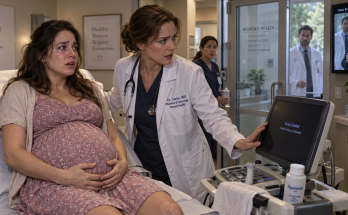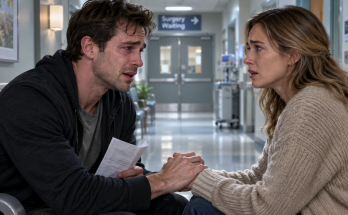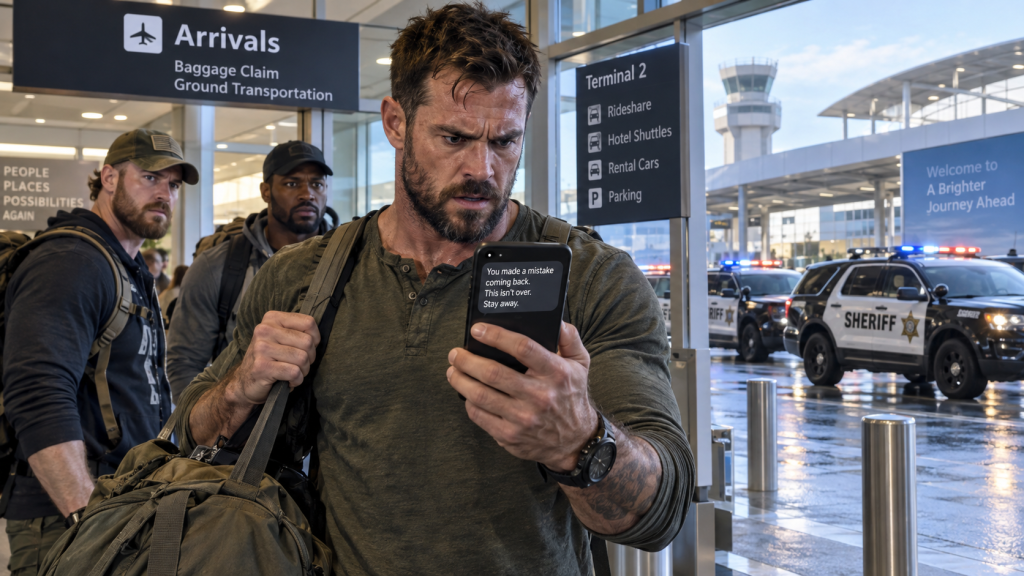
I was five thousand miles from home when a nurse called me sobbing and said, “Blake… they broke both of your wife’s legs.” Then a man took the phone from her, laughed, and whispered, “Come do something about it, soldier. My father owns the police.” Fourteen hours later, I landed on American soil—and two sheriff’s cruisers were already waiting for me.

My name is Blake Dean. For twelve years, I kept the darkest parts of my military life separated from my wife, Emily.
Until someone brought the war to her.
That night, rain hammered the canvas roof of our overseas operations tent when my phone lit up.
Emily.
She never called during duty unless something was wrong.
“Blake,” she whispered.
The fear in her voice made me stand immediately.
“They’re outside again.”
For three weeks, she had been telling me about a black sedan parked across from our house outside Richmond, Virginia. Then a sheriff’s cruiser started appearing nearby. Someone followed her home from the grocery store, and later she found a note beneath her windshield wiper:
STOP ASKING QUESTIONS.
“Call 911,” I told her.
“I already did.”
“What happened?”
“They transferred me to the sheriff’s department.”
Then she looked through the upstairs curtain.
“There’s already a cruiser outside.”
My blood went cold.
“Emily, lock yourself in the bedroom. Move the dresser against the door.”
Then came three slow knocks downstairs.
“Sheriff’s department!”
Emily whispered, “Maybe they came to help.”
“No. Don’t open that door.”
A second later, I heard wood explode.
Emily screamed.
I heard boots rushing upstairs, men shouting, then the bedroom door crashing inward.
“Blake!”
There was a terrible crack.
Emily screamed.
Another crack followed.
Then men laughed.
I shouted her name until the call went dead.
For the next two hours, I called everyone I could. County dispatch claimed there was no incident at our address. The sheriff’s office told me to stop tying up the line.
Finally, St. Jude’s Medical Center answered.
“Your wife is alive,” the nurse said.
I nearly collapsed.
Then she started crying.
“Both legs have multiple fractures.”
Before I could speak, someone approached her.
“You can’t be back here, sir.”
Then I heard that laugh.
A man took the phone.
“You Blake?”
“Who are you?”
“Doesn’t matter.”
He chuckled.
“Your wife was tougher than I expected.”
My hand tightened around the table.
Then he whispered, “Your wife walks funny now, soldier. Come do something about it.”
Someone ordered him to leave.
He laughed again.
“My dad owns the police.”
The line went dead.
Twenty minutes later, I stood inside Brigadier General Marcus Hale’s tent.
I showed him everything Emily had sent me.
The black sedan.
The cruiser.
Badge numbers.
License plates.
The threatening note.
And one name:
Cameron Voss.
Twenty-eight years old. Son of billionaire Richard Voss. Connected to Sheriff Nathan Cole.
Emily had witnessed Cameron assault a young woman in a parking garage three weeks earlier and called police.
The witness later withdrew her complaint.
That was when the surveillance started.
Hale studied the evidence silently.
Then he opened a locked drawer and placed a black access card on the desk.
“Emergency transit authorization.”
I stared at him.
“You’re sending me home?”
“I’m ordering you home.”
Then his eyes hardened.
“But not for revenge.”
He told me federal investigators were already being contacted.
Then he added, “Three men from your old unit are rotating home tomorrow.”
I looked up.
“Ghost Squad?”
“They volunteered.”
Fourteen hours later, our transport touched down stateside.
My phone connected.
One message said Emily was stable after surgery.
Then another appeared from an unknown number.
It was a photograph of Emily’s hospital room.
Taken from outside her door.
A second message arrived.
WELCOME HOME, SOLDIER.
One of my old teammates leaned forward.
“Problem?”
I showed him the screen.
Then I looked through the airplane window.
Two sheriff’s cruisers were parked beside the terminal.
Waiting.
The plane had not even stopped moving.
And somehow Cameron already knew I was home.
PART 2 — THE MAN WAITING BESIDE THE RUNWAY
The transport had not finished taxiing when I saw the sheriff’s cruisers.
Two of them.
Dark blue.
County markings.
Parked beyond the terminal fence as though the men inside knew exactly which aircraft I was on.
Mason Pike leaned across the aisle beside me.
Mason had been my team leader nine years earlier, back when the four of us were young enough to mistake surviving dangerous things for proof that we understood life.
He looked through the small window.
“Those yours?”
“No.”
Jonah Reed leaned forward from the row behind us.
“They know you?”
“They know my wife.”
Nobody said anything after that.
We did not need to.
My phone remained in my hand.
On the screen was the photograph of Emily’s hospital room.
Taken through the narrow glass beside her door.
WELCOME HOME, SOLDIER.
Whoever sent it knew I had landed before the plane stopped moving.
That meant one of two things.
Someone had access to military travel information.
Or someone had been waiting long enough that the exact arrival time did not matter.
Neither possibility made me feel better.
Luis Ortega sat across the aisle.
He looked at me.
“Blake.”
“I know.”
“No.”
He leaned closer.
“I mean it.”
That was why Marcus Hale had allowed them to rotate home alongside me.
Not because General Hale expected four former members of the same unit to wage some private war in Virginia.
Quite the opposite.
He knew exactly what rage does to trained men when somebody hurts the person waiting for them at home.
Mason, Jonah, and Luis were not there to help me take revenge.
They were there to make certain I did not confuse revenge with duty.
Before we left, Hale had stood in front of all four of us and said:
“If any one of you decides this is a combat operation, I will personally make sure your next address has bars.”
No one laughed.
Then he looked at me.
“Bring your wife home.”
That was the mission.
Nothing else.
The aircraft stopped.
My phone rang.
Unknown number.
I answered immediately.
“Dean.”
A woman spoke.
“Staff Sergeant Blake Dean?”
“Yes.”
“Special Agent Lena Ortiz, FBI.”
I looked at Mason.
He understood from my face.
Ortiz continued.
“Do not approach those cruisers.”
My eyes went back to the window.
“Too late for subtlety.”
“They want you to see them.”
“Who?”
“We’re determining that.”
I stood.
“What do you need me to do?”
“Walk into the terminal.”
“Do not argue with anyone.”
“Do not surrender your phone.”
“If anyone tells you you’re under arrest, ask whether you are free to leave and ask for counsel.”
My jaw tightened.
“Are they trying to arrest me?”
“Not on anything we can find.”
That was not comforting.
We entered through a restricted terminal gate.
A uniformed military liaison met us first.
Behind him stood Ortiz.
Early forties.
Dark suit.
Hair pulled back.
No dramatic federal-agent entrance.
She looked tired.
People doing real investigations often do.
Beside her was a man she introduced as Special Agent Thomas Keene, assigned to the FBI’s Richmond field office.
Ortiz shook my hand.
“I’m sorry about your wife.”
“Can I see her?”
“Yes.”
“Now?”
“As soon as we get through this.”
She looked toward the glass doors.
Two deputies had entered the terminal.
Both were walking toward us.
One was tall and broad.
The other older.
The older deputy stopped about fifteen feet away.
“Blake Dean?”
“Yes.”
He reached inside his jacket.
Mason shifted half a step.
I did not.
The deputy produced folded paper.
“We need to speak with you about threats made against Cameron Voss.”
I almost laughed.
Not because it was funny.
Because Cameron had broken my wife’s legs, called me from her hospital, invited me to come home, and apparently decided the safest person in Virginia needed protection from me.
Ortiz stepped forward.
“I’m Special Agent Ortiz.”
The deputy’s expression changed.
Only slightly.
“This is county business.”
Ortiz held out her identification.
“It became federal business when interstate communications, witness intimidation, and potential civil-rights violations entered the picture.”
The second deputy looked at the first.
Neither seemed to have expected her.
Good.
The older man held out the paper.
“Mr. Dean has been named in a complaint.”
Ortiz took it before I did.
She read.
Her eyebrows lifted.
“Complaint alleging threatening communications.”
She looked at me.
“Did you contact Cameron Voss?”
“No.”
“His father?”
“No.”
“Sheriff Cole?”
“I called the sheriff’s office after my wife was attacked.”
The deputy said:
“You were verbally aggressive.”
I stared at him.
“My wife was missing after I heard men break into my house and assault her.”
“Yes.”
“I was aggressive.”
Ortiz’s mouth almost moved.
Not a smile.
Close.
Then the deputy said:
“We’d like Mr. Dean to come with us voluntarily.”
“No.”
Ortiz answered before I could.
The deputy looked at her.
“I wasn’t asking you.”
“No.”
I said.
His eyes moved to me.
Good.
My turn.
“Am I under arrest?”
“No.”
“Am I legally required to come with you?”
He paused.
“No.”
“Then I’m going to the hospital.”
The younger deputy took a step toward me.
Mason moved beside my shoulder.
Not threatening.
Present.
Ortiz said:
“Deputy.”
One word.
Enough.
The man stopped.
The older deputy folded the complaint.
“You’re making this harder than it needs to be.”
I looked at him.
“Who filed it?”
No answer.
“Cameron?”
Still none.
“His father?”
The deputy’s face stayed flat.
Ortiz said:
“We’ll request the full file.”
Then she turned to me.
“We’re leaving.”
And we did.
That was the first battle Cameron lost.
Not because I hit anyone.
Because I refused to give him the fight he wanted.
On the drive to St. Jude’s, Ortiz sat in the passenger seat of an unmarked SUV.
I sat behind her.
Mason, Jonah, and Luis followed separately with the military liaison.
The rain had stopped, but Richmond looked washed gray beneath low clouds.
Every traffic light felt personal.
“Tell me what you know.”
I said.
Ortiz looked at me in the mirror.
“You already know your wife witnessed Cameron Voss assault a woman.”
“Yes.”
“The woman’s name is Tessa Ward.”
Twenty-six.
Graduate student.
Worked evenings at a hotel bar.
Three weeks earlier, Emily had parked in a downtown garage after meeting a friend.
On the third level, she heard shouting.
Cameron had Tessa pinned against a car.
Emily shouted.
Cameron stepped away.
Tessa was bleeding from the mouth.
Emily called police.
“What happened to Tessa?”
I asked.
“She gave an initial statement.”
“To county deputies?”
“Yes.”
“Then she withdrew it.”
“Why?”
Ortiz turned slightly.
“Her father’s landscaping business lost its largest commercial contract forty-eight hours later.”
My stomach tightened.
“Voss?”
“The canceled contract was with a company partly owned by Richard Voss.”
Of course.
“Anything else?”
“Tessa’s younger brother was stopped three times in six days.”
“By whom?”
“Sheriff’s deputies.”
My hands closed.
Ortiz saw.
“Blake.”
“I’m listening.”
“Good.”
Tessa withdrew the complaint.
Emily did not.
That was the problem.
She had not simply witnessed the assault.
She had photographed Cameron’s license plate.
And, without realizing it, the dash camera in our car had recorded part of the incident.
Not the assault itself.
Enough of the aftermath to matter.
Cameron moving away from Tessa.
Emily getting out.
Tessa crying.
Cameron pointing at Emily’s vehicle.
Time.
Date.
Audio.
Context.
Emily copied the file.
Then she emailed a local prosecutor.
The surveillance began two days later.
“Why didn’t the prosecutor protect her?”
I asked.
“The email never reached the prosecutor.”
“What?”
“It went to an intake address.”
“And was forwarded to the sheriff’s investigative unit because the alleged assault had initially been reported there.”
I stared through the window.
“So they handed the witness information back to the people connected to Voss.”
“We don’t yet know who deliberately did what.”
Ortiz said.
Important.
“But somebody inside the system knew Emily was still pushing.”
“Yes.”
I showed her the photograph from the hospital.
“You’ve seen this?”
“Yes.”
“Who took it?”
“We’re working on that.”
“Cameron?”
She hesitated.
“We don’t think so.”
My heart changed rhythm.
“Why?”
“Hospital security video puts Cameron on a different floor around the approximate time the image appears to have been taken.”
I stared.
“He was in the hospital?”
“Yes.”
“How?”
“That is an excellent question.”
My voice hardened.
“If a man who attacked my wife can walk around the hospital after surgery—”
“Blake.”
Ortiz turned around fully now.
“This is the part where you decide whether you want answers or an outlet.”
I said nothing.
She continued.
“Cameron wants you angry.”
“Sheriff Cole may want you angry.”
“The easiest version of this case for them is a decorated soldier coming home furious and threatening a wealthy civilian.”
My jaw tightened.
“They already tried that at the airport.”
“Exactly.”
Then she said:
“Do not give them their evidence.”
I looked away.
She was right.
I hated her for about five seconds.
Then respected her.
Emily was on the fourth floor.
Orthopedic trauma.
Before I entered, a surgeon met me.
Dr. Naomi Chen.
She spoke plainly.
Both femurs fractured.
One lower leg also had significant damage.
Multiple surgeries.
Months of rehabilitation.
There was a good chance Emily would walk again.
A good chance.
Not a promise.
“She’s awake?”
“Intermittently.”
“Can I see her?”
“Yes.”
“Has anyone been protecting the room?”
Dr. Chen looked toward Ortiz.
“We changed access thirty minutes ago.”
“Federal agents and hospital security now control the corridor.”
That sentence should never have been necessary in an American hospital.
I thanked her anyway.
Then I walked into the room.
Emily looked smaller.
That was my first thought.
Not broken.
Not weak.
Smaller beneath blankets and equipment.
Her face was bruised.
One cheek swollen.
Both legs elevated and heavily immobilized.
A monitor traced green lines beside her.
For twelve years I had trained myself not to bring certain feelings home.
Fear.
Helplessness.
The part of me that counted exits when entering a restaurant.
The part that woke at small noises.
I told myself separating those things from Emily protected our marriage.
Standing beside her hospital bed, I understood I had never protected her by pretending darkness existed only where I deployed.
Her eyes opened.
“Blake?”
That was it.
One word.
I broke.
I bent over her carefully.
She lifted one hand.
I took it.
“I’m here.”
She started crying.
“So am I.”
I kissed her forehead.
Again.
Again.
Because there was nothing else I could do with my mouth that would not become rage.
After several minutes, she whispered:
“They took my laptop.”
I froze.
“What?”
“My work laptop.”
“And my phone.”
I looked toward Ortiz.
She was standing outside the room, deliberately giving us privacy but close enough to hear if called.
Emily continued.
“They kept asking where I copied the video.”
“Did you tell them?”
She looked at me.
“No.”
That was my wife.
Quiet.
Careful.
Stronger than anyone knew until they tried to break her.
“Where is it?”
she asked.
“I don’t know.”
Emily’s eyes filled.
“I mailed it.”
“What?”
“The copy.”
“To who?”
She swallowed.
“To you.”
My heart stopped.
“When?”
“Three days before they came.”
“Where?”
“Your unit mail.”
I closed my eyes.
Across an ocean.
In military mail.
Maybe sitting somewhere nobody connected to Voss could reach.
Maybe lost.
Maybe already intercepted.
I pressed her hand against my cheek.
“Why didn’t you tell me?”
“Because you would have come home.”
“Yes.”
She almost smiled.
“I know.”
Even injured, Emily had found a way to expose me.
Then her face changed.
“Blake.”
“What?”
“They weren’t all deputies.”
I became still.
“How many men?”
“Three came inside.”
“One had a sheriff’s uniform.”
“Another had the pants and vest but no shirt underneath.”
“The third…”
She closed her eyes.
“Cameron.”
My jaw tightened.
“You saw him?”
“Yes.”
“You’re sure?”
“Yes.”
“What did he do?”
Emily started shaking.
I leaned closer.
“You don’t have to tell me now.”
Her fingers tightened around mine.
“No.”
“I need to.”
She took a breath.
“Cameron kept asking where the dashcam copy was.”
“I told him I gave it away.”
“He thought I was lying.”
“One of the deputies said…”
She stopped.
“What?”
Emily looked terrified.
“He said, ‘Cole wants the video. Voss wants her scared.’”
Ortiz stepped into the room.
“Emily.”
She had heard.
“That wording matters.”
Emily looked at her.
“I know what I heard.”
“I believe you.”
Ortiz said it immediately.
Not:
Are you sure?
Not:
You were frightened.
I believe you.
My wife began crying.
Sometimes belief is first aid.
Ortiz did not interrogate her.
Another thing I respected.
She asked if Emily felt able to answer a few urgent questions.
Emily said yes.
Names?
Cameron.
One man called Raines.
The other was addressed once as Deputy Bell.
Ortiz’s eyes changed.
I noticed.
“You know them.”
I said.
She looked at me.
“Deputy Aaron Bell was listed in the sheriff’s office records as the officer who responded to your wife’s earlier stalking complaint.”
My stomach tightened.
“He told Emily no crime had occurred.”
Emily nodded.
“Yes.”
“And Raines?”
“Sergeant Caleb Raines.”
Ortiz’s voice became harder.
“He supervises Sheriff Cole’s special investigations unit.”
There it was.
Not the entire department.
Not every officer.
A small circle.
Enough.
Emily whispered:
“They wore gloves.”
I squeezed her hand.
Ortiz remained quiet.
“They unplugged the door camera first.”
“What door camera?”
I asked.
Emily looked at me.
“The new one.”
I had not known she installed another camera.
She had bought a cheap interior camera after the note appeared.
Placed it on a bookshelf facing the front hallway.
“They saw it.”
she whispered.
“Raines took it.”
My stomach dropped.
“So there’s no footage.”
Emily looked at me.
Then, for the first time since I entered the room, something like the old Emily appeared.
A tired little smile.
“Cloud backup.”
Ortiz almost laughed.
Almost.
“Account?”
Emily told her.
Within minutes, an agent outside the room was making calls.
The footage did not show the upstairs assault.
It did not need to.
At 9:14 p.m., the front door shook.
At 9:15, a man wearing a sheriff’s uniform stepped into view after the door was forced open.
Badge partially visible.
Behind him came another.
Then Cameron Voss.
Face uncovered.
Looking directly into the camera.
He pointed at it.
The recording stopped thirty seconds later.
The cloud had kept those thirty seconds.
Thirty seconds.
Enough to destroy the sheriff’s claim that no incident occurred at our address.
Enough to prove Cameron had been inside.
Enough to place uniformed personnel at the scene.
For the first time since the phone call overseas, my rage made room for something else.
Hope.
Tiny.
Dangerous.
Real.
Ortiz left the room immediately.
Agents moved.
Warrants were requested.
The hospital corridor changed.
Phones started ringing.
Somewhere, carefully constructed stories began collapsing.
I stayed beside Emily.
That was harder than leaving.
Every instinct in me wanted to follow Ortiz.
Ask what came next.
Know who they were arresting.
Know when.
Know whether Cameron was running.
But my wife had spent fourteen hours without me.
She needed one thing from me now.
Presence.
So I stayed.
Around midnight, she woke again.
“Did you kill anybody?”
I stared.
Then laughed despite myself.
“No.”
“Good.”
“Were you worried?”
“Yes.”
“That hurts.”
She squeezed my fingers weakly.
“I know you.”
Fair.
Then she whispered:
“I don’t want you becoming something because of what they did to me.”
I looked at her.
“They broke your legs.”
“Yes.”
“They terrorized you.”
“Yes.”
“They stood in this hospital and laughed.”
“I know.”
Her eyes filled.
“But if you destroy your life trying to destroy theirs, then they take you too.”
That was Emily.
Both legs shattered.
Still protecting the future.
Not my pride.
Our future.
I bowed my head over her hand.
“I promise.”
She whispered:
“Say it like you mean it.”
“I promise.”
At 2:11 a.m., Agent Ortiz returned.
She looked exhausted.
“Cameron’s been detained.”
My pulse jumped.
“For what?”
“For questioning initially.”
“An arrest warrant was approved shortly after based on evidence developed tonight.”
She did not give me a victory speech.
Good.
“Raines?”
“Not located yet.”
“Bell?”
Her expression changed.
“Also not located.”
I looked at Emily.
She was asleep again.
“What about Sheriff Cole?”
“No arrest.”
“Why?”
“Because we build from evidence, Blake.”
I hated that sentence.
Still true.
Ortiz continued.
“Sheriff Cole claims he knew nothing about an unauthorized visit to your house.”
“Do you believe him?”
“What I believe is less useful than what I can prove.”
Another sentence I would remember.
Richard Voss released a statement through his attorney before dawn.
His son was “the victim of an escalating campaign of false allegations.”
The security footage was supposedly “incomplete and misleading.”
Richard expressed sympathy for Emily’s injuries while denying any involvement.
He also claimed Cameron had visited the hospital only because he was “concerned about the situation.”
I read that line twice.
Concern.
Apparently threatening a woman from inside her hospital was concern now.
I handed the phone back to Mason.
He had arrived after visiting hours technically ended, with permission from Ortiz and hospital security.
“What do you think?”
he asked.
“I think his lawyer earns every dollar.”
Mason nodded.
“Good.”
“What?”
“You sound like yourself.”
I was not sure that was true.
But I was trying.
Mason, Jonah, and Luis took turns staying nearby.
Not armed guards.
Friends.
They brought coffee.
Food.
A clean shirt.
Mason called my command and handled administrative details I could not think about.
Jonah found my truck and drove it to the hospital.
Luis sat beside me at four in the morning without talking for almost an hour.
That was what Ghost Squad became in America.
Not a team kicking in doors.
Three men making sure another man did not have to stand alone beside one.
I think that may have been the bravest thing we ever did together.
The mailed drive reached our overseas unit two days later.
General Hale called me personally.
“Package arrived.”
I nearly dropped the phone.
“Is it intact?”
“Yes.”
“What’s on it?”
“We are not opening it here.”
Good.
“Chain of custody is being arranged with federal investigators.”
I closed my eyes.
Emily had done everything right.
Not perfectly.
Nobody does.
But enough.
“Sir.”
“Yes?”
“Thank you.”
Hale went quiet.
Then:
“Take care of your wife, Dean.”
The call ended.
When federal investigators examined the drive, they found more than the garage recording.
Emily had kept a folder.
Photos of the black sedan.
Dates.
License plates.
Screenshots of calls to dispatch.
The threatening note.
A written timeline.
And an audio recording from the night before the home invasion.
Emily had forgotten to tell me about it.
Someone called from a blocked number.
A man said:
“You can still fix this.”
Emily:
“Who is this?”
The man:
“Tell the prosecutor you misidentified Cameron.”
Emily:
“No.”
The voice became colder.
“Then don’t complain about what happens next.”
Experts could not identify the caller from voice alone.
But the call record mattered.
Timing mattered.
Context mattered.
Page after page.
My wife had been building her own evidence because the people she called for help kept making her feel irrational.
That realization nearly destroyed me.
I asked her:
“Why didn’t you tell me how bad it was?”
She looked out the hospital window.
“You were deployed.”
“So?”
“So every time I told you something, I could hear you wanting to come home.”
“I should have.”
“No.”
Her answer surprised me.
“Why not?”
“Because I kept thinking the system would work.”
Then she looked at me.
“That part embarrasses me.”
I shook my head.
“It shouldn’t.”
She smiled sadly.
“No?”
“No.”
“Trusting people to do their jobs is not stupidity.”
I thought of Agent Ortiz.
Then:
“The shame belongs to the people who used that trust.”
Emily stared.
“That sounds like something a therapist would say.”
“I hate it too.”
She laughed.
Then winced because laughing hurt.
I apologized.
She laughed again.
Worth it.
Three days after I landed, Cameron was formally charged with offenses related to the attack on Emily, witness intimidation, and the earlier incident involving Tessa.
Not every charge prosecutors considered would necessarily survive.
Ortiz reminded me of that.
Evidence would be tested.
Defense attorneys would challenge it.
Cameron remained entitled to legal process.
Those words were difficult to hear.
Also necessary.
If I wanted the system to mean something when it protected Emily, I had to let it mean something even when it protected the rights of the man accused of hurting her.
Justice is inconvenient that way.
Tessa came forward again.
That changed everything.
She had seen news of Cameron’s arrest.
Her attorney contacted federal investigators.
This time, she did not withdraw.
She provided photographs of her injuries.
Messages Cameron had sent afterward.
A voicemail from someone claiming to represent Richard Voss offering to “help her family recover financially” if the misunderstanding went away.
Not enough alone to prove Richard ordered anything.
Enough to widen questions.
Her younger brother also documented the traffic stops.
Two appeared unsupported by any citation or warning.
One deputy involved was Aaron Bell.
Again.
Same name.
Same small circle.
Sheriff Nathan Cole held a press conference.
He looked directly into cameras and declared:
“No deputy under my command was authorized to enter the Dean residence that evening.”
Interesting wording.
Not:
No deputy entered.
Not:
My department had nothing to do with it.
Was authorized.
Ortiz replayed that portion for me.
“Why does that matter?”
I asked.
“Because careful people sometimes tell you which part they’re prepared to deny.”
She said it without satisfaction.
“We still need evidence.”
Sergeant Raines disappeared.
His department-issued SUV was found near a bus station south of Richmond.
Phone inside.
No Raines.
Aaron Bell reported sick the morning Cameron was arrested.
Then stopped answering calls.
A judge authorized searches relating to both men.
The story escaped containment.
Reporters arrived.
Richard Voss’s attorneys issued longer statements.
Sheriff Cole accused federal authorities of “political overreach.”
I stopped watching television.
Emily needed sleep.
I needed sanity.
Then something unexpected happened.
Deputies from the same sheriff’s office began talking.
Not publicly at first.
Through attorneys.
One said Raines ran a small unofficial group that handled “sensitive matters.”
Another said Sheriff Cole regularly took calls directly from Richard Voss.
A dispatcher reported being instructed to reroute complaints involving the Voss family.
A patrol deputy admitted he had been told to drive past our house several times but claimed he had no idea why.
That mattered.
Not every deputy was part of it.
Some were ignorant.
Some suspicious.
Some cowardly.
A few apparently complicit.
The truth became narrower and stronger at the same time.
There had been no countywide army owned by one billionaire.
There had been something more believable.
A powerful family.
A sheriff too close to them.
A small group of loyal men.
And enough fear around them that everyone else learned when not to ask questions.
Emily underwent another procedure.
Afterward, she woke disoriented and cried because she could not feel one foot properly.
The surgeon reassured us nerve swelling could cause temporary changes.
Could.
Again.
No promises.
I sat beside her through the night.
At three in the morning, she whispered:
“What if I never walk normally again?”
There was no brave answer.
No soldier answer.
No:
You will.
I had learned not to promise outcomes because fear wanted them.
So I said:
“Then we learn whatever comes next.”
She looked at me.
“Together?”
I almost broke again.
“Every inch.”
That was the only promise I could honestly make.
The next afternoon, Ortiz walked into the room holding a tablet.
Her expression told me something had changed.
Emily was sleeping.
I stepped into the corridor.
“What?”
“We identified who took the photograph outside your wife’s hospital room.”
My pulse quickened.
“Cameron?”
“No.”
I already knew that.
“Raines?”
“No.”
“Bell?”
Ortiz hesitated.
Then handed me the tablet.
The photograph was enlarged.
At first, I saw what I had already seen.
Emily’s door.
Window.
Part of her bed.
Then Ortiz zoomed into the reflection in the glass.
A figure.
Dark uniform.
Badge.
Not enough detail for my eye.
Ortiz pointed.
“Hospital security footage from an adjacent hallway gave us another angle.”
She swiped.
A deputy stood near the door.
Head turned away from the camera.
I stared at the badge number.
317.
“Who is he?”
Ortiz did not answer immediately.
Instead she opened another file.
The sheriff’s office roster.
Badge 317.
Deputy Aaron Bell.
My stomach turned.
The same deputy connected to Emily’s stalking complaint.
The same deputy involved in one of Tessa’s brother’s questionable traffic stops.
The same name Emily remembered from our house.
“He took the photograph?”
“Yes.”
“Then sent it to me?”
“We believe the image moved from his phone to another number before reaching you.”
“So Bell was in the hospital.”
“Yes.”
“After helping attack my wife.”
“The evidence is increasingly consistent with that.”
My hands tightened.
“Where is he?”
Ortiz’s expression changed.
“That’s why I came up.”
I looked at her.
“They found him?”
“Yes.”
“Alive?”
“Yes.”
Relief came from somewhere I did not expect.
A living witness could talk.
Then Ortiz said:
“He surrendered twenty minutes ago.”
I stared.
“Why?”
“He contacted a federal attorney through private counsel.”
“What does he want?”
“To cooperate.”
Of course.
When walls fall, people start looking for exits.
Ortiz lowered her voice.
“He says he was at your house.”
“He says Raines was there.”
“He says Cameron was there.”
My heartbeat pounded in my ears.
“And Sheriff Cole?”
She paused.
“He says Cole helped cover the response records afterward.”
I closed my eyes.
There it was.
Then:
“Richard Voss?”
Ortiz’s face changed again.
“Bell says Richard was involved before the attack.”
“How?”
“He claims Richard pressured Cole to make Emily’s witness problem disappear.”
My stomach turned.
“Claims.”
“Yes.”
“Can he prove it?”
“That’s the question.”
Ortiz swiped again.
A photograph of a small black device sealed inside an evidence bag.
“What is that?”
“A body camera.”
I stared.
“Bell’s?”
“Yes.”
“I thought they would have deleted everything.”
“The department system shows his body-camera file from that night as corrupted.”
My heart started pounding.
“But?”
Ortiz looked directly at me.
“Bell says he disabled the upload before going into your house because Raines told him to.”
“Then why keep the camera?”
“He says he panicked afterward.”
“He removed the memory card.”
“And?”
“He kept it.”
For the first time, Ortiz looked almost shaken.
“Blake, he says the camera was still recording when they went upstairs.”
The corridor disappeared around me.
Emily sleeping ten feet away.
Machines humming.
Rain beginning against the hospital windows again.
I stared at the evidence-bag photograph.
Thirty seconds of cloud video had shown who entered our house.
But somewhere inside federal evidence storage, investigators now had a memory card that might show what happened after the camera downstairs went dark.
Maybe Cameron.
Maybe Raines.
Maybe Bell.
Maybe the words Emily remembered.
Maybe enough to prove who ordered what.
I asked:
“Have you watched it?”
Ortiz was silent for a moment.
Then she said:
“Not yet.”
“Why?”
“Because Bell told us one more thing before he surrendered it.”
My stomach tightened.
“What?”
She looked through the glass toward Emily.
Then back at me.
“He says the worst thing on that recording isn’t what they did to your wife.”
I felt cold.
“What could be worse?”
Ortiz answered quietly.
“According to Bell, right before they left your house, Raines made a phone call on speaker.”
“To who?”
Ortiz held my eyes.
“Sheriff Cole.”
I stopped breathing.
Then she added:
“And Bell says someone else was already on the line with him.”
I knew the name before she said it.
“Richard Voss.”
Ortiz nodded.
And for the first time since I came home, I understood that the men who broke Emily’s legs might finally have left behind the one thing money, influence, and a sheriff’s badge could not intimidate.
Their own voices.
PART 3 — WHAT I CHOSE TO DO
For almost an hour, nobody was allowed to play the memory card.
Not Agent Ortiz.
Not me.
Not Emily.
Not even Bell’s attorney.
The federal evidence team had to image it first.
Document the seal.
Document who possessed it.
Document the device.
Document the transfer.
Everything Cameron Voss had built his life around seemed to depend on people believing power could bend facts.
So the people coming after him did the opposite.
They slowed down.
They wrote everything down.
They made copies.
They preserved originals.
They refused to hurry simply because I wanted answers badly enough to taste blood.
I hated every minute of it.
And somewhere beneath the hatred, I understood.
If this was going to hold, it had to survive more than my anger.
Emily was awake when Ortiz finally returned.
Dr. Chen had just finished checking circulation in her left foot.
I was sitting beside the bed with one hand wrapped around Emily’s.
Ortiz stood near the door.
“We reviewed the recording.”
Emily’s fingers tightened.
I looked at her before looking at Ortiz.
“Do you want to hear this?”
I asked.
Emily stared at the ceiling.
Then slowly shook her head.
“No.”
Good.
Her choice.
Always her choice now.
Ortiz nodded.
“I can summarize.”
Emily swallowed.
“Do.”
The body camera had not captured everything clearly.
Bell had partially covered the lens after entering the house.
Sometimes the image showed floor.
Walls.
Boots.
Fragments of movement.
But the audio was mostly intact.
That was enough.
Raines could be heard shouting upstairs.
Cameron could be heard demanding the location of the dashcam copy.
Emily could be heard refusing.
Then came impacts.
Her screaming.
My chest tightened so hard I thought something inside me might tear.
Ortiz stopped.
“You don’t have to keep going.”
Emily looked at her.
“Yes.”
She whispered.
“You do.”
So Ortiz continued.
After the assault, the recording captured Bell saying:
“She needs a hospital.”
Raines answered:
“She needs to remember.”
Cameron laughed.
Then, several minutes later, there was the phone call.
Speakerphone.
Raines dialed.
Sheriff Nathan Cole answered first.
His voice was clear enough that investigators were already arranging formal voice comparison and corroboration.
Raines said:
“She won’t give up the copy.”
Cole replied:
“Then make sure she understands this is over.”
Emily closed her eyes.
I felt her hand tremble inside mine.
Ortiz continued.
Then another voice came through the speaker.
Richard Voss.
Not shouting.
Not threatening.
Calm.
That almost made it worse.
He said:
“My son’s name does not go into a prosecutor’s file over some parking-garage misunderstanding.”
Raines answered:
“We’re handling it.”
Richard replied:
“Then handle it.”
No explicit instruction to break Emily’s legs.
No sentence saying:
Hurt her.
Kill her.
Break bones.
The world is rarely kind enough to put criminal intent into perfect dialogue.
But then Richard added:
“I’ve spent too much keeping this contained for one woman to reopen it.”
Ortiz paused.
“That line matters.”
I stared.
“What did he mean by ‘spent’?”
“We’re finding out.”
Emily whispered:
“Did Cole know they were in our house?”
Ortiz looked at her.
“The call strongly suggests he knew Raines was confronting you.”
“Whether he knew in advance that serious physical violence would occur is something prosecutors will have to prove from the total evidence.”
Emily nodded.
Facts.
Even now.
Then she asked:
“Cameron?”
Ortiz’s face hardened.
“The recording is clearer regarding Cameron’s conduct.”
I did not want to know.
I needed to.
“What does it show?”
“The camera angle catches portions of the upstairs hallway.”
She looked at me.
“Blake.”
I understood the warning.
“I’m not going anywhere.”
She continued.
“Cameron is visible holding a metal baton.”
My hand went numb around Emily’s.
“He struck her?”
“The recording appears to show him delivering at least one blow.”
Emily began crying.
Not loudly.
Just tears sliding into her hair.
Ortiz added:
“Raines is heard telling him to stop.”
That surprised me.
“Why?”
“Not because Raines objected to intimidation.”
Ortiz said carefully.
“The recording suggests he believed Cameron was going too far.”
There it was.
Different guilt.
Different men.
One crime touching another without making everyone identical.
Bell was not innocent.
That mattered too.
He had gone into our house knowingly.
He had participated in forcing entry.
He helped remove the interior camera.
He lied in official records afterward.
He stood there while Emily was attacked.
His later cooperation did not erase any of it.
But his body camera survived because, according to Bell, he had grown frightened after Raines ordered him to falsify the response log.
He removed the memory card.
Kept it hidden inside the lining of an old tool case.
Not because he suddenly became brave.
Because he wanted insurance.
Cowardice preserving evidence against worse cowardice.
Human beings are rarely clean enough for stories.
I asked:
“Where’s Raines?”
Ortiz looked at me.
“Found.”
My pulse changed.
“When?”
“An hour ago.”
“Where?”
“North Carolina.”
“He was staying with a cousin under another name.”
Federal marshals and local authorities had taken him into custody without violence.
No dramatic shootout.
No last stand.
A motel parking lot.
Plastic ice bucket still sitting on the roof of his vehicle when officers approached.
There was something appropriate about it.
Men can spend years making themselves look untouchable.
Then life catches them beside a vending machine.
Sheriff Cole was placed on administrative leave the next morning.
Not arrested immediately.
That furious part of me wanted handcuffs before breakfast.
Instead, investigators obtained warrants.
County servers were preserved.
Dispatch records seized.
Phones collected through process.
Financial records subpoenaed.
The department’s state oversight authorities became involved.
An acting sheriff took temporary command.
Some deputies cooperated.
Others hired lawyers.
The county government issued statements so cautious they barely qualified as English.
Emily watched none of it.
She had physical therapy.
That was harder.
The first time therapists tried to move her legs after surgery, she screamed.
Not because they were careless.
Because healing hurts too.
That is another truth nobody puts on motivational posters.
A physical therapist named Janelle Brooks stood beside the bed.
Patient.
Firm.
Emily glared at her.
“I hate you.”
Janelle smiled.
“Good.”
“I mean it.”
“I know.”
“Why are you smiling?”
“Because yesterday you were too medicated to insult me.”
Emily actually laughed.
Then cried because laughing moved her body.
Janelle waited.
Then said:
“Again.”
I wanted to tell her to stop.
My wife was in pain.
Every protective instinct in me screamed to end it.
Emily looked at me.
Saw it.
“Don’t.”
I froze.
“What?”
“Don’t save me from this.”
That sentence changed something.
So I stayed in the corner.
Watched.
Let her hurt.
Let her work.
Let someone else help in a way I could not.
There are battles love cannot fight for another person.
It can only remain close enough that they do not fight alone.
The financial investigation around Richard Voss widened.
Not because Bell’s testimony was automatically believed.
Because his claim led to records.
Payments.
Not bribes in envelopes.
Nothing that clean.
Companies linked to Richard had donated heavily to Sheriff Cole’s reelection committee.
Legal.
At least on its face.
A Voss-controlled foundation had funded equipment purchases for sheriff’s programs.
Also potentially legal.
The problem was what sat beside those relationships.
Private calls.
Unlogged meetings.
A consulting contract awarded to a business owned by Cole’s brother-in-law.
Payments made shortly after Tessa’s original complaint.
Then another payment after Emily emailed prosecutors.
Investigators followed each one carefully.
Some turned out irrelevant.
A few did not.
One bank transfer mattered.
A Voss company had paid $75,000 to a security consulting firm controlled by an old associate of Sergeant Raines.
The invoice described:
Risk assessment and executive-family threat mitigation.
The payment cleared three days after Emily witnessed Cameron attacking Tessa.
The firm performed no documented risk assessment anyone could find.
From that account, money later moved to cover expenses connected to the black sedan that followed Emily.
Vehicle rental.
Fuel.
A prepaid phone.
No single record said:
Stalk Emily Dean.
But evidence rarely comes labeled for the jury.
Patterns mattered.
Timing mattered.
People mattered.
Richard Voss’s attorneys fought everything.
Aggressively.
That was their job.
They said the security contract was legitimate.
The call with Raines concerned protecting Cameron from false allegations.
“Handle it” meant legal damage control.
“Spent too much” referred to attorney fees.
Possible explanations.
Prosecutors had to test them.
I learned something during those months I had never understood overseas.
In war, sometimes the threat is obvious because someone is shooting at you.
At home, the hardest fights happen over what a sentence meant at 10:17 p.m. six months earlier.
Truth has to survive grammar.
Cameron was denied release after prosecutors presented evidence of witness intimidation and the hospital incident.
His attorney argued that he had gone to the hospital out of concern.
Then hospital video showed him entering through a service corridor with Aaron Bell.
The phone call to me had been placed minutes later.
That explanation died quietly.
Good.
Not because I enjoyed his legal trouble.
I did.
A little.
I was still human.
But mostly because every false story that collapsed gave Emily one piece of reality back.
Tessa visited Emily three weeks after I came home.
Only after both women agreed.
I waited outside the room.
Not because they told me to.
Because the conversation belonged to them.
Forty minutes later, Tessa emerged crying.
She stopped beside me.
“You’re Blake?”
“Yes.”
She looked toward Emily’s door.
“She saved me.”
I shook my head.
“She tried.”
“No.”
Tessa wiped her face.
“She did.”
Then she said:
“I’m sorry.”
“For what?”
“If I hadn’t withdrawn—”
“No.”
I cut her off gently.
“This is not yours.”
She looked at me.
“They scared you.”
“They threatened your family.”
“You survived however you could.”
Her face folded.
Maybe I was talking to her.
Maybe Emily.
Maybe myself.
Fear explains choices.
It does not always make them wrong.
Sometimes surviving is the only choice left.
Tessa testified later.
So did Bell.
His cooperation agreement became public eventually.
He pleaded guilty to offenses involving the unlawful entry, obstruction, falsification, and violation of Emily’s rights.
He did not walk away.
He did not become a hero because he preserved evidence.
He received a substantial sentence, reduced because he surrendered, provided the memory card, and cooperated.
That felt right.
Not clean.
Right enough.
Raines fought longer.
Then phone-location data, body-camera audio, financial records, and messages with Cole cornered him.
One message from Cole the afternoon before the attack said:
Voss wants this finished. No reports.
Raines had responded:
Understood.
Again.
Not perfect proof of broken legs ordered in advance.
But enough to show concealment and coordination around intimidation.
Raines eventually pleaded guilty to a package of federal and state offenses tied to the home invasion, conspiracy, obstruction, and civil-rights violations.
His agreement included testimony against Cole.
The wall kept collapsing inward.
Sheriff Nathan Cole resigned before trial.
He did not admit guilt when he resigned.
His statement said he was protecting the department from distraction.
The phrase made Emily laugh so hard she had to hold a pillow against her ribs.
“Distraction.”
she said.
“Apparently federal charges are distracting.”
Months later, Cole was indicted.
Not for owning the entire police department like Cameron had bragged.
Reality was less ridiculous.
More dangerous.
He had used his authority selectively.
Steered complaints.
Protected the Voss family.
Allowed Raines’s unit to operate outside normal reporting.
Altered or caused records to be altered after Emily’s attack.
He knew enough.
Helped enough.
Covered enough.
That was sufficient.
Richard Voss took longest.
Money buys delay extremely well.
Lawyers challenged warrants.
Evidence.
Witness credibility.
Bell was a corrupt deputy trying to save himself.
Raines was lying for a better sentence.
Tessa was inconsistent because she had once withdrawn.
Emily was biased.
I was angry.
Every weakness became a door.
Prosecutors had to close them one at a time.
Then the financial records became harder to explain.
And one former Voss employee came forward.
Marian Keller, Richard’s executive assistant for eleven years.
She had kept calendars.
Private ones.
Richard met with Cole twice during the week after Tessa’s assault.
One meeting was not on any official schedule.
Marian had arranged it.
She also remembered Richard saying after the second meeting:
“Nathan will make sure this doesn’t become a case.”
That sentence alone did not prove violence.
Combined with everything else, it mattered.
Richard eventually went to trial on a narrower set of charges than I had imagined in my angriest moments.
Not attempted murder.
Not some fantasy indictment for owning Virginia.
Charges centered on obstruction, witness intimidation conspiracy, corrupt arrangements, and efforts to conceal Cameron’s conduct.
The jury did not convict on everything.
That surprised me.
At first, I was furious.
Then Ortiz called.
“This is what juries do.”
she said.
“They separate what was proven from what was alleged.”
I knew she was right.
Still hated it.
Richard was convicted on several serious counts.
Acquitted on others.
The system had not given me total victory.
It had given me findings.
That was more real.
Cameron’s case went before a jury too.
Emily testified.
That was the day I understood courage differently.
She walked into court using forearm crutches.
Slowly.
Carefully.
One leg still weaker.
Her gait changed.
Maybe permanently.
Cameron sat at the defense table.
For the first time since I had heard his laugh through a hospital phone, he looked small.
Not physically.
Humanly.
He could no longer control the room by assuming everyone would move around him.
Emily took the stand.
Swore to tell the truth.
Then did.
She described the parking garage.
Tessa.
The threats.
The black sedan.
The forced door.
Cameron upstairs.
The baton.
The pain.
His laughter.
She did not perform grief.
Did not exaggerate.
When she did not remember, she said:
“I don’t remember.”
When a defense attorney asked whether pain medication affected her recollection later in the hospital, she said:
“Yes.”
Then clarified which memories occurred before medication.
Careful words.
My wife.
Always choosing them.
The defense tried to suggest Raines was the real aggressor and Cameron had merely followed him into the house.
Then prosecutors played the body-camera audio.
Cameron’s voice:
Where’s the copy?
Emily refusing.
Cameron again.
Then the sound.
I left the courtroom before the impact played.
I could not hear it again.
Mason came with me.
We stood in the hallway.
I stared at the floor.
“I should be in there.”
“No.”
he said.
“She is.”
That was enough.
The case did not require my suffering as proof of love.
So I stayed outside until the audio ended.
The jury convicted Cameron of the most serious assault and intimidation charges supported by the evidence, along with offenses tied to the invasion and conspiracy.
Some lesser counts merged or were dismissed later.
At sentencing, Emily spoke.
Not about vengeance.
Not years.
Not numbers.
She looked at Cameron and said:
“You wanted me afraid enough to disappear.”
The courtroom was silent.
“You failed.”
Then she turned toward the judge.
“I don’t need him to suffer the way I suffered.”
“I need the truth to remain true after everyone leaves this room.”
That was my wife.
Stronger than any man I had ever followed into combat.
Cameron received a long prison sentence.
Raines too.
Cole was convicted later on corruption, obstruction, conspiracy, and civil-rights-related charges, with sentencing reflecting the conduct prosecutors proved.
Richard Voss received substantial prison time and financial penalties for the offenses of which he was convicted.
His companies survived.
Some were sold.
Some executives remained.
The world did not collapse because one powerful man fell.
That was another myth exposed.
No one person is as large as fear makes him look.
The sheriff’s department changed too.
Not overnight.
Outside review.
New leadership.
Policies.
Body-camera controls.
Complaint-routing changes.
Federal monitoring for a period.
Some deputies were disciplined.
Some cleared.
A few resigned.
One patrol deputy who had driven past our house came to testify voluntarily.
He admitted he had suspected something was wrong but told himself it was above his pay grade.
He cried afterward.
I did not hate him.
Not exactly.
Cowardice comes in degrees.
So does repair.
Emily’s recovery lasted longer than every criminal case headline.
That is another thing news stories get wrong.
Arrest is not ending.
Conviction is not ending.
The injured person still wakes up Tuesday morning and has to move her knee three degrees farther than Monday.
She had six surgeries in eighteen months.
Then another to remove hardware.
Physical therapy.
Aquatic therapy.
Nerve pain.
Insomnia.
Nightmares.
Anger.
There were days she could walk with a cane.
Days the pain put her back in bed.
Days she looked at the stairs in our house as though they had personally betrayed her.
I struggled too.
For months, every black sedan made my heart race.
Every knock at the door moved my hand toward a weapon that was not there.
I checked locks three times.
Then five.
I memorized license plates in grocery-store parking lots.
Emily finally said:
“Blake.”
“What?”
“You’re home.”
“I know.”
“No.”
She touched my chest.
“Come home.”
That was different.
So I went to therapy.
I hated saying that out loud at first.
Ghost Squad.
Twelve years.
Deployments.
Men like me are good at carrying weight until carrying becomes identity.
Therapy asked me to set some down.
It felt like failure.
Then it felt like breathing.
Mason went too.
I found out accidentally.
“You?”
I asked.
He shrugged.
“My wife told me I was becoming unbearable.”
“Are you?”
“Absolutely.”
We laughed.
Sometimes healing entered through insults.
Two years after the attack, Emily walked from our front door to the mailbox without a cane.
Twenty-seven yards.
I knew because I measured later.
She did not.
That morning she simply stood.
Looked at me.
Then looked at the mailbox.
“Don’t.”
she said.
“What?”
“Don’t hover.”
“I’m not.”
“You’re vibrating.”
Fair.
I stood on the porch.
Hands in pockets.
She took one step.
Then another.
Slow.
Uneven.
Beautiful.
Halfway there, she stopped.
I almost moved.
She looked back.
Pointed at me.
“No.”
I froze.
She continued.
Reached the mailbox.
Opened it.
Removed three pieces of junk mail and an electric bill.
Then started laughing.
“What?”
I called.
“Nothing.”
She waved the envelope.
“I walked twenty yards for garbage.”
“Twenty-seven.”
She stared.
“You measured?”
“Later.”
She burst out laughing.
I did too.
Then she walked back.
Her gait never returned exactly to what it was.
One knee remained stiff in cold weather.
She used a cane for long distances.
Sometimes strangers stared.
At first, I wanted to stare back.
Emily stopped me.
“They can look.”
she said.
“This is what surviving looks like.”
She was right.
Survival is not always graceful.
It limps.
It uses railings.
It gets tired.
It keeps going anyway.
Tessa became part of our lives.
Not constantly.
Birthdays sometimes.
Coffee.
Texts.
She finished graduate school.
Moved to Maryland.
Married a man named Ben who made terrible pancakes.
We attended the wedding.
She danced.
Emily did too.
Slowly.
One hand on my shoulder.
No pity.
No symbolism required.
Just music.
Agent Ortiz came to our house once after the last major case ended.
No badge displayed.
No file.
She brought wine.
Emily hugged her.
I shook her hand.
Then Ortiz looked at me.
“You did all right.”
I laughed.
“That sounds dangerously like praise.”
“Don’t get used to it.”
We sat on the porch.
At some point, Emily went inside.
I asked Ortiz:
“Did you think I was going to do something stupid when I landed?”
“Yes.”
Immediate.
I laughed.
“How stupid?”
“Very.”
“Thanks.”
She smiled.
“You were angry enough to be useful to Cameron.”
That sentence stayed with me.
Useful to Cameron.
That was exactly what revenge would have made me.
His argument.
His evidence.
His excuse.
Instead, I gave him none.
Years later, I thought often about what he said on the phone.
Come do something about it, soldier.
At the time, I thought he was challenging my strength.
Now I understand he was challenging my identity.
He wanted the soldier.
The weapon.
The furious husband who would come charging through a door and make everything simpler for him.
He wanted me to become violent enough that his violence could hide beside mine.
I almost did.
God, I almost did.
But I came home and did something else.
I sat beside Emily while she screamed through physical therapy.
I learned medication schedules.
Changed dressings.
Cooked badly.
Installed handrails.
Drove her to court.
Drove her home.
Listened when she hated everyone.
Stayed when she hated herself.
Went to therapy when my own fear started poisoning the rooms she was trying to heal inside.
That was what I did about it.
Five years after the attack, we moved.
Not because the house had defeated us.
Because Emily wanted a place without stairs.
One story.
Wide doors.
Big kitchen.
Small garden.
She chose the neighborhood.
I did not object when it was thirty minutes farther from base.
Progress.
The old house sold to a young couple expecting twins.
Before closing, Emily stood in the upstairs bedroom where she had barricaded the door.
The repaired frame was still visible beneath paint.
She touched it.
Then walked away.
No ceremony.
Some places do not deserve a speech.
At our new house, we planted a maple tree.
Emily said we needed something that would outlive our worst years.
I said:
“Optimistic.”
She hit me with the gardening glove.
We planted it anyway.
The first winter almost killed it.
Spring brought leaves.
Small ones.
Enough.
One evening, years after everything, rain began hitting the roof.
Hard.
The sound took me instantly back overseas.
Canvas.
Phone ringing.
Emily screaming.
For a moment, I could not move.
Then I heard her in the kitchen.
“Blake?”
I followed the sound.
She was standing at the counter making tea.
No cane.
Bare feet.
One leg still slightly angled when she was tired.
Alive.
She looked at me.
“You okay?”
I thought about lying.
Old habit.
Then:
“No.”
She put the kettle down.
Walked toward me.
Slowly.
Still.
Wrapped both arms around my waist.
I rested my chin on her hair.
Rain hammered the roof.
No boots downstairs.
No cruiser outside.
No one waiting to break through the door.
Just weather.
It took a long time for rain to become weather again.
Emily whispered:
“You came home.”
I closed my eyes.
“Yes.”
For years I thought coming home meant landing.
American soil.
Airport.
Hospital.
Front door.
It didn’t.
Coming home had taken much longer.
It meant learning that I did not have to destroy someone to protect the person I loved.
It meant understanding that justice and vengeance are not twins.
One asks what can be proved.
The other only asks how much pain can be returned.
It meant accepting that I could not undo the bones Cameron broke.
Could not give Emily back the body she had before.
Could not erase the nights she woke screaming.
Could not restore the years without scars.
But I could remain.
That choice was mine.
Every morning.
Every hard day.
Every ordinary one.
Cameron had laughed into a hospital phone and told me:
Come do something about it, soldier.
So I did.
I came home.
I told the truth.
I handed over evidence.
I refused the fight he wanted.
I stood beside my wife while better people than me built a case strong enough to survive anger.
And when all the powerful men who thought fear belonged to them finally stood in courtrooms where their money, badges, and family names could not silence the record, I did not feel victorious.
I felt tired.
Then grateful.
Because Emily was beside me.
Not untouched.
Not unbroken.
Alive.
Still choosing her words carefully.
Still laughing.
Still walking forward.
And in the end, that was the only victory I ever needed.
THE END STORIES! THANK YOU FOR READING GOOD LUCK !❤️
Related Posts