The store manager’s words seemed to stop time. Every face in the courtroom turned toward him. He was a broad-shouldered man in his early fifties, wearing a dark jacket with the name of the local grocery store embroidered above his pocket. Until that moment, I hadn’t paid much attention to him.
He had sat quietly behind the prosecutor, occasionally glancing at the photographs of the missing merchandise. Now he stood with both hands gripping the back of his chair. “Your Honor,” he repeated, “there’s something I need to confess.” Walter Miller closed his eyes. Margaret held the folded letter against her chest.
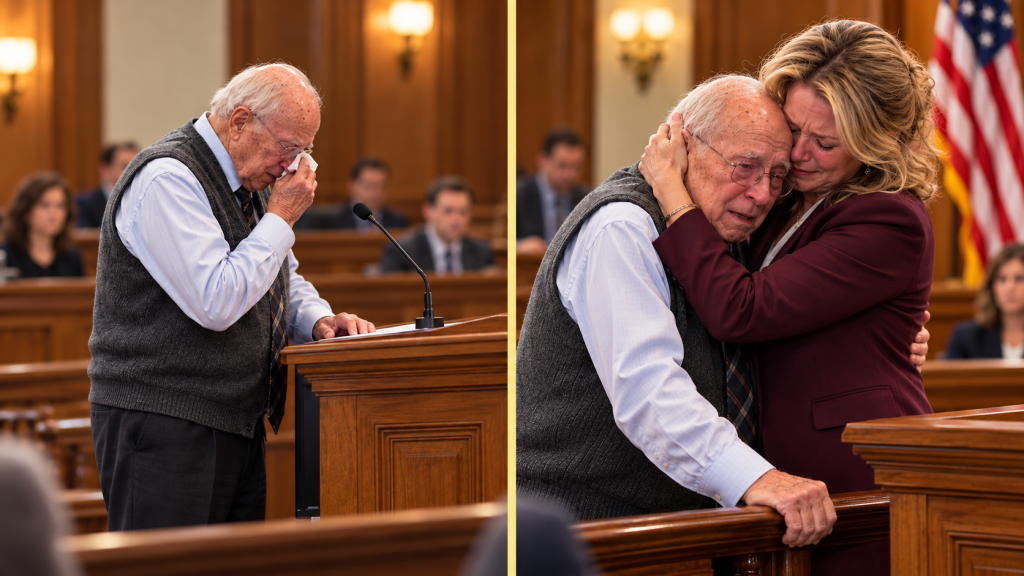
And Hannah, the young widow sitting near the back of the courtroom, tightened her arms around her sleeping son. The judge, Evelyn Hartwell, looked directly at the man. “State your name, please.” “Caleb Price, Your Honor. I’m the manager of Hearthside Market.” “Mr. Price, this is a court proceeding. If you have information relevant to the allegations, it must be presented through the proper process.”
“I understand.”
His voice shook.
“But I believe the amount the store reported is wrong.”
A murmur moved through the courtroom.
The judge raised her hand.
“Order, please.”
Caleb swallowed.
“We reported two thousand one hundred forty-six dollars and thirty-eight cents in missing merchandise.”
The prosecutor turned toward him.
“Mr. Price—”
Caleb continued.
“But some of those items weren’t stolen. They were approved through our store’s community assistance program.”
Walter lifted his head.
“What?”
For the first time since entering the courtroom, he looked genuinely confused.
Caleb’s face reddened.
“I authorized some of those groceries, Mr. Miller.”
Walter stared at him.
“I didn’t pay for them.”
“I know.”
“Then I took what wasn’t mine.”
Caleb shook his head.
“Some of it, yes. But not everything we’ve accused you of taking.”
The judge looked toward the prosecutor.
“Counsel, we need to establish what evidence is being offered before this proceeding continues.”
She ordered a short recess so the parties could review the manager’s information.
Walter’s attorney, Ms. Rebecca Lawson, moved quickly to his side.
Margaret stepped toward him, but Walter raised one trembling hand.
“Not yet, Margaret.”
His voice was soft.
“Please.”
She stopped.
The old man’s eyes filled with tears.
For months, he had carried his secret alone.
He had been willing to accept imprisonment rather than reveal the desperate circumstances of a young woman who’d once saved his life.
Now everything was coming into the open.
And what frightened him most, I thought, wasn’t the possibility of punishment.
It was the thought that Hannah might look at him differently.
Twenty minutes later, the hearing resumed.
Caleb had brought a folder containing receipts, donation records, inventory adjustments, and a written statement.
After the necessary procedural steps, he was permitted to provide sworn testimony.
The courtroom was completely silent.
Judge Hartwell looked down at the documents.
“Mr. Price, explain this community assistance program.”
Caleb cleared his throat.
“Hearthside Market has a small fund. We use it to help customers experiencing financial hardship. Sometimes that means a grocery voucher. Sometimes it means supplies for a local shelter.”
“And how does that relate to Mr. Miller?”
Caleb glanced toward Walter.
“About six months ago, I caught him leaving with children’s socks and canned soup.”
Walter lowered his head.
“He apologized,” Caleb continued. “He offered to pay, but he only had seven dollars in his wallet.”
The manager paused.
“I could see he was embarrassed. He kept saying he’d make it right.”
Judge Hartwell nodded for him to continue.
“So I told him the store would cover those items through our assistance fund.”
Walter looked up.
“You said you weren’t going to call the police.”
“Yes, sir.”
“I thought you were letting me go because you felt sorry for me.”
Caleb’s eyes filled.
“That was part of it. But I also approved the merchandise as assistance.”
He turned back toward the judge.
“After that, some employees set aside groceries and basic supplies through the same program. The records were supposed to reflect those approvals.”
“What happened?”
Caleb looked ashamed.
“Some were entered incorrectly as inventory losses. When the store’s security review was prepared, those transactions were included in the total attributed to Mr. Miller.”
The prosecutor examined the records.
“And did you correct that before the complaint was filed?”
Caleb shook his head.
“No.”
“Why not?”
He stared at the floor.
“I was afraid headquarters would think I’d been careless with the assistance program. And by then, Mr. Miller had been caught taking other things without permission.”
The judge’s expression hardened.
“So you allowed the total to remain inaccurate?”
Caleb nodded.
“Yes, Your Honor.”
“Knowing that it would be used in a criminal proceeding?”
His voice broke.
“Yes.”
For several seconds, nobody spoke.
Then Judge Hartwell asked him another question.
“Are you claiming Mr. Miller took nothing unlawfully?”
“No, ma’am.”
Caleb looked toward Walter.
“He did take merchandise that hadn’t been approved or paid for. I don’t want to mislead the court about that.”
He swallowed.
“But the figure we reported included items we had authorized, along with merchandise that was later recovered.”
After reviewing the preliminary documents, the lawyers identified several hundred dollars in disputed entries.
The amount attributed to actual unauthorized losses appeared substantially lower than the original allegation, although the judge made clear that the final calculation still required verification.
Walter stared at the table.
Then he said quietly, “I didn’t know about the accounting.”
Judge Hartwell looked toward him.
“I understand, Mr. Miller.”
He swallowed.
“But I know what I did.”
His attorney touched his arm.
“Mr. Miller, let us finish reviewing the evidence.”
Walter nodded.
And for the first time that morning, I saw something beyond shame in his expression.
I saw exhaustion.
The kind that comes when a person has spent too long trying to carry something no one should have carried alone.
Judge Hartwell continued the sentencing matter to allow the prosecution and defense to review the corrected records, Walter’s circumstances, and the possibility of restitution.
She did not dismiss his actions.
She did not declare that stealing became acceptable because its purpose was compassionate.
But she refused to make a sentencing decision based on figures the store manager had just admitted were unreliable.
When the hearing ended, Walter remained seated.
His cane rested against his knee.
Margaret approached slowly.
“Well,” she whispered, “I suppose you’re angry with me.”
Walter looked up.
His eyes were wet.
“You promised.”
Her face crumpled.
“I know.”
“Thirty years we’ve lived beside each other.”
“Yes.”
“And you promised you wouldn’t tell Hannah.”
Margaret sat beside him.
For a long moment, she couldn’t speak.
Then she took his thin hand.
“Walter, I watched you walk to that store in the rain. I watched you skip meals because you were buying things for somebody else. I watched you come home with swollen feet and pretend you weren’t in pain.”
She swallowed.
“And today I watched you stand before a judge prepared to spend whatever time you have left in prison rather than ask anybody for help.”
Walter turned away.
Margaret’s voice softened.
“I couldn’t keep that promise anymore.”
The old man was quiet.
Then he whispered, “I didn’t want her to feel indebted to me.”
Margaret nodded.
“I know.”
“She saved my life.”
His eyes filled.
“She was nineteen years old. She didn’t know me. She didn’t ask whether I deserved saving.”
He glanced toward the back of the courtroom.
“She just stopped.”
Margaret squeezed his hand.
Walter swallowed.
“And now she has that little boy. I couldn’t stand knowing they were hungry.”
His voice broke.
“Not when I was still here because she gave me another chance to live.”
Margaret began crying.
“Oh, Walter.”
He looked down at his cane.
“I should have asked somebody.”
She nodded.
“Yes.”
“I should have told the church. Or Caleb. Or you.”
“Yes.”
He wiped his eyes.
“But every time I thought about it, I pictured Hannah finding out.”
His face crumpled.
“She’d lost her husband. She was trying so hard to keep things together. I didn’t want her to think the whole town was talking about her troubles.”
Margaret held his hand.
For a moment, neither of them spoke.
Then Walter whispered, “I was trying to preserve her dignity.”
Margaret looked at him through tears.
“And somewhere along the way, you forgot to preserve your own.”
Hannah waited until the courtroom had nearly emptied.
Her little boy, Benjamin, had awakened during the hearing and was now sitting on a bench beside her, rubbing his eyes.
He was four years old, with dark curls and the solemn expression of a child who could sense that the adults around him were upset without understanding why.
Walter noticed them approaching.
His shoulders stiffened.
He tried to stand.
His attorney gently asked him to remain seated until he felt steady.
Hannah stopped a few feet away.
“Mr. Miller?”
Walter looked down.
“Hello, Hannah.”
She was crying.
For a long moment, she simply stared at him.
Then she whispered, “It was you?”
He nodded.
“The groceries?”
Another nod.
“The little winter coat?”
Walter’s face tightened.
“Blue one?”
She covered her mouth.
Benjamin looked up.
“Mommy, why are you crying?”
Hannah knelt beside him.
“I’m all right, sweetheart.”
Then she looked toward Walter.
“Did you leave the school supplies too?”
He nodded.
“I saw the list posted at the preschool.”
Hannah began sobbing.
For months, she’d believed the supplies appearing on her doorstep came from a church assistance program.
Every few weeks, a brown paper bag would appear.
Sometimes it contained canned soup, rice, and cereal.
Sometimes there were socks, notebooks, or laundry detergent.
Once, during a particularly cold week, there had been a tiny blue coat with a handwritten note.
For the little fellow. Hope it fits.
She had kept that note in a kitchen drawer.
Not because it was valuable.
Because during the loneliest year of her life, it had reminded her that somebody still cared whether her child was warm.
Now the handwriting had a face.
A face lined by a century of living.
And that face belonged to the man she’d found lying in the snow five winters earlier.
Hannah reached for Walter’s hand.
“Why didn’t you tell me?”
He shook his head.
“You had enough worries.”
“But you could have come to me.”
He smiled sadly.
“And said what? That an old man was stealing groceries because he couldn’t stand seeing you go without?”
She looked down.
Walter continued.
“I knew you’d tell me to stop.”
“Of course I would.”
“I know.”
His eyes filled.
“That’s why I kept quiet.”
Hannah shook her head through tears.
“You nearly went to prison.”
Walter looked toward the courtroom doors.
“I was wrong to take those things.”
His voice trembled.
“But I couldn’t stand the thought of that little boy going hungry.”
Benjamin looked up.
“Who?”
Walter smiled faintly.
“You, young man.”
The child studied him.
Then asked, “Are you the present man?”
The question silenced everyone nearby.
Walter’s mouth opened.
For a moment, no sound came.
Then he whispered, “I suppose I am.”
Benjamin stepped closer.
“Thank you for my coat.”
Walter’s eyes filled.
“You’re welcome, son.”
The boy hesitated.
Then reached out and gently touched Walter’s wooden cane.
“My grandpa has a stick too.”
Hannah closed her eyes.
Her father had died several years earlier.
Benjamin had only known him through photographs.
She reached for her son’s hand.
“Come here, honey.”
But Walter shook his head.
“It’s all right.”
He leaned forward slightly.
“Your grandpa must be a wise man to use a stick.”
Benjamin nodded seriously.
“He says it helps him go faster.”
Walter laughed.
It was a small, fragile laugh.
But it was the first time anyone in the courtroom had heard him laugh that morning.
Hannah asked whether they could sit somewhere private.
A courthouse employee helped them find an empty conference room, where Walter could rest while his attorney finished discussing the next hearing.
Margaret brought water.
Caleb stood uncertainly near the doorway until Walter invited him inside.
There were six chairs around a scratched wooden table.
A plastic plant stood beside the window.
Nothing about the room was remarkable.
Yet what happened there changed the lives of everyone who entered it.
Hannah sat across from Walter.
“I want you to know what happened after my husband died.”
Walter shook his head.
“You don’t owe me an explanation.”
“I know.”
She wiped her eyes.
“But I’d like to tell you.”
Walter nodded.
Her husband, Aaron, had worked repairing commercial refrigeration equipment.
He was twenty-seven when he died in a highway collision on his way home from a late service call.
He had left that morning before sunrise.
Hannah had packed his lunch and kissed him goodbye while Benjamin slept.
By evening, two officers were standing on her porch.
For weeks afterward, she moved through life as though everything were happening behind glass.
People brought casseroles.
Relatives offered to help.
Friends sent messages promising she could call anytime.
Then the funeral flowers wilted.
The casseroles stopped.
And the ordinary bills continued arriving.
Rent.
Electricity.
Daycare.
Car insurance.
Medical copayments.
Hannah had been working part-time at the pharmacy while caring for Benjamin.
She tried picking up additional shifts, but the late hours made childcare difficult.
She applied for benefits and assistance programs, but some applications required documents she didn’t have immediately.
Others took time to process.
She used what savings remained.
Then she began deciding which expenses could wait.
One week, it was the electricity bill.
Another, the groceries.
Then Benjamin developed a persistent cough and needed medication.
Hannah found herself standing outside the pharmacy with a prescription she couldn’t afford that day and a grocery list she couldn’t ignore.
“I thought I was being careful,” she whispered.
“I thought if I worked harder, I could make the numbers add up.”
Walter listened.
She looked down.
“But you can’t stretch forty dollars into eighty just because your child is hungry.”
Her voice broke.
“I stood in that parking lot crying because I didn’t know what to do.”
Walter’s eyes filled.
“I remember.”
Hannah stared at him.
“You were there?”
He nodded.
“Across the street.”
She covered her mouth.
“I didn’t see you.”
“You’re not supposed to notice every old fellow sitting on a bench.”
He smiled faintly.
Then his expression grew sad.
“I heard you telling someone on the phone that you had to choose between the medicine and food.”
Hannah swallowed.
“I was talking to my sister.”
Walter nodded.
“I didn’t hear much more.”
He looked toward Benjamin, who was drawing circles on a scrap of paper Margaret had found for him.
“But I remembered you.”
Hannah closed her eyes.
Five years earlier, she’d been walking home from her shift at the grocery store when she spotted an elderly man lying motionless near the sidewalk.
Snow had gathered along the curb.
His grocery bag had torn open.
An orange rolled into the road.
She’d dropped everything, called for emergency help, and followed the dispatcher’s instructions while performing CPR until paramedics arrived.
She had no idea whether he would survive.
When she learned later that he had, she’d written him a letter.
She was nineteen.
She’d never thought of herself as particularly brave.
She’d simply seen somebody who needed help.
Now the man she’d helped was sitting across from her, facing criminal consequences because he had tried to return that kindness in the worst possible way.
Hannah looked at Walter.
“I didn’t save you because I wanted anything back.”
He nodded.
“I know.”
“You didn’t owe me groceries.”
“I know.”
She began crying again.
“Then why?”
Walter stared at his hands.
When he finally spoke, his voice was barely audible.
“Because when I woke up in the hospital, they told me a young woman had stopped.”
He paused.
“I was ninety-six years old. I’d outlived almost everyone I knew. I’d begun to wonder what another day was for.”
Hannah wiped her eyes.
Walter continued.
“Then somebody I’d never met decided my life was worth fighting for.”
His face crumpled.
“I thought if I had been given more time, I ought to do something good with it.”
He looked toward the window.
“But I got so determined to help that I stopped thinking clearly about how I was doing it.”
He turned back to Hannah.
“I’m sorry.”
Those two words were almost lost beneath his tears.
“I’m sorry I used your kindness to justify doing something wrong.”
Hannah reached for his hands.
“Mr. Miller, I don’t want you to suffer because of me.”
Walter shook his head.
“The choices were mine, Hannah.”
He paused.
“And you mustn’t carry them.”
Caleb had been standing silently near the doorway.
Now he stepped forward.
“Mr. Miller, I owe you an apology too.”
Walter looked up.
Caleb swallowed.
“I knew you were struggling. I knew something wasn’t right. And I kept thinking if I let another week pass, maybe the problem would solve itself.”
He looked toward Hannah.
“I also knew the store had an assistance fund. But I didn’t make sure those approvals were properly recorded.”
Walter shook his head.
“You were kind to me.”
Caleb’s eyes filled.
“Not kind enough to do my job properly.”
He took a breath.
“I’m going to correct the records and cooperate fully with the attorneys. Whatever the final amount turns out to be, the court deserves accurate information.”
Walter nodded.
“Thank you.”
Caleb hesitated.
“There’s something else I can do.”
Everyone looked at him.
“Our store works with a community food organization. We have a way to provide groceries through documented assistance without anybody needing to take things from the shelves.”
He turned toward Hannah.
“If you’re willing, I can put you in contact with the coordinator.”
Hannah looked uncertain.
“I don’t want special treatment.”
Caleb shook his head.
“It wouldn’t be special treatment. It’s a program intended for families who need it.”
Margaret leaned forward.
“And I know a social worker who helps people apply for benefits and childcare assistance.”
Hannah looked from one face to another.
For months, she’d carried every problem alone because she believed asking for help meant admitting she couldn’t take care of her son.
Now people were offering assistance without treating her like a failure.
Her lips trembled.
“I don’t know what to say.”
Walter smiled.
“Sometimes it’s all right to say yes.”
She looked at him.
Then laughed through tears.
“That’s rather rich coming from you.”
Margaret laughed too.
Walter lowered his eyes.
“Yes, I suppose it is.”
And for a moment, the room filled with a fragile warmth.
Not because every problem had been solved.
But because, at last, nobody was pretending they had to solve everything alone.
The days following the hearing were difficult.
News traveled quickly through the little town.
A century-old man accused of stealing groceries.
A young widow struggling to feed her child.
A store manager who had admitted the loss records were inaccurate.
By the following morning, a local newspaper had published an article about the case.
The headline was dramatic.
101-YEAR-OLD SHOPLIFTER REVEALS HEARTBREAKING REASON FOR THEFTS.
Margaret read it at her kitchen table and felt sick.
The story described Walter as a lonely old man who’d stolen food to repay the woman who saved his life.
Some details were accurate.
Others simplified a complicated situation into something that sounded almost romantic.
There were comments beneath the online article.
Some people called Walter a hero.
Others insisted that stealing was stealing, regardless of age.
A few accused Hannah of allowing an elderly man to support her.
Margaret stared at those comments for several minutes.
Then she shut her laptop.
She walked next door and found Walter sitting in his living room, trying to repair the loose handle on an old wooden drawer.
His house smelled faintly of furniture polish and peppermint tea.
On the mantel stood a photograph of his late wife, Mabel.
She had died eighteen years earlier.
In the picture, she wore a yellow summer dress and held a bouquet of daisies.
Walter looked up when Margaret entered.
“Well, hello.”
She set a covered dish on the kitchen counter.
“Brought you some soup.”
He gave her a familiar look.
“I can make my own soup.”
“I know.”
“Then why bring it?”
“Because I made too much.”
Walter smiled faintly.
“That’s what you always say.”
Margaret sat beside him.
For a while, she watched him struggle with the drawer handle.
Then she asked, “Have you read the newspaper?”
He shook his head.
“No.”
“Good.”
He looked up.
“That bad?”
Margaret hesitated.
“People are talking.”
Walter nodded.
“I suppose they would.”
She studied him.
“Does it bother you?”
He looked toward Mabel’s photograph.
“Not as much as it bothers me that Hannah might hear them.”
Margaret’s expression softened.
“Walter, Hannah is a grown woman. She’s capable of deciding what to do with other people’s opinions.”
He nodded.
Then smiled sadly.
“Mabel used to tell me I was forever trying to fix things nobody had asked me to fix.”
Margaret laughed.
“She was a wise woman.”
“She was.”
Walter set the screwdriver aside.
For a long moment, he stared at his wife’s photograph.
Then he said, “We were married sixty-one years.”
Margaret nodded.
“I remember.”
“Mabel could stretch a bag of potatoes into enough suppers for a week.”
His eyes filled.
“When we were young, we went through some lean times. There were winters when I worked double shifts and still worried about the heating bill.”
Margaret waited.
“She never let me forget what it felt like.”
Walter smiled faintly.
“Every Christmas, she bought extra groceries for somebody who needed them. Never made a show of it.”
He looked down at his hands.
“She’d have been ashamed of how I went about helping Hannah.”
Margaret didn’t disagree.
Instead, she said gently, “I think she’d have been glad you finally let somebody help you.”
Walter looked toward the window.
For a long time, he said nothing.
Then he whispered, “I’ve been so afraid of becoming a burden.”
Margaret reached for his hand.
“You’ve never been a burden to me.”
He smiled sadly.
“Not yet.”
She squeezed his fingers.
“Walter, you’ve helped me for thirty years. You repaired my porch light. Shoveled my steps when my knee was bad. Sat beside me the night Harold died because you knew I didn’t want to be alone.”
Her voice trembled.
“You don’t lose your right to friendship just because you need something now.”
Walter stared at her.
Then his eyes filled.
He looked away.
And Margaret understood something that had been hidden beneath the entire case.
For years, Walter had known how to give.
But he had forgotten how to receive.
A few days later, Hannah met with a social worker named Lila Torres.
Margaret accompanied her at Hannah’s request.
They sat in a small community office with Benjamin playing quietly beside a box of wooden blocks.
Lila listened as Hannah explained her financial circumstances.
She asked about income, childcare expenses, outstanding bills, medical coverage, and the applications Hannah had already submitted.
Then she helped Hannah begin organizing the information.
There were no miracles.
No enormous check waiting in a forgotten account.
No wealthy stranger suddenly appearing to solve every problem.
Some assistance programs had waiting periods.
Others required documents Hannah needed to request.
But there were legitimate resources she’d been too exhausted or overwhelmed to find on her own.
Lila helped her review survivor benefits for Benjamin, determine her eligibility for food and healthcare assistance, and connect with an organization that could help with childcare while she worked.
She also arranged for Hannah to speak with a local nonprofit about overdue rent.
When the appointment ended, Hannah sat quietly in her chair.
Lila smiled.
“How are you feeling?”
Hannah looked down.
“Embarrassed.”
Margaret reached for her hand.
Lila nodded gently.
“A lot of people feel that way.”
Hannah swallowed.
“I’ve worked since I was sixteen. I always paid my bills.”
Lila leaned forward.
“Needing help after your husband died doesn’t erase the years you supported yourself.”
Hannah began crying.
“I just don’t want Benjamin growing up thinking his mother couldn’t take care of him.”
Lila’s expression softened.
“Your son will know his mother loved him enough to keep asking questions until she found a way forward.”
Hannah wiped her eyes.
Then looked toward Benjamin.
He was stacking wooden blocks into a crooked tower.
Every time one fell, he started again.
She smiled through her tears.
“He’s very determined.”
Margaret laughed.
“He gets that from his mother.”
Lila handed Hannah a folder.
“Let’s keep going, one thing at a time.”
Hannah took it.
And for the first time in months, she left an office with a plan that didn’t depend on an anonymous bag appearing at her door.
Meanwhile, Caleb Price began correcting the store’s records.
The process took longer than he’d expected.
Every disputed transaction needed documentation.
Some items had been covered through the assistance fund.
Others had been returned to inventory.
And some really had been taken without payment or approval.
When the accounting was completed, the documented unauthorized loss attributable to Walter was approximately thirteen hundred dollars.
It was still a serious amount.
Still property that didn’t belong to him.
Still something he needed to answer for.
But it wasn’t the figure the court had originally received.
Caleb provided the corrected records to the attorneys and the store’s regional office.
He also reported his own failure to reconcile the assistance transactions before signing the original loss summary.
He was disciplined for that omission.
For several days, he worried he might lose his job.
Then, during a meeting with his supervisor, he said something that surprised even himself.
“I thought I was being compassionate by not calling the police sooner.”
His supervisor looked at him.
“And?”
Caleb swallowed.
“I was being compassionate in the easiest way. I let him walk away without finding out why he kept coming back.”
He looked down.
“And when I finally reported him, I didn’t even make sure our numbers were right.”
The supervisor didn’t immediately respond.
Caleb continued.
“We have an assistance program. We have employees who care about our customers. But we don’t have a clear system for helping somebody before they’re desperate enough to make the same mistake again.”
He took a breath.
“Maybe we should change that.”
The conversation didn’t erase his disciplinary record.
But it did lead to a review of how the store administered charitable assistance, tracked donated merchandise, and referred customers to local support services.
Caleb began working with the community food organization to establish clearer procedures.
The program wasn’t designed around Walter’s name.
Walter had specifically asked that it not be.
Instead, it was built around a simple idea.
People should be able to ask for help without being shamed.
And employees should know how to respond before a difficult situation became a criminal one.
The second court hearing took place on a cold November morning.
Walter arrived wearing his best gray suit.
Margaret had pressed it the night before.
His wooden cane had been polished.
And tucked inside his jacket pocket was a small folded paper.
It wasn’t Hannah’s letter.
It was a handwritten account of the items he remembered taking, along with the amounts he believed he owed.
For several nights, he’d sat at his kitchen table trying to reconstruct every visit to the store.
Some entries were uncertain.
Others contained careful descriptions.
Two cans of soup.
Children’s mittens.
Laundry soap.
Notebook, blue cover.
Near the bottom, he’d written:
I meant to repay it. That does not make taking it right.
Margaret had found him working on the list at nearly midnight.
“Walter, you need to rest,” she’d said.
He looked up.
“I have to be honest.”
She touched his shoulder.
“You already have been.”
He shook his head.
“Not enough.”
Now, in the courtroom, he handed the paper to his attorney.
Rebecca Lawson read it quietly.
Then looked at him with tears in her eyes.
“Mr. Miller, why did you make this?”
He swallowed.
“Because I don’t want anyone thinking I only regret what happened because I got caught.”
She nodded.
He looked toward the judge’s bench.
“I want them to know I understand.”
At the hearing, the corrected loss figures were entered into the record.
The prosecutor acknowledged the revised accounting and explained the proposed resolution after discussions with the defense and the store.
Restitution remained part of the agreement.
The prosecutor also described Walter’s age, health, cooperation, lack of recent criminal history, and the circumstances surrounding the offenses.
Hannah had submitted a statement.
So had Margaret.
Caleb provided records concerning the assistance program and the store’s willingness to participate in an appropriate noncustodial resolution.
Judge Hartwell listened.
Then she looked toward Walter.
“Mr. Miller, do you understand that the court cannot excuse theft simply because you intended to help another person?”
Walter nodded.
“Yes, Your Honor.”
“Do you understand that the store’s accounting errors do not eliminate responsibility for the items you actually took unlawfully?”
“Yes, ma’am.”
She paused.
“Then tell me what you think you should have done differently.”
Walter looked toward Hannah.
Then back at the judge.
His voice trembled.
“I should have asked for help.”
The courtroom became still.
He continued.
“I was ashamed to tell anybody I couldn’t afford to do what I wanted to do.”
He swallowed.
“So I took things that weren’t mine.”
His eyes filled.
“I wanted that little boy to have food and warm clothes. But I understand now that doing something kind doesn’t give me permission to do something wrong to someone else.”
Judge Hartwell studied him.
Walter continued.
“I have lived one hundred and one years. I’ve had plenty of time to learn better.”
A faint, sad smile crossed his face.
“I wish I had remembered sooner.”
Judge Hartwell remained silent for several moments.
Then she turned to the attorneys.
After reviewing the agreed recommendations and the applicable sentencing options, she announced that Walter would not be sent to prison.
He would receive a suspended custodial sentence subject to the court’s conditions, a manageable restitution arrangement, and continued compliance with the law.
His age and medical needs would be considered in administering those conditions.
He would not be required to perform physically demanding community service that could endanger his health.
The judge was careful to explain that the decision reflected the particular facts of his case.
It was not a declaration that good intentions made theft lawful.
Walter listened without moving.
When the judge finished, he looked toward his attorney.
“Does that mean I can go home?”
Rebecca smiled through tears.
“Yes, Mr. Miller.”
He stared at her.
“Today?”
“Today.”
Walter closed his eyes.
For several seconds, he didn’t speak.
Then he whispered, “Thank you.”
His shoulders began to shake.
Margaret covered her face.
Hannah started crying.
And Benjamin, who had been quietly drawing beside his mother, looked up.
“Mommy, is Mr. Walter coming home?”
Hannah smiled through tears.
“Yes, sweetheart.”
The little boy grinned.
“Good. I made him a picture.”
Judge Hartwell glanced toward him.
A small smile crossed her face.
Then she looked back at Walter.
“Mr. Miller, I hope you use the time ahead of you wisely.”
Walter nodded.
“I intend to, Your Honor.”
She paused.
“And I hope you remember that asking for assistance is not a failure.”
His eyes filled.
“Yes, ma’am.”
The judge’s expression softened.
“You’re never too old to learn that.”
Walter gave a trembling smile.
“No, ma’am. Apparently not.”
Outside the courthouse, the November air was sharp and cold.
Margaret helped Walter into his coat.
Hannah approached with Benjamin beside her.
The child was holding a folded piece of construction paper.
“Mr. Walter?”
Walter turned.
“Hello, young man.”
Benjamin held out the paper.
“I made this for you.”
Walter unfolded it carefully.
Inside was a picture of a little blue house beneath a bright yellow sun.
Three stick figures stood outside.
One was small.
One had long hair.
And the third held a brown walking stick.
At the top, Benjamin had written his name with his mother’s help.
Beneath it were four crooked words.
THANK YOU, MR. WALTER.
The old man’s eyes filled.
He traced the drawing with one finger.
“Well,” he whispered, “that’s the finest picture anybody’s given me in years.”
Benjamin smiled.
“That’s you.”
Walter nodded.
“I can see that.”
“And that’s Mommy.”
“Yes.”
“And that’s me.”
Walter looked at him.
“You’re quite an artist.”
Benjamin beamed.
Then he asked, “Can you come to my birthday?”
Hannah looked surprised.
Walter turned toward her.
“I wouldn’t want to intrude.”
She shook her head.
“You’re not intruding.”
Her eyes filled.
“If you’d like to come, we’d love to have you.”
Walter stared at her.
For months, he’d been leaving groceries at her door before sunrise, carefully avoiding being seen.
Now she was inviting him through that same door.
Not because he had brought something.
Not because he owed her a debt.
Simply because she wanted him there.
He swallowed.
“I’d like that very much.”
Benjamin grinned.
“There’s going to be chocolate cake.”
Walter smiled.
“Then I certainly can’t miss it.”
The weeks that followed were quieter.
Hannah continued working with Lila Torres to stabilize her family’s finances.
She secured more predictable hours at a medical office and arranged childcare that allowed her to work without constantly fearing an unexpected scheduling change.
Assistance with benefits and essential expenses reduced some of the pressure she’d been carrying alone.
Life did not suddenly become easy.
There were still bills.
There were still mornings when Benjamin didn’t want to get dressed for preschool.
There were still evenings when Hannah missed Aaron so fiercely that setting two plates on the table felt almost unbearable.
But she wasn’t facing every difficult day alone anymore.
Walter began making restitution payments in the amounts established through the court process.
He maintained careful records.
Margaret helped him organize the paperwork, although she refused to let him describe her assistance as a burden.
Caleb continued improving the store’s assistance procedures.
And the community food organization began offering regular distributions through a system that allowed families to ask for help privately.
Walter sometimes asked Margaret whether he could donate a little money.
She would look over his budget with him.
Then remind him to pay his own bills first.
“You can’t help anybody if you don’t take care of yourself,” she’d say.
He’d sigh.
“Mabel used to tell me the same thing.”
“Then she and I must both be right.”
Walter would smile.
And put his wallet away.
One afternoon in December, Hannah visited Walter’s house carrying a covered dish.
He opened the door slowly.
“Hannah?”
She smiled.
“Hello, Mr. Miller.”
He glanced toward the dish.
“What’s that?”
“Chicken soup.”
He frowned.
“Now, you don’t need to be bringing me food.”
Hannah laughed softly.
“You’re beginning to sound familiar.”
Walter looked embarrassed.
She stepped inside.
“I made too much.”
From the kitchen, Margaret called, “That’s my excuse!”
Hannah laughed.
Walter shook his head.
“Everybody seems determined to feed me.”
Hannah placed the soup on the counter.
“Good.”
Then she took his hand.
“Because you deserve to be taken care of too.”
Walter looked down.
For a long moment, he couldn’t speak.
Then he whispered, “I’m learning.”
She smiled.
“That’s all any of us can do.”
On Christmas Eve, Walter sat at his dining room table with Margaret, Hannah, and Benjamin.
He hadn’t hosted Christmas dinner in years.
After Mabel died, he’d usually eaten something simple and listened to holiday music on the radio.
But this year, Margaret insisted they celebrate together.
Hannah prepared the main dish.
Margaret brought vegetables.
Walter made the cranberry sauce from a recipe written in Mabel’s old cookbook.
Benjamin helped arrange the napkins.
He placed one beside every chair and then announced proudly that he was in charge of decorations.
The table was crowded.
The food was simple.
And the house felt warm in a way it hadn’t for a very long time.
After dinner, Hannah noticed a framed photograph beside Walter’s chair.
It showed a smiling woman in a yellow dress.
“Is that Mabel?”
Walter nodded.
“My wife.”
Hannah studied the photograph.
“She looks lovely.”
Walter smiled.
“She was.”
He paused.
“She would’ve liked you.”
Hannah’s eyes filled.
“I wish I’d known her.”
Walter looked toward the kitchen, where Benjamin was helping Margaret carry plates to the sink.
“She would’ve liked that little fellow too.”
They sat quietly.
Then Hannah asked, “Walter, do you ever wish you hadn’t met me?”
He turned toward her, startled.
“Whatever would make you ask that?”
She looked down.
“Because if I hadn’t stopped that night, maybe you wouldn’t have felt you owed me anything. Maybe you wouldn’t have gotten into trouble.”
Walter stared at her.
Then he reached for her hand.
“Listen to me, Hannah.”
She looked up.
“You didn’t make me steal anything.”
His voice was gentle but firm.
“You saved my life. What I chose to do afterward was my responsibility.”
Tears filled her eyes.
He continued.
“And I’m grateful you stopped that night. Not because it gave me a chance to repay you.”
He smiled faintly.
“But because it gave me five more winters.”
Hannah squeezed his hand.
Walter looked toward Benjamin.
“Five more Christmases. Five more springs. Five more chances to hear somebody laugh.”
His eyes filled.
“I don’t know how many days I’ve got left.”
He paused.
“But I know I don’t want to spend them feeling ashamed to need other people.”
Hannah began crying.
She moved closer and hugged him.
Walter held her as tightly as his thin arms allowed.
Across the room, Margaret turned away to wipe her eyes.
Benjamin looked up from the sink.
“Why’s everybody crying?”
Walter laughed softly.
“Because we’re happy, son.”
Benjamin considered this.
Then nodded.
“Okay.”
He picked up another plate.
And the room filled with laughter.
Later that evening, after Hannah and Benjamin had gone home, Margaret helped Walter put away the remaining dishes.
On the mantel, beside Mabel’s photograph, stood Benjamin’s drawing of the little blue house.
Walter looked at it for a long time.
Margaret followed his gaze.
“Beautiful picture.”
He nodded.
“Very.”
She sat beside him.
“Walter?”
“Yes?”
“Are you still angry with me for telling the court?”
He was quiet.
Then he shook his head.
“No.”
Margaret’s eyes filled.
“I didn’t know what else to do.”
Walter reached for her hand.
“You did what you believed was right.”
He paused.
“And I understand that now.”
She squeezed his fingers.
For several moments, they sat together listening to the old clock ticking above the fireplace.
Then Walter said softly, “You know, Margaret, I thought the worst thing that could happen at my age was ending up in prison.”
She looked at him.
“And now?”
He smiled sadly.
“Now I think it would’ve been worse to spend the rest of my life believing I had to hide every trouble from the people who cared about me.”
Margaret nodded.
Walter looked toward Mabel’s photograph.
“I spent a hundred and one years learning how to be useful.”
He paused.
“Apparently, I needed one more lesson about being loved.”
Margaret began crying.
And he smiled.
“Don’t you start.”
She laughed through tears.
“Too late.”
The story of Walter Miller eventually faded from the newspapers.
There were no more dramatic courtroom photographs.
No cameras outside his house.
No strangers debating his character beneath online headlines.
Life returned to ordinary things.
Morning tea.
Doctor’s appointments.
A little boy’s birthday.
A neighbor checking whether the porch steps were slippery.
Sometimes Walter still walked to Hearthside Market, accompanied by Margaret or another friend when he needed assistance.
He paid for his groceries.
He kept his receipts.
And Caleb always greeted him warmly without making a spectacle of their history.
Hannah continued visiting.
Sometimes she brought Benjamin.
Sometimes she came alone.
They talked about work, the weather, Mabel, and the difficult business of raising a child while missing someone who should have been there.
Walter listened.
And when he had something useful to say, he said it.
But he no longer believed that every problem required him to make a secret sacrifice.
One spring afternoon, Benjamin arrived carrying a small paper bag.
Walter looked at it suspiciously.
“What’s that?”
The boy grinned.
“Cookies.”
Walter raised an eyebrow.
“Where’d you get them?”
“Mommy made them.”
“Did she pay for the ingredients?”
Hannah burst out laughing.
“Yes, Walter. I paid for the ingredients.”
The old man chuckled.
“Just checking.”
Benjamin climbed onto the chair beside him.
Then carefully placed a cookie in Walter’s hand.
“For you.”
Walter studied it.
A little uneven.
Too much chocolate on one side.
Perfect.
He took a bite.
Then smiled.
“That’s the best cookie I’ve had in a hundred and one years.”
Benjamin laughed.
And Hannah watched the two of them with tears in her eyes.
Because five winters earlier, she’d knelt beside a stranger in the snow and refused to give up on him.
She hadn’t asked his name.
She hadn’t wondered whether he was wealthy, important, or deserving.
She’d simply believed his life mattered.
Years later, that stranger had tried to repay her kindness and had made serious mistakes along the way.
But those mistakes had taught everyone involved something important.
Compassion does not erase responsibility.
And responsibility does not erase a person’s humanity.
Walter had been wrong to steal.
The court had held him accountable.
But the community had also begun asking why a century-old man and a struggling young mother had believed their troubles needed to remain secret.
That question mattered.
Because it changed what people did next.
Walter learned to ask for help.
Hannah learned that accepting support didn’t make her a lesser mother.
Caleb learned that sympathy without proper action could allow suffering to continue.
And Margaret learned that sometimes keeping a promise of silence meant allowing someone she loved to face danger alone.
No one emerged from that courtroom untouched.
But they emerged with a chance to live differently.
And perhaps that was the most meaningful kind of second chance.
Not the absence of consequences.
But the opportunity to become better because of them.
At one hundred and one, Walter Miller discovered that the kindness he’d tried so desperately to repay had never been a debt.
It was a gift.
And the greatest way to honor it wasn’t to carry the world’s suffering on his own shoulders.
It was to let kindness move freely between people, without shame, without secrecy, and without anyone having to break the law to receive it.
On the mantel, Benjamin’s drawing remained beside Mabel’s photograph.
A little blue house.
Three stick figures.
A bright yellow sun.
And four crooked words that meant more to Walter than any award he’d received during his long life.
THANK YOU, MR. WALTER.
Whenever he looked at it, he smiled.
Because after a hundred and one years, he’d finally learned something wonderfully simple.
Nobody is too old to be forgiven, too poor to deserve dignity, or too strong to need a helping hand.
THE END STORIES! THANK YOU FOR READING GOOD LUCK !❤️
Related Posts