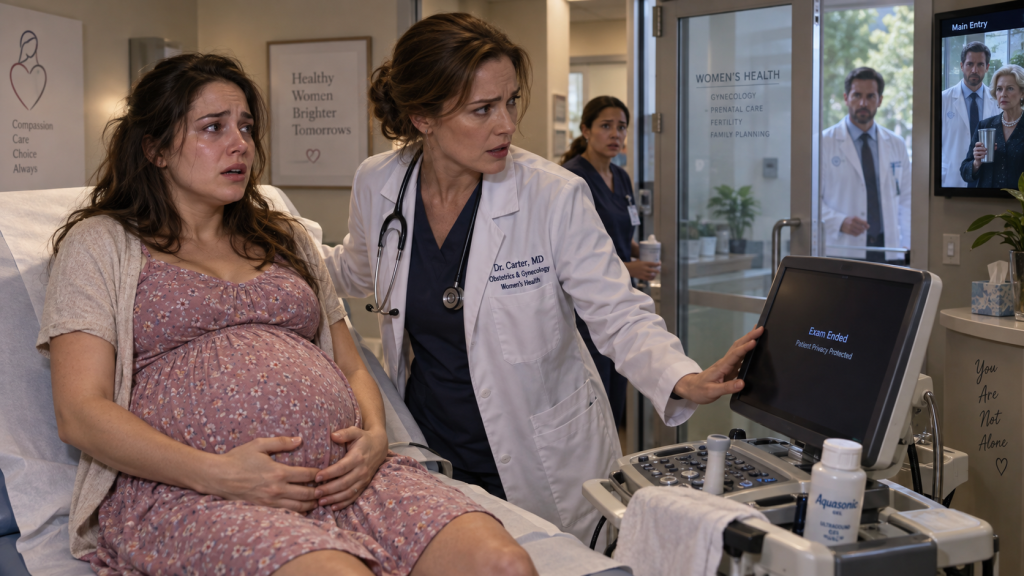
I went to another gynecologist just to calm myself down. When she saw my ultrasound, she turned off the screen and whispered, “Who has been touching you from the inside?”

I was seven months pregnant.
My husband, Dr. Aaron Mitchell, was the only doctor who had ever examined me. He was also a famous gynecologist in Boston. So when Dr. Natalie Reed turned pale and stopped the scan, I felt my baby kick once, hard, like even he knew something was wrong.
“Who handled your previous checkups?” she asked.
“My husband,” I said. “He’s a gynecologist too.”
Her fingers froze on the probe.
Then she reached over and switched off the ultrasound screen.
The room went dark.
“Mrs. Mitchell,” she said quietly, “I need to run tests right now. There is something inside you that should not be there.”
For a moment, I forgot how to breathe.
Until that morning, I had been calling myself dramatic.
Pregnancy hormones.
First baby fear.
Too much time alone in that white colonial house where everyone smiled too softly and watched me too closely.
Aaron had never hit me.
He had never shouted.
That made it harder to explain why I had started sleeping with my phone under my pillow.
To the world, I was lucky.
My husband was handsome, rich, educated, from an old New England family. Women in our gated community called him “the dream husband.” He checked my blood pressure himself. He counted my iron tablets. He planned my meals. He even adjusted the AC at night because, according to him, “a pregnant body must be protected.”
Protected.
That was the word he used for everything.
When I wanted to visit my parents in Ohio, he said traveling was risky.
When I wanted to attend my cousin’s wedding, he said the noise would stress the baby.
When I asked to consult another doctor, his smile disappeared.
“Why?” he asked. “Don’t you trust your own husband?”
So I stayed quiet.
Good wives stay quiet.
That is what my mother-in-law, Sylvia, reminded me every morning while clasping a small protective charm around my wrist.
“Too many jealous eyes are on your womb, sweetie,” she would say.
But her eyes were always the strangest ones.
She came into my room without knocking.
She touched my stomach without asking.
She brought bitter herbal tonics in silver cups and watched until I swallowed every drop.
Once, when she thought I was asleep, I heard her whisper near my belly.
“Come safely. Your place is already waiting.”
Not “our baby.”
Not “my grandchild.”
Your place.
I opened my eyes.
She smiled like nothing had happened.
“Sleep, Anna. A mother’s body belongs to the child now.”
That sentence followed me for days.
Then came the baby shower.
The house was covered in white floral arrangements. Older relatives shared traditional advice. My arms were filled with gifts, baby clothes, and silver rattles. Everyone praised me loudly.
“May the baby be strong.”
“May the baby be beautiful.”
“May the baby bring a legacy to the family.”
Sylvia draped a heavy heirloom shawl over my shoulders.
Then she leaned close enough that her perfume made me dizzy.
“After this child comes,” she whispered, “all unfinished things in this house will be corrected.”
I looked at her.
“What does that mean, Mom?”
She pressed one finger to my lips.
“Don’t ask questions that disturb a womb.”
Across the room, Aaron was watching us.
Not lovingly.
Carefully.
That night, I pretended to sleep.
Aaron sat beside me with his laptop open. The blue light cut across his face. He was speaking on the phone in a voice I had never heard before.
“Yes, she suspects nothing.”
My heart stopped.
He listened.
Then he said, “No. I won’t allow an outside scan.”
A pause.
“If she sees it before delivery, everything is finished.”
I lay still.
So still my ribs hurt.
The next morning, I told him I had a headache and wanted fresh organic juice from the market. When the driver brought the car, I told him to take me to the church.
Halfway there, I changed the address.
Dr. Natalie Reed’s clinic was small, quiet, and smelled of sanitizer and jasmine tea.
I almost turned back at the door.
Then my baby moved.
I went inside.
The scan began normally.
Dr. Reed smiled at first. She asked about my cravings, swelling, sleep.
Then her smile faded.
She tilted the probe.
Pressed deeper.
Zoomed in.
Her face lost all color.
I tried to lift my head. “Doctor? Is my baby okay?”
She did not answer.
The machine made a soft clicking sound.
She captured one image.
Then another.
Then another.
“Doctor,” I said, my voice breaking, “please say something.”
That was when she asked who had handled my previous checkups.
And when I said Aaron’s name, she looked at me as if I had just confessed to sleeping beside a snake.
She locked the clinic door.
Then she called her nurse.
“Take blood. Full panel. Prepare a urine test. And bring me the consent form for emergency imaging.”
My palms went numb.
“Emergency?” I whispered.
She sat beside me and lowered her voice.
“Anna, has your husband ever given you injections at home?”
I remembered the small glass vials.
The late-night “vitamin shots.”
The way Aaron always turned my face away before pushing the needle into my hip.
“Yes.”
Her jaw tightened.
“Has anyone given you herbal drinks?”
“My mother-in-law.”
“How often?”
“Every day.”
The nurse looked at the doctor.
The doctor looked away first.
That scared me more than the words.
I grabbed her wrist. “What is happening to me?”
Before she could answer, my phone rang.
Aaron.
The screen showed his photo: white coat, gentle smile, perfect husband.
Dr. Reed stared at the name.
“Do not answer,” she said.
It rang again.
Then again.
Then a message came.
Where are you?
Another.
The driver said you never went to the church.
Another.
Anna, pick up the phone right now.
My hands began to shake.
Dr. Reed took the phone from me and placed it face down.
“Listen carefully,” she said. “From this moment, you do not eat or drink anything from that house. You do not go back alone. And you do not tell your husband what I found.”
My throat closed.
“What did you find?”
She opened the ultrasound image again, but turned the screen away from me.
For the first time, her voice cracked.
“This is not a normal pregnancy complication.”
The clinic doorbell rang.
Once.
Twice.
Then someone banged on the glass.
The nurse rushed to the camera monitor and went stiff.
“Doctor,” she whispered, “it’s him.”
My blood turned to ice.
On the screen outside, Aaron stood in his white coat, breathing hard, with my mother-in-law beside him.
Sylvia was holding the same silver cup.
And when Dr. Reed zoomed in on the live camera, I saw what was floating inside it…
PART 2 — THE PREGNANCY HE HAD BEEN MANAGING WITHOUT ME
The clinic camera showed Aaron standing outside in his white coat.
Sylvia stood beside him.
In her hands was the silver cup.
The same one she had carried into my bedroom every morning for almost four months.
Dr. Reed leaned toward the security monitor.
“What is floating in that?”
At first, I thought she meant the herbs.
Sylvia always told me the pale fragments were dried roots.
But now that the camera had zoomed closer, I saw something else.
A thin white film clung to the rim.
And near the surface floated what looked like the softened shell of a capsule.
My stomach turned.
“I don’t know.”
The nurse looked at me.
“You’ve been drinking that?”
“Every day.”
Dr. Reed’s face changed.
Not panic.
Decision.
She reached for the phone.
“Call security.”
Then she looked at me.
“And call 911.”
Aaron struck the glass door again.
“Anna!”
His voice came through faintly.
“Open the door.”
I stepped backward.
He had never sounded like that with me.
Not angry exactly.
Commanding.
As though my failure to obey was not an emotional problem but a malfunction he expected to correct.
Sylvia pressed one palm against the glass.
Her expression was soft.
Almost maternal.
“Sweetheart.”
I could barely hear her.
“Come home.”
Home.
The word made something inside me recoil.
Dr. Reed moved between me and the entrance.
Aaron saw her.
His expression hardened.
Then he held up his medical badge.
“I’m Dr. Mitchell.”
Dr. Reed did not move.
“I know who you are.”
“My wife is experiencing pregnancy-related anxiety.”
My mouth fell open.
Dr. Reed’s eyes narrowed.
Aaron continued.
“She has a complicated obstetric history and should not be undergoing unsupervised testing.”
Complicated history?
I had never miscarried.
Never had cervical surgery.
Never been hospitalized during pregnancy.
Dr. Reed glanced at me.
I whispered:
“That isn’t true.”
She nodded once.
Then spoke loudly enough for Aaron to hear through the glass.
“Mrs. Mitchell has requested that you not enter.”
Aaron laughed.
Not kindly.
“She’s my wife.”
“She is also my patient.”
That stopped him for half a second.
Then:
“You have no idea what you’re interfering with.”
Dr. Reed answered:
“That may be the first thing we agree on.”
The police arrived before clinic security.
Two Boston officers.
I almost laughed from the relief.
Then immediately hated myself for being relieved by uniforms.
Aaron met them outside.
Of course he did.
By the time one officer entered, Aaron was already calmly explaining that his pregnant wife had become irrational, abandoned her driver, and undergone an unnecessary examination while medically vulnerable.
He sounded reasonable.
That was his gift.
He could turn control into concern before anyone noticed the difference.
The officer looked toward me.
“Mrs. Mitchell?”
“Yes.”
“Do you feel safe going home with your husband?”
“No.”
The answer came out before fear could edit it.
Aaron’s face changed through the glass.
The officer nodded.
“Okay.”
That one word nearly made me cry.
No debate.
No:
Are you sure?
Just okay.
Dr. Reed requested emergency transport to the hospital.
Not because my baby appeared to be in immediate distress.
His heartbeat was strong.
Movement was good.
That was the first mercy.
But she wanted me evaluated somewhere Aaron could not control the chart, staff, or equipment.
Aaron objected.
Loudly now.
He insisted he was my treating obstetrician.
Dr. Reed asked him for records documenting the condition he claimed I had.
He said they were at his office.
She asked which condition.
He told her my cervix had been shortening since the second trimester.
I stared at him through the door.
No one had ever told me that.
The ambulance arrived.
Before I was moved, one of the police officers asked Sylvia to set down the silver cup.
She clutched it tighter.
“It’s tea.”
Dr. Reed said:
“Then you should have no objection to leaving it.”
Sylvia looked at Aaron.
Not me.
Aaron gave the smallest nod.
She surrendered it.
The officer placed it into a clean evidence container after Dr. Reed explained why she was concerned.
I watched Sylvia’s face.
For the first time since I had known her, she looked frightened.
Not offended.
Not insulted.
Frightened.
That scared me more than anything.
Aaron called my name as paramedics rolled me outside.
“Anna.”
I refused to look.
Then:
“You’re going to hurt the baby.”
That worked.
I turned.
He knew it would.
He softened immediately.
“There.”
he said.
“Look at me.”
My hands went cold.
“Come home.”
“We’ll talk.”
“Dr. Reed doesn’t understand your history.”
I whispered:
“What history?”
His jaw tightened.
Too late.
He had said too much.
At the hospital, they registered me under privacy protections.
Security received photographs of Aaron and Sylvia.
A hospital social worker named Melissa Grant sat beside me while a maternal-fetal medicine specialist reviewed everything.
Dr. Reed stayed until the hospital team had the ultrasound images.
She did not abandon me simply because I had crossed into someone else’s building.
That mattered.
The new doctor introduced herself as Dr. Priya Shah.
She had kind eyes and the unnerving habit of becoming completely still when listening.
She reviewed my scan.
Then asked:
“Anna, did you ever consent to a cervical cerclage?”
I stared.
“A what?”
Her face changed.
That was the answer.
She pulled a chair closer.
“A cerclage is a strong suture placed around the cervix in certain pregnancies when there is concern that the cervix may open too early.”
I instinctively touched my stomach.
“Is that what Dr. Reed saw?”
“Yes.”
My mouth went dry.
“There is a surgical suture around your cervix.”
“No.”
Dr. Shah did not argue.
“I know.”
“No.”
I shook my head harder.
“No one put anything inside me.”
Then memory arrived.
Not fully.
Pieces.
A room at Aaron’s private practice.
Seventeen weeks pregnant.
Light spotting.
I had panicked.
Aaron told me the baby was fine but he wanted to perform a “more complete internal examination.”
He gave me an injection because I was shaking.
“Something to relax you.”
I remembered lying beneath a warm blanket.
Aaron telling me to close my eyes.
Pressure.
Sleepiness.
Waking later in a recovery room with aching low in my pelvis.
He told me he had taken a small sample because of irritation.
I believed him.
He was my husband.
My doctor.
The two roles had fused so completely that I no longer knew where trust was supposed to stop.
I covered my mouth.
“He did something that day.”
Dr. Shah said nothing.
I looked at her.
“He told me it was an examination.”
“We will need records before saying exactly what occurred.”
“But this suture didn’t place itself.”
“No.”
Her honesty was gentle.
Still devastating.
She explained that cerclage itself was not sinister medicine.
There were pregnancies where it was appropriate.
Sometimes lifesaving.
The problem was consent.
Indication.
Documentation.
And the fact that I had no idea it existed.
My cervix, on their current imaging, did not show the kind of obvious history that alone explained why Aaron had secretly placed it.
That did not prove it had never been medically indicated.
Old imaging and records would matter.
Everything would matter.
Again.
Facts before conclusions.
I clung to that.
Because the alternative was admitting the man who kissed my stomach every night might have operated on me without telling me.
Then the nurse returned with preliminary blood results.
Dr. Shah read them.
Her expression tightened.
“What?”
I asked.
She looked toward the nurse.
“Has pharmacy reviewed this?”
“They’re doing it now.”
I sat straighter.
“What is it?”
Dr. Shah spoke carefully.
“Your screening suggests exposure to a prescription sedating medication that is not listed in the medication history you gave us.”
My throat closed.
“I don’t take sedatives.”
“I understand.”
“The result needs confirmation.”
“Could it be from something normal?”
“There are legitimate explanations for many screening results.”
She said.
“But combined with what you’ve told us, we are not dismissing it.”
My hands began shaking.
The injections.
The silver cup.
The way I had become so tired after dinner lately that I sometimes could not remember Aaron coming to bed.
Melissa, the social worker, asked:
“When was your last injection?”
“Last night.”
“What did he tell you it was?”
“Vitamin B.”
“Did you see the vial?”
“Yes.”
“Could you read the label?”
I thought.
“No.”
“Why?”
“He always held it.”
That sounded ridiculous when spoken aloud.
Melissa did not make me feel ridiculous.
“Did you ever ask?”
“Yes.”
“What did he say?”
“That I worried too much.”
There it was again.
My questions had become symptoms.
The hospital contacted its safeguarding team.
Then legal counsel.
Then police again.
Not because anyone had decided Aaron was guilty of everything I feared.
Because there was now enough concern that evidence needed preserving.
They took samples.
Documented bruising from injections.
Photographed the charm Sylvia had tied around my wrist because I suddenly remembered she replaced it every few days and sometimes rubbed oil beneath it.
The charm itself was probably nothing.
But I no longer wanted anyone deciding what was irrelevant before it was examined.
The silver cup went to a laboratory.
So did a sample of the dried herbal mixture found in Sylvia’s car when police later obtained permission to inspect what she had brought to the clinic.
The initial result came back that evening.
The tonic contained herbs.
Mostly harmless in the amounts detected.
And something else.
Crushed prescription medication.
A sedating drug.
Not one prescribed to me.
Not one listed anywhere in the prenatal records available to the hospital.
I stared at Melissa.
“How much?”
“The lab is still quantifying it.”
“Could it hurt my baby?”
Dr. Shah answered that.
“We are monitoring him closely.”
“The reassuring part is that he looks stable right now.”
Right now.
Pregnancy had turned those two words into both prayer and threat.
Aaron called forty-three times.
Then he stopped calling me.
He called the hospital.
Administration.
Dr. Shah.
My parents.
My brother.
My cousin.
Anyone who might persuade me that I was panicking.
My mother called from Ohio sobbing.
“Anna, what is happening?”
For the first time in months, I told her the truth.
“I don’t know.”
Then I said:
“But I think Aaron has been doing things to me medically that I never agreed to.”
Silence.
Then my mother said:
“I’m coming.”
No questions.
No concern about embarrassing Aaron.
No reminder that marriage required patience.
Just:
I’m coming.
I cried after we hung up.
Sometimes freedom begins with hearing how easily someone could have believed you all along.
That night, I slept for less than an hour.
At two in the morning, I woke convinced someone was standing beside my bed.
No one was.
A security officer sat outside.
My baby moved beneath my ribs.
I pressed both hands over him.
“I’m sorry.”
The words came automatically.
Then I stopped.
Sorry for what?
Trusting my husband?
Being pregnant?
Not discovering sooner what had been deliberately hidden?
I changed the sentence.
“I’m here.”
My son kicked again.
So was he.
For now, that had to be enough.
The next morning, hospital counsel obtained records from Aaron’s practice through proper channels after investigators became involved.
Not all records.
Enough to begin comparing what I had been told with what he had written.
The first contradiction was almost laughably small.
Aaron’s notes described me as experiencing “significant health anxiety.”
Then “poor tolerance for uncertainty.”
Then “recurrent irrational fears regarding fetal wellbeing.”
Reading it felt like watching someone quietly build another version of me.
A woman who worried too much.
A woman whose questions could not be trusted.
A woman whose husband was patient enough to manage her.
Then came the medication list.
Home injections documented as:
Supportive supplementation per patient preference.
My preference?
I had never requested injections.
Another note:
Patient requests limited discussion of medication details due to anxiety response. Husband to supervise compliance.
I stared.
“That is a lie.”
The investigator beside me nodded.
“We’re documenting your dispute.”
“No.”
I looked at him.
“I want you to understand.”
“I never asked not to know what was being put into my body.”
His expression softened.
“I understand.”
But I needed the sentence in the room.
Needed someone else to hear it.
Consent can be stolen on paper long before anyone calls it theft.
Then Dr. Shah found the procedure note.
Seventeen weeks.
The day I remembered.
Aaron had documented that I consented to a cerclage after counseling about cervical shortening.
There was an electronic signature bearing my name.
I stared at it.
“That isn’t my signature.”
“It’s electronic.”
the hospital attorney explained.
“Did you authorize it?”
“No.”
“Did you sign anything on a tablet that day?”
I tried to remember.
Maybe.
At reception?
Insurance?
A general consent form?
Pregnancy had turned weeks into fog.
“I signed something when I arrived.”
I whispered.
“But no one told me surgery.”
That mattered.
A signature without informed understanding is not magic.
Investigators would have to determine exactly what had been presented to me.
Then came the most disturbing note.
Patient tolerated procedure with moderate sedation. Spouse present throughout.
I laughed.
A horrible sound.
“Spouse.”
Aaron had written himself into the chart as though he were a separate witness.
My husband had documented that my husband was present while my doctor performed a procedure.
Same man.
Two roles.
Two sources of authority created from one person.
Dr. Shah read it twice.
Then whispered:
“That should never have been managed this way.”
Aaron’s hospital privileges were reviewed.
His practice was notified of the investigation.
None of that meant he was convicted.
None of it meant every patient he had ever treated was suddenly in danger.
But his ability to involve himself in my care ended immediately.
I signed forms removing him from access wherever I could.
No information.
No room number.
No medical updates without my permission.
The first time a nurse asked:
“Who would you like us to call if there is an emergency?”
I almost said Aaron.
Habit.
Then stopped.
“My mother.”
I said.
“Linda Parker.”
My name before marriage suddenly sounded beautiful in my head.
Parker.
Anna Parker.
I was still Anna Mitchell legally.
But somewhere inside me, a door opened.
My mother arrived that afternoon.
She took one look at me and began crying.
Then immediately apologized.
“Sorry.”
“No.”
I held out my arms.
“Come here.”
She climbed carefully onto the edge of the bed.
For ten minutes, I let myself become someone’s daughter again.
Not an heir’s mother.
Not a doctor’s wife.
Not a patient being managed.
Just Anna.
Mom knew something about Sylvia I did not.
That became the next fracture.
Years earlier, before my wedding, Mom had met Sylvia alone for lunch.
Sylvia asked strange questions.
Whether mental illness ran in our family.
Whether I had ever taken antidepressants.
Whether I became “hysterical” under stress.
My mother thought it was intrusive but chalked it up to concern about the pregnancy someday.
“Pregnancy?”
I stared.
“We weren’t even trying then.”
Mom looked ashamed.
“She talked as though children were inevitable.”
Of course she did.
Then Mom remembered something else.
At the wedding reception, Sylvia told her:
“Aaron needs a steady woman this time.”
I froze.
“This time?”
Mom nodded.
“I thought she meant after old girlfriends.”
My skin went cold.
Aaron had told me he had never been married.
He said he spent his twenties training.
Residency.
Fellowship.
Work.
No time for serious relationships.
I looked toward Melissa.
“Can you find out if Aaron was married before?”
She did not promise.
“I can ask the investigators to check public records.”
The answer came before dinner.
Yes.
Aaron Mitchell had been married before.
For eleven months.
Her name was Rebecca Sloan Mitchell.
The marriage ended with her death.
My stomach dropped.
“How?”
The investigator hesitated.
“Complications after childbirth.”
Everything inside me went cold.
Aaron had told me about a former patient who died from an amniotic fluid embolism early in his career.
He said the experience was why he became obsessive about maternal safety.
He never said the woman was his wife.
Never said there had been a baby.
“Did the baby live?”
I asked.
The investigator looked down.
“No.”
A boy.
Born prematurely.
Died two days later.
The room blurred.
Your place is already waiting.
Sylvia’s whisper returned.
Come safely. Your place is already waiting.
I grabbed the bedrail.
My mother reached for me.
“No.”
I whispered.
“No, no, no.”
Dr. Shah stepped in.
“Anna.”
“What if they’re trying to replace him?”
My voice sounded hysterical even to me.
I hated that word.
Still said it.
“What if this is about that baby?”
“No one has enough information to say that.”
She answered immediately.
Good.
Ground.
“I need you not to fill the gaps with the worst possibility before we have evidence.”
I stared at her.
“What would you think?”
“I would think I need Rebecca’s records.”
That answer saved me.
Not reassurance.
Next step.
The hospital could not simply hand us another woman’s medical records.
Rebecca was dead.
There were privacy rules.
Legal processes.
Investigators began seeking what could lawfully be obtained.
Public records showed only broad facts.
Premature delivery.
Postpartum hemorrhage.
Death.
Nothing about secret procedures.
Nothing about sedatives.
Nothing proving a pattern.
Still, one detail surfaced.
Rebecca had delivered at thirty-four weeks.
Exactly the gestational age Aaron had recently begun mentioning whenever he talked about “being prepared.”
I was twenty-nine weeks and four days.
My heart would not stop racing.
Then investigators found an old disciplinary complaint.
Not against Aaron.
Against the private clinic where Rebecca had received prenatal care.
The complaint had been withdrawn before formal action.
Filed by Rebecca’s older sister.
It alleged Rebecca had become increasingly isolated during pregnancy and that family members were excluded from medical discussions.
It also alleged Rebecca told her sister:
Aaron says I’m too anxious to understand everything.
I stopped reading.
Same language.
My hands began to shake so violently my mother took the paper away.
Rebecca’s sister was named Megan Sloan.
Investigators contacted her.
She agreed to speak.
Not to me immediately.
To them.
Then, after hearing I was pregnant and hospitalized, she asked whether I wanted a phone call.
I said yes before fear could stop me.
Her voice sounded older than I expected.
Tired.
“Anna?”
“Yes.”
A pause.
Then:
“I hoped I would never hear from another Mrs. Mitchell.”
My throat closed.
Megan told me Rebecca had loved Aaron.
Deeply.
At first, everyone did.
He was attentive.
Brilliant.
Protective.
There was that word again.
During pregnancy, he began managing everything.
Food.
Appointments.
Sleep.
Visitors.
Rebecca complained that he gave her injections.
“Vitamins.”
I started crying.
Megan heard.
“So he did that to you too.”
I could not answer.
“Did Rebecca know about the cerclage?”
I asked.
Silence.
Then:
“How do you know about that?”
My entire body went cold.
Megan started crying.
“She told me something had been done to her cervix.”
“She didn’t understand what.”
“Aaron said it was necessary.”
“She started asking for another doctor.”
Then Megan’s voice hardened.
“And Sylvia told her outsiders would only frighten her.”
Same house.
Same words.
Different woman.
“Why did you withdraw the complaint?”
I asked.
Megan was quiet for a long time.
“Because I had no proof.”
“Aaron had records showing Rebecca consented.”
“Doctors said the delivery complication could happen naturally.”
“Her toxicology after death wasn’t unusual enough to prove poisoning or anything like that.”
She stopped.
“I was grieving.”
“I had no money.”
“The Mitchells had lawyers.”
“And I was afraid people would think I was blaming a doctor because I couldn’t accept my sister died.”
I closed my eyes.
“Do you think Aaron killed her?”
“No.”
The answer came immediately.
That surprised me.
“I don’t know what happened.”
Megan continued.
“And I will not turn suspicion into a fact just because I hate him.”
There.
Another person choosing truth carefully.
“I know he controlled her.”
“I know he hid things.”
“I know he made her doubt herself.”
“I know she was trying to leave his care before she died.”
“That is what I know.”
Enough.
More than enough.
After the call, I asked to be alone.
My mother left reluctantly.
I sat in the hospital room with my hands over my stomach.
For months, I had believed the strange feeling in our house came from Sylvia.
Her charms.
Her tonics.
Her whispers.
Now I understood something worse.
Sylvia may have been part of it.
But Aaron was not the passive son of an overbearing mother.
He was a doctor.
My doctor.
The person who knew exactly how to turn concern into chart notes.
How to make sedation look like supplementation.
How to make a procedure look consented to.
How to make a frightened pregnant woman sound unstable before she ever accused him of anything.
He had not simply isolated me socially.
He had been building a medical explanation for why nobody should believe me.
The next morning, the confirmed toxicology returned.
The drug found in my blood matched the prescription medication crushed into Sylvia’s tonic.
A sedating medication sometimes used legitimately for specific symptoms.
I had no prescription.
No documented reason to receive it daily.
The levels were not high enough to suggest an immediate poisoning attempt.
That distinction mattered.
This was not a cup meant to kill me.
In a strange way, that made the truth more chilling.
It was meant to manage me.
To make me sleepier.
Less questioning.
Easier to direct.
The injection analysis was harder.
No vial had been preserved.
But Aaron’s records documented something called “supportive supplementation.”
Investigators found purchasing records from his private office that included injectable medication not typically described to a patient simply as vitamins.
What exactly he gave me on each night would require more evidence.
I learned to live with sentences like that.
We cannot prove yet.
At first, they felt like failure.
Then I understood they were the language of people refusing to lie to me.
After months of Aaron deciding reality for me, uncertainty honestly stated felt almost sacred.
Sylvia hired a lawyer.
Aaron hired three.
They both denied wrongdoing.
Sylvia said she believed the tonic contained only a traditional herbal preparation supplied by Aaron.
That surprised me.
She blamed him?
Not exactly.
Her attorney said Sylvia had no medical knowledge and relied on her son.
Possible.
Investigators would have to determine whether she knew about the prescription drug.
The silver cups alone did not answer that.
I hated ambiguity.
Still, it belonged there.
Aaron’s statement was more aggressive.
He said I suffered severe prenatal anxiety.
That I had consented to the cerclage.
That sedating medication had been used intermittently for nausea and panic with my knowledge.
That he had limited travel because my pregnancy was medically complicated.
That Dr. Reed had alarmed me unnecessarily.
And then he made the mistake.
He said:
“My wife has recently exhibited paranoid thinking about my mother and our unborn child.”
Paranoid.
The word traveled through the hospital legal team like electricity.
Because it matched the narrative in his chart.
Too perfectly.
The question was no longer only whether I was anxious.
It was whether he had been documenting my supposed instability in anticipation of exactly this moment.
Then investigators found a folder on a synchronized practice server.
Not hidden well enough.
Titled:
AM — Delivery/Postpartum Planning.
AM.
Anna Mitchell.
Inside were notes.
Not formal medical chart entries.
Personal planning documents.
A proposed induction window beginning at thirty-four weeks.
Instructions for restricting visitors.
Draft language recommending a postpartum psychiatric evaluation if I became “agitated, resistant, or suspicious.”
My hands went numb.
Resistant.
Suspicious.
Words that could describe any woman discovering she had been lied to.
Then came the document that made my mother stand up and leave the room because she thought she might vomit.
A draft newborn-care authorization.
It stated that if I became medically or psychiatrically unable to make decisions after delivery, Sylvia Mitchell would be designated as the preferred temporary caregiver for the baby while Aaron “continued professional obligations.”
Not signed.
Not valid by itself.
Not some magical transfer of custody.
But prepared.
Waiting.
My child already had a place in their paperwork where I did not.
I whispered:
“That’s what she meant.”
Melissa looked at me.
“What?”
I heard Sylvia again.
Your place is already waiting.
Not a nursery.
Not exactly.
A role.
A plan.
A family structure built around the assumption that I might become unavailable after birth.
Maybe sick.
Maybe sedated.
Maybe labeled unstable.
And Sylvia would step in.
Not necessarily forever.
They did not need forever.
They needed control of the first days.
The narrative.
The records.
Who saw me.
Who saw my baby.
Who decided whether I was “well enough.”
My skin crawled.
Then Dr. Shah found one more document.
A consent form.
Scheduled procedure.
Thirty-four weeks.
Aaron’s private affiliated surgical center.
Planned preterm delivery for maternal-fetal indication.
There was no current hospital evidence supporting a need to deliver me at thirty-four weeks.
Maybe circumstances could change.
Pregnancy is unpredictable.
But the form had been prepared weeks earlier.
My name appeared at the bottom.
Electronic signature.
I stared.
“I never saw this.”
No one spoke.
Then I noticed another line.
If intraoperative findings require escalation, patient consents to all medically necessary procedures at physician discretion.
Broad language.
Not automatically sinister.
Sometimes standard forms were broad.
But in Aaron’s hands, after everything else, it terrified me.
I asked:
“Was he planning to hurt me?”
Dr. Shah answered immediately.
“We do not know that.”
Important.
“Was he planning to deliver the baby early?”
“It appears he was preparing for that possibility.”
“Without telling me.”
“That is what needs investigation.”
I pressed my palms over my eyes.
I wanted one clean answer.
Villain.
Plan.
Crime.
Instead I had something more realistic and, somehow, worse.
A husband who believed being a doctor gave him the right to decide what I should know.
A family that believed a pregnant woman’s body became community property once an heir was inside it.
A paper trail slowly converting my resistance into illness.
Then the investigator entered holding a sealed plastic evidence sleeve.
Inside was a photograph.
Old.
Slightly faded.
A woman standing on the front steps of my house.
My house.
Years before I lived there.
She had dark hair.
One hand rested over a pregnant stomach.
Sylvia stood beside her holding a silver cup.
My blood turned cold.
“Rebecca.”
The investigator nodded.
The photograph had been recovered from a locked cabinet in Aaron’s office during a records search authorized that morning.
Behind the picture was handwriting.
Sylvia’s.
Thirty-two weeks. Almost safe.
I could not breathe.
Then he placed a second item on the table.
A photocopy of a handwritten letter.
Rebecca’s.
Addressed to Megan.
Never mailed.
Recovered from the same cabinet.
The first paragraph was ordinary.
Pregnancy.
Fatigue.
Missing her sister.
Then I reached the final page.
My heart stopped.
Rebecca had written:
Aaron keeps saying I agreed to things I don’t remember agreeing to. He tells me I am confused because of the pregnancy. Yesterday I woke up after one of his injections and Sylvia was in the room holding the silver cup. They were talking about what would happen if I became “unfit” after the baby came. Megan, I am starting to think they are preparing for me not to be believed.
I stopped reading.
My mother covered her mouth.
Dr. Shah went completely still.
At the bottom, Rebecca had written one final line.
If anything happens to me, please find the other woman. Aaron said I am not the first patient who became difficult.
I looked up.
“What other woman?”
No one answered.
Because nobody knew.
Then the investigator slowly placed one more page on the table.
A list recovered from Aaron’s office.
Seven names.
All women.
All former patients.
Three had transferred care abruptly.
Two had filed complaints that went nowhere.
One was Rebecca.
And the seventh name was mine.
Beside my name, in Aaron’s handwriting, was a single word:
RESISTANT.
For months, I had thought I was uncovering what my husband had done to me.
Now I understood the question might be much larger.
How many women had Aaron Mitchell decided were easier to manage if everyone believed them less?
And how many of them were still alive to answer?
PART 3 — THE BODY THAT BELONGED TO ME
For three days, I could not stop looking at the word beside my name.
RESISTANT.
Not frightened.
Not pregnant.
Not patient.
Not wife.
Resistant.
As though my body were a door Aaron had been trying to open and my questions were simply the lock.
Dr. Shah eventually took the photocopy away from me.
Not because she wanted to hide it.
Because she noticed I had stopped sleeping.
“You don’t need to keep reading the word to prove it was written,” she said.
I looked at her.
“That sounds like therapy.”
“It probably is.”
“I hate it.”
“Good.”
She smiled faintly.
“Then remember it.”
Investigators began contacting the other women.
Slowly.
Carefully.
Some did not want to speak.
That mattered.
No one forced them into becoming witnesses simply because my case existed now.
Two of the seven said Aaron had treated them professionally and that they remembered nothing improper.
At first, that confused me.
Then Dr. Shah said something important.
“Patterns do not require every encounter to be abusive.”
Aaron could be an excellent doctor to ten women and still violate the eleventh.
Competence did not cancel misconduct.
Charm did not cancel control.
Good acts did not create credit that could be spent against someone else’s consent.
I wrote that down.
By then, I had started keeping my own notebook.
Not Aaron’s chart.
Mine.
Three women agreed to detailed interviews.
One was named Maya Collins.
She had been twenty-eight when Aaron treated her pregnancy four years earlier.
Her baby was breech late in pregnancy.
Nothing unusual.
What frightened investigators was not the breech presentation.
It was what happened after Maya questioned Aaron’s proposed delivery plan.
He documented her as “emotionally labile” and “poorly compliant.”
Maya said she had simply asked for a second opinion.
Aaron told her another doctor would “confuse her.”
When she insisted, he warned her that refusal could place her baby at risk.
She transferred care anyway.
Her new obstetrician recommended a different plan.
Her daughter was born healthy.
No scandal.
No hidden catastrophe.
Just a woman who said no and found herself described as unstable.
Beside Maya’s name on Aaron’s list was one word.
ARGUMENTATIVE.
Another woman was Laura Pierce.
Her story was worse.
Aaron had given her medication for severe nausea during pregnancy.
Legitimate medication.
But Laura said doses increased after she began questioning why Sylvia Mitchell had become so involved in her appointments.
Sylvia had not been Laura’s mother-in-law.
That detail froze me.
“Why was Sylvia involved?”
I asked the investigator.
Apparently Sylvia volunteered with a maternal-support foundation partly funded by the Mitchell family.
She sometimes visited Aaron’s private clinic.
Brought tea.
Gifts.
“Traditional comfort remedies.”
Laura remembered silver cups.
My stomach turned.
Laura had saved one voicemail.
Seven years old.
Aaron’s voice.
Calm.
Professional.
If you continue refusing the treatment plan, I’ll have to document that your anxiety is interfering with your ability to make safe decisions. I don’t want to do that, Laura. Let me help you.
Not a confession.
Not illegal by itself.
But alongside everything else, the phrasing mattered.
Help.
Safe decisions.
Anxiety.
The same language used to build walls around me.
Laura transferred care two days after that voicemail.
She never went back.
Her name on Aaron’s list:
NONCOMPLIANT.
The sixth woman refused to participate.
Her right.
The seventh was Rebecca.
Dead.
Unable to explain anything.
That absence became the heaviest thing in the investigation.
Everyone wanted her story to answer ours.
It could not.
Her old records were eventually reviewed by independent specialists through proper legal process.
They found troubling things.
Incomplete consent documentation.
Sedating medications administered close together.
A procedure note written later than expected.
Conflicting descriptions of how much blood Rebecca lost after delivery.
None of it proved Aaron caused her death.
None of it proved homicide.
The independent review concluded that Rebecca died from severe postpartum hemorrhage, a known and sometimes catastrophic obstetric complication.
Whether delays or poor decisions contributed was harder to determine years later.
Records were incomplete.
Memories faded.
Some staff had moved.
One had died.
There would be no perfect answer.
Megan cried when investigators told her.
Then she said:
“At least stop pretending we know what we don’t.”
I admired her for that.
Grief had spent years begging her for certainty.
She refused to manufacture it.
Aaron’s case did not depend on proving Rebecca had been murdered.
It depended on what could be proved about me.
That evidence was newer.
Cleaner.
Ugly enough on its own.
The cerclage.
The undisclosed sedating medication.
The false or misleading consent documentation.
The draft early-delivery plan.
The postpartum psychiatric language prepared before I had shown any psychiatric emergency.
The notes framing ordinary questions as instability.
The records describing injections I had never requested.
The computer logs showing Aaron accessed and edited parts of my chart from home after I began asking to see another doctor.
That last discovery hurt more than I expected.
He had been lying beside me in bed.
Waiting until I slept.
Then writing a medical version of me that would survive my own voice.
Sylvia’s phone mattered too.
At first, she insisted she had no idea prescription medication was mixed into the tonic.
Then investigators recovered messages between her and Aaron.
Not hundreds.
Enough.
One from three weeks before I fled the house:
She barely drank it today. Should I use the whole capsule tomorrow?
Aaron replied:
Half. Too much makes her suspicious because she wakes groggy.
I read the message once.
Then pushed the paper away.
My mother started crying beside me.
I did not.
I had moved beyond tears for several hours.
Sometimes betrayal becomes too large for the body to process all at once.
Another message:
She wants to go to Ohio again.
Aaron:
Keep telling her travel isn’t safe. I’ll handle the medical side.
Sylvia:
Her mother encourages questions.
Aaron:
Exactly.
There it was.
My family had not been inconvenient because they were far away.
They were inconvenient because they made me harder to isolate.
Sylvia was arrested before Aaron.
That surprised everyone.
Her attorneys argued she believed she was following her son’s medical instructions.
Maybe she did at first.
But the messages showed she knew medication was being hidden in my drink.
She knew the dose was adjusted to influence how alert I felt.
That crossed a line no maternal superstition could explain.
She faced charges related to secretly administering medication and participating in the coercive conduct around my care.
Not attempted murder.
Not kidnapping.
The evidence did not support fantasies.
It supported enough.
Aaron’s arrest happened at his attorney’s office.
No television cameras waiting outside.
No dramatic raid through the clinic.
He surrendered after charges were approved.
The allegations included offenses tied to unlawful medical treatment, falsified or deceptive records, medication administration without valid consent, and abuse of his professional authority.
The exact charges changed as prosecutors refined the case.
Some counts were later dismissed.
Others strengthened.
That is how real cases work.
Messier than revenge stories.
Slower too.
His medical license was suspended while separate professional proceedings moved forward.
Eventually, after hearings and review, he lost it.
That mattered almost more to him than anything else.
Medicine had been more than his career.
It had been his language of authority.
His white coat told people not to question him.
Then, one day, it did not belong to him anymore.
My pregnancy continued.
That almost felt strange.
The investigation became so large that sometimes I forgot my son was still growing.
He did not.
He kicked during attorney meetings.
Moved during police interviews.
Once, while my mother and I were sorting paperwork, he drove one foot hard into my ribs.
I gasped.
Mom jumped.
“What?”
“He kicked.”
She put her hand out automatically.
Then stopped.
“Can I?”
I stared at her.
Then smiled.
“Yes.”
Her palm rested gently on my stomach.
Another kick.
Mom cried.
I laughed.
After everything, one tiny question—
Can I?
—felt sacred.
I stayed in the hospital for several days, then moved into a furnished apartment arranged through people helping with safety planning.
I did not go back to the colonial house.
Not once.
My mother retrieved clothes with police accompaniment.
My brother collected my personal files.
Investigators had already searched parts of the house under warrants.
I never needed to see the bedroom again.
At first, that felt like weakness.
Then Melissa said:
“You don’t have to revisit every dangerous place to prove you survived it.”
More therapy language.
Still true.
Aaron filed through his attorney seeking information about the pregnancy.
He was still my husband legally.
Still the baby’s biological father.
Those facts did not disappear because criminal charges existed.
Family-law attorneys became involved.
Protective orders were requested.
The court limited direct contact.
Medical information moved through attorneys where appropriate.
No one promised me Aaron would never have any parental rights.
That question belonged to later proceedings.
Evidence.
Safety evaluations.
The child’s interests.
I hated uncertainty.
But by then, uncertainty honestly handled frightened me less than certainty imposed by Aaron.
I filed for divorce.
The petition looked almost ordinary.
Names.
Dates.
Property.
Marriage.
Separation.
Rows of boxes unable to contain what had happened.
I signed my name:
Anna Mitchell.
Then stared at it.
My attorney asked:
“You okay?”
“I want my name back.”
“Parker?”
“Yes.”
She nodded.
“We can request that as part of the process.”
Parker.
The name felt like a room with open windows.
Dr. Shah became my primary obstetrician, but only after she asked me.
That is important.
“You don’t have to choose me,” she said.
I almost laughed.
“You saved me.”
“No.”
Her expression became serious.
“I treated you.”
“Different thing.”
Then:
“You should choose your doctor because you want that doctor.”
I sat with the sentence.
Choice still felt unfamiliar enough that I had to practice.
“I choose you.”
Dr. Shah smiled.
“Okay.”
And that was that.
No debt.
No ownership.
Every appointment changed.
Before touching me, someone explained what they wanted to do.
Why.
What alternatives existed.
What would happen if I declined.
I could ask them to stop.
So I tested it.
The first pelvic examination after leaving Aaron, Dr. Shah said:
“I need to examine the cerclage.”
I nodded.
Then halfway through, panic closed my throat.
“Stop.”
Everything stopped.
Immediately.
No sigh.
No irritation.
Dr. Shah moved back.
The nurse lowered the instruments.
The room became still.
I started sobbing.
“I’m sorry.”
Dr. Shah shook her head.
“For what?”
“I know you need to—”
“We can try later.”
“But the baby—”
“Is not in immediate danger.”
She handed me a tissue.
“You said stop.”
“So we stopped.”
I cried harder.
Not because I was afraid anymore.
Because I had forgotten how powerful that word could be when someone respected it.
The cerclage eventually had to be removed.
Medically necessary.
For two nights beforehand, I barely slept.
Then I asked Dr. Shah to explain every step.
She did.
Twice.
I signed the consent after reading every page.
Not because signatures guarantee safety.
Because this time, the words above mine matched the conversation I remembered having.
When the procedure began, a nurse held my hand.
Dr. Shah asked:
“Ready?”
I said:
“Yes.”
That one yes repaired something inside me no court ever could.
At thirty-six weeks, I developed high blood pressure.
Real this time.
The irony almost made me laugh.
Every symptom Aaron had invented or exaggerated for months, and now my body produced one independently.
Dr. Shah increased monitoring.
At thirty-seven weeks and two days, she recommended delivery.
Not because Aaron’s form had once planned thirty-four weeks.
Because my blood pressure was rising and new lab results suggested waiting longer carried additional risk.
She explained.
I asked questions.
My mother asked questions.
A second maternal-fetal specialist reviewed the recommendation because I wanted another opinion.
He agreed.
Only then did I say yes.
I had never understood how beautiful informed consent could feel.
Not romantic.
Not ceremonial.
Just mine.
Labor began after induction.
It lasted nineteen hours.
Whoever invented the phrase “natural miracle” should be forced to experience hour fourteen.
I vomited.
Cried.
Changed my mind about pain medication twice.
Accepted it on the third offer.
Nobody called me inconsistent.
Nobody wrote resistant.
They simply asked again.
Benign repetition.
Choice allowed to change.
I almost cried because of that too.
Pregnancy had made me emotional long before trauma arrived.
I decided I was allowed.
My mother stayed beside me.
My brother came and went.
Megan Sloan sent flowers but did not visit.
Dr. Reed texted through Melissa:
You are allowed to be afraid and still decide.
I read that five times.
Aaron was nowhere near the hospital.
Security knew.
Staff knew.
No white coat appeared at my door.
No silver cup.
No voice telling me my fear meant I could not be trusted.
My son’s heart rate dipped late in labor.
For several minutes, the room changed.
More people.
Faster movements.
Dr. Shah leaned close.
“Anna, his heart rate is not recovering the way I want.”
My fear returned instantly.
“What do we do?”
“I recommend a cesarean delivery now.”
The word surgery slammed into me.
Aaron.
The cerclage.
Sedation.
I started shaking.
Dr. Shah saw it.
“We need to move quickly.”
she said.
“But I’m going to tell you what is happening.”
She explained why.
Briefly.
Clearly.
My son needed to be born.
Not because I was difficult.
Not because someone wanted control.
Because his heart rate was showing distress.
“Do you understand?”
“Yes.”
“Do you consent?”
My mother squeezed my hand.
I looked at Dr. Shah.
“Yes.”
Then:
“Please.”
The operating room was bright.
Terrifying.
Kind.
Those things can coexist.
Someone explained the spinal medication.
Someone asked before moving my gown.
Someone told me before touching my abdomen.
My mother could not come into the operating room until staff were ready, and when she entered she stood near my head and cried behind her mask.
“You okay?”
I whispered.
She laughed.
“Wrong patient.”
Fair.
Then pressure.
Movement.
Voices.
And suddenly—
a cry.
Loud.
Angry.
Perfect.
My son.
They held him up just long enough for me to see wet dark hair and furious little fists.
I sobbed.
“Is he okay?”
“Yes.”
Someone answered.
“Strong cry.”
Then:
“Would you like him brought to you when we finish the first assessment?”
Would I like.
Not assumption.
“Yes.”
A few minutes later, they placed him against my chest.
His cheek touched my skin.
Warm.
Real.
Alive.
My body shook so hard the nurse steadied him with one hand.
I looked down.
For months, Sylvia had talked about his place.
The nursery.
The family.
The legacy.
The plan.
I kissed his forehead.
Then whispered:
“Your place is here.”
My mother heard me.
She started crying again.
Of course she did.
So did I.
I named him Samuel Parker Mitchell at first.
Parker in the middle.
A bridge.
Later, after the divorce and custody proceedings developed, I changed my own surname back to Parker.
Samuel’s legal name remained what it was unless the court approved otherwise.
I stopped treating names as weapons.
He was my son.
Not my proof.
Not Aaron’s legacy.
Not Sylvia’s replacement grandchild.
A person.
That lesson had cost enough already.
Aaron’s criminal case took almost two years.
During that time, more former patients came forward.
Some complaints were impossible to prove.
Some involved poor communication rather than criminal misconduct.
Investigators separated them carefully.
That mattered to me.
I did not want every woman who disliked Aaron folded into one giant accusation.
I wanted truth.
Even when truth was less dramatic.
Especially then.
The strongest evidence remained mine.
The sedative in my blood.
The same medication in Sylvia’s tonic.
The messages discussing hidden dosing.
The undisclosed cerclage and disputed consent.
The computer logs.
The draft psychiatric plan.
The falsified or misleading chart language.
The prepared early-delivery paperwork.
And the pattern showing Aaron repeatedly framed women who challenged him as unstable or noncompliant.
He eventually entered a plea rather than take every count to trial.
He did not admit every accusation.
He admitted enough.
Enough for the court to sentence him to years in custody, followed by restrictions.
Enough for restitution tied to documented harm and treatment costs.
Enough that he could no longer pretend this was a misunderstanding between husband and wife.
His medical license was permanently revoked through separate proceedings.
That was public.
Permanent.
No white coat waiting at the end.
Sylvia also reached a plea.
Her sentence was shorter.
Her role had been different.
She had not performed procedures.
She had not created medical records.
But she admitted knowingly giving me medication hidden in drinks at Aaron’s direction and participating in efforts to keep me isolated from outside medical care.
At sentencing, she asked to speak.
I almost did not attend.
Then I went.
Not for her.
For myself.
She stood smaller than I remembered.
No silk scarf.
No silver cup.
Just an older woman in plain clothes.
She said:
“I thought I was protecting my son’s family.”
I felt nothing.
Then she continued.
“I understand now that I was protecting my son from being questioned.”
That reached me.
Not forgiveness.
Recognition.
She looked toward me.
“I treated Anna’s fear as danger to the baby instead of information about what was happening to Anna.”
I lowered my eyes.
That was true.
She finished:
“I am sorry.”
I believed she understood more than before.
That did not restore access.
Consequences and comprehension are separate things.
Rebecca’s death was never reclassified as homicide.
That disappointed people who wanted the story cleaner.
It relieved me.
Not because I stopped caring.
Because truth mattered more than satisfying narrative symmetry.
An independent medical review identified serious concerns about her care and recordkeeping, some of which contributed to civil claims her family later pursued.
But no one could prove beyond speculation that Aaron intentionally caused her death.
Megan accepted that.
Eventually.
She told me:
“My sister deserves the truth she has.”
“Not the ending we invent because we’re angry.”
I kept that sentence.
Megan and I became friends in the strange way people sometimes do when their lives overlap at the worst possible point.
Not constantly.
Birthdays.
Messages.
Coffee when she came to Boston.
The first time she held Samuel, she cried.
Then apologized.
I said:
“No.”
“Cry.”
So she did.
Afterward she told me Rebecca’s son had been named Matthew.
I looked down at Samuel.
Two babies.
Two mothers.
One lived.
One did not.
I refused to turn my survival into proof that Rebecca had failed.
Chance exists.
Medicine has limits.
Bodies betray people without villains.
The horror was not that Aaron controlled every outcome.
It was that he believed uncertainty gave him permission to control women.
My divorce took almost as long as the criminal case.
Aaron initially contested property.
Then custody.
His attorneys argued biological parenthood still mattered.
They were right in the abstract.
But safety mattered too.
The family court reviewed evidence separately.
Protective conditions remained.
For a long period, Aaron had no direct contact with Samuel.
Later decisions depended on his legal status, professional evaluations, and the child’s interests.
I learned not to summarize family law into revenge.
It is slower than anger.
More complicated than punishment.
That frustrated me.
It also protected Samuel from becoming a trophy in a fight between adults.
I wanted that.
I moved to Ohio for a while after legal permission and arrangements allowed it.
Close to my parents.
Not forever.
Just long enough to remember what life felt like without gates.
Without staff.
Without people who called a house secure because outsiders could not easily reach it.
Samuel learned to crawl across my mother’s kitchen floor.
He learned to walk holding the edge of her couch.
His first word was not Mama.
It was dog.
My mother considered this a personal betrayal.
I laughed for ten minutes.
Ordinary things became luxuries.
I returned to work part time when Samuel was fourteen months old.
Not because anyone told me motherhood required it.
Because I wanted to.
That phrase became important.
I wanted to.
I cut my hair shorter.
Bought a smaller house eventually.
Changed doctors.
Changed therapists.
Changed locks.
I kept no smart systems Aaron could access.
For a while, I still woke whenever someone knocked.
That got better.
Not completely.
Better was enough.
Years later, Samuel asked why there were no pictures of his father in our house.
He was eight.
Old enough for a truthful beginning.
I said:
“Your father and I were married.”
“He was a doctor.”
“He made some serious choices that hurt me and other people.”
Samuel frowned.
“Did he hurt me?”
I thought.
“Not in the way you mean.”
Then:
“But he made choices about my pregnancy and birth without respecting my right to decide.”
Samuel looked confused.
Fair.
So I simplified.
“He thought being a doctor and being my husband meant he could make choices about my body.”
“But he couldn’t?”
“No.”
“Because it was your body?”
“Yes.”
He nodded.
Children sometimes understand in one sentence what adults spend generations complicating.
Then he asked:
“Was Grandma Sylvia bad?”
I paused.
“She did bad things.”
“Is that different?”
“Yes.”
“How?”
I looked at him.
“People are more complicated than the worst thing they did.”
He considered that.
“Does that mean you have to forgive them?”
“No.”
“Does it mean you have to see them?”
“No.”
“Okay.”
Then he asked for cereal.
Conversation over.
I kept the protective charm.
For years, it sat inside a sealed evidence envelope.
After the case ended, it was returned.
A small silver bracelet.
Nothing supernatural.
No poison hidden in the metal.
Just an object Sylvia used while telling me my body belonged to the baby.
I almost threw it away.
Then I kept it.
Not on my wrist.
In a box with copies of the documents that mattered.
Dr. Reed’s first ultrasound.
The lab report.
The notice restoring my name professionally in medical records.
My divorce decree.
Samuel’s birth certificate.
And one handwritten card from Dr. Shah.
It said:
You never needed permission to belong to yourself.
I cried when I first read it.
I still do sometimes.
Dr. Reed and I remained friends too.
Not close enough to become family.
Close enough that every year on Samuel’s birthday, I send her a photograph.
The first year, she replied:
He has your eyes.
The second:
Still your eyes.
The third:
Please stop pretending this child has any feature from anyone else.
Doctors become funnier after you stop meeting them during emergencies.
Once, when Samuel was five, I visited her clinic.
The same small waiting room.
Same jasmine tea.
Different receptionist.
I stood outside the ultrasound room and remembered the day she turned off the screen.
“Who has been touching you from the inside?”
For years, that sentence haunted me.
Eventually, I understood why.
She had seen evidence that someone had entered my body medically without making sure I understood.
The horror was never the suture itself.
Medicine enters bodies every day.
With permission.
With explanation.
With trust.
The horror was being treated like access had already been granted simply because I was a wife.
A patient.
Pregnant.
Dependent.
That was what Aaron believed.
My body had become a place he managed.
Dr. Reed asked:
“You okay?”
I smiled.
“Yes.”
Then I corrected myself.
“Actually yes.”
That made her smile too.
Samuel is older now.
The scar from my cesarean has faded.
The place where Aaron gave me injections left no mark.
The cerclage is long gone.
Some injuries disappear from skin before they disappear from memory.
Others reverse.
The word resistant once terrified me.
Now I think Aaron accidentally named the part of me he could never completely erase.
I did resist.
Late.
Confused.
Afraid.
But I did.
I changed the driver’s destination.
Walked into another clinic.
Lay down beneath another ultrasound machine.
And when one doctor finally looked frightened on my behalf instead of telling me my fear was the problem, everything changed.
Not instantly.
Not cleanly.
But enough.
For a long time, I thought the story of my pregnancy was about discovering what my husband had put inside me.
The suture.
The medication.
The lies.
It wasn’t.
Not really.
It was about discovering what still belonged to me after everyone around me had started behaving as though pregnancy transferred ownership.
My body.
My questions.
My fear.
My yes.
My no.
My child was never entitled to my disappearance.
My husband was never entitled to my obedience.
And a doctor’s expertise was never permission to replace my voice with his own.
The night Samuel was born, while Dr. Shah closed the incision and my mother cried beside me, I held him against my chest and whispered:
“Your place is here.”
For years afterward, I thought I meant my arms.
My home.
My life.
Now I understand I meant something larger.
His place was not inside a family legacy designed before he could speak.
Not inside Sylvia’s expectations.
Not inside Aaron’s plans.
His place was in a life where love would never require ownership.
Where questions would not be punished.
Where help would be offered instead of imposed.
Where one day, when he grew old enough to love somebody, I would teach him the sentence nobody in the Mitchell house had understood.
Another person’s trust is not access.
Their body is not yours because they married you.
Their fear is not evidence against them.
And love that cannot survive the word no was never protection.
It was control.
I know the difference now.
My name is Anna Parker.
I am Samuel’s mother.
I am Rebecca’s witness, though I never met her.
I am the woman Aaron called resistant because I finally became harder to manage than to hear.
And after everything he tried to decide for me, there is one truth he never gets to edit again:
My body was mine before him.
It was mine while he tried to control it.
And it is mine now.
THE END STORIES! THANK YOU FOR READING GOOD LUCK !❤️
Related Posts