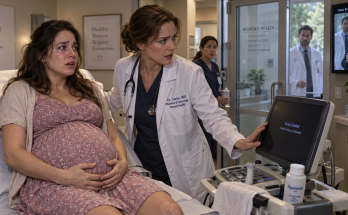
My daughter was fifteen when she finally looked at me and whispered, “I stopped telling Dad when it hurts. He says I’m just doing it for attention.” The next afternoon, I signed her out of school and took her to the hospital without telling my husband. Halfway through the scan,
the technician stopped talking. Then the doctor walked in, closed the door, and asked me one question: “How long has her father known about this?”
The exam room smelled sharply of sanitizer, and the paper beneath my daughter crackled every time she shifted. I stared at the doctor because his question made no sense.
“He doesn’t know,” I said. “I didn’t tell him we were coming.”
The doctor glanced at my daughter, then back at me. “I’m not asking about today.”
He pulled up an older entry in her chart.
Five weeks earlier, my daughter had been evaluated for the same pain. Her father was listed as the parent who brought her in. The note said additional imaging had been recommended because her symptoms needed follow-up.
I hadn’t known there had been a first visit.
My daughter pulled the sleeves of her hoodie over her hands and stared at the edge of the exam bed.
“Did Dad take you?” I asked.
She nodded.
The doctor kept his voice even. He explained that what they were seeing now needed prompt attention and more testing. He wasn’t accusing anyone. He was trying to understand why the recommended follow-up had never happened.
So was I.
“What did Dad tell you after that appointment?”
She swallowed. “He said they didn’t find anything important.”
I looked at the doctor.
He didn’t contradict her. He simply turned the screen enough for me to see the earlier discharge note.
The follow-up wasn’t some casual suggestion buried at the bottom of the page. It was part of the plan.
My stomach went cold.
For months, I had watched my daughter move more slowly in the mornings. I had seen her leave half her dinner untouched. I had noticed the heating pad disappearing into her bedroom and told myself it was cramps, stress, school—something ordinary teenagers didn’t always want to discuss with their mothers.
Whenever I asked, she said she was fine.
Now “fine” sounded different.
I moved from the chair and sat beside her. “You are not in trouble. I need the truth, even if you think it’s going to make me angry.”
Her eyes filled, but she kept looking at me.
“He got mad after the appointment,” she said. “He said you were already stressed about money and work, and I was making everything worse.”
That sounded painfully familiar. My husband had always hated problems he considered unnecessary drama—a missed shift, an unexpected bill, anything that couldn’t be fixed quickly and forgotten.
Still, part of me kept searching for an explanation I could live with.
Maybe he misunderstood the instructions. Maybe he believed the pain had passed. Maybe my daughter had heard fear in words he hadn’t meant that way.
Then the doctor asked her one simple question.
“Did your father ever tell you not to tell your mother about the follow-up?”
My daughter’s fingers tightened inside her sleeves. She pulled one sleeve farther over her hand and nodded.
PART 2 — THE PAIN HE TAUGHT HER NOT TO TRUST
My daughter nodded.
Just once.
The smallest movement.
But it divided my marriage into a before and an after.
Her father had told her not to tell me.
I stared at Maya.
At the sleeves pulled over her hands.
At the dark circles beneath her eyes I had blamed on homework.
At the careful way she sat because moving too quickly hurt.
Then I looked at the doctor.
“What exactly did my husband know?”
He did not answer immediately.
He turned toward the chart.
“My name is Dr. Samuel Ortiz,” he said gently. “Before I explain the current scan, I want to make sure Maya is comfortable with us discussing everything in front of you.”
That question almost broke me.
Not because it was complicated.
Because someone was asking my daughter what she wanted.
Maya nodded.
“Yes.”
Dr. Ortiz pulled his chair closer.
“All right.”
Then he looked at me.
“Your daughter has a large mass in her lower pelvis. It appears to arise from her right ovary.”
The room tilted.
“A mass?”
“Yes.”
“What kind?”
“We don’t know yet.”
Cancer.
The word arrived in my head before anyone said it.
Dr. Ortiz must have seen my face.
“Mass does not automatically mean cancer.”
He said it firmly.
“There are many ovarian masses in adolescents that are benign.”
“But the size and appearance mean we need to take it seriously.”
“How big?”
He glanced at the screen.
“A little over twelve centimeters.”
I stared.
Twelve centimeters.
I knew nothing about ovaries.
Nothing about adolescent gynecology.
But twelve centimeters sounded enormous inside the body of my fifteen-year-old daughter.
Maya whispered:
“Is that why it hurts?”
Dr. Ortiz turned toward her.
“Very likely.”
No hesitation.
No dismissal.
No accusation that she wanted attention.
Just an answer.
Maya lowered her head.
Then began to cry.
I reached for her.
She folded against me so quickly I understood something terrible.
She had been waiting months for someone to tell her the pain was real.
Not necessarily dangerous.
Not cancer.
Not surgery.
Just real.
I held her while she cried into my shoulder.
“I’m sorry.”
I whispered.
She shook her head.
“No.”
“I should’ve—”
“No, Mom.”
Her voice broke.
“You didn’t know.”
That did not absolve me.
But I let her say it.
Dr. Ortiz waited before continuing.
“There is something else we are concerned about.”
Of course there was.
“What?”
“The blood flow to the right ovary is not normal.”
My stomach tightened.
He explained carefully.
The ovary appeared enlarged around the mass.
On Doppler imaging, the blood flow was reduced.
That could happen if the ovary had twisted around the tissues supporting it.
Ovarian torsion.
I had never heard the phrase before.
Maya stared.
“Twisted?”
“Yes.”
Dr. Ortiz said.
“Sometimes an ovarian cyst or mass makes the ovary heavier and more likely to rotate.”
“If it twists enough, blood supply can be reduced.”
“Is that happening now?”
“We think it may be.”
“Can you untwist it?”
“That is why I’m calling pediatric gynecology now.”
My heart started pounding.
“Now?”
“Yes.”
“We are not sending Maya home.”
That sentence turned fear into reality.
I had driven to the hospital believing I was finally being a cautious mother.
Maybe we would discover painful periods.
A cyst.
Constipation.
Something treatable with medication and reassurance.
Instead, the doctor was telling me my daughter might need surgery before dinner.
I looked at Maya.
She looked terrified.
So I did the hardest thing I had done all afternoon.
I made my face calm.
Not cheerful.
Not fake.
Calm.
“Okay.”
I said.
“Then we do what we need to do.”
Maya whispered:
“Dad’s going to be mad.”
Everything inside me stopped.
Not:
Am I going to be okay?
Not:
Will I lose my ovary?
Her first fear was her father’s reaction.
I looked at her.
“Your dad’s feelings are not your responsibility right now.”
She stared at me as though I had spoken a language she had never heard.
I repeated it.
“Do you understand?”
A tear slid down her cheek.
“Yeah.”
“No.”
I squeezed her hand.
“Really understand.”
“He is allowed to feel whatever he feels.”
“But you are sick, Maya.”
“You are not in trouble for being sick.”
Her mouth folded.
That was when I realized someone had taught my daughter that pain itself could be misconduct.
A nurse came in to start an IV.
Before touching Maya, she said:
“I’m going to clean your arm and place a small catheter. Is that okay?”
Maya nodded.
Another question.
Another yes.
The day seemed full of them.
I began noticing every one.
Maybe because our house had stopped asking.
While we waited for the pediatric gynecology team, I asked Dr. Ortiz about the previous appointment.
“What happened five weeks ago?”
He opened the note.
Maya shifted beside me.
I held her hand.
He read carefully.
Maya had been brought to an urgent-care clinic connected to the hospital system.
Complaint:
Intermittent right-sided lower abdominal pain.
Reduced appetite.
Occasional nausea.
Pain worsening with physical activity.
She had tenderness during the examination.
The physician had recommended pelvic imaging.
Not necessarily an emergency scan at that moment, because Maya’s symptoms had improved during the visit and her vital signs were stable.
But imaging within days.
Follow-up with her pediatrician or adolescent gynecology.
Return immediately for severe pain, vomiting, fever, fainting, or worsening symptoms.
Clear.
Specific.
Written.
“What did David say?”
I asked.
Dr. Ortiz hesitated.
Then turned the screen.
Under the plan:
Father declines imaging today due to cost concerns. States family will arrange outpatient study through primary physician.
My skin went cold.
Cost concerns.
David earned more than I did.
We had insurance.
A high deductible, yes.
But we were not choosing between groceries and medical care.
Then I read the next sentence.
Father states mother is aware and agrees with outpatient plan.
I stopped breathing.
“I was not aware.”
Dr. Ortiz nodded.
“I understand.”
“I didn’t agree to anything.”
“I’m documenting that.”
The clinical simplicity of those words steadied me.
Documenting.
Not arguing.
Not guessing.
Correcting the record.
I turned toward Maya.
“Did Dad tell you we couldn’t afford the scan?”
She pulled her sleeves tighter.
“Sort of.”
“What did he say?”
“He said insurance barely pays for anything anymore.”
That sounded like David.
Then:
“He said if we ran to a hospital every time I had cramps, we’d never pay off the house.”
I closed my eyes.
We were not in danger of losing the house.
Not even close.
“Did he say anything else?”
Maya looked at the floor.
“Maya.”
“He said you already worry too much.”
The old familiar phrase.
Rachel worries.
Rachel makes things bigger.
Rachel catastrophizes.
My name is Rachel Bennett.
For sixteen years, David had made my anxiety into a family joke.
Sometimes deservedly.
I did worry.
I checked doors twice.
Read medication side effects.
Called if someone was late.
But somewhere along the way, my husband had discovered that calling me anxious was easier than answering me.
Now he had used my supposed anxiety as a reason to keep me uninformed.
“What happened after the appointment?”
I asked.
Maya looked embarrassed.
“He got mad in the car.”
“Because?”
“I asked when we were getting the scan.”
My chest tightened.
“He said the doctor was covering herself.”
“What does that mean?”
“He said doctors always order extra tests so they can’t get sued.”
Dr. Ortiz looked away.
Professional restraint.
I appreciated it.
Maya continued.
“Then he said the pain would go away if I stopped focusing on it.”
“And when it didn’t?”
She shrugged.
“I stopped telling him.”
There it was.
The sentence that had started everything.
I stopped telling Dad when it hurts.
I asked:
“Why didn’t you tell me?”
She began crying again.
“I almost did.”
“When?”
“A lot.”
That answer destroyed me.
“At night sometimes.”
“I’d come to your room and then Dad would be there.”
“He’d ask what I needed.”
“So I’d say nothing.”
I thought of every night I had looked up from my laptop and seen Maya hovering in the bedroom doorway.
Every time I said:
“You okay, sweetheart?”
And she answered:
“Yeah.”
David beside me.
Reading.
Watching television.
Breathing normally.
I had thought her teenage silence was privacy.
It had partly been fear.
“Did he specifically tell you not to tell me?”
Dr. Ortiz asked.
Maya nodded.
“What words did he use?”
She swallowed.
“He said, ‘Your mother does not need another thing to obsess over.’”
My eyes closed.
Then:
“He said if I made you panic, it would be selfish.”
I made a sound I did not recognize.
Not quite crying.
Not quite anger.
Something between grief and nausea.
My fifteen-year-old daughter had been in pain and had been taught that telling me would be selfish.
I looked away because I could not let her see what that sentence did to me.
Then Maya whispered:
“I’m sorry.”
I turned back instantly.
“No.”
“Not that word.”
She startled.
“You do not apologize for this.”
“Ever.”
Her chin trembled.
I touched her face.
“You hear me?”
“Yes.”
The pediatric gynecologist arrived twenty minutes later.
Dr. Leila Morgan.
She was younger than I expected.
Dark curls pulled into a loose bun.
Blue scrubs.
She sat at Maya’s eye level instead of standing over her.
“I’ve looked at your imaging.”
She said.
“I’m worried your right ovary may be twisting around the mass.”
Maya nodded.
Apparently she had already memorized the word.
“Torsion.”
“Exactly.”
“Do I need surgery?”
“Yes.”
My daughter’s hand tightened around mine.
Dr. Morgan continued quickly.
“Our goal is to preserve the ovary if we can.”
“We’ll look laparoscopically first.”
“If it’s twisted, we untwist it.”
“The mass will need to be managed too.”
“What kind of mass is it?”
I asked.
“We cannot tell with certainty from ultrasound alone.”
She showed us the images.
Complex.
Partly cystic.
Partly solid.
Words that made my heart pound even though I barely understood them.
“There are benign masses that look like this.”
She said.
“There are also tumors that require additional treatment.”
“We’ll send appropriate tissue for pathology.”
Cancer again.
Still not spoken.
Still in the room.
Maya asked:
“Am I going to lose my ovary?”
Dr. Morgan did not lie.
“I don’t know.”
“If the tissue is badly damaged or if we find something that makes removal medically necessary, that possibility exists.”
“But adolescent ovaries can sometimes recover even when they look very compromised at first.”
“So we try to save it whenever safely possible.”
Maya nodded.
Then:
“Can I still have kids with one?”
My heart cracked.
Dr. Morgan answered gently.
“Yes.”
“Many people with one healthy ovary become pregnant normally.”
“But we are not deciding you only have one yet.”
“First we take care of what is happening today.”
Maya breathed out.
“Okay.”
Then Dr. Morgan looked at me.
“We need consent.”
I reached for the clipboard automatically.
She stopped me.
“Both of you.”
I stared.
“Maya is a minor, so you will provide legal consent.”
“But this is her body.”
“I want her involved in every decision she can understand.”
I looked at my daughter.
Her eyes filled.
Mine too.
Dr. Morgan explained the surgery again.
This time to Maya.
Not around her.
Not through me.
To her.
Risks.
Bleeding.
Infection.
Damage to nearby structures.
Potential removal of the right ovary or tube if necessary.
Pathology.
Possibility of additional procedures depending on what they found.
Maya asked questions.
Good questions.
Then Dr. Morgan asked:
“Are you comfortable proceeding?”
Maya whispered:
“Yes.”
Only then did I sign.
My phone had been vibrating inside my purse for almost twenty minutes.
David.
Of course.
I had not told him where we were.
The school must have called because I signed Maya out.
Or he had checked the family location app.
I remembered we all shared locations.
I pulled out my phone.
Six missed calls.
Three messages.
Why is Maya at the hospital?
Rachel, answer me.
Then:
You are turning this into something again.
I stared at that sentence.
Something inside me became incredibly calm.
I did not respond.
Instead, I turned off location sharing.
For both Maya and me.
A hospital social worker named Nina Patel came to speak with us before surgery.
She did not accuse David of abuse.
She did not tell me to divorce him.
She asked questions.
Had Maya missed medical care before?
Did she feel afraid at home?
Had anyone physically hurt her?
Did she feel safe returning home after hospitalization?
Did David control access to medication or transportation?
Did I have another safe place to stay if conflict escalated?
Each question stripped away one excuse at a time.
Maya said her father had never hit her.
Never threatened to.
He loved her.
She said that too.
Important.
Then she said:
“But he gets mad when people are sick.”
Nina tilted her head.
“What do you mean?”
Maya thought.
“When Mom gets migraines, he says she ruins weekends.”
I stared at her.
She continued.
“When I had strep last year, he said I probably could’ve gone to school.”
“When Grandma had surgery, Dad said everybody made too much of it.”
Pattern.
Not violence.
Something else.
A household where illness was treated like inconvenience.
Where needing care carried moral weight.
Where pain had to earn permission before anyone believed it.
Nina asked:
“Does your father ever prevent you from taking medication?”
“No.”
“Prevent appointments?”
Maya hesitated.
“This one.”
Five weeks ago.
One known failure.
Enough to investigate.
Not enough to rewrite our entire life.
I appreciated Nina’s restraint.
Then she asked me:
“Mrs. Bennett, do you have access to your family’s health insurance information?”
“Yes.”
“Bills?”
“Mostly.”
“Mostly?”
“David handles the online insurance portal.”
Nina nodded.
“Would you be comfortable checking whether there were claims related to Maya’s earlier visit?”
I stared.
Of course.
Records.
I had spent the last hour asking what David said.
Maybe the billing history could show what happened.
I logged in from my phone.
Password failed.
Again.
Failed.
David had changed it.
My stomach tightened.
I requested a reset.
The verification email came to our shared account.
I got in.
There was the urgent-care claim from five weeks earlier.
Then another charge caught my eye.
Eight months earlier.
Same hospital system.
Different urgent-care location.
Patient:
Maya Bennett.
I stopped breathing.
“What?”
Nina asked.
I turned the screen toward her.
“I didn’t know about this either.”
Maya looked confused.
“I don’t remember going there.”
Then her face changed.
“Oh.”
“What?”
She stared at me.
“That was when you were in Cleveland with Grandma.”
My mother had undergone knee replacement.
I had spent six days in Ohio.
David stayed home with Maya.
“What happened?”
I asked.
“My stomach hurt after soccer.”
“You told me you pulled a muscle.”
“Dad said that.”
The room became cold.
Nina did not speculate.
She said:
“We’ll ask the medical team whether those records can be reviewed as part of her current care.”
Again.
Process.
Thank God for people who did not leap as quickly as my fear.
They took Maya to surgery at 5:42 p.m.
The hallway doors closed behind her.
And suddenly I had no child to take care of.
Only a phone full of missed calls from my husband and a chair beside a vending machine.
That was when I called him.
He answered on the first ring.
“Rachel.”
Angry.
Not scared.
Angry.
“What did you do?”
The question told me everything about where his mind was.
Not:
Is Maya okay?
What did you do?
I whispered:
“She’s in surgery.”
Silence.
Then:
“What?”
“She has a twelve-centimeter ovarian mass.”
Another silence.
“They think the ovary twisted.”
“Rachel—”
“You knew she needed imaging five weeks ago.”
He exhaled sharply.
“So that’s what this is about.”
I nearly dropped the phone.
“What this is about?”
“The doctor at urgent care was being overly cautious.”
David said.
My hand tightened around the phone.
“She is in an operating room.”
“I didn’t know that was going to happen.”
“No.”
“You knew she was hurting.”
“She always has something.”
My blood turned cold.
“She is fifteen.”
“Exactly.”
“Teenagers are dramatic.”
There.
Maya had not invented his words.
Not misunderstood his tone.
He believed them.
I asked:
“Why did you tell the clinic I agreed to delay the scan?”
Silence.
“David.”
“It was easier.”
My heart stopped.
“What?”
“The doctor kept pushing.”
“I told him we’d discuss it as a family.”
“No.”
“You told them I knew and agreed.”
“I knew what you would say.”
That sentence changed something fundamental.
He had not spoken for me because he could not reach me.
He had spoken for me because he believed predicting my answer gave him ownership of it.
“You lied.”
“Rachel, stop.”
“No.”
“You lied.”
“I handled it.”
“No.”
I stood in the hospital corridor.
“You hid it.”
His voice hardened.
“Do you know what that scan would have cost?”
There it was.
Money.
At last.
“How much?”
“Our deductible is terrible.”
“How much, David?”
“I don’t know exactly.”
“Then what are we talking about?”
He became quiet.
That scared me.
“How bad are things?”
I asked.
“What things?”
“Our finances.”
“Don’t change the subject.”
“I’m not.”
“Why were you so worried about the cost of imaging that you ignored a doctor?”
“We’ve had expenses.”
“What expenses?”
Silence.
Then:
“I’ll explain at home.”
“No.”
My answer surprised both of us.
“We are not doing this at home.”
“Rachel.”
“Maya is in surgery because a mass was allowed to grow without the recommended follow-up.”
“You do not get to decide where this conversation happens.”
He hung up.
I stood there trembling.
Nina appeared at the end of the hallway.
She did not ask what he said.
She simply handed me water.
Sometimes kindness is letting someone speak after their body catches up.
I told her everything.
She wrote notes.
Then she said:
“Do you want him here?”
I had never been asked whether I wanted my husband somewhere our family was experiencing an emergency.
He was the father.
Of course fathers came.
That had always been the assumption.
I thought about Maya saying:
Dad’s going to be mad.
“No.”
The answer hurt.
Still true.
“Not until Maya is awake and can say what she wants.”
Nina nodded.
Security was informed.
Not because David was violent.
Because the patient had expressed fear of his anger and I requested space.
Boundaries did not require bruises.
I was learning that quickly.
Dr. Morgan came out almost three hours later.
I stood too fast.
“How is she?”
“Stable.”
My knees weakened.
“The ovary had twisted twice around its supporting structures.”
I covered my mouth.
“We untwisted it.”
“What about the ovary?”
“It began showing signs of improved blood flow.”
I started crying.
“So you saved it?”
“We preserved it.”
She corrected gently.
“We’ll monitor.”
“I don’t want to promise more than we know yet.”
Fair.
Always fair.
“What about the mass?”
“We removed the cystic mass while preserving as much normal ovarian tissue as possible.”
“Do you know what it is?”
“Not yet.”
“Pathology needs to examine it.”
“Was it cancer?”
“I cannot answer that tonight.”
My relief stopped at the edge of another fear.
Still.
Maya was alive.
Her ovary remained.
Tomorrow could wait five minutes.
When Maya woke, she was groggy and nauseated.
Her first question was:
“Did you tell Dad?”
I held her hand.
“Yes.”
Her eyes filled.
“Is he here?”
“No.”
She visibly relaxed.
That was all I needed.
Later, when she was more alert, Nina asked whether Maya wanted David to visit.
Maya looked guilty.
“I don’t know.”
“That’s allowed.”
Nina said.
“I don’t want him yelling.”
“He won’t be permitted to yell at you here.”
Maya thought.
“Can Mom stay?”
“Yes.”
“Then maybe tomorrow.”
Her choice.
Good.
At nearly midnight, while Maya slept, I opened the records from the visit eight months earlier.
The note was more detailed than I expected.
Fourteen-year-old female.
Intermittent right lower abdominal and pelvic pain after activity.
Symptoms reported on and off for several months.
Tenderness.
No fever.
No acute surgical signs at that moment.
The clinician recommended pelvic ultrasound because the pain had been recurring.
My heart started pounding.
Then I reached the bottom.
Father declines emergency-department transfer and states symptoms have occurred previously. Plans follow-up with pediatrician.
Previously.
I stared.
How previously?
Then another line:
Father reports prior outside imaging approximately six months ago showed “small ovarian cyst” and was reportedly considered benign. Records unavailable.
My hands went numb.
Outside imaging.
Six months before that visit.
More than a year ago.
I looked at sleeping Maya.
She had been thirteen.
I had never known she had an ultrasound.
Never known anyone had found a cyst.
I called Nina.
She returned ten minutes later.
I handed her my phone.
“There was an earlier scan.”
She read.
“Maybe.”
“It says there was.”
“It says her father reported one.”
Important distinction.
“Can we find it?”
“We can try.”
Maya stirred.
Her eyes opened.
“Mom?”
“I’m here.”
She saw my face.
“What happened?”
I sat beside her.
“Sweetheart, do you remember having an ultrasound when you were thirteen?”
She frowned.
“Ultrasound?”
“Maybe for stomach pain?”
Her face stayed blank.
Then:
“Was that the machine where they put jelly on you?”
My heart stopped.
“Yes.”
“Oh.”
She closed her eyes again.
“Dad took me.”
“When?”
“I don’t know.”
“What did he say afterward?”
She was half asleep.
Her answer came slowly.
“He said it was nothing.”
My throat tightened.
“Did he tell me?”
Maya opened her eyes.
“No.”
“How do you know?”
She looked confused.
Then whispered:
“Because he told me not to.”
Everything inside me went cold.
Again.
Not five weeks.
Not eight months.
More than a year.
The next morning, medical records found the outside imaging center.
Different health network.
Same insurance.
The report arrived just after nine.
I sat beside Maya’s hospital bed while Dr. Morgan opened it.
Ultrasound.
Fourteen months earlier.
Right ovarian lesion.
Approximately four centimeters.
Probably benign appearing at the time.
Recommendation:
Repeat ultrasound in six to twelve weeks to confirm stability or resolution.
Four centimeters.
Then.
Twelve now.
No one could say the delay alone caused what happened.
Cysts change.
Some grow.
Some resolve.
Torsion can happen unpredictably.
I needed to remember that.
But beneath the report was a scanned communication note.
The imaging center had called with results.
The parent reached was David.
The note read:
Father informed that lesion requires follow-up imaging. Father verbalizes understanding. States he will arrange through primary pediatrician.
He had known.
Fourteen months.
And he had never arranged it.
Then I saw the attached registration form.
Emergency contact.
Mother:
Rachel Bennett.
Phone number correct.
At the bottom was a handwritten note from staff:
Father requests all result calls go to him. States mother becomes highly anxious and he manages daughter’s medical care.
I stared until the words blurred.
David had not merely failed to tell me.
He had built a system around not telling me.
And while I was sitting there trying to understand how a twelve-centimeter mass had grown inside my daughter without me knowing, my phone lit up with a message from him.
You need to stop turning Maya against me. I did what I thought was best.
I looked at my sleeping daughter.
At the IV in her arm.
At the small surgical dressings beneath her blanket.
Then back at the fourteen-month-old report.
Four centimeters.
Follow-up required.
Father informed.
And suddenly I understood that the question was no longer why David ignored one appointment five weeks ago.
The real question was how many times my daughter had asked him for help before she finally learned to stop asking at all.
PART 3 — THE PAIN SHE LEARNED TO NAME
For fourteen months, my husband had known there was something growing inside our daughter.
Not something obviously deadly.
Not something doctors had told him would become an emergency.
That distinction mattered.
The first ultrasound had shown a four-centimeter ovarian lesion that looked likely benign.
The recommendation had been simple.
Repeat the scan.
Make sure it disappeared.
Or stayed small.
Or, if it changed, deal with it before uncertainty became danger.
David had been told.
He had said he understood.
Then he brought Maya home and told her it was nothing.
Fourteen months later, surgeons untwisted an ovary wrapped twice around its own blood supply and removed a mass three times the size it had been when someone first told her father to follow it.
I sat beside my daughter’s hospital bed with that knowledge inside me and understood that marriages do not always end when someone cheats.
Sometimes they end when a sentence finally explains too many years.
Your mother becomes highly anxious. I manage our daughter’s medical care.
David had written me out of my own child’s body.
Maya woke shortly after nine that morning.
She looked exhausted.
Pale.
A little swollen from fluids.
Her hair was tangled against the pillow.
She opened her eyes, found me immediately, and whispered:
“Did you find the old scan?”
I stared at her.
She had heard more than I thought.
“Yes.”
Her face changed.
“He knew?”
“Yes.”
She looked toward the window.
Nothing dramatic happened.
No screaming.
No sobbing.
That frightened me more.
She simply became very still.
Then she asked:
“How long?”
“Fourteen months.”
Her lower lip trembled.
“Oh.”
I reached for her hand.
She let me take it.
For several minutes, we sat without speaking.
Then Maya said:
“So when he told me it was just cramps…”
I swallowed.
“He already knew there had been a cyst.”
“And when I said it kept hurting?”
“Yes.”
She closed her eyes.
The monitor beside her continued counting heartbeats that suddenly seemed too loud.
“I thought I was weak.”
Her voice was barely audible.
I leaned closer.
“What?”
“I thought everyone got pain like this and I was just bad at handling it.”
My throat closed.
“Maya.”
“Dad said if something was really wrong, I wouldn’t be able to go to school.”
I thought of every morning she had dragged herself downstairs.
Every time she had stood at the kitchen counter pale and silent while David said:
“See? Once she gets moving, she’s fine.”
She had not been proving she was fine.
She had been performing fine because we had taught her that being functional was the price of being believed.
I bent over her hand.
“I am so sorry.”
She looked at me.
“You didn’t know.”
“I should have known something.”
“How?”
The question was not angry.
That made it worse.
“I’m your mother.”
Maya frowned weakly.
“That doesn’t make you psychic.”
I laughed and cried at the same time.
Apparently anesthesia had made my daughter wise.
Dr. Morgan came in later that morning.
She examined the surgical sites.
Checked pain.
Reviewed blood work.
Then she asked Maya if she wanted to see the postoperative images.
Maya did.
So did I.
Dr. Morgan showed us the ovary after it had been untwisted.
It had looked dark initially because the blood supply had been compromised.
Over time in the operating room, color began returning.
Blood-flow signals improved.
“That’s encouraging.”
Dr. Morgan said.
“Will it be normal?”
I asked.
“We’ll know more with follow-up.”
There it was again.
No promises.
Just the next honest step.
Maya asked:
“Did waiting cause the torsion?”
Dr. Morgan paused.
Then answered carefully.
“The larger an ovarian mass becomes, the greater the risk that the ovary can twist.”
“So if they had taken it out when it was smaller…”
“We cannot say with certainty that torsion would never have happened.”
Dr. Morgan said.
“But earlier follow-up could have identified that the lesion was growing.”
“And that could have led to treatment before it reached this size.”
Could.
Not definitely.
Enough.
Maya nodded.
She did not ask anything else.
Pathology would take several days.
Those days were terrible.
Every time a doctor used the word mass, my brain silently added cancer.
Every time Maya asked whether she could go home, I imagined oncology wards.
Hair loss.
Chemotherapy.
Things nobody had told me were happening.
Fear loves unfinished sentences.
Dr. Morgan kept reminding us:
“The most likely possibilities in someone Maya’s age are benign.”
Most likely.
I held onto those words like a railing.
David arrived at the hospital shortly after noon.
Security called my room.
“Mr. Bennett is downstairs.”
My body tightened.
Maya heard.
She stared at me.
“What do you want?”
I asked.
Not:
Should your father come up?
What do you want?
She swallowed.
“I don’t know.”
“Then he waits.”
Her eyes filled.
“Is that mean?”
“No.”
“Will he be mad?”
“Probably.”
She looked frightened.
I continued:
“And he can be mad downstairs.”
For the first time, Maya smiled.
Small.
But real.
David called me instead.
I stepped into the hallway.
“Rachel, this is ridiculous.”
Not hello.
Not how is she.
“This is my daughter.”
“Yes.”
“Then tell security to let me upstairs.”
“Maya isn’t ready to see you.”
“She’s fifteen.”
I went still.
“What is that supposed to mean?”
“It means she is a child.”
“And you are using her confusion to punish me.”
There it was.
Even now, Maya’s opinion became my manipulation the moment it inconvenienced him.
I closed my eyes.
“No.”
I said.
“She is scared of you being angry.”
“That is absurd.”
“She relaxed last night when she found out you weren’t here.”
Silence.
Then:
“You’ve been filling her head.”
“No, David.”
My voice became very calm.
“That is what you keep telling yourself whenever another person has a thought you didn’t authorize.”
He hung up.
I did not call back.
The hospital made a report to child-protection authorities that afternoon.
Nina explained why before anyone contacted us.
She did not say:
Your husband is a monster.
She said:
“We have a minor with a serious medical condition, documented recommendations for follow-up on more than one occasion, and information suggesting one parent knowingly did not obtain that follow-up and discouraged the child from telling the other parent about symptoms.”
That was enough to require review.
I nodded.
Maya looked terrified.
“Are they taking me away?”
“No.”
Nina answered immediately.
“This is not about punishing you.”
“They may talk with you.”
“With your mother.”
“With your father.”
“They may review records.”
“But you have done nothing wrong.”
Maya looked at me.
I squeezed her hand.
“You hear that?”
She nodded.
The investigator met us the following day.
Her name was Carla Mendes.
She wore ordinary clothes and carried a notebook.
No intimidating badge displayed.
She spoke to Maya without me first.
I hated that.
Still agreed.
Because my daughter needed at least one room where my feelings were not part of the furniture.
Afterward, Carla spoke with me.
She asked questions I did not enjoy answering.
Had David controlled medical decisions before?
Had I ever disagreed with him about seeking care?
Had he concealed information from me in other areas?
Did Maya fear him?
Was there physical violence?
No.
No violence.
That mattered.
Had I ever felt financially controlled?
I hesitated.
“Not exactly.”
“What does exactly mean?”
I thought of insurance passwords.
Bills David handled.
The way he dismissed purchases by saying:
“I already ran the numbers.”
“I let him manage most finances.”
“Could you access them?”
“I thought I could.”
Thought.
That word became another doorway.
That evening, I went home alone.
Not to stay.
To collect clothes.
Maya would remain hospitalized another night.
My sister, Lauren, was coming to sit with her while I showered and gathered things.
Walking into our house felt strange.
Nothing had changed.
Shoes by the door.
David’s coffee mug in the sink.
Maya’s backpack near the stairs.
A load of towels still inside the dryer.
Ordinary houses are cruel that way.
They can look innocent after something inside them changes forever.
David was not there.
Good.
I went straight to the office.
For sixteen years, that room had been his.
Taxes.
Bills.
Insurance.
Mortgage.
I had access, technically.
Or believed I did.
I opened the filing cabinet.
Started reading.
The truth about our finances was not dramatic enough to be a crime.
It was simply bad enough to explain fear.
Credit-card balances.
A personal loan.
Another loan I had never seen.
Statements from an investment account with withdrawals far larger than deposits.
I sat on the floor.
Added numbers twice.
Then again.
Almost $48,000 in unsecured debt.
More than half had accumulated over eighteen months.
My stomach turned.
What had he bought?
I kept reading.
Transfers to a company called Northstar Home Ventures LLC.
David had mentioned Northstar once.
A coworker’s side project buying distressed properties, renovating them, and reselling them.
He told me he had considered investing.
Apparently he had done more than consider.
The investment had failed.
One property sat unfinished.
Another sale collapsed.
David kept covering losses with borrowed money because he believed the next sale would repair the first mistake.
It did not.
I sat at his desk.
My anger became complicated.
For the first time, the obsession with medical bills made sense.
Not moral sense.
Practical sense.
He had been terrified I would discover the debt.
The deductible.
The insurance statements.
A specialist visit.
Imaging.
All of it threatened to pull me into accounts he had quietly taken over.
He was not refusing Maya’s scan because we literally could not pay for it.
He was refusing because paying for it might expose what else he had spent.
That was worse.
Not financially.
Emotionally.
Our daughter’s pain had become something he needed to stay inexpensive so his secret could remain comfortable.
I photographed everything.
Then called an attorney.
Not a mysterious powerful friend.
A family-law attorney recommended by Lauren.
Jasmine Lee.
I explained enough.
Medical neglect investigation.
Hidden debt.
A hospitalized fifteen-year-old afraid of her father’s anger.
Jasmine listened.
Then said:
“Do not empty accounts.”
“I wasn’t going to.”
“Good.”
“Do not change locks unless safety planning requires it or counsel advises.”
“Okay.”
“Preserve documents.”
“I am.”
“And tonight, stay wherever you and Maya feel safe.”
No cinematic instructions.
No revenge.
Just structure.
Exactly what I needed.
David came home before I left.
He stopped when he saw the papers on the desk.
His face changed.
Not shock.
Recognition.
“You went through my files.”
“Our files.”
He closed the office door.
I hated the sound.
Not because I thought he would hurt me.
Because I suddenly understood how many conversations in our marriage had taken place behind doors he controlled.
“What is Northstar?”
He exhaled.
“Rachel.”
“How much did you lose?”
“It’s complicated.”
“How much?”
He looked at the floor.
“Thirty-two.”
“Thirty-two thousand?”
“Initially.”
I laughed once.
Horrible sound.
“What does initially mean?”
“There were carrying costs.”
“Loans.”
“Interest.”
He rubbed his forehead.
“Forty-six, maybe forty-eight.”
I stared.
“You let our daughter stay in pain because you didn’t want me finding out we owed forty-eight thousand dollars?”
His face hardened.
“No.”
“Then explain it.”
“I thought the cyst was benign.”
“It probably is.”
I said.
“That isn’t the point.”
“The first doctor said it looked benign.”
“And said follow up.”
“She was functioning.”
“She was hurting.”
“Teenagers hurt.”
I stared.
There.
Again.
Even now.
Not a single bad decision.
A worldview.
“If she’d been vomiting or passing out, obviously I would have taken her.”
“She did not have to collapse to deserve care.”
“I didn’t say that.”
“You taught her that.”
His mouth closed.
I continued.
“You told a clinic I agreed to delay imaging.”
“I knew you’d insist on doing it.”
“Yes.”
“Exactly.”
He said it as though he had won something.
I stared at him.
“You understand that makes it worse?”
His expression faltered.
“I was trying to keep us afloat.”
“No.”
“You were trying to keep me from knowing.”
“That investment was supposed to fix our finances.”
“What finances?”
I almost shouted.
“We were fine before you borrowed money to fix a problem we did not have.”
He flinched.
Good.
Truth deserved impact too.
Then David said:
“You panic about everything.”
The sentence came so naturally he probably did not hear himself.
I did.
For the first time, completely.
My anxiety had become the universal solvent he poured over every lie.
“You panic.”
Therefore I choose.
You worry.
Therefore I withhold.
You overreact.
Therefore I decide what counts as reality before you get a chance to see it.
I looked at him.
“I am done letting you use my fear as proof that I don’t deserve information.”
He stared.
“Rachel—”
“No.”
I picked up my bag.
“Maya and I are staying with Lauren when she leaves the hospital.”
“You can’t take her from me.”
“I’m not making permanent decisions tonight.”
“Then why—”
“Because she needs somewhere she can say ‘it hurts’ without somebody getting angry.”
His face changed.
That finally reached him.
For one second.
Then he looked away.
Pathology came back on the fourth day.
Dr. Morgan entered holding the report.
I stood.
Maya sat straighter.
Dr. Morgan smiled.
That was all I needed.
“Benign.”
she said.
Maya burst into tears.
I did too.
The mass was a benign ovarian cystadenoma.
Large.
Real.
Not cancer.
No chemotherapy.
No oncology plan.
No hidden second catastrophe.
Just something that had grown quietly and eventually helped twist the ovary.
Maya covered her face.
“Oh my God.”
I held her.
For the first time since the emergency room, relief entered without dragging another fear behind it.
Dr. Morgan reminded us we were not finished.
Follow-up imaging.
Watching the ovary recover.
Monitoring for recurrence.
Paying attention to new pain.
But the immediate danger had passed.
Before leaving, she looked at Maya.
“I want you to hear this.”
Maya nodded.
“Pelvic pain is common.”
“Some pain turns out to be minor.”
“Some pain does not.”
“Your job is not to decide whether it is important enough before telling someone.”
Maya stared.
“Your job is to tell us what you feel.”
“Our job is to help figure out why.”
I could have hugged Dr. Morgan.
I did not.
Professional boundaries.
Growth everywhere.
Maya came home to Lauren’s house two days later.
David was allowed to call.
Maya did not answer at first.
He texted.
Not dozens.
One.
I’m sorry. I love you. I’ll wait until you want to talk.
I wanted to criticize the message.
Too vague.
Too easy.
Then reminded myself it was Maya’s.
Not mine.
She read it.
Locked her phone.
Said nothing.
Good.
Her timing.
The temporary family-court arrangements came quickly because of the medical situation.
Not permanent.
Not a declaration that David could never parent again.
I received primary physical custody while the case was reviewed and temporary authority over Maya’s medical decisions.
David’s contact was structured.
At first, visits happened in a neutral setting with a therapist involved because Maya said she did not want to be alone with him.
Not because she feared violence.
Because she feared being convinced her own memory was wrong.
That sentence mattered in court.
It mattered to me even more.
The child-protection investigation took weeks.
Records were reviewed.
Doctors interviewed.
David interviewed.
Me.
Maya.
The agency concluded that the concerns about delayed care and concealment were substantiated under its process.
No criminal charges followed.
People expected me to be angry about that.
I wasn’t.
What David did was serious.
But criminal law was not the only language for serious failure.
He lost trust.
He lost the presumption that he could manage Maya’s health.
He lost the marriage we had built around me believing his confidence meant competence.
Consequences existed without a jail cell.
I filed for divorce.
David cried when I told him.
So did I.
That surprised me.
I still loved parts of him.
Sixteen years do not disappear because the ending finally becomes clear.
I loved the man who danced badly at our wedding.
The father who once sat on Maya’s bedroom floor assembling a dollhouse until two in the morning.
The husband who brought me coffee after migraines even while complaining that migraines ruined plans.
People are rarely only the worst thing they did.
That did not mean I had to remain married to the person whose worst pattern had put our daughter at risk.
Love and access are different.
So are history and obligation.
David finally told Maya the truth during a therapy session three months later.
I was not in the room.
Maya told me afterward.
Not every word.
Enough.
He admitted he knew about the first cyst.
Admitted he delayed follow-up.
Admitted he lied about telling me.
Admitted money was part of it.
Then, apparently, he said:
“I thought if I treated every pain like an emergency, you would become afraid of your own body.”
Maya stared at him.
Then said:
“So you taught me not to trust it at all.”
That sentence broke him.
Good.
Some truths need to.
He apologized.
Specific this time.
Not:
I’m sorry you felt dismissed.
Not:
I was doing what I thought was best.
He said:
“I made you responsible for my fear about money.”
“I made you responsible for your mother’s anxiety.”
“I called you dramatic because it was easier than admitting I didn’t want to deal with something.”
“And I taught you that pain had to become unbearable before you deserved help.”
Maya cried.
David cried.
Then he asked:
“Can you forgive me?”
The therapist interrupted.
Apparently she said:
“That is not the question Maya needs to answer today.”
God bless therapists.
Maya did not forgive him that day.
Or the next month.
She resumed seeing him gradually.
Short visits.
Then dinners.
Never medical appointments.
Not for a long time.
David took parenting classes.
Individual therapy.
Financial counseling.
He sold his share in the failed investment for almost nothing.
Set up a debt repayment plan.
Moved into an apartment smaller than he thought he deserved.
Life did not destroy him.
It corrected him.
That was enough.
One day, about a year after the surgery, Maya had pain again.
She was sixteen.
We were eating dinner.
She stopped halfway through a bite.
Pressed one hand to her right side.
I saw fear cross her face.
“What?”
I asked.
She hesitated.
Old training.
Then:
“It hurts.”
Those two words felt enormous.
“How bad?”
“Maybe a four.”
“Sharp?”
“Kind of.”
“Do you want to call Dr. Morgan?”
She thought.
“Yes.”
So we called.
No panic.
No dismissal.
They asked questions.
The pain settled.
Follow-up imaging showed no torsion.
No recurrent mass.
Probably ordinary ovulatory pain.
Maya almost apologized for going in.
Dr. Morgan stopped her.
“No.”
She said.
“This is exactly what follow-up is for.”
Maya looked at me.
Then smiled.
That smile meant more than the normal scan.
She had told.
We had listened.
Nothing terrible happened because the answer turned out to be ordinary.
Pain did not have to uncover disaster to justify being heard.
David’s relationship with her improved slowly.
Not back to normal.
I began to hate that phrase.
Normal had included too much silence.
They built something else.
When Maya was seventeen, he attended one of her soccer games.
She had stopped playing competitively after surgery for a while.
Then returned.
David sat three rows behind me.
Not beside me.
That was our life now.
After the game, Maya came off the field limping slightly.
David saw it.
I saw him see it.
For half a second, old fear moved through me.
Then he asked:
“Are you hurt?”
Maya said:
“My ankle’s sore.”
David nodded.
“Want ice?”
“Yes.”
That was all.
No:
You’re fine.
No:
Walk it off.
No:
Don’t make this a thing.
Ice.
Question.
Answer.
Repair sometimes looks unbearably small from the outside.
Inside a family, it can feel enormous.
Our divorce became final eighteen months after Maya’s surgery.
We divided property.
Debt.
Retirement accounts.
Northstar losses.
Nothing dramatic.
David remained responsible for his share of the debts he had created, subject to the legal settlement.
I kept the house for a while, then sold it.
Too many rooms held versions of us I did not want to keep maintaining.
Maya helped me pack.
In the kitchen, we found the old heating pad.
Folded in the back of a cabinet.
She held it up.
“Remember this?”
I did.
For months, that thing had disappeared into her bedroom.
A clue sitting in plain sight.
I expected guilt.
It came.
Then Maya said:
“Mom.”
I looked at her.
“Stop.”
“What?”
“You’re doing the face.”
“What face?”
“The ‘I should’ve known’ face.”
I laughed.
She knew me too well.
Then she said:
“I didn’t know either.”
That was true.
Pain had been happening inside her body and even she had been taught not to interpret it accurately.
We put the heating pad in the moving box.
Not the trash.
Useful things do not become guilty because of the years around them.
At eighteen, Maya left for college.
Three hours away.
Not across the country.
I pretended that was because she loved the school.
It was partly because she knew I would otherwise text every six minutes.
Before moving day, Dr. Morgan helped transition her to an adult gynecologist.
That appointment made me emotional in a way Maya found deeply embarrassing.
She signed her own forms.
Listed her own medications.
Answered her own questions.
Then she looked at me before the exam.
“You can wait outside.”
My heart broke.
In a good way.
“Okay.”
No:
Are you sure?
Just okay.
I sat in the waiting room.
Proud enough to cry.
Embarrassed enough to pretend allergies caused it.
David helped move her into the dorm.
So did I.
Awkward.
Civil.
At one point, Maya scraped her shin against the bed frame.
She hissed.
Both David and I turned.
Then stopped.
Maya looked between us.
“Oh my God.”
We laughed.
Even David.
She pointed at him.
“I’m fine.”
Then at me.
“And you’re not allowed to Google anything.”
“No promises.”
“Mom.”
“Fine.”
David smiled.
Not the old smile.
Smaller.
Less certain.
Maybe better.
Before we left, Maya hugged him.
Longer than I expected.
He whispered something.
Later, in the parking lot, I asked nothing.
Growth.
A week afterward, Maya told me anyway.
“He said thank you for still letting him be my dad.”
I swallowed.
“What did you say?”
“That he has to keep acting like one.”
Fair.
More than fair.
Years later, people still asked what happened to Maya’s ovary.
That seems strange, but family stories simplify.
Did they save it?
Yes.
Mostly.
Follow-up imaging showed healthy blood flow and functioning ovarian tissue.
Would she have fertility problems someday?
Maybe.
Maybe not.
No doctor could promise.
At twenty-one, Maya said she was not even sure she wanted children.
I laughed.
All those years I had feared a future she had not chosen yet.
Another lesson.
Children are not plans adults get to complete for them.
They become people.
Then decide.
David never stopped regretting what happened.
I know because Maya told me, not because he kept forcing apologies onto us.
That mattered.
He eventually volunteered with a parenting program at his therapist’s suggestion.
Not as some redeemed expert.
Just another parent talking honestly about minimization.
He once told a group:
“I thought dismissing fear made my family stronger.”
“It made them quieter.”
I heard about it later.
I was glad he learned the difference.
I did not remarry him.
Understanding is not a time machine.
I remarried years later.
A man named Michael.
Kind.
Boring in the healthiest possible ways.
The first time I had a migraine while we were dating, I canceled dinner.
I waited for disappointment.
Instead he said:
“Want soup or darkness?”
I laughed so hard my head hurt worse.
“Darkness.”
“Done.”
No accusation.
No martyrdom.
No telling me the whole weekend was ruined.
I cried after hanging up.
Healing has ridiculous triggers.
Maya stood beside me at that wedding.
Twenty-four years old.
Confident.
Funny.
Still sometimes anxious about abdominal pain.
Still gets checked when something feels wrong.
She wore dark green and carried no flowers because she said bouquets were “just expensive plants we murder for photographs.”
David attended.
Sat with his sister.
We were not friends.
But we had become something more useful.
Two people who loved the same daughter and no longer confused that love with a right to control each other.
At the reception, Maya found me alone near the terrace.
“You happy?”
she asked.
“Yes.”
“Actually?”
“Actually.”
She smiled.
Then placed one hand briefly against her lower abdomen.
Old instinct made my heart jump.
I tried not to show it.
Maya noticed anyway.
“You can ask.”
I laughed.
“Does it hurt?”
“A little.”
“How much?”
“Two.”
“Do you want anything?”
She thought.
“No.”
“Okay.”
She smiled.
There it was.
All those years distilled into one ordinary exchange.
I asked.
She answered.
And I believed that her answer belonged to her.
I have spent a lot of time thinking about the sentence Maya whispered when she was fifteen.
I stopped telling Dad when it hurts.
At first, I thought the tragedy was that David did not believe her.
That was only half.
The deeper damage was that eventually Maya stopped believing herself.
She had learned to cross-examine her own body before asking for help.
Is it bad enough?
Have I waited long enough?
Will someone think I’m dramatic?
Could I be ruining everyone’s day?
That was the wound that took longest to heal.
Long after the incisions closed.
Long after pathology came back benign.
Long after the ovary recovered blood flow.
We had to teach her that pain was not a performance.
Need was not manipulation.
And attention is not something children should have to become critically ill to deserve.
I had lessons too.
I learned that being “the anxious one” in a family can become dangerous when everyone begins using the label to decide which truths you are allowed to know.
I learned that competence can become control if no one is permitted to challenge it.
I learned that loving someone who made a terrible choice does not require remaining close enough for them to make it again.
And I learned that listening is not the same thing as fixing.
Sometimes Maya calls me now and says:
“Something hurts.”
My body still wants to solve it immediately.
Doctor.
Scan.
Emergency room.
Everything.
Instead I ask:
“What do you need?”
Sometimes she says:
“Advice.”
Sometimes:
“Help making an appointment.”
And sometimes:
“Nothing. I just wanted to tell you.”
That last answer used to confuse me.
Now I understand.
Being heard is sometimes the first treatment.
David once believed the safest family was the one with fewer problems.
So he renamed problems until they disappeared.
Pain became drama.
A medical recommendation became caution.
Debt became an investment.
A lie became handling things.
Silence became peace.
But problems do not vanish when you stop naming them.
They grow in quiet places.
Sometimes from four centimeters to twelve.
Sometimes from one secret into the end of a marriage.
And sometimes, if you are lucky, someone finally says:
“It hurts.”
And someone else finally answers:
“I believe you.”
That was the sentence our family had been missing.
Not:
You’ll be fine.
Not:
Don’t worry.
Not:
It’s probably nothing.
Just:
I believe you.
Everything better began there.
THE END STORIES! THANK YOU FOR READING GOOD LUCK !❤️
Related Posts