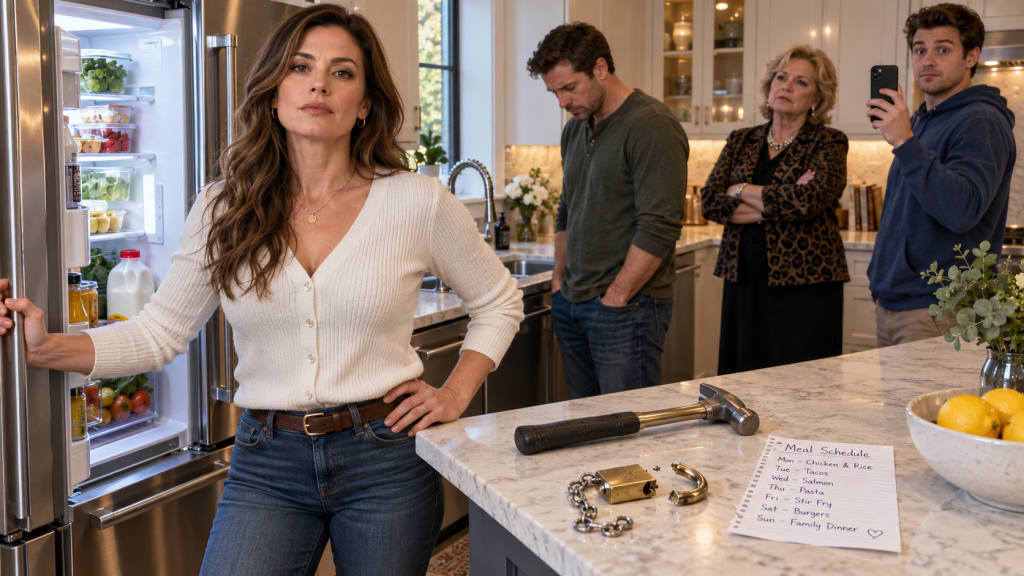
“MY MIL AND BIL MOVED IN TO JOB HUNT. ONE DAY, I CAME HOME TO FIND MY FRIDGE LOCKED. SHE SAID, ‘TO EAT, YOU MUST ASK PERMISSION.’ I GRABBED A HAMMER, SMA:SHED THE PADLOCK, AND SAID, ‘THIS IS MY NOTICE!’

The brass padlock on my refrigerator was the moment I understood my marriage had become an occupation. My mother-in-law stood behind me with her arms folded and said, “To eat in this house, you ask permission.”
For six weeks, Lorraine and her thirty-four-year-old son, Trevor, had been “staying temporarily” while Trevor looked for work. That was how my husband, Daniel, sold it to me: two weeks, maybe three, just until Trevor landed something.
By week two, Lorraine had rearranged my kitchen. By week three, Trevor had turned my office into a gaming room. By week four, groceries I bought vanished overnight while Lorraine criticized me for “wasting money” on yogurt and fresh vegetables.
I tried boundaries. Calmly.
“Please don’t use my office without asking.”
Lorraine smiled. “Family doesn’t need appointments.”
“Trevor, I need the car tomorrow.”
He laughed from my couch. “Daniel said I could use it.”
Every conversation ended the same way: Daniel rubbing his forehead and whispering, “Can you just be flexible? They’re going through a hard time.”
Apparently, their hard time required my house, my car, my food, and my silence.
I had paid the down payment myself, remodeled every room, and covered every repair long before Daniel’s family arrived. Lorraine knew that. She also knew I hated scenes, mistaking courtesy for surrender. Each week she tested one more boundary, watching to see whether I would finally stop resisting at all.
That Thursday I came home after a fourteen-hour shift and found the refrigerator chained shut. A handwritten meal schedule sat on the counter. Lorraine had even moved my pantry food into plastic bins inside Trevor’s room.
I stared at the lock.
Daniel stood near the sink, avoiding my eyes.
“You knew about this?”
He sighed. “Mom thinks structure will reduce conflict.”
Lorraine stepped closer. “You snack whenever you want, you buy expensive things, and you make the house chaotic. From now on, meals are at my discretion.”
“My refrigerator,” I said.
“Our family refrigerator,” she corrected.
I walked into the garage.
When I returned carrying a hammer, Trevor lifted his phone to record me, grinning. “Go ahead. Show everyone how crazy you are.”
I struck the lock once. Metal snapped against stainless steel. I hit it again, and the padlock fell onto the tile.
Lorraine shrieked.
I placed the hammer on the counter and looked at all three of them.
“This is my notice.”
Trevor laughed. Daniel looked embarrassed. Lorraine looked triumphant, as if my anger proved she had finally broken me.
None of them knew I had received a credit alert at lunch.
Someone had applied for a $48,000 personal loan in my name.
And the application had come from my home Wi-Fi.
PART 2 — THE LOAN THEY THOUGHT MY NAME COULD CARRY
The broken padlock hit the tile and spun once before stopping beside Lorraine’s shoe.
Nobody spoke.
Trevor was still holding his phone up.
Recording.
Good.
For once, I wanted the camera running.
I looked at Lorraine.
Then Trevor.
Then my husband.
“This is my notice.”
Lorraine gave a short, disbelieving laugh.
“Your notice of what?”
“That things change today.”
Daniel rubbed both hands over his face.
“Can we please not make this worse?”
I looked at him.
Behind me, a steel chain still hung from the refrigerator handles.
Inside that refrigerator was food I had bought after working fourteen hours.
Upstairs, my office had become Trevor’s gaming room.
My car keys had disappeared more than once because Daniel had “loaned” my vehicle without asking.
And in my purse was a credit alert showing someone had applied for a forty-eight-thousand-dollar loan using my identity from inside this house.
I had never been calmer.
“I’m not the person making this worse.”
Trevor lowered his phone.
“You just smashed a lock with a hammer.”
“Yes.”
“That’s insane.”
I looked at the refrigerator.
“Whose lock?”
His mouth closed.
“Whose refrigerator?”
Silence.
“Who bought the groceries?”
Lorraine stepped forward.
“That food feeds this family.”
“So did I.”
I said.
“For six weeks.”
“And somehow I am the only person in this kitchen who has to ask permission to eat it.”
Lorraine’s face hardened.
“You have no discipline.”
I almost laughed.
I had worked fourteen hours that day.
She had spent part of the afternoon writing a meal schedule for food she did not buy.
But discipline was apparently my problem.
Daniel finally said:
“Mom, the lock was too far.”
Too far.
Not wrong.
Not humiliating.
Not abusive.
Just slightly past some invisible line he had failed to mention existed.
Lorraine stared at him.
“Oh, now you agree with her?”
“I’m saying the lock wasn’t necessary.”
“She eats whenever she wants.”
I looked at Daniel.
He had spent ten years telling friends one of the things he loved about me was that I was independent.
Now his mother said I needed permission to open my own refrigerator, and his response was that perhaps the hardware had been excessive.
Something inside me went quiet.
Very quiet.
“Trevor.”
I said.
He looked at me.
“Give me my car keys.”
He laughed.
“What?”
“My keys.”
“Daniel said I can use it tomorrow.”
“I did not ask what Daniel said.”
Daniel stepped in.
“He has an interview.”
“Then you can drive him.”
“I have work.”
“Then Trevor can take a bus.”
Lorraine scoffed.
“You’d sabotage his interview over a tantrum?”
“No.”
I held out my hand.
“I’m simply no longer lending my car.”
Trevor stared at me.
Then dug into his pocket and dropped my keys into my palm.
Not gently.
Good enough.
I turned toward the hallway.
“And I need my office back tonight.”
Trevor actually laughed.
“Where am I supposed to put my computer?”
“That sounds like a problem for the person who moved it into someone else’s office.”
“You said I could use it.”
Daniel said.
“No.”
I turned toward him.
“You told me he needed the desk for job applications.”
“The gaming chair, second monitor, speakers, mini-fridge, and console arrived later.”
Trevor muttered:
“It’s temporary.”
“So are hotel rooms.”
Lorraine’s face became red.
“You cannot throw family into a hotel.”
“I haven’t thrown anyone anywhere.”
I said.
“Yet.”
That word finally changed the room.
I picked up the broken lock.
Placed it on the counter.
Then pointed at Trevor’s phone.
“Keep the video.”
He blinked.
“What?”
“Don’t delete it.”
His grin disappeared.
Daniel looked at me.
“Why?”
I smiled.
“Because apparently I’m crazy.”
“The video should help everyone remember exactly what happened.”
No one answered.
I walked upstairs.
The first thing I did inside my bedroom was lock the door.
Not because I believed anyone would hurt me.
Because I wanted five minutes in a room where nobody could tell me what belonged to whom.
I took the credit alert from my purse.
Read it again.
New credit application detected.
Lender name.
Timestamp.
Approximate amount.
Home internet connection.
My name.
My Social Security number.
My income.
Forty-eight thousand dollars.
My hands finally started shaking.
The refrigerator had given me somewhere to put my anger.
The loan gave me nowhere to put the fear.
I sat on the edge of the bed.
Then called the lender using the number from its official website rather than anything inside the alert.
The fraud department answered after twelve minutes.
I remember because I watched the clock.
Twelve minutes can be very long when someone else is trying to borrow money wearing your name.
The representative asked questions only I should have known.
Previous address.
Employer.
Last four digits of an old account.
Then:
“Did you submit an unsecured personal-loan application today?”
“No.”
“Did you authorize anyone to submit it for you?”
“No.”
“Do you know an email account beginning with—”
She read an address.
It looked almost like mine.
My first initial.
Last name.
Two numbers.
But it was not mine.
“No.”
“Did you upload income documents today?”
“No.”
“Driver’s license?”
“No.”
“Tax return?”
My stomach tightened.
“No.”
She became quieter.
“Mrs. Carter, I’m placing the application into fraud review.”
Carter.
My married name.
For the first time that evening, hearing it made me angry.
Someone inside my house had apparently decided the name belonged to whoever could type it into a form.
“Has any money been sent?”
I asked.
“No.”
I closed my eyes.
Relief came so hard my shoulders dropped.
“The application did not complete final verification.”
“Why?”
“I can’t discuss all internal screening.”
Then:
“But the credit alert on your file helped.”
Good.
The alert I had once considered an unnecessary subscription had just earned every dollar.
She instructed me to contact the credit bureaus and place freezes.
I did.
All three.
Then my bank.
Then the identity-theft reporting system recommended to me.
By the time I finished, my hands had stopped shaking.
Not because I felt safe.
Because paperwork had given fear a shape.
Freeze.
Report.
Preserve.
Verify.
Do not confront before you know what you are confronting.
The lender could not simply send me every internal record that night.
But after identity verification, I was able to learn enough.
The application included two recent pay stubs.
A copy of my driver’s license.
Part of our joint tax return.
My bank’s routing information.
And a utility statement from our house.
All things stored in one place.
My office.
The room Trevor had been occupying for five weeks.
I stared at the bedroom door.
Then remembered something.
My desk had a locking bottom drawer.
Tax papers.
Insurance documents.
Old employment files.
I rarely opened it.
I had given Daniel a spare key years earlier in case I misplaced mine.
I had never given it to Trevor.
I waited until the house became quiet.
Then went downstairs.
Lorraine was in the living room whispering angrily to Daniel.
Trevor had disappeared into my office.
I stood in the doorway.
“I need the room.”
He did not turn from the computer.
“I’m in the middle of something.”
“You have five minutes.”
He spun around.
“Are you serious?”
“Four minutes fifty-five.”
He looked toward the hallway.
“Daniel!”
I almost laughed.
Thirty-four years old.
Calling his brother because the owner of the desk wanted her room back.
Daniel appeared.
“Can we do this tomorrow?”
“No.”
Trevor threw his headset down.
“Fine.”
He pushed past me.
The smell of energy drinks and stale takeout hit me as soon as I entered.
My office.
My books shoved into boxes.
My printer buried beneath game controllers.
My father’s old desk lamp unplugged and placed on the floor.
I felt something sharper than anger.
Erasure.
They had not moved into my home.
They had begun rewriting it around themselves.
I closed the door.
Then checked the bottom drawer.
Unlocked.
My stomach dropped.
The lock still worked.
Someone had simply used a key.
Inside, the folders were there.
But not as I kept them.
My pay-stub envelope sat above the tax return.
Driver’s-license photocopy moved.
Bank documents crooked.
Maybe that meant nothing.
Maybe I was seeing guilt in paper because I wanted somewhere to place it.
Then I looked at the printer.
The machine stored recent scan history.
I touched the screen.
Several filenames appeared.
PAYSTUB_1
PAYSTUB_2
ID_FRONT
TAXRETURN
My mouth went dry.
Dates from the previous week.
I photographed the screen.
Then stopped.
Not proof of who scanned them.
The house contained four adults.
I needed to remember that.
Home Wi-Fi did not mean Trevor.
Printer history did not mean Lorraine.
Opportunity was not guilt.
Facts.
I needed facts.
The next morning, I met an attorney before work.
Her name was Janet Holloway.
She handled family, property, and financial disputes and had the exhausted expression of someone who had spent twenty years explaining to relatives that “but we’re family” is not a legal doctrine.
I told her everything.
The house.
Lorraine.
Trevor.
Daniel.
The refrigerator.
The loan.
The printer scans.
She took notes.
Then asked:
“Who owns the house?”
“Daniel and I are both on title.”
Important.
“Mortgage?”
“Both names.”
“Who paid the down payment?”
“I did.”
“From?”
“Money I had before the marriage.”
She nodded.
“Keep records.”
Then:
“Trevor and Lorraine?”
“No lease.”
“Do they pay rent?”
“No.”
“How long?”
“Six weeks.”
She leaned back.
“I will not guess about their exact occupancy rights without checking the local rules.”
“Do not throw belongings outside.”
“Do not shut utilities off.”
“Do not physically remove them.”
“If you want them out, we do it properly.”
Good.
I did not want to become reckless simply because they had.
“And Daniel?”
I asked.
“He lives there too.”
“Yes.”
“Different issue.”
She said.
“You cannot treat a spouse with an ownership interest like an unwanted guest.”
I nodded.
“I’m not trying to.”
“Are you separating?”
I thought about the refrigerator.
Then the printer.
Then the way Daniel had watched his mother chain food shut and asked me to be flexible.
“I don’t know.”
Janet looked at me.
“That is an acceptable answer for today.”
I almost cried.
So many people had spent six weeks telling me my uncertainty was inconvenience.
Here was a lawyer telling me I did not have to decide my marriage before lunch.
She helped prepare written notice ending Lorraine and Trevor’s permission to stay, subject to the required legal process.
Not dramatic.
No threats.
A date.
Instructions.
Property retrieval.
I would still need to follow whatever formal steps became necessary if they refused.
Fine.
Adults use doors.
Not hammers.
The hammer had been satisfying.
The paperwork would be more useful.
I also filed a police report about the attempted loan.
The detective who took it did not leap up and arrest Trevor.
Another useful lesson.
He listened.
Reviewed the lender reference number.
Asked who had access to my documents.
“Trevor.”
“Daniel.”
“Possibly Lorraine.”
He nodded.
“And the application came from the house?”
“That’s what the lender says.”
“That tells us where the internet connection was.”
He said.
“Not necessarily who was sitting behind the device.”
Exactly.
I hated it.
Respected it.
Both.
The lender was asked to preserve records.
Further information could be obtained through proper process.
I left with a case number instead of handcuffs.
Real life.
That evening, I went home carrying three envelopes.
Lorraine saw them.
“What’s that?”
“Paper.”
Trevor laughed from the couch.
I placed one envelope in front of him.
One in front of Lorraine.
Daniel watched from the dining table.
Trevor opened his.
His expression changed almost immediately.
“You’re serious.”
“Yes.”
Lorraine ripped hers in half.
Not ideal.
I had copies.
“Absolutely not.”
she said.
“This is my son’s home.”
I looked at Daniel.
He stared at the table.
Not hers.
Not Trevor’s.
Daniel’s.
And mine.
Somehow I had become the intruder in a house with my name on the mortgage.
“I want you both to leave.”
I said.
Lorraine looked at Daniel.
“He is not making us leave.”
Daniel finally looked at me.
“Can we talk alone?”
“No.”
His face hardened.
“Why not?”
“Because every private conversation for six weeks ended with you asking me to accept something they were doing.”
“If you have something new to say, say it here.”
He rubbed his forehead.
That gesture had become his flag of surrender.
“Mom and Trevor need time.”
“They have the time required by the notice.”
“Trevor has interviews.”
“Wonderful.”
“He has no money.”
“He has you.”
Lorraine snapped:
“Exactly.”
I looked at her.
“I am not Daniel.”
For the first time, she had nothing immediate to say.
Then I placed the third envelope on the table.
My credit report.
The inquiry highlighted.
Daniel went still.
Trevor stopped breathing.
Lorraine looked confused.
I watched them.
Not speaking.
People tell you surprising things when you let silence become uncomfortable.
Finally Daniel asked:
“What is that?”
“A forty-eight-thousand-dollar personal-loan application.”
Trevor blurted:
“It didn’t even get funded.”
The room froze.
I had not said whether it funded.
I had not said who submitted it.
I had barely said the amount.
Actually, I had said the amount.
But not the status.
Trevor’s face changed the second he heard himself.
Daniel closed his eyes.
Lorraine whispered:
“Trevor.”
I looked at him.
“How did you know it wasn’t funded?”
No answer.
“Trevor.”
He stood.
“This is ridiculous.”
“Sit down.”
“Don’t tell me what to do.”
“Then leave.”
Daniel stood too.
“Both of you stop.”
I turned toward him.
“No.”
“You don’t get to mediate this.”
“Someone used my identity to try to borrow forty-eight thousand dollars.”
“Your brother knows whether the application funded.”
“And you look like you already knew there was an application.”
His face told me I was right.
“Daniel.”
My voice became very quiet.
“Did you know?”
He looked toward Trevor.
Then Lorraine.
Then back at me.
“It wasn’t supposed to be submitted yet.”
For a second, I heard nothing.
Not Lorraine.
Not Trevor.
Not even myself.
“What?”
Daniel stepped toward me.
“I can explain.”
I laughed.
A broken little sound.
“Please do.”
Trevor had debts.
Much more than I knew.
Credit cards.
A failed online resale business.
A personal loan.
Several months of unpaid rent from the apartment he had left before moving into our house.
He had not come to “job hunt” because he merely needed a temporary place between opportunities.
He had come because his financial life had collapsed.
Lorraine had known.
Daniel had known.
I had not.
Three people had moved a crisis into my home and renamed it a job search.
“How much?”
I asked.
Trevor looked away.
Daniel answered.
“Thirty-one thousand.”
Lorraine said:
“Closer to twenty-eight.”
Trevor snapped:
“Can everyone stop talking about my business?”
I stared at him.
“You applied for forty-eight thousand dollars in my name.”
“Your business entered my credit report.”
That shut him up.
Daniel explained the plan.
If plan was the correct word.
Trevor would consolidate his debt.
Keep several thousand as a cushion.
Use part to complete a certification course.
Find stable work.
Then repay the loan.
Simple.
Except Trevor’s credit was destroyed.
Lorraine’s income was limited.
Daniel already carried enough debt that another loan would strain our own finances.
And I had excellent credit.
A steady income.
Long employment history.
A nearly perfect repayment record.
So somewhere inside this family, my name had become the obvious solution.
“I never agreed.”
I said.
Daniel looked miserable.
“I know.”
“You know?”
“We were going to ask.”
“When?”
“After we figured out whether it would work.”
I stared.
“You were going to apply first and ask me after?”
“It was supposed to be a prequalification.”
Trevor said.
“The website went farther than I thought.”
Janet’s warning echoed in my head.
Do not argue law from the kitchen table.
So I didn’t.
I asked:
“Who gave Trevor my pay stubs?”
Silence.
“Daniel.”
He looked down.
“I gave him the folder.”
My throat tightened.
“Who gave him my driver’s-license copy?”
“I did.”
“Tax return?”
“We file jointly.”
“That wasn’t my question.”
His voice dropped.
“Me.”
Each answer hurt more than the last because each one removed Trevor as the only villain.
“Did you give him my Social Security number?”
Daniel swallowed.
“It was on the tax return.”
“So yes.”
“I did not think he was going to submit anything without us talking.”
Trevor scoffed.
“You literally said we needed to know whether she qualified.”
Daniel turned.
“I said we needed numbers.”
“You said she’d say no if we asked first.”
The room changed.
Trevor realized too late what he had done.
Lorraine whispered:
“Stop.”
But truth had finally become less obedient than everyone else.
I looked at my husband.
“You said that?”
Daniel said nothing.
“Did you say I would say no?”
“Yes.”
“Then why were you proceeding?”
He sat down.
And in that moment, I understood.
They had not planned to ask permission.
They had planned to manage my reaction.
Lorraine spoke next.
“We were going to repay every penny.”
I looked at her.
“That does not matter.”
“Of course it matters.”
“No.”
I shook my head.
“If you take something without asking, intending to return it later does not transform the taking into permission.”
Her face hardened.
“You have more than enough.”
There.
Finally.
The sentence under everything.
My food.
My house.
My car.
My office.
My credit.
I had enough.
Therefore family could decide the excess belonged to them.
I looked at Lorraine.
“I could own ten refrigerators.”
“You still would not get to chain one shut and decide when I eat.”
Then at Trevor.
“I could have a million dollars available on credit.”
“You still would not get to borrow one dollar in my name.”
Then Daniel.
“And I could love you more than anyone I have ever loved.”
“You still do not get to volunteer me.”
His face broke.
Good.
Mine already had.
I told them a fraud report had been filed.
Trevor went pale.
“You called the police?”
“Yes.”
Lorraine stood.
“How could you do that to family?”
The answer came easily.
“How could family do this to me?”
She had none.
Trevor started pacing.
“It was an application.”
“No money moved.”
“I can explain it.”
“Then explain it to whoever investigates.”
His face twisted.
“You’re going to ruin my life.”
I looked at him.
“No.”
“You applied for credit using someone else’s identity.”
“Whatever consequences follow started there.”
I hated saying it.
Still true.
Daniel asked:
“Can you withdraw the report?”
I stared at him.
That question ended something.
Not the marriage completely.
Not yet.
But something.
He had just learned someone tried to use my identity for forty-eight thousand dollars, and his first concern was protecting his brother from the report.
Not protecting me.
Not rebuilding trust.
Managing Trevor’s consequences.
Again.
Always.
“Do not ask me that twice.”
I said.
He looked away.
Lorraine and Trevor left the room.
Not the house.
The room.
Still, the silence felt different afterward.
Daniel and I sat across from each other.
I removed my wedding ring.
Not dramatically.
My finger simply felt wrong with it on.
I placed it on the table.
Daniel started crying.
“I didn’t mean for this to happen.”
I believed him.
That was the sad part.
He had not intended for the refrigerator to become a symbol.
Had not intended Trevor to submit the application.
Had not intended me to discover the documents.
He had simply made small compromises.
One after another.
Until intention stopped mattering.
“You kept choosing them.”
I said.
“That isn’t fair.”
“No?”
I looked toward the living room.
“When your mother moved my kitchen, you asked me to be flexible.”
“When Trevor took my office, you asked me to be flexible.”
“When he took my car, you gave him permission.”
“When your mother locked my food, you said the lock was too far.”
“And when your brother used my identity, you asked me to withdraw the report.”
Daniel covered his face.
I whispered:
“At some point, flexibility is just the word the person taking too much uses for the person expected to surrender.”
He slept in the guest room that night.
I locked my office.
Changed the passwords to accounts that belonged to me.
Not our joint accounts.
Not anything I had no right to alter.
Mine.
Email.
Credit monitoring.
Employment portals.
Cloud storage.
I moved identity documents into a bank safe-deposit box the next morning.
Not because Lorraine was going to steal my passport.
Because I was finished treating privacy as hostility.
Then I started reviewing our actual finances.
That was where the next shock waited.
Daniel had been giving Trevor money for almost a year.
Not huge individual amounts.
Five hundred.
Eight hundred.
Twelve hundred.
Then another.
Joint-account transfers labeled vaguely.
Family
Car
Loan
Temp
Together, nearly eighteen thousand dollars.
I sat at the kitchen table with statements spread around me.
Not stolen exactly.
Daniel had equal access to the joint account.
Whether those transfers would matter legally was something Janet would sort out if our marriage ended.
But morally?
We had discussed none of them.
At the same time Daniel had complained about my grocery spending, he had quietly been pouring money into his brother.
I called him downstairs.
Placed the statements on the table.
“How long?”
He did not ask what I meant.
“About eleven months.”
“Why didn’t you tell me?”
“Because you would’ve said no.”
Again.
That sentence.
The anthem of people who know they do not have consent.
I asked:
“Are we in financial trouble?”
“No.”
“Do not answer fast.”
He looked down.
“We’re okay.”
“What does okay mean?”
He finally gave me the truth.
We had more credit-card debt than I knew.
Not catastrophic.
Enough to matter.
Daniel had used a card to cover several of Trevor’s emergencies so I would not see withdrawals from checking.
We were paying interest on compassion I had never agreed to provide.
I laughed bitterly.
“Your brother came here because he was drowning, and you tied our ankle to his.”
Daniel whispered:
“I thought I could fix it.”
There.
The sentence behind his entire family.
He believed love meant preventing the fall.
No matter whose body he had to stand on.
Lorraine and Trevor eventually complied with the notice rather than force the process further.
Not happily.
Trevor moved into an extended-stay motel paid for initially by Lorraine.
Then, according to Daniel, a friend took him in.
He found warehouse work before the month ended.
Not his dream job.
A job.
Amazing what becomes possible when someone else’s office, car, food, and credit are no longer available.
Lorraine went to stay with a cousin.
She left me a note on the counter.
I hope someday you understand that family is supposed to help each other.
I kept it.
Not because I valued the sentiment.
Because one day I wanted to remember exactly how easily help can be defined by the person receiving it.
The police investigation continued.
I did not control it.
The lender produced records.
The online application had been created on Trevor’s computer.
That fact came later through technical records and interview evidence.
He had uploaded my documents.
The lender had also preserved communications from the false email account created in my name.
Trevor eventually admitted submitting the application.
Daniel admitted providing the documents but insisted he had believed Trevor was checking eligibility, not completing a final application.
Whether investigators believed every distinction was not mine to decide.
No money had been disbursed.
That mattered.
So did the attempt.
Consequences developed slowly.
Lawyers became involved.
No dramatic arrest in my kitchen.
No handcuffs over breakfast.
Real life remained annoyingly committed to paperwork.
Daniel and I began counseling.
Not reconciliation.
Assessment.
I needed to know whether there was still a marriage somewhere beneath his family.
Some sessions were brutal.
The therapist asked Daniel:
“Why was your wife’s no treated as a problem to solve?”
He stared at the floor.
Then said:
“Because in my family, if someone had more, they shared.”
I almost responded.
The therapist stopped me.
“To what limit?”
Daniel was quiet.
“There wasn’t one.”
Exactly.
Lorraine had raised two sons to believe family need outranked individual ownership.
If Trevor needed a room, the office became his.
If Lorraine believed food needed structure, the refrigerator became hers.
If Trevor needed credit, my financial identity became a family resource.
Daniel did not initially see each escalation as theft of autonomy.
He saw it as cooperation.
The fact that I resisted made me selfish in their language.
Understanding that explained him.
It did not restore trust.
Two months after the refrigerator incident, I found another inquiry on my credit report.
Older than the forty-eight-thousand-dollar application.
My stomach dropped immediately.
A home-equity lender.
Three weeks before Lorraine had locked my fridge.
I called Janet before doing anything else.
Then the lender’s fraud department.
After identity verification, they confirmed there had been an application connected to our address.
Much larger.
I sat down.
“How much?”
The representative hesitated because she needed to verify what she could disclose.
Then:
“A requested credit line of one hundred eighty-five thousand dollars.”
I stopped breathing.
“Against my house?”
“Against the property jointly owned by you and your spouse.”
No funds had been issued.
No lien had been recorded.
The application had stalled during documentation because my direct authorization had not been completed.
Good.
Nothing had happened to the house.
But someone had tried.
“Who applied?”
I asked.
She could not simply accuse a person over the phone.
But she could tell me the application listed two borrowers.
Me.
And Daniel.
My hand went cold.
“Was my husband’s information verified?”
“Yes.”
“Mine?”
“Not fully.”
The room seemed to tilt.
“What was the stated purpose?”
“Debt consolidation and family business capital.”
Family business.
I knew only one person in the house talking about needing a fresh start.
Trevor.
Janet obtained the proper documentation later.
I waited three days.
Longest three days of my life.
Then we sat in her office.
She placed the preliminary application in front of me.
Daniel’s name.
My name.
Our property.
Household income.
Estimated equity.
Requested amount:
$185,000.
The application had not reached closing.
No mortgage documents signed.
No funding.
No damage to title.
I repeated those facts to myself.
Then I reached the notes.
The loan officer had recorded a conversation with Daniel.
Spouse works long shifts and may be difficult to reach during business hours. Husband states both parties agree proceeds will consolidate debt and assist brother with new business venture.
I stopped.
“Both parties agree.”
Janet said nothing.
I kept reading.
There was an email from Daniel.
Not to Trevor.
Not to Lorraine.
To the loan officer.
Sent from his own account.
My wife leaves most financial matters to me. She is on board but gets overwhelmed by paperwork. Please send anything possible through me first and I’ll coordinate signatures when needed.
My eyes blurred.
I read it again.
And again.
My wife leaves most financial matters to me.
She is on board.
I had never heard of the application.
Never agreed.
Never been asked.
The personal-loan fraud had started with Trevor.
This had not.
This was Daniel.
My husband.
Janet slid another page toward me.
“Read the purpose description.”
I looked down.
Proposed allocation:
$43,000 — unsecured household/family debt
$62,000 — business startup and equipment
$25,000 — vehicle and licensing
remainder — reserve and home improvements
I stared.
Trevor had not come into our house merely looking for work.
There had been a business plan.
A delivery company.
Commercial van.
Equipment.
Working capital.
And apparently the family had looked at the equity in my home and decided it was the seed money.
I whispered:
“Did Daniel sign this?”
“He completed his portion electronically.”
Janet said.
“Your portion was never completed.”
No forged final mortgage.
No secret lien.
No stolen house.
Still, my husband had represented to a lender that I had agreed.
That was enough.
My phone buzzed.
Daniel.
I stared at his name.
Then at the application.
Janet said:
“You do not have to answer in front of me.”
I almost laughed.
“I think I do.”
I picked up.
“Hello?”
Daniel’s voice sounded normal.
“Hey.”
“Counseling got moved to Thursday. Is that okay?”
For a moment, I could not speak.
Two months of therapy.
Tears.
Apologies.
He had admitted giving Trevor my documents.
Admitted secret transfers.
Admitted letting his family take over our home.
But he had never mentioned the one-hundred-eighty-five-thousand-dollar application secured by the house.
Not once.
“Daniel.”
Something in my voice changed his breathing.
“What?”
“I’m sitting with Janet.”
Silence.
“And I’m looking at the Heritage Equity application.”
Nothing.
Not even a question.
He knew exactly what I meant.
I closed my eyes.
“How long were you planning to wait before telling me about that?”
He whispered:
“I can explain.”
The same words.
Always.
I opened my eyes and looked at the line he had written to a stranger.
She is on board.
No.
I wasn’t.
Not with the loan.
Not with Trevor’s business.
Not with Lorraine’s rules.
And maybe, finally, not with the marriage either.
I looked through Janet’s window at the afternoon traffic moving below us.
Then said:
“Don’t explain it over the phone.”
Daniel inhaled sharply.
“Why?”
“Because this time, I want everything in writing.”
And for the first time since Lorraine chained my refrigerator shut, my husband had no answer at all.
PART 3 — THE NO THEY FINALLY HAD TO HEAR
For almost a full minute after I told Daniel I wanted everything in writing, neither of us spoke.
Janet sat across from me.
The home-equity application lay open between us.
My name.
My income.
My house.
And a sentence my husband had written to a stranger:
She is on board.
I had never been on board.
I had not even known there was a boat.
Daniel finally whispered through the phone:
“I was going to tell you.”
I looked at Janet.
Her expression did not change.
“Were you?”
“Yes.”
“When?”
Silence.
That was the problem with planned honesty.
It always seemed to be scheduled immediately after discovery.
“I need you to email Janet,” I said.
“What?”
“Tell her what happened.”
“Why would I—”
“Because I am done translating your explanations.”
My voice remained calm.
“If you believed I agreed to the home-equity application, write that.”
“If you knew I had not agreed, write that.”
“If you intended to ask me after you learned whether the loan could work, write that.”
“If Trevor’s business was the reason, write that.”
“But I am finished having conversations where you tell me one thing today and call it a misunderstanding tomorrow.”
He breathed into the phone.
“You’re treating me like a criminal.”
“No.”
I looked at the application.
“I’m treating you like someone whose words need a record.”
He went quiet.
Then:
“I’ll email.”
I ended the call.
My hands were shaking.
Janet waited.
Then asked:
“Are you ready to talk about separation?”
This time, I knew.
“Yes.”
I expected the word to feel dramatic.
It did not.
It felt tired.
For weeks, I had been asking whether there was still a marriage hidden beneath Daniel’s fear of disappointing his family.
The loan application answered me.
The refrigerator had been humiliating.
Trevor’s attempted loan had been frightening.
But this was Daniel’s own handwriting.
His own submission.
His own decision to tell a lender that my consent existed because he believed it eventually would.
Or because he believed it should.
There was nowhere left to place responsibility except where it belonged.
Janet helped me understand what separation did and did not mean.
I could not simply declare the house mine because I paid the down payment.
Daniel was on title.
So was I.
The origin of the down payment could matter in property division depending on the records and applicable law.
Mortgage payments during the marriage mattered.
Equity mattered.
Other assets and debts mattered.
Nothing would be solved by shouting:
I paid first.
Good.
I no longer wanted a life built around who could shout ownership louder.
I wanted accounting.
Documentation.
A clean end.
We also dealt with the home-equity application immediately.
The lender confirmed no credit line had been opened.
No money had been disbursed.
No lien had been recorded.
My direct authorization had never been completed.
I repeated those facts until my body believed them.
The house was still exactly what it had been the day before.
Jointly owned.
Mortgaged.
Not secretly encumbered.
The application was closed.
The lender preserved the records because there was a dispute over authorization.
I placed additional alerts on my credit.
Everything slowed down.
Good.
Slow meant nothing else happened without me.
Daniel’s email arrived that evening.
Three pages.
I read it at Janet’s office the next morning.
He did not lie completely.
That almost made it harder.
He admitted Trevor and Lorraine had approached him months earlier with a plan for Trevor to start a small delivery and logistics business once he found temporary work.
A commercial van.
Basic equipment.
Insurance.
Licensing.
Working capital.
Trevor believed he could eventually leave warehouse work and operate independently.
Lorraine believed it was his chance to “finally become the man he was supposed to be.”
Daniel believed it too.
The problem was money.
No bank wanted to lend Trevor enough.
His credit was damaged.
Lorraine had little collateral.
So Daniel began thinking about our house.
He wrote:
I knew you would be hesitant because you don’t trust Trevor with money.
Hesitant.
A beautiful word for no.
Then:
I believed that if I could show you the numbers and prove the monthly payment was manageable, you would agree.
That sentence mattered.
Because he had not thought I had already said yes.
He thought he could turn no into yes later.
And because of that, he acted as though yes already existed.
He admitted completing his side of the preliminary application.
Admitted telling the lender I handled little of the financial paperwork.
That part was partly true.
I had let him manage most of it.
Then he admitted telling the loan officer I was “on board.”
His explanation:
I meant emotionally, not formally. I believed you would support helping family once you understood the full plan.
I read the sentence three times.
Then laughed.
Not because it was funny.
Because even his confession could not stop assuming he knew what I would choose.
The last paragraph hurt most.
I was afraid that if I asked first, you would say no before I had a chance to show you why it could work.
There it was.
Everything.
Not evil.
Not greed.
Control disguised as preparation.
He thought my no was a premature conclusion.
Something he could postpone until he had built enough pressure around me that yes became easier.
That was our marriage in one paragraph.
I filed for divorce four days later.
Daniel cried.
I cried too.
People are surprised by that.
They think certainty about leaving should dry up grief.
It does not.
I still remembered the man who sat beside my hospital bed when I had pneumonia.
The man who drove six hours overnight when my father died.
The man who once spent an entire Saturday fixing a crooked bookshelf because I mentioned it leaned.
He had loved me.
I believe that.
He simply had a definition of family loyalty that eventually swallowed me.
Love can be real and still be unsafe for a marriage.
That may be one of the saddest truths adulthood teaches.
Lorraine reacted exactly as I expected.
She called from her cousin’s house.
I almost ignored her.
Then answered.
“This is because of me.”
she said.
“Partly.”
“I knew it.”
“That isn’t a victory, Lorraine.”
She began crying.
“You broke up my son’s marriage because I tried to help my family.”
“No.”
I closed my eyes.
“Your son’s marriage is ending because he made financial decisions using my name and property without my permission.”
“You pushed him.”
“How?”
“You never accepted us.”
I almost laughed.
“You lived in my house for six weeks.”
“I cooked for you.”
“Bought food.”
“Loaned out my car.”
“Lost my office.”
“And let you rearrange my kitchen.”
“If that is rejection, I cannot imagine what acceptance would have required.”
She had no answer.
Then she whispered:
“You’re selfish.”
That word had frightened me once.
Not anymore.
“Maybe.”
I said.
“But I’m done proving generosity by allowing people to decide what belongs to them.”
Then I ended the call.
Trevor’s case moved separately.
The lender’s records showed he had created the false email address.
Uploaded my pay stubs.
Uploaded my identification.
Submitted the forty-eight-thousand-dollar application.
He eventually admitted it through counsel.
He claimed Daniel had given him the documents and said I would probably agree.
That was not the same as me agreeing.
The application had not funded.
That mattered greatly.
No lender lost forty-eight thousand dollars.
No repayment obligation ever attached to me.
But attempting to obtain credit using someone else’s identity was still serious.
He eventually resolved the case through a plea arrangement involving fraud-related charges, probation, restitution for certain documented costs, financial monitoring, and conditions imposed by the court.
No ten-year cinematic prison sentence.
No dramatic courtroom collapse.
He was thirty-four, employed by then, with no serious prior record.
The outcome reflected both what he had done and what had not happened.
That felt appropriate.
Daniel was interviewed too.
His role was murkier.
He had given Trevor access to my documents.
That was terrible enough inside our marriage.
But proving he knowingly intended Trevor to submit the personal-loan application without my consent was harder.
Daniel insisted he believed Trevor was testing eligibility and gathering terms.
Trevor claimed Daniel knew more.
Neither version could be transformed into certainty merely because I was angry.
Daniel was not charged in connection with that application.
At first, I hated that.
Then Janet asked:
“Do you need criminal charges to know what he did to your trust?”
No.
I did not.
Law and marriage answer different questions.
The home-equity application also did not become a criminal spectacle.
Daniel had truthfully used his own information.
He had falsely represented my willingness.
But my portion had not been completed.
No final joint borrowing occurred.
No forged closing signature existed.
No lien.
No money.
The lender closed its file and documented the disputed authorization.
Family court cared more about it than prosecutors did.
That was enough.
The application became evidence of how Daniel had been handling marital finances and representing my consent.
Not a secret felony mortgage.
A devastating marriage record.
Sometimes that is the more accurate consequence.
The divorce accounting was ugly.
Not emotionally.
Numerically.
We discovered that Daniel had sent Trevor almost eighteen thousand dollars over roughly eleven months.
Some from joint checking.
Some through a credit card.
Some Trevor had repaid in small amounts.
Most he had not.
Daniel also had approximately fourteen thousand dollars in credit-card balances tied partly to those transfers and ordinary household spending.
Not ruin.
Not bankruptcy.
Enough to matter.
We had retirement accounts.
The house.
Savings.
Cars.
Normal middle-class assets complicated by one family’s inability to say no.
My down payment became part of the negotiation.
I had paid it from money I owned before marrying Daniel.
The records were clear.
Janet explained that how it would ultimately be treated could depend on tracing, title decisions, and the law.
I did not demand the entire house.
I demanded a fair accounting.
That distinction mattered to me.
After mediation, Daniel and I reached a settlement.
My documented premarital contribution received agreed consideration in dividing the home equity.
The remaining marital equity and other assets were balanced against retirement accounts and debts.
Daniel took responsibility for a larger share of the debt directly associated with money he had advanced to Trevor.
I kept some assets.
He kept others.
Nobody walked away with everything.
That was fine.
I wanted freedom more than victory.
We sold the house.
That surprised people.
My friends expected me to fight for it because the down payment had been mine.
But by then, I no longer wanted the refrigerator.
The kitchen.
The office.
The garage where I had found the hammer.
I could have stayed.
I simply did not want every room asking me to remember who had once decided it belonged to them.
So we sold.
The market was decent.
The mortgage was paid.
Proceeds divided according to the settlement.
No secret windfall.
No devastating loss.
Just an ending with closing documents.
The morning before we handed over the keys, I walked through the empty house alone.
The refrigerator was gone.
The buyers had negotiated for their own appliances.
I stood in the blank space where it had been.
The tile still had a tiny chip from the padlock landing there.
I touched it with my shoe.
For months, I had told the story as though smashing that lock was the moment I took my life back.
It wasn’t.
That was only anger.
Useful anger.
Necessary anger.
But breaking a lock is easy.
The harder part came afterward.
Reading statements.
Filing reports.
Sitting through mediation.
Accepting that Daniel’s family had not invaded my life by force.
I had been surrendering pieces because I wanted to avoid being called difficult.
The hammer did not fix that.
I had to.
I kept the broken padlock.
For a while.
It sat inside a box with legal papers.
Then one day, almost a year after the divorce, I threw it away.
A friend asked why.
I said:
“I don’t need souvenirs from boundaries anymore.”
That felt true.
I rented a townhouse for the first year after the divorce.
Small.
Quiet.
Two bedrooms.
One became an office.
A real one.
Desk.
Books.
My father’s lamp.
No gaming console.
No one asking whether they could “borrow” the room for a few days.
The first evening there, I stocked the refrigerator.
Yogurt.
Vegetables.
Cheese.
Strawberries.
The expensive sparkling water Lorraine had once called wasteful.
Then I stood with the refrigerator door open.
Just because I could.
Cold air spilled over my feet.
I laughed.
Then cried.
Healing is occasionally terrible for electricity bills.
Daniel went to therapy without me after the divorce.
I know because he told me years later.
Not during some grand reconciliation.
We ran into each other at a mutual friend’s retirement dinner.
He looked older.
So did I.
He asked whether he could speak to me outside.
I almost said no.
Then decided I was curious.
We stood beneath the restaurant awning while it rained.
He said:
“I finally understand the loan application.”
I stared.
“That took a while.”
“I know.”
He looked embarrassed.
Then:
“I thought the mistake was telling the lender you agreed.”
“That was a mistake.”
“Yes.”
“But the bigger thing was that I believed your agreement was something I could eventually produce.”
That was better.
He continued.
“I thought if I had enough reasons, then your no would become unreasonable.”
I said nothing.
He swallowed.
“And I thought being your husband gave me more authority over that line than it did.”
The rain fell harder.
I felt something old loosen inside me.
Not love.
Not desire.
Recognition.
“I’m sorry.”
he said.
“For the money.”
“For my mother.”
“For Trevor.”
“For asking you to withdraw the report.”
His voice cracked.
“And for making you feel like every boundary was cruelty.”
That was the apology I had needed.
Years earlier.
Too late to save the marriage.
Not too late to mean something.
“Thank you.”
I said.
He nodded.
Then:
“Do you forgive me?”
I thought.
“Some parts.”
He almost smiled.
“Fair.”
We went back inside.
Nothing restarted.
That mattered.
Forgiveness is not always a door.
Sometimes it is simply putting down a weight before you keep walking in the same direction.
Lorraine took longer.
Much longer.
For nearly two years, we had no contact.
Then she sent a card after learning from Daniel that I had undergone minor surgery.
Nothing dramatic.
The card said:
I hope you’re healing well. I won’t call unless you want me to.
That was new.
No advice.
No guilt.
No Bible verse about family.
No reference to forgiveness.
Just:
I won’t call unless you want me to.
I kept the card.
Three months later, I called.
Our conversation lasted eleven minutes.
Mostly weather.
She apologized before we hung up.
Not for the refrigerator alone.
She said:
“I thought because you had more stability, you were supposed to absorb more inconvenience.”
There.
The family rule.
Finally spoken.
“I raised Daniel that way.”
she continued.
“If one child was doing fine and another was struggling, I expected the strong one to give.”
I thought of Trevor.
Always in crisis.
Daniel.
Always rescuing.
Me.
Eventually recruited.
Lorraine whispered:
“I don’t think I understood there was an end point.”
I said:
“There has to be.”
“I know.”
Now.
Late.
Still.
Trevor rebuilt his life more slowly.
He kept the warehouse job.
Completed a logistics certification later using a workforce-development grant, not my credit.
Eventually became a shift supervisor.
Daniel told me.
I did not ask.
Then Trevor wrote me.
One page.
No excuses.
He said:
I thought because Daniel gave me your documents, that meant this was a family financial decision I was allowed to push forward. That was cowardly. I knew you had not said yes. I told myself the loan would fix everything before you had time to be angry.
There it was again.
Results used to excuse missing consent.
He ended:
I’m sorry I treated your good credit like an emergency resource that belonged to all of us.
I did not answer for several weeks.
Then I sent:
Thank you for saying it clearly. I wish you well.
That was enough.
We did not become family in some warm new way.
Some relationships do not need restoration to have closure.
Years passed.
I bought another house eventually.
Smaller than the first.
A brick bungalow with a ridiculous red front door.
The first thing my friend noticed was the refrigerator.
“No lock?”
she asked.
I stared.
Then we both laughed so hard we had to sit down.
Humor came back.
Not at my expense.
With me.
There is a difference.
I changed too.
More than I expected.
Before saying yes, I began asking myself whether I wanted to.
That sounds embarrassingly simple.
It was not.
My mother had raised me to be helpful.
My marriage rewarded helpfulness.
Daniel’s family exploited it, though not always consciously.
For years, I thought resentment meant I was insufficiently generous.
Now I understood resentment sometimes means a boundary arrived late.
I stopped waiting until anger became a hammer.
When friends asked favors, I answered honestly.
“Can you drive me to the airport?”
Sometimes yes.
Sometimes no.
“Can my cousin stay with you for a week?”
No.
“Can you lend me money?”
Usually no.
“Can you help me move?”
Depends how many stairs.
Nobody abandoned me.
That shocked me.
The people who loved me did not require unlimited access.
The people offended by limits became easier to identify.
Useful information.
I eventually started dating again.
Three years after the divorce.
His name was Michael.
He was a high-school science teacher and the kind of man who owned seven flashlights because apparently civilization could collapse at any moment.
On our sixth date, he reached into my refrigerator for water.
Then stopped.
“Can I?”
I stared at him.
He looked confused.
“Water?”
“Yes.”
I started crying.
Poor man.
He nearly dropped the bottle.
“What happened?”
I laughed through tears.
“Nothing.”
“That is obviously false.”
So I told him the refrigerator story.
Not the whole marriage.
Just enough.
When I finished, Michael looked horrified.
Then he said:
“Well.”
“What?”
“If we ever live together, I promise never to padlock dairy products.”
Romance.
He was good at it.
We did eventually live together.
Years later.
But before we did, we talked.
Money.
Rooms.
Family visitors.
Cars.
Privacy.
What required asking.
What did not.
Michael said:
“Do we really need rules for who uses the office?”
“Yes.”
He looked at my face.
“Office treaty. Understood.”
We wrote nothing down.
Did not need to.
The important part was that no one laughed at the need for the conversation.
Daniel never remarried.
Not while I knew him, anyway.
He dated.
Focused on work.
His relationship with Lorraine became healthier after he stopped financing every emergency.
The first time Trevor asked Daniel for money after our divorce, Daniel said no.
He told me that years later with almost comic pride.
“What happened?”
I asked.
“Trevor survived.”
“Remarkable.”
“I know.”
Then we both laughed.
That was the strange thing about time.
Two people who could not remain married could still eventually laugh at the lesson without pretending the damage had been necessary.
I sometimes think about that forty-eight-thousand-dollar credit alert.
If the lender had approved it instantly, my story might have been very different.
But it did not.
The alert came.
I noticed.
I acted.
And the application became evidence rather than debt.
The one-hundred-eighty-five-thousand-dollar equity line never funded either.
No lien ever touched the house.
No one stole my home.
That matters when I tell the story now.
Because fear likes exaggeration.
Truth was bad enough.
I do not need to enlarge it.
What they stole was trust.
What they borrowed without asking was my presumed consent.
That was the real pattern.
Lorraine decided she could control the refrigerator because family need justified control.
Trevor decided he could use my documents because future repayment would justify the application.
Daniel decided he could tell a lender I agreed because he believed eventual persuasion would justify acting early.
Different acts.
Same mistake.
They treated my no as an obstacle instead of an answer.
For a long time, I blamed Lorraine most.
She was loud.
Obvious.
Easy.
The padlock practically begged to become a symbol.
But Daniel was the harder truth.
Lorraine could only move into my house because my husband kept telling me to be flexible.
Trevor could only reach my documents because Daniel opened the drawer.
The home-equity lender only heard I was “on board” because Daniel spoke for me.
Marriage is not destroyed only by the person who crosses the boundary.
Sometimes it is destroyed by the partner who keeps holding the gate open and asking you not to make a scene.
That was what I could no longer live with.
The last time I saw the old house was years later.
I drove past accidentally.
Different owners.
Different car in the driveway.
A child’s bicycle near the garage.
The kitchen light was on.
For one second, I imagined the refrigerator inside.
Probably newer now.
Probably stainless steel.
Hopefully unlocked.
I smiled.
Then kept driving.
No ache.
No rage.
Just memory.
That surprised me.
Maybe healing is when the place where you once felt erased becomes only an address again.
People sometimes ask whether I regret smashing the padlock.
My sensible answer is yes.
I should have cut it properly.
Called a locksmith.
Documented it.
Protected the refrigerator door.
Hammers and stainless steel are not natural friends.
But emotionally?
No.
I do not regret it.
I had spent six weeks speaking politely while everyone treated politeness as permission.
That swing of the hammer was crude.
Imperfect.
Loud.
But it was the first sound I made that nobody could reinterpret as agreement.
Still, the hammer was not my real notice.
The papers were.
The credit freeze.
The police report.
The separation.
The divorce petition.
The decision not to withdraw consequences simply because family found them uncomfortable.
Those were the real notice.
Lorraine had once told me:
“To eat in this house, you ask permission.”
Years later, I understand why that sentence enraged me so deeply.
It was never about food.
It was about authority.
Who gets to decide whether another adult may access what belongs to her?
Her kitchen.
Her income.
Her credit.
Her car.
Her time.
Her own yes.
For too long, I thought marriage meant all of those things naturally became ours.
I know better now.
Sharing something is not the same as surrendering the right to consent.
Family does not erase ownership.
Love does not erase privacy.
Marriage does not erase no.
The red front door of my little bungalow sticks slightly in humid weather.
Michael keeps promising to sand it.
I keep forgetting to remind him.
Inside, the refrigerator contains too much yogurt.
Fresh vegetables.
Sparkling water.
Cheese I buy even though it is absurdly expensive.
Nobody complains.
Nobody counts portions.
Nobody schedules my meals.
And sometimes, late after work, I stand in the kitchen and eat strawberries directly from the container.
No plate.
No permission.
Ridiculous little freedom.
Mine.
I once thought strength was the moment I picked up the hammer.
It wasn’t.
Strength came later.
When Daniel cried and I still said the marriage was over.
When Lorraine called me selfish and I did not rush to prove her wrong.
When Trevor faced consequences and I refused to rescue him from the report he created.
When I accepted that love could survive distance—or not—and either outcome was better than disappearing to keep everyone close.
And when I finally understood that the word no does not become cruel merely because the person hearing it is family.
Sometimes no is the most honest thing love has left to say.
That refrigerator lock taught me that.
The loans proved it.
The divorce made me live it.
And the quiet life afterward taught me something better:
I did not need to keep breaking locks forever.
I only needed to stop handing other people the key.
THE END STORIES! THANK YOU FOR READING GOOD LUCK !❤️
Related Posts