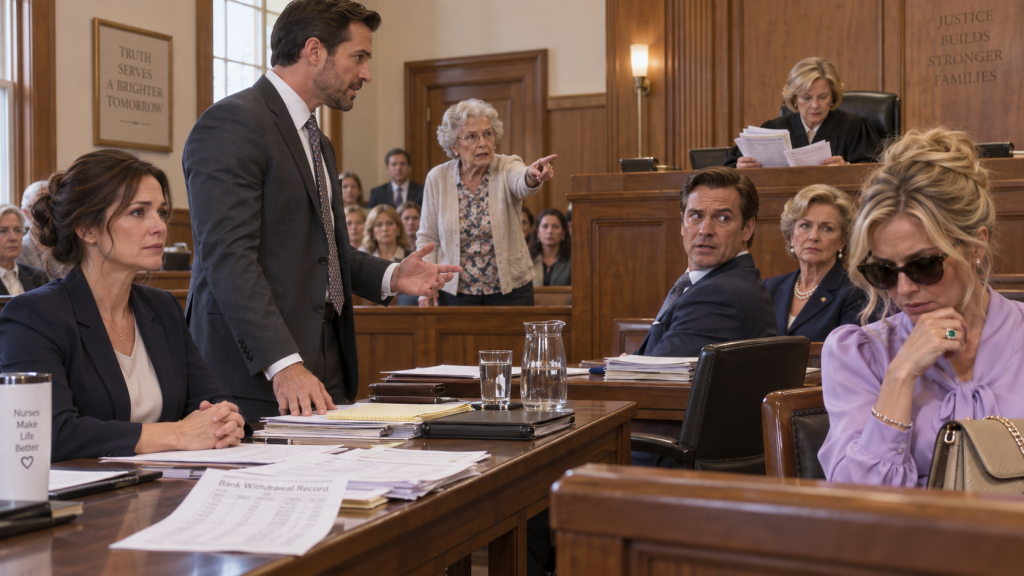
At my divorce hearing, my husband’s lawyer handed the judge a stack of withdrawal slips that say I emptied our savings, and my husband smiled at me. I said nothing. I folded my hands.

Every slip is signed in my name, and the teller who stamped them is sitting in the second row, and my husband does not know why.
“Sixty-one thousand dollars, Your Honor,” his lawyer said. “Four withdrawals in four weeks, while my client was working a pipeline job in North Dakota.”
My husband leaned toward me and whispered, “Should’ve taken the settlement, Ang.”
His mother sat in the front row behind him in her good navy suit, nodding.
Next to her, a blonde woman I had never seen before, who sat down after the first recess and never once looked at me.
My name is Angela. I am 42. I am a nurse.
For nine years I worked doubles at St. Luke’s.
I built that savings twelve hours at a time.
He built a bass boat.
“Your job is your hobby, babe.”
“I’m the one taking real risks.”
“Don’t touch the boat money.”
Every paycheck, I moved half into savings the same day. For the house with the big yard we were going to buy when I turned forty.
I turned forty in a rental, with an empty account and a husband who said, “You must have spent it and forgotten, Ang. You work too much.”
Last March my grandmother’s ring disappeared from my jewelry box. My husband said I must have lost it at work. His mother said, “Nurses are always taking their rings off, dear.”
In April the savings account was empty.
The bank said I had withdrawn it myself. Four times. In person. With my license.
I have never been inside that branch in my life.
Nobody believed me. Not the bank. Not his family. For a while, not even my own lawyer.
Then last Thursday my phone rang.
“Mrs. Brooks? My name is Joyce Wilkes. I was a teller at First Federal on Route 9 for twenty-two years. I retired in June.”
“Okay.”
“I read about your hearing in the county paper. I haven’t slept since.”
I sat down on the kitchen floor.
“The woman who came to my window in April wasn’t you, honey. I’d know. She came four times. She had your license, but the picture was old, and she’d had her hair done to match it.”
“How can you be sure?”
“Because every time, she was wearing a beautiful old ring. An emerald with two little diamonds. I told her I loved it. She said it was her grandmother’s.”
My grandmother’s ring is an emerald with two little diamonds.
“Mrs. Wilkes. Would you say that in court?”
“Honey, why do you think I called?”
So she came.
At the first recess, his mother stopped me in the hallway by the water fountain.
“You should have been grateful, dear. He could have had anyone.”
The blonde woman walked past us to the ladies’ room with her left hand shoved deep in her coat pocket.
She sat in the second row in a lavender blouse, with her purse on her knees.
My husband looked back at her once and didn’t know her.
Why would he? Nobody looks at the woman behind the glass.
The judge flipped through the slips.
“Mrs. Brooks, are these your signatures?”
“No, Your Honor.”
His lawyer sighed like I had embarrassed myself. “Your Honor, she’s been saying that for six months. There is no evidence anyone else—”
“There’s a witness,” my lawyer said, and stood up.
My husband’s smile stopped.
His mother’s hand went to her collar.
The blonde woman beside her took off her sunglasses, then put them right back on.
The judge looked at the second row. “Is this the teller?”
“I am,” Mrs. Wilkes said, and stood up, and her knees shook, and she stood anyway.
If she is wrong, I lose the house, the savings, and my name. I will be the nurse who stole from her husband, in the county paper, forever.
If she is right, somebody in this courtroom walked into a bank four times wearing my grandmother’s ring, and my husband sent her.
“Ma’am,” the judge said, “the person who came to your window in April. Do you see her in this room today?”
Mrs. Wilkes looked past my husband, past his lawyer, at the front row, and lifted one shaking finger, and said, “Your Honor, it was the one in the.
PART 2 — THE SIGNATURES THAT WERE NEVER MINE
Mrs. Wilkes’s finger shook as she lifted it.
For one suspended second, nobody in the courtroom seemed willing to breathe.
Then she pointed past my husband.
Past his lawyer.
Past the blonde woman in the lavender blouse.
Straight toward the front row.
“The one in the navy suit.”
My mother-in-law stopped moving.
Mrs. Wilkes swallowed.
“That’s her.”
A sound went through the courtroom.
Not a gasp exactly.
More like twenty people remembering at once that silence could make noise.
I looked at Diane Brooks.
My husband’s mother.
The woman who had sat at my kitchen table drinking coffee from mugs I bought.
The woman who helped me choose curtains when Richard and I first married.
The woman who, three months earlier, patted my hand and told me nurses were “always losing things” after my grandmother’s ring disappeared.
Her hand was still resting at her collar.
She looked at Mrs. Wilkes.
Then at me.
Then at her son.
Richard did not look back at her.
That told me everything before anyone spoke.
His lawyer stood immediately.
“Your Honor, I object to any theatrical identification without proper foundation.”
The judge did not raise her voice.
“Counsel, sit down.”
“But—”
“I said sit.”
He sat.
Richard leaned toward him.
I could see his mouth moving.
Could not hear the words.
For six months, Richard had spoken louder than me.
To the bank.
To his mother.
To mutual friends.
To anyone willing to listen.
Angela works too much.
Angela forgets things.
Angela probably spent the money.
Angela lost the ring.
Angela is angry about the divorce and trying to punish me.
I had defended myself so often that my own name had started sounding like an accusation.
Now Richard sat ten feet away and could not look at his mother.
For the first time, I did not feel any need to explain myself.
Judge Mercer turned toward Mrs. Wilkes.
“Ma’am, please come forward.”
Joyce’s knees were visibly trembling.
She gripped the wooden rail.
Then took one step.
Another.
The bailiff helped her through the small gate.
She was sworn.
Gave her name.
Age.
Employment history.
Twenty-two years at First Federal.
Retired four months after the disputed withdrawals.
My lawyer, Daniel Cho, stood.
Not my husband Daniel.
My attorney Daniel.
A detail that had caused several irritating phone conversations over the past year.
He walked slowly toward the witness stand.
“Mrs. Wilkes, you testified that you recognize someone in this courtroom as the person who made the withdrawals from Mrs. Brooks’s account.”
“Yes.”
“Who?”
Joyce pointed again.
Diane looked down.
“That lady.”
“Can you describe what she is wearing?”
“Navy blue suit.”
My lawyer nodded.
“Let the record reflect the witness has identified Diane Brooks.”
Richard’s lawyer rose again.
“Your Honor, we are in a divorce proceeding, not a criminal trial.”
Judge Mercer looked at him.
“I am aware of what courtroom I am sitting in.”
He lowered himself back into his chair.
My lawyer continued.
“How many times did you see Mrs. Brooks at your teller window?”
“Four.”
“Over what period?”
“About four weeks.”
“Did she identify herself as Diane Brooks?”
“No.”
Joyce looked toward me.
“She said she was Angela Brooks.”
My stomach turned even though I knew the answer.
There is something different about hearing your stolen name spoken aloud.
“How did she establish identity?”
“She presented a driver’s license in Mrs. Brooks’s name.”
“Did the photograph match?”
Joyce hesitated.
“Enough that I did not stop the transaction.”
Richard’s attorney almost jumped up.
My lawyer raised a hand.
“We’ll get there.”
Then he asked:
“What do you mean by enough?”
Joyce took a breath.
“The license photo was several years old.”
“Dark hair.”
“Similar face shape.”
“The woman at my window had styled her hair similarly.”
“She wore large prescription-looking glasses during two visits.”
“And she knew all the account information she was asked to verify.”
The courtroom became colder.
Someone had not simply walked in with my name.
They had prepared.
“Did anything about the customer concern you?”
my lawyer asked.
“Not at first.”
“Later?”
“Yes.”
“Why?”
“The withdrawals were large.”
“How large?”
Joyce referred to the slips.
“Fourteen thousand five hundred.”
“Fifteen thousand.”
“Sixteen thousand.”
“Fifteen thousand five hundred.”
Sixty-one thousand dollars.
Twelve-hour shifts.
Night differentials.
Holiday pay.
Missed lunches.
Years of putting half my paycheck aside before I could talk myself into using it for anything else.
Reduced to four numbers spoken in less than twenty seconds.
“Why did you complete the transactions?”
my lawyer asked.
Joyce looked ashamed.
“The identification passed the checks available to me.”
“The signatures appeared consistent enough with the signature card.”
“The customer knew the recent balance.”
“She knew the last deposit.”
“She knew the joint account holder’s full name.”
Richard.
My husband.
The man working in North Dakota.
Or supposed to be.
“And there was another reason.”
Joyce added quietly.
“What?”
“She said she was withdrawing cash because her husband was controlling.”
I stopped breathing.
Joyce looked toward me.
“She said she was preparing to leave him.”
Richard’s head snapped up.
His lawyer whispered something urgently.
I stared at my mother-in-law.
Diane would not look at me.
She had not just worn my name.
She had worn my marriage.
My fear.
My hypothetical private life.
She had stood behind bank glass and performed a version of me designed to make large cash withdrawals seem compassionate instead of suspicious.
My lawyer let the silence sit.
Then asked:
“Did the woman say anything else?”
Joyce nodded.
“She said her husband checked everything.”
“That she needed cash he couldn’t trace.”
Richard whispered:
“Jesus Christ.”
His attorney grabbed his arm.
Too late.
Judge Mercer looked toward him.
“Mr. Brooks, you will refrain from commentary.”
Richard nodded.
His face had gone pale.
For once, I could not tell whether he was frightened of the court or furious with his mother.
Maybe both.
Then Daniel asked about the ring.
Joyce’s voice changed.
Softer.
“I noticed it the first time.”
“Why?”
“Because it was beautiful.”
“Can you describe it?”
“Old-looking.”
“Yellow gold.”
“An oval green stone.”
“Emerald, I assumed.”
“Little diamonds on either side.”
My eyes burned.
Grandma wore that ring almost every Sunday of my childhood.
She kneaded biscuit dough wearing it until my mother yelled at her.
When Grandma died, it came to me wrapped in one of her handkerchiefs.
Richard knew what it meant.
Diane knew too.
She had admired it at Christmas.
“Did you ask the customer about it?”
“Yes.”
“What did she say?”
Joyce looked directly at me.
“She said, ‘My grandmother left it to me.’”
Something inside me cracked.
Not loudly.
Some wounds arrive too precisely for noise.
My lawyer approached the clerk and handed over a photograph.
My grandmother at sixty-eight.
Her hand resting on my shoulder.
Green stone glowing beneath the flash.
“Mrs. Wilkes, does this appear to be the ring you saw?”
“Yes.”
“Are you certain?”
“I am.”
Richard’s lawyer objected.
The judge allowed him to cross-examine later.
No instant conclusion.
No gavel declaring Diane guilty.
That was not what this courtroom was for.
But something had shifted anyway.
For six months, the withdrawal slips had been treated as proof that I was lying.
Now they were evidence that required explanation.
That difference felt like oxygen.
Then my lawyer asked:
“Mrs. Wilkes, did you know Diane Brooks before today?”
“No.”
“Had you ever met Angela Brooks before last Thursday?”
“No.”
“How did you come to contact her?”
Joyce explained.
The county paper had run a routine court notice about contested property in our divorce.
Richard’s attorney had made allegations about dissipation of marital funds during a preliminary hearing.
The paper summarized it.
Joyce saw my name.
Then my photograph.
And realized the woman accused of emptying the account was not the woman who had stood at her counter.
“I felt sick.”
she said.
“Why?”
“Because I stamped those slips.”
Her voice broke.
“I went home that night and pulled out my retirement box.”
“My husband asked what was wrong.”
“I told him I might have helped somebody steal from a woman.”
I wanted to tell her it was not her fault.
Then stopped.
That was not mine to decide for her.
Instead, I listened.
Richard’s lawyer cross-examined aggressively.
Memory fades.
Six months had passed.
People make mistakes.
Could she be influenced by seeing Diane in court?
Could she have confused one customer with another?
Joyce answered carefully.
“Yes, memory can fail.”
“Yes, six months is a long time.”
“No, she had not seen a lineup.
“No, nobody told her whom to point at.”
Then his attorney asked:
“How can you be so certain?”
Joyce stared at Diane.
“The ring.”
He sighed.
“We’ve established you saw a ring.”
“No.”
Joyce shook her head.
“You don’t understand.”
“The second time she came in, I told her I had always wanted an emerald.”
“She held her hand under the glass so I could see it better.”
“Then she said her grandmother had worn it for fifty years.”
Joyce’s eyes filled.
“I remembered because my grandmother left me nothing but recipes.”
“I thought it was sweet.”
The courtroom went silent again.
Cruelty is strange like that.
Sometimes the lie that makes it believable is the part someone remembers best.
Judge Mercer called a brief recess.
Nobody moved immediately.
Then Richard stood so quickly his chair nearly tipped.
His lawyer pulled him toward the side conference room.
Diane remained seated.
For one second, our eyes met.
I expected shame.
Instead she looked angry.
That hurt differently.
She stood and walked toward the hallway.
The bailiff stopped her.
“Ma’am, remain available.”
Her face tightened.
“I’m not under arrest.”
“No, ma’am.”
“But the court has not excused you.”
Diane sat again.
The woman who had spent ten years telling me how a wife should behave suddenly looked very small beneath fluorescent courthouse lights.
That was when the blonde woman in lavender finally looked at me.
Really looked.
Until then, she had avoided my eyes.
She stood from the second row.
Walked toward Daniel, my attorney.
Whispered something.
Then handed him a business card.
Richard noticed.
His face tightened.
He looked at her again.
Still no recognition.
I remembered thinking earlier:
Nobody looks at the woman behind the glass.
I had been closer to the truth than I knew.
Her name was Marcy Dean.
She worked at First Federal too.
Not Joyce’s branch.
A branch nineteen miles away.
And while Diane had stood at Joyce’s window pretending to be me, someone else had been standing at Marcy’s window days later turning pieces of my savings into something harder to see.
When court resumed, Daniel called Marcy.
Richard’s lawyer stood.
“We were given notice of this witness only yesterday.”
Daniel nodded.
“Because she came forward yesterday after Mrs. Wilkes identified related transactions.”
Judge Mercer reviewed both sides.
Allowed limited testimony subject to later supplementation.
Again, no ambush fantasy.
Procedure.
Slow enough to trust.
Marcy took the oath.
Her left hand came out of her coat pocket.
No ring.
No secret object.
Just fingers marked red where she had apparently been digging her nails into her palm from nerves.
Some details are simply human.
Not clues.
I had spent six months turning everything into clues.
I was tired.
Marcy explained that she worked in branch operations.
Sixteen years.
She handled large cash deposits, cashier’s checks, and identity-verification exceptions.
On April 29, Diane Brooks came to her branch.
This time, under her own name.
Richard was with her.
My husband.
Not in North Dakota.
Not that day.
My stomach turned.
Marcy identified him.
Richard finally recognized her.
I saw it happen.
His jaw loosened.
His eyes narrowed.
Not because he remembered her face.
Because he remembered the counter.
My lawyer approached.
“Ms. Dean, what transaction did Diane Brooks conduct?”
“A cash deposit.”
“How much?”
“Twenty-seven thousand dollars.”
The number made my pulse jump.
Twenty-seven thousand.
Two of the fraudulent withdrawals totaled twenty-nine thousand five hundred.
“Was Mr. Brooks involved?”
“He stood with her.”
“Did he conduct the deposit?”
“No.”
“Then why do you remember him?”
Marcy looked apologetic.
“Because after the deposit, they requested a cashier’s check.”
My husband’s attorney shifted.
“To whom?”
Daniel asked.
Marcy referred to a certified bank record.
“Carolina Escrow Services.”
“For twenty-five thousand dollars.”
I had never heard the name.
Richard had.
His face told me.
Daniel asked:
“Did Mr. Brooks speak during the transaction?”
“Yes.”
“What did he say?”
Marcy thought.
“He asked whether the check would show whose account the deposited cash originally came from.”
A low murmur moved through the room.
Judge Mercer looked sharply toward Richard.
My husband stared at the table.
Marcy continued.
“I told him the cashier’s check would reflect the purchaser and bank, and our internal records would still show the source account of the funds deposited.”
“What did he say?”
“He said, ‘That’s fine.’”
Two words.
That’s fine.
Not:
What cash?
Not:
Where did Mom get twenty-seven thousand dollars?
Fine.
Richard’s lawyer objected that this proved nothing about where Diane’s cash came from.
Technically, he was right.
Cash does not carry a label saying:
ANGELA’S NINE YEARS OF DOUBLE SHIFTS.
The judge acknowledged that.
So did my lawyer.
Then Daniel asked the next question.
“Ms. Dean, was there anything distinctive about the cash deposit?”
Marcy nodded.
“First Federal straps.”
“What does that mean?”
“Some bundles still had paper currency straps used at another First Federal branch.”
“Could you identify which branch?”
“Yes.”
My heart stopped.
“Route 9.”
Joyce’s branch.
Richard’s lawyer objected again.
Chain of custody.
Inference.
Possibility the cash came from somewhere else.
All valid arguments.
All things to be sorted.
But my husband had stopped smiling an hour ago.
Now he looked sick.
His mother looked worse.
Daniel introduced account timing.
One fraudulent withdrawal of sixteen thousand occurred April 26.
Another of fifteen thousand five hundred on April 28.
Diane deposited twenty-seven thousand on April 29.
Then purchased the cashier’s check.
Not proof by itself that every deposited bill came from my account.
But enough to ask why.
And what Carolina Escrow Services had done with twenty-five thousand dollars.
The answer came from records Daniel had obtained that morning after Marcy called him.
A property closing.
I stared at him.
“What property?”
He did not answer me.
Not yet.
Because we were in court.
For once, someone cared about the right order.
Marcy was excused subject to recall.
As she stepped down, she passed me.
Whispered:
“I’m sorry.”
I did not know what she was apologizing for.
Processing a transaction?
Not recognizing fraud?
Waiting?
Maybe all of it.
I nodded.
She returned to the second row.
Diane moved away from her.
Interesting.
Then my lawyer called me.
I had testified before in preliminary proceedings.
This felt different.
The oath sounded heavier now.
Daniel asked about the savings account.
My contributions.
Richard’s contributions.
The purpose.
The house we had once planned to buy.
I described moving half my paycheck into savings.
Night after night.
Year after year.
I did not exaggerate.
Richard had contributed too.
Less consistently.
But he had.
The savings were marital.
That mattered.
Truth does not become stronger by pretending every dollar was mine alone.
Then Daniel asked:
“Did you authorize Diane Brooks to withdraw funds from the account?”
“No.”
“Did you give her your driver’s license?”
“No.”
“Did you give her your grandmother’s ring?”
“No.”
“Did you authorize Richard Brooks to permit his mother to impersonate you?”
“No.”
Richard’s attorney objected to the phrasing.
Sustained.
Fair.
My lawyer rephrased.
“Did you ever tell Richard he could arrange withdrawals in your name?”
“No.”
Then came the question that hurt most.
“Where was your driver’s license kept before you discovered the account was empty?”
“My wallet.”
“Was it ever missing?”
I thought.
“Yes.”
“When?”
“March.”
Richard looked up.
I had forgotten until that moment.
Not the event.
Its importance.
I had gone to renew my hospital parking pass and could not find my license.
Richard found it two days later beneath the passenger seat of his truck.
Or claimed he did.
At the time, I thanked him.
He kissed my forehead and said:
“You’d lose your head if it wasn’t attached.”
His mother laughed when he told her.
I stared at him across the courtroom.
Maybe he could feel the memory arrive too.
His face changed.
“What about the ring?”
Daniel asked.
“Missing in March too.”
“Before or after the license?”
“I don’t remember exactly.”
“Did Richard know?”
“Yes.”
“Diane?”
“Yes.”
“She told me nurses always remove jewelry.”
My voice cracked.
I hated that.
Then decided not to.
Emotion was not a confession.
It was a body telling the truth had weight.
Richard’s attorney cross-examined me.
Had our marriage been troubled by March?
Yes.
Had I threatened divorce before?
Once during an argument.
Had I ever withdrawn cash?
Yes, normal amounts.
Had Richard contributed to the savings?
Yes.
Had I seen Diane enter the bank?
No.
Did I have personal knowledge Richard instructed her?
No.
That one mattered.
“No.”
I answered.
Because suspicion is not knowledge.
Even when it hurts.
I looked at Richard.
“I know he benefited from something.”
His lawyer objected.
Judge Mercer struck the last statement.
Fair.
Facts first.
Consequences later.
Then Diane was called.
Her lawyer requested time.
That was the moment I realized she had obtained separate counsel during lunch.
Smart.
Necessary.
The divorce judge was not going to force potentially self-incriminating testimony simply because everyone wanted a dramatic answer.
Judge Mercer allowed Diane’s counsel to advise her.
Diane invoked her right not to answer certain questions.
Richard’s face collapsed.
His mother did not confess.
She did not scream.
She did not run.
She simply stopped answering.
Some people in the gallery took that as proof.
Legally, it was more complicated.
I had learned enough by then not to let satisfaction outrun accuracy.
But emotionally?
I understood.
She had spent six months asking everyone to believe I was a liar.
Now she would not tell the court how my license and ring reached a bank counter in another woman’s hands.
That silence belonged to her.
Not me.
Judge Mercer ended testimony for the day late in the afternoon.
Then she did something Richard had not expected.
She refused to make a final property ruling.
“The evidence presented today raises substantial concerns regarding dissipation, concealment, and possible fraudulent transactions.”
My entire body went still.
She continued.
“I will not allocate disputed assets on an incomplete record.”
She ordered additional financial disclosure.
Preservation of relevant records.
No extraordinary movement of certain marital assets pending review.
Supplemental production from the bank and escrow company.
She also directed that the appropriate materials be made available to law enforcement through proper channels regarding the alleged impersonation and forged withdrawal documents.
No arrest.
No handcuffs.
No dramatic declaration that I had won.
Something better.
The slips were no longer accepted as evidence that I stole sixty-one thousand dollars.
They had become evidence that somebody else might have.
My name had finally moved to the correct side of the question.
Outside the courtroom, Richard caught me near the elevator.
“Ang.”
I stopped.
My lawyer stayed beside me.
Richard looked terrible.
His tie loosened.
Eyes red.
“Can we talk?”
“No.”
“Please.”
I almost kept walking.
Then I turned.
“One question.”
He nodded desperately.
“Were you in North Dakota the entire month of April?”
His face changed.
There.
I already knew.
“No.”
“How many times were you home?”
“Twice.”
“You told me the job kept you there six weeks straight.”
“I flew back for paperwork.”
“What paperwork?”
Silence.
Daniel touched my arm gently.
Enough.
I nodded.
Then walked away.
Richard whispered:
“I didn’t know Mom used the ring.”
I stopped.
My entire body turned cold.
He realized what he had said.
Too late.
My attorney went still beside me.
I looked back.
“I didn’t ask whether you knew about the ring.”
Richard closed his eyes.
That was the first time he looked afraid of me.
Not because I was dangerous.
Because I had finally stopped helping him out of his own sentences.
The criminal investigation did not resolve overnight.
Neither did the divorce.
Forensic accounting took time.
Bank subpoenas.
Property records.
Escrow records.
Statements.
Transfers.
The endless paper trail people assume cash can erase.
It cannot always.
Not when the cash reenters the financial system because someone wants to buy something expensive.
And Richard wanted something expensive.
Very expensive.
Carolina Escrow Services had handled a closing three days after Diane’s twenty-seven-thousand-dollar deposit.
The property was not a house.
Not exactly.
It was a two-acre lakefront parcel forty minutes from our rental.
A dock.
A small unfinished cabin.
Boat access.
Asking price:
$118,000.
My chest tightened when Daniel showed me.
Richard had talked about that lake for years.
“Someday.”
he always said.
“When pipeline money gets good.”
A place for weekends.
Fishing.
The bass boat.
I had always answered:
“House first.”
Big yard.
Home.
Then toys.
Apparently Richard had chosen a different order.
The property deed was not in his name.
It was in Diane’s.
My mother-in-law.
She had paid twenty-five thousand at closing.
Then obtained financing for the balance.
At first glance, that looked like her purchase.
Her property.
Her debt.
Then the forensic accountant found the monthly loan payments.
They did not come from Diane.
They came from a small business account Richard had opened eighteen months earlier.
Brooks Field Services LLC.
I had heard of it.
Barely.
Richard said it was for occasional independent pipeline consulting.
He told me it made almost nothing.
The account records disagreed.
Money had been flowing into Brooks Field Services for more than two years.
Per diem reimbursements.
Side-job checks.
Equipment reimbursements.
Mileage.
Small consulting fees.
Money that never reached the joint checking account.
Not millions.
Not some secret corporate empire.
Enough.
Nearly ninety-four thousand dollars in deposits over two years.
Expenses came out too.
Tools.
Travel.
Fuel.
Legitimate business costs.
But also boat payments.
Marina fees.
And, beginning in May, lake-property payments.
I stared at the statements.
“Was this all marital money?”
Daniel shook his head.
“Not automatically all of it.”
Always careful.
“Some income earned during the marriage may be relevant to the marital estate.”
“Business expenses must be separated.”
“Ownership interests need to be valued.”
“Payments benefiting another titled owner need explanation.”
No magical conclusions.
Fine.
“What matters right now?”
I asked.
He pointed toward a series of transfers.
“These.”
Five thousand.
Seven thousand.
Ten thousand.
From Brooks Field Services to Diane.
Then back in smaller amounts.
Circular movement.
Not proof of fraud by itself.
But a pattern worth understanding.
Then we found the bass boat.
I had always thought Richard owned it outright.
He called it his.
Spent weekends polishing it.
Told me not to touch “boat money.”
The title said otherwise.
Owner:
Diane Brooks.
My mother-in-law.
Purchased three years earlier.
Richard had made every payment.
Insurance came from our household account for the first year, then from the business account.
Registration notices went to Diane’s address.
I laughed when I saw it.
Not because it was funny.
Because suddenly his favorite possession did not technically belong to him.
He had spent years telling me my job was a hobby while quietly paying for a boat titled to his mother.
There are ironies too clean to improve.
The forensic accountant, Helen Park, looked at me over her glasses.
“Do not assume title alone settles beneficial ownership or marital characterization.”
“I know.”
She smiled slightly.
Apparently I was learning.
Then she turned another page.
“I think this is more important.”
“What?”
“A transfer from your joint home-purchase savings.”
My heart stopped.
Not the sixty-one thousand.
Earlier.
Eighteen months earlier.
Nine thousand dollars.
I had not noticed because it was moved shortly before Richard deposited a pipeline bonus of nearly the same amount.
The balance recovered.
So I never questioned it.
Destination:
Brooks Field Services.
Four days later, eight thousand five hundred went toward the boat.
I stared.
“Boat money.”
Helen looked confused.
“What?”
I laughed bitterly.
“Nothing.”
For years Richard had warned me:
Don’t touch the boat money.
Some of it had apparently been mine.
Every discovery made the divorce less dramatic and more sad.
Richard had not emptied our lives in one grand scheme.
He had made dozens of small decisions.
A transfer here.
A title there.
Cash routed through his mother.
Income held in a business account.
The kind of choices that become invisible when a spouse trusts you to handle certain things.
I had handled the house savings.
He handled boat expenses and business income.
We called that partnership.
He treated the boundaries between categories as something only he understood.
Then Helen called me one Tuesday evening.
Her voice was different.
“Angela, are you sitting down?”
I almost laughed.
“No.”
“Sit.”
I sat.
“What?”
“We received the complete escrow packet on the lake property.”
My stomach tightened.
“And?”
“The twenty-five-thousand-dollar cashier’s check was not the only source of funds connected to closing.”
“How much more?”
“Seventeen thousand eight hundred dollars.”
“From where?”
“An earnest-money payment made six weeks earlier.”
I frowned.
Before my savings account had been emptied.
“Whose account?”
There was a pause.
Helen answered:
“Yours.”
I stopped breathing.
“My personal account?”
“No.”
Then:
“Your retirement-plan loan proceeds.”
Everything inside me went quiet.
“I never took a retirement loan.”
“I know.”
Helen said.
“That is why I called.”
I opened my employee retirement portal immediately.
There it was.
A plan loan.
$20,000.
Issued seven weeks before the first fraudulent bank withdrawal.
Repayment being deducted from my paycheck.
Small enough that I had mistaken the reduction for changes in withholding and benefits after our hospital insurance renewed.
I stared at my pay stubs.
Nine years of looking after patients.
Monitoring tiny changes in blood pressure.
Catching medication errors.
Not noticing money being taken from my own future every two weeks.
“How?”
I whispered.
Helen said:
“We don’t know yet.”
“Do not assume signature forgery until we get the application.”
My hands shook.
I remembered Richard sometimes handling benefits enrollment because he claimed my hospital portals were “ridiculously complicated.”
He knew my passwords once.
Not anymore.
The retirement administrator produced the application.
Online.
My login.
My identifying information.
An electronic signature.
Loan purpose:
Primary residence acquisition.
My stomach turned.
Primary residence.
The house with the big yard.
The future I had been saving for.
Someone had used the category intended to help me buy a home to help fund Richard’s lake property.
The money was deposited into our joint checking account.
Stayed there less than forty-eight hours.
Then moved to Brooks Field Services.
Then to escrow.
A trail.
Not erased.
Just hidden beneath normal activity.
I drove to Daniel’s office after my shift.
Still in scrubs.
Sat across from him.
Placed the application down.
He read it.
Then looked at me.
“You did not authorize this?”
“No.”
“Did you give Richard permission to access your retirement account?”
“No.”
“Did you ever tell him to take a loan?”
“No.”
He nodded.
Then said:
“We preserve it.”
That was his answer now.
Not:
We got him.
Not:
You win.
Preserve.
The word had become almost sacred.
I looked out his office window.
Cars moved through rain below us.
People going home.
Grocery stores.
School pickups.
Dinner.
Normal lives.
“How much else is there?”
I whispered.
Daniel leaned back.
“We don’t know.”
I closed my eyes.
That answer terrified me more than any number.
The next hearing happened three weeks later.
Richard looked different.
No smile.
No whispered threat about settlements.
Diane did not attend.
Her lawyer appeared instead.
Joyce sat in the hallway, not because she had been recalled yet, but because she told me she wanted to be there.
Marcy came too.
Not as a surprise witness.
As a subpoenaed one this time.
Everything proper.
Everything documented.
I had never been so grateful for boring procedure in my life.
Helen testified about the financial tracing.
The judge listened.
Richard’s attorney challenged assumptions.
Appropriately.
Not every payment proved concealment.
Not every titled asset belonged to Richard.
Not every dollar entering a business account was marital profit.
But then Helen displayed one timeline.
My retirement loan.
Joint account.
Business account.
Escrow.
Lake parcel.
Seventeen thousand eight hundred dollars.
Five steps.
Seven days.
Same money.
That was harder to call coincidence.
Judge Mercer turned toward Richard.
“Mr. Brooks.”
His attorney stood.
“Your Honor, my client will respond through testimony after consultation.”
“Very well.”
The judge looked at the exhibit again.
Then:
“I want complete records concerning the retirement-plan loan, Brooks Field Services, the lake property, and the boat.”
His lawyer nodded.
Then the judge added:
“And I want disclosure of any other property, account, business interest, vehicle, or significant asset in which Mr. Brooks has contributed funds, made payments, exercised control, or claims any beneficial interest regardless of title.”
My husband went still.
There.
That sentence frightened him.
I saw it.
Daniel saw it too.
During the recess, Richard’s attorney asked to speak with mine privately.
Twenty minutes later, Daniel returned.
His face was unreadable.
“What?”
I asked.
“There may be another asset.”
Of course.
I almost laughed.
“What now?”
He sat beside me.
“Richard’s counsel says their amended disclosure will identify property not previously included.”
“What kind of property?”
“A house.”
I stared.
“The lake cabin?”
“No.”
My pulse stopped.
“What house?”
Daniel hesitated.
Then slid a handwritten note across the table.
An address.
I recognized the street immediately.
Not the number.
The neighborhood.
Cedar Ridge.
The neighborhood where Richard and I used to drive after Sunday breakfast and point at houses.
Big yards.
Mature trees.
Quiet roads.
The kind of place we promised ourselves we would buy when I turned forty.
My hands began shaking.
“Who owns it?”
“Title appears to be in Diane’s name.”
My breath disappeared.
“When was it purchased?”
“Eight months ago.”
Eight months.
Before the divorce filing.
Before the savings account was emptied.
Before my grandmother’s ring disappeared.
My eyes blurred.
“How much?”
Daniel looked at me.
“Three hundred and twelve thousand.”
I laughed.
One sharp sound.
“Diane doesn’t have three hundred thousand dollars.”
“No.”
“Mortgage?”
“Yes.”
“Down payment?”
He turned the note over.
$64,000.
Almost exactly the amount that vanished from our savings one month later.
Not necessarily the same money.
The timing did not match cleanly yet.
But close enough to make my skin cold.
Daniel continued.
“We do not know the source yet.”
I stared at the address.
The neighborhood where I had once pictured a vegetable garden.
A porch.
Grandchildren someday.
A home Richard and I would finally own after years of renting while I saved.
“Who lives there?”
I asked.
Daniel did not answer immediately.
“What?”
His expression changed.
“Angela…”
“Who lives in the house?”
He looked toward the courtroom doors.
Then back at me.
“According to utility records we obtained this morning, service is not in Diane’s name.”
My fingers tightened around the paper.
“Whose?”
Daniel slid another page toward me.
An electric account.
A woman’s name.
Kelsey Moran.
I had never heard it before.
Then I saw the second name beneath hers.
An authorized account contact.
Richard Brooks.
My husband.
My chest turned to ice.
I looked through the courtroom doors.
Richard was standing fifty feet away speaking with his lawyer.
His mother’s lake property.
His mother’s boat.
My emptied savings.
My retirement loan.
And now a three-hundred-thousand-dollar house titled to Diane, with utilities connected to another woman and my husband listed on the account.
Richard looked up.
Our eyes met.
For the first time in our entire marriage, I did not wonder whether I was imagining something.
I held up the page.
His face answered before he ever could.
And suddenly I understood why sixty-one thousand dollars had never been the whole story.
It was simply the first missing money large enough to make me look.
PART 3 — THE NAME THEY COULDN’T TAKE FROM ME
The address on Cedar Ridge stayed in my hand through the entire recess.
I knew that neighborhood.
Richard and I had driven through it for years.
Sunday mornings.
Coffee in paper cups.
Me pointing toward wide porches and old trees.
Richard saying:
“Someday, Ang.”
Someday had always meant after the pipeline jobs.
After the boat was paid down.
After we saved enough.
After life became less expensive.
Apparently someday had arrived.
Just not for me.
I looked across the courthouse hallway.
Richard saw the utility record in my hand.
Then looked away.
That was the closest thing to a confession I had received from him yet.
When court resumed, Richard’s attorney asked for time to amend his disclosures.
Judge Mercer granted it.
Then she looked directly at Richard.
“Mr. Brooks, this court expects complete disclosure.”
“Yes, Your Honor.”
“Complete does not mean whatever is discovered shortly before a hearing.”
His face tightened.
“No, Your Honor.”
“If there are additional assets, accounts, business interests, transfers, or arrangements involving third parties, now would be an excellent time for your counsel to know about them.”
Silence.
Then:
“Yes, Your Honor.”
His voice sounded smaller.
I sat with my hands folded.
Exactly as I had at the beginning.
Except now silence no longer felt like helplessness.
It felt like restraint.
I had finally learned that I did not have to chase every lie the moment it appeared.
Records could chase for me.
Kelsey Moran entered my life two days later.
Not by coming to my house.
Not by calling me.
Through a subpoena response.
Utility records.
Lease documents.
Insurance.
A driver’s-license address.
Her name kept appearing beside Cedar Ridge.
Then the forensic accountant found something else.
Monthly electronic transfers from Brooks Field Services.
Same date each month.
$2,146.
Nearly identical to the mortgage payment on the Cedar Ridge property.
The mortgage was technically in Diane’s name.
The money to pay it came from Richard’s business.
Every month.
For eight months.
Helen Park circled the transactions.
“This is significant.”
I stared at them.
“Does that mean the house is his?”
“Not automatically.”
Always careful.
“But it means we need to determine whether Diane is merely the titled borrower while Richard has been funding or using the property.”
“How do we prove that?”
“We don’t start by proving.”
Helen said.
“We start by asking for records.”
I was learning to love boring people.
The house closing file answered part of it.
Diane had signed the mortgage.
Diane appeared on the deed.
But Richard had attended closing.
He was not a buyer.
He was listed as a “family financial contributor.”
The down payment had come from three places.
Twenty-four thousand dollars from Diane.
Twenty thousand from Brooks Field Services.
Twenty thousand from another account Richard had never listed in the divorce.
A money-market account opened in his name alone.
The house was not purchased with the sixty-one thousand dollars taken from our savings.
Not directly.
That almost disappointed me.
Then I hated myself for wanting the fraud to line up more neatly.
Real wrongdoing does not arrange itself for storytelling.
The missing savings had gone elsewhere.
Twenty-seven thousand reentered the bank through Diane and became part of the lake-property purchase.
Another eleven thousand was deposited into Brooks Field Services in cash over several weeks.
Eight thousand paid down the bass-boat loan.
Roughly twelve thousand was used to pay credit-card balances connected to Richard’s travel and equipment.
The remaining amount took longer to trace.
Cash is good at becoming fog.
Not perfect.
But good.
Investigators never claimed they recovered every bill.
They did not need to.
The larger pattern was becoming visible.
Diane had impersonated me.
Cash left.
Richard and Diane then used cash or replenished funds for property and debts tied to Richard.
That was more important than forcing every dollar into a perfect arrow.
Then came the bank cameras.
First Federal had retained enough footage because the disputed withdrawals had already been flagged in the bank’s internal file.
Joyce’s memory had opened the door.
The footage walked through it.
The image quality was not beautiful.
No television clarity.
No dramatic zoom into pores.
But there was Diane.
Hair darkened.
Glasses.
A coat I had seen her wear.
At the teller window.
My grandmother’s emerald ring on her finger.
The first time investigators showed me the still photograph, I felt physically cold.
Not because I had doubted Joyce.
Because memory still allows a person to hope.
Video does not care what you hope.
Another camera showed Diane walking into the branch parking lot after the third withdrawal.
A truck waited near the far edge.
Richard’s truck.
The license plate was visible enough when enhanced against another frame.
He had not entered the bank.
He did not need to.
His lawyer later argued that being in a parking lot did not prove he knew his mother was impersonating me inside.
Technically true.
Then investigators obtained his cell-location records through proper legal process.
The phone had been near the branch for two of the four withdrawals.
Again:
Not enough alone.
But lies rarely survive because one fact destroys them.
They collapse because too many small facts stop agreeing with the story.
Richard had told me he had been in North Dakota.
His employer records showed something else.
He had taken two personal days during the withdrawal period.
One coincided with the bank footage.
Another coincided with Diane’s cash deposit and the cashier’s check for the lake property.
When investigators asked why, Richard first said family matters.
Then property matters.
Then he stopped answering without counsel.
I watched none of those interviews.
I learned about them later through discovery and my lawyer.
That was healthier.
For months, I had wanted to see his face when somebody finally cornered him.
By then, I understood that his face would not give me back a single dollar.
Paper was more useful.
Kelsey came forward before anyone subpoenaed her testimony.
Her attorney contacted mine.
That surprised me.
According to Marisol, who had joined Daniel Cho on the family-law side once the financial case widened, Kelsey wanted to make clear that she had no ownership claim to Cedar Ridge.
I laughed.
“Why would she think we believe she does?”
Marisol looked at me.
“Because she lives there.”
Right.
I had almost forgotten that part.
When betrayal becomes accounting, sometimes people disappear behind spreadsheets.
Kelsey was thirty-seven.
Divorced.
One teenage son who lived with her half the time.
She had met Richard eighteen months earlier at a safety-training conference connected to pipeline work.
There had been an affair.
No innocent explanation.
No secret cousin.
No business-only relationship.
Richard had told her my marriage to him had been effectively over for years.
He said we remained together because of finances.
He said I was already planning to file after we divided property.
He said the Cedar Ridge house would eventually become his after Diane’s mortgage was refinanced.
He told Kelsey he wanted them to live there together once my divorce was complete.
My divorce.
As if it already existed before I knew about it.
“Did she know about the savings?”
I asked.
“No.”
“Diane?”
“She knew Diane owned the house on paper.”
“Did she think that was strange?”
“Yes.”
“What did Richard tell her?”
“That his credit was temporarily tied up in business financing and his mother was helping him qualify.”
I laughed bitterly.
Everyone received a customized story.
The bank heard controlling husband.
Kelsey heard almost-divorced man.
Diane apparently heard devoted son.
I heard forgetful wife who must have spent sixty-one thousand dollars without remembering.
Richard had not built one lie.
He built separate rooms and kept everyone from comparing floor plans.
I agreed to meet Kelsey once.
Not because I wanted closure from her.
Because she had information.
We met at Marisol’s office.
Kelsey looked less glamorous than the version my anger had invented.
No villain heels.
No smug smile.
Jeans.
Gray sweater.
Tired eyes.
She sat across from me.
For a moment, neither of us spoke.
Then she said:
“I’m sorry.”
I almost asked:
For which part?
Instead:
“What did you know?”
She nodded.
Fair question.
“I knew he was married.”
There.
No pretending.
“I knew the divorce was not final.”
“Did you know it hadn’t been filed?”
Her eyes dropped.
“Yes.”
That mattered.
“But he told you we were separated?”
“Emotionally.”
I laughed.
The most convenient separation.
No paperwork.
No moved-out spouse.
No warning to me.
Just emotional.
Kelsey looked ashamed.
“I wanted to believe him.”
That sentence sounded familiar.
People will believe surprising things when the belief permits them to keep what they want.
“Did you know Diane was impersonating me at the bank?”
Her face went white.
“No.”
“Did you know money came from my retirement account?”
“No.”
“Did you know the lake property was being funded with marital money?”
“No.”
“Did you know he accused me of emptying our savings?”
Her eyes filled.
“No.”
I believed her.
Not because I trusted her.
Because horror has a recognizable shape when someone realizes the story they entered was dirtier than they agreed to.
She reached into her bag.
Placed an envelope on the table.
“Richard left some things at Cedar Ridge.”
Marisol immediately stopped her.
“What kind of things?”
“Documents.”
Good lawyer.
No mystery evidence passed casually across tables.
Kelsey’s attorney provided an inventory.
Business statements.
Printed mortgage schedules.
A notebook.
Several envelopes.
Everything would be handled properly.
But before the meeting ended, Kelsey said something that stayed with me.
“He used to tell me you didn’t care about houses anymore.”
I stared.
“What?”
“He said you only cared about work.”
“That he had wanted a home for years, but you preferred renting because it was easier with the hospital.”
I started laughing.
Could not stop.
Kelsey looked frightened.
“What?”
I wiped my eyes.
“I skipped lunches for nine years saving for a house.”
Her face collapsed.
“Angela…”
“Cedar Ridge was my neighborhood.”
She closed her eyes.
That was when I understood the affair was not the deepest insult either.
Richard had not merely taken money.
He had taken the future I described to him and repeated it to another woman as though it had always been his.
The notebook from Cedar Ridge became important.
Not because Richard had written:
I am committing fraud.
People are rarely that considerate.
It contained property expenses.
Mortgage notes.
Boat payments.
Amounts owed to Diane.
Cash entries.
Then one page near the back.
A list.
After divorce:
Refi Cedar Ridge
Move Kelsey in officially
Transfer boat title
Resolve lake parcel
Buy out Ang if possible
Keep business valuation low
That final line made Helen Park sit very still.
“Interesting.”
she said.
Not illegal by itself.
Not proof he had successfully hidden value.
But revealing.
It showed Richard knew the business value mattered in divorce.
And he had been thinking about minimizing it before proceedings began.
There was another line:
Need story for savings.
No elaboration.
Just five words.
I read them three times.
Then placed the notebook down.
I no longer needed to know whether Richard had personally chosen the wig, copied my signature, or handed his mother my ring.
He had been preparing a story for the missing money.
That was enough to destroy the last version of him I had been trying to preserve.
Diane eventually admitted her role.
Not in my divorce.
In a criminal case negotiated through her attorney.
The bank evidence, teller identification, surveillance, possession of my license, use of the ring, and transaction records had become difficult to explain away.
The exact charges were described differently in different documents.
Identity-related fraud.
Forgery connected to financial instruments.
Theft.
The language mattered to lawyers.
The admission mattered to me.
She had entered the bank four times pretending to be me.
She had forged my signatures.
She had used my license.
She had worn my grandmother’s ring because, as she later admitted, she believed it helped complete the appearance.
That part nearly made me vomit.
Her explanation was worse because it was so ordinary.
Richard told her he was preparing to leave me.
He said I would “clean him out” if he did not protect assets first.
He told her much of the savings really came from his pipeline income.
That was false.
He told her I had hidden money before.
Also false.
Diane believed her son deserved to “secure what was his” before I could take advantage.
So she helped.
Then once the first withdrawal worked, the second became easier.
Then the third.
Then the fourth.
Crime, like disrespect, sometimes grows through repetition.
“Why the ring?”
Investigators asked her.
According to the report later summarized to me, Diane said:
“The teller complimented it.”
That was all.
No master strategy.
She happened to be wearing the ring because Richard had given it to her beforehand.
When Joyce admired it, Diane improvised.
My grandmother left it to me.
One lie.
Small.
Useful.
Memorable.
That lie became the detail that brought everything back.
My grandmother had spent her life telling me:
“Never be ashamed of honest work.”
She would have found that poetic.
I did.
Eventually.
Richard’s criminal exposure took longer.
Diane’s admission implicated him.
So did the notebook.
The truck.
The false statements about being in North Dakota.
The money trails.
The license disappearing from my wallet.
His knowledge that the ring was being used.
And his participation in moving proceeds into assets.
His lawyer fought hard.
As he should have.
Everyone deserves counsel, even when you hate them.
Eventually Richard entered a plea agreement involving fraud-related financial offenses and concealment connected to the transactions.
The resolution did not send him away for decades.
No movie sentence.
He had no serious prior record.
The money trail was substantial, but not millions.
The agreement included a custodial component that was shorter than my anger initially wanted, followed by supervised release, restitution obligations, and financial restrictions.
Diane received probation with strict conditions and restitution obligations, in part because of her age, lack of record, cooperation, and plea.
Did I think either punishment was enough?
Some days yes.
Some no.
That is why victims do not sentence people.
Pain is not a stable measuring device.
The divorce court dealt with different questions.
What belonged in the marital estate?
What had been dissipated?
What value did Brooks Field Services actually hold?
How should the boat, lake parcel, and Cedar Ridge contributions be treated?
Which debts belonged where?
Helen Park became the least glamorous hero of my life.
Spreadsheets.
Account tracing.
Business valuation.
Hours of testimony that would put sane people to sleep.
I loved every minute.
Because numbers were finally being used to return reality instead of distort it.
The court found that Richard had failed to disclose substantial business income and had used marital funds in ways relevant to equitable distribution.
The withdrawn savings were accounted for against him.
So was the retirement-plan loan.
The loan itself remained attached to my retirement plan until repaid, but the settlement required that the financial impact be compensated through the asset division and restitution process.
I did not wake one morning with every lost dollar magically restored.
Some came through settlement offsets.
Some through sale proceeds.
Some through restitution over time.
Some value was recovered through assets.
A few dollars were probably lost forever in cash and fees.
I learned not to measure justice by whether every bill found its way home.
The lake property was sold.
The boat too.
Richard fought harder over the boat than anything else.
That told me more than I wanted to know.
Diane’s title did not end the inquiry because Richard had funded, insured, maintained, and treated the boat as his.
The parties ultimately resolved its value through the financial settlement rather than spending another fortune arguing about who loved the engine more.
I did not attend the sale.
I did not need to watch another man drive it away.
Cedar Ridge was harder.
Kelsey moved out voluntarily within weeks of learning the full scope of the fraud.
She did not ask for money from me.
Did not demand reimbursement.
She had no ownership interest.
Diane remained title holder.
But because Richard’s marital earnings and undisclosed business funds had contributed to the down payment and monthly carrying costs, those contributions were included in the financial accounting between Richard and me.
Eventually Diane sold the house.
I received value through the broader settlement, not the deed.
I never wanted the house itself after I understood what it had become.
Some dreams cannot be reclaimed by purchasing the contaminated version.
The day Cedar Ridge sold, I drove through the neighborhood.
Not to see the buyers.
Just once.
The house was beautiful.
Brick.
White trim.
Large oak tree.
Backyard deep enough for the garden I once described to Richard.
I parked across the street.
For a long time, I imagined the woman I had been at thirty-five.
Coming off night shift.
Moving half her paycheck into savings.
Thinking sacrifice and patience were building toward something shared.
I wanted to tell her:
You were not stupid.
Trust is not stupidity.
Someone abusing trust does not retroactively make trust shameful.
I wish I had learned that sooner.
Then I drove away.
The house never became mine.
But neither did it remain proof that Richard had won.
It became someone else’s address.
That was enough.
My grandmother’s ring came back too.
Diane surrendered it through her attorney.
When Marisol handed me the small evidence bag, I could not open it at first.
The emerald looked exactly the same.
Objects can survive betrayal better than people.
No bruise.
No memory visible in the gold.
I took it to a jeweler.
Had it cleaned.
Checked.
Resized slightly because my hands had changed.
Then I put it in a drawer for almost a year.
I could not wear it.
Not yet.
Every time I tried, I saw Diane’s hand beneath bank glass.
Eventually, on my forty-fourth birthday, I took it out.
Slid it onto my finger.
Looked in the mirror.
And realized something.
Diane wearing it had not made it hers.
Her lie had not altered inheritance.
Her fingerprints had not erased Grandma’s.
So I wore it to work.
That was all.
No ceremony.
Grandma would have preferred that.
Joyce Wilkes came to the final divorce hearing.
She insisted.
She sat in the second row again.
Same place.
Different feeling.
Marcy sat beside her.
They had apparently become friends through the strange little community formed when people discover they were adjacent to the same fraud.
Richard did not look back at them.
His mother did not attend.
Kelsey did not either.
Good.
The marriage should end between the two people who entered it.
Everyone else had occupied enough seats.
Judge Mercer reviewed the final settlement.
Property.
Retirement.
Restitution offsets.
Business valuation.
Debt.
My lawyer had negotiated hard.
So had Richard’s.
There was no triumphant moment where the judge handed me everything because I was the more sympathetic spouse.
I received what the final agreement and court findings supported.
Richard received property too.
His remaining retirement.
Certain business assets.
Personal items.
That did not offend me.
Divorce was not a prize ceremony.
I wanted what was mine.
Not proof that he deserved nothing.
Then the judge addressed the sixty-one thousand dollars.
The same number Richard’s lawyer had once used to accuse me.
Her words were careful.
The evidence no longer supported the assertion that I had made those withdrawals.
The fraudulent withdrawals and related financial conduct had been addressed through the court’s findings and other proceedings.
My breath stopped.
That was it.
No applause.
No dramatic clearing of my name in red letters.
Just a judge stating, in a public record, that the allegation was not supported.
For six months I had imagined something bigger.
I thought I would need Richard humiliated.
Diane exposed.
The courtroom shocked.
Instead, one calm sentence gave me back something none of the money could.
My own memory.
I had not done it.
I knew that before.
Now the record did too.
Richard looked at me when the hearing ended.
No smile.
No whisper.
No “Ang.”
He simply stood beside his attorney.
Older.
Thinner.
A man I had loved for almost half my adult life.
I felt grief.
Real grief.
Not desire.
Not doubt.
Grief for the person he had been sometimes.
The marriage he could have had if wanting more had not turned into believing he deserved to take it secretly.
I picked up my bag.
Joyce was waiting by the aisle.
She hugged me.
Her knees still shook.
Mine did too.
“I’m sorry.”
she whispered.
I pulled back.
“For what?”
“For stamping those slips.”
I looked at her.
“You called me.”
“That doesn’t undo it.”
“No.”
I smiled.
“But it changed what happened next.”
Her eyes filled.
Then she touched my ring.
“You got it back.”
“Yes.”
“Beautiful.”
“It was my grandmother’s.”
Joyce laughed through tears.
“I remember.”
Of course she did.
That sentence had started everything.
The county paper ran another story.
Small.
Not front page.
DIVORCE CASE RESOLVES AFTER DISPUTED WITHDRAWALS LINKED TO FINANCIAL FRAUD
My name appeared.
Richard’s too.
Diane’s.
Nothing sensational.
No headline calling me a thief.
I bought one copy.
Read it.
Then threw it away.
For months, I had believed clearing my name meant making everyone know I was innocent.
Eventually I understood something better.
Most people had never cared enough to remember the accusation.
I did not need the whole county to apologize.
I needed to stop carrying imagined strangers around in my head.
St. Luke’s never fired me.
Nobody at work treated me like a criminal.
One supervisor quietly asked whether I needed leave for court.
A doctor brought coffee one morning and said nothing.
The nurses who knew the story mostly responded with the aggressive loyalty nurses reserve for one of their own.
“Want us to go find him?”
“No.”
“Sure?”
“Yes.”
“Okay.”
Then they made me eat lunch.
Actual lunch.
That mattered more than revenge.
I stopped working doubles eventually.
Not immediately.
Money still mattered.
But I had spent nine years telling myself exhaustion was temporary because the house was coming later.
Then the house became evidence in a fraud case.
That changes your relationship with overtime.
I moved to four ten-hour shifts.
Less money.
More life.
For the first time in years, I had Wednesdays.
At first I did not know what to do with them.
Then I learned.
Walk.
Read.
Laundry while the sun was still up.
Coffee with people who did not need anything from me.
Ordinary wealth.
I bought a house eighteen months after the divorce.
Not Cedar Ridge.
Not huge.
A small craftsman on the other side of town.
Two bedrooms.
Deep porch.
Tiny backyard.
The realtor apologized that the yard was smaller than what I originally requested.
I looked at it.
Enough room for tomatoes.
A chair.
Maybe a dog someday.
“It’s perfect.”
I used money from my settlement and savings rebuilt after the divorce.
I took a mortgage.
I did not pay cash like some victorious heroine.
Life kept charging interest.
That was fine.
At closing, the attorney slid the deed toward me.
Angela Brooks.
I stared at my married name.
For months, I had considered changing it.
Angela Bennett again.
My maiden name.
Cleaner.
Uncontaminated.
Then I realized Brooks had also been my name for seventeen years.
I had worked under it.
Saved under it.
Cared for dying patients under it.
Signed school forms for nieces.
Built a life.
Richard did not own every letter simply because he gave me the name through marriage.
So I kept it.
Not for him.
For me.
I planted tomatoes that spring.
They nearly died.
Apparently surviving fraud does not teach gardening.
Joyce came over once.
Brought fertilizer.
Marcy brought wine.
I laughed at the absurdity.
Two bank tellers sitting on my porch, arguing about whether my tomatoes needed calcium.
Life after disaster is rarely cinematic.
That is its greatest kindness.
Diane wrote to me once.
Three pages.
Her attorney had probably told her not to.
Maybe by then it did not matter.
She apologized.
Not perfectly.
She said she had believed Richard.
Said she thought I would destroy him financially.
Said she had convinced herself the savings were “mostly his” because pipeline work paid more per hour than nursing.
That sentence nearly made me tear up the letter.
Then she wrote:
I understand now that I had to make you dishonest in my mind before I could do something dishonest to you.
I stopped.
Read it again.
That was the first line that sounded like accountability.
She continued:
You trusted me in your home. I used things I learned there to become you long enough to take money you had earned and saved. I have no defense for that.
I put the letter away.
I did not answer.
Forgiveness is not a debt victims owe because someone finally finds the correct words.
Maybe I forgave her later.
Maybe not.
I stopped checking.
Richard wrote too.
More than once.
At first, I returned the letters unread.
Then one arrived after his criminal case ended.
I opened it.
He did not ask me back.
Good.
He wrote:
I told myself I deserved the boat because I worked away from home. Then I told myself I deserved the lake because I had sacrificed. Then I told myself I deserved Cedar Ridge because you cared more about the hospital than about building something with me. Every time I wanted something I could not justify, I rewrote you until taking it felt fair.
I read that paragraph twice.
Then:
When the savings disappeared, I needed you to be the person who had done it, because otherwise I had to admit what Mom and I had done. I watched people doubt you and said nothing. That is the part I am most ashamed of.
That mattered.
More than I wanted it to.
He ended:
I know saying I’m sorry is smaller than what I did. I am sorry anyway.
I folded the letter.
Placed it in a drawer.
Not with Grandma’s ring.
That belonged somewhere else.
Years later, I saw Richard once at a gas station.
He looked older.
So did I.
No dramatic confrontation.
He nodded.
I nodded.
Then he noticed the emerald ring on my hand.
His face changed.
“Your grandmother’s.”
“Yes.”
“I’m glad you got it back.”
I looked at him.
For a second, anger returned.
How generous.
Then it passed.
He no longer had enough authority in my life to ruin ten seconds at a gas pump.
“Take care, Richard.”
“You too, Ang.”
I got into my car.
Drove home.
That was all.
And that was freedom.
People think the worst thing someone can steal is money.
Money hurts.
Sixty-one thousand dollars hurt.
The retirement loan hurt.
The boat.
The lake.
The house.
All of it.
But the most frightening thing Richard almost took was my certainty about myself.
For months, enough people looked at those signed slips that I started wondering whether I had made some catastrophic mistake I could not remember.
That is what repeated disbelief can do.
It makes you stand inside your own mind checking the locks.
Did I sign something?
Did I forget?
Was I exhausted?
Could I have?
No.
I could not.
But doubt is patient.
Joyce gave me more than testimony.
She gave me an outside witness to my own reality.
She stood up even though her knees shook.
She said:
That was not you.
Sometimes salvation is not someone fixing your life.
Sometimes it is one person refusing to participate in the lie.
The last withdrawal slip remained in my lawyer’s file.
Years later, when Daniel Cho retired, his office offered to return old originals no longer needed.
I went through the box.
There it was.
My forged signature.
Angela Brooks.
Almost right.
The A leaned too far.
The g was wrong.
I stared at it.
Once, that signature had terrified me.
A false version of my name attached to money I did not take.
Proof, everyone said.
Now it looked pathetic.
Ink pretending to know me.
I fed it into a shredder.
Watched my fake name disappear.
Then I signed the file-release receipt.
My real signature.
Quick.
Messy.
Mine.
The house I finally bought does not have the huge yard I once imagined.
It has six tomato plants.
A porch swing.
A kitchen window that catches afternoon light.
There is no bass boat.
No hidden business account.
No mother-in-law with a spare version of my driver’s license.
The mortgage payment comes out of my account every month.
I complain about it.
Then I smile.
Because every dollar leaves with permission.
That is a beautiful thing once you learn the opposite.
At my divorce hearing, Richard thought four withdrawal slips would decide who I was.
He smiled because paper seemed more convincing than my voice.
For a while, it was.
Then Joyce Wilkes stood up.
Marcy Dean stood up.
The records arrived.
The accounts opened.
The properties surfaced.
And the story Richard had built around me collapsed under the weight of ordinary facts.
I did not empty the savings.
I did not lose Grandma’s ring.
I did not invent the missing money.
I was not confused.
I was not forgetful.
And I did not need to become cruel in order to prove any of it.
I only needed to stop accepting other people’s certainty as stronger than my own memory.
My grandmother used to tell me something whenever I complained that nursing school was too hard.
“Your name follows you longer than money does.”
At twenty, I thought she meant reputation.
At forty-two, I finally understood.
A name is not what other people write on a withdrawal slip.
It is not what a husband tells a lawyer.
Not what a newspaper prints.
Not what someone signs while wearing your ring.
Your name is the life you continue living after people try to attach their choices to it.
They took money.
They took time.
They took pieces of the future I thought I was building.
But they never became me.
And in the end, that was the one thing they could not withdraw.
THE END STORIES! THANK YOU FOR READING GOOD LUCK !❤️
Related Posts