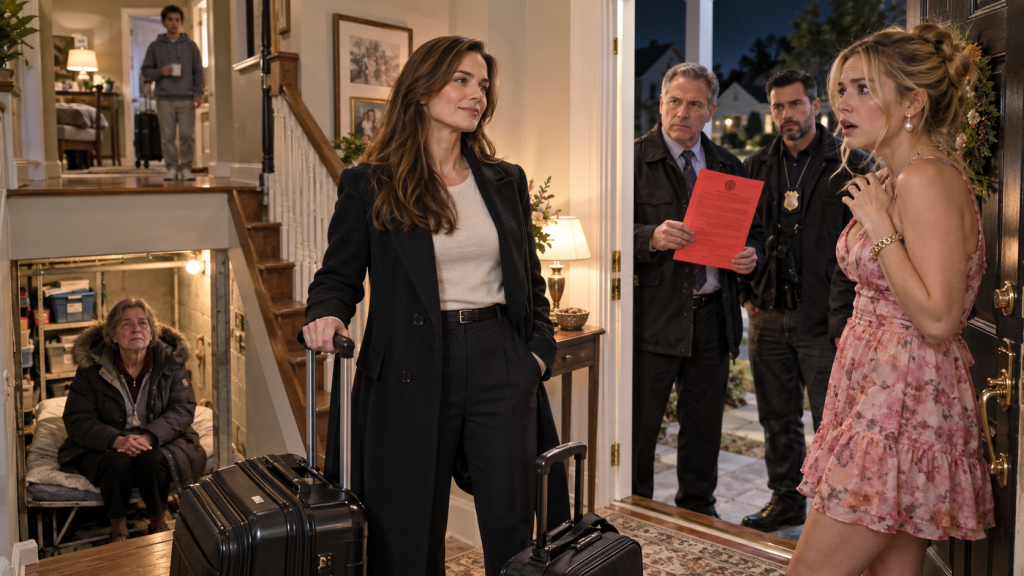
After six years abroad, I came home to surprise Mom in the house I bought for her. My sister answered the door wearing Mom’s jewelry and casually told me Mom now slept in the basement because the upstairs rooms were rented out. I smiled and said, “You just made this very easy.” By 9 p.m., two men were at the door.

After six years working in Singapore, I landed in Seattle with one suitcase, a carry-on, and the stupid grin of a daughter who thought she was about to give her mother the surprise of her life.
The house looked exactly as I remembered from the closing photos: pale blue siding, white porch rails, two maples in front. I had bought it for Mom three years earlier after Dad died, wiring the down payment and every mortgage payment from overseas.
I rang the bell.
My younger sister, Vanessa, opened the door wearing Mom’s pearl earrings and the gold bracelet Dad gave her on their twenty-fifth anniversary.
“Oh,” she said. “You’re back.”
Not hello. Not welcome home.
I looked past her. Three unfamiliar cars sat in the driveway. A man in gym clothes walked across the upstairs hallway carrying a towel.
“Where’s Mom?”
Vanessa folded her arms. “Basement.”
I thought I had misheard.
“What?”
“She sleeps downstairs now. The upstairs rooms are for people who pay.”
The basement door was beside the kitchen. I went down without taking off my shoes.
Mom was asleep on a narrow cot near the furnace, wrapped in a winter coat even though it was June. There was no proper bedroom, just storage shelves, detergent boxes, and an old lamp. Her prescription bottles sat on a folding chair.
Her face looked thinner than it had on our video calls. The camera had always been angled close, never showing the room. I suddenly understood why Vanessa had insisted Mom was “too tired” whenever I asked her to walk around the house with the phone.
When she woke and saw me, she started crying before she said my name.
Vanessa came down behind me. “Don’t make this dramatic. She agreed.”
Mom stared at the floor.
I asked, “Agreed to what?”
Vanessa sighed. “I manage the property. She needs supervision. The renters cover expenses.”
“The mortgage is paid from my account.”
“Utilities aren’t free.”
I looked around again. No smoke detector near the cot. No window large enough for emergency escape. A space heater plugged into an overloaded extension cord.
Then I noticed a stack of envelopes on a shelf, all addressed to me, unopened and hidden behind paint cans.
My smile came back.
Not because anything was funny.
Because Vanessa had finally made one mistake big enough to prove everything.
“You just made this very easy,” I said.
At 7:12 p.m., I photographed every room. At 7:35, I called the attorney who handled the purchase. At 8:10, I sent him the deed, bank records, and pictures.
At exactly 9:00, two men knocked on the front door.
Vanessa opened it.
One held a badge.
The other held a red notice from the city.
PART 2 — THE MAIL BEHIND THE PAINT CANS
At exactly nine o’clock, Vanessa opened the front door.
The first man held up an identification badge.
The second carried a red notice on a clipboard.
Neither looked interested in family drama.
That was the first thing that frightened my sister.
People inside a family can be argued with.
Guilted.
Distracted.
Reminded of birthdays, sacrifices, funerals, and every old favor that makes a boundary feel cruel.
Paperwork is harder to manipulate.
The man with the badge introduced himself as a city housing and safety inspector responding to an urgent complaint regarding possible unsafe residential occupancy.
The second man was a police officer.
Not there to arrest anyone.
There because my attorney had explained that an elderly resident might have been moved into an unsafe basement against her wishes, and no one yet knew how cooperative the person managing the house would be.
Vanessa looked over her shoulder at me.
“What did you do?”
I smiled.
“Asked other people to look.”
That was all.
Apparently it was enough.
Vanessa stepped into the doorway.
“You can’t just come in.”
The inspector remained calm.
“You don’t have to consent to a general inspection tonight.”
Then he looked beyond her.
“But we have a reported sleeping area with possible life-safety hazards and an occupant requesting assistance.”
Mom was standing behind me now.
She had insisted on climbing the basement stairs herself.
Slowly.
One hand gripping the rail.
My other hand beneath her elbow.
The winter coat still hung around her shoulders even though the house was warm upstairs.
The officer looked at her.
“Ma’am, do you want us to come inside?”
Mom glanced at Vanessa.
That one look told me more than anything she had said since I arrived.
Fear does not always look like fear.
Sometimes it looks like checking someone else’s face before answering a question about your own home.
I squeezed her arm.
Not to instruct.
Only to remind her I was there.
Mom swallowed.
“Yes.”
Vanessa turned.
“Mom.”
“Yes.”
Mom said again.
This time louder.
“I want them inside.”
The officer entered.
The inspector followed.
And for the first time since I had come home, Vanessa had to move out of someone else’s way.
The unfamiliar man I had seen upstairs came down wearing sweatpants and a University of Washington sweatshirt.
Behind him appeared a young woman holding a laptop.
Then another man.
Three renters.
All of them confused.
None of them looked like criminals.
That mattered immediately.
Vanessa had spent the last hour calling them “my tenants” as if that made them accomplices.
They were not.
They were people who had paid money for rooms and apparently believed they had rented them legitimately.
The oldest introduced himself as Eric Malone.
“I’ve been here eight months.”
The woman was Priya Shah.
“Eleven months.”
The third tenant, Caleb Ross, had moved in six weeks earlier.
Each of them had a written lease.
Each paid Vanessa electronically.
None had ever met me.
All three believed Vanessa either owned the house or managed it for the owner.
Me.
The inspector looked at the basement first.
He did not need long.
The cot was positioned between the furnace area and storage shelving.
An overloaded extension cord fed the lamp and space heater.
There was no approved bedroom egress.
No proper smoke alarm immediately protecting the sleeping space.
The area had never been finished or permitted as a bedroom.
The inspector photographed everything.
Then he looked at Mom.
“How long have you been sleeping here?”
Mom stared at her hands.
Vanessa answered.
“Three months.”
The inspector did not look at her.
“I asked your mother.”
Vanessa’s mouth closed.
Mom whispered:
“Almost nine.”
My stomach dropped.
Nine months.
Not three.
Nine.
The last time I had seen Mom standing normally during one of our video calls had been roughly nine months earlier.
After that, every call happened from a chair.
Close camera.
Blank wall.
Vanessa always nearby.
I felt sick.
“Why did you move downstairs?”
the officer asked.
Mom hesitated.
Vanessa immediately said:
“She fell.”
Mom flinched.
The officer noticed.
“Ma’am?”
Mom swallowed.
“I did fall.”
Vanessa folded her arms as if that proved everything.
Then Mom added:
“But I was better after six weeks.”
Silence.
I stared at her.
“What happened after six weeks?”
She looked at me.
Shame flooded her face.
Vanessa answered again.
“The rooms were already rented.”
Mom closed her eyes.
There it was.
Not healthcare.
Revenue.
I turned toward my sister.
“You rented Mom’s bedroom?”
“It was empty.”
“She was in the basement.”
“She wasn’t using the stairs well.”
“You told me physical therapy was helping.”
“It was.”
“You told me she still slept in the blue room.”
Vanessa looked away.
I laughed once.
No humor.
“Did you angle the camera so I wouldn’t see the basement wall?”
“Don’t be ridiculous.”
Mom whispered:
“Yes.”
Vanessa froze.
I turned toward Mom.
Her eyes filled.
“She told me not to show you.”
The room became completely still.
Even the tenants stopped shifting.
“Why?”
I asked.
Mom’s voice broke.
“Because you would worry.”
Vanessa snapped:
“Because you would overreact.”
I looked at my sister.
“I haven’t started reacting yet.”
That silenced her.
The inspector completed his immediate assessment.
The red notice did not magically condemn the entire house.
It did something narrower and more useful.
The basement area could not be used as a sleeping room.
Effective immediately.
The electrical setup had to be corrected.
Further inspection would determine whether the house was being operated as an unlicensed rooming arrangement and whether other code requirements applied.
The upstairs tenants were not thrown onto the street at nine-thirty at night.
Good.
Whatever Vanessa had done, Eric, Priya, and Caleb deserved due process too.
I told them that directly.
“You will not come home tomorrow and find your belongings on the sidewalk.”
Eric stared at me.
“You’re the owner?”
“Yes.”
Vanessa laughed.
“She lives in Singapore.”
“That was not the question.”
Priya looked from me to Vanessa.
Then quietly asked:
“Are our leases fake?”
“I don’t know yet.”
I answered.
“But nobody is making you solve my family problem tonight.”
Her shoulders lowered slightly.
I understood something then.
Vanessa had created a house full of people who did not know what was true.
Mom.
The tenants.
Me.
Maybe uncertainty had been part of how she stayed in control.
The officer spoke to Mom privately.
I stayed out.
That was hard.
Every part of me wanted to sit beside her.
Hear every word.
Correct dates.
Explain.
But if I wanted Mom’s voice to matter again, I had to stop hovering over it simply because my intentions were better than Vanessa’s.
So I went upstairs.
Into the room that used to be Mom’s bedroom.
A queen bed now belonged to Eric.
My mother’s floral curtains were gone.
The dresser Dad refinished forty years ago had been pushed into the hallway.
Eric stood awkwardly near the door.
“I didn’t know.”
I looked at him.
He appeared genuinely miserable.
“Vanessa told me your mother preferred downstairs.”
“Why?”
“She said the basement had been converted for accessibility.”
I looked around.
“Did you ever see it?”
“No.”
He rubbed the back of his neck.
“She said her mom was private.”
Of course.
Privacy.
Another useful word.
Eric opened an email on his phone.
“This is my lease.”
I read the first page.
Landlord:
Cedar Lane Property Management.
Authorized property representative:
Vanessa Moore.
Owner:
My full legal name.
My stomach tightened.
“What is Cedar Lane?”
“Her management company.”
I looked at Vanessa.
She stood at the end of the hallway.
She had heard.
“Business structure.”
she said.
“You don’t understand rental management.”
I almost smiled.
“What percentage do you own?”
“Of what?”
“Cedar Lane.”
Her silence answered.
“All of it?”
No response.
Eric looked suddenly uncomfortable.
“What did you pay her?”
I asked.
“First month, last month, security deposit.”
“How much monthly?”
“Fourteen fifty.”
My head turned toward Priya.
“Twelve seventy-five.”
Caleb:
“Fifteen hundred.”
I did the arithmetic.
$4,225 every month.
More than fifty thousand dollars a year.
And Vanessa had said:
Utilities aren’t free.
“Are there more rooms?”
I asked.
Priya nodded toward the converted den near the back.
“Short-term rental.”
My stomach dropped.
“How often?”
“Different people.”
Vanessa stepped forward.
“That money paid for repairs.”
“What repairs?”
“The roof.”
“The roof was replaced before Mom moved in.”
“Appliances.”
“I bought the refrigerator.”
“Property taxes.”
“Escrow pays them with the mortgage.”
She stopped.
There are lies that fail dramatically.
Others simply run out of places to stand.
I remembered the mortgage.
Three years.
Every payment from my Singapore account.
Automated on the fifth of each month.
I also paid homeowner’s insurance through escrow.
Before leaving overseas, Mom and I agreed she would cover ordinary utilities from Dad’s pension and her Social Security.
I paid major maintenance.
She lived there for as long as she wanted.
That was the arrangement.
Not because she owed me.
Because after Dad died, she could not bear staying in the house where he spent his last months.
So I bought this one.
Not for investment.
For rest.
A pale blue place with a garden.
Two maples.
A bedroom upstairs where morning sunlight came through the east window.
And somehow my mother had ended up beside a furnace while strangers paid my sister more than four thousand dollars a month to sleep where Mom was supposed to be safe.
The officer returned.
He did not tell me everything Mom said.
Only what mattered immediately.
Mom wanted to leave with me.
There was no medical reason she had to remain in the house.
She had medication.
Identification.
Clothing.
A doctor we could contact in the morning.
I booked two rooms at a nearby hotel.
Mom refused the second.
“Waste of money.”
I almost laughed.
There she was.
“I’m sleeping near you tonight.”
“You snore.”
“So do you.”
“I’m seventy-one.”
“What’s your excuse?”
Mom actually smiled.
Tiny.
But real.
It was the first time I had seen it since opening the basement door.
Before leaving, I retrieved the stack of envelopes from behind the paint cans.
Twenty-three pieces of mail.
All addressed to me.
Some unopened.
A few opened and resealed badly.
That changed the officer’s interest.
Mail interference can become legally complicated, and he was careful not to declare crimes standing in a basement.
He simply told me to preserve everything exactly as found.
So I put the envelopes into a grocery bag without sorting them.
Then took Mom upstairs to collect clothes.
Her closet held almost nothing.
I stared at the empty hangers.
“Where are your things?”
Vanessa answered from the doorway.
“She downsized.”
Mom turned.
“No.”
My sister’s face changed.
Mom looked at me.
“She sold some.”
“Who?”
“Vanessa.”
I felt my pulse in my throat.
“What did she sell?”
“Clothes.”
“Furniture.”
“Some jewelry.”
My eyes moved automatically to Vanessa’s ears.
Mom’s pearl earrings.
Then the bracelet.
Dad’s bracelet.
Vanessa touched it unconsciously.
That movement said more than words.
“Take them off.”
I said.
Vanessa’s face hardened.
“No.”
“Those belong to Mom.”
“She gave them to me.”
I looked at Mom.
Mom stared at the floor.
“Did you?”
Silence.
My anger surged.
Then I forced myself to wait.
Mom finally said:
“I told her she could have some things someday.”
Vanessa crossed her arms triumphantly.
Mom continued.
“Not now.”
The triumph vanished.
The officer stepped closer.
“This is not going to be resolved by arguing in the hallway.”
Correct.
He documented the dispute.
Vanessa eventually removed the earrings and bracelet voluntarily after the officer explained that contested property could be preserved rather than fought over physically.
Mom held the bracelet in both hands.
Then started crying.
“Your father put this on me at Salty’s.”
she whispered.
I remembered.
Twenty-fifth anniversary.
Dad had saved for six months.
He complained about the restaurant bill for six years afterward.
I put my arm around her.
Vanessa looked away.
For the first time that night, she appeared ashamed.
It did not last.
“You’re turning everyone against me.”
she said.
I looked at her.
“No.”
“You called police.”
“A safety inspector.”
“A lawyer.”
“You photographed everything.”
“Yes.”
“You came home after six years and decided you know everything because of one basement room.”
Mom flinched.
I wanted to scream.
Instead I said:
“You’re right.”
Vanessa blinked.
“I don’t know everything.”
Then I lifted the grocery bag filled with hidden mail.
“That’s why I’m going to read.”
Her face changed.
There.
Again.
Fear.
Mom and I left at 10:48 p.m.
Vanessa remained in the house.
So did the tenants.
That frustrated the part of me that wanted a cinematic ending.
My house.
My mother.
My sister had lied.
Surely someone should hand me a gavel and let me decide where everyone slept by midnight.
Real property does not work that way.
People acquire occupancy rights.
Notice periods exist.
Leases matter even when the person offering them may not have had authority.
Vanessa herself had been living there.
Nobody was being thrown into the rain because I had finally come home angry.
The legal pieces would take time.
I hated it.
Then I respected it.
Rights are not meaningful only when they protect people you like.
At the hotel, Mom showered for almost an hour.
When she came out, she was wearing one of my old T-shirts and hotel slippers.
She looked tiny.
Older than she had that morning.
Younger too.
Like a child in borrowed clothes.
She sat on the edge of the bed.
I brought her tea.
Neither of us touched the hidden mail yet.
“Why didn’t you tell me?”
I finally asked.
Mom’s face crumpled.
There it was.
The question I had been carrying since the basement.
“I tried.”
I stopped.
“When?”
“Last Christmas.”
I searched memory.
Christmas morning in Singapore.
Video call.
Vanessa’s voice in the background.
Mom had seemed distracted.
She asked whether I might come home that year.
I said probably not until summer.
She became quiet.
Then Vanessa entered with coffee.
The call ended ten minutes later.
“What happened?”
I asked.
Mom stared at the tea.
“I said the house felt crowded.”
“And?”
“Vanessa said I was making you feel guilty.”
I closed my eyes.
“She told me you were under pressure at work.”
“That you had spent too much money on the house already.”
“That you were worried I couldn’t afford to live there.”
My stomach turned.
“I never said that.”
“I know now.”
Mom continued.
“She said renting rooms was your idea.”
My hands went cold.
“What?”
“She said you wanted the house helping pay for itself.”
“That you didn’t want to tell me because you knew I’d feel embarrassed.”
I stood.
Walked to the window.
Came back.
“Mom, why would I buy you a house and then put you in the basement?”
Her eyes filled.
“At first she said the basement was temporary.”
“After my fall.”
“Then Eric moved in.”
“Then another room was rented.”
“She kept saying you needed the income.”
My anger turned toward something else.
Not Mom.
Myself.
Six years abroad.
Singapore time zones.
Quarterly visits postponed by work.
Video calls.
Money transfers.
I had mistaken financial provision for proximity.
I had believed paying the mortgage meant I still understood the house.
It didn’t.
Mom seemed to read my face.
“Don’t.”
“What?”
“Do what you always do.”
“What do I always do?”
“Make yourself guilty because it feels more useful than being angry.”
That sounded like Dad.
My throat closed.
Mom touched my hand.
“You bought me a house.”
“You called.”
“You asked.”
“I lied.”
“You didn’t create that.”
I looked away.
“You were afraid.”
“Yes.”
“Of Vanessa?”
Mom thought.
“Mostly of losing both of you.”
That hurt differently.
Vanessa had told Mom that if she complained, I might sell the house.
That I was tired of “supporting everyone.”
That Vanessa was the only reason Mom could afford utilities and groceries.
She told Mom assisted living would cost thousands.
That if she could not manage the basement, maybe it was time to “consider facilities.”
Not a direct threat.
Something softer.
A suggestion placed beside dependency.
Mom had begun believing the basement was the price of remaining in her own life.
“I should’ve called you.”
she whispered.
“Yes.”
I answered.
She looked surprised.
I continued.
“And Vanessa should never have put you in a position where calling me felt dangerous.”
Both things.
No comforting lie.
No blame.
Just truth.
Mom nodded.
We opened the mail at midnight.
One envelope at a time.
The first was from the city.
NOTICE OF RENTAL REGISTRATION DEFICIENCY
Dated fourteen months earlier.
The city had requested updated owner information after a complaint concerning multiple unrelated occupants.
Someone had responded online.
Apparently me.
My stomach tightened.
Second letter.
Homeowner’s insurance.
OCCUPANCY / RENTAL USE INQUIRY
The carrier had received information suggesting rooms were being rented.
It requested confirmation because the existing policy had been issued based on Mom’s residential occupancy.
I had never seen it.
Third.
A second insurance notice.
Fourth.
A certified letter from Priya.
Addressed to me as property owner.
She had complained about a leaking bathroom ceiling four months earlier.
She wrote that Vanessa repeatedly told her the “overseas owner” refused to approve repairs.
I read that sentence twice.
I paid every major repair invoice Vanessa sent me.
There had been no bathroom invoice.
Fifth envelope.
A bank.
Not my mortgage lender.
Puget Community Bank.
Addressed to me.
I frowned.
Inside:
Thank you for your recent inquiry regarding an owner-occupied home equity product. We were unable to continue processing your request because required identity verification was not completed.
My hands went cold.
Mom stared.
“What is that?”
“An application.”
“For what?”
“Borrowing against the house.”
Her face went white.
“Did you?”
“No.”
The date was eight months earlier.
While I was in Singapore.
No loan had funded.
Thank God.
But someone had apparently tried.
I placed the letter separately.
The grocery bag was no longer proof of one lie.
It was becoming a map.
Then came a letter from the county assessor.
I almost put it aside.
Taxes.
Routine.
Then I saw the subject.
OWNERSHIP CHANGE / RECORDING NOTICE
My stomach dropped.
I unfolded the page.
Property address:
Mom’s house.
Prior owner:
Me.
Current ownership:
My name.
And—
Vanessa Moore.
I stopped breathing.
Mom whispered:
“What?”
I handed her the page.
She read slowly.
“I don’t understand.”
Neither did I.
The notice referenced a recorded document from nine months earlier.
A deed.
I looked at the date.
Three days after Mom moved permanently into the basement.
For several seconds, I simply stared.
Then I called my attorney.
At 12:37 in the morning.
He answered.
That alone told me how serious he considered the situation.
His name was Daniel Cho.
He had handled the purchase three years earlier.
When I bought the house, Daniel had helped structure everything clearly.
Title remained solely in my name.
Mom received a written lifetime occupancy agreement allowing her to live there rent-free for as long as she wished, provided she used the property as her principal residence.
It was not ownership.
It did not make her responsible for the mortgage.
It protected her right to live there even if something happened to me.
The agreement required my written consent before any subletting or commercial rental arrangement.
Vanessa had no management authority.
None.
Daniel remembered because I had been obsessive.
“What if I die overseas?”
“What if Mom gets sick?”
“What if something happens with my job?”
I had asked too many questions.
Thank God.
Paperwork is love when written before anyone needs it.
I read Daniel the assessor notice.
His voice changed.
“Send me a photograph.”
I did.
He went quiet.
Then:
“I’m pulling the recording index.”
Mom watched me.
I put him on speaker.
Keyboard sounds.
Clicking.
Then silence.
Long enough to frighten me.
“Daniel?”
“I found it.”
“What is it?”
“A quitclaim deed.”
My stomach dropped.
“From who?”
“You.”
“No.”
“Purportedly.”
“To Vanessa?”
“It transfers an undivided fifty-percent interest in the property to Vanessa Moore.”
Mom covered her mouth.
I stood.
“No.”
“I never signed anything.”
“I understand.”
“I was in Singapore.”
“I understand.”
“Can someone just record a fake deed?”
“County recording does not mean the underlying signature is valid.”
His voice remained calm.
“It means a document meeting recording requirements was accepted into the public record.”
“Who notarized it?”
A pause.
“I’m opening the image.”
More clicking.
Then:
“Notary named Alicia Grant.”
The name meant nothing to me.
“Do you know her?”
“No.”
Daniel continued.
“The deed states you signed in Washington.”
“When?”
He gave me the date.
September 14.
I almost laughed.
“What?”
he asked.
“I was speaking at the Asia-Pacific compliance conference that day.”
“In Singapore?”
“Yes.”
“Public event?”
“Yes.”
“Travel records?”
“Yes.”
“Passport?”
“Yes.”
“Hotel?”
“Yes.”
“Photos?”
“Probably fifty.”
For the first time all night, something almost like relief entered Daniel’s voice.
“Good.”
Mom stared at me.
“How can that be good?”
“It means I can prove where I was.”
Evidence.
Not memory.
Not family versus family.
A timestamped reality outside Vanessa’s control.
Daniel told me not to confront her about the deed yet.
Too late emotionally.
Not too late practically.
We preserved the assessor notice.
The bank letter.
City notices.
Insurance correspondence.
Rental leases.
Photos.
Payment records from tenants would come later with their consent.
Daniel would arrange a formal title review in the morning and coordinate with the appropriate authorities regarding the disputed deed.
No promises that everything would be corrected in one day.
No theatrical tearing up the document.
Recorded title problems require process.
I hated that sentence.
Again.
But process was beginning to feel like the opposite of Vanessa.
Slow.
Visible.
Checkable.
Mom sat quietly after the call ended.
Then said:
“She told me you gave her half.”
I turned.
“What?”
Mom’s eyes filled.
“When?”
“Around the time she moved me downstairs.”
My skin went cold.
“What exactly did she say?”
“That you had decided the house should be equal between your daughters eventually.”
“That she was helping you manage your American property.”
“Did she show you paperwork?”
“Yes.”
“Did you believe it?”
Mom started crying.
“I wanted to.”
That answer surprised me.
“Why?”
“Because then what she was doing made sense.”
My chest hurt.
Of course.
If Vanessa owned half the house, the authority looked different.
If I had approved it, Mom was not being betrayed.
She was simply adjusting to a decision both daughters had already made.
Sometimes people believe lies because truth would make the person they love unbearable.
“Did she ever tell you I wanted you downstairs?”
Mom nodded.
Once.
That was enough to make me stand and walk into the hotel bathroom because I thought I might scream.
I closed the door.
Pressed both hands against the sink.
Looked at myself in the mirror.
Six years older than the daughter who left for Singapore.
Same face.
Different woman.
My sister had not merely taken rooms.
She had borrowed my voice.
That was what hurt most.
She told tenants I refused repairs.
Told Mom I wanted rental income.
Told the city I authorized management.
Told a bank I wanted a loan.
Put my name on a deed.
Everywhere I was absent, Vanessa built a version of me convenient enough to approve whatever she needed.
The next morning, Daniel met us at nine.
Mom came too.
I told her she could stay at the hotel.
She refused.
“My house.”
Fair.
Daniel spread documents across a conference table.
Original deed.
My occupancy agreement with Mom.
Mortgage records.
The disputed quitclaim.
The signature on the deed looked like mine from a distance.
The first letter of my name.
The long curve at the end.
But when Daniel placed it beside my purchase documents, differences appeared.
Spacing.
Pressure.
Angle.
Still, none of us pretended visual comparison alone proved forgery.
That would come through appropriate review.
More important was location.
The deed stated:
Signed personally before the notary in King County, Washington.
On the same date my employer’s conference schedule showed me presenting in Singapore.
There were photographs.
Event video.
Company travel booking.
Immigration records could support the timeline if needed.
Vanessa had picked the wrong day.
Or assumed nobody would check.
“Why transfer only half?”
I asked.
Daniel leaned back.
“Possibly because full ownership would draw more attention.”
“Possibly because she wanted to represent herself as co-owner.”
“Possibly because whoever prepared this believed fifty percent was enough for a particular purpose.”
“What purpose?”
“We don’t know.”
Then he opened a second report.
“The attempted home-equity inquiry happened one month after the deed.”
My stomach tightened.
There it was.
Sequence.
Not proof of motive yet.
But sequence.
Vanessa obtained a recorded claim to half.
Then someone approached a bank about borrowing against the property.
No loan funded because identity verification failed.
My absence had protected me accidentally.
The same six thousand miles that let Vanessa hide things made it harder to impersonate me once a lender insisted on speaking to the actual owner.
Then Daniel showed me Cedar Lane Property Management’s state registration.
Formed eighteen months earlier.
Sole member:
Vanessa.
Business address:
Mom’s house.
For the previous fourteen months, available bank records showed tenants paid Cedar Lane.
Eric sent Daniel his payment history voluntarily.
Priya did too.
Caleb followed later that afternoon.
Rent collected from those three alone exceeded forty-six thousand dollars during their respective occupancies.
The short-term room likely added more.
We did not know the total yet.
And we did not know expenses.
Some money had gone toward utilities.
Repairs.
Cleaning.
Furniture.
That mattered.
Financial truth is rarely the gross number.
But one fact was already clear.
Mom’s utilities had continued coming from Mom’s checking account.
Not Vanessa’s.
“How do you know?”
I asked.
Mom looked embarrassed.
“She set up autopay for me.”
Daniel asked permission before looking at her banking records.
Mom agreed.
The statements showed electricity.
Water.
Internet.
Groceries.
All primarily paid from Mom’s funds.
There were also transfers.
Regular.
$600.
$850.
$1,100.
Recipient:
Vanessa.
Descriptions:
HOUSEHOLD
CARE
MANAGEMENT
My stomach turned.
“Did you agree to these?”
Mom stared.
“Some.”
“Which?”
She pointed to the smaller ones.
“Groceries.”
“Medicine pickup.”
“Gas.”
The larger transfers?
“I don’t know.”
Daniel raised a hand.
“We should not label anything improperly taken until the records are complete.”
Good.
Careful.
Again.
But even Mom could see the pattern.
Vanessa was collecting rent from strangers.
Receiving money from Mom.
While I paid the mortgage.
And still describing herself as the person keeping the house afloat.
That afternoon we met the tenants.
Not at the house.
Daniel arranged a conference room.
No Vanessa.
Eric came carrying his lease.
Priya brought a folder thick enough to make me like her immediately.
Caleb had screenshots.
They told us what Vanessa had told them.
I was an investor living permanently in Singapore.
Mom was an elderly relative allowed to stay temporarily.
Vanessa was co-owner.
Rent supported taxes and maintenance.
Mom liked the basement because stairs were difficult.
The upstairs rooms had once been “wasted space.”
My stomach hurt with every sentence.
Then Priya said something that made Mom cry.
“I offered her my room.”
Mom looked up.
“What?”
“Two months ago.”
Priya’s eyes filled.
“You were coughing.”
“I said I could switch downstairs for a few nights if you wanted the bed.”
“You told me Vanessa wouldn’t allow it.”
Mom covered her face.
Vanessa had not merely hidden the arrangement.
She had defended it against kindness.
“I’m sorry.”
Priya whispered.
Mom lowered her hands.
“For what?”
“I should’ve known.”
Mom shook her head.
“No.”
That answer came stronger than any she had given yet.
“You were told it was normal.”
She looked at me.
Then back at Priya.
“People believe what someone with keys tells them.”
I felt that sentence in my chest.
Vanessa had keys.
Passwords.
Mail.
Access.
Authority performed long enough begins to resemble authority itself.
I told the tenants the truth.
I owned the property.
Mom had a written right to live there.
I had never authorized room rentals.
I had never refused their repairs.
I had never appointed Vanessa to manage anything.
Their leases and rights would be reviewed properly.
No retaliatory locks.
No midnight eviction.
No utilities shut off.
Priya started crying from relief.
Eric asked:
“Do we have to leave?”
“Eventually, maybe.”
I said.
“I don’t know yet.”
“Daniel will explain what happens legally.”
“But you’ll get notice.”
That was the best promise I could make.
A truthful one.
Mom squeezed my hand beneath the table.
Later she whispered:
“Your father would be proud.”
I almost cried.
Dad had worked forty-two years as an electrician.
He believed every problem could be solved with the right breaker and enough patience.
He would have hated every unsafe wire in that basement.
He would also have walked upstairs and tried to throw Vanessa’s furniture into the street.
So perhaps it was good he was present only in spirit.
Vanessa hired a lawyer.
That was the smartest thing she did.
Communication changed immediately.
No more screaming calls.
No more messages telling me I had abandoned Mom.
No more accusations that Singapore had made me arrogant.
Her attorney sent a letter stating that Vanessa denied wrongdoing, believed she possessed an ownership interest, and had made substantial contributions to the property’s maintenance and Mom’s care.
Fine.
Those claims could be examined.
Then the letter included one sentence:
Ms. Moore maintains that any ownership transfer was undertaken with her sister’s knowledge and consent.
I stared.
“Knowledge and consent.”
Daniel nodded.
“That’s her position.”
“She knows I was in Singapore.”
“She may have an explanation.”
“What explanation?”
“I don’t know.”
I hated him for being reasonable.
That probably meant he was good at his job.
Two days later, Mom finally told me what Vanessa had said before moving her downstairs.
We were eating soup in the hotel.
Mom had been silent for ten minutes.
Then:
“She said you were angry at me.”
My spoon stopped.
“For what?”
“For needing so much.”
I could not breathe.
“What exactly?”
Mom stared into the bowl.
“She said you were worried the house had become a burden.”
“That you wanted some return.”
“That you had your own retirement to think about.”
“That you couldn’t keep supporting me forever.”
My throat closed.
“Mom.”
“I know now.”
“No.”
I reached across the table.
“I need you to hear this from me.”
She looked up.
“That house was never payment for anything.”
“You raised me.”
“You took extra shifts when Dad’s hours were cut.”
“You paid my college deposit from money you saved in a coffee tin.”
“You mailed me food when I was twenty-three and too proud to admit I was broke.”
“I bought you a house because I could.”
“Not because you owed me a return.”
Mom cried quietly.
I did too.
Sometimes a lie does not need to be sophisticated.
It only needs to land on an old fear.
Mom’s fear was becoming expensive.
Vanessa knew where to place it.
Then Mom said:
“She told me something else.”
I waited.
“She said you had started asking about selling.”
I laughed from disbelief.
“I never did.”
“I know.”
“Did she say why?”
“To release equity.”
There was the phrase.
Equity.
The home-equity inquiry.
The forged deed.
The rental business.
Everything was beginning to lean toward the same direction.
Not proof.
Direction.
On Friday morning, Daniel called.
“Come in.”
Mom and I were already becoming accustomed to those words.
“What happened?”
“The title company located another document connected to the quitclaim deed.”
My stomach tightened.
“What kind?”
“An affidavit.”
I sat down.
Mom watched from across the hotel room.
“What affidavit?”
“A statement submitted during a later transaction inquiry.”
“Signed by who?”
“You.”
Of course.
I closed my eyes.
“What does fake me say now?”
Daniel did not laugh.
“That you transferred half the property to Vanessa as compensation for six years of unpaid caregiving to your mother.”
I stopped breathing.
Six years.
Vanessa had only moved into Mom’s house eighteen months earlier.
Before that, she lived twenty minutes away and visited irregularly.
Mom had been independent until her fall.
The timeline itself was absurd.
“Anything else?”
“Yes.”
Daniel’s voice changed.
“The affidavit says your mother is no longer competent to manage her own housing decisions.”
I looked at Mom.
She was standing by the window watering a hotel plant with the leftover water from her glass because she said nobody cared for indoor plants properly.
“Incompetent?”
I whispered.
Daniel continued.
“It states Vanessa should therefore be treated as the primary family representative regarding the property.”
Something inside me went very still.
There it was.
The full architecture.
I was too far away.
Mom was too confused.
Vanessa was the only reasonable person left.
Then Daniel said:
“There’s a signature from your mother too.”
I closed my eyes.
“Mom.”
She turned.
“What?”
I put the phone on speaker.
Daniel repeated it.
Mom went pale.
“I never signed that.”
“Do you remember signing any affidavit about your competency or Vanessa’s caregiving?”
“No.”
Her voice sharpened.
“No.”
Then she sat down.
“Wait.”
I watched her.
“What?”
“After I fell.”
She pressed her fingers to her forehead.
“Vanessa brought papers.”
My stomach dropped.
“What papers?”
“She said they were for insurance.”
“What kind of insurance?”
“I don’t remember.”
“Did you sign?”
“Two pages.”
Maybe three.
Her eyes filled.
“I didn’t read them.”
I wanted to say:
Mom.
Instead I stopped.
She already knew.
Shame would not improve memory.
Daniel spoke gently through the phone.
“Do you remember whether the affidavit was notarized in front of you?”
Mom frowned.
“There was a woman.”
My pulse jumped.
“What woman?”
“Vanessa’s friend.”
“Name?”
Mom closed her eyes.
Then opened them.
“Alicia.”
The room went silent.
Alicia Grant.
The notary on my forged quitclaim deed.
I looked at the phone.
Daniel did not speak for several seconds.
Then:
“That is important.”
Not proof of everything.
Important.
“Do you know Alicia?”
I asked Mom.
“Only from Vanessa.”
“How often did she come?”
“Twice.”
“When?”
“After my fall.”
“And once…”
Mom stopped.
“What?”
“The day Vanessa said you were giving her half the house.”
My skin went cold.
There.
A real person.
A notary.
A disputed deed supposedly signed by me in Washington while I stood on a stage in Singapore.
An affidavit questioning Mom’s competence.
Mom remembering Vanessa’s friend arriving with documents.
Suddenly this was not only a sister taking advantage of distance.
Someone else had helped create paperwork around the distance.
Daniel’s voice became firm.
“Do not contact Alicia.”
“I wasn’t planning to.”
“Do not contact Vanessa about this.”
“I won’t.”
“We preserve everything.”
“Yes.”
“We let the appropriate process determine what she witnessed, what she notarized, and what she believed.”
I looked at Mom.
She looked frightened.
Then angry.
Good.
Anger is not always healing.
Sometimes it is simply the moment shame stops pointing inward.
After the call, Mom walked to the mirror.
She touched her own face.
Then whispered:
“She told people I was incompetent.”
I stood beside her.
“Yes.”
“I’m not.”
“I know.”
“I forgot things.”
“Everyone forgets things.”
“I fell.”
“That doesn’t transfer ownership of your life.”
Mom looked at me.
Then, slowly:
“She made me feel like needing help meant I wasn’t allowed to decide.”
That sentence hurt more than the basement.
Because there was the real theft.
Not rent.
Not jewelry.
Not rooms.
Authority.
Vanessa had turned Mom’s temporary weakness into a permanent argument for control.
And she had used my absence as the other half.
One sister too far away.
One mother too old.
Only Vanessa left standing in the middle.
That evening, Daniel sent me the affidavit.
I read it once.
Then again.
Near the bottom was a sentence supposedly written from me:
I trust Vanessa Moore completely to act in the best interests of our mother and the property.
I stared at it.
My sister had been right about one thing.
She had made this very easy.
Not legally easy.
Nothing about title disputes, tenants, financial tracing, elder exploitation concerns, or forged documents would be easy.
But morally?
Clear.
I had spent six years wondering whether distance made me a bad daughter.
Mom had spent nine months believing dependence made her a burden.
The tenants wondered whether they had done something wrong simply by paying rent.
All of us had been made uncertain.
The documents were finally doing what lies hate most.
Fixing dates.
Fixing words.
Fixing responsibility.
Then Daniel called again.
His voice was different this time.
Not merely concerned.
“There’s one more thing.”
I almost laughed.
“You attorneys should stop saying that.”
“I agree.”
“What?”
“I pulled the full chain of title.”
My stomach tightened.
“And?”
“The quitclaim deed to Vanessa was not the most recent recording.”
I stopped breathing.
“What is?”
A pause.
“A deed of trust.”
Mom looked at me.
“What’s wrong?”
I held up one hand.
“To who?”
Daniel named a private lender I had never heard of.
My heart began pounding.
“Amount?”
“Two hundred and forty thousand dollars.”
The room tilted.
“Funded?”
“We’re confirming.”
I gripped the phone.
“How can there be a loan if the bank one failed?”
“This is not Puget Community Bank.”
“It appears to be a private real-estate lender.”
“Borrower?”
Another pause.
Then Daniel said:
“Vanessa Moore.”
I exhaled.
Then realized.
“Collateral?”
“The house.”
My house.
Mom’s home.
The one I had been paying for every month from Singapore.
I could barely speak.
“She borrowed against my house?”
“Against the interest she claimed to own.”
“Whether that interest was valid is now central.”
Mom had gone white.
I sat beside her.
“When?”
I asked.
Daniel gave me the date.
Four months earlier.
After the home-equity bank had refused to proceed without my direct verification.
Vanessa had apparently found another route.
“Where did the money go?”
I whispered.
“We don’t know yet.”
“Did she receive two hundred forty thousand?”
“We are confirming disbursement.”
“Daniel.”
“I know.”
Then his voice became even quieter.
“There is an attached borrower statement.”
My heart sank.
“What does it say?”
“That Vanessa intends to use the proceeds to acquire another residential property.”
I closed my eyes.
“Did she?”
“I’m searching.”
Keyboard sounds.
Mom held my wrist.
Then Daniel stopped typing.
“Oh.”
One syllable.
I hated it immediately.
“What?”
“There’s another property.”
My stomach dropped.
“Whose name?”
“Cedar Lane Holdings LLC.”
Vanessa’s management company had been Cedar Lane Property Management.
Another entity.
Another layer.
“Address?”
Daniel read it.
I knew the street.
Not the exact house.
But the neighborhood.
Expensive.
Water nearby.
Twenty minutes from Mom’s house.
“Purchase price?”
“Six hundred and eighty-five thousand.”
I almost laughed.
From disbelief.
“When?”
“Three months ago.”
“Who lives there?”
“I don’t know.”
Then Daniel added:
“But the mailing address for Cedar Lane Holdings is not your mother’s house.”
“What is it?”
He read another address.
A downtown Seattle condominium.
Mom frowned.
I did too.
Then something old stirred in my memory.
Vanessa had mentioned a man during our last Christmas call.
A “business partner.”
Someone named—
“Marcus.”
I whispered.
Mom looked at me.
Daniel paused.
“What?”
“Is there a Marcus connected to the LLC?”
More typing.
Then:
“Yes.”
My body went cold.
“Marcus Bell.”
“Minority member.”
“Thirty percent.”
Mom covered her mouth.
I had never met him.
Vanessa had told me he was helping her “learn real estate.”
Apparently she had omitted whose property funded the lesson.
Daniel’s next words came carefully.
“We still do not know whether the private loan proceeds funded this purchase.”
“Do not assume tracing until we have bank records.”
I nodded even though he could not see me.
Facts.
Always facts.
But the shape had changed again.
Vanessa had not simply rented rooms because utilities were expensive.
She had created companies.
Recorded herself into my title.
Attempted one loan.
Then apparently obtained another.
And within weeks, an LLC tied to her bought a nearly seven-hundred-thousand-dollar property.
All while Mom slept beside a furnace.
I looked at the hotel nightstand.
Dad’s gold bracelet lay there.
Recovered.
Small.
Ordinary.
He had bought it with overtime pay.
He would never have understood a world where people called this “property management.”
Mom squeezed my hand.
“Is my house gone?”
The fear in her voice cut through everything.
I turned toward her.
“No.”
I did not actually know what the final legal outcome would be.
So I corrected myself.
“No one is taking you back to that basement.”
That I could promise.
Mom nodded.
Specific.
Achievable.
The ground beneath the bridge.
Daniel said:
“We’re going to need a forensic title review and financial tracing.”
“Yes.”
“The private lender will need notice of the disputed deed.”
“Yes.”
“The tenants’ situation still needs proper handling.”
“Yes.”
“And there may be separate issues involving your mother’s finances and the notarizations.”
“Yes.”
Then:
“This is going to get bigger before it gets smaller.”
I looked at Mom.
At the stolen bracelet.
At the stack of mail.
At the assessor notice that should have reached me nine months earlier.
All of it had been sitting behind paint cans while I flew across the Pacific thinking the biggest surprise waiting in Seattle would be Mom’s face when she opened the door.
Instead, my sister had opened it.
Wearing our mother’s jewelry.
Standing inside a house she had quietly begun treating like an asset she inherited while both of us were still alive.
I tightened my hand around Mom’s.
“Fine.”
I told Daniel.
“Then make it accurate.”
That night, Mom fell asleep in the hotel bed beside mine.
For the first time since arriving, she was warm.
No furnace.
No extension cord.
No footsteps from strangers sleeping above her.
I stayed awake.
At 2:13 a.m., my phone vibrated.
A message from Daniel.
One attachment.
No explanation except:
Found the private loan closing package. Call me in the morning. Do not contact Vanessa.
I opened the first page.
Borrower:
Vanessa Moore.
Collateral:
The pale blue house.
Then I reached the signature section.
Vanessa had signed as borrower.
Below that was another signature line.
Consenting Property Owner.
My name.
My forged name.
Again.
But this time, beside it, someone had added a copy of my passport.
Not an old driver’s license.
My current passport.
The one I had renewed in Singapore eighteen months earlier.
A document Vanessa should never have possessed.
I sat upright.
There were only three places I had sent that passport copy.
My employer.
The airline handling my most recent relocation paperwork.
And—
my mother.
Because Vanessa had told me Mom needed it for “estate planning.”
I stared at the screen.
Then at Mom sleeping beside me.
A new thought entered.
Not about Vanessa.
About access.
Who had received the file?
Who had forwarded it?
Who else had been helping?
I scrolled to the notary acknowledgment.
Same name.
Alicia Grant.
Then the witness section.
One unfamiliar signature.
Marcus Bell.
Vanessa’s business partner.
My stomach turned.
Three people.
Not one.
And for the first time, I understood why my sister had looked afraid when I lifted that grocery bag of hidden mail.
She was not afraid I would discover she had rented Mom’s bedroom.
She was afraid I would discover the house had already become collateral for a much larger plan.
I closed the laptop.
Looked at Mom.
Then whispered into the dark:
“You weren’t the tenant.”
Neither was I.
We were the asset.
PART 3 — THE HOUSE WAS NEVER THE INHERITANCE
Daniel called at 7:03 the next morning.
Mom was already awake.
She had made hotel coffee and declared it “an insult to beans.”
That alone told me she was beginning to return to herself.
I put Daniel on speaker.
He did not waste time.
“The private lender did fund.”
My stomach tightened.
“How much actually disbursed?”
“Two hundred and thirty-one thousand after fees and reserves.”
Mom closed her eyes.
“And where did it go?”
“Mostly to a title company connected to the Cedar Lane Holdings purchase.”
There it was.
The second house.
The one Vanessa had bought through an LLC with Marcus Bell.
Daniel continued.
“Preliminary tracing suggests approximately one hundred ninety thousand dollars from the loan secured against your property went into the Cedar Lane purchase.”
I stared at the hotel carpet.
“So my house bought their house.”
“Partly.”
Daniel corrected gently.
“The new property also had other financing and cash contributions.”
Important.
No exaggeration.
“And Marcus?”
“Forty-five thousand appears to have come from him.”
“So Vanessa used my forged ownership interest for the rest.”
“That is what the documents appear to support.”
Mom whispered:
“My God.”
Daniel continued.
“The private lender is cooperating for now.”
“For now?”
“They relied on a recorded deed showing Vanessa as a fifty-percent owner.”
“And a notarized consent supposedly signed by you.”
“They are not eager to discover they accepted collateral based on forged documents either.”
I almost laughed.
For once, everybody had reason to want the same truth.
“What happens now?”
“Title litigation.”
“Fraud investigation.”
“Financial tracing.”
“Possibly a negotiated resolution with the lender.”
“Possibly court orders.”
“Not today.”
I hated the last two words.
Mom touched my hand.
She had begun recognizing that expression.
The one where I wanted the world corrected before breakfast.
Then Daniel said:
“We also found how Vanessa got the passport.”
My entire body went still.
“How?”
“Your mother’s email.”
I turned toward Mom.
She went pale.
“I didn’t send it to Vanessa.”
“I know.”
Daniel’s voice softened.
“Last year, your mother emailed the passport copy to herself after you sent it for estate-planning records.”
Mom frowned.
“I remember.”
“Vanessa later accessed the account from an IP address associated with the house.”
My stomach tightened.
“Could Mom have given her the password?”
Mom looked ashamed.
“I did.”
“Why?”
“She helped me order prescriptions.”
“And pay one bill when my hands were shaking after the fall.”
I squeezed her hand.
No lecture.
No hindsight performance.
Daniel continued.
“The email provider’s login records show the account was accessed repeatedly from a device we believe was Vanessa’s.”
“How do you know?”
“Device identifier and recovery contact.”
“What recovery contact?”
He paused.
“Vanessa changed it to her own phone number.”
Mom stared.
“When?”
“Seven months ago.”
After the basement.
After the rental rooms.
After the fake deed.
Control had not entered the house all at once.
It had accumulated.
Password by password.
Room by room.
The police investigator assigned to the financial case was named Detective Lauren Kim.
She met us that afternoon.
She did not call Vanessa a criminal.
She did not tell me the case was obvious.
She spread documents across a conference table and asked questions.
When had I last been physically in Washington?
Who had access to my passport copy?
Did I ever discuss transferring title?
Did I authorize Vanessa to manage renters?
Had I signed anything in front of Alicia Grant?
Had I ever met Marcus Bell?
No.
No.
No.
No.
No.
It was astonishing how much of the case could be built from the repetition of one word.
No.
A word Vanessa had spent years trying to make irrelevant.
Mom was interviewed separately.
Again, I was not allowed to answer for her.
Again, I had to sit with the discomfort.
When she came out, she looked tired.
But taller somehow.
“What did she ask?”
I said.
Mom smiled faintly.
“You’re not supposed to interrogate the witness.”
“That sounds like something Dad would say.”
“It does.”
Then she became serious.
“I told her about Alicia.”
“And the papers?”
“Yes.”
“I told her I signed things without reading.”
Shame flickered across her face.
I took her hand.
“You were recovering from a fall.”
“I still should have read.”
“Yes.”
She blinked.
Then laughed softly.
“You’re supposed to say no.”
“I’m tired of lying to make people feel better.”
Mom nodded.
“Good.”
Then:
“But Vanessa still didn’t have the right to lie about what you signed.”
“No.”
There it was.
Accountability without self-destruction.
We were both learning.
Marcus Bell contacted Daniel two days later.
Through his lawyer.
Of course.
He claimed he had believed Vanessa legitimately owned half of the pale blue house.
He had seen the recorded deed.
He had seen the notarized consent from me.
He knew I lived abroad.
He believed Vanessa had family authorization to manage the property.
That explanation did not make him innocent automatically.
It did not make him guilty either.
The records would matter.
Then Daniel showed me messages recovered through the civil process.
Marcus to Vanessa:
Your sister is okay with the collateral?
Vanessa:
She signed everything. She just doesn’t want Mom bothered with details.
Marcus:
Need her to confirm directly.
My pulse jumped.
Vanessa:
She’s in Singapore. Time zones are impossible. Alicia handled it.
Marcus:
That’s not the same thing.
I read the next message.
Vanessa:
Do you want the deal or not?
There it was.
Pressure.
Familiar in a different form.
Marcus had hesitated.
Then continued anyway.
That mattered.
Not because hesitation erased participation.
Because it showed he knew enough to ask a question and chose not to insist on the answer.
Marcus eventually admitted he had witnessed the private loan package without seeing me sign.
His signature as “witness” did not mean what the document implied.
He had watched Vanessa present a completed signature page and accepted her explanation that I had executed it remotely.
Alicia supposedly “confirmed” it.
Again, nobody called me.
Everyone trusted another person’s version of my yes.
It was becoming the defining sentence of the entire story.
Alicia Grant was harder to reach.
Then suddenly she was not.
Her attorney called Detective Kim.
Alicia wanted to cooperate.
That word traveled through the family faster than gossip.
Vanessa stopped sending messages completely.
Mom barely spoke for an hour after hearing it.
I thought she was relieved.
Then she said:
“I liked Alicia.”
I looked at her.
“She brought me soup once.”
Of course she did.
Betrayal is easiest when the person is not cruel every minute.
Alicia’s account was simple enough to make me furious.
Vanessa had been a client first.
Then a friend.
Vanessa referred property-management documents to her.
Routine acknowledgments.
Tenant affidavits.
Business filings.
Alicia had built a small mobile-notary practice.
When Vanessa brought the quitclaim deed supposedly signed by me, Alicia asked why I was not present.
Vanessa said I had already signed in Singapore and merely needed “Washington acknowledgment” to satisfy a title requirement.
That should have ended it.
It did not.
Alicia notarized anyway.
Later, when the private lender needed additional consent documents, Vanessa brought another signed page.
Alicia stamped again.
“Why?”
I asked Daniel.
He looked tired.
“Because people become accustomed to the first shortcut.”
That sentence stayed with me.
One broken rule creates a path.
The next time, the grass is already flattened.
Alicia also notarized Mom’s affidavit.
That one she did witness.
But Mom thought she was signing insurance paperwork.
The document itself included statements about Vanessa’s caregiving and Mom’s competency.
Whether Mom legally understood the contents would become a separate issue.
What mattered immediately was that Alicia admitted she did not explain the document, and Vanessa controlled the conversation.
Mom remembered signing near the bottom while Vanessa stood beside her.
“I should have read it.”
Mom said again.
This time Daniel answered.
“Yes.”
Mom looked surprised.
He continued.
“And the notary should have verified what she was notarizing properly.”
“And Vanessa should not have misrepresented the document.”
“Several things can be true.”
Mom nodded.
Apparently lawyers were useful for more than property.
The title case moved first.
Not fast.
First.
The court issued temporary restrictions preventing further transfers or new liens while ownership was disputed.
That did not magically erase the private lender’s claim.
It froze the board while everyone figured out which pieces belonged there.
The lender filed its own claims against Vanessa and related parties.
Cedar Lane Holdings became part of the dispute because loan proceeds had flowed into its property.
Marcus’s forty-five thousand dollars complicated the accounting.
The second house itself had a mortgage.
No one simply handed me the keys.
Good.
I did not want them.
I wanted my mother’s home disentangled from a business deal she had never agreed to support.
The tenants stayed during the initial proceedings.
Then we created a plan.
Eric found another apartment first.
He had been planning to move closer to work anyway.
I returned his security deposit personally once Daniel approved the process, then pursued reimbursement separately through the litigation.
He tried to refuse.
“This isn’t your fault.”
“No.”
I said.
“But you paid for a home in good faith.”
“So did you.”
He smiled sadly.
Fair.
Priya stayed longest.
She helped Mom pack the rest of her belongings.
The two of them cried in the upstairs bedroom that had once belonged to Mom and then to Eric and then, temporarily, to no one.
Caleb moved in with his girlfriend.
The short-term rental stopped immediately.
One by one, the house became quieter.
Not empty.
Quieter.
Vanessa still lived there under advice from counsel until an agreed move-out date was reached.
That infuriated me.
I had to learn a hard truth:
Owning a house does not mean you can treat people like furniture.
Even people who wronged you.
She had occupancy claims.
Personal property.
Notice rights.
Her wrongdoing did not make every protective rule disappear.
When she finally moved out, it happened at eleven on a Tuesday morning.
No police.
No television cameras.
No neighbors cheering.
A moving truck.
Boxes.
Her lawyer.
Mine.
Mom chose not to attend.
I did.
Not to watch her suffer.
To receive the keys.
Vanessa came down the porch steps last.
She looked smaller than I remembered.
No pearls.
No gold bracelet.
Hair tied back.
No makeup.
For one stupid second, I saw her at eleven years old, standing outside Dad’s workshop asking me to help her build a birdhouse.
Memory is cruel that way.
It does not wait until somebody deserves tenderness.
She held out the keys.
I took them.
There were seven.
Front door.
Back door.
Garage.
Mailbox.
Basement.
Two I did not recognize.
“What are these?”
“Storage unit.”
My stomach tightened.
“What storage unit?”
Her face changed.
Of course.
Daniel, standing beside me, sighed almost imperceptibly.
“Vanessa.”
She looked at him.
“What is in the storage unit?”
“Mom’s stuff.”
My grip tightened around the keys.
“What stuff?”
“Furniture.”
“Boxes.”
“Things that didn’t fit.”
Mom’s dresser.
Dad’s workshop chest.
Photo albums.
China.
Seasonal decorations.
Things Vanessa had told Mom were sold or donated.
Not all.
Some.
My anger changed again.
“Why store them?”
Vanessa looked at me.
“Because Mom wouldn’t let me throw everything away.”
That sentence almost made me laugh.
She had not kept them from kindness.
She had kept them because even control has limits when the person being controlled refuses one last thing.
Mom had preserved pieces of herself in a storage unit she did not know I would ever see.
“Is the unit paid?”
“Yes.”
“Through when?”
“End of the month.”
“Who has access?”
“Me.”
“And now?”
She looked at the key in my hand.
“You.”
Daniel immediately corrected:
“Assuming the storage account can be transferred properly.”
Right.
Process.
Again.
I almost smiled.
Vanessa looked toward the house.
Then whispered:
“I really thought I was helping.”
The sentence landed differently than I expected.
Not because I believed her completely.
Because I believed she believed parts of it.
“Helping who?”
I asked.
She looked at me.
“Mom.”
“You.”
“Myself.”
At least the third person finally entered the sentence.
She continued.
“You bought a house and disappeared.”
I flinched.
“You sent money.”
“You asked how everyone was.”
“But you weren’t here.”
“That does not make forged deeds okay.”
“I know.”
“Does it?”
Her face collapsed.
“No.”
I waited.
Vanessa continued.
“At first, I just rented one room.”
“Mom had fallen.”
“She wasn’t using it.”
“I thought the money would help.”
“Then people kept asking if there were more rooms.”
“And it was easy.”
There.
Easy.
The word behind so many disasters.
“What about the deed?”
She looked away.
“That came later.”
“Obviously.”
“I wanted to qualify for financing.”
“For Cedar Lane?”
“Yes.”
“Why not use your own property?”
“I didn’t have enough.”
“So you used mine.”
“I told myself you would agree if the investment worked.”
I closed my eyes.
There it was.
The family version of consent.
Success first.
Permission later.
Vanessa continued.
“I was going to pay everything back.”
“Then Mom would have the whole upstairs again.”
“Eventually.”
That word made me furious.
“Eventually?”
Vanessa started crying.
“I know.”
“No.”
“You put her beside a furnace so someday your numbers might work.”
“I know.”
Her voice broke.
“I know now.”
I asked the question that had lived inside me since Singapore.
“Why didn’t you ask me?”
She laughed through tears.
“Because you would have said no.”
The entire story collapsed into one sentence.
Not misunderstanding.
Not communication failure.
She knew.
She anticipated my answer.
Then built a world in which my actual answer no longer mattered.
I looked at the house.
Pale blue.
White rails.
Two maples.
Still beautiful.
Buildings are innocent.
That felt unfair.
The criminal cases resolved much later.
Alicia lost her notary commission and faced consequences for the false notarizations.
She entered a negotiated resolution and cooperated regarding the documents.
Marcus resolved his own exposure separately.
The records showed he had not created the forged signatures, but he had knowingly proceeded with incomplete verification and participated in a transaction that relied on representations he had reason to question.
There were civil financial consequences.
His share of Cedar Lane Holdings did not evaporate magically, but the property eventually had to be refinanced and then sold when the disputes made continued ownership impractical.
After legitimate debts and sale costs, proceeds were applied according to the legal resolutions.
No one became rich.
Everyone paid lawyers.
That may be the most realistic ending to any property scheme.
Vanessa’s case was the most serious because the evidence tied back repeatedly to her.
The fake deed.
The private-loan package.
The false email access.
The rental representations.
The use of Mom’s information.
The hidden mail.
No prosecutor charged every wrong I felt in my chest.
Some conduct belonged in civil court.
Some in title litigation.
Some in administrative proceedings.
Some was simply family betrayal with no satisfying statute attached.
Vanessa eventually entered a plea on fraud- and forgery-related offenses tied to the property documents and financial transactions.
There was restitution.
Supervision.
Restrictions.
No decades-long sentence.
No dramatic handcuffs outside the house.
I did not attend sentencing.
Mom did.
That surprised me.
When she came home afterward, I asked why.
Mom sat at my kitchen table.
My temporary apartment by then.
“I needed to see her.”
“Did she look at you?”
“Yes.”
“What did she say?”
Mom stared into her tea.
“She apologized.”
I waited.
“And?”
“She said she was angry that you got to be the successful daughter.”
My chest tightened.
Mom continued.
“She said after Dad died, everything became about what you could provide.”
“The house.”
“The money.”
“The flights.”
“She felt like the daughter who stayed got nothing except chores.”
I understood.
Again.
Understanding is not absolution.
But it matters.
“Did you ever make her feel that way?”
I asked.
Mom looked ashamed.
“Yes.”
I sat back.
“When?”
“Whenever you sent money.”
“I would say, ‘Your sister is taking care of this.’”
“I should have said you were helping.”
“Not taking care of everything.”
She looked down.
“And whenever Vanessa complained, I compared her to you.”
My stomach sank.
Another family pattern.
Different story.
Same architecture.
One child made into the standard.
The other into the disappointment.
No wonder resentment grew.
Still.
Resentment did not forge deeds.
Mom knew that too.
She said:
“I helped build the jealousy.”
“She built the crime.”
Simple.
Accurate.
Painful.
The court eventually corrected the title.
The forged transfer was set aside.
My ownership was restored in the public record.
The private lender’s lien against my interest was released through the legal resolution after the underlying ownership fraud was established and recovery shifted toward Vanessa, related assets, and transaction proceeds.
It took nearly eleven months.
Eleven months to fix what one false signature entered in minutes.
That taught me something about paperwork.
Documents are powerful not because paper is magic.
Because institutions assume people sign their own names.
Civilization depends heavily on that ordinary trust.
The first clean title report arrived by email.
Daniel called first.
“Congratulations.”
I stared at the PDF.
Owner:
Only me.
No Vanessa.
No disputed lien.
I expected triumph.
Instead, I cried.
Not because the house was worth money.
Because the record finally matched reality again.
My name belonged only where I had put it.
Then Daniel asked:
“So what are you going to do with the house?”
I looked at Mom.
She was sitting on my balcony clipping coupons.
Yes.
Coupons.
Even after everything.
“What do you want?”
I asked.
Mom looked up.
“What?”
“The house.”
Her face tightened immediately.
“I don’t know.”
That was allowed now.
I waited.
She thought for nearly a week.
Then asked me to drive her there.
We went on a Sunday morning.
Just us.
No lawyers.
No inspectors.
No Vanessa.
The house smelled different.
Empty homes always do.
We walked upstairs.
Mom entered her old bedroom.
Morning light still fell across the floor.
The blue walls needed paint.
The dresser was back from storage.
Dad’s photograph sat on top.
Mom touched it.
For a while, neither of us spoke.
Then she walked downstairs.
Opened the basement door.
Stood there.
Did not descend.
“I don’t want to live here.”
I felt something inside me release.
“Okay.”
She looked surprised.
“That’s all?”
“What else should I say?”
“I thought you’d be disappointed.”
“Why?”
“You bought it.”
“For you.”
“Not for the concept of the house.”
Mom began crying.
I smiled.
“Mom.”
“Yes?”
“It’s still yours to say no to.”
That was the sentence both of us needed.
We sold the pale blue house six months later.
Not because Vanessa had poisoned it beyond repair.
Because Mom wanted one level.
No basement.
No stairs.
No rooms big enough for people to turn into a business.
We used the sale proceeds according to the financial settlement and my own planning.
I bought Mom a smaller ranch house outside Seattle.
Two bedrooms.
Wide hallway.
Walk-in shower.
Little garden.
She chose it.
Every room.
Every curtain.
Every cabinet knob.
I paid most of it.
Mom contributed some of her own savings because she wanted to.
We argued once about that.
Then I realized what I was doing.
Trying to protect her by overruling her choice.
I stopped.
She paid for the kitchen appliances.
I let her.
Growth can be annoyingly expensive.
The first night there, Mom slept in the main bedroom.
Not basement.
Not guest room.
Main bedroom.
She called me at 11:14 p.m.
I answered immediately.
“What happened?”
“Nothing.”
My heart was pounding.
“Then why are you calling?”
“I can’t sleep.”
“Why?”
“The room is too quiet.”
I laughed.
“You want renters upstairs?”
“Don’t be cruel.”
We talked for twenty minutes.
Then she said:
“I can hear the refrigerator.”
“Good.”
“And the heater.”
“Good.”
“And nobody walking over my head.”
My throat closed.
“No.”
“Nobody.”
Mom whispered:
“I forgot how much space quiet takes.”
I understood.
Vanessa and Mom did not reconcile quickly.
For almost a year, Mom refused contact.
Then letters began.
Vanessa wrote through approved channels.
No requests for money.
No excuses.
At first, the letters were terrible.
Too much explanation.
I was overwhelmed.
I felt abandoned.
I thought the property would increase in value.
I intended to repay everyone.
Mom returned them unanswered.
Then one came that was different.
Vanessa wrote:
I kept calling what I wanted “helping” because I was ashamed to call it what it was. I wanted a business, a house, and proof I had built something. I used your dependence and my sister’s distance as tools.
Mom read that one twice.
Then gave it to me.
I asked:
“What do you think?”
She folded it.
“She finally put herself in the sentence.”
Exactly.
Mom eventually agreed to one supervised family-therapy session.
I did not attend the first.
It belonged to them.
Mother and daughter.
When Mom came home, she cried.
“Do you forgive her?”
I asked.
“Not yet.”
“Do you want to?”
Mom thought.
“I want to stop thinking about her every time I go downstairs somewhere.”
That was honest.
Forgiveness was not the goal.
Freedom was.
My own relationship with Vanessa took longer.
Years.
We exchanged birthday texts.
Nothing more.
Then one Christmas, she sent a photograph.
A small apartment.
Cheap artificial tree.
No caption except:
Mine. Paid with my paycheck.
I stared at it.
Then wrote:
That matters.
She replied:
I know.
Sometimes people rebuild themselves with humiliatingly ordinary bricks.
Rent.
Work.
Paychecks.
Asking before taking.
Maybe that was enough.
Marcus Bell disappeared from our lives completely after the legal cases ended.
Good.
Alicia sent Mom one apology letter.
Mom read it.
Then shredded it.
Not dramatically.
She simply said:
“I don’t need to store every person’s guilt.”
That was one of the wisest things she ever said.
The renters moved on.
Priya became a friend.
She visited Mom’s new house and brought a plant.
Mom immediately criticized the soil.
Perfect.
Eric sent a Christmas card for two years.
Caleb disappeared into adulthood.
As he had every right to.
They were never supposed to become permanent characters in our family story simply because Vanessa dragged them into it.
They had lives.
We let them continue.
I stayed in Seattle.
That surprised everyone.
Including me.
Singapore had been home for six years.
I loved the city.
The work.
The food.
The efficiency.
The skyline at night.
I did not leave because guilt ordered me to remain beside Mom.
I changed roles because I wanted something different.
That distinction mattered enormously.
My company transferred me to a West Coast position after several months.
I traveled.
Worked.
Built a life.
Mom had her own house.
Her own car.
A home-care aide twice a week later when arthritis worsened.
Not Vanessa.
Not me.
Someone hired.
Paid.
Clear role.
Clear hours.
No family member quietly turning care into authority.
Years later, Mom gave me Dad’s gold bracelet.
The one Vanessa had been wearing when I came home.
I immediately pushed it back.
“No.”
Mom frowned.
“What?”
“That is yours.”
“I know.”
“Then keep it.”
“I don’t want to.”
I stopped.
Old reflex.
I had nearly decided for her because the symbolism made me uncomfortable.
“Why?”
Mom smiled.
“Because my wrist hurts.”
I laughed.
Of course.
Then she placed the bracelet in my palm.
“I want you to have it.”
I accepted.
Not because I had rescued it.
Not because I earned it by winning against Vanessa.
Because Mom asked.
That was enough.
I still think about the stack of envelopes behind the paint cans.
Twenty-three pieces of mail.
City notices.
Insurance questions.
Tenant complaints.
Loan inquiries.
A county ownership notice.
Every envelope was an attempted conversation with the person whose name appeared on the deed.
Me.
Vanessa survived by stopping those conversations before they reached me.
That is what secrecy often is.
Not absence of information.
Interception.
Somebody standing between the question and the person allowed to answer it.
For six years abroad, I thought money was the easiest way to love from far away.
Mortgage.
Repairs.
Flights.
Transfers.
Sometimes money is love.
Sometimes it is just money.
What Mom needed most was not a bigger transfer.
It was a relationship where she could say:
I’m scared.
I don’t like this.
I changed my mind.
I need help.
Without believing the price would be control.
What I needed was similar.
I needed to learn that being the daughter who paid for the house did not make me the daughter who owned Mom.
That lesson embarrassed me.
Then freed me.
The final legal document Daniel sent me was not a deed.
Not a settlement.
Not a title report.
It was a simple revocation.
Mom revoked every prior informal authorization she had given Vanessa to access email, banking assistance, medical portals, or household accounts.
Then she signed new, carefully limited documents for the people she actually wanted helping her.
Her attorney.
Her doctor.
Me for a few specific emergency purposes.
Not everything.
Specific things.
When Mom signed, the attorney asked:
“Do you understand what authority this gives your daughter?”
Mom answered:
“Yes.”
“Do you understand what it does not give her?”
“Yes.”
I almost cried at that question.
Authority defined partly by its limits.
Imagine.
Afterward, Mom looked at me.
“You disappointed?”
“About what?”
“That you don’t control everything.”
I smiled.
“Thrilled.”
She narrowed her eyes.
“Liar.”
“Fine.”
I laughed.
“A little disappointed.”
She laughed too.
Normal families can joke about control when nobody is using it as a weapon.
That took us years to learn.
Mom died much later.
Not in a basement.
Not suddenly.
She was eighty-three.
Her final house was filled with plants she overwatered and books she refused to donate.
Vanessa was there during the last week.
So was I.
Not together constantly.
But enough.
Mom had chosen that too.
On the final afternoon, Vanessa sat beside her bed.
Mom opened her eyes.
Looked at both of us.
Then whispered:
“You girls ask before moving anything.”
Vanessa started crying.
I laughed.
Mom smiled.
Still herself.
Always.
After the funeral, Vanessa and I cleaned the house together.
Slowly.
We found the pearl earrings in Mom’s jewelry box.
The gold bracelet was already mine.
Vanessa held the pearls.
Then looked at me.
“Do you want them?”
I shook my head.
“Do you?”
She hesitated.
“Yes.”
I looked at her.
Years earlier, seeing those earrings on her had made something inside me go cold.
Now they were simply Mom’s earrings.
And Vanessa had asked.
“Yes.”
I said.
“Take them.”
Her face crumpled.
“Are you sure?”
I smiled.
“See how easy this is?”
She laughed through tears.
Then put them in her pocket.
Permission.
One sentence.
No forged deed required.
We sold Mom’s ranch house later.
Clean transaction.
Clear title.
One owner.
No hidden lien.
No fake email.
The closing documents arrived.
I read every page anyway.
Then signed where required.
Vanessa joked:
“You always read everything now.”
I looked at her.
“Yes.”
She nodded.
“Fair.”
No defensiveness.
Another small brick.
People who hear the short version always focus on the dramatic part.
I came home from Singapore.
My sister opened the door wearing Mom’s jewelry.
Mom slept beside a furnace.
Two men arrived with a badge and a red notice.
Then we discovered forged deeds, private loans, hidden rent, another property, a false notary, and business partners.
That sounds like the story.
It isn’t.
The real story was much quieter.
My mother had slowly been convinced that needing help meant losing the right to decide.
I had slowly been convinced that sending money meant I knew what was happening.
Vanessa had slowly convinced herself that if an idea might eventually benefit everyone, asking permission was optional.
All three of us were wrong in different ways.
Only one of those wrongs became fraud.
But all of them mattered.
The pale blue house is gone now.
The new owners painted it gray.
I know because Priya sent me a picture once.
The maples are taller.
The white porch rails survived.
Someone planted hydrangeas.
I looked at the photograph for a long time.
Then deleted it.
Not because the house hurt.
Because it no longer belonged to our story.
That felt healthy.
Sometimes I still hear my own voice from that first night.
You just made this very easy.
I was wrong.
None of it was easy.
The title fight took months.
The financial tracing took longer.
Mom’s shame lasted years.
Vanessa’s consequences did not turn her instantly into a better person.
My anger did not disappear when the deed was corrected.
And getting Mom out of the basement was much simpler than helping her believe she still had the right to choose the rest of her life.
But one part had become easy.
I knew what I would no longer pretend.
The house had never been Vanessa’s because she managed it.
It had never been mine in the way she accused me of believing either.
I held title.
I paid the mortgage.
But the entire reason I bought it was so Mom could have a place where nobody made her earn the right to sleep upstairs.
The moment that purpose disappeared, the building stopped being the important thing.
Vanessa thought the house was an inheritance waiting to be claimed.
I thought it was proof I had taken care of Mom from six thousand miles away.
Mom thought it was something she had to be grateful enough not to lose.
We were all assigning meaning to walls.
In the end, the most valuable thing we recovered was not equity.
It was the ability to ask one another a question and wait for the actual answer.
Do you want to stay?
Do you want help?
Do you want these earrings?
Do you want me to handle this?
Do you understand what you’re signing?
Simple questions.
Expensive questions.
Questions that prevent entire lives from becoming collateral.
The last time I wore Dad’s bracelet, Mom was already gone.
Vanessa and I were having lunch.
She noticed it.
“Looks better on you.”
I smiled.
“You said that because it’s mine now.”
“Yes.”
Then she added:
“And because I finally understand the difference.”
I looked at her.
“What difference?”
She touched one pearl earring.
“Between having something in your hand…”
“…and having the right to keep it.”
We sat quietly after that.
Two sisters.
Older.
Less certain.
Better.
Outside, Seattle rain tapped against the window.
Nothing dramatic happened.
No badge.
No notice.
No lawyer calling.
Nobody needed rescue.
For once, everything in the room belonged exactly where it was because the people involved had actually agreed.
After everything, that felt almost miraculous.
THE END STORIES! THANK YOU FOR READING GOOD LUCK !❤️
Related Posts