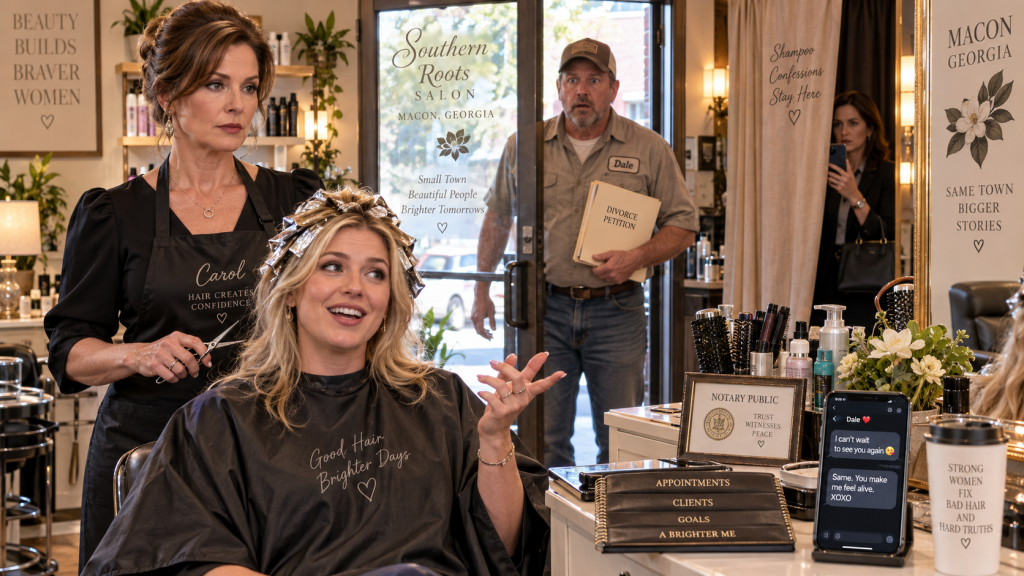
My husband’s girlfriend sits in my salon chair every Thursday at two, tips me twenty dollars, and tells me everything he’s planning. She has no idea whose wife is holding the scissors. This week, with foils in her hair, she told me exactly what he’s putting in my name before he files for divorce.

“You’re the only person in this whole town I can trust. You know that?”
She said it the very first week. She has said it every Thursday since.
Her name is Ashley. She drives a white Lexus that my husband’s company leases.
My name is Carol. I rent a chair at a salon on Vineville Avenue in Macon, Georgia. Everyone there calls me Miss C. I’ve been married to Dale for twenty-six years.
The first time she said, “My guy Dale, he’s in commercial roofing,” I dropped a comb.
She told me he was “stuck in a dead marriage.”
She told me his wife “let herself go and does hair or something.”
She told me he’d bought her a condo on the north side “through the business.”
She told me about the boat.
After she left each week, I wrote every word in the back of my appointment book. Date. Time. Dollar amounts.
Twenty-six years, and I learned more about my marriage from the back of a stranger’s head than I ever did across my own supper table.
This Thursday, at 2:05, she came in waving her phone.
“Okay. You have to see this. He finally did it.”
A photo of a ring. Two carats, easy.
“He says the divorce will be quick. He says she won’t fight, because she doesn’t even know what they have.”
I sprayed her hair with water. “Doesn’t she?”
“Honey, she thinks they’re broke.” She laughed. “He’s been telling her the business is struggling for two years. She even took a second job cleaning a dentist’s office on weekends to help out.”
I did. Saturdays. Since last spring.
The comb slipped in my hand.
“Oops. You okay?”
“Fine. Hold still.”
My face in the mirror behind hers looked like a stranger’s. Calm. Too calm. Calm like ice on a pond.
Struggling.
“So here’s the plan,” she said, lowering her voice like it was girl talk. “He has this account for the boat. The real money. Four hundred thousand, give or take.”
Four hundred thousand dollars. I had put off a mammogram in the spring because of the copay.
“And next week he’s moving all the business debt into her name. The equipment loans. The back taxes. So when they split, she gets the debt and he gets the boat account.”
“How does he get her to sign that?”
“He doesn’t. He’s signing for her. He’s done her signature for years. He says she never reads anything anyway.”
I never did. He always handed me the pen with a kiss.
Her phone buzzed. She glanced at it and giggled.
“That’s him. He wants to know if I asked you yet.”
“Asked me what?”
She tilted the screen toward the mirror so I could read it.
“Did you ask your hair lady about the paperwork? You said she’s a notary right? Needs to be someone who doesn’t know us.”
I am a notary. The certificate is taped beside my mirror. It has been there for eleven years. He has never once come into this salon to see it.
“He needs a few things notarized next Friday,” Ashley said. “He’ll pay cash. Like, good cash.”
I didn’t drop the scissors. I didn’t scream. I didn’t let her see one thing.
“Of course, sweetie,” I said. “Tell him Friday at four.”
She squeezed my arm. “Miss C, you’re the best.”
After she left, I flipped the sign on my station, and at 3:40 I called the only divorce attorney in Bibb County whose hair I don’t do.
Her name is Patrice Moody. She listened for eleven minutes without saying a word.
Then she said, “Carol. Bring the appointment book. And on Friday, let him hand you the folder before you look up.”
Friday at 3:58, Dale’s truck pulled up out front. Ashley was in the passenger seat, fixing her lipstick in the visor mirror.
Patrice was sitting in the shampoo chair behind the curtain with her phone recording.
Dale came in first with a folder under his arm, took off his sunglasses, set the folder on the counter, saw who was standing behind the notary stamp, and said.
PART 2 — THE SIGNATURE HE THOUGHT WAS MINE
Dale came through the salon door carrying a brown leather folder under one arm.
Ashley followed behind him.
He removed his sunglasses.
Set the folder on my counter.
Looked up.
And forgot how to breathe.
“Carol?”
For twenty-six years, I had heard my husband say my name in every possible way.
Sleepy.
Annoyed.
Affectionate.
Impatient.
Once through tears in a hospital waiting room after my mother died.
Never like that.
That afternoon, my name sounded like a trapdoor opening beneath him.
Ashley smiled.
At first, she thought he was simply surprised that her hairdresser and his wife shared a first name.
Then she looked at me.
Then him.
Then back at me.
Her smile slowly disappeared.
“Wait.”
Dale did not answer.
Ashley whispered:
“Miss C?”
I folded the towel on my station.
Carefully.
My hands were shaking, but I did not want either of them to see.
“My name is Carol Mercer.”
Ashley’s entire face changed.
The room became so quiet I could hear the little refrigerator near the shampoo sinks switching on.
“No.”
she whispered.
Dale reached for the folder.
I placed my hand on top of it.
He stopped.
“Move your hand.”
he said.
Twenty-six years of marriage.
And those were almost the first words he chose.
Not:
I can explain.
Not:
I’m sorry.
Not even:
How long have you known?
Move your hand.
I looked at him.
“No.”
His jaw tightened.
“Carol.”
Behind the curtain, I heard the smallest movement.
Patrice was still there.
Exactly where she had promised to remain.
She had been very clear before Dale arrived.
Do not provoke him.
Do not pretend to notarize anything.
Do not sign anything.
Do not make accusations we cannot yet prove.
Let him talk.
Let him present whatever he came to present.
Then stop.
That had seemed easy when she said it in her office.
It was much harder with my husband standing six feet away smelling like the cedar cologne I had bought him for Father’s Day.
Ashley looked at Dale.
“You know her?”
I almost felt sorry for her.
Almost.
Dale did not look away from me.
“She’s my wife.”
Ashley’s mouth fell open.
The color vanished from her face.
Then returned all at once.
Bright red.
“You said your wife’s name was Carol.”
She stared at me.
Then at the mirror.
Then back at him.
“You said she did hair somewhere across town.”
“I do.”
I said.
Ashley took one step backward.
“No.”
Her voice broke.
“No, no, no.”
She covered her mouth.
Then looked at me with something worse than embarrassment.
Memory.
Every Thursday.
Every confession.
Every joke.
Every ugly story she had repeated because she believed the woman holding the scissors had no connection to the wife she was helping betray.
“I told you…”
Her voice died.
“Yes.”
I said.
“You did.”
Dale grabbed the folder.
This time I let him.
That surprised him.
He tucked it against his chest.
“What the hell is this?”
I looked toward the curtain.
“Patrice.”
My attorney stepped out.
Dale’s face changed again.
He knew her.
Everybody who owned a business in our part of town knew Patrice Moody.
She was not loud.
Did not advertise on billboards.
Did not have to.
She wore a charcoal suit and carried a yellow legal pad.
Her phone sat in her hand.
Dale looked at it.
Then at her.
“What are you doing here?”
Patrice’s expression did not change.
“Representing Carol.”
His eyes snapped toward me.
Ashley whispered:
“Oh my God.”
Dale pointed toward Patrice’s phone.
“Are you recording me?”
Patrice answered calmly.
“You should assume that anything you say in this room may be preserved.”
He looked at me.
“You set me up?”
I almost laughed.
The unfairness of that sentence was breathtaking.
“You drove here with documents carrying my name.”
His mouth opened.
Closed.
Ashley turned toward him.
“Her name?”
Dale looked at her sharply.
“Stay out of this.”
That was the wrong thing to say.
I knew it the instant the words left his mouth.
Ashley’s entire posture changed.
For six months, she had described Dale as protective.
Confident.
Decisive.
A man trapped by a wife who “didn’t appreciate him.”
Now she was hearing the tone beneath the charm.
The same one I had spent years translating into patience.
“What’s in the folder?”
Ashley asked.
Dale tightened his grip.
“Business paperwork.”
“You said it was for the divorce.”
Silence.
Patrice did not move.
Neither did I.
Ashley looked at me.
Then back at Dale.
“You told me the hair lady just had to stamp some signatures.”
“Shut up.”
The words came out low.
Sharp.
Ashley stared at him.
I felt something cold settle inside me.
Not satisfaction.
Recognition.
Dale had spent twenty-six years rarely speaking to me that way.
He did not have to.
For most of our marriage, one irritated look had been enough to make me wonder whether I was being difficult.
Now that nobody in the room seemed willing to become smaller for him, his vocabulary was changing.
Patrice spoke.
“Dale, Carol will not notarize anything today.”
His laugh was immediate.
“She can’t.”
He pointed toward me.
“She’s involved.”
Patrice nodded.
“Correct.”
That surprised him.
“You seem to understand that now.”
His face tightened.
Ashley suddenly looked at him.
“Wait.”
She looked at the folder.
“Then who did you think Miss C was notarizing for?”
Nobody spoke.
Ashley’s eyes widened.
“You told me the signatures were already done.”
Dale stared at her.
“Ashley.”
She stepped away from him.
“You said Carol had already signed everything.”
I felt my stomach turn.
Patrice’s eyes moved toward me briefly.
A warning.
Do not interrupt.
Let her talk.
Ashley continued.
“You said she never reads anything anyway.”
Dale’s voice became almost a whisper.
“Stop.”
“No.”
Ashley shook her head.
“No, because you told me she signed those papers.”
“You told me all Miss C had to do was notarize them.”
She looked at me.
“And you were going to bring his wife’s forged signature to his wife?”
The absurdity finally landed.
For one second, nobody knew what emotion belonged there.
Then Patrice said:
“We do not yet know whether any signature is forged.”
Ashley stared at her.
“He told me he signs her name.”
Patrice nodded.
“That is important.”
“Still not the same as us declaring what every document is before reviewing it.”
I could have kissed her.
Because anger had already made me reckless enough to want every suspicion upgraded immediately into fact.
Patrice kept pulling me back to solid ground.
Dale moved toward the door.
Patrice said:
“You are free to leave.”
He stopped.
Maybe he expected her to threaten him.
She didn’t.
Then she added:
“But you came here seeking a notarization.”
“The notary is declining.”
“If those documents concern Carol, her attorney is requesting copies.”
Dale laughed.
“You can request whatever you want.”
“Correct.”
Patrice said.
“You may also decline.”
Another unexpected answer.
His confidence flickered.
She continued.
“If you decline, we will proceed through the appropriate discovery and preservation process.”
That word changed his face.
Preservation.
Not accusation.
Not scandal.
Something much less emotional.
Records.
Dale looked at me.
“Is this what you want?”
I stared.
He had asked me that question maybe fifty times in our marriage.
Do you really want to replace the roof this year?
Do you really want to make a big deal about Christmas?
Do you really want to spend that much on the dentist?
Most of the time, it never meant:
Tell me what you want.
It meant:
Are you sure you want the consequences of disagreeing with me?
I finally understood the difference.
“Yes.”
I said.
His eyes hardened.
“You have no idea what you’re doing.”
“Probably not.”
I answered.
“That’s why I hired Patrice.”
Patrice almost smiled.
Ashley sat in the empty styling chair.
Her knees seemed to stop working.
She stared at the floor.
“You told me you were separated.”
Dale exhaled.
“Ashley, not here.”
“You said you slept in separate rooms.”
I looked at him.
Interesting.
We did not.
“You said Carol knew the marriage was over.”
I looked at him again.
More interesting.
I had not.
“You said the divorce was delayed because she was emotionally unstable.”
There it was.
The sentence that finally hurt.
Not mistress.
Not condo.
Not ring.
Unstable.
He had needed a version of me that explained why secrecy was kindness.
Ashley looked up.
Her mascara had begun smearing beneath one eye.
“I asked you if she knew about me.”
Dale said nothing.
“You said she basically did.”
Still nothing.
Ashley laughed.
Then looked at me.
“I knew he was married.”
Her voice shook.
“I’m not going to sit here and pretend I didn’t.”
Good.
“At first he said it was over except for paperwork.”
“I chose to believe him.”
“That part is on me.”
Also good.
“But I did not know you were sitting behind me every Thursday.”
I stared at her.
“You knew there was a wife.”
“Yes.”
“That was enough information to make a better choice.”
Her face crumpled.
“I know.”
I believed she meant that too.
It did not make us friends.
Dale reached for Ashley’s arm.
She pulled away.
“Don’t.”
He stared.
“Ashley.”
“What is in the folder?”
“Nothing you need to worry about.”
She laughed through tears.
“Apparently that sentence means I should worry immediately.”
For the first time since Friday began, I almost admired her.
Dale looked toward Patrice.
Then me.
Then Ashley.
He was calculating.
I had watched him do it with roofing bids for twenty-six years.
Which subcontractor could be squeezed.
Which supplier could wait.
Which problem could be moved into next month.
He was looking for the cheapest exit.
Finally, he opened the folder.
“All right.”
he said.
“You want to see?”
He pulled out the first document.
Slapped it onto my counter.
“Equipment refinance.”
Second.
“Tax settlement.”
Third.
“Fleet restructuring.”
Fourth.
“Operating agreement.”
Fifth.
“Debt assumption.”
Patrice raised one hand.
“Stop.”
Dale looked at her.
She stepped closer without touching anything.
“Carol, do not sign.”
“I know.”
“Do not write on the documents.”
“I know.”
“Do not alter them.”
“I know.”
Then she looked at Dale.
“If you are voluntarily showing these, Carol and I will review only what you place in front of us.”
He gave a bitter laugh.
“Fine.”
That was anger’s favorite mistake.
Believing transparency no longer matters because someone has already been caught doing something else.
The first page had my full legal name.
Carol Ann Mercer.
I stared at the signature near the bottom.
My signature.
Almost.
The C was too wide.
The final r in Mercer looped upward.
Mine never did.
I looked at the date.
Next Friday.
The date had been prefilled.
The document described a personal guaranty associated with a refinancing of several company equipment obligations.
Amount:
$286,400.
My stomach tightened.
“This says I’m guaranteeing the loan.”
Dale answered quickly.
“It’s temporary.”
Patrice looked at him.
“Temporary until what?”
“Until the fleet is moved.”
“Moved where?”
Dale’s jaw tightened.
“To another entity.”
Ashley whispered:
“The new company.”
I looked at her.
Dale went still.
“What new company?”
I asked.
Ashley looked terrified now.
“Southline Commercial Services.”
Patrice wrote the name down.
Dale closed his eyes.
Ashley continued because apparently once betrayal opens, details fall out faster than anyone can catch them.
“He said Mercer Roofing had too much old debt.”
“He was going to move the good contracts and newer trucks into Southline.”
“And leave the bad loans?”
Patrice asked.
Ashley looked at Dale.
“I thought that’s what he meant.”
Patrice immediately clarified:
“You thought.”
“Yes.”
“Did you see documents?”
“No.”
“Did he specifically tell you he was moving liabilities away from Southline?”
“He said Southline would start clean.”
Dale snapped:
“For God’s sake, Ashley.”
Patrice wrote another note.
No conclusion.
Only words.
The next paper frightened me more.
It referenced delinquent employment and tax obligations connected to the business.
Amount estimated:
$73,860.
My name appeared beside a paragraph stating that I had participated in financial management and accepted certain responsibilities associated with repayment.
I looked at Dale.
“I never managed payroll.”
“You wrote checks years ago.”
“Twenty years ago.”
“You were involved.”
“I cut supplier checks when we started because we couldn’t afford a bookkeeper.”
Patrice touched my wrist lightly.
Not now.
Facts later.
I understood.
The document did not automatically make those debts mine.
It did show someone wanted a signed statement saying I had a financial role I did not remember having in years.
That was enough to make my skin cold.
The third paper listed equipment.
Roof cutters.
Trailers.
Three trucks.
A lift.
Two generators.
Items I recognized from decades of hearing Dale talk over dinner.
Most were being assigned from Mercer Commercial Roofing into Southline Commercial Services.
The transfer values seemed low.
Even I could see that.
A three-year-old work truck was listed at eight thousand dollars.
I had seen Dale refuse an offer of twenty-six for it the previous summer.
“Why are these values so low?”
I asked.
Dale answered:
“Depreciation.”
Patrice wrote something down.
“An accountant can review.”
No accusation.
Just another future pair of eyes.
Then came the document Ashley had described most casually on Thursday.
The debt-assumption agreement.
My name appeared as managing member of an entity called:
Mercer Legacy Equipment LLC.
I stared.
“What is this?”
Dale swallowed.
“It’s administrative.”
“I’ve never heard of Mercer Legacy Equipment.”
“It was just formed.”
“By whom?”
Silence.
Patrice asked:
“Carol, have you authorized formation of an LLC in that name?”
“No.”
“Have you signed an operating agreement?”
“No.”
“Have you authorized Dale or anyone else to sign one for you?”
“No.”
Dale exhaled violently.
“Oh, come on.”
Patrice turned toward him.
“No.”
Her voice remained quiet.
“You came to a notary with a document identifying my client as a member or manager of an entity she says she does not recognize.”
“That does not establish everything we need to know.”
“But ‘come on’ is not an explanation.”
Dale looked as though he hated her.
I understood why she had chosen law.
Ashley whispered:
“Is that the company getting the old equipment debt?”
Nobody answered.
Patrice looked at her.
“Why do you ask?”
“Because Dale said Carol would keep the old company mess.”
My chest hurt.
Dale said:
“I never said that.”
Ashley stood.
“You did.”
“I said the old obligations needed somewhere to go.”
“And you said, ‘Carol can carry that side through the divorce.’”
Silence.
Patrice’s pen stopped.
She looked up.
“When did he say that?”
“Tuesday night.”
“Where?”
“At the condo.”
“Any messages?”
Ashley looked at her phone.
“Maybe.”
Dale lunged one verbal step ahead.
“Do not give her my private messages.”
Ashley stared at him.
Then something hardened in her face.
“You mean the messages you sent to my phone?”
He stopped.
I had never seen my husband look so helpless.
It did not make me happy.
That surprised me.
Maybe twenty-six years is too long for another person’s fear to become satisfying overnight.
I looked at the ring photo still visible in my memory.
Two carats.
Easy.
“Where is the ring?”
I asked.
Ashley looked down.
“In my purse.”
“Did he pay for it from the business?”
“I don’t know.”
Dale said:
“No.”
Too quickly.
Patrice wrote nothing.
Maybe she noticed too.
Maybe she didn’t.
That was the beauty of having a professional in the room.
I no longer had to turn every twitch into evidence myself.
Then I saw the boat reference.
Not the boat itself.
An account number ending in 8841.
Marine reserve / equipment disposition proceeds.
Balance represented in the paperwork:
approximately $417,000.
My throat closed.
Four hundred thousand.
Ashley had been almost exact.
“What is this account?”
Dale’s answer was immediate.
“Company funds.”
“Why did Ashley call it the boat account?”
He looked at her.
She stared at the wall.
“It’s a nickname.”
Patrice asked:
“Who owns the account?”
“Mercer Roofing.”
“Who has signing authority?”
“Me.”
“Carol?”
Dale hesitated.
“She used to.”
I looked at him.
“I did?”
Years earlier, when we first started the company, I had signed some checks.
Then the business grew.
An office manager took over.
Later a controller.
I stopped thinking about company accounts entirely.
Dale always said that was his side of our life.
I had believed him.
Maybe too thoroughly.
Patrice looked at me.
“We will verify.”
Three words.
Not:
He stole it.
Not:
It’s yours.
Verify.
I wanted to tattoo them on my hand.
Dale suddenly gathered the pages.
“That’s enough.”
Patrice did not stop him.
I did not either.
He shoved everything back into the folder.
Ashley stared.
“You really were going to do it.”
He turned.
“Do what?”
“Bring these here.”
“Have Miss C stamp them.”
“You thought she was some random hairdresser who didn’t know your wife.”
Dale shouted:
“I thought you said she didn’t know us!”
Ashley stood.
“I said she didn’t know you.”
That silence almost became funny.
Almost.
Twenty-six years of marriage undone partly because my husband had never once bothered to learn the name of the salon where I spent most of my adult life.
He knew I worked on Vineville Avenue.
He knew my hours when he wanted dinner.
He knew Thursdays were busy.
But apparently he had never bothered to ask what name was printed above the door.
Dale looked at me.
“Carol, come home.”
The room changed.
Not because of the words.
Because some ancient part of me responded before my mind did.
Home.
Dinner.
Laundry.
His coffee cup beside the sink.
Our mattress.
The indentation his body had made over twenty-six years.
Routine has muscles.
For one second, I wanted to go.
Not forgive him.
Just return to the world where I knew what happened after six o’clock.
Then Patrice shifted beside me.
Not touching.
Just present.
I breathed.
“No.”
Dale’s face cracked.
Not dramatically.
A small thing.
The first visible understanding that whatever happened next would not be conducted from our kitchen table under his rules.
“Where are you going?”
he asked.
“I haven’t decided.”
“That’s ridiculous.”
Maybe.
Still mine.
“You can’t just disappear.”
“I’m not disappearing.”
I looked at him.
“You know exactly where my lawyer is.”
Patrice almost smiled.
Dale did not.
He left with the folder.
Ashley did not.
That surprised all of us.
He stood at the door.
“Ashley.”
She did not move.
“Ashley.”
She stared at her hands.
Then said:
“Go.”
His face hardened.
“You’re seriously choosing her?”
Ashley looked up.
“No.”
Her voice shook.
“I’m choosing not to get in that truck with you.”
Different.
Important.
Dale stood there another second.
Then walked out.
His truck started.
The sound faded down Vineville Avenue.
I had heard that engine thousands of times.
It had never sounded so much like a door closing.
Ashley cried for seventeen minutes.
I know because the salon clock was directly in front of me.
I did not comfort her.
That sounds cruel.
Maybe it was.
But there are limits to what one woman can reasonably ask from the wife of the man she has been sleeping with.
Patrice gave her tissues.
Neutral territory.
Finally Ashley looked at me.
“I’m sorry.”
I nodded.
Not acceptance.
Acknowledgment.
“I didn’t know the things he said were lies.”
I answered:
“You knew enough.”
She closed her eyes.
“I know.”
Then she opened her phone.
“What do you want?”
Patrice answered before I could.
“Nothing you are uncomfortable providing without your own legal advice.”
Ashley blinked.
Patrice continued.
“You may have information relevant to a divorce and potentially to disputed financial documents.”
“You also may have interests of your own.”
“Do not delete messages.”
“Do not alter anything.”
“If you choose to cooperate, preserve what you have.”
That was all.
No pressure.
No dramatic alliance between wife and mistress.
Just preservation.
Ashley looked at me.
“I have pictures.”
“Of what?”
“The condo.”
“The boat.”
“Statements Dale sent me.”
“Screenshots.”
“Messages about Southline.”
My stomach tightened.
“Why did he send you statements?”
“He wanted me to see how much money we’d have.”
We.
That word still found new ways to hurt.
“He said after the divorce he’d move into the condo with me.”
“Then we’d sell the boat.”
“He wanted to buy a place near Savannah.”
Patrice asked:
“Did he say where the purchase money would come from?”
“The boat account.”
“Anything else?”
Ashley hesitated.
“Sale of some equipment.”
Of course.
The same equipment being transferred on paper.
A plan was beginning to form.
Not proof.
A shape.
Then Ashley said something that changed the room again.
“There’s mail at the condo.”
I looked at her.
“What mail?”
“Business mail.”
“For Dale?”
“Some.”
She swallowed.
“Some for Carol.”
My skin went cold.
“Carol who?”
She looked at me.
“You.”
I sat down.
Patrice became very still.
“How long?”
she asked.
Ashley looked ashamed.
“Months.”
I could barely speak.
“You’ve been getting mail with my name?”
“Not me.”
“The condo.”
“That’s the same thing.”
“I know.”
“Why didn’t you tell me?”
Her face twisted.
The absurdity of the question sat between us.
Why would my husband’s girlfriend call his wife about mail when she did not even know the wife was her hairdresser?
“I asked Dale.”
she whispered.
“What did he say?”
“That it was old company paperwork.”
“That the mailing system still used your name because you used to be on some accounts.”
Patrice asked:
“Did you open any?”
“No.”
“Good.”
Ashley looked relieved.
“Some are still there.”
“Do not touch them.”
Patrice’s voice sharpened for the first time.
“Do not open them.”
“Do not destroy them.”
“Do not bring them here unless your own attorney advises you to.”
Ashley nodded quickly.
That night, I did not go home.
I went to my sister Joanie’s.
She lived fifteen minutes away in a small brick ranch with too many ceramic roosters in the kitchen.
I had mocked those roosters for years.
That night they were the most comforting ugly things I had ever seen.
Joanie opened the door.
Looked at my overnight bag.
Then at my face.
“Dale?”
I nodded.
She stepped aside.
No questions.
That is what sisters are for.
Patrice gave me rules too.
Do not access Dale’s business email.
Do not guess passwords.
Do not move company money.
Do not empty joint accounts simply because I could.
Do not delete messages.
Do not sign documents Dale sent.
Preserve my appointment book.
Photograph every page.
Store the original safely.
Change passwords on accounts that were mine.
Secure my credit.
Pull credit reports.
Gather tax returns.
Bank statements I lawfully possessed.
Mortgage records.
Insurance.
Retirement.
Twenty-six years of marriage had to be converted into paper.
There is something deeply sad about that.
A life together reduced to account numbers and dates.
But dates do not gaslight you.
Saturday morning, Joanie made biscuits.
I stared at one for ten minutes.
Then said:
“I cleaned a dentist’s office because he told me we were broke.”
She stopped buttering hers.
“He what?”
“I worked Saturdays.”
“I know.”
“I missed Marcy’s wedding because of it.”
“I know.”
“I put off my mammogram.”
Joanie’s face changed.
“What?”
“It was only a few months.”
“Carol.”
“I went later.”
“When?”
“August.”
“Was it normal?”
“Yes.”
She closed her eyes.
Then came around the table.
I expected a hug.
Instead she slapped both palms on the counter.
“I will kill him.”
I laughed.
For the first time in days.
Then cried so hard I could not catch my breath.
The money hurt.
Of course it did.
Four hundred thousand dollars sitting somewhere while I clipped coupons.
The condo.
The Lexus.
The ring.
But that was not the part that broke me.
It was the dentist’s office.
Saturday mornings.
Disinfectant.
Rubber gloves.
Scraping toothpaste off sinks in rooms where other women would come Monday morning and complain that cleanings cost too much.
Dale had watched me leave at six-thirty every Saturday.
Sometimes he kissed my forehead.
Once he said:
“You’re a good woman, Carol.”
Now I wondered whether he had gone back to sleep after I left or driven straight to Ashley.
There are questions lawyers cannot answer.
Some probably should remain unanswered.
By Monday, Patrice had retained a forensic accountant named Leon Graves.
Leon was sixty-two, wore suspenders, and spoke about money as if it had personally disappointed him.
He reviewed five years of tax returns first.
Then business statements Patrice obtained through proper channels.
He did not say:
Dale stole four hundred thousand.
He said:
“There are transfers I want explained.”
Better.
The marine reserve account existed.
Its balance had fluctuated.
Money came from equipment sales, project distributions, and transfers from Mercer Roofing.
Some may have been legitimate business reserves.
Some may not.
The condo was not titled to Ashley.
It belonged to an entity called Southline Property Holdings LLC.
Dale controlled it.
Ashley had simply been living there.
That surprised her when her lawyer told her.
Apparently even the mistress had been living inside property she misunderstood.
Dale had promised her a condo he had never actually given her.
Another future planned with someone else’s ignorance.
Southline Commercial Services had been formed eleven weeks earlier.
Owner of record:
Dale Mercer.
Not Ashley.
Not me.
Leon found no public evidence that I had authorized anything involving it.
Good.
But he also found Mercer Legacy Equipment.
The entity from the folder.
It had been formed only six days before the salon confrontation.
The registered organizer was a filing service.
My name appeared as proposed manager in internal documents Patrice later requested.
Whether those records had been officially filed or merely prepared would matter.
Again:
Facts first.
On Tuesday, Patrice filed for divorce.
Not because the affair forced divorce automatically.
Because I told her to.
She asked three times.
“Are you sure?”
The first time, I said:
“I think so.”
She waited.
The second time:
“Yes.”
She waited again.
The third time:
“Yes.”
Then she filed.
I loved her for making me hear myself say it without rage.
We also asked the court for temporary financial protections designed to prevent unusual transfers or disposal of significant marital assets while the divorce was pending.
No dramatic freezing of every dollar.
Dale still had a business to operate.
Employees needed paychecks.
Vendors needed payment.
The point was not to destroy Mercer Roofing.
The point was to stop either spouse from turning a divorce into a midnight moving sale.
I wanted truth.
Not ashes.
That distinction became more important every day.
Dale hired a lawyer named Franklin Webb.
Patrice knew him.
Of course she did.
The first letter from his office called the affair “irrelevant to the central financial issues.”
Maybe legally in some respects.
Emotionally, I could have set the letter on fire.
I didn’t.
The letter denied that Dale intended to fraudulently assign debt to me.
It described the salon documents as “draft restructuring materials.”
It claimed no document had been completed.
It stated that Dale sometimes signed documents on my behalf with my “knowledge and historical consent.”
That sentence made my hands shake.
Historical consent.
As if letting your husband sign a delivery receipt in 2007 becomes permission to place your name on a loan seventeen years later.
Patrice simply said:
“They’ve stated their position.”
No outrage.
No sarcasm.
She wrote it down.
Then Ashley’s lawyer provided messages.
Not all of them.
Only what her counsel determined could be produced appropriately.
They were enough.
Dale:
Carol never checks paperwork.
Another:
I’ve signed her name plenty.
Another:
Need the old side in her lane before filing.
Another:
Once Southline is clean, everything changes.
Ashley:
Does she know?
Dale:
She knows what she needs to know.
I stared at that sentence for a long time.
Then closed the file.
That was my marriage in seven words.
The messages did not prove every document was forged.
They did something more useful.
They told us where to look.
Equipment lenders.
Tax correspondence.
Corporate formation records.
Credit facilities.
Addresses.
One by one, Patrice and Leon built a list.
One by one, formal requests went out.
Slow.
Unromantic.
Devastating.
Dale called me twice.
I did not answer.
The third time, he left a voicemail.
“Carol, this has gone too far.”
I listened once.
Not twice.
“You’re letting that lawyer make you think I spent twenty-six years plotting against you.”
I had never thought that.
That was what made it worse.
I believed Dale loved me for many of those years.
Maybe most.
Then something changed.
Or maybe several things changed slowly enough that neither of us named them.
He continued:
“I made mistakes.”
Understatement.
“I was trying to protect the company.”
There was the word everybody eventually used.
Protect.
“I never wanted you hurt.”
I deleted nothing.
Saved the voicemail.
Then cried because part of me still recognized the man underneath it.
Betrayal does not erase every breakfast.
Every funeral.
Every Christmas morning.
It simply makes memory much harder to sort.
Thursday came.
Two o’clock.
My chair remained empty.
For the first time in months, Ashley did not sit there.
I thought I would feel relieved.
Instead the empty chair looked enormous.
At 2:13, my phone buzzed.
A message from her.
I won’t come unless you ever say it’s okay. I’m sorry for what I did. My lawyer has the mail.
I stared.
Then wrote:
Thank you for preserving it. Do not come to the salon.
No insult.
No forgiveness.
A boundary.
She replied:
Understood.
That felt strangely adult for two women connected by something so humiliating.
Friday morning, Patrice called.
Her voice was different.
“Can you come in?”
My stomach tightened.
“Is it Dale?”
“No emergency.”
That should have helped.
It didn’t.
“What happened?”
“We received a response from First Georgia Commercial Lending.”
I did not recognize the name.
“Who are they?”
“Equipment and working-capital lender.”
I sat down.
“What does that have to do with me?”
Patrice became quiet.
“Carol.”
My fingers went cold.
“You are listed as a personal guarantor on an existing line of credit.”
The room disappeared around me.
“How much?”
“Current facility is six hundred twenty-five thousand.”
I stopped breathing.
“No.”
“I understand.”
“No.”
My voice rose.
“I never guaranteed six hundred thousand dollars.”
“I understand.”
“When?”
“The credit line originated fourteen months ago.”
Fourteen months.
Before Ashley began sitting in my chair.
Before the second job at the dentist.
During the period Dale first told me the business was “getting squeezed.”
“Signature?”
I whispered.
“There is one represented as yours.”
“Notarized?”
“No.”
“The lender did not require notarization on that particular guaranty.”
I closed my eyes.
Of course.
Not every lie needs a stamp.
Patrice continued.
“The lender also provided the application materials.”
“Carol, I need you not to jump ahead.”
I almost laughed.
“Little late.”
“Listen to me.”
I did.
“The fact that your name appears does not establish that the guaranty is enforceable.”
“We will investigate how it was executed.”
“You will have an opportunity to dispute a signature you did not authorize.”
“Right now, I need facts.”
I breathed.
“Okay.”
“There is an email address listed for you.”
She read it.
It looked legitimate at first.
carol.mercer.accounts@…
Not mine.
“I’ve never had that email.”
“I thought not.”
“Phone?”
She read the last four digits.
Not mine either.
“Whose?”
“We’re checking.”
Then Patrice went quiet again.
I knew.
There was more.
“What?”
“The mailing address.”
My hand tightened around the phone.
“What about it?”
“It isn’t your house.”
I stopped.
“It is the north-side condo.”
Ashley’s condo.
The place Dale told her he had bought for their future.
My name had been receiving financial notices there.
The home of my husband’s girlfriend.
I could not speak.
Patrice continued gently.
“The lender’s file includes several mailed notices addressed to you at that property.”
“Some were returned?”
“No.”
“Then who received them?”
“We do not know yet.”
Ashley had told us unopened mail with my name was still there.
Months.
Maybe these were part of it.
Maybe not.
We would verify.
Always verify.
“Carol.”
Patrice’s voice brought me back.
“Yes?”
“There’s one more detail.”
I almost begged her not to say it.
“What?”
“The original credit application required an identity document.”
My stomach turned.
“Driver’s license?”
“Yes.”
“Mine?”
“A copy of yours.”
I closed my eyes.
Dale had copies.
Tax returns.
Insurance.
Everything married people accumulate together.
That alone proved little about how it got into the file.
Then Patrice said:
“The copy appears to have been submitted from the email account you say is not yours.”
I stopped breathing.
Someone had created an address in my name.
Used my identification.
Submitted a signature I denied making.
And directed the mail somewhere I had never lived.
Not to Dale’s office.
Not to our house.
To Ashley’s condo.
The affair suddenly became smaller.
Still painful.
But smaller.
A betrayal of the heart is one thing.
Using my identity as a piece of business equipment was another.
For twenty-six years, I had thought marriage meant that when Dale said:
Sign here, honey, it’s just business,
I could believe the man before I read the page.
Maybe that had been foolish.
Maybe it had been ordinary.
The difference no longer mattered.
Trust was never permission to become someone’s signature.
“I need you to come in.”
Patrice repeated.
“I’m coming.”
“And Carol?”
“Yes?”
“Do not call Dale.”
“I won’t.”
“Do not call the lender yourself.”
“I won’t.”
“Do not call Ashley.”
I hesitated.
Then:
“I won’t.”
“Good.”
“We are going to compare dates.”
“Documents.”
“Email records.”
“Account access.”
“Payment history.”
“And we are going to find out what actually happened.”
I stood.
Picked up my purse.
Then looked at the appointment book sitting beside my salon mirror.
Every Thursday.
Every date.
Every dollar amount.
Every careless sentence Ashley had spoken while believing I was nobody important.
For weeks, I had thought the appointment book would prove Dale was cheating.
Now I understood the affair had only been the door.
Behind it was something much larger.
A financial life my husband had been building beside our marriage.
Accounts I did not know.
Companies I had never heard of.
Documents carrying my name.
And at least one debt that had already existed for fourteen months before Dale ever walked into my salon holding that brown folder.
I touched the notary certificate taped beside the mirror.
For eleven years, Dale had never once come inside long enough to notice it.
He had thought my work was small.
My chair.
My scissors.
My twenty-dollar tips.
He had believed the important paperwork lived somewhere else.
He was wrong.
Because the most dangerous thing for a lie is not always a courtroom.
Sometimes it is a woman with an appointment book who finally starts writing down what everyone assumes she will forget.
I turned off the salon lights.
Locked my station.
And drove to Patrice’s office to find out how many times my husband had been signing a woman’s name he had stopped bothering to know.
PART 3 — THE NAME HE COULDN’T SIGN ANYMORE
Patrice had three folders waiting when I reached her office.
Blue.
Green.
Red.
I hated all three immediately.
Leon Graves sat beside her with a yellow legal pad and the expression of a man who had already discovered something irritating before breakfast.
Patrice pointed to the chair.
“Sit.”
This time, I did.
Not because someone had ordered me.
Because I wanted to know what my husband had done with my name.
That distinction had become important.
The blue folder contained the First Georgia Commercial Lending file.
The six-hundred-twenty-five-thousand-dollar credit line.
The one I supposedly guaranteed fourteen months earlier.
Leon slid a copy of the signature page toward me.
I stared.
Carol Ann Mercer
My name.
My handwriting, almost.
A reasonable imitation if someone had only seen it on tax returns and Christmas cards.
Then Leon placed three genuine signatures beside it.
One from our home refinance years earlier.
One from a salon lease.
One from my notary renewal.
“You don’t need to be a handwriting examiner to see differences.”
he said.
“But we won’t pretend that means more than it does.”
Patrice nodded.
“We’ll use proper evidence.”
Good.
I had grown almost addicted to people saying that.
Proper evidence.
After twenty-six years of taking Dale’s word for things, procedure felt romantic.
The fake email account had been created seventeen months earlier.
Three months before the business credit line opened.
Recovery phone number:
a prepaid mobile line.
The line had been purchased in cash.
At first, that sounded dramatic.
Then Leon ruined the mystery.
“Cash phone doesn’t mean genius.”
he said.
“Means convenience.”
The account had been accessed repeatedly from an internet connection assigned to Mercer Roofing’s main office.
Also from the north-side condo.
And twice from our home.
My stomach turned.
“Can you tell who used it?”
“Not from that alone.”
Leon said.
“An IP address is a location clue.”
“Not a fingerprint.”
Again.
No leap.
No shortcut.
Facts.
Then Patrice opened the green folder.
“The lender preserved its onboarding records.”
She slid another page toward me.
The application had been submitted by email.
Attached:
my driver’s license.
A copy of our joint tax return.
A personal financial statement.
And a document listing household assets.
The house.
Savings.
My salon income.
Dale’s business interest.
Retirement accounts.
I stared at the numbers.
Some were accurate.
Some were not.
My salon income had been inflated by almost forty percent.
My retirement account was listed under the wrong provider.
And one asset made me stop breathing.
Secondary residential property — North Macon — estimated value $412,000.
I looked up.
“What is that?”
Leon answered.
“The condo.”
“No.”
I shook my head.
“The condo isn’t mine.”
“We know.”
“But whoever prepared the statement listed it under household property.”
My hands went cold.
“So he used his girlfriend’s condo as if it belonged to us?”
Patrice corrected gently.
“An entity Dale controls owns the condo.”
“Which means the lender may have been shown it as indirectly connected to him.”
“Still doesn’t make it yours.”
Right.
Names matter.
Ownership matters.
Language matters.
Then Leon tapped the bottom of the page.
“Look here.”
I leaned closer.
There was a typed certification.
I certify that all financial information above is true and complete.
Below it:
my signature.
And beneath that:
an electronic timestamp.
11:42 p.m.
A Tuesday.
I stared.
“What date?”
Leon told me.
I knew exactly where I had been.
Not because I have a perfect memory.
Because Tuesdays were senior-discount nights at the grocery store.
And because that particular Tuesday was Joanie’s birthday.
I had eaten cake at her house until ten.
Then Dale picked me up because my car had been in the shop.
We were home by ten-thirty.
I looked at Patrice.
“He was with me.”
Her eyes sharpened.
“All night?”
“Yes.”
“Did either of you use a computer?”
“Probably.”
“That answer isn’t helpful.”
“I know.”
I thought harder.
Then remembered.
“We watched a movie.”
“What time?”
“Eleven.”
“Which movie?”
I told her.
Leon wrote it down.
Patrice asked:
“Streaming service?”
“Yes.”
“Account?”
“Ours.”
She nodded.
Maybe viewing logs would matter.
Maybe not.
But for once, a domestic memory had a timestamp outside my husband’s version.
The red folder was worse.
Patrice opened it last.
Inside were bank records from the marine reserve account.
Four hundred thousand dollars had never sat there untouched.
It moved.
In.
Out.
Back in.
Transfers from business equipment sales.
Insurance proceeds.
Project bonuses.
Payments to Southline Property Holdings.
A wire to a boat dealer.
Another to a brokerage account.
Several transfers marked:
OWNER DISTRIBUTION.
Not necessarily illegal.
Dale owned the company.
Businesses distribute money.
Married people own interests differently depending on facts.
Patrice refused to call any dollar stolen until Leon completed the tracing.
But one pattern was obvious.
For nearly two years, Dale had repeatedly told me Mercer Roofing was barely surviving.
During the same period, significant money left the company for things I had never been told existed.
The condo.
The boat.
Southline.
A brokerage account in his name.
And the ring Ashley had shown me.
The ring cost $18,600.
Not two carats easy.
Apparently heartbreak comes with receipts.
I stared at the page.
“I cleaned dental toilets for eighteen thousand dollars a year.”
Patrice closed her eyes.
Leon looked down.
Nobody corrected me.
That was what I needed.
Not legal language.
Not economic context.
Just someone letting the sentence exist.
I had put on rubber gloves every Saturday because my husband told me the company needed help.
Meanwhile he had spent more than my yearly cleaning income on a ring for another woman.
There are numbers accountants can reconcile.
That one was not among them.
“Did he use company money?”
I asked.
Leon answered.
“The payment originated from a personal account funded partly by recent business distributions.”
“So yes?”
“No.”
He shook his head.
“Not that simple.”
“You’re going to make me hate accounting.”
“I’m used to it.”
He adjusted his suspenders.
“Money can change character depending on source, timing, ownership, and accounting treatment.”
“I’m tracing it.”
“Let me finish.”
He said it almost kindly.
I nodded.
Another boundary.
Different profession.
The fake email account eventually gave us more.
Not because we hacked anything.
Because the lender produced records.
One recovery request showed a device name.
DMercer-iPhone
Dale’s initials.
His phone.
Not conclusive by itself.
A person can rename a device.
Phones can be shared.
But combined with the office IP address, home access, and condo access, the path narrowed.
Then came the authentication logs.
The fake account had received security codes at the prepaid number.
The prepaid number appeared in Ashley’s messages.
Not under Dale’s name.
Under:
Roof Phone.
She had asked once:
Why do you have another phone?
Dale replied:
Business nonsense. Keeps Carol out of it.
Ashley preserved that message.
So did her lawyer.
When Patrice showed me, I did not feel triumphant.
I felt tired.
Every new fact made our marriage smaller.
Not shorter.
Smaller.
The breakfasts.
The mortgage.
The trips.
Christmas.
Dad’s funeral.
All still real.
But beside them existed another life constructed one “business nonsense” explanation at a time.
Dale’s lawyer disputed almost everything.
Of course.
He claimed the second phone was used for subcontractor communications.
True, at least partly.
He claimed the fake email might have been created by office staff.
Possible.
He claimed my driver’s license had been included in company files for legitimate reasons.
Also true.
He claimed I had historically trusted him to handle business forms.
Absolutely true.
That was the problem.
Trust made access easy.
Access did not create authority.
Patrice repeated that until I could say it myself without shaking.
Trust is not authorization.
The lender froze additional draws on the credit line while the guaranty was disputed.
Mercer Roofing still owed what it had actually borrowed.
The question became who was responsible.
The company?
Dale?
Me?
Some combination?
I did not understand every part.
I learned enough to know nobody could simply wave a letter and make six hundred thousand dollars evaporate.
The lender had advanced real money.
Employees had been paid.
Equipment had been purchased.
Jobs had been completed.
The company could not become imaginary because a signature was disputed.
So the case separated two questions.
Did the business owe money?
Yes.
Had I personally guaranteed it?
That was what we fought.
A forensic document examiner concluded the guaranty signature was inconsistent with my verified writing characteristics.
Not magic words.
Not absolute certainty.
Evidence.
The lender’s email records showed all communications supposedly coming from me went through the fake address.
No call was ever completed to my actual phone.
No in-person verification happened.
The driver’s-license copy had come from an old scan with metadata tied to our household tax folder.
And then Patrice found the thing that made Dale’s lawyer stop calling the evidence “confusion.”
The guaranty contained my middle initial.
A.
I almost missed why that mattered.
Patrice did not.
“How do you usually sign legal documents?”
She asked.
“Carol Mercer.”
“No middle initial?”
“Never.”
“Your notary commission?”
“Carol Ann Mercer.”
“Driver’s license?”
“Carol A. Mercer.”
She nodded.
“Tax returns?”
I thought.
“Dale always used Carol A. Mercer.”
There it was.
Whoever created the signature had likely copied the version of my name used in tax and business records.
Not the way I actually signed.
Small thing.
Very small.
Sometimes truth hides in an initial.
Then came the deed.
Not to our house.
The condo.
Southline Property Holdings had bought it eleven months earlier.
Purchase funds included a transfer from Mercer Roofing.
Dale’s lawyer called it a business investment.
Maybe partly.
Ashley lived there.
No rent appeared to be paid.
Furniture came from business-linked cards.
Utilities were paid by Southline.
Again, not automatically illegal.
But in a divorce, Leon said, it was relevant.
Very relevant.
Because marital money does not stop being marital simply because someone runs it through a company with a different name.
That sentence I understood.
The boat was easier.
Titled to another LLC Dale controlled.
Paid partly from marine reserve funds.
Stored outside Savannah.
Ashley had photographs on it.
Dale in sunglasses.
Ashley in a white bikini.
Champagne.
A photograph dated the same weekend Dale told me he was attending a roofing conference in Jacksonville.
I looked at it once.
Then never again.
Not every piece of evidence deserves permanent residence in your mind.
Ashley cooperated.
But she did not become my friend.
That mattered to me.
People kept assuming we would eventually have some dramatic alliance.
Wife and mistress united against cheating husband.
No.
Ashley had slept with a married man knowing there was a wife.
She had believed convenient lies because believing them allowed her to continue.
She admitted that.
I respected the admission.
I did not erase the choice.
She provided texts.
Financial screenshots.
Dates.
Photographs of mail.
Information about Southline.
Then she disappeared from my weekly life.
No more Thursday at two.
No more foils.
No more twenty-dollar tips.
When we crossed paths once at a grocery store nine months later, we both stopped.
She looked thinner.
So did I.
“Hi, Miss C.”
she said.
“Hi, Ashley.”
That was all.
Sometimes closure is a greeting that goes nowhere.
She left Dale before the divorce finished.
Not for me.
Not because she discovered sisterhood.
She told Patrice through counsel that after Friday at the salon, she stopped believing anything Dale told her.
The condo became a problem because it had never been hers.
The ring went back through lawyers after ownership was disputed as part of marital accounting.
She moved out.
Bought her own used car.
The white Lexus returned to the leasing company.
There is a poetry to certain ordinary administrative events.
Dale’s company nearly collapsed.
I wish I could say I did not care.
I did.
Mercer Roofing had started in our garage.
I answered the first office phone.
I typed invoices.
I took Michael—our old Labrador, not a child—to job sites because he hated being alone.
I watched Dale climb roofs in August heat before he could afford crews.
There were thirty-two employees by the time we separated.
Thirty-two families.
I did not want revenge that bounced off Dale and landed on men who had no idea what he did to me.
So Patrice and I were careful.
My legal claims were mine.
Business operations were treated separately where possible.
Dale eventually sold a minority interest to a regional contractor.
Fresh money stabilized payroll.
The new investor demanded professional accounting controls.
No spouse signatures.
No mystery LLCs.
No “temporary” restructuring documents.
Funny how accountability often arrives disguised as boring corporate governance.
Dale lost control of the company he built.
Not completely.
Enough.
He hated that.
I understood.
But consequence is not the same thing as vengeance.
Nobody forced him to build a financial structure so dependent on nobody asking questions.
The divorce took nineteen months.
Nineteen.
Not three weeks.
Not one dramatic court day.
Nineteen months of documents.
Depositions.
Appraisals.
Tracing.
Settlement conferences.
Taxes.
Business valuation.
Arguments over whether certain distributions were marital, business, separate, hidden, ordinary, or improperly diverted.
I learned more financial vocabulary at fifty-four than I had in the previous five decades combined.
I hated almost all of it.
But I never again signed a page without reading it.
Not one.
Even when Patrice sighed and said:
“Carol, I drafted this.”
I answered:
“I know.”
Then read every line.
She eventually stopped sighing.
The six-hundred-twenty-five-thousand-dollar personal guaranty was formally disputed.
The evidence supporting my denial became strong enough that, as part of the lender’s resolution with Mercer Roofing and Dale, the lender released its claim against me personally.
Not because the debt disappeared.
Because it restructured the business obligation without relying on my disputed guarantee.
The day Patrice called to tell me, I sat on the salon floor.
Not in the chair.
On the floor.
And cried.
My credit.
My name.
My future.
Three things I had not understood could be endangered by paper until someone used paper against me.
The tax obligations required more work.
Some belonged to the company.
Some related to periods where Dale had authority.
My old involvement decades earlier did not automatically make me responsible for every later obligation.
Professionals sorted it.
Slowly.
No one sentence solved everything.
That was one of the most important things I learned.
A frightening document is not always a final fact.
Sometimes it is merely the beginning of a question.
The court never declared me stupid for signing papers Dale handed me over the years.
That mattered too.
I had blamed myself.
Why didn’t I read?
Why didn’t I know?
Why did I believe him?
Patrice eventually told me:
“Carol, marriage is not supposed to require forensic accounting every night at the dinner table.”
I wrote that sentence in the back of my appointment book.
Below Ashley’s Thursday entries.
It became the last thing I wrote there.
The financial settlement gave me my fair share of the marital estate.
Not everything.
Not his company outright.
Not the whole four hundred thousand.
Not the boat.
Not the condo.
Real life does not redistribute property according to who behaved worst at Christmas dinner.
Assets were valued.
Debts accounted for.
Improper transfers addressed.
Some transactions were unwound.
Some were credited against Dale’s share.
Some business interests remained with him with offsetting value to me.
I received a combination of cash, retirement assets, and property settlement payments.
Enough.
More than I expected.
Less than revenge fantasies would demand.
Exactly the kind of result accountants can explain without music swelling in the background.
I sold our house.
That was harder than divorcing Dale.
Maybe because the house had never cheated on me.
The kitchen still had the pencil marks from when Joanie’s kids were little and we measured them against the pantry door.
Our bedroom window still stuck in humidity.
The back porch still leaned slightly because Dale and I built it ourselves before we had enough money to hire anyone.
I stood in the empty living room on closing day.
Patrice had offered to come.
Joanie too.
I said no.
Some goodbyes deserve privacy.
I touched the wall.
Then whispered:
“You were a good house.”
Ridiculous.
True.
I left the keys on the counter.
And walked away.
I bought a small brick bungalow ten minutes from the salon.
Two bedrooms.
One bathroom.
A pecan tree.
No boat.
No condo.
No hidden company.
The mortgage was small.
The deed had one name.
Mine.
I read it three times before signing.
The closing attorney laughed.
“Everything okay?”
“Yes.”
I smiled.
“That’s why I’m reading.”
The first night, Joanie slept over.
Not because I was afraid.
Because she brought wine and refused to leave.
We ate pizza on cardboard because I had not unpacked plates.
At midnight she looked around and said:
“You happy?”
I thought.
“No.”
She nodded.
Good sister.
Did not correct me.
I continued:
“But I think I could be.”
That was more honest.
Happiness after betrayal is not a light switch.
It is permission.
Sometimes you notice it only after you stop checking whether misery is still in the room.
Dale asked to speak to me directly once the divorce was almost finished.
Patrice said I did not have to.
I chose to.
Public place.
Daytime.
A diner off Riverside Drive.
He looked older.
Not dramatically.
Just used.
He ordered coffee.
I ordered tea.
For five minutes, neither of us spoke.
Then he said:
“I’m sorry.”
I looked at him.
“Which part?”
His mouth twisted.
Apparently I had borrowed Richard Bradford’s line from another universe.
No.
Different life.
Different man.
Still useful.
Dale stared at the table.
“For Ashley.”
“For lying.”
“For the business documents.”
“For making you work Saturdays when we didn’t need the money.”
My throat tightened.
That one.
The dentist’s office.
Still the sharpest.
He continued.
“I told myself the business needed cash because I was moving money around.”
“That’s not the same as needing cash.”
“No.”
“I wanted you to keep living small while I built somewhere else.”
The honesty surprised me.
I did not rescue him from it.
“Why?”
I asked.
He looked out the window.
“I don’t know when I started resenting you.”
That hurt.
Still.
After everything.
“What did I do?”
“Nothing.”
Then he corrected himself.
“That’s not true.”
“You trusted me.”
I stared.
He laughed bitterly.
“I know how stupid that sounds.”
“Tell me anyway.”
He rubbed his hands together.
“You stopped asking about the company years ago.”
“I thought it meant you didn’t care.”
“You told me you wanted me out of the business.”
His face tightened.
“I know.”
There it was.
People sometimes build resentment around conditions they created themselves.
Dale continued.
“When the company got bigger, I liked being the one who knew everything.”
“Then I liked that you didn’t.”
“The money got easier.”
“So did hiding it.”
“Ashley made me feel…”
He stopped.
“Younger?”
I offered.
“Important.”
That answer surprised me.
“You were important to me.”
“I know.”
“Then why?”
“Because with you, I was Dale.”
“Bills.”
“Roof leak.”
“Blood pressure.”
“Thirty-year mortgage.”
“With her, I was the man who owned a boat.”
I almost laughed.
“What an expensive identity.”
He smiled.
Then cried.
Quietly.
I watched.
Did not touch him.
“Did you forge my signature?”
I asked.
He stopped crying.
Looked at me.
The question he had avoided answering directly for almost two years.
His lawyer had done most of the speaking.
Today there was no one else.
“Yes.”
One word.
My hands went cold even though I already knew.
“How many times?”
He shook his head.
“I don’t know.”
“Wrong answer.”
He flinched.
Then:
“More than I admitted.”
There it was.
“At first it was little things.”
he said.
“Vendor forms.”
“Insurance.”
“You told me years ago I could sign pickup receipts if needed.”
“I let that become everything.”
I looked at him.
“You knew the difference.”
“Yes.”
“Between signing a receipt and putting me on a guaranty.”
“Yes.”
“Between signing because I asked you to and signing because you didn’t want me to know.”
His face crumpled.
“Yes.”
No explanation could improve it.
I stopped asking.
Sometimes confession is only useful until the truth is clear.
After that, more details become another form of self-harm.
“Why my name?”
I asked.
He looked confused.
“What?”
“Why not use your own?”
He stared at me.
Then answered:
“Because yours was clean.”
That sentence ended whatever piece of the marriage still lived inside me.
Not Ashley.
Not the ring.
Not even the lies.
Because yours was clean.
My credit.
My history.
My reliability.
Twenty-six years of paying bills, renewing licenses, filing taxes, keeping appointments, and showing up.
He had treated all of it as unused borrowing capacity.
An asset.
Something available because marriage gave him access.
I stood.
Dale looked up.
“Carol.”
“No.”
“Please.”
“I heard what I needed.”
“Can you forgive me?”
I almost laughed.
The audacity of asking for the final product before doing the work.
“I don’t know.”
He looked devastated.
That was not punishment.
It was truth.
Then I said:
“Forgiveness is not the same as access.”
He stared.
I continued.
“If I forgive you someday, that does not make me your wife again.”
He nodded.
Slowly.
I left.
Dale eventually pleaded to offenses connected to falsified financial documents.
Not every wrong became a charge.
Not every forged signature became a separate courtroom scene.
His attorneys negotiated.
The business cooperation mattered.
Restitution and financial remedies mattered.
His lack of prior criminal history mattered.
I did not ask Patrice for every detail.
The criminal case belonged to the state and to the evidence.
My divorce was already enough.
Dale faced supervision and financial consequences.
His reputation in the local business community collapsed faster than the roofing company did.
People who once accepted his handshake began asking for two signatures and an audit trail.
Poetic.
Practical.
Probably healthier.
I kept cutting hair.
That surprised people.
Some expected me to retire because the settlement gave me options.
Why?
I liked the salon.
I liked Mrs. Beasley complaining about her grandson.
I liked prom season.
I liked fixing home dye disasters women swore were “auburn” when they were clearly orange.
My work had never been small.
Dale had simply trained me to see it through his hierarchy.
His company moved millions.
I moved people through divorces, funerals, weddings, first dates, chemotherapy, graduations, and bad Tuesdays.
Women sat in my chair and told me the truth because mirrors make confession easier.
That mattered.
I stopped cleaning the dentist’s office immediately.
Dr. Harmon called personally.
“You sure?”
“Yes.”
“We’ll miss you.”
I laughed.
“No offense, Doc, but I hope never to see your mop closet again.”
He understood.
My Saturdays became mine.
The first one, I woke at six out of habit.
Lay in bed.
Did nothing.
It felt almost illegal.
At nine, I made pancakes.
At eleven, Joanie came over.
At one, we went shopping for curtains.
Ordinary freedom is wildly underrated.
The notary certificate stayed beside my mirror until renewal.
When the commission expired, I almost did not renew.
Too many memories.
Then I did.
Not because Dale had almost used it.
Because it was mine.
I would not abandon a useful thing simply because someone else tried to make it part of his lie.
The new certificate went in a cleaner frame.
I hung it straight.
Very straight.
Two years after the divorce, a woman named Denise sat in my chair.
First appointment.
She talked the entire time.
Husband.
Children.
Mortgage.
A sister who borrowed money.
Then she laughed and said:
“My husband handles all the financial stuff.”
My hands stopped for half a second.
The old version of me would have stayed quiet.
Hairdressers are not marriage counselors.
Still true.
I looked at her in the mirror.
“Do you know where the accounts are?”
She frowned.
“Mostly.”
“Do you know whose name is on what?”
“I think so.”
I nodded.
Then kept trimming.
“I’m not telling you not to trust your husband.”
I said.
“I’m telling you trust works better when both people know what they’re trusting.”
Denise stared at me.
Then smiled.
“That sounds like experience.”
“Twenty-dollar tip and I’ll tell you nothing.”
She laughed.
Good.
I had learned not every woman needed my story.
Sometimes one sentence was enough.
Ashley never returned to my chair.
Years later, I heard she married someone else.
A teacher.
No company Lexus.
No condo.
Good for her.
I meant that.
Mostly.
Healing does not require turning every person who hurt you into a permanent villain.
Sometimes people make selfish choices.
Then different ones.
I hoped she had learned.
I did not need proof.
Dale sold the boat.
Partly because the settlement required liquidity.
Partly because the new company investor wanted nonessential assets separated.
I heard this from Leon.
I smiled.
Not because I wanted Dale deprived of joy.
Because that boat had become a symbol of an entire life financed by telling me we could not afford mine.
Some symbols deserve liquidation.
The appointment book remains in my house.
Top shelf.
Not hidden.
I do not open it often.
The back pages still hold everything Ashley said.
Thursday 2:00.
White Lexus.
Condo.
Boat.
$400K.
Debt in my name.
He signs for her.
Then the final note:
Patrice — call 3:40.
That line mattered most.
Not what Dale did.
What I did after I learned.
I made a call.
Not a scene.
Not a revenge plan.
A call.
Sometimes survival begins with choosing one person who knows more than you do and saying:
Help me understand what is real.
People hear the story now and want the dramatic part.
The mistress sitting in my chair.
The husband walking into the salon.
The lawyer behind the shampoo curtain.
They imagine I must have felt powerful when Dale saw me.
I didn’t.
I felt fifty-four.
Married twenty-six years.
Terrified.
Humiliated.
And very aware that I had scissors in my hand, which is why I had put them down before he arrived.
Real power does not always feel like power.
Sometimes it feels like not doing the thing rage would make easiest.
The most important moment was not when Dale saw me.
It was when I finally saw what he had done to the meaning of my name.
Carol Mercer.
For years, I thought a name was just identification.
Then I learned it can also be credit.
Reputation.
Consent.
Liability.
History.
A promise other people assume you made because the letters look right on paper.
Dale believed he could reproduce my signature because he had seen me write it thousands of times.
What he never understood was that the signature was not the permission.
I was.
That was the part I reclaimed.
Not just money.
Not just property.
My no.
My yes.
My ability to read a page and decide whether my name belonged at the bottom.
Years later, the salon owner retired.
She offered to sell me the business.
Old me would have said no immediately.
Too risky.
Too much money.
Dale had handled business.
I handled hair.
That was the story.
Then I looked at the numbers.
With an accountant.
With a lawyer.
With my own eyes.
Revenue.
Rent.
Payroll.
Supplies.
Taxes.
I asked questions until everyone was tired of me.
Then I bought the salon.
Not because I needed to prove anything.
Because the numbers worked.
We changed the sign.
CAROL & CO.
Joanie said it sounded fancy.
I told her to stop.
The first week, I replaced the shampoo chairs.
The second, I painted the back wall.
The third, I hired a young stylist named Brianna who reminded me of myself at twenty-five.
Fast hands.
Good instincts.
Terrified of talking about money.
I made her sit with the bookkeeper once a month.
She complained.
I told her:
“You don’t have to love numbers.”
“You do need to know which ones carry your name.”
She stopped complaining eventually.
Mostly.
On the fifth anniversary of my divorce, I closed the salon early.
Not because the date deserved mourning.
Because I had forgotten until Patrice texted:
Five years. You okay?
I looked at the message.
Then at the salon.
Four chairs occupied.
Women laughing.
Phones charging.
Hair dryers running.
My new notary certificate beside the mirror.
I wrote back:
More than okay. Busy.
She replied:
Best kind.
That evening, I went home.
My little brick house.
Pecan tree.
Yellow curtains Joanie chose badly and I kept anyway.
I made tea.
Sat at the kitchen table.
Opened the appointment book.
Read the old entries one last time.
Not every line.
Enough.
Then I turned to the final blank page.
For a long time, I held the pen.
I thought about Dale.
Ashley.
Patrice.
Leon.
The dentist’s office.
The lender.
The fake email.
The condo.
The boat.
The ring.
Twenty-six years.
Then I wrote one sentence.
My name belongs wherever I choose to put it.
That was all.
I closed the book.
Placed it back on the shelf.
I never burned it.
Never shredded it.
Evidence does not become poisonous just because you stop needing it.
It becomes history.
And history, if you are lucky, eventually stops feeling like an emergency.
The next morning, I opened the salon at eight.
First client at eight-thirty.
Gray coverage.
Then highlights.
Then a trim.
At two o’clock, my chair was empty.
For years, Thursday at two had belonged to Ashley.
Later, I kept the slot blocked without realizing why.
That day, I finally opened it again.
A new client booked online.
Her name was Maria.
She arrived five minutes late, apologizing.
Sat down.
Looked at herself in the mirror.
Then at me.
“I don’t know what I want.”
I smiled.
“That’s okay.”
“We can figure it out.”
I fastened the cape around her shoulders.
Picked up my comb.
And looked at the woman in the mirror holding it.
Older.
Different.
Mine.
For the first time in a very long while, no one in that chair knew a secret that belonged to my marriage.
No one was carrying my husband’s version of me.
No one needed to be tested.
No one needed to confess.
It was simply hair.
A Thursday.
Two o’clock.
And a woman beginning again.
THE END STORIES! THANK YOU FOR READING GOOD LUCK !❤️
Related Posts