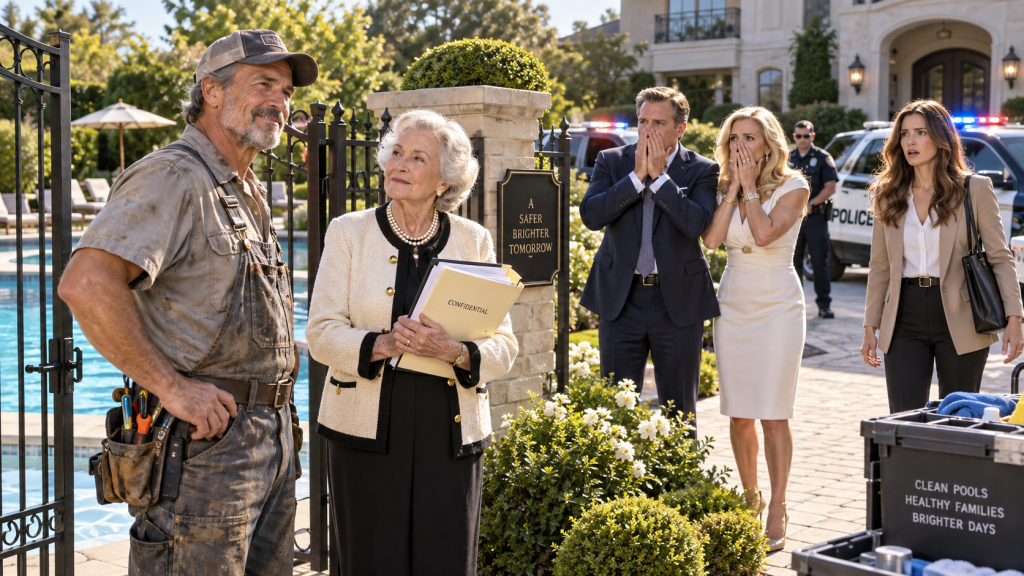
My boss’s wife refused to pay my dad for fixing his pool — he looked at the water, smiled, and said, “Call me tomorrow morning.” My dad had been repairing pools for almost thirty years. So when my boss, Richard, asked him to repair the enormous pool behind his $2 million house, Dad gave him a fair estimate.

$7,800.
The job took nine days.
New pump.
New pipes.
A completely new filtration system.
By the time Dad finished, the water had gone from dark green to crystal clear.
Everything worked perfectly.
But when it came time to pay, Richard’s wife, Melissa, suddenly had a problem.
“$7,800? For this?”
Dad calmly pulled out the estimate.
The same estimate she had signed before he started.
Melissa barely looked at it.
Instead, she laughed.
“My husband employs your daughter. I’d think carefully before arguing with me.”
I felt my face burn.
“Dad, I’ll figure something out.”
But Dad didn’t look angry.
He didn’t raise his voice.
He simply turned toward the pool.
Studied the water for a few seconds.
Then smiled.
“Okay.”
Melissa actually smirked.
As Dad and I walked toward his truck, she called after us:
“Glad we understand each other.”
Dad didn’t respond.
I waited until we were back home before confronting him.
“Dad, why didn’t you fight her? She owes you nearly eight thousand dollars.”
He opened the refrigerator, grabbed a beer, and leaned against the counter.
Then he said:
“Because tomorrow morning, they’re going to understand why I needed both their signatures.”
I stared at him.
“What signatures?”
Dad took a sip.
Then smiled.
“Go to work tomorrow. You’ll see.”
That was all he would tell me.
At exactly 7:46 the next morning, my phone rang.
Dad.
I answered immediately.
“What’s happening?”
“I’m standing in Richard’s driveway.”
I sat up.
“Why?”
“Get over here.”
“What happened?”
Dad paused.
“Your boss just found out what was underneath his pool.”
My stomach tightened.
“What are you talking about?”
Then Dad lowered his voice.
“And I’m not alone.”
I stood.
“Who’s with you?”
He told me.
I grabbed my keys immediately.
Twenty minutes later, I turned onto Richard’s street.
And slammed on the brakes.
Two police cars were parked outside the house.
Richard stood in the driveway shouting at someone.
Melissa was crying.
My father stood calmly beside the pool gate.
And next to him was an elderly woman I’d never seen before.
She had to be in her late seventies.
She was clutching a thick folder against her chest.
The second she saw my car, her expression changed.
She walked directly toward me.
Richard shouted:
“Don’t talk to her!”
The elderly woman ignored him.
She stopped beside my driver’s door and looked through the open window.
“You’re his employee?”
I nodded slowly.
“Yes.”
She glanced toward Richard’s house.
Then back at me.
“Then you probably don’t know why your father insisted both Richard and Melissa sign those papers before he touched that pool.”
I looked at Dad.
He said nothing.
The woman opened her folder.
And when she showed me the first document inside, I finally understood why Dad had smiled instead of arguing about the $7,800.
The pool repair had uncovered something Richard and Melissa apparently believed would stay hidden forever..
PART 2 — THE LINE BENEATH THE WATER
The first document the elderly woman showed me was a survey.
Not a photograph.
Not a police report.
Not some dramatic confession Richard had foolishly signed.
A survey.
White paper.
Black lines.
Numbers.
Measurements.
The sort of document I would ordinarily glance at for three seconds before deciding it belonged to people who understood property better than I did.
But one red line had been drawn across it.
And that line ran directly through the deep end of Richard’s pool.
I looked up.
The elderly woman stood beside my car with one hand gripping the folder against her chest.
“My name is Margaret Ellis,” she said.
I stared at the paper.
Then at the enormous pool behind Richard’s house.
Then back at her.
“I don’t understand.”
“You will.”
Richard shouted from the driveway.
“Margaret, get off my property!”
She turned slowly.
Even from twenty yards away, I could see something change in her face.
Not fear.
Familiarity.
Like she had heard that sentence too many times for it to have any power left.
She looked back at me.
“That,” she said quietly, “is the problem.”
Dad walked toward us.
A man in a reflective vest followed him.
I recognized the equipment in his hand before I recognized what he was.
Surveyor.
Behind them stood one of the police officers.
The other officer remained near Richard and Melissa.
Melissa was crying.
Richard was not.
He was furious.
There is a particular kind of anger that appears when someone has spent years mistaking control for ownership.
Richard wore it well.
“Dad,” I said.
“What is happening?”
He stopped beside me.
Then looked at Margaret.
“Did you show her?”
“The first survey.”
Dad nodded.
I turned toward him.
“You knew about this?”
“Not when I took the job.”
“When?”
His eyes went toward the pool.
“Day six.”
My stomach dropped.
“You knew for three days?”
“I suspected for three days.”
“That’s different.”
Margaret said.
Dad nodded toward her.
“Listen to her.”
The surveyor introduced himself as Caleb Monroe.
Licensed.
Independent.
Hired by Margaret’s attorney that morning after Dad called the previous afternoon.
He was standing on the strip of grass between Richard’s pool enclosure and a weathered wooden fence that separated Richard’s yard from Margaret’s property.
Except, according to the survey in my hand, the fence was not the property line.
Not even close.
The true line ran almost fourteen feet inside Richard’s side.
Through a row of decorative hedges.
Under part of the concrete pool deck.
Across the corner of the deep end.
And directly beneath the equipment shed Dad had spent nine days repairing.
I looked at Margaret.
“You own that?”
She nodded.
“According to my deed, the old plat, three prior surveys, and the monuments your father uncovered.”
Richard shouted again.
“She doesn’t own anything over here!”
Caleb looked toward him.
Then at the officer.
The officer said:
“Mr. Harlan, please remain where you are while the survey is being completed.”
Richard threw up both hands.
“This is insane.”
Dad muttered:
“That word’s doing a lot of work today.”
I pulled him aside.
“Start at the beginning.”
Dad looked at me.
“Your boss asked me to repair a pool.”
“I know that part.”
“He and Melissa both signed the work authorization because both names are on the property title.”
I remembered.
I had watched Dad slide the estimate across their patio table before work began.
Richard signed first.
Melissa signed beneath him.
At the time, I thought Dad was being unusually formal because the job was expensive.
He had explained only:
“Big job. Big house. Paper protects everybody.”
Now I understood there had been more.
Dad continued.
“The authorization gave me permission to open the equipment pad, trench existing lines, remove sections of deck where necessary, photograph concealed conditions, and stop work if I found something that didn’t belong to the job.”
“What did you find?”
He pointed toward the deep end.
“An old stone wall.”
I frowned.
“Under the deck?”
“Under part of it.”
“And two iron survey pins.”
My skin prickled.
“Survey pins?”
“Property markers.”
Margaret said behind us.
I turned.
She had followed quietly.
Dad nodded.
“Old ones.”
“Buried deep enough that nobody was going to find them by mowing the grass.”
He explained.
The old return line serving the deep end had collapsed.
Replacing it required cutting a narrow section of concrete along the rear edge of the pool and opening a trench.
Normal work.
Dirty.
Loud.
Nothing suspicious.
Then Dad’s helper hit stone where there should have been compacted fill.
Not a loose rock.
A straight masonry edge.
Dad stopped the digging.
A few inches farther over, he found rusted iron set vertically into the soil.
Then another.
Both aligned with the buried wall.
“I’ve worked around enough property lines to know you don’t pull metal stakes out of the ground unless you know exactly what they are.”
Dad said.
“So I didn’t.”
He photographed them.
Measured their location against the fence.
Then covered the trench safely overnight.
The next morning he asked Richard a simple question.
“Do you know where your rear property line is?”
Richard answered:
“The fence.”
Dad asked whether there had ever been a survey dispute.
Richard said no.
Melissa was standing there.
She said no too.
Dad had written it down in his daily job notes.
I looked at Margaret.
“You had a dispute.”
“For four years.”
Richard shouted from the driveway:
“She’s lying!”
Margaret’s mouth tightened.
Then she opened her folder again.
Certified letters.
Survey copies.
Photographs.
A lawyer’s letter dated three years earlier.
Another dated eighteen months earlier.
And a photograph of the backyard before the pool had been renovated.
There was no wooden fence.
No equipment shed.
No extended concrete deck.
Only grass.
And in the center of that grass stood a small white survey stake.
Margaret tapped the image.
“That was the northwest marker.”
Then she showed me a newer photograph.
Same view.
The stake was gone.
Pool deck extended across the area.
Fence moved outward.
My stomach tightened.
“What happened?”
Margaret laughed without humor.
“Richard happened.”
Years earlier, Margaret and her husband, Arthur, had owned the property next door.
The narrow strip behind Richard’s yard had always belonged to them.
It was awkward land.
Too narrow to build on.
Mostly trees and grass.
But Arthur had maintained it because drainage from both lots crossed through that area before reaching a municipal swale farther down the hill.
Then Arthur developed Parkinson’s disease.
Margaret spent years caring for him.
During that time, Richard renovated his backyard.
Bigger patio.
Expanded pool deck.
New landscaping.
New fence.
Margaret said she noticed the fence had moved but did not understand by how much.
Arthur was sick.
She was exhausted.
Richard told her the contractor had simply “straightened an old crooked line.”
She believed him.
Or perhaps she simply did not have enough strength left to fight.
Arthur died eleven months later.
“After the funeral,” Margaret said, “I had the land surveyed because I planned to sell part of the rear parcel to another neighbor.”
That was when she discovered nearly fourteen feet of her property had effectively disappeared behind Richard’s fence.
She contacted him.
He denied it.
His attorney argued the old surveys were inconsistent.
Richard claimed the fence followed a line everyone had treated as the boundary for years.
Margaret hired another surveyor.
Same result.
She found older plats.
Same result.
But the original physical monuments could not be located.
“And without them?”
I asked.
“It didn’t erase my deed.”
Caleb said.
“But original monuments can be very important evidence when boundaries are disputed.”
Margaret nodded.
“Richard kept telling everyone the markers were gone decades ago.”
Dad looked at the pool.
“They weren’t gone.”
They were under concrete.
My stomach turned.
“You think someone buried them intentionally?”
Dad immediately answered:
“I don’t think anything I can’t prove.”
Of course.
Thirty years repairing pools had apparently taught him more restraint than corporate management taught Richard.
Dad continued.
“I know the deck was poured over one.”
“I know another was under compacted fill beside the equipment pad.”
“I know they line up with Margaret’s recorded survey.”
“What happened before that is for surveyors, lawyers, and whoever else needs to figure it out.”
Margaret gave him a grateful look.
He had not turned suspicion into accusation simply because it made a better story.
I looked toward the police cars.
“Then why are they here?”
Dad exhaled.
“Because Richard lost his mind at seven-fifteen this morning.”
Of course he did.
Dad had called Margaret’s attorney the previous afternoon after identifying her through county property records.
He did not call Margaret directly at first.
He wanted documentation.
He also contacted Richard and told him there was a concealed boundary condition that needed to be resolved before Dad would perform any additional work around that area.
Richard demanded that he fill the trench and leave.
Dad refused to bury the markers.
Richard told him:
“You work for me.”
Dad replied:
“No. I performed work for you.”
There is a difference.
Richard apparently did not appreciate grammar before breakfast.
Margaret’s lawyer arranged for Caleb to inspect the site.
Because the disputed monuments were reachable only from the area inside Richard’s current fence, the attorney notified Richard that access would be requested.
Dad came at seven.
Caleb came shortly after.
Margaret came with him because the evidence concerned her land.
Richard refused entry.
That part was his right to argue through counsel.
Then, according to everyone except Richard, he tried to grab Caleb’s equipment when Caleb began taking measurements from a location near the public-side boundary.
Words escalated.
Richard threatened Dad.
Then Margaret.
A neighbor called police.
By the time I arrived, everyone had been separated and the officers were keeping things calm while the lawyers discussed what access could lawfully occur.
No one had been arrested.
No handcuffs.
No instant justice.
Just a very wealthy man discovering that shouting does not redraw land.
Melissa walked toward us.
The second officer stayed a few steps behind her.
Her face was blotched from crying.
She looked at me.
“You need to tell your father to stop this.”
I stared at her.
“My father?”
“Yes.”
“He caused this.”
Dad actually laughed.
Melissa turned toward him.
“You dug it up.”
“Yes.”
“You had no right.”
Dad reached into his truck and pulled out a clipboard.
Then removed one page.
The work authorization.
Two signatures.
Richard Harlan.
Melissa Harlan.
Dad tapped the paragraph.
“Authorization to excavate existing plumbing routes and document concealed site conditions.”
Melissa stared.
Dad continued.
“You both represented that you owned or had authority over the areas where you directed me to perform work.”
Her face changed.
That was why he had needed both signatures.
Not because he predicted any of this.
Because he ran his business like a professional.
The paperwork simply became important when the truth became inconvenient.
Melissa’s voice dropped.
“You should have just covered it.”
Dad looked at her.
“No.”
One word.
Nothing dramatic.
Melissa stared at him.
“You don’t understand what this could cost us.”
Dad answered:
“You still owe me seventy-eight hundred dollars.”
That almost made me laugh.
Even the officer looked away.
Melissa’s face hardened.
“You’re unbelievable.”
“No.”
Dad folded the contract.
“I’m a pool contractor.”
“You hired me to repair your pool.”
“I repaired it.”
“You refused the invoice.”
“Then I found evidence of a property issue during authorized work.”
“I preserved it.”
“Those are separate problems.”
That sentence mattered.
He had not sabotaged their pool because they refused payment.
He had not threatened them with the boundary dispute in exchange for money.
He had not invented leverage.
He simply refused to hide something because hiding it would be useful.
Richard finally pushed past the other officer far enough to shout:
“You’re fired.”
Every head turned.
Not toward Dad.
Toward me.
Of course.
I felt the blood leave my face.
Richard pointed.
“You.”
He looked at me.
“Don’t bother coming in.”
The officer said:
“Sir, this is not helping.”
Richard ignored him.
“You brought your father into my house.”
I stared.
“You asked me for a pool contractor.”
“And now he’s conspiring with that woman.”
Margaret’s expression sharpened.
Dad stepped forward.
I grabbed his arm.
“No.”
He looked at me.
I shook my head.
My fight.
Not his.
That was important.
I turned toward Richard.
“You’re firing me because my father found a boundary marker while doing the job you hired him to do?”
Richard laughed.
“I’m firing you because I can no longer trust you.”
“Put that in writing.”
The words came out before I could become afraid of them.
Richard stopped.
So did I.
Then I repeated:
“Please put the reason in writing.”
His expression shifted.
Not much.
Enough.
I had worked for Richard for seven years.
I knew that look.
The moment his anger finally collided with risk.
He looked toward the police officers.
The surveyor.
Margaret’s folder.
My father’s paperwork.
Then said:
“We’ll discuss your employment later.”
Interesting.
Apparently I had become trustworthy again.
Dad whispered:
“Good girl.”
I elbowed him.
“I’m thirty-six.”
“You’re still my girl.”
Some problems refuse correction.
Caleb eventually received permission, through the lawyers, to inspect the exposed monuments without enlarging the excavation.
Dad removed the temporary safety cover.
Everyone gathered at a distance.
I expected something dramatic.
It was not.
One rust-colored iron pin.
A small stamped cap.
Dirt.
Concrete.
Beside it, the top edge of an old masonry wall.
That was all.
The kind of thing most people would step over without noticing.
Yet Margaret began crying when she saw it.
Not loudly.
Her hand rose to her mouth.
She whispered:
“Arthur was right.”
I looked at her.
“What?”
Her eyes stayed on the marker.
“My husband kept saying the line had moved.”
“Near the end, people stopped believing him.”
My chest tightened.
“Because of Parkinson’s?”
“Partly.”
She wiped her face.
“Medication.”
“Confusion.”
“Bad days.”
“Richard would say, ‘Arthur doesn’t remember where the fence was.’”
Her voice broke.
“After a while, I wondered if Richard was right.”
That hurt more than the money.
More than the pool.
Someone’s illness had become convenient evidence against his own memory.
Caleb knelt beside the marker.
Took measurements.
Compared them to older survey data.
Then moved toward the second.
His face became serious.
“What?”
Margaret asked.
He stood.
“The alignment is consistent.”
“With my survey?”
“Yes.”
He did not declare victory.
Surveyors apparently have better emotional discipline than the rest of us.
He explained that a complete boundary opinion would require reviewing all records and measurements.
But the monuments appeared to correspond to the historic line shown on Margaret’s documents.
Enough to matter.
Not enough to turn a driveway into court.
Dad leaned toward me.
“Now you understand the smile.”
I stared.
“You smiled because you knew this was going to happen?”
“No.”
He looked offended.
“I smiled because Melissa threatened your job over my invoice.”
“That does not explain anything.”
“It does to me.”
He took off his cap.
Scratched his head.
“I knew two things last night.”
“One, I had paperwork.”
“Two, I had photographs of something they were going to want covered.”
My stomach tightened.
“That sounds like leverage.”
“No.”
Dad’s expression hardened.
“Listen carefully.”
“I never told them, ‘Pay me or I report this.’”
“I never offered silence.”
“I never tied my bill to Margaret’s property.”
“I knew I didn’t have to fight Melissa in her backyard.”
“I could leave.”
“Preserve my evidence.”
“File my lien if necessary.”
“And let the other problem belong to the people it actually belonged to.”
I stared at him.
That was why he had been calm.
Not because he had a revenge plan.
Because he understood where his responsibility ended.
“Then why tell me I’d understand tomorrow?”
He smiled.
“Because Richard had already called the original pool company while I was standing there.”
“What?”
Dad looked toward Margaret.
She opened the folder again.
Another document.
This one was not a survey.
It was a contractor record.
An old invoice from six years earlier.
The year Richard expanded the deck.
The company no longer existed.
But Dad recognized the name.
He knew the former owner.
Called him.
Not to accuse.
To ask whether he remembered the Harlan project.
He did.
Very well.
Because the job had ended badly.
The original contractor’s name was Pete Alvarez.
He had submitted a written statement to Margaret’s attorney early that morning.
Dad let me read it.
Pete remembered locating an old iron boundary pin near the proposed deck extension.
He had warned Richard that the planned concrete might cross a line and recommended obtaining a survey before continuing.
Richard allegedly told him the neighboring strip was “basically ours anyway.”
Pete refused to pour that section until he had written authorization.
The project stopped for several days.
Then Richard hired another concrete crew for the extension.
Pete completed only the pool-side work within the area he believed was safe.
He had photographs.
Not perfect.
But enough to show a pin standing near the edge of the original deck before the later extension covered the area.
Margaret gripped the folder.
“He knew.”
Her voice shook.
Dad answered carefully.
“Pete says he warned him.”
Not:
Richard stole your land.
Not yet.
Still facts.
Melissa had stopped crying.
She stood near the pool with both arms wrapped around herself.
I walked toward her.
Not to confront.
I am not sure why.
Maybe because something in her face looked less angry now.
More frightened.
“Did you know?”
I asked.
She stared at me.
“About what?”
“The boundary dispute.”
Her eyes flicked toward Richard.
That was enough to tell me she knew something.
But how much?
“Melissa.”
She whispered:
“Richard said it was nonsense.”
“When?”
“Years ago.”
“You told my father there had never been a dispute.”
She closed her eyes.
“Yes.”
“Why?”
“Because Richard said your dad didn’t need to know.”
My stomach turned.
“What about the estimate?”
“What?”
“The signatures.”
“You both signed that the work area was under your authority.”
She looked sick.
“I didn’t read all of it.”
Dad, from behind us:
“You should.”
Melissa flinched.
He was not cruel about it.
Which somehow made the sentence worse.
Richard started toward us again.
The officer intercepted him.
“Melissa, stop talking.”
She looked at her husband.
Then something changed.
Not rebellion.
Not yet.
Fatigue.
“I’m tired of you saying that.”
Richard froze.
Everyone did.
Melissa stared at him.
“You told me Margaret would give up.”
“Not now.”
“You told me those letters were bluffing.”
“Melissa.”
“You told me the refinance company didn’t care about the boundary dispute.”
Margaret’s head snapped toward her.
Dad went still.
Caleb looked up.
Even Richard stopped moving.
There it was.
Something new.
Margaret asked:
“What refinance?”
Melissa covered her mouth.
Richard’s face hardened.
“Enough.”
But the word had lost some of its authority.
Margaret looked at the surveyor.
Then at Dad.
Then at me.
“I knew they refinanced.”
she said.
“But…”
She opened her folder.
Pulled out another document.
A copy of a certified letter from her attorney.
Dated eight months earlier.
It had been sent to Richard and Melissa before the refinance.
Formal notice of an active boundary claim.
Receipt signed.
By Melissa.
I stared at her.
She looked at the ground.
Dad whispered:
“Now that’s interesting.”
It was not proof of fraud.
Dad made that clear later.
Neither was the conversation in the driveway.
But it raised a serious question.
When Richard and Melissa refinanced the house, had they been asked to disclose known boundary disputes or encroachments?
If so, what had they said?
Margaret’s attorney would need to obtain the documents.
The lender would decide what mattered to it.
No one in the driveway got to pronounce guilt.
But Richard understood the danger immediately.
That was obvious.
His anger disappeared.
Completely.
He looked afraid.
The police officers eventually left without arresting anyone.
They documented the morning disturbance.
Told everyone to keep future interactions peaceful.
Very uncinematic.
Very sensible.
Caleb finished his field measurements.
Margaret’s attorney arrived.
Richard called his own attorney.
Melissa went inside.
Dad packed his tools.
I stood beside his truck.
“What happens to your seventy-eight hundred?”
He shrugged.
“I send the final demand.”
“And if they don’t pay?”
“Lien process, small-business collections, whatever my lawyer says makes sense.”
“You have a lawyer?”
He looked offended.
“I’m a contractor.”
“That answer does not mean what you think it means.”
“It does after thirty years.”
I laughed for the first time that morning.
Then stopped.
“My job.”
Dad’s face changed.
“I’m sorry.”
“Don’t.”
“I brought you into this.”
“No.”
“Richard did.”
He looked unconvinced.
I continued.
“You did your job.”
“You didn’t create the property line.”
“You didn’t move the fence.”
“You didn’t refuse your own invoice.”
Dad nodded slowly.
Then:
“You still need to document what he said.”
“I know.”
“Write it down now.”
“Dad.”
“Now.”
I took out my phone.
Fathers.
Apparently contracts are hereditary.
I wrote the time.
Location.
Exact words as best I remembered.
Who heard them.
Then emailed the note to my personal account.
Dad nodded.
“Good.”
“You’re very annoying.”
“Also hereditary.”
Margaret came toward us before we left.
She held the folder less tightly now.
Something in her posture had changed.
Not victory.
Relief.
She looked at Dad.
“You could have buried those markers.”
He shook his head.
“No.”
“A lot of people would have.”
“Maybe.”
“You knew they might never pay you.”
“They already weren’t paying me.”
That made her laugh.
Then she looked at me.
“I’m sorry about your job.”
“I still have one.”
“For now.”
I tried to smile.
She did not.
“I know Richard.”
There was something in the way she said it that worried me.
“How?”
“Four years of lawyers.”
Fair.
Then she opened her folder again.
“I want to show you one more thing.”
Dad groaned.
“Margaret.”
“What?”
“Every time you say that, the day gets worse.”
She almost smiled.
Then handed me a copy of a letter.
Not from her attorney.
From Richard.
Company letterhead.
My company.
The business where I worked.
I recognized the logo immediately.
I looked at the date.
Three years earlier.
“What is this?”
Margaret watched my face.
“Richard sent it after my first lawyer wrote to him.”
I read.
Richard had told Margaret that continuing to “harass” him over the property issue could expose her to legal costs.
Then he referenced resources available through his company’s legal department.
My stomach tightened.
He had used company stationery in a private property fight.
Maybe inappropriate.
Maybe more.
Then I reached the final paragraph.
Richard claimed that an “internal review of historic vendor records” supported his position regarding the old property improvements.
I frowned.
“What vendor records?”
Margaret shook her head.
“I never knew.”
Dad leaned over my shoulder.
I read the sentence again.
Internal review.
Vendor records.
My company was not a construction business.
We were a regional insurance-services firm.
We had no reason to possess records about Richard’s pool.
Unless—
I stopped.
“What do you do at Richard’s company?”
Margaret asked.
“Operations.”
“What kind?”
“Vendor administration.”
Dad looked at me.
My stomach dropped.
That was exactly the department Richard supervised.
And three years earlier, I had worked under him as an analyst.
I thought back.
Old archive requests.
Vendor scans.
A strange project Richard once gave me involving property contractors.
He had said it was for an executive-home insurance review.
I had pulled invoices.
Certificate records.
Contractor histories.
Nothing illegal about that by itself.
But suddenly I could not remember exactly which addresses were in the file.
My hands went cold.
“Dad.”
He looked at me.
“What?”
“I think Richard may have had me pull records related to this house.”
Margaret’s expression changed.
“What records?”
“I don’t know.”
“Years ago.”
“I didn’t know what they were for.”
Dad’s face hardened.
Not at me.
At the house.
“Can you still access them?”
“No.”
“Maybe.”
“I don’t know.”
I immediately corrected myself.
“And I’m not accessing anything unless I’m authorized.”
Dad nodded.
“Good.”
Margaret’s attorney, now standing nearby, heard enough to approach.
“What records?”
I explained carefully.
No conclusions.
No accusations.
Only what I remembered.
She listened.
Then asked me one question.
“Did Richard ever ask you to alter anything?”
“No.”
“Delete anything?”
I started to say no.
Then stopped.
Because a memory had surfaced.
Three years earlier.
A Friday evening.
Richard standing beside my desk.
A scanned contractor file on my monitor.
He told me two documents had been “misclassified” and should be removed from the shared archive before migration.
I had done it.
Not deleted permanently.
Moved them to a restricted folder he controlled.
Normal enough at the time.
Except now I remembered the contractor name.
Alvarez Pool & Masonry.
Pete Alvarez.
The man who had warned Richard about the boundary.
My mouth went dry.
Margaret’s attorney became very still.
“Are you certain?”
“No.”
I answered immediately.
“I remember the name.”
“But I need to verify before I say anything more.”
Dad looked at me with something like pride.
Facts first.
Apparently the lesson had taken.
The attorney nodded.
“Good.”
“Do not access your employer’s systems outside your authorization.”
“Do not forward company documents to yourself.”
“Do not delete anything.”
“If your employment changes or someone instructs you to alter records, document that and get your own counsel.”
My own counsel.
The morning had begun with a $7,800 invoice.
Now apparently everyone needed lawyers.
Richard was watching us from across the driveway.
He could not hear.
But he saw Margaret’s attorney speaking to me.
And for the first time since I had known him, Richard looked genuinely afraid of an employee.
Not because I had power.
Because I might remember something.
That frightened me too.
Dad touched my shoulder.
“We’re leaving.”
I nodded.
Margaret thanked him again.
Caleb packed his equipment.
The police cars were already gone.
No one had been arrested.
No court had ruled.
No lender had accused anyone of anything.
The pool still shimmered blue beneath the morning sun.
Perfect.
Beautiful.
Working exactly as Dad had promised.
And beneath one corner of that beautiful water lay an old line in the earth that had refused to disappear simply because someone poured concrete over it.
I understood why that image stayed with me.
Some truths are like that.
You can build over them.
Landscape them.
Call them settled.
Threaten anyone who points toward the ground.
But covered is not the same as gone.
Dad started the truck.
I climbed into the passenger seat.
Before pulling away, he looked at Richard’s house.
Then at me.
“Call your HR department before you go back.”
I stared at him.
“Why?”
“Because your boss threatened your job in front of witnesses.”
“Dad—”
“And because if he had you handling records connected to his personal property dispute, you need to know whether the company knows that.”
My stomach tightened.
“You think he used me?”
“I think you need to ask questions before deciding.”
He put the truck in gear.
Then glanced at the pool.
“And don’t let anyone tell you a clean surface means there isn’t something underneath.”
We drove away.
At 10:12 that morning, I called Human Resources.
At 10:37, they asked me to come in.
At 11:15, Richard’s access to several internal systems was temporarily restricted pending review.
At 11:42, I learned something I had never known.
Three years earlier, Richard had submitted an internal request claiming he needed historic contractor files for a company-related risk matter.
The address attached to that request was his own.
And among the documents routed through my queue had been two photographs from Pete Alvarez.
One showed the old survey pin.
The other showed a handwritten note:
OWNER ADVISED DECK MAY CROSS REAR PARCEL — SURVEY RECOMMENDED BEFORE POUR.
I stared at the screen in the HR conference room.
There was my user ID beside the archive movement.
I had not created the document.
I had not altered it.
But I had moved it to the restricted folder because Richard instructed me to.
The folder had later been deleted under an administrator account.
Not mine.
HR would need to determine whose.
My hands began shaking.
Then the HR director turned to me.
“Did Mr. Harlan ever tell you these records were related to a personal dispute?”
“No.”
“Did you know the property was his?”
“No.”
“Did you know there was a boundary claim?”
“No.”
She nodded.
Then closed the laptop.
“We need you not to discuss the internal review with Mr. Harlan.”
My stomach dropped.
“Why?”
She hesitated.
Then:
“Because this may be larger than a property disagreement.”
I stared.
“How much larger?”
She slid one page toward me.
It was an audit log.
Richard had accessed the restricted contractor folder repeatedly over three years.
Most recently—
the night before Dad began repairing his pool.
And at 6:14 that morning, less than ninety minutes before he refused to pay Dad, Richard had attempted to permanently delete the remaining archived reference to Pete Alvarez.
The system had blocked him because the file was under retention hold.
I stared at the timestamp.
Then at the HR director.
Then at my own name in the original routing history.
Richard had not merely remembered those old records after Dad uncovered the property markers.
He had been thinking about them before the job was even finished.
Maybe before Dad ever dug into the ground.
And suddenly Dad’s unpaid invoice was no longer the strangest part of the story.
It was starting to look like Richard had known exactly what my father might find.
END OF PART 2
Related Posts