For 20 years, I was the quiet neighbor who mowed lawns and never raised his voice. But when I found my daughter shivering on my porch at midnight, bleeding because her husband kicked her out, something inside me broke forever. I put her to sleep, picked up my old baseball bat, and drove to his house. He opened the door expecting my daughter begging to come back. Instead, he saw a father who had absolutely nothing left to lose.

My name is John. To the neighborhood, I’m the retired guy at number 42. I mow my lawn on Tuesdays. I grow prize-winning roses. I fix the neighborhood kids’ bicycles. I wave. I smile. I am harmless.
Or so they think.
I was in the kitchen making tea when I heard it. It wasn’t the thunder. It was a sound too soft, too human to be the weather. A whimper.
I set the kettle down, my movements instantly shifting from casual to precise. I moved to the front door, disengaging the deadbolt without a sound.
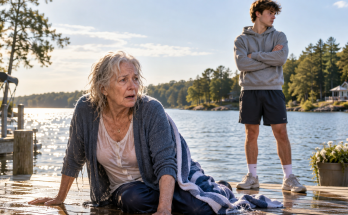
Lying on my welcome mat, curled into a fetal ball, was a woman. She was soaked to the bone, shivering violently in a thin silk nightgown. Her hair was matted with blood.
“Help me,” she whispered.
I knelt down. When she turned her face up to the porch light, my heart stopped for a single, terrifying second.
It was Lily. My daughter.
Her left eye was swollen shut, purple and bulbous. Her lip was split wide open. There were finger marks—bruises blooming like dark ink—around her throat.
“Lily,” I breathed, scooping her up. I grabbed the emergency medical kit from under the sink—not a store-bought plastic box, but a military-grade trauma pack I kept stocked out of habit. I cleaned the blood from her forehead. My hands, usually rough from gardening, moved with the steady, surgical grace of a field medic.
“Who?” I asked. My voice was calm. Too calm.
Lily opened her good eye. It was filled with a terror that no child should ever feel.
“Mark,” she whispered. “He came home drunk… He threw me down the stairs, Dad. He laughed.” She grabbed my wrist. “He said if I told anyone, he’d kill you. He said you’re just a weak old man.”
Something inside me clicked. It was a sound like a safety catch being disengaged.
For twenty years, I had buried Sergeant John inside a garden of roses. I had locked him away because the world didn’t need him anymore. But Mark Sterling, the rich real estate developer who had married my daughter, had just made a fatal calculation error. He looked at a gray-haired man and saw a victim. He didn’t know he was looking at a dormant volcano.
I sedated Lily, waited for her breathing to even, and stood up. I walked to the garage.
Under an old tarp in the corner was my Louisville Slugger baseball bat. Ash wood. Weighted. I picked it up. I gave it a test swing. The air hissed.
I looked at my reflection in the truck window. The eyes staring back weren’t the eyes of John the gardener. They were cold. Dead. They were the eyes of a man who had hunted in the dark for a living.
I drove to Mark’s mansion on the hill. The lights were blazing.
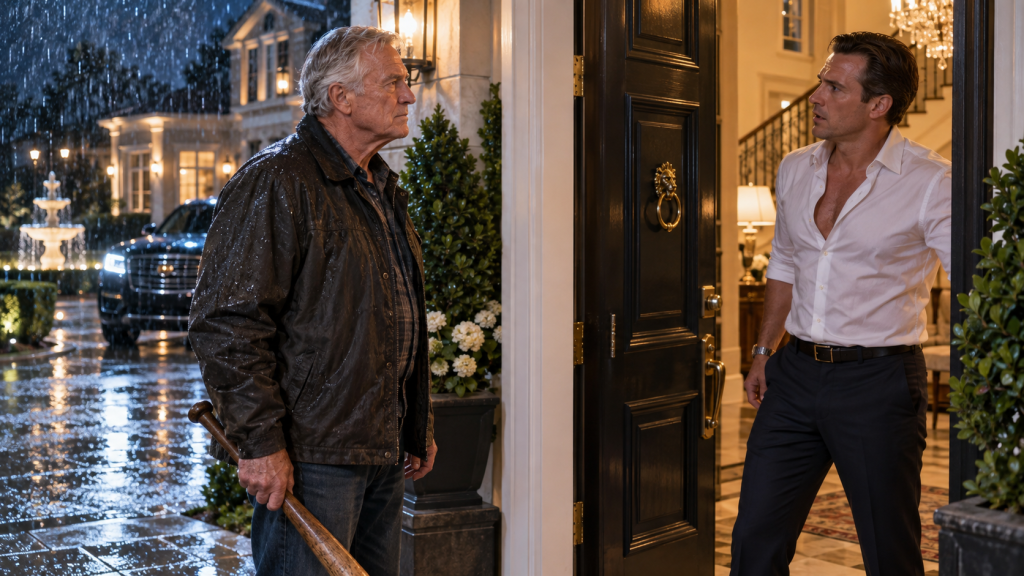
I walked up the stone steps to the massive oak front door. I didn’t ring the bell. I pounded on the wood—three hard, rhythmic knocks.
The door swung open.
Mark Sterling stood there. He was holding a tumbler of scotch. He was wearing a white dress shirt, unbuttoned, stained with what I knew was my daughter’s blood.
He looked at me and sneered.
“Well, look who it is,” he slurred. “The gardener. Did Lily run crying to daddy?” He peered past me into the rain. “Go get her. Tell her if she crawls back and apologizes, I might let her inside.”
I stood there, letting the rain soak my gray hair. I deliberately slumped my shoulders, making myself look small and pathetic.
“Mark,” I said, my voice trembling—a perfect affectation of fear. “She’s hurt bad. Why? Why did you do it?”
PART 2 — THE NIGHT I CHOSE NOT TO SWING
“Mark,” I said, keeping my voice small, “she’s hurt bad. Why?”
Rain rolled down my forehead.
“Why did you do it?”
Mark laughed.
Not nervously.
Not defensively.
He laughed like the question itself amused him.
Then he took a slow drink from his glass.
“Because she forgot who she was married to.”
My fingers tightened around the baseball bat.
Just once.
Barely.
But Mark noticed.
His eyes dropped to it.
Then he smirked.
“Oh.”
He leaned against the doorframe.
“The old man brought a stick.”
I said nothing.
Mark stepped onto the porch.
Rain touched the shoulders of his white shirt.
The stain near his cuff had darkened.
Lily’s blood.
I looked at it.
Something black and ancient moved behind my ribs.
The part of me I had spent twenty years burying beneath roses, routine, and quiet mornings.
A part that understood exactly what one swing could do.
Exactly where bone was weakest.
Exactly how long it took a man to stop standing.
I hated that I still knew those things.
I hated even more that, for one terrible second, knowing them felt useful.
Mark lifted his glass toward the bat.
“You planning to hit me, John?”
His smile widened.
“Go ahead.”
That was when I understood.
He wanted me to.
Not because he thought he could win a fight.
Because Mark Sterling never fought only the person standing in front of him.
He fought with money.
Lawyers.
Photographs.
Reputation.
He wanted me angry.
Wanted me inside his house.
Wanted my hands on him.
Because tomorrow, he could become the wealthy homeowner attacked by his unstable father-in-law.
And Lily?
Lily would become the hysterical wife from a “troubled marriage.”
The woman whose father had always been violent.
The woman who had exaggerated a private argument.
Mark was already writing the version of the night he intended other people to believe.
All I had to do was help him.
I lowered the bat slightly.
His smile faded.
“What?”
I asked.
“Disappointed?”
Mark’s eyes sharpened.
“You came all the way up here in the rain with a baseball bat.”
“Yes.”
“And now you’re standing there.”
“Yes.”
“Do something.”
I stared at him.
There it was.
The invitation.
The trap.
I had seen versions of it before.
Men who believed provoking someone into anger erased whatever came first.
Men who created chaos and then pointed at the reaction as evidence that they had been the reasonable one all along.
I looked at the blood on his sleeve.
Then at the expensive security camera mounted above the door.
Its little red indicator glowed.
Mark followed my gaze.
For the first time, he looked less drunk.
“You recording me?”
I asked.
He smiled again.
“My property records everything.”
“Good.”
That was not the answer he expected.
I saw it.
Only for a second.
Then I slipped my left hand into my jacket and took out my phone.
The emergency call had been active since I left my driveway.
I had not driven there completely blind with rage.
Almost.
But not completely.
Before I picked up the bat, I had called 911.
Told them Lily had been assaulted.
Gave them Mark’s address.
Told them I was going there.
The dispatcher ordered me not to confront him.
I had disobeyed that part.
I am not proud of it.
But I had left the line open.
Mark stared at the phone.
The color changed in his face.
I raised it just enough that he could see the active call.
“Everything you’ve said since you opened the door,” I told him quietly, “has company.”
The sneer disappeared.
For one second, Mark looked sober.
Then anger took its place.
“You son of a—”
He lunged.
Not at the bat.
At the phone.
I stepped backward.
His hand missed.
The whiskey glass fell and shattered against the stone.
Mark came again.
This time both hands.
I moved sideways.
Thirty years earlier, I would have hit him before his second step.
Twenty years earlier, I might have broken his wrist.
That night, I did neither.
I let him pass.
His shoulder struck the porch column.
He turned.
Furious.
Humiliated.
Dangerous men become most dangerous when humiliation enters the room.
“You think you’re clever?”
he spat.
“No.”
My voice stayed level.
“I think my daughter needs a father tomorrow.”
Mark’s face twisted.
“You don’t know your daughter.”
“No?”
“She’s weak.”
I felt the bat move in my hand.
One inch.
Maybe less.
He saw it.
And smiled again.
“She cries about everything.”
I breathed slowly.
“She begged me not to leave tonight.”
That sentence almost did it.
Almost.
Because I could see Lily on the welcome mat.
Bare feet blue from cold.
Blood in her hair.
Her throat bruised.
Her voice saying:
He laughed.
Mark kept talking.
Men like him mistake silence for permission.
“She always comes back.”
I looked at him.
“Not tonight.”
His expression changed.
Tiny.
But enough.
Then we heard sirens.
Far away.
Coming closer.
Mark’s head snapped toward the road.
He looked back at me.
“You called police?”
“Yes.”
His eyes became calculating.
Not panicked.
Calculating.
That frightened me more.
“Lily won’t press charges.”
“You don’t know that.”
“She never does anything without me.”
I stared.
Mark smiled.
“You think this is the first time?”
The words landed harder than a punch.
I stopped breathing.
“What?”
Mark knew immediately that he had said too much.
He looked away.
That was enough.
I took one step closer.
“How many times?”
“Get off my property.”
“How many times, Mark?”
“Get out.”
“You said this isn’t the first time.”
He pointed toward the driveway.
“Leave.”
I did not.
The sirens were louder now.
Red light began flashing against the wet trees below the hill.
Mark looked toward the road.
Then back at me.
And in that moment, I watched the rich developer disappear.
The polished husband.
The smiling man from Christmas photographs.
The speaker at charity dinners.
What remained was something smaller.
A frightened bully trying to decide which lie to use first.
“You hit her before.”
I said.
Mark’s jaw tightened.
“She falls.”
There it was.
The oldest sentence in the book.
“She fell down the stairs tonight too?”
“She was drunk.”
“She doesn’t drink.”
“She started.”
“When?”
“Tonight.”
“Interesting.”
He glared.
I continued.
“Because the blood test at the hospital will probably be inconvenient.”
That was a bluff.
Lily was not yet at the hospital.
Not when I left.
I had planned to take her myself after she rested.
That decision had been wrong.
I knew it already.
A head injury.
Strangulation marks.
Possible internal trauma.
She needed doctors, not my kitchen table.
I had called an ambulance for her before driving away.
My neighbor Martha, a retired nurse, was with her until it arrived.
Mark did not know that.
So I let him think Lily was already surrounded by people who could prove him wrong.
His face changed again.
“Hospital?”
he asked.
That word told me more than anything else he had said.
Not:
Is she okay?
Not:
What hospital?
Not even:
What happened?
Just fear.
Hospital meant records.
Photographs.
Doctors.
Questions.
People he could not easily intimidate from his living room.
I looked at him.
“Yes.”
He turned toward the house.
For the first time, he seemed to consider running.
That was when the police cars reached the driveway.
Two.
Then a third.
Lights washed the mansion in red and blue.
Mark cursed.
An officer shouted:
“Sir, step away from the door.”
Mark raised both hands.
“I’m the homeowner.”
“Step away.”
“He came here with a weapon.”
The officer looked at me.
Then at the bat.
I placed it slowly on the ground.
Hands visible.
No sudden movement.
“Yes,” I said.
“I brought it.”
Mark laughed.
“See?”
I looked at the officer.
“My daughter arrived at my house injured.”
“I called 911.”
“I came here before you got here.”
“That was a mistake.”
The officer studied me.
I added:
“I did not strike him.”
Mark immediately said:
“He threatened me.”
I looked at the glowing security camera.
“Then he should preserve his footage.”
Silence.
The officer looked up too.
Mark’s face tightened.
That was the first time I saw genuine fear in him.
Not because police had arrived.
Because evidence had.
They separated us.
I sat in the back of an ambulance that no patient occupied.
Blanket over my shoulders.
Rainwater dripping from my pants.
An officer took my statement.
Name.
Address.
Relationship to Lily.
Why I came.
Why the bat.
I told the truth.
“I wanted to hurt him.”
The officer looked up.
Most people would have edited that.
I did not.
“But you didn’t?”
“No.”
“Why?”
I stared at my hands.
“Because my daughter has already lost enough tonight.”
The officer wrote that down.
I watched his pen move.
There are moments when honesty feels almost like stepping off a roof.
You do it and trust there is ground somewhere below.
“Military?”
he asked.
I looked at him.
“How did you know?”
“Your posture.”
I almost smiled.
“Army.”
“What did you do?”
“Combat medic first.”
“Then other things.”
He did not ask.
Good.
Some histories do not improve a domestic violence report.
They photographed the bat.
Bagged it temporarily.
Asked for my phone recording.
I consented.
The dispatcher log already existed anyway.
Mark stood beneath the porch awning speaking to another officer.
He had changed his shirt.
That interested me.
I pointed.
“He changed clothes.”
The officer beside me looked over.
“When?”
“Between police arriving and now.”
“Did anyone see him go inside?”
“I don’t know.”
The officer stood immediately.
That was the first time I realized they were taking this more seriously than Mark expected.
One officer went inside.
Another stayed with Mark.
Minutes later, two more police vehicles arrived.
Then a detective.
Not because I had influence.
I had none.
Because Lily’s injuries, the open emergency call, Mark’s statements, and the possibility of strangulation changed the nature of the case.
A detective introduced herself as Elena Ruiz.
She asked me to repeat everything.
Again.
I did.
When I mentioned the blood on Mark’s white shirt, her expression changed.
“What shirt?”
“He was wearing one when he opened the door.”
“Where is it?”
“I don’t know.”
She nodded toward another officer.
No drama.
No barked commands.
Just procedure.
Procedure can be remarkably beautiful when your entire life feels like chaos.
Then my phone rang.
Martha.
My heart stopped.
“Lily?”
“They’re taking her to St. Catherine’s.”
I stood.
“How bad?”
“They’re evaluating her.”
“Martha.”
“I don’t know yet.”
Her voice softened.
“She was asking for you.”
I closed my eyes.
Guilt hit me harder than rain.
I had left her.
Not alone.
But I had left.
Because anger told me Mark required action more urgently than Lily required me.
I had been wrong.
That realization would stay with me for the rest of my life.
“I’m coming.”
I said.
Detective Ruiz stopped me.
“We need a little more before you go.”
“My daughter is being taken to the hospital.”
“I understand.”
Something in my face made her soften.
“Give me five minutes.”
I almost argued.
Then didn’t.
Because this was what I had wanted.
Evidence.
Law.
Consequences that did not depend on what my fists could accomplish.
Five minutes.
I could give five minutes.
Then an officer came out of the house carrying a clear evidence bag.
Inside was Mark’s white shirt.
Blood along the cuff.
Blood near the chest.
Ruiz looked at it.
Then at Mark.
His lawyer had not arrived yet.
He suddenly stopped talking.
Smartest thing he had done all night.
I drove to St. Catherine’s without the bat.
Police kept it.
Good.
I never wanted to touch it again.
Lily was in an examination room.
Not asleep.
Not calm.
Alive.
That became my entire world.
Her good eye found me when I entered.
Then hardened.
“Where did you go?”
The question stopped me.
Not:
Are you okay?
Not:
What happened?
Where did you go?
I sat beside the bed.
“I’m sorry.”
Her lip trembled.
“Dad.”
“I went to Mark’s.”
She closed her eyes.
Of course she knew.
Maybe she had always known exactly what kind of man slept under my roses.
Not Sergeant John.
But the father capable of becoming him again if she was hurt badly enough.
“Did you…”
“No.”
I answered immediately.
“I didn’t hit him.”
Her eyes opened.
Relief.
Actual relief.
That hurt.
She whispered:
“Thank God.”
Those two words changed me.
Because I had driven up that hill imagining violence would prove love.
And the person I loved had been lying in a hospital terrified I might throw my life away in her name.
I took her hand.
“I’m sorry I left.”
She squeezed weakly.
“Did they arrest him?”
“Not yet.”
Her face changed.
Fear returned.
“Then he’ll come.”
“No.”
“Dad, you don’t understand.”
“I’m starting to.”
“He always comes.”
The way she said always told me Mark had been right about one thing.
This was not the first time.
The doctor came in.
Lily had a concussion.
Severe bruising.
A fractured wrist.
Two cracked ribs.
No internal bleeding requiring surgery.
And injuries around her neck consistent with strangulation.
The doctor used that word.
Not choking.
Strangulation.
Clinical.
Ugly.
Precise.
He explained that even brief strangulation could carry serious risks and required monitoring.
I looked at Lily.
She stared at the wall.
I realized she had not told me everything.
Maybe because she could not.
Maybe because saying Mark threw her down the stairs had already been more truth than she could survive at midnight.
The body often remembers what language is still avoiding.
A forensic nurse came later.
She asked if Lily wanted me in the room.
Lily said yes.
Then changed her mind.
“No.”
I stood.
“Okay.”
No hurt.
No question.
I kissed her forehead.
“I’ll be outside.”
She started crying.
“I’m sorry.”
I stopped at the door.
“For what?”
“For making you leave.”
My chest cracked.
“You didn’t.”
“You asked for privacy.”
“That is allowed.”
“I’m your dad.”
“That does not mean I own the room.”
She stared at me.
Then nodded.
I stepped out.
That might have been the first truly useful thing I did all night.
Detective Ruiz arrived around dawn.
Mark had been arrested.
Not because I threatened him.
Not because I used an old military connection.
I had none.
Because evidence accumulated.
The shirt.
My recording.
The security footage he forgot could be preserved before he deleted anything.
Neighboring cameras showing Lily leaving barefoot in the rain.
The forensic examination.
His statement.
Her injuries.
Police had enough to move.
He would have a lawyer.
There would be hearings.
Nothing was guaranteed.
But he was not coming through the hospital door that morning.
Lily breathed differently when I told her.
Not relief exactly.
The body does not learn safety as quickly as information does.
But something loosened.
Then Detective Ruiz asked:
“Lily, has this happened before?”
I watched my daughter become very still.
She looked at me.
Then away.
Ruiz noticed.
“John, can I speak to her privately?”
Everything inside me wanted to stay.
Then I remembered the room.
The choice.
I stood.
“Of course.”
Lily reached for me.
I stopped.
“What?”
Her voice shook.
“Don’t go far.”
“I won’t.”
I waited in the hallway.
Twenty-eight minutes.
I know because I watched the clock every second.
When Ruiz came out, her face had changed.
Professional.
But heavier.
“John.”
I stood.
“What?”
“She told me there were prior incidents.”
My stomach dropped.
“How many?”
“I’m not going to give you details she has not given permission to share.”
That answer almost made me angry.
Then I caught myself.
Her story.
Not mine.
“Is she safe?”
“For now.”
“For now?”
Ruiz lowered her voice.
“She says Mark has threatened you before.”
“I know.”
“No.”
She looked directly at me.
“You know what he told her tonight.”
“She says he has made threats involving you for months.”
I felt cold.
“What kind?”
Again:
“That is for Lily to share.”
I hated boundaries when they stood between me and information.
Which is exactly why they mattered.
Ruiz continued.
“She also told me Mark controls most of the household finances.”
“That she has little access to her own money.”
“That he monitors her phone.”
“That he has destroyed property.”
“That he has isolated her from friends.”
Each sentence felt like a room in my daughter’s life I had never been allowed to enter.
I thought back over the last two years.
Cancelled lunches.
Missed birthdays.
The new phone every six months.
The way Lily stopped talking about college friends.
The expensive necklaces Mark bought after arguments.
I had seen all of it as marriage.
Busyness.
Wealth.
Adult life.
Maybe sometimes abuse survives not because nobody sees.
Because everybody finds ordinary names for what they see.
“Why didn’t she tell me?”
I asked.
Ruiz’s expression softened.
“Victims often have many reasons.”
I hated the word victims.
Not because it was wrong.
Because Lily was more than what Mark had done.
Ruiz seemed to understand.
“She said she was afraid you would confront him.”
I looked toward the floor.
There it was.
Proof.
My temper—buried or not—had become one of the reasons my daughter stayed silent.
Not because I ever hurt her.
Because she knew I might hurt him.
And then she would lose me too.
Something inside me broke differently.
Less dramatic.
More useful.
I sat down.
At seven-thirty, Lily asked me back inside.
She looked exhausted.
I sat beside her.
For a while we did not speak.
Then she said:
“Dad?”
“Yes.”
“Are you mad?”
“At you?”
She nodded.
I nearly cried.
“No.”
“You should be.”
“Why?”
“I lied.”
“What did you lie about?”
“Everything being okay.”
“That wasn’t a lie to hurt me.”
“I kept going back.”
“That doesn’t make what he did your fault.”
She looked away.
“I knew he’d do it again.”
I breathed slowly.
Then remembered something a counselor once told one of my soldiers after a completely different kind of trauma.
Knowing danger exists is not the same as choosing what another person does with it.
I said:
“You can regret staying without taking responsibility for what he chose.”
Lily stared at me.
“Those are different things.”
“Yes.”
She cried.
Maybe because she had spent too long believing they were the same.
Then she told me.
Not everything.
Enough.
The first time had been eighteen months earlier.
A shove against the refrigerator.
Mark apologized.
Cried.
Bought flowers.
Said work stress.
Then he punched a hole in a wall three months later.
Then grabbed her wrist.
Then pushed her.
Then slapped her.
Then came the threats.
If she left, he would ruin her financially.
If she told me, he would “teach the old man a lesson.”
If she went to police, he would make everyone believe she was unstable.
He had friends.
Money.
Lawyers.
He reminded her constantly.
It was not just violence.
It was a system.
One designed to make leaving feel more dangerous than staying.
“Why last night?”
I asked.
Lily stared at the blanket.
“I packed a bag.”
My throat tightened.
“You were leaving?”
“Yes.”
“What happened?”
“He came home early.”
Of course.
“He saw it.”
“He asked where I was going.”
“I said your house.”
Her voice cracked.
“He started laughing.”
“What did he say?”
She looked at me.
“He said you couldn’t protect me.”
Something inside me moved.
This time not toward rage.
Toward understanding.
Mark had made me part of the cage.
My age.
My quietness.
The lawn mower.
The roses.
He used the harmless old father in her mind as evidence that escape had nowhere strong enough to go.
I took her hand.
“He was wrong.”
Lily nodded.
Then whispered:
“But not because of the bat.”
I looked at her.
“No.”
She squeezed my fingers.
“Because you let police handle it.”
My eyes burned.
My daughter had to teach me what strength looked like.
At seventy-one.
Life is humiliating that way.
Mark was released on bail two days later.
That terrified Lily.
It infuriated me.
The court issued protective conditions.
No contact.
Stay away from my house.
Stay away from Lily.
Surrender firearms.
Monitoring.
Rules.
Pieces of paper.
I knew enough about violence to understand paper cannot stop a determined man physically.
But paper creates lines.
And crossing them creates evidence.
Consequences.
The law builds fences one document at a time.
Not perfect.
Better than a baseball bat.
Lily came home with me.
We moved her into my guest room.
The gold wallpaper she hated when she was sixteen was still there.
She laughed the first time she saw it.
Then cried.
Then laughed again.
Healing rarely respects tone.
I installed better locks.
With her permission.
Exterior lights.
With her permission.
A camera.
After asking.
Every improvement became a question:
“Would this make you feel safer?”
Not:
“I’m doing this.”
I was learning.
Slowly.
Three days after Lily came home, Detective Ruiz called.
“We found something.”
My stomach tightened.
“What?”
“Can you come to the station?”
“Is Lily needed?”
“Not yet.”
That frightened me more.
I went.
Ruiz met me in an interview room.
She placed a folder on the table.
No cuffs.
No accusation.
But she looked serious.
“John, when officers searched Mark’s house under the warrant, they recovered several electronic devices.”
I nodded.
“One had a hidden folder.”
My hands tightened.
“What kind of folder?”
“Videos.”
The word made me cold.
“Of Lily?”
“Some.”
I looked away.
I did not want details.
Ruiz continued carefully.
“Some appear to document arguments inside the home.”
“Others show aftermath.”
“Bruising.”
“Damage.”
“Why would he keep that?”
“We’re not sure.”
Then she slid one photograph toward me.
A still frame.
Mark’s living room.
Different woman.
Not Lily.
My stomach turned.
“Who is that?”
Ruiz looked at me.
“That is what we’re trying to determine.”
The woman appeared younger than Lily.
Maybe twenty-five.
She stood beside Mark’s fireplace.
One arm wrapped around herself.
A bruise near her jaw.
Timestamp:
Four years earlier.
Before Lily married Mark.
I stared.
“There were others?”
Ruiz nodded.
“How many?”
“At least three women appear in separate files.”
My hands went cold.
“Wives?”
“Not that we know.”
“Girlfriends?”
“Possibly.”
The room seemed to tilt.
Mark’s violence had not begun with my daughter.
She had stepped into a story that already had chapters.
Ruiz continued.
“We identified one woman.”
“Her name is Sarah Benton.”
“Do I know her?”
“I don’t think so.”
“She worked for one of Mark’s companies five years ago.”
“Did she report him?”
“No.”
“Why?”
Ruiz’s expression sharpened.
“According to her preliminary statement, she tried.”
I stared.
“What happened?”
“She went to company security.”
“Then HR.”
“Then an attorney.”
“And?”
“Mark settled a civil claim privately.”
“Nondisclosure agreement.”
“Payment.”
“Employment reference restrictions.”
My stomach turned.
“He bought her silence.”
Ruiz corrected me.
“He entered a settlement.”
Facts.
Again.
“I know what it sounds like.”
she added.
“But we need accuracy.”
I nodded.
“Why keep the videos?”
I asked.
“We don’t know.”
Then Ruiz pushed another document toward me.
An email draft recovered from Mark’s computer.
Never sent.
Addressed to Lily.
Subject:
IF YOU LEAVE
My blood went cold.
Ruiz did not let me read the body.
“That is Lily’s evidence to review with counsel.”
I nodded.
“What can you tell me?”
She hesitated.
“It references recordings.”
“Financial documents.”
“And something involving you.”
My chest tightened.
“Me?”
“Yes.”
“What?”
Ruiz looked at me.
“Mark had been investigating your military history.”
I stared.
“What military history?”
“Your service records.”
“Old unit associations.”
“Post-service employment.”
My mouth went dry.
“Why?”
“Based on the draft, he intended to portray you as unstable and violent if Lily sought help.”
The room became very quiet.
Suddenly the porch made sense.
The sneer.
The invitation.
Go ahead.
He had known.
Not everything.
Enough.
He wanted the bat.
Wanted the old soldier.
Wanted a story he could sell.
And I had almost handed it to him.
Ruiz watched my face.
“He was counting on you reacting.”
“Yes.”
“You didn’t.”
Barely.
That distinction mattered.
Then she removed one final item from the folder.
A photograph.
Not digital.
Printed.
Taken from far away.
My house.
Number 42.
My porch.
My roses.
My truck.
Timestamp:
Six months earlier.
Someone had been watching me.
On the back, handwritten:
OLD MAN — EASY PRESSURE POINT.
I stared until the words blurred.
Mark had not simply threatened Lily with me because it occurred to him during arguments.
He had studied me.
Measured me.
Reduced me to a weakness he could use against her.
My quiet life had become part of his strategy.
I looked at Ruiz.
“Did he take this?”
“We don’t know yet.”
“Was someone else helping him?”
“That’s what we’re trying to determine.”
My stomach tightened.
“Helping him do what?”
Ruiz leaned back.
“Control Lily.”
The simplest answer.
The worst one.
Then her phone rang.
She looked at the screen.
Answered.
Listened.
Her face changed.
“Where?”
Silence.
“When?”
Another pause.
Then:
“Do not approach alone.”
She hung up.
I stood.
“What?”
Ruiz looked at me.
“We found Sarah Benton.”
“You said you already identified her.”
“No.”
“I mean physically.”
Something in her expression made my blood run cold.
“Where?”
“She came to the station.”
“Why?”
“She saw Mark’s arrest on the news.”
I waited.
Ruiz continued.
“She brought records.”
“What records?”
“Photos.”
“Messages.”
“Settlement documents.”
Then she paused.
“And a letter.”
I frowned.
“What letter?”
“From Lily.”
My heart stopped.
“Lily knows her?”
Ruiz looked directly at me.
“Apparently.”
I could barely speak.
“Since when?”
“We don’t know.”
Then Detective Ruiz said the sentence that changed everything I thought I understood about why my daughter had finally tried to leave.
“Sarah says Lily contacted her six months ago.”
I stared.
Six months.
The same month someone photographed my house.
The same month Mark had labeled me an easy pressure point.
Lily had not spent those months simply enduring him.
She had been gathering something.
Planning something.
Trying to get out.
And she had done it without telling me because she knew exactly what I would do if I learned the truth too early.
I looked through the interview-room glass toward the hallway.
For the first time since midnight, I understood that my daughter had not crawled onto my porch because she had nowhere else to go.
She came because something had gone wrong with a plan she had already set in motion.
And if Sarah Benton was telling the truth, Lily had been preparing to expose Mark long before I ever picked up that baseball bat.
PART 3 — THE FATHER WHO STAYED
Sarah Benton arrived at the police station carrying a cardboard banker’s box.
No dramatic briefcase.
No secret recordings hidden inside a necklace.
Just an ordinary white box with blue handles, the kind offices use when someone quits, gets fired, or realizes they have accumulated too much paper to keep pretending they are organized.
Detective Ruiz brought her into the interview room.
I stood when she entered.
Sarah looked to be in her early thirties.
Dark hair pulled into a loose knot.
Gray coat.
No makeup.
A thin scar ran from beneath her left ear toward her jaw.
I tried not to stare.
She noticed anyway.
People who have survived being examined learn to recognize examination instantly.
“You’re John.”
she said.
“Yes.”
“Lily’s father.”
“Yes.”
She looked at my hands.
Then at my face.
Maybe searching for whatever Mark had told her I was.
Violent.
Unstable.
Dangerous.
The old man with the baseball bat.
Finally she said:
“She talks about your roses.”
Of all the things I expected, that was not one.
“My roses?”
Sarah almost smiled.
“She says you worry about them like they’re hospitalized relatives.”
I laughed.
Once.
Quietly.
“That sounds like Lily.”
The tension softened by half an inch.
Enough.
Detective Ruiz closed the door.
“Sarah has agreed to give us records voluntarily.”
I looked at the box.
“What’s in there?”
Sarah answered.
“Five years.”
My chest tightened.
“Of Mark?”
“Yes.”
She sat.
Then placed both hands on top of the box as though it might move if she let go.
“I worked for Sterling Development.”
“I know.”
“Executive communications.”
“I wrote speeches.”
“Investor letters.”
“Charity statements.”
She smiled bitterly.
“I made Mark sound like the kind of man people trusted with cities.”
That hurt in a way I had not expected.
I had seen those articles.
Mark opening affordable housing projects.
Mark donating money to hospitals.
Mark standing beside mayors.
Public goodness printed in glossy photographs.
Private cruelty hidden behind locked doors.
People often assume monsters look monstrous.
Most do not.
Most know how to wear jackets.
Sarah met Mark after his first divorce.
He was charming.
Attentive.
Sent flowers to her office.
Remembered the name of her dog.
Made her feel chosen.
The relationship remained secret at first because company policy discouraged executives from dating direct reports.
Then the first argument happened.
Mark smashed her phone.
He apologized the next morning.
Bought a new one.
A better one.
That pattern sounded familiar already.
Sarah saw it in my face.
“Yes.”
she said.
“Same thing.”
I looked away.
She continued.
“He liked replacing things after he broke them.”
“Phones.”
“Jewelry.”
“Furniture.”
“People’s confidence.”
“That part was harder.”
The violence escalated.
A shove.
A slap.
Hands around her throat once.
Sarah tried leaving.
Mark threatened her job.
Then threatened her professional reputation.
He had access to private emails.
He told her he could make it look as though she had stolen confidential company information.
Eventually Sarah went to HR.
That was when the problem became institutional.
A senior executive discouraged her from filing a formal complaint.
Company counsel offered separation terms.
Money.
Nondisclosure language.
Neutral reference.
Sarah hired her own lawyer.
The settlement happened.
She left.
“Why didn’t you go to police?”
I asked.
Ruiz glanced at me.
Not warning.
Just reminding me to be careful.
Sarah did not look offended.
“I almost did.”
“What stopped you?”
“Fear.”
Simple.
Honest.
Then:
“And shame.”
I nodded.
Not because I understood hers exactly.
Because I had watched my daughter wear the same thing.
Sarah moved.
Changed jobs.
Changed numbers.
Spent years rebuilding.
Then six months ago, she received an email.
The subject line read:
I think I married the man who hurt you.
Lily.
My Lily.
I closed my eyes.
Sarah continued.
“At first I thought it was a trap.”
“Why?”
“Mark used fake accounts before.”
“He liked knowing whether people were still talking about him.”
That sounded exactly like the man I had met on the porch.
Control did not stop when a relationship ended.
It simply changed method.
“So what made you believe her?”
Sarah looked at me.
“She described the apology.”
“What apology?”
Sarah swallowed.
“The one after he strangles you.”
My hands tightened under the table.
She noticed.
So did Ruiz.
I forced them open.
“What does he say?”
Sarah’s voice lowered.
“He says he scared himself.”
My stomach dropped.
Lily had said that sentence before.
Not to me.
But I remembered once overhearing her on the phone.
He scared himself, Dad. He just needs some space.
I thought they had argued.
God.
How many obvious things had I translated into harmless language because the truth seemed too ugly?
Sarah said Mark always cried afterward.
Said he did not recognize himself.
Said his father had been violent and he was terrified of becoming him.
Promised therapy.
Sometimes attended twice.
Then stopped.
“He made his guilt feel like something I needed to care for.”
Sarah said.
“That’s how he kept me.”
I thought of Lily tending everyone’s feelings but her own.
“Did Lily send proof?”
Ruiz asked.
Sarah nodded.
“Not at first.”
“She just wanted to know whether it happened before.”
“And you told her?”
“Yes.”
That single yes changed Lily’s life.
Because abuse survives partly by convincing each victim she is uniquely responsible for causing it.
Too sensitive.
Too difficult.
Too emotional.
Too provoking.
Then someone else says:
He did it to me too.
And suddenly the architecture begins cracking.
Sarah and Lily spoke for months.
Carefully.
Through an account Mark did not know about.
Lily documented injuries.
Not every time.
Enough.
Dates.
Photographs.
Messages.
Screenshots.
Financial restrictions.
Threats.
Records of broken property.
She copied documents showing Mark had placed assets under entities she could not access despite having promised shared ownership after marriage.
None of that necessarily proved a crime by itself.
But it showed pattern.
Control.
Intent.
And preparation.
Sarah helped her build a safety plan.
Not because Sarah was a lawyer.
Because she had once needed one and knew how badly fear destroys organization.
She told Lily to keep copies outside the house.
Pack important documents.
Memorize phone numbers.
Move small amounts of personal money where lawful and possible.
Identify somewhere safe.
My house.
Number 42.
The roses.
I looked at Sarah.
“She was planning to leave for six months?”
“Yes.”
“Why didn’t she tell me?”
Sarah’s expression softened.
“She was afraid you’d confront him.”
Same answer.
Again.
I looked down.
There are truths that only need repeating because you refused to learn them the first time.
Sarah added:
“She loves you.”
“That was the problem.”
I looked up.
“She said if you knew, you would go to his house.”
The shame was almost unbearable.
Because that was exactly what I did.
Baseball bat and all.
“What was supposed to happen the night she came to me?”
I asked.
Sarah looked at Ruiz.
Ruiz nodded.
Sarah opened the box.
Inside were folders.
Lily’s handwriting on some tabs.
BANK
THREATS
PHOTOS
PROPERTY
SARAH
And one labeled:
EXIT
My throat closed.
“She was supposed to leave while Mark was at a company dinner.”
Sarah said.
“She had a bag packed.”
“Documents copied.”
“Cash.”
“Medication.”
“She was going to come to your house.”
“Then call police from there.”
“What went wrong?”
“Mark came home early.”
We knew that part.
But not why.
Sarah pushed one page toward Ruiz.
An email printout.
Mark’s assistant had canceled the dinner because one investor backed out.
Mark returned home almost two hours early.
Saw Lily’s bag.
Then found something worse.
Not the secret email account.
A printed statement Lily had drafted.
For police.
Not yet filed.
Mark read enough to understand she had been documenting him.
That was when the beating began.
I looked toward the wall.
My daughter had not failed to leave because she lacked courage.
She had made a plan.
The plan collided with bad timing and a dangerous man.
That distinction mattered.
Maybe more than anyone who has never escaped something like that can understand.
Sarah reached deeper into the box.
“Lily gave me copies every week.”
“Why?”
“In case Mark found hers.”
“Where did you keep them?”
“Bank box.”
“Why bring them now?”
Sarah’s eyes hardened.
“Because he almost killed her.”
Not:
because police asked.
Not:
because I finally feel brave.
Because the cost of silence had become visible on Lily’s face.
Sarah looked at me.
“I signed an NDA about employment and certain civil claims.”
She said.
“My attorney is reviewing exactly what it covers.”
“But no settlement can make me lie to police.”
Ruiz nodded.
“Correct.”
“And I’m done being afraid of whether Mark approves of my memory.”
That sentence stayed with me.
Detective Ruiz asked me to leave before she took Sarah’s complete statement.
Fine.
I no longer needed to be inside every room where truth was happening.
I drove home.
Lily was sleeping.
Her door remained cracked open.
For three nights, she had not wanted it closed.
I stood outside.
Did not enter.
Then walked to the kitchen.
Martha had left soup.
The world’s answer to catastrophe is often soup.
I heated some.
Did not eat it.
Instead, I sat at the kitchen table and stared at my hands.
Hands that had cleaned wounds.
Held soldiers together.
Fixed bicycles.
Pruned roses.
Carried my daughter inside.
Picked up a baseball bat.
Hands can become whatever anger asks very quickly.
Maybe character is simply what you refuse to let them become next.
Lily came into the kitchen around midnight.
Barefoot.
Wearing one of my old flannel shirts.
Her bruises had begun turning yellow at the edges.
Healing has ugly colors.
She saw me.
“You okay?”
I almost laughed.
She was asking me.
“I met Sarah.”
Lily stopped.
Then sat across from me.
“She came?”
“Yes.”
“Was she okay?”
“She seemed strong.”
Lily smiled faintly.
“She is.”
I looked at my daughter.
“You’ve known her six months.”
“Yes.”
“Why didn’t you tell me?”
Her face changed.
“Dad…”
“No.”
I lifted a hand.
“I’m not asking to make you apologize.”
“I need to understand.”
Lily stared at the table.
Then:
“Because I knew you.”
That hurt.
She continued.
“I knew what you did before you retired.”
“Not details.”
“You never told me details.”
“But I knew you were military.”
“I knew people still called you.”
“I knew Uncle Ray once joked that you were the last person anyone should corner.”
I closed my eyes.
“Lily.”
“And I knew you love me in a way that sometimes scares me.”
That sentence broke something.
She started crying.
“So I thought if I told you Mark hit me, you’d make it stop.”
“Isn’t that what a father should do?”
“No.”
She shook her head.
“You would make him stop.”
“That’s different.”
I became still.
She wiped her face.
“I needed my life to become mine again.”
“I didn’t need it to become your war.”
There it was.
The whole story.
A father can love his daughter so fiercely that he accidentally places his anger at the center of her survival.
I had done exactly that the first night.
“I’m sorry.”
I said.
Lily looked up.
“For going there.”
“For leaving you.”
“For making my reaction something you had to plan around.”
Her face crumpled.
“I knew you wouldn’t hurt me.”
“I know.”
“That wasn’t enough.”
“No.”
I reached across the table but stopped halfway.
She put her hand in mine.
Choice.
Always better when offered.
Then she said:
“I’m glad you went.”
I frowned.
“What?”
“Not with the bat.”
“Thank you.”
She almost smiled.
“But Mark talked.”
“Yes.”
“He always talked too much when he thought someone was beneath him.”
That sounded like she knew her husband very well.
Maybe too well.
“Sarah said the 911 recording matters.”
“It does.”
“He said it wasn’t the first time.”
“Yes.”
Lily closed her eyes.
“He probably doesn’t even remember saying it.”
“Maybe.”
Then she whispered:
“He’s been so careful for years.”
“And one night he got careless.”
I looked at her.
“No.”
“What?”
“You got careful.”
The distinction mattered.
He did not expose himself because he became stupid.
Lily had spent six months creating a situation where his behavior no longer lived only behind walls.
Sarah had preserved records.
Doctors documented injuries.
Police recorded statements.
Evidence existed because Lily had decided to start believing herself.
That was courage.
Quiet.
Methodical.
Nothing like the baseball bat.
Mark’s attorneys attacked.
Of course.
Within weeks, they argued that Lily had conspired with a former disgruntled employee.
That Sarah was motivated by money.
That Lily had manipulated photographs.
That my arrival with a baseball bat proved Lily came from a violent family environment.
That one hurt.
Because it contained something true enough to be useful.
I had arrived armed.
No one could erase that.
So I did not try.
When prosecutors prepared me to testify at a preliminary hearing, they asked:
“Why did you bring the bat?”
I answered:
“Because I wanted to hurt him.”
The prosecutor looked uncomfortable.
“John, you understand defense counsel will use that.”
“Yes.”
“You could say you were afraid.”
“I was.”
“You could say you took it for protection.”
“That would not be the whole truth.”
She stared at me.
I continued.
“I spent years teaching my daughter not to lie because the truth is inconvenient.”
“I’m not starting now because a courtroom makes honesty expensive.”
She nodded.
We kept the answer.
Defense counsel did exactly what we expected.
“Mr. Bennett, you went to my client’s home armed with a baseball bat.”
“Yes.”
“You intended violence.”
“I wanted violence.”
“Please answer the question.”
“I am.”
A small stir in the courtroom.
The attorney frowned.
“Did you intend to strike Mr. Sterling?”
“When I left my house, part of me did.”
“And yet you want this court to believe my client was the dangerous person.”
I looked at Mark.
He sat in a dark suit.
Clean-shaven.
Calm.
The man magazines photographed.
Then I looked back at the attorney.
“I want the court to believe the evidence.”
The attorney paused.
I continued.
“I brought the bat.”
“I did not swing it.”
“Your client attacked my daughter.”
“Those things can both be true.”
The courtroom became very quiet.
Facts first.
Always.
The attorney tried again.
“You have military training.”
“Yes.”
“You know how to injure people.”
“Yes.”
“Would you agree that makes you dangerous?”
I thought.
Then:
“It means I have a greater responsibility not to use what I know when I’m angry.”
That answer was not planned.
It was simply true.
Mark looked away.
For the first time, I stopped caring whether I frightened him.
Fear was his language.
I no longer wanted to speak it.
Sarah testified later.
Behind closed doors for some portions because of evidentiary and privacy issues.
Other women came forward after news of the case spread.
Not all allegations became charges.
Not all could be proven.
One woman did not want to participate beyond providing background.
That was her right.
Another gave a statement.
A former girlfriend produced photographs.
The prosecution remained focused on Lily’s assault and the conduct they could prove.
Good.
A courtroom is not supposed to become a theater where every rumor gets a microphone because the defendant is disliked.
I learned that too.
Justice had rules.
Slow ones.
Frustrating ones.
Necessary ones.
Mark violated the protective order once.
Not physically.
Through a third party.
A flower delivery arrived at my house.
White lilies.
Of course.
No card.
Police traced the order to an assistant associated with one of Mark’s companies.
Mark claimed he knew nothing about it.
Maybe.
Maybe not.
Lily looked at the flowers for ten seconds.
Then said:
“Throw them away.”
I did.
No photograph.
No symbolic burning.
Trash bin.
Sometimes dignity is deliberately boring.
Lily filed for divorce.
Mark fought everything.
Household property.
Personal possessions.
Temporary support.
Even the dog, although the dog had belonged to Lily before the marriage.
I offered to pay every legal bill.
Lily said:
“Some.”
Not all.
She used her own savings where she could.
Accepted help where she wanted.
We found a family-law attorney experienced in abuse cases.
Lily chose her.
Not me.
I sat in the waiting room.
I became very good at waiting rooms.
Maybe that was my new skill.
Months passed.
Lily healed physically.
The eye opened.
The ribs mended.
Her wrist came out of the cast.
The bruises disappeared.
The invisible injuries remained stubborn.
She still startled when my garage door slammed.
Still checked locks twice.
Still slept with a lamp on some nights.
Still kept a packed bag inside the guest-room closet.
Not because she planned to leave me.
Because knowing she could leave any room made sleeping easier.
I never touched the bag.
Not once.
She started therapy.
At first she hated it.
Came home angry.
Said:
“She keeps asking me what I want.”
I smiled.
“That sounds terrible.”
Lily threw a cushion at me.
“Dad.”
I laughed.
Then stopped.
Because I realized how profound the question was.
What do you want?
Not:
What will keep Mark calm?
Not:
What will Dad do?
Not:
What will the family think?
What do you want?
A person can lose contact with that question slowly enough not to notice.
Learning it again took time.
Six months after the attack, Lily moved out of my house.
That hurt more than I expected.
I did not show it.
Mostly.
She rented a little bungalow fifteen minutes away.
Two bedrooms.
Peeling kitchen cabinets.
Small backyard.
Terrible plumbing.
I loved it immediately because Mark had never lived there.
On moving day, I brought tools.
Then stopped on the porch.
“What do you want me to fix first?”
She smiled.
“The bathroom faucet.”
Not locks.
Not cameras.
Not security.
A faucet.
Ordinary life returning through dripping plumbing.
I almost cried.
Instead I fixed it.
Badly at first.
Retirement makes a man overconfident.
She planted herbs behind the kitchen.
Basil.
Rosemary.
Mint.
No roses.
“Too much pressure.”
she said.
Fair.
She bought cheap curtains.
Secondhand dining chairs.
A blue couch ugly enough to count as independence.
Every object belonged there because she chose it.
That mattered more than quality.
The criminal case went to trial nearly a year after the night on my porch.
Mark rejected the final plea offer.
He believed a jury would believe him.
Maybe men like Mark must believe that.
Their entire survival depends on assuming performance is reality if enough people applaud.
Lily testified.
I was not allowed in the courtroom until after my own testimony.
Good.
Her story belonged to her without my face behind the prosecutor.
When I finally saw her afterward, she looked exhausted.
“How did it go?”
I asked.
She shrugged.
“I told the truth.”
“Then it went as well as it could.”
She leaned against me.
Only for a second.
Then stood straight again.
Stronger does not always mean less tired.
Mark testified too.
That surprised everyone.
His lawyer probably advised against it.
Mark had always believed he could talk his way out of rooms other people found locked.
He described the marriage as volatile.
Said Lily had become secretive.
Paranoid.
Influenced by Sarah.
Claimed the injuries resulted from a struggle after Lily attacked him.
Then the prosecutor played part of my 911 recording.
Mark’s voice filled the courtroom.
She always comes back.
Then:
You think this is the first time?
I watched him hear himself.
His face changed.
Only a little.
Enough.
Words spoken when you believe nobody important is listening have a strange way of becoming important later.
The jury convicted him of several serious offenses related to Lily’s assault, including charges tied to the strangulation and physical injuries.
Not every count.
Enough.
The judge imposed a substantial prison sentence.
I will not tell you I felt nothing.
I felt satisfaction.
Relief.
Anger.
Grief.
A primitive part of me felt pleased that a locked door would now stand between Mark and my daughter.
I do not romanticize that.
But I did not cheer.
Neither did Lily.
When the sentence was read, she simply closed her eyes.
Then exhaled.
Years of holding breath leaving a body one inch at a time.
Outside the courthouse, reporters waited.
Microphones.
Cameras.
Questions.
“Lily, do you feel justice was served?”
“What would you say to other women?”
“John, do you regret confronting your son-in-law?”
Lily stopped.
I thought she might speak.
Instead she looked at me.
Then at the cameras.
And said:
“I survived something private.”
“I’m not turning my recovery into public property.”
Then she walked away.
I followed.
That was my daughter.
The divorce concluded later.
Financial discovery uncovered misconduct unrelated to the assault.
Company issues.
Improper expenses.
Questionable transactions.
Other agencies handled those.
Not me.
I had learned enough not to enjoy every falling piece as though I personally deserved credit.
Mark’s business empire shrank.
Partners left.
Projects collapsed.
Some companies survived under different management.
I did not track every consequence.
There is a point where watching someone lose everything becomes another form of staying tied to them.
Lily understood that before I did.
“Stop checking.”
she told me.
“I’m not.”
“You read every article.”
“I like business news.”
“You hate business news.”
Fair.
I stopped.
Eventually.
Sarah became Lily’s friend.
Not because shared trauma automatically creates healthy friendship.
They were careful about that.
Sometimes they talked about Mark.
Often they did not.
Sarah got married two years later.
Lily attended.
I fixed a broken chair at the reception because apparently retirement follows me everywhere.
Sarah introduced me to her husband as:
“This is Lily’s dad, the one with the roses.”
Not:
the man with the bat.
I cannot explain why that almost made me cry.
The Louisville Slugger remained at the police station for months as evidence.
Eventually they told me I could collect it.
I drove there.
Signed the form.
The clerk handed it across the counter in a clear plastic evidence sleeve.
I stared.
Same ash wood.
Same dark grain.
Same bat I once used for neighborhood games when Lily was little.
Before anger turned it into something else.
I took it home.
Walked to the garage.
Removed the plastic.
Held it.
For a moment I remembered the hiss through the air when I tested the swing.
The cold eyes in the truck window.
The version of myself I nearly admired for becoming.
I hated that memory.
Then I carried the bat into the backyard.
Not to burn it.
Too theatrical.
I put it on my workbench.
Sandpaper.
Varnish.
Time.
I stripped the old finish.
Slowly.
The dents remained.
Wood remembers pressure.
I turned it into something else.
A month later, Lily visited.
She found me in the garage.
“What are you doing?”
“Finishing something.”
On the bench lay three narrow pieces of ash wood.
The bat was gone.
I had cut it lengthwise.
Planed the pieces.
Joined them.
Made a small rectangular box.
Not perfect.
But solid.
Lily stared.
“Is that…”
“Yes.”
She touched the wood.
“You cut up the bat?”
“Yes.”
“Why?”
I shrugged.
“Didn’t need it anymore.”
Her eyes filled.
Then she noticed the hinges.
“What’s the box for?”
“Seeds.”
She laughed.
“Seeds?”
“Rose seeds.”
“You don’t grow roses from seed.”
“I know.”
“Then why—”
“Symbolism.”
She stared at me.
“Dad.”
“I’m trying.”
She laughed harder.
Good.
In the end, we used the box for photographs.
Not Mark.
None.
Childhood.
Lily riding a bicycle.
Her mother before she died.
School plays.
Christmas mornings.
College graduation.
Our lives before one terrible man became too central.
That mattered.
Trauma steals space.
Recovery sometimes means giving ordinary memories their rooms back.
Lily did not become fearless.
I am glad.
Fear has useful work.
She became better at asking whether fear belonged to the present or the past.
She learned how to leave conversations.
How to disagree without explaining herself for twenty minutes.
How to recognize apology without mistaking it for change.
How to say:
“No.”
Then remain in the room while someone disliked hearing it.
I watched with enormous pride.
Quietly.
She no longer needed my pride to make choices valid.
Another lesson.
Three years later, she started dating again.
A teacher named Daniel.
Kind.
Soft-spoken.
Completely unable to repair anything.
Suspicious flaw.
The first time he came to dinner, he looked at my roses.
“They’re incredible.”
I said:
“Thank you.”
Then he looked at me.
“I’m a little nervous.”
“Why?”
Lily shouted from the kitchen:
“Because Sarah told him about the bat.”
I closed my eyes.
“Sarah is dead to me.”
Everyone laughed.
Daniel did too.
Good sign.
Then I said:
“For the record, there is no bat.”
He looked confused.
Lily smiled.
“I’ll explain later.”
I did not investigate Daniel.
That deserves mention.
I wanted to.
Background check.
Employment records.
References.
Credit.
Everything.
Then Lily asked:
“Are you going to trust me to decide?”
There it was.
My final exam.
“Yes.”
I said.
Then went inside and suffered privately like a civilized father.
Progress.
Daniel was not perfect.
Also important.
Once he forgot Lily’s birthday dinner reservation.
They argued.
She came to my house angry.
My body immediately prepared for emergency.
Then she said:
“He’s an idiot.”
Not:
I’m afraid.
Difference.
She vented.
Went home.
They worked it out.
Healthy relationships still contain disappointment.
I had to relearn that too.
After Mark, every raised voice sounded like danger.
But safety is not the absence of disagreement.
It is the absence of fear that disagreement will cost you your body, freedom, or dignity.
Five years after the night on my porch, Lily married Daniel.
Small ceremony.
Backyard.
My backyard.
Roses everywhere.
She asked me to walk her halfway down the aisle.
Then stop.
At first I did not understand.
“Why halfway?”
“Because I’m not being given away.”
Of course.
I smiled.
“Then why walk you at all?”
“Because I want you beside me for part of it.”
That was better.
We walked.
Halfway.
Then I kissed her forehead.
Stepped aside.
And watched my daughter walk the rest of the distance under her own power.
I think that was the proudest moment of my life.
Not because she married.
Because she chose every step.
At the reception, Sarah found me near the rose bushes.
“You crying?”
“No.”
“You are.”
“Allergies.”
“To weddings?”
“Apparently.”
She smiled.
Then looked toward Lily.
“Do you ever think about that night?”
“Yes.”
“The porch?”
“Yes.”
“The bat?”
Less often.
Sarah nodded.
Then:
“She always said you were her safe place.”
I looked at her.
“Even when she was afraid to tell me.”
“Yes.”
“That doesn’t sound very safe.”
Sarah thought.
“Safe doesn’t mean perfect.”
I waited.
“It means when she finally came, you opened the door.”
That sentence stayed with me.
Maybe I had spent years judging myself by the wrong moment.
The drive to Mark’s house.
The bat.
The rage.
Maybe the more important moment was before all of that.
The deadbolt turning.
The porch light.
My daughter whispering:
Help me.
And the door opening.
Sometimes that is the whole job.
I still live at number 42.
Still mow Tuesdays.
Still grow roses.
Still fix bicycles.
The neighborhood children eventually learned I had been in the Army because one boy found an old photograph in my garage.
For several weeks, I became wildly interesting.
Then a new family got a trampoline and my celebrity ended.
Correctly.
I prefer it that way.
People who heard pieces of the story sometimes said:
“If that happened to my daughter, I’d kill him.”
They expected agreement.
Maybe admiration.
I never give either.
I understand the feeling.
Believe me.
I understand it in my bones.
But I always answer the same way.
“No.”
They look surprised.
Then I say:
“If someone hurts your child, don’t make your anger the second emergency.”
That usually ends the conversation.
Good.
I do not need people clapping for the worst impulse I ever had.
Violence would have felt powerful for perhaps thirty seconds.
Then what?
Police.
Charges.
Lawyers.
Lily visiting me through glass while recovering alone.
Mark becoming the victim in every headline.
My daughter spending years wondering whether her father’s ruined life was another thing she caused.
No.
He had already taken enough.
I am grateful every day I did not hand him more.
The roses bloom every May.
Lily still comes over when the first ones open.
One variety is pale yellow.
Her mother’s favorite.
Another deep red.
Mine.
After Lily’s wedding, she planted one white rose beside the porch.
I asked why.
She shrugged.
“Needed one.”
No symbolism apparently.
I did not believe her.
But I respected the lie.
One spring night, years after Mark disappeared into a prison system I no longer followed, a storm rolled over the neighborhood.
Thunder.
Rain.
Wind beating the branches against my windows.
I was in the kitchen making tea.
Same kettle.
Same room.
For one second, I heard something at the front door.
My body remembered before my mind did.
I froze.
Then opened it.
No injured daughter.
No blood.
Just Lily.
Older.
Healthy.
Laughing beneath an umbrella.
Daniel behind her carrying a sleeping little girl.
My granddaughter.
Lily stepped inside.
“You going to leave us in the rain?”
I laughed.
“No.”
“Good.”
She kissed my cheek.
Then walked past me as though the house belonged partly to her.
It always had.
My granddaughter woke and reached for me.
I carried her to the kitchen.
Lily noticed the small ash-wood box on the shelf.
The one made from the bat.
She opened it.
Photographs.
Ordinary years.
She smiled.
“You still have this.”
“Yes.”
“Are you ever going to tell her?”
She nodded toward her daughter.
“About Mark?”
“Someday.”
“When?”
“When it helps her understand something.”
Not before.
Good.
The past should not become a bedtime story merely because adults survived it.
My granddaughter pointed toward an old photograph of Lily at seven.
“Mommy?”
“Yes.”
She looked confused.
“Why does Mommy have no front teeth?”
Lily laughed.
“Because Grandpa stole them.”
The child gasped.
I objected immediately.
Defamation.
Everyone laughed.
And suddenly the box was just a box.
The bat was completely gone.
That felt important.
For twenty years, the neighborhood believed I was harmless.
They were wrong.
Then, for one terrible night, I believed proving I was dangerous would somehow make me a better father.
I was wrong too.
Strength was never hiding Sergeant John beneath a garden.
And it was never unleashing him because somebody hurt my daughter.
Strength was learning which parts of him were still useful.
Calm hands.
Attention.
Endurance.
The ability to sit beside pain without running from it.
And which parts needed to remain buried.
The need to win through force.
The belief that violence becomes righteous because the person swinging first has a reason.
I kept the discipline.
I let the weapon go.
Lily once asked whether I still hated Mark.
I thought about it.
Then answered honestly.
“Not in a useful way.”
“What does that mean?”
“It means I don’t wish him well.”
She laughed.
“Fair.”
“But I also don’t wake up thinking about him.”
Her expression softened.
“That took a while.”
“Yes.”
“Me too.”
We sat quietly.
Then she said:
“I used to think healing meant I’d stop remembering.”
“And now?”
“Now I think it means remembering doesn’t get to pick what I do next.”
I smiled.
My daughter had become wiser than me.
Again.
That midnight porch will always exist somewhere inside us.
Lily soaked in rain.
Blood in her hair.
My hands lifting her.
The kettle abandoned in the kitchen.
There are nights that divide life into before and after.
But after is not one thing.
After became doctors.
Police reports.
Courtrooms.
Therapy.
A cheap bungalow.
A dripping faucet.
Sarah’s friendship.
Roses.
A wedding.
A granddaughter asleep against my chest.
The worst night did not get to write every page that followed.
That may be the most important thing I learned.
Mark wanted Lily to believe leaving him would destroy everything.
He wanted me to believe protecting her required becoming violent.
Both lies depended on fear narrowing the future until only one path remained.
Lily proved him wrong.
There were other paths.
Slow ones.
Messy ones.
Legal ones.
Painful ones.
Paths requiring help.
Paths where you changed your mind.
Paths where you sat in waiting rooms instead of kicking down doors.
Paths where victory looked less like defeating somebody and more like waking one morning and realizing you had not thought about him at all.
I used to think a father protects his daughter by standing between her and danger.
Sometimes he does.
But daughters grow.
And eventually protection means something harder.
Standing beside her.
Not in front.
Not deciding the route.
Not choosing the war.
Just close enough that when she reaches out, somebody reaches back.
That is the father I should have been from the beginning.
It is the father I became afterward.
I still mow the lawn on Tuesdays.
I still wave.
I still smile.
I still look harmless.
And now, finally, I do not consider that an insult.
Because the most dangerous version of me almost cost Lily the one thing she needed most that night.
A father who would still be there when morning came.
So I put the bat down.
I stayed.
And in the end, staying was the strongest thing I ever did.
THE END STORIES! THANK YOU FOR READING GOOD LUCK !❤️
Related Posts