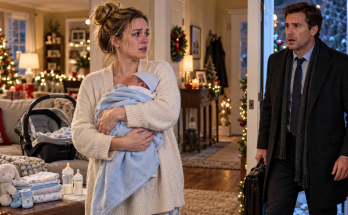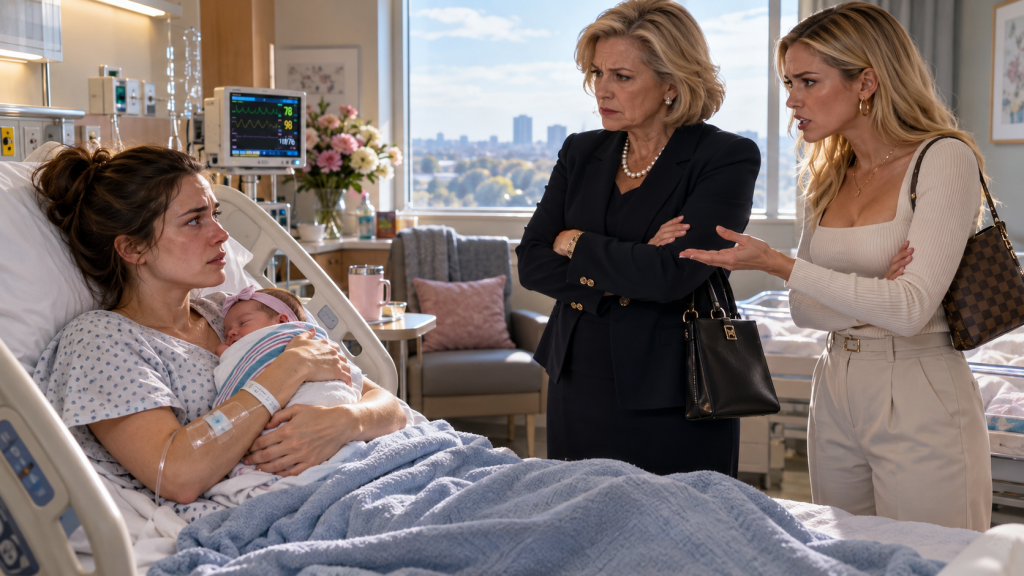
While I was still recovering from an emergency C-section, my mother and sister walked into my hospital room—not to meet my newborn daughter, not to ask whether I was okay, but to demand my credit card for my sister’s nearly $80,000 birthday party.

I thought that was as heartless as they could get.
I was wrong.
Because before that hospital visit was over, my sister would come at me, my mother would reach for my newborn baby, and I would scream for security.
But none of us were prepared for who came through those doors.
Part 1
My husband had been gone less than an hour when my mother walked into my hospital room without knocking.
The first thing I noticed was that she wasn’t carrying flowers.
It seems like a ridiculous detail to remember considering what happened afterward, but with my mother, Diane Mercer, details like that mattered.
Diane never showed up empty-handed when appearances were involved.
At funerals, she carried grocery-store roses.
At baby showers, she arrived with elaborate gift baskets.
Whenever she wanted people to admire how thoughtful and generous she was, she’d appear holding bakery boxes wrapped in satin ribbon like she was presenting someone with a royal gift.
But when she came to the hospital to meet her first granddaughter?
Nothing.
Just her purse.
And an expression so hard that I instantly knew something was wrong.
My younger sister, Brielle, marched in right behind her.
She took one look at me and snapped,
“You have got to be kidding me, Natalie.”
That was it.
No “Congratulations.”
No “How are you feeling?”
Not even, “How’s the baby?”
I stared at them from the hospital bed, almost wondering whether the pain medication was making me imagine the whole thing.
Clara, my daughter, was sleeping peacefully against my chest.
She hadn’t even been alive for twenty-four hours.
Less than a day earlier, I’d undergone an emergency C-section after my labor stopped progressing and Clara’s heart rate suddenly changed.
I still remembered how quickly the atmosphere in the delivery room had shifted.
One moment, nurses were calmly encouraging me.
The next, everyone was moving faster and speaking in short, urgent sentences.
Now my abdomen felt like someone had sewn a heavy zipper straight through me.
Every movement sent a deep pulling pain across my incision, reminding me that sitting up, turning, even laughing were no longer simple things.
My husband, Grant, had left the hospital briefly to retrieve the bag we’d abandoned beside our front door.
When my contractions started getting serious, neither of us had been thinking clearly.
I’d actually gone into labor at work, behind the counter of the small dry-cleaning shop Grant and I owned.
I’d been explaining a missing button to an elderly customer when another contraction hit so hard I had to grip the counter.
And somehow, even then, my first instinct had been to apologize.
That was me.
Always apologizing.
Always trying to keep everyone happy.
But as I looked down at Clara, I felt something different.
She smelled faintly of baby soap and warm milk. Dark hair lay flat against her tiny head, and one little hand was tucked beneath her chin.
Before my mother and sister arrived, I’d spent nearly twenty minutes staring at the miniature crescents of Clara’s fingernails, unable to understand how something so perfect could have emerged from the chaos of the night before.
Then Brielle’s voice shattered the moment.
“Do you know how many times I’ve called you?”
I glanced toward the rolling tray beside my bed.
My phone wasn’t there.
“I don’t know,” I said. “I’ve been a little busy.”
Brielle rolled her eyes.
Actually rolled her eyes.
At the woman who had given birth less than a day earlier.
She was dressed in a fitted cream coat and high-heeled boots. Her perfume was so strong I could smell it over the hospital disinfectant.
“The venue needs the deposit today.”
And there it was.
The real reason they had come.
I closed my eyes for half a second.
Six weeks earlier, Brielle had announced that her thirtieth birthday couldn’t possibly be, in her words, “some sad dinner at a steakhouse.”
No.
Brielle wanted an experience.
An “immersive rooftop celebration.”
That meant a private downtown venue, a custom floral installation, a professional photographer, a videographer, live music, cocktail stations, a dessert wall, designer favors, and forty carefully selected guests.
When she’d first shown me her spreadsheet, the budget was around twenty-five thousand dollars.
Then it became forty thousand.
Then sixty.
Eventually, it climbed to almost eighty thousand dollars.
I’d laughed the first time I saw the numbers.
Not because I was trying to insult her.
I genuinely thought she was joking.
Brielle hadn’t laughed.
Now she stood beside my hospital bed holding her phone toward me like she was presenting an overdue bill.
“They’ll release the date if I don’t pay today.”
I stared at her.
“Brielle, I gave birth yesterday.”
“I know when you gave birth.”
“Then maybe this conversation can wait.”
“It can’t wait.”
My mother finally stepped in.
“Natalie, please don’t make this harder than it needs to be.”
My stomach tightened.
That sentence.
That exact sentence had controlled half of my adult life.
Please don’t make this harder.
I knew what it really meant.
Stop arguing.
Stop resisting.
Give Brielle what she wants.
I carefully adjusted Clara against my chest.
“I already told you I wasn’t paying for that party.”
Brielle’s jaw tightened.
“You said you’d help.”
“I said I might contribute something reasonable.”
“Eighty thousand is the total budget. I don’t need the whole amount today.”
I narrowed my eyes.
“How much?”
For the first time, Brielle hesitated.
Her eyes flicked toward my mother.
Just for a second.
But I saw it.
And something about that glance sent a warning through me.
“Twenty-seven thousand.”
I laughed.
I couldn’t help it.
The sudden movement tore through my incision so sharply that the laugh turned into a gasp.
I grabbed the blanket beside me, breathing through the pain.
Then I looked at my sister.
“You came into my hospital room for twenty-seven thousand dollars?”
“It’s a deposit.”
“It’s a birthday party.”
“It’s my thirtieth.”
“You’ll survive being thirty without an orchid wall.”
My mother’s face changed immediately.
She stepped closer to the bed.
“You don’t have to be cruel.”
For a moment, I honestly couldn’t believe what I’d heard.
“Cruel?”
Clara stirred against my chest.
The tiny movement instantly snapped my attention back to her, and I lowered my voice.
“Diane, I have a baby who isn’t even a full day old.”
I shouldn’t have called her Diane.
I knew it the moment the name left my mouth.
My mother hated when I used her first name.
To her, it was disrespectful.
To me, in that moment, it was the only thing stopping me from saying something much worse.
The muscles around her mouth tightened.
Brielle stopped moving.
And the entire room suddenly felt different.
The air seemed to go still.
I held Clara a little closer.
My mother’s eyes dropped toward my newborn daughter.
Then she looked back at me.
And the expression on her face made every instinct in my body scream that this was no longer about a birthday party.
➡️PART 2*_* The Hand That Reached for My Baby
When Natalie refuses the $27,000 deposit, Diane’s expression changes. She tells Natalie she is “clearly emotional from the surgery” and insists Brielle should simply take Natalie’s purse and use the card they have used before.
That sentence freezes Natalie.
Used before?
Brielle realizes too late that she has revealed something.
Natalie demands an explanation, but Diane reaches toward sleeping Clara and says, “Give me the baby. You’re too worked up to hold her safely.”
Natalie immediately pulls Clara against her chest.
Brielle moves toward the bedside table, apparently searching for Natalie’s wallet. When Natalie tries to stop her, pain tears across her C-section incision. Brielle grabs Natalie’s wrist and snaps that she is ruining everything over money she can easily afford.
Natalie screams for security.
Diane reaches for Clara again.
Before either woman can touch the baby, the hospital door bursts open.
But Grant is not alone.
Standing beside him is Michael Mercer—Natalie’s estranged father, whom Diane has spent fifteen years insisting wanted nothing to do with his daughters.
Michael had received a disturbing call from Grant that morning after Grant discovered several suspicious charges while checking their joint finances.
The confrontation changes instantly.
Diane goes pale.
Michael looks at Natalie and says quietly:
“Do not give them another dollar. They have already taken enough.”
Hospital security removes Diane and Brielle while a nurse documents Natalie’s pain and checks Clara. Grant apologizes for leaving Natalie alone and promises neither woman will regain access without Natalie’s permission.
Then Michael reveals why he came.
Years earlier, during his divorce from Diane, he created separate investment accounts for both daughters. Natalie’s money was placed under safeguards until adulthood.
Brielle spent hers years ago.
Natalie did not.
Yet recent records suggest someone has been attempting withdrawals from Natalie’s old account using documents claiming Natalie authorized Diane to act for her.
Natalie has never signed such authorization.
Worse, Grant discovers that several smaller transactions have already cleared.
The birthday-party deposit was not the beginning.
It was simply the first time Diane and Brielle became desperate enough to ask Natalie directly.
The outline ends with Michael placing a bank statement beside Natalie’s hospital bed.
One transfer is circled.
$62,400.
The recipient is not Brielle.
It is Diane.
And beside the transaction appears a signature that looks almost exactly like Natalie’s.
Natalie stares at her newborn daughter and realizes her mother had not reached for Clara because she thought Natalie was unstable.
She had reached for her because control was slipping away.
PART 3 — THE FIRST THING I GAVE MY DAUGHTER
The first person through the hospital door was security.
The second was my husband.
The third was my father.
For fifteen years, I had imagined seeing Michael Mercer again in a hundred different ways.
At a funeral.
Across a grocery store.
Standing awkwardly on my porch after finally deciding that whatever had kept him away no longer mattered.
I never imagined I would see him less than twenty-four hours after giving birth, while my mother was reaching for my newborn and my sister was standing beside my hospital bed with her hand still half-raised toward me.
Everything happened at once.
A security officer moved between Diane and Clara.
Another caught Brielle by the elbow before she could step closer to my bed.
Grant rushed toward me.
“Natalie.”
I barely heard him.
My eyes were fixed on Michael.
He had aged.
That was the first stupid thing my mind noticed.
His hair had turned almost completely silver.
His shoulders, once impossibly broad in my childhood memory, had narrowed.
He wore a dark wool coat over a blue shirt, and he looked as if he had dressed quickly.
But his eyes were exactly the same.
Mine.
And Clara’s, maybe.
I hated that thought for making my throat tighten.
Diane saw him.
All the fury vanished from her face.
Not softened.
Vanished.
As though someone had unplugged it.
“You.”
she whispered.
Michael looked at her.
Then at Brielle.
Then at me.
His gaze dropped to Clara.
His entire expression changed.
He did not approach.
Did not say:
My granddaughter.
Did not reach.
He simply looked at me and said:
“Do not give them another dollar.”
The room went silent.
Michael held up a bank statement.
“They have already taken enough.”
Diane recovered first.
“This is none of your business.”
The security officer beside her said:
“Ma’am, you need to step into the hall.”
Diane ignored him.
She pointed at Michael.
“You have no right to be here.”
Michael’s expression remained almost unnervingly calm.
“Neither do you, apparently.”
“Mom.”
Brielle grabbed Diane’s sleeve.
Not because she wanted her to stop.
Because she wanted her to leave before something else came out.
I saw it.
So did Michael.
“Brielle.”
he said.
My sister went pale.
There was something devastating about hearing our father say her name after fifteen years.
She stared at him.
“You don’t get to say my name.”
Michael nodded once.
“You’re right.”
No argument.
That somehow made it worse.
The nurse rushed to my bedside.
“Natalie, I need you to look at me.”
I did.
“Where does it hurt?”
“My incision.”
“From before, or worse now?”
“Worse.”
She placed one hand carefully over my blanket.
“Did anyone strike you?”
“No.”
“Grab you?”
I looked at Brielle.
Her hand had caught my wrist when she lunged toward the bedside table.
“Yes.”
The nurse glanced at the swelling.
“Who?”
“My sister.”
Brielle exploded.
“I barely touched her.”
Security moved immediately.
“Ma’am.”
“I barely touched her!”
The officer guided her toward the door.
“She was reaching for my card.”
I said.
Brielle looked at me.
“Natalie, don’t do this.”
There it was again.
Not:
I’m sorry.
Not:
Are you bleeding?
Don’t do this.
As if whatever happened next belonged to my choices instead of hers.
Diane stepped toward Clara one more time.
The officer blocked her.
“That is my granddaughter.”
he said.
“She is also the patient’s newborn daughter, and you have been instructed not to approach.”
“I am her grandmother.”
“I heard you.”
The nurse touched the call panel beside my bed.
“Both visitors are being removed.”
Diane looked at Grant.
“Are you going to allow this?”
Grant stared at her.
His face had become something I had never seen before.
Not anger.
Not exactly.
Disgust.
“Yes.”
One word.
Diane flinched as if he had slapped her.
Then security escorted them out.
Brielle shouted until the doors closed.
Diane did not.
She kept looking at Clara.
That frightened me more.
For several seconds afterward, nobody spoke.
Then Clara cried.
A small, sharp sound.
My entire body snapped back toward her.
I looked down.
Her face had turned pink.
Her tiny mouth opened wider.
“Hey.”
I whispered.
“I know.”
The nurse adjusted my blanket.
“Let me check your incision.”
Grant reached for Clara.
Then stopped.
“Can I?”
That question almost broke me.
“Yes.”
He lifted our daughter carefully.
He held her against his chest while the nurse examined me.
No separation.
No disappearing baby.
I could see her the entire time.
My incision had not opened.
Thank God.
The pain came from sudden movement and muscle strain around the surgical site.
My wrist was red but not seriously injured.
My blood pressure, however, was too high.
Shocking.
Michael remained near the door.
He had not moved.
The nurse looked at him.
“And you are?”
He opened his mouth.
Stopped.
Then looked at me.
My choice.
Even then.
I almost resented him for getting that right when everyone else had spent the morning getting it wrong.
“He’s my father.”
I said.
The words tasted unfamiliar.
The nurse nodded.
“Do you want him to stay?”
I looked at Michael.
Fifteen years.
Fifteen birthdays.
My college graduation.
My wedding.
Pregnancy.
All missing.
Then I looked at the paper in his hand.
“Yes.”
I said.
“For now.”
His eyes filled.
“Thank you.”
Not:
I knew you’d understand.
Not:
I’m your father.
Thank you.
That mattered.
Grant sat beside me with Clara.
Michael took the chair across the room.
No one spoke until the nurse finished.
Then she looked at me.
“I’m placing a temporary restriction on visitors.”
“Good.”
“Security will only allow people you and your husband approve.”
“Good.”
“Do you want Diane Mercer and Brielle Mercer completely barred?”
“Yes.”
The answer came before guilt could interfere.
Grant said:
“Yes.”
The nurse documented it.
A few taps on a tablet.
A boundary entered into a system.
I almost cried.
Apparently no did not always require an argument.
Sometimes it was simply recorded.
When the nurse left, I looked at Michael.
“What is that?”
He placed the bank statement on the rolling tray.
Not close enough that I had to take it.
Another small thing.
The page showed an investment account I recognized.
Or thought I did.
My father had created it during my parents’ divorce.
For years, I barely thought about it.
It had started as one of two protected brokerage accounts.
One for me.
One for Brielle.
When I turned twenty-five, mine became fully mine.
The balance was substantial but not absurdly so.
Enough that Grant and I had treated it as long-term security.
Retirement.
Maybe Clara’s education someday.
I rarely touched it.
Brielle, by contrast, had emptied hers within three years.
Travel.
A luxury car.
An apartment she could not afford.
Then debt.
I knew all of that.
What I did not know was why my father had a statement from mine.
“How did you get this?”
I asked.
“I’m still listed as the trusted contact.”
“I thought that meant emergencies.”
“It does.”
“Not account access?”
“No.”
“Then how—”
“The brokerage called me.”
Michael swallowed.
“They couldn’t reach you yesterday.”
I looked at Grant.
He nodded.
“That’s part of why I called him.”
I frowned.
“Start at the beginning.”
Grant shifted Clara against his chest.
“When I went home for the hospital bag, I checked our accounts.”
“Why?”
“Your card company texted my phone.”
I stared.
“What text?”
“A fraud alert.”
“For what?”
“Twenty-seven thousand dollars.”
My mouth went dry.
“The party deposit.”
“Probably.”
“Did it go through?”
“No.”
Grant shook his head.
“Declined pending verification.”
I closed my eyes.
Brielle had not come to the hospital only because she needed my physical card.
She had already tried using the number.
Grant continued.
“There were two smaller charges too.”
“How much?”
“Three thousand eight hundred and fifty.”
“What?”
“One florist.”
“One event-rental company.”
I stared at him.
“On my card?”
“Yes.”
“I called the issuer.”
“They froze it.”
His jaw tightened.
“Then I started checking everything.”
Grant found an old email in our records with the name of the brokerage adviser who handled my account.
He called because my father’s original documents were attached to it.
The adviser would not discuss details with Grant.
Good.
But when Grant said I was recovering from emergency surgery and there might be unauthorized activity, the adviser escalated it internally.
That was when the firm tried to reach me.
I had been sleeping.
Or feeding Clara.
Or being harassed for party money.
They could not get me.
So, under their elder-and-vulnerable-client fraud procedures—even though I was nowhere near elderly—they contacted the trusted person listed on file.
Michael.
My father.
“The adviser didn’t tell me everything.”
Michael said.
“But he asked whether I had recently spoken to you.”
“I said no.”
“He asked if I knew anyone named Diane Mercer.”
I laughed bitterly.
“And?”
“I said unfortunately.”
Grant almost smiled.
I did not.
Not yet.
Michael continued.
“The adviser said they were reviewing a suspicious authorization that supposedly came from you.”
“What kind of authorization?”
“A third-party disbursement request.”
My skin went cold.
“To Mom?”
He nodded.
“How much?”
He pointed at the statement.
I looked.
One number had been circled.
$62,400.
Recipient:
DIANE MERCER
I stared.
The transfer had cleared six weeks earlier.
Six weeks.
I had been eight months pregnant.
Working.
Preparing the nursery.
Throwing up from reflux at night.
My mother had taken sixty-two thousand four hundred dollars from an account I barely touched.
My voice came out small.
“I never approved this.”
“I know.”
Michael looked at the signature line.
“It isn’t yours.”
It looked like mine.
Too much like mine.
That was almost worse.
The long N.
The sloping t.
Even the ridiculous loop I made when signing quickly.
Someone had studied it.
Grant moved closer.
“Natalie.”
I could not look away.
“How?”
I whispered.
Michael answered.
“They’re investigating.”
“The form was submitted electronically.”
“The brokerage says there was a phone verification too.”
I looked at him.
“Someone pretended to be me.”
“Yes.”
My stomach turned.
“Who?”
“We don’t know yet.”
Then he added:
“But the receiving account belongs to Diane.”
That was fact.
Enough.
I looked down at Clara.
She was asleep again against Grant.
Less than a day alive.
Already surrounded by adults carrying years of unfinished history into her hospital room.
I felt suddenly ashamed.
Not because I had caused any of it.
Because I understood, with terrifying clarity, how easy it would be to spend Clara’s childhood trying to control every person who came near her.
To become hypervigilant.
To treat love as permission to manage.
The exact thing Diane had done to me.
I pushed the thought away.
Not now.
One emergency at a time.
“How much total?”
I asked.
Michael glanced at Grant.
Then back at me.
“That’s what we don’t know yet.”
“Why?”
“Because the sixty-two thousand is only the largest transfer they flagged.”
Something in my chest tightened.
“There are others?”
“Yes.”
“How many?”
“Several.”
“How much?”
“Michael.”
Grant said softly.
Maybe warning him.
I looked at Grant.
“No.”
Then at my father.
“Tell me.”
Michael took a breath.
“Based on what the adviser could confirm after you authorized them to speak to Grant just now…”
I frowned.
“When did I authorize that?”
Grant held up my phone.
“You did while the nurse was checking you.”
I vaguely remembered pressing my thumb to the screen.
Good.
At least that part had consent.
Michael continued.
“They’re reviewing roughly one hundred fourteen thousand dollars in transfers and charges over about eighteen months.”
The room tilted.
I grabbed the bed rail.
“Eighteen months?”
“Yes.”
“Why didn’t I notice?”
Grant answered.
“Because the account grows and drops with the market.”
“And you didn’t watch it monthly.”
True.
I looked once or twice a year.
The balance had fluctuated.
I assumed investments.
Not family.
“Where did it go?”
I asked.
Michael opened a second page.
“Some to Diane.”
“Some to accounts associated with Brielle.”
“Some directly to vendors.”
“What vendors?”
He hesitated.
“Rent.”
“Credit cards.”
“A travel company.”
“A cosmetic clinic.”
My mouth went dry.
“And now the party.”
“Yes.”
The room became unbearably quiet.
I thought about every time Brielle called me lucky.
Every time Mom said I was “better with money.”
Every time they joked that I was the responsible one.
Apparently responsibility had become their permission slip.
Grant’s voice was low.
“Why didn’t they just ask?”
I laughed.
Both men looked at me.
It was not funny.
Still.
“Because I would have said no.”
There it was.
The entire family dynamic.
Simple enough to fit on a sticky note.
Michael looked at me carefully.
“Natalie, there’s something else.”
I closed my eyes.
“Of course there is.”
He swallowed.
“The brokerage had already frozen additional outgoing transfers before today.”
“When?”
“Yesterday afternoon.”
My eyes opened.
“Yesterday?”
“Before Clara was born?”
“Yes.”
“Why?”
“The large transfer request triggered an internal review.”
“They tried to reach you.”
“You were in labor.”
I understood.
Suddenly.
Brielle’s desperation.
The hospital invasion.
Twenty-seven thousand dollars.
The party venue.
My mother’s fury.
Their secret source of money had closed.
For eighteen months, they had apparently reached into my account without asking.
Then the door slammed shut.
So they came to the hospital and tried the old method.
Pressure.
Guilt.
Family.
When that failed, Brielle reached for my wallet.
Diane reached for my baby.
Control was slipping in every direction.
I started shaking.
Grant immediately put Clara in the bassinet beside me and took my hand.
“Hey.”
“No.”
I pulled away.
Not because I did not want him.
Because I needed one second where no one touched me.
Grant stopped instantly.
Good.
I breathed.
Slowly.
In.
Out.
My abdomen hurt.
My breasts ached.
My daughter slept.
My father sat across the room.
My mother had stolen from me.
My sister had tried to steal again.
And somehow the strangest thought came:
They did this while I was buying them Christmas presents.
I started crying.
Hard.
Not elegant.
Not meaningful.
The kind of crying that leaves your mouth open because the body has run out of civilized ways to process betrayal.
Grant stayed beside me.
Did not touch until I reached for him.
Michael looked away.
That kindness hurt too.
Eventually, I wiped my face.
Then looked at my father.
“Why were you gone?”
The question surprised all three of us.
It had nothing to do with the account.
Everything to do with it.
Michael’s face collapsed slightly.
“I…”
“No.”
I shook my head.
“Not the short version.”
“Not ‘your mother made things difficult.’”
“Not ‘the divorce was complicated.’”
“Fifteen years.”
I looked at him.
“Why were you gone?”
He sat very still.
Then said:
“Because I failed.”
No defense.
Interesting.
Michael told me the divorce had been uglier than Diane ever admitted.
Not because of one affair.
Not because of one dramatic betrayal.
Years of debt.
Control.
Fighting about money.
Fighting about us.
My mother told us our father chose work over family.
Michael said he left the marriage after discovering Diane had opened credit accounts in both their names without telling him.
I looked at the statement on my tray.
The pattern felt nauseatingly familiar.
But Michael did not ask me to believe him on faith.
“There are court records.”
he said.
“Old ones.”
“You can read them if you ever want.”
“I’m not asking you to take my version because I’m standing here.”
Good.
During the divorce, Michael established the two investment accounts partly because he did not trust himself and Diane to agree on money later.
College.
Emergency expenses.
A future start.
He wanted something neither parent could easily consume.
That sounded noble.
Then reality.
Diane received primary custody at first.
Michael got regular parenting time.
For two years, he fought constantly about schedules.
Late pickups.
Canceled weekends.
Accusations.
Some real.
Some exaggerated.
Some, he admitted, caused by him.
He traveled for work too much.
Missed events.
Arrived late twice.
Broke promises.
Then Diane began telling us he had chosen his new life.
I remembered.
She never used his name.
Your father has priorities.
Your father knows where you live.
If he wanted to call, he would.
Children understand implications long before they understand divorce decrees.
Michael kept filing motions for access.
Then something happened when I was seventeen.
Diane accused him of screaming at Brielle during an exchange.
He denied most of it.
Admitted he raised his voice.
A judge ordered a temporary change in visitation while everyone cooled down.
Then I refused to see him.
I remembered that.
Of course I did.
Mom stood in the kitchen and asked:
“Do you want to spend your Saturday being interrogated by a man who abandoned us?”
I had said no.
Michael received the message.
He stopped fighting.
That was his failure.
Not Diane’s.
His.
“I told myself you were old enough to choose.”
he said.
“I told myself fighting would hurt you.”
“I told myself someday you’d call.”
His eyes filled.
“That was cowardice dressed as respect.”
My throat tightened.
“Why didn’t you?”
I whispered.
“Call?”
“Yes.”
“I did for a while.”
“I changed my number.”
“I know.”
“Emails?”
“Some bounced.”
“Then?”
He looked down.
“I stopped.”
“Why?”
“Shame.”
The answer was too familiar.
So many adults seem to make children pay for shame they did not cause.
“I watched your graduation online.”
he said.
I stared.
“Someone posted it.”
“I found it.”
“I saw your wedding photographs.”
“How?”
“Public album.”
“Why didn’t you come?”
“You didn’t invite me.”
“You could have written.”
“Yes.”
“Why didn’t you?”
“I was afraid you would reject me.”
I laughed through tears.
“So I rejected you without being asked.”
He closed his eyes.
“Yes.”
That answer mattered.
Michael was not the secret perfect parent Mom had stolen from us.
He was a man who had been pushed, discouraged, ashamed, and then chose distance because distance hurt him less than trying.
The reasons explained.
They did not restore fifteen years.
I respected him more for knowing that.
“Why now?”
I asked.
He looked at Clara.
Then away quickly.
“Because Grant called.”
“Not because of the baby?”
“I knew you were pregnant.”
My stomach tightened.
“How?”
“Your shop’s social media.”
I almost laughed.
Grant posted a picture of me behind the counter eight months pregnant beside a sign:
NEW ASSISTANT MANAGER ARRIVING SOON.
Michael had seen it.
Did not contact me.
Again.
“I almost wrote.”
he said.
“But I thought showing up because you had a child would make it about me becoming a grandfather.”
“So you waited.”
“Yes.”
“Until fraud.”
His mouth twisted sadly.
“Apparently financial crimes are my love language.”
I laughed before I could stop myself.
Then winced from my incision.
Grant smiled.
Michael looked shocked.
For one tiny second, the room held something other than disaster.
Then it passed.
I said:
“You don’t get to skip the hard part.”
Michael nodded.
“I know.”
“I don’t know what I want from you.”
“I know.”
“You cannot just become Grandpa because you brought a bank statement.”
“I know.”
“You don’t get to hate Mom on my behalf.”
His expression changed.
“Okay.”
“I mean it.”
“I do.”
“I’m furious with her.”
“I might never speak to her again.”
“That does not make you right for disappearing.”
“I know.”
Again.
No defense.
I found that almost suspicious.
Then remembered I had spent my life with Diane.
Someone accepting responsibility without rewriting it felt foreign.
Grant spoke carefully.
“Natalie, we don’t have to decide anything today.”
I looked at him.
He had been quiet for a long time.
“I know.”
Then I asked:
“What did you know?”
His face tightened.
“About the money?”
“About Mom and Brielle.”
He understood.
More history.
“I knew they asked you for too much.”
“How much?”
“I didn’t know they were taking money.”
“That’s not what I asked.”
Grant looked at the floor.
“I knew you paid Brielle’s rent twice.”
“Three times.”
He winced.
“I knew you paid for your mother’s dental work.”
“Yes.”
“Her car repair.”
“Yes.”
“I knew they called constantly.”
“Yes.”
“And?”
He swallowed.
“I thought it was your family.”
There it was.
Another form of stepping back disguised as respect.
“How many times did I complain?”
“A lot.”
“How many times did you say, ‘Just tell them no’?”
“A lot.”
“Then what?”
He knew.
“You’d get upset.”
“Yes.”
“And I stopped wanting to talk about it.”
He closed his eyes.
“I treated your problem like an annoying loop instead of something we needed to solve together.”
My eyes filled.
“Yes.”
He nodded.
“I’m sorry.”
“Not now.”
He flinched.
“I can’t take another apology right now.”
“Okay.”
Better.
The financial investigation began before I left the hospital.
Not because I became a detective from my recovery bed.
Because I did not.
That mattered.
I signed fraud affidavits.
Authorized the brokerage to freeze outgoing transfers.
Changed passwords.
Placed alerts on my credit.
Grant handled phone calls when I asked.
Michael gave his statement.
Then everyone left me alone long enough to feed my daughter.
The most radical thing I did that week was recover.
I had spent my entire life reacting to family crises instantly.
This time professionals could investigate while I learned how to stand without feeling as though my incision might split open.
Clara lost seven percent of her birth weight.
Normal.
I still panicked.
My milk came in late.
Also normal after emergency surgery.
I cried about that too.
The lactation consultant sat beside me.
“Natalie.”
“Yes?”
“Your baby is fed.”
I looked at the tiny bottle in Grant’s hand.
“I wanted to breastfeed.”
“You still can.”
“Supplementing today is not a moral verdict on your motherhood.”
That sentence reached somewhere deep.
Apparently everything in my life was teaching the same lesson.
Care is not performance.
Love is not proof.
You do not earn motherhood by suffering correctly.
We went home three days later.
Diane and Brielle were not there.
Security escorted us to the car because the hospital preferred caution.
I felt ridiculous.
Then remembered my mother had tried to take Clara from my arms while calling me unstable.
I stopped feeling ridiculous.
At home, Grant had changed the alarm codes.
Not the locks.
Diane had never had a key.
Thank God.
He installed a camera doorbell.
He asked first.
“Yes.”
I said.
Then immediately worried I was becoming paranoid.
My therapist later called that trauma math:
If one boundary saved you, the brain wants a hundred.
We settled on reasonable.
Doorbell camera.
No family access.
No surprise visitors.
Not a fortress.
A home.
My phone exploded for the first week.
Aunts.
Cousins.
Family friends.
Your mother is devastated.
Brielle says this is a misunderstanding.
Surely you don’t think your own mother would steal from you.
You just had a baby. This stress isn’t good for you.
That last one made me laugh.
Apparently my stress was the problem.
Not the people creating it.
Grant offered to block everyone.
I almost said yes.
Then stopped.
“My phone.”
“Right.”
He nodded.
“What do you want?”
“I want to read nothing for three days.”
“Okay.”
I turned off notifications myself.
Progress.
The brokerage investigation took six weeks.
Long enough for me to learn Clara’s hungry cry from her tired cry.
Long enough for my incision to heal enough that sneezing no longer felt like violence.
Long enough for Michael to send exactly two messages.
The first:
I hope you and Clara are healthy. No need to respond.
The second, two weeks later:
The adviser asked me for another statement. I provided it. I won’t contact you again unless you ask.
He kept his word.
That did more to rebuild trust than twenty paragraphs would have.
The investigation found the first unauthorized transfer sixteen months before Clara’s birth.
$4,800.
Destination:
Brielle’s credit-card company.
The request carried my signature.
Fake.
Then:
$7,250 to Diane’s account.
Then:
$3,100 to a travel agency.
Then:
$9,600 to an apartment management company connected to Brielle.
Then more.
Small enough, spread out enough, that my investment balance never screamed.
Some months the market rose by more than they took.
I saw fluctuations.
Not theft.
The largest was the $62,400 transfer to Diane.
What had she done with it?
The bank records answered.
Paid off a home-equity line.
Covered credit-card debt.
Transferred fourteen thousand to Brielle.
Paid property taxes.
No secret yacht.
No second family.
No dramatic criminal empire.
Something more ordinary.
My money had become the solution to their financial choices.
That almost hurt more.
They had not stolen because they wanted to destroy me.
They stole because they had slowly decided my resources belonged inside the family pool, whether I agreed or not.
Entitlement rarely introduces itself as villainy.
Usually it says:
You have more.
We need it.
Why are you making this difficult?
The phone verification mattered.
The brokerage kept recordings.
I listened only once.
My lawyer insisted I did not need to.
I chose to.
A woman’s voice answered security questions.
My date of birth.
Old address.
Last four digits of my Social Security number.
Mother’s maiden name.
Of course.
Diane knew everything.
Then the representative asked:
“Am I speaking with Natalie Mercer Bennett?”
The woman said:
“Yes.”
My mother’s voice.
Slightly softer.
Trying to sound like me.
I stopped the recording.
Ran to the bathroom.
Threw up.
Grant found me kneeling beside the toilet.
He did not ask what happened.
He saw the laptop.
Understood.
He sat outside the bathroom door.
Not touching.
Not speaking.
After several minutes, I said:
“She said my name.”
Grant’s voice came from the hallway.
“I know.”
“She said she was me.”
“I know.”
“I don’t understand.”
He was quiet.
Then:
“You don’t have to understand today.”
That helped.
The bank reimbursed some transfers under its fraud policies.
Others required longer review because of timing, documentation, and the fact that the money had gone to accounts belonging to close relatives who knew my personal information.
My lawyer filed civil claims to preserve recovery rights.
Police reports followed.
Then prosecutors became involved.
Again, not because I screamed:
Arrest them.
Because forgery and impersonation do not become family disagreements simply because the forged name belongs to your daughter.
The evidence decided what happened next.
Not my anger.
That distinction became important.
Brielle’s birthday party was canceled.
I learned from someone else.
Apparently the venue released the date after the deposit failed.
The florist demanded payment for custom materials already ordered.
The photographer kept his retainer.
Part of me felt satisfaction.
A small, ugly part.
Then I pictured Brielle crying over an orchid wall while I held a newborn after major surgery.
I allowed myself the satisfaction.
For five minutes.
Then moved on.
Revenge is exhausting when you have a baby who wakes every ninety minutes.
Diane hired an attorney.
So did Brielle.
Their first position was that I had historically allowed them to use funds.
I had not.
Their second was that some payments were gifts I had verbally promised.
I had not.
Their third was that Diane believed she had informal authority because she had helped manage family finances.
She had never managed mine.
Then the recordings appeared.
The forged forms.
The signature comparisons.
The receiving accounts.
At some point, stories meet documents.
Documents are less sentimental.
Brielle eventually admitted she knew Mom had access to the account.
Not at first.
Later.
She claimed she did not know Mom was impersonating me.
Some evidence supported that distinction.
Other messages complicated it.
One text from Brielle to Diane:
Can Nat cover the venue from the account before she notices?
Diane:
I’ll handle it.
Brielle:
Love you.
That message ended my desire to protect my sister from the consequences of ignorance.
Maybe she had not forged my signature herself.
She knew enough.
My mother’s messages were worse.
Not cruel.
Practical.
That was the terrible part.
Natalie won’t touch that money for years.
She has Grant and the business.
Brielle needs help now.
I’ll replace some when the house sells someday.
There was no plan to sell her house.
No repayment schedule.
No permission.
Just a private moral accounting system in which my future security was less urgent than their present wants.
When investigators asked why the hospital confrontation happened, Brielle told the truth more quickly than Mom.
The account had been frozen.
The party vendors wanted payment.
She panicked.
Mom told her I was vulnerable after surgery and “wouldn’t want drama.”
That phrase.
Wouldn’t want drama.
My entire childhood.
My entire adulthood.
They had depended on my dislike of conflict more reliably than they depended on bank passwords.
Then came the part that hurt differently.
Diane told investigators she reached for Clara because she thought I was “too emotional.”
Maybe she believed that in the second she did it.
Maybe not.
There was no evidence of a plan to take my baby.
No secret custody petition.
No hidden nursery.
Nothing cinematic.
Good.
Reality did not need embellishment.
She had been losing control of the conversation.
She reached for the one thing she believed would force me to respond as a daughter instead of an adult.
My baby.
That was enough.
Grant asked once:
“Do you think she would’ve taken Clara?”
“No.”
The answer surprised him.
“No?”
“I think she wanted to hold her.”
“To prove what?”
“I don’t know.”
“That she was still Grandma.”
“That she still had access.”
“That I wasn’t allowed to say no.”
I looked at Clara asleep in her bassinet.
“But I’m not going to invent something worse just because what happened was terrible.”
Grant nodded.
Good.
Fear did not get to become evidence either.
The criminal case took nearly a year.
Diane ultimately entered a plea on charges related to forgery and identity misuse.
Brielle entered a separate plea connected to knowingly benefiting from fraudulent transactions and participating in later attempted unauthorized charges.
The exact legal labels mattered less to me than the facts they admitted.
Mom had pretended to be me.
Brielle knew money was being taken without my permission.
Both had tried to continue after the account froze.
There were fines.
Probation.
Restitution orders.
No prison.
My extended family reacted as if the justice system had personally insulted Thanksgiving.
Some thought they deserved jail.
Others thought they deserved nothing.
I wanted neither debate.
I wanted distance.
Restitution recovered much of what the bank did not reimburse.
Not all immediately.
Diane refinanced her house.
Sold jewelry.
Brielle sold the luxury car she had insisted was “basically paid off.”
A payment plan followed.
I did not monitor their suffering.
That surprised me.
For months I thought seeing consequences would heal something.
Then the first restitution check arrived.
I looked at it.
Felt nothing.
Money returning was useful.
It was not repair.
Michael never testified unless required.
He refused every invitation from relatives to “finally tell the truth about Diane.”
I learned that later.
He did not use my mother’s criminal case to rewrite himself as the heroic ex-husband.
That mattered more than he probably knew.
Four months after Clara’s birth, I texted him.
Would you like to meet for coffee?
He replied nine minutes later.
Yes. Wherever you choose.
No:
Finally.
No:
I’ve waited fifteen years.
Good.
We met at a café near my shop.
Public.
Daylight.
One hour.
I left Clara with Grant.
That surprised me too.
I did not need to present my daughter as proof of access.
Michael arrived early.
He stood when I approached.
Then clearly did not know whether to hug me.
I solved it.
“Not yet.”
He nodded.
“Okay.”
We sat.
For fifteen minutes, we talked about nothing.
Coffee.
Traffic.
The shop.
Then I asked:
“Did you send birthday cards?”
Michael looked down.
“For a while.”
“Where?”
“To the house.”
“I never got them.”
“I assumed you threw them away.”
“I didn’t know they existed.”
He swallowed.
“I kept copies of some.”
My stomach tightened.
“Don’t bring them.”
He looked up.
“Okay.”
Not because I never wanted them.
Because I refused to let fifteen years collapse into one emotional afternoon.
I needed the past in pieces small enough to digest.
I asked:
“Did Mom keep them?”
“I don’t know.”
“Did you ever prove she intercepted anything?”
“No.”
Good.
No mythology.
Then:
“Why didn’t you send them certified?”
“I should have.”
“Why didn’t you come to my college?”
“I was afraid.”
“Still not enough.”
“I know.”
“Why didn’t you try after I got married?”
“Same answer.”
I looked at him.
“That gets less sympathetic every year.”
A sad smile.
“I know.”
That honesty let us continue.
Michael asked one question about Clara.
“How is she?”
“Good.”
“Sleeping?”
“Badly.”
He smiled.
“So normal.”
“Apparently.”
Then:
“May I see a picture?”
He did not ask to meet her.
A picture.
I showed him one.
Clara asleep with one fist beside her face.
Michael stared.
His eyes filled.
Then he handed the phone back.
“Thank you.”
That was all.
I went home and cried anyway.
Grant and I started couples therapy when Clara was three months old.
Not because our marriage was failing.
Because I was terrified of repeating things.
I had spent my childhood watching Diane make love conditional on compliance.
I had spent adulthood smoothing conflict.
Grant had spent years stepping back from “my family problem” because involvement felt dangerous.
Then we became parents.
That combination needed examination before Clara learned from it.
In one session, our therapist asked Grant:
“What happens when Natalie says no?”
Grant answered:
“I try to respect it.”
The therapist waited.
I laughed.
Grant looked at me.
“What?”
“Try?”
He sighed.
“Fine.”
Then told the truth.
“I often ask why.”
I nodded.
The therapist asked:
“And what does Natalie hear?”
I answered:
“That no is the beginning of negotiations.”
Grant looked stricken.
He had never meant that.
Meaning did not erase impact.
We worked on it.
Then she asked me:
“What happens when Grant asks for something?”
“I usually say yes.”
“Why?”
“Because if I can do it, why not?”
She waited.
I hated therapists.
Eventually I said:
“Because saying no makes me feel selfish.”
There it was.
My mother still living in my nervous system without permission.
We practiced tiny things.
Grant:
“Can my coworker stop by tonight?”
Me:
“No, I’m exhausted.”
Grant:
“Okay.”
No interrogation.
No sulking.
No:
Why?
No:
It’ll only be twenty minutes.
Then my body would spend ten minutes waiting for punishment that never came.
Healing can be embarrassingly boring.
Grant changed too.
He stopped referring to my family as something I needed to “handle.”
When relatives called him, he answered his own boundaries.
When Diane’s attorney once contacted him directly, Grant did not say:
I’ll ask Natalie.
He said:
“Please communicate through her counsel.”
He stopped making me the gatekeeper of problems other people created.
That was love in a shape I could finally recognize.
Clara grew.
Three months.
Six.
Nine.
Her first tooth arrived after three nights of screaming.
Grant and I almost divorced over infant acetaminophen dosing at 2:00 a.m.
We recovered.
Her first laugh sounded like a hiccup.
Her first word was “light.”
Not Mama.
Not Dada.
A lamp.
Humbling.
Life became gloriously ordinary.
That saved me more than court ever did.
Diane saw none of it.
That was my choice.
For the first year, there was no contact.
Not supervised.
Not photos.
Nothing.
Some relatives called that punishment.
It was not.
I did not withhold Clara to make Diane suffer.
I withheld access because I did not trust her around my boundaries.
Grandparent was not a magic word that erased that.
Brielle wrote twice.
The first letter was useless.
She blamed Mom.
Stress.
Debt.
The party pressure.
Said she never understood how serious everything was.
I did not answer.
Six months later, another arrived.
Different.
I knew.
That was the first line.
I kept reading.
She admitted she knew Mom was moving money from my account.
She told herself I had plenty.
Told herself I would help if asked.
Told herself because Mom handled the details, Brielle was not stealing.
Then:
I made your silence into permission because I knew your actual answer would be no.
I cried.
Not because forgiveness arrived.
Because truth did.
Brielle wrote something else.
I think I have spent my whole life treating your competence as evidence that you needed less care.
That sentence followed me for days.
At birthdays, Mom protected Brielle from disappointment.
At school, I was expected to understand.
If Brielle forgot something, someone drove back.
If I forgot, I learned.
If Brielle struggled, family mobilized.
If I struggled, everyone said:
Natalie will figure it out.
I had been proud of that identity.
Until I realized it was also how people justified taking from me.
The strong one will survive.
True.
Not permission.
I wrote Brielle back eventually.
I believe you understand more now. I am not ready for a relationship. Do not contact me about Clara. If I ever want that to change, I will tell you.
She replied:
Okay.
Then stopped.
That helped.
Mom did not apologize well.
Not for a long time.
Her first letter began:
As your mother, I have always wanted what was best for both my daughters.
I stopped reading.
Three months later:
I understand you are still angry.
Stopped.
Then:
I never thought you would involve police.
Stopped.
Every sentence made my reaction the central event.
So I waited.
Michael and I met monthly.
Then every few weeks.
Slowly.
He told me things about his life after the divorce.
No secret replacement family.
No beautiful second wife.
He had one long relationship that ended years earlier.
Worked.
Moved twice.
Cared for his brother through cancer.
Got a dog.
Lost the dog.
Ordinary life.
The kind of life that made fifteen years feel even more wasteful.
No grand reason.
Just human avoidance.
I eventually read the old court records.
Not because I wanted ammunition.
Because I wanted history.
The truth landed in the middle.
Diane had obstructed some visitation.
Michael had missed some too.
Diane exaggerated certain events.
Michael had genuinely raised his voice and behaved badly during one exchange.
Both lawyers accused.
Both parents retaliated.
And two daughters learned to interpret love through whichever adult controlled the story that week.
There was no clean victim among the adults.
Only children who deserved better.
That helped me release the fantasy that one missing document would explain everything.
When Clara was ten months old, I invited Michael to our house.
First time.
Grant was there.
I made coffee.
My hands shook.
Michael arrived carrying a small paper bag.
My entire body tightened.
Gift.
Money.
Obligation.
Then he noticed.
He stopped at the door.
“I brought something.”
“You didn’t have to.”
“I know.”
He opened the bag before entering.
A board book.
Eight dollars, maybe.
Goodnight Moon.
“I remembered you loved it.”
he said.
I stared.
I had.
As a child.
He remembered.
That almost hurt more than if he had forgotten.
“Can I come in?”
he asked.
I looked at my father.
At my home.
At Clara crawling badly across the rug behind Grant.
“Yes.”
He stepped inside.
No entitlement.
No arms reaching for the baby.
He sat on the sofa.
Waited.
Clara stared at him.
Then crawled directly toward his shoe because apparently emotional significance meant nothing to infants.
Michael laughed.
She grabbed his shoelace.
He looked at me.
“May I pick her up?”
My throat closed.
“Yes.”
He lifted her.
Carefully.
No declaration.
No:
Grandpa’s girl.
He just said:
“Hello, Clara.”
And started crying.
I cried too.
Not because everything was fixed.
Because nothing was.
And we were there anyway.
Sometimes healing is not repair.
Sometimes it is building something new beside what cannot be repaired.
Grant’s parents met Clara too.
They asked.
Scheduled.
Brought dinner.
Left after an hour because I looked tired.
No drama.
I used to think healthy families were boring.
Now I worshipped boring.
The restitution payments continued.
Every month.
I moved them into a separate savings account for a while.
Then one day realized I was turning recovered money into a shrine.
So I used part of it to replace the ancient boiler in our house.
Another portion went into Clara’s education account.
The rest returned to long-term investments.
Not dramatic.
Money became money again.
That was healing too.
When Clara turned one, Grant suggested a small party.
My body reacted before my mind did.
Party.
Money.
Brielle.
Eighty thousand dollars.
I almost said no.
Then looked at our daughter.
“Small.”
I said.
“How small?”
“Cake.”
“Food.”
“Ten people.”
“No floral installations.”
Grant looked offended.
“I had already ordered imported orchids.”
I laughed so hard I nearly cried.
Good.
We held the party in our backyard.
A grocery-store cake.
Paper hats.
Bubbles.
Clara ignored every gift and played with the box from a wooden puzzle.
Michael came.
He stood awkwardly near Grant’s parents at first.
Then helped clean spilled juice.
Useful without making himself central.
I noticed.
Brielle was not there.
Diane was not there.
That absence hurt.
I let it.
Missing someone is not evidence they belong in the room.
Important lesson.
After everyone left, I found one pink balloon caught in the hedge.
For a second, Brielle’s hospital coat flashed through my memory.
Her perfume.
Her phone held toward me.
Twenty-seven thousand.
Then Clara squealed from the patio because Grant had put a paper hat on his head sideways.
The memory passed.
The present stayed.
Good.
At eighteen months, Diane finally wrote a letter I could finish.
The first sentence:
I stole from you.
I sat down.
No motherhood.
No family.
No intentions.
She continued:
I stole money, and before that I stole something less visible by teaching you that being my daughter meant your boundaries were temporary.
My hands shook.
She admitted the first transfer.
She had been behind on taxes.
Brielle was struggling.
She knew my account existed.
She had old paperwork with my identifying information.
She submitted the form.
It worked.
That success changed everything.
Once.
Then twice.
Then enough times that stopping would require admitting what she had become.
Every time I took money, I told myself I would explain later. Then later became impossible because explaining one theft meant admitting the earlier ones.
Shame again.
Another family tradition.
Then she wrote:
At the hospital, I did not reach for Clara because I planned to take her. I reached for her because I believed holding the baby would restore my place in the room. That is difficult to admit because it means I treated your daughter like leverage.
I stopped.
Cried.
Then continued.
You called me Diane because you needed me to hear you as one adult speaking to another. I heard only disrespect because motherhood had become the authority I used whenever you disagreed with me.
There.
That was it.
The sentence I had needed my whole life.
Not:
I loved you too much.
Not:
I was only trying to help.
Authority.
She ended:
I am not asking to meet Clara. I am not asking you to forgive me. I am asking you to know that I understand why you screamed for security. You were protecting your child from someone who had not respected the mother holding her.
I folded the letter.
Then unfolded it.
Read that line again.
Something inside me loosened.
Not enough to call her.
Enough to sleep.
I replied one month later.
I read your letter. I believe this is the first time you have apologized to me without asking me to carry part of the apology for you. I am not ready for contact. Please continue respecting that.
She did.
For another year.
That mattered.
Brielle’s life changed too.
Not as punishment from me.
Consequences have their own momentum.
She downsized her apartment.
Took a second job briefly.
Completed court-ordered financial counseling.
Cancelled the elaborate lifestyle she had treated as baseline.
A cousin told me she became quieter.
I asked them not to update me.
Brielle’s struggle did not need to become entertainment.
I wanted accountability.
Not surveillance.
When Clara was almost three, Brielle asked through my lawyer whether I would consider meeting.
Alone.
No Diane.
No Clara.
I surprised myself.
“Yes.”
We met in a park.
Public.
Daylight.
She looked older.
Not dramatically.
Just less polished around the edges.
No cream coat.
No designer bag.
Jeans.
Sweater.
She saw me and cried immediately.
I did not hug her.
She did not ask.
Good.
We sat on a bench.
For a while, she stared at her hands.
Then:
“I hated you.”
I was not expecting that.
“Why?”
“Because you always had it together.”
I almost laughed.
“You stole from me because I meal-prepped?”
She smiled through tears.
“Basically.”
Then became serious.
“Mom always compared us.”
“You were the responsible one.”
“I was the emotional one.”
“You got the good grades.”
“I got told I was creative.”
“You saved money.”
“I spent it.”
“And every time I failed at something, Mom would say…”
She swallowed.
“Why can’t you be more like Natalie?”
My anger shifted.
Not disappeared.
Shifted.
“So when I needed money…”
Brielle continued.
“…I thought of yours as the proof that you had won.”
I stared.
“Won what?”
“Everything.”
“My marriage had ended.”
“I was in debt.”
“You had Grant.”
“The business.”
“The house.”
“The investment account.”
“And then the baby.”
Her eyes filled.
“When Mom started taking money from the account, I knew it was wrong.”
“I also thought…”
She started crying.
“…she was evening something out.”
There it was.
Envy turned into morality.
Dangerous.
I said:
“You could have hated me.”
She looked up.
“You could have thought life was unfair.”
“You could have asked me for help and been furious when I said no.”
“All of that would have been human.”
“You still did not get to steal.”
“I know.”
“Do you?”
“Yes.”
She looked directly at me.
“I know now that resentment does not create ownership.”
That sentence stayed with me.
She apologized for the hospital.
Not vaguely.
For walking in without asking.
For demanding money before asking about Clara.
For reaching toward my purse.
For grabbing my wrist.
For participating in an atmosphere where Mom believed taking Clara from me was acceptable.
Then she said:
“I am sorry that your first day as a mother includes my face looking at you like money mattered more than your baby.”
I started crying.
Because yes.
For three years, that memory had remained fused to Clara’s first twenty-four hours.
Brielle finally named it.
That helped.
“I don’t know if I forgive you.”
I said.
She nodded.
“I know.”
“I don’t know if you’ll ever have a relationship with Clara.”
Her face broke.
“I know.”
“If you do, it will happen because I decide it is safe.”
“Yes.”
“And Grant.”
“Yes.”
She nodded again.
No argument.
That was as far as we went.
Then we stood.
No hug.
At the last second, Brielle said:
“For what it’s worth, I had a thirty-first birthday at a pizza place.”
I laughed.
She smiled.
“Total budget: two hundred eighteen dollars.”
“Reckless.”
“I know.”
We parted.
Something had changed.
Not repaired.
Changed.
Enough.
It took another year before I let Brielle meet Clara.
Supervised was not the word we used.
But it was.
Our house.
Grant home.
Two hours.
No gifts over twenty dollars.
That rule was mine.
Brielle brought crayons.
Clara immediately drew on her sleeve.
Excellent.
Consequences.
Brielle laughed.
Did not complain.
Did not try to become Aunt Brielle overnight.
She asked Clara questions.
Followed her lead.
When two hours ended, she left.
No:
Just another ten minutes.
No:
But I barely saw her.
Progress.
Diane took longer.
Much longer.
By then, I understood something important.
Forgiveness is not a queue.
One person apologizing well does not require you to advance them automatically toward access.
Mom had done more harm.
Over more years.
Her rebuilding would be different.
When Clara was five, she asked me:
“Do you have a mommy?”
Simple.
Devastating.
We had never lied.
Just given age-appropriate truth.
“Yes.”
“What’s her name?”
“Diane.”
“Why don’t I see her?”
Grant looked at me from across the dinner table.
My answer.
I thought.
“Because Grandma Diane made some choices that hurt me.”
Clara frowned.
“Did she say sorry?”
“Yes.”
“Then why can’t she come?”
Five-year-old logic.
I smiled sadly.
“Because sorry is the beginning of fixing something.”
“Not the whole fix.”
Clara considered.
“If I break my cup and say sorry, it’s still broken?”
Exactly.
“Yes.”
She nodded.
Then asked for more noodles.
Children are merciful with truth when adults do not drown them in it.
Six months later, I chose to meet Diane.
Not because Clara asked.
That would have put too much power on a child’s curiosity.
Because I wanted to know whether the woman who wrote those letters still existed face-to-face.
Therapist’s office.
One hour.
No Clara.
Grant waited nearby because I asked.
Michael did not know.
Important.
My relationship with Mom did not belong inside my relationship with Dad.
Diane entered.
I barely recognized her.
She had lost weight.
Her hair was shorter.
No dramatic jewelry.
No handbag placed on the table like a weapon.
She sat across from me.
“Hello, Natalie.”
“Hello.”
For almost a minute, nothing.
Then:
“I’m sorry.”
I asked:
“For what?”
Old habit.
Useful one.
Diane did not flinch.
“For stealing your money.”
“For forging your signature.”
“For pretending to be you.”
“For making Brielle’s needs your responsibility.”
“For coming to the hospital because I wanted access to your card more than I wanted to meet your daughter.”
Her voice broke.
“For reaching for Clara when you had told me not to.”
I swallowed.
She continued.
“And for spending your childhood making you believe being loved meant being useful.”
There it was.
The deepest part.
I cried.
So did she.
But I did not move toward her.
Neither did she.
Good.
Eventually I asked:
“Why did you bring Brielle to the hospital?”
Diane looked ashamed.
“Because I knew you would be less likely to refuse both of us.”
Honest.
“Why reach for Clara?”
“You had stopped responding to me as my daughter.”
“What does that mean?”
“You were treating me like an adult who had done something wrong.”
I almost laughed.
“And you didn’t like that?”
“No.”
She wiped her eyes.
“I was used to being your mother as though that meant higher rank.”
My throat tightened.
“And when you called me Diane, I felt that rank disappear.”
Exactly.
“Did you love me?”
I asked.
The question surprised both of us.
Diane looked horrified.
“Yes.”
“Then how did you steal from me?”
She breathed in.
“I loved you badly.”
The answer landed.
No grand excuse.
Just that.
“I thought loving my children meant managing what everyone had and redistributing it according to who I believed needed more.”
She looked down.
“I did it emotionally before I did it financially.”
That may have been the truest thing she ever told me.
“I don’t know what happens now.”
I said.
“I know.”
“I might never let you be alone with Clara.”
Diane cried.
“I understand.”
“I might never give you access to my finances.”
“I hope not.”
That startled a laugh out of me.
Diane almost smiled.
“Apparently I’m not good with boundaries.”
“Understatement.”
A strange, fragile humor passed between us.
Then faded.
We met again three months later.
Then six.
Eventually Grant joined one session.
Then, after more than a year, Clara met Diane.
Public park.
Thirty minutes.
Diane brought nothing.
Not even flowers.
I noticed that.
Part of me remembered the hospital.
No flowers.
But now absence meant something different.
She had asked if gifts were okay.
I said not yet.
She listened.
That was the gift.
Clara looked at her.
“You’re Grandma Diane?”
Diane’s face crumpled.
“Yes.”
Clara nodded.
Then pointed at the swings.
“Push me?”
Diane looked at me.
Not automatic.
“May I?”
My chest tightened.
“Yes.”
She pushed Clara gently.
No grand speech.
No:
My baby.
No reclaiming.
Just a grandmother pushing a little girl on a swing because the mother had said yes.
I watched every second.
Not relaxed.
Not fully.
Maybe never.
That was okay.
Trust does not have to become total to become real.
Michael and Diane never reconciled.
They did not need to.
At Clara’s sixth birthday, both were invited.
Separate arrival times.
Separate tables at first.
Grant joked that we needed U.N. observers.
I nearly canceled.
Then remembered this was my house.
My daughter.
My guest list.
If adults could not behave, adults could leave.
That simple.
They behaved.
Michael said hello.
Diane said hello.
No history lesson.
No fight.
They both watched Clara blow out six candles on a cake that cost forty-three dollars.
No orchid wall.
No live band.
No dessert installation.
Just chocolate cake.
Clara asked for a dinosaur theme.
Nobody argued about elegance.
Perfect.
After the guests left, Brielle stayed to help clean.
That would once have been my job automatically.
Now people asked.
“Want help?”
“Yes.”
She stacked plates.
Grant took out trash.
Michael had already folded chairs before leaving.
Diane went home when the party ended.
No one needed me to coordinate their departure.
I stood in the kitchen for a moment listening to ordinary cleanup.
Something inside me softened.
Not because everything had returned.
Because it had not.
This was a different family.
Smaller in some places.
Stronger in others.
Built around permission instead of expectation.
The investment account recovered.
Not completely in the sense that history could disappear.
Financially, almost all of it came back through restitution, bank reimbursement, and repayment over time.
I changed institutions.
New adviser.
New passwords.
Grant was listed as trusted contact.
Michael was removed.
Not because I distrusted him.
Because I wanted the account architecture to reflect my current life.
When I told him, he smiled.
“That makes sense.”
No hurt performance.
Good.
I created an education account for Clara.
Grant and I funded it monthly.
Not enormous deposits.
Regular ones.
I added one rule in my estate plan that mattered to me more than returns.
When Clara became an adult, the money would belong to her under terms we chose transparently.
No family borrowing against it.
No “temporary” use.
No invisible redistribution.
Her future would not become communal property simply because someone else needed something sooner.
I asked the attorney:
“Is that too rigid?”
She smiled.
“It’s clear.”
Clear.
My new favorite word.
Years later, Clara asked about the scar on my abdomen.
She was eight.
We were changing at a swimming pool.
She touched the air above it without touching me.
“What happened?”
“That’s where doctors helped you come out.”
Her eyes widened.
“I came out of there?”
“Not exactly like a zipper.”
She looked relieved.
“Did it hurt?”
“Yes.”
“A lot?”
“Yes.”
“Were you scared?”
I thought about the operating room.
Then the hospital confrontation.
Different fears.
“Yes.”
She became quiet.
Then:
“Did Grandma Diane come see me?”
There are moments parents wish they could ask the future for the correct sentence.
I chose simple truth.
“Yes.”
“Was she happy?”
“I think she was.”
“Then why did you used to not see her?”
I looked at my daughter.
“Because loving someone and behaving safely with them are different things.”
Clara frowned.
Then nodded slowly.
Children keep growing into answers.
You do not have to give them all at once.
When she was older, I would tell her more.
Not to poison her against anyone.
To give her ownership of her own family history.
I would tell her that Grandma Diane did something wrong.
Aunt Brielle did too.
Grandpa Michael stayed away too long.
Dad once mistook stepping back for respecting me.
And Mom—me—spent years saying yes when I meant no.
No heroes.
No inherited villains.
Just people.
Choices.
Consequences.
Repair where possible.
Distance where necessary.
That was the story I wanted Clara to inherit.
Not loyalty at the expense of truth.
The hospital memory changed over time.
At first, whenever I thought about Clara’s birth, I saw Brielle’s cream coat.
Diane’s empty hands.
The bank statement.
Security.
My father at the door.
I hated that.
It felt as though my family had stolen even the memory of becoming a mother.
Therapy helped.
But something else helped more.
Clara herself.
Her first smile.
First tooth.
First steps.
First fever.
First day of school.
Thousands of ordinary moments slowly surrounded the hospital day until it became one page rather than the whole book.
Trauma likes to announce itself as the beginning of everything.
Life, if given time, disagrees.
On Clara’s tenth birthday, she asked for breakfast for dinner.
Pancakes.
Eggs.
Fruit.
Brielle came.
Michael came.
Diane came for the first hour.
Not because everything was erased.
Because years of consistent behavior had earned a limited place.
Grant flipped pancakes.
Michael burned bacon.
Brielle mocked him.
Diane started cleaning without asking.
Then stopped herself.
Looked at me.
“Do you want help with dishes?”
I smiled.
“Yes.”
She helped.
That question still mattered after a decade.
Maybe especially then.
At one point, Clara opened an envelope from my mother.
Inside was a bookstore gift card.
Fifty dollars.
Clara yelled:
“Grandma, you’re rich!”
Everyone laughed.
Diane looked at me.
Then said:
“No, sweetheart.”
“Just staying within the budget your mother approved.”
I laughed so hard I had to sit down.
Ten years earlier, this woman had impersonated me to move tens of thousands of dollars.
Now she was bragging about respecting a fifty-dollar gift limit.
People can change.
Not always.
Not completely.
But enough, sometimes.
The important thing was that change had been required before access returned.
Not promised afterward.
Later that night, after everyone left, Grant found me standing beside Clara’s half-eaten cake.
“What?”
he asked.
I shook my head.
“Nothing.”
He waited.
Then:
“You’re doing the face.”
“What face?”
“The one where you’re living in three decades at once.”
Accurate.
I looked around the kitchen.
“Do you remember the hospital?”
“Yes.”
“Sometimes I can’t believe all of that started because Brielle wanted a birthday party.”
Grant shook his head.
“It didn’t.”
I looked at him.
“The party was just where everything surfaced.”
He was right.
Like the hospital itself.
The money.
The estrangement.
The family roles.
All of it existed before Clara arrived.
Her birth did not create the fracture.
It exposed it.
I went upstairs.
Clara was asleep.
One foot outside the blanket.
Hair across her face.
Ten years earlier, she had fit beneath my chin.
I sat on the edge of her bed.
Not touching.
Just looking.
Then I thought about the first thing I had wanted to give her.
Security.
Money.
A good school.
A peaceful home.
The things parents list before children are born.
I still wanted all of those.
But none was the first gift.
The first gift came in that hospital room.
I did not understand it then.
I understand it now.
I gave my daughter a mother who screamed when someone crossed the line.
A mother who said:
Do not touch my baby.
A mother who called security even though the person reaching was her own mother.
A mother who finally understood that family does not outrank consent.
That was the first thing I gave Clara.
A boundary.
Everything healthier came after.
For most of my life, I thought a good daughter was easy.
A good sister was generous.
A good wife kept peace.
A good mother sacrificed.
There is truth hidden inside each idea.
And danger.
Because generosity without choice becomes extraction.
Peace without honesty becomes silence.
Sacrifice without limits becomes disappearance.
And family without boundaries becomes ownership.
I learned those distinctions in the worst room imaginable.
Recovering from surgery.
Holding my newborn.
Watching the women who raised me reveal exactly what they believed I belonged to.
I wish I had learned earlier.
I did not.
But Clara would.
The old bank statement is gone now.
Shredded after the case closed.
I kept no copy.
No need.
The numbers had done their job.
The forged signature had done its job.
Evidence becomes less important once you stop arguing with yourself about whether something happened.
I know what happened.
That is enough.
Michael is still in our lives.
Not as the father who returned and magically erased absence.
As Michael.
Then Dad again, slowly.
Clara calls him Grandpa Michael.
Sometimes I call him Dad without thinking.
The first time it happened, both of us pretended not to notice.
Later he texted me:
For the record, I noticed.
I replied:
Don’t make it weird.
He wrote:
Too late. I’m crying in a grocery store.
That felt right.
Messy.
Late.
Real.
Brielle never had another eighty-thousand-dollar birthday.
She jokes that her fortieth will be “financially responsible and emotionally devastating.”
We are sisters again.
Not inseparable.
Not the old arrangement.
She asks before borrowing.
Actually, she almost never borrows.
She has learned that needing help is not shameful.
Taking it without consent is.
We still argue.
That is healthy.
No one has called security.
Progress.
Diane never regained unrestricted access to my home.
Even after trust improved.
She does not have a key.
She does not know my financial passwords.
She is not authorized on any account.
When she complains jokingly that Grant knows more about my retirement than she does, I say:
“That is intentional.”
She nods.
Old Diane would have called that disrespect.
Newer Diane calls it information.
And Grant?
We are still married.
Not because the crisis made us stronger.
I dislike that phrase.
Trauma does not deserve credit for the work people do afterward.
We stayed married because we both changed things that needed changing.
He stopped standing outside conflicts because they belonged to “my side.”
I stopped expecting him to read resentment I refused to speak.
We learned to ask.
To hear no.
To distinguish help from takeover.
We still fail.
Then repair.
That is marriage too.
Sometimes, late at night, when Clara is asleep and the house is quiet, Grant asks:
“Would you do anything differently?”
I always know what he means.
The hospital.
I think.
Then answer:
“Yes.”
“What?”
“I would have called security sooner.”
He laughs.
Then realizes I’m serious.
“So would I.”
The truth is, for years I had believed confrontation was failure.
If someone became angry with me, I must have communicated poorly.
If Mom cried, maybe I had been too harsh.
If Brielle exploded, maybe I should have chosen a better time.
If Dad disappeared, maybe I had made it clear I did not want him.
Every conflict turned inward.
What did I do wrong?
Motherhood changed that.
Not because mothers become fearless.
I was terrified.
But when Diane reached for Clara, the question changed.
It was no longer:
How do I keep everyone comfortable?
It became:
What keeps my child safe?
Once I heard myself answer that question clearly, I realized I deserved some of the same protection.
That was the second gift Clara gave me.
On the anniversary of her birth, I sometimes think about those first twenty-four hours.
Emergency surgery.
Pain.
Exhaustion.
My mother.
My sister.
My father suddenly reappearing with a financial statement.
Honestly, it sounds ridiculous when compressed.
Life usually does.
But memory no longer stops at the worst moment.
I remember Grant holding Clara.
The nurse asking who I wanted in the room.
Security waiting for my answer.
Michael staying near the door until invited closer.
The first time I said no and watched an institution respect it without demanding I justify myself.
That mattered too.
And I remember something very small.
After everyone left that afternoon, Grant went downstairs.
He came back carrying flowers.
Not expensive ones.
Hospital gift-shop daisies.
I looked at him.
“What are those?”
He smiled awkwardly.
“You said once your mother always brings flowers when she wants people to think she cares.”
I stared.
“I did?”
“Years ago.”
He placed them beside the window.
“I thought maybe someone should bring flowers who isn’t trying to prove anything.”
I cried.
Of course.
Hormones.
Pain medication.
Betrayal.
Whatever.
I cried.
Those daisies lasted four days.
I kept one pressed inside Clara’s baby book.
Not because flowers mean love.
They don’t.
But because intention matters.
Choice matters.
And that afternoon, something was given to me without anyone expecting anything back.
Years later, Clara found the dried daisy.
“What’s this?”
she asked.
I smiled.
“Your dad brought me flowers the day after you were born.”
“Why?”
“Because it was a hard day.”
She considered.
“Did it fix it?”
I laughed.
“No.”
“Then why flowers?”
I looked at the brown little petals flattened between pages.
“Because not everything kind has to fix something.”
Clara seemed to like that.
So do I.
My mother walked into my hospital room empty-handed because she came to take.
Money.
Control.
Compliance.
My sister came for the same reason.
My father arrived carrying evidence because he wanted to repair something he had waited too long to repair.
My husband returned carrying fear, then flowers.
And I sat in the middle of all of them holding the only person in that room who needed nothing from me except care.
Clara.
Perhaps that was why everything became clear.
A newborn does not know your bank balance.
Does not care whether you are the good daughter.
Does not understand family politics.
She knows warmth.
Food.
Safety.
A familiar heartbeat.
That simplicity stripped away every excuse.
So if you ask me what happened to the eighty-thousand-dollar birthday party, I can tell you.
It never happened.
If you ask what happened to the money, most of it eventually came back.
If you ask whether my mother went to prison, no.
If you ask whether Brielle and I ever became sisters again, yes—carefully.
If you ask whether Michael became my father again, the answer is more complicated.
If you ask whether Diane became a grandmother to Clara, eventually, in a limited way she earned over years.
Those are the facts.
But they are not the ending.
The ending is quieter.
The ending is Clara at ten years old standing in our kitchen, asking before taking the last piece of cake because it belongs to Grant.
Grant saying:
“Yes, but thank you for asking.”
The ending is Brielle offering to wash dishes and accepting no when I say we have it.
The ending is Diane waiting at the front door until someone invites her inside.
The ending is Michael texting before calling.
The ending is me receiving a bank alert and feeling nothing except mild annoyance.
The ending is our house becoming a place where love no longer arrives disguised as entitlement.
That took longer than court.
Longer than restitution.
Longer than apologies.
But it lasted.
And sometimes, when Clara falls asleep beside me on the sofa, I look at the hand curled against my sleeve.
Those same tiny fingernails I stared at in the hospital are larger now.
Painted badly.
Usually chipped.
She is becoming a person separate from me.
That fact is beautiful.
And frightening.
My job is not to keep her mine.
That was Diane’s mistake.
My job is to help her become hers.
To teach her that love can be generous without surrendering itself.
That no is a complete word.
That yes should be chosen.
That money does not purchase access.
That family is not ownership.
That an apology can matter without reopening every door.
And that being strong does not make her resources public.
The first day of Clara’s life, I thought I had failed because I was weak.
I could barely sit up.
Could not walk without help.
Needed nurses to bring me water.
Needed Grant to lift the baby sometimes.
Needed pain medication.
Needed rest.
Then my mother walked in and treated vulnerability as opportunity.
For years afterward, I associated needing help with danger.
I had to unlearn that too.
Real help asks.
Real help listens.
Real help can hear no without punishing you.
Real help leaves when asked.
That is what I teach Clara now.
And myself.
Still.
The scar from the C-section faded.
Not completely.
A pale line remains.
I used to touch it and remember panic.
Now I touch it and remember arrival.
Not Diane.
Not Brielle.
Not money.
Clara.
My daughter came through that scar.
The rest was noise around the miracle.
It took me years to separate those things.
I finally did.
And that is how the story ends.
Not with my mother defeated.
Not with my sister ruined.
Not with my father restored to some role he never fully earned back.
Not with money.
With a little girl asleep upstairs in a home where everyone knocks.
With a husband who asks.
With a mother who learned to wait outside the door.
With a sister who learned that resentment does not create ownership.
With a father who learned that shame is not a substitute for showing up.
And with me.
No longer apologizing simply because someone else is disappointed.
No longer confusing silence with peace.
No longer offering access as proof of love.
The first thing I ever gave my daughter was not money.
It was not a name.
It was not even life.
Doctors helped with that.
The first thing I consciously gave her was something I had failed to give myself for years.
Protection without apology.
And once I learned how to give it to her, I finally learned how to give it to myself.
THE ENDPART 3 — THE FIRST THING I GAVE MY DAUGHTER
The first person through the hospital door was security.
The second was my husband.
The third was my father.
For fifteen years, I had imagined seeing Michael Mercer again in a hundred different ways.
At a funeral.
Across a grocery store.
Standing awkwardly on my porch after finally deciding that whatever had kept him away no longer mattered.
I never imagined I would see him less than twenty-four hours after giving birth, while my mother was reaching for my newborn and my sister was standing beside my hospital bed with her hand still half-raised toward me.
Everything happened at once.
A security officer moved between Diane and Clara.
Another caught Brielle by the elbow before she could step closer to my bed.
Grant rushed toward me.
“Natalie.”
I barely heard him.
My eyes were fixed on Michael.
He had aged.
That was the first stupid thing my mind noticed.
His hair had turned almost completely silver.
His shoulders, once impossibly broad in my childhood memory, had narrowed.
He wore a dark wool coat over a blue shirt, and he looked as if he had dressed quickly.
But his eyes were exactly the same.
Mine.
And Clara’s, maybe.
I hated that thought for making my throat tighten.
Diane saw him.
All the fury vanished from her face.
Not softened.
Vanished.
As though someone had unplugged it.
“You.”
she whispered.
Michael looked at her.
Then at Brielle.
Then at me.
His gaze dropped to Clara.
His entire expression changed.
He did not approach.
Did not say:
My granddaughter.
Did not reach.
He simply looked at me and said:
“Do not give them another dollar.”
The room went silent.
Michael held up a bank statement.
“They have already taken enough.”
Diane recovered first.
“This is none of your business.”
The security officer beside her said:
“Ma’am, you need to step into the hall.”
Diane ignored him.
She pointed at Michael.
“You have no right to be here.”
Michael’s expression remained almost unnervingly calm.
“Neither do you, apparently.”
“Mom.”
Brielle grabbed Diane’s sleeve.
Not because she wanted her to stop.
Because she wanted her to leave before something else came out.
I saw it.
So did Michael.
“Brielle.”
he said.
My sister went pale.
There was something devastating about hearing our father say her name after fifteen years.
She stared at him.
“You don’t get to say my name.”
Michael nodded once.
“You’re right.”
No argument.
That somehow made it worse.
The nurse rushed to my bedside.
“Natalie, I need you to look at me.”
I did.
“Where does it hurt?”
“My incision.”
“From before, or worse now?”
“Worse.”
She placed one hand carefully over my blanket.
“Did anyone strike you?”
“No.”
“Grab you?”
I looked at Brielle.
Her hand had caught my wrist when she lunged toward the bedside table.
“Yes.”
The nurse glanced at the swelling.
“Who?”
“My sister.”
Brielle exploded.
“I barely touched her.”
Security moved immediately.
“Ma’am.”
“I barely touched her!”
The officer guided her toward the door.
“She was reaching for my card.”
I said.
Brielle looked at me.
“Natalie, don’t do this.”
There it was again.
Not:
I’m sorry.
Not:
Are you bleeding?
Don’t do this.
As if whatever happened next belonged to my choices instead of hers.
Diane stepped toward Clara one more time.
The officer blocked her.
“That is my granddaughter.”
he said.
“She is also the patient’s newborn daughter, and you have been instructed not to approach.”
“I am her grandmother.”
“I heard you.”
The nurse touched the call panel beside my bed.
“Both visitors are being removed.”
Diane looked at Grant.
“Are you going to allow this?”
Grant stared at her.
His face had become something I had never seen before.
Not anger.
Not exactly.
Disgust.
“Yes.”
One word.
Diane flinched as if he had slapped her.
Then security escorted them out.
Brielle shouted until the doors closed.
Diane did not.
She kept looking at Clara.
That frightened me more.
For several seconds afterward, nobody spoke.
Then Clara cried.
A small, sharp sound.
My entire body snapped back toward her.
I looked down.
Her face had turned pink.
Her tiny mouth opened wider.
“Hey.”
I whispered.
“I know.”
The nurse adjusted my blanket.
“Let me check your incision.”
Grant reached for Clara.
Then stopped.
“Can I?”
That question almost broke me.
“Yes.”
He lifted our daughter carefully.
He held her against his chest while the nurse examined me.
No separation.
No disappearing baby.
I could see her the entire time.
My incision had not opened.
Thank God.
The pain came from sudden movement and muscle strain around the surgical site.
My wrist was red but not seriously injured.
My blood pressure, however, was too high.
Shocking.
Michael remained near the door.
He had not moved.
The nurse looked at him.
“And you are?”
He opened his mouth.
Stopped.
Then looked at me.
My choice.
Even then.
I almost resented him for getting that right when everyone else had spent the morning getting it wrong.
“He’s my father.”
I said.
The words tasted unfamiliar.
The nurse nodded.
“Do you want him to stay?”
I looked at Michael.
Fifteen years.
Fifteen birthdays.
My college graduation.
My wedding.
Pregnancy.
All missing.
Then I looked at the paper in his hand.
“Yes.”
I said.
“For now.”
His eyes filled.
“Thank you.”
Not:
I knew you’d understand.
Not:
I’m your father.
Thank you.
That mattered.
Grant sat beside me with Clara.
Michael took the chair across the room.
No one spoke until the nurse finished.
Then she looked at me.
“I’m placing a temporary restriction on visitors.”
“Good.”
“Security will only allow people you and your husband approve.”
“Good.”
“Do you want Diane Mercer and Brielle Mercer completely barred?”
“Yes.”
The answer came before guilt could interfere.
Grant said:
“Yes.”
The nurse documented it.
A few taps on a tablet.
A boundary entered into a system.
I almost cried.
Apparently no did not always require an argument.
Sometimes it was simply recorded.
When the nurse left, I looked at Michael.
“What is that?”
He placed the bank statement on the rolling tray.
Not close enough that I had to take it.
Another small thing.
The page showed an investment account I recognized.
Or thought I did.
My father had created it during my parents’ divorce.
For years, I barely thought about it.
It had started as one of two protected brokerage accounts.
One for me.
One for Brielle.
When I turned twenty-five, mine became fully mine.
The balance was substantial but not absurdly so.
Enough that Grant and I had treated it as long-term security.
Retirement.
Maybe Clara’s education someday.
I rarely touched it.
Brielle, by contrast, had emptied hers within three years.
Travel.
A luxury car.
An apartment she could not afford.
Then debt.
I knew all of that.
What I did not know was why my father had a statement from mine.
“How did you get this?”
I asked.
“I’m still listed as the trusted contact.”
“I thought that meant emergencies.”
“It does.”
“Not account access?”
“No.”
“Then how—”
“The brokerage called me.”
Michael swallowed.
“They couldn’t reach you yesterday.”
I looked at Grant.
He nodded.
“That’s part of why I called him.”
I frowned.
“Start at the beginning.”
Grant shifted Clara against his chest.
“When I went home for the hospital bag, I checked our accounts.”
“Why?”
“Your card company texted my phone.”
I stared.
“What text?”
“A fraud alert.”
“For what?”
“Twenty-seven thousand dollars.”
My mouth went dry.
“The party deposit.”
“Probably.”
“Did it go through?”
“No.”
Grant shook his head.
“Declined pending verification.”
I closed my eyes.
Brielle had not come to the hospital only because she needed my physical card.
She had already tried using the number.
Grant continued.
“There were two smaller charges too.”
“How much?”
“Three thousand eight hundred and fifty.”
“What?”
“One florist.”
“One event-rental company.”
I stared at him.
“On my card?”
“Yes.”
“I called the issuer.”
“They froze it.”
His jaw tightened.
“Then I started checking everything.”
Grant found an old email in our records with the name of the brokerage adviser who handled my account.
He called because my father’s original documents were attached to it.
The adviser would not discuss details with Grant.
Good.
But when Grant said I was recovering from emergency surgery and there might be unauthorized activity, the adviser escalated it internally.
That was when the firm tried to reach me.
I had been sleeping.
Or feeding Clara.
Or being harassed for party money.
They could not get me.
So, under their elder-and-vulnerable-client fraud procedures—even though I was nowhere near elderly—they contacted the trusted person listed on file.
Michael.
My father.
“The adviser didn’t tell me everything.”
Michael said.
“But he asked whether I had recently spoken to you.”
“I said no.”
“He asked if I knew anyone named Diane Mercer.”
I laughed bitterly.
“And?”
“I said unfortunately.”
Grant almost smiled.
I did not.
Not yet.
Michael continued.
“The adviser said they were reviewing a suspicious authorization that supposedly came from you.”
“What kind of authorization?”
“A third-party disbursement request.”
My skin went cold.
“To Mom?”
He nodded.
“How much?”
He pointed at the statement.
I looked.
One number had been circled.
$62,400.
Recipient:
DIANE MERCER
I stared.
The transfer had cleared six weeks earlier.
Six weeks.
I had been eight months pregnant.
Working.
Preparing the nursery.
Throwing up from reflux at night.
My mother had taken sixty-two thousand four hundred dollars from an account I barely touched.
My voice came out small.
“I never approved this.”
“I know.”
Michael looked at the signature line.
“It isn’t yours.”
It looked like mine.
Too much like mine.
That was almost worse.
The long N.
The sloping t.
Even the ridiculous loop I made when signing quickly.
Someone had studied it.
Grant moved closer.
“Natalie.”
I could not look away.
“How?”
I whispered.
Michael answered.
“They’re investigating.”
“The form was submitted electronically.”
“The brokerage says there was a phone verification too.”
I looked at him.
“Someone pretended to be me.”
“Yes.”
My stomach turned.
“Who?”
“We don’t know yet.”
Then he added:
“But the receiving account belongs to Diane.”
That was fact.
Enough.
I looked down at Clara.
She was asleep again against Grant.
Less than a day alive.
Already surrounded by adults carrying years of unfinished history into her hospital room.
I felt suddenly ashamed.
Not because I had caused any of it.
Because I understood, with terrifying clarity, how easy it would be to spend Clara’s childhood trying to control every person who came near her.
To become hypervigilant.
To treat love as permission to manage.
The exact thing Diane had done to me.
I pushed the thought away.
Not now.
One emergency at a time.
“How much total?”
I asked.
Michael glanced at Grant.
Then back at me.
“That’s what we don’t know yet.”
“Why?”
“Because the sixty-two thousand is only the largest transfer they flagged.”
Something in my chest tightened.
“There are others?”
“Yes.”
“How many?”
“Several.”
“How much?”
“Michael.”
Grant said softly.
Maybe warning him.
I looked at Grant.
“No.”
Then at my father.
“Tell me.”
Michael took a breath.
“Based on what the adviser could confirm after you authorized them to speak to Grant just now…”
I frowned.
“When did I authorize that?”
Grant held up my phone.
“You did while the nurse was checking you.”
I vaguely remembered pressing my thumb to the screen.
Good.
At least that part had consent.
Michael continued.
“They’re reviewing roughly one hundred fourteen thousand dollars in transfers and charges over about eighteen months.”
The room tilted.
I grabbed the bed rail.
“Eighteen months?”
“Yes.”
“Why didn’t I notice?”
Grant answered.
“Because the account grows and drops with the market.”
“And you didn’t watch it monthly.”
True.
I looked once or twice a year.
The balance had fluctuated.
I assumed investments.
Not family.
“Where did it go?”
I asked.
Michael opened a second page.
“Some to Diane.”
“Some to accounts associated with Brielle.”
“Some directly to vendors.”
“What vendors?”
He hesitated.
“Rent.”
“Credit cards.”
“A travel company.”
“A cosmetic clinic.”
My mouth went dry.
“And now the party.”
“Yes.”
The room became unbearably quiet.
I thought about every time Brielle called me lucky.
Every time Mom said I was “better with money.”
Every time they joked that I was the responsible one.
Apparently responsibility had become their permission slip.
Grant’s voice was low.
“Why didn’t they just ask?”
I laughed.
Both men looked at me.
It was not funny.
Still.
“Because I would have said no.”
There it was.
The entire family dynamic.
Simple enough to fit on a sticky note.
Michael looked at me carefully.
“Natalie, there’s something else.”
I closed my eyes.
“Of course there is.”
He swallowed.
“The brokerage had already frozen additional outgoing transfers before today.”
“When?”
“Yesterday afternoon.”
My eyes opened.
“Yesterday?”
“Before Clara was born?”
“Yes.”
“Why?”
“The large transfer request triggered an internal review.”
“They tried to reach you.”
“You were in labor.”
I understood.
Suddenly.
Brielle’s desperation.
The hospital invasion.
Twenty-seven thousand dollars.
The party venue.
My mother’s fury.
Their secret source of money had closed.
For eighteen months, they had apparently reached into my account without asking.
Then the door slammed shut.
So they came to the hospital and tried the old method.
Pressure.
Guilt.
Family.
When that failed, Brielle reached for my wallet.
Diane reached for my baby.
Control was slipping in every direction.
I started shaking.
Grant immediately put Clara in the bassinet beside me and took my hand.
“Hey.”
“No.”
I pulled away.
Not because I did not want him.
Because I needed one second where no one touched me.
Grant stopped instantly.
Good.
I breathed.
Slowly.
In.
Out.
My abdomen hurt.
My breasts ached.
My daughter slept.
My father sat across the room.
My mother had stolen from me.
My sister had tried to steal again.
And somehow the strangest thought came:
They did this while I was buying them Christmas presents.
I started crying.
Hard.
Not elegant.
Not meaningful.
The kind of crying that leaves your mouth open because the body has run out of civilized ways to process betrayal.
Grant stayed beside me.
Did not touch until I reached for him.
Michael looked away.
That kindness hurt too.
Eventually, I wiped my face.
Then looked at my father.
“Why were you gone?”
The question surprised all three of us.
It had nothing to do with the account.
Everything to do with it.
Michael’s face collapsed slightly.
“I…”
“No.”
I shook my head.
“Not the short version.”
“Not ‘your mother made things difficult.’”
“Not ‘the divorce was complicated.’”
“Fifteen years.”
I looked at him.
“Why were you gone?”
He sat very still.
Then said:
“Because I failed.”
No defense.
Interesting.
Michael told me the divorce had been uglier than Diane ever admitted.
Not because of one affair.
Not because of one dramatic betrayal.
Years of debt.
Control.
Fighting about money.
Fighting about us.
My mother told us our father chose work over family.
Michael said he left the marriage after discovering Diane had opened credit accounts in both their names without telling him.
I looked at the statement on my tray.
The pattern felt nauseatingly familiar.
But Michael did not ask me to believe him on faith.
“There are court records.”
he said.
“Old ones.”
“You can read them if you ever want.”
“I’m not asking you to take my version because I’m standing here.”
Good.
During the divorce, Michael established the two investment accounts partly because he did not trust himself and Diane to agree on money later.
College.
Emergency expenses.
A future start.
He wanted something neither parent could easily consume.
That sounded noble.
Then reality.
Diane received primary custody at first.
Michael got regular parenting time.
For two years, he fought constantly about schedules.
Late pickups.
Canceled weekends.
Accusations.
Some real.
Some exaggerated.
Some, he admitted, caused by him.
He traveled for work too much.
Missed events.
Arrived late twice.
Broke promises.
Then Diane began telling us he had chosen his new life.
I remembered.
She never used his name.
Your father has priorities.
Your father knows where you live.
If he wanted to call, he would.
Children understand implications long before they understand divorce decrees.
Michael kept filing motions for access.
Then something happened when I was seventeen.
Diane accused him of screaming at Brielle during an exchange.
He denied most of it.
Admitted he raised his voice.
A judge ordered a temporary change in visitation while everyone cooled down.
Then I refused to see him.
I remembered that.
Of course I did.
Mom stood in the kitchen and asked:
“Do you want to spend your Saturday being interrogated by a man who abandoned us?”
I had said no.
Michael received the message.
He stopped fighting.
That was his failure.
Not Diane’s.
His.
“I told myself you were old enough to choose.”
he said.
“I told myself fighting would hurt you.”
“I told myself someday you’d call.”
His eyes filled.
“That was cowardice dressed as respect.”
My throat tightened.
“Why didn’t you?”
I whispered.
“Call?”
“Yes.”
“I did for a while.”
“I changed my number.”
“I know.”
“Emails?”
“Some bounced.”
“Then?”
He looked down.
“I stopped.”
“Why?”
“Shame.”
The answer was too familiar.
So many adults seem to make children pay for shame they did not cause.
“I watched your graduation online.”
he said.
I stared.
“Someone posted it.”
“I found it.”
“I saw your wedding photographs.”
“How?”
“Public album.”
“Why didn’t you come?”
“You didn’t invite me.”
“You could have written.”
“Yes.”
“Why didn’t you?”
“I was afraid you would reject me.”
I laughed through tears.
“So I rejected you without being asked.”
He closed his eyes.
“Yes.”
That answer mattered.
Michael was not the secret perfect parent Mom had stolen from us.
He was a man who had been pushed, discouraged, ashamed, and then chose distance because distance hurt him less than trying.
The reasons explained.
They did not restore fifteen years.
I respected him more for knowing that.
“Why now?”
I asked.
He looked at Clara.
Then away quickly.
“Because Grant called.”
“Not because of the baby?”
“I knew you were pregnant.”
My stomach tightened.
“How?”
“Your shop’s social media.”
I almost laughed.
Grant posted a picture of me behind the counter eight months pregnant beside a sign:
NEW ASSISTANT MANAGER ARRIVING SOON.
Michael had seen it.
Did not contact me.
Again.
“I almost wrote.”
he said.
“But I thought showing up because you had a child would make it about me becoming a grandfather.”
“So you waited.”
“Yes.”
“Until fraud.”
His mouth twisted sadly.
“Apparently financial crimes are my love language.”
I laughed before I could stop myself.
Then winced from my incision.
Grant smiled.
Michael looked shocked.
For one tiny second, the room held something other than disaster.
Then it passed.
I said:
“You don’t get to skip the hard part.”
Michael nodded.
“I know.”
“I don’t know what I want from you.”
“I know.”
“You cannot just become Grandpa because you brought a bank statement.”
“I know.”
“You don’t get to hate Mom on my behalf.”
His expression changed.
“Okay.”
“I mean it.”
“I do.”
“I’m furious with her.”
“I might never speak to her again.”
“That does not make you right for disappearing.”
“I know.”
Again.
No defense.
I found that almost suspicious.
Then remembered I had spent my life with Diane.
Someone accepting responsibility without rewriting it felt foreign.
Grant spoke carefully.
“Natalie, we don’t have to decide anything today.”
I looked at him.
He had been quiet for a long time.
“I know.”
Then I asked:
“What did you know?”
His face tightened.
“About the money?”
“About Mom and Brielle.”
He understood.
More history.
“I knew they asked you for too much.”
“How much?”
“I didn’t know they were taking money.”
“That’s not what I asked.”
Grant looked at the floor.
“I knew you paid Brielle’s rent twice.”
“Three times.”
He winced.
“I knew you paid for your mother’s dental work.”
“Yes.”
“Her car repair.”
“Yes.”
“I knew they called constantly.”
“Yes.”
“And?”
He swallowed.
“I thought it was your family.”
There it was.
Another form of stepping back disguised as respect.
“How many times did I complain?”
“A lot.”
“How many times did you say, ‘Just tell them no’?”
“A lot.”
“Then what?”
He knew.
“You’d get upset.”
“Yes.”
“And I stopped wanting to talk about it.”
He closed his eyes.
“I treated your problem like an annoying loop instead of something we needed to solve together.”
My eyes filled.
“Yes.”
He nodded.
“I’m sorry.”
“Not now.”
He flinched.
“I can’t take another apology right now.”
“Okay.”
Better.
The financial investigation began before I left the hospital.
Not because I became a detective from my recovery bed.
Because I did not.
That mattered.
I signed fraud affidavits.
Authorized the brokerage to freeze outgoing transfers.
Changed passwords.
Placed alerts on my credit.
Grant handled phone calls when I asked.
Michael gave his statement.
Then everyone left me alone long enough to feed my daughter.
The most radical thing I did that week was recover.
I had spent my entire life reacting to family crises instantly.
This time professionals could investigate while I learned how to stand without feeling as though my incision might split open.
Clara lost seven percent of her birth weight.
Normal.
I still panicked.
My milk came in late.
Also normal after emergency surgery.
I cried about that too.
The lactation consultant sat beside me.
“Natalie.”
“Yes?”
“Your baby is fed.”
I looked at the tiny bottle in Grant’s hand.
“I wanted to breastfeed.”
“You still can.”
“Supplementing today is not a moral verdict on your motherhood.”
That sentence reached somewhere deep.
Apparently everything in my life was teaching the same lesson.
Care is not performance.
Love is not proof.
You do not earn motherhood by suffering correctly.
We went home three days later.
Diane and Brielle were not there.
Security escorted us to the car because the hospital preferred caution.
I felt ridiculous.
Then remembered my mother had tried to take Clara from my arms while calling me unstable.
I stopped feeling ridiculous.
At home, Grant had changed the alarm codes.
Not the locks.
Diane had never had a key.
Thank God.
He installed a camera doorbell.
He asked first.
“Yes.”
I said.
Then immediately worried I was becoming paranoid.
My therapist later called that trauma math:
If one boundary saved you, the brain wants a hundred.
We settled on reasonable.
Doorbell camera.
No family access.
No surprise visitors.
Not a fortress.
A home.
My phone exploded for the first week.
Aunts.
Cousins.
Family friends.
Your mother is devastated.
Brielle says this is a misunderstanding.
Surely you don’t think your own mother would steal from you.
You just had a baby. This stress isn’t good for you.
That last one made me laugh.
Apparently my stress was the problem.
Not the people creating it.
Grant offered to block everyone.
I almost said yes.
Then stopped.
“My phone.”
“Right.”
He nodded.
“What do you want?”
“I want to read nothing for three days.”
“Okay.”
I turned off notifications myself.
Progress.
The brokerage investigation took six weeks.
Long enough for me to learn Clara’s hungry cry from her tired cry.
Long enough for my incision to heal enough that sneezing no longer felt like violence.
Long enough for Michael to send exactly two messages.
The first:
I hope you and Clara are healthy. No need to respond.
The second, two weeks later:
The adviser asked me for another statement. I provided it. I won’t contact you again unless you ask.
He kept his word.
That did more to rebuild trust than twenty paragraphs would have.
The investigation found the first unauthorized transfer sixteen months before Clara’s birth.
$4,800.
Destination:
Brielle’s credit-card company.
The request carried my signature.
Fake.
Then:
$7,250 to Diane’s account.
Then:
$3,100 to a travel agency.
Then:
$9,600 to an apartment management company connected to Brielle.
Then more.
Small enough, spread out enough, that my investment balance never screamed.
Some months the market rose by more than they took.
I saw fluctuations.
Not theft.
The largest was the $62,400 transfer to Diane.
What had she done with it?
The bank records answered.
Paid off a home-equity line.
Covered credit-card debt.
Transferred fourteen thousand to Brielle.
Paid property taxes.
No secret yacht.
No second family.
No dramatic criminal empire.
Something more ordinary.
My money had become the solution to their financial choices.
That almost hurt more.
They had not stolen because they wanted to destroy me.
They stole because they had slowly decided my resources belonged inside the family pool, whether I agreed or not.
Entitlement rarely introduces itself as villainy.
Usually it says:
You have more.
We need it.
Why are you making this difficult?
The phone verification mattered.
The brokerage kept recordings.
I listened only once.
My lawyer insisted I did not need to.
I chose to.
A woman’s voice answered security questions.
My date of birth.
Old address.
Last four digits of my Social Security number.
Mother’s maiden name.
Of course.
Diane knew everything.
Then the representative asked:
“Am I speaking with Natalie Mercer Bennett?”
The woman said:
“Yes.”
My mother’s voice.
Slightly softer.
Trying to sound like me.
I stopped the recording.
Ran to the bathroom.
Threw up.
Grant found me kneeling beside the toilet.
He did not ask what happened.
He saw the laptop.
Understood.
He sat outside the bathroom door.
Not touching.
Not speaking.
After several minutes, I said:
“She said my name.”
Grant’s voice came from the hallway.
“I know.”
“She said she was me.”
“I know.”
“I don’t understand.”
He was quiet.
Then:
“You don’t have to understand today.”
That helped.
The bank reimbursed some transfers under its fraud policies.
Others required longer review because of timing, documentation, and the fact that the money had gone to accounts belonging to close relatives who knew my personal information.
My lawyer filed civil claims to preserve recovery rights.
Police reports followed.
Then prosecutors became involved.
Again, not because I screamed:
Arrest them.
Because forgery and impersonation do not become family disagreements simply because the forged name belongs to your daughter.
The evidence decided what happened next.
Not my anger.
That distinction became important.
Brielle’s birthday party was canceled.
I learned from someone else.
Apparently the venue released the date after the deposit failed.
The florist demanded payment for custom materials already ordered.
The photographer kept his retainer.
Part of me felt satisfaction.
A small, ugly part.
Then I pictured Brielle crying over an orchid wall while I held a newborn after major surgery.
I allowed myself the satisfaction.
For five minutes.
Then moved on.
Revenge is exhausting when you have a baby who wakes every ninety minutes.
Diane hired an attorney.
So did Brielle.
Their first position was that I had historically allowed them to use funds.
I had not.
Their second was that some payments were gifts I had verbally promised.
I had not.
Their third was that Diane believed she had informal authority because she had helped manage family finances.
She had never managed mine.
Then the recordings appeared.
The forged forms.
The signature comparisons.
The receiving accounts.
At some point, stories meet documents.
Documents are less sentimental.
Brielle eventually admitted she knew Mom had access to the account.
Not at first.
Later.
She claimed she did not know Mom was impersonating me.
Some evidence supported that distinction.
Other messages complicated it.
One text from Brielle to Diane:
Can Nat cover the venue from the account before she notices?
Diane:
I’ll handle it.
Brielle:
Love you.
That message ended my desire to protect my sister from the consequences of ignorance.
Maybe she had not forged my signature herself.
She knew enough.
My mother’s messages were worse.
Not cruel.
Practical.
That was the terrible part.
Natalie won’t touch that money for years.
She has Grant and the business.
Brielle needs help now.
I’ll replace some when the house sells someday.
There was no plan to sell her house.
No repayment schedule.
No permission.
Just a private moral accounting system in which my future security was less urgent than their present wants.
When investigators asked why the hospital confrontation happened, Brielle told the truth more quickly than Mom.
The account had been frozen.
The party vendors wanted payment.
She panicked.
Mom told her I was vulnerable after surgery and “wouldn’t want drama.”
That phrase.
Wouldn’t want drama.
My entire childhood.
My entire adulthood.
They had depended on my dislike of conflict more reliably than they depended on bank passwords.
Then came the part that hurt differently.
Diane told investigators she reached for Clara because she thought I was “too emotional.”
Maybe she believed that in the second she did it.
Maybe not.
There was no evidence of a plan to take my baby.
No secret custody petition.
No hidden nursery.
Nothing cinematic.
Good.
Reality did not need embellishment.
She had been losing control of the conversation.
She reached for the one thing she believed would force me to respond as a daughter instead of an adult.
My baby.
That was enough.
Grant asked once:
“Do you think she would’ve taken Clara?”
“No.”
The answer surprised him.
“No?”
“I think she wanted to hold her.”
“To prove what?”
“I don’t know.”
“That she was still Grandma.”
“That she still had access.”
“That I wasn’t allowed to say no.”
I looked at Clara asleep in her bassinet.
“But I’m not going to invent something worse just because what happened was terrible.”
Grant nodded.
Good.
Fear did not get to become evidence either.
The criminal case took nearly a year.
Diane ultimately entered a plea on charges related to forgery and identity misuse.
Brielle entered a separate plea connected to knowingly benefiting from fraudulent transactions and participating in later attempted unauthorized charges.
The exact legal labels mattered less to me than the facts they admitted.
Mom had pretended to be me.
Brielle knew money was being taken without my permission.
Both had tried to continue after the account froze.
There were fines.
Probation.
Restitution orders.
No prison.
My extended family reacted as if the justice system had personally insulted Thanksgiving.
Some thought they deserved jail.
Others thought they deserved nothing.
I wanted neither debate.
I wanted distance.
Restitution recovered much of what the bank did not reimburse.
Not all immediately.
Diane refinanced her house.
Sold jewelry.
Brielle sold the luxury car she had insisted was “basically paid off.”
A payment plan followed.
I did not monitor their suffering.
That surprised me.
For months I thought seeing consequences would heal something.
Then the first restitution check arrived.
I looked at it.
Felt nothing.
Money returning was useful.
It was not repair.
Michael never testified unless required.
He refused every invitation from relatives to “finally tell the truth about Diane.”
I learned that later.
He did not use my mother’s criminal case to rewrite himself as the heroic ex-husband.
That mattered more than he probably knew.
Four months after Clara’s birth, I texted him.
Would you like to meet for coffee?
He replied nine minutes later.
Yes. Wherever you choose.
No:
Finally.
No:
I’ve waited fifteen years.
Good.
We met at a café near my shop.
Public.
Daylight.
One hour.
I left Clara with Grant.
That surprised me too.
I did not need to present my daughter as proof of access.
Michael arrived early.
He stood when I approached.
Then clearly did not know whether to hug me.
I solved it.
“Not yet.”
He nodded.
“Okay.”
We sat.
For fifteen minutes, we talked about nothing.
Coffee.
Traffic.
The shop.
Then I asked:
“Did you send birthday cards?”
Michael looked down.
“For a while.”
“Where?”
“To the house.”
“I never got them.”
“I assumed you threw them away.”
“I didn’t know they existed.”
He swallowed.
“I kept copies of some.”
My stomach tightened.
“Don’t bring them.”
He looked up.
“Okay.”
Not because I never wanted them.
Because I refused to let fifteen years collapse into one emotional afternoon.
I needed the past in pieces small enough to digest.
I asked:
“Did Mom keep them?”
“I don’t know.”
“Did you ever prove she intercepted anything?”
“No.”
Good.
No mythology.
Then:
“Why didn’t you send them certified?”
“I should have.”
“Why didn’t you come to my college?”
“I was afraid.”
“Still not enough.”
“I know.”
“Why didn’t you try after I got married?”
“Same answer.”
I looked at him.
“That gets less sympathetic every year.”
A sad smile.
“I know.”
That honesty let us continue.
Michael asked one question about Clara.
“How is she?”
“Good.”
“Sleeping?”
“Badly.”
He smiled.
“So normal.”
“Apparently.”
Then:
“May I see a picture?”
He did not ask to meet her.
A picture.
I showed him one.
Clara asleep with one fist beside her face.
Michael stared.
His eyes filled.
Then he handed the phone back.
“Thank you.”
That was all.
I went home and cried anyway.
Grant and I started couples therapy when Clara was three months old.
Not because our marriage was failing.
Because I was terrified of repeating things.
I had spent my childhood watching Diane make love conditional on compliance.
I had spent adulthood smoothing conflict.
Grant had spent years stepping back from “my family problem” because involvement felt dangerous.
Then we became parents.
That combination needed examination before Clara learned from it.
In one session, our therapist asked Grant:
“What happens when Natalie says no?”
Grant answered:
“I try to respect it.”
The therapist waited.
I laughed.
Grant looked at me.
“What?”
“Try?”
He sighed.
“Fine.”
Then told the truth.
“I often ask why.”
I nodded.
The therapist asked:
“And what does Natalie hear?”
I answered:
“That no is the beginning of negotiations.”
Grant looked stricken.
He had never meant that.
Meaning did not erase impact.
We worked on it.
Then she asked me:
“What happens when Grant asks for something?”
“I usually say yes.”
“Why?”
“Because if I can do it, why not?”
She waited.
I hated therapists.
Eventually I said:
“Because saying no makes me feel selfish.”
There it was.
My mother still living in my nervous system without permission.
We practiced tiny things.
Grant:
“Can my coworker stop by tonight?”
Me:
“No, I’m exhausted.”
Grant:
“Okay.”
No interrogation.
No sulking.
No:
Why?
No:
It’ll only be twenty minutes.
Then my body would spend ten minutes waiting for punishment that never came.
Healing can be embarrassingly boring.
Grant changed too.
He stopped referring to my family as something I needed to “handle.”
When relatives called him, he answered his own boundaries.
When Diane’s attorney once contacted him directly, Grant did not say:
I’ll ask Natalie.
He said:
“Please communicate through her counsel.”
He stopped making me the gatekeeper of problems other people created.
That was love in a shape I could finally recognize.
Clara grew.
Three months.
Six.
Nine.
Her first tooth arrived after three nights of screaming.
Grant and I almost divorced over infant acetaminophen dosing at 2:00 a.m.
We recovered.
Her first laugh sounded like a hiccup.
Her first word was “light.”
Not Mama.
Not Dada.
A lamp.
Humbling.
Life became gloriously ordinary.
That saved me more than court ever did.
Diane saw none of it.
That was my choice.
For the first year, there was no contact.
Not supervised.
Not photos.
Nothing.
Some relatives called that punishment.
It was not.
I did not withhold Clara to make Diane suffer.
I withheld access because I did not trust her around my boundaries.
Grandparent was not a magic word that erased that.
Brielle wrote twice.
The first letter was useless.
She blamed Mom.
Stress.
Debt.
The party pressure.
Said she never understood how serious everything was.
I did not answer.
Six months later, another arrived.
Different.
I knew.
That was the first line.
I kept reading.
She admitted she knew Mom was moving money from my account.
She told herself I had plenty.
Told herself I would help if asked.
Told herself because Mom handled the details, Brielle was not stealing.
Then:
I made your silence into permission because I knew your actual answer would be no.
I cried.
Not because forgiveness arrived.
Because truth did.
Brielle wrote something else.
I think I have spent my whole life treating your competence as evidence that you needed less care.
That sentence followed me for days.
At birthdays, Mom protected Brielle from disappointment.
At school, I was expected to understand.
If Brielle forgot something, someone drove back.
If I forgot, I learned.
If Brielle struggled, family mobilized.
If I struggled, everyone said:
Natalie will figure it out.
I had been proud of that identity.
Until I realized it was also how people justified taking from me.
The strong one will survive.
True.
Not permission.
I wrote Brielle back eventually.
I believe you understand more now. I am not ready for a relationship. Do not contact me about Clara. If I ever want that to change, I will tell you.
She replied:
Okay.
Then stopped.
That helped.
Mom did not apologize well.
Not for a long time.
Her first letter began:
As your mother, I have always wanted what was best for both my daughters.
I stopped reading.
Three months later:
I understand you are still angry.
Stopped.
Then:
I never thought you would involve police.
Stopped.
Every sentence made my reaction the central event.
So I waited.
Michael and I met monthly.
Then every few weeks.
Slowly.
He told me things about his life after the divorce.
No secret replacement family.
No beautiful second wife.
He had one long relationship that ended years earlier.
Worked.
Moved twice.
Cared for his brother through cancer.
Got a dog.
Lost the dog.
Ordinary life.
The kind of life that made fifteen years feel even more wasteful.
No grand reason.
Just human avoidance.
I eventually read the old court records.
Not because I wanted ammunition.
Because I wanted history.
The truth landed in the middle.
Diane had obstructed some visitation.
Michael had missed some too.
Diane exaggerated certain events.
Michael had genuinely raised his voice and behaved badly during one exchange.
Both lawyers accused.
Both parents retaliated.
And two daughters learned to interpret love through whichever adult controlled the story that week.
There was no clean victim among the adults.
Only children who deserved better.
That helped me release the fantasy that one missing document would explain everything.
When Clara was ten months old, I invited Michael to our house.
First time.
Grant was there.
I made coffee.
My hands shook.
Michael arrived carrying a small paper bag.
My entire body tightened.
Gift.
Money.
Obligation.
Then he noticed.
He stopped at the door.
“I brought something.”
“You didn’t have to.”
“I know.”
He opened the bag before entering.
A board book.
Eight dollars, maybe.
Goodnight Moon.
“I remembered you loved it.”
he said.
I stared.
I had.
As a child.
He remembered.
That almost hurt more than if he had forgotten.
“Can I come in?”
he asked.
I looked at my father.
At my home.
At Clara crawling badly across the rug behind Grant.
“Yes.”
He stepped inside.
No entitlement.
No arms reaching for the baby.
He sat on the sofa.
Waited.
Clara stared at him.
Then crawled directly toward his shoe because apparently emotional significance meant nothing to infants.
Michael laughed.
She grabbed his shoelace.
He looked at me.
“May I pick her up?”
My throat closed.
“Yes.”
He lifted her.
Carefully.
No declaration.
No:
Grandpa’s girl.
He just said:
“Hello, Clara.”
And started crying.
I cried too.
Not because everything was fixed.
Because nothing was.
And we were there anyway.
Sometimes healing is not repair.
Sometimes it is building something new beside what cannot be repaired.
Grant’s parents met Clara too.
They asked.
Scheduled.
Brought dinner.
Left after an hour because I looked tired.
No drama.
I used to think healthy families were boring.
Now I worshipped boring.
The restitution payments continued.
Every month.
I moved them into a separate savings account for a while.
Then one day realized I was turning recovered money into a shrine.
So I used part of it to replace the ancient boiler in our house.
Another portion went into Clara’s education account.
The rest returned to long-term investments.
Not dramatic.
Money became money again.
That was healing too.
When Clara turned one, Grant suggested a small party.
My body reacted before my mind did.
Party.
Money.
Brielle.
Eighty thousand dollars.
I almost said no.
Then looked at our daughter.
“Small.”
I said.
“How small?”
“Cake.”
“Food.”
“Ten people.”
“No floral installations.”
Grant looked offended.
“I had already ordered imported orchids.”
I laughed so hard I nearly cried.
Good.
We held the party in our backyard.
A grocery-store cake.
Paper hats.
Bubbles.
Clara ignored every gift and played with the box from a wooden puzzle.
Michael came.
He stood awkwardly near Grant’s parents at first.
Then helped clean spilled juice.
Useful without making himself central.
I noticed.
Brielle was not there.
Diane was not there.
That absence hurt.
I let it.
Missing someone is not evidence they belong in the room.
Important lesson.
After everyone left, I found one pink balloon caught in the hedge.
For a second, Brielle’s hospital coat flashed through my memory.
Her perfume.
Her phone held toward me.
Twenty-seven thousand.
Then Clara squealed from the patio because Grant had put a paper hat on his head sideways.
The memory passed.
The present stayed.
Good.
At eighteen months, Diane finally wrote a letter I could finish.
The first sentence:
I stole from you.
I sat down.
No motherhood.
No family.
No intentions.
She continued:
I stole money, and before that I stole something less visible by teaching you that being my daughter meant your boundaries were temporary.
My hands shook.
She admitted the first transfer.
She had been behind on taxes.
Brielle was struggling.
She knew my account existed.
She had old paperwork with my identifying information.
She submitted the form.
It worked.
That success changed everything.
Once.
Then twice.
Then enough times that stopping would require admitting what she had become.
Every time I took money, I told myself I would explain later. Then later became impossible because explaining one theft meant admitting the earlier ones.
Shame again.
Another family tradition.
Then she wrote:
At the hospital, I did not reach for Clara because I planned to take her. I reached for her because I believed holding the baby would restore my place in the room. That is difficult to admit because it means I treated your daughter like leverage.
I stopped.
Cried.
Then continued.
You called me Diane because you needed me to hear you as one adult speaking to another. I heard only disrespect because motherhood had become the authority I used whenever you disagreed with me.
There.
That was it.
The sentence I had needed my whole life.
Not:
I loved you too much.
Not:
I was only trying to help.
Authority.
She ended:
I am not asking to meet Clara. I am not asking you to forgive me. I am asking you to know that I understand why you screamed for security. You were protecting your child from someone who had not respected the mother holding her.
I folded the letter.
Then unfolded it.
Read that line again.
Something inside me loosened.
Not enough to call her.
Enough to sleep.
I replied one month later.
I read your letter. I believe this is the first time you have apologized to me without asking me to carry part of the apology for you. I am not ready for contact. Please continue respecting that.
She did.
For another year.
That mattered.
Brielle’s life changed too.
Not as punishment from me.
Consequences have their own momentum.
She downsized her apartment.
Took a second job briefly.
Completed court-ordered financial counseling.
Cancelled the elaborate lifestyle she had treated as baseline.
A cousin told me she became quieter.
I asked them not to update me.
Brielle’s struggle did not need to become entertainment.
I wanted accountability.
Not surveillance.
When Clara was almost three, Brielle asked through my lawyer whether I would consider meeting.
Alone.
No Diane.
No Clara.
I surprised myself.
“Yes.”
We met in a park.
Public.
Daylight.
She looked older.
Not dramatically.
Just less polished around the edges.
No cream coat.
No designer bag.
Jeans.
Sweater.
She saw me and cried immediately.
I did not hug her.
She did not ask.
Good.
We sat on a bench.
For a while, she stared at her hands.
Then:
“I hated you.”
I was not expecting that.
“Why?”
“Because you always had it together.”
I almost laughed.
“You stole from me because I meal-prepped?”
She smiled through tears.
“Basically.”
Then became serious.
“Mom always compared us.”
“You were the responsible one.”
“I was the emotional one.”
“You got the good grades.”
“I got told I was creative.”
“You saved money.”
“I spent it.”
“And every time I failed at something, Mom would say…”
She swallowed.
“Why can’t you be more like Natalie?”
My anger shifted.
Not disappeared.
Shifted.
“So when I needed money…”
Brielle continued.
“…I thought of yours as the proof that you had won.”
I stared.
“Won what?”
“Everything.”
“My marriage had ended.”
“I was in debt.”
“You had Grant.”
“The business.”
“The house.”
“The investment account.”
“And then the baby.”
Her eyes filled.
“When Mom started taking money from the account, I knew it was wrong.”
“I also thought…”
She started crying.
“…she was evening something out.”
There it was.
Envy turned into morality.
Dangerous.
I said:
“You could have hated me.”
She looked up.
“You could have thought life was unfair.”
“You could have asked me for help and been furious when I said no.”
“All of that would have been human.”
“You still did not get to steal.”
“I know.”
“Do you?”
“Yes.”
She looked directly at me.
“I know now that resentment does not create ownership.”
That sentence stayed with me.
She apologized for the hospital.
Not vaguely.
For walking in without asking.
For demanding money before asking about Clara.
For reaching toward my purse.
For grabbing my wrist.
For participating in an atmosphere where Mom believed taking Clara from me was acceptable.
Then she said:
“I am sorry that your first day as a mother includes my face looking at you like money mattered more than your baby.”
I started crying.
Because yes.
For three years, that memory had remained fused to Clara’s first twenty-four hours.
Brielle finally named it.
That helped.
“I don’t know if I forgive you.”
I said.
She nodded.
“I know.”
“I don’t know if you’ll ever have a relationship with Clara.”
Her face broke.
“I know.”
“If you do, it will happen because I decide it is safe.”
“Yes.”
“And Grant.”
“Yes.”
She nodded again.
No argument.
That was as far as we went.
Then we stood.
No hug.
At the last second, Brielle said:
“For what it’s worth, I had a thirty-first birthday at a pizza place.”
I laughed.
She smiled.
“Total budget: two hundred eighteen dollars.”
“Reckless.”
“I know.”
We parted.
Something had changed.
Not repaired.
Changed.
Enough.
It took another year before I let Brielle meet Clara.
Supervised was not the word we used.
But it was.
Our house.
Grant home.
Two hours.
No gifts over twenty dollars.
That rule was mine.
Brielle brought crayons.
Clara immediately drew on her sleeve.
Excellent.
Consequences.
Brielle laughed.
Did not complain.
Did not try to become Aunt Brielle overnight.
She asked Clara questions.
Followed her lead.
When two hours ended, she left.
No:
Just another ten minutes.
No:
But I barely saw her.
Progress.
Diane took longer.
Much longer.
By then, I understood something important.
Forgiveness is not a queue.
One person apologizing well does not require you to advance them automatically toward access.
Mom had done more harm.
Over more years.
Her rebuilding would be different.
When Clara was five, she asked me:
“Do you have a mommy?”
Simple.
Devastating.
We had never lied.
Just given age-appropriate truth.
“Yes.”
“What’s her name?”
“Diane.”
“Why don’t I see her?”
Grant looked at me from across the dinner table.
My answer.
I thought.
“Because Grandma Diane made some choices that hurt me.”
Clara frowned.
“Did she say sorry?”
“Yes.”
“Then why can’t she come?”
Five-year-old logic.
I smiled sadly.
“Because sorry is the beginning of fixing something.”
“Not the whole fix.”
Clara considered.
“If I break my cup and say sorry, it’s still broken?”
Exactly.
“Yes.”
She nodded.
Then asked for more noodles.
Children are merciful with truth when adults do not drown them in it.
Six months later, I chose to meet Diane.
Not because Clara asked.
That would have put too much power on a child’s curiosity.
Because I wanted to know whether the woman who wrote those letters still existed face-to-face.
Therapist’s office.
One hour.
No Clara.
Grant waited nearby because I asked.
Michael did not know.
Important.
My relationship with Mom did not belong inside my relationship with Dad.
Diane entered.
I barely recognized her.
She had lost weight.
Her hair was shorter.
No dramatic jewelry.
No handbag placed on the table like a weapon.
She sat across from me.
“Hello, Natalie.”
“Hello.”
For almost a minute, nothing.
Then:
“I’m sorry.”
I asked:
“For what?”
Old habit.
Useful one.
Diane did not flinch.
“For stealing your money.”
“For forging your signature.”
“For pretending to be you.”
“For making Brielle’s needs your responsibility.”
“For coming to the hospital because I wanted access to your card more than I wanted to meet your daughter.”
Her voice broke.
“For reaching for Clara when you had told me not to.”
I swallowed.
She continued.
“And for spending your childhood making you believe being loved meant being useful.”
There it was.
The deepest part.
I cried.
So did she.
But I did not move toward her.
Neither did she.
Good.
Eventually I asked:
“Why did you bring Brielle to the hospital?”
Diane looked ashamed.
“Because I knew you would be less likely to refuse both of us.”
Honest.
“Why reach for Clara?”
“You had stopped responding to me as my daughter.”
“What does that mean?”
“You were treating me like an adult who had done something wrong.”
I almost laughed.
“And you didn’t like that?”
“No.”
She wiped her eyes.
“I was used to being your mother as though that meant higher rank.”
My throat tightened.
“And when you called me Diane, I felt that rank disappear.”
Exactly.
“Did you love me?”
I asked.
The question surprised both of us.
Diane looked horrified.
“Yes.”
“Then how did you steal from me?”
She breathed in.
“I loved you badly.”
The answer landed.
No grand excuse.
Just that.
“I thought loving my children meant managing what everyone had and redistributing it according to who I believed needed more.”
She looked down.
“I did it emotionally before I did it financially.”
That may have been the truest thing she ever told me.
“I don’t know what happens now.”
I said.
“I know.”
“I might never let you be alone with Clara.”
Diane cried.
“I understand.”
“I might never give you access to my finances.”
“I hope not.”
That startled a laugh out of me.
Diane almost smiled.
“Apparently I’m not good with boundaries.”
“Understatement.”
A strange, fragile humor passed between us.
Then faded.
We met again three months later.
Then six.
Eventually Grant joined one session.
Then, after more than a year, Clara met Diane.
Public park.
Thirty minutes.
Diane brought nothing.
Not even flowers.
I noticed that.
Part of me remembered the hospital.
No flowers.
But now absence meant something different.
She had asked if gifts were okay.
I said not yet.
She listened.
That was the gift.
Clara looked at her.
“You’re Grandma Diane?”
Diane’s face crumpled.
“Yes.”
Clara nodded.
Then pointed at the swings.
“Push me?”
Diane looked at me.
Not automatic.
“May I?”
My chest tightened.
“Yes.”
She pushed Clara gently.
No grand speech.
No:
My baby.
No reclaiming.
Just a grandmother pushing a little girl on a swing because the mother had said yes.
I watched every second.
Not relaxed.
Not fully.
Maybe never.
That was okay.
Trust does not have to become total to become real.
Michael and Diane never reconciled.
They did not need to.
At Clara’s sixth birthday, both were invited.
Separate arrival times.
Separate tables at first.
Grant joked that we needed U.N. observers.
I nearly canceled.
Then remembered this was my house.
My daughter.
My guest list.
If adults could not behave, adults could leave.
That simple.
They behaved.
Michael said hello.
Diane said hello.
No history lesson.
No fight.
They both watched Clara blow out six candles on a cake that cost forty-three dollars.
No orchid wall.
No live band.
No dessert installation.
Just chocolate cake.
Clara asked for a dinosaur theme.
Nobody argued about elegance.
Perfect.
After the guests left, Brielle stayed to help clean.
That would once have been my job automatically.
Now people asked.
“Want help?”
“Yes.”
She stacked plates.
Grant took out trash.
Michael had already folded chairs before leaving.
Diane went home when the party ended.
No one needed me to coordinate their departure.
I stood in the kitchen for a moment listening to ordinary cleanup.
Something inside me softened.
Not because everything had returned.
Because it had not.
This was a different family.
Smaller in some places.
Stronger in others.
Built around permission instead of expectation.
The investment account recovered.
Not completely in the sense that history could disappear.
Financially, almost all of it came back through restitution, bank reimbursement, and repayment over time.
I changed institutions.
New adviser.
New passwords.
Grant was listed as trusted contact.
Michael was removed.
Not because I distrusted him.
Because I wanted the account architecture to reflect my current life.
When I told him, he smiled.
“That makes sense.”
No hurt performance.
Good.
I created an education account for Clara.
Grant and I funded it monthly.
Not enormous deposits.
Regular ones.
I added one rule in my estate plan that mattered to me more than returns.
When Clara became an adult, the money would belong to her under terms we chose transparently.
No family borrowing against it.
No “temporary” use.
No invisible redistribution.
Her future would not become communal property simply because someone else needed something sooner.
I asked the attorney:
“Is that too rigid?”
She smiled.
“It’s clear.”
Clear.
My new favorite word.
Years later, Clara asked about the scar on my abdomen.
She was eight.
We were changing at a swimming pool.
She touched the air above it without touching me.
“What happened?”
“That’s where doctors helped you come out.”
Her eyes widened.
“I came out of there?”
“Not exactly like a zipper.”
She looked relieved.
“Did it hurt?”
“Yes.”
“A lot?”
“Yes.”
“Were you scared?”
I thought about the operating room.
Then the hospital confrontation.
Different fears.
“Yes.”
She became quiet.
Then:
“Did Grandma Diane come see me?”
There are moments parents wish they could ask the future for the correct sentence.
I chose simple truth.
“Yes.”
“Was she happy?”
“I think she was.”
“Then why did you used to not see her?”
I looked at my daughter.
“Because loving someone and behaving safely with them are different things.”
Clara frowned.
Then nodded slowly.
Children keep growing into answers.
You do not have to give them all at once.
When she was older, I would tell her more.
Not to poison her against anyone.
To give her ownership of her own family history.
I would tell her that Grandma Diane did something wrong.
Aunt Brielle did too.
Grandpa Michael stayed away too long.
Dad once mistook stepping back for respecting me.
And Mom—me—spent years saying yes when I meant no.
No heroes.
No inherited villains.
Just people.
Choices.
Consequences.
Repair where possible.
Distance where necessary.
That was the story I wanted Clara to inherit.
Not loyalty at the expense of truth.
The hospital memory changed over time.
At first, whenever I thought about Clara’s birth, I saw Brielle’s cream coat.
Diane’s empty hands.
The bank statement.
Security.
My father at the door.
I hated that.
It felt as though my family had stolen even the memory of becoming a mother.
Therapy helped.
But something else helped more.
Clara herself.
Her first smile.
First tooth.
First steps.
First fever.
First day of school.
Thousands of ordinary moments slowly surrounded the hospital day until it became one page rather than the whole book.
Trauma likes to announce itself as the beginning of everything.
Life, if given time, disagrees.
On Clara’s tenth birthday, she asked for breakfast for dinner.
Pancakes.
Eggs.
Fruit.
Brielle came.
Michael came.
Diane came for the first hour.
Not because everything was erased.
Because years of consistent behavior had earned a limited place.
Grant flipped pancakes.
Michael burned bacon.
Brielle mocked him.
Diane started cleaning without asking.
Then stopped herself.
Looked at me.
“Do you want help with dishes?”
I smiled.
“Yes.”
She helped.
That question still mattered after a decade.
Maybe especially then.
At one point, Clara opened an envelope from my mother.
Inside was a bookstore gift card.
Fifty dollars.
Clara yelled:
“Grandma, you’re rich!”
Everyone laughed.
Diane looked at me.
Then said:
“No, sweetheart.”
“Just staying within the budget your mother approved.”
I laughed so hard I had to sit down.
Ten years earlier, this woman had impersonated me to move tens of thousands of dollars.
Now she was bragging about respecting a fifty-dollar gift limit.
People can change.
Not always.
Not completely.
But enough, sometimes.
The important thing was that change had been required before access returned.
Not promised afterward.
Later that night, after everyone left, Grant found me standing beside Clara’s half-eaten cake.
“What?”
he asked.
I shook my head.
“Nothing.”
He waited.
Then:
“You’re doing the face.”
“What face?”
“The one where you’re living in three decades at once.”
Accurate.
I looked around the kitchen.
“Do you remember the hospital?”
“Yes.”
“Sometimes I can’t believe all of that started because Brielle wanted a birthday party.”
Grant shook his head.
“It didn’t.”
I looked at him.
“The party was just where everything surfaced.”
He was right.
Like the hospital itself.
The money.
The estrangement.
The family roles.
All of it existed before Clara arrived.
Her birth did not create the fracture.
It exposed it.
I went upstairs.
Clara was asleep.
One foot outside the blanket.
Hair across her face.
Ten years earlier, she had fit beneath my chin.
I sat on the edge of her bed.
Not touching.
Just looking.
Then I thought about the first thing I had wanted to give her.
Security.
Money.
A good school.
A peaceful home.
The things parents list before children are born.
I still wanted all of those.
But none was the first gift.
The first gift came in that hospital room.
I did not understand it then.
I understand it now.
I gave my daughter a mother who screamed when someone crossed the line.
A mother who said:
Do not touch my baby.
A mother who called security even though the person reaching was her own mother.
A mother who finally understood that family does not outrank consent.
That was the first thing I gave Clara.
A boundary.
Everything healthier came after.
For most of my life, I thought a good daughter was easy.
A good sister was generous.
A good wife kept peace.
A good mother sacrificed.
There is truth hidden inside each idea.
And danger.
Because generosity without choice becomes extraction.
Peace without honesty becomes silence.
Sacrifice without limits becomes disappearance.
And family without boundaries becomes ownership.
I learned those distinctions in the worst room imaginable.
Recovering from surgery.
Holding my newborn.
Watching the women who raised me reveal exactly what they believed I belonged to.
I wish I had learned earlier.
I did not.
But Clara would.
The old bank statement is gone now.
Shredded after the case closed.
I kept no copy.
No need.
The numbers had done their job.
The forged signature had done its job.
Evidence becomes less important once you stop arguing with yourself about whether something happened.
I know what happened.
That is enough.
Michael is still in our lives.
Not as the father who returned and magically erased absence.
As Michael.
Then Dad again, slowly.
Clara calls him Grandpa Michael.
Sometimes I call him Dad without thinking.
The first time it happened, both of us pretended not to notice.
Later he texted me:
For the record, I noticed.
I replied:
Don’t make it weird.
He wrote:
Too late. I’m crying in a grocery store.
That felt right.
Messy.
Late.
Real.
Brielle never had another eighty-thousand-dollar birthday.
She jokes that her fortieth will be “financially responsible and emotionally devastating.”
We are sisters again.
Not inseparable.
Not the old arrangement.
She asks before borrowing.
Actually, she almost never borrows.
She has learned that needing help is not shameful.
Taking it without consent is.
We still argue.
That is healthy.
No one has called security.
Progress.
Diane never regained unrestricted access to my home.
Even after trust improved.
She does not have a key.
She does not know my financial passwords.
She is not authorized on any account.
When she complains jokingly that Grant knows more about my retirement than she does, I say:
“That is intentional.”
She nods.
Old Diane would have called that disrespect.
Newer Diane calls it information.
And Grant?
We are still married.
Not because the crisis made us stronger.
I dislike that phrase.
Trauma does not deserve credit for the work people do afterward.
We stayed married because we both changed things that needed changing.
He stopped standing outside conflicts because they belonged to “my side.”
I stopped expecting him to read resentment I refused to speak.
We learned to ask.
To hear no.
To distinguish help from takeover.
We still fail.
Then repair.
That is marriage too.
Sometimes, late at night, when Clara is asleep and the house is quiet, Grant asks:
“Would you do anything differently?”
I always know what he means.
The hospital.
I think.
Then answer:
“Yes.”
“What?”
“I would have called security sooner.”
He laughs.
Then realizes I’m serious.
“So would I.”
The truth is, for years I had believed confrontation was failure.
If someone became angry with me, I must have communicated poorly.
If Mom cried, maybe I had been too harsh.
If Brielle exploded, maybe I should have chosen a better time.
If Dad disappeared, maybe I had made it clear I did not want him.
Every conflict turned inward.
What did I do wrong?
Motherhood changed that.
Not because mothers become fearless.
I was terrified.
But when Diane reached for Clara, the question changed.
It was no longer:
How do I keep everyone comfortable?
It became:
What keeps my child safe?
Once I heard myself answer that question clearly, I realized I deserved some of the same protection.
That was the second gift Clara gave me.
On the anniversary of her birth, I sometimes think about those first twenty-four hours.
Emergency surgery.
Pain.
Exhaustion.
My mother.
My sister.
My father suddenly reappearing with a financial statement.
Honestly, it sounds ridiculous when compressed.
Life usually does.
But memory no longer stops at the worst moment.
I remember Grant holding Clara.
The nurse asking who I wanted in the room.
Security waiting for my answer.
Michael staying near the door until invited closer.
The first time I said no and watched an institution respect it without demanding I justify myself.
That mattered too.
And I remember something very small.
After everyone left that afternoon, Grant went downstairs.
He came back carrying flowers.
Not expensive ones.
Hospital gift-shop daisies.
I looked at him.
“What are those?”
He smiled awkwardly.
“You said once your mother always brings flowers when she wants people to think she cares.”
I stared.
“I did?”
“Years ago.”
He placed them beside the window.
“I thought maybe someone should bring flowers who isn’t trying to prove anything.”
I cried.
Of course.
Hormones.
Pain medication.
Betrayal.
Whatever.
I cried.
Those daisies lasted four days.
I kept one pressed inside Clara’s baby book.
Not because flowers mean love.
They don’t.
But because intention matters.
Choice matters.
And that afternoon, something was given to me without anyone expecting anything back.
Years later, Clara found the dried daisy.
“What’s this?”
she asked.
I smiled.
“Your dad brought me flowers the day after you were born.”
“Why?”
“Because it was a hard day.”
She considered.
“Did it fix it?”
I laughed.
“No.”
“Then why flowers?”
I looked at the brown little petals flattened between pages.
“Because not everything kind has to fix something.”
Clara seemed to like that.
So do I.
My mother walked into my hospital room empty-handed because she came to take.
Money.
Control.
Compliance.
My sister came for the same reason.
My father arrived carrying evidence because he wanted to repair something he had waited too long to repair.
My husband returned carrying fear, then flowers.
And I sat in the middle of all of them holding the only person in that room who needed nothing from me except care.
Clara.
Perhaps that was why everything became clear.
A newborn does not know your bank balance.
Does not care whether you are the good daughter.
Does not understand family politics.
She knows warmth.
Food.
Safety.
A familiar heartbeat.
That simplicity stripped away every excuse.
So if you ask me what happened to the eighty-thousand-dollar birthday party, I can tell you.
It never happened.
If you ask what happened to the money, most of it eventually came back.
If you ask whether my mother went to prison, no.
If you ask whether Brielle and I ever became sisters again, yes—carefully.
If you ask whether Michael became my father again, the answer is more complicated.
If you ask whether Diane became a grandmother to Clara, eventually, in a limited way she earned over years.
Those are the facts.
But they are not the ending.
The ending is quieter.
The ending is Clara at ten years old standing in our kitchen, asking before taking the last piece of cake because it belongs to Grant.
Grant saying:
“Yes, but thank you for asking.”
The ending is Brielle offering to wash dishes and accepting no when I say we have it.
The ending is Diane waiting at the front door until someone invites her inside.
The ending is Michael texting before calling.
The ending is me receiving a bank alert and feeling nothing except mild annoyance.
The ending is our house becoming a place where love no longer arrives disguised as entitlement.
That took longer than court.
Longer than restitution.
Longer than apologies.
But it lasted.
And sometimes, when Clara falls asleep beside me on the sofa, I look at the hand curled against my sleeve.
Those same tiny fingernails I stared at in the hospital are larger now.
Painted badly.
Usually chipped.
She is becoming a person separate from me.
That fact is beautiful.
And frightening.
My job is not to keep her mine.
That was Diane’s mistake.
My job is to help her become hers.
To teach her that love can be generous without surrendering itself.
That no is a complete word.
That yes should be chosen.
That money does not purchase access.
That family is not ownership.
That an apology can matter without reopening every door.
And that being strong does not make her resources public.
The first day of Clara’s life, I thought I had failed because I was weak.
I could barely sit up.
Could not walk without help.
Needed nurses to bring me water.
Needed Grant to lift the baby sometimes.
Needed pain medication.
Needed rest.
Then my mother walked in and treated vulnerability as opportunity.
For years afterward, I associated needing help with danger.
I had to unlearn that too.
Real help asks.
Real help listens.
Real help can hear no without punishing you.
Real help leaves when asked.
That is what I teach Clara now.
And myself.
Still.
The scar from the C-section faded.
Not completely.
A pale line remains.
I used to touch it and remember panic.
Now I touch it and remember arrival.
Not Diane.
Not Brielle.
Not money.
Clara.
My daughter came through that scar.
The rest was noise around the miracle.
It took me years to separate those things.
I finally did.
And that is how the story ends.
Not with my mother defeated.
Not with my sister ruined.
Not with my father restored to some role he never fully earned back.
Not with money.
With a little girl asleep upstairs in a home where everyone knocks.
With a husband who asks.
With a mother who learned to wait outside the door.
With a sister who learned that resentment does not create ownership.
With a father who learned that shame is not a substitute for showing up.
And with me.
No longer apologizing simply because someone else is disappointed.
No longer confusing silence with peace.
No longer offering access as proof of love.
The first thing I ever gave my daughter was not money.
It was not a name.
It was not even life.
Doctors helped with that.
The first thing I consciously gave her was something I had failed to give myself for years.
Protection without apology.
And once I learned how to give it to her, I finally learned how to give it to myself.
THE ENDPART 3 — THE FIRST THING I GAVE MY DAUGHTER
The first person through the hospital door was security.
The second was my husband.
The third was my father.
For fifteen years, I had imagined seeing Michael Mercer again in a hundred different ways.
At a funeral.
Across a grocery store.
Standing awkwardly on my porch after finally deciding that whatever had kept him away no longer mattered.
I never imagined I would see him less than twenty-four hours after giving birth, while my mother was reaching for my newborn and my sister was standing beside my hospital bed with her hand still half-raised toward me.
Everything happened at once.
A security officer moved between Diane and Clara.
Another caught Brielle by the elbow before she could step closer to my bed.
Grant rushed toward me.
“Natalie.”
I barely heard him.
My eyes were fixed on Michael.
He had aged.
That was the first stupid thing my mind noticed.
His hair had turned almost completely silver.
His shoulders, once impossibly broad in my childhood memory, had narrowed.
He wore a dark wool coat over a blue shirt, and he looked as if he had dressed quickly.
But his eyes were exactly the same.
Mine.
And Clara’s, maybe.
I hated that thought for making my throat tighten.
Diane saw him.
All the fury vanished from her face.
Not softened.
Vanished.
As though someone had unplugged it.
“You.”
she whispered.
Michael looked at her.
Then at Brielle.
Then at me.
His gaze dropped to Clara.
His entire expression changed.
He did not approach.
Did not say:
My granddaughter.
Did not reach.
He simply looked at me and said:
“Do not give them another dollar.”
The room went silent.
Michael held up a bank statement.
“They have already taken enough.”
Diane recovered first.
“This is none of your business.”
The security officer beside her said:
“Ma’am, you need to step into the hall.”
Diane ignored him.
She pointed at Michael.
“You have no right to be here.”
Michael’s expression remained almost unnervingly calm.
“Neither do you, apparently.”
“Mom.”
Brielle grabbed Diane’s sleeve.
Not because she wanted her to stop.
Because she wanted her to leave before something else came out.
I saw it.
So did Michael.
“Brielle.”
he said.
My sister went pale.
There was something devastating about hearing our father say her name after fifteen years.
She stared at him.
“You don’t get to say my name.”
Michael nodded once.
“You’re right.”
No argument.
That somehow made it worse.
The nurse rushed to my bedside.
“Natalie, I need you to look at me.”
I did.
“Where does it hurt?”
“My incision.”
“From before, or worse now?”
“Worse.”
She placed one hand carefully over my blanket.
“Did anyone strike you?”
“No.”
“Grab you?”
I looked at Brielle.
Her hand had caught my wrist when she lunged toward the bedside table.
“Yes.”
The nurse glanced at the swelling.
“Who?”
“My sister.”
Brielle exploded.
“I barely touched her.”
Security moved immediately.
“Ma’am.”
“I barely touched her!”
The officer guided her toward the door.
“She was reaching for my card.”
I said.
Brielle looked at me.
“Natalie, don’t do this.”
There it was again.
Not:
I’m sorry.
Not:
Are you bleeding?
Don’t do this.
As if whatever happened next belonged to my choices instead of hers.
Diane stepped toward Clara one more time.
The officer blocked her.
“That is my granddaughter.”
he said.
“She is also the patient’s newborn daughter, and you have been instructed not to approach.”
“I am her grandmother.”
“I heard you.”
The nurse touched the call panel beside my bed.
“Both visitors are being removed.”
Diane looked at Grant.
“Are you going to allow this?”
Grant stared at her.
His face had become something I had never seen before.
Not anger.
Not exactly.
Disgust.
“Yes.”
One word.
Diane flinched as if he had slapped her.
Then security escorted them out.
Brielle shouted until the doors closed.
Diane did not.
She kept looking at Clara.
That frightened me more.
For several seconds afterward, nobody spoke.
Then Clara cried.
A small, sharp sound.
My entire body snapped back toward her.
I looked down.
Her face had turned pink.
Her tiny mouth opened wider.
“Hey.”
I whispered.
“I know.”
The nurse adjusted my blanket.
“Let me check your incision.”
Grant reached for Clara.
Then stopped.
“Can I?”
That question almost broke me.
“Yes.”
He lifted our daughter carefully.
He held her against his chest while the nurse examined me.
No separation.
No disappearing baby.
I could see her the entire time.
My incision had not opened.
Thank God.
The pain came from sudden movement and muscle strain around the surgical site.
My wrist was red but not seriously injured.
My blood pressure, however, was too high.
Shocking.
Michael remained near the door.
He had not moved.
The nurse looked at him.
“And you are?”
He opened his mouth.
Stopped.
Then looked at me.
My choice.
Even then.
I almost resented him for getting that right when everyone else had spent the morning getting it wrong.
“He’s my father.”
I said.
The words tasted unfamiliar.
The nurse nodded.
“Do you want him to stay?”
I looked at Michael.
Fifteen years.
Fifteen birthdays.
My college graduation.
My wedding.
Pregnancy.
All missing.
Then I looked at the paper in his hand.
“Yes.”
I said.
“For now.”
His eyes filled.
“Thank you.”
Not:
I knew you’d understand.
Not:
I’m your father.
Thank you.
That mattered.
Grant sat beside me with Clara.
Michael took the chair across the room.
No one spoke until the nurse finished.
Then she looked at me.
“I’m placing a temporary restriction on visitors.”
“Good.”
“Security will only allow people you and your husband approve.”
“Good.”
“Do you want Diane Mercer and Brielle Mercer completely barred?”
“Yes.”
The answer came before guilt could interfere.
Grant said:
“Yes.”
The nurse documented it.
A few taps on a tablet.
A boundary entered into a system.
I almost cried.
Apparently no did not always require an argument.
Sometimes it was simply recorded.
When the nurse left, I looked at Michael.
“What is that?”
He placed the bank statement on the rolling tray.
Not close enough that I had to take it.
Another small thing.
The page showed an investment account I recognized.
Or thought I did.
My father had created it during my parents’ divorce.
For years, I barely thought about it.
It had started as one of two protected brokerage accounts.
One for me.
One for Brielle.
When I turned twenty-five, mine became fully mine.
The balance was substantial but not absurdly so.
Enough that Grant and I had treated it as long-term security.
Retirement.
Maybe Clara’s education someday.
I rarely touched it.
Brielle, by contrast, had emptied hers within three years.
Travel.
A luxury car.
An apartment she could not afford.
Then debt.
I knew all of that.
What I did not know was why my father had a statement from mine.
“How did you get this?”
I asked.
“I’m still listed as the trusted contact.”
“I thought that meant emergencies.”
“It does.”
“Not account access?”
“No.”
“Then how—”
“The brokerage called me.”
Michael swallowed.
“They couldn’t reach you yesterday.”
I looked at Grant.
He nodded.
“That’s part of why I called him.”
I frowned.
“Start at the beginning.”
Grant shifted Clara against his chest.
“When I went home for the hospital bag, I checked our accounts.”
“Why?”
“Your card company texted my phone.”
I stared.
“What text?”
“A fraud alert.”
“For what?”
“Twenty-seven thousand dollars.”
My mouth went dry.
“The party deposit.”
“Probably.”
“Did it go through?”
“No.”
Grant shook his head.
“Declined pending verification.”
I closed my eyes.
Brielle had not come to the hospital only because she needed my physical card.
She had already tried using the number.
Grant continued.
“There were two smaller charges too.”
“How much?”
“Three thousand eight hundred and fifty.”
“What?”
“One florist.”
“One event-rental company.”
I stared at him.
“On my card?”
“Yes.”
“I called the issuer.”
“They froze it.”
His jaw tightened.
“Then I started checking everything.”
Grant found an old email in our records with the name of the brokerage adviser who handled my account.
He called because my father’s original documents were attached to it.
The adviser would not discuss details with Grant.
Good.
But when Grant said I was recovering from emergency surgery and there might be unauthorized activity, the adviser escalated it internally.
That was when the firm tried to reach me.
I had been sleeping.
Or feeding Clara.
Or being harassed for party money.
They could not get me.
So, under their elder-and-vulnerable-client fraud procedures—even though I was nowhere near elderly—they contacted the trusted person listed on file.
Michael.
My father.
“The adviser didn’t tell me everything.”
Michael said.
“But he asked whether I had recently spoken to you.”
“I said no.”
“He asked if I knew anyone named Diane Mercer.”
I laughed bitterly.
“And?”
“I said unfortunately.”
Grant almost smiled.
I did not.
Not yet.
Michael continued.
“The adviser said they were reviewing a suspicious authorization that supposedly came from you.”
“What kind of authorization?”
“A third-party disbursement request.”
My skin went cold.
“To Mom?”
He nodded.
“How much?”
He pointed at the statement.
I looked.
One number had been circled.
$62,400.
Recipient:
DIANE MERCER
I stared.
The transfer had cleared six weeks earlier.
Six weeks.
I had been eight months pregnant.
Working.
Preparing the nursery.
Throwing up from reflux at night.
My mother had taken sixty-two thousand four hundred dollars from an account I barely touched.
My voice came out small.
“I never approved this.”
“I know.”
Michael looked at the signature line.
“It isn’t yours.”
It looked like mine.
Too much like mine.
That was almost worse.
The long N.
The sloping t.
Even the ridiculous loop I made when signing quickly.
Someone had studied it.
Grant moved closer.
“Natalie.”
I could not look away.
“How?”
I whispered.
Michael answered.
“They’re investigating.”
“The form was submitted electronically.”
“The brokerage says there was a phone verification too.”
I looked at him.
“Someone pretended to be me.”
“Yes.”
My stomach turned.
“Who?”
“We don’t know yet.”
Then he added:
“But the receiving account belongs to Diane.”
That was fact.
Enough.
I looked down at Clara.
She was asleep again against Grant.
Less than a day alive.
Already surrounded by adults carrying years of unfinished history into her hospital room.
I felt suddenly ashamed.
Not because I had caused any of it.
Because I understood, with terrifying clarity, how easy it would be to spend Clara’s childhood trying to control every person who came near her.
To become hypervigilant.
To treat love as permission to manage.
The exact thing Diane had done to me.
I pushed the thought away.
Not now.
One emergency at a time.
“How much total?”
I asked.
Michael glanced at Grant.
Then back at me.
“That’s what we don’t know yet.”
“Why?”
“Because the sixty-two thousand is only the largest transfer they flagged.”
Something in my chest tightened.
“There are others?”
“Yes.”
“How many?”
“Several.”
“How much?”
“Michael.”
Grant said softly.
Maybe warning him.
I looked at Grant.
“No.”
Then at my father.
“Tell me.”
Michael took a breath.
“Based on what the adviser could confirm after you authorized them to speak to Grant just now…”
I frowned.
“When did I authorize that?”
Grant held up my phone.
“You did while the nurse was checking you.”
I vaguely remembered pressing my thumb to the screen.
Good.
At least that part had consent.
Michael continued.
“They’re reviewing roughly one hundred fourteen thousand dollars in transfers and charges over about eighteen months.”
The room tilted.
I grabbed the bed rail.
“Eighteen months?”
“Yes.”
“Why didn’t I notice?”
Grant answered.
“Because the account grows and drops with the market.”
“And you didn’t watch it monthly.”
True.
I looked once or twice a year.
The balance had fluctuated.
I assumed investments.
Not family.
“Where did it go?”
I asked.
Michael opened a second page.
“Some to Diane.”
“Some to accounts associated with Brielle.”
“Some directly to vendors.”
“What vendors?”
He hesitated.
“Rent.”
“Credit cards.”
“A travel company.”
“A cosmetic clinic.”
My mouth went dry.
“And now the party.”
“Yes.”
The room became unbearably quiet.
I thought about every time Brielle called me lucky.
Every time Mom said I was “better with money.”
Every time they joked that I was the responsible one.
Apparently responsibility had become their permission slip.
Grant’s voice was low.
“Why didn’t they just ask?”
I laughed.
Both men looked at me.
It was not funny.
Still.
“Because I would have said no.”
There it was.
The entire family dynamic.
Simple enough to fit on a sticky note.
Michael looked at me carefully.
“Natalie, there’s something else.”
I closed my eyes.
“Of course there is.”
He swallowed.
“The brokerage had already frozen additional outgoing transfers before today.”
“When?”
“Yesterday afternoon.”
My eyes opened.
“Yesterday?”
“Before Clara was born?”
“Yes.”
“Why?”
“The large transfer request triggered an internal review.”
“They tried to reach you.”
“You were in labor.”
I understood.
Suddenly.
Brielle’s desperation.
The hospital invasion.
Twenty-seven thousand dollars.
The party venue.
My mother’s fury.
Their secret source of money had closed.
For eighteen months, they had apparently reached into my account without asking.
Then the door slammed shut.
So they came to the hospital and tried the old method.
Pressure.
Guilt.
Family.
When that failed, Brielle reached for my wallet.
Diane reached for my baby.
Control was slipping in every direction.
I started shaking.
Grant immediately put Clara in the bassinet beside me and took my hand.
“Hey.”
“No.”
I pulled away.
Not because I did not want him.
Because I needed one second where no one touched me.
Grant stopped instantly.
Good.
I breathed.
Slowly.
In.
Out.
My abdomen hurt.
My breasts ached.
My daughter slept.
My father sat across the room.
My mother had stolen from me.
My sister had tried to steal again.
And somehow the strangest thought came:
They did this while I was buying them Christmas presents.
I started crying.
Hard.
Not elegant.
Not meaningful.
The kind of crying that leaves your mouth open because the body has run out of civilized ways to process betrayal.
Grant stayed beside me.
Did not touch until I reached for him.
Michael looked away.
That kindness hurt too.
Eventually, I wiped my face.
Then looked at my father.
“Why were you gone?”
The question surprised all three of us.
It had nothing to do with the account.
Everything to do with it.
Michael’s face collapsed slightly.
“I…”
“No.”
I shook my head.
“Not the short version.”
“Not ‘your mother made things difficult.’”
“Not ‘the divorce was complicated.’”
“Fifteen years.”
I looked at him.
“Why were you gone?”
He sat very still.
Then said:
“Because I failed.”
No defense.
Interesting.
Michael told me the divorce had been uglier than Diane ever admitted.
Not because of one affair.
Not because of one dramatic betrayal.
Years of debt.
Control.
Fighting about money.
Fighting about us.
My mother told us our father chose work over family.
Michael said he left the marriage after discovering Diane had opened credit accounts in both their names without telling him.
I looked at the statement on my tray.
The pattern felt nauseatingly familiar.
But Michael did not ask me to believe him on faith.
“There are court records.”
he said.
“Old ones.”
“You can read them if you ever want.”
“I’m not asking you to take my version because I’m standing here.”
Good.
During the divorce, Michael established the two investment accounts partly because he did not trust himself and Diane to agree on money later.
College.
Emergency expenses.
A future start.
He wanted something neither parent could easily consume.
That sounded noble.
Then reality.
Diane received primary custody at first.
Michael got regular parenting time.
For two years, he fought constantly about schedules.
Late pickups.
Canceled weekends.
Accusations.
Some real.
Some exaggerated.
Some, he admitted, caused by him.
He traveled for work too much.
Missed events.
Arrived late twice.
Broke promises.
Then Diane began telling us he had chosen his new life.
I remembered.
She never used his name.
Your father has priorities.
Your father knows where you live.
If he wanted to call, he would.
Children understand implications long before they understand divorce decrees.
Michael kept filing motions for access.
Then something happened when I was seventeen.
Diane accused him of screaming at Brielle during an exchange.
He denied most of it.
Admitted he raised his voice.
A judge ordered a temporary change in visitation while everyone cooled down.
Then I refused to see him.
I remembered that.
Of course I did.
Mom stood in the kitchen and asked:
“Do you want to spend your Saturday being interrogated by a man who abandoned us?”
I had said no.
Michael received the message.
He stopped fighting.
That was his failure.
Not Diane’s.
His.
“I told myself you were old enough to choose.”
he said.
“I told myself fighting would hurt you.”
“I told myself someday you’d call.”
His eyes filled.
“That was cowardice dressed as respect.”
My throat tightened.
“Why didn’t you?”
I whispered.
“Call?”
“Yes.”
“I did for a while.”
“I changed my number.”
“I know.”
“Emails?”
“Some bounced.”
“Then?”
He looked down.
“I stopped.”
“Why?”
“Shame.”
The answer was too familiar.
So many adults seem to make children pay for shame they did not cause.
“I watched your graduation online.”
he said.
I stared.
“Someone posted it.”
“I found it.”
“I saw your wedding photographs.”
“How?”
“Public album.”
“Why didn’t you come?”
“You didn’t invite me.”
“You could have written.”
“Yes.”
“Why didn’t you?”
“I was afraid you would reject me.”
I laughed through tears.
“So I rejected you without being asked.”
He closed his eyes.
“Yes.”
That answer mattered.
Michael was not the secret perfect parent Mom had stolen from us.
He was a man who had been pushed, discouraged, ashamed, and then chose distance because distance hurt him less than trying.
The reasons explained.
They did not restore fifteen years.
I respected him more for knowing that.
“Why now?”
I asked.
He looked at Clara.
Then away quickly.
“Because Grant called.”
“Not because of the baby?”
“I knew you were pregnant.”
My stomach tightened.
“How?”
“Your shop’s social media.”
I almost laughed.
Grant posted a picture of me behind the counter eight months pregnant beside a sign:
NEW ASSISTANT MANAGER ARRIVING SOON.
Michael had seen it.
Did not contact me.
Again.
“I almost wrote.”
he said.
“But I thought showing up because you had a child would make it about me becoming a grandfather.”
“So you waited.”
“Yes.”
“Until fraud.”
His mouth twisted sadly.
“Apparently financial crimes are my love language.”
I laughed before I could stop myself.
Then winced from my incision.
Grant smiled.
Michael looked shocked.
For one tiny second, the room held something other than disaster.
Then it passed.
I said:
“You don’t get to skip the hard part.”
Michael nodded.
“I know.”
“I don’t know what I want from you.”
“I know.”
“You cannot just become Grandpa because you brought a bank statement.”
“I know.”
“You don’t get to hate Mom on my behalf.”
His expression changed.
“Okay.”
“I mean it.”
“I do.”
“I’m furious with her.”
“I might never speak to her again.”
“That does not make you right for disappearing.”
“I know.”
Again.
No defense.
I found that almost suspicious.
Then remembered I had spent my life with Diane.
Someone accepting responsibility without rewriting it felt foreign.
Grant spoke carefully.
“Natalie, we don’t have to decide anything today.”
I looked at him.
He had been quiet for a long time.
“I know.”
Then I asked:
“What did you know?”
His face tightened.
“About the money?”
“About Mom and Brielle.”
He understood.
More history.
“I knew they asked you for too much.”
“How much?”
“I didn’t know they were taking money.”
“That’s not what I asked.”
Grant looked at the floor.
“I knew you paid Brielle’s rent twice.”
“Three times.”
He winced.
“I knew you paid for your mother’s dental work.”
“Yes.”
“Her car repair.”
“Yes.”
“I knew they called constantly.”
“Yes.”
“And?”
He swallowed.
“I thought it was your family.”
There it was.
Another form of stepping back disguised as respect.
“How many times did I complain?”
“A lot.”
“How many times did you say, ‘Just tell them no’?”
“A lot.”
“Then what?”
He knew.
“You’d get upset.”
“Yes.”
“And I stopped wanting to talk about it.”
He closed his eyes.
“I treated your problem like an annoying loop instead of something we needed to solve together.”
My eyes filled.
“Yes.”
He nodded.
“I’m sorry.”
“Not now.”
He flinched.
“I can’t take another apology right now.”
“Okay.”
Better.
The financial investigation began before I left the hospital.
Not because I became a detective from my recovery bed.
Because I did not.
That mattered.
I signed fraud affidavits.
Authorized the brokerage to freeze outgoing transfers.
Changed passwords.
Placed alerts on my credit.
Grant handled phone calls when I asked.
Michael gave his statement.
Then everyone left me alone long enough to feed my daughter.
The most radical thing I did that week was recover.
I had spent my entire life reacting to family crises instantly.
This time professionals could investigate while I learned how to stand without feeling as though my incision might split open.
Clara lost seven percent of her birth weight.
Normal.
I still panicked.
My milk came in late.
Also normal after emergency surgery.
I cried about that too.
The lactation consultant sat beside me.
“Natalie.”
“Yes?”
“Your baby is fed.”
I looked at the tiny bottle in Grant’s hand.
“I wanted to breastfeed.”
“You still can.”
“Supplementing today is not a moral verdict on your motherhood.”
That sentence reached somewhere deep.
Apparently everything in my life was teaching the same lesson.
Care is not performance.
Love is not proof.
You do not earn motherhood by suffering correctly.
We went home three days later.
Diane and Brielle were not there.
Security escorted us to the car because the hospital preferred caution.
I felt ridiculous.
Then remembered my mother had tried to take Clara from my arms while calling me unstable.
I stopped feeling ridiculous.
At home, Grant had changed the alarm codes.
Not the locks.
Diane had never had a key.
Thank God.
He installed a camera doorbell.
He asked first.
“Yes.”
I said.
Then immediately worried I was becoming paranoid.
My therapist later called that trauma math:
If one boundary saved you, the brain wants a hundred.
We settled on reasonable.
Doorbell camera.
No family access.
No surprise visitors.
Not a fortress.
A home.
My phone exploded for the first week.
Aunts.
Cousins.
Family friends.
Your mother is devastated.
Brielle says this is a misunderstanding.
Surely you don’t think your own mother would steal from you.
You just had a baby. This stress isn’t good for you.
That last one made me laugh.
Apparently my stress was the problem.
Not the people creating it.
Grant offered to block everyone.
I almost said yes.
Then stopped.
“My phone.”
“Right.”
He nodded.
“What do you want?”
“I want to read nothing for three days.”
“Okay.”
I turned off notifications myself.
Progress.
The brokerage investigation took six weeks.
Long enough for me to learn Clara’s hungry cry from her tired cry.
Long enough for my incision to heal enough that sneezing no longer felt like violence.
Long enough for Michael to send exactly two messages.
The first:
I hope you and Clara are healthy. No need to respond.
The second, two weeks later:
The adviser asked me for another statement. I provided it. I won’t contact you again unless you ask.
He kept his word.
That did more to rebuild trust than twenty paragraphs would have.
The investigation found the first unauthorized transfer sixteen months before Clara’s birth.
$4,800.
Destination:
Brielle’s credit-card company.
The request carried my signature.
Fake.
Then:
$7,250 to Diane’s account.
Then:
$3,100 to a travel agency.
Then:
$9,600 to an apartment management company connected to Brielle.
Then more.
Small enough, spread out enough, that my investment balance never screamed.
Some months the market rose by more than they took.
I saw fluctuations.
Not theft.
The largest was the $62,400 transfer to Diane.
What had she done with it?
The bank records answered.
Paid off a home-equity line.
Covered credit-card debt.
Transferred fourteen thousand to Brielle.
Paid property taxes.
No secret yacht.
No second family.
No dramatic criminal empire.
Something more ordinary.
My money had become the solution to their financial choices.
That almost hurt more.
They had not stolen because they wanted to destroy me.
They stole because they had slowly decided my resources belonged inside the family pool, whether I agreed or not.
Entitlement rarely introduces itself as villainy.
Usually it says:
You have more.
We need it.
Why are you making this difficult?
The phone verification mattered.
The brokerage kept recordings.
I listened only once.
My lawyer insisted I did not need to.
I chose to.
A woman’s voice answered security questions.
My date of birth.
Old address.
Last four digits of my Social Security number.
Mother’s maiden name.
Of course.
Diane knew everything.
Then the representative asked:
“Am I speaking with Natalie Mercer Bennett?”
The woman said:
“Yes.”
My mother’s voice.
Slightly softer.
Trying to sound like me.
I stopped the recording.
Ran to the bathroom.
Threw up.
Grant found me kneeling beside the toilet.
He did not ask what happened.
He saw the laptop.
Understood.
He sat outside the bathroom door.
Not touching.
Not speaking.
After several minutes, I said:
“She said my name.”
Grant’s voice came from the hallway.
“I know.”
“She said she was me.”
“I know.”
“I don’t understand.”
He was quiet.
Then:
“You don’t have to understand today.”
That helped.
The bank reimbursed some transfers under its fraud policies.
Others required longer review because of timing, documentation, and the fact that the money had gone to accounts belonging to close relatives who knew my personal information.
My lawyer filed civil claims to preserve recovery rights.
Police reports followed.
Then prosecutors became involved.
Again, not because I screamed:
Arrest them.
Because forgery and impersonation do not become family disagreements simply because the forged name belongs to your daughter.
The evidence decided what happened next.
Not my anger.
That distinction became important.
Brielle’s birthday party was canceled.
I learned from someone else.
Apparently the venue released the date after the deposit failed.
The florist demanded payment for custom materials already ordered.
The photographer kept his retainer.
Part of me felt satisfaction.
A small, ugly part.
Then I pictured Brielle crying over an orchid wall while I held a newborn after major surgery.
I allowed myself the satisfaction.
For five minutes.
Then moved on.
Revenge is exhausting when you have a baby who wakes every ninety minutes.
Diane hired an attorney.
So did Brielle.
Their first position was that I had historically allowed them to use funds.
I had not.
Their second was that some payments were gifts I had verbally promised.
I had not.
Their third was that Diane believed she had informal authority because she had helped manage family finances.
She had never managed mine.
Then the recordings appeared.
The forged forms.
The signature comparisons.
The receiving accounts.
At some point, stories meet documents.
Documents are less sentimental.
Brielle eventually admitted she knew Mom had access to the account.
Not at first.
Later.
She claimed she did not know Mom was impersonating me.
Some evidence supported that distinction.
Other messages complicated it.
One text from Brielle to Diane:
Can Nat cover the venue from the account before she notices?
Diane:
I’ll handle it.
Brielle:
Love you.
That message ended my desire to protect my sister from the consequences of ignorance.
Maybe she had not forged my signature herself.
She knew enough.
My mother’s messages were worse.
Not cruel.
Practical.
That was the terrible part.
Natalie won’t touch that money for years.
She has Grant and the business.
Brielle needs help now.
I’ll replace some when the house sells someday.
There was no plan to sell her house.
No repayment schedule.
No permission.
Just a private moral accounting system in which my future security was less urgent than their present wants.
When investigators asked why the hospital confrontation happened, Brielle told the truth more quickly than Mom.
The account had been frozen.
The party vendors wanted payment.
She panicked.
Mom told her I was vulnerable after surgery and “wouldn’t want drama.”
That phrase.
Wouldn’t want drama.
My entire childhood.
My entire adulthood.
They had depended on my dislike of conflict more reliably than they depended on bank passwords.
Then came the part that hurt differently.
Diane told investigators she reached for Clara because she thought I was “too emotional.”
Maybe she believed that in the second she did it.
Maybe not.
There was no evidence of a plan to take my baby.
No secret custody petition.
No hidden nursery.
Nothing cinematic.
Good.
Reality did not need embellishment.
She had been losing control of the conversation.
She reached for the one thing she believed would force me to respond as a daughter instead of an adult.
My baby.
That was enough.
Grant asked once:
“Do you think she would’ve taken Clara?”
“No.”
The answer surprised him.
“No?”
“I think she wanted to hold her.”
“To prove what?”
“I don’t know.”
“That she was still Grandma.”
“That she still had access.”
“That I wasn’t allowed to say no.”
I looked at Clara asleep in her bassinet.
“But I’m not going to invent something worse just because what happened was terrible.”
Grant nodded.
Good.
Fear did not get to become evidence either.
The criminal case took nearly a year.
Diane ultimately entered a plea on charges related to forgery and identity misuse.
Brielle entered a separate plea connected to knowingly benefiting from fraudulent transactions and participating in later attempted unauthorized charges.
The exact legal labels mattered less to me than the facts they admitted.
Mom had pretended to be me.
Brielle knew money was being taken without my permission.
Both had tried to continue after the account froze.
There were fines.
Probation.
Restitution orders.
No prison.
My extended family reacted as if the justice system had personally insulted Thanksgiving.
Some thought they deserved jail.
Others thought they deserved nothing.
I wanted neither debate.
I wanted distance.
Restitution recovered much of what the bank did not reimburse.
Not all immediately.
Diane refinanced her house.
Sold jewelry.
Brielle sold the luxury car she had insisted was “basically paid off.”
A payment plan followed.
I did not monitor their suffering.
That surprised me.
For months I thought seeing consequences would heal something.
Then the first restitution check arrived.
I looked at it.
Felt nothing.
Money returning was useful.
It was not repair.
Michael never testified unless required.
He refused every invitation from relatives to “finally tell the truth about Diane.”
I learned that later.
He did not use my mother’s criminal case to rewrite himself as the heroic ex-husband.
That mattered more than he probably knew.
Four months after Clara’s birth, I texted him.
Would you like to meet for coffee?
He replied nine minutes later.
Yes. Wherever you choose.
No:
Finally.
No:
I’ve waited fifteen years.
Good.
We met at a café near my shop.
Public.
Daylight.
One hour.
I left Clara with Grant.
That surprised me too.
I did not need to present my daughter as proof of access.
Michael arrived early.
He stood when I approached.
Then clearly did not know whether to hug me.
I solved it.
“Not yet.”
He nodded.
“Okay.”
We sat.
For fifteen minutes, we talked about nothing.
Coffee.
Traffic.
The shop.
Then I asked:
“Did you send birthday cards?”
Michael looked down.
“For a while.”
“Where?”
“To the house.”
“I never got them.”
“I assumed you threw them away.”
“I didn’t know they existed.”
He swallowed.
“I kept copies of some.”
My stomach tightened.
“Don’t bring them.”
He looked up.
“Okay.”
Not because I never wanted them.
Because I refused to let fifteen years collapse into one emotional afternoon.
I needed the past in pieces small enough to digest.
I asked:
“Did Mom keep them?”
“I don’t know.”
“Did you ever prove she intercepted anything?”
“No.”
Good.
No mythology.
Then:
“Why didn’t you send them certified?”
“I should have.”
“Why didn’t you come to my college?”
“I was afraid.”
“Still not enough.”
“I know.”
“Why didn’t you try after I got married?”
“Same answer.”
I looked at him.
“That gets less sympathetic every year.”
A sad smile.
“I know.”
That honesty let us continue.
Michael asked one question about Clara.
“How is she?”
“Good.”
“Sleeping?”
“Badly.”
He smiled.
“So normal.”
“Apparently.”
Then:
“May I see a picture?”
He did not ask to meet her.
A picture.
I showed him one.
Clara asleep with one fist beside her face.
Michael stared.
His eyes filled.
Then he handed the phone back.
“Thank you.”
That was all.
I went home and cried anyway.
Grant and I started couples therapy when Clara was three months old.
Not because our marriage was failing.
Because I was terrified of repeating things.
I had spent my childhood watching Diane make love conditional on compliance.
I had spent adulthood smoothing conflict.
Grant had spent years stepping back from “my family problem” because involvement felt dangerous.
Then we became parents.
That combination needed examination before Clara learned from it.
In one session, our therapist asked Grant:
“What happens when Natalie says no?”
Grant answered:
“I try to respect it.”
The therapist waited.
I laughed.
Grant looked at me.
“What?”
“Try?”
He sighed.
“Fine.”
Then told the truth.
“I often ask why.”
I nodded.
The therapist asked:
“And what does Natalie hear?”
I answered:
“That no is the beginning of negotiations.”
Grant looked stricken.
He had never meant that.
Meaning did not erase impact.
We worked on it.
Then she asked me:
“What happens when Grant asks for something?”
“I usually say yes.”
“Why?”
“Because if I can do it, why not?”
She waited.
I hated therapists.
Eventually I said:
“Because saying no makes me feel selfish.”
There it was.
My mother still living in my nervous system without permission.
We practiced tiny things.
Grant:
“Can my coworker stop by tonight?”
Me:
“No, I’m exhausted.”
Grant:
“Okay.”
No interrogation.
No sulking.
No:
Why?
No:
It’ll only be twenty minutes.
Then my body would spend ten minutes waiting for punishment that never came.
Healing can be embarrassingly boring.
Grant changed too.
He stopped referring to my family as something I needed to “handle.”
When relatives called him, he answered his own boundaries.
When Diane’s attorney once contacted him directly, Grant did not say:
I’ll ask Natalie.
He said:
“Please communicate through her counsel.”
He stopped making me the gatekeeper of problems other people created.
That was love in a shape I could finally recognize.
Clara grew.
Three months.
Six.
Nine.
Her first tooth arrived after three nights of screaming.
Grant and I almost divorced over infant acetaminophen dosing at 2:00 a.m.
We recovered.
Her first laugh sounded like a hiccup.
Her first word was “light.”
Not Mama.
Not Dada.
A lamp.
Humbling.
Life became gloriously ordinary.
That saved me more than court ever did.
Diane saw none of it.
That was my choice.
For the first year, there was no contact.
Not supervised.
Not photos.
Nothing.
Some relatives called that punishment.
It was not.
I did not withhold Clara to make Diane suffer.
I withheld access because I did not trust her around my boundaries.
Grandparent was not a magic word that erased that.
Brielle wrote twice.
The first letter was useless.
She blamed Mom.
Stress.
Debt.
The party pressure.
Said she never understood how serious everything was.
I did not answer.
Six months later, another arrived.
Different.
I knew.
That was the first line.
I kept reading.
She admitted she knew Mom was moving money from my account.
She told herself I had plenty.
Told herself I would help if asked.
Told herself because Mom handled the details, Brielle was not stealing.
Then:
I made your silence into permission because I knew your actual answer would be no.
I cried.
Not because forgiveness arrived.
Because truth did.
Brielle wrote something else.
I think I have spent my whole life treating your competence as evidence that you needed less care.
That sentence followed me for days.
At birthdays, Mom protected Brielle from disappointment.
At school, I was expected to understand.
If Brielle forgot something, someone drove back.
If I forgot, I learned.
If Brielle struggled, family mobilized.
If I struggled, everyone said:
Natalie will figure it out.
I had been proud of that identity.
Until I realized it was also how people justified taking from me.
The strong one will survive.
True.
Not permission.
I wrote Brielle back eventually.
I believe you understand more now. I am not ready for a relationship. Do not contact me about Clara. If I ever want that to change, I will tell you.
She replied:
Okay.
Then stopped.
That helped.
Mom did not apologize well.
Not for a long time.
Her first letter began:
As your mother, I have always wanted what was best for both my daughters.
I stopped reading.
Three months later:
I understand you are still angry.
Stopped.
Then:
I never thought you would involve police.
Stopped.
Every sentence made my reaction the central event.
So I waited.
Michael and I met monthly.
Then every few weeks.
Slowly.
He told me things about his life after the divorce.
No secret replacement family.
No beautiful second wife.
He had one long relationship that ended years earlier.
Worked.
Moved twice.
Cared for his brother through cancer.
Got a dog.
Lost the dog.
Ordinary life.
The kind of life that made fifteen years feel even more wasteful.
No grand reason.
Just human avoidance.
I eventually read the old court records.
Not because I wanted ammunition.
Because I wanted history.
The truth landed in the middle.
Diane had obstructed some visitation.
Michael had missed some too.
Diane exaggerated certain events.
Michael had genuinely raised his voice and behaved badly during one exchange.
Both lawyers accused.
Both parents retaliated.
And two daughters learned to interpret love through whichever adult controlled the story that week.
There was no clean victim among the adults.
Only children who deserved better.
That helped me release the fantasy that one missing document would explain everything.
When Clara was ten months old, I invited Michael to our house.
First time.
Grant was there.
I made coffee.
My hands shook.
Michael arrived carrying a small paper bag.
My entire body tightened.
Gift.
Money.
Obligation.
Then he noticed.
He stopped at the door.
“I brought something.”
“You didn’t have to.”
“I know.”
He opened the bag before entering.
A board book.
Eight dollars, maybe.
Goodnight Moon.
“I remembered you loved it.”
he said.
I stared.
I had.
As a child.
He remembered.
That almost hurt more than if he had forgotten.
“Can I come in?”
he asked.
I looked at my father.
At my home.
At Clara crawling badly across the rug behind Grant.
“Yes.”
He stepped inside.
No entitlement.
No arms reaching for the baby.
He sat on the sofa.
Waited.
Clara stared at him.
Then crawled directly toward his shoe because apparently emotional significance meant nothing to infants.
Michael laughed.
She grabbed his shoelace.
He looked at me.
“May I pick her up?”
My throat closed.
“Yes.”
He lifted her.
Carefully.
No declaration.
No:
Grandpa’s girl.
He just said:
“Hello, Clara.”
And started crying.
I cried too.
Not because everything was fixed.
Because nothing was.
And we were there anyway.
Sometimes healing is not repair.
Sometimes it is building something new beside what cannot be repaired.
Grant’s parents met Clara too.
They asked.
Scheduled.
Brought dinner.
Left after an hour because I looked tired.
No drama.
I used to think healthy families were boring.
Now I worshipped boring.
The restitution payments continued.
Every month.
I moved them into a separate savings account for a while.
Then one day realized I was turning recovered money into a shrine.
So I used part of it to replace the ancient boiler in our house.
Another portion went into Clara’s education account.
The rest returned to long-term investments.
Not dramatic.
Money became money again.
That was healing too.
When Clara turned one, Grant suggested a small party.
My body reacted before my mind did.
Party.
Money.
Brielle.
Eighty thousand dollars.
I almost said no.
Then looked at our daughter.
“Small.”
I said.
“How small?”
“Cake.”
“Food.”
“Ten people.”
“No floral installations.”
Grant looked offended.
“I had already ordered imported orchids.”
I laughed so hard I nearly cried.
Good.
We held the party in our backyard.
A grocery-store cake.
Paper hats.
Bubbles.
Clara ignored every gift and played with the box from a wooden puzzle.
Michael came.
He stood awkwardly near Grant’s parents at first.
Then helped clean spilled juice.
Useful without making himself central.
I noticed.
Brielle was not there.
Diane was not there.
That absence hurt.
I let it.
Missing someone is not evidence they belong in the room.
Important lesson.
After everyone left, I found one pink balloon caught in the hedge.
For a second, Brielle’s hospital coat flashed through my memory.
Her perfume.
Her phone held toward me.
Twenty-seven thousand.
Then Clara squealed from the patio because Grant had put a paper hat on his head sideways.
The memory passed.
The present stayed.
Good.
At eighteen months, Diane finally wrote a letter I could finish.
The first sentence:
I stole from you.
I sat down.
No motherhood.
No family.
No intentions.
She continued:
I stole money, and before that I stole something less visible by teaching you that being my daughter meant your boundaries were temporary.
My hands shook.
She admitted the first transfer.
She had been behind on taxes.
Brielle was struggling.
She knew my account existed.
She had old paperwork with my identifying information.
She submitted the form.
It worked.
That success changed everything.
Once.
Then twice.
Then enough times that stopping would require admitting what she had become.
Every time I took money, I told myself I would explain later. Then later became impossible because explaining one theft meant admitting the earlier ones.
Shame again.
Another family tradition.
Then she wrote:
At the hospital, I did not reach for Clara because I planned to take her. I reached for her because I believed holding the baby would restore my place in the room. That is difficult to admit because it means I treated your daughter like leverage.
I stopped.
Cried.
Then continued.
You called me Diane because you needed me to hear you as one adult speaking to another. I heard only disrespect because motherhood had become the authority I used whenever you disagreed with me.
There.
That was it.
The sentence I had needed my whole life.
Not:
I loved you too much.
Not:
I was only trying to help.
Authority.
She ended:
I am not asking to meet Clara. I am not asking you to forgive me. I am asking you to know that I understand why you screamed for security. You were protecting your child from someone who had not respected the mother holding her.
I folded the letter.
Then unfolded it.
Read that line again.
Something inside me loosened.
Not enough to call her.
Enough to sleep.
I replied one month later.
I read your letter. I believe this is the first time you have apologized to me without asking me to carry part of the apology for you. I am not ready for contact. Please continue respecting that.
She did.
For another year.
That mattered.
Brielle’s life changed too.
Not as punishment from me.
Consequences have their own momentum.
She downsized her apartment.
Took a second job briefly.
Completed court-ordered financial counseling.
Cancelled the elaborate lifestyle she had treated as baseline.
A cousin told me she became quieter.
I asked them not to update me.
Brielle’s struggle did not need to become entertainment.
I wanted accountability.
Not surveillance.
When Clara was almost three, Brielle asked through my lawyer whether I would consider meeting.
Alone.
No Diane.
No Clara.
I surprised myself.
“Yes.”
We met in a park.
Public.
Daylight.
She looked older.
Not dramatically.
Just less polished around the edges.
No cream coat.
No designer bag.
Jeans.
Sweater.
She saw me and cried immediately.
I did not hug her.
She did not ask.
Good.
We sat on a bench.
For a while, she stared at her hands.
Then:
“I hated you.”
I was not expecting that.
“Why?”
“Because you always had it together.”
I almost laughed.
“You stole from me because I meal-prepped?”
She smiled through tears.
“Basically.”
Then became serious.
“Mom always compared us.”
“You were the responsible one.”
“I was the emotional one.”
“You got the good grades.”
“I got told I was creative.”
“You saved money.”
“I spent it.”
“And every time I failed at something, Mom would say…”
She swallowed.
“Why can’t you be more like Natalie?”
My anger shifted.
Not disappeared.
Shifted.
“So when I needed money…”
Brielle continued.
“…I thought of yours as the proof that you had won.”
I stared.
“Won what?”
“Everything.”
“My marriage had ended.”
“I was in debt.”
“You had Grant.”
“The business.”
“The house.”
“The investment account.”
“And then the baby.”
Her eyes filled.
“When Mom started taking money from the account, I knew it was wrong.”
“I also thought…”
She started crying.
“…she was evening something out.”
There it was.
Envy turned into morality.
Dangerous.
I said:
“You could have hated me.”
She looked up.
“You could have thought life was unfair.”
“You could have asked me for help and been furious when I said no.”
“All of that would have been human.”
“You still did not get to steal.”
“I know.”
“Do you?”
“Yes.”
She looked directly at me.
“I know now that resentment does not create ownership.”
That sentence stayed with me.
She apologized for the hospital.
Not vaguely.
For walking in without asking.
For demanding money before asking about Clara.
For reaching toward my purse.
For grabbing my wrist.
For participating in an atmosphere where Mom believed taking Clara from me was acceptable.
Then she said:
“I am sorry that your first day as a mother includes my face looking at you like money mattered more than your baby.”
I started crying.
Because yes.
For three years, that memory had remained fused to Clara’s first twenty-four hours.
Brielle finally named it.
That helped.
“I don’t know if I forgive you.”
I said.
She nodded.
“I know.”
“I don’t know if you’ll ever have a relationship with Clara.”
Her face broke.
“I know.”
“If you do, it will happen because I decide it is safe.”
“Yes.”
“And Grant.”
“Yes.”
She nodded again.
No argument.
That was as far as we went.
Then we stood.
No hug.
At the last second, Brielle said:
“For what it’s worth, I had a thirty-first birthday at a pizza place.”
I laughed.
She smiled.
“Total budget: two hundred eighteen dollars.”
“Reckless.”
“I know.”
We parted.
Something had changed.
Not repaired.
Changed.
Enough.
It took another year before I let Brielle meet Clara.
Supervised was not the word we used.
But it was.
Our house.
Grant home.
Two hours.
No gifts over twenty dollars.
That rule was mine.
Brielle brought crayons.
Clara immediately drew on her sleeve.
Excellent.
Consequences.
Brielle laughed.
Did not complain.
Did not try to become Aunt Brielle overnight.
She asked Clara questions.
Followed her lead.
When two hours ended, she left.
No:
Just another ten minutes.
No:
But I barely saw her.
Progress.
Diane took longer.
Much longer.
By then, I understood something important.
Forgiveness is not a queue.
One person apologizing well does not require you to advance them automatically toward access.
Mom had done more harm.
Over more years.
Her rebuilding would be different.
When Clara was five, she asked me:
“Do you have a mommy?”
Simple.
Devastating.
We had never lied.
Just given age-appropriate truth.
“Yes.”
“What’s her name?”
“Diane.”
“Why don’t I see her?”
Grant looked at me from across the dinner table.
My answer.
I thought.
“Because Grandma Diane made some choices that hurt me.”
Clara frowned.
“Did she say sorry?”
“Yes.”
“Then why can’t she come?”
Five-year-old logic.
I smiled sadly.
“Because sorry is the beginning of fixing something.”
“Not the whole fix.”
Clara considered.
“If I break my cup and say sorry, it’s still broken?”
Exactly.
“Yes.”
She nodded.
Then asked for more noodles.
Children are merciful with truth when adults do not drown them in it.
Six months later, I chose to meet Diane.
Not because Clara asked.
That would have put too much power on a child’s curiosity.
Because I wanted to know whether the woman who wrote those letters still existed face-to-face.
Therapist’s office.
One hour.
No Clara.
Grant waited nearby because I asked.
Michael did not know.
Important.
My relationship with Mom did not belong inside my relationship with Dad.
Diane entered.
I barely recognized her.
She had lost weight.
Her hair was shorter.
No dramatic jewelry.
No handbag placed on the table like a weapon.
She sat across from me.
“Hello, Natalie.”
“Hello.”
For almost a minute, nothing.
Then:
“I’m sorry.”
I asked:
“For what?”
Old habit.
Useful one.
Diane did not flinch.
“For stealing your money.”
“For forging your signature.”
“For pretending to be you.”
“For making Brielle’s needs your responsibility.”
“For coming to the hospital because I wanted access to your card more than I wanted to meet your daughter.”
Her voice broke.
“For reaching for Clara when you had told me not to.”
I swallowed.
She continued.
“And for spending your childhood making you believe being loved meant being useful.”
There it was.
The deepest part.
I cried.
So did she.
But I did not move toward her.
Neither did she.
Good.
Eventually I asked:
“Why did you bring Brielle to the hospital?”
Diane looked ashamed.
“Because I knew you would be less likely to refuse both of us.”
Honest.
“Why reach for Clara?”
“You had stopped responding to me as my daughter.”
“What does that mean?”
“You were treating me like an adult who had done something wrong.”
I almost laughed.
“And you didn’t like that?”
“No.”
She wiped her eyes.
“I was used to being your mother as though that meant higher rank.”
My throat tightened.
“And when you called me Diane, I felt that rank disappear.”
Exactly.
“Did you love me?”
I asked.
The question surprised both of us.
Diane looked horrified.
“Yes.”
“Then how did you steal from me?”
She breathed in.
“I loved you badly.”
The answer landed.
No grand excuse.
Just that.
“I thought loving my children meant managing what everyone had and redistributing it according to who I believed needed more.”
She looked down.
“I did it emotionally before I did it financially.”
That may have been the truest thing she ever told me.
“I don’t know what happens now.”
I said.
“I know.”
“I might never let you be alone with Clara.”
Diane cried.
“I understand.”
“I might never give you access to my finances.”
“I hope not.”
That startled a laugh out of me.
Diane almost smiled.
“Apparently I’m not good with boundaries.”
“Understatement.”
A strange, fragile humor passed between us.
Then faded.
We met again three months later.
Then six.
Eventually Grant joined one session.
Then, after more than a year, Clara met Diane.
Public park.
Thirty minutes.
Diane brought nothing.
Not even flowers.
I noticed that.
Part of me remembered the hospital.
No flowers.
But now absence meant something different.
She had asked if gifts were okay.
I said not yet.
She listened.
That was the gift.
Clara looked at her.
“You’re Grandma Diane?”
Diane’s face crumpled.
“Yes.”
Clara nodded.
Then pointed at the swings.
“Push me?”
Diane looked at me.
Not automatic.
“May I?”
My chest tightened.
“Yes.”
She pushed Clara gently.
No grand speech.
No:
My baby.
No reclaiming.
Just a grandmother pushing a little girl on a swing because the mother had said yes.
I watched every second.
Not relaxed.
Not fully.
Maybe never.
That was okay.
Trust does not have to become total to become real.
Michael and Diane never reconciled.
They did not need to.
At Clara’s sixth birthday, both were invited.
Separate arrival times.
Separate tables at first.
Grant joked that we needed U.N. observers.
I nearly canceled.
Then remembered this was my house.
My daughter.
My guest list.
If adults could not behave, adults could leave.
That simple.
They behaved.
Michael said hello.
Diane said hello.
No history lesson.
No fight.
They both watched Clara blow out six candles on a cake that cost forty-three dollars.
No orchid wall.
No live band.
No dessert installation.
Just chocolate cake.
Clara asked for a dinosaur theme.
Nobody argued about elegance.
Perfect.
After the guests left, Brielle stayed to help clean.
That would once have been my job automatically.
Now people asked.
“Want help?”
“Yes.”
She stacked plates.
Grant took out trash.
Michael had already folded chairs before leaving.
Diane went home when the party ended.
No one needed me to coordinate their departure.
I stood in the kitchen for a moment listening to ordinary cleanup.
Something inside me softened.
Not because everything had returned.
Because it had not.
This was a different family.
Smaller in some places.
Stronger in others.
Built around permission instead of expectation.
The investment account recovered.
Not completely in the sense that history could disappear.
Financially, almost all of it came back through restitution, bank reimbursement, and repayment over time.
I changed institutions.
New adviser.
New passwords.
Grant was listed as trusted contact.
Michael was removed.
Not because I distrusted him.
Because I wanted the account architecture to reflect my current life.
When I told him, he smiled.
“That makes sense.”
No hurt performance.
Good.
I created an education account for Clara.
Grant and I funded it monthly.
Not enormous deposits.
Regular ones.
I added one rule in my estate plan that mattered to me more than returns.
When Clara became an adult, the money would belong to her under terms we chose transparently.
No family borrowing against it.
No “temporary” use.
No invisible redistribution.
Her future would not become communal property simply because someone else needed something sooner.
I asked the attorney:
“Is that too rigid?”
She smiled.
“It’s clear.”
Clear.
My new favorite word.
Years later, Clara asked about the scar on my abdomen.
She was eight.
We were changing at a swimming pool.
She touched the air above it without touching me.
“What happened?”
“That’s where doctors helped you come out.”
Her eyes widened.
“I came out of there?”
“Not exactly like a zipper.”
She looked relieved.
“Did it hurt?”
“Yes.”
“A lot?”
“Yes.”
“Were you scared?”
I thought about the operating room.
Then the hospital confrontation.
Different fears.
“Yes.”
She became quiet.
Then:
“Did Grandma Diane come see me?”
There are moments parents wish they could ask the future for the correct sentence.
I chose simple truth.
“Yes.”
“Was she happy?”
“I think she was.”
“Then why did you used to not see her?”
I looked at my daughter.
“Because loving someone and behaving safely with them are different things.”
Clara frowned.
Then nodded slowly.
Children keep growing into answers.
You do not have to give them all at once.
When she was older, I would tell her more.
Not to poison her against anyone.
To give her ownership of her own family history.
I would tell her that Grandma Diane did something wrong.
Aunt Brielle did too.
Grandpa Michael stayed away too long.
Dad once mistook stepping back for respecting me.
And Mom—me—spent years saying yes when I meant no.
No heroes.
No inherited villains.
Just people.
Choices.
Consequences.
Repair where possible.
Distance where necessary.
That was the story I wanted Clara to inherit.
Not loyalty at the expense of truth.
The hospital memory changed over time.
At first, whenever I thought about Clara’s birth, I saw Brielle’s cream coat.
Diane’s empty hands.
The bank statement.
Security.
My father at the door.
I hated that.
It felt as though my family had stolen even the memory of becoming a mother.
Therapy helped.
But something else helped more.
Clara herself.
Her first smile.
First tooth.
First steps.
First fever.
First day of school.
Thousands of ordinary moments slowly surrounded the hospital day until it became one page rather than the whole book.
Trauma likes to announce itself as the beginning of everything.
Life, if given time, disagrees.
On Clara’s tenth birthday, she asked for breakfast for dinner.
Pancakes.
Eggs.
Fruit.
Brielle came.
Michael came.
Diane came for the first hour.
Not because everything was erased.
Because years of consistent behavior had earned a limited place.
Grant flipped pancakes.
Michael burned bacon.
Brielle mocked him.
Diane started cleaning without asking.
Then stopped herself.
Looked at me.
“Do you want help with dishes?”
I smiled.
“Yes.”
She helped.
That question still mattered after a decade.
Maybe especially then.
At one point, Clara opened an envelope from my mother.
Inside was a bookstore gift card.
Fifty dollars.
Clara yelled:
“Grandma, you’re rich!”
Everyone laughed.
Diane looked at me.
Then said:
“No, sweetheart.”
“Just staying within the budget your mother approved.”
I laughed so hard I had to sit down.
Ten years earlier, this woman had impersonated me to move tens of thousands of dollars.
Now she was bragging about respecting a fifty-dollar gift limit.
People can change.
Not always.
Not completely.
But enough, sometimes.
The important thing was that change had been required before access returned.
Not promised afterward.
Later that night, after everyone left, Grant found me standing beside Clara’s half-eaten cake.
“What?”
he asked.
I shook my head.
“Nothing.”
He waited.
Then:
“You’re doing the face.”
“What face?”
“The one where you’re living in three decades at once.”
Accurate.
I looked around the kitchen.
“Do you remember the hospital?”
“Yes.”
“Sometimes I can’t believe all of that started because Brielle wanted a birthday party.”
Grant shook his head.
“It didn’t.”
I looked at him.
“The party was just where everything surfaced.”
He was right.
Like the hospital itself.
The money.
The estrangement.
The family roles.
All of it existed before Clara arrived.
Her birth did not create the fracture.
It exposed it.
I went upstairs.
Clara was asleep.
One foot outside the blanket.
Hair across her face.
Ten years earlier, she had fit beneath my chin.
I sat on the edge of her bed.
Not touching.
Just looking.
Then I thought about the first thing I had wanted to give her.
Security.
Money.
A good school.
A peaceful home.
The things parents list before children are born.
I still wanted all of those.
But none was the first gift.
The first gift came in that hospital room.
I did not understand it then.
I understand it now.
I gave my daughter a mother who screamed when someone crossed the line.
A mother who said:
Do not touch my baby.
A mother who called security even though the person reaching was her own mother.
A mother who finally understood that family does not outrank consent.
That was the first thing I gave Clara.
A boundary.
Everything healthier came after.
For most of my life, I thought a good daughter was easy.
A good sister was generous.
A good wife kept peace.
A good mother sacrificed.
There is truth hidden inside each idea.
And danger.
Because generosity without choice becomes extraction.
Peace without honesty becomes silence.
Sacrifice without limits becomes disappearance.
And family without boundaries becomes ownership.
I learned those distinctions in the worst room imaginable.
Recovering from surgery.
Holding my newborn.
Watching the women who raised me reveal exactly what they believed I belonged to.
I wish I had learned earlier.
I did not.
But Clara would.
The old bank statement is gone now.
Shredded after the case closed.
I kept no copy.
No need.
The numbers had done their job.
The forged signature had done its job.
Evidence becomes less important once you stop arguing with yourself about whether something happened.
I know what happened.
That is enough.
Michael is still in our lives.
Not as the father who returned and magically erased absence.
As Michael.
Then Dad again, slowly.
Clara calls him Grandpa Michael.
Sometimes I call him Dad without thinking.
The first time it happened, both of us pretended not to notice.
Later he texted me:
For the record, I noticed.
I replied:
Don’t make it weird.
He wrote:
Too late. I’m crying in a grocery store.
That felt right.
Messy.
Late.
Real.
Brielle never had another eighty-thousand-dollar birthday.
She jokes that her fortieth will be “financially responsible and emotionally devastating.”
We are sisters again.
Not inseparable.
Not the old arrangement.
She asks before borrowing.
Actually, she almost never borrows.
She has learned that needing help is not shameful.
Taking it without consent is.
We still argue.
That is healthy.
No one has called security.
Progress.
Diane never regained unrestricted access to my home.
Even after trust improved.
She does not have a key.
She does not know my financial passwords.
She is not authorized on any account.
When she complains jokingly that Grant knows more about my retirement than she does, I say:
“That is intentional.”
She nods.
Old Diane would have called that disrespect.
Newer Diane calls it information.
And Grant?
We are still married.
Not because the crisis made us stronger.
I dislike that phrase.
Trauma does not deserve credit for the work people do afterward.
We stayed married because we both changed things that needed changing.
He stopped standing outside conflicts because they belonged to “my side.”
I stopped expecting him to read resentment I refused to speak.
We learned to ask.
To hear no.
To distinguish help from takeover.
We still fail.
Then repair.
That is marriage too.
Sometimes, late at night, when Clara is asleep and the house is quiet, Grant asks:
“Would you do anything differently?”
I always know what he means.
The hospital.
I think.
Then answer:
“Yes.”
“What?”
“I would have called security sooner.”
He laughs.
Then realizes I’m serious.
“So would I.”
The truth is, for years I had believed confrontation was failure.
If someone became angry with me, I must have communicated poorly.
If Mom cried, maybe I had been too harsh.
If Brielle exploded, maybe I should have chosen a better time.
If Dad disappeared, maybe I had made it clear I did not want him.
Every conflict turned inward.
What did I do wrong?
Motherhood changed that.
Not because mothers become fearless.
I was terrified.
But when Diane reached for Clara, the question changed.
It was no longer:
How do I keep everyone comfortable?
It became:
What keeps my child safe?
Once I heard myself answer that question clearly, I realized I deserved some of the same protection.
That was the second gift Clara gave me.
On the anniversary of her birth, I sometimes think about those first twenty-four hours.
Emergency surgery.
Pain.
Exhaustion.
My mother.
My sister.
My father suddenly reappearing with a financial statement.
Honestly, it sounds ridiculous when compressed.
Life usually does.
But memory no longer stops at the worst moment.
I remember Grant holding Clara.
The nurse asking who I wanted in the room.
Security waiting for my answer.
Michael staying near the door until invited closer.
The first time I said no and watched an institution respect it without demanding I justify myself.
That mattered too.
And I remember something very small.
After everyone left that afternoon, Grant went downstairs.
He came back carrying flowers.
Not expensive ones.
Hospital gift-shop daisies.
I looked at him.
“What are those?”
He smiled awkwardly.
“You said once your mother always brings flowers when she wants people to think she cares.”
I stared.
“I did?”
“Years ago.”
He placed them beside the window.
“I thought maybe someone should bring flowers who isn’t trying to prove anything.”
I cried.
Of course.
Hormones.
Pain medication.
Betrayal.
Whatever.
I cried.
Those daisies lasted four days.
I kept one pressed inside Clara’s baby book.
Not because flowers mean love.
They don’t.
But because intention matters.
Choice matters.
And that afternoon, something was given to me without anyone expecting anything back.
Years later, Clara found the dried daisy.
“What’s this?”
she asked.
I smiled.
“Your dad brought me flowers the day after you were born.”
“Why?”
“Because it was a hard day.”
She considered.
“Did it fix it?”
I laughed.
“No.”
“Then why flowers?”
I looked at the brown little petals flattened between pages.
“Because not everything kind has to fix something.”
Clara seemed to like that.
So do I.
My mother walked into my hospital room empty-handed because she came to take.
Money.
Control.
Compliance.
My sister came for the same reason.
My father arrived carrying evidence because he wanted to repair something he had waited too long to repair.
My husband returned carrying fear, then flowers.
And I sat in the middle of all of them holding the only person in that room who needed nothing from me except care.
Clara.
Perhaps that was why everything became clear.
A newborn does not know your bank balance.
Does not care whether you are the good daughter.
Does not understand family politics.
She knows warmth.
Food.
Safety.
A familiar heartbeat.
That simplicity stripped away every excuse.
So if you ask me what happened to the eighty-thousand-dollar birthday party, I can tell you.
It never happened.
If you ask what happened to the money, most of it eventually came back.
If you ask whether my mother went to prison, no.
If you ask whether Brielle and I ever became sisters again, yes—carefully.
If you ask whether Michael became my father again, the answer is more complicated.
If you ask whether Diane became a grandmother to Clara, eventually, in a limited way she earned over years.
Those are the facts.
But they are not the ending.
The ending is quieter.
The ending is Clara at ten years old standing in our kitchen, asking before taking the last piece of cake because it belongs to Grant.
Grant saying:
“Yes, but thank you for asking.”
The ending is Brielle offering to wash dishes and accepting no when I say we have it.
The ending is Diane waiting at the front door until someone invites her inside.
The ending is Michael texting before calling.
The ending is me receiving a bank alert and feeling nothing except mild annoyance.
The ending is our house becoming a place where love no longer arrives disguised as entitlement.
That took longer than court.
Longer than restitution.
Longer than apologies.
But it lasted.
And sometimes, when Clara falls asleep beside me on the sofa, I look at the hand curled against my sleeve.
Those same tiny fingernails I stared at in the hospital are larger now.
Painted badly.
Usually chipped.
She is becoming a person separate from me.
That fact is beautiful.
And frightening.
My job is not to keep her mine.
That was Diane’s mistake.
My job is to help her become hers.
To teach her that love can be generous without surrendering itself.
That no is a complete word.
That yes should be chosen.
That money does not purchase access.
That family is not ownership.
That an apology can matter without reopening every door.
And that being strong does not make her resources public.
The first day of Clara’s life, I thought I had failed because I was weak.
I could barely sit up.
Could not walk without help.
Needed nurses to bring me water.
Needed Grant to lift the baby sometimes.
Needed pain medication.
Needed rest.
Then my mother walked in and treated vulnerability as opportunity.
For years afterward, I associated needing help with danger.
I had to unlearn that too.
Real help asks.
Real help listens.
Real help can hear no without punishing you.
Real help leaves when asked.
That is what I teach Clara now.
And myself.
Still.
The scar from the C-section faded.
Not completely.
A pale line remains.
I used to touch it and remember panic.
Now I touch it and remember arrival.
Not Diane.
Not Brielle.
Not money.
Clara.
My daughter came through that scar.
The rest was noise around the miracle.
It took me years to separate those things.
I finally did.
And that is how the story ends.
Not with my mother defeated.
Not with my sister ruined.
Not with my father restored to some role he never fully earned back.
Not with money.
With a little girl asleep upstairs in a home where everyone knocks.
With a husband who asks.
With a mother who learned to wait outside the door.
With a sister who learned that resentment does not create ownership.
With a father who learned that shame is not a substitute for showing up.
And with me.
No longer apologizing simply because someone else is disappointed.
No longer confusing silence with peace.
No longer offering access as proof of love.
The first thing I ever gave my daughter was not money.
It was not a name.
It was not even life.
Doctors helped with that.
The first thing I consciously gave her was something I had failed to give myself for years.
Protection without apology.
And once I learned how to give it to her, I finally learned how to give it to myself.
THE ENDPART 3 — THE FIRST THING I GAVE MY DAUGHTER
The first person through the hospital door was security.
The second was my husband.
The third was my father.
For fifteen years, I had imagined seeing Michael Mercer again in a hundred different ways.
At a funeral.
Across a grocery store.
Standing awkwardly on my porch after finally deciding that whatever had kept him away no longer mattered.
I never imagined I would see him less than twenty-four hours after giving birth, while my mother was reaching for my newborn and my sister was standing beside my hospital bed with her hand still half-raised toward me.
Everything happened at once.
A security officer moved between Diane and Clara.
Another caught Brielle by the elbow before she could step closer to my bed.
Grant rushed toward me.
“Natalie.”
I barely heard him.
My eyes were fixed on Michael.
He had aged.
That was the first stupid thing my mind noticed.
His hair had turned almost completely silver.
His shoulders, once impossibly broad in my childhood memory, had narrowed.
He wore a dark wool coat over a blue shirt, and he looked as if he had dressed quickly.
But his eyes were exactly the same.
Mine.
And Clara’s, maybe.
I hated that thought for making my throat tighten.
Diane saw him.
All the fury vanished from her face.
Not softened.
Vanished.
As though someone had unplugged it.
“You.”
she whispered.
Michael looked at her.
Then at Brielle.
Then at me.
His gaze dropped to Clara.
His entire expression changed.
He did not approach.
Did not say:
My granddaughter.
Did not reach.
He simply looked at me and said:
“Do not give them another dollar.”
The room went silent.
Michael held up a bank statement.
“They have already taken enough.”
Diane recovered first.
“This is none of your business.”
The security officer beside her said:
“Ma’am, you need to step into the hall.”
Diane ignored him.
She pointed at Michael.
“You have no right to be here.”
Michael’s expression remained almost unnervingly calm.
“Neither do you, apparently.”
“Mom.”
Brielle grabbed Diane’s sleeve.
Not because she wanted her to stop.
Because she wanted her to leave before something else came out.
I saw it.
So did Michael.
“Brielle.”
he said.
My sister went pale.
There was something devastating about hearing our father say her name after fifteen years.
She stared at him.
“You don’t get to say my name.”
Michael nodded once.
“You’re right.”
No argument.
That somehow made it worse.
The nurse rushed to my bedside.
“Natalie, I need you to look at me.”
I did.
“Where does it hurt?”
“My incision.”
“From before, or worse now?”
“Worse.”
She placed one hand carefully over my blanket.
“Did anyone strike you?”
“No.”
“Grab you?”
I looked at Brielle.
Her hand had caught my wrist when she lunged toward the bedside table.
“Yes.”
The nurse glanced at the swelling.
“Who?”
“My sister.”
Brielle exploded.
“I barely touched her.”
Security moved immediately.
“Ma’am.”
“I barely touched her!”
The officer guided her toward the door.
“She was reaching for my card.”
I said.
Brielle looked at me.
“Natalie, don’t do this.”
There it was again.
Not:
I’m sorry.
Not:
Are you bleeding?
Don’t do this.
As if whatever happened next belonged to my choices instead of hers.
Diane stepped toward Clara one more time.
The officer blocked her.
“That is my granddaughter.”
he said.
“She is also the patient’s newborn daughter, and you have been instructed not to approach.”
“I am her grandmother.”
“I heard you.”
The nurse touched the call panel beside my bed.
“Both visitors are being removed.”
Diane looked at Grant.
“Are you going to allow this?”
Grant stared at her.
His face had become something I had never seen before.
Not anger.
Not exactly.
Disgust.
“Yes.”
One word.
Diane flinched as if he had slapped her.
Then security escorted them out.
Brielle shouted until the doors closed.
Diane did not.
She kept looking at Clara.
That frightened me more.
For several seconds afterward, nobody spoke.
Then Clara cried.
A small, sharp sound.
My entire body snapped back toward her.
I looked down.
Her face had turned pink.
Her tiny mouth opened wider.
“Hey.”
I whispered.
“I know.”
The nurse adjusted my blanket.
“Let me check your incision.”
Grant reached for Clara.
Then stopped.
“Can I?”
That question almost broke me.
“Yes.”
He lifted our daughter carefully.
He held her against his chest while the nurse examined me.
No separation.
No disappearing baby.
I could see her the entire time.
My incision had not opened.
Thank God.
The pain came from sudden movement and muscle strain around the surgical site.
My wrist was red but not seriously injured.
My blood pressure, however, was too high.
Shocking.
Michael remained near the door.
He had not moved.
The nurse looked at him.
“And you are?”
He opened his mouth.
Stopped.
Then looked at me.
My choice.
Even then.
I almost resented him for getting that right when everyone else had spent the morning getting it wrong.
“He’s my father.”
I said.
The words tasted unfamiliar.
The nurse nodded.
“Do you want him to stay?”
I looked at Michael.
Fifteen years.
Fifteen birthdays.
My college graduation.
My wedding.
Pregnancy.
All missing.
Then I looked at the paper in his hand.
“Yes.”
I said.
“For now.”
His eyes filled.
“Thank you.”
Not:
I knew you’d understand.
Not:
I’m your father.
Thank you.
That mattered.
Grant sat beside me with Clara.
Michael took the chair across the room.
No one spoke until the nurse finished.
Then she looked at me.
“I’m placing a temporary restriction on visitors.”
“Good.”
“Security will only allow people you and your husband approve.”
“Good.”
“Do you want Diane Mercer and Brielle Mercer completely barred?”
“Yes.”
The answer came before guilt could interfere.
Grant said:
“Yes.”
The nurse documented it.
A few taps on a tablet.
A boundary entered into a system.
I almost cried.
Apparently no did not always require an argument.
Sometimes it was simply recorded.
When the nurse left, I looked at Michael.
“What is that?”
He placed the bank statement on the rolling tray.
Not close enough that I had to take it.
Another small thing.
The page showed an investment account I recognized.
Or thought I did.
My father had created it during my parents’ divorce.
For years, I barely thought about it.
It had started as one of two protected brokerage accounts.
One for me.
One for Brielle.
When I turned twenty-five, mine became fully mine.
The balance was substantial but not absurdly so.
Enough that Grant and I had treated it as long-term security.
Retirement.
Maybe Clara’s education someday.
I rarely touched it.
Brielle, by contrast, had emptied hers within three years.
Travel.
A luxury car.
An apartment she could not afford.
Then debt.
I knew all of that.
What I did not know was why my father had a statement from mine.
“How did you get this?”
I asked.
“I’m still listed as the trusted contact.”
“I thought that meant emergencies.”
“It does.”
“Not account access?”
“No.”
“Then how—”
“The brokerage called me.”
Michael swallowed.
“They couldn’t reach you yesterday.”
I looked at Grant.
He nodded.
“That’s part of why I called him.”
I frowned.
“Start at the beginning.”
Grant shifted Clara against his chest.
“When I went home for the hospital bag, I checked our accounts.”
“Why?”
“Your card company texted my phone.”
I stared.
“What text?”
“A fraud alert.”
“For what?”
“Twenty-seven thousand dollars.”
My mouth went dry.
“The party deposit.”
“Probably.”
“Did it go through?”
“No.”
Grant shook his head.
“Declined pending verification.”
I closed my eyes.
Brielle had not come to the hospital only because she needed my physical card.
She had already tried using the number.
Grant continued.
“There were two smaller charges too.”
“How much?”
“Three thousand eight hundred and fifty.”
“What?”
“One florist.”
“One event-rental company.”
I stared at him.
“On my card?”
“Yes.”
“I called the issuer.”
“They froze it.”
His jaw tightened.
“Then I started checking everything.”
Grant found an old email in our records with the name of the brokerage adviser who handled my account.
He called because my father’s original documents were attached to it.
The adviser would not discuss details with Grant.
Good.
But when Grant said I was recovering from emergency surgery and there might be unauthorized activity, the adviser escalated it internally.
That was when the firm tried to reach me.
I had been sleeping.
Or feeding Clara.
Or being harassed for party money.
They could not get me.
So, under their elder-and-vulnerable-client fraud procedures—even though I was nowhere near elderly—they contacted the trusted person listed on file.
Michael.
My father.
“The adviser didn’t tell me everything.”
Michael said.
“But he asked whether I had recently spoken to you.”
“I said no.”
“He asked if I knew anyone named Diane Mercer.”
I laughed bitterly.
“And?”
“I said unfortunately.”
Grant almost smiled.
I did not.
Not yet.
Michael continued.
“The adviser said they were reviewing a suspicious authorization that supposedly came from you.”
“What kind of authorization?”
“A third-party disbursement request.”
My skin went cold.
“To Mom?”
He nodded.
“How much?”
He pointed at the statement.
I looked.
One number had been circled.
$62,400.
Recipient:
DIANE MERCER
I stared.
The transfer had cleared six weeks earlier.
Six weeks.
I had been eight months pregnant.
Working.
Preparing the nursery.
Throwing up from reflux at night.
My mother had taken sixty-two thousand four hundred dollars from an account I barely touched.
My voice came out small.
“I never approved this.”
“I know.”
Michael looked at the signature line.
“It isn’t yours.”
It looked like mine.
Too much like mine.
That was almost worse.
The long N.
The sloping t.
Even the ridiculous loop I made when signing quickly.
Someone had studied it.
Grant moved closer.
“Natalie.”
I could not look away.
“How?”
I whispered.
Michael answered.
“They’re investigating.”
“The form was submitted electronically.”
“The brokerage says there was a phone verification too.”
I looked at him.
“Someone pretended to be me.”
“Yes.”
My stomach turned.
“Who?”
“We don’t know yet.”
Then he added:
“But the receiving account belongs to Diane.”
That was fact.
Enough.
I looked down at Clara.
She was asleep again against Grant.
Less than a day alive.
Already surrounded by adults carrying years of unfinished history into her hospital room.
I felt suddenly ashamed.
Not because I had caused any of it.
Because I understood, with terrifying clarity, how easy it would be to spend Clara’s childhood trying to control every person who came near her.
To become hypervigilant.
To treat love as permission to manage.
The exact thing Diane had done to me.
I pushed the thought away.
Not now.
One emergency at a time.
“How much total?”
I asked.
Michael glanced at Grant.
Then back at me.
“That’s what we don’t know yet.”
“Why?”
“Because the sixty-two thousand is only the largest transfer they flagged.”
Something in my chest tightened.
“There are others?”
“Yes.”
“How many?”
“Several.”
“How much?”
“Michael.”
Grant said softly.
Maybe warning him.
I looked at Grant.
“No.”
Then at my father.
“Tell me.”
Michael took a breath.
“Based on what the adviser could confirm after you authorized them to speak to Grant just now…”
I frowned.
“When did I authorize that?”
Grant held up my phone.
“You did while the nurse was checking you.”
I vaguely remembered pressing my thumb to the screen.
Good.
At least that part had consent.
Michael continued.
“They’re reviewing roughly one hundred fourteen thousand dollars in transfers and charges over about eighteen months.”
The room tilted.
I grabbed the bed rail.
“Eighteen months?”
“Yes.”
“Why didn’t I notice?”
Grant answered.
“Because the account grows and drops with the market.”
“And you didn’t watch it monthly.”
True.
I looked once or twice a year.
The balance had fluctuated.
I assumed investments.
Not family.
“Where did it go?”
I asked.
Michael opened a second page.
“Some to Diane.”
“Some to accounts associated with Brielle.”
“Some directly to vendors.”
“What vendors?”
He hesitated.
“Rent.”
“Credit cards.”
“A travel company.”
“A cosmetic clinic.”
My mouth went dry.
“And now the party.”
“Yes.”
The room became unbearably quiet.
I thought about every time Brielle called me lucky.
Every time Mom said I was “better with money.”
Every time they joked that I was the responsible one.
Apparently responsibility had become their permission slip.
Grant’s voice was low.
“Why didn’t they just ask?”
I laughed.
Both men looked at me.
It was not funny.
Still.
“Because I would have said no.”
There it was.
The entire family dynamic.
Simple enough to fit on a sticky note.
Michael looked at me carefully.
“Natalie, there’s something else.”
I closed my eyes.
“Of course there is.”
He swallowed.
“The brokerage had already frozen additional outgoing transfers before today.”
“When?”
“Yesterday afternoon.”
My eyes opened.
“Yesterday?”
“Before Clara was born?”
“Yes.”
“Why?”
“The large transfer request triggered an internal review.”
“They tried to reach you.”
“You were in labor.”
I understood.
Suddenly.
Brielle’s desperation.
The hospital invasion.
Twenty-seven thousand dollars.
The party venue.
My mother’s fury.
Their secret source of money had closed.
For eighteen months, they had apparently reached into my account without asking.
Then the door slammed shut.
So they came to the hospital and tried the old method.
Pressure.
Guilt.
Family.
When that failed, Brielle reached for my wallet.
Diane reached for my baby.
Control was slipping in every direction.
I started shaking.
Grant immediately put Clara in the bassinet beside me and took my hand.
“Hey.”
“No.”
I pulled away.
Not because I did not want him.
Because I needed one second where no one touched me.
Grant stopped instantly.
Good.
I breathed.
Slowly.
In.
Out.
My abdomen hurt.
My breasts ached.
My daughter slept.
My father sat across the room.
My mother had stolen from me.
My sister had tried to steal again.
And somehow the strangest thought came:
They did this while I was buying them Christmas presents.
I started crying.
Hard.
Not elegant.
Not meaningful.
The kind of crying that leaves your mouth open because the body has run out of civilized ways to process betrayal.
Grant stayed beside me.
Did not touch until I reached for him.
Michael looked away.
That kindness hurt too.
Eventually, I wiped my face.
Then looked at my father.
“Why were you gone?”
The question surprised all three of us.
It had nothing to do with the account.
Everything to do with it.
Michael’s face collapsed slightly.
“I…”
“No.”
I shook my head.
“Not the short version.”
“Not ‘your mother made things difficult.’”
“Not ‘the divorce was complicated.’”
“Fifteen years.”
I looked at him.
“Why were you gone?”
He sat very still.
Then said:
“Because I failed.”
No defense.
Interesting.
Michael told me the divorce had been uglier than Diane ever admitted.
Not because of one affair.
Not because of one dramatic betrayal.
Years of debt.
Control.
Fighting about money.
Fighting about us.
My mother told us our father chose work over family.
Michael said he left the marriage after discovering Diane had opened credit accounts in both their names without telling him.
I looked at the statement on my tray.
The pattern felt nauseatingly familiar.
But Michael did not ask me to believe him on faith.
“There are court records.”
he said.
“Old ones.”
“You can read them if you ever want.”
“I’m not asking you to take my version because I’m standing here.”
Good.
During the divorce, Michael established the two investment accounts partly because he did not trust himself and Diane to agree on money later.
College.
Emergency expenses.
A future start.
He wanted something neither parent could easily consume.
That sounded noble.
Then reality.
Diane received primary custody at first.
Michael got regular parenting time.
For two years, he fought constantly about schedules.
Late pickups.
Canceled weekends.
Accusations.
Some real.
Some exaggerated.
Some, he admitted, caused by him.
He traveled for work too much.
Missed events.
Arrived late twice.
Broke promises.
Then Diane began telling us he had chosen his new life.
I remembered.
She never used his name.
Your father has priorities.
Your father knows where you live.
If he wanted to call, he would.
Children understand implications long before they understand divorce decrees.
Michael kept filing motions for access.
Then something happened when I was seventeen.
Diane accused him of screaming at Brielle during an exchange.
He denied most of it.
Admitted he raised his voice.
A judge ordered a temporary change in visitation while everyone cooled down.
Then I refused to see him.
I remembered that.
Of course I did.
Mom stood in the kitchen and asked:
“Do you want to spend your Saturday being interrogated by a man who abandoned us?”
I had said no.
Michael received the message.
He stopped fighting.
That was his failure.
Not Diane’s.
His.
“I told myself you were old enough to choose.”
he said.
“I told myself fighting would hurt you.”
“I told myself someday you’d call.”
His eyes filled.
“That was cowardice dressed as respect.”
My throat tightened.
“Why didn’t you?”
I whispered.
“Call?”
“Yes.”
“I did for a while.”
“I changed my number.”
“I know.”
“Emails?”
“Some bounced.”
“Then?”
He looked down.
“I stopped.”
“Why?”
“Shame.”
The answer was too familiar.
So many adults seem to make children pay for shame they did not cause.
“I watched your graduation online.”
he said.
I stared.
“Someone posted it.”
“I found it.”
“I saw your wedding photographs.”
“How?”
“Public album.”
“Why didn’t you come?”
“You didn’t invite me.”
“You could have written.”
“Yes.”
“Why didn’t you?”
“I was afraid you would reject me.”
I laughed through tears.
“So I rejected you without being asked.”
He closed his eyes.
“Yes.”
That answer mattered.
Michael was not the secret perfect parent Mom had stolen from us.
He was a man who had been pushed, discouraged, ashamed, and then chose distance because distance hurt him less than trying.
The reasons explained.
They did not restore fifteen years.
I respected him more for knowing that.
“Why now?”
I asked.
He looked at Clara.
Then away quickly.
“Because Grant called.”
“Not because of the baby?”
“I knew you were pregnant.”
My stomach tightened.
“How?”
“Your shop’s social media.”
I almost laughed.
Grant posted a picture of me behind the counter eight months pregnant beside a sign:
NEW ASSISTANT MANAGER ARRIVING SOON.
Michael had seen it.
Did not contact me.
Again.
“I almost wrote.”
he said.
“But I thought showing up because you had a child would make it about me becoming a grandfather.”
“So you waited.”
“Yes.”
“Until fraud.”
His mouth twisted sadly.
“Apparently financial crimes are my love language.”
I laughed before I could stop myself.
Then winced from my incision.
Grant smiled.
Michael looked shocked.
For one tiny second, the room held something other than disaster.
Then it passed.
I said:
“You don’t get to skip the hard part.”
Michael nodded.
“I know.”
“I don’t know what I want from you.”
“I know.”
“You cannot just become Grandpa because you brought a bank statement.”
“I know.”
“You don’t get to hate Mom on my behalf.”
His expression changed.
“Okay.”
“I mean it.”
“I do.”
“I’m furious with her.”
“I might never speak to her again.”
“That does not make you right for disappearing.”
“I know.”
Again.
No defense.
I found that almost suspicious.
Then remembered I had spent my life with Diane.
Someone accepting responsibility without rewriting it felt foreign.
Grant spoke carefully.
“Natalie, we don’t have to decide anything today.”
I looked at him.
He had been quiet for a long time.
“I know.”
Then I asked:
“What did you know?”
His face tightened.
“About the money?”
“About Mom and Brielle.”
He understood.
More history.
“I knew they asked you for too much.”
“How much?”
“I didn’t know they were taking money.”
“That’s not what I asked.”
Grant looked at the floor.
“I knew you paid Brielle’s rent twice.”
“Three times.”
He winced.
“I knew you paid for your mother’s dental work.”
“Yes.”
“Her car repair.”
“Yes.”
“I knew they called constantly.”
“Yes.”
“And?”
He swallowed.
“I thought it was your family.”
There it was.
Another form of stepping back disguised as respect.
“How many times did I complain?”
“A lot.”
“How many times did you say, ‘Just tell them no’?”
“A lot.”
“Then what?”
He knew.
“You’d get upset.”
“Yes.”
“And I stopped wanting to talk about it.”
He closed his eyes.
“I treated your problem like an annoying loop instead of something we needed to solve together.”
My eyes filled.
“Yes.”
He nodded.
“I’m sorry.”
“Not now.”
He flinched.
“I can’t take another apology right now.”
“Okay.”
Better.
The financial investigation began before I left the hospital.
Not because I became a detective from my recovery bed.
Because I did not.
That mattered.
I signed fraud affidavits.
Authorized the brokerage to freeze outgoing transfers.
Changed passwords.
Placed alerts on my credit.
Grant handled phone calls when I asked.
Michael gave his statement.
Then everyone left me alone long enough to feed my daughter.
The most radical thing I did that week was recover.
I had spent my entire life reacting to family crises instantly.
This time professionals could investigate while I learned how to stand without feeling as though my incision might split open.
Clara lost seven percent of her birth weight.
Normal.
I still panicked.
My milk came in late.
Also normal after emergency surgery.
I cried about that too.
The lactation consultant sat beside me.
“Natalie.”
“Yes?”
“Your baby is fed.”
I looked at the tiny bottle in Grant’s hand.
“I wanted to breastfeed.”
“You still can.”
“Supplementing today is not a moral verdict on your motherhood.”
That sentence reached somewhere deep.
Apparently everything in my life was teaching the same lesson.
Care is not performance.
Love is not proof.
You do not earn motherhood by suffering correctly.
We went home three days later.
Diane and Brielle were not there.
Security escorted us to the car because the hospital preferred caution.
I felt ridiculous.
Then remembered my mother had tried to take Clara from my arms while calling me unstable.
I stopped feeling ridiculous.
At home, Grant had changed the alarm codes.
Not the locks.
Diane had never had a key.
Thank God.
He installed a camera doorbell.
He asked first.
“Yes.”
I said.
Then immediately worried I was becoming paranoid.
My therapist later called that trauma math:
If one boundary saved you, the brain wants a hundred.
We settled on reasonable.
Doorbell camera.
No family access.
No surprise visitors.
Not a fortress.
A home.
My phone exploded for the first week.
Aunts.
Cousins.
Family friends.
Your mother is devastated.
Brielle says this is a misunderstanding.
Surely you don’t think your own mother would steal from you.
You just had a baby. This stress isn’t good for you.
That last one made me laugh.
Apparently my stress was the problem.
Not the people creating it.
Grant offered to block everyone.
I almost said yes.
Then stopped.
“My phone.”
“Right.”
He nodded.
“What do you want?”
“I want to read nothing for three days.”
“Okay.”
I turned off notifications myself.
Progress.
The brokerage investigation took six weeks.
Long enough for me to learn Clara’s hungry cry from her tired cry.
Long enough for my incision to heal enough that sneezing no longer felt like violence.
Long enough for Michael to send exactly two messages.
The first:
I hope you and Clara are healthy. No need to respond.
The second, two weeks later:
The adviser asked me for another statement. I provided it. I won’t contact you again unless you ask.
He kept his word.
That did more to rebuild trust than twenty paragraphs would have.
The investigation found the first unauthorized transfer sixteen months before Clara’s birth.
$4,800.
Destination:
Brielle’s credit-card company.
The request carried my signature.
Fake.
Then:
$7,250 to Diane’s account.
Then:
$3,100 to a travel agency.
Then:
$9,600 to an apartment management company connected to Brielle.
Then more.
Small enough, spread out enough, that my investment balance never screamed.
Some months the market rose by more than they took.
I saw fluctuations.
Not theft.
The largest was the $62,400 transfer to Diane.
What had she done with it?
The bank records answered.
Paid off a home-equity line.
Covered credit-card debt.
Transferred fourteen thousand to Brielle.
Paid property taxes.
No secret yacht.
No second family.
No dramatic criminal empire.
Something more ordinary.
My money had become the solution to their financial choices.
That almost hurt more.
They had not stolen because they wanted to destroy me.
They stole because they had slowly decided my resources belonged inside the family pool, whether I agreed or not.
Entitlement rarely introduces itself as villainy.
Usually it says:
You have more.
We need it.
Why are you making this difficult?
The phone verification mattered.
The brokerage kept recordings.
I listened only once.
My lawyer insisted I did not need to.
I chose to.
A woman’s voice answered security questions.
My date of birth.
Old address.
Last four digits of my Social Security number.
Mother’s maiden name.
Of course.
Diane knew everything.
Then the representative asked:
“Am I speaking with Natalie Mercer Bennett?”
The woman said:
“Yes.”
My mother’s voice.
Slightly softer.
Trying to sound like me.
I stopped the recording.
Ran to the bathroom.
Threw up.
Grant found me kneeling beside the toilet.
He did not ask what happened.
He saw the laptop.
Understood.
He sat outside the bathroom door.
Not touching.
Not speaking.
After several minutes, I said:
“She said my name.”
Grant’s voice came from the hallway.
“I know.”
“She said she was me.”
“I know.”
“I don’t understand.”
He was quiet.
Then:
“You don’t have to understand today.”
That helped.
The bank reimbursed some transfers under its fraud policies.
Others required longer review because of timing, documentation, and the fact that the money had gone to accounts belonging to close relatives who knew my personal information.
My lawyer filed civil claims to preserve recovery rights.
Police reports followed.
Then prosecutors became involved.
Again, not because I screamed:
Arrest them.
Because forgery and impersonation do not become family disagreements simply because the forged name belongs to your daughter.
The evidence decided what happened next.
Not my anger.
That distinction became important.
Brielle’s birthday party was canceled.
I learned from someone else.
Apparently the venue released the date after the deposit failed.
The florist demanded payment for custom materials already ordered.
The photographer kept his retainer.
Part of me felt satisfaction.
A small, ugly part.
Then I pictured Brielle crying over an orchid wall while I held a newborn after major surgery.
I allowed myself the satisfaction.
For five minutes.
Then moved on.
Revenge is exhausting when you have a baby who wakes every ninety minutes.
Diane hired an attorney.
So did Brielle.
Their first position was that I had historically allowed them to use funds.
I had not.
Their second was that some payments were gifts I had verbally promised.
I had not.
Their third was that Diane believed she had informal authority because she had helped manage family finances.
She had never managed mine.
Then the recordings appeared.
The forged forms.
The signature comparisons.
The receiving accounts.
At some point, stories meet documents.
Documents are less sentimental.
Brielle eventually admitted she knew Mom had access to the account.
Not at first.
Later.
She claimed she did not know Mom was impersonating me.
Some evidence supported that distinction.
Other messages complicated it.
One text from Brielle to Diane:
Can Nat cover the venue from the account before she notices?
Diane:
I’ll handle it.
Brielle:
Love you.
That message ended my desire to protect my sister from the consequences of ignorance.
Maybe she had not forged my signature herself.
She knew enough.
My mother’s messages were worse.
Not cruel.
Practical.
That was the terrible part.
Natalie won’t touch that money for years.
She has Grant and the business.
Brielle needs help now.
I’ll replace some when the house sells someday.
There was no plan to sell her house.
No repayment schedule.
No permission.
Just a private moral accounting system in which my future security was less urgent than their present wants.
When investigators asked why the hospital confrontation happened, Brielle told the truth more quickly than Mom.
The account had been frozen.
The party vendors wanted payment.
She panicked.
Mom told her I was vulnerable after surgery and “wouldn’t want drama.”
That phrase.
Wouldn’t want drama.
My entire childhood.
My entire adulthood.
They had depended on my dislike of conflict more reliably than they depended on bank passwords.
Then came the part that hurt differently.
Diane told investigators she reached for Clara because she thought I was “too emotional.”
Maybe she believed that in the second she did it.
Maybe not.
There was no evidence of a plan to take my baby.
No secret custody petition.
No hidden nursery.
Nothing cinematic.
Good.
Reality did not need embellishment.
She had been losing control of the conversation.
She reached for the one thing she believed would force me to respond as a daughter instead of an adult.
My baby.
That was enough.
Grant asked once:
“Do you think she would’ve taken Clara?”
“No.”
The answer surprised him.
“No?”
“I think she wanted to hold her.”
“To prove what?”
“I don’t know.”
“That she was still Grandma.”
“That she still had access.”
“That I wasn’t allowed to say no.”
I looked at Clara asleep in her bassinet.
“But I’m not going to invent something worse just because what happened was terrible.”
Grant nodded.
Good.
Fear did not get to become evidence either.
The criminal case took nearly a year.
Diane ultimately entered a plea on charges related to forgery and identity misuse.
Brielle entered a separate plea connected to knowingly benefiting from fraudulent transactions and participating in later attempted unauthorized charges.
The exact legal labels mattered less to me than the facts they admitted.
Mom had pretended to be me.
Brielle knew money was being taken without my permission.
Both had tried to continue after the account froze.
There were fines.
Probation.
Restitution orders.
No prison.
My extended family reacted as if the justice system had personally insulted Thanksgiving.
Some thought they deserved jail.
Others thought they deserved nothing.
I wanted neither debate.
I wanted distance.
Restitution recovered much of what the bank did not reimburse.
Not all immediately.
Diane refinanced her house.
Sold jewelry.
Brielle sold the luxury car she had insisted was “basically paid off.”
A payment plan followed.
I did not monitor their suffering.
That surprised me.
For months I thought seeing consequences would heal something.
Then the first restitution check arrived.
I looked at it.
Felt nothing.
Money returning was useful.
It was not repair.
Michael never testified unless required.
He refused every invitation from relatives to “finally tell the truth about Diane.”
I learned that later.
He did not use my mother’s criminal case to rewrite himself as the heroic ex-husband.
That mattered more than he probably knew.
Four months after Clara’s birth, I texted him.
Would you like to meet for coffee?
He replied nine minutes later.
Yes. Wherever you choose.
No:
Finally.
No:
I’ve waited fifteen years.
Good.
We met at a café near my shop.
Public.
Daylight.
One hour.
I left Clara with Grant.
That surprised me too.
I did not need to present my daughter as proof of access.
Michael arrived early.
He stood when I approached.
Then clearly did not know whether to hug me.
I solved it.
“Not yet.”
He nodded.
“Okay.”
We sat.
For fifteen minutes, we talked about nothing.
Coffee.
Traffic.
The shop.
Then I asked:
“Did you send birthday cards?”
Michael looked down.
“For a while.”
“Where?”
“To the house.”
“I never got them.”
“I assumed you threw them away.”
“I didn’t know they existed.”
He swallowed.
“I kept copies of some.”
My stomach tightened.
“Don’t bring them.”
He looked up.
“Okay.”
Not because I never wanted them.
Because I refused to let fifteen years collapse into one emotional afternoon.
I needed the past in pieces small enough to digest.
I asked:
“Did Mom keep them?”
“I don’t know.”
“Did you ever prove she intercepted anything?”
“No.”
Good.
No mythology.
Then:
“Why didn’t you send them certified?”
“I should have.”
“Why didn’t you come to my college?”
“I was afraid.”
“Still not enough.”
“I know.”
“Why didn’t you try after I got married?”
“Same answer.”
I looked at him.
“That gets less sympathetic every year.”
A sad smile.
“I know.”
That honesty let us continue.
Michael asked one question about Clara.
“How is she?”
“Good.”
“Sleeping?”
“Badly.”
He smiled.
“So normal.”
“Apparently.”
Then:
“May I see a picture?”
He did not ask to meet her.
A picture.
I showed him one.
Clara asleep with one fist beside her face.
Michael stared.
His eyes filled.
Then he handed the phone back.
“Thank you.”
That was all.
I went home and cried anyway.
Grant and I started couples therapy when Clara was three months old.
Not because our marriage was failing.
Because I was terrified of repeating things.
I had spent my childhood watching Diane make love conditional on compliance.
I had spent adulthood smoothing conflict.
Grant had spent years stepping back from “my family problem” because involvement felt dangerous.
Then we became parents.
That combination needed examination before Clara learned from it.
In one session, our therapist asked Grant:
“What happens when Natalie says no?”
Grant answered:
“I try to respect it.”
The therapist waited.
I laughed.
Grant looked at me.
“What?”
“Try?”
He sighed.
“Fine.”
Then told the truth.
“I often ask why.”
I nodded.
The therapist asked:
“And what does Natalie hear?”
I answered:
“That no is the beginning of negotiations.”
Grant looked stricken.
He had never meant that.
Meaning did not erase impact.
We worked on it.
Then she asked me:
“What happens when Grant asks for something?”
“I usually say yes.”
“Why?”
“Because if I can do it, why not?”
She waited.
I hated therapists.
Eventually I said:
“Because saying no makes me feel selfish.”
There it was.
My mother still living in my nervous system without permission.
We practiced tiny things.
Grant:
“Can my coworker stop by tonight?”
Me:
“No, I’m exhausted.”
Grant:
“Okay.”
No interrogation.
No sulking.
No:
Why?
No:
It’ll only be twenty minutes.
Then my body would spend ten minutes waiting for punishment that never came.
Healing can be embarrassingly boring.
Grant changed too.
He stopped referring to my family as something I needed to “handle.”
When relatives called him, he answered his own boundaries.
When Diane’s attorney once contacted him directly, Grant did not say:
I’ll ask Natalie.
He said:
“Please communicate through her counsel.”
He stopped making me the gatekeeper of problems other people created.
That was love in a shape I could finally recognize.
Clara grew.
Three months.
Six.
Nine.
Her first tooth arrived after three nights of screaming.
Grant and I almost divorced over infant acetaminophen dosing at 2:00 a.m.
We recovered.
Her first laugh sounded like a hiccup.
Her first word was “light.”
Not Mama.
Not Dada.
A lamp.
Humbling.
Life became gloriously ordinary.
That saved me more than court ever did.
Diane saw none of it.
That was my choice.
For the first year, there was no contact.
Not supervised.
Not photos.
Nothing.
Some relatives called that punishment.
It was not.
I did not withhold Clara to make Diane suffer.
I withheld access because I did not trust her around my boundaries.
Grandparent was not a magic word that erased that.
Brielle wrote twice.
The first letter was useless.
She blamed Mom.
Stress.
Debt.
The party pressure.
Said she never understood how serious everything was.
I did not answer.
Six months later, another arrived.
Different.
I knew.
That was the first line.
I kept reading.
She admitted she knew Mom was moving money from my account.
She told herself I had plenty.
Told herself I would help if asked.
Told herself because Mom handled the details, Brielle was not stealing.
Then:
I made your silence into permission because I knew your actual answer would be no.
I cried.
Not because forgiveness arrived.
Because truth did.
Brielle wrote something else.
I think I have spent my whole life treating your competence as evidence that you needed less care.
That sentence followed me for days.
At birthdays, Mom protected Brielle from disappointment.
At school, I was expected to understand.
If Brielle forgot something, someone drove back.
If I forgot, I learned.
If Brielle struggled, family mobilized.
If I struggled, everyone said:
Natalie will figure it out.
I had been proud of that identity.
Until I realized it was also how people justified taking from me.
The strong one will survive.
True.
Not permission.
I wrote Brielle back eventually.
I believe you understand more now. I am not ready for a relationship. Do not contact me about Clara. If I ever want that to change, I will tell you.
She replied:
Okay.
Then stopped.
That helped.
Mom did not apologize well.
Not for a long time.
Her first letter began:
As your mother, I have always wanted what was best for both my daughters.
I stopped reading.
Three months later:
I understand you are still angry.
Stopped.
Then:
I never thought you would involve police.
Stopped.
Every sentence made my reaction the central event.
So I waited.
Michael and I met monthly.
Then every few weeks.
Slowly.
He told me things about his life after the divorce.
No secret replacement family.
No beautiful second wife.
He had one long relationship that ended years earlier.
Worked.
Moved twice.
Cared for his brother through cancer.
Got a dog.
Lost the dog.
Ordinary life.
The kind of life that made fifteen years feel even more wasteful.
No grand reason.
Just human avoidance.
I eventually read the old court records.
Not because I wanted ammunition.
Because I wanted history.
The truth landed in the middle.
Diane had obstructed some visitation.
Michael had missed some too.
Diane exaggerated certain events.
Michael had genuinely raised his voice and behaved badly during one exchange.
Both lawyers accused.
Both parents retaliated.
And two daughters learned to interpret love through whichever adult controlled the story that week.
There was no clean victim among the adults.
Only children who deserved better.
That helped me release the fantasy that one missing document would explain everything.
When Clara was ten months old, I invited Michael to our house.
First time.
Grant was there.
I made coffee.
My hands shook.
Michael arrived carrying a small paper bag.
My entire body tightened.
Gift.
Money.
Obligation.
Then he noticed.
He stopped at the door.
“I brought something.”
“You didn’t have to.”
“I know.”
He opened the bag before entering.
A board book.
Eight dollars, maybe.
Goodnight Moon.
“I remembered you loved it.”
he said.
I stared.
I had.
As a child.
He remembered.
That almost hurt more than if he had forgotten.
“Can I come in?”
he asked.
I looked at my father.
At my home.
At Clara crawling badly across the rug behind Grant.
“Yes.”
He stepped inside.
No entitlement.
No arms reaching for the baby.
He sat on the sofa.
Waited.
Clara stared at him.
Then crawled directly toward his shoe because apparently emotional significance meant nothing to infants.
Michael laughed.
She grabbed his shoelace.
He looked at me.
“May I pick her up?”
My throat closed.
“Yes.”
He lifted her.
Carefully.
No declaration.
No:
Grandpa’s girl.
He just said:
“Hello, Clara.”
And started crying.
I cried too.
Not because everything was fixed.
Because nothing was.
And we were there anyway.
Sometimes healing is not repair.
Sometimes it is building something new beside what cannot be repaired.
Grant’s parents met Clara too.
They asked.
Scheduled.
Brought dinner.
Left after an hour because I looked tired.
No drama.
I used to think healthy families were boring.
Now I worshipped boring.
The restitution payments continued.
Every month.
I moved them into a separate savings account for a while.
Then one day realized I was turning recovered money into a shrine.
So I used part of it to replace the ancient boiler in our house.
Another portion went into Clara’s education account.
The rest returned to long-term investments.
Not dramatic.
Money became money again.
That was healing too.
When Clara turned one, Grant suggested a small party.
My body reacted before my mind did.
Party.
Money.
Brielle.
Eighty thousand dollars.
I almost said no.
Then looked at our daughter.
“Small.”
I said.
“How small?”
“Cake.”
“Food.”
“Ten people.”
“No floral installations.”
Grant looked offended.
“I had already ordered imported orchids.”
I laughed so hard I nearly cried.
Good.
We held the party in our backyard.
A grocery-store cake.
Paper hats.
Bubbles.
Clara ignored every gift and played with the box from a wooden puzzle.
Michael came.
He stood awkwardly near Grant’s parents at first.
Then helped clean spilled juice.
Useful without making himself central.
I noticed.
Brielle was not there.
Diane was not there.
That absence hurt.
I let it.
Missing someone is not evidence they belong in the room.
Important lesson.
After everyone left, I found one pink balloon caught in the hedge.
For a second, Brielle’s hospital coat flashed through my memory.
Her perfume.
Her phone held toward me.
Twenty-seven thousand.
Then Clara squealed from the patio because Grant had put a paper hat on his head sideways.
The memory passed.
The present stayed.
Good.
At eighteen months, Diane finally wrote a letter I could finish.
The first sentence:
I stole from you.
I sat down.
No motherhood.
No family.
No intentions.
She continued:
I stole money, and before that I stole something less visible by teaching you that being my daughter meant your boundaries were temporary.
My hands shook.
She admitted the first transfer.
She had been behind on taxes.
Brielle was struggling.
She knew my account existed.
She had old paperwork with my identifying information.
She submitted the form.
It worked.
That success changed everything.
Once.
Then twice.
Then enough times that stopping would require admitting what she had become.
Every time I took money, I told myself I would explain later. Then later became impossible because explaining one theft meant admitting the earlier ones.
Shame again.
Another family tradition.
Then she wrote:
At the hospital, I did not reach for Clara because I planned to take her. I reached for her because I believed holding the baby would restore my place in the room. That is difficult to admit because it means I treated your daughter like leverage.
I stopped.
Cried.
Then continued.
You called me Diane because you needed me to hear you as one adult speaking to another. I heard only disrespect because motherhood had become the authority I used whenever you disagreed with me.
There.
That was it.
The sentence I had needed my whole life.
Not:
I loved you too much.
Not:
I was only trying to help.
Authority.
She ended:
I am not asking to meet Clara. I am not asking you to forgive me. I am asking you to know that I understand why you screamed for security. You were protecting your child from someone who had not respected the mother holding her.
I folded the letter.
Then unfolded it.
Read that line again.
Something inside me loosened.
Not enough to call her.
Enough to sleep.
I replied one month later.
I read your letter. I believe this is the first time you have apologized to me without asking me to carry part of the apology for you. I am not ready for contact. Please continue respecting that.
She did.
For another year.
That mattered.
Brielle’s life changed too.
Not as punishment from me.
Consequences have their own momentum.
She downsized her apartment.
Took a second job briefly.
Completed court-ordered financial counseling.
Cancelled the elaborate lifestyle she had treated as baseline.
A cousin told me she became quieter.
I asked them not to update me.
Brielle’s struggle did not need to become entertainment.
I wanted accountability.
Not surveillance.
When Clara was almost three, Brielle asked through my lawyer whether I would consider meeting.
Alone.
No Diane.
No Clara.
I surprised myself.
“Yes.”
We met in a park.
Public.
Daylight.
She looked older.
Not dramatically.
Just less polished around the edges.
No cream coat.
No designer bag.
Jeans.
Sweater.
She saw me and cried immediately.
I did not hug her.
She did not ask.
Good.
We sat on a bench.
For a while, she stared at her hands.
Then:
“I hated you.”
I was not expecting that.
“Why?”
“Because you always had it together.”
I almost laughed.
“You stole from me because I meal-prepped?”
She smiled through tears.
“Basically.”
Then became serious.
“Mom always compared us.”
“You were the responsible one.”
“I was the emotional one.”
“You got the good grades.”
“I got told I was creative.”
“You saved money.”
“I spent it.”
“And every time I failed at something, Mom would say…”
She swallowed.
“Why can’t you be more like Natalie?”
My anger shifted.
Not disappeared.
Shifted.
“So when I needed money…”
Brielle continued.
“…I thought of yours as the proof that you had won.”
I stared.
“Won what?”
“Everything.”
“My marriage had ended.”
“I was in debt.”
“You had Grant.”
“The business.”
“The house.”
“The investment account.”
“And then the baby.”
Her eyes filled.
“When Mom started taking money from the account, I knew it was wrong.”
“I also thought…”
She started crying.
“…she was evening something out.”
There it was.
Envy turned into morality.
Dangerous.
I said:
“You could have hated me.”
She looked up.
“You could have thought life was unfair.”
“You could have asked me for help and been furious when I said no.”
“All of that would have been human.”
“You still did not get to steal.”
“I know.”
“Do you?”
“Yes.”
She looked directly at me.
“I know now that resentment does not create ownership.”
That sentence stayed with me.
She apologized for the hospital.
Not vaguely.
For walking in without asking.
For demanding money before asking about Clara.
For reaching toward my purse.
For grabbing my wrist.
For participating in an atmosphere where Mom believed taking Clara from me was acceptable.
Then she said:
“I am sorry that your first day as a mother includes my face looking at you like money mattered more than your baby.”
I started crying.
Because yes.
For three years, that memory had remained fused to Clara’s first twenty-four hours.
Brielle finally named it.
That helped.
“I don’t know if I forgive you.”
I said.
She nodded.
“I know.”
“I don’t know if you’ll ever have a relationship with Clara.”
Her face broke.
“I know.”
“If you do, it will happen because I decide it is safe.”
“Yes.”
“And Grant.”
“Yes.”
She nodded again.
No argument.
That was as far as we went.
Then we stood.
No hug.
At the last second, Brielle said:
“For what it’s worth, I had a thirty-first birthday at a pizza place.”
I laughed.
She smiled.
“Total budget: two hundred eighteen dollars.”
“Reckless.”
“I know.”
We parted.
Something had changed.
Not repaired.
Changed.
Enough.
It took another year before I let Brielle meet Clara.
Supervised was not the word we used.
But it was.
Our house.
Grant home.
Two hours.
No gifts over twenty dollars.
That rule was mine.
Brielle brought crayons.
Clara immediately drew on her sleeve.
Excellent.
Consequences.
Brielle laughed.
Did not complain.
Did not try to become Aunt Brielle overnight.
She asked Clara questions.
Followed her lead.
When two hours ended, she left.
No:
Just another ten minutes.
No:
But I barely saw her.
Progress.
Diane took longer.
Much longer.
By then, I understood something important.
Forgiveness is not a queue.
One person apologizing well does not require you to advance them automatically toward access.
Mom had done more harm.
Over more years.
Her rebuilding would be different.
When Clara was five, she asked me:
“Do you have a mommy?”
Simple.
Devastating.
We had never lied.
Just given age-appropriate truth.
“Yes.”
“What’s her name?”
“Diane.”
“Why don’t I see her?”
Grant looked at me from across the dinner table.
My answer.
I thought.
“Because Grandma Diane made some choices that hurt me.”
Clara frowned.
“Did she say sorry?”
“Yes.”
“Then why can’t she come?”
Five-year-old logic.
I smiled sadly.
“Because sorry is the beginning of fixing something.”
“Not the whole fix.”
Clara considered.
“If I break my cup and say sorry, it’s still broken?”
Exactly.
“Yes.”
She nodded.
Then asked for more noodles.
Children are merciful with truth when adults do not drown them in it.
Six months later, I chose to meet Diane.
Not because Clara asked.
That would have put too much power on a child’s curiosity.
Because I wanted to know whether the woman who wrote those letters still existed face-to-face.
Therapist’s office.
One hour.
No Clara.
Grant waited nearby because I asked.
Michael did not know.
Important.
My relationship with Mom did not belong inside my relationship with Dad.
Diane entered.
I barely recognized her.
She had lost weight.
Her hair was shorter.
No dramatic jewelry.
No handbag placed on the table like a weapon.
She sat across from me.
“Hello, Natalie.”
“Hello.”
For almost a minute, nothing.
Then:
“I’m sorry.”
I asked:
“For what?”
Old habit.
Useful one.
Diane did not flinch.
“For stealing your money.”
“For forging your signature.”
“For pretending to be you.”
“For making Brielle’s needs your responsibility.”
“For coming to the hospital because I wanted access to your card more than I wanted to meet your daughter.”
Her voice broke.
“For reaching for Clara when you had told me not to.”
I swallowed.
She continued.
“And for spending your childhood making you believe being loved meant being useful.”
There it was.
The deepest part.
I cried.
So did she.
But I did not move toward her.
Neither did she.
Good.
Eventually I asked:
“Why did you bring Brielle to the hospital?”
Diane looked ashamed.
“Because I knew you would be less likely to refuse both of us.”
Honest.
“Why reach for Clara?”
“You had stopped responding to me as my daughter.”
“What does that mean?”
“You were treating me like an adult who had done something wrong.”
I almost laughed.
“And you didn’t like that?”
“No.”
She wiped her eyes.
“I was used to being your mother as though that meant higher rank.”
My throat tightened.
“And when you called me Diane, I felt that rank disappear.”
Exactly.
“Did you love me?”
I asked.
The question surprised both of us.
Diane looked horrified.
“Yes.”
“Then how did you steal from me?”
She breathed in.
“I loved you badly.”
The answer landed.
No grand excuse.
Just that.
“I thought loving my children meant managing what everyone had and redistributing it according to who I believed needed more.”
She looked down.
“I did it emotionally before I did it financially.”
That may have been the truest thing she ever told me.
“I don’t know what happens now.”
I said.
“I know.”
“I might never let you be alone with Clara.”
Diane cried.
“I understand.”
“I might never give you access to my finances.”
“I hope not.”
That startled a laugh out of me.
Diane almost smiled.
“Apparently I’m not good with boundaries.”
“Understatement.”
A strange, fragile humor passed between us.
Then faded.
We met again three months later.
Then six.
Eventually Grant joined one session.
Then, after more than a year, Clara met Diane.
Public park.
Thirty minutes.
Diane brought nothing.
Not even flowers.
I noticed that.
Part of me remembered the hospital.
No flowers.
But now absence meant something different.
She had asked if gifts were okay.
I said not yet.
She listened.
That was the gift.
Clara looked at her.
“You’re Grandma Diane?”
Diane’s face crumpled.
“Yes.”
Clara nodded.
Then pointed at the swings.
“Push me?”
Diane looked at me.
Not automatic.
“May I?”
My chest tightened.
“Yes.”
She pushed Clara gently.
No grand speech.
No:
My baby.
No reclaiming.
Just a grandmother pushing a little girl on a swing because the mother had said yes.
I watched every second.
Not relaxed.
Not fully.
Maybe never.
That was okay.
Trust does not have to become total to become real.
Michael and Diane never reconciled.
They did not need to.
At Clara’s sixth birthday, both were invited.
Separate arrival times.
Separate tables at first.
Grant joked that we needed U.N. observers.
I nearly canceled.
Then remembered this was my house.
My daughter.
My guest list.
If adults could not behave, adults could leave.
That simple.
They behaved.
Michael said hello.
Diane said hello.
No history lesson.
No fight.
They both watched Clara blow out six candles on a cake that cost forty-three dollars.
No orchid wall.
No live band.
No dessert installation.
Just chocolate cake.
Clara asked for a dinosaur theme.
Nobody argued about elegance.
Perfect.
After the guests left, Brielle stayed to help clean.
That would once have been my job automatically.
Now people asked.
“Want help?”
“Yes.”
She stacked plates.
Grant took out trash.
Michael had already folded chairs before leaving.
Diane went home when the party ended.
No one needed me to coordinate their departure.
I stood in the kitchen for a moment listening to ordinary cleanup.
Something inside me softened.
Not because everything had returned.
Because it had not.
This was a different family.
Smaller in some places.
Stronger in others.
Built around permission instead of expectation.
The investment account recovered.
Not completely in the sense that history could disappear.
Financially, almost all of it came back through restitution, bank reimbursement, and repayment over time.
I changed institutions.
New adviser.
New passwords.
Grant was listed as trusted contact.
Michael was removed.
Not because I distrusted him.
Because I wanted the account architecture to reflect my current life.
When I told him, he smiled.
“That makes sense.”
No hurt performance.
Good.
I created an education account for Clara.
Grant and I funded it monthly.
Not enormous deposits.
Regular ones.
I added one rule in my estate plan that mattered to me more than returns.
When Clara became an adult, the money would belong to her under terms we chose transparently.
No family borrowing against it.
No “temporary” use.
No invisible redistribution.
Her future would not become communal property simply because someone else needed something sooner.
I asked the attorney:
“Is that too rigid?”
She smiled.
“It’s clear.”
Clear.
My new favorite word.
Years later, Clara asked about the scar on my abdomen.
She was eight.
We were changing at a swimming pool.
She touched the air above it without touching me.
“What happened?”
“That’s where doctors helped you come out.”
Her eyes widened.
“I came out of there?”
“Not exactly like a zipper.”
She looked relieved.
“Did it hurt?”
“Yes.”
“A lot?”
“Yes.”
“Were you scared?”
I thought about the operating room.
Then the hospital confrontation.
Different fears.
“Yes.”
She became quiet.
Then:
“Did Grandma Diane come see me?”
There are moments parents wish they could ask the future for the correct sentence.
I chose simple truth.
“Yes.”
“Was she happy?”
“I think she was.”
“Then why did you used to not see her?”
I looked at my daughter.
“Because loving someone and behaving safely with them are different things.”
Clara frowned.
Then nodded slowly.
Children keep growing into answers.
You do not have to give them all at once.
When she was older, I would tell her more.
Not to poison her against anyone.
To give her ownership of her own family history.
I would tell her that Grandma Diane did something wrong.
Aunt Brielle did too.
Grandpa Michael stayed away too long.
Dad once mistook stepping back for respecting me.
And Mom—me—spent years saying yes when I meant no.
No heroes.
No inherited villains.
Just people.
Choices.
Consequences.
Repair where possible.
Distance where necessary.
That was the story I wanted Clara to inherit.
Not loyalty at the expense of truth.
The hospital memory changed over time.
At first, whenever I thought about Clara’s birth, I saw Brielle’s cream coat.
Diane’s empty hands.
The bank statement.
Security.
My father at the door.
I hated that.
It felt as though my family had stolen even the memory of becoming a mother.
Therapy helped.
But something else helped more.
Clara herself.
Her first smile.
First tooth.
First steps.
First fever.
First day of school.
Thousands of ordinary moments slowly surrounded the hospital day until it became one page rather than the whole book.
Trauma likes to announce itself as the beginning of everything.
Life, if given time, disagrees.
On Clara’s tenth birthday, she asked for breakfast for dinner.
Pancakes.
Eggs.
Fruit.
Brielle came.
Michael came.
Diane came for the first hour.
Not because everything was erased.
Because years of consistent behavior had earned a limited place.
Grant flipped pancakes.
Michael burned bacon.
Brielle mocked him.
Diane started cleaning without asking.
Then stopped herself.
Looked at me.
“Do you want help with dishes?”
I smiled.
“Yes.”
She helped.
That question still mattered after a decade.
Maybe especially then.
At one point, Clara opened an envelope from my mother.
Inside was a bookstore gift card.
Fifty dollars.
Clara yelled:
“Grandma, you’re rich!”
Everyone laughed.
Diane looked at me.
Then said:
“No, sweetheart.”
“Just staying within the budget your mother approved.”
I laughed so hard I had to sit down.
Ten years earlier, this woman had impersonated me to move tens of thousands of dollars.
Now she was bragging about respecting a fifty-dollar gift limit.
People can change.
Not always.
Not completely.
But enough, sometimes.
The important thing was that change had been required before access returned.
Not promised afterward.
Later that night, after everyone left, Grant found me standing beside Clara’s half-eaten cake.
“What?”
he asked.
I shook my head.
“Nothing.”
He waited.
Then:
“You’re doing the face.”
“What face?”
“The one where you’re living in three decades at once.”
Accurate.
I looked around the kitchen.
“Do you remember the hospital?”
“Yes.”
“Sometimes I can’t believe all of that started because Brielle wanted a birthday party.”
Grant shook his head.
“It didn’t.”
I looked at him.
“The party was just where everything surfaced.”
He was right.
Like the hospital itself.
The money.
The estrangement.
The family roles.
All of it existed before Clara arrived.
Her birth did not create the fracture.
It exposed it.
I went upstairs.
Clara was asleep.
One foot outside the blanket.
Hair across her face.
Ten years earlier, she had fit beneath my chin.
I sat on the edge of her bed.
Not touching.
Just looking.
Then I thought about the first thing I had wanted to give her.
Security.
Money.
A good school.
A peaceful home.
The things parents list before children are born.
I still wanted all of those.
But none was the first gift.
The first gift came in that hospital room.
I did not understand it then.
I understand it now.
I gave my daughter a mother who screamed when someone crossed the line.
A mother who said:
Do not touch my baby.
A mother who called security even though the person reaching was her own mother.
A mother who finally understood that family does not outrank consent.
That was the first thing I gave Clara.
A boundary.
Everything healthier came after.
For most of my life, I thought a good daughter was easy.
A good sister was generous.
A good wife kept peace.
A good mother sacrificed.
There is truth hidden inside each idea.
And danger.
Because generosity without choice becomes extraction.
Peace without honesty becomes silence.
Sacrifice without limits becomes disappearance.
And family without boundaries becomes ownership.
I learned those distinctions in the worst room imaginable.
Recovering from surgery.
Holding my newborn.
Watching the women who raised me reveal exactly what they believed I belonged to.
I wish I had learned earlier.
I did not.
But Clara would.
The old bank statement is gone now.
Shredded after the case closed.
I kept no copy.
No need.
The numbers had done their job.
The forged signature had done its job.
Evidence becomes less important once you stop arguing with yourself about whether something happened.
I know what happened.
That is enough.
Michael is still in our lives.
Not as the father who returned and magically erased absence.
As Michael.
Then Dad again, slowly.
Clara calls him Grandpa Michael.
Sometimes I call him Dad without thinking.
The first time it happened, both of us pretended not to notice.
Later he texted me:
For the record, I noticed.
I replied:
Don’t make it weird.
He wrote:
Too late. I’m crying in a grocery store.
That felt right.
Messy.
Late.
Real.
Brielle never had another eighty-thousand-dollar birthday.
She jokes that her fortieth will be “financially responsible and emotionally devastating.”
We are sisters again.
Not inseparable.
Not the old arrangement.
She asks before borrowing.
Actually, she almost never borrows.
She has learned that needing help is not shameful.
Taking it without consent is.
We still argue.
That is healthy.
No one has called security.
Progress.
Diane never regained unrestricted access to my home.
Even after trust improved.
She does not have a key.
She does not know my financial passwords.
She is not authorized on any account.
When she complains jokingly that Grant knows more about my retirement than she does, I say:
“That is intentional.”
She nods.
Old Diane would have called that disrespect.
Newer Diane calls it information.
And Grant?
We are still married.
Not because the crisis made us stronger.
I dislike that phrase.
Trauma does not deserve credit for the work people do afterward.
We stayed married because we both changed things that needed changing.
He stopped standing outside conflicts because they belonged to “my side.”
I stopped expecting him to read resentment I refused to speak.
We learned to ask.
To hear no.
To distinguish help from takeover.
We still fail.
Then repair.
That is marriage too.
Sometimes, late at night, when Clara is asleep and the house is quiet, Grant asks:
“Would you do anything differently?”
I always know what he means.
The hospital.
I think.
Then answer:
“Yes.”
“What?”
“I would have called security sooner.”
He laughs.
Then realizes I’m serious.
“So would I.”
The truth is, for years I had believed confrontation was failure.
If someone became angry with me, I must have communicated poorly.
If Mom cried, maybe I had been too harsh.
If Brielle exploded, maybe I should have chosen a better time.
If Dad disappeared, maybe I had made it clear I did not want him.
Every conflict turned inward.
What did I do wrong?
Motherhood changed that.
Not because mothers become fearless.
I was terrified.
But when Diane reached for Clara, the question changed.
It was no longer:
How do I keep everyone comfortable?
It became:
What keeps my child safe?
Once I heard myself answer that question clearly, I realized I deserved some of the same protection.
That was the second gift Clara gave me.
On the anniversary of her birth, I sometimes think about those first twenty-four hours.
Emergency surgery.
Pain.
Exhaustion.
My mother.
My sister.
My father suddenly reappearing with a financial statement.
Honestly, it sounds ridiculous when compressed.
Life usually does.
But memory no longer stops at the worst moment.
I remember Grant holding Clara.
The nurse asking who I wanted in the room.
Security waiting for my answer.
Michael staying near the door until invited closer.
The first time I said no and watched an institution respect it without demanding I justify myself.
That mattered too.
And I remember something very small.
After everyone left that afternoon, Grant went downstairs.
He came back carrying flowers.
Not expensive ones.
Hospital gift-shop daisies.
I looked at him.
“What are those?”
He smiled awkwardly.
“You said once your mother always brings flowers when she wants people to think she cares.”
I stared.
“I did?”
“Years ago.”
He placed them beside the window.
“I thought maybe someone should bring flowers who isn’t trying to prove anything.”
I cried.
Of course.
Hormones.
Pain medication.
Betrayal.
Whatever.
I cried.
Those daisies lasted four days.
I kept one pressed inside Clara’s baby book.
Not because flowers mean love.
They don’t.
But because intention matters.
Choice matters.
And that afternoon, something was given to me without anyone expecting anything back.
Years later, Clara found the dried daisy.
“What’s this?”
she asked.
I smiled.
“Your dad brought me flowers the day after you were born.”
“Why?”
“Because it was a hard day.”
She considered.
“Did it fix it?”
I laughed.
“No.”
“Then why flowers?”
I looked at the brown little petals flattened between pages.
“Because not everything kind has to fix something.”
Clara seemed to like that.
So do I.
My mother walked into my hospital room empty-handed because she came to take.
Money.
Control.
Compliance.
My sister came for the same reason.
My father arrived carrying evidence because he wanted to repair something he had waited too long to repair.
My husband returned carrying fear, then flowers.
And I sat in the middle of all of them holding the only person in that room who needed nothing from me except care.
Clara.
Perhaps that was why everything became clear.
A newborn does not know your bank balance.
Does not care whether you are the good daughter.
Does not understand family politics.
She knows warmth.
Food.
Safety.
A familiar heartbeat.
That simplicity stripped away every excuse.
So if you ask me what happened to the eighty-thousand-dollar birthday party, I can tell you.
It never happened.
If you ask what happened to the money, most of it eventually came back.
If you ask whether my mother went to prison, no.
If you ask whether Brielle and I ever became sisters again, yes—carefully.
If you ask whether Michael became my father again, the answer is more complicated.
If you ask whether Diane became a grandmother to Clara, eventually, in a limited way she earned over years.
Those are the facts.
But they are not the ending.
The ending is quieter.
The ending is Clara at ten years old standing in our kitchen, asking before taking the last piece of cake because it belongs to Grant.
Grant saying:
“Yes, but thank you for asking.”
The ending is Brielle offering to wash dishes and accepting no when I say we have it.
The ending is Diane waiting at the front door until someone invites her inside.
The ending is Michael texting before calling.
The ending is me receiving a bank alert and feeling nothing except mild annoyance.
The ending is our house becoming a place where love no longer arrives disguised as entitlement.
That took longer than court.
Longer than restitution.
Longer than apologies.
But it lasted.
And sometimes, when Clara falls asleep beside me on the sofa, I look at the hand curled against my sleeve.
Those same tiny fingernails I stared at in the hospital are larger now.
Painted badly.
Usually chipped.
She is becoming a person separate from me.
That fact is beautiful.
And frightening.
My job is not to keep her mine.
That was Diane’s mistake.
My job is to help her become hers.
To teach her that love can be generous without surrendering itself.
That no is a complete word.
That yes should be chosen.
That money does not purchase access.
That family is not ownership.
That an apology can matter without reopening every door.
And that being strong does not make her resources public.
The first day of Clara’s life, I thought I had failed because I was weak.
I could barely sit up.
Could not walk without help.
Needed nurses to bring me water.
Needed Grant to lift the baby sometimes.
Needed pain medication.
Needed rest.
Then my mother walked in and treated vulnerability as opportunity.
For years afterward, I associated needing help with danger.
I had to unlearn that too.
Real help asks.
Real help listens.
Real help can hear no without punishing you.
Real help leaves when asked.
That is what I teach Clara now.
And myself.
Still.
The scar from the C-section faded.
Not completely.
A pale line remains.
I used to touch it and remember panic.
Now I touch it and remember arrival.
Not Diane.
Not Brielle.
Not money.
Clara.
My daughter came through that scar.
The rest was noise around the miracle.
It took me years to separate those things.
I finally did.
And that is how the story ends.
Not with my mother defeated.
Not with my sister ruined.
Not with my father restored to some role he never fully earned back.
Not with money.
With a little girl asleep upstairs in a home where everyone knocks.
With a husband who asks.
With a mother who learned to wait outside the door.
With a sister who learned that resentment does not create ownership.
With a father who learned that shame is not a substitute for showing up.
And with me.
No longer apologizing simply because someone else is disappointed.
No longer confusing silence with peace.
No longer offering access as proof of love.
The first thing I ever gave my daughter was not money.
It was not a name.
It was not even life.
Doctors helped with that.
The first thing I consciously gave her was something I had failed to give myself for years.
Protection without apology.
And once I learned how to give it to her, I finally learned how to give it to myself.
THE ENDPART 3 — THE FIRST THING I GAVE MY DAUGHTER
The first person through the hospital door was security.
The second was my husband.
The third was my father.
For fifteen years, I had imagined seeing Michael Mercer again in a hundred different ways.
At a funeral.
Across a grocery store.
Standing awkwardly on my porch after finally deciding that whatever had kept him away no longer mattered.
I never imagined I would see him less than twenty-four hours after giving birth, while my mother was reaching for my newborn and my sister was standing beside my hospital bed with her hand still half-raised toward me.
Everything happened at once.
A security officer moved between Diane and Clara.
Another caught Brielle by the elbow before she could step closer to my bed.
Grant rushed toward me.
“Natalie.”
I barely heard him.
My eyes were fixed on Michael.
He had aged.
That was the first stupid thing my mind noticed.
His hair had turned almost completely silver.
His shoulders, once impossibly broad in my childhood memory, had narrowed.
He wore a dark wool coat over a blue shirt, and he looked as if he had dressed quickly.
But his eyes were exactly the same.
Mine.
And Clara’s, maybe.
I hated that thought for making my throat tighten.
Diane saw him.
All the fury vanished from her face.
Not softened.
Vanished.
As though someone had unplugged it.
“You.”
she whispered.
Michael looked at her.
Then at Brielle.
Then at me.
His gaze dropped to Clara.
His entire expression changed.
He did not approach.
Did not say:
My granddaughter.
Did not reach.
He simply looked at me and said:
“Do not give them another dollar.”
The room went silent.
Michael held up a bank statement.
“They have already taken enough.”
Diane recovered first.
“This is none of your business.”
The security officer beside her said:
“Ma’am, you need to step into the hall.”
Diane ignored him.
She pointed at Michael.
“You have no right to be here.”
Michael’s expression remained almost unnervingly calm.
“Neither do you, apparently.”
“Mom.”
Brielle grabbed Diane’s sleeve.
Not because she wanted her to stop.
Because she wanted her to leave before something else came out.
I saw it.
So did Michael.
“Brielle.”
he said.
My sister went pale.
There was something devastating about hearing our father say her name after fifteen years.
She stared at him.
“You don’t get to say my name.”
Michael nodded once.
“You’re right.”
No argument.
That somehow made it worse.
The nurse rushed to my bedside.
“Natalie, I need you to look at me.”
I did.
“Where does it hurt?”
“My incision.”
“From before, or worse now?”
“Worse.”
She placed one hand carefully over my blanket.
“Did anyone strike you?”
“No.”
“Grab you?”
I looked at Brielle.
Her hand had caught my wrist when she lunged toward the bedside table.
“Yes.”
The nurse glanced at the swelling.
“Who?”
“My sister.”
Brielle exploded.
“I barely touched her.”
Security moved immediately.
“Ma’am.”
“I barely touched her!”
The officer guided her toward the door.
“She was reaching for my card.”
I said.
Brielle looked at me.
“Natalie, don’t do this.”
There it was again.
Not:
I’m sorry.
Not:
Are you bleeding?
Don’t do this.
As if whatever happened next belonged to my choices instead of hers.
Diane stepped toward Clara one more time.
The officer blocked her.
“That is my granddaughter.”
he said.
“She is also the patient’s newborn daughter, and you have been instructed not to approach.”
“I am her grandmother.”
“I heard you.”
The nurse touched the call panel beside my bed.
“Both visitors are being removed.”
Diane looked at Grant.
“Are you going to allow this?”
Grant stared at her.
His face had become something I had never seen before.
Not anger.
Not exactly.
Disgust.
“Yes.”
One word.
Diane flinched as if he had slapped her.
Then security escorted them out.
Brielle shouted until the doors closed.
Diane did not.
She kept looking at Clara.
That frightened me more.
For several seconds afterward, nobody spoke.
Then Clara cried.
A small, sharp sound.
My entire body snapped back toward her.
I looked down.
Her face had turned pink.
Her tiny mouth opened wider.
“Hey.”
I whispered.
“I know.”
The nurse adjusted my blanket.
“Let me check your incision.”
Grant reached for Clara.
Then stopped.
“Can I?”
That question almost broke me.
“Yes.”
He lifted our daughter carefully.
He held her against his chest while the nurse examined me.
No separation.
No disappearing baby.
I could see her the entire time.
My incision had not opened.
Thank God.
The pain came from sudden movement and muscle strain around the surgical site.
My wrist was red but not seriously injured.
My blood pressure, however, was too high.
Shocking.
Michael remained near the door.
He had not moved.
The nurse looked at him.
“And you are?”
He opened his mouth.
Stopped.
Then looked at me.
My choice.
Even then.
I almost resented him for getting that right when everyone else had spent the morning getting it wrong.
“He’s my father.”
I said.
The words tasted unfamiliar.
The nurse nodded.
“Do you want him to stay?”
I looked at Michael.
Fifteen years.
Fifteen birthdays.
My college graduation.
My wedding.
Pregnancy.
All missing.
Then I looked at the paper in his hand.
“Yes.”
I said.
“For now.”
His eyes filled.
“Thank you.”
Not:
I knew you’d understand.
Not:
I’m your father.
Thank you.
That mattered.
Grant sat beside me with Clara.
Michael took the chair across the room.
No one spoke until the nurse finished.
Then she looked at me.
“I’m placing a temporary restriction on visitors.”
“Good.”
“Security will only allow people you and your husband approve.”
“Good.”
“Do you want Diane Mercer and Brielle Mercer completely barred?”
“Yes.”
The answer came before guilt could interfere.
Grant said:
“Yes.”
The nurse documented it.
A few taps on a tablet.
A boundary entered into a system.
I almost cried.
Apparently no did not always require an argument.
Sometimes it was simply recorded.
When the nurse left, I looked at Michael.
“What is that?”
He placed the bank statement on the rolling tray.
Not close enough that I had to take it.
Another small thing.
The page showed an investment account I recognized.
Or thought I did.
My father had created it during my parents’ divorce.
For years, I barely thought about it.
It had started as one of two protected brokerage accounts.
One for me.
One for Brielle.
When I turned twenty-five, mine became fully mine.
The balance was substantial but not absurdly so.
Enough that Grant and I had treated it as long-term security.
Retirement.
Maybe Clara’s education someday.
I rarely touched it.
Brielle, by contrast, had emptied hers within three years.
Travel.
A luxury car.
An apartment she could not afford.
Then debt.
I knew all of that.
What I did not know was why my father had a statement from mine.
“How did you get this?”
I asked.
“I’m still listed as the trusted contact.”
“I thought that meant emergencies.”
“It does.”
“Not account access?”
“No.”
“Then how—”
“The brokerage called me.”
Michael swallowed.
“They couldn’t reach you yesterday.”
I looked at Grant.
He nodded.
“That’s part of why I called him.”
I frowned.
“Start at the beginning.”
Grant shifted Clara against his chest.
“When I went home for the hospital bag, I checked our accounts.”
“Why?”
“Your card company texted my phone.”
I stared.
“What text?”
“A fraud alert.”
“For what?”
“Twenty-seven thousand dollars.”
My mouth went dry.
“The party deposit.”
“Probably.”
“Did it go through?”
“No.”
Grant shook his head.
“Declined pending verification.”
I closed my eyes.
Brielle had not come to the hospital only because she needed my physical card.
She had already tried using the number.
Grant continued.
“There were two smaller charges too.”
“How much?”
“Three thousand eight hundred and fifty.”
“What?”
“One florist.”
“One event-rental company.”
I stared at him.
“On my card?”
“Yes.”
“I called the issuer.”
“They froze it.”
His jaw tightened.
“Then I started checking everything.”
Grant found an old email in our records with the name of the brokerage adviser who handled my account.
He called because my father’s original documents were attached to it.
The adviser would not discuss details with Grant.
Good.
But when Grant said I was recovering from emergency surgery and there might be unauthorized activity, the adviser escalated it internally.
That was when the firm tried to reach me.
I had been sleeping.
Or feeding Clara.
Or being harassed for party money.
They could not get me.
So, under their elder-and-vulnerable-client fraud procedures—even though I was nowhere near elderly—they contacted the trusted person listed on file.
Michael.
My father.
“The adviser didn’t tell me everything.”
Michael said.
“But he asked whether I had recently spoken to you.”
“I said no.”
“He asked if I knew anyone named Diane Mercer.”
I laughed bitterly.
“And?”
“I said unfortunately.”
Grant almost smiled.
I did not.
Not yet.
Michael continued.
“The adviser said they were reviewing a suspicious authorization that supposedly came from you.”
“What kind of authorization?”
“A third-party disbursement request.”
My skin went cold.
“To Mom?”
He nodded.
“How much?”
He pointed at the statement.
I looked.
One number had been circled.
$62,400.
Recipient:
DIANE MERCER
I stared.
The transfer had cleared six weeks earlier.
Six weeks.
I had been eight months pregnant.
Working.
Preparing the nursery.
Throwing up from reflux at night.
My mother had taken sixty-two thousand four hundred dollars from an account I barely touched.
My voice came out small.
“I never approved this.”
“I know.”
Michael looked at the signature line.
“It isn’t yours.”
It looked like mine.
Too much like mine.
That was almost worse.
The long N.
The sloping t.
Even the ridiculous loop I made when signing quickly.
Someone had studied it.
Grant moved closer.
“Natalie.”
I could not look away.
“How?”
I whispered.
Michael answered.
“They’re investigating.”
“The form was submitted electronically.”
“The brokerage says there was a phone verification too.”
I looked at him.
“Someone pretended to be me.”
“Yes.”
My stomach turned.
“Who?”
“We don’t know yet.”
Then he added:
“But the receiving account belongs to Diane.”
That was fact.
Enough.
I looked down at Clara.
She was asleep again against Grant.
Less than a day alive.
Already surrounded by adults carrying years of unfinished history into her hospital room.
I felt suddenly ashamed.
Not because I had caused any of it.
Because I understood, with terrifying clarity, how easy it would be to spend Clara’s childhood trying to control every person who came near her.
To become hypervigilant.
To treat love as permission to manage.
The exact thing Diane had done to me.
I pushed the thought away.
Not now.
One emergency at a time.
“How much total?”
I asked.
Michael glanced at Grant.
Then back at me.
“That’s what we don’t know yet.”
“Why?”
“Because the sixty-two thousand is only the largest transfer they flagged.”
Something in my chest tightened.
“There are others?”
“Yes.”
“How many?”
“Several.”
“How much?”
“Michael.”
Grant said softly.
Maybe warning him.
I looked at Grant.
“No.”
Then at my father.
“Tell me.”
Michael took a breath.
“Based on what the adviser could confirm after you authorized them to speak to Grant just now…”
I frowned.
“When did I authorize that?”
Grant held up my phone.
“You did while the nurse was checking you.”
I vaguely remembered pressing my thumb to the screen.
Good.
At least that part had consent.
Michael continued.
“They’re reviewing roughly one hundred fourteen thousand dollars in transfers and charges over about eighteen months.”
The room tilted.
I grabbed the bed rail.
“Eighteen months?”
“Yes.”
“Why didn’t I notice?”
Grant answered.
“Because the account grows and drops with the market.”
“And you didn’t watch it monthly.”
True.
I looked once or twice a year.
The balance had fluctuated.
I assumed investments.
Not family.
“Where did it go?”
I asked.
Michael opened a second page.
“Some to Diane.”
“Some to accounts associated with Brielle.”
“Some directly to vendors.”
“What vendors?”
He hesitated.
“Rent.”
“Credit cards.”
“A travel company.”
“A cosmetic clinic.”
My mouth went dry.
“And now the party.”
“Yes.”
The room became unbearably quiet.
I thought about every time Brielle called me lucky.
Every time Mom said I was “better with money.”
Every time they joked that I was the responsible one.
Apparently responsibility had become their permission slip.
Grant’s voice was low.
“Why didn’t they just ask?”
I laughed.
Both men looked at me.
It was not funny.
Still.
“Because I would have said no.”
There it was.
The entire family dynamic.
Simple enough to fit on a sticky note.
Michael looked at me carefully.
“Natalie, there’s something else.”
I closed my eyes.
“Of course there is.”
He swallowed.
“The brokerage had already frozen additional outgoing transfers before today.”
“When?”
“Yesterday afternoon.”
My eyes opened.
“Yesterday?”
“Before Clara was born?”
“Yes.”
“Why?”
“The large transfer request triggered an internal review.”
“They tried to reach you.”
“You were in labor.”
I understood.
Suddenly.
Brielle’s desperation.
The hospital invasion.
Twenty-seven thousand dollars.
The party venue.
My mother’s fury.
Their secret source of money had closed.
For eighteen months, they had apparently reached into my account without asking.
Then the door slammed shut.
So they came to the hospital and tried the old method.
Pressure.
Guilt.
Family.
When that failed, Brielle reached for my wallet.
Diane reached for my baby.
Control was slipping in every direction.
I started shaking.
Grant immediately put Clara in the bassinet beside me and took my hand.
“Hey.”
“No.”
I pulled away.
Not because I did not want him.
Because I needed one second where no one touched me.
Grant stopped instantly.
Good.
I breathed.
Slowly.
In.
Out.
My abdomen hurt.
My breasts ached.
My daughter slept.
My father sat across the room.
My mother had stolen from me.
My sister had tried to steal again.
And somehow the strangest thought came:
They did this while I was buying them Christmas presents.
I started crying.
Hard.
Not elegant.
Not meaningful.
The kind of crying that leaves your mouth open because the body has run out of civilized ways to process betrayal.
Grant stayed beside me.
Did not touch until I reached for him.
Michael looked away.
That kindness hurt too.
Eventually, I wiped my face.
Then looked at my father.
“Why were you gone?”
The question surprised all three of us.
It had nothing to do with the account.
Everything to do with it.
Michael’s face collapsed slightly.
“I…”
“No.”
I shook my head.
“Not the short version.”
“Not ‘your mother made things difficult.’”
“Not ‘the divorce was complicated.’”
“Fifteen years.”
I looked at him.
“Why were you gone?”
He sat very still.
Then said:
“Because I failed.”
No defense.
Interesting.
Michael told me the divorce had been uglier than Diane ever admitted.
Not because of one affair.
Not because of one dramatic betrayal.
Years of debt.
Control.
Fighting about money.
Fighting about us.
My mother told us our father chose work over family.
Michael said he left the marriage after discovering Diane had opened credit accounts in both their names without telling him.
I looked at the statement on my tray.
The pattern felt nauseatingly familiar.
But Michael did not ask me to believe him on faith.
“There are court records.”
he said.
“Old ones.”
“You can read them if you ever want.”
“I’m not asking you to take my version because I’m standing here.”
Good.
During the divorce, Michael established the two investment accounts partly because he did not trust himself and Diane to agree on money later.
College.
Emergency expenses.
A future start.
He wanted something neither parent could easily consume.
That sounded noble.
Then reality.
Diane received primary custody at first.
Michael got regular parenting time.
For two years, he fought constantly about schedules.
Late pickups.
Canceled weekends.
Accusations.
Some real.
Some exaggerated.
Some, he admitted, caused by him.
He traveled for work too much.
Missed events.
Arrived late twice.
Broke promises.
Then Diane began telling us he had chosen his new life.
I remembered.
She never used his name.
Your father has priorities.
Your father knows where you live.
If he wanted to call, he would.
Children understand implications long before they understand divorce decrees.
Michael kept filing motions for access.
Then something happened when I was seventeen.
Diane accused him of screaming at Brielle during an exchange.
He denied most of it.
Admitted he raised his voice.
A judge ordered a temporary change in visitation while everyone cooled down.
Then I refused to see him.
I remembered that.
Of course I did.
Mom stood in the kitchen and asked:
“Do you want to spend your Saturday being interrogated by a man who abandoned us?”
I had said no.
Michael received the message.
He stopped fighting.
That was his failure.
Not Diane’s.
His.
“I told myself you were old enough to choose.”
he said.
“I told myself fighting would hurt you.”
“I told myself someday you’d call.”
His eyes filled.
“That was cowardice dressed as respect.”
My throat tightened.
“Why didn’t you?”
I whispered.
“Call?”
“Yes.”
“I did for a while.”
“I changed my number.”
“I know.”
“Emails?”
“Some bounced.”
“Then?”
He looked down.
“I stopped.”
“Why?”
“Shame.”
The answer was too familiar.
So many adults seem to make children pay for shame they did not cause.
“I watched your graduation online.”
he said.
I stared.
“Someone posted it.”
“I found it.”
“I saw your wedding photographs.”
“How?”
“Public album.”
“Why didn’t you come?”
“You didn’t invite me.”
“You could have written.”
“Yes.”
“Why didn’t you?”
“I was afraid you would reject me.”
I laughed through tears.
“So I rejected you without being asked.”
He closed his eyes.
“Yes.”
That answer mattered.
Michael was not the secret perfect parent Mom had stolen from us.
He was a man who had been pushed, discouraged, ashamed, and then chose distance because distance hurt him less than trying.
The reasons explained.
They did not restore fifteen years.
I respected him more for knowing that.
“Why now?”
I asked.
He looked at Clara.
Then away quickly.
“Because Grant called.”
“Not because of the baby?”
“I knew you were pregnant.”
My stomach tightened.
“How?”
“Your shop’s social media.”
I almost laughed.
Grant posted a picture of me behind the counter eight months pregnant beside a sign:
NEW ASSISTANT MANAGER ARRIVING SOON.
Michael had seen it.
Did not contact me.
Again.
“I almost wrote.”
he said.
“But I thought showing up because you had a child would make it about me becoming a grandfather.”
“So you waited.”
“Yes.”
“Until fraud.”
His mouth twisted sadly.
“Apparently financial crimes are my love language.”
I laughed before I could stop myself.
Then winced from my incision.
Grant smiled.
Michael looked shocked.
For one tiny second, the room held something other than disaster.
Then it passed.
I said:
“You don’t get to skip the hard part.”
Michael nodded.
“I know.”
“I don’t know what I want from you.”
“I know.”
“You cannot just become Grandpa because you brought a bank statement.”
“I know.”
“You don’t get to hate Mom on my behalf.”
His expression changed.
“Okay.”
“I mean it.”
“I do.”
“I’m furious with her.”
“I might never speak to her again.”
“That does not make you right for disappearing.”
“I know.”
Again.
No defense.
I found that almost suspicious.
Then remembered I had spent my life with Diane.
Someone accepting responsibility without rewriting it felt foreign.
Grant spoke carefully.
“Natalie, we don’t have to decide anything today.”
I looked at him.
He had been quiet for a long time.
“I know.”
Then I asked:
“What did you know?”
His face tightened.
“About the money?”
“About Mom and Brielle.”
He understood.
More history.
“I knew they asked you for too much.”
“How much?”
“I didn’t know they were taking money.”
“That’s not what I asked.”
Grant looked at the floor.
“I knew you paid Brielle’s rent twice.”
“Three times.”
He winced.
“I knew you paid for your mother’s dental work.”
“Yes.”
“Her car repair.”
“Yes.”
“I knew they called constantly.”
“Yes.”
“And?”
He swallowed.
“I thought it was your family.”
There it was.
Another form of stepping back disguised as respect.
“How many times did I complain?”
“A lot.”
“How many times did you say, ‘Just tell them no’?”
“A lot.”
“Then what?”
He knew.
“You’d get upset.”
“Yes.”
“And I stopped wanting to talk about it.”
He closed his eyes.
“I treated your problem like an annoying loop instead of something we needed to solve together.”
My eyes filled.
“Yes.”
He nodded.
“I’m sorry.”
“Not now.”
He flinched.
“I can’t take another apology right now.”
“Okay.”
Better.
The financial investigation began before I left the hospital.
Not because I became a detective from my recovery bed.
Because I did not.
That mattered.
I signed fraud affidavits.
Authorized the brokerage to freeze outgoing transfers.
Changed passwords.
Placed alerts on my credit.
Grant handled phone calls when I asked.
Michael gave his statement.
Then everyone left me alone long enough to feed my daughter.
The most radical thing I did that week was recover.
I had spent my entire life reacting to family crises instantly.
This time professionals could investigate while I learned how to stand without feeling as though my incision might split open.
Clara lost seven percent of her birth weight.
Normal.
I still panicked.
My milk came in late.
Also normal after emergency surgery.
I cried about that too.
The lactation consultant sat beside me.
“Natalie.”
“Yes?”
“Your baby is fed.”
I looked at the tiny bottle in Grant’s hand.
“I wanted to breastfeed.”
“You still can.”
“Supplementing today is not a moral verdict on your motherhood.”
That sentence reached somewhere deep.
Apparently everything in my life was teaching the same lesson.
Care is not performance.
Love is not proof.
You do not earn motherhood by suffering correctly.
We went home three days later.
Diane and Brielle were not there.
Security escorted us to the car because the hospital preferred caution.
I felt ridiculous.
Then remembered my mother had tried to take Clara from my arms while calling me unstable.
I stopped feeling ridiculous.
At home, Grant had changed the alarm codes.
Not the locks.
Diane had never had a key.
Thank God.
He installed a camera doorbell.
He asked first.
“Yes.”
I said.
Then immediately worried I was becoming paranoid.
My therapist later called that trauma math:
If one boundary saved you, the brain wants a hundred.
We settled on reasonable.
Doorbell camera.
No family access.
No surprise visitors.
Not a fortress.
A home.
My phone exploded for the first week.
Aunts.
Cousins.
Family friends.
Your mother is devastated.
Brielle says this is a misunderstanding.
Surely you don’t think your own mother would steal from you.
You just had a baby. This stress isn’t good for you.
That last one made me laugh.
Apparently my stress was the problem.
Not the people creating it.
Grant offered to block everyone.
I almost said yes.
Then stopped.
“My phone.”
“Right.”
He nodded.
“What do you want?”
“I want to read nothing for three days.”
“Okay.”
I turned off notifications myself.
Progress.
The brokerage investigation took six weeks.
Long enough for me to learn Clara’s hungry cry from her tired cry.
Long enough for my incision to heal enough that sneezing no longer felt like violence.
Long enough for Michael to send exactly two messages.
The first:
I hope you and Clara are healthy. No need to respond.
The second, two weeks later:
The adviser asked me for another statement. I provided it. I won’t contact you again unless you ask.
He kept his word.
That did more to rebuild trust than twenty paragraphs would have.
The investigation found the first unauthorized transfer sixteen months before Clara’s birth.
$4,800.
Destination:
Brielle’s credit-card company.
The request carried my signature.
Fake.
Then:
$7,250 to Diane’s account.
Then:
$3,100 to a travel agency.
Then:
$9,600 to an apartment management company connected to Brielle.
Then more.
Small enough, spread out enough, that my investment balance never screamed.
Some months the market rose by more than they took.
I saw fluctuations.
Not theft.
The largest was the $62,400 transfer to Diane.
What had she done with it?
The bank records answered.
Paid off a home-equity line.
Covered credit-card debt.
Transferred fourteen thousand to Brielle.
Paid property taxes.
No secret yacht.
No second family.
No dramatic criminal empire.
Something more ordinary.
My money had become the solution to their financial choices.
That almost hurt more.
They had not stolen because they wanted to destroy me.
They stole because they had slowly decided my resources belonged inside the family pool, whether I agreed or not.
Entitlement rarely introduces itself as villainy.
Usually it says:
You have more.
We need it.
Why are you making this difficult?
The phone verification mattered.
The brokerage kept recordings.
I listened only once.
My lawyer insisted I did not need to.
I chose to.
A woman’s voice answered security questions.
My date of birth.
Old address.
Last four digits of my Social Security number.
Mother’s maiden name.
Of course.
Diane knew everything.
Then the representative asked:
“Am I speaking with Natalie Mercer Bennett?”
The woman said:
“Yes.”
My mother’s voice.
Slightly softer.
Trying to sound like me.
I stopped the recording.
Ran to the bathroom.
Threw up.
Grant found me kneeling beside the toilet.
He did not ask what happened.
He saw the laptop.
Understood.
He sat outside the bathroom door.
Not touching.
Not speaking.
After several minutes, I said:
“She said my name.”
Grant’s voice came from the hallway.
“I know.”
“She said she was me.”
“I know.”
“I don’t understand.”
He was quiet.
Then:
“You don’t have to understand today.”
That helped.
The bank reimbursed some transfers under its fraud policies.
Others required longer review because of timing, documentation, and the fact that the money had gone to accounts belonging to close relatives who knew my personal information.
My lawyer filed civil claims to preserve recovery rights.
Police reports followed.
Then prosecutors became involved.
Again, not because I screamed:
Arrest them.
Because forgery and impersonation do not become family disagreements simply because the forged name belongs to your daughter.
The evidence decided what happened next.
Not my anger.
That distinction became important.
Brielle’s birthday party was canceled.
I learned from someone else.
Apparently the venue released the date after the deposit failed.
The florist demanded payment for custom materials already ordered.
The photographer kept his retainer.
Part of me felt satisfaction.
A small, ugly part.
Then I pictured Brielle crying over an orchid wall while I held a newborn after major surgery.
I allowed myself the satisfaction.
For five minutes.
Then moved on.
Revenge is exhausting when you have a baby who wakes every ninety minutes.
Diane hired an attorney.
So did Brielle.
Their first position was that I had historically allowed them to use funds.
I had not.
Their second was that some payments were gifts I had verbally promised.
I had not.
Their third was that Diane believed she had informal authority because she had helped manage family finances.
She had never managed mine.
Then the recordings appeared.
The forged forms.
The signature comparisons.
The receiving accounts.
At some point, stories meet documents.
Documents are less sentimental.
Brielle eventually admitted she knew Mom had access to the account.
Not at first.
Later.
She claimed she did not know Mom was impersonating me.
Some evidence supported that distinction.
Other messages complicated it.
One text from Brielle to Diane:
Can Nat cover the venue from the account before she notices?
Diane:
I’ll handle it.
Brielle:
Love you.
That message ended my desire to protect my sister from the consequences of ignorance.
Maybe she had not forged my signature herself.
She knew enough.
My mother’s messages were worse.
Not cruel.
Practical.
That was the terrible part.
Natalie won’t touch that money for years.
She has Grant and the business.
Brielle needs help now.
I’ll replace some when the house sells someday.
There was no plan to sell her house.
No repayment schedule.
No permission.
Just a private moral accounting system in which my future security was less urgent than their present wants.
When investigators asked why the hospital confrontation happened, Brielle told the truth more quickly than Mom.
The account had been frozen.
The party vendors wanted payment.
She panicked.
Mom told her I was vulnerable after surgery and “wouldn’t want drama.”
That phrase.
Wouldn’t want drama.
My entire childhood.
My entire adulthood.
They had depended on my dislike of conflict more reliably than they depended on bank passwords.
Then came the part that hurt differently.
Diane told investigators she reached for Clara because she thought I was “too emotional.”
Maybe she believed that in the second she did it.
Maybe not.
There was no evidence of a plan to take my baby.
No secret custody petition.
No hidden nursery.
Nothing cinematic.
Good.
Reality did not need embellishment.
She had been losing control of the conversation.
She reached for the one thing she believed would force me to respond as a daughter instead of an adult.
My baby.
That was enough.
Grant asked once:
“Do you think she would’ve taken Clara?”
“No.”
The answer surprised him.
“No?”
“I think she wanted to hold her.”
“To prove what?”
“I don’t know.”
“That she was still Grandma.”
“That she still had access.”
“That I wasn’t allowed to say no.”
I looked at Clara asleep in her bassinet.
“But I’m not going to invent something worse just because what happened was terrible.”
Grant nodded.
Good.
Fear did not get to become evidence either.
The criminal case took nearly a year.
Diane ultimately entered a plea on charges related to forgery and identity misuse.
Brielle entered a separate plea connected to knowingly benefiting from fraudulent transactions and participating in later attempted unauthorized charges.
The exact legal labels mattered less to me than the facts they admitted.
Mom had pretended to be me.
Brielle knew money was being taken without my permission.
Both had tried to continue after the account froze.
There were fines.
Probation.
Restitution orders.
No prison.
My extended family reacted as if the justice system had personally insulted Thanksgiving.
Some thought they deserved jail.
Others thought they deserved nothing.
I wanted neither debate.
I wanted distance.
Restitution recovered much of what the bank did not reimburse.
Not all immediately.
Diane refinanced her house.
Sold jewelry.
Brielle sold the luxury car she had insisted was “basically paid off.”
A payment plan followed.
I did not monitor their suffering.
That surprised me.
For months I thought seeing consequences would heal something.
Then the first restitution check arrived.
I looked at it.
Felt nothing.
Money returning was useful.
It was not repair.
Michael never testified unless required.
He refused every invitation from relatives to “finally tell the truth about Diane.”
I learned that later.
He did not use my mother’s criminal case to rewrite himself as the heroic ex-husband.
That mattered more than he probably knew.
Four months after Clara’s birth, I texted him.
Would you like to meet for coffee?
He replied nine minutes later.
Yes. Wherever you choose.
No:
Finally.
No:
I’ve waited fifteen years.
Good.
We met at a café near my shop.
Public.
Daylight.
One hour.
I left Clara with Grant.
That surprised me too.
I did not need to present my daughter as proof of access.
Michael arrived early.
He stood when I approached.
Then clearly did not know whether to hug me.
I solved it.
“Not yet.”
He nodded.
“Okay.”
We sat.
For fifteen minutes, we talked about nothing.
Coffee.
Traffic.
The shop.
Then I asked:
“Did you send birthday cards?”
Michael looked down.
“For a while.”
“Where?”
“To the house.”
“I never got them.”
“I assumed you threw them away.”
“I didn’t know they existed.”
He swallowed.
“I kept copies of some.”
My stomach tightened.
“Don’t bring them.”
He looked up.
“Okay.”
Not because I never wanted them.
Because I refused to let fifteen years collapse into one emotional afternoon.
I needed the past in pieces small enough to digest.
I asked:
“Did Mom keep them?”
“I don’t know.”
“Did you ever prove she intercepted anything?”
“No.”
Good.
No mythology.
Then:
“Why didn’t you send them certified?”
“I should have.”
“Why didn’t you come to my college?”
“I was afraid.”
“Still not enough.”
“I know.”
“Why didn’t you try after I got married?”
“Same answer.”
I looked at him.
“That gets less sympathetic every year.”
A sad smile.
“I know.”
That honesty let us continue.
Michael asked one question about Clara.
“How is she?”
“Good.”
“Sleeping?”
“Badly.”
He smiled.
“So normal.”
“Apparently.”
Then:
“May I see a picture?”
He did not ask to meet her.
A picture.
I showed him one.
Clara asleep with one fist beside her face.
Michael stared.
His eyes filled.
Then he handed the phone back.
“Thank you.”
That was all.
I went home and cried anyway.
Grant and I started couples therapy when Clara was three months old.
Not because our marriage was failing.
Because I was terrified of repeating things.
I had spent my childhood watching Diane make love conditional on compliance.
I had spent adulthood smoothing conflict.
Grant had spent years stepping back from “my family problem” because involvement felt dangerous.
Then we became parents.
That combination needed examination before Clara learned from it.
In one session, our therapist asked Grant:
“What happens when Natalie says no?”
Grant answered:
“I try to respect it.”
The therapist waited.
I laughed.
Grant looked at me.
“What?”
“Try?”
He sighed.
“Fine.”
Then told the truth.
“I often ask why.”
I nodded.
The therapist asked:
“And what does Natalie hear?”
I answered:
“That no is the beginning of negotiations.”
Grant looked stricken.
He had never meant that.
Meaning did not erase impact.
We worked on it.
Then she asked me:
“What happens when Grant asks for something?”
“I usually say yes.”
“Why?”
“Because if I can do it, why not?”
She waited.
I hated therapists.
Eventually I said:
“Because saying no makes me feel selfish.”
There it was.
My mother still living in my nervous system without permission.
We practiced tiny things.
Grant:
“Can my coworker stop by tonight?”
Me:
“No, I’m exhausted.”
Grant:
“Okay.”
No interrogation.
No sulking.
No:
Why?
No:
It’ll only be twenty minutes.
Then my body would spend ten minutes waiting for punishment that never came.
Healing can be embarrassingly boring.
Grant changed too.
He stopped referring to my family as something I needed to “handle.”
When relatives called him, he answered his own boundaries.
When Diane’s attorney once contacted him directly, Grant did not say:
I’ll ask Natalie.
He said:
“Please communicate through her counsel.”
He stopped making me the gatekeeper of problems other people created.
That was love in a shape I could finally recognize.
Clara grew.
Three months.
Six.
Nine.
Her first tooth arrived after three nights of screaming.
Grant and I almost divorced over infant acetaminophen dosing at 2:00 a.m.
We recovered.
Her first laugh sounded like a hiccup.
Her first word was “light.”
Not Mama.
Not Dada.
A lamp.
Humbling.
Life became gloriously ordinary.
That saved me more than court ever did.
Diane saw none of it.
That was my choice.
For the first year, there was no contact.
Not supervised.
Not photos.
Nothing.
Some relatives called that punishment.
It was not.
I did not withhold Clara to make Diane suffer.
I withheld access because I did not trust her around my boundaries.
Grandparent was not a magic word that erased that.
Brielle wrote twice.
The first letter was useless.
She blamed Mom.
Stress.
Debt.
The party pressure.
Said she never understood how serious everything was.
I did not answer.
Six months later, another arrived.
Different.
I knew.
That was the first line.
I kept reading.
She admitted she knew Mom was moving money from my account.
She told herself I had plenty.
Told herself I would help if asked.
Told herself because Mom handled the details, Brielle was not stealing.
Then:
I made your silence into permission because I knew your actual answer would be no.
I cried.
Not because forgiveness arrived.
Because truth did.
Brielle wrote something else.
I think I have spent my whole life treating your competence as evidence that you needed less care.
That sentence followed me for days.
At birthdays, Mom protected Brielle from disappointment.
At school, I was expected to understand.
If Brielle forgot something, someone drove back.
If I forgot, I learned.
If Brielle struggled, family mobilized.
If I struggled, everyone said:
Natalie will figure it out.
I had been proud of that identity.
Until I realized it was also how people justified taking from me.
The strong one will survive.
True.
Not permission.
I wrote Brielle back eventually.
I believe you understand more now. I am not ready for a relationship. Do not contact me about Clara. If I ever want that to change, I will tell you.
She replied:
Okay.
Then stopped.
That helped.
Mom did not apologize well.
Not for a long time.
Her first letter began:
As your mother, I have always wanted what was best for both my daughters.
I stopped reading.
Three months later:
I understand you are still angry.
Stopped.
Then:
I never thought you would involve police.
Stopped.
Every sentence made my reaction the central event.
So I waited.
Michael and I met monthly.
Then every few weeks.
Slowly.
He told me things about his life after the divorce.
No secret replacement family.
No beautiful second wife.
He had one long relationship that ended years earlier.
Worked.
Moved twice.
Cared for his brother through cancer.
Got a dog.
Lost the dog.
Ordinary life.
The kind of life that made fifteen years feel even more wasteful.
No grand reason.
Just human avoidance.
I eventually read the old court records.
Not because I wanted ammunition.
Because I wanted history.
The truth landed in the middle.
Diane had obstructed some visitation.
Michael had missed some too.
Diane exaggerated certain events.
Michael had genuinely raised his voice and behaved badly during one exchange.
Both lawyers accused.
Both parents retaliated.
And two daughters learned to interpret love through whichever adult controlled the story that week.
There was no clean victim among the adults.
Only children who deserved better.
That helped me release the fantasy that one missing document would explain everything.
When Clara was ten months old, I invited Michael to our house.
First time.
Grant was there.
I made coffee.
My hands shook.
Michael arrived carrying a small paper bag.
My entire body tightened.
Gift.
Money.
Obligation.
Then he noticed.
He stopped at the door.
“I brought something.”
“You didn’t have to.”
“I know.”
He opened the bag before entering.
A board book.
Eight dollars, maybe.
Goodnight Moon.
“I remembered you loved it.”
he said.
I stared.
I had.
As a child.
He remembered.
That almost hurt more than if he had forgotten.
“Can I come in?”
he asked.
I looked at my father.
At my home.
At Clara crawling badly across the rug behind Grant.
“Yes.”
He stepped inside.
No entitlement.
No arms reaching for the baby.
He sat on the sofa.
Waited.
Clara stared at him.
Then crawled directly toward his shoe because apparently emotional significance meant nothing to infants.
Michael laughed.
She grabbed his shoelace.
He looked at me.
“May I pick her up?”
My throat closed.
“Yes.”
He lifted her.
Carefully.
No declaration.
No:
Grandpa’s girl.
He just said:
“Hello, Clara.”
And started crying.
I cried too.
Not because everything was fixed.
Because nothing was.
And we were there anyway.
Sometimes healing is not repair.
Sometimes it is building something new beside what cannot be repaired.
Grant’s parents met Clara too.
They asked.
Scheduled.
Brought dinner.
Left after an hour because I looked tired.
No drama.
I used to think healthy families were boring.
Now I worshipped boring.
The restitution payments continued.
Every month.
I moved them into a separate savings account for a while.
Then one day realized I was turning recovered money into a shrine.
So I used part of it to replace the ancient boiler in our house.
Another portion went into Clara’s education account.
The rest returned to long-term investments.
Not dramatic.
Money became money again.
That was healing too.
When Clara turned one, Grant suggested a small party.
My body reacted before my mind did.
Party.
Money.
Brielle.
Eighty thousand dollars.
I almost said no.
Then looked at our daughter.
“Small.”
I said.
“How small?”
“Cake.”
“Food.”
“Ten people.”
“No floral installations.”
Grant looked offended.
“I had already ordered imported orchids.”
I laughed so hard I nearly cried.
Good.
We held the party in our backyard.
A grocery-store cake.
Paper hats.
Bubbles.
Clara ignored every gift and played with the box from a wooden puzzle.
Michael came.
He stood awkwardly near Grant’s parents at first.
Then helped clean spilled juice.
Useful without making himself central.
I noticed.
Brielle was not there.
Diane was not there.
That absence hurt.
I let it.
Missing someone is not evidence they belong in the room.
Important lesson.
After everyone left, I found one pink balloon caught in the hedge.
For a second, Brielle’s hospital coat flashed through my memory.
Her perfume.
Her phone held toward me.
Twenty-seven thousand.
Then Clara squealed from the patio because Grant had put a paper hat on his head sideways.
The memory passed.
The present stayed.
Good.
At eighteen months, Diane finally wrote a letter I could finish.
The first sentence:
I stole from you.
I sat down.
No motherhood.
No family.
No intentions.
She continued:
I stole money, and before that I stole something less visible by teaching you that being my daughter meant your boundaries were temporary.
My hands shook.
She admitted the first transfer.
She had been behind on taxes.
Brielle was struggling.
She knew my account existed.
She had old paperwork with my identifying information.
She submitted the form.
It worked.
That success changed everything.
Once.
Then twice.
Then enough times that stopping would require admitting what she had become.
Every time I took money, I told myself I would explain later. Then later became impossible because explaining one theft meant admitting the earlier ones.
Shame again.
Another family tradition.
Then she wrote:
At the hospital, I did not reach for Clara because I planned to take her. I reached for her because I believed holding the baby would restore my place in the room. That is difficult to admit because it means I treated your daughter like leverage.
I stopped.
Cried.
Then continued.
You called me Diane because you needed me to hear you as one adult speaking to another. I heard only disrespect because motherhood had become the authority I used whenever you disagreed with me.
There.
That was it.
The sentence I had needed my whole life.
Not:
I loved you too much.
Not:
I was only trying to help.
Authority.
She ended:
I am not asking to meet Clara. I am not asking you to forgive me. I am asking you to know that I understand why you screamed for security. You were protecting your child from someone who had not respected the mother holding her.
I folded the letter.
Then unfolded it.
Read that line again.
Something inside me loosened.
Not enough to call her.
Enough to sleep.
I replied one month later.
I read your letter. I believe this is the first time you have apologized to me without asking me to carry part of the apology for you. I am not ready for contact. Please continue respecting that.
She did.
For another year.
That mattered.
Brielle’s life changed too.
Not as punishment from me.
Consequences have their own momentum.
She downsized her apartment.
Took a second job briefly.
Completed court-ordered financial counseling.
Cancelled the elaborate lifestyle she had treated as baseline.
A cousin told me she became quieter.
I asked them not to update me.
Brielle’s struggle did not need to become entertainment.
I wanted accountability.
Not surveillance.
When Clara was almost three, Brielle asked through my lawyer whether I would consider meeting.
Alone.
No Diane.
No Clara.
I surprised myself.
“Yes.”
We met in a park.
Public.
Daylight.
She looked older.
Not dramatically.
Just less polished around the edges.
No cream coat.
No designer bag.
Jeans.
Sweater.
She saw me and cried immediately.
I did not hug her.
She did not ask.
Good.
We sat on a bench.
For a while, she stared at her hands.
Then:
“I hated you.”
I was not expecting that.
“Why?”
“Because you always had it together.”
I almost laughed.
“You stole from me because I meal-prepped?”
She smiled through tears.
“Basically.”
Then became serious.
“Mom always compared us.”
“You were the responsible one.”
“I was the emotional one.”
“You got the good grades.”
“I got told I was creative.”
“You saved money.”
“I spent it.”
“And every time I failed at something, Mom would say…”
She swallowed.
“Why can’t you be more like Natalie?”
My anger shifted.
Not disappeared.
Shifted.
“So when I needed money…”
Brielle continued.
“…I thought of yours as the proof that you had won.”
I stared.
“Won what?”
“Everything.”
“My marriage had ended.”
“I was in debt.”
“You had Grant.”
“The business.”
“The house.”
“The investment account.”
“And then the baby.”
Her eyes filled.
“When Mom started taking money from the account, I knew it was wrong.”
“I also thought…”
She started crying.
“…she was evening something out.”
There it was.
Envy turned into morality.
Dangerous.
I said:
“You could have hated me.”
She looked up.
“You could have thought life was unfair.”
“You could have asked me for help and been furious when I said no.”
“All of that would have been human.”
“You still did not get to steal.”
“I know.”
“Do you?”
“Yes.”
She looked directly at me.
“I know now that resentment does not create ownership.”
That sentence stayed with me.
She apologized for the hospital.
Not vaguely.
For walking in without asking.
For demanding money before asking about Clara.
For reaching toward my purse.
For grabbing my wrist.
For participating in an atmosphere where Mom believed taking Clara from me was acceptable.
Then she said:
“I am sorry that your first day as a mother includes my face looking at you like money mattered more than your baby.”
I started crying.
Because yes.
For three years, that memory had remained fused to Clara’s first twenty-four hours.
Brielle finally named it.
That helped.
“I don’t know if I forgive you.”
I said.
She nodded.
“I know.”
“I don’t know if you’ll ever have a relationship with Clara.”
Her face broke.
“I know.”
“If you do, it will happen because I decide it is safe.”
“Yes.”
“And Grant.”
“Yes.”
She nodded again.
No argument.
That was as far as we went.
Then we stood.
No hug.
At the last second, Brielle said:
“For what it’s worth, I had a thirty-first birthday at a pizza place.”
I laughed.
She smiled.
“Total budget: two hundred eighteen dollars.”
“Reckless.”
“I know.”
We parted.
Something had changed.
Not repaired.
Changed.
Enough.
It took another year before I let Brielle meet Clara.
Supervised was not the word we used.
But it was.
Our house.
Grant home.
Two hours.
No gifts over twenty dollars.
That rule was mine.
Brielle brought crayons.
Clara immediately drew on her sleeve.
Excellent.
Consequences.
Brielle laughed.
Did not complain.
Did not try to become Aunt Brielle overnight.
She asked Clara questions.
Followed her lead.
When two hours ended, she left.
No:
Just another ten minutes.
No:
But I barely saw her.
Progress.
Diane took longer.
Much longer.
By then, I understood something important.
Forgiveness is not a queue.
One person apologizing well does not require you to advance them automatically toward access.
Mom had done more harm.
Over more years.
Her rebuilding would be different.
When Clara was five, she asked me:
“Do you have a mommy?”
Simple.
Devastating.
We had never lied.
Just given age-appropriate truth.
“Yes.”
“What’s her name?”
“Diane.”
“Why don’t I see her?”
Grant looked at me from across the dinner table.
My answer.
I thought.
“Because Grandma Diane made some choices that hurt me.”
Clara frowned.
“Did she say sorry?”
“Yes.”
“Then why can’t she come?”
Five-year-old logic.
I smiled sadly.
“Because sorry is the beginning of fixing something.”
“Not the whole fix.”
Clara considered.
“If I break my cup and say sorry, it’s still broken?”
Exactly.
“Yes.”
She nodded.
Then asked for more noodles.
Children are merciful with truth when adults do not drown them in it.
Six months later, I chose to meet Diane.
Not because Clara asked.
That would have put too much power on a child’s curiosity.
Because I wanted to know whether the woman who wrote those letters still existed face-to-face.
Therapist’s office.
One hour.
No Clara.
Grant waited nearby because I asked.
Michael did not know.
Important.
My relationship with Mom did not belong inside my relationship with Dad.
Diane entered.
I barely recognized her.
She had lost weight.
Her hair was shorter.
No dramatic jewelry.
No handbag placed on the table like a weapon.
She sat across from me.
“Hello, Natalie.”
“Hello.”
For almost a minute, nothing.
Then:
“I’m sorry.”
I asked:
“For what?”
Old habit.
Useful one.
Diane did not flinch.
“For stealing your money.”
“For forging your signature.”
“For pretending to be you.”
“For making Brielle’s needs your responsibility.”
“For coming to the hospital because I wanted access to your card more than I wanted to meet your daughter.”
Her voice broke.
“For reaching for Clara when you had told me not to.”
I swallowed.
She continued.
“And for spending your childhood making you believe being loved meant being useful.”
There it was.
The deepest part.
I cried.
So did she.
But I did not move toward her.
Neither did she.
Good.
Eventually I asked:
“Why did you bring Brielle to the hospital?”
Diane looked ashamed.
“Because I knew you would be less likely to refuse both of us.”
Honest.
“Why reach for Clara?”
“You had stopped responding to me as my daughter.”
“What does that mean?”
“You were treating me like an adult who had done something wrong.”
I almost laughed.
“And you didn’t like that?”
“No.”
She wiped her eyes.
“I was used to being your mother as though that meant higher rank.”
My throat tightened.
“And when you called me Diane, I felt that rank disappear.”
Exactly.
“Did you love me?”
I asked.
The question surprised both of us.
Diane looked horrified.
“Yes.”
“Then how did you steal from me?”
She breathed in.
“I loved you badly.”
The answer landed.
No grand excuse.
Just that.
“I thought loving my children meant managing what everyone had and redistributing it according to who I believed needed more.”
She looked down.
“I did it emotionally before I did it financially.”
That may have been the truest thing she ever told me.
“I don’t know what happens now.”
I said.
“I know.”
“I might never let you be alone with Clara.”
Diane cried.
“I understand.”
“I might never give you access to my finances.”
“I hope not.”
That startled a laugh out of me.
Diane almost smiled.
“Apparently I’m not good with boundaries.”
“Understatement.”
A strange, fragile humor passed between us.
Then faded.
We met again three months later.
Then six.
Eventually Grant joined one session.
Then, after more than a year, Clara met Diane.
Public park.
Thirty minutes.
Diane brought nothing.
Not even flowers.
I noticed that.
Part of me remembered the hospital.
No flowers.
But now absence meant something different.
She had asked if gifts were okay.
I said not yet.
She listened.
That was the gift.
Clara looked at her.
“You’re Grandma Diane?”
Diane’s face crumpled.
“Yes.”
Clara nodded.
Then pointed at the swings.
“Push me?”
Diane looked at me.
Not automatic.
“May I?”
My chest tightened.
“Yes.”
She pushed Clara gently.
No grand speech.
No:
My baby.
No reclaiming.
Just a grandmother pushing a little girl on a swing because the mother had said yes.
I watched every second.
Not relaxed.
Not fully.
Maybe never.
That was okay.
Trust does not have to become total to become real.
Michael and Diane never reconciled.
They did not need to.
At Clara’s sixth birthday, both were invited.
Separate arrival times.
Separate tables at first.
Grant joked that we needed U.N. observers.
I nearly canceled.
Then remembered this was my house.
My daughter.
My guest list.
If adults could not behave, adults could leave.
That simple.
They behaved.
Michael said hello.
Diane said hello.
No history lesson.
No fight.
They both watched Clara blow out six candles on a cake that cost forty-three dollars.
No orchid wall.
No live band.
No dessert installation.
Just chocolate cake.
Clara asked for a dinosaur theme.
Nobody argued about elegance.
Perfect.
After the guests left, Brielle stayed to help clean.
That would once have been my job automatically.
Now people asked.
“Want help?”
“Yes.”
She stacked plates.
Grant took out trash.
Michael had already folded chairs before leaving.
Diane went home when the party ended.
No one needed me to coordinate their departure.
I stood in the kitchen for a moment listening to ordinary cleanup.
Something inside me softened.
Not because everything had returned.
Because it had not.
This was a different family.
Smaller in some places.
Stronger in others.
Built around permission instead of expectation.
The investment account recovered.
Not completely in the sense that history could disappear.
Financially, almost all of it came back through restitution, bank reimbursement, and repayment over time.
I changed institutions.
New adviser.
New passwords.
Grant was listed as trusted contact.
Michael was removed.
Not because I distrusted him.
Because I wanted the account architecture to reflect my current life.
When I told him, he smiled.
“That makes sense.”
No hurt performance.
Good.
I created an education account for Clara.
Grant and I funded it monthly.
Not enormous deposits.
Regular ones.
I added one rule in my estate plan that mattered to me more than returns.
When Clara became an adult, the money would belong to her under terms we chose transparently.
No family borrowing against it.
No “temporary” use.
No invisible redistribution.
Her future would not become communal property simply because someone else needed something sooner.
I asked the attorney:
“Is that too rigid?”
She smiled.
“It’s clear.”
Clear.
My new favorite word.
Years later, Clara asked about the scar on my abdomen.
She was eight.
We were changing at a swimming pool.
She touched the air above it without touching me.
“What happened?”
“That’s where doctors helped you come out.”
Her eyes widened.
“I came out of there?”
“Not exactly like a zipper.”
She looked relieved.
“Did it hurt?”
“Yes.”
“A lot?”
“Yes.”
“Were you scared?”
I thought about the operating room.
Then the hospital confrontation.
Different fears.
“Yes.”
She became quiet.
Then:
“Did Grandma Diane come see me?”
There are moments parents wish they could ask the future for the correct sentence.
I chose simple truth.
“Yes.”
“Was she happy?”
“I think she was.”
“Then why did you used to not see her?”
I looked at my daughter.
“Because loving someone and behaving safely with them are different things.”
Clara frowned.
Then nodded slowly.
Children keep growing into answers.
You do not have to give them all at once.
When she was older, I would tell her more.
Not to poison her against anyone.
To give her ownership of her own family history.
I would tell her that Grandma Diane did something wrong.
Aunt Brielle did too.
Grandpa Michael stayed away too long.
Dad once mistook stepping back for respecting me.
And Mom—me—spent years saying yes when I meant no.
No heroes.
No inherited villains.
Just people.
Choices.
Consequences.
Repair where possible.
Distance where necessary.
That was the story I wanted Clara to inherit.
Not loyalty at the expense of truth.
The hospital memory changed over time.
At first, whenever I thought about Clara’s birth, I saw Brielle’s cream coat.
Diane’s empty hands.
The bank statement.
Security.
My father at the door.
I hated that.
It felt as though my family had stolen even the memory of becoming a mother.
Therapy helped.
But something else helped more.
Clara herself.
Her first smile.
First tooth.
First steps.
First fever.
First day of school.
Thousands of ordinary moments slowly surrounded the hospital day until it became one page rather than the whole book.
Trauma likes to announce itself as the beginning of everything.
Life, if given time, disagrees.
On Clara’s tenth birthday, she asked for breakfast for dinner.
Pancakes.
Eggs.
Fruit.
Brielle came.
Michael came.
Diane came for the first hour.
Not because everything was erased.
Because years of consistent behavior had earned a limited place.
Grant flipped pancakes.
Michael burned bacon.
Brielle mocked him.
Diane started cleaning without asking.
Then stopped herself.
Looked at me.
“Do you want help with dishes?”
I smiled.
“Yes.”
She helped.
That question still mattered after a decade.
Maybe especially then.
At one point, Clara opened an envelope from my mother.
Inside was a bookstore gift card.
Fifty dollars.
Clara yelled:
“Grandma, you’re rich!”
Everyone laughed.
Diane looked at me.
Then said:
“No, sweetheart.”
“Just staying within the budget your mother approved.”
I laughed so hard I had to sit down.
Ten years earlier, this woman had impersonated me to move tens of thousands of dollars.
Now she was bragging about respecting a fifty-dollar gift limit.
People can change.
Not always.
Not completely.
But enough, sometimes.
The important thing was that change had been required before access returned.
Not promised afterward.
Later that night, after everyone left, Grant found me standing beside Clara’s half-eaten cake.
“What?”
he asked.
I shook my head.
“Nothing.”
He waited.
Then:
“You’re doing the face.”
“What face?”
“The one where you’re living in three decades at once.”
Accurate.
I looked around the kitchen.
“Do you remember the hospital?”
“Yes.”
“Sometimes I can’t believe all of that started because Brielle wanted a birthday party.”
Grant shook his head.
“It didn’t.”
I looked at him.
“The party was just where everything surfaced.”
He was right.
Like the hospital itself.
The money.
The estrangement.
The family roles.
All of it existed before Clara arrived.
Her birth did not create the fracture.
It exposed it.
I went upstairs.
Clara was asleep.
One foot outside the blanket.
Hair across her face.
Ten years earlier, she had fit beneath my chin.
I sat on the edge of her bed.
Not touching.
Just looking.
Then I thought about the first thing I had wanted to give her.
Security.
Money.
A good school.
A peaceful home.
The things parents list before children are born.
I still wanted all of those.
But none was the first gift.
The first gift came in that hospital room.
I did not understand it then.
I understand it now.
I gave my daughter a mother who screamed when someone crossed the line.
A mother who said:
Do not touch my baby.
A mother who called security even though the person reaching was her own mother.
A mother who finally understood that family does not outrank consent.
That was the first thing I gave Clara.
A boundary.
Everything healthier came after.
For most of my life, I thought a good daughter was easy.
A good sister was generous.
A good wife kept peace.
A good mother sacrificed.
There is truth hidden inside each idea.
And danger.
Because generosity without choice becomes extraction.
Peace without honesty becomes silence.
Sacrifice without limits becomes disappearance.
And family without boundaries becomes ownership.
I learned those distinctions in the worst room imaginable.
Recovering from surgery.
Holding my newborn.
Watching the women who raised me reveal exactly what they believed I belonged to.
I wish I had learned earlier.
I did not.
But Clara would.
The old bank statement is gone now.
Shredded after the case closed.
I kept no copy.
No need.
The numbers had done their job.
The forged signature had done its job.
Evidence becomes less important once you stop arguing with yourself about whether something happened.
I know what happened.
That is enough.
Michael is still in our lives.
Not as the father who returned and magically erased absence.
As Michael.
Then Dad again, slowly.
Clara calls him Grandpa Michael.
Sometimes I call him Dad without thinking.
The first time it happened, both of us pretended not to notice.
Later he texted me:
For the record, I noticed.
I replied:
Don’t make it weird.
He wrote:
Too late. I’m crying in a grocery store.
That felt right.
Messy.
Late.
Real.
Brielle never had another eighty-thousand-dollar birthday.
She jokes that her fortieth will be “financially responsible and emotionally devastating.”
We are sisters again.
Not inseparable.
Not the old arrangement.
She asks before borrowing.
Actually, she almost never borrows.
She has learned that needing help is not shameful.
Taking it without consent is.
We still argue.
That is healthy.
No one has called security.
Progress.
Diane never regained unrestricted access to my home.
Even after trust improved.
She does not have a key.
She does not know my financial passwords.
She is not authorized on any account.
When she complains jokingly that Grant knows more about my retirement than she does, I say:
“That is intentional.”
She nods.
Old Diane would have called that disrespect.
Newer Diane calls it information.
And Grant?
We are still married.
Not because the crisis made us stronger.
I dislike that phrase.
Trauma does not deserve credit for the work people do afterward.
We stayed married because we both changed things that needed changing.
He stopped standing outside conflicts because they belonged to “my side.”
I stopped expecting him to read resentment I refused to speak.
We learned to ask.
To hear no.
To distinguish help from takeover.
We still fail.
Then repair.
That is marriage too.
Sometimes, late at night, when Clara is asleep and the house is quiet, Grant asks:
“Would you do anything differently?”
I always know what he means.
The hospital.
I think.
Then answer:
“Yes.”
“What?”
“I would have called security sooner.”
He laughs.
Then realizes I’m serious.
“So would I.”
The truth is, for years I had believed confrontation was failure.
If someone became angry with me, I must have communicated poorly.
If Mom cried, maybe I had been too harsh.
If Brielle exploded, maybe I should have chosen a better time.
If Dad disappeared, maybe I had made it clear I did not want him.
Every conflict turned inward.
What did I do wrong?
Motherhood changed that.
Not because mothers become fearless.
I was terrified.
But when Diane reached for Clara, the question changed.
It was no longer:
How do I keep everyone comfortable?
It became:
What keeps my child safe?
Once I heard myself answer that question clearly, I realized I deserved some of the same protection.
That was the second gift Clara gave me.
On the anniversary of her birth, I sometimes think about those first twenty-four hours.
Emergency surgery.
Pain.
Exhaustion.
My mother.
My sister.
My father suddenly reappearing with a financial statement.
Honestly, it sounds ridiculous when compressed.
Life usually does.
But memory no longer stops at the worst moment.
I remember Grant holding Clara.
The nurse asking who I wanted in the room.
Security waiting for my answer.
Michael staying near the door until invited closer.
The first time I said no and watched an institution respect it without demanding I justify myself.
That mattered too.
And I remember something very small.
After everyone left that afternoon, Grant went downstairs.
He came back carrying flowers.
Not expensive ones.
Hospital gift-shop daisies.
I looked at him.
“What are those?”
He smiled awkwardly.
“You said once your mother always brings flowers when she wants people to think she cares.”
I stared.
“I did?”
“Years ago.”
He placed them beside the window.
“I thought maybe someone should bring flowers who isn’t trying to prove anything.”
I cried.
Of course.
Hormones.
Pain medication.
Betrayal.
Whatever.
I cried.
Those daisies lasted four days.
I kept one pressed inside Clara’s baby book.
Not because flowers mean love.
They don’t.
But because intention matters.
Choice matters.
And that afternoon, something was given to me without anyone expecting anything back.
Years later, Clara found the dried daisy.
“What’s this?”
she asked.
I smiled.
“Your dad brought me flowers the day after you were born.”
“Why?”
“Because it was a hard day.”
She considered.
“Did it fix it?”
I laughed.
“No.”
“Then why flowers?”
I looked at the brown little petals flattened between pages.
“Because not everything kind has to fix something.”
Clara seemed to like that.
So do I.
My mother walked into my hospital room empty-handed because she came to take.
Money.
Control.
Compliance.
My sister came for the same reason.
My father arrived carrying evidence because he wanted to repair something he had waited too long to repair.
My husband returned carrying fear, then flowers.
And I sat in the middle of all of them holding the only person in that room who needed nothing from me except care.
Clara.
Perhaps that was why everything became clear.
A newborn does not know your bank balance.
Does not care whether you are the good daughter.
Does not understand family politics.
She knows warmth.
Food.
Safety.
A familiar heartbeat.
That simplicity stripped away every excuse.
So if you ask me what happened to the eighty-thousand-dollar birthday party, I can tell you.
It never happened.
If you ask what happened to the money, most of it eventually came back.
If you ask whether my mother went to prison, no.
If you ask whether Brielle and I ever became sisters again, yes—carefully.
If you ask whether Michael became my father again, the answer is more complicated.
If you ask whether Diane became a grandmother to Clara, eventually, in a limited way she earned over years.
Those are the facts.
But they are not the ending.
The ending is quieter.
The ending is Clara at ten years old standing in our kitchen, asking before taking the last piece of cake because it belongs to Grant.
Grant saying:
“Yes, but thank you for asking.”
The ending is Brielle offering to wash dishes and accepting no when I say we have it.
The ending is Diane waiting at the front door until someone invites her inside.
The ending is Michael texting before calling.
The ending is me receiving a bank alert and feeling nothing except mild annoyance.
The ending is our house becoming a place where love no longer arrives disguised as entitlement.
That took longer than court.
Longer than restitution.
Longer than apologies.
But it lasted.
And sometimes, when Clara falls asleep beside me on the sofa, I look at the hand curled against my sleeve.
Those same tiny fingernails I stared at in the hospital are larger now.
Painted badly.
Usually chipped.
She is becoming a person separate from me.
That fact is beautiful.
And frightening.
My job is not to keep her mine.
That was Diane’s mistake.
My job is to help her become hers.
To teach her that love can be generous without surrendering itself.
That no is a complete word.
That yes should be chosen.
That money does not purchase access.
That family is not ownership.
That an apology can matter without reopening every door.
And that being strong does not make her resources public.
The first day of Clara’s life, I thought I had failed because I was weak.
I could barely sit up.
Could not walk without help.
Needed nurses to bring me water.
Needed Grant to lift the baby sometimes.
Needed pain medication.
Needed rest.
Then my mother walked in and treated vulnerability as opportunity.
For years afterward, I associated needing help with danger.
I had to unlearn that too.
Real help asks.
Real help listens.
Real help can hear no without punishing you.
Real help leaves when asked.
That is what I teach Clara now.
And myself.
Still.
The scar from the C-section faded.
Not completely.
A pale line remains.
I used to touch it and remember panic.
Now I touch it and remember arrival.
Not Diane.
Not Brielle.
Not money.
Clara.
My daughter came through that scar.
The rest was noise around the miracle.
It took me years to separate those things.
I finally did.
And that is how the story ends.
Not with my mother defeated.
Not with my sister ruined.
Not with my father restored to some role he never fully earned back.
Not with money.
With a little girl asleep upstairs in a home where everyone knocks.
With a husband who asks.
With a mother who learned to wait outside the door.
With a sister who learned that resentment does not create ownership.
With a father who learned that shame is not a substitute for showing up.
And with me.
No longer apologizing simply because someone else is disappointed.
No longer confusing silence with peace.
No longer offering access as proof of love.
The first thing I ever gave my daughter was not money.
It was not a name.
It was not even life.
Doctors helped with that.
The first thing I consciously gave her was something I had failed to give myself for years.
Protection without apology.
And once I learned how to give it to her, I finally learned how to give it to myself.
THE END STORIES! THANK YOU FOR READING GOOD LUCK !❤️
Related Posts