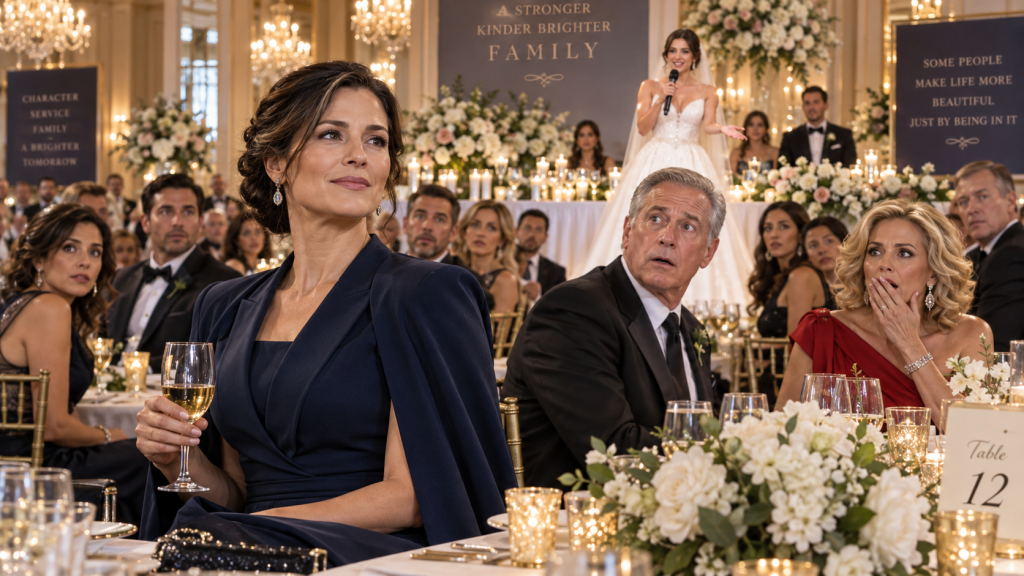
PART 3 — THE DAUGHTER HE COULD NO LONGER ERASE
Clare unfolded the letter.
For the first time that evening, my father looked uncertain.
Not afraid.
Gerald Ulette did not scare easily.
But uncertainty had always been harder for him than fear because uncertainty meant he did not control what happened next.
Clare lifted the page.
Her hands were trembling.
Her voice was too.
Neither weakness mattered.
“To Major General Evelyn Ulette.”
The ballroom went silent.
Not quieter.
Silent.
The kind of silence in which two hundred and fifty people suddenly become aware of themselves breathing.
Richard Hail lowered his scotch.
Margaret’s hand dropped from my father’s arm.
My father stared at Clare.
Then at me.
His expression changed so slowly that I almost missed it.
First confusion.
Then disbelief.
Then calculation.
He was trying to fit the woman sitting beside the kitchen doors into the story he had been telling about me for fifteen years.
The pieces would not go together.
Clare kept reading.
The letter contained publicly releasable language from one of my recent command citations.
I knew it immediately.
I also knew Clare had gone to some trouble to obtain it.
She read only part.
Thank God.
I had never enjoyed hearing official language about myself spoken aloud.
It always made ordinary work sound mythological.
Leadership under difficult operational conditions.
Distinguished service.
Command responsibility.
Airmen brought home.
Lives protected.
Missions completed.
Words like that flatten years.
They remove the terrible coffee.
The funerals.
The 3:00 a.m. phone calls.
The young lieutenant crying in my office because she had made a mistake and believed one mistake had ended her future.
The mechanic who worked fourteen hours in cold rain because an aircraft needed to fly before dawn.
The spouse who delivered a baby while her husband was overseas.
The empty chair after a casualty notification.
No citation can hold those things.
Still, Clare read.
And the room listened.
My father did not.
Not really.
He heard rank.
That was the only language he understood quickly.
Major General.
Two words that carried hierarchy.
Authority.
Recognition.
Public value.
All the things he had spent fifteen years insisting I lacked.
I wish I could say I enjoyed watching that realization strike him.
A part of me did.
I am not holy.
But the feeling lasted only a few seconds.
Then it became sad.
Because I was still the same daughter he had thrown out at twenty-two.
The rank had not made me more deserving of his love.
It had merely made my worth legible to a man who respected titles more easily than people.
Clare reached the end of the citation.
Then folded it.
She looked at me.
Her eyes were shining.
“When I was fifteen,” she said, “my sister left our house with one suitcase.”
My father stood.
“Clare.”
She did not even look at him.
“She didn’t leave because she hated us.”
“Enough.”
Gerald’s voice had changed.
Lower.
Dangerously calm.
The voice that had once made me apologize for things I had not done because ending the conversation felt safer than winning it.
Clare finally turned toward him.
“No, Dad.”
Two words.
I felt them across the entire ballroom.
He stared at her.
“You are embarrassing yourself.”
Clare’s face went pale.
I knew that sensation.
The sudden childhood that can return to an adult body when a parent uses the old voice.
Her shoulders moved once.
Then steadied.
“No.”
she said again.
“I’m embarrassing you.”
There is a difference.
David stood beside her.
He did not take the microphone.
Did not speak for her.
He simply placed one hand against the small of her back.
That mattered.
Support without takeover.
I liked him immediately for it.
Clare continued.
“When Evelyn told Dad she wanted to join the Air Force instead of entering the family company, he told her she had made her choice.”
Her voice caught.
“He changed the locks.”
A few people shifted in their chairs.
My father’s expression hardened.
“This is a wedding.”
he said.
“Yes.”
Clare answered.
“Mine.”
There was no anger in her voice anymore.
That was what frightened him.
She looked toward me again.
“I watched my sister leave through my bedroom window.”
Her mouth trembled.
“I thought being good enough would make sure Dad never did the same thing to me.”
My chest tightened.
Oh, Clare.
I had spent fifteen years thinking I was the cautionary tale in her life.
I had never understood I had also become the threat hanging over it.
Behave.
Or become Evelyn.
Obey.
Or disappear.
“I went to the college he wanted.”
Clare said.
“I accepted the apartment he chose.”
“I drove the car he bought.”
“I worked at the foundation because he said it would teach me responsibility.”
“I let him approve my guest lists, my vacations, my finances, even parts of this wedding.”
Margaret rose halfway from her chair.
“That is incredibly ungrateful.”
Clare looked at her.
“Maybe.”
Margaret froze.
I almost smiled.
People who control through gratitude often do not know what to do when someone accepts the accusation.
Clare lifted the second envelope.
The kraft paper one.
“This contains the keys to the apartment.”
My father went very still.
“And the car.”
Margaret whispered:
“You can’t be serious.”
“I am.”
Clare continued.
“There is also a signed letter to the trustee declining future discretionary distributions from the family trust that require Dad’s approval.”
A murmur moved through the room.
Not because anyone understood trust law.
Because everyone understood what she was doing.
She was placing money on the table.
And stepping back.
My father laughed.
One short sound.
Disbelief disguised as contempt.
“You have no idea what you’re giving up.”
Clare looked at him.
“I know exactly what I’m giving up.”
“Security.”
he snapped.
“No.”
She answered.
“Permission.”
The room disappeared for me.
For one second, I was twenty-two again.
Suitcase on the porch.
My father’s face behind the door.
You made your choice.
Then I was thirty-seven again.
At table twenty-two.
Watching my little sister make hers.
Gerald turned toward David.
“So this is you.”
David’s jaw tightened.
Clare raised one hand.
“No.”
My father ignored her.
“What did you promise her?”
David answered calmly.
“Nothing she cannot choose for herself.”
Wrong answer for Gerald.
My father’s face reddened.
“You marry into this family and immediately start poisoning her against—”
“Dad.”
Clare’s voice cut across his.
“This was my decision.”
He looked at her.
“You couldn’t afford your life without me.”
The cruelty landed.
I saw it.
Clare flinched.
Not visibly enough for most people.
Enough for me.
She had prepared for anger.
Perhaps not that sentence.
I stood.
Not because she needed rescue.
Because my body had decided before my mind.
Clare looked at me.
I stopped.
She gave the smallest shake of her head.
Stay.
So I stayed.
It was harder than combat.
Clare placed the envelope on the table.
“You’re right.”
My father blinked.
“I cannot afford the life you built around me.”
Silence.
“So David and I are going to live a different one.”
That sentence changed the room.
Not dramatic freedom.
Not:
I don’t need anything.
Something more honest.
I cannot afford this life.
So I will choose another.
She explained.
They had rented a small townhouse thirty minutes away.
Both names on the lease.
They had opened a household account funded only by their salaries.
David had returned a company vehicle from his employer and bought a used car.
Clare had accepted a new job outside the Ulette Foundation.
Less money than her father paid her.
More autonomy.
The wedding vendors had all been paid.
Gerald’s contributions had been gifts already made, and Clare was not pretending she could reimburse the entire event overnight.
But she had personally paid the remaining balances he had expected to control after the wedding.
No unpaid bill remained available as a leash.
Months of preparation.
Quiet.
Careful.
Not an impulsive speech.
My father realized that too.
That was when his anger became something closer to panic.
“You planned this behind my back.”
he said.
Clare looked at him.
“Yes.”
The honesty unsettled everyone.
“Because every time I tried to discuss a boundary with you, you turned the discussion into a financial consequence.”
“That is not true.”
“The apartment?”
Clare asked.
Silence.
“The car?”
Silence.
“The foundation?”
Margaret stood now.
“Your father gave you opportunities people would kill for.”
Clare nodded.
“He did.”
Then:
“And I spent years believing gratitude meant I could never say no to the person who provided them.”
Margaret’s mouth closed.
My father pointed at me.
“This is because of her.”
There it was.
Of course.
Evelyn.
The old contamination.
The daughter who disobeyed had returned, and now obedience itself was collapsing.
“No.”
Clare said.
He did not hear her.
“You bring her in here and let her turn this into some military spectacle—”
“It was my idea.”
“No.”
His voice rose.
“No, you don’t do things like this.”
Clare’s face changed.
Not fear this time.
Grief.
“Exactly.”
she whispered.
“That’s why I had to.”
For the first time all night, my father looked old.
Not seventy.
Not weak.
Old in the way people look when a belief that has supported them for decades breaks in public.
He looked around the room.
Two hundred and fifty witnesses.
Business partners.
Family.
People whose admiration mattered to him.
The Ulette name.
The Ulette family.
Established 1988.
His missing daughter sitting near the kitchen.
His obedient daughter standing at the microphone.
And suddenly neither one was playing the role he had written.
I walked toward the stage.
Slowly.
Every eye followed.
I hated that.
Ranks teach you to tolerate attention.
They do not teach you to enjoy it.
Clare stepped down before I reached her.
I took her hands.
“You okay?”
“No.”
she whispered.
“Good.”
Her eyebrows lifted.
I smiled.
“You’re supposed to feel terrible when you do something this hard.”
She laughed through tears.
That was the first sound in the room that felt human.
Then she hugged me.
The same way she had when I arrived.
Only this time, I understood what the grip meant.
Not:
Save me.
Stay with me.
Different request.
I could do that.
My father came toward us.
Richard followed.
Margaret too.
David moved instinctively closer.
I turned.
My father stopped six feet away.
“Evelyn.”
It was the first time he had used my name without contempt all evening.
Too late to impress me.
Still noticeable.
“This is a family matter.”
I looked around the ballroom.
“Then perhaps it should not have been turned into a public performance.”
His jaw clenched.
“You think you’ve won something.”
“No.”
That answer surprised him.
I meant it.
This was not victory.
My sister was crying on her wedding night.
My father was humiliated.
My childhood had been turned into reception entertainment.
No one wins those things.
“You came here to destroy me.”
he said.
“No.”
“Then why did you stay?”
I looked at Clare.
“Because the bride asked me to.”
His face twisted.
“You always were dramatic.”
I almost laughed.
There he was.
Fifteen years erased in one sentence.
I did not argue.
That was the old trap.
Prove you are not dramatic while he keeps provoking you until you become exactly what he predicted.
I knew better now.
Richard stepped forward.
“So what exactly are we supposed to do?”
I looked at him.
“About what?”
“This.”
He gestured toward Clare.
Toward me.
Toward the uncomfortable room.
I shrugged.
“Eat dessert.”
Several people laughed.
Quietly.
Richard did not.
I took Clare’s hand.
“This is still her wedding.”
That was important.
Gerald did not get to own the rest of the evening just because he had lost the speech.
David took the microphone.
Not to address the fight.
To redirect.
“Ladies and gentlemen.”
He looked at Clare.
“Apparently my wife has decided to make the first twenty minutes of our marriage significantly more interesting than rehearsed.”
A nervous laugh moved through the room.
Clare wiped her face.
David smiled at her.
“I married her for several reasons.”
“Timing was not one.”
More laughter.
Good.
He continued.
“We would like to thank everyone who came here to celebrate with us.”
Then he looked at Gerald.
Not submissive.
Not challenging.
Simply direct.
“And we would like to finish tonight as a wedding.”
That was the kindest boundary anyone set that evening.
My father left.
Of course he did.
Margaret with him.
Richard hesitated.
Then followed.
About twenty people noticed.
Two hundred thirty remained.
That mattered too.
Control often teaches you to believe one person leaving means everyone will.
It doesn’t.
Dinner resumed.
Awkwardly.
Then less awkwardly.
The band played.
Someone refilled wine.
A child crawled under a table.
An elderly aunt asked where the restroom was in the middle of Clare’s first dance.
Life returned.
It usually does.
I moved from table twenty-two.
Not because I demanded a better seat.
Clare’s maid of honor appeared beside me holding a place card.
“Bride’s orders.”
she said.
At table six, an empty chair had been added beside one of David’s cousins.
The card said:
EVELYN ULETTE
Not Major General.
Not guest of the bride.
My name.
I sat.
That almost hurt more than the salute.
Later, Clare found me near the terrace.
Shoes off.
Wedding dress gathered in one hand.
“Did I ruin everything?”
she asked.
I stared at her.
“No.”
“Dad left.”
“Yes.”
“Margaret left.”
“Yes.”
“Half his friends probably think I’m insane.”
“Probably less than half.”
She laughed.
Then started crying.
I opened my arms.
She came into them.
“I thought I’d feel free.”
she whispered.
“You do?”
“No.”
“Good.”
She pulled back.
“Stop saying good.”
I smiled.
“Freedom usually feels terrible at first.”
“Why?”
“Because cages are familiar.”
She stared at me.
That line sounded wiser than I felt.
The truth was, when my father threw me out, I did not feel brave.
I felt homeless.
There is a difference.
People love stories about courageous departures because they begin the story after the door closes.
They skip the first night.
The first bill.
The first holiday nobody calls.
The moment you almost go back because humiliation feels less frightening than uncertainty.
“I need you to know something.”
I said.
“What?”
“I did not become okay because I was strong.”
Her face softened.
“I became okay because people helped me.”
She listened.
“At twenty-two, I had eighty-seven dollars after the bus ticket.”
Her eyes widened.
“You never told me.”
“We never talked.”
That sentence sat between us.
Fifteen years.
So much lost time.
“I stayed three nights on the couch of a woman I barely knew.”
I continued.
“Then in a room over somebody’s garage.”
“I borrowed money.”
“I ate badly.”
“I cried in bathrooms.”
“I almost called Dad twice.”
“Why didn’t you?”
“Pride.”
I smiled sadly.
“Not wisdom.”
Clare reached for my hand.
“So if you need help, ask.”
Her face shifted.
“Financial help?”
“No.”
I answered too quickly.
Then softened.
“Not automatically.”
She blinked.
I smiled.
“You chose independence tonight.”
“I’m not going to replace Dad as the person who controls your life by paying for it.”
Relief and disappointment passed across her face together.
Honest.
Good.
“But if you need a place to sleep.”
I said.
“Advice.”
“A meal.”
“A ride.”
“A sister.”
“I can do those.”
She started crying again.
“So much for the makeup.”
she muttered.
David joined us a few minutes later.
He had two plates of cake.
“I was told by three separate women that if I let my bride go more than thirty minutes without sugar, the marriage can be annulled.”
Clare took one.
“You’re learning.”
He handed me the other.
I shook my head.
“I’m fine.”
He frowned.
I took it.
Apparently I could command thousands of people but not decline wedding cake.
David looked at me.
“Thank you for coming.”
“I almost didn’t.”
Clare stared.
“What?”
I looked at her.
“You invited me into a room full of people who had spent fifteen years hearing I was unstable, selfish, or dead.”
“Dad never said dead.”
“You’d be surprised how many versions of absence sound similar.”
She winced.
“I’m sorry.”
“Don’t be.”
I looked back through the ballroom doors.
“Sometimes you need to find out whether ghosts are still frightening in daylight.”
“And?”
David asked.
I ate a bite of cake.
“Mostly they’re just older.”
Clare laughed so hard she nearly dropped her plate.
That became my favorite memory of the wedding.
Not the salute.
Not my father’s face.
My sister barefoot in a wedding dress, laughing with cake in her mouth because I had insulted our father’s age.
Family can be sacred without being solemn.
I left before midnight.
Clare wanted me to stay at the hotel.
I had already booked a room elsewhere.
Habit.
Independence can become excessive too.
Before I left, she hugged me.
“Are you going to disappear again?”
The question was so quiet I almost missed it.
I held her tighter.
“No.”
That was all.
Not:
We’ll talk every day.
Not:
Nothing will ever separate us again.
Promises should fit reality.
“No.”
I could keep that one.
At 6:14 the next morning, my phone rang.
My father.
I stared at the screen.
Fifteen years without one call.
Then two in less than twelve hours.
I let it ring out.
He called again.
I answered.
Not because he deserved immediate access.
Because I wanted to hear what he would do with it.
“Evelyn.”
“Dad.”
“You have caused enough damage.”
I almost hung up.
Good to know we were not skipping steps.
“Clare made her own decision.”
“She would never have done that without seeing you.”
“That is possible.”
My answer stopped him.
He had expected denial.
“But influence is not control.”
I continued.
“She saw me.”
“She saw another option.”
“What she chose afterward belongs to her.”
“You think because you have stars on your shoulders—”
“I wasn’t wearing a uniform.”
“That isn’t the point.”
“No.”
I said.
“It isn’t.”
Silence.
Then:
“You embarrassed me.”
I sat on the edge of the hotel bed.
“Do you remember changing the locks?”
He went quiet.
“Fifteen years ago.”
I continued.
“I had one suitcase.”
“Do you remember telling Clare not to speak to me?”
Still nothing.
“Do you remember canceling my health insurance before I had even entered training?”
“That was my policy.”
There it was.
Technicality.
The favorite refuge of people avoiding morality.
“Yes.”
I said.
“It was.”
“You chose to leave.”
he said.
“I chose a career.”
“You chose against the family.”
“No.”
“You made those the same choice.”
Silence.
I breathed.
This was the conversation I once imagined having in a thousand forms.
In every version, I won.
He apologized.
Cried.
Admitted everything.
Real conversations are less obedient.
“I was trying to protect what I built.”
he said.
“From me?”
“From instability.”
I laughed.
“Flying rescue missions was more stable than being your daughter.”
He ignored that.
“The company was supposed to remain in the family.”
“Clare existed.”
“She was fifteen.”
“She grew up.”
“Exactly.”
There.
I heard it.
He had always planned a successor.
If not me, Clare.
A daughter became a position to fill.
“Were you ever angry because you thought I would get killed?”
I asked.
The question surprised both of us.
Long silence.
Then his voice changed.
Slightly.
“Yes.”
My throat tightened.
There it was.
Not redemption.
A human motive beneath cruelty.
“Your mother died.”
he said.
That stopped me.
He rarely spoke of her.
Our mother had died when I was nineteen and Clare twelve.
Cancer.
Fast at the end.
My father had become harder afterward.
I had called it grief once.
Then eventually stopped giving him that much generosity.
“I had already buried a wife.”
he said.
“I was not going to watch a daughter volunteer for danger.”
I closed my eyes.
There are explanations you wait years to hear, only to discover they solve less than you hoped.
“So you buried me anyway.”
I said.
He did not answer.
“You erased my photographs.”
Silence.
“Told people I abandoned you.”
Silence.
“Made Clare believe loving you meant never choosing anything you feared.”
His breath changed.
“I made mistakes.”
“No.”
I said quietly.
“You made decisions.”
That mattered.
Mistakes sound like spilled wine.
He chose.
Repeatedly.
“I’m not asking you to forgive me.”
he said.
I almost laughed.
“You haven’t apologized.”
Silence again.
Then:
“I have another call.”
Of course.
I stared at the phone after he hung up.
Thirty-seven years old.
Major General.
Two stars.
And somehow still capable of feeling eleven when my father ended a conversation first.
Ranks are terrible armor against childhood.
I called Clare.
She answered sleepily.
“You okay?”
I asked.
“David snores.”
“I meant about Dad.”
“Oh.”
Silence.
“He called me too.”
“What did he say?”
“That I’m cut off.”
My chest tightened.
“From what?”
“Everything.”
“Foundation salary.”
“Trust distributions.”
“He said the car better be returned today.”
“And?”
“I already returned it last week.”
I smiled.
“Good planning.”
She sounded proud.
Then less so.
“He said I’m no longer welcome at the house.”
There it was.
The porch.
The suitcase.
Different daughter.
Same weapon.
I closed my eyes.
“I’m sorry.”
Clare started crying.
“I knew he’d do it.”
“Knowing doesn’t make it painless.”
“I keep wanting to call and apologize.”
“Then wait.”
“How long?”
“Twenty-four hours.”
“That’s arbitrary.”
“Yes.”
I smiled.
“Still useful.”
Twenty-four hours became three days.
Clare did not apologize.
Gerald did not call.
Something shifted.
Not healed.
Shifted.
The first year after the wedding was hard.
That part matters.
Freedom did not transform Clare’s life into a montage of joyful apartment decorating.
Her new job paid less.
The townhouse had thin walls.
David’s commute was terrible.
Their used washing machine flooded the laundry room two months after they moved in.
Clare called me crying.
“I made a mistake.”
“About the washing machine?”
“About everything.”
I sat in my office at the base.
Closed the door.
“What happened?”
“Nothing.”
That told me enough.
Sometimes nothing is the hardest part.
No emergency.
No villain.
Just exhaustion and doubt.
“I had a driver before.”
she said.
“Sometimes.”
“Yes.”
“I had a housekeeper.”
“Sometimes.”
“Yes.”
“Dad’s assistant handled my travel.”
“Yes.”
“I didn’t even know how much car insurance cost.”
“That one is genuinely offensive.”
She laughed through tears.
Then:
“I feel stupid.”
“You’re inexperienced.”
“Different thing.”
“I’m thirty.”
“Yes.”
“And now you’re learning.”
She was quiet.
“I thought being independent would make me feel capable.”
“No.”
I said.
“Becoming capable often starts by feeling incompetent.”
She hated that.
Still true.
I did not offer to pay for the washer.
That was hard.
David and Clare bought a used replacement.
Three months later, I sent them an anniversary gift.
A new dishwasher.
Not because they needed rescue.
Because I wanted to give them a present.
There is a difference between generosity and takeover.
I was learning it too.
Clare found her footing.
She became good at her new job.
Then better.
Two years later, promoted.
Her salary still did not match the foundation package my father had given her.
Her pride did not need it to.
David thrived too.
They argued about money occasionally.
Normal.
One Christmas they could not afford to fly anywhere.
So they hosted me.
Frozen lasagna.
Cheap wine.
A tree that leaned noticeably left.
It was one of the best Christmases of my life.
Our father sent nothing.
Not a card.
Not a message.
Margaret sent Clare an email every few months.
Usually beginning with:
Your father is devastated by what you have done.
Clare stopped reading them.
Then blocked her.
Good.
I heard from Gerald indirectly.
Richard called once.
I almost did not answer.
“Evelyn.”
“Richard.”
He sounded less confident without a ballroom around him.
“Your father’s health isn’t good.”
My body tightened.
“What happened?”
“Blood pressure.”
“Stress.”
“Nothing immediate.”
I exhaled.
Richard continued.
“He misses Clare.”
“Then he can call her.”
“You know it’s not that simple.”
“It is exactly that simple.”
“She embarrassed him publicly.”
“He humiliated me publicly fifteen minutes earlier.”
“That’s different.”
“Of course.”
Richard sighed.
“Could you talk to him?”
“No.”
“He listens to you now.”
That made me laugh.
“No, he respects my rank now.”
“Different thing.”
Richard had no answer.
Good.
Three years after the wedding, Clare became pregnant.
She called me first.
Not because she loved me more than David.
He was standing beside her.
She said:
“I’m terrified.”
I smiled.
“So is everyone.”
“No.”
“About Dad.”
Ah.
“Do I tell him?”
I leaned back.
“What do you want?”
“I don’t know.”
“Then don’t decide today.”
That became a family rule.
Not every question requires immediate courage.
Sometimes uncertainty deserves time.
Two months later, she sent Gerald a letter.
Not invitation.
Information.
I am pregnant. The baby is due in October. I am telling you because you are my father. I am not asking for money. I am not asking you to agree with my decisions. If you want a relationship with me, it must begin without threats, financial conditions, or attacks on Evelyn.
Clare showed it to me only after sending.
I read it.
Then looked at her.
“You put me in there.”
“Yes.”
“I can fight my own battles.”
“I know.”
“Then why?”
“Because I am setting my boundary.”
Fair.
I returned the letter.
“Good.”
Gerald did not respond for six weeks.
Then a card arrived.
No money.
No check.
No trust document.
Just:
I received your letter. I hope you and the baby are healthy. Dad.
Clare cried for an hour.
Hope is dangerous after deprivation.
A crumb feels like a feast.
I reminded her:
“It is a card.”
“I know.”
“Not proof.”
“I know.”
“Let behavior accumulate.”
She looked at me.
“You sound like a commander.”
“No.”
“I sound like someone who once mistook a single nice phone call for a changed father.”
“When?”
She asked.
I smiled.
“Not important.”
It was.
I just wasn’t ready to tell her.
When Clare’s daughter was born, she named her Anna.
Not after anyone.
Thank God.
Family names carry unnecessary pressure.
Gerald asked to visit.
Clare said yes.
Her terms:
At her home.
One hour.
Margaret could come.
No gifts over fifty dollars.
No photographs posted publicly.
No discussion of inheritance.
No criticism of Evelyn.
I laughed when she told me.
“Specific.”
“Learned from the Air Force.”
“No.”
“You learned from therapy.”
“Less glamorous.”
“More useful.”
Gerald came.
I was not there.
That mattered.
Clare’s relationship with him could not become a proxy war with me.
He held Anna.
Cried.
Stayed fifty-eight minutes.
Brought a stuffed rabbit.
Thirty-two dollars.
Clare checked later.
I laughed when she admitted that.
“Of course you checked.”
“I have trust issues.”
“Appropriate ones.”
Contact grew slowly.
Gerald called once a month.
Sometimes behaved well.
Sometimes did not.
The first time he criticized their small house, Clare ended the visit.
No screaming.
“Dad, we agreed.”
He protested.
She opened the door.
He left.
Next month, he did not mention the house.
Changed behavior.
Evidence.
Margaret had a harder time.
She continued making little comments.
David’s salary.
Clare’s clothes.
My unmarried life.
At the third visit, Clare told her:
“If you insult Evelyn again, you will leave.”
Margaret stared.
“I’m only saying she gave up a family for a career.”
Clare stood.
Visit over.
Margaret cried in the driveway.
Clare cried after.
Boundaries hurt the person setting them too.
That does not make them wrong.
My own relationship with Gerald remained almost nonexistent.
Five years after the wedding, I was nominated for another senior command.
The process involved hearings, paperwork, scrutiny, endless preparation.
Somewhere along the way, an article about my career appeared in a national newspaper.
The reporter mentioned my estrangement from my father because I refused to answer certain personal questions.
Gerald called.
“You made me sound monstrous.”
“I did not discuss you.”
“They said we were estranged.”
“We are.”
Silence.
Then:
“I’m proud of you.”
There are sentences people dream of hearing until they hear them too late.
I waited.
Nothing happened inside me.
Not nothing exactly.
A small ache.
An old room opening.
But no transformation.
“Thank you.”
I said.
That was all.
He seemed disappointed.
He had imagined praise as a key.
It was not.
“Is that it?”
he asked.
“What else should there be?”
“I told you I’m proud.”
“I heard you.”
I was not cruel.
Just accurate.
“You wanted that once.”
he said.
“Yes.”
“Do you not anymore?”
I thought.
“Not the way I did.”
That may have been the first truth he could not punish.
He became quiet.
Then:
“I didn’t know.”
“No.”
“You didn’t ask.”
Another silence.
Then he hung up.
No breakthrough.
Still, something changed.
Months later, a letter arrived.
Handwritten.
Gerald had beautiful handwriting.
Always.
He began:
Evelyn, I do not know how to apologize without explaining myself, and I am beginning to understand that explanations have been one of the ways I avoid apologizing.
I sat at my kitchen counter.
Read it again.
Better than I expected.
He wrote about my mother.
Fear.
The company.
His belief that family survival required continuity.
His terror when I chose the Air Force.
Then:
None of that explains changing the locks. None of it explains removing your photographs. I did those things because I wanted your choice to hurt enough that you would reverse it.
I stopped.
There.
Truth.
Ugly.
Clean.
When you did not come back, I changed the story. I told people you had abandoned us because admitting I had made it impossible for you to return would have required me to admit I had lost my daughter through pride.
My vision blurred.
I put the letter down.
Walked around the kitchen.
Came back.
He wrote about Clare too.
After you left, I watched her become careful. I mistook that for loyalty. I see now that part of it was fear.
Then:
At her wedding I blamed you because I could not accept that both of my daughters had reached the same conclusion about me independently.
I laughed through tears.
Gerald Ulette.
Still precise when he finally wanted to be.
The final paragraph:
You do not owe me a relationship. I am sorry I taught you that my love was available only inside the life I had chosen for you.
No request.
No:
Call me.
No:
Before I die.
No guilt.
I folded the letter.
Did not answer for three months.
Apologies should survive silence if they are real.
When I finally replied, I wrote:
I believe you understand more than you did. I am not ready to become close. I am willing to meet for coffee once.
Once.
A small door.
Not an open house.
We met at a diner.
Not his club.
Not Greenfield.
A diner halfway between us.
He arrived early.
I arrived exactly on time.
He stood when I entered.
For one ridiculous second, I wondered whether I should salute.
I did not.
“Evelyn.”
“Dad.”
We sat.
Coffee.
He ordered black.
I remembered cream.
He remembered I hated grapefruit.
Tiny facts surviving fifteen years of estrangement.
People are strange archives.
He asked about my work.
Not rank.
Work.
I told him about mentoring younger officers.
About the difficulty of command.
About being tired.
He listened.
Mostly.
Twice he tried to tell me what I should do.
Twice he caught himself.
Progress can be microscopic.
Still progress.
Eventually, he said:
“I was wrong about the Air Force.”
I looked at him.
“No.”
He frowned.
“What?”
“You were wrong about me.”
He stared.
“The Air Force did not need to prove itself.”
His eyes filled.
Mine too.
That was the center.
Not career choice.
Personhood.
He had believed disagreement transformed daughter into enemy.
“I don’t know how to make up fifteen years.”
he said.
“You can’t.”
He flinched.
I continued gently.
“That does not mean the future has to be nothing.”
He nodded.
We finished coffee.
No hug.
At the door, he asked:
“May I call you sometime?”
The question.
May I.
He had never asked permission for access before.
“Yes.”
I said.
“Sometimes.”
That became our relationship.
Sometimes.
Gerald did not become a different man overnight.
He never loved boundaries.
He learned to obey more of them.
That is not the same as enjoying them.
Still valuable.
He met me for coffee every few months.
He attended one promotion ceremony only after I invited him.
He sat beside Clare.
Margaret did not come.
Her choice.
Good.
At the ceremony, Gerald cried.
I saw him from the stage.
For years I had imagined seeing pride in his face.
By the time it happened, I no longer needed it to hold myself upright.
That made receiving it easier.
Need can make affection dangerous.
Choice makes it lighter.
Clare and I rebuilt too.
That relationship mattered more.
We could not recover fifteen years.
We stopped trying.
Instead, we learned the adults we had become.
She hated olives.
I had forgotten.
I loved terrible detective novels.
She mocked me.
She was impulsive with furniture.
I was incapable of purchasing anything decorative without reading reviews.
She sent me photographs of Anna covered in spaghetti.
I sent her photographs from bases around the world.
Not classified things.
Mostly bad coffee and sunsets.
Sisters.
Late.
Still sisters.
One night, seven years after the wedding, Clare called.
“Do you ever wish you had stayed?”
“With Dad?”
“Yes.”
I thought.
“No.”
“Never?”
“Sometimes I wish leaving had not cost so much.”
“That is different.”
She was quiet.
“I think I understand now.”
“How?”
“Sometimes I miss the apartment.”
“The car.”
“The vacations.”
“Not because I want Dad controlling me.”
“Because they were nice.”
I laughed.
“Of course they were nice.”
“You are allowed to miss comfort.”
“Freedom does not require pretending discomfort is superior.”
She exhaled.
“Thank you.”
“For what?”
“For not making poverty a moral achievement.”
I laughed harder.
She and David were not poor.
But compared with Gerald’s world, ordinary middle-class life had once felt like falling.
Now it was simply life.
Anna grew.
Then Clare had a son, Matthew.
Gerald became a grandfather under supervision of reality.
He gave reasonable gifts.
Usually.
Once he tried to open a college account without asking.
Clare stopped it.
He argued.
She said:
“We discussed this.”
He complained to me.
I answered:
“Why are you calling me?”
He went silent.
Then:
“Right.”
We were all learning.
Margaret never apologized to me.
Not really.
She sent one Christmas card with:
I hope someday we can put the past behind us.
I did not answer.
Putting the past behind us is often what people request when they would prefer not to walk through it.
She remained married to Gerald.
Clare maintained limited contact.
I maintained none.
Not every relationship must be repaired for a family to become healthier.
Absence can be appropriate architecture.
Richard eventually apologized too.
Sort of.
At Gerald’s seventieth birthday dinner, he approached me.
No Tom Ford suit this time.
Still a Rolex.
Some things survive character development.
“General.”
he said.
“Evelyn.”
“Right.”
He looked embarrassed.
“I was rude at Clare’s wedding.”
“Yes.”
“I didn’t understand what you actually did.”
I looked at him.
Then smiled.
“That wasn’t the problem.”
He frowned.
“You did not need to understand my career to treat me respectfully.”
His face reddened.
“Fair.”
Better than argument.
My military career eventually ended.
All careers do.
That surprised me emotionally.
For years, the uniform had been more than work.
It was the first place where my decision to leave home had become something other than betrayal.
The Air Force did not love me unconditionally.
Institutions cannot.
But it gave me structure when my family withdrew theirs.
Responsibility.
Purpose.
People who depended on competence rather than obedience.
Leaving it felt like losing a country.
At my retirement ceremony, Clare sat in the front row.
David beside her.
Anna and Matthew fidgeting.
Gerald came too.
Older.
Cane now.
Margaret stayed home.
I had invited my father because I wanted him there.
Not because tradition required it.
Important.
Someone read another citation.
I endured it.
Then came speeches.
Too many.
Then Clare was invited forward.
I did not know why.
She walked to the microphone.
I narrowed my eyes.
She smiled.
“Relax.”
she said.
The room laughed.
“Years ago.”
she began.
“At my wedding, I saluted my sister because I had just discovered that while our family was pretending she had disappeared, she had built a life larger than any story we told about her.”
I looked down.
Here we go.
Clare continued.
“I thought her rank was the proof.”
Then she looked directly at me.
“I was wrong.”
The room quieted.
“The rank was impressive.”
“But Evelyn deserved a place in our family when she was twenty-two, broke, scared, and standing outside with one suitcase.”
My throat closed.
She smiled through tears.
“She did not become worthy when the Air Force promoted her.”
“Some of us simply took too long to notice she had always been.”
I could not see clearly after that.
Damn her.
I looked toward Gerald.
He was crying openly.
Not elegantly.
For once, he did not seem to care who saw.
Clare returned to her seat.
My aide whispered:
“You okay, ma’am?”
“No.”
I said.
“Carry on.”
Professionalism.
Barely.
After the ceremony, Gerald found me near the hangar doors.
He held his cane in one hand.
His program in the other.
“Your sister was right.”
he said.
“I know.”
He laughed.
“Still modest.”
“Retirement starts tomorrow.”
He looked at me.
Then:
“I’m sorry I missed so much.”
That apology was different from regretting what he did.
Missing what followed.
Birthdays.
Promotions.
Bad years.
Good ones.
The ordinary accumulation that makes a relationship.
“I’m sorry too.”
I said.
Not for leaving.
For the loss.
Those are different regrets.
“Can I hug you?”
he asked.
Another question.
May I.
Can I.
Late language.
Still language.
“Yes.”
I stepped forward.
My father hugged me for the first time in more than twenty years.
It did not erase the porch.
It did not restore my twenties.
It did not transform him into the father I had wanted.
It was one hug.
And because I no longer required it to be anything else, it was enough.
Gerald died three years later.
A stroke.
Quick.
Clare called me.
I sat on the floor after hanging up.
Not because I collapsed.
Because my legs simply stopped wanting responsibility for a while.
I cried for my father.
The cruel one.
The frightened one.
The proud one.
The controlling one.
The man who changed the locks.
The man who eventually learned to ask permission before hugging his daughter.
All of him.
Grief does not require acquittal.
His will surprised everyone.
Not because of money.
There was plenty.
He left most of his company interests according to long-established business structures.
Clare received property.
So did Margaret.
I received one thing.
The old family photograph album.
The one from before photographs of me began disappearing.
Inside the front cover was a note.
Evelyn — I spent years removing you from photographs because I thought if I controlled the picture, I could control the story. I was wrong. Dad.
I sat in Martin—no, not Martin, wrong story. Need correct. Hmm can’t alter inside writing? We can just say at my dining room table. Need continue without error. Let’s fix mentally. I’ll write cleanly: I sat at my dining table. Good.
I sat at my dining table and cried.
Then laughed because even dead, Gerald Ulette needed one final written conclusion.
The businessman to the end.
Clare came over that evening.
We opened the album together.
There I was.
Age six.
Missing front teeth.
Age eleven.
Holding a science-fair ribbon.
Age seventeen.
Angry at the camera.
Clare as a baby in my arms.
Our mother.
Dad younger.
Margaret nowhere yet.
A family before it became the version that hurt us.
Clare touched one photograph.
“You look like Anna.”
“Anna looks like me.”
“Rank pulling already?”
“Absolutely.”
She laughed.
Then:
“Do you want to keep all these?”
“Yes.”
No hesitation.
The past belonged to me too.
I no longer needed to destroy it to prove I had survived.
The welcome board from Clare’s wedding had said:
THE ULETTE FAMILY — ESTABLISHED 1988
It left me out.
For years, that detail bothered me more than I admitted.
Not because I needed my name printed on wood.
Because erasure had been my father’s favorite punishment.
If you did not obey, you disappeared from the official version.
Later, I understood something simpler.
Families are not established once.
They are established over and over.
Every time someone asks instead of orders.
Every time a child is allowed to become an adult.
Every time money stops being a leash.
Every time love survives a no.
Every time an apology leaves room for distance.
Every time someone walks away without being declared dead.
And every time someone returns without demanding the old role back.
Years after Gerald died, Clare hosted Thanksgiving.
Nothing formal.
David burned the rolls.
I mocked him mercilessly.
Anna, now fourteen, rolled her eyes at everything.
Matthew had become obsessed with military aircraft and asked me questions so technical I suspected he was trying to embarrass me.
Clare’s house was crowded.
Normal.
No chandeliers.
No country club.
No seating hierarchy.
I was carving turkey badly.
Clare took the knife.
“You flew aircraft and commanded thousands of people, but you cannot carve poultry.”
“Different qualification.”
She laughed.
Anna appeared carrying a school project.
Family tree.
I braced myself.
Children are dangerous archivists.
She had included Gerald.
Margaret.
Our mother.
Thomas? No, wrong family. Need no invented. We’ll avoid names. She included Clare, David, me, and branches I barely recognized.
Then I noticed something.
Beside my name, she had written:
Aunt Evelyn
Nothing else.
No Major General.
No medals.
No career.
Just Aunt Evelyn.
I stared.
Anna frowned.
“Did I spell something wrong?”
“No.”
I smiled.
“It’s perfect.”
And it was.
After all those years of titles finally forcing people to see me, the title I cherished most required no rank at all.
Aunt.
Sister.
Daughter, complicated as that had been.
Evelyn.
Enough.
That evening, after everyone left the table, Clare and I sat on the back porch with wine.
Pinot Noir.
She noticed.
“Wedding drink.”
“Coincidence.”
“Sure.”
We watched the children chase each other across the yard.
Clare said:
“Do you remember what Dad said?”
“At the wedding?”
“Yes.”
“Which terrible thing?”
She laughed.
“Pity.”
I did remember.
If it wasn’t for pity, no one would have invited you.
I took a sip.
“What about it?”
“I think that was the moment everything changed.”
I shook my head.
“No.”
She looked surprised.
“The microphone?”
“No.”
“The salute?”
“No.”
“Then what?”
I looked at her.
“The invitation.”
Her eyes filled.
“You wrote: Please come. I need you there.”
I said.
“That changed everything.”
“Why?”
“Because someone in the family asked me to come without asking me to be different first.”
Clare looked down.
For a while, neither of us spoke.
Then she leaned her head against my shoulder.
At fifteen, she had watched me leave from an upstairs window.
At her wedding, she had asked me to return.
Neither moment defined us forever.
Thank God.
People like stories where the cruel father learns his daughter became a general and is instantly humiliated into repentance.
That is not what happened.
My rank embarrassed him.
It challenged his story.
It did not change his heart.
That took years.
Consequences.
Distance.
Clare’s boundaries.
My refusal to perform either hatred or obedience.
His own aging.
His own losses.
A letter written without demands.
Coffee.
Occasional calls.
One question at a time.
May I?
Can I?
Late.
Imperfect.
Real.
And Clare did not become free because she rejected his money in a ballroom.
That was only the first bill.
Freedom cost rent.
Career uncertainty.
A broken washing machine.
Therapy.
Grief.
Learning to make choices without imagining Gerald’s reaction before her own preference.
Learning to accept gifts without assuming they carried contracts.
Learning that independence did not require refusing help from everyone.
Learning she could miss wealth without missing control.
Learning that her father could improve and still never regain the authority he once mistook for love.
That was the work.
As for me, I eventually understood that the Air Force had not saved me either.
People did.
A recruiter who treated my decision like a future instead of a betrayal.
A roommate who lent me money.
A commander who corrected me without humiliating me.
Airmen who trusted me.
Friends who became family.
Clare, eventually.
Even Gerald, in the limited late relationship we managed, gave me something I once thought impossible.
An apology that did not demand I erase the consequences.
But none of them gave me my worth.
That existed before all of them.
Before the uniform.
Before the stars.
Before the country club ballroom turned toward me.
Before anyone saluted.
My father had once told me I was still searching for something I would never get.
His approval.
He was partly right.
For many years, I was.
Then somewhere along the way, I stopped.
And that was the strangest thing:
Only after I no longer needed it did he finally learn how to offer some.
Life has a cruel sense of timing.
It also has mercy.
I kept the family album.
It sits on a shelf in my home.
Not displayed like a shrine.
Just there.
Sometimes Anna asks to see it.
Sometimes Clare takes photographs of old photographs with her phone.
Sometimes I open it alone.
There is one picture I return to.
I am twenty-one.
Before the argument.
Before the porch.
Before the Air Force.
My father stands beside me.
One arm around my shoulders.
I am laughing at something outside the frame.
He looks proud.
For years, I thought that picture was a lie because of what happened afterward.
Now I know better.
The moment was real.
So was the cruelty later.
One truth does not erase the other.
That understanding gave me more peace than choosing which version of my father was “the real one.”
They both were.
So am I.
At Clare’s wedding, everyone turned toward me when she said:
Major General Evelyn Ulette.
I thought that was the reveal.
It wasn’t.
The rank was only the loudest fact in the room.
The real revelation came afterward.
My father learned I had built a life without him.
Clare learned she could build one without his permission.
And I learned that walking back into my family did not require becoming the twenty-two-year-old daughter they had frozen in memory.
I could return as myself.
No apology.
No performance.
No begging to be restored to an old photograph.
The last thing Gerald ever said to me in person happened three weeks before his stroke.
We had coffee.
He was slower by then.
Hands trembling slightly.
He looked at me for a long time.
Then said:
“If I had let you go properly, do you think you would have come home sooner?”
The question broke my heart.
Because the answer was probably yes.
“I don’t know.”
I said.
Then, because he deserved truth:
“Maybe.”
His eyes filled.
He nodded.
“That’s what I thought.”
We sat quietly.
No lesson.
No clever line.
Just two people beside the cost of a choice neither could undo.
Then he reached for his coffee.
His hand shook.
I steadied the cup.
Not because he deserved service.
Because he was my father.
Because I wanted to.
Choice changes everything.
That is how I remember him now.
Not sneering beside the cocktail tables.
Not changing the locks.
Not even crying at my retirement.
An old man in a diner.
His daughter’s hand briefly steadying a cup.
No debt created.
No authority restored.
No past erased.
Just kindness freely given.
That is the kind I trust.
And when I think about Clare’s wedding now, I do not hear my father saying nobody would have invited me without pity.
I hear my sister.
Please come. I need you there.
Then later:
I need to honor someone this family tried to erase.
She thought she was honoring a general.
What she really did was something much more important.
She gave her sister a seat.
And eventually, both of us learned that we had never needed Gerald Ulette’s permission to belong to our own lives.
THE END STORIES! THANK YOU FOR READING GOOD LUCK !❤️
Related Posts