➡️ PART 3 — WHAT MY DAUGHTER SHOULD NEVER HAVE HAD TO SAY
My cousin’s voice dropped.
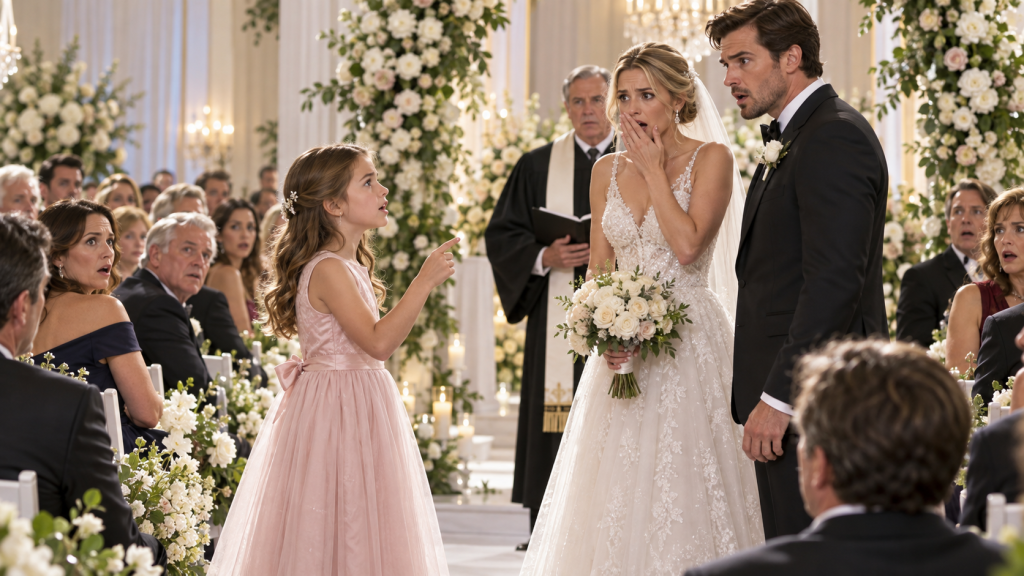
“Annie, Amelia is standing in the middle of the aisle holding the ultrasound picture.”
For one second, I could not remember how to breathe.
Behind me, cartoons still played.
My three younger children were curled beneath the blanket where I had left them, completely unaware that somewhere across town their sister had just stopped their father’s wedding with a photograph of the sibling they would never meet.
“What is Ryan doing?”
I asked.
“He looks like he’s been hit.”
“And Claire?”
My cousin went quiet.
Then:
“She’s crying.”
I closed my eyes.
I did not feel satisfaction.
That surprised me.
There had been nights during the divorce when I imagined my sister finally understanding even one fraction of what she had done to me.
I had pictured regret.
Humiliation.
Perhaps even the collapse of the relationship she had defended so proudly.
But hearing that she was crying at the altar did not heal anything.
It only made me think of Amelia.
Nine years old.
Standing alone in front of a room full of adults because none of the adults had said the thing she apparently needed said.
“Stay with her.”
I told my cousin.
“I am.”
“Do not let anyone yell at her.”
“I won’t.”
“I’m coming.”
I called my neighbor.
Mrs. Alvarez arrived before I finished putting on my shoes.
She had known enough of the story to understand immediately.
“I’ve got the little ones.”
she said.
I kissed each child.
My seven-year-old son looked up.
“Where are you going?”
“To get Amelia.”
“From the wedding?”
“Yes.”
“Did something happen?”
I forced my face to stay calm.
“She needs me.”
That answer satisfied him.
Children understand needing Mom without requiring a complete investigation.
I wish adults were sometimes as merciful.
The drive took twenty-three minutes.
I remember because every minute felt like a separate room I had to cross.
At red lights, my hands shook against the steering wheel.
I kept hearing Amelia’s words through my cousin’s retelling.
Everybody keeps telling Mom that Aunt Claire deserves to be happy. But nobody ever asks what Mom deserved.
I should have been proud.
Part of me was.
That made me feel sick.
Because pride can be dangerous when a child has become brave only because adults failed.
I did not want Amelia remembered as the little girl who ruined a wedding.
I wanted her remembered as a child who should never have needed to defend her mother at one.
When I pulled into the venue, guests were standing outside.
That frightened me.
Groups of relatives clustered beneath white flowering trees.
Some whispered.
Some held champagne glasses.
Some stared when I stepped out of my car.
The looks began immediately.
Pity.
Curiosity.
Judgment.
The exact collection of expressions I had lived beneath for months.
I ignored them.
Then I saw my cousin.
Nora stood near the entrance.
Amelia was pressed against her side.
The moment my daughter saw me, her face collapsed.
“Mom.”
I ran.
She hit me so hard I staggered.
Her arms locked around my waist.
“I’m sorry.”
she sobbed.
Those were the first words.
Not:
Did you hear what I said?
Not:
I showed them.
Not:
Dad deserved it.
I’m sorry.
My heart broke.
I knelt in my dress pants on the gravel.
“No.”
She buried her face in my shoulder.
“I ruined everything.”
“No.”
“Grandma said—”
“What did Grandma say?”
Amelia froze.
Nora answered for her.
“She said Amelia should have waited until after the ceremony if she was upset.”
Something hot moved through me.
I stood.
Slowly.
“Where is my mother?”
Nora pointed toward the building.
Before I could move, Amelia grabbed my hand.
“Mom, please.”
I looked down.
Fear.
Not of Ryan.
Not of Claire.
Of me going inside angry.
I softened.
“I’m not going to scream.”
“Promise?”
“Yes.”
I held out my pinky.
She hooked hers through mine.
Nine years old again.
Thank God.
Then I saw the ultrasound picture.
She was still holding it.
The corner had bent.
My fifth baby.
Twelve weeks.
A tiny profile.
A photograph I had kept inside a box in my bedroom because looking at it hurt too much and not looking at it hurt differently.
I stared.
“Where did you get that?”
Amelia looked ashamed.
“Your drawer.”
“When?”
“Last night.”
“Why?”
She began crying again.
“I wanted Dad to remember.”
There was no anger left in me after that.
Only grief.
I touched her hair.
“Sweetheart, he remembers.”
She shook her head fiercely.
“No, he doesn’t.”
“Yes.”
“He was getting married.”
“That doesn’t mean he forgot the baby.”
“It felt like it.”
There.
The truth.
Not revenge.
Not a plan to destroy the ceremony.
A child whose family had moved forward publicly before she had understood how to move at all.
Nora touched my arm.
“Ryan is inside with Claire.”
I looked toward the venue.
“And my parents?”
“Inside too.”
“What happened after Amelia spoke?”
Nora hesitated.
“The officiant stopped.”
“Ryan tried to take Amelia aside.”
“She wouldn’t go with him.”
“Claire told everyone they needed ten minutes.”
“Then your mom started crying.”
“And?”
Nora lowered her voice.
“Your dad told Amelia she had embarrassed the family.”
I closed my eyes.
Of course.
Some people can stand inside a burning building and still complain about smoke etiquette.
I looked at Amelia.
“Do you want to go home?”
She glanced toward the building.
Then at me.
“I don’t know.”
“What do you need?”
She whispered:
“I want Dad to answer me.”
My throat tightened.
“What question?”
“Why everybody says Aunt Claire deserves happiness.”
She wiped her face.
“Didn’t we deserve Dad?”
There are questions no parent should have to answer alone.
Especially when the other parent is twenty yards away wearing a wedding suit.
I stood.
“Okay.”
Nora looked at me.
“You sure?”
“No.”
Then I took Amelia’s hand.
“But we’re going inside.”
The reception hall had gone quiet.
No music.
No clinking glasses.
No laughter.
Rows of guests sat or stood in clusters.
At the front, flowers surrounded the altar.
Claire’s bouquet rested on a chair.
She stood near the side door with her arms folded around herself.
Wedding dress.
Perfect hair.
Tear-streaked face.
Ryan stood several feet away.
My parents between them.
The image was so absurdly beautiful and painful that for a second I nearly turned around.
Then Ryan saw me.
His face changed.
“Annie.”
Every head turned.
I hated him for saying my name like relief.
Mom rushed toward me.
“This is getting out of hand.”
I looked at her.
“Is Amelia okay?”
“What?”
“Did you ask if she was okay?”
My mother blinked.
“She interrupted a wedding.”
“That wasn’t my question.”
She lowered her voice.
“She’s upset.”
“Yes.”
“So am I.”
Mom’s face tightened.
“Annie, please. Not today.”
Not today.
For months, every conversation about betrayal had contained some version of those words.
Not now.
Not at Thanksgiving.
Not in front of the children.
Not while Claire is planning the wedding.
Not when Ryan is trying to co-parent.
Not when your father’s blood pressure is high.
There had always been a reason my pain should wait.
Amelia had apparently inherited my place in line.
No.
I turned to Ryan.
“Amelia wants you to answer her.”
His eyes moved to our daughter.
He looked terrified.
Good.
Not because I wanted him afraid.
Because perhaps fear would finally make him careful.
He stepped closer.
“Sweetheart—”
Amelia tightened her grip on my hand.
Ryan stopped.
Good again.
“What do you want to ask me?”
he said.
Amelia stared at his shoes.
Then:
“Did we do something wrong?”
Ryan’s face broke.
“No.”
“Then why did you leave?”
No adult moved.
Somewhere behind us, a glass touched a table.
Small sound.
Huge room.
Ryan opened his mouth.
Closed it.
Then said:
“I made choices that hurt our family.”
Amelia looked up.
“But why?”
He glanced at Claire.
She lowered her eyes.
Then he looked back at Amelia.
“Because I wanted something I should not have tried to take without being honest first.”
My chest tightened.
It was not perfect.
But it was more truth than he had given the children before.
Amelia asked:
“Did you love Mom?”
“Yes.”
That answer surprised several relatives.
I could feel it.
Ryan continued.
“I did.”
“Then why did you cheat?”
There is no mercy in a nine-year-old vocabulary.
Ryan swallowed.
“Because loving someone doesn’t automatically make you behave well.”
That was almost good.
Then he ruined it.
“And your mom and I had problems.”
I laughed.
I could not stop myself.
Ryan looked at me.
“No.”
I said.
He went still.
“No.”
I repeated.
“You do not put this on our marriage in front of her.”
“I’m not.”
“You just did.”
“I said we had problems.”
“Every marriage has problems.”
I stepped closer.
“You made an affair.”
“That was your choice.”
“Do not teach her that betrayal appears because a spouse failed some hidden test.”
Ryan’s face reddened.
Then he looked at Amelia.
“You’re right.”
Another small improvement.
He crouched.
Not too close.
“Amelia, your mom did not make me cheat.”
My daughter’s eyes filled.
“My choices were mine.”
“I hurt your mother.”
“I hurt you.”
“I hurt your brothers and sister.”
“And none of you caused it.”
That sentence entered the room differently.
Claire began crying again.
My mother covered her mouth.
My father looked toward the floor.
Amelia whispered:
“And the baby?”
Ryan stopped breathing.
The ultrasound picture trembled in her hand.
Ryan looked at it.
The sound he made was quiet.
Almost nothing.
But I heard it.
I had heard that sound before.
In the hospital.
After the doctor told us there was no heartbeat.
Whatever else he had become, he had lost that child too.
That did not excuse leaving.
It did not excuse the affair.
It did not give him ownership of my grief.
But I suddenly remembered that grief was not mine alone.
He stood slowly.
“Can I see it?”
Amelia looked at me.
I nodded.
Her choice.
She handed him the photograph.
Ryan held it as though paper could bruise.
His shoulders shook.
“I remember.”
he whispered.
Amelia stared.
“Then why are you getting married?”
The question was not logical.
Not in an adult way.
It made perfect emotional sense.
To Amelia, marriage meant moving on.
Moving on meant forgetting.
Ryan understood.
I saw it.
He knelt again.
“Because remembering someone we lost does not mean nobody is allowed to keep living.”
I swallowed.
Painfully true.
Then he added:
“But I should have helped you understand that.”
“Yes.”
she said.
No politeness.
Good.
Claire finally stepped forward.
“Amelia.”
My daughter looked at her.
“Aunt Claire.”
Not stepmother.
Not anything else.
Aunt Claire.
The old relationship still existed inside the new one like a bone healed badly.
Claire’s voice trembled.
“I am sorry.”
My entire body went still.
She had never said it.
Not once.
Not during the affair’s discovery.
Not during the divorce.
Not after I lost the baby.
Not after the engagement announcement.
She had said:
I didn’t mean for this to happen.
Ryan and I fell in love.
I know this is hard.
I hope someday you understand.
Never:
I am sorry.
Amelia stared.
“For what?”
Claire’s eyes moved to me.
Then back to my daughter.
“For hurting your mom.”
My mother inhaled.
Claire continued.
“And for hurting you.”
“And your siblings.”
“And for behaving like wanting something made it okay to take it in a way that hurt people I loved.”
Her voice cracked.
I did not rescue her.
This apology belonged to the room she had helped create.
Amelia asked:
“Did you love Mom?”
Claire began sobbing.
“Yes.”
“Then why did you do it?”
There it was again.
The impossible question children ask because adults spend years telling them love prevents harm.
It does not.
Not automatically.
Claire wiped her face.
“I was selfish.”
Simple.
Ugly.
True.
“I wanted Ryan.”
“I wanted the way he made me feel.”
“And I told myself your mom would eventually be okay because that made it easier to do something I knew would hurt her.”
My chest tightened.
That was the first honest explanation she had ever given.
No soulmate language.
No destiny.
No “we couldn’t help it.”
Selfishness.
Desire.
Rationalization.
Human failure without romance wrapped around it.
Amelia looked at Grandma.
My mother flinched before the child even spoke.
“And you?”
Mom’s lips parted.
“Me?”
“You kept telling Mom Aunt Claire deserves happiness.”
The entire room seemed to lean toward them.
Amelia continued.
“Why didn’t you tell Aunt Claire Mom deserved not to be hurt?”
My mother began crying.
Not graceful crying.
Her shoulders shook.
For months, I had wanted her to understand.
Now I would have given anything for my daughter not to be the one teaching her.
Mom whispered:
“I should have.”
Amelia waited.
Mom looked at me.
Then back at her.
“I was afraid of losing your aunt.”
I almost laughed.
“So you were okay losing Mom?”
Amelia asked.
Children are brutal because they do not know which truths adults have agreed not to say aloud.
Mom’s face crumpled.
“No.”
“But that’s what happened.”
“Yes.”
she whispered.
“That is what happened.”
Dad stepped forward.
“That’s enough.”
I turned toward him.
“No.”
His jaw tightened.
“She’s a child.”
“Yes.”
“Exactly why the adults should answer her.”
“This is not appropriate.”
My cousin Nora spoke from behind me.
“With respect, Uncle Tom, none of this has been appropriate for months.”
Several heads turned.
Dad’s face reddened.
The old family hierarchy was collapsing publicly.
I did not enjoy it.
But I did not stop it.
Dad looked at Amelia.
“You should never have interrupted the ceremony.”
My daughter shrank.
I immediately stepped between them.
“Do not.”
He looked at me.
“What?”
“Do not make her carry the embarrassment for what the adults did.”
“She embarrassed everyone.”
“She is nine.”
“She knew what she was doing.”
“No.”
I said.
“She knew she was hurting.”
“There’s a difference.”
Then I turned to Amelia.
“Sweetheart.”
She looked at me.
“What you did today was not your job.”
Her face fell.
I kept going.
“You were not wrong for having those feelings.”
“You were not wrong for asking questions.”
“But you should never have had to stand in front of a wedding full of adults and make them tell the truth.”
Tears filled her eyes.
“I’m sorry.”
“No.”
I knelt.
“You do not apologize for the adults failing to make space for your grief.”
“But I interrupted.”
“Yes.”
“That part wasn’t okay.”
She looked confused.
Good.
Nuance.
I needed her to learn it.
“You can be hurting and still choose a bad moment.”
“You can do something imperfect for a real reason.”
“Both can be true.”
She looked down.
“Am I in trouble?”
My heart broke.
“No.”
“Why?”
“Because punishment isn’t what you need.”
“What do I need?”
I touched her cheek.
“A parent.”
She collapsed against me.
That was the moment the wedding ended.
Not forever.
Not dramatically.
The officiant quietly announced there would be a delay and asked guests to move to the reception room for refreshments.
Ryan did not object.
Claire did not either.
No one seemed capable of returning to vows.
Flowers still stood.
Music remained queued.
The cake waited.
But the ceremony had been emotionally removed from the building.
Ryan approached me while Amelia sat with Nora.
“Can we talk?”
I looked at him.
“About what?”
“The kids.”
Good answer.
Not Claire.
Not us.
The kids.
We stepped into a small side room.
He closed the door.
I immediately said:
“Leave it open.”
He did.
Another old reflex.
No secrets today.
He leaned against the wall.
“I didn’t know she felt like that.”
I stared.
“How?”
His eyes filled.
“I thought she was adjusting.”
“She’s nine.”
“She seemed okay.”
“That phrase should be banned from parenting.”
He nodded.
Fair.
“I talk to them.”
he said.
“Yes.”
“Every week.”
“You ask about school.”
“I ask how they feel.”
“Do you?”
His face tightened.
“Yes.”
“What happens when they say they’re angry at you?”
He looked away.
There.
Answer.
“You tell them this is complicated.”
I said.
“You tell them adult relationships change.”
“You tell them they can love both of us.”
“All technically true.”
“But have you ever said, ‘I hurt your mother and I am sorry’?”
Ryan said nothing.
“Have you ever said, ‘You are allowed to be angry at me’?”
Nothing.
“Have you ever said, ‘You do not have to be excited about my wedding’?”
His eyes closed.
“No.”
There it was.
“You wanted acceptance.”
I said.
He looked up.
“I wanted them okay.”
“No.”
“You wanted them okay in a way that looked like acceptance.”
“That is different.”
His shoulders sagged.
“I thought if I kept things positive—”
“You were managing optics.”
“That’s not fair.”
“Isn’t it?”
He opened his mouth.
Then closed it.
We both knew.
The children had been told:
Dad still loves you.
Aunt Claire loves you.
Adults fall in love.
Families change.
We are still family.
All carefully true.
None sufficient.
Nobody had said:
Your father betrayed your mother.
Your aunt participated.
You may love them and still hate what they did.
Your sadness is not disloyalty.
Your anger does not need to disappear before their wedding.
No wonder Amelia had brought an ultrasound picture to the altar.
Adults had sanitized the truth until a child had to bring blood back into it.
“We need family therapy.”
I said.
Ryan nodded immediately.
“Yes.”
“With the kids.”
“Yes.”
“Not to repair our marriage.”
“I know.”
“Not to get them comfortable with Claire.”
His face tightened slightly.
I noticed.
“That may happen.”
I said.
“Or it may not.”
“She’s going to be part of their lives.”
“Maybe.”
He frowned.
“She’s my wife.”
“Not yet.”
The sentence landed.
Neither of us spoke.
Then I softened.
“If you marry her, yes, she’ll be part of your household.”
“But that does not mean our children owe her a particular emotional relationship.”
“You cannot schedule closeness.”
Ryan looked tired.
“You’re right.”
I almost asked whether the wedding was still happening.
Then realized I did not need to.
Not my relationship.
That was freedom in a strange form.
I took Amelia home.
In the car, she sat silent.
Halfway back, she whispered:
“Are you mad at me?”
“No.”
“Are you mad at Dad?”
“Yes.”
“Are you mad at Aunt Claire?”
“Yes.”
“Grandma?”
“Yes.”
She almost smiled.
“At everyone?”
“Currently, yes.”
That got a tiny laugh.
Then I added:
“But my feelings are my responsibility.”
She looked out the window.
“Even when they’re big?”
“Especially then.”
When we arrived home, her siblings attacked her with questions.
“How was the wedding?”
“Did Aunt Claire look like a princess?”
“Did you get cake?”
Amelia looked at me.
I rescued her this time.
“The wedding got postponed.”
My seven-year-old frowned.
“Why?”
“Some big feelings needed attention.”
Children accept phrases adults would interrogate.
“Oh.”
Then:
“Can we still have pizza?”
Yes.
We ordered pizza.
That was how the worst wedding day of my life ended.
Pepperoni.
Cartoons.
Four children arguing about crusts.
My ninth chair was empty because there was no ninth chair.
The missing baby remained missing.
The husband remained gone.
My sister remained my sister even when I wished biology allowed refunds.
And somehow, we ate.
Ryan and Claire did not marry that day.
They sent guests home.
The venue charged them anyway.
I heard that from Nora.
I felt no joy.
Consequences do not need applause.
For three weeks, Claire stayed at our parents’ house.
Ryan returned to his apartment.
That surprised everyone.
Rumors began immediately.
Wedding canceled.
Relationship over.
Claire pregnant.
Ryan changed his mind.
None true.
They had simply discovered that standing at an altar after a child publicly described the human cost of your relationship creates questions flowers cannot answer.
Good.
They needed questions.
Claire called me after eleven days.
I stared at her name until the phone almost stopped ringing.
Then answered.
“Hello?”
She cried immediately.
I almost hung up.
Not because tears were manipulative automatically.
Because I had spent too much of my life comforting the person who hurt me.
“Claire.”
“I’m sorry.”
“You said that at the wedding.”
“I know.”
“What do you need?”
She went quiet.
Good question.
People often call without knowing whether they want forgiveness, relief, or permission.
Finally:
“I need to tell you something without asking you for anything.”
That surprised me.
“Okay.”
She said:
“I knew you were pregnant when it started.”
My stomach tightened.
I had suspected.
Never confirmed.
Ryan claimed Claire knew we were “trying” but did not know until later.
Apparently another edited truth.
“How early?”
“Before the first hotel.”
I closed my eyes.
The fifth baby.
Still alive then.
Heart beating.
Tiny future.
Claire knew.
“I told myself your marriage was already dead.”
she whispered.
“Ryan said you two were mostly parenting together.”
“That is what married couples with four children sometimes look like on Tuesday.”
“I know that now.”
“You knew then.”
Silence.
“Yes.”
Better.
She continued.
“I was jealous of you.”
That stunned me.
“Of me?”
“Yes.”
I laughed bitterly.
“Why?”
“You had everything.”
“Ryan.”
“The kids.”
“Mom and Dad respected you.”
I almost laughed again.
Not after the affair, apparently.
Claire continued.
“You were always the one who got things right.”
“I felt like the younger sister who needed help.”
“You were the person everyone trusted.”
“And when Ryan started talking to me…”
She stopped.
“Talking?”
I asked.
“Flirting.”
There.
“Continue.”
“He made me feel chosen.”
My chest tightened.
Chosen.
The word at the center of so many betrayals.
“I did not think enough about what being chosen by him meant he was doing to you.”
Claire said.
“That is the ugliest truth.”
“I cared more about winning something I thought you had than about what losing it would do to you.”
My hand tightened around the phone.
“Did you love him?”
“Yes.”
She answered quickly.
“Still do?”
“Yes.”
Then:
“But love wasn’t why I gave myself permission.”
“What was?”
“Entitlement.”
Good.
Therapy had perhaps begun.
Or consequences.
Both teach vocabulary.
“I’m not asking you to forgive me.”
she said.
“Good.”
“I’m not asking you to come to another wedding.”
“Good.”
“I just…”
She broke down.
I waited.
She pulled herself together.
“I needed to stop telling myself this happened because you and Ryan were unhappy.”
“It happened because Ryan and I made choices.”
I looked toward the backyard where my children were playing.
“Yes.”
Then:
“Thank you for finally saying that.”
I ended the call five minutes later.
No reconciliation.
No dramatic sister embrace.
Truth first.
Maybe nothing after.
That was allowed.
My mother called next.
I did not answer for two weeks.
When I finally did, she said:
“I failed you.”
No preamble.
I leaned against the counter.
“Yes.”
She cried.
I did not soften the answer.
We had reached a point where politeness would be cruelty.
“I thought if I condemned Claire, I would lose her.”
she said.
“So I asked you to be understanding because I knew you would stay.”
That sentence nearly broke me.
Not because it surprised me.
Because it named the family structure perfectly.
The reliable daughter gets asked to absorb what the fragile daughter cannot.
I had been chosen too.
Just for a different role.
“You gambled with the child you trusted not to leave.”
I said.
“Yes.”
“And lost her.”
Mom sobbed.
“Yes.”
Silence.
Then:
“I don’t know how to fix that.”
“You don’t.”
She went quiet.
I continued.
“You show me whether you can behave differently.”
“How?”
“Stop asking me to comfort Claire.”
“Stop updating me on Ryan unless it affects the children.”
“Stop telling relatives I’m bitter because I have boundaries.”
“I never said—”
“You did.”
Nora had screenshots.
Mom went silent.
Good.
“And Amelia?”
Mom whispered.
“What about her?”
“Can I apologize?”
“Yes.”
“With me there.”
Mom agreed.
That mattered.
No private emotional burden placed on a child.
The apology happened at my house.
Mom sat across from Amelia at the kitchen table.
No gifts.
I had specifically said no gifts.
Apologies should not come wrapped in bribery.
Mom took a breath.
“I was wrong at the wedding.”
Amelia looked at me.
I nodded.
Mom continued.
“You were hurting.”
“And instead of helping you, I worried about what everyone else thought.”
“That was unfair.”
“I also told your mom she should support the wedding when I should have supported her.”
Amelia asked:
“Do you like Aunt Claire better?”
Mom began crying.
I almost intervened.
Then didn’t.
She could answer.
“No.”
Amelia waited.
Mom corrected herself.
“I protected Claire more.”
“That can feel like liking someone better.”
Excellent.
No adult would have phrased it that honestly a year earlier.
Amelia seemed to accept it.
Then:
“Are you still mad I interrupted?”
Mom thought.
“No.”
“I wish it had happened differently.”
“But I understand why it happened.”
My daughter nodded.
Then asked:
“Can we have cookies?”
Children are merciful.
Dad took longer.
Months.
He believed the family had become “too emotional.”
That phrase became our shorthand for:
Grandpa does not want to examine himself.
He refused therapy.
Refused to apologize to Amelia for calling her embarrassing.
So he did not see the children unsupervised.
Not as revenge.
Because I would not send them into a room where their feelings were likely to be mocked.
He complained.
I held the boundary.
Eventually, he came around.
Not beautifully.
People rarely transform in one speech.
He simply began saying less harmful things.
Then, one afternoon, while fixing a loose cabinet hinge at my house, he looked at Amelia.
“I said something mean to you at the wedding.”
She looked up from homework.
“You said I embarrassed the family.”
He winced.
“Yes.”
“You embarrassed me.”
She returned to her worksheet.
Dad stood there holding a screwdriver.
I almost smiled.
Consequences from fourth-grade grammar.
“I’m sorry.”
he said.
Amelia looked up.
“Okay.”
Then:
“Hold this.”
She handed him the cabinet handle.
Apology accepted enough for the afternoon.
No orchestra.
Family therapy began with Ryan and the children.
I attended some sessions.
Not all.
The therapist, Dr. Mendoza, made one rule in the first meeting:
“No child carries information between households.”
That included wedding updates.
Money.
Schedules adults could communicate directly.
Opinions about Claire.
Opinions about me.
The kids were not messengers.
Not spies.
Not therapists.
Not referees.
I wanted to frame her.
In one session, my seven-year-old son asked Ryan:
“Are you going to leave Aunt Claire too?”
Ryan froze.
“No.”
Then Dr. Mendoza interrupted gently.
“You cannot promise that.”
Ryan looked startled.
She continued.
“You can promise how you will behave.”
So Ryan tried again.
“I cannot promise what every future year will look like.”
“But I can promise I will not disappear from your life.”
“I will tell you the truth when things affect you.”
“And if my relationship with Claire changes, that will never mean I stop being your dad.”
Better.
My son nodded.
Therapy was exhausting.
Useful.
Amelia’s guilt took longer.
She believed postponing the wedding had cost thousands of dollars.
Because she overheard Grandma say so.
I found her crying one night.
“I can pay Dad back when I’m older.”
I nearly lost my mind.
“No.”
“But the wedding—”
“Stop.”
I sat beside her.
“You did not create the affair.”
“You did not schedule the wedding before everyone had processed the divorce.”
“You did not decide how the adults handled the interruption.”
“But I stopped it.”
“You spoke.”
“The adults stopped it.”
She frowned.
I continued.
“Your words had consequences.”
“That is not the same as owing adults money.”
“Do you understand?”
“Kind of.”
Fair.
We kept working.
Ryan eventually told her:
“The money is not your responsibility.”
That helped more because it came from him.
Good.
Parents should clean up their own part of the mess.
Six months after the original wedding date, Ryan and Claire married.
Small courthouse ceremony.
No children present.
No parents.
Two witnesses.
I learned afterward because Ryan told me himself before the kids arrived for his weekend.
“I wanted you to hear it from me.”
I appreciated that.
“How are you?”
he asked.
I looked at him.
Strange question.
“Fine.”
“You don’t have to be.”
“I know.”
Then I realized I was.
Not happy.
Not devastated.
Fine.
That was progress.
The children reacted differently.
My youngest barely cared.
My five-year-old asked whether Claire was now “double family” because she was both aunt and stepmother.
I had no answer.
Ryan laughed when I told him.
Amelia went quiet for two days.
Then asked:
“Did they use the same vows?”
“No idea.”
“Do you think they meant them?”
I thought.
“I hope they did.”
She looked surprised.
“Really?”
“Yes.”
“Why?”
“Because if they’re going to build a household where you spend time, I want it to be stable and honest.”
This was adulthood at its least satisfying.
Wishing decent things for people who hurt you because your children’s wellbeing intersects with theirs.
Claire did not become “Mom.”
Thank God she did not try.
She was Claire.
Sometimes Aunt Claire.
Sometimes Dad’s wife.
The children found their own language.
At first, she overcompensated.
Gifts.
Special outings.
Matching pajamas.
Amelia hated it.
Therapy helped.
Claire learned to stop purchasing closeness.
She became quieter.
More reliable.
She showed up to games without forcing conversation.
Helped with homework when asked.
Did not insist on hugs.
Trust likes low-pressure environments.
One afternoon, two years after the wedding that did not happen, Claire dropped the children home.
Amelia had fallen asleep in the car.
Claire helped carry her backpack to the porch.
Then hesitated.
“She had a hard day.”
“What happened?”
“Some girl at school said something about…”
Claire looked uncomfortable.
“Us.”
My stomach tightened.
“What?”
“She heard from someone that I stole her dad from you.”
I closed my eyes.
Small town.
Long memory.
“What did Amelia say?”
“That it was more complicated.”
I laughed bitterly.
Our family motto apparently.
Claire continued.
“Then she cried in the bathroom.”
I looked at sleeping Amelia in the car.
“Thank you for telling me.”
Claire nodded.
Then:
“I’m sorry she has to carry that because of us.”
Not:
because people gossip.
Because of us.
Important.
I called the school.
Not to censor truth.
To address bullying.
Then sat with Amelia.
She asked:
“Did Aunt Claire steal Dad?”
I breathed.
“No.”
She looked confused.
“He wasn’t property.”
“Then what happened?”
“Your dad made promises to me and broke them.”
“Claire helped him hide it.”
“That was betrayal.”
“But nobody stole a person.”
She thought.
“So he chose?”
“Yes.”
That truth was heavier.
But cleaner.
“Did he choose her over us?”
“No.”
I said.
Then paused.
Not because the answer was complicated.
Because I wanted precision.
“He chose a relationship with her in a way that hurt all of us.”
“That is different from choosing not to love you.”
She looked relieved.
Children need language sturdy enough to hold nuance.
We had finally started building some.
My miscarriage remained the quietest wound.
Everyone talked about the affair.
The wedding.
The family divide.
Almost nobody mentioned the baby after the first year.
Grief makes people nervous when there is no socially convenient ritual after the funeral—or in my case, no funeral at all.
I had a small box.
Ultrasound.
Hospital bracelet.
A knitted cap someone gave me too early.
The photograph Amelia had carried to the wedding.
After that day, I placed it inside a frame.
Not on the living room wall.
My bedroom.
Private.
Present.
On what would have been the baby’s second birthday, I took the children to plant a tree in a public memorial garden.
Not because I wanted them permanently grieving.
Because Amelia’s wedding interruption taught me that pretending did not make loss disappear.
We planted a small dogwood.
Each child put soil around the roots.
My youngest asked:
“Was the baby a boy or girl?”
“We never knew.”
“Can I think girl?”
“You can.”
My son said:
“I think boy.”
Both acceptable.
Then Amelia placed a little stone beside the tree.
No speech.
No adults telling her to move on.
She smiled afterward.
Lighter.
Grief given a place becomes less likely to invade every other place.
I dated no one for three years.
Not as a vow.
I was tired.
Four children.
Work.
Therapy.
Court schedules.
School pickups.
I had no energy for romantic mystery.
My cousin Nora once suggested an accountant she knew.
I said:
“If he cannot fold laundry, don’t waste my time.”
She stopped suggesting people.
Good cousin.
Then I met Daniel.
Not dramatically.
At a school fundraiser.
He had one daughter.
Divorced.
Kind.
He asked me to coffee.
I almost said no.
Then yes.
The first date lasted forty-eight minutes.
I kept waiting for some charismatic explosion.
Nothing.
He listened.
Did not overshare.
Did not touch my knee.
Did not tell me his ex-wife was crazy.
Green flags can be boring after chaos.
I learned to appreciate boring.
We dated slowly.
Very slowly.
I did not introduce him to the children for six months.
Ryan complained when he heard through the kids.
I stared at him.
“You married my sister.”
He had the decency to laugh at himself.
“Fair.”
Growth.
Daniel never tried to replace Ryan.
Another reason I loved him.
He said:
“They have a dad.”
Yes.
Exactly.
He became something else.
Daniel.
The man who fixed bikes badly.
Made excellent soup.
Forgot names at school events.
Showed up anyway.
Amelia was twelve when she asked:
“Are you going to marry him?”
“I don’t know.”
“Do you love him?”
“Yes.”
She studied my face.
“Does that mean you stopped loving Dad?”
The question surprised me.
“No.”
“Not exactly.”
She frowned.
I explained.
“I don’t want to be married to your father.”
“I do not trust him the way I once did.”
“But thirteen years and four children do not become fake because the marriage ended badly.”
She listened.
“I loved him.”
“Part of me always will in some form because he is part of my life story.”
“But that is not the same thing as wanting him back.”
She nodded slowly.
“So feelings are annoying.”
“Extremely.”
Daniel and I married when Amelia was fifteen.
Small backyard ceremony.
No dramatic symbolism intended.
Still symbolic.
Ryan brought the children.
Claire came too.
That surprised some relatives.
Not me.
By then, our family structure had become weird enough that politeness was easier than pretending simplicity.
Before the ceremony, Amelia came into my room.
She was holding something behind her back.
“No.”
I said immediately.
She laughed.
“You don’t even know what it is.”
“If it’s an ultrasound picture, absolutely not.”
She burst out laughing.
I did too.
The fact that we could laugh about the form of the memory without laughing at the grief meant time had done something useful.
She showed me a small charm.
Five tiny stones.
One for each child.
Including the baby we lost.
“I had it made.”
My eyes filled.
“Amelia.”
“Don’t cry.”
“You brought jewelry to a wedding.”
“What did you expect?”
She fastened it around my wrist.
Then whispered:
“I know I wasn’t supposed to fix everything back then.”
My throat tightened.
She continued.
“But I’m glad I said something.”
I thought carefully.
“So am I.”
Her eyes widened.
“But I’m more glad you learned it wasn’t your job.”
She hugged me.
There.
The correct ending to that part.
Ryan attended the ceremony only long enough to drop off and later pick up our youngest.
He did not stay.
Reasonable.
Claire sent a card.
Wishing you peace and honesty in the life you build.
I stared at it for a long time.
Then kept it.
People become more than the worst thing they have done if they actually do the work afterward.
Not everyone earns renewed closeness.
Claire and I never became close again.
But we reached something I would once have considered impossible.
Civility without denial.
My parents changed too.
Slowly.
Mom stopped asking me to “be the bigger person.”
I told her once:
“I have been the bigger person so often I should qualify as architecture.”
She laughed.
Then apologized because the phrase had become a family wound.
Dad learned to stop treating emotional discomfort like disrespect.
At sixty-seven.
Late.
Still useful.
Years later, Mom confessed something.
We were sitting on my porch while Daniel grilled.
The children were older.
Amelia at college.
Mom said:
“I think I defended Claire because I saw myself in her.”
I frowned.
“What?”
She told me that before marrying Dad, she had once had an affair with a married man.
Short.
Ended before his wife knew.
No child.
No family collapse.
She had buried the shame.
When Claire confessed the affair with Ryan, Mom’s first reaction was horror.
Second was recognition.
She feared condemning Claire would mean condemning the younger version of herself.
So she turned forgiveness into permission.
I stared.
“Why are you telling me now?”
“Because I finally understand that my guilt made me fail you.”
She wiped her eyes.
“I thought compassion meant refusing judgment.”
“It doesn’t.”
I said.
“No.”
“It means seeing the person and still naming what they did.”
Mom nodded.
That conversation repaired something I had not known remained broken.
Not because her secret excused anything.
Because motives finally became visible.
Understanding is not absolution.
It simply removes some ghosts.
Ryan and Claire stayed married.
That surprised people who assumed relationships born in affairs must collapse dramatically.
Life is less tidy.
They had problems.
Therapy.
Arguments.
Trust issues.
Of course.
If a relationship begins with both people participating in secrecy, trust requires deliberate reconstruction.
But they stayed.
Years later, I stopped caring whether they would.
That was one of my favorite milestones.
Their marriage became their business instead of the continuation of my wound.
Claire never had children.
She wanted them.
It did not happen.
For a period, I felt guilty for the dark satisfaction that occasionally flickered inside me.
Then I took that to therapy instead of pretending moral perfection.
My therapist said:
“A thought is not a curse.”
Good.
Because I had thoughts.
Ugly ones.
Then they passed.
Eventually, when Claire told me she had stopped treatment, I felt genuine sadness for her.
Not because I forgot what she did.
Because pain does not become deserved simply because the person once caused pain.
That understanding freed me more than it helped her.
Amelia grew.
Nine became sixteen.
Sixteen became twenty-two.
The little girl who stood at an altar with an ultrasound photo became a young woman studying psychology.
Of course.
I worried.
She rolled her eyes.
“Mom, not everything is trauma.”
Then called me during finals to analyze her roommate’s attachment style.
So perhaps some things were.
At twenty-three, Amelia asked me a question I had been waiting years for.
“Do you regret letting me go to the wedding?”
We were washing dishes after Thanksgiving.
Everyone else in the living room.
I stopped.
“Yes.”
Her face fell.
Then I continued.
“And no.”
“Helpful.”
“I regret that you entered a situation where the adults had not prepared you emotionally.”
“I regret that you thought you needed to defend me.”
“I regret that you carried the baby’s ultrasound like evidence.”
Her eyes filled.
“But I don’t regret letting you have a relationship with your dad.”
“I don’t regret trusting that you were allowed feelings about his life separate from mine.”
“And I don’t wish I had controlled you more just because the day became painful.”
She nodded slowly.
“Do you regret what you did?”
I asked.
She smiled sadly.
“Yes.”
Then:
“And no.”
“Apparently ambiguity is hereditary.”
She laughed.
“I wish I hadn’t done it in front of everyone.”
“I’m glad I said what I felt.”
“That sounds healthy.”
“Therapy was expensive.”
“Your father can thank me.”
Then she said:
“I used to think I stopped the wedding.”
“You did.”
“For six months.”
“No.”
I corrected.
“The adults stopped the wedding.”
“You spoke.”
“They chose.”
Her eyes softened.
“You’re still saying that.”
“I’ll say it when you’re eighty.”
“I’ll put it on your tombstone.”
“Please do not make my funeral weird.”
She stared at me.
“Have you met this family?”
Fair.
Ryan became a better father after the disaster.
Not perfect.
Better.
He attended therapy.
Stopped defending the affair to the children.
Stopped insisting they view Claire as evidence of his happiness.
He became willing to say:
“I hurt your mother.”
Not every conversation.
Enough.
The children trusted him more because he stopped demanding that they erase what they knew.
When our son was seventeen, he got caught cheating on a girlfriend.
Nothing sexual.
Messages with another girl.
Still betrayal.
He expected me to explode.
Instead, Ryan and I sat with him together.
That was strange.
Our divorced-parent summit on fidelity.
Ryan spoke first.
“Do not tell yourself you did it because your girlfriend wasn’t enough.”
I looked at him.
He looked back.
Years between us.
Then he told our son:
“If you wanted out, you had the right to leave.”
“You did not have the right to keep someone’s trust while secretly shopping for the next relationship.”
I felt something inside me settle.
Not forgiveness.
Something adjacent.
Ryan had finally learned enough from what he did to teach our child differently.
Pain becoming instruction without becoming destiny.
Useful.
Our son apologized to his girlfriend.
They broke up anyway.
Good.
An apology is not a coupon for continued access.
Another lesson.
The baby we lost remained part of us.
The dogwood tree grew.
Slowly.
By the tenth year, it flowered beautifully.
Amelia sent me a photograph from college once:
Tell Peanut happy almost-birthday.
Peanut.
Our temporary nickname during pregnancy.
I had forgotten she remembered.
I stood in my kitchen crying and laughing.
Daniel asked:
“What?”
I showed him.
He kissed my forehead.
Did not try to claim the grief.
Good man.
On the twentieth anniversary of Ryan and my original wedding, I expected sadness.
Instead, I forgot.
Completely.
The date passed.
Two days later, Nora texted:
Didn’t this used to be your anniversary?
I stared.
Then laughed.
I had gone grocery shopping.
Worked.
Watched television with Daniel.
Called Amelia.
Lived.
The date had stopped being a monument.
That was another form of healing.
Claire and I had one final important conversation years later.
My mother was in the hospital.
Nothing catastrophic.
Pneumonia.
We both arrived.
Sisters again because illness does not care about family history.
We sat in plastic chairs.
Coffee between us.
Mom sleeping.
Claire looked older.
So did I.
She said:
“Do you ever wish I had disappeared after everything?”
I considered.
“At the beginning?”
“Yes.”
“Later?”
“No.”
She nodded.
Then:
“I used to think if you forgave me, I would stop feeling guilty.”
I looked at her.
“That’s not how it works.”
“I know.”
“Now.”
We smiled faintly.
She continued.
“I think guilt became useful only when I stopped asking you to cure it.”
That was wise.
I told her.
“Therapy.”
“Expensive.”
Apparently our whole family had one joke.
Then she said:
“I loved you.”
Past tense hurt.
I looked at her.
“I know.”
“I still do.”
That hurt differently.
“I know.”
“I don’t expect us to ever be sisters like before.”
“No.”
“Do you miss it?”
I looked at our sleeping mother.
“Sometimes.”
Claire cried.
“So do I.”
We did not hug.
That would have been too tidy.
But when she left for coffee, I asked her to bring me one.
Small trust.
Enough.
Mom recovered.
Dad complained about hospital parking.
Life continued.
When Amelia became engaged at twenty-eight, she called me first.
Then Ryan.
Then her siblings.
Then grandparents.
No secret.
Good start.
Her fiancé, Jonah, was gentle and funny and terrified of our family history.
Correct response.
At dinner, Ryan told him:
“Never cheat.”
Amelia groaned.
“Dad.”
“What?”
“That is not a toast.”
“It’s important.”
I laughed so hard I cried.
Claire covered her face.
Daniel nearly choked.
Jonah said:
“Noted, sir.”
Some wounds eventually become warnings instead of open cuts.
Wedding planning brought old ghosts.
Of course.
When invitations were discussed, Amelia asked whether Claire would come.
I said:
“Your wedding.”
“She’s my aunt and stepmom.”
“Complicated.”
“Welcome to us.”
She invited Claire.
Good.
Then Amelia asked:
“Will you be okay?”
I looked at her.
“I am not nine.”
She laughed.
“Neither am I.”
Important.
The morning of Amelia’s wedding, she came into my room holding a small photograph.
My heart stopped.
She grinned.
“Relax.”
It was not the ultrasound.
It was a family photograph from years earlier.
All five of us before the affair.
Ryan.
Me.
Amelia.
Her siblings.
I stared.
“Why this?”
“Because I want to remember that my childhood existed before it broke.”
My throat tightened.
She continued.
“I don’t want Dad walking me down the aisle alone.”
I waited.
“I want you both.”
I swallowed.
“That’s your decision.”
“Are you okay with it?”
“Yes.”
Ryan agreed.
So we walked our daughter together.
My ex-husband on one side.
Me on the other.
Claire seated several rows back beside Daniel.
Nothing about it would have made sense to the woman I had been twenty years earlier.
Good.
That woman knew too little about what survival could become.
Halfway down the aisle, Ryan whispered:
“No speeches.”
I almost laughed.
Amelia heard.
“Dad.”
“What?”
“Too soon?”
“Twenty years too soon.”
We laughed.
Guests probably thought we were emotional.
We were.
Just not for the reasons they imagined.
At the front, Ryan kissed Amelia’s cheek.
I did too.
Then we stepped away.
No child interrupted.
No ultrasound picture rose.
No one asked whether the bride’s happiness required someone else’s silence.
Jonah took her hand.
The officiant began.
At one point, the officiant said:
“Marriage asks us to protect the trust another person places in our hands.”
My eyes moved instinctively toward Ryan.
His eyes had already found mine.
For one second, the past stood between us.
Then he nodded.
Not apology exactly.
Recognition.
Enough.
Claire caught my eye later at the reception.
She looked nervous.
I walked over.
“What?”
She smiled sadly.
“That line.”
“I know.”
“I thought about the first wedding.”
“So did I.”
Then she said:
“Amelia looks happy.”
“She does.”
“Does that hurt?”
“What?”
“Seeing her get the wedding we…”
She stopped.
I understood.
“No.”
I said.
Then smiled.
“It heals something.”
Claire began crying.
We were old enough by then not to pretend tears were emergencies.
I handed her a napkin.
She laughed.
My father danced badly.
Mom cried through dinner.
Daniel danced with me.
Ryan danced with Claire.
Our children danced with everyone.
No sides.
Not because the past was erased.
Because people had stopped requiring allegiance as proof of love.
That was the family we eventually became.
Not repaired to original condition.
Rebuilt differently.
Late that night, Amelia found me alone near the garden.
She had kicked off her shoes.
Wedding dress gathered in both hands.
“Mom.”
“Shouldn’t you be dancing?”
“I’ve danced.”
She stood beside me.
For a moment we watched everyone through the windows.
Then she said:
“I thought about the baby today.”
My throat tightened.
“So did I.”
“I wish they were here.”
“Me too.”
“Do you think losing the baby happened because of all the stress?”
There it was.
A question I had once asked doctors.
Myself.
God.
Anyone.
“No one ever told me that.”
I said.
“We never had an answer.”
She nodded.
“I used to blame Dad.”
I looked at her.
“I know.”
“How?”
“You brought an ultrasound photo to his wedding.”
Fair evidence.
“I don’t anymore.”
she said.
“I still blame him for cheating.”
“Good distinction.”
She smiled.
Then:
“I used to think if he hadn’t done it, the baby would be alive.”
My heart broke for the nine-year-old still hidden inside her.
I took her hand.
“We don’t know.”
“And when we don’t know, grief loves to invent someone to blame.”
She cried quietly.
“I’m tired of blaming.”
“Then don’t.”
“Can it be that simple?”
“No.”
“But it can start with a sentence.”
She looked at me.
“What sentence?”
I thought.
“The baby died.”
Her face crumpled.
I continued softly.
“We loved the baby.”
“We lost the baby.”
“We do not know why.”
“All three are enough.”
She leaned against me.
We stayed there a long time.
Then she laughed through tears.
“I really did wreck a wedding.”
I smiled.
“You delayed one.”
“Semantics.”
“I’m an adult.”
“It’s my job.”
She looked toward the reception.
“I’m glad they still got married.”
That surprised me.
“Why?”
“Because if they hadn’t, I think I would’ve spent years wondering if it was because of me.”
There.
Another truth.
“I’m glad too.”
I said.
And meant it.
When Amelia returned to dance, I stayed in the garden.
I thought about the phone call decades earlier.
Nora:
Annie, you are not going to believe what your daughter just did.
At the time, I thought the story would be about revenge.
A little girl humiliating the adults who hurt her mother.
People love stories like that.
Clean.
Satisfying.
Villains embarrassed.
Victim vindicated.
But that was never the real story.
The real story was that a child had become the only person in a room willing to say pain existed.
And afterward, the adults finally had to grow up.
Ryan had to learn fatherhood did not mean demanding forgiveness because he still attended soccer games.
Claire had to learn love did not transform betrayal into destiny.
My mother had to learn protecting one daughter by asking another to absorb harm was not neutrality.
My father had to learn family reputation was not more important than a child’s grief.
I had to learn that being wronged did not mean every choice I made afterward would automatically be right.
And Amelia had to learn the hardest thing of all:
She could tell the truth without becoming responsible for what the truth changed.
That was the lesson I spent years giving back to her.
You did not end their first wedding.
Adults made decisions.
You did not cause Grandma to cry.
Grandma had feelings.
You did not make Dad ashamed.
Dad confronted himself.
You did not create the miscarriage.
Some losses have no villain.
You were a child.
You were hurting.
You spoke.
Then the grown-ups took it from there.
Eventually.
I am older now.
My children are adults.
Daniel snores.
Ryan sends birthday texts.
Claire occasionally mails me novels she thinks I’ll like.
Mom is gone.
Dad too.
Nora still knows everyone’s business before anyone else.
Some structures are permanent.
The ultrasound photograph is still in my bedroom.
Different frame now.
Beside it is a photograph from Amelia’s wedding.
In one image, a life that never got to begin.
In the other, a daughter beginning a new chapter.
I do not place them together because one replaces the other.
Nothing does.
I keep them together because both belong to my life.
Loss.
Continuation.
Grief.
Joy.
No need to choose one emotional truth.
Sometimes people ask whether I forgave Ryan.
Yes.
Eventually.
Not by pretending the affair was understandable.
Not by deciding Claire was my soulmate sister again.
Not by erasing what happened.
I forgave him when I stopped needing his future to be miserable in order for my past to count.
That was the line.
His happiness no longer insulted me.
Mine no longer needed to prove anything to him.
I forgave Claire differently.
More slowly.
I never trusted her with the same soft parts of me.
Some doors do not reopen.
That is not hatred.
It is architecture.
We built a smaller relationship.
One sturdy enough for coffee.
Hospital waiting rooms.
Family weddings.
Shared concern for aging parents.
Occasional laughter.
No illusion that thirteen years of sisterhood before betrayal could simply resume where it paused.
Still real.
Just different.
I forgave my parents most painfully.
Because parents are supposed to be where fairness begins.
Mine failed.
Then changed.
Not perfectly.
Enough that my children remember them with warmth instead of only conflict.
I am grateful.
Also aware that repair should never be demanded from the injured person simply because the person who caused harm has improved.
I chose what I chose.
Another daughter might have stayed away forever.
She would not have been cruel.
And myself?
That forgiveness took longest.
For not seeing the affair.
For miscarrying even though I knew intellectually I did not cause it.
For letting Amelia attend.
For feeling pride when she spoke.
For feeling hate.
For wishing Claire’s marriage would fail.
For later hoping it would survive because my children spent time there.
For every contradictory emotion.
Therapy taught me something useful.
Feelings are not court testimony.
They do not need to agree with one another.
They arrive.
We decide what to do.
What did I do?
I kept raising my children.
Paid bills.
Went to work.
Cried.
Laughed too soon sometimes.
Laughed too late other times.
Fell in love again.
Planted a tree.
Sat through therapy.
Learned to speak about the baby without collapsing.
Learned to hear Claire’s name without tasting betrayal.
Learned to watch Ryan become a grandfather someday and not rewrite him into either monster or saint.
A person.
Flawed.
Loved once.
Forgiven later.
Kept at an appropriate distance.
The last time Amelia and I discussed that first wedding, she was thirty-one and pregnant with her first baby.
She sat at my kitchen table eating crackers because everything else made her nauseous.
“Mom.”
“Yes?”
“Was I terrible?”
I laughed.
“At nine?”
“At the wedding.”
I looked at my grown daughter.
Gray under the eyes.
One hand unconsciously resting against the small life inside her.
“No.”
“You were overwhelmed.”
“Dramatic.”
“Definitely.”
“Rude?”
“A little.”
She smiled.
“Good.”
Then serious.
“Were you proud?”
I thought.
“Yes.”
Her eyes filled.
“But not for interrupting.”
“For telling the truth?”
“Partly.”
Then:
“I was proud that you cared enough to know something was wrong.”
“I was heartbroken you thought fixing it was yours.”
She nodded.
“I think about that now.”
she said.
“With the baby?”
“Yes.”
“I don’t want my child feeling responsible for me.”
My throat tightened.
“You’ll mess up.”
“Thanks.”
“I’m your mother.”
“I’m legally required to say that.”
She laughed.
I continued.
“You’ll lean too hard sometimes.”
“You’ll apologize.”
“You’ll correct.”
“You’ll remember your child is not your emotional partner.”
She nodded.
Then:
“Did you ever wish Dad had stayed?”
The question surprised me after all those years.
I looked out the window.
“No.”
She seemed shocked.
“Never?”
“Early on, I wished none of it had happened.”
“That’s different.”
“If he had stayed only because he was caught or afraid, we would have spent years inside a marriage already emptied of honesty.”
“I didn’t deserve that.”
“Neither did you.”
She rested her hand on her belly.
“Okay.”
Then she whispered:
“I’m sorry about the baby, Mom.”
Thirty-one years old.
Still carrying tenderness for a sibling she never met.
I covered her hand with mine.
“I know.”
“Do you think this baby…”
She could not finish.
Pregnancy after family loss revives old fear even when the loss was someone else’s.
I understood.
“You are not repeating my story.”
I said.
She began crying.
“We don’t know what will happen.”
“That’s true.”
“But fear is not prophecy.”
Her shoulders relaxed.
I wish someone had told me that once.
Maybe now it could travel forward instead.
Her baby was born healthy.
A girl.
They named her Rose.
When I held my granddaughter for the first time, I thought briefly of the fifth baby.
Not as replacement.
As company in memory.
Then Rose yawned.
Tiny.
Alive.
Present.
And I returned to her.
That is what life keeps asking.
Remember.
Then return.
Years ago, I thought my daughter taught Ryan and Claire a lesson they would never forget.
Perhaps she did.
But the larger lesson belonged to all of us.
Happiness is not innocent merely because it feels sincere.
Love does not excuse how you obtain it.
Forgiveness cannot be demanded from the person who was harmed.
Children are not responsible for making adult truths visible.
And moving forward does not require pretending the past was acceptable.
Most importantly, nobody’s happiness should require someone else’s silence.
Not Claire’s.
Not Ryan’s.
Not my parents’.
Not mine.
Not Amelia’s.
On the afternoon of that first wedding, my daughter stood beneath expensive flowers holding a black-and-white ultrasound photograph.
Nine years old.
Hands shaking.
She asked why everyone cared about my sister’s happiness but nobody asked what her mother deserved.
It took me years to answer properly.
What did I deserve?
Not Ryan back.
Not Claire humiliated.
Not a family forced to choose sides forever.
I deserved truth.
Respect.
Space to grieve.
The freedom to decide which relationships I could rebuild.
The right to raise my children without asking them to protect me.
And eventually, joy that did not depend on anyone else suffering first.
Amelia deserved something too.
A childhood.
So after the wedding she interrupted, that became my mission.
Not make her my champion.
Not tell the story at every family gathering as though her pain were entertainment.
Not praise her until bravery became another job.
I let her return to homework.
Cartoons.
Sleepovers.
Soccer.
Silly crushes.
Bad haircuts.
Normal mistakes.
I stopped telling people:
“You should hear what Amelia did.”
Because she was more than the worst day our family had lived publicly.
She deserved to become ordinary again.
And she did.
That was perhaps our greatest victory.
Not the stunned wedding guests.
Not Claire crying.
Not Ryan finally apologizing.
A nine-year-old girl eventually becoming simply a girl again.
Then a teenager.
Then a woman.
Then a mother.
Without spending her life standing at altars correcting adults.
Sometimes the strongest ending is not revenge.
It is watching a child put down something she should never have had to carry.
A photograph.
A secret.
A parent’s pain.
And walk forward with both hands free.
That is what Amelia finally did.
And after years of learning, so did I.
THE END STORIES! THANK YOU FOR READING GOOD LUCK !❤️
Related Posts