PART 3 — WHAT GRANDMA LEFT BEHIND
For several seconds, I could only stare at Grandma’s handwriting.
FOR CHLOE. NOT RICHARD.
He already stole enough.
The envelope trembled between my fingers.
Not because I was cold.
Because those five words beneath my name had changed the shape of every memory I had of my grandmother.
Every time she had locked the kitchen drawer when Dad came over.
Every time she had lowered her voice when money came up.
Every time she had asked me whether I was saving, whether I had a copy of my birth certificate somewhere safe, whether I still used the same signature I had practiced as a teenager.
Things I had dismissed as the harmless worries of an old woman suddenly seemed like stones marking a path.
Grandma had not been forgetful.
She had not been paranoid.
She had been afraid.
And apparently, she had been afraid for a very long time.
The bank manager sat across from me without speaking.
One of the police officers had taken the chair near the door.
The other stood beside the window with a small notebook in his hand.
Nobody rushed me.
Nobody told me to open the envelope.
Maybe they understood that whatever was inside had waited long enough.
Finally, I slipped my finger beneath the flap.
Inside were three things.
A letter.
A small brass key.
And a photograph.
The photograph came out first.
It was old enough that the corners had softened.
Grandma was standing beside Grandpa on the back porch of the house where I had spent most of my childhood summers.
Grandpa wore a ridiculous straw hat.
Grandma was laughing at something outside the frame.
Between them stood a little girl in red overalls with two crooked braids.
Me.
I could not have been older than four.
On the back, in Grandma’s handwriting, were the words:
The first day Chloe planted tomatoes. She buried them too deep and cried when I dug them back up.
Underneath that, Grandma had added something years later in darker ink.
Some things survive because somebody loves them enough to dig them back out.
My vision blurred.
I set the photograph carefully on the desk.
Then I unfolded the letter.
The paper smelled faintly of lavender.
Grandma always kept lavender sachets in her dresser drawers.
For one impossible second, sitting inside that cold bank office with two police officers watching me, I was eight years old again.
I was lying on Grandma’s sofa beneath the quilt she had made from old dresses, listening to rain hit the windows while she brought me cinnamon toast cut into triangles.
Then I saw the first line.
My darling Chloe,
And I broke.
Not loudly.
There was no dramatic collapse.
Just one small sound that escaped before I could stop it.
The manager looked away.
I wiped my eyes and kept reading.
If you are holding this letter, then one of two things has happened. Either I finally found the courage to give it to you myself, or I ran out of time. Knowing me, sweetheart, I am sorry to say it was probably the second one.
A laugh came out through my tears.
That was Grandma.
Even from the grave, she could scold herself.
I continued.
There are things I should have told you years ago. I kept quiet because I wanted to protect you from your father. I understand now that silence does not always protect the people we love. Sometimes silence only gives the cruel person more room.
I stopped.
The words blurred again.
The officer near the door lowered his eyes.
I pressed my palm against my mouth.
Then I read the next sentence.
Richard has been taking money from me for almost eleven years.
Everything inside me went still.
I looked at the bank manager.
He gave the smallest nod.
He already knew.
Or at least part of it.
I went back to the letter.
At first, I gave it willingly. Your father told me his business was struggling. He said he needed six thousand dollars to cover payroll and that men with families would lose their jobs if I did not help him. I gave it to him.
Then he needed twelve thousand.
Then twenty.
Then he told me he had missed payments on your childhood home and that your mother would lose everything if I did not help. By then, your mother had been gone seven years, and there was no reason for him to mention that house except that he knew I still associated it with you.
I closed my eyes.
My mother had died when I was nineteen.
Cancer.
Fast.
Violent.
Six months between diagnosis and funeral.
Dad had cried so hard at her graveside that my uncle had held him upright.
For years, I had believed grief had changed him.
Made him harder.
Meaner.
Sharper around money.
I had excused so much because of that grief.
Grandma apparently had not.
The money did not save his business, because that was not where all of it went. I later learned that Richard had personal debts he did not tell me about. He began using my accounts as if they belonged to him. When I confronted him, he told me I was old, confused, and lucky to have a son willing to manage things for me.
I felt heat crawl up my neck.
I knew that sentence.
Not the exact words.
The tone.
Dad had used it around me.
Grandma forgets things.
Grandma gets mixed up.
Grandma shouldn’t handle important paperwork anymore.
She’s eighty-two, Chloe. Stop treating every little thing she says like gospel.
I had believed him.
Not entirely.
But enough.
That realization hurt almost worse than the money.
The letter continued.
Your father convinced me to sign a limited power of attorney after my hip surgery. I believed it was only so he could pay my utilities while I recovered. I later discovered paperwork I had never seen before and signatures that looked like mine but were not mine.
He opened lines of credit.
He transferred investments.
He changed mailing addresses.
He intercepted statements.
And when I challenged him, he reminded me how embarrassing it would be if everyone thought I could no longer manage my own affairs.
My hands clenched around the paper.
Grandma had spent years making fun of aging.
She used to point at her gray hair and say, “Every one of these cost me money or patience.”
She was proud of being independent.
Dad had not merely stolen from her.
He had found the one fear she rarely admitted.
Losing control over her own life.
And he had sharpened it into a weapon.
I kept reading.
I became ashamed.
That sentence hurt most.
Not frightened.
Not angry.
Ashamed.
Grandma Maggie, who had worked two jobs when Grandpa was laid off in 1982.
Grandma Maggie, who had once chased a raccoon out of the garage with a broom because Grandpa was too scared to go near it.
Grandma Maggie, who taught me that no woman should apologize for knowing what she wants.
He had made her ashamed.
I was ashamed that my own son could fool me. I was ashamed that I kept hoping he would stop. I was ashamed that I had raised him and somehow failed to recognize what he had become.
That shame kept me quiet longer than it should have.
Please do not inherit my shame, Chloe. It belongs to the person who caused the harm, not to the person who survived it.
My shoulders started shaking.
I read that sentence twice.
Then a third time.
Please do not inherit my shame.
I did not know until that moment how badly I needed someone to tell me the same thing.
Dad had spent my entire life making his anger feel like a debt other people owed him.
If he screamed, you must have pushed too far.
If he insulted you, you must have embarrassed him.
If he stopped speaking to you, you must apologize first.
If he needed money, family helped family.
If you asked where the money went, you were disrespectful.
If you said no, you were selfish.
Dad had built a world in which every road somehow led back to his pain.
And everyone else learned to walk quietly.
Grandma had finally stopped.
The account you are now learning about was opened for you when you were a baby. Your grandfather and I started it with two hundred dollars after your baptism.
I looked toward the computer screen.
$386,420.17.
Two hundred dollars had become that.
Not quickly.
Not magically.
But across twenty-seven years.
Birthdays.
Christmases.
Deposits.
Interest.
Investments.
Grandpa’s inheritance.
A lifetime of quiet preparation.
Your grandfather used to call it your running-away money. Do not misunderstand him. He did not want you to run from your family. He wanted you to know that you should never have to stay somewhere cruel because you could not afford to leave.
I cried harder.
Grandpa had died when I was sixteen.
I remembered him slipping twenty-dollar bills into my hand and saying, “Emergency fund.”
At fifteen, I thought he meant movie tickets.
At twenty-seven, I understood.
After your grandfather died, I added part of what he left me. I never told Richard the exact amount. He knew an account existed, but he believed it was much smaller.
Six months ago, he found an old statement.
That was when everything changed.
The manager leaned forward slightly.
I looked up.
“He came here?”
“Yes,” he said.
“When?”
“March seventeenth.”
Six months before Grandma died.
Three weeks before her first fall.
A cold sensation moved through my stomach.
“What happened?”
The manager gestured gently toward the letter.
“Your grandmother explains most of it better than I can.”
So I continued.
Richard came to my house holding a statement. He wanted to know why I had hidden almost four hundred thousand dollars from him.
I told him because it was not his.
I could hear her voice.
Calm.
Dry.
Unimpressed.
I could almost see Dad’s face when she said it.
He became very angry. He said you were irresponsible, that you would waste it, that I was rewarding you for doing nothing.
My jaw tightened.
Of course.
He said a son should come before a granddaughter.
I asked him whether a thief should come before either one.
I actually laughed.
The police officer near the window smiled.
Just slightly.
Grandma.
Even terrified, she had still been Grandma.
He grabbed my wrist.
The laughter disappeared.
I stared at the sentence.
The letters looked darker than the rest.
Maybe Grandma had pressed harder with the pen.
He had never put his hands on me before.
I stopped breathing.
He did not strike me. I want that understood. But he grabbed me hard enough to bruise me, and he told me I was going to fix what I had done.
My mind flashed back to a week that spring.
Grandma had worn long sleeves even though the weather was warm.
I teased her about it.
She said old people were always cold.
I believed her.
God.
I believed her.
The next morning I called this bank. I told them everything. I revoked every authorization connected to Richard and placed additional restrictions on the account.
From that day forward, no withdrawal could be made without your identity being verified in person.
I looked at the manager.
He nodded.
“That was the thing your father never had.”
“What?”
He glanced at my driver’s license lying beside the passbook.
“You.”
I stared at him.
“He had your information,” the manager said. “Date of birth. Social Security number. Old addresses. He produced forged signatures. But after your grandmother reported what happened, we placed a restriction requiring you to appear physically with government identification before any beneficiary-authorized transaction could occur.”
“So even if he had the passbook…”
“He couldn’t take the money.”
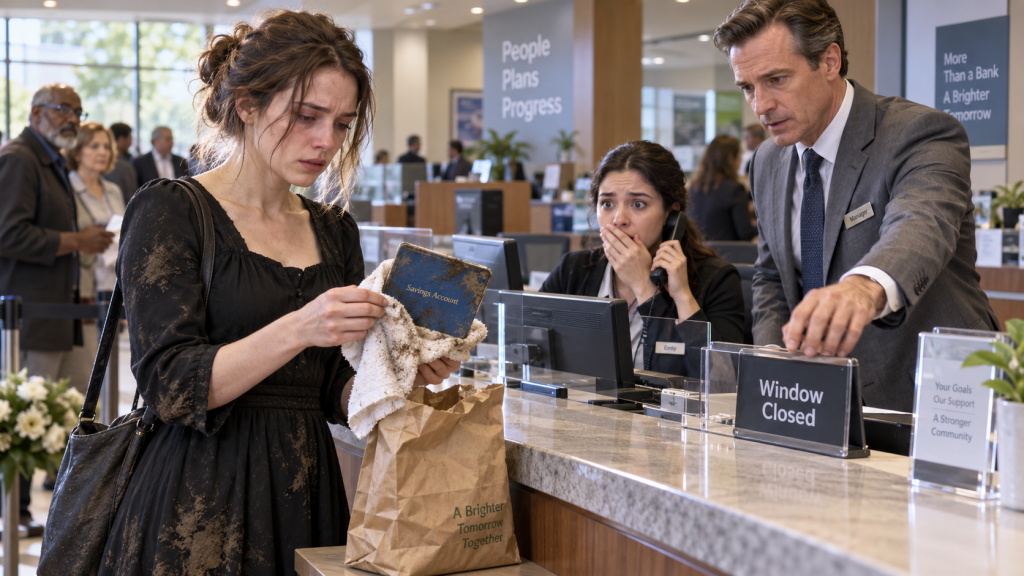
The muddy little blue book lay between us.
I looked at it differently now.
Yesterday, Dad had thrown it into Grandma’s grave because he thought it was worthless.
In reality, it had never been the key.
I was.
Grandma had made sure of that.
I returned to the letter.
Richard believes the passbook is important. Let him. Sometimes it is useful for a thief to keep looking at the wrong lock.
A strange, aching smile spread across my face.
Even in fear, she had outsmarted him.
There is more.
My smile disappeared.
The key in this envelope belongs to safe-deposit box 214 at this branch.
I looked at the brass key beside the photograph.
The manager nodded.
“I was instructed to give you access after your grandmother’s death.”
My heart began beating faster.
Everything I could document is inside. Statements. Copies of checks. Loan papers. Letters. Recordings. My corrected will. The original documents revoking Richard’s authority.
And one thing I hope you never need.
I swallowed.
Proof that he took money from your mother too.
The room tilted.
I lowered the letter.
“What?”
The word barely came out.
Nobody answered.
I looked back down.
I found the records after she died. I did not know during her illness. I swear to you I did not know.
My throat closed.
Mom.
No.
There are certain dead people you preserve inside yourself at a particular age.
My mother would always be fifty-one.
Thin from chemotherapy.
A scarf covering her hair.
Still joking that hospital pudding violated the Geneva Convention.
I had spent the last weeks of her life beside her bed, reading novels aloud when she could not sleep.
Money had been tight then.
Dad told me treatment costs were destroying them.
He asked relatives for help.
Grandma sold some investments.
I emptied the savings account I had built working summers at a bookstore.
I gave Dad $6,800.
Every dollar I had.
He hugged me.
He cried into my hair.
He told me Mom would be proud.
I suddenly could not feel my hands.
The letter shook violently.
Your mother had a life insurance policy and a separate investment account inherited from her aunt. Richard accessed part of those funds before and during her illness. I do not know whether she understood how much he took.
I looked up.
“Did he steal from my mother while she was dying?”
No one wanted to answer.
The manager finally said, “The documents in the box may help establish what happened.”
May help establish.
Bank language.
Careful language.
Language designed not to accuse someone before evidence had been examined.
But Grandma’s words were not careful.
I found two signatures in your mother’s name dated during the final week of her life. Chloe, your mother could not hold a spoon that week.
I dropped the letter.
It landed softly on the desk.
My chair scraped backward.
I stood.
I could not breathe.
I walked to the corner of the office.
Pressed both hands against the wall.
For years I had remembered that last week in pieces.
Mom sleeping.
Mom waking and asking for ice chips.
Mom whispering my name.
Dad disappearing for hours and telling me he was meeting with insurance people.
I had admired him for handling practical things while I stayed beside her.
What had he really been doing?
“Ms. Henderson?”
One of the officers had stood.
“I’m okay.”
I wasn’t.
But I needed the sentence to be true long enough to finish this.
I turned around.
“I want to see the box.”
The manager looked at the officer.
The officer nodded.
“All right.”
I folded Grandma’s letter carefully.
Not because my hands had stopped shaking.
Because hers had shaken when she wrote it.
And suddenly, every word felt sacred.
—
Safe-deposit box 214 was longer than I expected.
Metal.
Gray.
Unremarkable.
The manager used his key first.
Then handed me Grandma’s brass one.
The lock turned with a quiet click.
There are sounds that seem too small for the things they release.
A hospital monitor going flat.
A judge striking a gavel.
A door locking behind someone.
A tiny metal click.
The manager pulled out the box and carried it into a private viewing room.
Then he left me with the two officers.
I lifted the lid.
Grandma had organized everything into folders.
Of course she had.
Even her evidence had labels.
RICHARD — BANK RECORDS
RICHARD — PROPERTY
ELAINE
My mother’s name.
I touched that folder but could not open it yet.
Beside the folders was a small digital recorder.
A sealed copy of Grandma’s will.
Three photographs.
A notebook.
And one white envelope with my name.
Again.
CHLOE — LISTEN LAST.
I stared at it.
Grandma had planned the order.
She knew me too well.
If she had written LISTEN FIRST, I would have ignored everything else.
The officer introduced himself properly then.
Detective Aaron Bell.
Financial crimes.
The second officer, Officer Ramirez, had come because the bank’s fraud protocol required local police presence after suspicious documents were presented.
Detective Bell asked if I was willing to let him photograph the contents before we moved anything.
“Yes.”
He worked slowly.
Folder by folder.
Page by page.
I sat at the small table and watched my family history transform into evidence.
Checks Dad had written to himself.
Transfers into his business account.
Credit applications.
Copies of emails.
A mortgage document involving Grandma’s house.
My stomach turned.
“Did she know about this?”
I pointed.
Bell examined it.
“It looks like a home-equity application.”
“She never borrowed against her house.”
Bell did not answer immediately.
The signature at the bottom looked like Grandma’s.
Almost.
Except I had spent twenty-seven years receiving birthday cards from her.
Grandma’s capital M had a small loop at the beginning.
That one did not.
“That’s fake.”
Bell photographed it.
“We’ll have a document examiner evaluate it.”
“It’s fake.”
“I believe you recognize her signature,” he said gently. “But we’ll document it properly.”
That sentence, strangely, calmed me.
For the first time in my life, Dad’s behavior was entering a world where feelings were not the only evidence.
Dates existed.
Numbers existed.
Signatures existed.
Paper remembered.
The next folder contained statements from Grandma’s checking account.
Small withdrawals at first.
$800.
$1,200.
$2,000.
Then larger ones.
$7,500.
$14,000.
$23,000.
Grandma had highlighted transactions she did not authorize.
Beside several, she had written notes.
Richard said furnace. Not true.
Richard claimed taxes. County says paid.
Never approved this.
Asked him. He shouted.
One note simply said:
I am frightened of my own son.
I put the paper down.
That sentence destroyed something in me.
Not because I had never suspected Dad could frighten her.
Because she had written it alone.
Probably at her kitchen table.
Maybe after he left.
Maybe while the kettle whistled.
Maybe with the curtains open toward the maple tree Grandpa planted.
Grandma had lived in that house for fifty-three years.
She knew every creak in the floor.
Every neighbor.
Every cabinet hinge.
It was supposed to be the safest place she had.
And somewhere along the way, her own son had become the person whose car she dreaded seeing pull into the driveway.
Bell spoke quietly.
“Chloe, you don’t have to go through all of this today.”
“Yes, I do.”
“You can stop.”
“I know.”
I looked at him.
“But she couldn’t.”
That ended the discussion.
I opened Mom’s folder.
The first page was a copy of an account statement.
Elaine Henderson.
My mother.
I recognized the address.
Her balance nine months before she died had been $96,114.
Three months before she died:
$71,800.
One month before:
$42,360.
Then transfers.
Large transfers.
To an account ending in four digits I recognized.
Dad’s business account.
My stomach twisted.
There were signed authorizations.
Mom’s signature.
Or something pretending to be Mom’s signature.
Then came two transfers during the last week of her life.
$18,000.
$12,500.
The second had been authorized three days before she died.
Grandma had attached a copy of Mom’s hospice medication chart.
Morphine.
Lorazepam.
Notes stating she was intermittently conscious.
Unable to sign paperwork.
My chest tightened so hard I thought I might be sick.
I remembered that day.
Three days before Mom died.
I remembered because she woke around sunset.
She looked toward the window and said she wanted to see the sky.
I helped raise the blinds.
She watched the light change over the roof across the street.
Then she whispered:
“Don’t spend your life begging anyone to be gentle with you.”
At the time, I thought she meant love.
Relationships.
Marriage.
I had no idea how much wider the sentence was.
Dad had been gone that afternoon.
Bank paperwork, he said.
I had believed him.
I folded my arms across my stomach.
“He did this while she was dying.”
Bell’s expression remained professional, but his voice softened.
“We’ll need records from the receiving accounts before we know exactly where the funds went.”
“I know where they went.”
I looked at the transactions.
“Into him.”
—
We spent almost four hours inside that bank.
By the time I walked outside, the morning rain had stopped.
Cars moved along Main Street.
People carried coffee.
A woman pushed a stroller past the pharmacy.
A delivery truck blocked half the intersection.
The world had the nerve to look ordinary.
That offended me.
Grandma was dead.
My father had apparently stolen from her for more than a decade.
He may have stolen from my dying mother.
And a man in a fluorescent vest across the street was calmly eating a sandwich.
I wanted the sky to crack open.
I wanted sirens everywhere.
I wanted some visible sign that the universe understood what had just been uncovered.
Instead, my phone buzzed.
DAD
I stared at the screen until it stopped.
Then it rang again.
I declined it.
A text arrived immediately.
Where are you?
Then:
We need to talk about Grandma’s things before your uncles start grabbing everything.
Then:
Answer me.
I almost laughed.
Even now.
Even now, he was worried someone else might take something.
Detective Bell walked out behind me carrying an evidence bag.
The muddy passbook was inside.
Seeing it sealed in plastic made everything real in a way the bank office had not.
“Your father may contact you,” he said.
“He already has.”
“Do not confront him about the investigation if you can avoid it.”
I looked at Bell.
“He threw that passbook into my grandmother’s grave yesterday.”
Bell glanced at the evidence bag.
“Why?”
“Because he thought it was worthless.”
Bell was quiet.
Then he said, “People are often careless with things they believe have no value.”
I looked at the cemetery mud dried along the passbook’s edges.
“Yes.”
I thought of Grandma.
“And sometimes with people too.”
—
I drove to Grandma’s house.
I should not have.
Bell told me I did not need to go anywhere near Dad.
I could have gone home.
Locked my door.
Turned off my phone.
Cried until there was nothing left.
Instead, I drove the twelve minutes from the bank to the little white house on Willow Street.
The house where Grandma had baked birthday cakes.
The house where Grandpa had taught me to shuffle cards.
The house where my mother had once stood at the sink on Christmas Eve, elbow-deep in soap bubbles, singing badly to a radio.
The house Dad had apparently tried to borrow against without Grandma’s permission.
Three cars were parked outside.
Dad’s black SUV.
Uncle Mark’s truck.
Aunt Denise’s sedan.
My hands tightened around the steering wheel.
I almost kept driving.
Then I saw movement through the front window.
Dad.
Carrying a cardboard box.
Something inside me went cold.
I got out.
The front door was unlocked.
Voices drifted from the living room.
Dad was standing beside Grandma’s bookcase.
A box sat open on the rug.
Inside were framed photographs.
Silver candlesticks.
Grandpa’s old pocket watch.
Aunt Denise stood near the sofa, crying quietly.
Uncle Mark was examining a stack of papers.
Dad looked up.
“There you are.”
No hello.
No how are you.
“There you are.”
As though I had been late.
As though he owned the clock.
“Where were you?”
I closed the door behind me.
“The bank.”
Silence.
It was extraordinary how quickly a face could change.
Dad’s did not collapse.
It tightened.
Just slightly.
But I saw it.
His right hand stopped moving.
A photograph of Grandma and Grandpa remained suspended halfway toward the box.
Uncle Mark looked up.
“The bank?”
I looked at Dad.
“Yes.”
Dad put the photograph down.
“Why?”
“You know why.”
Aunt Denise wiped her eyes.
“What’s going on?”
Dad stepped toward me.
“Did you take that filthy passbook out of Mom’s grave?”
There it was.
Not grief.
Not confusion.
Fear disguised as anger.
“Yes.”
His face reddened.
“What the hell is wrong with you?”
I almost admired the instinct.
Attack first.
Make the other person defend themselves.
He had spent decades turning accusation into camouflage.
But something in me had changed inside that bank.
Maybe it was Grandma’s letter.
Maybe Mom’s statements.
Maybe seeing the words I am frightened of my own son written by the strongest person I had ever known.
Whatever it was, Dad raised his voice and I did not shrink.
“You threw it there.”
“Because it was garbage.”
“No.”
I looked straight at him.
“Because you hoped everyone else would think it was.”
Uncle Mark slowly lowered the papers in his hand.
Dad’s eyes narrowed.
“What did they tell you?”
Aunt Denise looked between us.
“Richard?”
Dad ignored her.
“What did that bank tell you, Chloe?”
I thought of Detective Bell.
Do not confront him.
So I did not tell Dad everything.
I gave him one sentence.
“They told me Grandma protected herself.”
He went pale.
Not dramatically.
His skin simply seemed to lose warmth.
Then came the smile.
That terrible, practiced smile.
The one he used when he wanted everyone to believe he was the calm person in the room.
“I don’t know what nonsense she told them in the last few months. Mom was confused.”
Aunt Denise whispered, “Richard…”
“She was eighty-four,” Dad continued. “She mixed things up constantly.”
I stepped closer.
“No, she didn’t.”
“You saw her once a week. I handled her finances. I know.”
My voice stayed low.
“You handled them?”
He realized the mistake.
A tiny flicker.
Then he recovered.
“She asked me to help.”
“With what?”
“Bills.”
“Loans?”
His jaw tightened.
“Don’t start.”
“Transfers?”
“Chloe.”
“Credit lines?”
Aunt Denise’s hand flew to her mouth.
Uncle Mark stared at Dad.
“What credit lines?”
Dad turned.
“Nothing.”
I looked at Uncle Mark.
“Grandma kept records.”
Dad’s head snapped back toward me.
“What records?”
That was the moment I knew.
Not suspected.
Knew.
An innocent man asks:
What are you talking about?
My father asked:
What records?
I felt something inside me break cleanly in half.
Maybe the last piece of the daughter who still wanted a different explanation.
A clerical mistake.
A misunderstanding.
A confused old woman.
Anything.
Dad took another step toward me.
“What records, Chloe?”
I said nothing.
His voice rose.
“What did she give you?”
Aunt Denise whispered, “Richard, stop.”
He pointed at me.
“She has no idea what she’s getting involved in.”
I almost smiled.
For the first time in my life, that sentence did not frighten me.
“I think I’m beginning to.”
Dad’s face twisted.
“You always do this.”
I blinked.
“Do what?”
“Turn everything into some moral drama where you’re the good one.”
That was so familiar it almost felt comforting.
The old script.
“You barely visited your grandmother compared with me.”
Three times a week.
That was how often I visited Grandma.
Every Wednesday evening.
Most Saturdays.
And Sunday lunch whenever work allowed.
But facts had never stopped Dad when guilt was more useful.
“She depended on me,” he said.
“She was afraid of you.”
Silence.
I had not meant to say it.
But once the sentence existed, I refused to take it back.
Dad stared at me.
Aunt Denise started crying again.
Uncle Mark sat down.
Dad’s voice dropped.
“Who told you that?”
“Grandma.”
“When?”
“She wrote it.”
His eyes changed.
There are truths you can argue with.
And truths written in the hand of a dead woman.
He turned away.
Ran one hand through his hair.
Then laughed once.
It was ugly.
“You have no idea what I did for that woman.”
“What did you do?”
“I took her to appointments. Fixed the house. Bought groceries. Paid bills. Dealt with insurance. Sat with her when you were busy living your life.”
“You mean working?”
“You were always too busy.”
“And that entitled you to her money?”
“I didn’t say that.”
“You didn’t have to.”
Dad slammed his palm against the bookcase.
Aunt Denise jumped.
There he was.
The man behind the smile.
“She was my mother!”
“And I was her granddaughter.”
“She owed me!”
The words exploded through the room.
No one moved.
Even Dad seemed shocked that he had said them aloud.
I stared at him.
There it was.
Not confusion.
Not desperation.
Not a misunderstanding.
Entitlement.
Pure and simple.
Grandma’s money belonged to him because he believed her life belonged to him.
Her house.
Her accounts.
Her labor.
Her gratitude.
Her age.
Her fear.
Everything.
Aunt Denise whispered, “She owed you?”
Dad breathed hard.
“That’s not what I meant.”
“It sounded pretty clear,” Uncle Mark said.
Dad spun toward him.
“Stay out of this.”
Mark stood.
“She was my mother too.”
“And when did you ever help?”
“I helped when she asked.”
“She shouldn’t have had to ask!”
“No,” Mark said. “But helping her doesn’t mean you get to rob her.”
Dad froze.
The word landed harder than anything I had said.
Rob.
A simple word.
An ugly word.
A word without family excuses wrapped around it.
Dad looked at me.
“You went to the police.”
Not a question.
I did not answer.
His nostrils flared.
“You stupid little girl.”
Something in Aunt Denise changed.
“Don’t.”
Dad looked at her.
“What?”
“Don’t talk to her like that.”
“Oh, now everybody’s brave?”
Denise flinched.
Then straightened.
“Yes.”
That one word shifted the room.
Dad stared at his younger sister.
She wiped her face.
“I should have been brave sooner.”
He scoffed.
“You don’t even know what’s happening.”
“I know Mom asked me last year whether you could legally sell her house without permission.”
Dad stopped moving.
I turned toward Denise.
“What?”
Her face crumpled.
“She asked me.”
“When?”
“Last November.”
“Why didn’t you tell me?”
“I thought she was confused.”
The words came out broken.
“I thought… God, Chloe, Richard kept telling us she was getting confused, and sometimes she did forget little things. She’d repeat stories. Lose her glasses. She asked the same question twice sometimes.”
“That’s called being eighty-four,” Mark said bitterly.
Denise covered her face.
“I know that now.”
Dad grabbed his coat from the chair.
“This is ridiculous.”
I stepped aside.
Not to stop him.
To make sure he understood he was free to leave.
That seemed to anger him more.
“You think you won?” he asked me.
I almost answered.
Then realized there was nothing to win.
Grandma was dead.
Mom was dead.
Money did not resurrect people.
Evidence did not erase fear.
Justice did not return stolen years.
So I said the only thing that felt true.
“No.”
Dad waited.
“I think Grandma finally stopped losing.”
His face hardened.
Then he walked out.
The front door slammed so violently the small glass pane rattled.
For several seconds, nobody spoke.
Then Aunt Denise sat on Grandma’s sofa and sobbed.
Not delicately.
Not quietly.
She bent forward with her hands over her face and cried like a child.
“I should have listened to her.”
I stood in the center of the room.
Part of me wanted to comfort her.
Another part wanted to scream.
Where were you?
Where were all of you?
Why was Grandma left to collect evidence against her own son while everyone else called her confused?
But I remembered Grandma’s letter.
Silence does not always protect the people we love.
And I knew screaming at Denise would not change what had happened.
So I sat beside her.
“I should have listened too.”
Denise looked up.
“You didn’t know.”
“Neither did you.”
“She asked me directly.”
“And Dad spent years teaching all of us not to trust her.”
Denise shook her head.
“That’s no excuse.”
“No.”
I swallowed.
“It isn’t.”
We sat with that.
No excuses.
But maybe, eventually, understanding.
There is a difference.
Grandma had taught me that too.
You can understand why someone failed you without pretending they didn’t fail you.
—
Dad was arrested forty-eight hours later.
Not for everything.
Not yet.
Investigations take time.
Real life is slower than rage.
But the bank had surveillance footage from his attempted withdrawal six months earlier.
They had forged authorization documents.
They had Grandma’s original fraud report.
They had her recorded interview with the bank’s compliance department.
And they had enough evidence related to the attempted transfer to obtain a warrant.
I learned he had been arrested from Uncle Mark.
Not from the police.
Not from Dad.
Mark called me at 6:12 in the morning.
“Chloe.”
His voice sounded strange.
“He’s in custody.”
I sat upright in bed.
Outside, dawn had barely started.
The apartment was gray.
“For what?”
“Forgery. Attempted theft. Financial exploitation charges. There may be more.”
I closed my eyes.
I expected relief.
Instead I felt hollow.
That surprised me.
For days, I had imagined police putting handcuffs on Dad.
Some childish part of me believed the moment would feel like justice arriving.
Trumpets.
Vindication.
A door opening.
Instead, I pictured him sitting alone in a holding cell wearing yesterday’s clothes.
My father.
The man who taught me to ride a bicycle by running behind me with one hand on the seat.
The man who brought me soup when I had pneumonia at fourteen.
The man who stole from his dying wife.
The man who frightened his elderly mother.
Human beings are terrible that way.
They refuse to become only one thing.
Loving someone who hurts people does not make the harm disappear.
Knowing they caused harm does not erase every good memory.
Both truths live inside you.
And they fight.
I sat on the edge of my bed until sunlight reached the wall.
Then I got dressed.
I drove to Grandma’s house.
And for the first time since she died, I made coffee in her kitchen.
One cup.
I reached automatically for her mug.
The white one with tiny blue flowers.
Then stopped.
I could not use it.
Not yet.
So I used Grandpa’s old brown mug instead.
I carried it to the table.
Grandma’s chair stood empty across from me.
“Dad got arrested,” I said aloud.
The room did not answer.
I laughed once.
Then cried.
“Was this what you wanted?”
Silence.
I looked toward the window.
Grandma had kept three African violets on the sill.
Two were blooming.
The third looked terrible.
Leaves drooping.
Soil dry.
I stood.
Filled a measuring cup with water.
And watered it.
That was grief, I learned.
The world ends.
Then you notice a plant is thirsty.
—
The investigation lasted seven months.
Seven months of statements.
Interviews.
Records.
Subpoenas.
Phone calls from attorneys.
Family arguments.
Canceled holidays.
Rumors.
People choosing sides.
People pretending not to choose sides while clearly choosing sides.
Dad was released on bond two days after his arrest.
He called me seventeen times that first week.
I answered none of them.
Then came the voicemail.
“Chloe, this has gone far enough.”
I deleted it.
Another.
“You don’t understand the financial arrangements your grandmother and I had.”
Deleted.
Another.
“If you cared about this family, you would call me before lawyers turn this into something it isn’t.”
Deleted.
Then:
“Your mother would be ashamed of you.”
I did not delete that one.
I listened twice.
Not because I believed him.
Because something changed in me the second time.
All my life, that sentence would have destroyed me.
Mom would be ashamed.
Grandma would be disappointed.
Your family needs you.
You’re selfish.
You’re ungrateful.
Dad had always borrowed the voices of dead people when his own authority stopped working.
But this time, I had Grandma’s actual voice.
And soon, I would hear it.
A week after the funeral, I returned to the safe-deposit box alone.
The white envelope remained there.
CHLOE — LISTEN LAST.
Inside was the digital recorder and a note.
Make tea first. You always listen better with something warm in your hands.
I laughed so hard I cried.
So I drove to Grandma’s house.
Made tea.
Sat at the kitchen table.
Put the recorder between my hands.
And pressed play.
Static.
A small cough.
Then:
“Is the red light on?”
Grandma’s voice.
Alive.
I stopped the recording.
I could not do it.
I put both hands over my face.
Her voice had entered the room as though death had only been a scheduling problem.
After several minutes, I pressed play again.
“Is the red light on? I think it is. Lord, Margaret, just talk.”
I laughed through my tears.
Then Grandma sighed.
“Hello, Chloe.”
My heart cracked open.
“If you are hearing this, then I suppose I have finally managed to become unbearable from beyond the grave.”
I lowered my forehead onto my hand.
“I am sorry.”
Her voice changed.
Softened.
“I am sorry for leaving you this mess.”
She paused.
“I wish I had been braver sooner.”
I whispered, “You were brave.”
The recording continued.
“I know what you are going to do. You are going to sit there and decide everything was obvious and that you should have known.”
I froze.
“You will remember every bruise you overlooked. Every time I changed the subject. Every time your father spoke for me. And because you are your mother’s daughter, you will find some way to blame yourself.”
My lips trembled.
“So I need you to listen to me carefully.”
Her voice became firm.
“This is not yours to carry.”
I closed my eyes.
“I hid things from you. I lied when you asked whether I was all right. I made excuses for your father because I was ashamed. You cannot know what someone works hard to hide.”
A long pause.
“And if you are angry with me for that, you are allowed to be.”
That surprised me.
Grandma had always apologized terribly.
She preferred feeding you pie.
“I spent too many years teaching you that good women forgive quickly.”
She sighed.
“I was wrong about that.”
I smiled.
“Forgiveness is not the same as pretending. It is not forgetting. And it is certainly not handing the knife back to someone because they said sorry for cutting you.”
I wrote that sentence down later.
At the time, I only cried.
“Your father may apologize.”
Grandma paused.
“He may mean it.”
Another pause.
“That still does not require you to trust him.”
The kettle clicked softly behind me as it cooled.
“You may love him.”
My throat tightened.
“That does not require you to save him.”
I had spent my whole life confusing those two things.
Love.
Rescue.
I thought they were synonyms.
Grandma knew better.
“Your grandfather loved your father very much,” she continued. “So did I. Perhaps that is part of why we excused things too long.”
Her voice shook slightly.
“Love becomes dangerous when it asks truth to leave the room.”
I looked toward Grandma’s empty chair.
There are sentences you hear once and spend the rest of your life understanding.
That was one of them.
Grandma spoke for almost twenty minutes.
She told me about the account.
About Grandpa.
About why they saved.
She told me not to give all the money away out of guilt.
That part made me laugh.
“I know you,” she said. “You’ll want to turn it into scholarships and animal shelters and buy everyone winter coats. You may do some good with it if that makes you happy. But you listen to me: some of that money is for your life.”
I wiped my face.
“Go somewhere.”
A breath.
“Buy a home if you want one.”
Another.
“Take a class nobody thinks is useful.”
She laughed softly.
“Buy the expensive cheese.”
I laughed too.
“Your grandfather saved that money because he wanted your life to have choices.”
Her voice grew quieter.
“Do not turn our gift into another obligation.”
I stared at the tea in my hands.
That was Grandma’s final lesson about money.
Money is not love.
But sometimes love saves money so someone else can have freedom.
There is a difference.
Then she said something I was not prepared for.
“I need to tell you about your mother.”
I gripped the mug.
“I believe Elaine knew something was wrong before she died.”
I stopped breathing.
“She came to see me about two months before the end. Richard was not with her. She was very weak.”
Grandma’s voice cracked.
“She asked me whether I had ever signed documents I did not remember signing.”
My skin prickled.
“I asked what she meant. She said Richard had been moving money and telling her not to worry about it. She said she was tired and did not want to spend whatever time she had left fighting.”
I closed my eyes.
That sounded like Mom.
God.
It sounded exactly like her.
“But she told me something else.”
Grandma paused.
“She said, ‘If Chloe ever asks, tell her I knew she tried to protect me.’”
I covered my mouth.
The room blurred.
“When you gave your mother your savings, she found out. Richard told her later.”
My breath broke.
“She was furious.”
I laughed and sobbed at the same time.
Of course she was.
Mom hated borrowing money from me.
“She made him promise to return it.”
Grandma inhaled shakily.
“He never did.”
I looked down.
My hands were trembling.
“But Chloe…”
Grandma’s voice softened.
“Your mother did not die believing you failed her.”
I bowed my head.
I had never said that fear aloud.
Not to anyone.
But Grandma had known.
“She knew you sat beside her.”
“She knew you read to her.”
“She knew you washed her hair.”
“She knew you slept on the floor when the hospital chair hurt your back.”
“She knew.”
I was crying so hard I almost missed the next sentence.
“She knew exactly who loved her.”
I stopped the recording.
I put my head down on Grandma’s kitchen table.
And for the first time since I was nineteen years old, I cried for my mother without also blaming myself for something.
I had carried guilt for eight years.
Why did I go home that one night?
Why did I become impatient when she refused food?
Why had I not noticed Dad’s money problems?
Why had I not asked more questions?
Grief is talented at rewriting history until you become the villain of every scene.
Grandma gave me the story back.
Mom knew.
She knew I loved her.
That was enough.
Eventually, I pressed play again.
Grandma’s voice returned.
“Now there is one final thing.”
A long pause.
“You do not owe the Henderson family your silence.”
I straightened.
“People will ask you to keep this private.”
She was right.
They already had.
“Some will say Richard has suffered enough.”
They did.
“Some will say exposing him hurts everyone.”
They said that too.
“Some will remind you of good things he has done.”
Yes.
“They may all be telling the truth.”
I waited.
“But truth does not cancel truth.”
My chest tightened.
“Your father can have loved you and harmed me.”
“He can have cared for his wife and stolen from her.”
“He can have done generous things and cruel things.”
“Life would be easier if bad people were bad every minute.”
Grandma gave a tired little laugh.
“They aren’t.”
I wiped my eyes.
“That is why boundaries matter.”
Then:
“I hope Richard changes.”
My eyes opened.
“I do.”
There was no bitterness in her voice.
“I hope someday he looks honestly at what he has done and becomes someone better.”
Another pause.
“But Chloe, his becoming better is his job.”
I swallowed.
“Your job is to become free.”
The recording grew quiet.
I knew the end was coming.
I wanted to stop it.
To preserve one final unheard minute.
As if unheard words remained alive.
But Grandma continued.
“When you were little, you once asked me what happens to love when someone dies.”
I remembered.
Grandpa’s sister had died.
I was six.
“I told you love becomes memory.”
She paused.
“I think I was wrong.”
My tears came again.
“I think memory is only one place love goes.”
Outside, wind moved through the maple branches.
“I think some of it becomes courage.”
I shut my eyes.
“Some becomes patience.”
“Some becomes the voice in your head saying, ‘No, sweetheart, you deserve better than that.’”
I laughed.
“And some of it becomes the strength to walk away from the table when someone keeps serving you pain and calling it family.”
My hand covered my heart.
“So if you miss me, use me.”
Her voice broke.
“Use what I taught you.”
“Plant tomatoes too deep.”
“Burn the first pancake.”
“Keep emergency cash.”
“Wear lipstick to the grocery store if you feel like it.”
“Do not marry anyone who is rude to waiters.”
I laughed through tears.
“And when somebody tells you that love requires you to disappear…”
A pause.
“Do not believe them.”
The recorder hissed softly.
Then Grandma said:
“I love you, Chloe Marie.”
My entire body shook.
“More than the money.”
“More than the house.”
“More than any proof I left behind.”
“You were never an account to me.”
“You were the best part.”
Another pause.
“Now go live.”
Click.
The recording ended.
I sat there until the tea became cold.
—
The forensic accounting took months.
When investigators finally explained the total, the number sounded unreal.
Dad had taken or attempted to take more than $470,000 from Grandma across eleven years.
Not all through outright theft.
Some transfers had begun as loans.
Grandma had willingly helped him at first.
But the pattern changed.
Unauthorized transfers.
Forged documents.
Credit accounts.
A line of credit against her house.
Money redirected from investments.
The bank had prevented the largest attempt: the account intended for me.
That one transfer alone would have been $360,000.
Then there was Mom.
The investigation found that more than $80,000 moved from her separate assets into accounts controlled primarily by Dad during the final year of her life.
Some might have been legally accessible because they were married.
Some was not.
Some documents were disputed.
Some signatures could not conclusively be attributed.
Death had left gaps no investigation could fill.
That was one of the hardest things to accept.
I wanted every question answered.
Life does not always give you that.
Sometimes justice arrives with footnotes.
The prosecutors focused on what they could prove.
The attempted theft from Grandma’s protected account.
The forged authorizations.
Two loans tied to documents Grandma denied signing.
Unauthorized transfers made after she had formally revoked Dad’s power of attorney.
Financial exploitation of an elderly adult.
Forgery.
Fraud.
The case grew.
So did the family fracture.
My cousin Jared called me one night.
“Why are you destroying Uncle Richard?”
I almost hung up.
Instead I asked, “What did he tell you?”
“That Grandma gave him permission.”
“She filed a fraud report against him.”
Silence.
“He said she was confused.”
“She recorded an interview.”
Another silence.
“He said you manipulated her.”
I laughed.
Not because it was funny.
Because Dad had finally run out of dead women to blame and arrived at me.
“What would you like me to do, Jared?”
“I don’t know. Just… families don’t do this to each other.”
I stared out my apartment window.
“Exactly.”
He went quiet.
I do not know whether that sentence changed his mind.
Maybe it did.
Maybe it didn’t.
But I stopped arguing afterward.
People who truly wanted to understand could see the records.
People who wanted a simpler story would invent one.
I could not spend my life attending trials inside other people’s heads.
—
Dad asked to see me three months after his arrest.
Through his lawyer.
I said no.
He asked again.
I said no again.
Then he wrote a letter.
I left it unopened for six days.
On the seventh, I drove to Grandma’s house and opened it at her kitchen table.
It began:
Chloe,
I know you think I’m a monster.
I almost stopped.
That sentence already shifted responsibility onto me.
What I think.
Not what he did.
But I continued.
There are things you don’t understand about your grandmother and me. She could be controlling. She used money to judge people. She helped your uncle more than she helped me. Your grandfather always respected Mark more. I spent my whole life feeling like the disappointment.
I stared at the page.
Maybe some of that was true.
Families are full of old wounds nobody else can see.
Grandma had not been perfect.
Grandpa had not been perfect.
Maybe Dad had grown up feeling second best.
Maybe resentment had started young.
But childhood wounds are explanations.
Not licenses.
I kept reading.
My business failed twice. I was drowning. Your mother was sick. I was terrified. Your grandmother had hundreds of thousands of dollars sitting there while I was losing everything.
There.
There it was again.
Sitting there.
As though money belonging to somebody else became his because his need was louder.
Yes, I moved funds. I intended to replace them.
I looked at the dates.
Eleven years.
I never wanted to hurt Mom.
Maybe that was true.
That may have been the saddest part.
People do terrible things without waking up one morning and deciding to become terrible.
They justify.
Then justify the justification.
Then justify the consequences.
Eventually they cannot see the original line they crossed.
I know grabbing her wrist was wrong. I was angry. I apologized.
Grandma had not mentioned an apology.
I should never have tried to move the money in your account.
Finally.
A sentence without fog.
Then:
But I need you to understand I thought I was protecting the family.
I put the letter down.
Protection.
That word had done enough damage in our family.
Grandma hid the truth to protect me.
Dad stole to protect the family.
Denise stayed quiet to protect peace.
Everyone protecting.
Everyone hurting.
Maybe real protection sometimes looks less heroic.
Ask questions.
Believe people.
Tell the truth.
Say no.
I finished the letter.
I am still your father.
That was the final sentence.
Not I am sorry.
Not I love you.
Not I will repay what I can.
I am still your father.
A title held up like a shield.
I folded the letter.
Then, on the back, I wrote four words.
And she was your mother.
I never mailed it.
I did not need to.
Some answers are for yourself.
—
Grandma’s will was read in October.
She left Aunt Denise her jewelry.
Uncle Mark got Grandpa’s tools, the old fishing boat, and a collection of records he had loved since high school.
Several charities received smaller amounts.
The church got money for its food pantry.
Her neighbor, Mrs. Keller, inherited the rose-patterned china because they had drunk coffee from it every Thursday for almost thirty years.
Dad was left one thing.
Grandpa’s Bible.
Nothing else.
Tucked inside was a handwritten note.
Nobody showed me the exact wording.
Mark said it belonged to Dad.
I agreed.
For once, I did not need to know everything.
Grandma left the house to me.
That stunned me more than the account.
I had assumed it would be sold and divided.
But her will was explicit.
To Chloe Marie Henderson, I leave my home at 18 Willow Street, if she wants it. If she does not, she may sell it without guilt. A home should never become a burden simply because someone loved you inside it.
I read that paragraph five times.
Even dead, Grandma refused to trap me.
I did not move in immediately.
For months, the house remained exactly as she left it.
Her coat behind the door.
Reading glasses beside the sofa.
A grocery list attached to the refrigerator.
Eggs
Tea
Apples
Dish soap
Birthday card for Chloe
That last line nearly ruined me.
My birthday was three weeks after she died.
I found the card later.
Already purchased.
Unsigned.
A yellow envelope with flowers.
For a long time, I thought that was cruel.
Not Grandma.
Time.
It had allowed her to buy the card but not write inside it.
Eventually I placed the blank card in a drawer beside her letter.
Not every unfinished thing needs finishing.
Sometimes it can simply be proof that someone intended to be there.
—
Dad’s case did not go to a dramatic trial.
There was no packed courtroom.
No surprise witness.
No last-minute confession.
Real justice, I learned, is usually less cinematic and more exhausting.
His lawyer negotiated.
Evidence was exchanged.
Charges were amended.
Restitution calculations went back and forth.
Dad eventually pleaded guilty to multiple financial crimes related to Grandma’s accounts.
Other allegations were not pursued separately.
I was angry about that at first.
I wanted every stolen dollar named.
Every lie.
Every signature.
Every night Grandma sat frightened at her table.
I wanted a legal document large enough to contain all of it.
There is no such document.
A criminal case can address crimes.
It cannot prosecute betrayal.
There is no sentence enhancement for making your mother afraid to answer the door.
No restitution table for the years someone doubted her own judgment.
No line item for the granddaughter who discovers her family history inside a safe-deposit box.
The judge ordered restitution.
Dad lost his business.
He sold his SUV.
A property he owned jointly with an investor was liquidated.
Some money was recovered.
Some never would be.
He received a sentence that included incarceration followed by supervised release.
I will not pretend I felt satisfied when the judge announced it.
I felt tired.
Dad stood at the defense table in a dark suit that hung looser on him than it had before.
Seven months had aged him.
His hair had gone noticeably gray.
For one terrible second, he looked like Grandpa.
I hated that.
Genetics can be cruel.
Before sentencing, Dad was allowed to speak.
He unfolded a sheet of paper.
His hands trembled.
“I have spent most of this case angry.”
His voice was rough.
“At the bank. At the police. At prosecutors. At my siblings. At my daughter.”
He looked at me.
I did not look away.
“I told myself everybody misunderstood.”
He swallowed.
“I told myself my mother had given me permission years earlier and that somehow meant I could keep deciding for her.”
The courtroom was completely quiet.
“I told myself I would put the money back.”
His eyes lowered.
“I did not.”
Something tightened in my chest.
“I told myself I was owed things because I helped her.”
He breathed in.
“I was not.”
Aunt Denise began crying beside me.
“I hurt my mother.”
Dad’s voice broke.
For the first time, I heard the sentence I had waited months for.
Without excuses.
Without but.
“I hurt my mother.”
He wiped his eyes.
“And I made her afraid of me.”
I looked down at my hands.
“I do not expect my daughter to forgive me.”
My jaw tightened.
“I hope someday she believes that I understand why.”
Dad looked toward me.
“I am sorry, Chloe.”
I closed my eyes.
There it was.
The apology.
The thing families pretend fixes everything.
It did not.
I believed he was sorry in that moment.
I also believed Grandma.
An apology does not require trust.
Dad turned toward the judge.
“My mother deserved better from me.”
I cried then.
Quietly.
Not for Dad.
Not exactly.
For Grandma.
Because she had deserved to hear that sentence while she was alive.
And she never did.
—
I visited Dad once.
Eleven months after sentencing.
I did not tell anyone beforehand.
Not Aunt Denise.
Not Mark.
Not my therapist.
Yes, I had started therapy.
Grandma would have approved after pretending she did not understand why therapists cost so much.
I drove two hours to the correctional facility.
Parked.
Sat inside my car for twenty minutes.
Almost left.
Then I remembered Grandma:
His becoming better is his job.
Your job is to become free.
Freedom, I was discovering, did not always mean distance.
Sometimes it meant being able to enter a room without surrendering yourself.
Dad sat behind glass.
He looked older.
Smaller.
That was difficult too.
Children spend years believing their parents are physically larger than ordinary people.
Even when you grow up, part of your brain preserves the scale.
Then one day you see your father in a plastic chair beneath fluorescent lights.
And he is simply a man.
He picked up the phone.
I did the same.
“Hi.”
“Hi.”
He smiled faintly.
“You look like your mother.”
I almost ended the visit right there.
Not because it was cruel.
Because he knew those words could reach inside me.
Maybe he meant nothing by it.
Maybe he meant everything.
“I came because I need to say something,” I told him.
His smile disappeared.
He nodded.
“All right.”
“I believe you’re sorry.”
His eyes filled immediately.
I held up one hand.
“But that doesn’t mean things go back.”
He closed his mouth.
“I don’t know if we’ll ever have a normal father-daughter relationship.”
He nodded slowly.
“I understand.”
“No.”
I shook my head.
“I don’t think you do yet.”
His face tightened.
Maybe from pain.
Maybe defensiveness.
I continued.
“All my life, when you were hurt, everybody else had to become smaller.”
He looked down.
“If you were angry, we apologized.”
“If you were scared, we reassured you.”
“If you needed money, somebody paid.”
“If you made a mistake, somebody explained why it wasn’t really your fault.”
His hand gripped the phone.
“And Grandma did that too long.”
I swallowed.
“So did Mom.”
Dad closed his eyes.
“So did I.”
That one hurt.
“But I’m finished.”
He nodded.
A tear moved down his cheek.
“I know.”
“I’m not coming here every week.”
“I know.”
“I’m not managing your lawyer, your bills, your appeals, or your life.”
“I wouldn’t ask you to.”
“You might.”
That made him flinch.
I hated hurting him.
That is the secret nobody tells you about boundaries.
They can be necessary and still hurt.
You can love someone and hate the pain on their face.
You can know you are doing the right thing and still want to apologize for it.
I did not.
Dad wiped his eyes.
“I read Grandma’s note.”
I had not expected that.
“The one inside Grandpa’s Bible?”
He nodded.
I waited.
He looked through the glass.
“She wrote, ‘Richard, I loved you every day of your life. I just finally learned that loving you does not mean letting you take from me.’”
My breath caught.
Of course she had.
Even her final words to him were both love and boundary.
Dad looked down.
“I wish she had hated me.”
That surprised me.
“Why?”
“Would’ve been easier.”
His laugh was bitter.
“If she hated me, I could tell myself she did all of this to punish me.”
He looked at me.
“But she didn’t.”
“No.”
“I think that’s worse.”
I understood what he meant.
Hatred gives people somewhere to hide.
Love sometimes leaves them alone with themselves.
Dad pressed his palm against the glass.
Not dramatically.
Just rested it there.
“I’m trying, Chloe.”
I looked at his hand.
When I was little, that hand had seemed enormous around mine.
I remembered crossing busy parking lots.
Holding his finger.
Squeezing.
I did not put my hand against the glass.
But I stayed seated.
“I hope you keep trying.”
The buzzer sounded.
Our time was nearly finished.
Dad’s face crumpled for half a second.
“Will you come again?”
I could have lied.
Instead:
“I don’t know.”
He nodded.
For once, he accepted an answer he did not like.
That mattered.
A little.
I hung up.
Walked out.
And cried in my car.
Then I drove home.
Not to my apartment.
To Willow Street.
To Grandma’s house.
My house now.
—
I moved in the following spring.
I changed almost nothing at first.
Then one Saturday, sunlight came through the kitchen windows and I realized I was treating the house like a museum.
Grandma would have hated that.
She believed homes were meant to be used hard.
So I painted the spare bedroom.
Replaced the broken porch light.
Bought a new sofa.
Donated clothes.
Gave away three boxes of kitchen equipment no human being needs.
Nobody needs eleven pie plates.
Even Grandma.
I kept four.
I kept Grandpa’s chair.
I kept the kitchen table.
And I kept the mark on the pantry door where Grandpa measured my height from age four until sixteen.
When the painter offered to cover it, I nearly tackled him.
The account remained mostly untouched for almost a year.
I was afraid of it.
Not because Dad could reach it.
Because money that large changes things.
I met with a fiduciary adviser who had no relationship with my family.
I paid off my student loans.
I created an emergency fund.
I invested most of the rest.
Then I did something Grandma predicted.
I started a small scholarship.
Not enormous.
Not performative.
One scholarship each year for a student caring for a sick parent or grandparent while trying to finish school.
I named it after both Grandma and Mom.
The Margaret and Elaine Henderson Scholarship.
The first recipient was a nineteen-year-old nursing student named Kayla whose father had ALS.
When I called to tell her, she went silent.
Then she started crying.
“I was going to drop two classes so I could work more hours.”
I closed my eyes.
Grandpa’s voice entered my head.
Running-away money.
No.
Choice money.
That was what it really was.
Money that lets someone choose.
“Stay in your classes,” I told her.
After we hung up, I sat at Grandma’s kitchen table and cried again.
I seemed to do a lot of that in those days.
But grief was changing.
At first it had been an ocean.
Then a river.
Then weather.
It still arrived unexpectedly.
But it no longer drowned everything.
—
On the first anniversary of Grandma’s death, I went to Oakfield Cemetery alone.
The morning was cold.
The same maple trees had started turning gold.
Grandma’s stone sat beside Grandpa’s.
Simple.
Gray.
Exactly what she had requested.
MARGARET ELAINE HENDERSON
1942–2026
BELOVED WIFE, MOTHER, GRANDMOTHER
I sat on the grass.
For a while, I said nothing.
Then I pulled something from my coat pocket.
A copy of the old passbook.
Not the original.
That remained stored with the case records for a long time before eventually being returned.
The original mud stains never completely came out.
I had put it into a clear protective sleeve.
But today I had brought a photocopy.
I held it up.
“Remember this?”
Wind moved through the grass.
“Dad said it wasn’t worth a dime.”
My voice caught.
“I guess he was wrong about a few things.”
I smiled.
Then I looked at Grandpa’s stone.
“You two were sneaky.”
A bird landed several yards away.
“You know what I bought?”
I paused.
“The expensive cheese.”
I laughed.
It came out half sob.
“Seventeen dollars, Grandma.”
I shook my head.
“You would’ve complained for twenty minutes.”
I stayed almost an hour.
I told her about the scholarship.
The house.
Dad.
Therapy.
The violet that had somehow survived despite my terrible plant-care skills.
I told Grandpa I still hated fishing.
I told Mom I finally understood that she knew I loved her.
Then I became quiet.
There was one thing left.
“Thank you.”
The words felt insufficient.
Thank you for the money?
No.
Thank you for the house?
No.
Those were things.
Useful things.
Life-changing things.
But still things.
I touched Grandma’s name carved into stone.
“Thank you for believing me before I even knew what I needed to believe.”
My eyes filled.
“Thank you for making sure I had a way out.”
The wind lifted my hair.
“And thank you for finally finding your own.”
I placed a small bunch of lavender beneath the stone.
Then I stood.
As I walked toward my car, I thought about the funeral.
Dad in his black gloves.
The muddy grave.
The blue passbook landing against Grandma’s dress.
“That book isn’t worth a dime.”
He believed he was throwing away an object.
But what he actually threw into that grave was his last chance to control the story.
Because I picked it up.
That was all.
Such a small action.
Bend down.
Reach into the dirt.
Take back what someone else discarded.
Grandma had written on the photograph:
Some things survive because somebody loves them enough to dig them back out.
For a long time, I thought she meant the tomatoes.
Then I thought she meant the passbook.
Eventually I understood.
She meant herself.
She meant Mom.
She meant me.
Maybe she meant all of us.
—
Two years passed.
Life became quieter.
Not perfect.
Quieter.
Dad and I exchanged letters occasionally.
His changed over time.
The first ones were full of explanations.
Then fewer explanations.
Then questions.
How is work?
Did the roof repair hold?
Is the maple tree still losing branches?
One letter contained only six sentences.
The last was:
I’m learning that missing someone is not the same as having the right to demand their return.
I kept that one.
Not because it fixed anything.
Because it sounded like growth.
And growth deserved to be noticed even when trust was still far away.
Aunt Denise came over every Thursday, taking over Mrs. Keller’s old coffee ritual after she moved to assisted living.
Mark repaired the porch swing.
We did not become a magically healed family.
There were awkward holidays.
Empty chairs.
Arguments.
Subjects we approached carefully.
People who never apologized.
People who apologized too much.
Cousins who stayed distant.
Others who returned.
Healing was less like stitching a torn cloth and more like making something new from pieces that no longer fit the old pattern.
That was okay.
One Sunday in June, I stood in Grandma’s backyard planting tomatoes.
I had avoided it for two years.
Too sentimental.
Too obvious.
Then I bought six plants on impulse.
I knelt in the garden.
Dug the holes.
And immediately heard Grandma’s voice in my head.
Not so deep, Chloe.
I laughed.
“Fine.”
I lifted one plant.
Shallowed the hole.
“You happy?”
A little girl’s voice came from behind the fence.
“Who are you talking to?”
I turned.
My neighbor’s daughter, Sophie, was peeking between the boards.
She was six.
Missing one front tooth.
“My grandmother.”
“Where is she?”
I looked toward the sky automatically.
Then stopped.
That answer had never satisfied me.
“She died.”
Sophie considered this.
“Then how are you talking to her?”
I smiled.
“I remember what she would say.”
The child nodded as though that made perfect sense.
Maybe it did.
“Can I help?”
“Sure.”
Her mother gave permission, and Sophie came through the gate.
I showed her how to loosen the roots.
She immediately buried the first tomato too deep.
I stared at it.
Then laughed so suddenly Sophie looked alarmed.
“What?”
“Nothing.”
I crouched beside her.
“Somebody once taught me we don’t put them quite that deep.”
Together, we dug it back out.
I thought of the photograph.
Four-year-old me.
Red overalls.
Grandma laughing.
Grandpa beside her.
Some things survive because somebody loves them enough to dig them back out.
My eyes filled.
Sophie looked worried.
“Are you crying?”
“A little.”
“Why?”
I brushed dirt from my fingers.
“Because I miss somebody.”
“Oh.”
She thought.
“Was she nice?”
I looked at Grandma’s kitchen window.
At the blue-flowered mug now sitting beside my sink.
At the house she had trusted me with.
At the life she had quietly prepared me to live.
“Yes.”
Then I corrected myself.
“She was brave.”
Sophie nodded solemnly.
“That’s good.”
“Yes.”
I smiled.
“It is.”
—
That autumn, the bank called.
The original passbook was ready to be returned.
I almost told them to destroy it.
Then I changed my mind.
I drove downtown.
The same branch.
The same counter.
The teller from that first morning still worked there.
Her name was Melissa.
I had been too terrified that day to notice her name tag.
When she saw me, recognition crossed her face.
“Ms. Henderson.”
“Chloe is fine.”
She smiled.
“How have you been?”
It was such a normal question.
And for once, I had a normal answer.
“Pretty good.”
She disappeared into the back.
The manager who had handled everything had retired six months earlier.
Melissa returned holding a clear evidence sleeve.
Inside lay the passbook.
Blue.
Bent.
Still faintly stained brown from Oakfield Cemetery.
I signed the release.
Then stood there looking at it.
$386,420.17.
That number had once seemed like the center of the story.
It was not.
Money only opened the door.
Behind it were the real things.
Fear.
Shame.
Courage.
Truth.
Love.
The teller hesitated.
“I remember the day you brought that in.”
“So do I.”
“I thought you were going to faint.”
“I almost did.”
She smiled.
Then her expression softened.
“I’m sorry about your grandmother.”
“Thank you.”
I slipped the passbook into my bag.
Before leaving, I stopped.
“Melissa?”
“Yes?”
“Did she come here herself when she reported Dad?”
Her face changed slightly.
“Yes.”
“Was she alone?”
Melissa thought.
“Yes.”
That hurt.
I nodded.
“Was she scared?”
Melissa looked down.
“I probably shouldn’t…”
“It’s okay.”
I started to turn away.
Then she said:
“She was.”
I stopped.
“But she was very clear.”
I looked back.
Melissa smiled faintly.
“She kept saying, ‘I should have done this sooner.’”
My throat tightened.
“She also said something about you.”
“What?”
Melissa hesitated.
“She said, ‘My granddaughter will know what to do.’”
I stared at her.
“Are you sure?”
“Yes.”
“Those exact words?”
“Pretty close.”
My eyes filled.
I laughed softly.
“That sounds like her.”
I walked out of the bank carrying the passbook.
This time, nobody called the police.
Nobody whispered.
Nobody turned pale.
Sunlight reflected from the windows across the street.
I stood on the sidewalk.
And I realized something.
The first time I left that bank, I had felt as though my entire life had been ripped open.
Now I simply felt alive.
Not victorious.
Not avenged.
Alive.
There is a difference.
—
Dad came home the following year.
I knew the date.
I did not go meet him.
Mark did.
Two weeks later, Dad sent me a letter asking whether he could visit Grandma’s grave.
Not whether I would meet him.
Just whether I minded.
The cemetery did not belong to me.
I wrote back:
You never needed my permission to miss her.
A month passed.
Then one Saturday morning, I found an envelope in my mailbox.
No return address.
Dad’s handwriting.
Inside was a photograph.
Grandma’s grave.
Fresh lavender lay beneath the stone.
On the back Dad had written:
I told her the truth.
Nothing more.
I sat on the front steps for a long time.
I did not know what truth he meant.
Maybe all of it.
Maybe only what he could bear.
But for once, I did not need to investigate.
His relationship with his dead mother belonged to him now.
My relationship with her belonged to me.
That was another kind of freedom.
—
On my thirtieth birthday, Aunt Denise planned dinner at Grandma’s house.
My house.
She invited Mark.
Two cousins.
Mrs. Keller’s son brought her over from assisted living.
Sophie from next door made me a card covered in glitter.
There was cake.
Too much food.
Grandma would have approved.
After dinner, Denise handed me a small wrapped box.
“What’s this?”
“Something Mom left with me years ago.”
My heart jumped.
“Why am I only getting it now?”
“Because she said thirty.”
I tore the paper carefully.
Inside was a cheap red plastic jewelry box.
I recognized it instantly.
I had owned one almost exactly like it as a child.
I opened the lid.
Inside was a folded twenty-dollar bill.
And a note.
Emergency fund.
I burst out laughing.
Mark saw it and laughed too.
“Dad.”
“Grandpa,” I said.
Denise nodded.
“He gave Mom one of those twenties every year for you. Apparently she kept the last one.”
I unfolded the note.
There was another sentence beneath the first.
Grandma’s handwriting.
You have enough money now. This emergency is for cake.
I laughed until tears ran down my face.
Everyone around the table laughed with me.
And suddenly, for one beautiful moment, grief was not a dark thing sitting among us.
It was love wearing an old coat.
Still familiar.
Still welcome.
After everyone left, I cleaned the kitchen.
Then I sat alone on the porch.
Thirty years old.
Grandma had been gone almost three years.
Mom nearly eleven.
Grandpa fourteen.
I used to believe losing people meant your life slowly emptied.
I was beginning to understand something else.
The dead leave spaces.
Yes.
But sometimes those spaces become windows.
Through them, you see the world differently.
Through Grandma, I had learned that kindness without boundaries could become surrender.
Through Mom, that love did not need perfect final words to be real.
Through Grandpa, that money was most beautiful when it became choice.
Even through Dad, I learned something.
Pain does not become harmless simply because you understand where it came from.
And being someone’s child does not make you responsible for saving them from the consequences of who they chose to become.
I looked across the yard.
The tomato plants were tall.
Sophie and I had planted too many.
Grandma would have said there was no such thing.
Fireflies blinked near the fence.
For a second, I imagined all three of them on the porch.
Mom with her feet tucked beneath her.
Grandpa complaining about mosquitoes.
Grandma criticizing the tomatoes.
The image hurt.
But it was a good hurt.
Clean.
Like pressing a thumb against a healed scar and remembering the wound without reopening it.
I went inside.
Opened the desk drawer.
Took out the original passbook.
The cemetery mud had stained the lower corner permanently.
I ran my thumb over it.
Dad had thrown it into Grandma’s grave and called it worthless.
For years, he had measured worth in ownership.
What belonged to him.
What should have belonged to him.
What people owed him.
But Grandma had understood something better.
Worth is not always the number printed on a statement.
Sometimes worth is a door you can finally close.
A truth somebody believed long enough to preserve.
A house where fear no longer lives.
A letter written with shaking hands.
A voice saved on a cheap recorder.
A tomato planted too deep.
A granddaughter who finally stops apologizing for surviving the people she loves.
I returned the passbook to the drawer.
Then I noticed Grandma’s old blue-flowered mug beside the sink.
For years after she died, I refused to drink from it.
I was afraid I would break it.
That night, for no particular reason, I picked it up.
Made tea.
Carried it onto the porch.
And used it.
The mug did not break.
Neither did I.
—
Years later, when people asked how I inherited Grandma’s house, I rarely told them the whole story.
Most people do not need every wound in order to understand a scar.
I usually said:
“My grandmother planned ahead.”
That was true.
But once, a young woman receiving the Margaret and Elaine Scholarship asked me something after the ceremony.
Her name was Nora.
Her mother had suffered a stroke during Nora’s first year of college.
Nora worked nights and took classes during the day.
She reminded me of myself in certain ways.
Always apologizing.
Always saying she was fine.
Always afraid accepting help meant stealing it from someone more deserving.
We were sitting in the community college courtyard when she asked:
“Why did you start this scholarship?”
I almost gave her the polished answer.
Education.
Caregivers.
Community.
Instead, I looked at her and told the truth.
“Because my grandmother saved money so I would never have to stay somewhere I was afraid to leave.”
Nora became very still.
I continued.
“She called it running-away money.”
Nora smiled faintly.
“That’s kind of sad.”
“At first I thought so too.”
I looked at the students crossing the courtyard.
“Now I think it’s one of the most loving things anyone ever did for me.”
“Did you run away?”
I thought about Dad.
The courtroom.
The prison glass.
The house.
Grandma’s grave.
“No.”
I smiled.
“I learned I could.”
Nora looked down.
I could see something in her face change.
Not a revelation.
Something quieter.
Permission.
Grandma had given it to me.
Maybe I could pass a little of it on.
“That’s what this money is for,” I told her.
“Not running away?”
“Choice.”
She nodded.
Then, to my horror, started crying.
“I’m sorry.”
“There you go.”
She blinked.
“What?”
“Apologizing for crying.”
She laughed.
I handed her a tissue.
“My grandmother would have charged you a quarter every time you apologized for something that didn’t need an apology.”
Nora smiled.
“She sounds scary.”
“She was.”
I looked toward the sky.
“And wonderful.”
—
Dad and I never returned to what we had been.
That deserves to be said.
Some stories lie about healing.
They make forgiveness look like a bridge that carries everyone back to the same house.
Ours did not.
There was no Christmas morning where Dad appeared on my porch and I ran into his arms.
No speech erased what happened.
No amount of regret resurrected trust.
We built something smaller.
Careful.
A phone call every few weeks.
Coffee in public at first.
Then lunch.
Eventually, one afternoon, I allowed him into Grandma’s house.
He stood in the doorway for a long time.
His face changed when he saw the kitchen.
“You kept the table.”
“Yes.”
He touched the back of Grandma’s chair.
His eyes filled.
“I sat there the night she accused me.”
I said nothing.
Dad walked toward the window.
“I remember thinking she was being cruel.”
“Was she?”
“No.”
He breathed out.
“She was finally being honest.”
He looked at the violets.
“You saved that one?”
“Barely.”
He smiled.
For several minutes, we existed inside the same room without trying to repair history.
Then he noticed the photograph on the refrigerator.
Grandma.
Grandpa.
Me in red overalls.
Tomato day.
He walked closer.
“God.”
His voice cracked.
“You were tiny.”
“I was four.”
Dad smiled.
“Mom loved that picture.”
“I know.”
He read the words on the back.
Some things survive because somebody loves them enough to dig them back out.
His face fell.
“Did she write that before…”
“I don’t know.”
He handed the photograph back.
Then looked at me.
“Did she hate me at the end?”
There are questions people ask that contain another question beneath them.
Did she hate me?
Am I beyond love?
I could have punished him.
A younger version of me might have.
Instead, I told the truth.
“No.”
Dad looked away quickly.
“How do you know?”
“Because she said she hoped you would change.”
His face crumpled.
I continued.
“She loved you.”
He covered his eyes.
“She just stopped letting that love be used against her.”
Dad cried.
I let him.
I did not touch him.
I did not rescue him.
I did not tell him everything was okay.
Because everything was not okay.
And strangely, allowing that truth to remain in the room felt kinder than lying.
Eventually he wiped his face.
“I wish I had understood that sooner.”
“So did she.”
He nodded.
“So do I.”
Dad stayed twenty more minutes.
When he left, he paused on the porch.
“Chloe?”
“Yes?”
“I’m proud of you.”
Years earlier, those words would have meant everything.
Now they meant something.
There is freedom in that difference too.
“Thank you.”
He drove away.
I went inside.
The house remained quiet.
Safe.
Mine.
—
Grandma once told me that a person should leave a place a little better than they found it.
She meant campsites.
Hotel rooms.
Borrowed kitchens.
But I think people are places too.
Grandma left me better than she found me.
Not untouched.
Better.
She taught me how to make biscuits.
How to sew a button.
How to check tire pressure.
How to recognize when someone was flattering me because they wanted something.
She taught me to keep cash in my wallet.
To send thank-you notes.
To buy good shoes.
And eventually, in the hardest way possible, she taught me that love without truth is not kindness.
It is fear wearing perfume.
She taught me that forgiveness is not access.
That guilt is not responsibility.
That family is not a magic word capable of turning wrongdoing into sacrifice.
That money cannot make a person good.
But it can give a good person room to breathe.
Most importantly, she taught me that leaving does not always mean abandoning someone.
Sometimes you leave the argument.
The role.
The fear.
The version of yourself who believes peace must be purchased with silence.
Sometimes the person you finally stop abandoning is yourself.
—
Grandma’s fourth death anniversary fell on a Sunday.
I went to the cemetery early.
Dad was already there.
I nearly turned around.
Then he saw me.
He looked uncertain.
“I can go.”
That sentence told me how much had changed.
Old Dad would have said:
We need to talk.
New Dad said:
I can go.
I shook my head.
“You can stay.”
So we stood together.
Not touching.
Not pretending.
He had brought lavender.
I had brought tomatoes.
One perfect red tomato from Grandma’s garden.
Dad laughed when he saw it.
“She’d call that a waste.”
“I know.”
“Then why bring it?”
“Because she can’t stop me.”
Dad laughed harder.
So did I.
And there we were.
Father and daughter.
Standing above the woman whose fear had nearly destroyed us and whose courage had done something neither of us expected.
It had forced us to tell the truth.
Dad crouched.
Touched Grandma’s stone.
“I’m sorry, Mom.”
The words were soft.
Nobody applauded.
The sky did not open.
Grandma did not answer.
But Dad stayed there a long time.
When he stood, his eyes were red.
“You okay?”
He nodded.
Then laughed sadly.
“I’m learning not everything has to be okay.”
I smiled.
“That sounds like something Grandma would say.”
“No.”
He wiped his face.
“That’s therapy.”
I laughed.
“Even better.”
We walked toward the parking lot.
At my car, Dad stopped.
“I’ll see you next month?”
We had lunch scheduled.
“Yes.”
“All right.”
He started away.
“Dad?”
He turned.
I almost did not say it.
But forgiveness, for me, had begun to mean telling the truth without using it as a weapon.
“I love you.”
Dad’s face broke.
He nodded.
“I love you too.”
Then I added:
“That doesn’t erase anything.”
“I know.”
“And it doesn’t put things back.”
“I know.”
I studied him.
For once, I believed he knew.
So I got into my car.
And drove home.
—
That evening, I sat on Grandma’s porch while rain moved across Willow Street.
The same kind of rain that had fallen the week she died.
Soft.
Steady.
The garden smelled like earth.
The porch roof clicked above me.
I had Grandma’s letter in my lap.
The paper was worn now.
Folded and unfolded so many times that the creases had weakened.
I rarely needed to read it anymore.
I knew most of it by heart.
Still, I found the sentence.
Please do not inherit my shame.
I traced the words.
Then another.
Your job is to become free.
I looked through the rain toward the maple tree.
Freedom had not looked the way I imagined.
It did not arrive when the bank told me the balance.
Not when Dad was arrested.
Not when the judge sentenced him.
Not even when the house became legally mine.
Freedom came quietly.
The first time I ignored a phone call without feeling guilty.
The first time I said no without explaining for ten minutes.
The first time someone became angry with me and I did not rush to fix it.
The first time I spent money on myself without hearing Dad call me selfish.
The first time I remembered Mom and smiled before I cried.
The first time I visited Dad because I chose to, not because I owed him.
The first time I drank tea from Grandma’s mug.
Small moments.
That was how freedom entered.
Not as a door thrown open.
As locks disappearing.
One by one.
I folded Grandma’s letter.
The rain became heavier.
Somewhere down the street, a child laughed.
I thought again of the funeral.
Dad standing over Grandma’s grave.
Black coat.
Black gloves.
Mud.
His voice cold.
“That book isn’t worth a dime. Let it rot with the old lady.”
He had been wrong.
But not because the account held $386,420.17.
Not because of the house.
Not because Grandma’s records helped recover money.
He was wrong because he had spent his life misunderstanding worth.
He thought valuable meant something you could possess.
Something you could spend.
Something you could take.
Grandma knew better.
A thing is valuable when it protects someone.
When it preserves truth.
When it gives somebody a choice.
When it survives long enough to be found.
The passbook had done all of that.
But even then, the book itself was never the treasure.
Grandma was.
Her courage was.
Her truth was.
Her love was.
And somewhere between the cemetery and the bank, between Mom’s stolen signatures and Grandma’s recorded voice, between Dad’s arrest and the tomato garden, I understood one last thing.
I had spent years believing I inherited money.
I hadn’t.
I inherited a boundary.
I inherited evidence.
I inherited courage.
I inherited the right to say enough.
And I inherited the knowledge that love does not require a person to stay buried beside someone else’s mistakes.
I stood and walked toward the porch steps.
Rain blew against my face.
Grandma would have told me I was going to catch pneumonia.
Mom would have said that was not how pneumonia worked.
Grandpa would have stayed out in the rain just to annoy both of them.
I laughed.
Out loud.
Alone.
But not lonely.
Then I went into the garden.
I reached down.
Picked one ripe tomato.
And held it in my muddy hand.
For a moment, I could see a four-year-old girl in red overalls crying because she had planted something wrong.
I could see Grandma kneeling beside her.
Digging carefully into the soil.
Showing her that mistakes did not always mean endings.
Sometimes you simply lifted the fragile thing back into the light.
Adjusted the earth.
Tried again.
I looked toward the darkening sky.
“I got it, Grandma.”
The rain kept falling.
I smiled.
“I finally got it.”
Then I went home.
Not to the house Grandma left me.
Not to the money.
Not to the past.
Home to the life I had finally chosen.
And behind me, beneath a gray stone at Oakfield Cemetery, Grandma Maggie rested beside the man who had once saved two hundred dollars for a little girl they hoped would grow up knowing she always had somewhere else to go.
They had called it running-away money.
But after everything that happened, I knew its real name.
It was freedom.
And that muddy blue passbook my father had thrown into a grave had never been worth merely $386,420.17.
It was worth the truth.
It was worth my mother’s voice returning to me through memory.
It was worth Grandma finally being believed.
It was worth a frightened old woman becoming brave before time ran out.
And for me, it was worth something no number on any bank statement could ever measure.
It was worth the moment I stopped being afraid to live my own life.
THE END STORIES! THANK YOU FOR READING GOOD LUCK !❤️
Related Posts