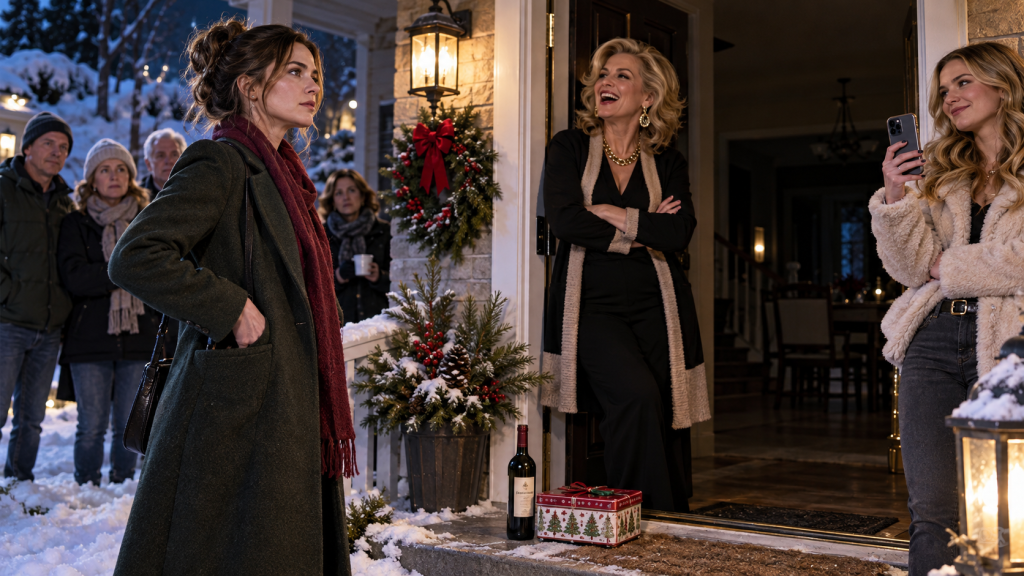
➡️ PART 3 ENDING PART➡️
The woman on the porch did not look at my mother first.
She looked at me.
That mattered.
For thirty-five years, people entering Sylvia Bennett’s house had instinctively looked toward her for permission.
My mother had a way of standing in a room as though every doorway belonged to her.
This woman did not ask permission.
She stepped inside, closed the door against the December wind, and held out an identification card.
“My name is Naomi Price.”
Her voice was quiet.
Professional.
“I’m a senior fraud investigator with Commonwealth Home Lending.”
Addison’s phone lowered another inch.
My mother looked from Naomi to me.
Then to Leonard Shaw.
Then back to me.
“What is this?”
I placed the sealed envelope on the kitchen table.
The old table.
The same one where I had done algebra homework while Addison was allowed to watch television.
The same table where Mom once told me that college loans would “build character.”
The same table where, years later, I had written her checks because the furnace was supposedly failing.
I rested my hand beside the envelope.
“You wanted to see if I’d come running.”
My voice was steady.
“I came.”
Mom’s jaw tightened.
Naomi removed a leather portfolio from beneath her arm.
“I’d prefer that we discuss this without an audience.”
My mother laughed.
Only it sounded different now.
Too high.
“These people are my neighbors.”
Naomi glanced toward the men and women gathered in the hallway and living room.
Ruth remained beside the wall.
Denny stood near the coat rack.
The others suddenly looked less entertained than they had fifteen minutes earlier.
Mrs. Talbot from next door stared at the floor.
Mr. Pierce cleared his throat.
Mom had invited them to watch me be humiliated.
Now nobody knew whether leaving would look guilty or staying would look nosy.
I almost felt sorry for them.
Almost.
I looked around.
“You all came to watch.”
Nobody answered.
“So you’ve seen enough.”
Mrs. Talbot opened her mouth.
“Ren, honey, Sylvia just said—”
“I know what Sylvia said.”
My voice was not cruel.
That seemed to make the sentence worse.
“You can go home.”
One by one, coats moved.
Doors opened.
Cold entered.
People murmured things that sounded like goodnight but felt more like retreat.
Addison remained.
Of course.
Her phone was still in her hand.
Naomi noticed it.
“Are you recording?”
Addison’s face changed.
“No.”
I looked at her.
“Addison.”
She swallowed.
“Yes.”
Naomi nodded once.
“Do not delete the original recording.”
My sister stared.
“Why?”
“Because depending on what was captured, it may become relevant.”
The phone nearly slipped from her fingers.
That was the first moment Addison understood that she had spent the evening creating evidence.
Not content.
Evidence.
My mother understood too.
“Turn that thing off.”
Addison looked at her.
“You told me to record.”
Silence.
There it was.
Small.
Accidental.
Perfect.
Naomi looked toward me.
Then Leonard.
Neither of us said anything.
Mom snapped:
“Addison.”
“What?”
“Stop talking.”
My sister’s face hardened.
For the first time that evening, I saw a crack appear in the alliance between them.
Good.
Not satisfying.
Useful.
Naomi opened her portfolio.
She did not sit.
Neither did Leonard.
I remained at the table.
My mother stayed near the doorway as though standing gave her some authority over what was about to happen.
Naomi placed a photocopy in front of me.
I had already seen it.
Still, my stomach tightened.
Residential Mortgage Application.
Borrower:
Renata Bennett.
My full legal name.
My Social Security number.
My birth date.
My former employer.
My salary from three years earlier.
A signature at the bottom.
It looked like mine.
Not perfectly.
But enough to fool someone who had never watched me sign Christmas cards.
The property address was in Lake Anna.
A three-bedroom cottage overlooking the water.
I had never been there.
Never toured it.
Never made an offer.
Never applied for a mortgage.
Yet according to those pages, I had done all four.
Naomi said:
“Ms. Bennett contacted our fraud department three months ago after an inquiry appeared on her credit file.”
My mother’s eyes moved sharply toward me.
Three months.
That was new information for her.
Good.
Naomi continued.
“The application requested a mortgage of three hundred twelve thousand dollars.”
Denny made a low sound.
Addison stared at Mom.
“For what house?”
Mom said nothing.
Naomi slid a photograph across the table.
White siding.
Blue shutters.
Lake behind it.
Pretty.
Expensive.
Completely unfamiliar.
Addison whispered:
“Mom.”
My mother’s mouth tightened.
Naomi said:
“The application stated Ms. Bennett intended to purchase this property as a second residence.”
“I did not.”
I said.
“Yes.”
Naomi replied.
“We know.”
Mother laughed suddenly.
Not convincingly.
“This is ridiculous.”
Naomi turned toward her.
“Do you know this property?”
“No.”
Denny spoke from behind us.
“Yes, you do.”
Every head turned.
Mom stared at him.
“Denny.”
He stepped away from the wall.
“You showed it to me.”
Her face hardened.
“No, I didn’t.”
“You called it the lake place.”
“You said you were buying it for rental income.”
Addison whispered:
“What?”
Mom turned.
“He doesn’t know what he’s talking about.”
Denny’s expression changed.
For months, perhaps years, he had probably surrendered arguments simply because Sylvia could outlast other people’s confidence.
Tonight he did not.
“You asked me if I’d help replace the deck.”
My mother’s eyes flashed.
“Denny.”
“You said Addison could use it on weekends.”
My sister looked as though she had been slapped.
“Me?”
Mom snapped:
“I said maybe.”
Naomi spoke.
“Ms. Bennett.”
My mother turned.
“Which Ms. Bennett?”
Naomi did not smile.
“Renata.”
My mother flinched.
It was such a small thing.
But I noticed.
For years, Sylvia had treated the surname as if it belonged to the branch of the family she approved of.
Hearing someone use it for me unsettled her.
Naomi continued.
“The loan did not close.”
My lungs loosened slightly.
Even though I already knew.
“The application was suspended when a credit security alert required direct borrower verification.”
My mother looked at me.
I met her eyes.
Eight months earlier, after Ruth’s first call, I had frozen my credit.
Not because I knew exactly what had happened.
Because I had learned one useful thing in financial compliance:
If you think someone may have used your identity, stop the next transaction before you solve the last one.
Naomi continued.
“When our verification department contacted Ms. Bennett at a number independently obtained from her credit file, she denied applying.”
Mom laughed.
“So nothing happened.”
Naomi looked at her.
“A fraudulent loan application happened.”
“It wasn’t funded.”
“That does not make the documents genuine.”
Mom folded her arms.
“You’re accusing me?”
“I have not accused anyone.”
Naomi said.
“I am here because Ms. Bennett asked that the documents be formally identified in the presence of counsel and because our internal investigation traced the application process to devices and contact information connected to this address.”
The room went silent.
My mother finally sat.
Addison looked from Naomi to me.
“You knew about this before the letter?”
“Yes.”
“How long?”
“Three months.”
Her face twisted.
“And you said nothing?”
I almost laughed.
“What was I supposed to say?”
“Mom, are you pretending to be me for mortgage applications?”
Addison flinched.
“I don’t know.”
“No.”
I said.
“You don’t.”
My mother leaned forward.
“That house was going to benefit everybody.”
There.
Not denial.
Purpose.
Naomi’s eyes sharpened.
Leonard looked down as if taking mental notes.
Denny closed his eyes.
Addison stared at Mom.
“What does that mean?”
Sylvia realized too late that the sentence had escaped.
She tried to recover.
“It was an investment.”
“In whose name?”
I asked.
She glared at me.
“It was complicated.”
“No.”
I said.
“The application is remarkably simple.”
I touched the first page.
“My name.”
“My Social Security number.”
“My income.”
“My signature.”
“Your address for correspondence.”
Her face tightened.
“You moved away.”
I almost laughed.
There it was.
The oldest charge.
You left.
As though geography transferred ownership.
Naomi said:
“Mrs. Bennett—”
“My name is Sylvia Hall now.”
That surprised me.
I looked at her.
Hall.
Denny’s surname was Mercer.
So this was something else.
Mom noticed my confusion.
“After the divorce.”
I blinked.
“What divorce?”
She stared.
Then looked away.
Another silence.
Another door.
Addison looked uncomfortable.
I slowly stood.
“What divorce?”
My mother sighed.
“Your father and I divorced three years ago.”
I could not speak.
Three years.
I had been gone five.
Nobody told me.
My father had not contacted me either.
Or so I thought.
I looked at Addison.
“You knew.”
She nodded.
“Where is Dad?”
Nobody answered immediately.
My heart began pounding.
“Where is he?”
Addison whispered:
“Richmond.”
“Why?”
“He moved.”
“Where?”
My mother snapped:
“This has nothing to do with the loan.”
I turned toward her.
“You invited me here using the word ‘we.’”
Her face changed.
I continued.
“Your letter said we miss you.”
No answer.
“Who is we?”
Sylvia looked at the table.
I laughed.
It hurt.
“You.”
“And Addison.”
“And the neighbors?”
“Was Dad even part of this?”
“No.”
Addison whispered it.
I closed my eyes.
Another lie embedded inside the invitation.
Five years of silence, and my mother had borrowed my father’s absence to make reconciliation look real.
I wanted to ask more.
Where he was.
Why he never called.
Whether he had wanted me back.
But Naomi was still standing there.
Leonard was still holding an estate file.
And my name was still on a mortgage I had never requested.
Some truths have to wait their turn.
I sat again.
“Continue.”
My voice sounded like somebody else’s.
Naomi did.
The application had been started online.
A new email address had been created:
ren.bennettfinance@…
Not mine.
The phone number belonged to a prepaid line.
The IP address traced repeatedly to my mother’s internet service.
An electronic copy of my old driver’s license had been uploaded.
I remembered exactly where that copy came from.
Five years earlier, Mom asked me to send it because the family insurance agent supposedly needed identification to remove me from an old auto policy.
I sent it.
Of course.
There was also an employment letter.
Fake.
Printed on the letterhead of the company where I currently worked.
The salary was almost right.
My title was outdated by one promotion.
The person listed as HR contact did not exist.
My mother had not known about my promotion.
That was the mistake.
One of many.
I asked:
“Who prepared the employment letter?”
Sylvia stared.
“No idea.”
Naomi looked at her.
“Your laptop was not accessed.”
My mother said.
Naomi did not react.
Interesting.
Neither had I asked about a laptop.
Addison noticed too.
Her face changed.
Denny looked toward Sylvia.
Leonard finally spoke.
“Sylvia.”
His voice was soft.
“Stop.”
My mother turned on him.
“You have no right to come into my home and—”
“I am here because my former firm handled Margaret Bennett’s estate.”
Grandma.
The room changed again.
My mother sank back.
Leonard continued.
“And because records now suggest that my office accepted documents bearing Renata’s signature that she did not sign.”
Addison whispered:
“Oh my God.”
Mom looked at her.
“Stop acting surprised.”
My sister stared back.
“I didn’t know about a mortgage.”
“No.”
Mom said.
“You just liked everything the money bought.”
Addison recoiled.
I watched them.
For most of our lives, Mom and Addison had moved like a unit.
Not always kind.
But synchronized.
The pretty daughter.
The approving mother.
The daughter who stayed.
The mother who rewarded staying.
Now money had entered between them.
Money has an ugly talent for translating love into receipts.
Leonard opened his file.
“Margaret established separate beneficiary accounts for each granddaughter.”
He looked at Addison.
“One for you.”
Then me.
“One for Ren.”
“One hundred eighty-four thousand dollars each at final distribution.”
Addison sat down.
“I never got one hundred eighty-four thousand dollars.”
Leonard looked at her.
“No?”
“My tuition.”
“My car.”
“The condo down payment.”
“Mom told me those came from Grandma.”
“They did.”
“Then that was my trust?”
“Likely.”
Addison looked at my mother.
“You said Grandma left you money for us.”
Sylvia’s jaw tightened.
“That is essentially what happened.”
“No.”
Leonard said.
“It is not.”
His voice remained calm.
That made it sharper.
“The accounts belonged beneficially to the girls.”
“They were adults.”
“Distribution instructions required their signatures.”
He slid a page toward me.
I had already seen a copy.
Still ugly.
Beneficiary Distribution Direction.
My name.
My fake signature.
An instruction authorizing the entire balance to be transferred to a custodial family account controlled by Sylvia.
The form was dated eleven years earlier.
I had been living in North Carolina then.
I had been working double shifts while paying graduate school debt.
I had eaten canned soup for dinner because money was tight.
I stared at my forged name.
“How much of mine went into this house?”
I asked.
Mom said nothing.
Leonard looked at me.
“We don’t yet have complete tracing.”
“How much do you know?”
“Approximately one hundred eighteen thousand dollars left the family account within eighteen months of the trust distribution.”
“For what?”
He turned pages.
“Some payments went toward Addison’s tuition.”
My sister went pale.
“How much?”
“Approximately twenty-six thousand from the account associated with Ren’s distribution.”
Addison shook her head.
“No.”
Mom snapped:
“You were in school.”
“I had my own money.”
“Your account was invested.”
“What does that mean?”
“It means I managed it.”
Leonard interrupted.
“It means funds traceable to Ren’s share were used while Addison’s share remained largely intact at that time.”
My sister stared at Mom.
“You used hers first?”
Sylvia’s eyes flashed.
“She had left.”
There it was.
Not financial logic.
Punishment.
I felt something cold move through me.
My mother looked at me.
“You were making your own life.”
“You had a good job.”
“You didn’t need it the way Addison did.”
I whispered:
“I was twenty-four.”
“You had always been independent.”
“That was not permission.”
“You didn’t call.”
“You told me not to.”
Silence.
My mother looked away.
I continued.
“You said not to bother coming home.”
“You stopped sending money eventually.”
My heart stopped.
There it was.
She said it as though the sending had been rent I stopped paying.
Addison looked between us.
“Sending money?”
Mom stiffened.
My sister turned to me.
“What money?”
I laughed.
Of course she did not know.
“Every month.”
Her face changed.
“How much?”
“Usually six hundred.”
“Sometimes eight.”
“For years.”
She stared at Mom.
“For what?”
“Furnace.”
“Insurance.”
“Medical bills.”
“Property taxes.”
My voice broke.
“All the things that were supposedly falling apart.”
Denny whispered:
“The furnace was replaced once.”
I looked at him.
“When?”
“Seven years ago.”
I had sent money for furnace repairs at least four times after that.
Denny’s face crumpled.
“I didn’t know you were paying.”
I nodded.
Of course.
That was how systems like this survived.
Nobody knew the full story.
Only Sylvia.
She had made herself the center of every version.
Ruth finally moved from the wall.
She had been so quiet I almost forgot she was there.
My mother noticed.
Her face hardened.
“You.”
Ruth looked tired.
Not triumphant.
“Yes.”
“You’ve been filling her head with this.”
“No.”
Ruth said.
“I told her where to look.”
“That is the same thing.”
“No.”
Ruth’s voice sharpened.
“Filling someone’s head is what you do when the information is false.”
Mom stood.
“Get out of my house.”
Ruth did not move.
“You invited me.”
“That was before—”
“Before you realized I wasn’t here for the joke?”
Silence.
My mother had invited Ruth too.
Of course.
She wanted the neighbor who had known me since childhood to witness my humiliation.
That choice had brought her own witness into the room.
Ruth looked at me.
“Do you want me to tell you?”
I nodded.
“Yes.”
Mom snapped:
“No.”
Ruth ignored her.
“Your grandmother told me about the trusts before she died.”
My breath caught.
“Why?”
“She didn’t trust Sylvia.”
Mom laughed bitterly.
“Mother didn’t trust anyone.”
Ruth looked at her.
“She specifically didn’t trust you with Ren’s share.”
The sentence hit.
My mother turned red.
Ruth continued.
“Margaret knew you thought Ren was too independent.”
“She told me once, ‘Sylvia rewards the child who stays close and sends invoices to the one who leaves.’”
My eyes filled.
Grandma.
I could hear her.
She had not been warm in the way people imagine grandmothers.
She was blunt.
Tough.
Always carrying tissues.
But she had seen me.
Maybe more than I knew.
Ruth continued.
“She made me promise that if I ever thought something looked wrong, I would speak up.”
“You waited eleven years.”
I said.
No accusation.
Just pain.
Ruth’s eyes filled.
“I thought Leonard’s office handled it correctly.”
Leonard looked down.
“And I thought you knew.”
“What changed?”
Ruth looked toward Denny.
He swallowed.
Then stepped forward.
“Eight months ago, I found a letter.”
My mother closed her eyes.
There.
The message.
Ruth’s message to me.
Eight months before Christmas.
Denny continued.
“It was from a mortgage broker.”
“Addressed to you.”
“At this house.”
I stared.
“Me?”
“Yes.”
“I gave it to Sylvia.”
“She said you were helping them buy an investment place.”
“I thought it sounded strange.”
“Why?”
“Because you hadn’t been here in five years.”
Fair.
Denny looked ashamed.
“A week later I saw another envelope with your name.”
“I asked her.”
“She got angry.”
“So I told Ruth.”
Ruth nodded.
“Denny knew I still had your old email address.”
That was the message.
Ren, there are things you deserve to know. Call me when you’re ready.
I looked at Denny.
“Why didn’t you contact me yourself?”
His eyes dropped.
“Cowardice.”
The honesty surprised me.
“I live with her.”
He said.
“She has a way of making you feel like every question is betrayal.”
I looked at my mother.
She laughed bitterly.
“So now I’m some monster.”
Nobody answered.
That was worse.
Naomi cleared her throat.
“I need to ask one question before I leave.”
My mother glared.
“What?”
“Did you prepare or direct anyone to prepare the mortgage application using Renata Bennett’s identity?”
Silence.
Leonard said:
“You should consider counsel before answering.”
Mom turned toward him.
“Whose side are you on?”
His face changed.
“This is not a family dinner anymore.”
The words fell heavily.
“This involves potential identity theft, forgery, and estate misconduct.”
Mom sat.
Her performance was gone now.
Not entirely.
But the audience had changed.
Neighbors could be manipulated.
Professionals less so.
She whispered:
“I used information I had.”
Naomi waited.
“For a family investment.”
Naomi continued waiting.
My mother sighed.
“Ren would have benefited.”
“How?”
I asked.
She looked at me.
“The house would appreciate.”
“In my name?”
“Yes.”
“So you were going to give me the house?”
Silence.
Addison turned.
“Mom?”
I almost smiled.
“Were you going to give me the house?”
My mother’s face hardened.
“We would have figured that out later.”
There.
Meaning no.
I looked at Naomi.
“She has your answer.”
Naomi nodded.
“I’ll follow up formally.”
Then she turned to Addison.
“I will also need the original recording from tonight preserved.”
Addison’s face drained.
“Why me?”
“Because your mother stated you benefited from funds in dispute, and because the recording may contain spontaneous statements relevant to the investigation.”
Addison looked at Mom.
“You said this was just a joke.”
My mother said nothing.
My sister whispered:
“You said we were going to prove she still wanted your approval.”
Silence.
I turned.
“What?”
Addison’s eyes filled.
She looked ashamed.
“Mom said…”
She stopped.
“What did she say?”
“She said you had been asking questions about Grandma.”
My blood went cold.
So Sylvia knew.
Not everything.
Enough.
Addison continued.
“She said you were probably going to show up and accuse us of stealing.”
My mother closed her eyes.
“And?”
I asked.
Addison cried.
“She said if we recorded you getting emotional, yelling, demanding money…”
She could barely continue.
“…then everyone would see what you were really like.”
There it was.
The Christmas invitation was not only cruelty.
It was preparation.
A trap.
A narrative.
If I came and cried, I was needy.
If I became angry, I was unstable.
If I demanded answers, I was after money.
And Addison’s phone would capture exactly what Sylvia wanted people to see.
My chest hurt.
I looked at my mother.
“You knew I was investigating.”
“No.”
“You suspected.”
She said nothing.
“How?”
Denny answered.
“The lender called here.”
My mother glared at him.
He continued.
“They asked for Ren.”
“Sylvia told them you were traveling.”
“I asked why a mortgage company was calling.”
“She wouldn’t answer.”
There.
The loan had failed.
Sylvia realized something had gone wrong.
Then my letter arrived.
Christmas reconciliation.
Not reconciliation at all.
A test.
Would I come?
Would I accuse?
Would I show my hand?
My mother had invited the neighborhood because humiliation is most effective when witnessed.
She had told Addison to record because video can be edited into a weapon.
The old pattern had simply grown more sophisticated.
I looked at her.
“You didn’t invite me because you missed me.”
Her face tightened.
“I did miss you.”
That almost broke me more.
Because some part of her probably did.
People can miss what they abuse.
People can love you and still choose themselves over your dignity.
That is what makes family betrayal so hard to explain.
“You could have called.”
I whispered.
“I didn’t know what you wanted.”
“The truth.”
“You always think the truth is simple.”
“No.”
I said.
“I think lies get expensive.”
Then I looked at the loan papers.
“Apparently literally.”
Naomi left after arranging a formal meeting.
Leonard stayed.
Ruth stayed.
Denny stayed.
Addison remained at the table, no longer recording.
My mother stood near the sink.
The house that had been dark when I arrived was now painfully bright.
Every light on.
I had turned on more as we moved from room to room.
It felt symbolic in a way I almost resented.
Life rarely arranges itself this neatly.
Then Leonard said:
“There’s something else.”
I closed my eyes.
Of course.
My mother said:
“Leonard.”
He looked at her.
“I’m sorry.”
He was not speaking to me.
He was speaking to her.
That frightened me.
“What?”
I asked.
Leonard took another document from his folder.
“The distribution instruction from Margaret’s estate was notarized.”
“I saw.”
“Yes.”
“By someone in my office.”
I stared.
“Who?”
“Janice Cole.”
The name was familiar.
Then I remembered.
Short blond hair.
Bright lipstick.
My mother’s friend.
Not close enough for Christmas.
Close enough for lunch.
She had worked at Leonard’s firm when Grandma died.
Mom said:
“Janice is retired.”
Leonard looked at her.
“She gave a sworn statement last week.”
My mother went white.
That reaction was immediate.
Real.
“What statement?”
I asked.
Leonard looked at me.
“Janice admitted that you were not present when your signature was notarized.”
Silence.
Addison covered her mouth.
My mother gripped the counter.
Leonard continued.
“She says Sylvia brought the forms already signed.”
I laughed once.
A sound without humor.
“Already forged.”
“Yes.”
“And Janice notarized them?”
“Yes.”
“Why?”
Leonard’s face tightened.
“She says Sylvia told her you had signed them before leaving for North Carolina and could not return.”
“That is not legally sufficient.”
“No.”
“Did she know that?”
“Yes.”
Of course.
“Why would she risk her job?”
Leonard looked toward my mother.
Then back to me.
“Seven thousand five hundred dollars.”
The room disappeared.
I heard Addison whisper:
“Mom.”
My mother shook her head.
“That wasn’t payment.”
Leonard’s eyes sharpened.
“You paid her?”
“She had bills.”
“After the distribution?”
“She was my friend.”
“Seven thousand five hundred dollars from the family account.”
Silence.
There.
The first direct trail.
Not suspicion.
Not memory.
Money.
A woman had been paid to certify my forged signature.
My mother said:
“She would have done it anyway.”
Leonard’s face changed.
“That does not help you.”
I almost laughed.
Then the worst financial truth arrived.
The part that had nothing to do with houses.
Leonard slid an accounting summary toward me.
My share:
$184,000.
Transfers over four years.
$26,000 — Addison tuition.
$18,500 — Addison vehicle purchase and insurance.
$32,000 — Sylvia personal credit cards.
$14,000 — property taxes and home repairs.
$7,500 — Janice.
$21,000 — failed boutique investment.
$11,800 — cash withdrawals.
$9,400 — medical bills.
$15,000 — Addison condo deposit.
$29,800 — transferred into an investment account later liquidated.
The numbers continued.
Some amounts still being traced.
Some mixed.
Some legitimate family expenses.
Some not.
I stared at the line for the boutique.
“What boutique?”
Addison whispered:
“Belle & Birch.”
I looked at her.
She swallowed.
“Mom tried opening a clothing store.”
“When?”
“Ten years ago.”
I remembered.
She told me a friend owned it.
She had asked me for $3,000 to “help a friend through a rough quarter.”
I sent $1,500.
Apparently I had already invested twenty-one thousand without knowing.
I laughed.
Then cried.
Not because of the money.
Because I remembered living in a basement apartment at the time.
The bathroom ceiling leaked.
I had delayed dental work.
I used to count grocery prices to the cent.
My mother had my inheritance.
She watched me struggle.
Then asked for more.
I whispered:
“Why?”
Sylvia said nothing.
I looked at her.
“Why didn’t you just tell me Grandma left money?”
“You would have left anyway.”
The sentence made no sense.
Until it did.
I stared.
“Was this about keeping me tied to you?”
My mother’s face changed.
Addison looked at her.
Ruth closed her eyes.
There.
The thing under the numbers.
Sylvia whispered:
“You always wanted to leave.”
I felt suddenly very young.
Seventeen.
Packing college brochures.
Mom saying:
“Some people think they’re too good for where they come from.”
I had thought she meant the town.
Maybe she meant her.
“You went to North Carolina.”
she continued.
“You got the job.”
“You stopped needing anybody.”
My throat tightened.
“So you took my money?”
“You were never good at being part of this family.”
I laughed through tears.
“I sent you money every month.”
“Because you felt guilty.”
“No.”
I whispered.
“Because I loved you.”
That quieted her.
For a second, the woman behind the control appeared.
Not sympathetic.
Human.
Then she said:
“You always made love look like charity.”
I stared.
“What does that mean?”
“You came home with answers.”
“Money.”
“Advice.”
“You never came home needing us.”
I could barely breathe.
“So you punished me for functioning.”
“You always act like a victim.”
There she was again.
Gone.
The vulnerable woman disappeared behind defense.
I nodded.
“Okay.”
Mom frowned.
“What?”
“Okay.”
I stood.
“I’m done asking why.”
Something in her face panicked.
“What does that mean?”
“It means reasons stop mattering when they keep becoming permission.”
I picked up the envelope.
“Leonard.”
He stood.
“We should go.”
My mother moved toward me.
“You are not walking out of here after accusing me of—”
I turned.
“Watch me.”
Addison followed me onto the porch.
Snow had started falling again.
Small flakes.
The bottle of wine I had brought still sat on the step.
Nobody had moved it.
The cookies were inside with Denny.
My sister closed the door behind her.
“Ren.”
I kept walking.
“Ren.”
I stopped beside my car.
She hugged her coat around herself.
No shoes.
Only socks.
She had always hated the cold.
“What?”
Her face crumpled.
“I didn’t know.”
I looked at her.
“Which part?”
“The trust.”
“The money.”
“The loan.”
“Mom told me Grandma had given her money to help us.”
“She said you already got your share.”
I almost laughed.
“What did she say I spent it on?”
“School.”
“Moving.”
“Your first apartment.”
I stared.
Addison started crying.
“She said you didn’t want us knowing how much Grandma gave you because you thought we’d ask for more.”
Of course.
Perfect.
In one story, I was the selfish daughter who kept her inheritance secret.
In reality, I never knew it existed.
“How convenient.”
Addison wiped her face.
“I swear.”
I looked at her.
I believed she did not know everything.
I also knew she had laughed when I arrived.
Recorded me.
Helped stage humiliation.
Two truths.
“You still did tonight.”
Her face fell.
“I know.”
“You knew Mom was baiting me.”
“I thought…”
“What?”
She cried.
“I thought you deserved it.”
There.
Better than excuses.
“Why?”
“Because you left.”
My chest tightened.
“You too?”
“I stayed.”
“So?”
“You have no idea what it was like after you stopped talking to her.”
I laughed.
“I think I have some idea what talking to her is like.”
“No.”
Addison snapped.
“You left me here with her.”
Silence.
The snow fell between us.
For the first time, I saw something other than the golden child.
I saw the daughter who remained.
The one who received cars.
Tuition.
Condo money.
And every string tied around them.
Addison whispered:
“When you left, everything became me.”
“Every phone call.”
“Every appointment.”
“Every holiday.”
“If she was angry, me.”
“If she needed something, me.”
“If Denny upset her, me.”
“If she needed someone to agree that you were terrible…”
Her voice broke.
“Me.”
I stared.
“I didn’t know.”
“I know.”
She laughed bitterly.
“You got freedom and called it abandonment.”
“I got gifts and called it love.”
There.
A family system translated in one sentence.
I softened.
Slightly.
Then said:
“That does not excuse tonight.”
“I know.”
“Or recording me.”
“I know.”
“Or laughing.”
She nodded.
“I know.”
I opened my car door.
“Preserve the video.”
She stared.
“That’s it?”
“For tonight.”
“Ren.”
I looked at her.
“I cannot comfort you about what you did to me.”
Her face collapsed.
“I’m sorry.”
“I believe you’re sorry.”
“Do you forgive me?”
I almost laughed.
Christmas Eve.
Snow.
A fraud investigator.
A stolen trust.
And my sister wanted a verdict before I got into the car.
“No.”
She flinched.
Then I added:
“Not tonight.”
That was all I could honestly give.
I drove away.
I cried before I reached the highway.
Not pretty tears.
Not cinematic.
I pulled into a gas station because I could no longer see clearly.
My hands shook around the steering wheel.
For months, I had imagined the Christmas confrontation.
Not this exact trap.
But the moment of truth.
I had assumed evidence would make me feel powerful.
Instead I felt emptied.
The trust existed.
The forged signatures existed.
The loan existed.
I had been right.
Right felt terrible.
My phone rang.
Bashi.
Of course.
She knew I was going.
I answered without speaking.
She heard me crying.
“Oh, Ren.”
That was all it took.
I sobbed.
“I was right.”
“I know.”
“No.”
“You don’t understand.”
“I was right.”
“And I hate it.”
“I know.”
I leaned my forehead against the steering wheel.
“My mother stole from me.”
Bashi was quiet.
“My sister helped humiliate me.”
Silence.
“My grandmother knew.”
“She tried to protect me.”
“I spent years thinking I was selfish.”
“Ren.”
“I sent money.”
“I sent so much money.”
“I know.”
“I paid student loans while she had my trust.”
“I know.”
“I missed Dad’s divorce.”
That part came out strangled.
“I didn’t even know.”
Bashi inhaled.
“Where are you?”
“Gas station.”
“Which one?”
I told her.
She said:
“I’m coming.”
“You’re two hours away.”
“Not asking.”
“Bashi.”
“I will hang up if you argue.”
She did.
I sat beneath fluorescent lights on Christmas Eve and realized chosen family can sound a lot like threats.
I did not go back to my mother’s house.
Not that night.
Not for eight months.
The investigation did.
The lawyers did.
The paper trail did.
I had finally learned that accountability does not require personal attendance at every consequence.
Naomi’s company referred the attempted loan fraud to authorities.
I filed a formal identity theft report.
Leonard’s firm notified its insurer and opened an internal investigation into how Janice had notarized false beneficiary instructions.
Janice retained counsel.
My mother retained counsel.
Addison did too after learning that some condo funds could be traced to my trust.
Denny moved out two weeks after Christmas.
Ruth called me often.
Never with gossip.
Only:
“How are you?”
That distinction mattered.
The first major twist after Christmas belonged to Addison.
She called in January.
“Can I come to North Carolina?”
I said no.
Silence.
Then:
“Okay.”
That surprised me.
She continued.
“Can I send you something?”
“What?”
“The video.”
“You already sent it to Naomi.”
“No.”
“The full one.”
My stomach tightened.
“What do you mean?”
“Mom told me to start recording before you arrived.”
Of course.
“How early?”
“Twenty minutes.”
“And?”
“There’s something you should hear.”
I closed my eyes.
“Send it to my lawyer first.”
The old Ren would have opened it immediately.
The new one liked buffers.
My attorney, Melissa Grant, called me the next day.
“You need to hear this.”
That frightened me.
We listened together.
The video began with Addison laughing upstairs.
Camera pointed toward herself.
My mother’s voice downstairs.
Faint.
Then clearer as Addison walked toward the stairs.
Denny:
“Sylvia, this is cruel.”
Mom:
“She needs to be brought down.”
My stomach turned.
Denny:
“She thinks you invited her to Christmas.”
Mom laughed.
“So?”
“You wrote that you missed her.”
“I miss the daughter I had before she decided she was better than everyone.”
Denny:
“Then talk to her.”
Mom:
“No.”
“She’s been sniffing around.”
My breathing stopped.
Addison’s voice from behind camera:
“What does that mean?”
Mom:
“Nothing.”
Then quieter:
“If she starts accusing me about your grandmother’s money, keep filming.”
Addison:
“Why would she?”
Mom:
“Because Ruth can’t mind her own business.”
There.
Proof she suspected.
Denny:
“Sylvia, if Ren knows, you need a lawyer.”
Mom:
“She doesn’t know enough.”
My skin went cold.
Then Addison laughed.
“I want to see her face.”
I closed my eyes.
My sister’s voice.
Cruel.
Careless.
Real.
Then Mom said something I did not expect.
“If she gets loud, make sure you get Denny in the frame.”
Addison:
“Why?”
“Because I want witnesses that she came here threatening people.”
Melissa paused the video.
We sat in silence.
My mother had not only wanted humiliation.
She wanted a record she could shape into defense.
I whispered:
“She planned to make me look dangerous.”
“Yes.”
Melissa said.
Then:
“Keep listening.”
The video resumed.
Denny:
“I’m not lying for you.”
Mom:
“Nobody asked you to lie.”
Denny:
“You always say that after telling people exactly what you want them to say.”
Silence.
Then Mom:
“Maybe you should go spend Christmas somewhere else.”
Denny:
“Maybe I should.”
The recording continued until my car pulled up.
My hands shook.
Melissa stopped it.
“This materially helps.”
I stared.
“My sister recorded herself helping set me up.”
“Yes.”
I laughed bitterly.
“She’s really bad at crime.”
Melissa did not smile.
Then:
“Addison voluntarily sent the unedited file.”
That mattered.
I knew it did.
Not absolution.
Evidence of change.
Small.
In February, I learned my mother had taken from Addison too.
Not in the same way.
Addison’s trust was real.
It had paid tuition.
A car.
Part of her condo deposit.
But Leonard’s forensic accountant discovered approximately forty-one thousand dollars transferred from Addison’s remaining share into Sylvia’s personal accounts after the condo purchase.
Addison had never authorized it.
My sister called me sobbing.
“She stole from me too.”
The sentence made me angry.
Not because it was false.
Because part of me wanted to say:
Now you care?
I did not.
Pain does not become invalid simply because it arrives late.
“She did.”
I said.
“I thought I was the favorite.”
Addison laughed through tears.
“I thought that meant I was safe.”
There it was.
I stared out my office window.
“No one is safe in a system where love depends on obedience.”
My sister went quiet.
Then:
“Did you learn that in therapy?”
“No.”
“Compliance.”
She laughed.
Progress.
The money had not all vanished.
That surprised us.
Sylvia had invested part of the stolen funds.
Badly at first.
Better later.
One account still held approximately fifty-seven thousand dollars traceable in part to my trust.
Another twenty-three thousand remained tied up in a certificate.
Her house had equity.
The boutique loss was gone.
Cash withdrawals were gone.
Some money had paid real expenses.
Some had subsidized Addison.
Some bought furniture.
Trips.
A kitchen renovation.
The white granite counters my mother once told me Denny had paid for.
He had not.
I had.
Partly.
I laughed when I learned that.
Then I cried.
There is something uniquely strange about discovering your childhood home contains pieces of your stolen inheritance.
Cabinets.
Tile.
A refrigerator.
You begin wondering whether grief can be depreciated.
Then Leonard came to North Carolina.
He insisted.
We met at my office.
He looked older than he had at Christmas.
“I owe you more than an apology.”
I waited.
“My firm failed you.”
“Yes.”
No false politeness.
He nodded.
“We accepted a notarized beneficiary instruction without independently confirming it with you.”
“Yes.”
“We mailed confirmation to the address Sylvia provided.”
“Her house.”
“Yes.”
“You had my North Carolina address.”
“We had an older one.”
“You had my email.”
He closed his eyes.
“Yes.”
That one hurt him.
Good.
“Janice intercepted the file.”
I looked up.
“What?”
He opened a folder.
“She was assigned to estate administration.”
“After the distribution, she changed the correspondence preference in our system.”
“To what?”
“Paper only.”
“My mother’s address.”
“Yes.”
I leaned back.
There.
One last betrayal inside the estate.
Not just one forged stamp.
Process manipulation.
Leonard continued.
“Janice says Sylvia told her you were estranged and did not want direct contact.”
“Did you verify that?”
“No.”
“So your office helped erase me.”
His face tightened.
“Yes.”
I appreciated the word.
No excuses.
“What happens now?”
“Our insurer is negotiating restitution for the portion of loss attributable to our professional failure.”
“How much?”
“Not determined.”
“I don’t want hush money.”
“It is not.”
“Good.”
I looked at him.
“Because if this disappears quietly, someone else gets hurt.”
He nodded.
“Janice’s notary conduct has been reported.”
“Her employment records have been preserved.”
“The relevant authorities have the file.”
I breathed.
Then asked:
“Why did she do it?”
Leonard looked tired.
“She and Sylvia had been friends since high school.”
“Money mattered.”
“Loyalty mattered.”
“She also said something I think you should hear.”
“What?”
“She believed Sylvia when Sylvia said you had abandoned the family.”
I laughed.
Of course.
The story had done practical work.
If I was selfish enough, stealing from me could become redistribution.
If I was cold enough, forging my signature could become family necessity.
If I was ungrateful enough, my absence could justify anything.
My mother had not merely insulted me for years.
She had built a moral permission structure around me.
That realization hurt more than the numbers.
I finally called my father in March.
I had his number for three months.
I had not used it.
Fear makes no sense.
I could confront financial fraud.
I could not press one contact labeled Dad.
Bashi finally sat beside me.
“Call.”
“What if he doesn’t answer?”
“Then you survive.”
“What if he does?”
“Then you survive that too.”
Annoying woman.
I called.
Three rings.
Then:
“Hello?”
My father sounded older.
Of course he did.
Five years.
Time had not paused because we were angry.
“Dad?”
Silence.
Then a sound I had never heard from him.
A sob.
“Ren?”
I covered my mouth.
Bashi looked away.
Dad whispered:
“My God.”
Neither of us spoke for several seconds.
Then:
“Are you okay?”
I laughed through tears.
Apparently that was the first thing everyone asked after five years.
“I don’t know.”
“Fair.”
His voice shook.
“Where are you?”
“North Carolina.”
“I know.”
That surprised me.
“How?”
“Ruth.”
Of course.
“When?”
“Last year.”
“You knew she contacted me?”
“Yes.”
“Why didn’t you?”
Long silence.
Then:
“I thought you didn’t want me to.”
I closed my eyes.
There it was.
Two people waiting inside assumptions built by Sylvia.
“What did Mom tell you?”
“That you wanted nothing to do with either of us.”
“What did she tell you?”
I whispered.
“That after our last fight, you said the whole family was dead to you.”
“I never said that.”
“I know now.”
“Did you try to contact me?”
“Yes.”
“How?”
“Letters.”
My chest tightened.
“I never got them.”
“I mailed them to Maple Drive first.”
“Why?”
“I thought Sylvia would forward them.”
I laughed bitterly.
Of course.
Then:
“Later I found an old email address.”
“I wrote twice.”
I had not used that email in years.
“I’m sorry.”
“No.”
He said quickly.
“Don’t.”
“I should have found another way.”
“We both should have.”
Silence.
Then I asked:
“Why did you divorce her?”
Dad exhaled.
“Money.”
I closed my eyes.
Of course.
“What money?”
“I found accounts.”
“When?”
“Three years ago.”
“What accounts?”
“Some in her name.”
“One with yours listed as beneficiary.”
My skin went cold.
“Did you know about the trust?”
“No.”
“Not until later.”
“She told me the accounts came from her mother.”
“Technically true.”
I laughed.
Dad continued.
“I asked questions.”
“She said I was accusing her.”
“We fought.”
“Then I found out she had been lying about debt.”
“How much?”
“A lot.”
“Did she use my name?”
“I did not know that.”
His voice broke.
“If I had…”
“I know.”
I believed him.
Then he said:
“I left.”
“Why didn’t you tell me?”
“I was ashamed.”
“Of what?”
“That I had spent decades letting her decide what kind of father I was allowed to be.”
The sentence stunned me.
“I was weak, Ren.”
I said nothing.
He continued.
“When you and Sylvia fought, I always told you to apologize.”
“Even when she was wrong.”
“Because peace was easier.”
“I called that being the calm parent.”
“It was cowardice.”
Tears came.
Old memories rearranged.
Dad standing in my bedroom doorway:
Just say sorry to your mother.
Dad whispering after arguments:
You know how she is.
Dad hugging me after Mom insulted me, then sitting beside her at dinner as though nothing happened.
He had loved me.
He had also failed me.
Two truths.
“I was angry at you.”
I whispered.
“You should be.”
“I thought you chose her.”
“I did.”
That hurt.
He did not hide.
“Again and again.”
I cried.
Then he said:
“I don’t expect forgiveness because I’m old and sad.”
I laughed through tears.
“That sounded rehearsed.”
“Therapist.”
“Good.”
We talked for three hours.
Not enough.
A beginning.
My mother accepted a plea agreement the following autumn.
I will not turn this story into legal theater.
There was no dramatic jury.
No judge pounding a gavel.
Most white-collar cases look disappointingly administrative from the outside.
Documents.
Negotiations.
Admissions.
Restitution schedules.
The mortgage application had never funded, which mattered.
The forged trust documents and diversion of funds mattered too.
Janice cooperated.
The law firm insurer contributed to a civil settlement.
Sylvia agreed to sell the Maple Drive house as part of resolving restitution and other claims.
She avoided the most severe outcome I once imagined for her.
She did not avoid consequences.
Neither did Janice.
I discovered that getting justice is not the same as watching someone suffer as much as you suffered.
The math never balances that cleanly.
My restitution came in pieces.
A settlement from Leonard’s former firm.
Funds recovered from Sylvia’s accounts.
A share from the sale of the house.
Money Addison voluntarily returned after refinancing part of her condo.
I resisted that one.
She insisted.
“Some of the down payment was yours.”
“You didn’t know.”
“I benefited.”
“Those are not the same.”
“No.”
She said.
“But I want this part back where it belongs.”
I accepted.
Not because I needed every dollar.
Because sometimes repayment is a language.
Not forgiveness.
Responsibility.
In the end, I recovered a large portion of the original trust.
Not everything.
Never the years.
Never the student-loan interest.
Never the nights I counted grocery money.
Never the feeling of being called selfish while subsidizing the person accusing me.
Money can return.
Time cannot.
That distinction became important.
The most painful conversation with Addison happened ten months after Christmas.
We met in Charlottesville.
Neutral territory.
Coffee shop.
She looked thinner.
Older.
Not physically much.
Emotionally.
She placed her phone on the table.
“I deleted Mom’s number.”
I stared.
“That’s dramatic.”
“I blocked it first.”
“Still dramatic.”
She almost smiled.
Then:
“I’m in therapy.”
“I heard.”
“Dad told you?”
“No.”
“Ruth.”
“Of course.”
We laughed faintly.
Then Addison said:
“I owe you something more than money.”
I waited.
She took a breath.
“When we were kids, I knew Mom treated us differently.”
My chest tightened.
“I told myself you deserved it.”
There.
No softening.
“Why?”
“Because if you deserved it, then I didn’t have to feel guilty for being treated better.”
I looked down.
She continued.
“When I got the car, you acted happy for me.”
“I remember.”
“I knew you didn’t get one.”
“I told myself it was because you were difficult.”
“Mom said you were.”
My throat tightened.
“College?”
“Same.”
“Birthdays?”
“Same.”
“Every time she gave me something you didn’t get, I needed a reason.”
“And the easiest reason was that I was better.”
I looked at her.
She was crying now.
“I built part of myself out of being the daughter who was easier to love.”
I whispered:
“And I built part of myself out of being the daughter who didn’t need anything.”
We stared at each other.
There.
Two sisters shaped around the same mother in opposite directions.
Addison said:
“I hated you for leaving.”
“I hated you for staying.”
She laughed through tears.
“Great system.”
“Efficient.”
Then she became serious.
“I laughed when you came on Christmas Eve.”
“Yes.”
“I wanted you humiliated.”
“Yes.”
“I’m sorry.”
I breathed.
This was the moment she had asked for in the snow.
Ten months late.
Maybe that was why it was real.
“I forgive you.”
Her face collapsed.
“But.”
She laughed through tears.
“Of course there’s a but.”
“But forgiveness is not the same as returning to what we had.”
“We didn’t have much.”
“Exactly.”
She nodded.
“So what now?”
I thought.
“Coffee.”
She blinked.
“What?”
“We finish coffee.”
“Then maybe we try again another time.”
Small.
Boring.
Safe.
She smiled.
“Okay.”
That became our relationship for a while.
Coffee.
Texts.
Birthday cards.
No instant sisterhood.
No montage.
Trust grows at the speed betrayal allows.
My relationship with Dad rebuilt differently.
He visited North Carolina.
The first time he walked into my house, he stood in the doorway holding a plant.
“You hate plants.”
I said.
“I panicked.”
“It’s already dying.”
“I bought it yesterday.”
We laughed.
Then cried.
He stayed three days.
We talked.
Walked.
Fought once.
That mattered.
Healthy reconciliation is not never being angry again.
It is learning anger no longer threatens abandonment.
Dad apologized without asking me to tell him he had been a good father anyway.
I appreciated that.
He had been a loving father.
He had also enabled my mother.
Again:
Two truths.
Life became easier when I stopped forcing people into single categories.
I did not speak to Sylvia for nearly a year.
Then mediation required us to be in the same building.
Different rooms at first.
Later, one brief face-to-face conversation.
My lawyer asked:
“Are you sure?”
“Yes.”
I was.
Not because I wanted reconciliation.
Because there was one thing I needed to say without an investigator or lawyer translating it.
Sylvia entered the conference room.
She looked smaller.
House gone.
Hair grayer.
No performance audience.
She sat opposite me.
“Ren.”
“Mom.”
The word still came.
Muscle memory.
She cried immediately.
I did not.
“I’m sorry.”
I waited.
“I was angry.”
“I know.”
“You left.”
“I moved.”
“You stopped needing me.”
I breathed.
“That is not the same as leaving.”
She wiped her face.
“I felt abandoned.”
“I believe you.”
Her eyes lifted.
Hope.
Dangerous.
I continued.
“Your feelings were real.”
“What you did with them was wrong.”
Hope faded.
Good.
She nodded.
“I thought I was keeping the family together.”
“No.”
I said.
“You were billing me for belonging.”
She stared.
I continued.
“You took money Grandma left me.”
“You asked me for more.”
“You told Addison I had already taken my share.”
“You told Dad I wanted nothing to do with him.”
“You used my identity to apply for a mortgage.”
“Then when you suspected I knew, you invited me home to humiliate me in front of neighbors and record my reaction.”
My voice remained calm.
“That is not keeping a family together.”
“It is controlling the story.”
Mom sobbed.
“I did love you.”
That sentence broke something.
I cried.
Quietly.
“I know.”
She looked shocked.
“You do?”
“Yes.”
“I think you loved me.”
Her shoulders shook.
“Then maybe—”
“No.”
I whispered.
“Love is not the same as safety.”
She stopped.
That was the sentence.
The one I had needed for years.
“I can believe you loved me and still decide I cannot build my life around being hurt by you.”
Mom covered her face.
“I’m your mother.”
“Yes.”
“And I’m your daughter.”
I cried harder.
“That should have protected me too.”
Silence.
There was nothing else.
I stood.
She looked up.
“Will I ever see you again?”
I thought.
“I don’t know.”
Not cruel.
True.
Then I left.
Closure is not always an answer.
Sometimes it is the right to stop answering.
The Maple Drive house sold in spring.
I did not attend the closing.
I drove past once afterward.
I had no reason to.
Still did.
The new owners had painted the shutters green.
A child’s bicycle lay on the lawn.
The porch light was on.
That got me.
The light.
Christmas Eve had begun with every light turned off.
A dark house waiting for me like a joke.
Now someone else lived there.
Someone who knew nothing about trusts.
Or forged signatures.
Or daughters who learned love by surviving comparison.
I pulled over three houses down and cried.
Not because I wanted the house back.
Because childhood places continue existing after they stop belonging to you.
It feels rude.
Then I smiled.
Some other family would make different mistakes there.
Hopefully smaller ones.
I drove away.
Ruth became family in the way some neighbors quietly do.
She came to North Carolina for Christmas the following year.
Bashi came too.
Dad.
Eventually Addison, for dessert only.
Fletcher Ames joined because he had nowhere nearby to go and because five years earlier he had been the coworker who told me:
“Don’t go hoping. Go ready.”
I raised my glass.
“To Fletcher.”
He looked alarmed.
“What did I do?”
“You ruined Christmas.”
Bashi laughed.
Dad looked confused.
I explained.
Fletcher shook his head.
“I specifically told you to go for closure.”
“Yes.”
“Not a financial-crimes operation.”
“Details.”
We laughed.
For years, I had imagined a happy family Christmas looking like reconciliation with my mother.
Same house.
Same people.
Apologies.
Maybe a tree.
I was wrong.
Happy did not mean restoring the old arrangement.
Sometimes it meant building a table that did not require anyone to shrink.
Addison arrived carrying cookies.
Not store-bought.
Badly homemade.
I stared.
“You baked?”
She glared.
“I’m healing.”
We laughed.
Dad hugged her.
There was awkwardness.
Good.
Awkwardness is honest.
Ruth gave everyone scarves.
Bashi drank too much wine.
Fletcher fell asleep during a movie.
At 10:00, Addison stood to leave.
She looked at me.
“Thanks for inviting me.”
“Thanks for coming.”
No:
I always knew we’d fix this.
No promises.
Just gratitude for the evening that actually happened.
As she left, she turned.
“Oh.”
“What?”
She pulled out her phone.
For one second, my body tightened.
Memory.
Then she held it up.
“Picture?”
I thought.
Then smiled.
“Yes.”
We stood beside the tree.
Dad.
Ruth.
Bashi.
Fletcher half-awake.
Addison.
Me.
No performance.
No prank.
No hidden recording.
Addison asked:
“Ready?”
I said:
“Wait.”
Everyone groaned.
I walked to the lamp.
Turned it on.
More light.
Then:
“Now.”
The photograph was terrible.
Dad blinked.
Ruth moved.
Bashi laughed with her mouth open.
I loved it.
My career changed after everything.
Not dramatically.
I was already good at what I did.
But I became more patient with people who said:
“I should have noticed.”
Clients.
Employees.
Spouses.
People who discovered someone close had been stealing.
I used to think evidence lived in documents.
It does.
But betrayal changes perception.
A suspicious transaction from a stranger looks suspicious immediately.
The same transaction connected to your mother?
Your husband?
Your sister?
The brain explains before it investigates.
Family is the first internal-control weakness most people ever experience.
We assume authorization because love exists.
We assume intention because history exists.
We assume people who know our signatures will use them only with permission.
Most do.
Some do not.
That does not make trust foolish.
It makes betrayal what it is.
A misuse of access.
Years later, I gave a training presentation on insider fraud.
I put one sentence on the screen:
Access is not authority.
A young analyst raised his hand.
“What does that mean in practice?”
I thought of my driver’s license copy.
My Social Security number.
My mother knowing my date of birth.
My grandmother’s trust.
Janice’s notary stamp.
Addison’s recording.
My father’s silence.
Everything.
“It means someone can have the ability to do something and still not have the right.”
I said.
“Never confuse familiarity with permission.”
I did not tell them why my voice shook.
Sylvia and I never returned to a normal mother-daughter relationship.
I know some people dislike endings like that.
They want forgiveness to mean reunion.
They want one apology at a hospital bed or Christmas table.
A hug.
Music.
Then everyone repaired.
That is not what happened.
For several years, we exchanged birthday cards through Addison.
Then direct cards.
No calls.
Eventually, one phone call after Dad had heart surgery.
Short.
Civil.
She asked:
“Is he okay?”
“Yes.”
“Thank you.”
“You’re welcome.”
That was all.
Later, when Sylvia became ill, Addison told me.
I visited once.
Not because guilt ordered me to.
Because I wanted to know I had chosen.
That distinction mattered more than I can explain.
She looked old.
Smaller than the woman on Maple Drive.
She reached for my hand.
I let her.
“I was cruel to you.”
she whispered.
I said nothing.
“I think I needed you to keep coming back so I could prove you hadn’t really left.”
My eyes filled.
There.
Years late.
The truth beneath the prank.
“If I could make you run home, I still mattered.”
I breathed.
“You mattered.”
She cried.
“You always mattered.”
“I just couldn’t keep proving it by letting you hurt me.”
She closed her eyes.
“I know.”
That was our last deep conversation.
No magical absolution.
No demand.
I kissed her forehead before I left.
I loved her.
Still.
From a distance safe enough to remain myself.
Sometimes that is the most honest form love can take.
When Sylvia died, I grieved.
That confused Addison.
Maybe even me.
At the funeral, I cried harder than I expected.
Not only for the mother I lost.
For the mother I kept hoping might appear if I behaved correctly.
That woman died too.
Perhaps she had never existed.
Grief does not require innocence.
You can mourn a person and the damage they caused.
You can miss a voice you learned to fear.
You can remember good Christmases beside the Christmas designed to humiliate you.
The heart is not an auditor.
It does not reconcile every account before closing.
After the funeral, Addison and I stood beside the grave.
She asked:
“Do you think she knew we loved her?”
“Yes.”
“Do you think she knew what she did?”
I thought.
“Some of it.”
“Not all?”
“I don’t think any of us fully know what we do to other people.”
Addison nodded.
Then:
“I still hate that video.”
“So do I.”
“I kept it.”
I looked at her.
“Why?”
“For evidence at first.”
“And now?”
She wiped her eyes.
“To remember who I don’t want to be.”
I thought about that.
“Delete it.”
She stared.
“What?”
“You don’t need to keep shame as a surveillance system.”
Her eyes filled.
“You sure?”
“Yes.”
She took out her phone.
Found the archive.
We watched the thumbnail for one second.
Me on the porch.
Wine in hand.
Mother smiling.
Addison laughing from above.
Then she pressed delete.
Gone.
Not history.
Just file.
There is a difference.
The money I recovered from Grandma’s trust sat untouched for almost two years.
I did not know what to do with it.
Every purchase felt contaminated.
A car?
Too practical.
A trip?
Too indulgent.
Invest it?
Too invisible.
Then Dad said:
“Your grandmother did not leave you a shrine.”
I stared.
“What?”
“She left money.”
“Use some.”
“For what?”
He shrugged.
“Something she would approve of and something she would hate.”
That sounded exactly right.
Grandma loved education.
Hated beaches.
So I paid off the remaining balance of my student loans.
Then took a two-week trip to Portugal with Bashi.
Dad called it sacrilege.
I sent him photographs from the ocean.
Grandma would have complained about the price of everything.
I could hear her.
It made me happy.
The rest I invested.
In my name.
At an institution with multi-factor authentication.
Very romantic.
I also created a small scholarship at my old state university.
Nothing grand.
One student a year.
For someone working at least twenty hours a week while studying.
The first recipient wrote me:
Thank you for helping me reduce my work hours enough to sleep.
I cried.
For years, I had thought recovering my trust meant getting back what had been stolen.
Impossible.
But I could let some of it become something my twenty-year-old self would have understood.
Rest.
One extra night without a shift.
A textbook bought without calculating groceries.
That felt more like inheritance than any account balance.
Dad died much later.
Peacefully.
Addison and I were both there.
Funny, considering all the years we thought proximity proved who loved whom.
In the end, nobody counted nights.
Nobody won.
Dad squeezed both our hands.
Then whispered:
“Don’t let your mother haunt every conversation after I’m gone.”
Addison laughed through tears.
“She’s already dead.”
Dad frowned.
“Exactly.”
Last joke.
Very Dad.
Afterward, my sister and I sat together in the hospital hallway.
She leaned against me.
I let her.
No rivalry.
No golden child.
No discarded daughter.
Just two women whose parents were gone.
That was the closest we had ever been.
Years after that first Christmas letter, I found it again.
The cream envelope.
Mom’s handwriting:
Ren, it’s time to stop this. We miss you. Come home for Christmas dinner at six.
I had saved it as evidence.
Of course.
I looked at the words.
For years they represented manipulation.
Then I noticed something else.
She had written:
Come home.
That had always been the command.
Come home.
Come running.
Come explain.
Come apologize.
Come pay.
Come prove.
Come back into the role we know how to give you.
The night she invited me home, I finally did something different.
I arrived.
Saw the trap.
Turned on the lights.
And left as myself.
That mattered.
People sometimes ask whether I regret going.
Bashi asked me once.
We were sitting at an airport bar.
“Wouldn’t it have been easier to stay home that Christmas?”
“Yes.”
“Do you wish you had?”
I thought.
“No.”
“Why?”
“Because if I hadn’t gone, I would have spent years wondering whether the letter was real.”
She nodded.
“And now?”
“Now I know.”
The answer sounded sad.
It was also freeing.
Closure is not always discovering you were loved in the way you hoped.
Sometimes closure is discovering exactly what happened and no longer negotiating with fantasy.
Ruth lived long enough to see Addison and me become sisters again.
Real sisters.
Not perfect.
She attended Addison’s second wedding.
Yes.
Second.
Different long story.
At the reception, Ruth pulled me aside.
“Your grandmother would be proud.”
I laughed.
“Grandma was never proud.”
“She was suspiciously pleased.”
“Better.”
Ruth smiled.
Then:
“I should have contacted you sooner.”
I looked at her.
“Maybe.”
“I’m sorry.”
“I know.”
She took my hand.
“Did I do enough?”
That question hurt.
People near the end of life want scorecards.
I refused to give her one.
“You did something when it mattered.”
She cried.
So did I.
That was enough.
I sometimes think about the neighbors outside on Christmas Eve.
The audience.
People Mom had gathered because humiliation needed witnesses.
For months afterward, some sent messages.
Apologies.
Excuses.
We didn’t know what Sylvia planned.
We thought it was a family joke.
We should have left.
Mrs. Talbot wrote the best one.
I laughed because everyone else did. I am embarrassed by how easy that was.
I respected that.
Crowds rarely think of themselves as participants.
But every audience gives something to cruelty.
Attention.
Permission.
Silence.
That night taught me not only who my mother was.
It taught me what laughter costs when it is aimed at someone trying not to break.
Addison never recorded another family conflict.
At least not that I know of.
She became annoyingly protective about phones at holidays.
One Thanksgiving, her teenage stepdaughter started filming a cousin during an argument.
Addison immediately said:
“Put it away.”
The girl groaned.
“Why?”
“Because people deserve to be upset without becoming content.”
I looked across the table.
Our eyes met.
No one else knew why the sentence mattered.
I smiled.
She did too.
That was healing.
Quiet.
Embedded in behavior.
The strangest thing happened when I turned fifty.
Addison gave me a cream-colored envelope.
I stared.
“Seriously?”
She laughed.
“I know.”
Inside was one sentence.
Dinner at six. Real food. No ambushes.
I laughed until I cried.
Then beneath:
You are allowed to say no.
That was the line.
I went.
Of course I went.
Not running.
Choosing.
There is a world of difference.
That Christmas dinner was ordinary.
Too much ham.
Burned rolls.
Addison’s husband told a terrible joke.
Dad was gone by then.
Ruth too.
Mom too.
Their absences sat with us.
Not loudly.
Family history does not disappear.
It becomes furniture.
You stop tripping over it every day.
Then occasionally your hand touches the edge and remembers.
After dinner, Addison poured coffee.
“Remember when Mom invited the neighborhood to watch you get humiliated?”
I stared.
“Wonderful dinner topic.”
Her husband nearly choked.
She laughed.
“Sorry.”
Then became serious.
“I think about it every Christmas.”
“So do I.”
“Do you still hate me?”
I considered.
“No.”
“Not even a little?”
“You load the dishwasher wrong.”
“That’s not hate.”
“It’s close.”
She laughed.
Then:
“I love you.”
The words still surprised me sometimes.
“I love you too.”
We did not add:
Despite everything.
The phrase was implied.
If Grandma had known what happened to her trust, she would have been furious.
I imagine her marching into Leonard’s office with her handbag tucked under one arm, demanding names.
I imagine her calling Sylvia irresponsible.
Janice dishonest.
Me too trusting.
Addison spoiled.
Then she would have complained the coffee was weak.
Grandma believed love and criticism should be delivered in equal quantities.
Maybe that is why her money eventually became the clearest proof that someone had seen me.
She knew I might not be protected equally.
So she tried.
The system failed.
People failed.
But her intention survived the paperwork.
Sometimes love does that.
The original trust documents are in my safe now.
Not because I worship them.
Because I learned something about records.
Memory is emotional.
Documents are boring.
Boring can save you.
The fake signature is there too.
I used to stare at it.
The copied R.
The too-round B.
Whoever signed had tried hard.
Now I barely look.
My name survived imitation.
My life did too.
The last thing my mother ever asked me during that hospital visit before she died was:
“Do you think I ruined your life?”
I remember how small her voice sounded.
I could have said yes.
For years, part of me wanted that power.
To make her understand the scale.
Instead, I told the truth.
“No.”
She looked surprised.
“You hurt me.”
“You stole from me.”
“You lied about me.”
“You cost me years with Dad.”
“You changed how I understood my own childhood.”
Her eyes filled.
“But you did not ruin my life.”
I took her hand.
“That part belongs to me.”
She cried.
So did I.
Maybe that was the final thing she needed to hear.
Maybe it was the final thing I needed to say.
No one gets credit for destroying a life that continues growing beyond them.
And that is why, when people tell the Christmas story, I correct them.
They say:
“Your mother invited you home after five years just to humiliate you?”
“Yes.”
“They turned off all the lights?”
“Yes.”
“Your sister recorded?”
“Yes.”
“And then you exposed them?”
Not exactly.
Evidence did.
Time did.
Ruth did.
Denny did.
Leonard’s records did.
Naomi’s loan file did.
Addison’s own video did.
My mother’s choices exposed themselves.
I simply stopped hiding them for her.
There is a difference.
That Christmas Eve, Sylvia laughed and said:
“We just wanted to see if you’d still come running.”
For most of my life, I thought coming back proved love.
Sending money proved love.
Forgiving quickly proved love.
Accepting less proved love.
Being the bigger person proved love.
What I learned was simpler.
Love that requires you to abandon yourself is not a test you need to pass.
I had come home.
But I had not come helpless.
Inside my coat was an envelope containing eleven years of things my family believed would stay buried because I had always been easier to shame than to answer.
A trust.
Forged signatures.
Transfers.
A mortgage application.
A name stolen onto paper.
My name.
They thought I had come running because I still needed them to choose me.
The truth was harder.
I had come because, after five years, I was finally ready to choose myself in the same house where I first learned not to.
My mother wanted an audience.
My sister wanted a video.
The neighbors wanted entertainment.
Instead, the lights came on.
And once they did, nobody laughed for very long.
I lost the family I had spent years trying to earn.
Then slowly, carefully, I built relationships with the people willing to meet me without a price.
Dad.
Eventually Addison.
Ruth.
Bashi.
Fletcher.
Myself.
Especially myself.
That was the relationship I had neglected longest.
And in the end, the most important thing inside that sealed envelope was not the money Grandma left.
Not the forged loan.
Not the signature.
It was proof.
Proof that I had not imagined the imbalance.
Proof that independence had never made me selfish.
Proof that generosity does not become obligation just because someone gets used to receiving it.
Proof that I could love my family without volunteering to be their victim.
My mother once believed one little letter could make me come running.
She was right about one thing.
I came.
But I never ran for her again.
THE END STORIES! THANK YOU FOR READING GOOD LUCK !❤️
Related Posts