➡️ PART 3 ENDING PART➡️
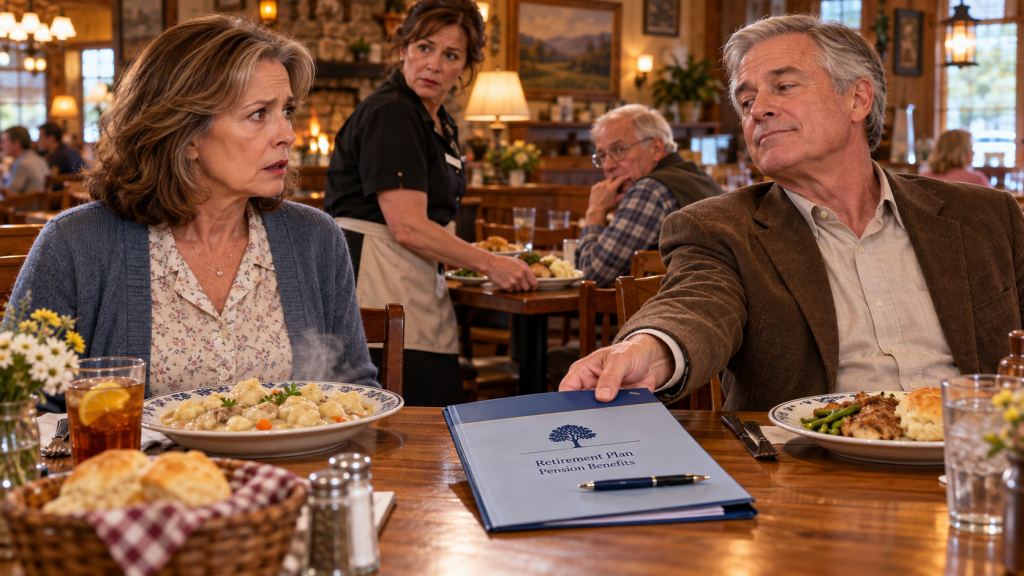
When I opened the front door and saw Marla standing beside Beverly from Henderson Tool’s pension office, Charles made a sound behind me that I had never heard in forty-one years of marriage.
Not anger.
Not irritation.
Fear.
It was small.
Almost nothing.
A little breath caught too high in his throat.
But I heard it.
After four decades with a man, you learn the private noises beneath the public ones.
Marla was wearing a cream-colored coat and too much lipstick for ten in the morning.
Beverly wore navy slacks, sensible shoes, and the expression of a woman who had spent twenty-three years explaining retirement forms to men who believed highlighting a signature line counted as financial planning.
Marla looked past me.
“Charles?”
He stood in the kitchen doorway.
His pen was still in one hand.
The pension folder was in the other.
“What is she doing here?”
He was looking at Beverly.
Not Marla.
Interesting.
Beverly raised one eyebrow.
“Mrs. Dalton requested an explanation of her spousal rights before making any election.”
Charles’s face darkened.
“You make house calls now?”
“No.”
Beverly said.
“Ruth and I agreed to meet at the branch office at ten-thirty.”
She looked at me.
“But someone called the benefits desk this morning asking whether a spouse could ‘sign later’ after a lump-sum distribution had already been initiated.”
My eyes moved toward Charles.
He said nothing.
Beverly continued.
“That concerned me.”
Then she looked at Marla.
“And Ms. Kessler happened to be in the lobby when I arrived.”
Marla’s face reddened.
I turned toward her.
“You went to Henderson Tool?”
She swallowed.
“I just wanted to ask a question.”
Charles snapped:
“Why?”
She stared at him.
“Because you weren’t answering.”
Something passed between them.
Not romance.
Panic.
I stepped back.
“Come in.”
Charles said:
“No.”
I looked at him.
“It’s my house too.”
His jaw tightened.
There it was.
Too.
The first useful word he had said all morning.
Beverly came inside.
Marla followed.
Charles remained frozen near the kitchen.
I closed the door.
The house felt suddenly too small for forty-one years of marriage, one dental hygienist, one pension administrator, and all the lies that had apparently been waiting for better lighting.
Beverly took the chair across from me.
Marla stayed standing.
Charles did too.
I poured Beverly coffee.
She accepted.
I did not offer Charles any.
Petty?
Perhaps.
But after forty-one years of refilling that man’s cup before my own, it felt medicinal.
Beverly set down her handbag.
“Before we discuss anything, I want to be clear.”
She looked at Charles.
“I am not here to negotiate your marriage.”
Then at me.
“I am here to explain the plan documents.”
“That’s all I asked.”
Charles laughed bitterly.
“You called my employer behind my back.”
I looked at him.
“You announced your mistress over chicken and dumplings.”
Marla flinched at the word.
Good.
Not because I wanted to hurt her.
Because I was tired of polite vocabulary making ugly things look accidental.
Beverly pretended not to hear.
Professional women develop useful deafness.
She opened a copy of the pension packet.
“Mr. Dalton has elected retirement effective March first.”
I looked at Charles.
“March?”
He had told me “this spring.”
Apparently dates were another luxury reserved for Marla.
Beverly continued.
“Under the plan, the normal form of payment for a married participant is a qualified joint and survivor annuity.”
She tapped the page.
“That means Mr. Dalton receives a monthly benefit during his lifetime, and if he dies first, the surviving spouse continues receiving the designated survivor percentage.”
Charles interrupted.
“She knows.”
“No.”
I said.
“I know now.”
Beverly continued.
“He has requested an optional lump-sum distribution.”
She looked at me.
“That election would eliminate the standard survivor annuity.”
“Which is why they need me to sign line fourteen.”
“Yes.”
“Not just sign.”
Beverly said.
“Consent must be knowing, voluntary, and properly witnessed or notarized.”
I looked at Charles.
He looked toward the window.
I asked:
“And if I don’t?”
“The plan cannot process this particular waiver.”
Charles slammed the pen onto the table.
“This is absurd.”
Beverly looked at him.
“It is the plan.”
“It’s my pension.”
“It is your earned benefit.”
she said.
“And your spouse has statutory protections regarding the form of distribution.”
His face went red.
“I worked thirty-seven years for that money.”
Beverly did not blink.
“I am aware.”
I leaned back.
“And I spent forty-one years building the life that made those thirty-seven possible.”
Charles looked at me.
“Oh, here we go.”
Something old in me shrank.
Then something new stood in its place.
“No.”
I said.
“Here we stop.”
He stared.
Marla shifted near the counter.
“Charles told me Ruth had already agreed.”
There it was.
He whipped around.
“Marla.”
She crossed her arms.
“You did.”
“I said she would.”
“That’s not the same thing.”
I almost laughed.
Even Beverly looked briefly interested.
Marla looked at me.
“He said you wanted the house.”
I stared.
“What?”
“He said the agreement was you keep the house, he takes the pension.”
Charles snapped:
“We discussed that.”
I looked at him.
“When?”
Silence.
“Was I present?”
His jaw clenched.
“Ruth.”
“Then it wasn’t a discussion.”
Marla continued.
“He said the house is paid off.”
I looked at Charles.
He stopped breathing.
There.
Another loose thread.
Beverly closed her folder.
“That is outside the pension plan.”
She knew when to retreat.
I did not.
I looked at Charles.
“Is the house paid off?”
He rubbed his forehead.
“Mostly.”
The room went quiet.
There is no honest use of the word mostly after someone asks whether a mortgage exists.
“How much?”
“Ruth.”
“How much?”
“It’s not a mortgage.”
“What is it?”
“A home-equity line.”
My hand went cold around my coffee cup.
I had known we opened one eight years earlier.
Twenty-five thousand.
For the roof and furnace.
We paid it down.
Or I thought we had.
“How much is on it?”
Charles said nothing.
Marla looked between us.
“How much?”
she asked.
He glared at her.
I repeated:
“How much, Charles?”
“Thirty-eight.”
My heart kicked.
“Thirty-eight hundred?”
No one answered.
I laughed.
“Thirty-eight thousand dollars?”
He looked down.
Marla whispered:
“You told me the house was clear.”
Charles snapped:
“It practically is.”
I stared at him.
“We owe thirty-eight thousand dollars on a house you told another woman was paid off?”
He said:
“It was for expenses.”
“What expenses?”
No answer.
And just like that, the pension was no longer the only folder I wanted opened.
Beverly looked uncomfortable.
“I should probably—”
“Wait.”
I said.
She paused.
“I need to ask you one more pension question.”
“Of course.”
I pulled the blue packet closer.
“Can Charles name someone other than me as beneficiary if I refuse this waiver?”
Beverly glanced at him.
Then back at me.
“For the pension form we’re discussing, not in a way that defeats your current spousal protections without valid consent.”
Charles’s mouth tightened.
Beverly continued carefully.
“However, Henderson Tool also maintains a separate savings plan.”
I stared.
“What savings plan?”
Charles closed his eyes.
Marla said:
“Charles.”
I looked at her.
“You knew?”
Her expression told me yes.
Beverly shifted.
“Mr. Dalton participates in the company 401(k).”
I felt stupid for one second.
Then angry at myself for feeling stupid.
Charles had always said Henderson Tool’s “retirement money” was all one thing.
I managed taxes.
Bills.
Insurance.
But his payroll elections had been his.
I knew there was a pension.
I did not know the balance of the supplemental account.
“How much?”
I asked.
Beverly hesitated.
“Account-specific information—”
“I’m his spouse.”
“That doesn’t automatically authorize me to disclose balances in this setting.”
Fair.
I appreciated that.
Then she added:
“But I can explain that the account has separate beneficiary rules.”
I looked at Charles.
“Who is listed?”
He said nothing.
Marla’s face changed.
Oh.
She did not know either.
Interesting.
Beverly glanced at Charles.
“Mr. Dalton changed his beneficiary designation six weeks ago.”
My heart stopped.
Charles said:
“Beverly.”
She looked at him.
“You initiated the change.”
I whispered:
“To who?”
Beverly answered only after Charles said nothing.
“The form is currently incomplete.”
“Why?”
“Because the designation attempts to name a non-spouse primary beneficiary.”
She looked at me.
“Your consent is required for that as well.”
I stared at Charles.
Then Marla.
Her hand rose to her mouth.
“You named me?”
Charles said:
“Marla.”
She stared.
“You told me you hadn’t done that yet.”
I almost smiled.
So he had lied to both of us.
How efficient.
Beverly continued.
“The change was not accepted.”
I looked at Charles.
“Did you forge anything?”
His head snapped up.
“No.”
Too fast.
I had raised three children.
I knew the velocity of falsehood.
“Beverly?”
She became very still.
“There was an earlier form.”
Charles said:
“Do not.”
Beverly looked at me.
“We received a paper spousal-consent form approximately three weeks ago.”
The room disappeared.
I could hear the refrigerator humming.
A truck passing outside.
My own breathing.
I asked:
“With my signature?”
“Yes.”
“Was it notarized?”
Beverly hesitated.
“Yes.”
Charles sat down.
Finally.
I whispered:
“Who notarized it?”
Beverly looked toward him.
Then:
“Wayne Fletcher.”
Cracker Barrel.
Next table.
Pretending not to listen.
His friend Wayne.
I almost laughed.
Of course.
I looked at Charles.
“Wayne is a notary?”
He said nothing.
Forty-one years.
I had known Wayne almost that long.
Bowling league.
Fishing trips.
Henderson Tool picnics.
His wife, Patty, sent Christmas cards with glitter that stayed in our carpet until Easter.
He had never mentioned a notary commission.
Because why would he?
Beverly continued.
“The form was rejected.”
“Why?”
“The signature differed significantly from the signature on previous plan records.”
I stared.
“You caught it?”
“Our quality review did.”
Something in my chest loosened.
Paperwork.
Bless boring paperwork.
Beverly continued.
“We mailed a notice to your home address.”
Charles looked at the table.
I already knew.
“I never saw it.”
“No.”
Beverly said.
“The notice was returned to us.”
“Returned?”
“Marked undeliverable.”
I laughed.
At the same house where I had lived twenty-nine years.
“How convenient.”
Charles snapped:
“I handled it.”
I turned.
“You handled my mail?”
“It was pension mail.”
“With my name on it?”
Silence.
Beverly said:
“The rejected document is now under internal review.”
Marla stepped backward.
“What does that mean?”
Charles looked at her.
“Nothing.”
Beverly corrected him.
“It means Henderson Tool’s benefits department is reviewing whether a submitted spousal consent was authentic.”
Marla whispered:
“Charles, did you sign her name?”
“No.”
“Then who did?”
He looked away.
That answer hurt more than if he had confessed.
Because suddenly there was another person in the story.
Someone who knew enough to imitate me.
Someone Wayne was willing to notarize.
I thought of Patty.
No.
I thought of our daughter.
No.
I refused to build accusations out of fear.
Evidence first.
Always.
I asked Beverly:
“Can I get a copy?”
“Through the appropriate request process.”
“I’ll file it today.”
“Good.”
Charles said:
“This is getting ridiculous.”
I looked at him.
“No.”
“What’s ridiculous is that you thought I’d sign another one after the first one failed.”
His face changed.
There.
He had hoped.
That was exactly what happened.
The forged form had failed.
So he brought me a clean packet and assumed humiliation would do what forgery could not.
Just sign, Ruth. You’re used to leftovers.
Not cruelty by accident.
Pressure.
Marla sat down slowly.
She looked at Charles as if she were seeing him for the first time.
Maybe she was.
“How much is the cabin?”
I turned toward her.
Interesting question.
Charles glared.
“Not now.”
“Yes.”
Marla said.
“Now.”
She pulled out her phone.
“The deposit is due Monday.”
My heart gave a strange little jump.
“What deposit?”
Marla looked at me.
“I thought you knew.”
“Assume I know nothing.”
She swallowed.
“Twenty-five thousand.”
Charles stood.
“Enough.”
I remained seated.
“From where?”
Marla stared at him.
“You said the pension advance would cover it.”
Beverly frowned.
“There is no pension advance.”
Charles closed his eyes.
Marla turned toward her.
“What?”
“The plan does not issue advances against a pending lump-sum election.”
Marla looked at Charles.
“You said the money would clear Friday.”
“It would after paperwork.”
“No.”
Beverly said.
“Not that quickly.”
Marla’s face drained.
I almost felt sorry for her.
Then I remembered her text.
He said she’ll sign because she has nowhere else to go.
No.
Not sorry yet.
I asked:
“Where is the cabin?”
Marla named a lake town two hours away.
I knew it.
Charles had taken three “fishing weekends” there since October.
I stared.
“You already chose one?”
Marla said nothing.
Charles finally exploded.
“I’m sixty-five years old!”
We all went silent.
He spread his arms.
“I worked my entire life.”
“I raised kids.”
“I paid bills.”
“I stayed in the same damn house.”
“And yes, I want something for myself.”
I stared.
Something for himself.
As though forty-one years of marriage had been a charity sentence.
He pointed toward me.
“You got the house.”
“We both live here.”
“You got the kids.”
“They’re your children too.”
“You got every holiday.”
“I cooked every holiday.”
“You got to stay home.”
There it was.
The sentence.
The old weapon.
I had stayed home twelve years.
Not forty-one.
Twelve.
Three children.
His mother with dementia for the final two.
Then I returned to work part-time at the school district office and stayed seventeen years.
But in Charles’s memory, my labor had dissolved into leisure because no one handed me a pension folder for it.
I stood.
“I stayed home because childcare for three children cost more than I earned.”
“You wanted to.”
“Yes.”
“I also wanted you to finish your apprenticeship.”
He stopped.
“I also wanted your mother to stay out of a nursing home as long as possible.”
His face changed.
“I also wanted our kids to have somebody at the school play at three in the afternoon.”
I took a breath.
“And I wanted a husband who did not call my life leftovers while planning a cabin with the woman who cleans his teeth.”
Marla looked down.
Beverly stared very intently at her coffee.
Charles’s mouth opened.
Nothing came.
Good.
Beverly stood.
“I need to return to the office.”
I nodded.
“Thank you.”
She gathered her folder.
Then looked directly at me.
“Mrs. Dalton, do not sign anything you do not understand.”
Charles laughed bitterly.
“She understands plenty.”
Beverly met his eyes.
“Yes.”
she said.
“I believe she does.”
Then she left.
I liked her.
Marla remained.
Charles looked at her.
“You should go.”
She stood.
“No.”
He stared.
“I want to know about the fake form.”
“I did not fake it.”
“Then why did you tell me Ruth had already agreed to the beneficiary change?”
His face tightened.
“I said it was handled.”
“Exactly.”
Marla looked at me.
“I knew he was married.”
I said nothing.
She continued.
“I’m not going to pretend otherwise.”
Good.
“I knew he was leaving.”
“I believed him.”
“Also your choice.”
“Yes.”
She nodded.
“I thought you knew.”
I laughed once.
“That seems to be everybody’s favorite sentence.”
Marla looked ashamed.
“Not about the affair.”
“I knew you didn’t know that.”
There.
At least no insult pretending innocence.
“But the pension.”
“The house.”
“The cabin.”
“He told me you two had already discussed money.”
“He told me you wanted the house and half the savings.”
Charles said:
“Marla.”
She ignored him.
“He told me the children knew.”
I looked at him.
My heart stopped.
“The children?”
He rubbed his face.
Marla looked confused.
“You said Mark knew.”
Our son.
Oldest.
Forty.
Lives three states away.
I stared at Charles.
“Does Mark know about her?”
“No.”
Too fast again.
Marla whispered:
“You told me he did.”
Charles snapped:
“I said he knew I was unhappy.”
“That is not what you said.”
I looked at Marla.
“What exactly did he say?”
She swallowed.
“He said Mark told him life was too short to stay miserable.”
Charles shouted:
“Because he did!”
The room went silent.
There.
Not proof Mark knew about Marla.
But something.
I asked:
“When?”
“Thanksgiving.”
My son had been home for Thanksgiving.
He and Charles disappeared into the garage for forty minutes.
I had assumed tools.
Sports.
Whatever fathers and grown sons discuss when they do not invite mothers.
My stomach turned.
“What did you tell him?”
Charles looked away.
“I said I was thinking about leaving.”
“And?”
“He said I deserved to be happy.”
I closed my eyes.
Maybe innocent.
Maybe not.
I would ask Mark.
Not guess.
Marla picked up her purse.
Then looked at Charles.
“I’m not going to the cabin.”
He stared.
“What?”
“Not until I know what is real.”
His face hardened.
“So that’s it?”
She almost laughed.
“You lied to me about the pension.”
“You lied about the house.”
“You apparently sent a fake spousal form.”
“I did not.”
“And you told me your kids knew when they didn’t.”
Charles looked toward me.
As if somehow I had caused Marla to develop standards.
I almost admired the absurdity.
He said:
“You knew I was married.”
Marla’s face changed.
“Yes.”
Then she said something I never forgot.
“That made me wrong.”
“It did not make every lie you told me true.”
She left.
Charles blamed me for that too.
Of course.
The moment the door closed, he turned.
“You satisfied?”
“No.”
He laughed.
“You wanted to embarrass me.”
“No.”
“You brought Beverly here.”
“Yes.”
“You dragged Marla into it.”
“She was already in it.”
His face went red.
“You’ve always done this.”
I stared.
“Done what?”
“Made yourself the victim.”
I almost laughed.
Instead, I went to the kitchen drawer and took out a yellow legal pad.
Charles stared.
“What are you doing?”
“Making a list.”
He scoffed.
“Of course.”
I wrote:
Pension form.
Forged consent.
401(k).
Home-equity line.
Cabin deposit.
Mark.
Then I looked up.
“Anything else?”
His expression changed.
“Ruth.”
“Anything else I should know before I pay someone three hundred dollars an hour to discover it?”
He sat.
That was the first moment he understood this might end in lawyers instead of tears.
I watched him calculate.
Forty-one years teaches you that too.
His right eyebrow lifted slightly when he was lying to himself.
Then he said:
“There’s a credit card.”
I wrote.
“How much?”
“Twelve.”
“Twelve hundred?”
He did not answer.
I stared.
“Twelve thousand.”
“Yes.”
“In whose name?”
“Mine.”
“For what?”
“Expenses.”
“Cabin?”
“Some.”
“Marla?”
He looked down.
I wrote:
$12,000 card.
“What else?”
He sighed.
“A personal loan.”
I stopped writing.
“How much?”
“Fifteen.”
I closed my eyes.
Then wrote.
“Anything else?”
“No.”
I looked at him.
“I don’t believe you.”
His face collapsed.
That was when I knew there was more.
The next person I called was not one of our children.
It was a lawyer.
Her name was Denise Carver.
She had handled my friend Evelyn’s divorce after thirty-four years.
Evelyn described her as “five feet two inches of invoice-generating common sense.”
Exactly what I needed.
Denise saw me the next afternoon.
I brought shoeboxes.
Tax folders.
Pension paperwork.
The legal pad.
Marla’s text.
A screenshot of the forged-beneficiary issue from my online benefits access after Beverly helped me establish my own credentials.
Denise looked at the boxes.
Then at me.
“You came prepared.”
“I’m sixty-three.”
“That doesn’t answer the question.”
“At sixty-three, I no longer enjoy making two trips.”
She smiled.
Good.
We got along.
Denise explained something I needed to hear immediately.
“Do not treat the unsigned pension consent as leverage for revenge.”
I stared.
“It feels like leverage.”
“It is protection.”
“That distinction matters.”
She pointed to the folder.
“Your retirement rights are part of the financial picture.”
“We preserve them.”
“We do not use them to extort unrelated concessions.”
I nodded.
“Understood.”
“Good.”
Then she opened the tax documents.
“Now let’s find out whether your husband has been telling the truth about anything else.”
He had not.
The $38,000 home-equity balance was real.
The $12,000 credit card was actually $16,400.
The $15,000 personal loan was $21,000.
Charles had rounded every number downward.
Even confession came with a discount.
He had also withdrawn $27,500 from a savings account I knew existed but had not checked in months because Charles had spent years telling me “retirement is handled.”
I nearly threw up when Denise’s paralegal showed me the statements.
Transfers.
Cashier’s checks.
Hotel charges.
Lake-town restaurants.
Jewelry.
One dental conference in Nashville where Marla had attended a continuing-education event and Charles had apparently found a sudden interest in oral health.
Then a $10,000 cashier’s check.
Payable to:
Pine Ridge Realty Escrow.
Cabin deposit.
Not twenty-five thousand.
Ten so far.
The additional fifteen was due Monday.
Marla had not known that either.
Charles’s future was being financed in installments because even his betrayal could not afford itself.
Then we found Wayne.
Not physically.
On paper.
The rejected spousal-consent form arrived from Henderson Tool.
My signature.
Bad.
Not cartoonishly bad.
A careful imitation.
The R almost right.
The D too narrow.
The final h missing the little upward hook I had made since eighth grade.
Beneath it:
Notary: Wayne Fletcher.
Commission number.
Seal.
Date.
Denise looked at me.
“Did you sign this?”
“No.”
“Were you present before Wayne?”
“No.”
“Did you authorize Charles to sign for you?”
“No.”
She nodded.
“Then we preserve it.”
My stomach twisted.
“What happens to Wayne?”
“That depends on what actually occurred.”
I called him before Denise could stop me.
Not because she recommended it.
Because I had known him forty years and rage briefly outran legal strategy.
He answered:
“Ruth?”
I said:
“Did you notarize my forged signature?”
Silence.
Then:
“Charles told you.”
“No.”
“Your seal did.”
He cursed.
I heard a door close on his end.
“Ruth, I can explain.”
“Wonderful.”
I said.
“Explain.”
He breathed.
“I didn’t see you sign.”
There.
Simple.
“Then why did you notarize it?”
“Charles said you had.”
“That’s not how notarization works.”
“I know.”
“You know now?”
“I knew then.”
My hand shook.
“Why?”
Wayne began crying.
That surprised me.
“Charles said it was just retirement paperwork.”
“He said you had signed at home and didn’t want to come out because your arthritis was bad.”
I stared at my perfectly functional hands.
“My arthritis?”
“I know.”
“I know how stupid it sounds.”
“Did you see the name Marla Kessler on the form?”
Silence.
That was answer enough.
“Wayne.”
“Yes.”
“And you still notarized it?”
“He told me you two were separated.”
I laughed so hard I almost choked.
“We slept in the same bed that week.”
“I didn’t know.”
“Did Patty know you were doing this?”
“No.”
Of course.
Secrets breed privacy.
“Why were you at Cracker Barrel?”
He went quiet.
My heart began pounding.
“Wayne.”
“Charles asked me to come.”
“Why?”
“He thought if you signed the new form there, I could notarize it.”
I sat down.
Witnesses but not privacy.
Of course.
Charles had not chosen Cracker Barrel because he lacked courage.
He chose it because he had a notary sitting fifteen feet away.
His friend.
His plan.
Public pressure.
Then a stamp.
Just sign, Ruth.
Everything rearranged.
I whispered:
“You were there to notarize my consent.”
“Yes.”
“And after he told me about Marla in front of everybody?”
Wayne cried.
“I didn’t know he was going to do it like that.”
That did not help.
“What did you think would happen?”
“He said you knew.”
Again.
The sentence of cowards.
I hung up.
Patty called me twenty minutes later.
I did not answer.
Then again.
Then a text.
Ruth, please. I just found out.
I put the phone down.
Forty-one years of marriage had become a room full of people saying they had just found out.
Maybe some had.
Maybe we were all simply discovering which lie had been assigned to us.
Mark called that evening.
My son.
Charles had called him first.
Of course.
“Mom.”
His voice sounded careful.
That made me angry before he said anything.
“What did your father tell you?”
Silence.
Then:
“That you refused to sign his pension paperwork.”
I laughed.
“That is technically true.”
“And that you called his work.”
“Also true.”
“And Marla?”
I closed my eyes.
“He told you?”
“Now.”
“Did you know before?”
“No.”
The answer came quickly.
But not defensively.
I believed him.
“Did he tell you at Thanksgiving he wanted to leave me?”
Mark exhaled.
“Yes.”
There.
“Why didn’t you tell me?”
“I didn’t know there was another woman.”
“That is not what I asked.”
“Mom.”
“Why didn’t you tell me?”
He was quiet.
“Because he asked me not to.”
My chest hurt.
“I thought he was having some late-life crisis.”
“He said he was tired.”
“He said you two had been unhappy for years.”
“Were we?”
Mark whispered.
“I don’t know.”
“Exactly.”
I stood in my kitchen.
The same kitchen where Charles had assumed I would sign.
I looked at the calendar.
Family birthdays.
Dentist appointments.
A recipe held by a magnet.
Forty-one years reduced to a room that had no idea its marriage was unhappy.
Mark continued.
“I told him not to do anything stupid.”
“Then he asked if he deserved happiness.”
“And?”
“I said everybody does.”
Marla had heard only the convenient version.
My son says life is too short.
I sighed.
“Mark.”
“Yes?”
“He used what you said as permission.”
My son’s voice broke.
“I’m sorry.”
“I know you didn’t know.”
“I should have told you.”
“Yes.”
He cried.
That hurt worse than anger.
“I’m sorry.”
I let him.
Then:
“Your father tried to submit a forged spousal-consent form.”
Silence.
“What?”
“He also has $38,000 on the home-equity line.”
“What?”
“Sixteen thousand on a card.”
“Mom.”
“A personal loan.”
“Stop.”
“No.”
I said.
“You’re forty.”
“You wanted adult information.”
“This is adult information.”
He went silent.
Then:
“What do you need?”
That was the right question.
Not:
What should I tell Dad?
Not:
Can’t you work it out?
“What do you need?”
I almost cried.
“I need you not to mediate.”
“I can do that.”
“I need you not to ask me to sign anything because you feel sorry for him.”
“I won’t.”
“And I need you to call your sisters yourself.”
“Okay.”
I exhaled.
“Thank you.”
He whispered:
“Mom?”
“Yes?”
“You’re not getting leftovers.”
That did it.
I cried.
Our daughters reacted differently.
Claire, forty-two, swore for three uninterrupted minutes.
Then asked whether she could “accidentally” drive through the lake cabin.
I said no.
She said:
“Fine.”
Then asked for Marla’s address.
Also no.
Laura, thirty-seven, cried.
Not for me first.
For the family.
That initially hurt.
Then I remembered she had been the child who hated raised voices.
At seven, she once hid under the dining-room table because Charles and I argued about a refrigerator repair.
She said:
“Mom, is this really it?”
I answered:
“I don’t know what ‘it’ means yet.”
“Are you divorcing him?”
“I have a lawyer.”
She sobbed.
I let her.
Children can be adults and still grieve their parents’ marriage like a house being demolished.
I did not need her to cheer.
Only not to ask me to move back inside while it burned.
She did not.
Charles moved out three days later.
Not voluntarily at first.
Denise advised me not to play games with locks or property.
So we negotiated temporary arrangements.
He went to a short-term rental near Henderson Tool.
Not Marla’s apartment.
Interesting.
She had apparently stopped returning his calls.
He blamed me.
Naturally.
Before leaving, he stood in our bedroom holding a suitcase.
I was folding towels.
He said:
“I hope you’re happy.”
I looked at him.
“I’m folding towels.”
“You know what I mean.”
“No.”
“You ruined everything.”
I stopped.
Then laughed.
Not cruelly.
From exhaustion.
“Charles.”
He glared.
“You told your wife of forty-one years you were leaving her for another woman in a Cracker Barrel.”
“You tried to get her to waive survivor pension rights.”
“You submitted a forged consent before that.”
“You hid debt.”
“You put ten thousand dollars toward a cabin with your mistress.”
“You had Wayne notarize something I never signed.”
I tilted my head.
“At which exact step did I ruin everything?”
His mouth opened.
Nothing.
Then he said:
“I was going to leave you the house.”
“The house with $38,000 in secret debt?”
“It has equity.”
“So does the pension.”
His face hardened.
“There it is.”
“What?”
“You want my pension.”
I stared.
Then understood.
He needed that story.
Greedy Ruth.
After his money.
Otherwise he would have to admit he had tried to take marital security into retirement while leaving me with debt.
I softened.
Not for him.
For myself.
“No, Charles.”
“I want what the law recognizes as mine after forty-one years of shared life.”
He looked away.
“And I want you to stop calling fairness theft because you expected obedience.”
He left.
Marla came back two weeks later.
Alone.
No Beverly.
No Charles.
I almost did not let her in.
Then she held up an envelope.
“I think you should see these.”
I opened the door.
We sat at the kitchen table.
Again.
Apparently every major betrayal in my life required that table.
Marla placed printed messages between us.
Charles’s texts.
Months of them.
I did not want to read.
Then I did.
At first, flirtation.
Nothing explicit.
Then:
Ruth doesn’t like traveling anymore.
Lie.
I had asked Charles to take the Alaska cruise for our fortieth anniversary.
He said it was too expensive.
Another message:
We haven’t been husband and wife in years.
Lie.
At least physically.
I did not need details.
Then:
Kids know it’s over.
Lie.
House is paid. Ruth will keep it.
Lie.
Pension payout should be around $640k.
Maybe lie.
Maybe fantasy.
Then the message that hollowed me out:
She doesn’t understand money. I’ve handled everything forever.
I stopped reading.
Marla looked ashamed.
“He told me you couldn’t manage without him.”
I almost laughed.
“I filed our taxes.”
“I know now.”
“He told me you didn’t drive on highways.”
“I drove to Nashville alone last year.”
“He said you hated restaurants.”
“He took me to Cracker Barrel to leave me.”
Marla covered her face.
I surprised myself by laughing.
Then she did too.
It was awful.
And absurd.
Two women sitting at a kitchen table comparing the fictional version of one of us that a man built to justify himself.
Marla wiped her eyes.
“I’m sorry.”
I looked at her.
“For what part?”
She accepted the question.
“For being involved with a married man.”
“For believing the version that made it easy.”
“For the text.”
My face tightened.
“She has nowhere else to go.”
Marla closed her eyes.
“I’m ashamed of that.”
“You should be.”
“Yes.”
Good.
No argument.
Then she said:
“There’s more.”
Of course.
I almost laughed.
“What?”
“Charles gave me a key.”
“To what?”
“A storage unit.”
My stomach tightened.
“Why?”
“He said he had started moving things for the cabin.”
I stood.
“What things?”
“I don’t know everything.”
“Marla.”
“Tools.”
“Fishing gear.”
“Some furniture.”
Then:
“And boxes from your basement.”
The room went cold.
“What boxes?”
She looked frightened.
“Financial stuff.”
I was already reaching for my phone.
We did not go alone.
Denise insisted.
Charles’s lawyer was contacted.
The storage unit was inventoried with agreement because some items were potentially marital property.
That sentence sounds boring.
Good.
Boring prevents people from claiming later that you stole your own lamp.
Inside the unit:
Charles’s fishing rods.
A table saw.
Two lamps from our guest room.
My grandmother’s cedar chest.
I nearly lost my mind over that one.
Charles had apparently decided the cabin deserved my grandmother’s chest more than I did.
Then we found banker’s boxes.
Tax returns.
Bank statements.
Insurance.
Old deeds.
And one metal cash box.
Inside were savings bonds.
I stared.
Series EE.
Some issued twenty-five years earlier.
My name.
Charles’s.
The children’s.
I had forgotten them.
Christmas gifts from my parents.
Birthdays.
My father used to buy bonds for the grandchildren.
Charles had told me years ago they had all matured and been deposited into college expenses.
They had not.
At least not these.
Denise’s assistant counted.
Face value and accrued value had to be verified.
But it was not nothing.
Then we found a life-insurance policy.
Charles had changed the beneficiary six months earlier.
From me.
To Marla.
No spousal consent required on that particular policy.
The change appeared valid.
That hurt.
Not because I expected insurance money after divorce.
Because six months earlier, while I made his favorite meatloaf and asked if he wanted to visit our daughter, he was already writing another woman’s name where mine had been for thirty years.
I sat on a folding chair in the storage unit and cried.
Denise let me.
No legal advice.
No silver lining.
Just tissues.
Good lawyers know when not to explain.
Then she found the ledger.
Charles had kept one.
Not because he was careful.
Because he was proud.
A small black notebook.
Dates.
Amounts.
Cabin estimates.
Retirement numbers.
Expected home sale value.
Pension lump sum.
401(k).
Insurance.
He had built a future like a contractor pricing a job.
One line:
Ruth — house + $30k savings.
Another:
Marla — cabin + pension.
I stared.
Forty-one years placed beside a number.
Leftovers.
There it was in handwriting.
Not the word.
The plan.
He had allocated me what he thought I would accept.
Not what was fair.
What was enough to keep me quiet.
Then I saw another entry.
Wayne — $500 if form handled.
My blood went cold.
Paid notarization.
Denise photographed the page.
“That changes Wayne’s problem.”
I nodded.
I did not enjoy that.
Wayne had made his choice.
Consequences belonged to him.
Charles called that night.
His lawyer had obviously told him about the ledger.
He was furious.
“You went through my private notebook.”
“It was in a storage unit containing marital property.”
“You had no right.”
“My lawyer disagrees.”
“You’ve become impossible.”
I laughed.
“Forty-one years and this is the first time?”
“Ruth.”
“What?”
He went quiet.
Then:
“I made mistakes.”
There it was.
Not apology.
Pluralization.
A foggy little basket called mistakes.
I waited.
“I panicked.”
“About retirement?”
“Yes.”
“Why?”
“I didn’t know who I was if I stopped working.”
That surprised me.
For once, truth.
I sat.
Charles continued.
“Every day for thirty-seven years, I went somewhere people needed me.”
“At home too.”
“That was different.”
“Why?”
No answer.
Maybe because home need did not clap.
Did not issue paychecks.
Did not call him Mr. Dalton.
He continued.
“Marla made me feel young.”
There.
Simple.
“I know how stupid that sounds.”
“It sounds common.”
That hurt him more than anger.
Good.
“I thought I had one chance.”
“At what?”
“A different life.”
“And I was what?”
Silence.
“The old one?”
He started crying.
That surprised me even after everything.
“You were everything.”
The sentence angered me.
“No.”
“Do not make me everything now because you treated me like nothing last month.”
He cried harder.
“I don’t know what I was thinking.”
“Yes, you do.”
“I wanted the pension.”
“The cabin.”
“Marla.”
“And the house arrangement that made you feel generous.”
“You wanted all of it without having to sit across from me and negotiate like I mattered.”
Silence.
Then:
“Yes.”
There.
Truth.
Ugly.
Useful.
Wayne lost his notary commission.
There were other consequences too.
I will not turn them into entertainment.
He admitted he improperly notarized my signature outside my presence.
The ledger payment made the situation worse.
He insisted he believed Charles when Charles said I had consented.
That may have been partly true.
It did not make the notarization valid.
Patty left him for six months.
Later they reconciled.
Their marriage was their business.
When Wayne apologized to me, he said:
“I didn’t think one stamp could matter this much.”
I looked at him.
“That’s why they give you rules for the stamp.”
He nodded.
Then cried.
I was tired of crying men by then.
Still, I accepted the apology.
Not absolution.
Just the apology.
The pension review confirmed my signature on the earlier waiver was fraudulent.
Henderson Tool froze Charles’s optional distribution election while everything was reviewed.
He eventually retired under a form consistent with the final legal arrangements and plan requirements.
Our divorce lawyers dealt with the retirement assets properly.
No dramatic trick.
No Ruth holding a signature hostage until Charles crawled.
I refused the waiver because it was not in my interest.
Then the pension and 401(k) were addressed in the divorce like marital retirement assets are supposed to be addressed.
There were court orders.
Actuarial language.
Qualified domestic relations paperwork.
Pages so boring even revenge would fall asleep reading them.
I loved every page.
Because boring documents replaced secret ones.
The divorce took fourteen months.
Forty-one years apparently require considerable filing.
We divided equity.
Debt.
Retirement.
Savings bonds.
Vehicles.
Furniture.
The cedar chest came home immediately.
That was nonnegotiable emotionally, though Denise reminded me everything was negotiable legally.
I kept the house initially.
Not as victory.
Because moving while divorcing felt like volunteering for a second nervous breakdown.
Charles took responsibility for a larger share of certain debts connected to his separate spending under the settlement structure our attorneys reached.
The cabin purchase never closed.
Pine Ridge Realty returned part of the deposit after fees.
Some money was lost.
Charles called that “our loss.”
I corrected him.
“No.”
It was one of the few times I enjoyed accounting.
Marla did not stay with him.
People assumed I would celebrate.
I did not.
Not much.
Maybe a little.
I’m human.
But she ended it before the divorce was final.
She sent me one message.
I realized if he could build an entire future by lying about you, I would eventually become the woman he lied about to someone else.
I stared at that for a long time.
Then answered:
Probably.
She replied:
Fair.
We did not become friends.
Thank goodness.
Some stories over-romanticize women becoming best friends after sharing the same dishonest man.
No.
We became two people who knew something unpleasant about each other and stopped adding damage.
Enough.
Charles blamed her for leaving.
Then blamed me.
Then himself.
The order mattered.
He reached himself last.
Therapy helped.
Our son insisted.
Charles hated therapy because the therapist kept asking:
“What did you expect Ruth to feel?”
Apparently this was revolutionary.
He told Mark:
“I paid someone two hundred dollars an hour to ask obvious questions.”
Mark answered:
“Maybe obvious was overdue.”
I raised that boy correctly.
Eventually.
My relationship with the children changed.
Divorce does that even when they are grown.
Mark became protective.
Too protective.
I had to tell him:
“I need a son, not a security guard.”
Claire wanted to know every detail.
I told her fewer.
Laura avoided talking about Charles for months because she felt disloyal no matter which parent she comforted.
I told all three the same thing.
“Your father hurt me.”
“You are allowed to love him.”
That sentence cost me something.
Then gave something back.
Children should not be used as restitution.
Charles had already taken enough from the marriage.
I was not giving him their love as another battlefield.
The hardest day was not mediation.
Not the pension meeting.
Not court.
It was the afternoon Charles came to collect the last box of his clothes.
He stood in our bedroom.
Mostly empty closet on his side.
He touched the dresser.
“I built this.”
I looked at it.
He had.
Oak.
Too heavy.
One drawer always stuck in humidity.
“Your father helped.”
I said.
He smiled faintly.
“Yeah.”
We stood there.
Two people who had once painted a nursery together.
Buried parents.
Graduated children.
Paid electric bills.
Sat through colonoscopies.
Lost a dog.
Bought a minivan.
Argued about thermostat settings.
Laughed until midnight over things neither of us could remember now.
Betrayal does not erase ordinary love.
That is what makes divorce after forty-one years feel like trying to separate two colors of paint.
You can identify them.
You cannot return them perfectly to their original cans.
Charles looked at me.
“Was I terrible the whole time?”
I cried instantly.
“No.”
He looked relieved.
I continued.
“You were not.”
That mattered.
“You were a good father in many ways.”
“A good provider in many ways.”
“You made me laugh.”
“You sat with my mother when she died.”
“You carried me to the car when I broke my ankle.”
His eyes filled.
“Then how did we get here?”
I breathed.
“By you believing good things you did before could finance a betrayal later.”
He looked down.
“No marriage works that way.”
He nodded.
Then:
“Do you hate me?”
I thought.
“No.”
He looked up.
“I hate some things you did.”
“I hate who I became around the end.”
“I hate that you made plans based on my helplessness.”
“But hating you every day would still make my life revolve around you.”
Charles cried.
“I don’t want that.”
Neither did I.
Our divorce became final on a rainy Thursday.
No one clapped.
No dramatic speech.
The judge asked questions.
We answered.
Signatures.
Orders.
Done.
Forty-one years did not vanish.
Only the legal container changed.
Outside the courthouse, Charles stood beside me under the awning.
“Ruth.”
“Yes?”
“Do you remember our first apartment?”
I laughed.
“Moldy bathroom.”
“Purple carpet.”
“You loved that carpet.”
“I was twenty-two.”
“Still no excuse.”
He smiled.
Then stopped.
“I am sorry.”
I had heard versions.
This one felt different.
Maybe because there was nothing left he could get from saying it.
No waiver.
No house bargain.
No reconciliation.
No Marla.
Only truth after usefulness had expired.
He continued.
“I treated your dependence as permission.”
My eyes filled.
“I thought because I earned more, I owned more.”
“I thought because you stayed, you had fewer choices.”
“I thought you’d sign because you always made things easier for me.”
He looked at me.
“I’m sorry I confused your kindness with weakness.”
That was the apology.
The real one.
I cried.
Then nodded.
“Thank you.”
He waited.
Maybe for forgiveness.
I did not offer it as a ceremony.
Some things happen gradually.
We parted.
Retirement arrived for me too.
Not from a factory.
From the school district office.
I had kept working through the divorce because normality became medicine.
Two years later, I turned sixty-five and retired.
My coworkers gave me a sheet cake with blue icing.
Someone wrote:
RUTH — NO MORE FORMS!
I laughed so hard I almost ruined the frosting.
Beverly came.
Not as pension administrator.
As my friend.
Yes.
Somewhere between explaining Charles’s documents and my final settlement, we started having lunch.
She handed me a card.
Inside:
Always read line 14.
I framed it.
Not the pension document.
I am not that strange.
Just the card.
I sold the house three years after the divorce.
The children were upset.
“Mom, that’s our childhood home.”
Claire said.
“Yes.”
“And I lived there after you left.”
I added.
“It is allowed to stop being something.”
I bought a two-bedroom townhouse with a small patio.
No basement.
No cedar siding.
No room for a man to hide financial records for six months.
I kept my grandmother’s cedar chest.
It sits at the end of my bed.
Inside:
Baby blankets.
Photo albums.
My mother’s recipes.
And the blue pension folder.
I know.
I said I was not strange enough to frame it.
Keeping it is different.
Probably.
The money from my share of retirement assets did not make me rich.
It made me secure.
Different.
I had Social Security.
My own small school pension.
Retirement funds from the settlement.
House proceeds.
Enough.
Not a private jet.
Not even first class.
But enough to know a broken water heater would be irritating rather than catastrophic.
Enough to visit Claire.
Enough to buy good shoes.
Enough to stop checking the price of chicken every single time.
At sixty-six, that felt luxurious.
My first solo trip was to Savannah.
Three nights.
I booked the hotel myself.
Drove myself.
Ate alone in a restaurant overlooking the river.
The hostess said:
“Just one?”
I almost answered:
“No.”
Not because someone was joining me.
Because just one sounded like a subtraction.
Instead I smiled.
“One.”
She seated me by the window.
I ordered shrimp and grits.
Dessert.
Coffee.
No one rushed me.
No one said restaurants were a waste.
No one announced a mistress over dinner.
A woman at the next table asked if I was traveling by myself.
“Yes.”
She smiled.
“Brave.”
I almost laughed.
Driving to Savannah was not brave.
Reading line fourteen had been brave.
Calling Beverly.
Calling Denise.
Telling the children.
Sitting across from Charles after forty-one years and refusing to trade my future for his comfort.
That was brave.
Dessert was simply cake.
Still good.
Charles struggled after retirement.
Not because I cursed him.
Life simply did not turn into the brochure he had imagined.
No cabin.
No Marla.
No daily work.
Smaller apartment.
Reduced budget.
Children who loved him but no longer admired him without questions.
He started volunteering at a vocational program teaching machining to teenagers.
Mark told me.
At first, I thought:
Of course.
He needs to feel needed.
Then I stopped being cynical.
Maybe he did.
Most of us do.
The difference is learning not to punish the people who need you differently.
Apparently Charles was good with the students.
Patient.
Funny.
One boy wrote him a thank-you note after getting an apprenticeship.
Charles mailed me a photocopy.
No message.
Just the note.
I understood.
He was trying to show me he could still become somebody other than the man at Cracker Barrel.
I did not answer.
But I kept the copy.
Marla married someone else six years later.
I learned from Beverly, who learned from someone at Dr. Osborn’s office.
Small towns should issue disclaimers about privacy.
Her husband owned a landscaping company.
I sincerely hoped he was unmarried when they met.
That was the extent of my interest.
Wayne and Patty eventually sent me a Christmas card.
The first after everything.
I almost threw it away.
Inside, Wayne had written:
I will regret what I did for the rest of my life. I am not asking you to make that regret smaller. I just wanted you to know I understand why trust mattered more than the stamp.
I read it twice.
Then put it away.
I did not respond that year.
The next year, I sent them a card.
Nothing profound.
Merry Christmas. Ruth.
Sometimes forgiveness begins with stationery.
At seventy, I attended Henderson Tool’s retirees picnic with Beverly.
Not as Charles’s wife.
As Beverly’s friend.
I nearly backed out.
Then decided the place did not belong to him.
Charles was there.
Of course.
He stood near the picnic shelter talking to three former machinists.
When he saw me, he froze.
Then smiled.
Small.
I smiled back.
Later he approached.
“Ruth.”
“Charles.”
He looked at Beverly.
“Still causing trouble?”
Beverly answered:
“Only documented trouble.”
I laughed.
Charles did too.
For one minute, we were ordinary.
Then Wayne walked past.
All three of us went silent.
Life has a sense of humor too dark to be called kindness.
Charles and I sat on a bench that afternoon.
Not long.
He asked about the kids.
Information he already knew.
Then:
“Do you ever think about the cabin?”
I laughed.
“No.”
“I do.”
“Why?”
He stared across the grass.
“Because I nearly traded my entire life for a building I never even owned.”
That was a good sentence.
I said:
“You traded the marriage.”
He nodded.
“Yes.”
“Not your entire life.”
He looked at me.
I continued.
“You still have children.”
“Work you did.”
“People.”
“Time.”
“Don’t make me the whole life you lost.”
His eyes filled.
“I did that when I left.”
“What?”
“Made you the symbol of everything old.”
He looked ashamed.
“I’m sorry.”
“I know.”
Then he said:
“You look happy.”
“I am.”
That hurt him.
I saw it.
I did not apologize.
He smiled anyway.
“Good.”
That was growth too.
The strangest healing arrived through my granddaughter.
Mark’s oldest girl, Sophie.
She was sixteen when she asked:
“Grandma, is it true Grandpa tried to steal your pension?”
I nearly spit out iced tea.
“Who told you that?”
“Dad.”
“I am going to kill your father.”
She laughed.
“So?”
“No.”
I said.
“He tried to get me to waive rights without explaining what I was giving up.”
“That’s worse.”
I stared.
“Maybe.”
She leaned closer.
“What did you do?”
“I read the form.”
“That’s it?”
“That’s it.”
She looked disappointed.
Teenagers prefer explosions.
I continued.
“Sometimes the entire difference between losing something and keeping it is reading what somebody hopes you won’t.”
She thought about that.
Then said:
“I hate paperwork.”
“So did your grandfather.”
We laughed.
Then I made her promise never to sign anything because someone was impatient.
She rolled her eyes.
“Grandma.”
“Promise.”
“Fine.”
Generational wealth can be money.
Sometimes it is suspicion at the correct moment.
When Charles turned seventy-five, the children threw him a dinner.
They invited me.
I almost declined.
Then I went.
Not because we were family in the old sense.
Because our children should not have to run two separate birthdays forever if we could sit at the same table without bleeding on anyone.
The restaurant was not Cracker Barrel.
Thank God.
Charles gave a little speech.
He thanked the kids.
The grandchildren.
His volunteer students.
Then his eyes found me.
“And Ruth.”
The room went quiet.
My children looked nervous.
Charles smiled sadly.
“She taught me to read the fine print.”
Everyone laughed.
I did too.
Then he added:
“Too late for some things.”
That quieted the table.
He did not say more.
Good.
Not every dinner needs a confession.
Afterward, as I put on my coat, he approached.
“You know what I remember most about that morning?”
“What?”
“The coffee.”
I frowned.
“What coffee?”
“The morning you refused.”
“You had yours in the blue mug.”
“I did.”
“You didn’t refill mine.”
I stared.
Then laughed.
“That’s what you remember?”
“Yes.”
He smiled.
“I knew before Beverly arrived.”
“Knew what?”
“That something had changed.”
He looked down.
“For forty-one years, you always noticed my cup.”
My chest tightened.
I remembered.
The small acts.
Cream.
Sugar.
Napkin.
Prescription picked up.
Shirt ironed.
Appointment written down.
Birthday remembered.
Charles continued.
“I thought love meant you would always refill it.”
I looked at him.
“And I thought love meant noticing it was empty before you asked.”
He nodded.
“We were both wrong about some things.”
“Yes.”
Then I smiled.
“But mostly you.”
He laughed.
“Fair.”
That may have been the most peaceful conversation we ever had.
Charles died at seventy-nine.
Heart attack.
Quick.
Mark called me.
“Mom.”
I knew from his voice.
“Dad died.”
I sat down.
The room became still.
I cried.
Of course I cried.
Forty-one years do not become irrelevant because the ending was ugly.
I cried for the man who had proposed to me outside a bowling alley.
The young father asleep with our newborn son on his chest.
The husband who built a swing set badly and rebuilt it better.
The man who lied.
The man who humiliated me.
The man who later apologized.
All of him.
Grief can hold contradictory evidence without reaching a verdict.
At the funeral, Marla did not come.
Wayne did.
Beverly.
Old Henderson Tool men.
Students Charles had mentored.
Children.
Grandchildren.
I sat with our family.
Not front-center as widow.
I was not his widow legally.
Still, Mark asked me to sit beside him.
Charles’s later will was modest.
Mostly divided among the children.
A few charitable gifts.
One item surprised me.
My grandmother’s cedar chest.
Of course already mine.
A joke in a letter.
Charles had written:
If Ruth is reading this, tell her I know the chest was always hers. This is not a legal bequest. It is an apology for putting it in the storage unit like an idiot.
I laughed at the lawyer’s office until I cried.
Then came another envelope.
For me.
I opened it at home.
Ruth,
I spent years thinking retirement would be the beginning of my real life. That was one of the dumbest things I ever believed.
I sat on the couch.
The real life was school mornings, broken furnaces, kids fighting in the back seat, your mother’s Sunday dinners, mowing grass, you yelling because I left screws in the washing machine, and forty-one years of coffee I did not notice you were pouring.
Tears blurred the page.
I mistook ordinary for empty.
I stopped.
That sentence.
There.
Everything.
Marla was not responsible for what I did to you. I was. Wayne was not responsible for what I asked him to do. He was responsible for saying yes, but I asked. The pension office was not keeping my money from me. The rules were protecting you from me.
I cried harder.
You were never leftovers.
My hands shook.
I was the fool who looked at a whole life and called it the part I was finished with.
I pressed the letter against my chest.
I hope you used every dollar that was yours.
I hope you ordered dessert.
Charles
I sat there for a very long time.
Then I laughed.
Because the man had spent decades refusing dessert because restaurants charged too much.
People remain themselves even in apologies.
A month later, I went to Cracker Barrel.
Alone.
Same one.
I had avoided it for years.
Not consciously.
Apparently my car had simply learned.
I sat near the window.
Different waitress.
Different tables.
No Wayne.
No Charles.
No blue pension folder.
I ordered chicken and dumplings.
Of course.
When the plate came, steam rose the same way.
For one second, I was sixty-three again.
Charles across from me.
Brown jacket.
Aftershave.
The blue folder moving over the table.
Just sign, Ruth. You’re used to leftovers.
I could almost hear it.
Then the waitress asked:
“Need anything else, honey?”
I looked at the menu.
“Yes.”
“What?”
“Apple pie.”
She smiled.
“Now or later?”
“Now.”
I laughed.
“Definitely now.”
The pie arrived warm.
Ice cream melting at the edge.
I took one bite.
Good.
Too sweet.
Perfect.
I looked around the restaurant.
Families.
Retirees.
A crying toddler.
Two teenagers staring at phones.
Ordinary life.
Mean sometimes.
Beautiful sometimes.
Mostly unnoticed while it is happening.
Charles had spent his retirement chasing a dramatic beginning.
Cabin.
Younger woman.
Lump sum.
Freedom.
I had learned something different.
Freedom is not always a new life.
Sometimes it is finally owning the one you were already living.
Your name.
Your money.
Your chair at the table.
Your right to read before signing.
Your right to ask:
Why do they need me?
Your right to understand the answer.
For years after the divorce, women would hear pieces of my story and say:
“I could never start over at sixty-three.”
I hated that phrase.
Start over.
As if everything before was erased.
I did not start over.
I continued.
With better information.
I carried forty-one years with me.
Children.
Recipes.
Scars.
Retirement accounts.
A cedar chest.
A bad knee.
A sense of humor I did not know I had because Charles laughed louder.
I did not become twenty-five.
I became sixty-three without asking permission.
Then sixty-four.
Sixty-five.
Seventy.
Seventy-five.
Every year less interested in being considered easy.
The blue pension folder still sits inside my cedar chest.
Sometimes Sophie asks why I keep it.
I tell her:
“Because paper saved me.”
That is not entirely true.
Paper did not save me.
Reading did.
Questioning did.
Beverly did a little.
Denise did a lot.
My children did when they refused to make my dignity the price of keeping peace.
But mostly, I saved the part of myself Charles had counted on remaining asleep.
The woman who understood paperwork.
The woman who had spent decades making sure everybody else was protected.
One morning she finally put her own name on the list.
Charles’s mistake was not falling in love with someone else.
Painful as that was.
Marriages end.
People change.
Honest endings exist.
His mistake was deciding that because he wanted a different future, mine could be reduced.
House.
Thirty thousand.
Leftovers.
He treated fairness as something he could pre-measure for me.
He thought forty-one years of my life could be settled by highlighting one signature line and tapping a pen beside it.
He thought dependence was ignorance.
Patience was weakness.
Silence was consent.
He was wrong about all three.
That morning at 9:30, he walked into the kitchen shaved and cheerful, carrying my car keys.
He thought we were going to the bank.
He thought Wayne’s first fraudulent notarization had been an inconvenience.
He thought the second attempt would be cleaner because this time he could make me sign myself.
He thought humiliation at Cracker Barrel had already softened me.
He thought Marla was waiting for a cabin.
He thought the pension belonged entirely to the future he had chosen.
Then I slid the paper back.
Unsigned.
That was all.
No screaming.
No glass thrown.
No dramatic revenge.
Just one blank line where my obedience was supposed to be.
And sometimes a blank line can hold more power than a signature.
If I had signed, Charles might have taken the lump sum.
The details of what happened next would have depended on forms, laws, divorce proceedings, taxes, and choices neither of us had fully considered.
But emotionally, something simpler would have happened.
I would have participated in my own erasure.
Not because signing one financial form makes a woman weak.
People make different decisions for good reasons.
But I would have signed without information because a man who had already betrayed me told me not to ask questions.
That was the thing I could not live with.
So I asked.
One question became another.
Pension.
401(k).
Forgery.
Wayne.
Debt.
Cabin.
Storage unit.
Ledger.
Life insurance.
Every answer hurt.
Every answer also returned something to me.
Reality.
The truth did not save my marriage.
It saved me from signing away parts of my future just to make the end of my marriage more convenient for the person ending it.
That was enough.
More than enough.
Near the end of his life, Charles told Mark:
“Your mother was always smarter than me.”
When Mark repeated it, I said:
“No.”
He frowned.
“What?”
“Your father was smart.”
“He knew machines.”
“People.”
“Work.”
“He just made the mistake of thinking intelligence was one thing.”
Mark smiled.
“So what should I tell Sophie?”
I thought.
“Tell her intelligence does not protect you if you refuse to use it where love is involved.”
My son stared.
“That’s depressing.”
“No.”
“It means love and questions can live in the same house.”
That was the lesson.
I wished I had learned it younger.
I was glad I learned it at all.
Today, line fourteen no longer frightens me.
I can see it in my mind.
Small print.
Nothing dramatic.
A bureaucratic sentence surrounded by other bureaucratic sentences.
No one would embroider it on a pillow.
But that line marked the moment my life turned.
Not because government paperwork defeated Charles.
Not because I outsmarted him.
Because for the first time in a very long marriage, I saw a place where my consent was required and understood that required meant something.
He could ask.
He could pressure.
He could insult.
He could leave.
He could love someone else.
He could call me leftovers.
But that blank space still belonged to me.
My signature.
My choice.
My future.
And once I understood that one blank belonged to me, I started noticing how many other parts of my life did too.
My money.
My house.
My retirement.
My time.
My anger.
My forgiveness.
My grief.
Even my peace.
Especially my peace.
Charles had announced at Cracker Barrel that he deserved peace.
Maybe he did.
But peace is not something you purchase with another person’s surrender.
That was what neither of us understood that day.
He wanted peace to mean escape.
I eventually learned peace meant no longer arguing with reality.
The marriage was over.
The years were real.
The betrayal was real.
The love had been real too.
I could carry all of that without letting any one part decide what remained of my life.
So if you ask me when my retirement truly began, I will not say the day I left the school district.
I will say it began one winter morning at my kitchen table.
Charles stood there with my keys.
A highlighted form.
A pen.
A future he believed was already arranged.
I picked up the pension packet.
Looked at line fourteen.
Then slid it back across the table.
Unsigned.
The man who had told me I was used to leftovers finally discovered something he had forgotten during forty-one years of marriage.
I had spent my whole life serving everybody else first.
But I still knew how to read the menu.
And this time, I ordered my own future.
THE END STORIES! THANK YOU FOR READING GOOD LUCK !❤️
Related Posts