➡️ PART 3 ENDING PART ➡️
For several seconds, I could only stare at the flight attendant.
The cabin around me seemed to keep moving without us.
People adjusted their seat belts.
Someone laughed near the front.
An overhead compartment clicked shut.
A baby cried three rows behind us.
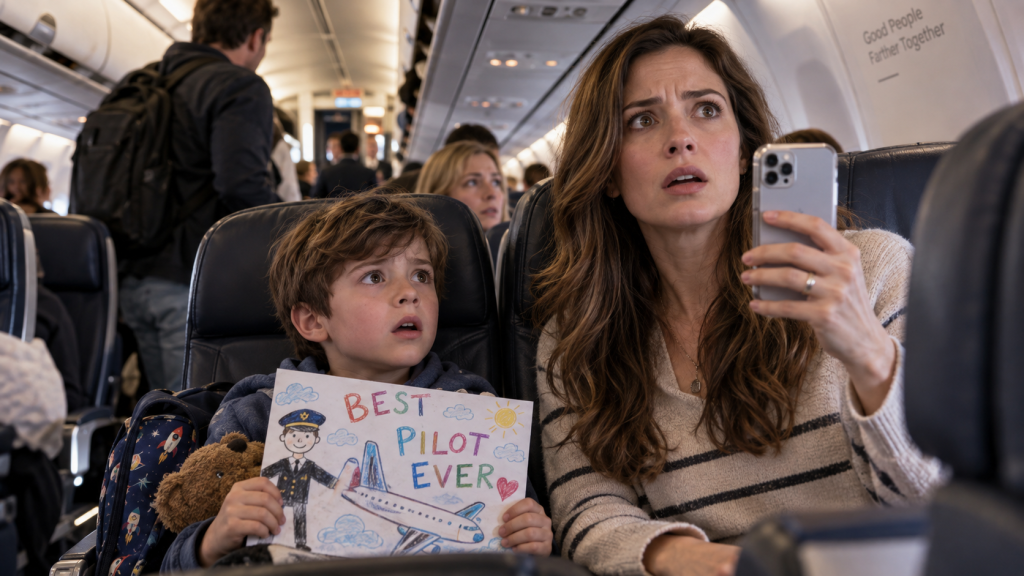
And beside me, my seven-year-old son was still holding the drawing he had made for his father, only now the words BEST PILOT EVER were folded down the middle.
“What do you mean she saved his life?”
I whispered.
The flight attendant glanced toward the cockpit.
“My name is Rebecca.”
She crouched a little lower.
“I was working with Captain Carter the night it happened.”
“What happened?”
Her eyes moved toward Mason.
I understood immediately.
Whatever she was about to tell me was not something she wanted to explain in front of a child.
Unfortunately, Mason understood too.
“I’m not a baby.”
he said.
Rebecca gave him a gentle smile.
“I know.”
“Then tell us.”
“Mason.”
I touched his arm.
He looked at me.
There was fear beneath his confusion now.
“Mom, did something happen to Dad?”
I swallowed.
“I don’t know yet.”
Rebecca stood.
“I shouldn’t be the one telling you this.”
“Then who should?”
“Your husband.”
My voice hardened.
“My husband apparently had an entire year.”
She flinched.
I regretted the sharpness immediately.
She wasn’t responsible.
“I’m sorry.”
“No.”
Rebecca shook her head.
“You have every right to be upset.”
“What happened?”
She hesitated.
Then quietly said:
“A year ago, Captain Carter collapsed during an overnight layover.”
My stomach dropped.
“Collapsed?”
“Yes.”
“Where?”
“Denver.”
Tyler had been in Denver a year earlier.
I remembered.
A three-day sequence of flights.
He came home exhausted.
He told me the schedule had been brutal.
I had complained that he hadn’t answered my calls for almost six hours.
He said his phone had died.
My fingers went cold.
“What caused it?”
Rebecca looked at Mason again.
“A cardiac rhythm problem.”
I stopped breathing.
“His heart?”
“Yes.”
Mason’s eyes widened.
“Dad’s heart stopped?”
Rebecca’s face softened.
“Not exactly.”
That answer frightened me more.
“What exactly happened?”
I asked.
“Captain Carter had a dangerous arrhythmia. Lauren found him.”
“Where?”
“In the hotel corridor.”
“How?”
Rebecca took a breath.
“She was part of the cabin crew on that trip. She noticed he hadn’t come downstairs for transportation to the airport. When she went back up, she found him outside his room.”
Mason unfolded his drawing.
Then folded it again.
“Was Dad dying?”
Rebecca hesitated.
“He was very sick.”
I felt anger rising beneath the fear.
A year.
Tyler had hidden this for a year.
Doctor visits.
Tests.
A heart problem.
A woman saving his life.
And somehow I knew none of it.
“How could I not know?”
I whispered.
Rebecca looked at me sadly.
“I wondered the same thing.”
That hurt.
Because it meant other people knew.
Other people had known my husband had collapsed.
Other people had known someone had found him on a hotel floor.
Other people had known there had been ambulances and doctors and fear.
His wife had known nothing.
Mason touched my sleeve.
“Mom?”
I looked down.
“Is Dad okay?”
I forced myself to breathe.
“He’s flying the airplane, sweetheart.”
“So he’s okay?”
“Yes.”
At least I hoped so.
Rebecca quickly added:
“He was medically evaluated and cleared before returning to flight duty. He wouldn’t be in that cockpit otherwise.”
That helped.
A little.
Then Mason asked the question that broke me.
“Why didn’t Dad tell us?”
Rebecca looked at me.
I looked away.
“I don’t know.”
The aircraft began moving.
Rebecca had to return to her position.
Before leaving, she touched the top of Mason’s seat.
“Your dad loves you very much.”
Mason did not answer.
Rebecca walked away.
The plane pushed back from the gate.
I sat there staring at the seat in front of me.
My phone was still in my hand.
The recording was running.
I stopped it.
On the screen, the video thumbnail showed Mason smiling.
His face lit with pride.
Taken seconds before everything changed.
I locked the phone.
Then Tyler’s voice returned over the speakers.
“Cabin crew, prepare for departure.”
Professional.
Calm.
Familiar.
The voice I had heard hundreds of times in our kitchen while he practiced announcements jokingly for Mason.
Except now it sounded like the voice of a stranger.
Mason whispered:
“Mom?”
“Yes?”
“Did Dad almost die?”
I closed my eyes.
“I think he got very sick.”
“But why didn’t he tell us?”
“I don’t know.”
“Did he tell Lauren?”
“She was there.”
“Does she know him better than we do?”
The question went straight through me.
“No.”
I answered too quickly.
Mason looked at me.
Children hear uncertainty even when adults hide it beneath perfect grammar.
I took his hand.
“No, sweetheart.”
I tried again.
“Knowing one frightening thing about someone doesn’t mean you know them better.”
He nodded.
But he did not look convinced.
Neither was I.
The plane accelerated.
Normally, Mason would have been pressed against the window.
He had spent weeks talking about takeoff.
He wanted to feel the engines.
Watch the ground disappear.
Tell Tyler afterward whether his landing deserved ten stars.
Instead, he stared down at his drawing.
As the aircraft lifted into the air, I watched my son quietly smooth the crease running through the word PILOT.
That hurt more than the announcement.
Because whatever Tyler had hidden from me, he had unknowingly hidden it from Mason too.
Twenty minutes after takeoff, the seat belt sign turned off.
A woman stood from row three.
Lauren.
I knew immediately.
She looked to be in her early forties.
Dark hair.
Gray sweater.
No glamorous secret mistress.
No dramatic red dress.
No lipstick-stained conspiracy.
Just a tired-looking woman carrying a paperback book.
She walked toward the rear lavatory.
When she reached our row, Rebecca appeared from the galley.
Their eyes met.
Then Rebecca looked toward me.
Lauren followed her gaze.
She stopped.
I saw recognition move across her face.
Not because she knew me personally.
Because she had probably seen photographs.
Tyler kept a picture of Mason and me inside his flight bag.
At least I thought he still did.
Lauren stared.
“Are you…”
I stood.
“Natalie Carter.”
Her face lost color.
“Oh.”
That one word told me Tyler had never expected us to be there.
Mason looked up.
“Are you Lauren?”
She looked at him.
Her entire expression softened.
“You must be Mason.”
Mason frowned.
“You know me?”
Lauren glanced at me.
Then answered carefully.
“Your dad talks about you.”
“How much?”
“Mason.”
I said quietly.
Lauren understood what he was really asking.
“A lot.”
He looked down.
“Did you save him?”
The cabin seemed suddenly too small.
Lauren sat in the empty aisle seat across from us.
“Your dad had a medical emergency.”
she said gently.
“I found him and called for help.”
“Did his heart stop?”
“No.”
She answered immediately.
“Not completely.”
I appreciated the precision.
“What happened?”
I asked.
Lauren looked at me.
“He had an episode of ventricular tachycardia.”
The medical term meant almost nothing to me then.
But the seriousness in her face did.
“He had been feeling strange for most of the evening.”
“Did he tell anyone?”
“No.”
Of course not.
That was Tyler.
He could fly hundreds of people through thunderstorms but treated his own vulnerability like prohibited cargo.
Lauren continued.
“He said he was tired.”
“We finished dinner.”
“He went upstairs.”
“About forty minutes later, our shuttle was leaving.”
“He wasn’t answering his phone.”
“I went up because I was annoyed.”
She gave a sad smile.
“I was going to yell at him.”
“What happened?”
“I found him sitting against the wall outside his room.”
My throat tightened.
“Conscious?”
“Barely.”
“He was sweating.”
“Disoriented.”
“He said his chest felt strange.”
“I called emergency services.”
She paused.
“Then he lost consciousness.”
Mason gripped my hand.
Lauren saw.
“He woke up.”
she said quickly.
“The paramedics were already coming.”
“Did you do CPR?”
Mason asked.
“No.”
Lauren shook her head.
“His pulse was still there.”
That distinction mattered.
Even to a frightened child.
“I stayed with him until the paramedics arrived.”
I whispered:
“And then?”
“I went to the hospital.”
“You?”
“Yes.”
“Why?”
“Because nobody else was there.”
The sentence hit me harder than she intended.
Nobody else was there.
His wife was hundreds of miles away.
Unaware.
His son was asleep.
Unaware.
And Lauren had sat beside my husband in an emergency department while doctors tried to determine whether his heart was going to betray him again.
“Did he call me?”
Lauren looked away.
“No.”
“Did you tell him to?”
“Yes.”
“What did he say?”
She hesitated.
“Lauren.”
I needed the truth.
“He said he didn’t want to scare you until he knew what was happening.”
My laugh came out bitter.
“So he waited a year?”
“No.”
She said.
“That wasn’t the plan.”
“What was the plan?”
“He said he would tell you when he got home.”
“He came home.”
“I know.”
“He slept in our bed.”
“I know.”
“He ate breakfast with our son.”
“I know.”
“He went to Mason’s soccer game.”
Lauren’s eyes filled.
“I know.”
“You know a lot.”
“I wish I knew less.”
That stopped me.
She looked at me directly.
“Natalie, I have never had an affair with your husband.”
“I didn’t ask.”
“You were thinking it.”
I had been.
For about thirty seconds.
Then fear replaced jealousy.
Lauren continued.
“I’m married.”
She lifted her left hand.
A wedding band.
“My husband knows Tyler.”
“My children know what happened.”
“You were apparently the only person who didn’t.”
That sentence could have sounded cruel.
It didn’t.
She sounded ashamed.
“Why didn’t you tell me?”
I asked.
“It wasn’t my story to tell.”
“He made it your story when he collapsed in front of you.”
She looked down.
“You’re right.”
“Did you ever tell him he should tell me?”
“Repeatedly.”
“How repeatedly?”
“For months.”
My stomach twisted.
“You’ve stayed in contact?”
“Yes.”
“Why?”
Lauren looked toward the cockpit.
“Because I was scared he’d do it again.”
“Do what?”
“Pretend he was fine.”
I sat back.
That sounded like my husband.
Painfully.
Exactly.
“Did he?”
“No.”
“After the hospital, he followed every medical requirement.”
“Specialists.”
“Monitoring.”
“Medication for a while.”
“Testing.”
“He was grounded from flying during the evaluation period.”
My eyes widened.
“Grounded?”
“Yes.”
I thought back.
There had been a six-week stretch when Tyler told me his schedule had been changed because the airline was short on training assignments.
He had spent more time home.
He said it was administrative.
I had believed him.
Because marriage cannot function if every sentence requires forensic examination.
“He lied.”
I whispered.
Lauren said nothing.
“He told me he was doing training.”
“I don’t know exactly what he told you.”
“He lied.”
“Yes.”
There it was.
No excuse.
No softening.
Mason looked between us.
“Dad lies?”
My heart broke.
I crouched beside him.
“Your dad kept something important from us.”
“That’s lying.”
Seven-year-olds are ruthless philosophers.
“Yes.”
I said.
“It was.”
His eyes filled.
“Why?”
“I don’t know.”
Lauren spoke quietly.
“I think he was afraid.”
Mason looked at her.
“Dad isn’t afraid.”
Every adult nearby who heard that sentence became very still.
Lauren smiled sadly.
“Everybody is afraid of something.”
“Not Dad.”
“Especially dads.”
Mason frowned.
“My dad flies airplanes.”
“Yes.”
“That’s scary.”
“Sometimes.”
“So why would he be scared to tell Mom?”
Lauren looked at me.
Then back at Mason.
“Because sometimes people who are very good at protecting others are terrible at letting other people protect them.”
I hated how accurate that sounded.
Mason thought for a moment.
Then asked:
“Did my dad cry?”
Lauren’s face changed.
“Yes.”
Mason stared.
“When?”
“At the hospital.”
“Why?”
“Because he was scared he might not see you again.”
Mason started crying.
I pulled him against me.
Lauren’s eyes filled too.
“I’m sorry.”
she whispered.
I shook my head.
“No.”
For once, the truth was not the cruel thing.
The hiding had been.
The flight lasted one hour and forty-three minutes.
It felt like ten years.
Lauren returned to her seat.
Mason eventually fell asleep against my shoulder.
I watched clouds pass beneath us.
I thought about every strange detail from the previous year.
Tyler becoming obsessed with walking every evening.
Tyler refusing wine at Christmas.
Tyler buying a smartwatch with heart monitoring.
Tyler suddenly changing his diet.
Tyler going to appointments he described as “work physicals.”
Tyler hugging Mason for unusually long periods.
Tyler waking once at two in the morning and standing beside our son’s bed.
I had seen all of it.
I simply had not known what I was seeing.
That is the cruelty of hidden truth.
It rearranges old memories.
Nothing changes.
And everything changes.
When the descent began, Mason woke.
He looked out the window.
Chicago spread beneath us.
“Dad’s landing.”
he whispered.
There was still pride in his voice.
That somehow made me sadder.
The wheels touched the runway smoothly.
Passengers applauded lightly.
Mason did not.
He held his drawing.
After we reached the gate, people began standing.
Rebecca approached us.
“Would you wait here?”
I nodded.
Lauren stayed near the front.
The cabin emptied.
Then the cockpit door opened.
Tyler stepped out.
He was smiling.
Talking to the first officer.
Then he saw Lauren.
“Hey.”
She looked past him.
Tyler followed her gaze.
Saw me.
Stopped.
Then saw Mason.
Everything disappeared from his face.
“Natalie?”
Mason stood.
For weeks, he had planned this moment.
He had imagined running toward his father.
Shouting surprise.
Handing over the drawing.
Instead, he remained beside me.
Tyler looked from him to me.
“What are you doing here?”
Mason whispered:
“Surprise.”
Tyler’s face crumpled.
“Oh my God.”
He took one step toward us.
Mason stepped backward.
Tyler stopped.
That moment broke him.
I saw it.
“Mason?”
“Did you almost die?”
Tyler closed his eyes.
Lauren turned away.
Rebecca quietly walked into the galley.
The first officer disappeared back into the cockpit.
Tyler opened his eyes.
“Buddy…”
“Did you?”
“Yes.”
The word was barely audible.
Mason began crying.
“Why didn’t you tell me?”
Tyler crouched.
“Because I didn’t want you to be scared.”
“I’m scared now!”
“I know.”
“You lied.”
“I did.”
“Mom didn’t know.”
Tyler looked at me.
“No.”
“Why?”
His eyes filled.
“I was going to tell her.”
“When?”
I asked.
He stood slowly.
“I don’t know.”
“That’s not an answer.”
“I know.”
“One year, Tyler.”
“I know.”
“One year.”
“I know.”
“You collapsed.”
“I know.”
“You were taken to a hospital.”
“Yes.”
“You were grounded from flying.”
“Yes.”
“You saw specialists.”
“Yes.”
“You had follow-up tests.”
“Yes.”
“And every night you came home and looked me in the face.”
His voice broke.
“Yes.”
“Why?”
He had no answer.
That was worse than a bad one.
Mason threw the drawing at him.
It hit Tyler’s chest.
Fell to the floor.
“I don’t want you to have it.”
“Mason.”
Tyler whispered.
But our son was already walking away.
I followed him.
Tyler picked up the drawing.
He did not chase us.
For once, he understood that love does not automatically give you permission to follow someone who needs space.
We went home that evening on another flight.
Without Tyler.
He had duty obligations and returned later.
Mason barely spoke.
At bedtime, he asked:
“Can Dad die when he flies?”
“Everybody can die someday.”
“That isn’t what I asked.”
I closed my eyes.
“No.”
I tried again.
“The doctors cleared your dad to fly.”
“Does that mean his heart is fixed?”
“It means doctors believe he can safely do his job.”
“Can it happen again?”
“I don’t know.”
He pulled his blanket higher.
“Did Dad think we’d be happier if he died without telling us?”
The question destroyed me.
“No.”
“Then why didn’t he tell us?”
“I think he thought hiding it would protect us.”
“That’s stupid.”
“Yes.”
I said.
“It was.”
Mason looked surprised.
Adults rarely agree when children call other adults stupid.
I kissed his forehead.
“Your dad made a very bad decision because he was scared.”
“Is he still a good dad?”
I thought carefully.
“I think people can be good and still do things that hurt us.”
“Can he be both?”
“Yes.”
“That’s confusing.”
“Very.”
Tyler came home after midnight.
I was waiting in the kitchen.
He placed his flight bag by the door.
The drawing was sticking out of the side pocket.
Carefully flattened.
I noticed.
It did not make me less angry.
“Is Mason asleep?”
“Yes.”
“How is he?”
“What do you think?”
Tyler lowered his eyes.
“I deserve that.”
“Don’t do that.”
“What?”
“Don’t turn this into whether you deserve punishment.”
I folded my arms.
“I need to understand.”
He sat.
For the first time in eleven years of marriage, my husband looked like someone who had run out of places to hide.
“It happened exactly the way Lauren told you.”
“Start before that.”
“What?”
“Why were you feeling sick?”
“I’d been having palpitations for weeks.”
My stomach turned.
“Weeks?”
“Yes.”
“You knew?”
“I knew something felt wrong.”
“Did you see a doctor?”
“No.”
“Why?”
“I thought it was stress.”
“Tyler.”
“I know.”
“No, apparently you don’t.”
He looked down.
“I was stupid.”
“Stop using that word as if insulting yourself is accountability.”
He looked up.
“What do you want me to say?”
“The truth.”
So he gave it.
He had been experiencing episodes for almost a month.
A racing heartbeat.
Dizziness.
Occasional shortness of breath.
He told himself it was caffeine.
Fatigue.
Work.
Anything except something serious.
Then Denver.
He collapsed.
Lauren called emergency services.
At the hospital, doctors discovered an electrical rhythm problem.
Not a heart attack.
Not terminal heart disease.
But serious enough to require evaluation.
Medication.
Monitoring.
Temporary grounding.
He had been terrified.
“Why didn’t you call me from the hospital?”
“I picked up my phone.”
“Then?”
“I saw your picture.”
“And?”
“I couldn’t do it.”
“Why?”
“Because Mason was home.”
“What does that have to do with me?”
“You would’ve been terrified.”
“Yes.”
“You would’ve flown out.”
“Yes.”
“You would’ve had to find someone for Mason.”
“Yes.”
“You would’ve spent the entire flight thinking I was dying.”
“Yes!”
I shouted.
“Because you’re my husband!”
He flinched.
“That is what marriage is, Tyler.”
“I know.”
“No.”
“You know it now because the lie exploded.”
“But you didn’t know it then.”
“I thought I was protecting you.”
“You were protecting yourself.”
Silence.
He looked at me.
I continued.
“You didn’t want to see me scared.”
“You didn’t want to answer questions.”
“You didn’t want Mason to look at you differently.”
“You didn’t want to feel weak.”
His eyes filled.
“You were protecting yourself from being seen.”
He started crying.
Quietly.
I had seen Tyler cry four times.
At our wedding.
When Mason was born.
When his father died.
And now.
“You’re right.”
he whispered.
I sat across from him.
“Why the announcement?”
He wiped his face.
“Lauren is retiring.”
“What?”
“Today was her last flight as a passenger before she relocates with her husband.”
“Why was she on your flight?”
“She booked it.”
“Did you know?”
“Yes.”
“So you planned that speech?”
“Yes.”
“Without telling me.”
His face tightened.
“I wanted to thank her publicly.”
“Why now?”
“Because I realized I’ve spent a year acting like the worst night of my life didn’t happen.”
I stared at him.
“And your solution was to acknowledge it to a plane full of strangers before your wife?”
He closed his eyes.
“When you say it like that…”
“How else should I say it?”
“You shouldn’t.”
He whispered.
“It was wrong.”
That was the first useful sentence.
Not:
I was trying to protect you.
Not:
You don’t understand.
Not:
I had good intentions.
It was wrong.
I let silence sit between us.
Then I asked:
“Are you healthy?”
“Yes.”
“Don’t answer as my husband.”
He looked confused.
“Answer as a pilot.”
That changed him.
Pilots understood precision.
“I am medically cleared.”
“Any restrictions?”
“No current restrictions.”
“Medication?”
“Not anymore.”
“Monitoring?”
“Annual specialist review beyond my standard aviation medical requirements.”
“Chance of recurrence?”
“Low, according to my cardiologist, but not zero.”
“Could you lose your medical clearance again?”
“Yes.”
“Could you stop flying?”
“If something changes medically, yes.”
“Could you die from this?”
He swallowed.
“Potentially.”
My eyes filled.
“Thank you.”
“For what?”
“For finally respecting me enough to frighten me with the truth.”
He cried harder.
We slept separately.
Not because our marriage was over.
Because forgiveness offered too quickly can become another form of avoidance.
The next morning, Tyler sat outside Mason’s bedroom.
He did not knock.
He waited.
Eventually Mason opened the door.
“Mom says you can come in if I want.”
Tyler nodded.
“Do you want me to?”
Mason thought.
“Yes.”
I remained downstairs.
Twenty minutes passed.
Then forty.
An hour.
Eventually Tyler came down alone.
His eyes were red.
“What happened?”
“He asked me if I was going to die.”
“What did you say?”
“That someday I will.”
I stared.
“He asked.”
“And?”
“I told him doctors believe I’m healthy enough to fly and live normally.”
“Good.”
“He asked if I lied because I didn’t trust him.”
My chest hurt.
“What did you say?”
“That I didn’t trust myself to handle his fear.”
That was painfully accurate.
“He gave me the drawing back.”
My eyes widened.
Tyler looked toward the stairs.
“He told me to keep it because I’m still a pilot.”
“Then he said he isn’t sure about the best part.”
I almost smiled.
Almost.
“He’s seven.”
“He’s brutal.”
“He’s hurt.”
“I know.”
Tyler entered therapy.
That was not my condition for staying married.
It was his decision.
That mattered.
We also entered marriage counseling.
The first session was awful.
Tyler explained why he hid the diagnosis.
The counselor listened.
Then asked:
“What did secrecy give you?”
Tyler frowned.
“Give me?”
“Yes.”
“What benefit did you receive from keeping the truth from Natalie?”
“I thought I was protecting her.”
“That describes the story you told yourself.”
The counselor said.
“What did the secrecy give you?”
Tyler sat silent.
Finally:
“Control.”
I looked at him.
He continued.
“If she didn’t know, I didn’t have to see her scared.”
“I didn’t have to talk about dying.”
“I didn’t have to watch Mason become afraid of airplanes.”
“I could go home and pretend I was still the same person.”
The counselor nodded.
“So secrecy allowed you to manage everyone else’s emotional reality in order to avoid your own.”
Tyler looked sick.
“Yes.”
That became the real problem.
Not Lauren.
Lauren had done nothing wrong.
Not the arrhythmia.
Illness was not betrayal.
The betrayal was Tyler deciding that because he feared our reactions, he had the right to remove our choice to react at all.
It took time to repair.
Months.
Not one dramatic apology.
Not flowers.
Not a vacation.
Repair is boring.
That is why people often avoid it.
It looked like Tyler putting every medical appointment on our shared calendar.
It looked like him telling me when he felt anxious.
It looked like Mason being allowed to ask the same question twenty times.
“Is your heart okay?”
“Yes.”
“Today?”
“Yes.”
“Promise?”
“I promise to tell you if something changes.”
Notice the difference.
Not:
I promise nothing bad will happen.
No parent can promise that.
He promised truth.
That was something he could control.
Lauren remained in our lives.
At first, that felt strange.
Then it became less strange.
Her husband, David, was kind.
They had two grown daughters.
We invited them to dinner six months after the flight.
Mason answered the door.
Lauren smiled.
“Hey, buddy.”
Mason stared at her.
Then said:
“Thanks for not letting my dad die.”
Lauren burst into tears.
David laughed.
Tyler cried.
I stood there thinking this was the strangest dinner party I had ever hosted.
Later that evening, Lauren and I sat on the porch.
She said:
“I’m sorry.”
“For what?”
“For keeping his secret.”
I looked at her.
“Did he ask you to?”
“Not directly.”
“Then why?”
“I thought it was his marriage.”
“It was.”
“I told myself that meant it wasn’t my place.”
I nodded.
“Maybe it wasn’t.”
She looked surprised.
“I was angry with you at first.”
“I know.”
“But you were his colleague.”
“Not my friend.”
“You told him repeatedly to tell me.”
“Yes.”
“You couldn’t force him.”
“No.”
“So I’m not going to make you responsible for a lie my husband chose.”
Her eyes filled.
“Thank you.”
“Don’t thank me.”
“I’m just putting responsibility where it belongs.”
Tyler heard about that conversation later.
He did not defend himself.
Good.
A year after our surprise flight, we tried again.
This time Tyler knew.
Mason and I boarded one of his flights to Boston.
Mason was eight.
Before takeoff, Tyler came over the speakers.
“Good morning, everyone.”
Mason grinned.
I looked at him.
“Don’t get too excited.”
He laughed.
Tyler continued with the ordinary announcement.
Weather.
Flight time.
Seat belts.
Then:
“And on a personal note, my son Mason is onboard today.”
Mason’s eyes widened.
Passengers looked around.
Tyler continued:
“He has informed me that my landing will be graded.”
People laughed.
Mason stood slightly in his seat.
“Ten points!”
I pulled him down.
Tyler finished:
“And my wife Natalie is with him.”
His voice softened.
“They both taught me something important this past year.”
My stomach tightened.
But this time he had discussed the announcement with me first.
“I used to believe protecting the people you love meant keeping fear away from them.”
Tyler said.
“I learned that sometimes love means trusting them enough to tell them when you’re afraid.”
The cabin became quiet.
“So this flight is dedicated to my favorite two passengers.”
Mason squeezed my hand.
“And, Mason?”
Tyler added.
“I still have the drawing.”
Mason smiled.
A real smile.
The landing received ten points.
Mason deducted one for “slightly aggressive braking.”
Tyler demanded an appeal.
Denied.
Life moved forward.
Tyler flew another sixteen years.
His heart remained stable.
He became a training captain.
Then an instructor.
He developed a reputation for one particular lesson.
During training, he told younger pilots:
“The most dangerous sentence in aviation isn’t always ‘something is wrong.’ Sometimes it’s ‘I’m probably fine.’”
He taught them about fatigue.
Medical honesty.
Crew resource management.
The arrogance of assuming silence equals strength.
He never used his own medical story publicly without context.
But privately, with pilots struggling to report symptoms, he sometimes told them:
“I once nearly let embarrassment make a medical decision for me.”
Several later wrote to thank him.
Mason grew up surrounded by airplanes.
For years, everyone assumed he would become a pilot.
At twelve, he announced he hated flying.
Tyler looked devastated.
Then caught himself.
“Okay.”
That one word showed me how much he had changed.
He did not turn Mason into an extension of himself.
At fourteen, Mason loved engineering.
At seventeen, robotics.
At nineteen, he changed majors twice.
At twenty-two, he became an emergency medical technician.
Tyler laughed when Mason told us.
“What?”
Mason asked.
“Nothing.”
“Dad.”
Tyler smiled.
“The kid who hated hearing about medical emergencies chose emergency medicine.”
Mason shrugged.
“Maybe I like knowing what to do.”
That made sense.
He eventually became a paramedic.
Then a physician assistant in emergency medicine.
The first time he treated a pilot who came in complaining of palpitations, Mason called Tyler afterward.
“Guess what I told him?”
“What?”
“Don’t be an idiot.”
Tyler laughed.
“Excellent bedside manner.”
“I also told him to stop deciding his family can’t handle the truth.”
Tyler went quiet.
“Fair.”
Mason never forgot.
But he forgave.
Those are different things.
When Mason was twenty-eight, he got married.
Before the ceremony, Tyler helped him with his tie.
I stood outside the room and heard Mason say:
“Dad?”
“Yeah?”
“Were you really afraid you’d never see me again that night?”
Silence.
“Yes.”
“Why didn’t you call?”
Another silence.
“I was a coward.”
I almost entered.
Then Mason said:
“No.”
Tyler sounded confused.
“What?”
“You weren’t a coward.”
“You were scared.”
“You made a bad decision.”
“Don’t turn the decision into your whole identity.”
I covered my mouth.
Tyler started crying.
“You sound like your mother.”
“Terrifying, right?”
“Extremely.”
Then Mason said:
“I forgave you years ago.”
“I know.”
“No.”
“I don’t think you do.”
Silence.
“You can stop trying to make up for it.”
Tyler cried harder.
“So can you.”
“What?”
“Stop punishing yourself.”
That was the final part of repair Tyler had resisted.
Forgiveness from others is sometimes easier than mercy toward yourself.
Mason had children.
Two girls.
Emma and Grace.
Tyler became the grandfather who arrived absurdly early.
Dance recitals.
Soccer.
School plays.
Birthday parties.
He attended everything.
Once, Emma had a kindergarten performance in which she played a cloud.
She had no lines.
Tyler drove three hours.
I teased him.
“You know she just stands there?”
“She is the most important cloud.”
“Obviously.”
He recorded the entire performance.
Thirty-seven minutes.
Emma appeared for four.
On the drive home, I looked at him.
“You’ve changed.”
He kept his eyes on the road.
“I had good teachers.”
At sixty-one, Tyler retired from commercial flying.
His final flight was Chicago.
Same route.
On purpose.
Mason came.
So did I.
Lauren and David attended too.
Lauren was seventy-three.
Tyler had invited her.
This time there were no secrets.
Before departure, another captain made the announcement.
“Ladies and gentlemen, today’s flight marks Captain Tyler Carter’s final trip after more than three decades in aviation.”
Passengers applauded.
Tyler looked embarrassed.
Good.
Then the captain added:
“There are several people onboard who helped Captain Carter reach this day.”
Tyler looked toward us.
Mason held up something.
The drawing.
The original.
BEST PILOT EVER.
Faded.
Creased.
Protected inside a clear sleeve.
Tyler saw it.
Covered his face.
Mason laughed.
“Still under review!”
The cabin applauded.
Lauren cried.
I cried.
Tyler cried.
We were becoming a very hydrated family.
After landing, airport fire trucks gave the aircraft a water salute.
Tyler stepped off the plane.
Mason handed him the drawing.
“For real this time.”
Tyler looked at it.
“Am I officially the best?”
Mason smiled.
“No.”
Tyler frowned.
“Your granddaughters outrank you.”
“Unbelievable.”
Then Mason hugged him.
I watched the two of them.
The seven-year-old boy who once stopped smiling in row twenty-seven was gone.
In his place stood a grown man who understood something his father had needed years to learn.
People do not become trustworthy because they never fail us.
Trustworthiness is revealed by what they do after failure becomes undeniable.
Lauren died before Tyler.
Cancer.
Seventy-nine.
We visited her near the end.
Tyler sat beside her bed.
She looked at him.
“You still telling your wife things?”
He laughed.
“Too many.”
I nodded.
“It’s exhausting.”
Lauren smiled.
“Good.”
Tyler held her hand.
“I never properly thanked you.”
“Yes, you did.”
“No.”
“For Denver.”
“You thanked me on an airplane full of people.”
He winced.
“Bad example.”
She laughed.
Then coughed.
When she recovered, Tyler said:
“You gave me sixteen extra years in the cockpit.”
Lauren shook her head.
“No.”
“I called an ambulance.”
“The doctors treated you.”
“You took care of yourself.”
“Your wife put up with you.”
“Your son forgave you.”
“Don’t make one person responsible for your whole life because they helped you survive one night.”
Tyler became quiet.
Lauren looked toward me.
“Natalie?”
“Yes?”
“Was I right?”
“About what?”
“He’s stubborn.”
“Catastrophically.”
“Good.”
She smiled.
Then looked back at Tyler.
“I didn’t save your life.”
“I helped during an emergency.”
“There’s a difference.”
Tyler nodded.
“Okay.”
“Say it.”
He sighed.
“You helped during an emergency.”
“Better.”
Lauren died two weeks later.
At her memorial, Tyler did not call her the woman who saved his life.
He said:
“Lauren noticed when I needed help and refused to walk past.”
That was better.
Years later, Tyler’s heart problem returned.
He was seventy-four.
We were eating breakfast.
He put down his coffee.
“Natalie.”
Something in his voice changed.
“What?”
“My heart feels strange.”
I froze.
For half a second, I was back on the airplane.
Row twenty-seven.
Rebecca crouched beside me.
A secret splitting open.
Then Tyler reached for my hand.
“I’m telling you.”
Those three words almost broke me.
“I know.”
We went to the hospital.
No hiding.
No waiting.
No pretending.
Mason met us there.
Doctors diagnosed another rhythm problem.
Treatable.
Tyler needed a procedure.
Before they took him back, he looked at Mason.
“Scared?”
Mason asked.
“Yes.”
“Good.”
Tyler frowned.
“Good?”
“Means you’re not lying.”
Tyler smiled.
“I’m terrified.”
“Excellent.”
“Terrible doctor.”
“I’m not your doctor.”
The procedure went well.
We got six more years.
Six ordinary, precious years.
Coffee.
Grandchildren.
Arguments about thermostat settings.
A trip to Italy.
One terrible cruise Tyler insisted he enjoyed even though he was seasick for four days.
Christmas mornings.
Doctor visits.
Anniversaries.
Life.
Tyler died at eighty.
Not suddenly.
His heart gradually weakened.
By then, we had been married fifty-two years.
On his final night, Mason sat beside him.
I sat on the other side.
Tyler’s breathing was shallow.
He opened his eyes.
Looked at Mason.
“Hey, buddy.”
Mason smiled through tears.
“Hey, Dad.”
“Still have the drawing?”
“Of course.”
“Rating?”
Mason pretended to think.
“Eight.”
Tyler looked offended.
“Eight?”
“Okay.”
“Nine.”
“After fifty years?”
“Fine.”
“Ten.”
Tyler smiled.
Then looked at me.
“I should’ve told you.”
I knew immediately what he meant.
Denver.
A lifetime later.
Still there.
“Yes.”
“I was so scared.”
“I know.”
“I thought if I said it out loud, it would become real.”
“I know.”
“I thought being your husband meant protecting you from fear.”
I squeezed his hand.
“You learned.”
“Slowly.”
“Very.”
He smiled.
“Did you forgive me?”
“Years ago.”
“All the way?”
I thought.
“Enough.”
He laughed softly.
“That’s a very Natalie answer.”
“Would you prefer a lie?”
“No.”
That was the point.
He closed his eyes.
Then opened them again.
“Tell me something true.”
I leaned closer.
“I love you.”
He smiled.
“Another.”
“Mason loves you.”
Mason took his hand.
“Another.”
“You were a wonderful grandfather.”
“Another.”
“You were a pain in my ass.”
Mason laughed.
Tyler smiled.
“Another.”
I started crying.
“You scared me more than anyone I’ve ever loved.”
His eyes filled.
“Another.”
“You taught me that forgiveness doesn’t require forgetting.”
“Another.”
“You changed.”
He stopped.
That was the one.
Tears slid toward his ears.
“Did I?”
“Yes.”
“How do you know?”
“Because the second time your heart frightened you, you told me before I even asked.”
He smiled.
“That took seventy-four years.”
“Slow learner.”
“I love you.”
“I love you too.”
Tyler died shortly before dawn.
His hand in mine.
Mason beside us.
No secrets.
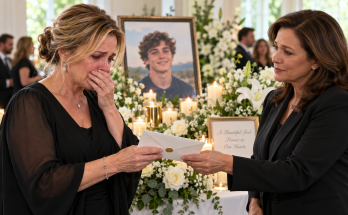
At his funeral, Mason placed the drawing beside the urn.
The paper was almost fifty years old.
BEST PILOT EVER.
He stood at the podium.
“My father spent most of his life flying airplanes.”
he began.
“So naturally, the story I want to tell is about the worst decision he ever made on the ground.”
People laughed softly.
Mason told the story.
Carefully.
The collapse.
Lauren.
The secret.
The surprise flight.
The announcement.
He did not romanticize it.
“My father hid a serious medical event from his wife and child for a year.”
Mason said.
“That was wrong.”
The room became quiet.
“He did it because he loved us.”
“That did not make it less wrong.”
“He did it because he was afraid.”
“That explained it.”
“It did not excuse it.”
I cried.
Mason continued.
“For most of my childhood, I thought courage meant not being scared.”
“My father was a pilot.”
“He flew through storms.”
“He made decisions with hundreds of lives behind him.”
“To me, he was fearless.”
“Then I learned that the man I thought feared nothing had once been too afraid to call his wife from a hospital.”
He paused.
“That disappointed me.”
“But it also taught me something I needed.”
“Courage is not one permanent quality you either possess or lack.”
“You can be brave in a cockpit and cowardly in a conversation.”
“You can be calm in an emergency and terrified of vulnerability.”
“You can be strong enough to save other people and still need help saving yourself.”
Then Mason looked at me.
“My mother taught him the next part.”
I shook my head.
He smiled.
“She taught him that love without truth eventually becomes control.”
The room went silent.
“My father thought he was protecting us by deciding what we were allowed to know.”
“He learned that real protection sometimes means giving the people you love enough truth to make their own choices.”
Then he spoke about repair.
“My father did not repair our trust with one apology.”
“He repaired it for decades.”
“He told the truth when it was uncomfortable.”
“He went to therapy.”
“He answered my questions.”
“He stopped promising that nothing bad would ever happen.”
“Instead, he promised he would tell us when something did.”
“That promise was harder.”
“And better.”
Mason picked up the old drawing.
“When I was seven, I made this.”
He showed everyone.
BEST PILOT EVER.
“I gave it to him.”
“Then I took it back.”
A little laughter.
“Then I gave it back.”
“Then I spent approximately forty years insulting his landings.”
More laughter.
“I used to think this drawing was about airplanes.”
“It wasn’t.”
He looked at his father’s photograph.
“My dad was not the best pilot ever.”
“I have no statistical evidence.”
Laughter moved through the room.
“But he became something more important to me.”
“A man who learned.”
Mason’s voice broke.
“And I think learning may be one of the purest forms of love.”
After the funeral, I took the drawing home.
Mason told me to keep it.
I framed it.
Not because Tyler had been perfect.
Because he hadn’t.
Not because our marriage had been perfect.
It wasn’t.
Because the crease down the middle remained visible.
That mattered.
You could see where Mason had folded it on the airplane.
You could see where the paper had nearly torn.
You could also see where Tyler had carefully flattened it.
The damage remained.
So did the picture.
That became my favorite metaphor for our marriage.
Not broken and magically restored.
Not ruined forever.
Creased.
Handled carefully afterward.
Still whole enough to keep.
I lived another fourteen years.
Long enough to watch Emma become a pilot.
Yes.
Tyler’s granddaughter.
The little cloud.
She announced it when she was seventeen.
Mason nearly choked.
“You want to fly?”
“Yes.”
“You hate turbulence.”
“I’ll be in front.”
“That is not how turbulence works.”
She became a commercial pilot anyway.
At her graduation, she carried Tyler’s wings inside her pocket.
Before her first passenger flight, she visited me.
I was ninety-two.
She wore her uniform.
Tyler would have cried for six hours.
“Grandma?”
“Yes?”
“Were you ever scared when Grandpa flew?”
“After Denver?”
“Yes.”
“Every time.”
Her expression changed.
“Every time?”
“For a while.”
“How did you handle it?”
“Badly.”
She laughed.
“Eventually I learned the difference between fear and information.”
“What does that mean?”
“I could be afraid.”
“But I didn’t have to invent danger when the facts said he was medically cleared.”
“I could ask questions.”
“I could learn.”
“I could trust without pretending certainty existed.”
Emma nodded.
“Dad told me Grandpa lied about his heart.”
“Yes.”
“Do you think pilots should tell their families everything medical?”
“Pilots should follow medical reporting rules.”
I said.
“As husbands?”
She smiled.
“As husbands, they should probably avoid letting their wives discover major health emergencies over an airplane speaker.”
“Good policy.”
“Extremely.”
Then Emma asked:
“Did you ever wish you hadn’t boarded that flight?”
I thought.
That question stayed with me.
The surprise.
The announcement.
Lauren.
The collapse.
The lie.
The counseling.
The decades after.
“No.”
“Why?”
“Because I would rather discover an ugly truth than live comfortably inside a beautiful lie.”
Emma became quiet.
“That’s depressing.”
“Wait until you’re married.”
“Grandma.”
I smiled.
“Truth doesn’t always make life happier immediately.”
“It makes life real.”
“And real things can actually be repaired.”
A year later, Emma took me on one of her flights.
I sat near the front.
Mason sat beside me.
Before departure, the speakers crackled.
Emma’s voice filled the cabin.
“Ladies and gentlemen, welcome aboard.”
Mason grabbed my hand.
“Here we go.”
Emma gave the usual announcement.
Then:
“And I have two special passengers onboard today.”
I laughed.
Mason groaned.
“My father, Mason, and my grandmother Natalie.”
Passengers turned.
I covered my face.
Emma continued.
“My grandfather Tyler was also a pilot.”
“He taught my father to love aviation.”
“My father taught me something even more important about it.”
“Checklists exist because memory isn’t enough.”
“Crew exists because one person isn’t enough.”
“And honesty exists because pretending nothing is wrong has never made anything safer.”
I looked at Mason.
He was crying.
Emma finished:
“So today’s flight is for Grandpa.”
“And Grandma?”
“Yes?”
she said through the speakers.
I laughed.
“You can’t hear me.”
Apparently Rebecca’s spiritual successor was nearby because a flight attendant shouted:
“She says yes!”
The cabin laughed.
Emma continued:
“Dad says Grandpa’s landing score was ten.”
Mason shouted:
“Revisionist history!”
Everyone laughed.
Then Emma said:
“I’ll try for eleven.”
She did.
After landing, Mason and I remained seated while passengers left.
Emma came out of the cockpit.
“How was it?”
Mason stood.
“Eight.”
She stared.
“Eight?”
I laughed so hard my ribs hurt.
Some things survive generations.
At ninety-five, I knew my time was near.
Not dramatically.
My body was simply tired.
Mason was sixty-seven.
Emma had children.
Grace had become an architect.
Life had widened far beyond that Saturday flight.
One afternoon, Mason visited carrying a box.
“What is that?”
“You’ll see.”
He opened it.
Tyler’s uniform cap.
His wings.
The framed drawing.
And my old phone.
I stared.
“That thing still exists?”
“Apparently.”
“Does it work?”
“No.”
“Thank God.”
Mason smiled.
“I recovered the video years ago.”
My chest tightened.
“What video?”
He looked at me.
“You recording me on the flight.”
I remembered.
My phone.
Tyler’s voice.
Mason smiling.
Then the announcement.
“I never watched it.”
“I know.”
“Did you?”
“Once.”
“Why?”
“I wanted to see him.”
“Your dad isn’t in the video.”
“No.”
“But his voice is.”
Mason sat beside me.
“Do you want to watch?”
I thought.
“No.”
He nodded.
No pressure.
Then I changed my mind.
“Yes.”
He opened a tablet.
The video began.
Seven-year-old Mason appeared.
Tiny.
Headphones around his neck.
Gummy bears in his lap.
Drawing clutched against his chest.
Then Tyler’s voice:
“Good afternoon, ladies and gentlemen…”
Young Mason’s face exploded with joy.
“That’s him.”
he whispered in the recording.
Old Mason beside me started crying.
So did I.
Then came Tyler’s announcement.
“There is a very special person on this plane tonight…”
Young Mason looked toward the camera.
“He knows!”
My own voice laughed.
Then:
“Her name is Lauren.”
The smile disappeared from my son’s face.
I reached forward.
Mason paused the video.
“Enough?”
I looked at the frozen image.
My little boy.
Confused.
Hurt.
Still holding his father’s drawing.
“No.”
“Keep going.”
The video continued for only a few more seconds.
Then I had stopped recording.
That was it.
Thirty-eight seconds.
For decades, I had imagined it as a record of betrayal.
Now I saw something else.
The moment before our family learned the truth.
Painful.
Yes.
But not the end.
Never the end.
“Mom?”
“Yes?”
“Do you think Dad would’ve told us eventually if we hadn’t been there?”
I looked at him.
“I don’t know.”
He nodded.
“Me neither.”
We did not need to invent a kinder answer.
Then he asked:
“Do you think he loved us even when he lied?”
“Yes.”
Immediately.
No hesitation.
“Do you think loving us made the lie okay?”
“No.”
Again.
Immediate.
Mason smiled.
“You’ve had fifty years to perfect those answers.”
“More.”
He looked at the drawing.
“I really thought he was the best pilot ever.”
“You were seven.”
“He was my hero.”
“I know.”
“Then he became human.”
I touched his hand.
“That is what eventually happens to every good parent in a child’s eyes.”
“Was it disappointing?”
“Yes.”
“Was it better?”
I thought.
“In the long run?”
“Yes.”
“Heroes are difficult to love honestly.”
“Humans are easier.”
Mason leaned his head against mine.
We stayed that way.
I died the following spring.
At home.
Family nearby.
No dramatic last words.
I had said most of what mattered while I was alive.
At my memorial, Emma read a letter I had written.
It began:
To my family,
There is a story you all know about the day Mason and I secretly boarded Tyler’s flight.
It has been told so many times that some of you probably believe you were there.
Laughter.
We boarded because we wanted to surprise him.
Instead, he surprised us.
That is one way to describe it.
Another is this:
We accidentally walked into a truth he had spent a year avoiding.
Emma paused.
Then continued.
For a long time, I believed the important question was why Tyler lied.
Fear.
Pride.
Control.
Love distorted into protection.
All were part of the answer.
But eventually I became more interested in another question.
What did he do after the truth became unavoidable?
The room became quiet.
That question matters in marriage.
In parenting.
In friendship.
In life.
Everyone eventually gets something wrong.
Sometimes badly.
The mistake matters.
The repair matters too.
Do not use repair to erase harm.
Do not use harm to erase repair.
Hold both.
Then:
Tyler should have called me from the hospital.
There is no romantic version of that sentence.
He should have called.
He should have told me when he came home.
He should have told Mason in an age-appropriate way.
He should not have allowed strangers and coworkers to carry knowledge about his life that his own family was denied.
He was wrong.
He eventually understood that.
Not merely because he apologized.
Because he changed his behavior.
Then:
An apology without changed behavior is often just a request to stop experiencing consequences.
A few people murmured.
Tyler changed.
He learned to tell me when he was frightened.
He learned to let Mason see him uncertain.
He learned that vulnerability does not make a father smaller in his son’s eyes.
Sometimes it finally lets the son see the whole man.
Emma’s voice trembled.
Mason learned too.
At seven, he believed his father was fearless.
At eight, he learned his father was not.
At twenty-eight, he learned that did not make Tyler less worthy of love.
It made love more honest.
Then Lauren.
Lauren did not save my marriage.
She did not save Tyler’s entire life.
She noticed a sick colleague, called for help, and stayed.
That was enough.
We sometimes turn people into heroes because ordinary human decency feels too small for the gratitude we carry.
But noticing is not small.
Staying is not small.
Calling for help is not small.
Lauren did those things.
I remained grateful for the rest of my life.
Then:
I spent years thinking about the announcement Tyler made over the speakers.
The sentence that made Mason and me stop smiling.
At the time, I thought it ruined our surprise.
Eventually I understood something.
Sometimes the moment that ruins the story you expected is the moment the real story begins.
Emma stopped.
Her eyes filled.
Then she continued.
Our real story was not that Tyler nearly died.
It was not that he lied.
It was not that Mason threw his drawing at him.
The real story was everything after.
The uncomfortable conversations.
The therapy appointments.
The questions asked repeatedly.
The medical information shared openly.
The trust rebuilt in ordinary pieces.
The dinners.
The flights.
The grandchildren.
The second heart scare when Tyler finally said, “My heart feels strange,” instead of pretending he was fine.
That sentence meant more to me than a thousand apologies.
Then:
If someone you love tells you something frightening, do not punish them for frightening you.
Otherwise you teach them to hide.
If you are frightened, do not decide on behalf of everyone who loves you that ignorance is kinder.
Otherwise you turn love into control.
Tell the truth with care.
Receive the truth with care.
And when either of you fails, repair with behavior.
The final page was for Mason.
Mason,
Emma looked at her father.
He covered his mouth.
You once asked me whether your father was still a good dad after you learned he lied.
I told you good people can do things that hurt us.
I still believe that.
But I would add something now.
Goodness is not a permanent certificate issued once.
It is a practice.
Your father practiced becoming better after he hurt us.
So did I.
So did you.
Keep practicing.
Then for Emma and Grace.
Do not inherit our fear.
Inherit what we learned from it.
Ask questions.
Report symptoms.
Tell people when you are scared.
Do not confuse silence with strength.
Do not confuse anxiety with prophecy.
Do not confuse love with the right to control another person’s access to reality.
And please stop scoring landings. Your grandfather suffered enough.
The room laughed through tears.
Emma folded the letter.
Then unfolded the final corner.
“There’s one more line.”
She read:
P.S. Tyler still braked too hard in Chicago. Mason was right.
Mason laughed louder than anyone.
That was how our story ended.
Not with the announcement.
Not with Lauren’s name.
Not with a hospital secret.
Not with a frightened seven-year-old folding a drawing in half.
It ended decades later, surrounded by people who knew the entire truth and stayed anyway.
And perhaps that was what Tyler had failed to understand on the night his heart nearly betrayed him.
He believed love needed him fearless.
It didn’t.
He believed being a husband meant standing between his family and every frightening truth.
It didn’t.
He believed a father had to look invincible for his son to feel safe.
He didn’t.
Mason never needed a father who could promise he would never die.
I never needed a husband who could guarantee nothing bad would happen.
We needed something smaller.
Harder.
More human.
We needed Tyler to trust us with reality.
He failed at that once.
Badly.
Then he spent the rest of his life learning how not to fail the same way again.
The drawing remained in our family.
The crease never disappeared.
Emma eventually hung it in her home beside Tyler’s old pilot wings.
Her children asked why the paper was folded.
She told them.
Not the polished version.
The real one.
Their great-grandfather had been brave.
And frightened.
Honest sometimes.
Dishonest once when it mattered terribly.
Loved deeply.
Failed painfully.
Apologized sincerely.
Changed slowly.
And kept showing up.
A whole human being.
Not a hero.
Not a villain.
Just Tyler.
And beneath the framed drawing, Emma placed a small engraved plaque.
It did not say:
BEST PILOT EVER.
Instead, it said:
THE TRUTH MAY FRIGHTEN THE PEOPLE WHO LOVE YOU.
TRUST THEM WITH IT ANYWAY.
And every time I imagine Tyler seeing that plaque, I know exactly what he would say.
He would make one of his terrible pilot jokes.
Mason would groan.
I would roll my eyes.
And somewhere in the middle of all that ordinary noise, the man who once believed love required him to hide his fear would finally understand what had taken us a lifetime to learn.
The people who truly love you do not need you to be invincible.
They need you to let them stand beside you when you aren’t.
THE END STORIES! THANK YOU FOR READING GOOD LUCK !❤️
Related Posts