➡️ PART 3 ENDING PART➡️
At the bottom of the page was my father’s signature.
Not a photocopy.
Not a typed name.
A signature.
The same long R he had used on birthday cards, school forms, tax returns, and the checks he used to slip into my hand when I was twenty and too proud to admit I needed grocery money.
Beside it was the date.
I tapped it once.
No one moved.
Then I looked at my father.
“You signed this.”
His face had gone gray.
Kayla turned toward him.
“Dad?”
My mother spoke first.
“Put that away.”
I almost smiled.
For most of my life, those four words had worked.
Put that away.
Don’t make a scene.
Not now.
This isn’t the place.
Family business stays in the family.
Every sentence meant the same thing.
Your discomfort is less important than our appearance.
I looked at her.
“No.”
Nate stepped toward the coffee table.
“Give me the folder.”
Michael Reyes rose from the armchair.
He did not raise his voice.
He didn’t need to.
“Don’t touch anything.”
Nate stopped.
Kayla looked from Michael to me.
“What is happening?”
I turned the page so she could see it.
The heading read:
Articles of Organization — Holloway Coastal Holdings LLC.
Holloway.
My mother’s maiden name.
Kayla stared.
“What is that?”
“A company.”
“I can see that.”
Her voice cracked.
“Why is Dad’s name on it?”
“That’s the interesting part.”
My mother snapped:
“Enough.”
I ignored her.
I looked at my father.
“According to a claim filed with Harbor Mutual Insurance eleven months ago, Robert Palmer died in a boating accident outside Cabo San Lucas.”
Kayla laughed.
Not because anything was funny.
Because the sentence was impossible.
“What?”
My father closed his eyes.
Nate whispered:
“Don’t.”
That was not directed at me.
It was directed at Dad.
Michael noticed.
So did I.
I continued.
“Not dead according to the state.”
“Not dead according to the airport that let him fly to Hawaii.”
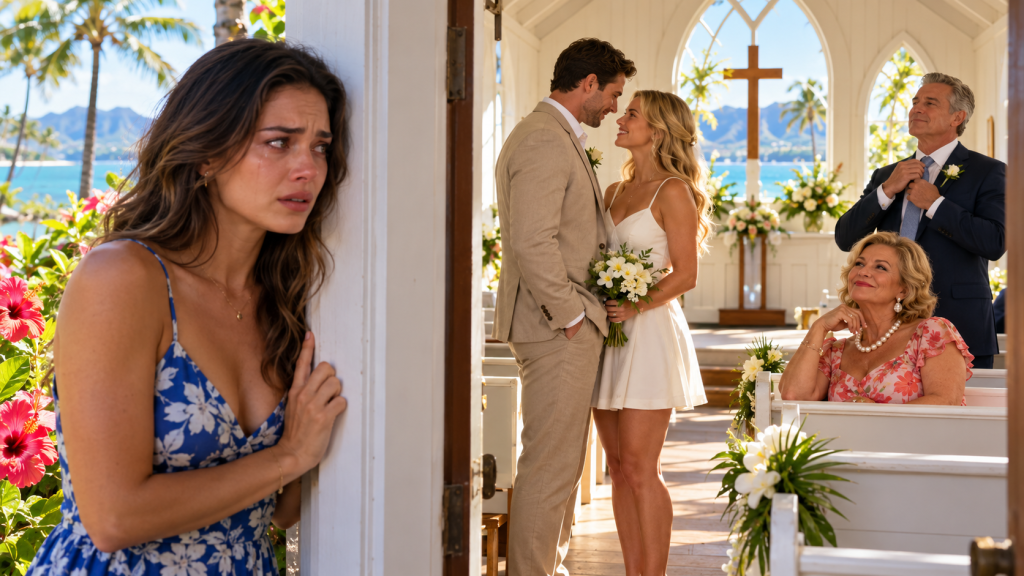
“Not dead according to the chapel where I saw him standing three feet from the aisle.”
My mother’s mouth tightened.
“But according to one insurance company?”
I lifted the page.
“Very dead.”
Kayla stared at our father.
“Dad?”
His lower lip trembled.
Then he sat.
Slowly.
Like a man whose bones had suddenly remembered his age.
I had seen my father ashamed before.
When he forgot an anniversary.
When he backed into my first car.
When he drank too much at Uncle Pete’s retirement party.
This was different.
This was a man watching a wall collapse and realizing he had helped lay every brick.
Kayla whispered:
“Tell me she’s lying.”
Dad looked at her.
He could not.
My sister staggered backward.
“Oh my God.”
My mother stood.
“Everyone needs to calm down.”
I looked at her.
“The woman whose husband was declared dead on an insurance claim is asking us to calm down.”
Her eyes sharpened.
“It was not like that.”
Michael finally spoke.
“What was it like?”
My mother looked at him as if she had forgotten he existed.
“Who exactly are you?”
“My wife’s attorney.”
Nate answered before Michael could.
That word.
Wife.
I looked at him.
He seemed to realize the irony a second too late.
Michael said:
“Michael Reyes.”
“And I would strongly recommend that none of you destroy, alter, transfer, or conceal any financial records related to Holloway Coastal Holdings.”
My mother laughed.
“You can’t come into my daughter’s house and threaten us.”
I said:
“This is my house.”
Silence.
She looked around.
As though she had forgotten.
This living room.
The couch Nate and I chose together.
The framed wedding photograph on the mantel.
The rug my mother had once called too plain.
They had returned from Hawaii assuming they were entering Nate’s home.
Not mine.
That assumption suddenly seemed to trouble everyone.
Kayla lowered herself onto the sofa.
She looked at Nate.
“You told me that company belonged to your friend.”
His face tightened.
I turned.
“Which friend?”
Kayla looked at me.
“He said it was an investment group.”
“For what?”
“The condo.”
My stomach dropped.
“What condo?”
Nate said:
“Kayla.”
She turned on him.
“Shut up.”
I had never heard my sister speak to him that way.
At the chapel, she had looked at Nate like he was rescue.
Now she looked at him like he was a locked door with smoke leaking underneath.
Kayla continued.
“The Hawaii condo.”
My mother closed her eyes.
There it was.
Another layer.
I sat.
“Explain.”
Kayla swallowed.
“Nate said after the divorce, he was going to move to Hawaii part of the year.”
“With you.”
“Yes.”
She looked ashamed.
Good.
She should.
“But he said the condo belonged to an investment group.”
“He said he would buy into it once everything was settled.”
I looked at Nate.
“How romantic.”
He said nothing.
Kayla looked at Dad.
“Were you buying it too?”
Dad shook his head.
“I didn’t know about a condo.”
My mother turned toward him.
“Robert.”
He stared at her.
“What?”
“You absolutely knew.”
“No.”
“I knew about the company.”
“I knew what the company was supposed to do.”
“What was it supposed to do?”
I asked.
Dad looked at me.
His eyes filled.
“Protect the money.”
“What money?”
He did not answer.
My mother did.
“The insurance proceeds.”
Kayla stood so quickly she knocked her suitcase over.
“You actually did it?”
My mother’s face hardened.
“No one was supposed to get hurt.”
I stared at her.
“That sentence generally comes after somebody has already been hurt.”
She ignored me.
“It was temporary.”
Michael said:
“Insurance fraud is rarely improved by duration.”
My mother’s eyes flashed.
“You don’t understand.”
“Then help us.”
he said.
For the first time, my mother looked frightened.
Not because of me.
Because Michael was not emotionally attached to her version of reality.
People like my mother are often strongest inside family systems.
They know exactly which guilt to press.
Which history to rewrite.
Which wound to call selfishness.
Lawyers are less nostalgic.
Dad rubbed both hands over his face.
Then said:
“I was in debt.”
My mother snapped:
“Robert.”
“No.”
He looked at her.
“I’m done.”
That sentence changed the room.
My father had spent my entire childhood avoiding conflict like it was a contagious disease.
When Mom shouted, he washed dishes.
When Kayla and I fought, he went to the garage.
When I moved out after my mother told me I was “too difficult to live with,” Dad carried my boxes to the car and whispered:
“Give her time.”
He had always confused peace with retreat.
Now he looked exhausted by both.
He turned toward me.
“Two years ago, I lost money.”
“How much?”
“A lot.”
I waited.
He swallowed.
“Almost four hundred thousand.”
Kayla gasped.
I stared.
“How?”
“An investment.”
My mother laughed bitterly.
“Say what it was.”
Dad closed his eyes.
“A private development deal.”
“It failed.”
Michael asked:
“Were the funds yours?”
“Some.”
Dad whispered.
“Some were borrowed.”
“How much debt remained?”
“Two hundred and sixty thousand.”
My chest tightened.
My parents did not live like people carrying a quarter-million dollars of private debt.
They had hosted barbecues.
Bought a new SUV.
Gone to Charleston twice.
Mom had complained about grocery prices while wearing a bracelet I later learned cost four thousand dollars.
I whispered:
“You hid that?”
Dad nodded.
“From all of us?”
“Yes.”
Kayla looked at our mother.
“You knew?”
Mom’s expression said she was offended by the question.
“Of course I knew.”
I almost laughed.
Of course.
In our family, secrets were distributed according to rank.
My mother got all of them.
Kayla got the flattering ones.
I got whatever explanation required the least respect.
Dad continued.
“The people involved started threatening lawsuits.”
“Liens.”
“Everything.”
“So Mom found the insurance policy.”
I frowned.
“What policy?”
Dad looked down.
“A private life policy I’d kept after selling my share of the construction company.”
My mother said:
“Six hundred thousand dollars.”
Michael became very still.
I understood why.
Dad continued.
“We had talked about letting it lapse.”
“But then…”
He stopped.
Michael finished softly.
“You submitted a death claim.”
Dad nodded.
Kayla whispered:
“But you weren’t dead.”
“No.”
“Obviously.”
She looked around the room as though asking the furniture to confirm reality.
Dad’s voice broke.
“We had documents.”
I did not ask how.
I did not want instructions.
I wanted truth, not a manual.
He continued.
“Someone told us it could be done if the death occurred outside the country and the paperwork looked right.”
Michael interrupted.
“I recommend you stop describing mechanics.”
Dad nodded.
Thank God.
My mother crossed her arms.
“The company paid the claim.”
I stared at her.
“And you thought that made it legal?”
“No.”
Her eyes met mine.
“I thought it made us solvent.”
There.
Not remorse.
Arithmetic.
“Where did the six hundred thousand go?”
I asked.
My mother looked at Nate.
Nate looked at the floor.
My stomach turned.
“You.”
He finally looked at me.
“What?”
“You helped them.”
Silence.
Kayla stared at him.
“No.”
He said nothing.
She stepped toward him.
“Nate.”
He rubbed his forehead.
“It was supposed to be temporary.”
I laughed.
Apparently temporary was the family motto.
“How?”
I asked.
Nate’s eyes hardened.
“You don’t need to know every detail.”
My mouth went dry.
Even now.
Even with the affair exposed.
The shell company exposed.
The false death exposed.
He still thought information belonged to him.
Michael spoke from beside me.
“She does if marital funds were used.”
Nate looked at him.
Michael continued.
“Seventy-four thousand dollars came from a home-equity line secured by property jointly owned by my client.”
Kayla stared.
“You used their house?”
Nate turned on her.
“You knew I was putting money into something.”
“I thought it was your money.”
“My money is our money until the divorce.”
I laughed.
He looked at me.
I said:
“Interesting.”
“What?”
“How quickly you remember community when explaining what you took.”
No answer.
I continued.
“Where did the seventy-four thousand go?”
Nate stared.
Michael placed another sheet on the table.
“Twenty thousand to Holloway Coastal Holdings.”
“Fourteen to a real-estate escrow account.”
“Fifteen to a law firm in Honolulu.”
“Eight to a contractor.”
“Seventeen to an account we are still tracing.”
My mother snapped:
“You had no right to access those records.”
I looked at her.
“They came from debt secured by my house.”
Again.
Paper has no loyalty.
That is why people who depend on silence hate statements.
Kayla picked up the chapel photograph.
Her hands shook.
“What was the ceremony really for?”
No one answered.
She looked at Nate.
“You told me it was for us.”
He said:
“It was.”
“Was it?”
“Yes.”
“Then why was Mom talking to me about signing company documents afterward?”
My head snapped toward her.
“What?”
Kayla froze.
Then looked at our mother.
“You said it was just a property management thing.”
Mom’s face went pale.
Michael leaned slightly forward.
“What documents?”
Kayla looked terrified now.
“I don’t know.”
“Mom had a folder.”
“She said if Nate and I were serious about building a future, there were papers to sign when we got back.”
Nate said:
“Kayla, stop.”
She screamed:
“STOP TELLING ME TO STOP!”
The room went silent.
Her face crumpled.
“I stood in a chapel with you.”
She pointed at Nate.
“I knew it wasn’t legal.”
“I knew you were still married.”
Her eyes flicked toward me.
Shame.
Good.
“But I thought…”
She began crying.
“I thought it meant something.”
My mother stepped toward her.
“Sweetheart—”
Kayla backed away.
“No.”
Mom stopped.
My sister looked at me.
“I’m not asking you to feel sorry for me.”
“Good.”
I said.
She nodded through tears.
“I knew what I was doing to you.”
The honesty hurt.
“I knew.”
“I thought he loved me.”
I whispered:
“He probably did in whatever way he is capable of loving when it does not interfere with what he wants.”
Nate glared.
I did not care.
Kayla turned back to our mother.
“What papers?”
Mom said:
“Nothing important.”
Kayla laughed wildly.
“Everything in this family becomes ‘nothing important’ right before I find out someone committed a crime.”
That almost made me smile.
Even Dad looked like he wanted to.
Mom did not.
Michael asked:
“Was Kayla intended to become a member of the LLC?”
Silence.
Dad looked confused.
So did Kayla.
Nate looked at Mom.
There.
Again.
A shared secret.
My mother said:
“We wanted the property protected.”
“From what?”
I asked.
“Creditors.”
Michael answered before she could.
My mother glared.
He continued.
“If Robert had personal exposure from debt, placing assets in an entity under another family member’s control might have seemed attractive.”
He looked at Kayla.
“Particularly someone without involvement in the prior debt.”
Kayla’s face drained.
“You wanted the condo in my name.”
Mom said:
“Partly.”
“Partly?”
“You would benefit.”
Kayla laughed.
The sound broke.
“Everyone keeps saying I’d benefit.”
She looked at Nate.
“You said I’d benefit.”
Then Mom.
“You said I’d benefit.”
Then Dad.
“Did anyone plan to tell me what I could be responsible for?”
Dad looked stunned.
“I didn’t know.”
My sister turned to me.
“You knew nothing either.”
“No.”
She started crying harder.
“So they used both of us.”
I shook my head.
“Not the same way.”
She flinched.
Good.
It needed saying.
“You chose to betray me.”
“I did.”
“I did not choose this.”
“No.”
She wiped her face.
“You’re right.”
For once, she did not ask for symmetry.
That mattered.
My father stood.
“Diane.”
There.
My mother’s name.
He almost never used it when angry.
“Where are the papers?”
She stared.
“What papers?”
“The LLC documents you wanted Kayla to sign.”
“I don’t have them here.”
“Where?”
She looked toward Nate.
My husband said:
“Hotel safe.”
I closed my eyes.
Of course.
Hawaii.
The family trip.
The chapel.
The property.
They had not merely used the vacation to hide an affair.
The entire trip had been a business meeting wrapped in leis.
My mother’s “once-in-a-lifetime chance to reconnect.”
Reconnect.
I almost laughed.
She had invited me to Hawaii so everyone involved in deceiving me could be in one place.
That level of arrogance was almost art.
I asked:
“Was the hotel paid by the LLC?”
Silence.
Michael looked at Nate.
“Was it?”
Nate said:
“Some expenses.”
My mother snapped:
“It was a family trip.”
Michael said:
“That was not the question.”
Dad sat again.
He looked sick.
I suddenly remembered him standing near the chapel aisle.
Adjusting his tie.
Not smiling.
Not laughing.
I had interpreted it as pride.
Maybe it had been panic.
I looked at him.
“Why were you there?”
His face folded.
“Your mother asked me to come.”
“That isn’t why.”
He looked at Kayla.
Then me.
“I thought the ceremony would keep Kayla committed.”
The sentence landed badly.
Kayla stared.
“To Nate?”
Dad shook his head.
“To the property.”
My sister took one step backward.
Dad continued.
“Diane said if Kayla felt like she and Nate were building a life together, she’d be more willing to put her name on things.”
No one spoke.
Nate whispered:
“Robert.”
Dad turned on him.
“You told me that.”
My husband’s face changed.
There.
The chapel.
The white dress.
The bouquet.
My mother in the front row.
My father adjusting his tie.
The commitment ceremony had been romantic for Kayla.
Strategic for Nate.
Useful for my mother.
Cowardly for my father.
And catastrophic for me.
I laughed.
I could not help it.
Then I cried.
“That is almost impressive.”
Nobody answered.
“You turned an affair into collateral.”
Kayla covered her face.
Nate finally exploded.
“You’re making this sound worse than it was.”
I looked at him.
“No.”
“Actually, I’m struggling to keep up.”
He pointed at Michael.
“You hired a lawyer before you even spoke to me.”
“Yes.”
“You froze accounts.”
“Yes.”
“You went through our finances.”
“Yes.”
“You left Hawaii without saying anything.”
“Yes.”
“Do you hear yourself?”
I stared.
Then Michael spoke.
“She discovered you in a chapel with her sister.”
Nate looked at him.
“This is between me and my wife.”
I almost laughed.
Michael replied:
“You made it between you, your wife, her sister, her mother, her father, an LLC, an insurance carrier, a mortgage lender, and at least one Hawaiian escrow company.”
Even Kayla let out a broken laugh.
Nate looked around.
He was losing control.
Men like Nate do not fear anger half as much as they fear loss of narrative.
Anger can be called hysteria.
Documents are rude that way.
My mother pointed toward me.
“She has always been like this.”
I stared.
“Like what?”
“Suspicious.”
There it was.
Childhood.
I was the one who asked why.
Why did Kayla get to stay out later?
Why was Mom borrowing money from my savings jar?
Why did Dad sleep in the guest room after certain arguments?
Why did everyone pretend Aunt Monica’s drinking was “stress”?
My questions had always been treated like character defects.
My mother continued.
“You never know when to let something go.”
I looked at her.
“Maybe that’s why I found seventy-four thousand dollars missing.”
Her face twisted.
“That money was going to be paid back.”
“With fraudulent insurance proceeds?”
Silence.
I nodded.
“Right.”
Then she said the sentence I think she had been waiting to say for years.
“You always thought you were smarter than us.”
My chest tightened.
Not because it was true.
Because it was familiar.
Every success I had made my mother uneasy.
A promotion became arrogance.
A boundary became disloyalty.
Moving two hours away became abandonment.
Asking for receipts became distrust.
I looked at her.
“No.”
I said.
“I spent most of my life trying not to make you feel small.”
She went still.
“That is not the same thing.”
No one spoke.
I continued.
“You called me dramatic when I noticed unfairness.”
“Jealous when I noticed favoritism.”
“Cold when I stopped apologizing.”
“And stupid when you thought I wasn’t listening.”
My voice cracked.
“But you were wrong about the stupid part.”
Mom’s eyes filled.
For one second, she looked hurt.
Then the armor returned.
“You’re enjoying this.”
“No.”
That surprised her.
I meant it.
“I would trade every piece of evidence in this room for one family vacation where my mother wasn’t helping my husband commit fraud while he promised himself to my sister.”
Even Nate looked away.
Michael stood.
“That’s enough for tonight.”
My mother laughed.
“You don’t decide when this family stops talking.”
I stood too.
“In my house, I do.”
Mom looked at me.
The words hurt her.
Maybe because she finally heard the border.
My house.
My lawyer.
My evidence.
My choice.
Not her stage.
I turned toward Kayla.
“You cannot stay here.”
She nodded immediately.
Fair.
To Dad:
“You too.”
He looked devastated.
Still nodded.
To my mother:
“Especially you.”
Her mouth opened.
I continued.
“Nate’s attorney can communicate with Michael.”
“I am not discussing finances with anyone else tonight.”
Then I looked at my husband.
“You need somewhere else to sleep.”
His face hardened.
“This is my home.”
“Yes.”
“So don’t make me force a legal issue tonight.”
Michael added calmly:
“We can arrange temporary possession and access properly.”
Nate glared.
I looked at him.
“You wanted to leave.”
“Consider this the first successful part of your plan.”
They left in groups.
My parents first.
Dad paused on the porch.
“I’m sorry.”
Mom was already halfway toward the car.
I looked at him.
“For which part?”
His face crumpled.
“All of it.”
I believed he meant it.
That did not make it enough.
“Goodnight, Dad.”
He nodded.
Left.
Kayla stood beside her suitcase.
She had nowhere obvious to go.
For one dangerous second, old habit tried to make me solve that.
My little sister.
Crying.
Confused.
I remembered fixing her prom dress.
Driving two hours when her first boyfriend left.
Loaning her money she never returned.
Then I remembered the chapel.
White dress.
Bouquet.
She doesn’t know, does she?
I said:
“Call the hotel.”
She nodded through tears.
“I deserve that.”
“Yes.”
She took her suitcase.
At the door, she turned.
“I did love him.”
I stared.
“That makes it sad.”
Her lip trembled.
“It does not make it right.”
She nodded.
“I know.”
Then left.
Nate remained.
His suitcase was still in the hall from Hawaii.
Convenient.
He looked at our wedding photograph above the mantel.
Then at me.
“You really want me gone?”
I almost laughed.
“What answer are you hoping for?”
His eyes filled.
That annoyed me more than anger would have.
“You followed me.”
he said.
“Yes.”
“If you hadn’t—”
I stared.
He stopped.
Even he heard it.
I smiled sadly.
“There it is.”
“What?”
“The last refuge of someone caught.”
“If only you had trusted me enough not to discover what I was doing.”
He looked down.
“I didn’t mean it that way.”
“I know.”
I opened the door.
He picked up the suitcase.
Then asked:
“Did you ever love me?”
My chest broke open.
Of all the questions.
“Nate.”
I whispered.
“I followed you because I loved you.”
He looked at me.
“I stood outside that chapel trying not to collapse because I loved you.”
“I flew home alone because I loved you enough that what I saw destroyed something.”
My voice broke.
“Do not rewrite my pain as proof that the marriage was empty.”
He cried.
So did I.
Then he left.
I closed the door.
Locked it.
And finally fell apart.
I cried on the hallway floor.
Not elegantly.
Not silently.
The kind of crying that hurts your jaw.
Your ribs.
Your throat.
I cried for Nate.
For Kayla.
For my father.
For the mother I kept expecting to become kind if I behaved correctly enough.
For Hawaii.
For the ridiculous flower lei still crushed inside my suitcase.
For the white chapel.
For the ocean I had barely seen because I spent the trip watching people who were already living without me.
Michael sat at the kitchen table for a while.
He did not interrupt.
Eventually, I looked up.
“You can go.”
He shook his head.
“I’m not leaving you on the floor.”
I laughed through tears.
“Legal requirement?”
“Basic humanity.”
I stood.
Barely.
He made tea.
Too strong.
I drank it anyway.
Then asked:
“How bad is this?”
He knew what I meant.
Not the marriage.
The money.
“The marriage is bad.”
I laughed.
“Thank you, counselor.”
He smiled faintly.
“The financial situation is complicated.”
“Better.”
“We need full statements.”
“Insurance records.”
“LLC books.”
“Title records.”
“The HELOC authorization history.”
“Whatever your mother and Nate were planning to have Kayla sign.”
“And?”
He looked at me.
“We may need to report evidence of fraud.”
My stomach turned.
“My parents.”
“Yes.”
“My husband.”
“Yes.”
“My sister?”
“Depends what she actually did.”
I closed my eyes.
“Do I have a choice?”
“You always have choices.”
He paused.
“But some information may trigger obligations once institutions become aware.”
I stared into my tea.
“I don’t want revenge.”
“I know.”
“I want my money back.”
“Reasonable.”
“I want my house protected.”
“Reasonable.”
“I want them to stop deciding I’m stupid.”
Michael looked at me.
“That last one is not a legal remedy.”
I laughed despite myself.
“No.”
“It’s probably the most important one.”
He nodded.
“Yes.”
The next morning, I woke at 5:42.
For one beautiful second, I forgot.
Then memory returned all at once.
Hawaii.
Chapel.
Kayla.
Insurance.
My father’s signature.
I rolled over.
Nate’s side of the bed was empty.
For twelve years, I had complained he stole the blanket.
That morning, the whole bed felt too large.
Betrayal is strange.
You can want someone gone and still reach for the warmth they used to leave behind.
I hated that.
Then forgave myself.
I had lost a husband.
Not a defendant.
Not yet.
A husband.
Grief was allowed.
By noon, Michael had arranged a formal financial hold on future draws from the home-equity line through the appropriate process.
Our joint investment account already required dual authorization after I had contacted the institution from Hawaii.
The seventy-four thousand was gone from accessible marital funds.
But the trail existed.
The LLC existed.
And Holloway Coastal Holdings owned something.
That became the next surprise.
Not the condo.
Not yet.
A vacant parcel on Oahu.
Purchased seven months earlier.
Cash.
Two hundred nineteen thousand dollars.
Title:
Holloway Coastal Holdings LLC.
My stomach tightened when Michael showed me.
“Where did that money come from?”
“We’re tracing it.”
“Insurance?”
“Likely in part.”
“Any of ours?”
“Possibly.”
Then another document.
An option agreement for a condominium development.
Total purchase price:
$910,000.
The LLC had placed a nonrefundable reservation deposit.
Twenty-eight thousand.
Another payment due in ten days.
Forty-five thousand.
I stared.
“Why would they need Kayla?”
Michael pointed to a draft membership amendment we obtained after Nate’s attorney began preserving records.
Kayla Palmer — 40% membership interest.
My sister.
Forty percent.
I called her.
Not because I forgave her.
Because facts did not care about timing.
She answered on the first ring.
“Hello?”
“You were supposed to own forty percent of Holloway Coastal.”
Silence.
“What?”
“I’m looking at the draft.”
“I never saw that.”
“Did Mom or Nate ever mention forty percent?”
“No.”
“Did they ask for your Social Security number?”
Pause.
My blood ran cold.
“When?”
“Hawaii.”
“Mom said the property manager needed it for a background check.”
I closed my eyes.
“Did you give it?”
“Yes.”
Of course.
“What else?”
“A copy of my license.”
My chest tightened.
“Kayla.”
“I didn’t know.”
“I believe you.”
She started crying.
That surprised both of us.
“Freeze your credit.”
I said.
“What?”
“Now.”
“Why?”
“Because if our mother is willing to tell an insurance company Dad is dead, I am no longer making optimistic assumptions about paperwork.”
She went silent.
Then:
“Okay.”
I added:
“And get your own lawyer.”
“I can use Michael.”
“No.”
“Why?”
“Because Michael represents me.”
A pause.
Then:
“Right.”
There it was.
A boundary.
She accepted it.
Progress, maybe.
Kayla called again that night.
Her voice shook.
“There’s an inquiry.”
I sat up.
“What?”
“On my credit report.”
“When?”
“Two weeks ago.”
“What lender?”
She named a bank.
I wrote it down.
“Do you recognize it?”
“No.”
My stomach twisted.
“Call the fraud department.”
“I’m scared.”
I almost said:
I’ll do it.
Old pattern.
Instead:
“I know.”
“Can you stay on the phone while I call?”
That was different.
“Yes.”
She made the call.
I listened without speaking.
The inquiry related to a commercial-guarantee prequalification connected to the Hawaii condo.
Kayla had never knowingly applied.
My sister began sobbing.
“I was going to marry him.”
I closed my eyes.
“Not legally.”
“You know what I mean.”
“Yes.”
“He was going to put debt in my name.”
“Maybe.”
“We need evidence before saying more.”
She laughed through tears.
“You really are like this.”
“Like what?”
“Even now, you won’t say something is true until you can prove it.”
I smiled sadly.
“Someone in this family should try it.”
She cried harder.
Then:
“I’m sorry.”
Not enough.
Still true.
“I know.”
Nate’s attorney produced the Hawaii folder four days later.
The papers Kayla had been expected to sign included:
LLC membership consent.
Management agreement.
Bank authorization.
A commercial guaranty draft.
And a document giving Nate limited authority to act for the LLC on certain transactions.
Kayla’s lawyer nearly lost her mind.
So did Kayla.
She called me afterward.
“He told me it was so we could own the condo together.”
I said nothing.
“I know.”
she whispered.
“I know what you’re thinking.”
“No.”
“You don’t.”
“What are you thinking?”
I stared out the window.
“I’m thinking I wish someone had stopped me before I married him too.”
Silence.
Then we both cried.
That was the first moment I felt something other than anger toward my sister.
Not forgiveness.
Recognition.
Nate had chosen us differently.
He married me because I was stable.
Responsible.
Financially literate.
Creditworthy.
He pursued Kayla because she was impulsive.
Romantic.
Hungry to be chosen.
He saw our traits not as parts of us.
As tools.
I had become funding.
Kayla had become cover.
That realization did not erase what she did to me.
But it shifted the shape.
My father came to see me alone.
Two weeks after Christmas.
He looked ten years older.
I almost did not open the door.
Then I did.
He carried no flowers.
Good.
No casseroles.
No envelope.
Just himself.
“Can I come in?”
I thought.
Then:
“For thirty minutes.”
He nodded.
We sat at the kitchen table.
He looked around.
“Nate gone?”
“Yes.”
“Good.”
I stared.
“You liked him.”
“I was wrong.”
“That doesn’t answer anything.”
Dad nodded.
“No.”
He folded his hands.
“I want to tell you everything I know.”
“Why now?”
His eyes filled.
“Because your mother wants me to keep lying.”
There.
Simple.
“And I can’t.”
I waited.
Dad told me the insurance scheme began after his investment collapsed.
Mom had panicked.
Creditors were circling.
Their home was not immediately at risk the way she later claimed, but the possibility terrified her.
Nate had recently helped a client unwind an estate after an overseas death.
That gave him ideas.
Not expertise.
Ideas.
Dangerous enough.
He told them an insurance company might pay quickly if the claim paperwork appeared complete.
Dad initially refused.
Then debt collectors called.
Mom cried.
Nate said nobody would be hurt because the policy was “their money anyway.”
Dad agreed.
He signed some documents.
Others were prepared for him.
The insurer paid.
Six hundred thousand.
They used roughly two hundred sixty thousand to settle private debts.
Another portion went to taxes, fees, and expenses.
Then my mother did something Dad did not expect.
She refused to leave the remaining money alone.
“She said we could rebuild.”
He whispered.
“Invest.”
“Make the lie worth it.”
My stomach turned.
“And Nate?”
“He found the Hawaii development.”
“Why Hawaii?”
Dad laughed bitterly.
“Because Diane thought no one questions money if there’s a palm tree in the brochure.”
That sounded like my mother.
Dad continued.
“Nate said short-term rentals could double our return.”
“He wanted to put in some of his money.”
“My money.”
Dad closed his eyes.
“Yes.”
“The home-equity line?”
“He told us it was available.”
“Did he say I knew?”
Dad hesitated.
My heart sank.
“Yes.”
Of course.
“What exactly?”
“That you two had discussed investing together.”
I laughed.
“Did you believe him?”
Dad looked ashamed.
“I wanted to.”
Better.
Not innocence.
Truth.
“You never asked me.”
“No.”
“Why?”
He cried.
“Because if I asked, I might hear no.”
That sentence.
There.
The entire family in one line.
Consent avoided because the answer might interfere.
Dad looked at me.
“Your mother knew the relationship with Kayla.”
“How long?”
“Four months before Hawaii.”
My breath caught.
He continued.
“I found out two months before.”
“And you said nothing.”
“No.”
“Why?”
He looked down.
“Diane said the marriage was already over.”
I laughed bitterly.
“Was I informed?”
“No.”
He cried.
“I’m sorry.”
“Were you at the chapel because you approved?”
“No.”
“Then why go?”
He took a long time.
“Because I had become afraid of being the person who broke the plan.”
I stared.
He explained.
Once the insurance lie existed, everything after felt chained to it.
If he challenged Mom, she reminded him they could lose everything.
If he challenged Nate, Nate reminded him his signature was on documents.
If he told Kayla, the LLC might collapse.
If he told me, the marriage would explode and the financial trail might come out.
“So you did nothing.”
“Yes.”
I felt anger rise.
“You always do nothing.”
He flinched.
Good.
“You did nothing when Mom treated Kayla and me differently.”
“Nothing when she insulted me.”
“Nothing when I stopped coming home.”
“Nothing when my husband started sleeping with my sister.”
“Nothing when your wife and my husband moved money secured by my house.”
I was crying now.
“You keep calling silence peace, Dad.”
He sobbed.
“I know.”
“No.”
“I don’t think you do.”
He looked at me.
I continued.
“Peace without truth is just the quiet part of fear.”
He covered his face.
For a while, neither of us spoke.
Then Dad whispered:
“I’m going to cooperate.”
“With who?”
“Everybody.”
“Insurance.”
“Your lawyer.”
“Whatever comes.”
I breathed.
“That may hurt Mom.”
“I know.”
“Kayla.”
“I know.”
“You.”
“I know.”
He looked at me.
“It should.”
There.
Accountability.
Not heroism.
Too late for heroism.
But real.
My mother reacted exactly as expected.
She called me twenty-seven times after Dad left.
I answered once.
“What did you say to him?”
I almost laughed.
Not:
How are you?
Not:
What did he tell you?
“What did you say to him?”
I replied:
“Nothing he didn’t already know.”
“You’ve turned him against me.”
“No.”
“Your father is vulnerable.”
“He’s seventy-one.”
“That doesn’t mean—”
“He participated.”
Silence.
Then she hissed:
“You think you’re better than all of us.”
I closed my eyes.
The old hook.
Still sharp.
But no longer attached.
“No.”
I said.
“I think I’m done protecting people who call me stupid while using my name, money, marriage, and silence.”
Her voice broke.
“I am your mother.”
“Yes.”
“And Kayla is your sister.”
“Yes.”
“And Robert is your father.”
“Yes.”
“And Nate was my husband.”
She went quiet.
I continued.
“Titles describe relationships.”
“They do not erase conduct.”
Mom started crying.
I felt the old urge to comfort her.
Then remembered Hawaii.
Her laugh.
She’s too stupid to notice.
I asked:
“Why did you say that?”
She stopped.
“What?”
“In the chapel.”
Silence.
“You laughed and said I was too stupid to notice.”
My voice cracked despite everything.
“Why?”
Mom exhaled.
“It was a joke.”
“No.”
“Kayla was nervous.”
“So you made me the joke.”
No answer.
I whispered:
“Did you actually think I was stupid?”
Another silence.
Then the truth.
“I thought you were trusting.”
I closed my eyes.
There it was.
“And you thought those were the same thing.”
Mom began crying again.
I ended the call.
The insurance investigation widened.
Not because I wanted my parents dragged through public humiliation.
Because false claims create paper.
Money moves.
Institutions react.
Dad cooperated.
Mom did not at first.
Nate’s involvement became impossible to separate from the LLC transfers.
Michael warned me that I needed to stop reading every update as emotional news.
“This is now several different matters.”
he said.
“Divorce.”
“Asset tracing.”
“Insurance investigation.”
“Potential unauthorized credit activity.”
“Do not turn all of them into one giant moral trial.”
“Why?”
“Because you will never sleep.”
He was right.
Annoying man.
I learned to ask:
Does this affect my divorce?
Does this affect my credit?
Does this require action from me?
If no, I stopped reading for the day.
That skill may have saved me.
The divorce revealed another betrayal.
Not another woman.
Thank God.
I was full.
A retirement account.
Nate had one I did not know about.
Not huge.
Forty-nine thousand dollars.
He opened it three years earlier.
Funded partly from bonuses he told me had been smaller than they were.
Michael’s forensic accountant found it.
When confronted, Nate said:
“It was emergency money.”
I laughed.
“For whose emergency?”
No answer.
Then:
“I was going to use it if we separated.”
There.
He had been planning exit money long before Kayla.
That hurt in a different way.
I realized the marriage had not broken in Hawaii.
Hawaii was simply where I was allowed to see the fracture.
Kayla and Nate ended within three weeks.
Not because she suddenly became loyal to me.
Because she found messages.
He had been telling our mother one version.
Kayla another.
Me another.
He told Kayla that I refused to have children.
Not true.
We had tried for two years.
Two miscarriages.
Kayla knew about one.
Not the second.
I had not told my family because after the first miscarriage, Mom said:
“Maybe your body is telling you something.”
Some sentences close doors permanently.
Nate knew why I kept the second private.
Yet he told Kayla I simply did not want a family.
When she showed me the messages, I could not breathe.
She likes her career more than motherhood.
Written by my husband.
The man who held me on the bathroom floor while I bled.
I nearly vomited.
Kayla sat across from me.
“I didn’t know.”
I stared.
“You knew enough.”
She nodded.
“Yes.”
No defense.
Good.
Then:
“I’m sorry.”
I did not answer.
She continued.
“I thought you had everything.”
My chest tightened.
“What does that mean?”
“You were Mom’s difficult one, but you were always the successful one.”
“Good job.”
“House.”
“Nate.”
“You never seemed to need anybody.”
I laughed.
That old family myth.
Competence mistaken for invulnerability.
Kayla cried.
“When Nate started talking to me, I felt like…”
She stopped.
“Like what?”
“Like I finally had something you didn’t.”
There.
Ugly.
Honest.
“He chose me.”
My eyes filled.
“Yes.”
She covered her face.
“I know how horrible that is.”
“It is.”
“I hated feeling second to you.”
“You were never second.”
“In my head I was.”
I stared at my little sister.
The favored daughter who had secretly believed she was losing.
Families are creative machines.
They can make two daughters each believe the other received the love that should have been hers.
I said:
“You didn’t steal Nate because you were second.”
“He walked.”
“You opened the door.”
She cried harder.
“I know.”
“Do not make your insecurity my responsibility.”
“I won’t.”
She looked at me.
“Not anymore.”
I believed she meant it.
Meaning it was only the beginning.
My parents separated.
That was the next shock.
Dad moved into a small apartment.
Mom called it betrayal.
I called it forty-three years late.
Dad said he was not leaving because of the investigation.
He was leaving because he finally understood how often fear had been the organizing principle of their marriage.
Mom controlled.
Dad retreated.
Mom escalated.
Dad disappeared.
The rest of us learned to survive between them.
Without the old system, Dad had no idea who he was.
He started therapy.
At seventy-one.
I mocked him once.
“Forty years late.”
He smiled sadly.
“Better than forty-one.”
Fair.
Mom refused therapy.
“Therapy is for people who enjoy blaming their mothers.”
I laughed when Kayla repeated that.
Then realized Mom had managed to blame her own hypothetical grandchildren for something.
Impressive.
The financial consequences arrived slowly.
The LLC property was frozen from further transfer during the investigation and divorce-related asset proceedings.
The condo option collapsed.
Deposits were lost.
Some of the insurance money had already gone to legitimate debt.
Some remained traceable.
Some did not.
My seventy-four thousand did not simply reappear because truth had been discovered.
That was one of the most adult disappointments.
People imagine exposing fraud means money springs backward through time.
It does not.
Lawyers cost money.
Investigations cost time.
Assets lose value.
Fees exist.
Mistakes eat.
Eventually, in the divorce settlement, I received credits and a greater share of certain remaining marital assets to account for Nate’s unauthorized use of marital funds.
I kept the house.
Not as revenge.
Because after what had happened, I wanted one door nobody could enter with a secret plan.
Dad and Mom both faced consequences related to the false insurance claim.
Nate did too.
I will not turn court into spectacle.
There were lawyers.
Interviews.
A negotiated resolution.
Restitution.
Admissions.
Dad’s cooperation mattered.
Mom’s initial obstruction did not help her.
Nate’s records mattered.
The insurer recovered significant assets from Holloway Coastal.
The vacant Hawaii parcel was eventually sold.
Money went where the legal agreements required.
Nobody emerged wealthy.
Nobody emerged clever.
Fraud had not been a shortcut.
It had been a machine that converted fear into debt.
Kayla was not charged in the insurance matter.
Evidence supported what she had said:
She did not know about the false death claim.
She did know she was having an affair with my husband.
There is no criminal statute for being a terrible sister.
Some betrayals are handled by distance instead.
For almost a year, I did not see her.
We texted only when necessary about Dad.
She sent birthday flowers.
I returned them.
Not out of cruelty.
Because I did not want a bouquet doing emotional work she had not yet done.
The next year she sent a card.
No gift.
I’m still sorry. I’m not asking you to answer.
Better.
I kept it.
Nate tried to reconcile.
Of course.
After Kayla left.
After the condo collapsed.
After the LLC became evidence instead of opportunity.
After my mother stopped answering him because her lawyer told her to limit communication.
Suddenly, he remembered our marriage contained love.
He wrote letters.
Called.
Sent emails.
One said:
I think Hawaii woke me up.
I answered once.
Hawaii woke me up too. That does not mean we woke up in the same life.
He stopped for a month.
Then tried again.
Michael told me I did not have to respond to emotional outreach just because legal communication remained necessary.
Another useful lesson.
Access is not entitlement.
The hardest conversation with Nate happened during mediation.
Not about money.
About the miscarriages.
His lawyer left the room.
Michael did too after I asked.
Nate sat across from me.
He looked tired.
Thinner.
“I should never have told Kayla that.”
“No.”
“I was trying to make sense of why we didn’t have kids.”
“You knew why.”
He cried.
“I blamed myself.”
That surprised me.
“For what?”
“The second miscarriage.”
I stared.
“Why?”
“You were under so much stress.”
“My job.”
“The house renovation.”
“My mother.”
He shook his head.
“I thought I didn’t protect you.”
My anger softened for one dangerous second.
Then he continued.
“And when Kayla asked, I couldn’t tell her I was scared.”
“So you said I didn’t want children.”
“Yes.”
I closed my eyes.
Cowardice.
Again.
People choose lies not only to gain things.
Sometimes they choose them to avoid looking small.
Nate whispered:
“I’m sorry.”
“You used my grief to make your affair easier.”
His face collapsed.
“I know.”
“No.”
I needed him to hear it.
“You took one of the most private losses of my life and rewrote it so another woman would feel less guilty about sleeping with you.”
He sobbed.
I did too.
“I am sorry.”
I believed him.
That changed nothing.
Some apologies are for truth.
Not reunion.
Our divorce finalized seventeen months after Hawaii.
I wore blue.
Not white.
Not black.
Blue.
No symbolism at first.
It was simply the dress that fit.
The judge asked the questions.
I answered.
Nate answered.
Papers were signed.
The marriage ended.
Twelve years.
One sentence.
Afterward, Nate caught me near the courthouse elevator.
“Can I ask you something?”
I almost said no.
Then:
“One.”
He swallowed.
“If you hadn’t followed me that day, do you think we’d still be married?”
I stared.
There it was again.
The imagined universe where ignorance equals salvation.
“No.”
He looked surprised.
“You would have kept lying.”
“You might have gotten deeper into the property.”
“Maybe Kayla would have signed.”
“Maybe more money would have disappeared.”
“And eventually I would have found something.”
I pressed the elevator button.
“The marriage did not end because I followed you.”
The doors opened.
“It ended because there was something to follow.”
I stepped inside.
He did not.
The doors closed.
That was the last private conversation we had for years.
My relationship with Dad rebuilt first.
Slowly.
He came to my house every other Sunday.
At first, we talked about safe things.
Weather.
Baseball.
His blood pressure.
Then one afternoon he asked:
“Do you forgive me?”
I looked at him.
“No.”
His face fell.
I continued.
“Not yet.”
He nodded.
Good.
Six months later, I said:
“I think I forgive parts.”
He laughed.
“Which parts?”
“The stupid ones.”
“That leaves a lot.”
“Yes.”
A year after that, I realized I had stopped rehearsing arguments with him in the shower.
That was probably forgiveness.
Not a declaration.
A reduction in imaginary litigation.
Dad once said:
“I thought being a good father meant avoiding conflict.”
I answered:
“It made you unavailable at exactly the moments we needed you to choose.”
He cried.
Then nodded.
No defense.
That was why we could rebuild.
Accountability creates space where excuses take up all the air.
Mom was harder.
For two years, no contact.
Then a letter.
Twelve pages.
The first six blamed everyone else.
I almost stopped.
Then page seven changed.
I have spent my whole life believing that if I controlled enough variables, nobody could leave me.
I sat down.
There.
Something real.
My own mother left twice when I was a child. She came back both times. I learned that love was something you secured before someone changed their mind.
I had known Grandma was “difficult.”
I had not known this.
Mom continued.
I controlled money because money made people answer the phone.
That sentence hurt.
I liked Kayla needing me. I resented you for not needing me enough.
Tears came.
When Nate came to us about the investment, I liked that he asked my opinion. I liked that your husband needed something from me.
Ugly.
Honest.
When I learned about him and Kayla, I should have told you. Instead, I convinced myself your marriage was already broken because that version kept everyone else close to me.
I closed my eyes.
At the chapel, when I said you were too stupid to notice, what I meant was that I needed to believe you would not notice. If you noticed, everything would come apart.
There it was.
Not stupidity.
Fear disguised as contempt.
The letter ended:
I am sorry. I do not expect you to come back because I finally found better words.
That was the first apology from my mother I believed.
I did not call.
Not yet.
I kept the letter.
Kayla and I met three years after Hawaii.
Not because time magically heals.
Because Dad had surgery, and we both spent twelve hours in the same waiting room.
At first, we sat apart.
Then the vending machine ate my dollar.
Kayla walked over.
She hit it once.
My chips fell.
I stared.
She shrugged.
“Still better at violence.”
I laughed.
Against my will.
That was the first crack.
Later, at 2 a.m., Dad still in surgery, Kayla said:
“I dream about the chapel.”
I looked at her.
“So do I.”
“In mine, you walk in.”
“What happens?”
“You don’t yell.”
“You just look at me.”
I knew why that frightened her.
Silence gives people space to hear themselves.
She whispered:
“I wish you had hit me.”
I stared.
“That would have been easier.”
“Yes.”
I looked at my sister.
Thirty-three then.
Tired.
Older.
No white dress.
No bouquet.
“I hated you.”
Her eyes filled.
“I know.”
“Sometimes I still do for five minutes.”
“Fair.”
“You were cruel.”
“I know.”
“You wanted to win.”
“Yes.”
She cried.
“I thought if Nate chose me, it proved something.”
“What?”
“That I wasn’t just the pretty one who needed Mom.”
I stared.
She continued.
“You had the career.”
“The house.”
“You were always the one people trusted with serious things.”
“I thought you looked down on me.”
“Did I?”
She hesitated.
“Sometimes.”
Fair.
I had.
Not enough to justify betrayal.
Enough to own.
“I’m sorry for that.”
Kayla looked stunned.
I continued.
“I’m not apologizing for Nate.”
“I know.”
“I’m apologizing for treating you like you were shallow every time you made a different choice than me.”
She cried.
“I was shallow sometimes.”
“So was I.”
We laughed.
Quietly.
Then I said:
“I don’t know if we can be sisters the way we were.”
She looked down.
“We weren’t very good sisters before.”
True.
“So maybe different?”
I thought.
“Maybe.”
Dad survived surgery.
So did the possibility.
My mother and I finally met four years after Hawaii.
Public place.
Coffee shop.
No family audience.
No white dresses.
No financial documents.
She looked smaller.
Not physically.
Authority had left her shoulders.
We hugged awkwardly.
Then sat.
She said:
“I’m in therapy.”
I almost spit out coffee.
She smiled.
“I know.”
“The therapist is very irritating.”
“Good sign.”
She laughed.
For one second, she was simply my mother.
Then the past returned.
“I am sorry.”
I nodded.
“I read the letter.”
“I know.”
“Dad told you?”
“No.”
“You never sent it back.”
That was such a Mom answer I laughed.
Then:
“I’m not ready for a normal relationship.”
She nodded.
“I don’t think we ever had one.”
Also true.
We agreed on limited contact.
Lunch occasionally.
No financial entanglements.
No surprise visits.
No using Kayla as messenger.
No rewriting Hawaii.
That last one mattered.
Mom tried once.
“You know, the chapel wasn’t actually a wedding.”
I put down my fork.
She stopped.
Then corrected herself.
“That was me minimizing.”
I smiled.
“Therapy really is irritating.”
She laughed.
Progress.
The legal and financial mess eventually ended.
Not perfectly.
Nothing does.
The insurer recovered money.
The LLC dissolved.
The vacant parcel sold.
The Hawaii condo became someone else’s home.
I saw an online photograph years later by accident.
Beautiful balcony.
Ocean view.
For one second, anger rose.
Then disappeared.
A building had never betrayed me.
People had.
The island had not betrayed me either.
That mattered later.
At forty-two, I went back to Hawaii.
Alone.
Everyone thought this was symbolic.
It wasn’t at first.
I found cheap airfare.
Then realized what I had done.
Bashi—yes, the same coworker friend who had told me to call Michael years earlier—said:
“You’re going back to the scene of the crime.”
“I’m going to a beach.”
“Same thing.”
I laughed.
I stayed on a different island.
Different hotel.
No family itinerary.
No forced dinners.
No mother organizing matching outfits.
One morning, I rented a car.
Drove.
And somehow ended up near the chapel.
Not by accident.
I parked across the street.
Same white walls.
Hibiscus taller.
Door closed.
I sat in the car for twenty minutes.
Then got out.
I did not go inside.
I stood on the sidewalk.
Remembered Nate walking through the door.
Kayla in white.
Dad near the aisle.
Mom laughing.
She’s too stupid to notice.
I waited for the old pain.
It came.
But smaller.
Not because what happened mattered less.
Because I had become larger than the moment.
That was different.
A woman came out of the chapel carrying flowers.
She smiled.
“Wedding?”
I asked.
She nodded.
“My daughter.”
“Congratulations.”
“Thank you.”
She looked at me.
“You waiting for someone?”
I almost laughed.
“No.”
Then I realized that was true in more ways than one.
“No.”
I said again.
“I’m not.”
I walked to the beach.
That evening, I sat near the water.
No husband.
No sister.
No mother.
No lawyer.
Just me.
The sunset was offensively beautiful.
Hawaii had looked beautiful the first time too.
That was part of the cruelty.
Pain does not require ugly scenery.
Sometimes the worst day of your life happens beneath perfect palm trees.
I watched the light turn orange.
Then pink.
Then gray.
I thought about everyone.
Dad, who learned too late that silence has victims.
Mom, who confused control with security.
Kayla, who confused being chosen with being valuable.
Nate, who confused people with resources.
And me.
I had confused trust with evidence that I was safe.
That one took longer to forgive.
Not because trust was wrong.
Because after the betrayal, I blamed myself for giving it.
I spent years thinking:
How did I miss it?
The secret phone calls.
The family looks.
The changed passwords.
Nate’s new interest in Hawaii property.
Mom suddenly insisting on a family vacation.
Kayla buying a white dress.
How stupid was I?
Then one day Michael said:
“You weren’t conducting an audit of your marriage.”
It sounded obvious.
It saved me.
Trust is not stupidity.
People who exploit trust depend on you believing it is.
Because if they can make your faith in them look foolish, their betrayal starts to resemble your mistake.
It wasn’t.
I trusted my husband.
My sister.
My parents.
That was not a crime against intelligence.
What they did with the trust belonged to them.
What I did after belonged to me.
Years later, Kayla married.
Not Nate.
A teacher named Sam.
Kind man.
Terrible dancer.
Before the wedding, she called.
“I need to ask you something.”
I froze.
“Should I be afraid?”
“Probably.”
She laughed nervously.
“I want you there.”
I closed my eyes.
A wedding.
Sister.
White dress.
Of course.
“I understand if you can’t.”
I thought.
Then:
“Is it in Hawaii?”
She laughed so hard she cried.
“No.”
“Good start.”
She became serious.
“I don’t want Mom walking me down the aisle.”
“Dad?”
“He will.”
“But…”
She stopped.
“What?”
“I want you to stand with me.”
My throat closed.
“Kayla.”
“You don’t have to.”
“Why?”
“Because I want the person I hurt most to be there when I promise not to build love out of hurting someone else.”
That was too much.
I cried.
Then said:
“Yes.”
At the wedding, Kayla wore ivory.
Not white.
She joked it was “legally distinct.”
I told her to shut up.
We laughed.
Before walking down the aisle, she squeezed my hand.
“She doesn’t know, does she?”
My body froze.
Then Kayla’s eyes widened.
“Oh my God.”
She covered her mouth.
“I’m sorry.”
For one second, silence.
Then I laughed.
Really laughed.
So hard I had to lean against the wall.
Kayla started laughing too.
Dad looked confused.
Mom, several feet away, understood and turned bright red.
The old sentence had lost its knife.
Not erased.
Transformed.
That was healing too.
The ability to remember without being transported.
Nate remarried eventually.
I heard from a mutual acquaintance.
No sister.
Good start.
I never met his new wife.
I sincerely hoped he told her the truth about his retirement accounts.
That joke belonged to a different story, but I had earned it.
He wrote me one final letter after his mother died.
I almost did not open it.
Then did.
I blamed you for discovering me for a long time.
I smiled sadly.
At least honest.
Then I realized I had spent most of my life wanting credit for what I intended instead of responsibility for what I actually did.
I kept reading.
I loved you.
I believed him.
That was the tragedy.
I also used your stability as something I believed would always be waiting while I experimented with another life.
My eyes filled.
You were never stupid.
I stopped.
There it was.
The word.
I needed you to be unaware because awareness would make me answerable.
I breathed.
I am sorry.
No request.
No reunion.
No call me.
I folded the letter.
Placed it in a drawer.
Then, months later, threw it away.
Not every apology needs to become an heirloom.
Dad died first.
Heart failure.
Years after everything.
Kayla and I were both with him.
Mom too.
Strange little family around one hospital bed.
Dad looked at me near the end.
“I should’ve walked out of the chapel.”
I cried.
“I know.”
“I should’ve taken you with me.”
“You didn’t know I was outside.”
He smiled weakly.
“I should’ve been the kind of father who would have.”
That sentence broke me.
I squeezed his hand.
“You became better.”
He cried.
“So did you.”
Then he looked toward Kayla.
“So did she.”
Kayla sobbed.
Mom looked out the window.
Dad whispered:
“Diane.”
She turned.
“Stop trying to hold everybody.”
Mom’s face collapsed.
He smiled faintly.
“They stay better when you let them.”
Those were among his last clear words.
He died the next morning.
Mom changed after Dad.
Not completely.
People do not become new characters at seventy.
She still liked control.
Still criticized restaurant service.
Still acted as though boundaries were personal challenges.
But she asked more.
Less assumed.
Once, she wanted us both for Thanksgiving.
She called.
“Would you like to come?”
I almost cried.
Not:
Dinner is at four.
Not:
Your sister is coming, so don’t make this difficult.
Would you like to come?
“I would.”
I said.
Choice changes the taste of everything.
At that Thanksgiving, Kayla brought pie.
Mom overcooked the turkey.
I made potatoes.
No one discussed investments.
Excellent progress.
During dinner, Mom looked at us.
“My girls.”
Old phrase.
Once loaded.
Now simply tired.
Kayla rolled her eyes.
I kicked her under the table.
She kicked me back.
For one minute, we were children.
Not rival women.
Not betrayed sisters.
Just two daughters being annoying.
I treasured that.
The seventy-four thousand dollars became a family legend eventually.
Not because I recovered every cent directly.
Because whenever someone suggested a “great investment opportunity,” Kayla would say:
“Does it involve Mom’s maiden name and a dead person who is still eating dinner?”
Conversation over.
Humor is how some scars stop itching.
I built a different life.
Not spectacular.
That is important.
After divorce stories, people expect transformation to mean wealth.
Perfect love.
A new mansion.
A glamorous career.
I had a good career already.
I kept it.
I traveled.
Made friends.
Learned to paddleboard badly.
Bought a dog named Milo who mistrusted vacuum cleaners.
I dated.
Some good men.
Some dull men.
One man who spent forty minutes explaining cryptocurrency on our second date.
There was no third.
I did not rush to remarry.
Maybe I never needed to.
My happy ending was not another husband proving Nate replaceable.
It was discovering I was not waiting to be chosen at all.
On my fiftieth birthday, Kayla gave me a framed photograph.
I opened it carefully.
Then froze.
Hawaii.
Not the chapel.
The beach.
A photograph she had taken years after everything, on her own trip.
Empty shoreline at sunrise.
On the back she wrote:
For the place that didn’t do anything wrong.
I cried.
She knew.
The island had become contaminated in my memory because people had chosen it as the setting for betrayal.
She was giving the place back.
I hung the photograph in my hallway.
Michael came to the birthday dinner.
By then he was more friend than lawyer.
He looked at the photo.
“Never thought I’d see Hawaii on your wall.”
“Neither did I.”
“Growth?”
“Discount frame.”
He laughed.
Then asked:
“Any regrets?”
I knew what he meant.
“Following Nate?”
“Yes.”
I thought.
“No.”
“Leaving without confronting them?”
“No.”
“Not storming the chapel?”
“No.”
“Why?”
I looked at the photograph.
“Because walking away gave me one hour where they didn’t know I knew.”
Michael nodded.
“And you used it.”
“Yes.”
“Very compliance of you.”
I smiled.
“Very survival of me.”
Both.
If I had stormed into that chapel, the story would have been simpler.
There would have been screaming.
Kayla crying.
Nate lying.
Mom calling me hysterical.
Dad trying to calm everyone.
Phones out.
Maybe security.
Then we would have flown home inside their explanation of what happened.
Instead, I walked away.
Called a lawyer.
Changed my flight.
Copied records.
Protected accounts.
Found the company.
Found the transfers.
Found the insurance trail.
Found the false death claim.
Found the Hawaii property.
Found the draft documents.
Found myself.
That last one sounds sentimental.
It is still true.
For years, my family had trained me to believe leaving a room meant losing.
If I stopped arguing, Mom won.
If I stopped competing, Kayla won.
If I stopped rescuing Dad, fear won.
If I left Nate, another woman won.
Hawaii taught me something better.
Sometimes leaving is how you stop playing a game designed so everybody wins except you.
My mother once laughed:
“She’s too stupid to notice.”
She was wrong twice.
First, I noticed.
Second, noticing was not the most important thing I did.
I could have noticed and stayed.
Noticed and screamed.
Noticed and accepted an apology before it had evidence behind it.
Noticed and signed whatever papers people put in front of me because I was afraid being alone would feel worse than being betrayed.
What mattered was what came after noticing.
I believed myself.
That sounds simple.
It wasn’t.
For years, every conflict in my family ended with someone explaining my own perception back to me.
You’re overreacting.
You misunderstood.
Kayla didn’t mean it.
Mom was joking.
Dad hates conflict.
Nate is stressed.
You always make things bigger than they are.
Standing outside that chapel, I finally stopped waiting for someone else to certify what I had seen.
White dress.
Bouquet.
My husband.
My sister.
My mother laughing.
My father watching.
That was enough.
Then the financial records were enough.
The insurance documents were enough.
The forged stories were enough.
I did not need a family vote.
That became the lesson I carried forward.
Not:
Trust nobody.
What a lonely lesson that would be.
Not:
Follow your husband whenever he says he needs time alone.
Exhausting.
Not:
Always hire a lawyer in Hawaii.
Though Michael would probably approve.
The lesson was smaller.
When reality shows you something painful, do not abandon yourself just because the people you love prefer a more convenient story.
You can investigate.
Ask.
Leave.
Wait.
Cry.
Forgive later.
Or not.
But do not make your own eyes the least credible witness in your life.
Years after Dad died, Mom asked me one final question.
We were sitting on her porch.
She was eighty.
Kayla inside making tea.
Mom looked at me.
“Did I lose you that day?”
I knew which day.
Hawaii.
The chapel.
“No.”
She seemed surprised.
“When?”
I thought.
“You lost the version of me who would accept anything to stay included.”
Mom’s eyes filled.
“Is that different?”
“Yes.”
“How?”
“I’m still here.”
She cried.
So did I.
That was the answer.
Boundaries had not removed love.
They had removed access without accountability.
For years, Mom believed those were the same thing.
Eventually, she learned.
Mostly.
When she died, Kayla and I sorted her things.
There were boxes.
So many boxes.
Mom kept receipts from 1997.
Apparently control has archives.
We found the Hawaii itinerary.
Folded inside a drawer.
Day three:
2:00 — Nate personal time
That was what she had written.
I stared.
Kayla sat beside me.
“I can’t believe she put it on the itinerary.”
I laughed.
Then cried.
Underneath:
3:30 — family free time
Family free time.
While my husband stood beside my sister in a chapel.
Mom had scheduled betrayal between snorkeling and dinner.
It was so absurd we both laughed until our stomachs hurt.
Then Kayla took the paper.
“Burn it?”
I thought.
“No.”
She looked surprised.
“Why?”
I folded it.
“Because it doesn’t hurt anymore.”
That felt better than fire.
I kept it for a while.
Then eventually recycled it during a move.
Not every relic deserves ceremony.
The last time Kayla and I talked about Nate, we were both in our sixties.
Sitting on her back porch.
Her grandchildren running through sprinklers.
She said:
“Do you think he ever really loved me?”
I looked at her.
“Probably.”
She seemed surprised.
“You do?”
“Yes.”
“In his way.”
She stared at the yard.
“Was that supposed to make me feel better?”
“No.”
I smiled.
“Love is not always proof someone will treat you well.”
She nodded.
Then:
“Do you think he loved you more?”
Old question.
Old competition.
I shook my head.
“No.”
“Different.”
“Better?”
“No.”
“Different.”
She thought.
Then smiled.
“Look at us.”
“What?”
“Still trying to score it.”
We laughed.
Some habits age with you.
The difference is whether you obey them.
If I could return to Hawaii and speak to the woman standing outside that chapel, I would not tell her to be strong.
I hate that phrase sometimes.
Strong people are often simply people nobody rescued in time.
I would tell her:
You are allowed to be devastated.
You do not need to perform dignity for people who are behaving without it.
You do not need to decide today whether your sister is dead to you forever.
You do not need to decide whether your parents deserve forgiveness.
You do not need to understand why Nate did this before you leave.
You only need to protect tomorrow long enough to reach it.
Then the next day.
Then the next.
That is how lives are rebuilt.
Not in one triumphant reveal.
In a thousand small refusals to return to the place where you disappeared.
The envelope on my front door had frightened them.
Divorce papers.
Account notice.
Chapel photograph.
But those were not the things that truly changed my life.
The important thing happened earlier.
Outside the chapel.
Nobody saw it.
No dramatic music.
No witness.
I stood behind hibiscus bushes with my heart breaking and realized I could walk inside and demand they explain me to myself.
Or I could trust what I had already seen.
I chose the second.
That was the beginning.
Everything else was paperwork.
They thought I walked away because I was too shocked to fight.
Nate thought I would come home and negotiate.
Kayla thought guilt would eventually make me comfort her.
Dad thought silence might still save everyone.
Mom thought I was too stupid to notice.
None of them understood.
I was not walking away because I had noticed too little.
I was walking away because, for the first time in my life, I had noticed enough.
And once I did, I never again confused being included in a family with being safe inside one.
I learned that love without honesty becomes theater.
That loyalty without boundaries becomes permission.
That peace without truth is only quiet fear.
And that sometimes the bravest thing a betrayed woman can do is not storm the chapel.
Not scream.
Not beg.
Not fight for a man already standing beside someone else.
Sometimes she simply turns around.
Walks into the sunlight.
Calls the right person.
Protects what is hers.
And lets everyone who laughed discover, in their own time, exactly how much she had noticed.
THE END STORIES! THANK YOU FOR READING GOOD LUCK !❤️
Related Posts