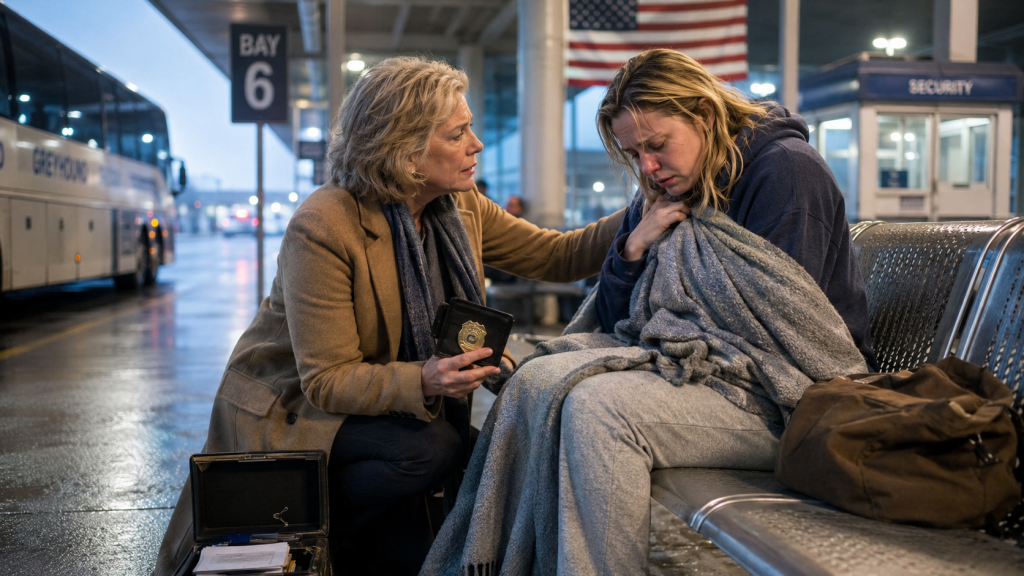
“I never told my arrogant son-in-law that I was a retired federal prosecutor. At 5:00 AM on Thanksgiving Day, he called me and said, “Come pick up your daughter at the bus terminal.” When I arrived, I found her shivering on a bench in the cold, shaking, weak, and barely able to speak.

“Mom,” she whispered, “they hurt me… so his mistress could take my place at the table.” While they carved their Thanksgiving turkey and laughed with their guests, I opened the old lockbox, took out my badge, and made the call that would bring their whole dining room to a halt.
The clock on my nightstand read 5:02 AM.
Thanksgiving morning.
My kitchen still smelled like pumpkin pie, black coffee, and the cinnamon I had spilled beside the stove. Ice tapped against the windows, and the small American flag on my porch snapped in the wind.
Then my phone rang.
Marcus.
My son-in-law never called unless he wanted something moved, signed, covered up, or forgiven. At thirty-two and newly promoted, he had started treating every conversation like a meeting he controlled.
His mother, Sylvia, was worse. She could turn a compliment into an obligation and silence into a verdict.
To them, I was just Eleanor—a quiet widow with a ten-year-old SUV, grocery coupons in her purse, and birthday cards with cash tucked inside.
They had never once asked what I had retired from.
I answered.
“Come pick up your garbage,” Marcus said.
My hand tightened around the edge of the counter. “Where is Chloe?”
“Downtown bus terminal. Your daughter decided last night was the perfect time for a hysterical breakdown. I’m hosting my CEO for Thanksgiving dinner, and I don’t have time for trash inside my house.”
Chloe was twenty-eight, an engineer, and one of the most composed people I knew. She made spreadsheets for camping trips and labeled moving boxes by room and weight. Once, during freezing rain, she changed a tire with scraped knuckles and never raised her voice.
Chloe did not have hysterical breakdowns.
Sylvia laughed somewhere behind him. “Tell her to take that pathetic girl back where she came from. And tell her I expect payment for my five-thousand-dollar Persian rug. That brat destroyed it.”
“Go get her, Eleanor,” Marcus said. “The caterers will be here in four hours. Do not bring her back.”
The call ended.
For three years, I had swallowed things I should have challenged sooner. I wanted to call him back and tell him that the harmless old woman he dismissed had spent years standing in federal courtrooms across from men who had powerful lawyers and even more powerful friends.
I didn’t.
Anger mattered later. Facts mattered now.
I grabbed my coat and keys, then opened the hallway closet and took down a small lockbox I had not touched in years.
At 5:19 AM, my SUV backed out of the driveway.
By 5:43, I was at the terminal. Fluorescent lights buzzed over cracked tile inside, while the automatic doors pushed out brief waves of warm air that disappeared into the freezing morning. A security guard sat behind scratched glass beside a paper coffee cup and the Thanksgiving schedule.
I found Chloe outside Bay 6.
She was curled on a metal bench beneath a broken streetlight with no coat and only one shoe. Her fingers had turned blue from the cold. Her entire body shook so hard that, at first, she couldn’t say my name.
“Mom.”
I dropped to my knees. “Baby, look at me. Stay with me.”
Her one open eye shifted toward me, unfocused. Her hand found my coat and held on weakly.
“They hurt me,” she whispered. “Marcus… and Sylvia…”
“What happened?”
“They cornered me. He has someone else. Sylvia said I had to leave so his mistress could sit at the table. She said I was embarrassing him.”
The terminal doors opened behind us, releasing another useless breath of warm air.
“Who brought you here?”
“Marcus. Sylvia cleaned everything. They said no one would believe me.” Chloe swallowed painfully. “They said you were only… an old woman.”
Then her eyes rolled back, and her body went limp against me.
At 5:47 AM, I called 911.
“I need Advanced Life Support at the downtown bus terminal, Bay 6,” I said. “Adult female, unconscious after prolonged exposure to freezing temperatures. She may be seriously injured. Send police as well. I need to report a domestic incident.”
The dispatcher asked if I was safe.
“Not relevant yet,” I said.
The security guard stood behind the glass. A bus driver froze with his coffee halfway to his mouth.
I opened the lockbox.
Then I removed the badge Marcus had never known existed.
“My name is Eleanor,” I told the dispatcher. “I’m a retired federal prosecutor.”
The change in her voice was immediate.
Then I gave her the instruction Marcus had never imagined an “old woman” would know to give.
PART 2
“Please put this in the call notes exactly,” I said. “The victim reported a domestic incident, she says the people involved cleaned the residence afterward, and there may be evidence at risk. I want responding officers to know that before anyone contacts that house.”
The dispatcher repeated it back to me.
That mattered. Not because my old badge gave me authority—it didn’t—but because I knew how quickly a frightened victim’s first words could disappear beneath somebody else’s cleaner, calmer version of events.
I gave her Marcus’s address.
Then I closed the lockbox and put the badge away.
The security guard came outside with a blanket while I kept one hand against Chloe’s shoulder. Her breathing was shallow, but I could feel it. I stayed beside her until the approaching emergency lights reflected across the terminal windows.
Every instinct in me wanted to drive straight to Marcus’s house. I could picture the dining room he had been so desperate to protect: Sylvia arranging everything, Marcus rehearsing his version of the night, guests arriving later to a table where my daughter’s place had been deliberately given away.
But Chloe needed her mother more than Marcus needed an opponent.
So when the responders took over, I made my first decision.
I would go with my daughter.
The police could go to the house.
And for the first time that morning, Marcus would have to explain himself without me standing there for him to blame.
Then the dispatcher told me officers had been notified of the evidence concern—and that changed what Marcus’s Thanksgiving morning was about to become.
The first thing Eleanor did after emergency responders arrived was choose her daughter instead of chasing the people who had hurt her. She stayed beside Chloe as the freezing morning gave way to flashing lights, while the people preparing a holiday dinner were about to face questions they never expected.
For years, Eleanor had lived quietly. She kept her life simple, drove an older SUV, carried grocery coupons in her purse, and sent birthday cards with a little extra money inside. To Marcus and Sylvia, that was all they saw. They saw a widow who kept her head down. They saw someone they could dismiss.
They never asked what Eleanor had done before retirement.
They never wondered why she stayed calm when conversations became cruel.
They never considered that the quiet woman they underestimated had spent years in federal courtrooms, challenging people who believed money, influence, or confidence could protect them from consequences.
Eleanor never needed to announce that part of herself. She had built a life after leaving that world, and she preferred being known as a mother and grandmother rather than by a title from her past.
But Thanksgiving morning forced her to open a door she had kept closed.
The call came just after 5:00 AM.
Marcus was on the other end of the phone, and his voice carried the same arrogance Eleanor had heard growing over the years. He did not call to ask if she was awake. He did not call because he was worried about Chloe.
He called because he wanted Eleanor to clean up a problem he had created.
He told her to pick up her daughter from the bus terminal.
The words were cold. The meaning behind them was colder.
Chloe, his wife, was no stranger to pressure. She was an engineer who planned carefully, solved problems, and rarely showed panic. She was the person who organized trips down to the smallest detail. She was the person who handled difficult situations without needing anyone to rescue her.
That was why Eleanor immediately knew something was wrong.
Chloe did not simply have a breakdown.
Something had happened.
Marcus tried to make the situation sound like Chloe was the problem. He described her as inconvenient. He complained about his Thanksgiving plans. He talked about guests arriving and a dinner that mattered more to him than his own wife.
Behind him, Sylvia added her own cruelty.
She complained about a damaged rug. She talked about Chloe as if she were an object that could be removed from a room. She spoke about a replacement at the holiday table, as though a person who had shared years of life with Marcus could simply be erased.
Eleanor listened.
She did not argue.
She did not reveal who she used to be.
Because anger could wait.
Her daughter could not.
Before leaving the house, Eleanor opened an old lockbox she had not touched in years. Inside was a reminder of a life she had put behind her. It was not a weapon. It was not a way to intimidate anyone.
It was a reminder that facts mattered.
It was a reminder that people who tried to control the story were not always the people who controlled the truth.
When Eleanor reached the bus terminal, she found Chloe outside near Bay 6.
The scene was nothing like Marcus had described.
There was no dramatic argument. No angry outburst. No person causing trouble.
There was a young woman sitting alone in the cold, barely able to hold herself together.
Chloe had no coat. She had only one shoe. Her hands were cold, and her body shook as Eleanor rushed toward her.
The moment Chloe recognized her mother, she finally stopped trying to pretend she was fine.
She whispered that Marcus and Sylvia had hurt her.
She explained that they had confronted her. She explained that Marcus had someone else in his life. She explained that Sylvia wanted her gone before the Thanksgiving gathering because another woman was supposed to take her place.
The sentence hurt Eleanor more than the cold air around them.
A family table had been treated like a stage.
And Chloe had been treated like something disposable.
Eleanor held her daughter while calling for help.
She did not drive straight to Marcus’s house.
She did not burst into the Thanksgiving celebration.
She did not let rage decide her next move.
That was the difference between revenge and justice.
She understood something Marcus did not.
The strongest person in the room is not always the loudest one.
Sometimes it is the person who knows exactly when to stop speaking and start documenting.
When Eleanor spoke with the dispatcher, she carefully explained what Chloe had reported. She asked that the information be recorded because she understood how quickly stories could change once people realized their actions might have consequences.
She provided the address.
She explained that evidence could be at risk because Chloe said the home had been cleaned afterward.
Then she put the lockbox away.
The badge was not a magic solution. It did not make Eleanor more important than anyone else. It did not replace the need for facts, medical care, or proper investigation.
But it represented experience.
It represented years of seeing how people behaved when they believed nobody would question them.
Marcus had mistaken Eleanor’s quiet life for weakness.
He had mistaken patience for permission.
He had mistaken kindness for a lack of strength.
Those mistakes were about to cost him.
While Chloe was taken for medical attention, Eleanor stayed focused on the person who mattered most. The Thanksgiving dinner could wait. The excuses could wait. Marcus’s carefully planned holiday could wait.
His wife needed her mother.
That was the choice Eleanor made first.
And it was the choice Marcus never expected.
Inside his home, everything had likely been arranged around the image he wanted people to see. A perfect holiday. A successful man. A beautiful dinner. A story where he was the victim of an unreasonable wife.
But stories built on control have a weakness.
They collapse when someone else finally speaks.
Marcus thought Eleanor was harmless because she did not fight him in the past.
He never understood that she was collecting moments.
The comments.
The dismissive attitudes.
The times Chloe looked uncomfortable but tried to keep peace.
The ways people reveal themselves when they believe nobody is paying attention.
Those details matter.
Not because they create drama.
Because patterns tell the truth.
The most painful part for Eleanor was not that Marcus underestimated her.
It was that he underestimated Chloe.
He believed Chloe would stay silent.
He believed shame would keep her from speaking.
He believed family reputation mattered more than what happened inside a home.
But Chloe had already taken the hardest step.
She told the truth.
For many people, that first moment is the hardest one. Not because they do not know what happened, but because they know what comes after admitting it.
Questions.
Doubt.
People choosing sides.
A family forced to look at something they would rather ignore.
Eleanor knew that reality well.
That was why she did not promise Chloe a perfect ending.
She promised something simpler.
She promised she would not leave.
The morning began with Marcus believing he could remove Chloe from his life before his guests arrived.
Instead, his actions created the one thing he feared most.
A record of what happened.
A witness who understood the importance of timing.
And a mother who had spent years learning that the truth does not need to shout to be powerful.
The holiday table Marcus wanted to protect was no longer the center of the story.
The center was the daughter sitting in the cold.
The mother who came when she was called.
And the moment when a family secret stopped belonging only to the people who created it.
Eleanor had spent years letting others underestimate her because she believed her actions mattered more than her reputation.
That morning, she learned something different.
Sometimes people need to know the strength standing quietly beside them.
Not for pride.
Not for intimidation.
But because there are moments when being underestimated becomes the reason the truth finally gets heard.
THE END STORIES! THANK YOU FOR READING GOOD LUCK !❤️
Related Posts